JEEnify Logo
JEEnify
All formula sheets

The p-Block Elements Formula Sheet — JEE Main Chemistry

Every key The p-Block Elements formula, definition and theorem for JEE Main Chemistry in one place — with common examiner traps and worked examples. Free to read; blurt from memory, then check your gaps.

Syllabus — topics coveredNTA · 6 sub-topics

  • Group-13 to Group-18 Elements
  • General introduction
  • Electronic configuration
  • General trends in physical and chemical properties
  • Trends across periods and down groups
  • Unique behaviour of first element in each group

p-Block: General Introduction & Trends

The p-block (Groups 13–18): Elements whose last electron enters a p orbital — valence configuration (He is ). The block uniquely contains ; non-metallic character decreases down each group.
GroupValence config2nd-period elementGroup oxid. state
13B+3
14C+4
15N+5
16O+6
17F+7
18Ne+8 (—)
Gr 13 / 14 / 15
Gr 16 / 17 / 18
★ Remember · Inert pair effect
Down a group the pair becomes reluctant to bond (poor d/f shielding), so the (group ) oxidation state grows more stable: , , .
🎯 Exam · Anomalous first member
B, C, N, O, F differ from heavier members: , high electronegativity, (max covalence 4), and strong multiple bonding (e.g. , ) that the heavier elements lack.
Oxide & character trends
  • Across a period: metallic , non-metallic ; oxides go .
  • Down a group: metallic character , so oxides become more basic.
  • Non-metals form acidic (or neutral) oxides; metals form basic oxides.
🚫 Examiner Trap · Examiner traps
(1) : down a group the LOWER (group) oxidation state grows more stable (Tl, P, B). (2) The 1st member (B, C, N, O, F) is anomalous — small, -orbital (max covalence 4), strong bonding. (3) Oxides across a period: basic amphoteric acidic. (4) The p-block uniquely has metals, metalloids AND non-metals.

Group 13 — Boron Family

Trends ()
  • B is a (hard, high m.p.); Al, Ga, In, Tl are metals.
  • Atomic radius: Ga Al pm — poor -electron shielding.
  • : stability rises AlTl, so is stable and is strongly oxidising.
  • Trihalides are ().
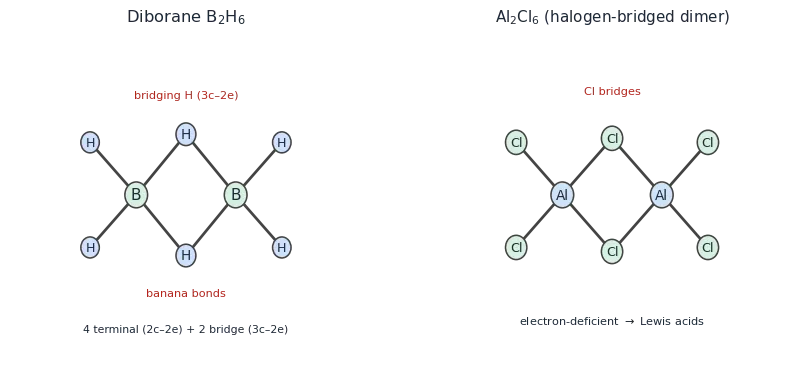
Diborane B2H6 with four terminal two-centre-two-electron B-H bonds and two bridging three-centre-two-electron banana bonds, beside the chlorine-bridged Al2Cl6 dimer
Diborane's two bridging H use 3c–2e 'banana' bonds; bridges similarly.
Key boron compounds: (alkaline solution; borax-bead test). — a weak (), layered, H-bonded. — catches fire in air, hydrolyses to .
🎯 Exam · Aluminium is amphoteric
Al dissolves in both acid and alkali liberating : and . Oxides go (acidic) (amphoteric) (basic).
🚫 Examiner Trap · Examiner traps
(1) B is a ; Al–Tl are metals. (2) Ga Al pm — poor d-shielding anomaly. (3) Diborane has (banana) bonds — B is electron-deficient. (4) is a weak (accepts OH), not a proton donor; Al and its oxide are amphoteric.

Group 14 — Carbon Family

Trends ()
  • C (non-metal), Si (non-metal), Ge (metalloid), Sn & Pb (metals).
  • (self-linking) falls C Si Ge Sn; Pb shows none.
  • Only carbon forms strong multiple bonds (C=C, C=O, C≡N).
  • Oxidation and ; stability rises GePb (inert pair), so is stable, oxidising.
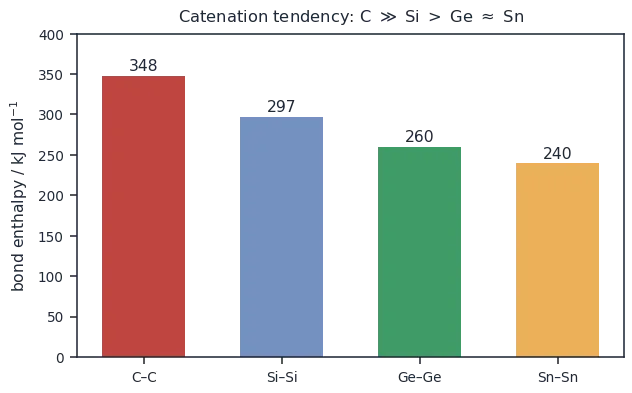
Bar chart of E-E bond enthalpies showing C-C 348 greater than Si-Si 297 greater than Ge-Ge 260 and Sn-Sn 240, beside Group 14 highlights on allotropes and oxides
Falling E–E bond enthalpy explains the catenation order.
Oxides & allotropes: : CO neutral, & acidic, / amphoteric. is a discrete linear molecule, but is a giant covalent network. : diamond (, 3-D), graphite ( layers, conducting), fullerene ().
⚠️ Watch out · Why resists hydrolysis but doesn't
hydrolyses () because Si can use vacant orbitals to accept the water lone pair; carbon has , so is inert to water.
🚫 Examiner Trap · Examiner traps
(1) Catenation falls C Si Ge Sn (Pb none) — tracks E–E bond enthalpy. (2) Only C forms strong bonds (CC, CO). (3) CC resists hydrolysis (C has no d-orbital); SiC hydrolyses (Si uses ). (4) stability rises GePb (inert pair) P is oxidising.

Group 15 — Nitrogen Family

Trends ()
  • Half-filled gives extra stability and high ionization enthalpy.
  • Oxidation states ; tendency falls and (inert pair, Bi) rises down the group.
  • : stability & basicity fall ; reducing power rises the opposite way.
  • Anomalous N: triple bond, no d-orbital, max covalence 4 (no ).
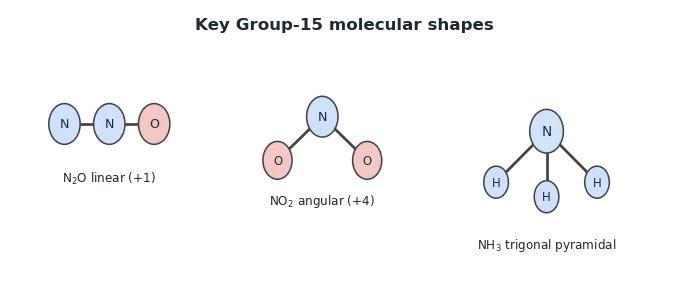
Structures of N2O linear, NO2 angular, the trigonal pyramidal ammonia molecule, and a ladder of nitrogen oxidation states from minus 3 to plus 5
Nitrogen's oxidation states to and key molecular shapes.
Ammonia & nitric acid: — trigonal pyramidal, made by Haber's process (, Fe, ~700 K, 200 atm); a Lewis base forming complexes (deep-blue ). — Ostwald process (); a strong oxidiser that passivates Al, Cr, Fe.
🎯 Exam · Phosphorus essentials
Allotropes: (reactive, tetrahedral , glows), (polymeric, stable), . Halides: pyramidal (); trigonal bipyramidal (solid is ionic ). Oxoacid basicity = number of P–OH bonds ( mono, di, tri).
🚫 Examiner Trap · Examiner traps
(1) Hydride stability/basicity fall NH PH AsH SbH Bi; reducing power rises the OPPOSITE way. (2) N has no d-orbital max covalence 4 (no NC); it forms the NN triple bond. (3) PC solid is ionic [PC. (4) Oxoacid basicity number of bonds ( mono, di, tri).

Group 16 — Oxygen Family

Trends (, chalcogens)
  • O & S non-metals, Se & Te metalloids, Po metal; oxidation .
  • : acidity rises ; thermal stability falls down the group.
  • Anomalous O: small size & H-bonding make a liquid (vs gaseous ).
  • is paramagnetic; (ozone) is bent and a powerful oxidiser.
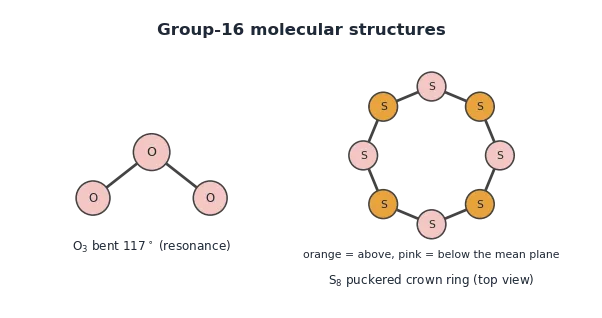
The bent O_3 molecule and the puckered S_8 ring.
The bent molecule and the puckered ring.
Sulphur & its oxides: : rhombic () and monoclinic () sulphur, both built of puckered crown rings. is angular and a (decolourises acidified ). Oxides classify as acidic (), basic (), amphoteric () or neutral (CO, NO).
★ Remember · — Contact process
; ; (oleum); dilute to . It is a strong acid, agent () and (hot, conc.) an oxidiser.
🚫 Examiner Trap · Examiner traps
(1) Hydride rises O S Se Te, but thermal falls. (2) O is a liquid (H-bonding) while S is a gas — O's anomaly. (3) S is a REDUCING agent (decolourises KMn); is an oxidiser. (4) Contact process uses ; conc. is a dehydrating agent.

Group 17 — Halogens

Trends ()
  • Most reactive non-metals; oxidising power .
  • Oxidation (only state for F); Cl, Br, I also show .
  • Anomalous F: small, no d-orbitals, low F–F bond energy; of Cl is more negative than F.
  • A halogen oxidises the halide of a higher member ().
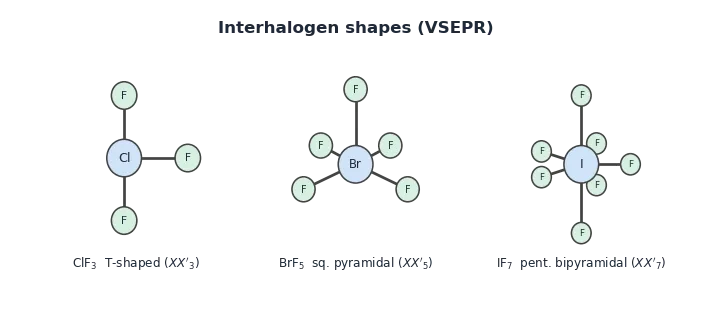
Interhalogen shapes: ClF_3 (T-shaped), BrF_5 (square pyramidal), IF_7 (pentagonal bipyramidal).
Interhalogen shapes: (T-shaped), (square pyramidal), (pentagonal bipyramidal).
Hydrogen halides & chlorine: rises (bond strength falls the other way); HF is a liquid (H-bonding). : ; with dry slaked lime gives .
🎯 Exam · Interhalogens & oxoacids
are more reactive than the halogens: bent T-shape (), square pyramidal (), pentagonal bipyramidal (). Oxoacid strength rises with O atoms: .
🚫 Examiner Trap · Examiner traps
(1) Oxidising power F Cl Br ; a halogen displaces the halide below it. (2) HX acidity rises HF HCl HBr HI (bond strength falls). (3) F shows (no d-orbital); of Cl is more negative than F. (4) Oxoacid strength rises with O count: HOCl HClO HClO HCl.

Group 18 — Noble Gases

Trends ()
  • Completely filled valence shells very high IE, positive , chemical inertness.
  • Monatomic gases; only weak dispersion forces give boiling points (He = 4.2 K, lowest of all).
  • Atomic radius and reactivity increase down the group.
  • Only the heavier, larger Xe (and some Kr) form compounds — with the most electronegative F and O.
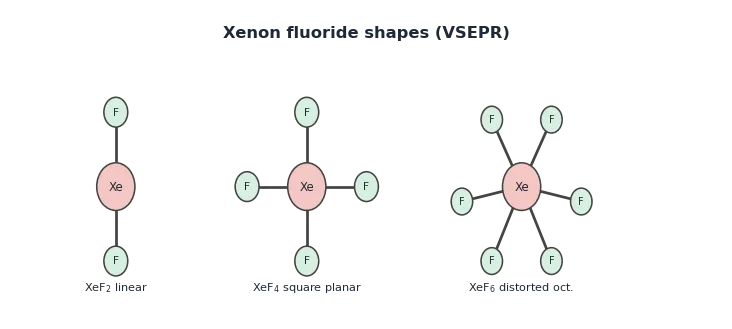
Xenon fluorides by VSEPR: XeF2 linear, XeF4 square planar, XeF6 distorted octahedral, with hydrolysis to XeO3 and uses of helium, neon and argon
Xenon fluoride shapes (VSEPR), hydrolysis and noble-gas uses.
Xenon compounds: First made after Bartlett (1962) prepared . linear, square planar, distorted octahedral. Hydrolysis: ( pyramidal); partial hydrolysis gives (square pyramidal).
💡 Tip · Uses
— weather balloons, cryogenics (liquid He cools NMR/MRI magnets), a breathing-gas diluent for divers. — discharge tubes & advertising signs. — inert atmosphere for welding and air-sensitive reactions.
🚫 Examiner Trap · Examiner traps
(1) Filled shell very high IE, , inertness; He has the lowest boiling point of all (4.2 K). (2) Only (and some Kr) form compounds, with F/O (Bartlett 1962). (3) Shapes: Xe linear, Xe square planar, Xe distorted octahedral. (4) Hydrolysis: XeFO Xe (pyramidal) HF.

More JEE Main Chemistry formula sheets

Frequently Asked Questions

What are the most important The p-Block Elements formulas for JEE Main?

This The p-Block Elements formula sheet covers all the high-yield Chemistry formulas, definitions and theorems you need for JEE Main, across Group-13 to Group-18 Elements, General introduction, Electronic configuration, General trends in physical and chemical properties, Trends across periods and down groups — each shown with the key result and, where useful, a worked example.

Is this The p-Block Elements formula sheet free?

Yes — the full chapter formula sheet is free to read online, no login or payment required.

How should I revise The p-Block Elements formulas?

Blurt the The p-Block Elements formulas from memory, then check against this sheet to find your gaps — and practise a few previous-year questions on the chapter to make sure you can apply them under time pressure.

Also useful: all formula sheets · JEE Main previous-year papers · most important chapters.