
JEEnify Logo
JEEnify
All formula sheets

Three Dimensional Geometry Formula Sheet — JEE Main Mathematics

Every key Three Dimensional Geometry formula, definition and theorem for JEE Main Mathematics in one place — with common examiner traps and worked examples. Free to read; blurt from memory, then check your gaps.

Syllabus — topics coveredNTA · 10 sub-topics

  • Coordinates of a point in space
  • Distance between two points
  • Section formula
  • Direction ratios and direction cosines
  • Angle between two intersecting lines
  • Skew lines
  • Shortest distance between two lines
  • Equation of a line and a plane in different forms
  • Intersection of a line and a plane
  • Coplanarity of two lines

Coordinates, Distance & Direction Cosines/Ratios
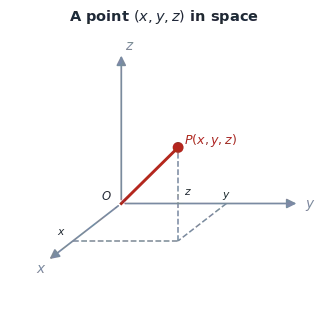
Direction cosines & direction ratios: The l,m,n of a line are the cosines of the angles it makes with the x,y,z axes, and always satisfy . a,b,c are any numbers proportional to l,m,n — a direction vector .
A point in 3D space, the distance and section formulas in space, and the definitions and conversion between direction cosines and direction ratios
Points in space, distance/section, and direction cosines/ratios.
Formulas in space
  • Distance: .
  • Section (m:n): .
  • DRs of the line AB: .
  • DR DC: divide each by .
★ Remember · l² + m² + n² = 1, but a² + b² + c² ≠ 1
Direction are normalised: . Direction are not — they only fix the direction up to a scalar, so and describe the same line.
🎯 Exam · Two directions from one ratio set
Each direction ratio set gives opposite sets of direction cosines (e.g. ). For a line either sign is fine; for a directed segment, choose the sign that matches the orientation.
⚠️ Watch out · Sum of direction cosines isn't 1
It is the sum of the that is (), not . A common error is to set — that has no special meaning.
🚫 Examiner Trap · Examiner traps
(1) Direction COSINES always satisfy ; direction RATIOS are only PROPORTIONAL (a,b,c) — don't treat DRs as DCs without normalising. (2) Convert via etc. (3) A direction has TWO sets of DCs () — opposite senses. (4) DRs of the join of two points are , not their sum.

The Straight Line in Space

Equation of a line: A line is a point on it plus a direction. : ( a point, the direction). : , where (a,b,c) are direction ratios.
★ Remember · A general point on the line
From the Cartesian form, set each ratio equal to : every point on the line is . This single parametrisation solves almost every intersection/foot/image problem.
Building the equation
  • Through two points A,B: direction , so .
  • Through a point with given DRs: substitute straight into the Cartesian form.
  • Convert vector Cartesian by reading off the point and the direction components.
  • If a DR is (say ): that coordinate is constant, .
🎯 Exam · Vector ⇔ Cartesian
is exactly . The point gives the constants, the direction gives the denominators.
⚠️ Watch out · Denominators are direction ratios, not points
In , the numbers a,b,c are the — not coordinates of a point. Mixing them up (e.g. putting where a belongs) is a frequent slip.
🚫 Examiner Trap · Examiner traps
(1) In , the denominators are DIRECTION RATIOS and the numerators use a POINT on the line — don't mix them up. (2) A general point on the line is — the key to intersection problems. (3) Through two points A,B: direction . (4) If a DR is (say ), that coordinate is FIXED: write separately.

Angle Between Lines, Skew Lines & Shortest Distance
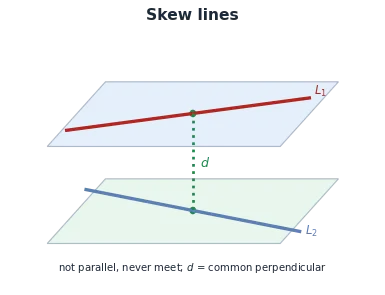
The angle between two lines, a sketch of skew lines, and the shortest-distance formulas for skew and parallel lines with the coplanarity condition
The angle, skew lines, and the shortest distance.
★ Remember · Angle between two lines
. Perpendicular ; parallel .
🎯 Exam · Shortest distance between skew lines
For and : . For lines use .
Skew vs intersecting
  • lines are not parallel and do not meet.
  • Lines are coplanar (intersect or are parallel) .
  • (scalar triple product).
  • Cartesian coplanarity: a determinant .
⚠️ Watch out · Use the cross product, not the difference of directions
The shortest distance involves (perpendicular to both lines), not . And the numerator is a — keep the dot and cross in the right places.
🚫 Examiner Trap · Examiner traps
(1) The angle between two lines uses with their direction ratios; perpendicular (NOT the cross product). (2) Skew lines are NOT parallel and do NOT intersect — shortest distance . (3) For PARALLEL lines use (different formula). (4) the lines are coplanar (intersect).

The Plane — Equations & Forms

The plane: A plane is fixed by a point on it and a direction . Its general equation is , and the coefficients of x,y,z are exactly the components of the normal vector.
Forms of a plane
FormEquation
General (normal )
Point-normal
Vector ( unit normal, p = distance from O)
Normal form ( = DCs of normal)
Intercept
The forms
  • General: ; normal .
  • Point-normal: .
  • Vector / normal: , i.e. ( distance from origin).
  • Intercept: .
★ Remember · The coefficients are the normal
In , the vector (a,b,c) is to the plane. This single fact powers angle, distance, parallel and perpendicular conditions — read off the normal first.
🎯 Exam · Plane through three points
Take two edge vectors from one vertex, their cross product is the normal ; then use point-normal form. Equivalently, set the determinant of the edge vectors (to the general point) to .
⚠️ Watch out · Normalise before reading p
In , the normal must be a vector for p to be the true distance from the origin. If you have a general , divide through by first.
🚫 Examiner Trap · Examiner traps
(1) In the NORMAL is (a,b,c) — a plane is fixed by a point AND a normal. (2) needs a UNIT normal , and then p is the distance from the origin. (3) Intercept form gives the axis intercepts directly. (4) Plane through 3 points: set the determinant of the edge vectors to .

Planes — Angles, Distances & Family

★ Remember · Angle & distance with planes
Angle between planes angle between normals: . Distance of a point from a plane: .
Parallel & perpendicular planes
  • Parallel: (normals proportional).
  • Perpendicular: .
  • Distance between parallel planes: .
  • A plane parallel to is .
🎯 Exam · Family of planes
Every plane through the line of intersection of and is . Fix from one extra condition (a point it passes through, or a required angle/parallelism).
⚠️ Watch out · Keep the same coefficients for parallel-plane distance
The formula needs the two planes written with a,b,c. If they aren't, scale one equation first (e.g. vs rewrite as ).
🚫 Examiner Trap · Examiner traps
(1) Angle between two planes angle between their NORMALS; parallel normals proportional, perpendicular . (2) Distance of a point: (keep the modulus). (3) Between PARALLEL planes the numerator is — but the a,b,c must be IDENTICAL first (scale one plane to match). (4) Family through the intersection of is .

Line & Plane Together

★ Remember · Line-plane angle uses SINE
, where is the line's direction and the plane's normal. It is the because the line tilts from the plane but from the normal.
Line-plane relationships
  • Parallel to the plane: .
  • Lies in the plane: AND a point of the line satisfies the plane.
  • Perpendicular to the plane: .
  • Intersection: substitute the line's general point into the plane and solve for .
🎯 Exam · Foot of perpendicular & image
from a point P to a plane: move from P along the normal until you reach the plane. (reflection): go twice as far, . For a line, drop the perpendicular using the line's direction as the constraint.
⚠️ Watch out · Don't use cosine for the line-plane angle
gives the angle with the — to get the angle with the plane you must take of it (or subtract from ). Writing here is the classic mistake.
🚫 Examiner Trap · Examiner traps
(1) Line–plane angle uses (SINE, not cosine — the line tilts from the plane, from the normal). (2) Line PARALLEL to plane ; line IN the plane needs that AND a point on the plane. (3) Line plane . (4) Intersection: substitute the line's general point into the plane and solve for .

Coplanarity & Master Formula Summary

★ Remember · Coplanarity of two lines
Two lines are coplanar (a common plane exists) iff — the scalar triple product of the join and the two directions vanishes (equivalently the determinant is ).
Angle formulas at a glance
  • Line ↔ line: .
  • Plane ↔ plane: .
  • Line ↔ plane: (note the sine).
  • Point ↔ plane: .
🎯 Exam · Lines use directions, planes use normals
Every formula here is a dot product of the two 'characteristic vectors': for lines and for planes. The only oddity is the line-plane angle, which uses because one object is given by its direction and the other by its normal.
★ Remember · Reduce everything to point + direction/normal
Almost every 3D problem starts the same way: extract a and a (line) or (plane), then apply the matching dot/cross-product formula. Set the problem up in this language and the rest is arithmetic.
🚫 Examiner Trap · Examiner traps
(1) Two lines are coplanar IFF the scalar triple product (equivalently shortest distance ). (2) Coplanar lines either INTERSECT or are PARALLEL — then a common plane exists. (3) Cartesian test: the determinant of . (4) Use for line–line/plane–plane angles but for line–plane — the most-confused pairing.

More JEE Main Mathematics formula sheets

Frequently Asked Questions

What are the most important Three Dimensional Geometry formulas for JEE Main?

This Three Dimensional Geometry formula sheet covers all the high-yield Mathematics formulas, definitions and theorems you need for JEE Main, across Coordinates of a point in space, Distance between two points, Section formula, Direction ratios and direction cosines, Angle between two intersecting lines — each shown with the key result and, where useful, a worked example.

Is this Three Dimensional Geometry formula sheet free?

Yes — the full chapter formula sheet is free to read online, no login or payment required.

How should I revise Three Dimensional Geometry formulas?

Blurt the Three Dimensional Geometry formulas from memory, then check against this sheet to find your gaps — and practise a few previous-year questions on the chapter to make sure you can apply them under time pressure.

Also useful: all formula sheets · JEE Main previous-year papers · most important chapters.