JEEnify Logo
JEEnify
All formula sheets

Vector Algebra Formula Sheet — JEE Main Mathematics

Every key Vector Algebra formula, definition and theorem for JEE Main Mathematics in one place — with common examiner traps and worked examples. Free to read; blurt from memory, then check your gaps.

Syllabus — topics coveredNTA · 5 sub-topics

  • Vectors and scalars
  • Addition of vectors
  • Components of a vector in two dimensions and three dimensional space
  • Scalar and vector products
  • Scalar and vector triple product

Vectors — Types, Components & Algebra
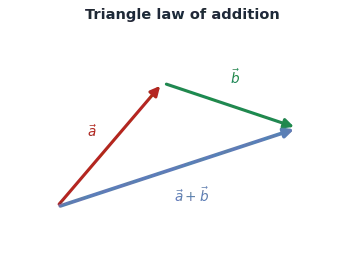
Vector: A quantity with both magnitude and direction, written . Its magnitude is and its unit vector is (same direction, length ).
Triangle-law vector addition, the component form and magnitude, the unit vector, and a table of the types of vectors
Adding vectors, components/magnitude, and the types of vectors.
Types of vectors
  • (magnitude ); (magnitude ).
  • : same magnitude AND direction.
  • (parallel): ; : lie in one plane.
  • from a fixed origin O.
★ Remember · Addition: triangle & parallelogram laws
Place vectors head-to-tail and join start to finish (triangle law), or as adjacent sides of a parallelogram. Addition is () and ; .
🎯 Exam · Magnitude of a sum
. So exactly when (the diagonals of a rectangle are equal).
⚠️ Watch out · Magnitude isn't additive
in general — equality holds only when point the . By the triangle inequality, .
🚫 Examiner Trap · Examiner traps
(1) Magnitude of is — components are SIGNED, square them. (2) A unit vector is (only for ). (3) The zero vector has magnitude and NO definite direction. (4) Collinear ; coplanar means lying in one plane — don't confuse the two.

Position Vectors, Section Formula & Collinearity

★ Remember · Section formula
The point dividing AB in ratio m:n internally has position vector (midpoint ); externally . The centroid of a triangle is .
Collinearity & coplanarity
  • Two vectors collinear .
  • Points A,B,C collinear (i.e. ).
  • Three vectors coplanar one is a linear combination of the others ().
  • with the four points are coplanar.
🎯 Exam · Vectors give clean geometry proofs
Express each point as a position vector, then 'collinear', 'midpoint', 'parallel' and 'perpendicular' all become simple vector equations. This converts a geometry problem into algebra you can just compute.
⚠️ Watch out · Watch the order in the section formula
The point dividing AB in ratio m:n takes — the endpoint pairs with m. Swapping the weights gives the point that divides it in ratio n:m instead.
🚫 Examiner Trap · Examiner traps
(1) (terminal MINUS initial) — not . (2) Internal section is ; EXTERNAL division uses (sign change). (3) Points A,B,C collinear i.e. . (4) with the points are coplanar.

Dot (Scalar) Product
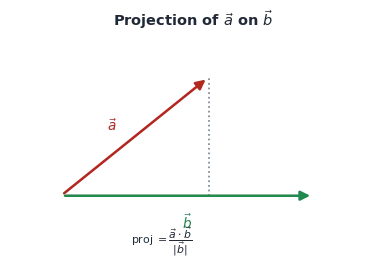
Dot (scalar) product: — a . It is commutative, and exactly when the vectors are (for non-zero vectors).
The dot product definition, projection of one vector onto another, its properties, and its uses (angle, projection, magnitude of sums, work)
The dot product, projection, and what it gives you.
★ Remember · Angle & projection
— the sign of alone tells you acute () vs obtuse (). Scalar projection of on is ; the vector projection is .
Key properties
  • ; , .
  • Distributive: .
  • .
  • Work done by a force: .
🎯 Exam · Perpendicularity is a dot product
To impose , just set — a single linear equation in the components. This is the standard way to find a vector orthogonal to a given one, or to locate a foot of perpendicular.
⚠️ Watch out · The dot product is a number
is a , so expressions like are meaningless (you can't cross a scalar with a vector). Keep track of which products yield scalars and which yield vectors.
🚫 Examiner Trap · Examiner traps
(1) Dot product is a SCALAR; perpendicular (for non-zero vectors). (2) Scalar projection of on is , but the VECTOR projection is — don't mix them. (3) The sign of tells acute () vs obtuse (). (4) (cosine rule).

Cross (Vector) Product

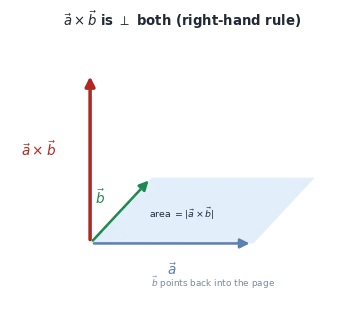
Cross (vector) product: — a perpendicular to both and , with given by the right-hand rule. It is () and is exactly when the vectors are parallel.
The cross product definition with the right-hand rule, its properties, and its uses (component determinant, area, unit normal, moment)
The cross product, the right-hand rule, and what it gives you.
★ Remember · Area from the cross product
is the area of the on , so the triangle area is . A unit vector perpendicular to both is .
Key properties
  • Component form: the determinant of the two component rows.
  • , , (cyclic); .
  • Distributive but commutative or associative.
  • Moment (torque) of a force: .
🎯 Exam · Parallel is a cross product
To impose , set (equivalently, the components are proportional). This is the cross-product counterpart of using the dot product for perpendicularity.
⚠️ Watch out · Order matters — it's anticommutative
, so swapping the factors reverses the direction. When you compute an area you take the magnitude (sign-free), but for a normal direction the order is essential.
🚫 Examiner Trap · Examiner traps
(1) Cross product is a VECTOR and is ANTI-commutative: . (2) PARALLEL (note ); compare with dot for perpendicular. (3) is the area of the PARALLELOGRAM; the triangle is HALF that. (4) Direction by right-hand rule: (cyclic) — reverse the order and the sign flips.

Scalar Triple Product (Box Product)

Scalar triple product: — a equal to the determinant of the components. Its absolute value is the built on .
The scalar triple product as a.(b x c), a parallelepiped, the cyclic/sign properties, and the coplanarity and volume results
The box product, the parallelepiped, and coplanarity.
★ Remember · Coplanarity test
Three vectors are (zero volume). Four points A,B,C,D are coplanar . They are linearly independent iff .
Properties
  • Cyclic: .
  • Swapping any two vectors flips the sign; two equal vectors give .
  • Dot and cross can be interchanged: .
  • Tetrahedron volume .
🎯 Exam · Just evaluate a determinant
In components, is the determinant whose rows are the components of . Volume, coplanarity and linear-independence questions all reduce to evaluating (or zeroing) this one determinant.
⚠️ Watch out · Order changes the sign, not the volume
A swap of two vectors negates , but the volume is — always take the modulus for a volume. A negative triple product just means a left-handed ordering.
🚫 Examiner Trap · Examiner traps
(1) is a SCALAR (the determinant). (2) It is CYCLIC () but swapping two vectors FLIPS the sign; two equal vectors . (3) the three are COPLANAR (zero volume). (4) Volume of parallelepiped ; tetrahedron (don't forget the ).

Vector Triple Product & Identities

Vector triple product: — the rule. The result is a vector lying in the plane of and , and the operation is .
★ Remember · BAC − CAB (and mind the brackets)
, but . They differ, so the brackets cannot be dropped — vector products are not associative.
Useful identities
  • Lagrange: .
  • .
  • .
  • The middle vector of the bracket () gets the 'outer-dot-far' coefficient.
🎯 Exam · Expand, don't try to compute the crosses
For any , immediately apply BACCAB to turn it into dot products and the vectors . Computing the inner cross then the outer cross is far more error-prone.
⚠️ Watch out · The identity depends on the bracketing
Which two vectors get dotted depends on . For it's the -dots; for it's the -dots. Read the brackets carefully before expanding.
🚫 Examiner Trap · Examiner traps
(1) BAC–CAB: — the result lies in the plane of . (2) The vector triple product is NOT associative: in general — mind the brackets. (3) Get the dot-products' grouping right (it's first). (4) Lagrange: .

Applications of Vectors

Geometry & physics
  • : .
  • : triangle ; parallelogram .
  • : parallelepiped ; tetrahedron .
  • ; .
★ Remember · Linear independence
Three vectors are iff — they then span all of 3-space. If the triple product is they are coplanar (dependent), and one is a combination of the others.
🎯 Exam · Translate geometry into dot/cross
Perpendicular ; parallel ; collinear points ; coplanar . Most 'prove that...' problems are one of these set equal to its target.
★ Remember · Scalar vs vector — keep them straight
Dot and scalar-triple products give (angle, work, volume); cross and vector-triple products give (normal, area direction, torque). Matching the right product to what the question wants is half the work.
🚫 Examiner Trap · Examiner traps
(1) Area: triangle , parallelogram (or from diagonals). (2) Work is a SCALAR; torque is a VECTOR — match the product to the quantity. (3) are linearly independent . (4) For geometry proofs, translate perpendicularity/area conditions into dot/cross equations.

More JEE Main Mathematics formula sheets

Frequently Asked Questions

What are the most important Vector Algebra formulas for JEE Main?

This Vector Algebra formula sheet covers all the high-yield Mathematics formulas, definitions and theorems you need for JEE Main, across Vectors and scalars, Addition of vectors, Components of a vector in two dimensions and three dimensional space, Scalar and vector products, Scalar and vector triple product — each shown with the key result and, where useful, a worked example.

Is this Vector Algebra formula sheet free?

Yes — the full chapter formula sheet is free to read online, no login or payment required.

How should I revise Vector Algebra formulas?

Blurt the Vector Algebra formulas from memory, then check against this sheet to find your gaps — and practise a few previous-year questions on the chapter to make sure you can apply them under time pressure.

Also useful: all formula sheets · JEE Main previous-year papers · most important chapters.