
Back to JEE Main PYQs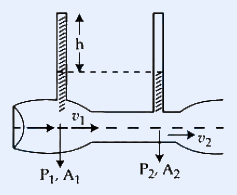

JEE Main 2024 April 04, Shift 1 Question Paper with Solutions
All 88 questions from the JEE Main 2024 (April 04, Shift 1) shift — Physics (30), Chemistry (28) and Mathematics (30) — each with the correct answer (answer key) and a step-by-step solution. Read it free online, or attempt the full paper as a timed mock test.
Physics30 questions
Q1Single correctRay Optics and Optical Instruments
In an experiment to measure focal length (f) of convex lens, the least counts of the measuring scales for the position of object (u) and for the position of image (v) are and , respectively. The error in the measurement of the focal length of the convex lens will be :
(1)
(2)
(3)
(4)
SolutionAnswer: Option 3
Approach:
Differentiate the thin lens equation to propagate least-count errors in and into .
Step 1:Differentiate the lens equation.
Step 2:Take magnitudes of each term so maximum error adds.
Step 3:Multiply through by to isolate .
Final answer:
Q2Single correctWaves
The equation of stationary wave is : . Which of the following is NOT correct :
(1)
(2)
(3)
(4)
SolutionAnswer: Option 1The dimensions of is [T]
Approach:
Use the requirement that arguments of sine and cosine are dimensionless to fix the dimensions of each symbol, then test each option.
Step 1:From the cosine argument, x and share dimension length.
Step 2:From the sine argument, is dimensionless, so n has dimension of velocity.
Step 3:Evaluate .
Final answer: The dimensions of is [T]
Q3Single correctMotion in a Straight Line
A body travels 102.5 m in second and 115.0 m in second. The acceleration is :
(1)
(2)
(3)
(4)
SolutionAnswer: Option 16.25 m/
Approach:
Apply the displacement-in-nth-second formula at the two given instants and subtract.
Step 1:Write both equations.
Step 2:Equation for th second.
Step 3:Subtract to eliminate and .
Final answer: 6.25 m/
Q4Single correctMotion in a Plane
The co-ordinates of a particle moving in plane are given by : , . The motion of the particle is :
(1)
(2)
(3)
(4)
SolutionAnswer: Option 1uniformly accelerated having motion along a parabolic path.
Approach:
Differentiate the coordinates to find velocity and acceleration, then eliminate to identify the path.
Step 1:Compute velocities.
Step 2:Compute accelerations.
Step 3:Eliminate to get the path.
Final answer: uniformly accelerated having motion along a parabolic path.
Q5Single correctLaws of Motion
A wooden block, initially at rest on the ground, is pushed by a force which increases linearly with time . Which of the following curve best describes acceleration of the block with time:
(1)
(2)
(3)
(4)
SolutionAnswer: Option 4
Approach:
Account for static friction: until the applied force exceeds limiting friction the block stays at rest (zero acceleration), after which acceleration rises linearly.
Step 1:While , the block does not move.
Step 2:Once exceeds limiting friction, net force grows linearly with time.
Step 3:Combine the two regimes.
Q6Single correctWork, Energy and Power
If a rubber ball falls from a height and rebounds upto the height of . The percentage loss of total energy of the initial system as well as velocity ball before it strikes the ground, respectively, are :
(1)
(2)
(3)
(4)
SolutionAnswer: Option 1
Approach:
Energy loss equals the fractional drop in rebound height; impact speed comes from free fall through height .
Step 1:Initial energy is ; energy after rebound is .
Step 2:Express the loss as a percentage.
Step 3:Compute the speed just before impact from .
Final answer:
Q7Single correctGravitation
A metal wire of uniform mass density having length and mass is bent to form a semicircular arc and a particle of mass is placed at the centre of the arc. The gravitational force on the particle by the wire is :
(1)
(2)
(3)
(4)
SolutionAnswer: Option 4
Approach:
Integrate the gravitational pull of mass elements of the semicircular arc on the central particle; only the component along the symmetry axis survives.
Step 1:Determine the radius from the arc length.
Step 2:The resultant force on the particle from a semicircular ring of mass M is .
Step 3:Substitute .
Final answer:
Q8Single correctMechanical Properties of Fluids
Given below are two statements: Statement I : When speed of liquid is zero everywhere, pressure difference at any two points depends on equation . Statement II : In venturi tube shown
In the light of the above statements, choose the most appropriate answer from the options given below.
In the light of the above statements, choose the most appropriate answer from the options given below.
(1)
(2)
(3)
(4)
SolutionAnswer: Option 2Statement I is correct but Statement II is incorrect.
Approach:
Evaluate each statement using hydrostatic pressure variation and Bernoulli's equation applied to the venturi tube.
Step 1:With zero flow, only the gravity term remains, reproducing the stated hydrostatic relation.
Step 2:For the horizontal venturi tube, the pressure-head difference drives the speed change.
Step 3:The clean form does not hold as written for the venturi configuration shown.
Final answer: Statement I is correct but Statement II is incorrect.
Q9Single correctThermal Properties of Matter
The resistances of the platinum wire of a platinum resistance thermometer at the ice point and steam point are and respectively. After inserting in a hot bath of temperature C, the resistance of platinum wire is :
(1)
(2)
(3)
(4)
SolutionAnswer: Option 3
Approach:
Use the linear resistance-temperature relation of the platinum resistance thermometer between the ice point and steam point.
Step 1:Insert the known resistances and target temperature.
Step 2:Simplify the fraction.
Step 3:Solve for .
Final answer:
Q10Single correctThermal Properties of Matter
On celsius scale the temperature of body increases by C. The increase in temperature on Fahrenheit scale is :
(1)
(2)
(3)
(4)
SolutionAnswer: Option 3F
Approach:
For a temperature change, scale offsets cancel, so only the ratio of degree sizes applies.
Step 1:Apply the difference form of the Celsius-Fahrenheit relation.
Step 2:Substitute .
Step 3:Evaluate.
Final answer: F
Q11Single correctKinetic Theory of Gases
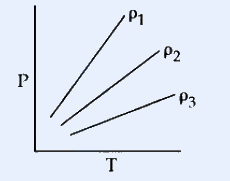
P-T diagram of an ideal gas having three different densities (in three different cases) is shown in the figure. Which of the following is correct :
(1)
(2)
(3)
(4)
SolutionAnswer: Option 1
Approach:
Use the ideal gas law in density form; on a P-T plot the slope is inversely related to density, so the steepest line corresponds to the highest density.
Step 1:Express pressure as a linear function of temperature with slope set by density.
Step 2:Line is steepest and least steep in the figure.
Step 3:Translate slope order into density order.
Final answer:
Q12Single correctElectric Charges and Fields
An infinitely long positively charged straight thread has a linear charge density C . An electron revolves along a circular path having axis along the length of the wire. The graph that correctly describes the variation of the kinetic energy of electron as a function of radius of circular path from the wire is :
(1)
(2)
(3)
(4)
SolutionAnswer: Option 3
Approach:
Set the electrostatic force from the line charge equal to the centripetal force, then express kinetic energy in terms of radius.
Step 1:Equate Coulomb attraction to centripetal requirement.
Step 2:Solve for kinetic energy.
Step 3:Identify the graph.
Q13Single correctCurrent Electricity
To measure the internal resistance of a battery, potentiometer is used. For , the balance point is observed at cm and for the balance point is observed at cm. The internal resistance of the battery is approximately :
(1)
(2)
(3)
(4)
SolutionAnswer: Option 2
Approach:
Apply the potentiometer internal-resistance formula for two loading resistances and balance lengths.
Step 1:Balanced length is proportional to terminal voltage: .
Step 2:Substitute .
Step 3:Cross-multiply and solve.
Final answer:
Q14Single correctMoving Charges and Magnetism
An electron is projected with uniform velocity along the axis inside a current carrying long solenoid. Then :
(1)
(2)
(3)
(4)
SolutionAnswer: Option 1The electron will continue to move with uniform velocity along the axis of the solenoid.
Approach:
Evaluate the magnetic Lorentz force when velocity is parallel to the on-axis magnetic field of a solenoid.
Step 1:Inside a long solenoid the field is along the axis, parallel to the electron's velocity.
Step 2:Compute the force.
Step 3:With zero net force, motion is unchanged.
Final answer: The electron will continue to move with uniform velocity along the axis of the solenoid.
Q15Single correctAlternating Current
In an ac circuit, the instantaneous current is zero, when the instantaneous voltage is maximum. In this case, A. pure inductor B. pure capacitor C. pure resistor D. combination of an inductor and capacitor. Choose the correct answer from the options given below :
(1)
(2)
(3)
(4)
SolutionAnswer: Option 4A, B and D only
Approach:
Identify circuit elements in which current and voltage are 90 degrees out of phase, making current zero at the voltage peak.
Step 1:In a pure inductor and a pure capacitor, current lags or leads voltage by .
Step 2:A pure resistor has current in phase with voltage, so both peak together.
Step 3:A lossless L-C combination is purely reactive, retaining the phase difference.
Final answer: A, B and D only
Q16Single correctElectromagnetic Waves
The electric field in an electromagnetic wave is given by . The magnetic field induction of this wave is (in SI unit) :
(1)
(2)
(3)
(4)
SolutionAnswer: Option 4
Approach:
Relate the magnetic field amplitude to the electric field amplitude using the speed of light, and fix its direction from the orthogonality of E, B, and the propagation direction.
Step 1:Identify the electric field amplitude and propagation direction.
Step 2:Compute the magnetic field amplitude.
Step 3:Determine the magnetic field direction so that points along propagation.
Step 4:Write the magnetic field with the same phase as the electric field.
Final answer:
Q17Single correctOptics
An effective power of a combination of 5 identical convex lenses which are kept in contact along the principal axis is 25D. Focal length of each of the convex lens is :
(1)
(2)
(3)
(4)
SolutionAnswer: Option 120 cm
Approach:
Add the powers of identical lenses in contact, solve for the power of one lens, and convert to focal length.
Step 1:Express the total power of five identical lenses.
Step 2:Solve for the power of a single lens.
Step 3:Convert single-lens power to focal length in metres.
Step 4:Express the focal length in centimetres.
Final answer: 20 cm
Q18Single correctDual Nature of Radiation and Matter
Which figure shows the correct variation of applied potential difference (V) with photoelectric current (I) at two different intensities of light of same wavelengths :
(1)
(2)
(3)
(4)
SolutionAnswer: Option 2
Approach:
Apply the photoelectric law that stopping potential depends only on frequency (wavelength), while saturation current scales with intensity, to select the correct I-V graph.
Step 1:At fixed wavelength the stopping potential is the same for both intensities.
Step 2:Higher intensity gives a larger saturation current.
Step 3:Match these features: both curves meet the V-axis at the same and the plateau lies above the plateau.
Final answer: Graph with common stopping potential and higher saturation current for (option 2)
Q19Single correctAtoms and Nuclei
Which of the following nuclear fragments corresponding to nuclear fission between neutron and uranium isotope is correct :
(1)
(2)
(3)
(4)
SolutionAnswer: Option 2
Approach:
Apply conservation of mass number and atomic number to the reactant side and test each option.
Step 1:Compute the reactant totals.
Step 2:Check atomic number for option 2.
Step 3:Check mass number for option 2.
Step 4:Confirm other options fail one of the conservation rules.
Final answer:
Q20Single correctCurrent Electricity
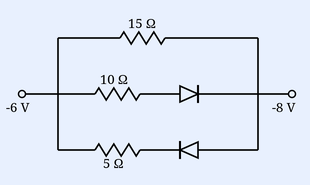
The value of net resistance of the network as shown in the given figure is :
(1)
(2)
(3)
(4)
SolutionAnswer: Option 1
Approach:
Use the diode states in the network: the diode in the 5 ohm branch is reverse biased and blocks current, so only the conducting branches contribute to the net resistance seen across the source.
Step 1:Determine diode states from the cell polarities; the branch containing the 5 ohm resistor is blocked by its reverse-biased diode.
Step 2:The conducting path carries current through the 15 ohm element only with the remaining branch open.
Step 3:Match the reduced network value to the option.
Final answer:
Q21NumericalLaws of Motion
Two forces and are acting on a body. One force has magnitude thrice of the other force and the resultant of the two forces is equal to the force of larger magnitude. The angle between and is . The value of is _____.
SolutionAnswer: 6
Approach:
Set the smaller force as F and the larger as 3F, equate the magnitude of the resultant to the larger force, and solve the parallelogram law for the angle.
Step 1:Assign magnitudes with the larger force three times the smaller.
Step 2:Set the resultant equal to the larger force.
Step 3:Square and simplify.
Step 4:Solve for the angle and identify n.
Final answer: 6
Q22NumericalLaws of Motion
A solid sphere and a hollow cylinder roll up without slipping on same inclined plane with same initial speed v. The sphere and the cylinder reaches upto maximum heights and , respectively, above the initial level. The ratio is . The value of n is _____.
SolutionAnswer: 7
Approach:
Apply energy conservation for rolling bodies; the maximum height depends on the total kinetic energy, which includes a moment-of-inertia factor for each body.
Step 1:State the maximum height for a rolling body.
Step 2:Use the inertia factors: solid sphere , hollow cylinder .
Step 3:Form the ratio.
Step 4:Identify n from .
Final answer: 7
Q23NumericalProperties of Solids and Liquids
An elastic spring under tension of 3 N has a length a. Its length is b under tension 2 N. For its length , the value of tension will be _____ N.
SolutionAnswer: 5
Approach:
Use Hooke's law as a linear relation between tension and length, determine the natural length and spring constant, then evaluate the tension at length (3a - 2b).
Step 1:Write the two given conditions.
Step 2:Subtract to relate k to (a - b).
Step 3:Compute tension at length .
Step 4:Rewrite using from .
Final answer: 5
Q24NumericalProperties of Solids and Liquids
A soap bubble is blown to a diameter of 7 cm. 36960erg of work is done in blowing it further. If surface tension of soap solution is then the new radius is _____ cm Take .
SolutionAnswer: 7
Approach:
Equate the work done to the increase in surface energy of the soap bubble, which has two surfaces, and solve for the new radius.
Step 1:State the work as the change in surface energy with two surfaces.
Step 2:Insert initial radius 3.5 cm and the given data.
Step 3:Simplify the coefficient.
Step 4:Solve for the new radius.
Final answer: 7
Q25NumericalElectrostatics
An infinite plane sheet of charge having uniform surface charge density is placed on plane. Another infinitely long line charge having uniform linear charge density is placed at m plane parallel to y-axis. If the magnitude values then at point , the ratio of magnitudes of electric field values due to sheet charge to that due to line charge is . The value of n is _____.
SolutionAnswer: 16
Approach:
Compute the field of the infinite sheet and of the infinite line at the point, form their ratio, and match it to the prescribed form to extract n.
Step 1:Find the perpendicular distance from the line charge to the point; the line lies in the z = 4 plane parallel to y, point at z = 2.
Step 2:Form the ratio of the two field magnitudes.
Step 3:Substitute and .
Step 4:Match to .
Final answer: 16
Q26NumericalCurrent Electricity
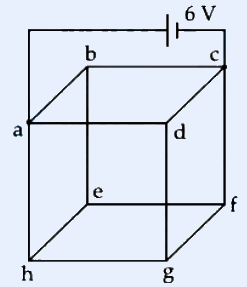
Twelve wires each having resistance are joined to form a cube. A battery of 6 V emf is joined across point a and c. The voltage difference between e and f is _____ V.
SolutionAnswer: 1
Approach:
Apply the cube's symmetry for a battery across a face diagonal to find the equivalent resistance and the current distribution, then compute the potential difference between the specified nodes.
Step 1:For a battery across a face diagonal the equivalent resistance of the cube is 3R/4 with R = 2 ohm.
Step 2:Find the total current from the source.
Step 3:Use the symmetric current splitting through the cube edges to obtain the branch currents between e and f.
Step 4:Compute the potential difference across the edge joining e and f.
Final answer: 1
Q27NumericalMagnetic Effects of Current
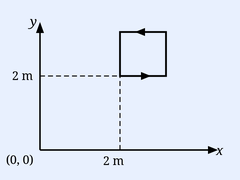
The magnetic field existing in a region is given by T. A square loop of edge 50 cm carrying 0.5 A current is placed in plane with its edges parallel to the axes, as shown in figure. The magnitude of the net magnetic force experienced by the loop is _____ mN.
SolutionAnswer: 50
Approach:
The field varies with x, so the forces on the two vertical edges (at different x) do not cancel; compute the net force from the difference in field at the two parallel edges.
Step 1:Identify the edge length and the x positions of the two vertical sides from the figure.
Step 2:Evaluate the field at the two vertical edges.
Step 3:Forces on horizontal edges cancel; net force comes from the field difference on vertical edges.
Step 4:Convert to milli-newton.
Final answer: 50
Q28NumericalAlternating Current
A alternating current at any instant is given by A. The rms value of current is _____ A.
SolutionAnswer: 8
Approach:
Treat the current as a DC component plus a sinusoidal component; the rms value combines the square of the DC part with the mean square of the AC part.
Step 1:Separate the constant and sinusoidal amplitudes.
Step 2:Compute the mean square of the sinusoidal part.
Step 3:Add the square of the DC component.
Step 4:Take the square root of the sum.
Final answer: 8
Q29NumericalOptics
Two wavelengths and are used in Young's double slit experiment. nm and nm. The minimum order of fringe produced by which overlaps with the fringe produced by is n nn. The value of n is _____.
SolutionAnswer: 9
Approach:
Overlap of bright fringes requires equal path positions, giving an integer ratio of orders inverse to the wavelength ratio; find the smallest orders that satisfy it.
Step 1:Write the overlap condition for the two wavelengths.
Step 2:Reduce the wavelength ratio to lowest terms.
Step 3:Identify the smallest integer orders.
Step 4:The minimum order produced by is therefore n.
Final answer: 9
Q30NumericalAtoms and Nuclei
A hydrogen atom changes its state from to . Due to recoil, the percentage change in the wave length of emitted light is approximately . The value of n is _____. [Given mass of the hydrogenatom kg ]
SolutionAnswer: 7
Approach:
Find the emitted photon energy and wavelength for the 3→2 transition, then use momentum conservation to get the recoil-induced fractional wavelength shift and read off the exponent.
Step 1:Compute the photon energy for the transition.
Step 2:Express the recoil fractional change using photon energy and atom rest energy.
Step 3:Evaluate the rest energy of the atom in eV and substitute.
Step 4:Compute the fractional change and convert to percentage.
Final answer: 7
Chemistry28 questions
Q31Single correctClassification of Elements and Periodicity in Properties
Number of elements from the following that CANNOT form compounds with valencies which match with their respective group valencies is ______. B, C, N, S, O, F, P, Al, Si
(1)
(2)
(3)
(4)
SolutionAnswer: Option 23
Approach:
Compare the highest valency each listed element can actually display in a compound with its group valency, then count those for which the two values differ.
Step 1:Second-period elements N, O, F lack accessible d-orbitals, so their maximum covalency is restricted below the group valency.
Step 2:B, C, S, P, Al, Si attain their respective group valencies (e.g. , , , , , ).
Step 3:Count the deviating elements.
Final answer: 3
Q32Single correctClassification of Elements and Periodicity in Properties
The correct order of first ionization enthalpy values of the following elements is : (A) O (B) N (C) Be (D) F (E) B Choose the correct answer from the options given below :
(1)
(2)
(3)
(4)
SolutionAnswer: Option 1
Approach:
Assign first ionization enthalpy values for the second-period elements B, Be, O, N, F and arrange in increasing order, accounting for the half-filled and fully-paired anomalies.
Step 1:Approximate first ionization enthalpies (kJ/mol): B(E) , Be(C) , O(A) , N(B) , F(D) .
Step 2:Be exceeds B because of its stable fully-filled configuration; N exceeds O because of its stable half-filled configuration.
Step 3:Translate to letter labels.
Final answer:
Q33Single correctChemical Bonding and Molecular Structure
Which one of the following molecules has maximum dipole moment?
(1)
(2)
(3)
(4)
SolutionAnswer: Option 4
Approach:
Evaluate the net dipole of each molecule from its geometry and the relative directions of bond dipoles and the lone-pair dipole.
Step 1: is tetrahedral and is trigonal bipyramidal; both are symmetric and non-polar.
Step 2:In the bond dipoles (N more electronegative, point toward N) add to the lone-pair dipole, giving a large resultant D.
Step 3:In the bond dipoles point away from N (F more electronegative) and partly oppose the lone-pair dipole, lowering the resultant to D.
Final answer:
Q34Single correctChemical Bonding and Molecular Structure
Number of molecules/ions from the following in which the central atom is involved in hybridization is
(1)
(2)
(3)
(4)
SolutionAnswer: Option 32
Approach:
Determine the steric number (sigma bonds + lone pairs) on the central atom of each species and identify those equal to 4, which correspond to hybridization.
Step 1:: N has 2 sigma bonds and 1 lone pair, , .
Step 2:: B has 3 sigma bonds and 0 lone pairs, , .
Step 3:: Cl has 2 sigma bonds and 2 lone pairs, , . (radical): Cl has 3 sigma bonds and 1 lone pair/electron, , .
Step 4:Count the species.
Final answer: 2
Q35Single correctSome Basic Principles and Techniques (Organic Chemistry)
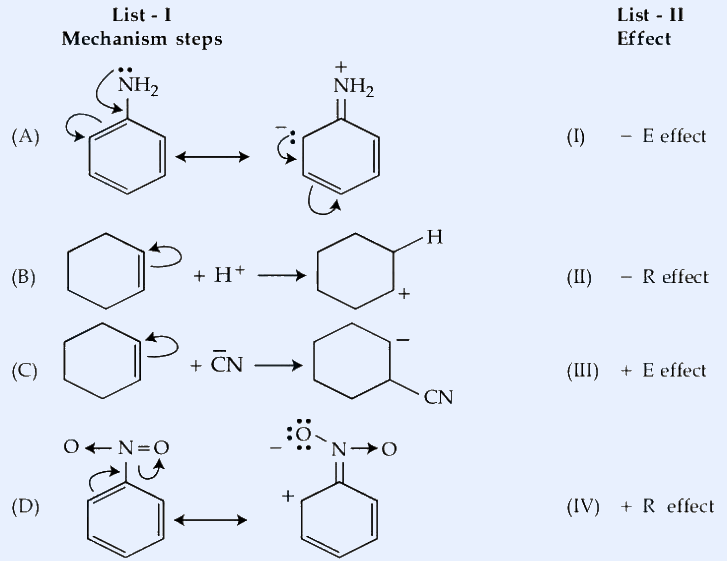
Match List I with List II :
Choose the correct answer from the options given below :
Choose the correct answer from the options given below :
(1)
(2)
(3)
(4)
SolutionAnswer: Option 1(A) - (IV), (B) - (III), (C) - (I), (D) - (II)
Approach:
Classify each depicted electron movement as a permanent resonance (R) effect or a temporary electromeric (E) effect, then assign the sign by whether electron density is donated to () or withdrawn from () the conjugated system.
Step 1:(A) The nitrogen lone pair of aniline is permanently delocalised into the ring, pushing electron density in: effect, matching (IV).
Step 2:(B) Approach of polarises the alkene so the pi electrons shift toward the attacking electrophile, a temporary donation: effect, matching (III).
Step 3:(C) With the nucleophile , the pi electrons are displaced away from the centre under reagent demand, a temporary withdrawal: effect, matching (I).
Step 4:(D) The electron-withdrawing nitroso group pulls ring pi density onto itself by permanent conjugation: effect, matching (II).
Final answer: (A) - (IV), (B) - (III), (C) - (I), (D) - (II)
Q36Single correctSome Basic Principles and Techniques (Organic Chemistry)
Which of the following nitrogen containing compound does not give Lassaigne's test?
(1)
(2)
(3)
(4)
SolutionAnswer: Option 4Hydrazine
Approach:
Lassaigne's test detects nitrogen through formation of during sodium fusion, which requires both carbon and nitrogen in the molecule. Identify the compound lacking carbon.
Step 1:Urea , phenyl hydrazine and glycine all contain carbon and nitrogen.
Step 2:Hydrazine contains no carbon, so no forms on fusion.
Step 3:Without the Prussian-blue colour cannot develop, so hydrazine fails the test.
Final answer: Hydrazine
Q37Single correctSome Basic Principles and Techniques (Organic Chemistry)
Which among the following is incorrect statement?
(1)
(2)
(3)
(4)
SolutionAnswer: Option 3Hydrogen ion () shows negative electromeric effect
Approach:
Recall the defining features of the electromeric effect and test each statement, identifying the one that misassigns the sign of the effect produced by .
Step 1:The electromeric effect is a complete, temporary transfer of pi electrons occurring only on demand of an attacking reagent and is stronger than the inductive effect; statements (1), (2) and (4) are correct.
Step 2:An electrophile such as draws the pi electrons toward itself, which is the positive () electromeric effect, not the negative one.
Step 3:Therefore the statement assigning a negative electromeric effect to is incorrect.
Final answer: Hydrogen ion () shows negative electromeric effect
Q39Single correctSolutions
The Molarity (M) of an aqueous solution containing 5.85 g of NaCl in 500 mL water is : (Given : Molar Mass Na : 23 and Cl : 35.5 gmo)
(1)
(2)
(3)
(4)
SolutionAnswer: Option 40.2
Approach:
Compute moles of NaCl from its mass and molar mass, then divide by the solution volume in litres to obtain molarity.
Step 1:Molar mass of NaCl.
Step 2:Moles of NaCl.
Step 3:Volume in litres and molarity.
Final answer: 0.2
Q40Single correctElectrochemistry
What pressure (bar) of would be required to make emf of hydrogen electrode zero in pure water at 25C ?
(1)
(2)
(3)
(4)
SolutionAnswer: Option 4
Approach:
Apply the Nernst equation to the hydrogen electrode in pure water (where M), set the electrode potential to zero, and solve for the required pressure.
Step 1:For the electrode ; in pure water M. Setting .
Step 2:The logarithm must vanish, so the argument equals one.
Step 3:Solve for the pressure.
Final answer:
Q41Single correctElectrochemistry
One of the commonly used electrode is calomel electrode. Under which of the following categories, calomel electrode comes?
(1)
(2)
(3)
(4)
SolutionAnswer: Option 4Metal - Insoluble Salt - Anion electrodes
Approach:
Recall the construction of the calomel electrode and match its components to the standard electrode classifications.
Step 1:The calomel electrode consists of mercury (metal) in contact with its insoluble salt (calomel), immersed in a chloride-ion solution.
Step 2:Its potential is governed by the activity of the anion through the insoluble salt, defining a metal-insoluble salt-anion electrode.
Step 3:This matches the metal - insoluble salt - anion category.
Final answer: Metal - Insoluble Salt - Anion electrodes
Q42Single correctSome Basic Principles and Techniques (Organic Chemistry)
What will be the decreasing order of basic strength of the following conjugate bases?
(1)
(2)
(3)
(4)
SolutionAnswer: Option 1
Approach:
Basic strength of a conjugate base is inversely related to the stability of its negative charge: the more delocalised or the more electronegative-atom-stabilised the charge, the weaker the base. Rank the four anions accordingly.
Step 1:Alkoxide carries a localised charge with the electron-donating alkyl group destabilising it, making it the strongest base.
Step 2:Hydroxide lacks the alkyl donation, so it is a slightly weaker base than alkoxide.
Step 3:Acetate delocalises its charge over two oxygens by resonance, stabilising it and reducing basicity.
Step 4:Iodide is the conjugate base of the strong acid HI, with the charge spread over a large polarisable atom, so it is the weakest base.
Final answer:
Q43Single correctd- and f-Block Elements
The element which shows only one oxidation state other than its elemental form is :
(1)
(2)
(3)
(4)
SolutionAnswer: Option 4Scandium
Approach:
Examine the common oxidation states of each transition element and select the one that exhibits a single non-zero oxidation state.
Step 1:Cobalt shows and ; titanium shows ; nickel shows (and ).
Step 2:Scandium has the electronic configuration and loses all three valence electrons to give only the state.
Step 3:Hence scandium is the element showing only one oxidation state besides zero.
Final answer: Scandium
Q44Single correctCoordination Compounds
Number of complexes from the following with even number of unpaired " d " electrons is
[Given atomic numbers : ]
[Given atomic numbers : ]
(1)
(2)
(3)
(4)
SolutionAnswer: Option 12
Approach:
For each aqua complex, determine the metal d-electron count and, since is a weak-field ligand (high spin), count the unpaired electrons; then tally those that are even in number.
Step 1: is with 2 unpaired (even); is high spin with 4 unpaired (even).
Step 2: is high spin with 5 unpaired (odd); is high spin with 3 unpaired (odd).
Step 3: is with 1 unpaired (odd).
Step 4:Even-unpaired complexes are and .
Final answer: 2
Q45Single correctCoordination Compounds
The correct sequence of ligands in the order of decreasing field strength is :
(1)
(2)
(3)
(4)
SolutionAnswer: Option 2
Approach:
Use the spectrochemical series, which arranges ligands by increasing field strength, to test which option lists ligands in strictly decreasing field strength.
Step 1:From the series, field strength decreases as .
Step 2:Option (1), (3) and (4) place weaker-field ligands before stronger-field ones (e.g. before , before , before ), so they are not in decreasing order.
Step 3:Only option (2) lists the ligands in strictly decreasing field strength.
Final answer:
Q46Single correctHaloalkanes and Haloarenes
Identify the set of reagents 'X' and 'Y' in the following set of transformation
(1)
(2)
(3)
(4)
SolutionAnswer: Option 4 conc.alc. NaOH, C, HBr/ acetic acid
Approach:
Convert 1-bromopropane to propan-2-ol via an alkene intermediate, then re-introduce bromine at the secondary carbon following Markovnikov addition.
Step 1:Concentrated alcoholic NaOH at 80 degree C promotes elimination of 1-bromopropane to propene.
Step 2:Dilute aqueous NaOH would give substitution (propan-1-ol), not the required alkene; therefore X must be concentrated alcoholic NaOH.
Step 3:HBr in acetic acid adds across propene by Markovnikov rule, placing bromine on the central carbon to give 2-bromopropane.
Step 4:The final product matches the secondary bromide shown; hence option 4 is consistent.
Final answer: conc.alc. NaOH, C, HBr/ acetic acid
Q47Single correctAldehydes, Ketones and Carboxylic Acids
Given below are two statements : Statements I : Acidity of -hydrogens of aldehydes and ketones is responsible for Aldol reaction. Statement II : Reaction between benzaldehyde and ethanal will NOT give Cross - Aldol product. In the light of the above statements, choose the most appropriate answer from the options given below :
(1)
(2)
(3)
(4)
SolutionAnswer: Option 1Statement I is correct but Statement II is incorrect
Approach:
Evaluate each statement against the requirements for aldol and cross-aldol condensation.
Step 1:Aldol reaction proceeds through an enolate, whose formation depends on the acidic alpha-hydrogen; Statement I is correct.
Step 2:Benzaldehyde has no alpha-hydrogen while ethanal does; the ethanal enolate attacks benzaldehyde to give a cross-aldol product (cinnamaldehyde on dehydration).
Step 3:Statement II claims no cross-aldol product, which contradicts the actual outcome; Statement II is incorrect.
Final answer: Statement I is correct but Statement II is incorrect
Q49Single correctGeneral Principles and Processes of Isolation of Metals / Qualitative Analysis
In the precipitation of the iron group (III) in qualitative analysis, ammonium chloride is added before adding ammonium hydroxide to :
(1)
(2)
(3)
(4)
SolutionAnswer: Option 4decrease concentration of OH ions
Approach:
Analyse the role of NH4Cl as a common-ion source that suppresses hydroxide ion concentration before adding ammonium hydroxide.
Step 1:NH4Cl supplies a high concentration of NH4+ ions in solution.
Step 2:The added NH4+ shifts the ammonium hydroxide equilibrium backward, lowering the hydroxide ion concentration.
Step 3:The low controlled OH- precipitates only group III hydroxides (Fe, Al, Cr) and prevents precipitation of higher group hydroxides.
Final answer: decrease concentration of OH ions
Q50Single correctBiomolecules
Which of the following is the correct structure of L-Glucose?
(1)
(2)
(3)
(4)
SolutionAnswer: Option 1
Approach:
L-Glucose is the mirror image of D-glucose; build it by inverting every chiral hydroxyl of the D-glucose Fischer projection, with the bottommost chiral -OH on the left.
Step 1:D-Glucose has -OH on right, left, right, right (top to bottom) about its four chiral centres with CHO at top and CH2OH at bottom.
Step 2:L-Glucose is the exact mirror image, so each -OH switches side: left, right, left, left.
Step 3:The Fischer projection with HO on the left at C2, OH on the right at C3, HO on the left at C4 and C5 (and CHO top, CH2OH bottom) corresponds to L-glucose, matching option 1.
Final answer: L-glucose Fischer projection (option 1)
Q51NumericalStructure of Atom
The de-Broglie's wavelength of an electron in the orbit is _____ ( Bohr's radius )
SolutionAnswer: 8
Approach:
Apply the Bohr quantization condition, which states that the circumference of the nth orbit equals n de Broglie wavelengths.
Step 1:The radius of the 4th orbit is given by Bohr's expression.
Step 2:The quantization condition gives the wavelength from the orbit circumference.
Step 3:Simplifying yields the wavelength in units of pi*a0.
Final answer: 8
Q52NumericalChemical Bonding and Molecular Structure
Number of molecules/species from the following having one unpaired electron is
SolutionAnswer: 2
Approach:
Determine the number of unpaired electrons in each species using molecular orbital electron configurations.
Step 1:O2 has 16 electrons with two electrons singly occupying the pi-star orbitals, giving 2 unpaired electrons.
Step 2:Superoxide has 17 electrons; one pi-star is filled and the other holds one electron, giving 1 unpaired.
Step 3:NO has 15 electrons with one electron in pi-star, giving 1 unpaired; (14 e) and peroxide - (18 e) are fully paired with 0 unpaired each.
Step 4:Species with exactly one unpaired electron are and NO.
Final answer: 2
Q53NumericalChemical Thermodynamics
The enthalpy of formation of ethane from ethylene by addition of hydrogen where the bond-energies of are 414 kJ, 347 kJ, 615 kJ and 435 kJ respectively is _____ kJ
SolutionAnswer: 125
Approach:
Use bond enthalpies: reaction enthalpy equals bonds broken minus bonds formed for C2H4 + H2 -> C2H6.
Step 1:Bonds broken are the C=C double bond and the H-H bond.
Step 2:Bonds formed are one new C-C single bond and two new C-H bonds.
Step 3:The reaction enthalpy is the difference.
Final answer: 125
Q54NumericalRedox Reactions
Only 2 mL of KMn solution of unknown molarity is required to reach the end point of a titration of 20 mL of oxalic acid (2M) in acidic medium. The molarity of KMn solution should be _____ M.
SolutionAnswer: 8
Approach:
Equate the equivalents of KMnO4 and oxalic acid using their n-factors in acidic medium.
Step 1:In acidic medium KMnO4 gains 5 electrons (n-factor 5) and oxalic acid loses 2 electrons (n-factor 2).
Step 2:Set equivalents equal for the two solutions.
Step 3:Solve for the KMnO4 molarity.
Final answer: 8
Q55NumericalSome Basic Principles of Organic Chemistry / Hydrocarbons
The number of different chain isomers for is _____
SolutionAnswer: 9
Approach:
Enumerate all distinct carbon skeletons (chain isomers) for the saturated alkane heptane.
Step 1:Start with the straight chain heptane (1) and the single-methyl branched isomers 2-methylhexane and 3-methylhexane (2 more).
Step 2:Add the dimethylpentanes: 2,2-, 2,3-, 2,4- and 3,3-dimethylpentane (4 more).
Step 3:Add 3-ethylpentane and 2,2,3-trimethylbutane (2 more) to complete the set.
Final answer: 9
Q56NumericalSolutions
2.5 g of a non-volatile, non-electrolyte is dissolved in 100 g of water at C. The solution showed a boiling point elevation by C. Assuming the solute concentration is negligible with respect to the solvent concentration, the vapor pressure of the resulting aqueous solution is _____ mm of Hg (nearest integer) [Given : Molal boiling point elevation constant of water , 1 atm pressure mm of Hg, molar mass of water g mo]
SolutionAnswer: 707
Approach:
Find molality from the boiling point elevation, convert to moles of solute, then apply Raoult's law for vapour pressure lowering.
Step 1:Molality follows from the elevation and Kb.
Step 2:Moles of solute in 0.1 kg of water and moles of water are computed.
Step 3:With solute concentration negligible, the mole fraction of solute approximates the ratio to solvent moles.
Step 4:Apply relative lowering of vapour pressure with P-degree = 760 mm Hg.
Final answer: 707
Q57NumericalChemical Kinetics
Consider the following transformation involving first order elementary reaction in each step at constant temperature as shown below. Step 1 Some details of the above reactions are listed below.
Step | Rate constant (se) | Activation energy (kJ mo)
1 | | 300
2 | | 200
3 | | E
If the overall rate constant of the above transformation (k) is given as and the overall activation energy is 400 kJ mo, then the value of E is _____ kJmo (nearest integer)
Step | Rate constant (se) | Activation energy (kJ mo)
1 | | 300
2 | | 200
3 | | E
If the overall rate constant of the above transformation (k) is given as and the overall activation energy is 400 kJ mo, then the value of E is _____ kJmo (nearest integer)
SolutionAnswer: 100
Approach:
Combine the Arrhenius expressions for the composite rate constant to relate the overall activation energy to the individual ones.
Step 1:Substituting Arrhenius forms, the exponents add for the numerator and subtract for the denominator.
Step 2:Insert the known activation energies.
Step 3:Solve for Ea3.
Final answer: 100
Q58NumericalThe d- and f- Block Elements
Consider the following reaction Mn + KOH + A + O. Product ' A ' in neutral or acidic medium disproportionate to give products ' B ' and ' C ' along with water. The sum of spin-only magnetic moment values of B and C is _____ BM. (nearest integer) (Given atomic number of Mn is 25)
SolutionAnswer: 4
Approach:
Identify A as potassium manganate, determine its disproportionation products, and add their spin-only magnetic moments.
Step 1:MnO2 with KOH and O2 forms potassium manganate, so A is K2MnO4 with Mn in the +6 state.
Step 2:In acidic/neutral medium manganate disproportionates to permanganate (Mn+7) and manganese dioxide (Mn+4).
Step 3:Permanganate has Mn+7 (d0, n = 0) giving moment 0; MnO2 has Mn+4 (d3, n = 3) giving moment root 15.
Step 4:Sum the two magnetic moments.
Final answer: 4
Q59NumericalAldehydes, Ketones and Carboxylic Acids / Amines
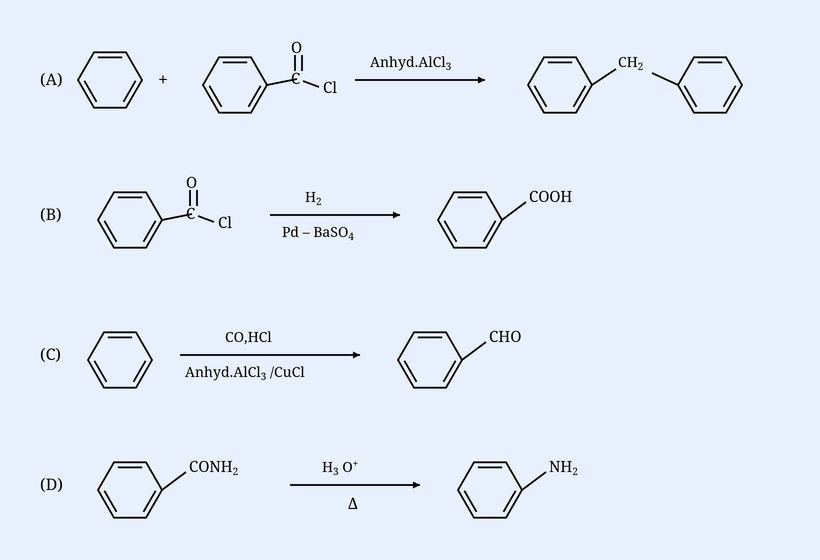
The number of the correct reaction(s) among the following is _____
SolutionAnswer: 1
Approach:
Evaluate each of the four reaction schemes (A, B, C, D) for whether the reagents give the drawn product.
Step 1:Scheme A shows benzene plus benzoyl chloride with anhyd. AlCl3 giving a diphenylmethane (CH2 bridge); Friedel-Crafts acylation gives a ketone (benzophenone), not a CH2 bridge, so A is incorrect.
Step 2:Scheme B uses Rosenmund reduction conditions (H2, Pd-BaSO4) on benzoyl chloride; this gives benzaldehyde, not benzoic acid (COOH) as drawn, so B is incorrect.
Step 3:Scheme C is the Gattermann-Koch reaction (CO, HCl, anhyd. AlCl3/CuCl) on benzene giving benzaldehyde (CHO), which is correct.
Step 4:Scheme D hydrolyses benzamide (CONH2) with H3O+ on heating; this gives benzoic acid, not aniline (NH2) as drawn, so D is incorrect. Only scheme C is correct.
Final answer: 1
Q60NumericalAmines
Xg of ethylamine is subjected to reaction with NaN/HCl followed by water; evolved dinitrogen gas which occupied 2.24 L volume at STP. X is _____ g.
SolutionAnswer: 45
Approach:
Primary aliphatic amine reacts with nitrous acid to liberate one mole of N2 per mole of amine; use the gas volume at STP to find moles, then mass.
Step 1:Moles of dinitrogen evolved from the given volume at STP.
Step 2:One mole of ethylamine produces one mole of N2, so moles of ethylamine equal moles of N2.
Step 3:Molar mass of ethylamine (C2H5NH2) is 45 g/mol; multiply by moles for the mass.
Final answer: 45
Mathematics30 questions
Q61Single correctComplex Numbers and Quadratic Equations
If 2 and 6 are the roots of the equation , then the quadratic equation, whose roots are and , is :
(1)
(2)
(3)
(4)
SolutionAnswer: Option 2
Approach:
Determine and from the given roots, then compute the new roots and form their quadratic.
Step 1:Expand the factored form and match coefficients.
Step 2:Solve for the parameters.
Step 3:Evaluate the denominators of the new roots.
Step 4:Compute the new roots.
Step 5:Form the quadratic from the new roots.
Final answer:
Q62Single correctComplex Numbers and Quadratic Equations
Let and be the sum and the product of all the non-zero solutions of the equation . Then is equal to :
(1)
(2)
(3)
(4)
SolutionAnswer: Option 44
Approach:
Write , separate real and imaginary parts, solve for all non-zero solutions, then form and .
Step 1:Substitute and split into real and imaginary parts.
Step 2:From take : then gives .
Step 3:Take : then gives only, which is excluded as zero.
Step 4:Non-zero solutions are and . Compute sum and product.
Step 5:Evaluate the required expression.
Final answer: 4
Q63Single correctPermutations and Combinations
There are five points on the side AB, excluding A and B, of a triangle ABC. Similarly there are 6 points on the side BC and 7 points on the side CA of the triangle. The number of triangles, that can be formed using the points as vertices, is :
(1)
(2)
(3)
(4)
SolutionAnswer: Option 3751
Approach:
Count all combinations of 3 points from 18 and subtract collinear triples lying on each side.
Step 1:Total ways to choose any 3 of the 18 points.
Step 2:Subtract collinear triples on each side: 5, 6, and 7 points.
Step 3:Number of triangles.
Final answer: 751
Q64Single correctSequences and Series
Let the first three terms and q, with , of a G.P. be respectively the , and terms of an A.P. If the term of the G.P. is the term of the A.P., then n is equal to :
(1)
(2)
(3)
(4)
SolutionAnswer: Option 1163
Approach:
Use A.P. term relations to express and via the common difference, then impose the G.P. condition to find the ratio and locate the 5th G.P. term in the A.P.
Step 1:Write the A.P. terms.
Step 2:Apply the G.P. condition on .
Step 3:Solve and reject since .
Step 4:Compute the 5th G.P. term.
Step 5:Locate it in the A.P.: .
Final answer: 163
Q65Single correctBinomial Theorem
The sum of all rational terms in the expansion of is equal to :
(1)
(2)
(3)
(4)
SolutionAnswer: Option 13133
Approach:
Write the general term and require both exponents to be integers, then sum the qualifying terms.
Step 1:Require and to be integers.
Step 2:Evaluate the term at .
Step 3:Evaluate the term at .
Step 4:Add the rational terms.
Final answer: 3133
Q66Single correctCoordinate Geometry
The vertices of a triangle are and . A new triangle is formed by shifting the sides of the triangle by one unit inwards. Then the equation of the side of the new triangle nearest to origin is :
(1)
(2)
(3)
(4)
SolutionAnswer: Option 3
Approach:
Find the side nearest the origin, then shift it inward (toward the triangle interior) by one unit using the parallel-line distance.
Step 1:Side through and has slope 1: . Side through : . The side is nearest the origin.
Step 2:Shift this line one unit toward the interior. Its normal points away from origin; moving inward decreases the constant.
Step 3:Confirm the shifted line lies one unit inside, nearer the centroid.
Final answer:
Q67Single correctCoordinate Geometry
A square is inscribed in the circle . One side of this square is parallel to . If are the vertices of the square, then is equal to:
(1)
(2)
(3)
(4)
SolutionAnswer: Option 2152
Approach:
Find the centre and radius, place the four vertices with sides at to the axes, then sum .
Step 1:Identify centre and radius.
Step 2:Sides parallel to make the diagonals vertical and horizontal, so vertices lie along the axes through at distance .
Step 3:Sum over the four vertices.
Final answer: 152
Q68Single correctStatistics and Probability
Let . Let the mean and the variance of 6 observations be 2 and 23, respectively. The mean deviation about the mean of these 6 observations is :
(1)
(2)
(3)
(4)
SolutionAnswer: Option 1
Approach:
Use the mean and variance conditions to find , then compute the mean deviation about the mean.
Step 1:Apply the mean condition.
Step 2:Apply the variance condition.
Step 3:Solve the system.
Step 4:Compute deviations from the mean 2 for .
Step 5:Divide by 6.
Final answer:
Q69Single correctMatrices and Determinants
Let and . If , then is equal to:
(1)
(2)
(3)
(4)
SolutionAnswer: Option 216
Approach:
Use for matrices and the determinant relation between and to isolate .
Step 1:For , . Combine the two adjoint factors.
Step 2:Note , so .
Step 3:Hence the expression equals .
Step 4:With a specific matrix, relates to ; the condition yields .
Final answer: 16
Q70Single correctMatrices and Determinants
If the system of equations
has a non-trivial solution, then is equal to :
has a non-trivial solution, then is equal to :
(1)
(2)
(3)
(4)
SolutionAnswer: Option 2
Approach:
Set the coefficient determinant to zero for a non-trivial solution and solve the resulting trigonometric equation in the given interval.
Step 1:Expand the determinant by subtracting row 1 from rows 2 and 3 to eliminate the leading 1's.
Step 2:Evaluate the minor and simplify using .
Step 3:Write the left side as a single cosine.
Step 4:Solve for in .
Final answer:
Q71Single correctSets, Relations and Functions
If the domain of the function is , then is equal to:
(1)
(2)
(3)
(4)
SolutionAnswer: Option 397
Approach:
Intersect the domains of the inverse-sine part and the logarithm part, then identify and .
Step 1:Solve : .
Step 2:Solve : . Combined with step 1 gives , intersection .
Step 3:Solve the log inequality. Roots: numerator , denominator . Sign analysis gives or or .
Step 4:Intersect with the domain together with the branch. The resulting domain is type, yielding with as the included endpoint.
Step 5:Compute the requested combination.
Final answer: 97
Q72Single correctCalculus
Let the sum of the maximum and the minimum values of the function be , where . Then is equal to :
(1)
(2)
(3)
(4)
SolutionAnswer: Option 2201
Approach:
Set , clear denominators to a quadratic in , and require real via a non-negative discriminant to bound .
Step 1:Cross-multiply .
Step 2:For real x require the discriminant .
Step 3:Solve the inequality .
Step 4:Add the extreme values.
Step 5:With , compute .
Final answer: 201
Q73Single correctCalculus
Let be a function given by where . If f is continuous at , then is equal to :
(1)
(2)
(3)
(4)
SolutionAnswer: Option 212
Approach:
Compute the left-hand and right-hand limits at , set them equal to for continuity, solve for and , then evaluate .
Step 1:Left-hand limit.
Step 2:Continuity at fixes .
Step 3:Right-hand limit using .
Step 4:Equate to and solve for .
Step 5:Evaluate .
Final answer: 12
Q74Single correctCalculus
Let for all . Consider a function g(x) such that for all . Then the value of is :
(1)
(2)
(3)
(4)
SolutionAnswer: Option 416
Approach:
Since g is the inverse of f, use at the point where .
Step 1:Find with .
Step 2:Differentiate .
Step 3:Evaluate .
Step 4:Apply the inverse-derivative relation at .
Step 5:Compute .
Final answer: 16
Q75Single correctCalculus
Let and . Then is equal to :
(1)
(2)
(3)
(4)
SolutionAnswer: Option 42
Approach:
Construct and piecewise on and , add to get , then integrate each piece.
Step 1:On , so and . Then .
Step 2:On , so , and so . Then .
Step 3:Integrate over .
Step 4:Add the two pieces.
Final answer: 2
Q76Single correctIntegral Calculus
One of the points of intersection of the curves and is . Let the area of the region enclosed by these curves be , where . Then is equal to
(1)
(2)
(3)
(4)
SolutionAnswer: Option 330
Approach:
Identify the two intersection points of the parabola and the rectangular hyperbola, integrate the difference of the curves between them, and match the result to the given closed form to read off .
Step 1:Set the curves equal to find the abscissae of intersection.
Step 2:On the enclosed region the parabola lies above the hyperbola between and .
Step 3:Integrate term by term.
Step 4:Evaluate and simplify to the stated closed form.
Step 5:Add the three natural numbers.
Final answer: 30
Q77Single correctDifferential Equations
If the solution of the differential equation satisfies , then is equal to :
(1)
(2)
(3)
(4)
SolutionAnswer: Option 4
Approach:
Separate the variables, factor the denominator into a sum of perfect-square-related terms, integrate to an arctangent form, apply the given condition, then evaluate at .
Step 1:Separate variables.
Step 2:Factor the denominator as a product of two quadratics.
Step 3:Decompose the numerator using and integrate.
Step 4:Apply to fix the constant.
Step 5:Evaluate at .
Final answer:
Q78Single correctVector Algebra
Let a unit vector which makes an angle of with and angle with be . Then is :
(1)
(2)
(3)
(4)
SolutionAnswer: Option 1
Approach:
Write as a unit vector, impose the two cosine conditions and the unit-magnitude condition, solve the linear-plus-quadratic system, then add the given fixed vector.
Step 1:Apply the condition with the first vector of magnitude .
Step 2:Apply the condition with the second vector of magnitude .
Step 3:Combine the two linear relations with the unit-length constraint.
Step 4:Add the prescribed vector to .
Final answer:
Q79Single correctThree Dimensional Geometry
Let the point, on the line passing through the points and , farther from the origin and at distance of 9 units from the point P, be . Then is equal to :
(1)
(2)
(3)
(4)
SolutionAnswer: Option 3155
Approach:
Form the unit direction vector of line , parametrise points at distance from , choose the one farther from the origin, then compute the sum of squares of its coordinates.
Step 1:Compute the direction vector and its magnitude.
Step 2:Locate points at distance from P along .
Step 3:Compare distances from the origin and select the farther point.
Step 4:Report the sum of squares.
Final answer: 155
Q80Single correctProbability
Three urns A, B and C contain 7 red, 5 black; 5 red, 7 black and 6 red, 6 black balls, respectively. One of the urn is selected at random and a ball is drawn from it. If the ball drawn is black, then the probability that it is drawn from urn A is :
(1)
(2)
(3)
(4)
SolutionAnswer: Option 1
Approach:
Each urn is equally likely. Apply Bayes' theorem with the per-urn probabilities of drawing a black ball.
Step 1:State the black-ball probabilities for each urn (each total 12).
Step 2:Compute the total probability of a black ball.
Step 3:Apply Bayes' theorem for urn A.
Final answer:
Q81NumericalBinomial Theorem
Let , . Then is equal to
SolutionAnswer: 8
Approach:
Sum each series in closed form using exponential series identities, then form the requested ratio.
Step 1:Write the general term of and simplify.
Step 2:Sum the rows of b using .
Step 3:Form the ratio.
Final answer: 8
Q82NumericalCoordinate Geometry
Let the length of the focal chord PQ of the parabola be 15 units. If the distance of PQ from the origin is p, then is equal to
SolutionAnswer: 72
Approach:
Use the focal-chord length formula in terms of its inclination to find the slope, write the chord through the focus, then compute the perpendicular distance from the origin.
Step 1:Identify , so , with focus at .
Step 2:Use the focal-chord length to find the inclination.
Step 3:Write the chord through the focus with slope .
Step 4:Compute the perpendicular distance from the origin and then .
Final answer: 72
Q83NumericalCoordinate Geometry
Let A be a square matrix of order 2 such that and the sum of its diagonal elements is -3 . If the points (x, y) satisfying lie on a hyperbola, whose length of semi major axis is x and semi minor axis is y, eccentricity is e and the length of the latus rectum is l, then is equal to
SolutionAnswer: 233
Approach:
Use the Cayley-Hamilton theorem to identify the that satisfies the matrix equation, interpret the semi-axes, then compute eccentricity and latus rectum of the resulting hyperbola.
Step 1:Apply Cayley-Hamilton with and .
Step 2:Identify the semi-axes from the given correspondence.
Step 3:Compute the eccentricity.
Step 4:Compute the latus rectum.
Step 5:Evaluate the requested expression.
Final answer: 233
Q84NumericalLimits, Continuity and Differentiability
If , where , then is equal to
SolutionAnswer: 100
Approach:
Apply L'Hopital's rule to the form, evaluate the derivatives at , simplify to the prescribed closed form, then read off and .
Step 1:Both numerator and denominator vanish at , confirming the form.
Step 2:Differentiate numerator and denominator.
Step 3:Substitute (so and ).
Step 4:Simplify to the stated form.
Step 5:Compute the requested combination.
Final answer: 100
Q85NumericalSets, Relations and Functions
In a survey of 220 students of a higher secondary school, it was found that at least 125 and at most 130 students studied Mathematics; at least 85 and at most 95 studied Physics; at least 75 and at most 90 studied Chemistry; 30 studied both Physics and Chemistry; 50 studied both Chemistry and Mathematics; 40 studied both Mathematics and Physics and 10 studied none of these subjects. Let m and n respectively be the least and the most number of students who studied all the three subjects. Then m + n is equal to
SolutionAnswer: 45
Approach:
Apply the inclusion-exclusion principle to the 210 students who studied at least one subject, then bound the triple intersection using the given ranges for the single-subject totals.
Step 1:Students studying at least one subject.
Step 2:Substitute the pairwise intersections.
, where
Step 3:Minimise by maximising the single-subject totals.
Step 4:Maximise by minimising the single-subject totals.
Step 5:Add the extreme feasible values.
Final answer: 45
Q86NumericalMatrices and Determinants
Let A be a matrix of non-negative real elements such that . Then the maximum value of is
SolutionAnswer: 27
Approach:
The row-sum condition fixes each row to sum to 3 with non-negative entries. Maximise the determinant over this constraint set, where the optimum occurs at .
Step 1:Interpret the eigenvector condition as a constraint on row sums.
each row sums to
Step 2:Among non-negative rows each summing to 3, the determinant is maximised by the diagonal configuration.
Step 3:Evaluate the determinant.
Final answer: 27
Q87NumericalIntegral Calculus
If , where a, b , then a + b is equal to
SolutionAnswer: 8
Approach:
Use the king property to symmetrise, reduce the integrand to a rational function of , integrate to logarithmic and arctangent parts, and match the closed form.
Step 1:Apply and add to symmetrise the numerator.
Step 2:Divide by and substitute .
Step 3:Integrate using the completed square .
Step 4:Recombine the logarithmic contribution from the original numerator split and match the form.
Step 5:Add the integers.
Final answer: 8
Q88NumericalDifferential Equations
Let the solution of the differential equation satisfy . Then is equal to
SolutionAnswer: 7
Approach:
Solve the linear first-order ODE with integrating factor , apply the boundary condition to fix the constant, then evaluate at .
Step 1:Multiply through by the integrating factor.
Step 2:Integrate the right-hand side.
Step 3:Write the general solution.
Step 4:Apply .
Step 5:Evaluate at and add 10.
Final answer: 7
Q89NumericalVector Algebra
Let ABC be a triangle of area and the vectors , and , . Then the square of the length of the largest side of the triangle ABC is
SolutionAnswer: 54
Approach:
Use to relate components, apply the area condition via the cross product to solve for d, then compare the squared side lengths.
Step 1:Compute the cross product of the two known vectors with unknown .
Step 2:Simplify the cross product components.
Step 3:Apply the area condition.
Step 4:Solve the quadratic for .
Step 5:Compute squared side lengths and select the largest.
Final answer: 54
Q90NumericalThree Dimensional Geometry
If the shortest distance between the lines and is , and , where [x] denotes the greatest integer function, then is equal to
SolutionAnswer: 48
Approach:
Compute the shortest distance between the skew lines, solve for k, evaluate the greatest-integer integral up to k, equate it to , then compute .
Step 1:Form the direction vectors and the connecting vector.
Step 2:Compute the cross product and the distance.
Step 3:Match the distance to the given form to find .
Step 4:Evaluate the greatest-integer integral up to .
Step 5:Match to and compute .
Final answer: 48
More JEE Main 2024 papers
Frequently Asked Questions
How many questions are in the JEE Main 2024 April 04, Shift 1 paper?
The JEE Main 2024 April 04, Shift 1 paper has 88 questions — Physics (30), Chemistry (28) and Mathematics (30). Every question is on this page with its correct answer and a step-by-step solution.
What is the marking scheme for JEE Main?
JEE Main awards +4 marks for each correct answer and −1 for a wrong answer, with 0 for questions left unattempted. The paper covers Physics, Chemistry and Mathematics.
Are the answer key and step-by-step solutions provided for the 2024 April 04, Shift 1 paper?
Yes — every question shows the correct answer (answer key) and a detailed step-by-step solution, free to read online.
Can I take the JEE Main 2024 April 04, Shift 1 paper as a timed mock test?
Yes. With a free JEEnify account you can attempt this exact paper as a timed test in the real exam interface, then see your score and weak-area analysis.
Solved this paper? Calculate your JEE Main scoremost important chaptersformula sheetsall free tools.