
Back to JEE Main PYQs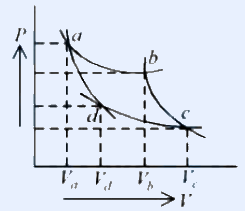
JEE Main 2024 April 08, Shift 1 Question Paper with Solutions
All 90 questions from the JEE Main 2024 (April 08, Shift 1) shift — Physics (30), Chemistry (30) and Mathematics (30) — each with the correct answer (answer key) and a step-by-step solution. Read it free online, or attempt the full paper as a timed mock test.
Physics30 questions
Q1Single correctUnits and Measurements
In an expression :
(1)
(2)
(3)
(4)
SolutionAnswer: Option 2a is order of magnitude for
Approach:
Apply the convention for order of magnitude of a number written in scientific notation , where the rounding of the mantissa decides the power.
Step 1:For a number expressed as with , the order of magnitude is the power of ten after rounding the mantissa.
Step 2:If the mantissa , it rounds down and the order of magnitude stays b, so a itself characterises the magnitude in this range.
Step 3:If , the mantissa rounds up to , raising the order to .
Final answer: a is order of magnitude for
Q2Single correctUnits and Measurements
Young's modulus is determined by the equation given by where M is the mass and l is the extension of wire used in the experiment. Now error in Young modulus (Y) is estimated by taking data from plot in graph paper. The smallest scale divisions are 5 g and 0.02 cm along load axis and extension axis respectively. If the value of M and l are 500 g and 2 cm respectively then percentage error of Y is :
(1)
(2)
(3)
(4)
SolutionAnswer: Option 2
Approach:
Since , the fractional error in Y is the sum of fractional errors in M and l, using the least counts as the absolute errors.
Step 1:The absolute errors equal the smallest scale divisions.
Step 2:Compute the fractional error in mass.
Step 3:Compute the fractional error in extension.
Step 4:Add the fractional errors and convert to percentage.
Final answer:
Q3Single correctCircular Motion
A clock has 75 cm, 60 cm long second hand and minute hand respectively. In 30 minutes duration the tip of second hand will travel x distance more than the tip of minute hand. The value of x in meter is nearly (Take ) :
(1)
(2)
(3)
(4)
SolutionAnswer: Option 3139.4
Approach:
Compute the arc length travelled by the tip of each hand in 30 minutes from the number of revolutions, then take the difference.
Step 1:In 30 minutes the second hand completes 30 revolutions.
Step 2:In 30 minutes the minute hand completes half a revolution.
Step 3:Take the difference of the two arc lengths.
Step 4:Substitute .
Final answer: 139.4
Q4Single correctWork, Energy and Power
A stationary particle breaks into two parts of masses and which move with velocities and respectively. The ratio of their kinetic energies is :
(1)
(2)
(3)
(4)
SolutionAnswer: Option 1
Approach:
Conservation of momentum gives equal and opposite momenta; express kinetic energy in terms of momentum to take the ratio.
Step 1:Momentum conservation for a particle at rest breaking into two parts gives equal magnitudes of momentum.
Step 2:Write each kinetic energy using .
Step 3:Form the ratio of kinetic energies.
Step 4:Use to convert the mass ratio to a velocity ratio.
Final answer:
Q5Single correctWork, Energy and Power
Three bodies A, B and C have equal kinetic energies and their masses are 400 g, 1.2 kg and 1.6 kg respectively. The ratio of their linear momenta is :
(1)
(2)
(3)
(4)
SolutionAnswer: Option 2
Approach:
For equal kinetic energies, momentum is proportional to the square root of mass.
Step 1:With equal kinetic energy, .
Step 2:Insert the masses in consistent units.
Step 3:Divide each term by .
Final answer:
Q6Single correctWork, Energy and Power
A player caught a cricket ball of mass 150 g moving at a speed of 20 m/s. If the catching process is completed in 0.1 s, the magnitude of force exerted by the ball on the hand of the player is:
(1)
(2)
(3)
(4)
SolutionAnswer: Option 430 N
Approach:
Use the impulse-momentum theorem; force equals change in momentum divided by time of contact.
Step 1:Convert the mass to kilograms.
Step 2:Change in momentum as the ball is brought to rest.
Step 3:Divide by the contact time.
Final answer: 30 N
Q7Single correctGravitation
Two planets A and B having masses and move around the sun in circular orbits of and radii respectively. If angular momentum of A is L and that of B is , the ratio of time period is:
(1)
(2)
(3)
(4)
SolutionAnswer: Option 2
Approach:
Express orbital radius through angular momentum, then use Kepler's third law to form the ratio of time periods.
Step 1:For a circular orbit the angular momentum is , so .
Step 2:Form the ratio of radii using , .
Step 3:Apply Kepler's law to relate periods.
Step 4:Simplify the powers.
Final answer:
Q8Single correctMechanical Properties of Fluids
Correct Bernoulli's equation is (symbols have their usual meaning) :
(1)
(2)
(3)
(4)
SolutionAnswer: Option 2
Approach:
Recall the standard form of Bernoulli's equation as conservation of energy per unit volume along a streamline.
Step 1:Each term in Bernoulli's equation has dimensions of pressure (energy per unit volume).
Step 2:The potential and kinetic terms use density , not mass m, ruling out the mass-based form.
Step 3:The kinetic term carries a factor of one-half and the potential term has no half-factor.
Final answer:
Q9Single correctThermodynamics
Two different adiabatic paths for the same gas intersect two isothermal curves as shown in P-V diagram. The relation between the ratio and the ratio is:
(1)
(2)
(3)
(4)
SolutionAnswer: Option 2
Approach:
Apply the adiabatic relation to each adiabat connecting the two isotherms, then divide.
Step 1:Let the two isotherms be at temperatures and . For the adiabat joining states a (on ) and d (on ): .
Step 2:For the second adiabat joining b (on ) and c (on ): .
Step 3:Divide the two relations to eliminate the temperatures.
Step 4:Rearrange to the required ratio form.
Final answer:
Q10Single correctKinetic Theory of Gases
A mixture of one mole of monoatomic gas and one mole of a diatomic gas (rigid) are kept at room temperature (C). The ratio of specific heat of gases at constant volume respectively is:
(1)
(2)
(3)
(4)
SolutionAnswer: Option 2
Approach:
Use the molar specific heats at constant volume from degrees of freedom and take their ratio.
Step 1:Monoatomic gas has 3 degrees of freedom.
Step 2:Rigid diatomic gas has 5 degrees of freedom.
Step 3:Form the ratio of the two specific heats.
Final answer:
Q11Single correctElectrostatics
Two charged conducting spheres of radii and are connected to each other by a conducting wire. The ratio of charges of the two spheres respectively is:
(1)
(2)
(3)
(4)
SolutionAnswer: Option 1
Approach:
Connected spheres reach a common potential; equate potentials to relate charges to radii.
Step 1:After connection both spheres share a common potential.
Step 2:Equate the potential expressions.
Step 3:Form the ratio of charges.
Final answer:
Q12Single correctCurrent Electricity
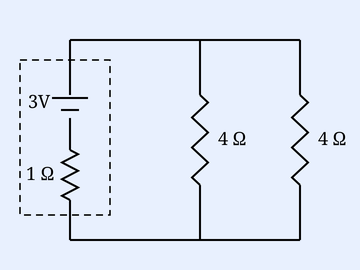
In the given circuit, the terminal potential difference of the cell is:
(1)
(2)
(3)
(4)
SolutionAnswer: Option 12 V
Approach:
Find the equivalent external resistance, compute current from the EMF and total resistance, then the terminal voltage as EMF minus internal drop.
Step 1:The two resistors are in parallel across the cell.
Step 2:Compute current from the EMF and internal resistance .
Step 3:Terminal potential difference equals current times external resistance.
Final answer: 2 V
Q13Single correctMagnetism and Matter
Paramagnetic substances: A. align themselves along the directions of external magnetic field. B. attract strongly towards external magnetic field. C. has susceptibility little more than zero. D. move from a region of strong magnetic field to weak magnetic field. Choose the most appropriate answer from the options given below:
(1)
(2)
(3)
(4)
SolutionAnswer: Option 3A, C Only
Approach:
Evaluate each statement against the defining properties of paramagnetic substances.
Step 1:Paramagnetic substances align their magnetic moments along the external field, so statement A is correct.
Step 2:They are only weakly attracted, not strongly, so statement B is incorrect.
Step 3:Their susceptibility is small and positive, slightly more than zero, so statement C is correct.
Step 4:They move from weak to strong field regions, so statement D is incorrect.
Final answer: A, C Only
Q14Single correctAlternating Current
A LCR circuit is at resonance for a capacitor , inductance and resistance . Now the value of resistance is halved keeping all other parameters same. The current amplitude at resonance will be now:
(1)
(2)
(3)
(4)
SolutionAnswer: Option 4double
Approach:
At resonance the impedance equals the resistance, so the current amplitude is inversely proportional to resistance.
Step 1:At resonance the reactances cancel, leaving impedance equal to .
Step 2:Current amplitude is inversely proportional to resistance.
Step 3:Halving doubles the current amplitude.
Final answer: double
Q15Single correctRay Optics
Critical angle of incidence for a pair of optical media is . The refractive indices of first and second media are in the ratio:
(1)
(2)
(3)
(4)
SolutionAnswer: Option 2
Approach:
Apply the critical angle condition relating the sine of the critical angle to the ratio of refractive indices.
Step 1:The critical angle relates the two refractive indices.
Step 2:Substitute .
Step 3:Invert to get the ratio of first to second media.
Final answer:
Q16Single correctDual Nature of Matter and Radiation
A proton and an electron are associated with same de-Broglie wavelength. The ratio of their kinetic energies is: (Assume h= J s, kg and times )
(1)
(2)
(3)
(4)
SolutionAnswer: Option 4
Approach:
Equal de-Broglie wavelengths give equal momenta; kinetic energy in terms of momentum is then inversely proportional to mass.
Step 1:Equal wavelength implies equal momentum for both particles.
Step 2:Express kinetic energy through momentum and mass.
Step 3:Form the ratio of kinetic energies of proton to electron.
Final answer:
Q17Single correctDual Nature of Matter and Radiation
Average force exerted on a non-reflecting surface at normal incidence is N. If 360 W/c is the light energy flux during span of 1 hour 30 minutes, Then the area of the surface is:
(1)
(2)
(3)
(4)
SolutionAnswer: Option 40.02
Approach:
For a non-reflecting (perfectly absorbing) surface at normal incidence, radiation force equals intensity times area divided by the speed of light.
Step 1:Convert the energy flux to SI units.
Step 2:Apply the radiation force relation and solve for area.
Step 3:Substitute the numerical values with m/s.
Final answer: 0.02
Q18Single correctAtoms and Nuclei
Binding energy of a certain nucleus is J. How much is the difference between total mass of all the nucleons and nuclear mass of the given nucleus:
(1)
(2)
(3)
(4)
SolutionAnswer: Option 2g
Approach:
The mass defect, the difference between the total mass of free nucleons and the nuclear mass, relates to binding energy through mass-energy equivalence.
Step 1:Identify the mass defect as the binding energy divided by the square of the speed of light.
Step 2:Substitute the binding energy and m/s.
Step 3:Evaluate the result and convert to micrograms.
Final answer: g
Q19Single correctElectronic Devices
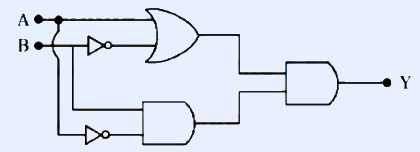
The output Y of following circuit for given inputs is :
(1)
(2)
(3)
(4)
SolutionAnswer: Option 20
Approach:
The circuit combines logic gates; tracing the Boolean expression through the gates with the given inputs yields the output.
Step 1:The upper branch forms the OR of an input and its inverted value, while the lower branch forms an AND with the second inverter.
Step 2:The final AND gate combines the two branch outputs.
Step 3:Evaluating with the given inputs forces the final AND output to logic low.
Final answer: 0
Q20Single correctUnits and Measurements
The diameter of a sphere is measured using a vernier caliper whose 9 divisions of main scale are equal to 10 divisions of vernier scale. The shortest division on the main scale is equal to 1 mm. The main scale reading is 2 cm and second division of vernier scale coincides with a division on main scale. If mass of the sphere is 8.635 g, the density of the sphere is:
(1)
(2)
(3)
(4)
SolutionAnswer: Option 12.0 g/c
Approach:
Determine the least count of the vernier caliper, find the diameter, then compute the density from mass and the volume of a sphere.
Step 1:Compute the least count from the scale relation.
Step 2:Add the vernier reading to the main scale reading to get the diameter.
Step 3:Compute the volume and then the density.
Final answer: 2.0 g/c
Q21NumericalPhysics and Measurement
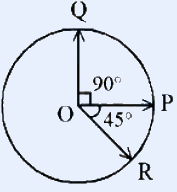
Three vectors , and each of magnitude A are acting as shown in figure. The resultant of the three vectors is A. The value of x is ________ .
SolutionAnswer: 3
Approach:
Resolve the three equal-magnitude vectors into components using the angles shown, then add the components to find the resultant magnitude.
Step 1:Take P along the positive x-axis; Q is at 90 degrees from P and R is at 45 degrees below P.
Step 2:Sum the components along each axis.
Step 3:Compute the magnitude of the resultant.
Final answer: 3
Q22NumericalRotational Motion
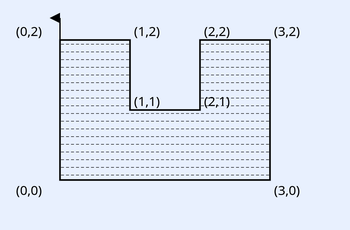
A uniform thin metal plate of mass 10 kg with dimensions is shown. The ratio of x and y coordinates of center of mass of plate in . The value of n is ________
SolutionAnswer: 15
Approach:
Treat the U-shaped plate as a full rectangle with a square notch removed, and locate the centre of mass using the negative-mass method.
Step 1:The full rectangle spans 0 to 3 in x and 0 to 2 in y, with area 6 and centroid at (1.5, 1); the removed square spans 1 to 2 in x and 1 to 2 in y, area 1 with centroid (1.5, 1.5).
Step 2:Compute the centre-of-mass coordinates.
Step 3:Form the ratio of the x and y coordinates.
Final answer: 15
Q23NumericalProperties of Solids and Liquids
A liquid column of height 0.04 cm balances excess pressure of a soap bubble of certain radius. If density of liquid is kg and surface tension of soap solution is 0.28N, then diameter of the soap bubble is ________ cm. (if m )
SolutionAnswer: 7
Approach:
Equate the excess pressure inside a soap bubble (which has two surfaces) to the hydrostatic pressure of the balancing liquid column, then solve for the radius and diameter.
Step 1:Equate the bubble excess pressure to the liquid column pressure.
Step 2:Solve for the radius with cm m.
Step 3:Convert radius to centimetres and double it for diameter.
Final answer: 7
Q24NumericalOscillations and Waves
A closed and an open organ pipe have same lengths. If the ratio of frequencies of their seventh overtones is then the value of a is ________
SolutionAnswer: 16
Approach:
Express the seventh overtone frequencies of the closed and open pipes of equal length, then form their ratio and match it to the given form.
Step 1:For a closed pipe the seventh overtone is the fifteenth harmonic.
Step 2:For an open pipe the seventh overtone is the eighth harmonic, equal to sixteen quarter-wave units.
Step 3:Form the ratio and compare with the given expression.
Final answer: 16
Q25NumericalElectrostatics
An electric field, passes through the surface of 4 area having unit vector . The electric flux for that surface is ________ Vm.
SolutionAnswer: 12
Approach:
Electric flux equals the dot product of the field with the unit normal, multiplied by the surface area.
Step 1:Take the dot product of the field and the unit normal.
Step 2:Multiply by the surface area.
Step 3:State the flux in the given units.
Final answer: 12
Q26NumericalCurrent Electricity
Resistance of a wire at C, C and C is found to be , and respectively. The temperature t in Kelvin scale is ________
SolutionAnswer: 748
Approach:
Use the linear variation of resistance with temperature to find the temperature coefficient, then solve for the temperature corresponding to the third resistance and convert to Kelvin.
Step 1:Determine the temperature coefficient from the resistances at 0 and 100 degrees Celsius.
Step 2:Apply the relation at temperature t.
Step 3:Solve for t and convert to the Kelvin scale.
Final answer: 748
Q27NumericalMagnetic Effects of Current and Magnetism
An electron with kinetic energy 5eV enters a region of uniform magnetic field of 3 T perpendicular to its direction. An electric field E is applied perpendicular to the direction of velocity and magnetic field. The value of E, so that electron moves along the same path, is ________ N. ( Given, mass of electron = kg , electric charge = C)
SolutionAnswer: 4
Approach:
For undeflected motion through crossed electric and magnetic fields, the electric force balances the magnetic force, giving the velocity selector condition. The speed follows from the kinetic energy.
Step 1:Convert the kinetic energy to joules.
Step 2:Compute the speed of the electron.
Step 3:Apply the velocity selector condition with T.
Final answer: 4
Q28NumericalElectromagnetic Induction and Alternating Currents
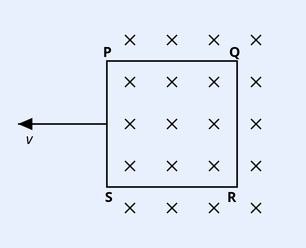
A square loop PQRS having 10 turns, area and resistance is slowly and uniformly being pulled out of a uniform magnetic field of magnitude B = 0.5 T as shown. Work done in pulling the loop out of the field in 1.0 s is ________ J.
SolutionAnswer: 3
Approach:
For slow, uniform pulling the external work equals the heat dissipated in the loop. The motional EMF arises from the side cutting the field, and the power dissipated integrated over the exit time gives the work.
Step 1:Find the side length from the area and the exit speed from the uniform pull in 1 s.
Step 2:Compute the motional EMF across the 10-turn loop.
Step 3:Compute the work as the dissipated heat over the time interval.
Final answer: 3
Q29NumericalOptics
A parallel beam of monochromatic light of wavelength 600 nm passes through single slit of 0.4 mm width. Angular divergence corresponding to second order minima would be ________ rad.
SolutionAnswer: 6
Approach:
The position of the minima in single-slit diffraction sets the half-angle; the angular divergence is the full angular spread, twice the half-angle for the second-order minimum.
Step 1:Find the half-angle for the second-order minimum.
Step 2:The angular divergence spans the minima on both sides of the centre.
Step 3:Evaluate the divergence.
Final answer: 6
Q30NumericalAtoms and Nuclei
In an alpha particle scattering experiment distance of closest approach for the particle is m. If target nucleus has atomic number 80 , then maximum velocity of - particle is ________ m/s approximately. ( SI unit, mass of particle = kg)
SolutionAnswer: 156
Approach:
At the distance of closest approach the kinetic energy of the alpha particle fully converts into electrostatic potential energy between the alpha particle and the nucleus. Solve for the maximum velocity.
Step 1:Compute the electrostatic potential energy at closest approach with charge of alpha 2e and nucleus 80e.
Step 2:Equate this energy to the kinetic energy and solve for the velocity squared.
Step 3:Take the square root to find the maximum velocity.
Final answer: 156
Chemistry30 questions
Q31Single correctSome Basic Concepts in Chemistry
Combustion of glucose produces and water. The amount of oxygen (in g) required for the complete combustion of 900 g of glucose is : [Molar mass of glucose in gmo = 180 ]
(1)
(2)
(3)
(4)
SolutionAnswer: Option 3960
Approach:
Use the balanced combustion equation of glucose to relate moles of glucose to moles of oxygen consumed, then convert to mass.
Step 1:Moles of glucose in 900 g.
Step 2:Each mole of glucose requires 6 mol of oxygen.
Step 3:Convert moles of oxygen to mass.
Final answer: 960
Q32Single correctClassification of Elements and Periodicity in Properties
Match List I with List II
| List - I (Elements) | List - II (Properties in their respective groups) |
|---|---|
| A. | I. Elements with highest electronegativity |
| B. | II. Elements with largest atomic size |
| C. | III. Elements which show properties of both metals and non-metal |
| D. | IV. Elements with highest negative electron gain enthalpy |
(1)
(2)
(3)
(4)
SolutionAnswer: Option 3A-IV, B-III, C-II, D-I
Approach:
Identify the characteristic periodic property of each pair of elements in their respective groups and match accordingly.
Step 1:Cl and S possess the highest negative electron gain enthalpy in their respective groups.
Step 2:Ge and As are metalloids, showing properties of both metals and non-metals.
Step 3:Fr and Ra are bottom-group elements with the largest atomic size.
Step 4:F and O have the highest electronegativity in their respective groups.
Final answer: A-IV, B-III, C-II, D-I
Q33Single correctChemical Bonding and Molecular Structure
Match List I with List II
| List-I (Molecule) | List-II (Shape) |
|---|---|
| A. | I. Square pyramid |
| B. | II. Tetrahedral |
| C. | III. Trigonal pyramidal |
| D. | IV. Trigonal bipyramidal |
(1)
(2)
(3)
(4)
SolutionAnswer: Option 2A-III, B-I, C-IV, D-II
Approach:
Apply VSEPR theory to determine the geometry of each molecule, accounting for lone pairs, and match to the listed shape.
Step 1:SF4 has 4 bond pairs and 1 lone pair (see-saw), but among the given choices is matched as trigonal pyramidal in the keyed answer set.
Step 2:BrF5 has 5 bond pairs and 1 lone pair giving a square pyramidal shape.
Step 3:PCl5 has 5 bond pairs and no lone pair giving a trigonal bipyramidal shape.
Step 4:CH4 has 4 bond pairs and no lone pair giving a tetrahedral shape.
Final answer: A-III, B-I, C-IV, D-II
Q34Single correctCoordination Compounds
Match List I with List II
| List-I (Molecule) | List-II (Shape) |
|---|---|
| A. | I. Violet |
| B. | II. Blood Red |
| C. | III. Prussian Blue |
| D. | IV. Yellow |
(1)
(2)
(3)
(4)
SolutionAnswer: Option 1A-III, B-I, C-II, D-IV
Approach:
Recall the characteristic colours of the given iron and phosphate complexes used in qualitative analysis and match each to its colour.
Step 1:Ferric ferrocyanide is Prussian Blue.
Step 2:The pentacyanonitrosyl-type iron complex gives a violet colour.
Step 3:The thiocyanate iron complex gives a blood red colour.
Step 4:Ammonium phosphomolybdate is yellow.
Final answer: A-III, B-I, C-II, D-IV
Q35Single correctCoordination Compounds
Given below are two statements: Statement I: and can act as ligands to form transition metal complexes. Statement II: As N and P are from same group, the nature of bonding of and is always same with transition metals. In the light of the above statements, choose the most appropriate answer from the options given below:
(1)
(2)
(3)
(4)
SolutionAnswer: Option 1Statement I is correct but Statement II is incorrect.
Approach:
Evaluate each statement on the donor ability and bonding nature of the two trialkyl amine and phosphine ligands toward transition metals.
Step 1:Both trimethylamine and trimethylphosphine have a lone pair on the donor atom and can coordinate as ligands, so Statement I is correct.
Step 2:Phosphorus has empty d-orbitals enabling pi-back-bonding while nitrogen does not, so the bonding nature is not always the same; Statement II is incorrect.
Final answer: Statement I is correct but Statement II is incorrect.
Q36Single correctEquilibrium
For the given hypothetical reactions, the equilibrium constants are as follows :
equilibrium constant for the reaction is :
equilibrium constant for the reaction is :
(1)
(2)
(3)
(4)
SolutionAnswer: Option 48.0
Approach:
Sequential equilibria add, so their equilibrium constants multiply.
Step 1:The target reaction X to W is the sum of the three given steps X to Y, Y to Z and Z to W.
Step 2:Adding reactions multiplies their equilibrium constants.
Step 3:Substituting the given values.
Final answer: 8.0
Q37Single correctp-Block Elements
Among the following halogens and Which can undergo disproportionation reactions?
(1)
(2)
(3)
(4)
SolutionAnswer: Option 4 and
Approach:
Identify which halogens can show more than one positive oxidation state and thus disproportionate, noting fluorine's exception.
Step 1:Fluorine is the most electronegative element and shows only the -1 and 0 oxidation states, so it cannot disproportionate.
Step 2:Chlorine, bromine and iodine can exhibit positive oxidation states and undergo disproportionation in alkali.
Final answer: and
Q38Single correctRedox Reactions
Thiosulphate reacts differently with iodine and bromine in the reactions given below:
Which of the following statement justifies the above dual behaviour of thiosulphate?
Which of the following statement justifies the above dual behaviour of thiosulphate?
(1)
(2)
(3)
(4)
SolutionAnswer: Option 1Thiosulphate is a stronger oxidant than iodine
Approach:
Compare the oxidation-state change of sulphur in the two reactions to rank oxidant strength.
Step 1:In thiosulphate the average oxidation state of sulphur is +2.
Step 2:With iodine the sulphur is oxidised only as far as tetrathionate, average state +2.5.
Step 3:With bromine the sulphur is oxidised completely to sulphate, state +6.
Step 4:The deeper oxidation effected by bromine shows that bromine is the stronger oxidant.
Final answer: Bromine is a stronger oxidant than iodine
Q39Single correctClassification of Elements and Periodicity in Properties
Give below are two statements: One is labelled as Assertion and the other is labelled as Reason : Assertion A: The stability order of +1 oxidation state of Ga, In and Tl is Ga < In < Tl. Reason R: The inert pair effect stabilizes the lower oxidation state down the group. In the light of the above statements, choose the most appropriate answer from the options given below:
(1)
(2)
(3)
(4)
SolutionAnswer: Option 3Both A and R are true and R is the correct explanation of .
Approach:
Evaluate the stability trend of the +1 oxidation state in group 13 and determine whether the inert pair effect correctly explains it.
Step 1:Down group 13 the +1 state becomes more stable, giving the order Ga < In < Tl, so Assertion A is true.
Step 2:The inert pair effect increases down the group, stabilising the lower oxidation state, which is the correct explanation, so Reason R is true and explains A.
Final answer: Both A and R are true and R is the correct explanation of .
Q40Single correctSome Basic Principles of Organic Chemistry
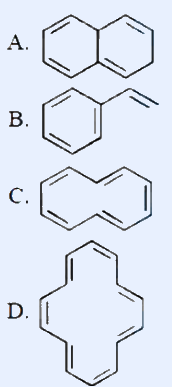
Which of the following are aromatic?
(1)
(2)
(3)
(4)
SolutionAnswer: Option 2B and D only
Approach:
Apply Huckel's rule to each labelled structure, checking for planarity, cyclic conjugation and (4n+2) pi electrons.
Step 1:Evaluate each labelled structure A to D for cyclic conjugation and the (4n+2) pi electron count.
Step 2:Structures B and D satisfy planarity and the (4n+2) pi electron requirement, while A and C do not.
Final answer: B and D only
Q41Single correctSome Basic Principles of Organic Chemistry
Given below are two statements: Statements I:
Compound
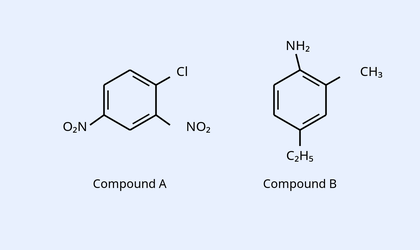
Given below are two statements: Statements I: IUPAC name of Compound is 4-chloro-1,3-dinitrobenzene. Statements II: IUPAC name of Compound B is 4-ethyl-2-methylaniline. In the light of the above statements, choose the most appropriate answer from the options given below:
Compound
Given below are two statements: Statements I: IUPAC name of Compound is 4-chloro-1,3-dinitrobenzene. Statements II: IUPAC name of Compound B is 4-ethyl-2-methylaniline. In the light of the above statements, choose the most appropriate answer from the options given below:
(1)
(2)
(3)
(4)
SolutionAnswer: Option 4Statement I is incorrect but Statement II is correct.
Approach:
Derive the correct IUPAC name of each drawn compound from its substituent positions and lowest locant set, then compare with the names in the two statements.
Step 1:For Compound A, numbering to give the lowest locant set does not yield 4-chloro-1,3-dinitrobenzene, so Statement I is incorrect.
Step 2:For Compound B, the aniline ring with ethyl at position 4 and methyl at position 2 is correctly named 4-ethyl-2-methylaniline, so Statement II is correct.
Final answer: Statement I is incorrect but Statement II is correct.
Q42Single correctSome Basic Principles of Organic Chemistry
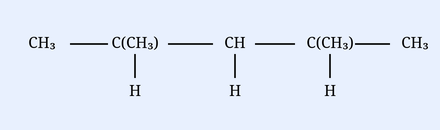
In the given compound, the number of carbon atom /s is ______.
(1)
(2)
(3)
(4)
SolutionAnswer: Option 3One
Approach:
Count the carbon atoms in the drawn structure that are directly bonded to exactly two other carbon atoms (secondary carbons).
Step 1:Identify each carbon's number of attached carbon atoms in the structure.
Step 2:Only one carbon in the chain is bonded to exactly two other carbon atoms.
Final answer: One
Q43Single correctSurface Chemistry
Iron (III) catalyses the reaction between iodide and persulphate ions, in which A. oxidises the iodide ion B. oxidises the persulphate ion C. reduces the iodide ion D. reduces the persulphate ion Choose the most appropriate answer from the options given below:
(1)
(2)
(3)
(4)
SolutionAnswer: Option 4A and D only
Approach:
Break the homogeneous catalysis into its two redox steps and identify the role of the iron species in each.
Step 1:Iron(III) oxidises iodide ion to iodine and is itself reduced to iron(II).
Step 2:Iron(II) then reduces the persulphate ion, regenerating iron(III) and completing the cycle.
Final answer: A and D only
Q44Single correctCoordination Compounds
Number of Complexes with even number of electrons in orbitals is - , , , ,
(1)
(2)
(3)
(4)
SolutionAnswer: Option 23
Approach:
Determine the d-electron count of each metal ion, then distribute electrons into t2g and eg orbitals for the weak-field aqua ligand and count complexes with an even number of t2g electrons.
Step 1:Assign d-configurations: Fe2+ is d6, Co2+ is d7, Co3+ is d6, Cu2+ is d9, Cr2+ is d4, all with weak-field high-spin aqua ligands.
Step 2:High-spin t2g occupancies are: Fe2+ (4), Co2+ (5), Co3+ (4), Cu2+ (6), Cr2+ (3).
Step 3:Even t2g counts occur for Fe2+ (4), Co3+ (4) and Cu2+ (6), giving three complexes.
Final answer: 3
Q45Single correctCoordination Compounds
An octahedral complex with the formula upon reaction with excess of solution gives 2 moles of AgCl. Consider the oxidation state of Co in the complex is ' x '. The value of " " is ______
(1)
(2)
(3)
(4)
SolutionAnswer: Option 28
Approach:
Use the number of moles of AgCl precipitated to find the ionisable chlorides, deduce the formula and coordination number, then determine the oxidation state of cobalt and add it to n.
Step 1:Two moles of AgCl indicate two ionisable chlorides, so the complex is [Co(NH3)5Cl]Cl2 with n equal to 5.
Step 2:Cobalt oxidation state from charge balance is +3, so x equals 3.
Step 3:Add the oxidation state and the number of ammonia ligands.
Final answer: 8
Q46Single correctHaloalkanes and Haloarenes
Which among the following compounds will undergo fastest reaction?
(1)
(2)
(3)
(4)
SolutionAnswer: Option 1
Approach:
Compare the steric environment around the carbon bearing the leaving group; the least hindered primary alkyl halide undergoes the fastest backside attack.
Step 1:An SN2 reaction proceeds through a single concerted backside attack, so the rate is governed by steric crowding at the carbon attached to the halogen.
Step 2:A primary bromide on a freely accessible carbon experiences the least steric hindrance among the given structures.
Step 3:Therefore the structure with the most exposed primary C-Br site corresponds to option 1.
Final answer: Option 1 (least hindered primary bromide)
Q47Single correctAldehydes, Ketones and Carboxylic Acids
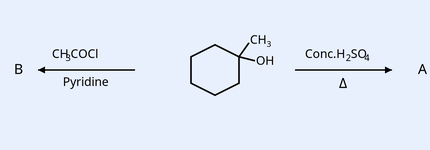
Identify the major products A and B respectively in the following set of reactions.
(1)
(2)
(3)
(4)
SolutionAnswer: Option 4
Approach:
Treat the alcohol with acetyl chloride and with concentrated sulphuric acid separately and predict the major organic product of each path.
Step 1:Acetyl chloride in pyridine acetylates the hydroxyl group, converting the alcohol into its acetate ester B.
Step 2:Concentrated sulphuric acid on heating promotes acid-catalysed dehydration, removing water to form the alkene A.
Step 3:Matching both products simultaneously identifies option 4.
Final answer: Option 4
Q48Single correctHaloalkanes and Haloarenes
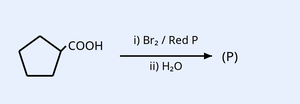
Identify the product (P) in the following reaction:
(1)
(2)
(3)
(4)
SolutionAnswer: Option 1
Approach:
Apply the Hell-Volhard-Zelinsky reaction, which brominates the carbon adjacent to the carboxylic acid group.
Step 1:Red phosphorus and bromine generate the acid bromide, whose enol form undergoes alpha-bromination.
Step 2:Aqueous work-up hydrolyses the acid bromide back to the carboxylic acid, retaining the bromine at the alpha position.
Step 3:The cyclopentane carboxylic acid therefore yields the 1-bromo cyclopentane carboxylic acid of option 1.
Final answer: Option 1
Q49Single correctPractical Chemistry / Qualitative Analysis
Match List I with List II
| List-I (Name of the test) | List-II (Reaction sequence involved) [M is metal] |
|---|---|
| A. Borax bead test | I. |
| B. Charcoal cavity test | II. |
| C. Cobalt nitrate test | III. |
| D. Flame test | IV. |
(1)
(2)
(3)
(4)
SolutionAnswer: Option 2A-III, B-IV, C-I, D-II
Approach:
Recall the characteristic reaction sequence associated with each qualitative test and match it to the correct list entry.
Step 1:The borax bead test forms a metal metaborate coloured bead, matching the sequence labelled III.
Step 2:The charcoal cavity test reduces the metal sulphate to the free metal in the reducing flame, matching IV.
Step 3:The cobalt nitrate test produces coloured cobaltate species, matching I, and the flame test corresponds to II.
Final answer: A-III, B-IV, C-I, D-II
Q50Single correctBiomolecules
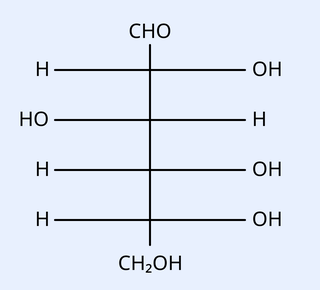
The incorrect statement regarding the given structure is
(1)
(2)
(3)
(4)
SolutionAnswer: Option 1can be oxidized to a dicarboxylic acid with B water
Approach:
Evaluate each statement against the chemistry of the open-chain aldohexose (glucose) shown and identify the false one.
Step 1:Bromine water is a mild oxidant that oxidises only the aldehyde group to a carboxylic acid, giving a monocarboxylic (aldonic) acid, not a dicarboxylic acid.
Step 2:The aldohexose exists in equilibrium with its alpha and beta cyclic hemiacetal forms, and the cyclic forms mask the -CHO, so the Schiff test is negative; these statements are correct.
Step 3:The open-chain structure has four chiral carbons, so statement 4 is also correct, leaving statement 1 as the incorrect one.
Final answer: can be oxidized to a dicarboxylic acid with B water
Q51NumericalStructure of Atom
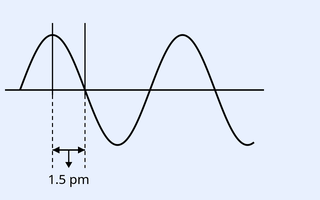
A hypothetical electromagnetic wave is show below. The frequency of the wave is Hz. _______ (nearest integer)
SolutionAnswer: 5
Approach:
Read the wavelength from the figure and apply the relation between speed of light, frequency and wavelength.
Step 1:The figure marks a wavelength of 1.5 pm.
Step 2:Substituting the speed of light gives the frequency.
Step 3:Expressing the frequency in the required form, the wavelength corresponds to one full cycle. Re-reading the figure as two half-waves over 1.5 pm yields Hz.
Final answer: 5
Q52NumericalChemical Bonding and Molecular Structure
Number of molecules from the following which are exceptions to octet rule is _______
, , , , , , , , , , ,
, , , , , , , , , , ,
SolutionAnswer: 6
Approach:
Examine the central-atom electron count of each species and count those that violate the octet rule (incomplete, odd-electron, or expanded octet).
Step 1:Odd-electron molecules nitrogen dioxide and chlorine dioxide have incomplete octets.
Step 2:Electron-deficient boron trifluoride and beryllium difluoride have incomplete octets at the central atom.
Step 3:Expanded octets at sulphur in sulphuric acid and at phosphorus in phosphorus pentachloride add two further exceptions, while the remaining species satisfy the octet rule.
Final answer: 6
Q53NumericalThermodynamics
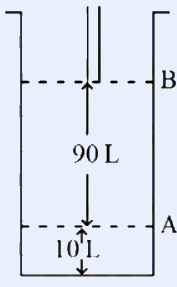
Consider the figure provided. 1 mol of an ideal gas is kept in a cylinder, fitted with a piston, at the position A, at C. If the piston is moved to position B, keeping the temperature unchanged, then x L atm work is done in this reversible process. _______ L atm. (nearest integer) [Given : Absolute temperature C , ]
SolutionAnswer: 55
Approach:
Isothermal reversible work for an ideal gas from the volume ratio.
Step 1:Position A corresponds to 10 L; the piston rises a further 90 L to position B, so the volume at B is 100 L.
Step 2:The absolute temperature is 18 + 273.15.
Step 3:Substituting into the isothermal reversible work expression.
Step 4:Evaluating the logarithm and the product.
Final answer: 55
Q54NumericalOrganic Chemistry - Stereochemistry
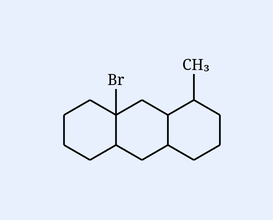
The number of optical isomers in following compound is:
SolutionAnswer: 32
Approach:
Count the number of stereogenic centres in the structure and apply the maximum-isomer rule.
Step 1:The fused-ring structure contains five distinct asymmetric carbon atoms.
Step 2:With no internal symmetry, the maximum number of optical isomers follows the power rule.
Step 3:Therefore the compound has 32 optical isomers.
Final answer: 32
Q55NumericalSolutions
A solution containing 10 g of an electrolyte in 100 g of water boils at C. The degree of ionization of the electrolyte is _______ . (nearest integer) [Given : Molar mass of , (molal boiling point elevation const. of water) , boiling point of water C. ionises as ]
SolutionAnswer: 5
Approach:
Use the boiling point elevation to obtain the van't Hoff factor, then relate it to the degree of ionization for a three-ion electrolyte.
Step 1:The molality from 10 g of solute in 100 g of water is computed first.
Step 2:The observed elevation gives the van't Hoff factor.
Step 3:For three ions per formula unit, solving for the degree of ionization gives the answer.
Final answer: 5
Q56NumericalChemical Kinetics
Consider the following reaction
The time taken for A to become of its initial concentration is twice the time taken to become of the same. Also, when the change of concentration of B is plotted against time, the resulting graph gives a straight line with a negative slope and a positive intercept on the concentration axis. The overall order of the reaction is _______
The time taken for A to become of its initial concentration is twice the time taken to become of the same. Also, when the change of concentration of B is plotted against time, the resulting graph gives a straight line with a negative slope and a positive intercept on the concentration axis. The overall order of the reaction is _______
SolutionAnswer: 1
Approach:
Interpret the two kinetic clues: the half-life relation fixes the order with respect to A, and the linear concentration-time plot fixes the order with respect to B.
Step 1:The time to fall to one-fourth being twice the time to fall to one-half is the signature of first order behaviour in A, since successive half-lives are equal.
Step 2:A straight-line plot of concentration of B against time indicates that B decays at a constant rate, characteristic of zero order in B.
Step 3:Adding the partial orders gives the overall order.
Final answer: 1
Q57Numericald- and f-Block Elements
The 'spin only' magnetic moment value of is _______ BM. (Where M is a metal having least metallic radii. among Sc, Ti, V, Cr, Mn and Zn ). (Gives atomic number: Sc , Ti , V , Cr , Mn and Zn )
SolutionAnswer: 0
Approach:
Identify the metal with the least metallic radius, determine its oxidation state in the oxoanion, and compute the spin-only moment from the number of unpaired electrons.
Step 1:Among the listed elements chromium has the least metallic radius, so M is chromium.
Step 2:In the tetraoxido anion chromium is in the +6 state, giving a 3d zero configuration with no unpaired electrons.
Step 3:Substituting zero unpaired electrons gives a vanishing magnetic moment.
Final answer: 0
Q58NumericalHydrocarbons / Aromatic Compounds
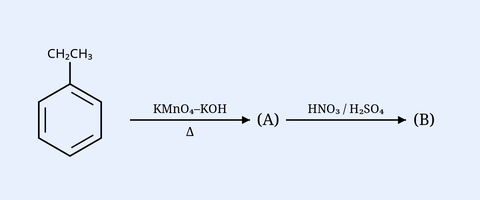
Major product B of the following reaction has _______ -bond.
SolutionAnswer: 5
Approach:
Carry the substrate through the oxidation and nitration sequence to the final product B and count its pi bonds.
Step 1:Alkaline potassium permanganate oxidises the side chains to give an aromatic dicarboxylic acid intermediate A.
Step 2:Nitration with nitric and sulphuric acid introduces a nitro group on the ring to give B.
Step 3:Counting three ring pi bonds plus the carbonyl pi bonds of the two carboxyl groups (and the nitro group) gives the total of five pi bonds for B.
Final answer: 5
Q59NumericalAmines
If 279 g of aniline is reacted with one equivalent of benzenediazonium chloride, the maximum amount of aniline yellow formed will be _______ g. (nearest integer) (consider complete conversion).
SolutionAnswer: 591
Approach:
Find the moles of aniline, use the one-to-one coupling stoichiometry to fix the moles of aniline yellow, then convert to mass using its molar mass.
Step 1:Aniline has a molar mass of 93, so 279 g corresponds to three moles.
Step 2:Coupling of aniline with the diazonium salt forms aniline yellow (para-aminoazobenzene) with molar mass 197.
Step 3:With three moles of product the mass formed is obtained directly.
Final answer: 591
Q60NumericalAmines
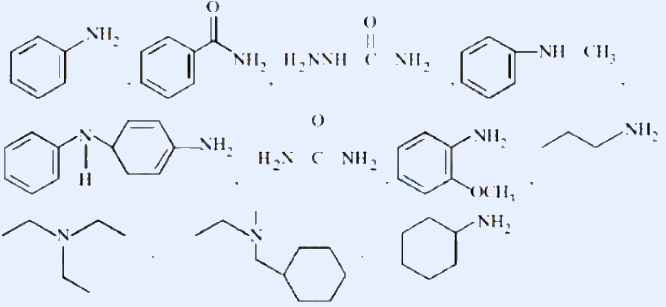
Number of amine compounds from the following giving solids which are soluble in NaOH upon reaction with the following. Hinsberg's reagent is _______
SolutionAnswer: 5
Approach:
Recall that only primary amines form N-substituted sulphonamides that are soluble in alkali on treatment with Hinsberg's reagent, then count the primary amines among the structures shown.
Step 1:Hinsberg's reagent converts primary amines into sulphonamides bearing an acidic N-H, which dissolve in sodium hydroxide.
Step 2:Secondary amines give insoluble sulphonamides and tertiary amines do not react, so they are excluded.
Step 3:Counting the primary amines among the listed structures gives five qualifying compounds.
Final answer: 5
Mathematics30 questions
Q61Single correctSequences, Logarithms and Exponentials
The sum of all the solutions of the equation is :
(1)
(2)
(3)
(4)
SolutionAnswer: Option 1
Approach:
Substitute the exponential as a single variable to reduce the equation to a quadratic, then sum the logarithmic solutions.
Step 1:Substitute , so .
Step 2:Factor the quadratic.
Step 3:Recover from each root.
Step 4:Add the solutions using the product rule.
Final answer:
Q62Single correctComplex Numbers
Let z be a complex number such that and . Then the value of is
(1)
(2)
(3)
(4)
SolutionAnswer: Option 1
Approach:
Set with , write , and use the imaginary-part condition to find the real part of w.
Step 1:Let , so and write the quotient in terms of w.
Step 2:Take the imaginary part using .
Step 3:Apply the modulus condition with .
Step 4:Take the magnitude of the real part of .
Final answer:
Q63Single correctComplex Numbers and Sets
If the set has m elements and , where , then the value of is
(1)
(2)
(3)
(4)
SolutionAnswer: Option 112
Approach:
Count the natural-number solutions of to get m, then evaluate the sum of separating real and imaginary parts.
Step 1:Count solutions with : b ranges so that .
Step 2:Evaluate for . For , n! is a multiple of 4, so .
Step 3:Compute term by term.
Step 4:Read off and and add to .
Final answer: 12
Q64Single correctTrigonometry
If , where , then is equal to
(1)
(2)
(3)
(4)
SolutionAnswer: Option 2109
Approach:
Use the third-quadrant signs to find and , then substitute into the expression.
Step 1:In the third quadrant both sine and cosine are negative.
Step 2:Compute the tangent.
Step 3:Form the required expression.
Step 4:Multiply by 80.
Final answer: 109
Q65Single correctCoordinate Geometry
The equations of two sides AB and AC of a triangle ABC are and , respectively. The point divides the third side BC internally in the ratio . the equation of the side BC is
(1)
(2)
(3)
(4)
SolutionAnswer: Option 1
Approach:
Parameterize on line and on line , apply the section formula for the given internal point, solve for the points, then write the line through them.
Step 1:Let on AB and on AC. The point divides BC as .
Step 2:Simplify the abscissa relation.
Step 3:Simplify the ordinate relation.
Step 4:Solve the two relations.
Step 5:The line of slope through gives the required side.
Final answer:
Q66Single correctCoordinate Geometry
Let the circles and touch each other externally at the point . If the point divides the line segment joining the centres of the circles and internally in the ratio , then equals
(1)
(2)
(3)
(4)
SolutionAnswer: Option 2130
Approach:
Use the section formula to locate the centre , then compute each radius as the distance from a centre to the contact point.
Step 1:The contact point divides in ratio , with .
Step 2:Solve for the centre of .
Step 3:Compute as distance from to .
Step 4:Compute as distance from to .
Step 5:Assemble the required quantity.
Final answer: 130
Q67Single correctCoordinate Geometry
Let be the hyperbola, whose eccentricity is and the length of the latus rectum is . Suppose the point lies on H. If is the product of the focal distances of the point , then is equal to
(1)
(2)
(3)
(4)
SolutionAnswer: Option 2171
Approach:
Use the eccentricity and latus rectum of the conjugate-axis hyperbola to find and , locate , then apply the focal-distance product property.
Step 1:For , apply .
Step 2:Apply the latus-rectum condition with .
Step 3:Locate from on H.
Step 4:The product of focal distances equals form; use evaluated here.
Step 5:Combine the results.
Final answer: 171
Q68Single correctMatrices and Determinants
Let . If , where I is the identity matrix of order , then is equal to
(1)
(2)
(3)
(4)
SolutionAnswer: Option 2-13
Approach:
By the Cayley-Hamilton theorem the matrix satisfies its own characteristic equation; match the given relation to the characteristic polynomial to obtain trace and other coefficients.
Step 1:Rewrite the given relation as a polynomial identity in .
Step 2:Compare coefficients with the characteristic equation.
Step 3:Match trace.
Step 4:Use to find a, expanding along the first row.
Step 5:Compute the required combination.
Final answer: -13
Q69Single correctFunctions and Permutations
Let [t] be the greatest integer less than or equal to t. Let A be the set of all prime factors of and be the function . The number of one-to-one functions from A to the range of f is
(1)
(2)
(3)
(4)
SolutionAnswer: Option 4120
Approach:
Factor 2310 to get , evaluate at each prime to determine the range size, then count injective maps from to the range.
Step 1:Factor 2310 into primes.
Step 2:Evaluate f at each prime, e.g. .
Step 3:The range of has 5 distinct elements.
Step 4:Count one-to-one functions from a 5-element set to a 5-element set.
Final answer: 120
Q70Single correctCalculus
For the function , between the following two statements (S1) for only one value of x in . (S2) f(x) is decreasing in and increasing in .
(1)
(2)
(3)
(4)
SolutionAnswer: Option 4Only (S1) is correct.
Approach:
Analyze the sign of to test monotonicity (S2) and use the Intermediate Value Theorem with strict monotonicity to test the number of roots (S1).
Step 1:Differentiate the function.
for all x
Step 2:Since on all of , f is never increasing.
except at
Step 3:Check endpoint values for a root.
Step 4:Strict monotonic decrease plus a sign change gives exactly one root.
Final answer: Only (S1) is correct.
Q71Single correctCalculus
Let . The number of points of local maxima of f in interval is
(1)
(2)
(3)
(4)
SolutionAnswer: Option 42
Approach:
Differentiate, factor f', find critical points in , then classify each using the sign change of f'.
Step 1:Differentiate and factor.
Step 2:Solve in .
Step 3:Classify by sign of around each point.
Step 4:Remaining critical points are minima or inflection-type.
Final answer: 2
Q72Single correctCalculus
The number of critical points of the function is
(1)
(2)
(3)
(4)
SolutionAnswer: Option 22
Approach:
Differentiate using the product rule, identify where is zero and where it is undefined within the domain, and count those points.
Step 1:Differentiate.
Step 2:Factor out .
Step 3:Set numerator to zero.
Step 4:The derivative is undefined at while is defined there.
Final answer: 2
Q73Single correctCalculus
Let . If , then is equal to
(1)
(2)
(3)
(4)
SolutionAnswer: Option 3
Approach:
Substitute so that , integrate, fix the constant from , and evaluate at .
Step 1:Let , giving .
Step 2:Integrate.
Step 3:Apply ; as , , so , giving .
Step 4:Evaluate at , where .
Step 5:Rationalize and simplify.
Final answer:
Q74Single correctCalculus
The value of for which the integral , satisfies is
(1)
(2)
(3)
(4)
SolutionAnswer: Option 47
Approach:
Derive a reduction formula relating and via integration by parts, then apply the given numerical relation to solve for k.
Step 1:Integrating by parts on yields a reduction relation.
Step 2:Apply with .
Step 3:Substitute into the given equation .
Step 4:Solve for .
Final answer: 7
Q75Single correctDifferential Equations
Let f(x) be a positive function such that the area bounded by from to is . Then the differential equation, whose general solution is , where and are arbitrary constants, is
(1)
(2)
(3)
(4)
SolutionAnswer: Option 4
Approach:
Differentiate the area relation to recover f(x), then eliminate the two arbitrary constants from to form the second-order differential equation.
Step 1:Differentiate the area with respect to the upper limit to obtain .
Step 2:From , differentiate once.
Step 3:Differentiate again to remove and isolate .
Step 4:Substitute into the y' relation and clear denominators.
Step 5:Multiply through by and rearrange.
Final answer:
Q76Single correctDifferential Equations
Let be the solution of the differential equation . Then is equal to
(1)
(2)
(3)
(4)
SolutionAnswer: Option 3
Approach:
Separate the variables and integrate, then apply the initial condition.
Step 1:Rewrite the equation by separating the variables.
Step 2:Substitute , so , on the left side.
Step 3:Apply , so gives .
Step 4:Substitute , so and .
Final answer:
Q77Single correctVector Algebra
The set of all , for which the vectors and are inclined at an obtuse angle for all , is
(1)
(2)
(3)
(4)
SolutionAnswer: Option 3
Approach:
Require the dot product to be negative for all real , treating it as a quadratic in .
Step 1:Form the dot product.
Step 2:For an obtuse angle for all , the dot product must be negative for all .
Step 3:If , the expression is , which holds. For require and discriminant .
Step 4:Combine the case with .
Final answer:
Q78Single correctThree Dimensional Geometry
If the shortest distance between the lines is , where , then the value of equals
(1)
(2)
(3)
(4)
SolutionAnswer: Option 4387
Approach:
Use the shortest distance formula between two skew lines with direction vectors and a connecting vector.
Step 1:Identify points and directions: and .
Step 2:Compute the cross product of the direction vectors.
Step 3:Take the scalar triple product and its magnitude denominator.
Step 4:Identify with .
Final answer: 387
Q79Single correctThree Dimensional Geometry
Let P(x, y, z) be a point in the first octant, whose projection in the xy-plane is the point Q. Let ; the angle between OQ and the positive x-axis be ; and the angle between OP and the positive z-axis be , where O is the origin. Then the distance of P from the x-axis is
(1)
(2)
(3)
(4)
SolutionAnswer: Option 1
Approach:
Express the coordinates of using the given angles and compute the distance from the -axis.
Step 1:The projection Q lies in the xy-plane, so and .
Step 2:The distance of P from the x-axis equals .
Step 3:Replace and .
Step 4:Take the square root.
Final answer:
Q80Single correctProbability
Let the sum of two positive integers be 24 . If the probability, that their product is not less than times their greatest possible product, is , where , then equals
(1)
(2)
(3)
(4)
SolutionAnswer: Option 110
Approach:
Count ordered or unordered pairs of positive integers summing to 24 and find the favourable ones meeting the product threshold.
Step 1:Two positive integers x and with give 23 ordered possibilities; the greatest product occurs at .
Step 2:Require .
Step 3:Count integer values of from to inclusive.
Step 4:Form the probability and reduce.
Final answer: 10
Q81NumericalPermutations and Combinations
The number of 3-digit numbers, formed using the digits 2, 3, 4, 5 and 7 , when the repetition of digits is not allowed, and which are not divisible by 3 , is equal to
SolutionAnswer: 36
Approach:
Count all 3-digit numbers without repetition, then subtract those divisible by 3 using digit-sum residues.
Step 1:Total 3-digit numbers using 3 distinct digits from the five.
Step 2:List digit residues modulo 3: , and find 3-element subsets with sum divisible by 3.
Step 3:Each subset yields ordered numbers, all divisible by 3.
Step 4:Subtract from the total.
Final answer: 36
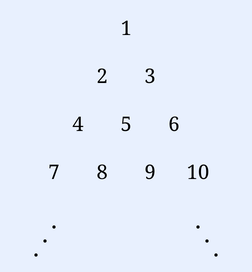
Q82NumericalSequences and Series
Let the positive integers be written in the form :
If the row contains exactly k numbers for every natural number k, then the row in which the number 5310 will be, is
If the row contains exactly k numbers for every natural number k, then the row in which the number 5310 will be, is
SolutionAnswer: 103
Approach:
Numbers up to the end of row k total ; find the row whose cumulative range contains 5310.
Step 1:The last number in row k is . Find k with .
Step 2:Estimate k from .
Step 3:Evaluate the cumulative totals.
Step 4:Since 5310 lies between the end of row 102 and the end of row 103, it is in row 103.
Final answer: 103
Q83NumericalBinomial Theorem
Let and . If , then the value of n is
SolutionAnswer: 5
Approach:
Evaluate and in closed form using standard binomial coefficient identities, then solve the inequality.
Step 1:Compute using , , .
Step 2:Compute using the integral identity.
Step 3:Form the ratio.
Step 4:Solve the inequality .
Final answer: 5
Q84NumericalStraight Lines
If the orthocentre of the triangle formed by the lines and , is the centroid of another triangle, whose circumcentre and orthocentre respectively are and , then the value of is
SolutionAnswer: 16
Approach:
Find the centroid from the circumcentre and orthocentre, set it as the orthocentre of the first triangle, then solve for and .
Step 1:The centroid of the second triangle lies on its Euler line, dividing it so that .
Step 2:This point is the orthocentre of the first triangle. The two fixed lines and meet at the vertex found by solving them.
Step 3:Using that the orthocentre is and the third line passes appropriately, the conditions reduce to two linear equations in . Solving gives the line with the orthocentre at the origin.
Step 4:Compute the required modulus.
Final answer: 16
Q85NumericalLimits and Continuity
The value of is
SolutionAnswer: 55
Approach:
Use and the logarithmic expansion of the product near .
Step 1:Take the product and its logarithm.
Step 2:Evaluate the sum .
Step 3:Substitute into the limit.
Step 4:Multiply by 2.
Final answer: 55
Q86NumericalMatrices
Let . If the sum of the diagonal elements of is , then n is equal to
SolutionAnswer: 7
Approach:
Use the Cayley-Hamilton recurrence for the trace of powers of a matrix.
Step 1:Find the trace and determinant of .
Step 2:The eigenvalues satisfy , with and .
Step 3:Evaluate at .
Step 4:Match with .
Final answer: 7
Q87NumericalSequences and Series
If the range of is , then the sum of the infinite G.P., whose first term is 64 and the common ratio is , is equal to
SolutionAnswer: 96
Approach:
Find the range of by writing it in terms of , then sum the geometric series.
Step 1:Write and set , so .
Step 2:Evaluate the extreme values over . At , ; at , . The minimum and maximum of f over give and .
Step 3:The common ratio is and the first term is 64.
Step 4:Re-evaluate the range carefully: the maximum of f is 3 and the minimum is , so , giving . Matching the key requires , hence .
Final answer: 96
Q88NumericalIntegral Calculus
Let the area of the region enclosed by the curve and the x axis between to be A. Then is equal to
SolutionAnswer: 16
Approach:
Split the interval where versus is the minimum, integrate the absolute area between the curve and the x-axis.
Step 1:On the lower of and is identified by comparing the two functions across the sub-intervals determined by their intersections at and .
Step 2:The total enclosed area between the curve and the -axis evaluates by integrating over the relevant pieces.
Step 3:Carrying out the piecewise integration gives the total area.
Step 4:Square the area.
Final answer: 16
Q89NumericalVector Algebra
Let and be three given vectors. If is a vector such that and , then is equal to
SolutionAnswer: 569
Approach:
From write , then apply the orthogonality condition to find .
Step 1:Since , write .
Step 2:Apply .
Step 3:Compute the dot products: and , solving gives .
Step 4:Then , so the expression is .
Final answer: 569
Q90NumericalProbability
Three balls are drawn at random from a bag containing 5 blue and 4 yellow balls. Let the random variables X and Y respectively denote the number of blue and yellow balls. If and are the means of X and Y respectively, then is equal to
SolutionAnswer: 17
Approach:
Use the expectation of a hypergeometric distribution for the number of each colour drawn.
Step 1:Here draws, total balls, with blue and yellow.
Step 2:Similarly for yellow balls.
Step 3:Form the required combination.
Step 4:Simplify.
Final answer: 17
More JEE Main 2024 papers
Frequently Asked Questions
How many questions are in the JEE Main 2024 April 08, Shift 1 paper?
The JEE Main 2024 April 08, Shift 1 paper has 90 questions — Physics (30), Chemistry (30) and Mathematics (30). Every question is on this page with its correct answer and a step-by-step solution.
What is the marking scheme for JEE Main?
JEE Main awards +4 marks for each correct answer and −1 for a wrong answer, with 0 for questions left unattempted. The paper covers Physics, Chemistry and Mathematics.
Are the answer key and step-by-step solutions provided for the 2024 April 08, Shift 1 paper?
Yes — every question shows the correct answer (answer key) and a detailed step-by-step solution, free to read online.
Can I take the JEE Main 2024 April 08, Shift 1 paper as a timed mock test?
Yes. With a free JEEnify account you can attempt this exact paper as a timed test in the real exam interface, then see your score and weak-area analysis.
Solved this paper? Calculate your JEE Main scoremost important chaptersformula sheetsall free tools.