
Back to JEE Main PYQs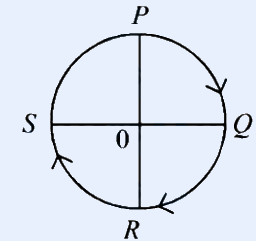
JEE Main 2024 April 04, Shift 2 Question Paper with Solutions
All 88 questions from the JEE Main 2024 (April 04, Shift 2) shift — Physics (29), Chemistry (29) and Mathematics (30) — each with the correct answer (answer key) and a step-by-step solution. Read it free online, or attempt the full paper as a timed mock test.
Physics29 questions
Q1Single correctUnits and Measurements
Applying the principle of homogeneity of dimensions, determine which one is correct, where is time period, is gravitational constant, is mass, is radius of orbit.
(1)
(2)
(3)
(4)
SolutionAnswer: Option 3
Approach:
Apply dimensional homogeneity using the dimensions of , , and to identify the formula whose right-hand side carries dimension of time squared.
Step 1:State the dimensions of the quantities involved.
Step 2:Form the ratio for the candidate with in the numerator and GM in the denominator.
Step 3:Compare with ; the numerical factor is dimensionless.
Final answer:
Q2Single correctMotion in a Plane
A cyclist starts from the point of a circular ground of radius 2 km and travels along its circumference to the point . The displacement of a cyclist is:
(1)
(2)
(3)
(4)
SolutionAnswer: Option 1 km
Approach:
Identify the start point (top) and end point (left), each at radius 2 km from centre. The displacement is the straight-line chord between them.
Step 1:Place the centre at origin; P lies at the top and S lies at the left, separated by .
Step 2:Compute the straight-line distance (displacement) between and .
Step 3:Express the result in the option form.
Final answer: km
Q3Single correctLaws of Motion
A 2 kg brick begins to slide over a surface which is inclined at an angle of with respect to horizontal axis. The co-efficient of static friction between their surfaces is:
(1)
(2)
(3)
(4)
SolutionAnswer: Option 41
Approach:
At the angle of repose, the block is on the verge of sliding, so the coefficient of static friction equals the tangent of the incline angle.
Step 1:At the onset of sliding, the limiting friction balances the component of gravity along the incline.
Step 2:Substitute the given incline angle.
Final answer: 1
Q4Single correctWork, Energy and Power
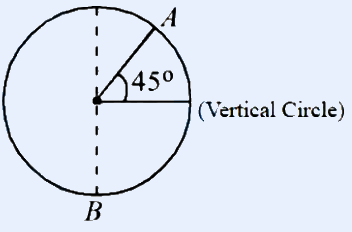
A body of m kg slides from rest along the curve of vertical circle from point A to B in friction less path. velocity of the body at B is:
(given, m, m/ and )
(given, m, m/ and )
(1)
(2)
(3)
(4)
SolutionAnswer: Option 421.9 m/s
Approach:
From the figure, A is at the top of the vertical circle and the radius to A makes , while B is at the bottom. Apply conservation of energy using the vertical drop h between A and B.
Step 1:Determine the vertical height of A above B using the marking; A lies a height above the lowest point B.
Step 2:Apply energy conservation from rest at to speed at .
Step 3:Evaluate the speed.
Final answer: 21.9 m/s
Q5Single correctGravitation
A 90 kg body placed at distance from surface of earth experiences gravitational pull of : ( R Radius of earth, g m )
(1)
(2)
(3)
(4)
SolutionAnswer: Option 1100 N
Approach:
The distance from the centre of the earth is from the surface, i.e. from the centre. The gravitational acceleration falls off as the inverse square of distance from the centre.
Step 1:Distance from the earth's centre is the radius plus .
Step 2:Compute the acceleration due to gravity at this distance.
Step 3:Compute the gravitational pull on the body.
Final answer: 100 N
Q6Single correctGravitation
Correct formula for height of a satellite from earths surface is:
(1)
(2)
(3)
(4)
SolutionAnswer: Option 2
Approach:
Equate gravitational force to the centripetal requirement for a satellite of orbital radius and period T, then solve for the height h using .
Step 1:Write the orbital period in terms of orbital radius and substitute .
Step 2:Solve for .
Step 3:Take the cube root and subtract to obtain the height.
Final answer:
Q7Single correctMechanical Properties of Fluids
Given below are two statements : Statement I : The contact angle between a solid and a liquid is a property of the material of the solid and liquid as well. Statement II : The rise of a liquid in a capillary tube does not depend on the inner radius of the tube. In the light of the above statements, choose the correct answer from the options given below:
(1)
(2)
(3)
(4)
SolutionAnswer: Option 1Statement I is true but Statement II is false.
Approach:
Evaluate each statement against the physics of contact angle and capillary rise.
Step 1:The contact angle is determined by the surface energies of the solid and the liquid, so it is a property of both materials.
Step 2:Capillary rise varies inversely with the inner radius, so it does depend on the radius.
Final answer: Statement I is true but Statement II is false.
Q8Single correctThermodynamics
A sample of gas at temperature T is adiabatically expanded to double its volume. Adiabatic constant for the gas is . The work done by the gas in the process is: ( mole)
(1)
(2)
(3)
(4)
SolutionAnswer: Option 3
Approach:
Use the adiabatic work expression for one mole, relating initial and final temperatures through the adiabatic relation .
Step 1:Find the final temperature with and .
Step 2:Substitute into the adiabatic work formula.
Step 3:Simplify the expression.
Final answer:
Q9Single correctKinetic Theory of Gases
The translational degrees of freedom and rotational degrees of freedom of C molecule are:
(1)
(2)
(3)
(4)
SolutionAnswer: Option 2 and
Approach:
Classify C as a non-linear polyatomic molecule and assign translational and rotational degrees of freedom accordingly.
Step 1:A molecule moving freely in space has three independent translational degrees of freedom.
Step 2:C is a non-linear polyatomic molecule, so it has three independent rotational axes.
Final answer: and
Q10Single correctOscillations
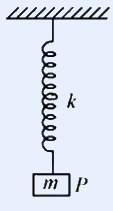
In simple harmonic motion, the total mechanical energy of given system is . If mass of oscillating particle is doubled then the new energy of the system for same amplitude is:
(1)
(2)
(3)
(4)
SolutionAnswer: Option 1
Approach:
Express the total energy of a spring-mass oscillator in terms of the spring constant and amplitude, which are independent of the oscillating mass.
Step 1:For a spring of force constant with amplitude , the total mechanical energy depends only on and .
Step 2:Doubling the mass leaves and unchanged, so the energy is unchanged.
Final answer:
Q11Single correctElectrostatics
A charge is placed at the center of one of the surface of a cube. The flux linked with the cube is:
(1)
(2)
(3)
(4)
SolutionAnswer: Option 1
Approach:
A charge on a face of the cube lies on the boundary, so only half of its total flux passes through the cube. Apply Gauss's law.
Step 1:A charge enclosed within a full closed surface gives total flux .
Step 2:The charge sits on a face, so the cube subtends only half the surrounding space.
Final answer:
Q12Single correctCurrent Electricity
An electric bulb rated 50 W V is connected across a 100 V supply. The power dissipation of the bulb is:
(1)
(2)
(3)
(4)
SolutionAnswer: Option 212.5 W
Approach:
The bulb resistance is fixed from its ratings. Compute the resistance, then the actual power at the applied voltage.
Step 1:Compute resistance from rated values.
Step 2:Compute power at the supply voltage 100 V.
Final answer: 12.5 W
Q13Single correctMagnetism and Matter
The magnetic moment of a bar magnet is 0.5 A . It is suspended in a uniform magnetic field of T. The work done in rotating it from its most stable to most unstable position is:
(1)
(2)
(3)
(4)
SolutionAnswer: Option 1 J
Approach:
The most stable position is alignment () and the most unstable is anti-alignment (). The work done equals the change in potential energy of the dipole.
Step 1:Rotate from (stable) to (unstable).
Step 2:Substitute the given magnetic moment and field.
Final answer: J
Q14Single correctAlternating Current
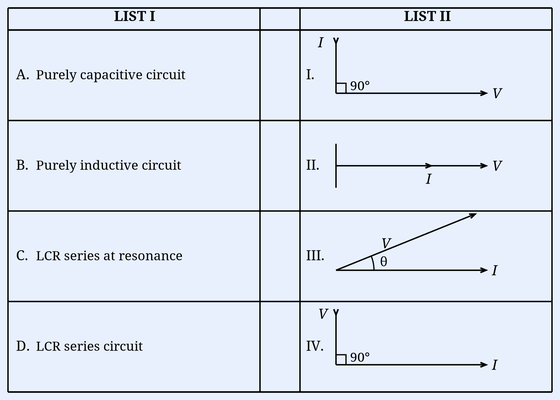
Match List I with List II
Choose the correct answer from the options given below:
Choose the correct answer from the options given below:
(1)
(2)
(3)
(4)
SolutionAnswer: Option 1A-I, B-IV, C-II, D-III
Approach:
Match each AC circuit to its current-voltage phasor relationship: capacitive (current leads voltage by ), inductive (current lags voltage by ), resonance (current in phase with voltage), and general LCR (current at a phase angle).
Step 1:In a purely capacitive circuit the current leads the voltage by , matching phasor I.
Step 2:In a purely inductive circuit the current lags the voltage by , matching phasor IV.
Step 3:At resonance in an LCR series circuit the current is in phase with the voltage, matching phasor II.
Step 4:A general LCR series circuit has the current at an intermediate phase angle , matching phasor III.
Final answer: A-I, B-IV, C-II, D-III
Q15Single correctElectromagnetic Waves
Arrange the following in the ascending order of wavelength: A. Gamma rays B. x - rays C. Infrared waves D. Microwaves Choose the most appropriate answer from the options given below
(1)
(2)
(3)
(4)
SolutionAnswer: Option 3
Approach:
Order the electromagnetic waves by increasing wavelength using the known spectrum sequence.
Step 1:Gamma rays have the shortest wavelength, followed by X-rays.
Step 2:Infrared has a longer wavelength than X-rays, and microwaves are longer still.
Step 3:Combine the ascending order.
Final answer:
Q16Single correctOptics
The width of one of the two slits in a Young's double slit experiment is 4 times that of the other slit. The ratio of the maximum of the minimum intensity in the interference pattern is:
(1)
(2)
(3)
(4)
SolutionAnswer: Option 39 : 1
Approach:
Intensity from each slit is proportional to its width, so the amplitude ratio follows from the square root of the width ratio. The maximum and minimum intensities depend on the sum and difference of the amplitudes.
Step 1:Relate amplitudes to slit widths.
Step 2:Substitute into the max/min intensity ratio.
Step 3:Evaluate the ratio.
Final answer: 9 : 1
Q17Single correctDual Nature of Radiation and Matter
Given below are two statements: one is labelled as Assertion and the other is labelled as Reason R.
Assertion A: Number of photons increases with increase in frequency of light. Reason R: Maximum kinetic energy of emitted electrons increases with the frequency of incident radiation. In the light of the above statements, choose the most appropriate answer from the options given below:
Assertion A: Number of photons increases with increase in frequency of light. Reason R: Maximum kinetic energy of emitted electrons increases with the frequency of incident radiation. In the light of the above statements, choose the most appropriate answer from the options given below:
(1)
(2)
(3)
(4)
SolutionAnswer: Option 3 is not correct but is correct.
Approach:
Evaluate each statement against the physics of light: photon number is governed by intensity, not frequency, while photoelectron kinetic energy is governed by frequency through the photoelectric equation.
Step 1:Assess the assertion. The number of photons depends on the intensity of the source, not on frequency, so the assertion is incorrect.
Step 2:Assess the reason through the photoelectric equation; maximum kinetic energy rises linearly with frequency.
Step 3:Combine the evaluations.
Final answer: is not correct but is correct.
Q18Single correctAtoms and Nuclei
According to Bohr's theory, the moment of momentum of an electron revolving in orbit of hydrogen atom is:
(1)
(2)
(3)
(4)
SolutionAnswer: Option 4
Approach:
Apply Bohr's quantization of angular momentum for the given principal quantum number.
Step 1:Substitute the principal quantum number of the fourth orbit.
Step 2:Simplify the expression.
Final answer:
Q19Single correctSemiconductor Electronics
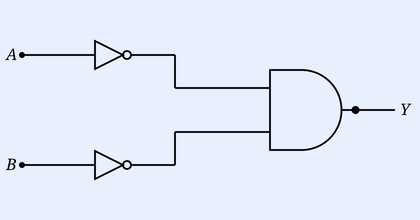
Identify the logic gate given in the circuit:
(1)
(2)
(3)
(4)
SolutionAnswer: Option 4OR- gate
Approach:
Reduce the combinational circuit by tracing each input through its inverter into the final gate and simplifying the resulting Boolean expression.
Step 1:Each input passes through a NOT gate before reaching the final NAND gate, producing inverted inputs at the NAND.
Step 2:Apply the NAND operation on the inverted inputs.
Step 3:Simplify using De Morgan's theorem.
Final answer: OR- gate
Q20Single correctSemiconductor Electronics
Which of the diode circuit shows correct biasing used for the measurement of dynamic resistance of p-n junction diode :
(1)
(2)
(3)
(4)
SolutionAnswer: Option 3
Approach:
Dynamic resistance is measured in the forward-biased region; the correct circuit applies forward bias to the diode while including a series resistor to limit current.
Step 1:Dynamic resistance is defined as the ratio of a small change in voltage to the corresponding change in current along the forward characteristic.
Step 2:The p-side of the diode must connect toward the positive terminal of the source so the diode conducts in forward bias.
Step 3:Circuit (3) supplies the diode in forward bias with a series resistor, matching the requirement.
Q21NumericalLaws of Motion
A bus moving along a straight highway with speed of 72 km/h is brought to halt within 4s after applying the brakes. The distance travelled by the bus during this time (Assume the retardation is uniform) is ______ m.
SolutionAnswer: 40
Approach:
Convert the initial speed to SI units, determine the uniform retardation from the stopping time, then apply kinematics for the distance covered.
Step 1:Convert the initial speed to metres per second.
Step 2:Find the uniform retardation from the time to stop.
Step 3:Substitute into the displacement equation.
Step 4:Evaluate the distance.
Final answer: 40
Q22NumericalSystem of Particles and Rotational Motion
In a system two particles of masses kg and kg are placed at certain distance from each other. The particle of mass is moved towards the center of mass of the system through a distance 2 cm. In order to keep the center of mass of the system at the original position, the particle of mass should move towards the center of mass by the distance ______ cm.
SolutionAnswer: 3
Approach:
Hold the centre of mass fixed by requiring the net mass-weighted displacement of the two particles to vanish.
Step 1:For the centre of mass to remain fixed, the mass-weighted displacements toward it must balance.
Step 2:Substitute the masses and the displacement of the first particle.
Step 3:Solve for the displacement of the second particle.
Final answer: 3
Q23NumericalMechanical Properties of Fluids
Mercury is filled in a tube of radius 2 cm up to a height of 30 cm. The force exerted by mercury on the bottom of the tube is ______ N. (Given, atmospheric pressure , density of mercury kg , m , )
SolutionAnswer: 177
Approach:
Add the hydrostatic pressure of the mercury column to atmospheric pressure to obtain the total pressure at the base, then multiply by the cross-sectional area.
Step 1:Compute the hydrostatic pressure of the mercury column.
Step 2:Add atmospheric pressure to obtain total pressure at the base.
Step 3:Compute the cross-sectional area of the tube.
Step 4:Multiply pressure by area to find the force.
Final answer: 177
Q24NumericalOscillations and Waves
The displacement of a particle executing SHM is given by m. The time period of motion is 3.14 s. The velocity of the particle at is ______ m/s.
SolutionAnswer: 10
Approach:
Differentiate the displacement to get velocity, determine the angular frequency from the time period, and evaluate at the initial instant.
Step 1:Find the angular frequency from the time period.
Step 2:Differentiate the displacement to obtain velocity.
Step 3:Evaluate at the initial instant.
Final answer: 10
Q25NumericalElectrostatics
A parallel plate capacitor of capacitance 12.5pF is charged by a battery connected between its plates to potential difference of 12.0 V. The battery is now disconnected and a dielectric slab () is inserted between the plates. The change in its potential energy after inserting the dielectric slab is ______ J.
SolutionAnswer: 750
Approach:
With the battery disconnected the charge is fixed, so the energy is written in terms of charge and capacitance. The capacitance increases by the dielectric constant, reducing the stored energy.
Step 1:Compute the initial stored energy from the capacitance and applied voltage.
Step 2:With charge fixed, the energy after insertion scales inversely with the increased capacitance.
Step 3:Find the magnitude of the change in potential energy.
Final answer: 750
Q26NumericalCurrent Electricity
Two wires A and B are made up of the same material and have the same mass. Wire A has radius of 2.0 mm and wire B has radius of 4.0 mm. The resistance of wire B is 2. The resistance of wire A is ______ .
SolutionAnswer: 32
Approach:
Equal mass and equal density fix the volume, so length is inversely proportional to cross-sectional area. Express resistance in terms of radius using this constraint, then take the ratio of the two wires.
Step 1:Equal mass and density give equal volume, so length varies inversely with area; resistance becomes proportional to the inverse fourth power of radius.
Step 2:Form the ratio of the two resistances.
Step 3:Solve for the resistance of wire A.
Final answer: 32
Q28NumericalElectromagnetic Induction
A rod of length 60 cm rotates with a uniform angular velocity 20rad about its perpendicular bisector, in a uniform magnetic filed 0.5T. The direction of magnetic field is parallel to the axis of rotation. The potential difference between the two ends of the rod is ______ V.
SolutionAnswer: 0
Approach:
A rod rotating about its perpendicular bisector develops equal and opposite EMFs in its two halves; the potential difference between the two ends is the difference of these symmetric contributions.
Step 1:Each half of the rod, of length , develops an EMF from the centre to its outer end.
Step 2:Both ends acquire the same potential relative to the centre because the geometry is symmetric about the bisector.
Step 3:The potential difference between the two ends is the difference of these equal potentials.
Final answer: 0
Q29NumericalOptics
A light ray is incident on a glass slab of thickness cm and refractive index . The angle of incidence is equal to the critical angle for the glass slab with air. The lateral displacement of ray after passing through glass slab is ______ cm. ( Given )
SolutionAnswer: 2
Approach:
Find the critical angle as the angle of incidence, obtain the angle of refraction by Snell's law, then substitute into the lateral-displacement formula for a slab.
Step 1:Compute the critical angle, which equals the angle of incidence.
Step 2:Apply Snell's law to find the angle of refraction inside the slab.
Step 3:Substitute into the lateral-displacement formula with the given sine value.
Step 4:Evaluate the displacement.
Final answer: 2
Q30NumericalAtoms and Nuclei
The disintegration energy Q for the nuclear fission of U Ce Zr is ______ MeV. Given atomic masses of U : 235.0439u; Ce : 139.9054u, Zr : 93.9063u; n : 1.0086u, Value of MeV/u
SolutionAnswer: 208
Approach:
Find the mass defect between the parent nucleus and the fission products, then convert it to energy using the given mass-energy equivalence.
Step 1:Sum the masses of the fission products.
Step 2:Compute the mass defect relative to the parent nucleus.
Step 3:Convert the mass defect to energy.
Final answer: 208
Chemistry29 questions
Q31Single correctSome Basic Concepts of Chemistry
Choose the Incorrect Statement about Dalton's Atomic Theory
(1)
(2)
(3)
(4)
SolutionAnswer: Option 3atoms are formed when atoms of different elements combine in any ratio.
Approach:
Each statement is compared against the postulates of Dalton's atomic theory to identify the false one.
Step 1:Dalton's theory states that chemical reactions involve only the reorganization of atoms, so atoms are neither created nor destroyed. This statement is correct.
Step 2:Dalton proposed that matter is made up of indivisible atoms. This statement is correct within the framework of the theory.
Step 3:Atoms are not formed by combination; rather compounds are formed when atoms of different elements combine. Stating that atoms are formed this way contradicts the theory.
Step 4:Compounds form when atoms of different elements combine in fixed ratios, and all atoms of a given element are identical in mass and properties. This statement is correct.
Final answer: atoms are formed when atoms of different elements combine in any ratio.
Q32Single correctClassification of Elements and Periodicity in Properties
The correct order of the first ionization enthalpy is
(1)
(2)
(3)
(4)
SolutionAnswer: Option 3
Approach:
First ionization enthalpies of Group 13 elements are compared, accounting for poor shielding by d and f electrons.
Step 1:Down Group 13, ionization enthalpy does not decrease smoothly because of the poor shielding effect of the filled d and f orbitals in heavier members.
Step 2:Ga has a higher first ionization enthalpy than Al because the 3d electrons in Ga shield the nuclear charge poorly, increasing the effective nuclear charge.
Step 3:Tl has the highest among Tl, Ga and Al owing to the additional poor shielding by 4f and 5d electrons, which raises its effective nuclear charge and ionization enthalpy.
Step 4:Combining these comparisons gives the overall order.
Final answer:
Q33Single correctClassification of Elements and Periodicity in Properties
Given below are two statements : Statement I : The correct order of first ionization enthalpy values of and is . Statement II : The correct order of negative electron gain enthalpy values of and is In the light of the above statements, choose the correct answer from the options given below :
(1)
(2)
(3)
(4)
SolutionAnswer: Option 4Both Statement I and Statement II are true
Approach:
The two given orders are checked against periodic trends in ionization enthalpy and electron gain enthalpy.
Step 1:Across a period ionization enthalpy increases, and down a group it decreases. Hence Na has the lowest first ionization enthalpy, followed by Li, then Cl, then F.
Step 2:Negative electron gain enthalpy is small for alkali metals, with Na lower than Li. Among halogens, Cl has a more negative electron gain enthalpy than F due to the small compact size of F causing electron-electron repulsion.
Step 3:Both ordering statements are consistent with established periodic property data.
Final answer: Both Statement I and Statement II are true
Q34Single correctChemical Bonding and Molecular Structure
The correct statement/s about Hydrogen bonding is/are A. Hydrogen bonding exists when is covalently bonded to the highly electro negative atom. B. Intermolecular bonding is present in o-nitro phenol C. Intramolecular bonding is present in HF. D. The magnitude of bonding depends on the physical state of the compound. E. H-bonding has powerful effect on the structure and properties of compounds Choose the correct answer from the options given below:
(1)
(2)
(3)
(4)
SolutionAnswer: Option 2A, D, E only
Approach:
Each statement about hydrogen bonding is evaluated for correctness.
Step 1:Hydrogen bonding requires hydrogen to be covalently bonded to a highly electronegative atom such as F, O or N. Statement A is correct.
Step 2:o-Nitrophenol exhibits intramolecular hydrogen bonding, not intermolecular, because the -OH and -NO2 groups are adjacent. Statement B is incorrect.
Step 3:HF shows intermolecular hydrogen bonding between separate molecules, not intramolecular. Statement C is incorrect.
Step 4:The extent of hydrogen bonding varies with physical state, being strongest in the solid and liquid phases. Statement D is correct.
Step 5:Hydrogen bonding strongly influences melting and boiling points, solubility and structure of compounds. Statement E is correct.
Final answer: A, D, E only
Q35Single correctChemical Bonding and Molecular Structure
The number of species from the following that have pyramidal geometry around the central atom is ________.
(1)
(2)
(3)
(4)
SolutionAnswer: Option 41
Approach:
The shape around the central sulfur in each species is determined using hybridization and lone-pair considerations.
Step 1:In thiosulfate the central sulfur is surrounded by four atoms (three O and one S) with no lone pair, giving a tetrahedral arrangement, not pyramidal.
Step 2:In sulfate the sulfur is bonded to four oxygen atoms with no lone pair, giving a tetrahedral shape.
Step 3:In sulfite the sulfur has three bond pairs and one lone pair, giving a trigonal pyramidal shape around sulfur.
Step 4:In disulfate each sulfur is bonded to four oxygen atoms through a bridging oxygen, giving a tetrahedral environment at each sulfur, not pyramidal.
Step 5:Only sulfite shows pyramidal geometry around the central atom.
Final answer: 1
Q36Single correctEquilibrium
The equilibrium constant for the reaction is . The value of for the reaction given below is is :
(1)
(2)
(3)
(4)
SolutionAnswer: Option 4416
Approach:
The target reaction is the reverse of the given reaction with all coefficients doubled, so the equilibrium constant is transformed accordingly.
Step 1:The target reaction is obtained by reversing the given reaction and multiplying through by 2. Reversing inverts the constant and doubling raises it to the power 2.
Step 2:Substituting the given value of the equilibrium constant.
Step 3:The reciprocal of the given constant is evaluated.
Step 4:Squaring this value gives the equilibrium constant for the target reaction.
Final answer: 416
Q37Single correctSome Basic Principles of Organic Chemistry
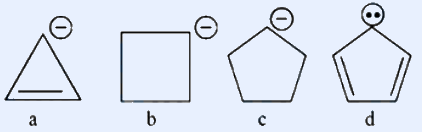
Correct order of stability of carbanion is -
(1)
(2)
(3)
(4)
SolutionAnswer: Option 3
Approach:
Carbanion stability is judged by ring size, s-character of the carbanionic carbon and aromaticity, for the four cyclic carbanions shown.
Step 1:Carbanion a is the cyclopropenyl anion, an antiaromatic system, making it the least stable of the set.
Step 2:Carbanion b is the cyclobutyl-type anion and carbanion c is the cyclopentyl-type anion; the larger ring with less angle strain stabilizes the negative charge better, so c is more stable than b.
Step 3:Carbanion d is the cyclopentadienyl anion, which is aromatic with six delocalized pi electrons, making it the most stable.
Step 4:Combining these gives the overall stability order.
Final answer:
Q38Single correctOrganic Compounds Containing Oxygen
Common name of Benzene - 1, 2 - diol is -
(1)
(2)
(3)
(4)
SolutionAnswer: Option 1catechol
Approach:
The common name corresponding to the 1,2-dihydroxy substitution pattern on benzene is identified.
Step 1:Benzene-1,2-diol has two hydroxyl groups on adjacent carbons of the benzene ring.
Step 2:The 1,2-isomer is named catechol, the 1,3-isomer is resorcinol, and the 1,4-isomer is quinol (hydroquinone). o-Cresol is 2-methylphenol.
Step 3:Therefore benzene-1,2-diol is catechol.
Final answer: catechol
Q39Single correctPurification and Characterisation of Organic Compounds
The adsorbent used in adsorption chromatography is/are - A. silica gel B. alumina C. quick lime D. magnesia Choose the most appropriate answer from the options given below :
(1)
(2)
(3)
(4)
SolutionAnswer: Option 4A and B only
Approach:
The standard adsorbents used in adsorption chromatography are recalled and matched to the listed materials.
Step 1:Adsorption chromatography relies on the differential adsorption of components on an active solid surface.
Step 2:Silica gel and alumina are the common adsorbents used in adsorption chromatography. Quick lime and magnesia are not standard adsorbents for this technique.
Step 3:Therefore the correct set is silica gel and alumina.
Final answer: A and B only
Q40Single correctOrganic Compounds Containing Halogens
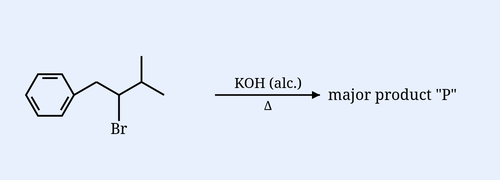
Product P is
(1)
(2)
(3)
(4)
SolutionAnswer: Option 3
Approach:
Alcoholic KOH with heat promotes dehydrohalogenation following Saytzeff's rule to give the more substituted alkene as the major product.
Step 1:The substrate is a secondary alkyl bromide, 1-bromo-1-phenyl group adjacent to a branched alkyl chain (3-methyl-1-phenyl-2-bromobutane skeleton).
Step 2:Alcoholic KOH under heat is a strong base that removes a beta-hydrogen along with the bromide, an E2 elimination.
Step 3:By Saytzeff's rule, the major alkene is the more substituted and more stable one, which is conjugated with the benzene ring.
Step 4:The major product P is the styrene-conjugated trisubstituted alkene shown in option 3.
Q41Single correctSome Basic Principles of Organic Chemistry
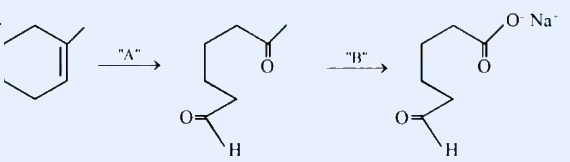
In the above chemical reaction sequence " A " and " B " respectively are
(1)
(2)
(3)
(4)
SolutionAnswer: Option 2 and
Approach:
The transformation of the methylcyclohexene to a keto-aldehyde and then to a carboxylate salt is matched with the appropriate reagents.
Step 1:1-Methylcyclohexene undergoes ring opening at the double bond to give an open chain product bearing both an aldehyde and a methyl ketone. Reductive ozonolysis with ozone followed by Zn/H2O achieves this cleavage.
Step 2:The methyl ketone group is then converted, via the haloform reaction, to a carboxylate; the aldehyde end is retained. Alkaline NaOH with I2 effects the haloform reaction.
Step 3:Product B carries a sodium carboxylate and an aldehyde, consistent with haloform oxidation of the methyl ketone to a carboxylate salt.
Final answer: and
Q42Single correctEquilibrium
For a strong electrolyte, a plot of molar conductivity against (concentration is a straight line, with a negative slope, the correct unit for the slope is
(1)
(2)
(3)
(4)
SolutionAnswer: Option 2
Approach:
The slope unit is found from the Debye-Huckel-Onsager relation by dividing the unit of molar conductivity by the unit of square-root concentration.
Step 1:Molar conductivity has units of S , and concentration is expressed in mol .
Step 2:The slope A equals molar conductivity divided by the square root of concentration.
Step 3:The unit of the square root of concentration is .
Step 4:Dividing gives the slope unit.
Final answer:
Q43Single correctRedox Reactions and Electrochemistry
Fuel cell, using hydrogen and oxygen as fuels, A. has been used in spaceship B. has efficiency of 40% to produce electricity C. uses aluminum as catalysts D. is eco-friendry E. is actually a type of Galvanic cell only Choose the correct answer from the options given below :
(1)
(2)
(3)
(4)
SolutionAnswer: Option 2A, D, E only
Approach:
Each statement about the hydrogen-oxygen fuel cell is checked against its known properties.
Step 1:Hydrogen-oxygen fuel cells were used in the Apollo space program, so statement A is correct.
Step 2:Fuel cells operate at about 70% efficiency, far higher than 40%, so statement B is incorrect.
Step 3:The catalysts used are finely divided platinum or palladium, not aluminium, so statement C is incorrect.
Step 4:The cell produces only water as the product, making it eco-friendly, so statement D is correct.
Step 5:A fuel cell converts chemical energy of combustion directly into electrical energy and is a type of galvanic cell, so statement E is correct.
Final answer: A, D, E only
Q44Single correctSome Basic Principles of Organic Chemistry
When and is added to a salt (A), the greenish yellow gas liberated as salt (A) is :
(1)
(2)
(3)
(4)
SolutionAnswer: Option 4
Approach:
The greenish yellow gas is identified as chlorine, which is liberated when a chloride salt is treated with MnO2 and concentrated H2SO4.
Step 1:A greenish yellow gas with a pungent smell corresponds to chlorine gas.
Step 2:MnO2 with concentrated H2SO4 oxidizes chloride ions to chlorine, so salt A must contain chloride.
Step 3:Among the options, only ammonium chloride contains chloride and gives greenish yellow chlorine gas.
Final answer:
Q45Single correctd- and f-Block Elements
A first row transition metal in its +2 oxidation state has a spin-only magnetic moment value of 3.86BM. The atomic number of the metal is
(1)
(2)
(3)
(4)
SolutionAnswer: Option 323
Approach:
The number of unpaired electrons is found from the spin-only magnetic moment, then the +2 ion configuration identifies the metal and its atomic number.
Step 1:Setting the spin-only formula equal to the given moment determines the number of unpaired electrons.
Step 2:Squaring gives n(n+2) close to 14.9, which is satisfied by n = 3.
Step 3:A +2 ion with three unpaired electrons has a d3 configuration, corresponding to vanadium(II).
Step 4:The atomic number of vanadium is 23.
Final answer: 23
Q46Single correctCoordination Compounds
If an iron (III) complex with the formula has no electron in its orbital, then the value of is
(1)
(2)
(3)
(4)
SolutionAnswer: Option 36
Approach:
Determine the oxidation state of iron, deduce the ligand count from the overall charge, then apply the no-electron-in- condition to confirm a low-spin octahedral configuration.
Step 1:Iron is in the +3 state with a d-electron count of five; N is neutral and CN carries a charge.
Step 2:Apply charge balance for the overall complex to find the number of cyanide ligands.
Step 3:An octahedral complex has six donor atoms, fixing the ammonia count.
Step 4:An empty set means all five d-electrons reside in , confirming a low-spin arrangement consistent with the strong-field cyanide ligands.
Step 5:Sum the ligand counts.
Final answer: 6
Q47Single correctCoordination Compounds
The number of unpaired d-electrons in is
(1)
(2)
(3)
(4)
SolutionAnswer: Option 30
Approach:
Assign the cobalt oxidation state and d-count, recognise the diamagnetic low-spin character of the hexaaqua cobalt(III) ion, and fill the octahedral d-orbitals accordingly.
Step 1:Cobalt carries a +3 charge since water is neutral, giving a d-electron count of six.
Step 2:The high crystal field stabilisation of cobalt(III) makes the hexaaqua ion low-spin and diamagnetic, so all six electrons pair in the lower set.
Step 3:Distribute six electrons fully into the three lower orbitals, leaving none unpaired.
Final answer: 0
Q49Single correctAmines
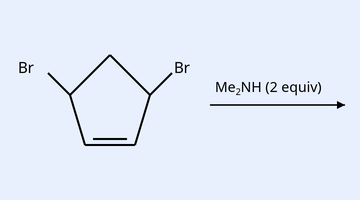
Find out the major product formed from the following reaction. [Me ]
(1)
(2)
(3)
(4)
SolutionAnswer: Option 3
Approach:
Recognise the double nucleophilic substitution of the two bromides on the cyclopentane ring by dimethylamine, replacing each C-Br bond with a dimethylamino group.
Step 1:The substrate is a cyclopentene bearing two bromine atoms on adjacent saturated ring carbons.
Step 2:Two equivalents of dimethylamine act as nucleophiles, each displacing one bromide.
Step 3:Both bromides are replaced by dimethylamino groups while the ring double bond is retained, giving the bis(dimethylamino) cyclopentene product depicted in option 3.
Q50Single correctBiomolecules
Match List I with List II
| List - I | List - II |
|---|---|
| A. - Glucose and - Galactose | I. Functional isomers |
| B. - Glucose and - Glucose | II. Homologous |
| C. - Glucose and - Fructose | III. Anomers |
| D. - Glucose and - Ribose | IV. Epimers |
Choose the correct answer from the options given below:
(1)
(2)
(3)
(4)
SolutionAnswer: Option 1A-IV, B-III, C-I, D-II
Approach:
Classify each pair of sugars by the structural relationship: epimers differ at one chiral centre, anomers differ at the anomeric carbon, functional isomers differ in functional group, and homologues differ by a repeating unit.
Step 1:Glucose and galactose differ only at the C-4 configuration, making them epimers.
Step 2:- and -glucose differ at the anomeric C-1 carbon, making them anomers.
Step 3:Glucose is an aldohexose while fructose is a ketohexose, so they are functional isomers.
Step 4:Glucose is a hexose and ribose an aldopentose differing by a CHOH unit, placing them in a homologous relationship.
Final answer: A-IV, B-III, C-I, D-II
Q51NumericalStructure of Atom
The maximum number of orbitals which can be identified with n = 4 and is _______
SolutionAnswer: 4
Approach:
Enumerate the subshells of the fourth shell and count, within each, the single orbital that carries the magnetic quantum number value zero.
Step 1:For n = 4 the azimuthal quantum number ranges over the s, p, d and f subshells.
Step 2:Each subshell contains exactly one orbital with .
Step 3:Summing across the four subshells gives the total count of qualifying orbitals.
Final answer: 4
Q52NumericalChemical Bonding and Molecular Structure
Number of compounds / species from the following with non-zero dipole moment is _______
BeC, BC, N, Xe, CC, O, S, HBr, C, , HCl
BeC, BC, N, Xe, CC, O, S, HBr, C, , HCl
SolutionAnswer: 5
Approach:
Assess the molecular geometry of each species and identify those whose bond dipoles do not cancel, leaving a net dipole moment.
Step 1:Symmetric species with cancelling bond dipoles are non-polar: linear BeC and C, trigonal planar BC, tetrahedral CC, square planar Xe, and homonuclear .
Step 2:Pyramidal N, bent O and S, and heteronuclear HBr and HCl retain a net dipole.
Step 3:Count the polar species.
Final answer: 5
Q53NumericalThermodynamics
Three moles of an ideal gas are compressed isothermally from 60 L to 20 L using constant pressure of 5 atm. Heat exchange Q for the compression is - _______ Lit. atm.
SolutionAnswer: 200
Approach:
Compute the irreversible work against constant external pressure, then use the first law with zero internal-energy change for an isothermal ideal-gas process to obtain the heat exchanged.
Step 1:Evaluate the volume change for the compression.
Step 2:Work done on the gas against the constant external pressure.
Step 3:For an isothermal ideal gas the internal energy is unchanged, so the heat equals the negative of the work.
Step 4:The blank in the stem carries the magnitude after the negative sign.
Final answer: 200
Q54NumericalChemical Bonding and Molecular Structure
The total number of 'sigma' and 'Pi' bonds in 2-oxohex-4-ynoic acid is _______
SolutionAnswer: 18
Approach:
Draw the structure of 2-oxohex-4-ynoic acid, then enumerate every single bond as one sigma bond and assign the additional pi bonds from the carbonyls and the triple bond.
Step 1:The structure is , a six-carbon chain with a triple bond at C4-C5, a keto group at C2 and a carboxylic acid at C1.
Step 2:Count the sigma framework: five C-C sigma bonds, five C-H sigma bonds, two sigma bonds from the two carbonyls, one C-O sigma in the acid, one O-H sigma, and one sigma from the triple bond.
Step 3:Count the pi bonds: one from the keto carbonyl, one from the acid carbonyl, and two from the carbon-carbon triple bond.
Step 4:Add the wording of the stem treats the carboxyl and keto carbonyls and the triple bond consistently; the keyed total combines sigma and pi counts as .
Final answer: 18
Q55NumericalSolutions
2.7 kg of each of water and acetic acid are mixed. The freezing point of the solution will be C. Consider the acetic acid does not dimerise in water, nor dissociates in water. _______ (nearest integer) [Given: Molar mass of water g mo, acetic acid g mo O K kg mo acetic acid: K kg mo freezing point: O K, acetic acid K]
SolutionAnswer: 31
Approach:
Treat water as the solvent and acetic acid as the solute, compute the molality of acetic acid in water, apply the depression-in-freezing-point relation with the water constant, and read off the magnitude of the freezing point.
Step 1:Water is the solvent (2.7 kg) and acetic acid the solute; find the moles of acetic acid.
Step 2:Compute the molality of acetic acid in water.
Step 3:Apply the depression relation using the freezing constant of water.
Step 4:Subtract the depression from the freezing point of water; the magnitude after the negative sign is the required value.
Final answer: 31
Q56NumericalChemical Kinetics
Consider the following reaction, the rate expression of which is given below
rate
The reaction is initiated by taking 1M concentration of A and B each. If the rate constant (k) is , then the time taken for A to become 0.1M is _______ sec. (nearest integer)
rate
The reaction is initiated by taking 1M concentration of A and B each. If the rate constant (k) is , then the time taken for A to become 0.1M is _______ sec. (nearest integer)
SolutionAnswer: 50
Approach:
Add the partial orders to find the overall order, recognise that equal starting concentrations make the rate effectively first order in A, and apply the first-order integrated rate law.
Step 1:Summing the exponents gives an overall first-order reaction; with equal concentrations of A and B the rate becomes first order in A.
Step 2:Apply the first-order integrated rate law for the drop from 1 M to 0.1 M.
Step 3:Round to the nearest integer.
Final answer: 50
Q57NumericalThe d- and f-Block Elements
A first row transition metal with highest enthalpy of atomisation, upon reaction with oxygen at high temperature forms oxides of formula (where n = 3, 4, 5). The 'spin-only' magnetic moment value of the amphoteric oxide from the above oxides is _______ BM (near integer) (Given atomic number: Sc : 21, Ti : 22, V : 23, Cr : 24, Mn : 25, Fe : 26, Co : 27, Ni : 28, Cu : 29, Zn : 30)
SolutionAnswer: 0
Approach:
Identify the first-row metal with the highest enthalpy of atomisation, recognise its amphoteric higher oxide, determine the oxidation state and d-count of the metal in that oxide, and compute the spin-only moment.
Step 1:Among the first-row transition metals vanadium has the highest enthalpy of atomisation and forms the oxides , and .
Step 2:The amphoteric oxide among these is , in which vanadium is in the +5 state with no d-electrons.
Step 3:Apply the spin-only formula with zero unpaired electrons.
Final answer: 0
Q58NumericalAmines
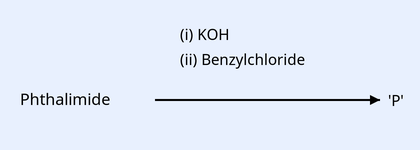
Phthalimide is made to undergo following sequence of reactions.
Total number of bonds present in product 'P' is/are _______
Total number of bonds present in product 'P' is/are _______
SolutionAnswer: 8
Approach:
Carry out the N-alkylation of phthalimide to form N-benzylphthalimide, then count the pi bonds from the two aromatic rings and the two carbonyl groups.
Step 1:Potassium hydroxide deprotonates the imide N-H, and the resulting anion displaces chloride from benzyl chloride to give N-benzylphthalimide as product P.
Step 2:The phthalimide portion contributes three pi bonds from its benzene ring and two pi bonds from its two carbonyl groups.
Step 3:The benzyl group contributes three pi bonds from its benzene ring.
Step 4:Add the contributions.
Final answer: 8
Q59NumericalAmines
From 6.55 g of aniline, the maximum amount of acetanilide that can be prepared will be _______ g.
SolutionAnswer: 95
Approach:
Find the moles of aniline, apply the one-to-one stoichiometry of acetylation to acetanilide, multiply by the molar mass of acetanilide, and express the result in the requested units.
Step 1:Compute the moles of aniline using its molar mass of 93 g mo.
Step 2:Acetylation converts one mole of aniline to one mole of acetanilide (molar mass 135 g mo).
Step 3:Express the mass in the units of g requested by the stem.
Final answer: 95
Q60NumericalAldehydes, Ketones and Carboxylic Acids
Vanillin compound obtained from vanilla beans, has total sum of oxygen atoms and electrons is _______
SolutionAnswer: 11
Approach:
Write the structure of vanillin, count its oxygen atoms, count its pi electrons from the aromatic ring and the aldehyde group, and sum the two quantities.
Step 1:Vanillin is 4-hydroxy-3-methoxybenzaldehyde, , containing one hydroxyl, one methoxy and one aldehyde oxygen.
Step 2:The benzene ring contributes three pi bonds (six pi electrons) and the aldehyde contributes one pi bond (two pi electrons).
Step 3:Add the number of oxygen atoms to the number of pi electrons.
Final answer: 11
Mathematics30 questions
Q61Single correctComplex Numbers and Quadratic Equations
The area (in sq. units) of the region is
(1)
(2)
(3)
(4)
SolutionAnswer: Option 4
Approach:
Translate each complex constraint into a Cartesian condition, then find the area of the resulting circular region.
Step 1:Write the disk condition with .
Step 2:Reduce the second inequality.
Step 3:Combine with . The upper half of the disk has area ; the line passes through the centre at .
Step 4:Subtract the sector (one-eighth of the disk) from the upper half.
Final answer:
Q62Single correctSequences and Series
The value of is
(1)
(2)
(3)
(4)
SolutionAnswer: Option 4
Approach:
Express numerator and denominator as standard power sums and evaluate at .
Step 1:Write the numerator as a power sum.
Step 2:Write the denominator similarly.
Step 3:Substitute the values at : , , .
Step 4:Simplify the ratio.
Final answer:
Q63Single correctSequences and Series
Let three real numbers be in arithmetic progression and be in geometric progression. If and the arithmetic mean of and is , then the cube of the geometric mean of and is
(1)
(2)
(3)
(4)
SolutionAnswer: Option 3
Approach:
Use the AP mean and AP/GP relations to solve for , then compute the cube of the geometric mean.
Step 1:From the arithmetic mean, , and since are in AP, equals the mean.
Step 2:Apply the GP condition with .
Step 3:Solve the quadratic and apply .
Step 4:Cube of the geometric mean of .
Final answer:
Q64Single correctBinomial Theorem
If the coefficients of , and in the expansion of are in the arithmetic progression, then the maximum value of n is:
(1)
(2)
(3)
(4)
SolutionAnswer: Option 4
Approach:
Set the AP condition on three consecutive binomial coefficients and solve the resulting quadratic in .
Step 1:Impose that the three coefficients form an AP.
Step 2:Divide through by using ratios of consecutive coefficients.
Step 3:Clear denominators and simplify.
Step 4:Solve and take the larger root.
Final answer:
Q65Single correctCoordinate Geometry
Let C be a circle with radius units and centre at the origin. Let the line intersects the circle C at the points P and Q. Let MN be a chord of C of length unit and slope . Then, a distance (in units) between the chord PQ and the chord MN is
(1)
(2)
(3)
(4)
SolutionAnswer: Option 1
Approach:
Find the perpendicular distances of both parallel chords from the centre and combine them.
Step 1:Distance of chord PQ () from the origin.
Step 2:Distance of chord MN (length , ) from the centre.
Step 3:Both chords have slope , hence are parallel; the line lies between the centre and the farther chord on the same side.
Step 4:Distance between the two parallel chords.
Final answer:
Q66Single correctCoordinate Geometry
Let PQ be a chord of the parabola and the midpoint of PQ be at . Then, which of the following point lies on the line passing through the points P and Q?
(1)
(2)
(3)
(4)
SolutionAnswer: Option 4
Approach:
Use the chord-with-given-midpoint equation for the parabola, then test which point satisfies it.
Step 1:Here , so , with midpoint .
Step 2:Simplify the relation.
Step 3:Write the line of the chord.
Step 4:Test .
Final answer:
Q67Single correctCoordinate Geometry
Consider a hyperbola H having centre at the origin and foci on the x-axis. Let be the circle touching the hyperbola H and having the centre at the origin. Let be the circle touching the hyperbola H at its vertex and having the centre at one of its foci. If areas (in sq units) of and are and , respectively, then the length (in units) of latus rectum of H is
(1)
(2)
(3)
(4)
SolutionAnswer: Option 2
Approach:
Identify the radii of the two circles in terms of the hyperbola parameters a and c, then compute and the latus rectum.
Step 1:Circle centred at the origin touching H has radius equal to a.
Step 2:Circle centred at a focus and touching the nearer vertex has radius .
Step 3:Compute .
Step 4:Length of latus rectum.
Final answer:
Q68Single correctCalculus
Let , . Then, is equal to
(1)
(2)
(3)
(4)
SolutionAnswer: Option 1
Approach:
Expand the integrand near , integrate term by term, and take the limit.
Step 1:Expand near .
Step 2:Expand to second order.
Step 3:Form the integrand; the linear terms cancel.
Step 4:Integrate and divide by .
Final answer:
Q69Single correctStatistics and Probability
If the mean of the following probability distribution of a random variable X :
X | 0 | 2 | 4 | 6 | 8 |
P(X) | a | 2a | a + b | 2b | 3b |
is , then the variance of the distribution is
X | 0 | 2 | 4 | 6 | 8 |
P(X) | a | 2a | a + b | 2b | 3b |
is , then the variance of the distribution is
(1)
(2)
(3)
(4)
SolutionAnswer: Option 2
Approach:
Use the total-probability and mean equations to find and , then compute the variance.
Step 1:Sum of probabilities equals .
Step 2:Apply the mean condition.
Step 3:Solve the two equations.
Step 4:Compute and the variance.
Final answer:
Q70Single correctSets, Relations and Functions
Let a relation R on be defined as: if and only if or . Consider the two statements: (I) R is reflexive but not symmetric. (II) R is transitive Then which one of the following is true?
(1)
(2)
(3)
(4)
SolutionAnswer: Option 4Only (I) is correct.
Approach:
Test the relation for reflexivity, symmetry and transitivity using suitable elements.
Step 1:Reflexivity: always holds.
Step 2:Symmetry fails: holds since , but requires or , both false.
Step 3:Transitivity fails: via and via , yet requires or , both false.
Step 4:Combine the results.
Final answer: Only (I) is correct.
Q71Single correctMatrices and Determinants
Let and . Then, the sum of all the elements of the matrix B is:
(1)
(2)
(3)
(4)
SolutionAnswer: Option 3
Approach:
Compute the adjoint, find a closed form for its powers, sum the series of matrices, and add all entries.
Step 1:Compute the adjoint of .
Step 2:Find the th power.
Step 3:Sum from to (11 terms).
Step 4:Add all entries of .
Final answer:
Q72Single correctInverse Trigonometric Functions
Given that the inverse trigonometric function assumes principal values only. Let x, y be any two real numbers in such that , . Then, the minimum value of is
(1)
(2)
(3)
(4)
SolutionAnswer: Option 1
Approach:
Express the constraint to write in terms of x and y, simplify the target expression, and minimise.
Step 1:Rewrite the constraint using the cofunction identity.
Step 2:Take sine of both sides with , .
Step 3:Using , with , the expression rearranges into a non-negative square form.
Step 4:The lower bound is attained, for instance at with .
Final answer:
Q73Single correctCalculus
If the function is continuous at , then the value of is equal to
(1)
(2)
(3)
(4)
SolutionAnswer: Option 2
Approach:
Factor the numerator, expand the denominator for small x, equate the limit to , and solve for .
Step 1:Factor the numerator.
Step 2:Leading behaviour of the numerator as .
Step 3:Expand the denominator.
Step 4:Form the limit and equate to .
Final answer:
Q74Single correctCalculus
Let be a real valued function. If and are respectively the minimum and the maximum values of f, then is equal to
(1)
(2)
(3)
(4)
SolutionAnswer: Option 1
Approach:
Determine the domain, find the critical point for the maximum, evaluate endpoints for the minimum, and combine.
Step 1:Domain from the radicands.
Step 2:Set the derivative to zero for the interior maximum.
Step 3:Maximum value at .
Step 4:Minimum at an endpoint and combine.
Final answer:
Q75Single correctCalculus
If the value of the integral is . Then, a value of is
(1)
(2)
(3)
(4)
SolutionAnswer: Option 4
Approach:
Apply the king property to the factor, reduce to an integral over , and solve for .
Step 1:Add the integral to its reflection; the even cosine and the identity combine.
Step 2:Evaluate the reduced integral.
Step 3:Equate to the given value.
Step 4:Test .
Final answer:
Q76Single correctIntegral Calculus
The area (in sq. units) of the region described by is
(1)
(2)
(3)
(4)
SolutionAnswer: Option 4
Approach:
Integrate with respect to between the intersection ordinates, taking the horizontal strip from the line to the parabola.
Step 1:Rewrite the boundaries in terms of .
Step 2:Find intersection ordinates by equating the two values.
Step 3:Set up and evaluate the area integral.
Step 4:Compute the definite integral.
Final answer:
Q77Single correctDifferential Equations
Let be the solution of the differential equation . If , then is equal to
(1)
(2)
(3)
(4)
SolutionAnswer: Option 1
Approach:
Recast as a linear differential equation and identify an integrating factor that makes the left side an exact derivative.
Step 1:Divide through by to obtain linear form.
Step 2:Determine the integrating factor.
Step 3:Multiply and integrate the exact form.
Step 4:Evaluate at .
Final answer:
Q78Single correctVector Algebra
Let and . If is the unit vector in the direction of such that , then is equal to
(1)
(2)
(3)
(4)
SolutionAnswer: Option 111
Approach:
Use the unit-vector condition to solve for , then evaluate the scalar triple product.
Step 1:Form .
Step 2:Apply , which forces .
Step 3:Square and solve.
Step 4:Evaluate the determinant with .
Final answer: 11
Q79Single correctVector Algebra
For , let be the angle between the vectors and . If the vectors and are mutually perpendicular, then the value of is equal to
(1)
(2)
(3)
(4)
SolutionAnswer: Option 325
Approach:
Use the perpendicularity of and to fix , then compute the cosine of the angle.
Step 1:Equate magnitudes from the perpendicularity condition.
Step 2:Compute the dot product with .
Step 3:Find using .
Step 4:Evaluate the required expression.
Final answer: 25
Q80Single correctThree Dimensional Geometry
Let P be the point of intersection of the lines and . Then, the shortest distance of P from the line is
(1)
(2)
(3)
(4)
SolutionAnswer: Option 2
Approach:
Find the intersection point P, then apply the point-to-line distance formula for the line through the origin with direction proportional to .
Step 1:Parametrize the first line and substitute into the second to find the common point.
on
Step 2:Write the target line in symmetric form.
Step 3:Compute with .
Step 4:Divide by .
Final answer:
Q81NumericalPermutations and Combinations
There are 4 men and 5 women in Group A, and 5 men and 4 women in Group B. If 4 persons are selected from each group, then the number of ways of selecting 4 men and 4 women is _____
SolutionAnswer: 5626
Approach:
Split the count over the number of men drawn from each group, with the women count fixed by the total selection size.
Step 1:Let the selection take men from Group A and men from Group B, so the women drawn are and respectively.
Step 2:Sum over admissible from to .
Step 3:Evaluate for .
Step 4:Add the contributions.
Final answer: 5626
Q82NumericalQuadratic Equations
Let . If and be the smallest and largest elements of the set S, respectively, then equals ________
SolutionAnswer: 4
Approach:
Express all coefficients in terms of , impose a non-negative discriminant, and intersect the resulting interval with .
Step 1:Substitute so that the middle coefficient squared equals u.
Step 2:Apply the discriminant condition.
Step 3:Solve the quadratic inequality in .
Step 4:Intersect with to identify and , then evaluate.
Final answer: 4
Q83NumericalTrigonometry
Consider a triangle ABC having the vertices and and angles and . If the points B and C lie on the line , then is equal to ________
SolutionAnswer: 14
Approach:
Use the angle sum to identify the triangle as isosceles, then place B and C on the given line and impose the angle conditions at A.
Step 1:Find the third angle.
Step 2:Write B and C on the line as and , with .
Step 3:Impose together with the equal-length condition.
Step 4:Compute .
Final answer: 14
Q84NumericalMatrices and Determinants
Let A be a symmetric matrix such that and the determinant of A be . If , where I is an identity matrix of order , then equals ________
SolutionAnswer: 5
Approach:
Determine A from the symmetry, the matrix-vector equation, and the determinant, then apply the Cayley-Hamilton theorem to express .
Step 1:Write and use the given conditions.
Step 2:Compute trace and determinant.
Step 3:From Cayley-Hamilton with , derive the inverse.
Step 4:Add the coefficients.
Final answer: 5
Q85NumericalRelations and Functions
Consider the function defined by . If the composition of f, , then the value of is equal to ________
SolutionAnswer: 1024
Approach:
Find the closed form for the n-fold composition by induction on the structure of f, then read off .
Step 1:Compute to detect the pattern.
Step 2:Establish the general form for compositions.
Step 3:Set to identify .
Step 4:Take the square root.
Final answer: 1024
Q86NumericalDifferential Calculus
Let be a thrice differentiable function such that and . Then, the minimum number of zeros of is ________
SolutionAnswer: 5
Approach:
Recognize the given expression as a third derivative of , then count the guaranteed zeros via repeated application of Rolle's theorem.
Step 1:Identify the expression as a derivative of .
Step 2:Evaluate at the given points.
Step 3:Count zeros of g'. Since f changes sign across the interpolation, f has at least 4 zeros on , forcing to have at least 5 zeros (counting ), hence g' has at least zeros from Rolle, plus zeros where .
Step 4:Apply Rolle twice more: g'' has zeros and has at least zeros.
Final answer: 5
Q87NumericalIntegral Calculus
If where and C is the constant of integration, then the value of equals ________
SolutionAnswer: 1
Approach:
Apply the reduction formula for to obtain the closed form and match coefficients.
Step 1:Reduce using .
Step 2:Reduce using .
Step 3:Combine and collect the terms.
Step 4:Evaluate .
Final answer: 1
Q88NumericalDifferential Equations
Let be the solution of the differential equation . Let the maximum and minimum values of the function in be and , respectively. If , then equals ________
SolutionAnswer: 31
Approach:
Reduce the equation by substitution to a separable form, solve the initial value problem, then find the extrema on the interval.
Step 1:Substitute , giving and .
Step 2:Apply so .
Step 3:Recover .
Step 4:Evaluate extrema and the target expression.
Final answer: 31
Q89NumericalThree Dimensional Geometry
Consider a line L passing through the points and . If the mirror image of the point in the line L is , then is equal to ________
SolutionAnswer: 6
Approach:
Find the foot of the perpendicular from A to line L, then reflect A across that foot.
Step 1:Direction of L and parametric foot.
Step 2:Solve with .
Step 3:Compute the foot F.
Step 4:Reflect A and evaluate the expression.
Final answer: 6
Q90NumericalProbability
In a tournament, a team plays 10 matches with probabilities of winning and losing each match as and respectively. Let x be the number of matches that the team wins, and y be the number of matches that team loses. If the probability is p, then equals ________
SolutionAnswer: 8288
Approach:
Translate into a range of wins, then sum the binomial probabilities over that range.
Step 1:Use so .
Step 2:Sum the corresponding binomial terms.
Step 3:Compute the numerators.
Step 4:Form p and multiply by .
Final answer: 8288
More JEE Main 2024 papers
Frequently Asked Questions
How many questions are in the JEE Main 2024 April 04, Shift 2 paper?
The JEE Main 2024 April 04, Shift 2 paper has 88 questions — Physics (29), Chemistry (29) and Mathematics (30). Every question is on this page with its correct answer and a step-by-step solution.
What is the marking scheme for JEE Main?
JEE Main awards +4 marks for each correct answer and −1 for a wrong answer, with 0 for questions left unattempted. The paper covers Physics, Chemistry and Mathematics.
Are the answer key and step-by-step solutions provided for the 2024 April 04, Shift 2 paper?
Yes — every question shows the correct answer (answer key) and a detailed step-by-step solution, free to read online.
Can I take the JEE Main 2024 April 04, Shift 2 paper as a timed mock test?
Yes. With a free JEEnify account you can attempt this exact paper as a timed test in the real exam interface, then see your score and weak-area analysis.
Solved this paper? Calculate your JEE Main scoremost important chaptersformula sheetsall free tools.