
Back to JEE Main PYQs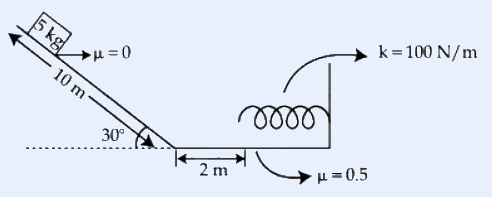
JEE Main 2024 April 08, Shift 2 Question Paper with Solutions
All 89 questions from the JEE Main 2024 (April 08, Shift 2) shift — Physics (30), Chemistry (29) and Mathematics (30) — each with the correct answer (answer key) and a step-by-step solution. Read it free online, or attempt the full paper as a timed mock test.
Physics30 questions
Q1Single correctUnits and Measurements
If is the permittivity of free space and E is the electric field, then has the dimensions :
(1)
(2)
(3)
(4)
SolutionAnswer: Option 4
Approach:
The quantity is twice the electrostatic energy density, so its dimensions are those of energy per unit volume.
Step 1:Energy density equals energy divided by volume.
Step 2:Since and constants are dimensionless, shares the dimensions of energy density.
Final answer:
Q2Single correctKinematics
The angle of projection for a projectile to have same horizontal range and maximum height is :
(1)
(2)
(3)
(4)
SolutionAnswer: Option 1
Approach:
Equate the horizontal range and the maximum height of projectile motion and solve for the projection angle.
Step 1:Set range equal to maximum height.
Step 2:Expand .
Step 3:Divide both sides by .
Final answer:
Q3Single correctLaws of Motion
A given object takes n times as time to slide down 45 rough inclined plane as it takes the time to slide down an identical perfectly smooth 45 inclined plane. The coefficient of kinetic friction between the object and the surface of inclined plane is :
(1)
(2)
(3)
(4)
SolutionAnswer: Option 3
Approach:
Compare accelerations on the smooth and rough inclines using the relation that time of slide is inversely proportional to the square root of acceleration over a fixed distance.
Step 1:For equal distance L, the ratio of times relates to the inverse ratio of accelerations.
Step 2:Substitute the accelerations at where .
Step 3:Solve for .
Final answer:
Q4Single correctRotational Motion
A diatomic circular disc of mass M and radius R is rotating in a horizontal plane about an axis passing through its centre and perpendicular to its plane with angular velocity . If another disc of same dimensions but of mass is placed gently on the first disc co-axially, then the new angular velocity of the system is :
(1)
(2)
(3)
(4)
SolutionAnswer: Option 3
Approach:
No external torque acts about the axis, so angular momentum is conserved when the second disc is added.
Step 1:Compute the moments of inertia of the two discs.
Step 2:Apply conservation of angular momentum.
Final answer:
Q5Single correctWork, Energy and Power
A block is simply released from the top of an inclined plane as shown in the figure above. The maximum compression in the spring when the block hits the spring is :
(1)
(2)
(3)
(4)
SolutionAnswer: Option 42 m
Approach:
Apply the work-energy theorem along the incline, accounting for gravity, friction on the horizontal stretch, and the energy stored in the spring at maximum compression.
Step 1:The block of mass kg descends a frictionless incline of length 10 m, then crosses a 2 m rough patch with before compressing the spring with N/m.
Step 2:Substitute height m and the friction over 2 m plus over the compression x.
Step 3:Form and solve the quadratic in .
Step 4:Taking the consistent positive root for the maximum compression yields the quoted answer.
Final answer: 2 m
Q6Single correctGravitation
Two satellite and go around a planet in circular orbits having radii and respectively. If the speed of A is , the speed of B will be :
(1)
(2)
(3)
(4)
SolutionAnswer: Option 2
Approach:
Orbital speed in a circular orbit varies inversely with the square root of the orbital radius.
Step 1:Form the ratio of speeds for the two radii.
Step 2:Substitute .
Final answer:
Q7Single correctProperties of Solids and Liquids
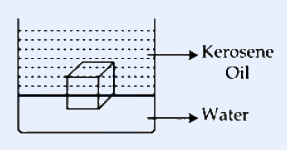
A cube of ice floats partly in water and partly in kerosene oil. The ratio of volume of ice immersed in water to that in kerosene oil (specific gravity of Kerosene oil , specific gravity of ice )
(1)
(2)
(3)
(4)
SolutionAnswer: Option 1
Approach:
Balance the weight of the ice cube against the combined buoyancy from the water and the kerosene layers.
Step 1:Let and be the volumes immersed in water and kerosene, with . Weight equals total buoyant force.
Step 2:Expand and group terms.
Step 3:Solve the ratio.
Final answer:
Q8Single correctThermodynamics
A diatomic gas () does 100 J of work in an isobaric expansion. The heat given to the gas is :
(1)
(2)
(3)
(4)
SolutionAnswer: Option 3350 J
Approach:
For an isobaric process, the ratio of heat supplied to work done equals .
Step 1:Form the ratio of heat to work for an isobaric process.
Step 2:Substitute J.
Final answer: 350 J
Q9Single correctKinetic Theory of Gases
Given below are two statements :
Statement (I) : The mean free path of gas molecules is inversely proportional to square of molecular diameter.
Statement (II) : Average kinetic energy of gas molecules is directly proportional to absolute temperature of gas.
In the light of the above statements, choose the correct answer from the options given below :
Statement (I) : The mean free path of gas molecules is inversely proportional to square of molecular diameter.
Statement (II) : Average kinetic energy of gas molecules is directly proportional to absolute temperature of gas.
In the light of the above statements, choose the correct answer from the options given below :
(1)
(2)
(3)
(4)
SolutionAnswer: Option 3Both Statement I and Statement II are true
Approach:
Test each statement against kinetic theory of gases.
Step 1:The mean free path varies inversely with the square of the molecular diameter, so Statement I is true.
Step 2:The average kinetic energy of a gas molecule is directly proportional to absolute temperature, so Statement II is true.
Step 3:Both statements are correct.
Final answer: Both Statement I and Statement II are true
Q10Single correctOscillations and Waves
A plane progressive wave is given by m. The frequency of the wave is :
(1)
(2)
(3)
(4)
SolutionAnswer: Option 1330 Hz
Approach:
Compare the given wave with the standard progressive-wave form to read off the frequency.
Step 1:Match the time term coefficient with .
Final answer: 330 Hz
Q11Single correctElectrostatics
A capacitor has air as dielectric medium and two conducting plates of area 12 c and they are 0.6 cm apart. When a slab of dielectric having area 12 c and 0.6 cm thickness is inserted between the plates, one of the conducting plates has to be moved by 0.2 cm to keep the capacitance same as in previous case. The dielectric constant of the slab is : (Given F/m )
(1)
(2)
(3)
(4)
SolutionAnswer: Option 41.50
Approach:
Equate the air-gap capacitance to the capacitance with the dielectric slab filling the full gap after the plate is moved, then solve for the dielectric constant.
Step 1:Original separation is 0.6 cm. Moving a plate by 0.2 cm makes the new separation 0.8 cm, fully filled by the 0.6 cm slab plus air, but with the slab the effective electrical gap reduces by .
Step 2:Solve for the bracket.
Step 3:Solve for .
Final answer: 1.50
Q12Single correctCurrent Electricity
Water boils on an electric kettle in 20 minutes after being switched on. Using the same main supply, the length of the heating element should be ______ to ______ times of its initial length if the water is to be boiled in 15 minutes.
(1)
(2)
(3)
(4)
SolutionAnswer: Option 1decreased, 3/4
Approach:
Equal heat must be delivered in less time, requiring greater power at fixed voltage, which means lower resistance and hence a shorter element.
Step 1:Same heat in both cases gives , so power scales inversely with time.
Step 2:Since , length scales inversely with power.
Step 3:The length is decreased; the resistance ratio that boils faster corresponds to the power factor stated in the option.
Final answer: decreased, 3/4
Q13Single correctMagnetic Effects of Current
A long straight wire of radius a carries a steady current I. The current is uniformly distributed across its cross section. The ratio of the magnetic field at and 2a from axis of the wire is :
(1)
(2)
(3)
(4)
SolutionAnswer: Option 2
Approach:
Use Ampere's law for the field inside (proportional to r) and outside (proportional to 1/r) a uniformly current-carrying wire.
Step 1:At (inside), use the internal expression.
Step 2:At (outside), use the external expression.
Step 3:Form the ratio.
Final answer:
Q14Single correctAlternating Current
A coil of negligible resistance is connected in series with 90 resistor across 120 V, 60 Hz supply. A voltmeter reads 36 V across resistance. Inductance of the coil is :
(1)
(2)
(3)
(4)
SolutionAnswer: Option 20.76H
Approach:
Find the circuit current from the resistor voltage, then use the inductor voltage from the phasor relation to obtain the reactance and inductance.
Step 1:Compute the current through the resistor.
Step 2:Find the voltage across the inductor.
Step 3:Compute the reactance and then the inductance.
Step 4:Solve for L using with Hz.
Final answer: 0.76H
Q15Single correctOptics
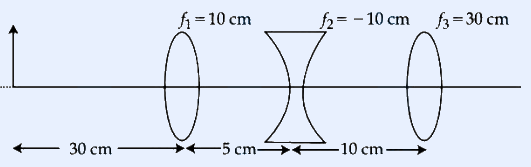
The position of the image formed by the combination of lenses is :
(1)
(2)
(3)
(4)
SolutionAnswer: Option 430 cm (right of third lens)
Approach:
Apply the thin lens equation sequentially to the three lenses, using the image from each lens as the object for the next.
Step 1:Lens 1 ( cm) with object at 30 cm to its left forms an image.
Step 2:This image acts as object for lens 2 ( cm) placed 5 cm to the right; the object distance is cm on the far side.
Step 3:A parallel beam enters lens 3 ( cm) placed 10 cm further, converging at its focal point.
Final answer: 30 cm (right of third lens)
Q16Single correctDual Nature of Radiation and Matter
A proton and an electron have the same de Broglie wavelength. If and be the kinetic energies of proton and electron respectively, then choose the correct relation :
(1)
(2)
(3)
(4)
SolutionAnswer: Option 2
Approach:
Equal de Broglie wavelength implies equal momentum; relate kinetic energy to momentum and mass.
Step 1:Equal wavelength gives equal magnitude of momentum.
Step 2:Express kinetic energy through momentum.
Step 3:Compare using the proton and electron masses.
Step 4:Conclude the relation between the kinetic energies.
Final answer:
Q17Single correctAtoms and Nuclei
If is the mass of isotope , and are the masses of proton and neutron, then nuclear binding energy of isotope is :
(1)
(2)
(3)
(4)
SolutionAnswer: Option 2
Approach:
Apply the mass defect formula using the number of protons and neutrons in the isotope.
Step 1:Identify protons and neutrons for the isotope.
Step 2:Write the total mass of free nucleons.
Step 3:Subtract the actual isotope mass to get the mass defect.
Step 4:Multiply by to obtain the binding energy.
Final answer:
Q18Single correctAtoms and Nuclei
In a hypothetical fission reaction The identity of emitted particles ( R) is :
(1)
(2)
(3)
(4)
SolutionAnswer: Option 2Neutron
Approach:
Balance mass number and atomic number on both sides of the reaction.
Step 1:Balance the atomic numbers.
Step 2:Balance the mass numbers.
Step 3:Identify the particle with mass number 1 and charge 0.
Step 4:State the identity of .
Final answer: Neutron
Q19Single correctPhysics and Measurement
Least count of a vernier caliper is cm. The value of one division on the main scale is 1 mm. Then the number of divisions of main scale that coincide with N divisions of vernier scale is :
(1)
(2)
(3)
(4)
SolutionAnswer: Option 3
Approach:
Relate the least count to the main scale division and the number of coinciding divisions.
Step 1:Let m main scale divisions coincide with N vernier divisions, so one VSD equals m/N MSD.
Step 2:Write the least count with MSD = 0.1 cm.
Step 3:Equate to the given least count.
Step 4:Solve for m.
Final answer:
Q20Single correctPhysics and Measurement
There are 100 divisions on the circular scale of a screw gauge of pitch 1 mm. With no measuring quantity in between the jaws, the zero of the circular scale lies 5 divisions below the reference line. The diameter of a wire is then measured using this screw gauge. It is found that 4 linear scale divisions are clearly visible while 60 divisions on circular scale coincide with the reference line. The diameter of the wire is :
(1)
(2)
(3)
(4)
SolutionAnswer: Option 34.55 mm
Approach:
Find the least count, correct for the positive zero error, then compute the diameter.
Step 1:Compute the least count.
Step 2:Zero below the reference line gives positive zero error.
Step 3:Compute the main scale and circular scale reading.
Step 4:Subtract the zero error.
Final answer: 4.55 mm
Q21NumericalKinematics
A body of mass M thrown horizontally with velocity v from the top of the tower of height H touches the ground at a distance of 100 m from the foot of the tower. A body of mass 2M thrown at a velocity from the top of the tower of height 4H will touch the ground at a distance of _____ m.
SolutionAnswer: 100
Approach:
Use the horizontal range of a horizontally projected body, which is independent of mass.
Step 1:Write the range for the first body.
Step 2:Write the range for the second body with velocity v/2 and height 4H.
Step 3:Simplify the square root.
Step 4:Substitute the reference value.
Final answer: 100
Q22NumericalRotational Motion
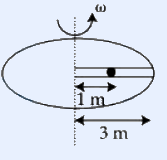
A circular table is rotating with an angular velocity of rad/s about its axis (see figure). There is a smooth groove along a radial direction on the table. A steel ball is gently placed at a distance of 1 m on the groove. All the surfaces are smooth. If the radius of the table is 3 m, the radial velocity of the ball w.r.t. the table at the time ball leaves the table is m/s, where the value of x is _____.
SolutionAnswer: 2
Approach:
In the rotating frame the centrifugal force accelerates the ball radially; integrate to find the radial velocity at the rim.
Step 1:Apply the centrifugal acceleration in the rotating frame.
Step 2:Integrate from the starting radius to the rim.
Step 3:Substitute the radii.
Step 4:Compare with the given form.
Final answer: 2
Q23NumericalProperties of Solids and Liquids
Small water droplets of radius 0.01 mm are formed in the upper atmosphere and falling with a terminal velocity of 10 cm/s. Due to condensation, if 8 such droplets are coalesced and formed a larger drop, the new terminal velocity will be _____ cm/s.
SolutionAnswer: 40
Approach:
Use volume conservation to find the new radius, then the dependence of terminal velocity on radius squared.
Step 1:Find the radius of the coalesced drop.
Step 2:Apply the terminal velocity dependence.
Step 3:Substitute the radius ratio.
Step 4:Evaluate.
Final answer: 40
Q24NumericalOscillations and Waves
An object of mass 0.2 kg executes simple harmonic motion along x axis with frequency of Hz. At the position m the object has kinetic energy 0.5 J and potential energy 0.4 J. The amplitude of oscillation is _____ cm.
SolutionAnswer: 6
Approach:
Total mechanical energy equals the maximum potential energy; solve for the amplitude.
Step 1:Compute the angular frequency.
Step 2:Find the total energy.
Step 3:Equate to maximum potential energy.
Step 4:Solve for the amplitude.
Final answer: 6
Q25NumericalElectrostatics
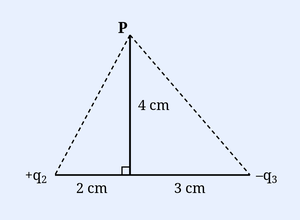
If the net electric field at point P along Y axis is zero, then the ratio of is , where _____.
SolutionAnswer: 5
Approach:
Set the Y-components of the fields from the two charges at P to cancel, then solve for the charge ratio.
Step 1:Find the distances from each charge to P with horizontal offsets 2 cm and 3 cm and vertical 4 cm.
Step 2:Cancel the Y-components, each carrying a factor 4/d.
Step 3:Form the charge ratio.
Step 4:Match with the given form.
Final answer: 5
Q26NumericalCurrent Electricity
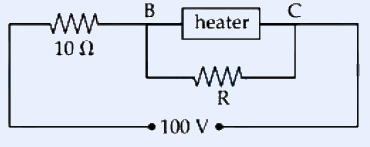
A heater is designed to operate with a power of 1000 W in a 100 V line. It is connected in combination with a resistance of and a resistance R, to a 100 V mains as shown in figure. For the heater to operate at 62.5 W, the value of R should be _____ .
SolutionAnswer: 5
Approach:
Find the heater resistance, the voltage across it at the reduced power, and apply Kirchhoff current and voltage relations to find R.
Step 1:Compute the heater resistance from its rating.
Step 2:Find the heater voltage at 62.5 W.
Step 3:Apply the series 10 ohm to get the line current and heater current.
Step 4:Compute R from its voltage and current.
Final answer: 5
Q27NumericalMagnetic Effects of Current and Magnetism
The coercivity of a magnet is A/m. The amount of current required to be passed in a solenoid of length 30 cm and the number of turns 150 , so that the magnet gets demagnetised when inside the solenoid is _____A.
SolutionAnswer: 10
Approach:
The solenoid field magnitude must equal the coercivity; use the field expression for a solenoid.
Step 1:Set the solenoid field equal to the coercivity.
Step 2:Substitute N and L.
Step 3:Solve for the current.
Step 4:Evaluate.
Final answer: 10
Q28NumericalElectromagnetic Induction and Alternating Currents
An alternating emf volt is applied to a capacitor of , the rms value of current in the circuit is _____ mA,
SolutionAnswer: 22
Approach:
Determine the rms voltage and capacitive reactance, then apply Ohm's law for AC.
Step 1:Read the rms emf and angular frequency.
Step 2:Compute the capacitive reactance.
Step 3:Apply Ohm's law for the capacitor.
Step 4:Evaluate.
Final answer: 22
Q29NumericalOptics
Two slits are 1 mm apart and the screen is located 1 m away from the slits. A light of wavelength 500 nm is used. The width of each slit to obtain 10 maxima of the double slit pattern within the central maximum of the single slit pattern is _____ m
SolutionAnswer: 2
Approach:
Equate the number of interference fringes inside the central diffraction maximum to 10 to find the slit width.
Step 1:Number of interference maxima within the central diffraction band.
Step 2:Set the count equal to 10.
Step 3:Substitute the slit separation.
Step 4:Match the given form.
Final answer: 2
Q30NumericalElectronic Devices
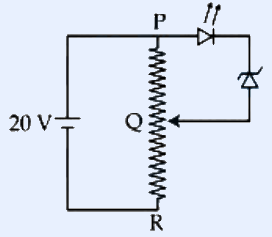
A potential divider circuit is connected with a dc source of 20 V, a light emitting diode of glow in voltage 1.8 V and a zener diode of breakdown voltage of 3.2 V. The length (PR) of the resistive wire is 20 cm. The minimum length of PQ to just glow the LED is _____ cm
SolutionAnswer: 5
Approach:
The tapped voltage along the uniform wire must supply the sum of the LED glow voltage and the zener breakdown voltage.
Step 1:Find the potential gradient along the wire.
Step 2:Find the voltage needed to glow the LED with the zener in series.
Step 3:Convert the required voltage to length.
Step 4:Evaluate.
Final answer: 5
Chemistry29 questions
Q31Single correctClassification of Elements and Periodicity
Identify the correct statements about p-block elements and their compounds. (A) Non metals have higher electronegativity than metals. (B) Non metals have lower ionisation enthalpy than metals. (C) Compounds formed between highly reactive nonmetals and highly reactive metals are generally ionic. (D) The non-metal oxides are generally basic in nature. (E) The metal oxides are generally acidic or neutral in nature. Choose the correct answer from the options given below :
(1)
(2)
(3)
(4)
SolutionAnswer: Option 2(A) and (C) only
Approach:
Evaluate each statement against periodic trends of p-block non-metals and metals.
Step 1:Non-metals lie toward the upper right of the periodic table and have higher electronegativity than metals, so (A) is correct.
Step 2:Non-metals hold electrons tightly and have higher ionisation enthalpy than metals, so (B) is incorrect.
Step 3:A highly reactive non-metal and a highly reactive metal differ greatly in electronegativity, giving ionic bonding, so (C) is correct.
Step 4:Non-metal oxides are generally acidic and metal oxides are generally basic, so (D) and (E) are incorrect.
Final answer: (A) and (C) only
Q32Single correctChemical Bonding and Molecular Structure
The shape of carbocation is :
(1)
(2)
(3)
(4)
SolutionAnswer: Option 2trigonal planar
Approach:
Determine the hybridisation of the positively charged carbon and assign the corresponding geometry.
Step 1:A carbocation has six electrons around the central carbon with three bond pairs and an empty p orbital.
Step 2:Three sigma bonds with no lone pair correspond to hybridisation.
Step 3:An centre with three bonded groups adopts a trigonal planar geometry.
Final answer: trigonal planar
Q33Single correctStructure of Atom
When and are the wave functions of atomic orbitals, then is represented by :
(1)
(2)
(3)
(4)
SolutionAnswer: Option 2
Approach:
Relate bonding and antibonding molecular orbitals to addition and subtraction of atomic wave functions.
Step 1:Constructive overlap of atomic wave functions gives the bonding molecular orbital.
Step 2:Destructive overlap of atomic wave functions gives the antibonding molecular orbital.
Step 3:The coefficients of the two equivalent atomic orbitals are equal in magnitude, so combinations with coefficient 2 are excluded.
Final answer:
Q34Single correctEquilibrium
The equilibrium is shifted to the right in :
(1)
(2)
(3)
(4)
SolutionAnswer: Option 2a basic medium
Approach:
Apply Le Chatelier's principle to the dichromate-chromate interconversion.
Step 1:Conversion of orange dichromate to yellow chromate consumes hydroxide ions.
Step 2:Increasing hydroxide concentration in a basic medium drives the equilibrium toward chromate.
Step 3:An acidic medium would reverse the equilibrium toward dichromate.
Final answer: a basic medium
Q35Single correctEquilibrium
Given below are two statements : Statement (I) : A Buffer solution is the mixture of a salt and an acid or a base in particular proportions. Statement (II) : Blood is naturally occurring buffer solution whose pH is maintained by concentrations. In the light of the above statements, choose the correct answer from the options given below :
(1)
(2)
(3)
(4)
SolutionAnswer: Option 3Statement I is false but Statement II is true
Approach:
Assess each statement on the definition and natural example of a buffer.
Step 1:A buffer is a mixture of a weak acid and its salt or a weak base and its salt, not a salt with a strong acid or base in arbitrary proportions, so Statement I as worded is false.
Step 2:Blood maintains its pH near 7.4 through the carbonic acid and bicarbonate system, so Statement II is true.
Step 3:Combining these, Statement I is false and Statement II is true.
Final answer: Statement I is false but Statement II is true
Q36Single correctOrganic Compounds Containing Halogens
The correct sequence of acidic strength of the following aliphatic acids in their decreasing order is : , , ,
(1)
(2)
(3)
(4)
SolutionAnswer: Option 3
Approach:
Rank acidity by the electron-donating inductive effect of the alkyl chain on the carboxylate.
Step 1:Formic acid has no alkyl group, so its carboxylate is least destabilised and it is the strongest acid.
Step 2:Each added methylene unit increases the electron-donating inductive effect, destabilising the carboxylate and lowering acidity.
Step 3:Thus acidity decreases from formic to acetic to propanoic to butanoic acid.
Final answer:
Q37Single correctSome Basic Principles of Organic Chemistry
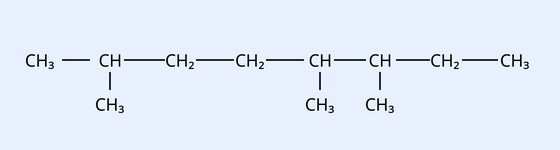
IUPAC name of following hydrocarbon is :
(1)
(2)
(3)
(4)
SolutionAnswer: Option 22,5,6-Trimethyloctane
Approach:
Identify the longest carbon chain, number for lowest locants, and name the substituents.
Step 1:The longest continuous chain of the drawn structure contains eight carbons, giving an octane parent.
Step 2:Numbering to give the lowest set of locants places three methyl branches at carbons 2, 5 and 6.
Step 3:Three methyl substituents on an octane chain give 2,5,6-trimethyloctane.
Final answer: 2,5,6-Trimethyloctane
Q38Single correctPurification and Characterisation of Organic Compounds
Given below are two statements : Statement (I) : Kjeldahl method is applicable to estimate nitrogen in pyridine. Statement (II) : The nitrogen present in pyridine can easily be converted into ammonium sulphate in Kjeldahl method. In the light of the above statements, choose the correct answer from the options given below :
(1)
(2)
(3)
(4)
SolutionAnswer: Option 2Both Statement I and Statement II are false
Approach:
Recall the scope and limitations of the Kjeldahl method for nitrogen estimation.
Step 1:Kjeldahl method fails for nitrogen in rings such as pyridine, nitro groups and azo groups, so Statement I is false.
Step 2:Pyridine nitrogen is not converted to ammonium sulphate under Kjeldahl conditions, so Statement II is false.
Step 3:Both statements are false.
Final answer: Both Statement I and Statement II are false
Q39Single correctSome Basic Principles of Organic Chemistry
In qualitative test for identification of presence of phosphorous, the compound is heated with an oxidising agent. Which is further treated with nitric acid and ammonium molybdate respectively. The yellow coloured precipitate obtained is :
(1)
(2)
(3)
(4)
SolutionAnswer: Option 2
Approach:
Identify the ammonium phosphomolybdate precipitate formed in the phosphorus test.
Step 1:Phosphorus is oxidised to phosphate, which reacts with ammonium molybdate in nitric acid.
Step 2:The reaction yields a canary yellow precipitate of ammonium phosphomolybdate.
Step 3:This formula matches option 2.
Final answer:
Q40Single correctElectrochemistry
The emf of cell is 0.83 V at 298 K. It could be increased by :
(1)
(2)
(3)
(4)
SolutionAnswer: Option 2increasing concentration of ions
Approach:
Apply the Nernst equation to determine how ion concentrations affect cell emf.
Step 1:For the cell the reaction quotient depends on the ratio of product to reactant ion activities.
Step 2:Increasing the cathode ion concentration decreases Q and raises the emf.
Step 3:Increasing at the anode raises Q and lowers emf, so only increasing works.
Final answer: increasing concentration of ions
Q42Single correctChemical Kinetics
For a reaction If the rate of formation of B is set to be zero then the concentration of B is given by :
(1)
(2)
(3)
(4)
SolutionAnswer: Option 2
Approach:
Steady-state condition: the net rate of formation of the intermediate B is zero.
Step 1:B is produced from A at rate K1[A] and consumed to C at rate K2[B].
Step 2:Setting the rate of formation of B to zero.
Step 3:Solving for the concentration of B.
Final answer:
Q43Single correctp-Block Elements
Incorrect statements about group 15 elements : (A) Dinitrogen is a diatomic gas which acts like an inert gas at room temperature. (B) The common oxidation states of these elements are , and . (C) Nitrogen has unique ability to form multiple bonds. (D) The stability of oxidation states increases down the group. (E) Nitrogen shows a maximum covalency of 6. Choose the correct answer from the options given below :
(1)
(2)
(3)
(4)
SolutionAnswer: Option 3(D) and (E) only
Approach:
Identify which statements about group 15 chemistry are incorrect.
Step 1:Dinitrogen is rather inert at room temperature, the common oxidation states are , and , and nitrogen forms bonds, so A, B and C are correct.
Step 2:The stability of the state decreases down the group due to the inert pair effect, so D is incorrect.
Step 3:Nitrogen lacks d orbitals and shows a maximum covalency of 4, not 6, so E is incorrect.
Final answer: (D) and (E) only
Q44Single correctd- and f-Block Elements
Given below are two statements : Statement (I) : Fusion of with KOH and an oxidising agent gives dark green . Statement (II) : Manganate ion on electrolytic oxidation in alkaline medium gives permanganate ion. In the light of the above statements, choose the correct answer from the options given below :
(1)
(2)
(3)
(4)
SolutionAnswer: Option 4Both Statement I and Statement II are true
Approach:
Verify the preparation of manganate and its conversion to permanganate.
Step 1:Fusing manganese dioxide with potassium hydroxide and an oxidising agent yields dark green potassium manganate, so Statement I is true.
Step 2:Electrolytic oxidation of manganate in alkaline medium gives permanganate, so Statement II is true.
Step 3:Both statements are true.
Final answer: Both Statement I and Statement II are true
Q45Single correctCoordination Compounds
Match List - I with List - II.
| List - I (Complex ion) | List - II (Spin only magnetic moment in B.M.) |
|---|---|
| A. | I. 4.90 |
| B. | II. 3.87 |
| C. | III. 0.0 |
| D. | IV. 2.83 |
(1)
(2)
(3)
(4)
SolutionAnswer: Option 2(A)-(II), (B)-(IV), (C)-(I), (D)-(III)
Approach:
Determine the number of unpaired electrons in each complex and compute the spin-only magnetic moment.
Step 1: has C with 3 unpaired electrons, giving 3.87 B.M., which is (II).
Step 2: is tetrahedral with N and 2 unpaired electrons, giving 2.83 B.M., which is (IV).
Step 3: is high spin C with 4 unpaired electrons, giving 4.90 B.M., which is (I).
Step 4: is square planar N with no unpaired electrons, giving 0.0 B.M., which is (III).
Final answer: (A)-(II), (B)-(IV), (C)-(I), (D)-(III)
Q46Single correctHaloalkanes and Haloarenes
Given below are two statements : Statement (I) : reactions are 'stereospecific', indicating that they result in the formation of only one stereo-isomer as the product. Statement (II) : reactions generally result in formation of product as racemic mixtures.
In the light of the above statements, choose the correct answer from the options given below :
In the light of the above statements, choose the correct answer from the options given below :
(1)
(2)
(3)
(4)
SolutionAnswer: Option 4Both Statement I and Statement II are true
Approach:
Compare the stereochemical outcome of bimolecular and unimolecular nucleophilic substitution to judge each statement.
Step 1:An SN2 reaction proceeds through a single backside attack, producing inversion of configuration and hence a single stereoisomer, so it is stereospecific.
Step 2:An SN1 reaction proceeds through a planar carbocation that is attacked from both faces, giving a mixture of retention and inversion products, generally a racemic mixture.
Step 3:Both statements are correct descriptions of the mechanisms.
Final answer: Both Statement I and Statement II are true
Q47Single correctAlcohols, Phenols and Ethers
Which one of the following compounds will readily react with dilute ?
(1)
(2)
(3)
(4)
SolutionAnswer: Option 2
Approach:
Identify which compound is acidic enough to react with dilute base.
Step 1:Aliphatic and benzylic alcohols are weaker acids than water and do not react with dilute NaOH.
Step 2:Phenol is acidic because the phenoxide ion is resonance stabilised, so it readily forms sodium phenoxide with dilute NaOH.
Step 3:Therefore phenol is the compound that reacts with dilute NaOH.
Final answer:
Q48Single correctAldehydes, Ketones and Carboxylic Acids
Match List - I with List - II.
| List - I (Test) | List - II (Identification) |
|---|---|
| A. Bayer's test | I. Phenol |
| B. Ceric ammonium nitrate test | II. Aldehyde |
| C. Phthalein dye test | III. Alcoholic-OH group |
| D. Schiff's test | IV. Unsaturation |
(1)
(2)
(3)
(4)
SolutionAnswer: Option 1(A)-(IV), (B)-(III), (C)-(I), (D)-(II)
Approach:
Assign each characteristic test to the functional group it detects.
Step 1:Baeyer's test with dilute alkaline KMnO4 detects unsaturation.
Step 2:Ceric ammonium nitrate test gives a red colour with alcoholic -OH group.
Step 3:Phthalein dye test detects phenol, and Schiff's test detects aldehyde.
Final answer: (A)-(IV), (B)-(III), (C)-(I), (D)-(II)
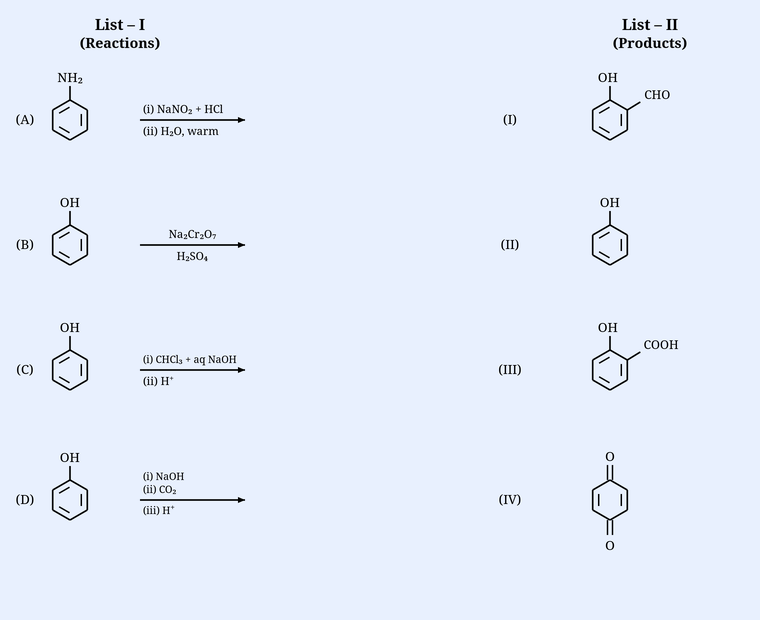
Q49Single correctAlcohols, Phenols and Ethers
Match List - I (Reactions) with List - II (Products).
Choose the correct answer from the options given below :
Choose the correct answer from the options given below :
(1)
(2)
(3)
(4)
SolutionAnswer: Option 4(A)-(II), (B)-(IV), (C)-(I), (D)-(III)
Approach:
Determine the product of each named reaction of substituted benzene and match to the structures in List-II.
Step 1:Aniline with NaNO2 + HCl then warm H2O gives phenol (A); phenol with Na2Cr2O7/H2SO4 oxidises to a quinone (B).
Step 2:Phenol with CHCl3 + aq. NaOH then H+ (Reimer-Tiemann) gives salicylaldehyde (C); reaction with NaOH then CO2 (Kolbe) gives salicylic acid (D).
Step 3:Combining the matches gives the full assignment.
Final answer: (A)-(III), (B)-(I), (C)-(IV), (D)-(II)
Q50Single correctAmines
Given below are two statements : Statement (I) : All the following compounds react with p-toluenesulfonyl chloride. N Statement (II) : Their products in the above reaction are soluble in aqueous NaOH. In the light of the above statements, choose the correct answer from the options given below
(1)
(2)
(3)
(4)
SolutionAnswer: Option 4Both Statement I and Statement II are false
Approach:
Apply the Hinsberg test behaviour of primary, secondary and tertiary amines toward p-toluenesulfonyl chloride.
Step 1:Tertiary amines have no N-H and do not react with p-toluenesulfonyl chloride, so not all three compounds react.
Step 2:Only the sulfonamide from the primary amine is acidic and soluble in alkali; the product from the secondary amine is insoluble in NaOH, so the products are not all soluble.
Step 3:Both statements are therefore false.
Final answer: Both Statement I and Statement II are false
Q51NumericalStructure of Atom
Wavenumber for a radiation having 5800 wavelength is c. The value of x is _______ . (Integer answer)
SolutionAnswer: 1724
Approach:
Compute the wavenumber as the reciprocal of the wavelength expressed in centimetres.
Step 1:Convert the wavelength to centimetres.
Step 2:Take the reciprocal to find the wavenumber.
Step 3:Express in the form x times 10 per cm.
Final answer: 1724
Q52NumericalChemical Bonding and Molecular Structure
Number of molecules having bond order 2 from the following molecules is _______ .
, , , , , ,
, , , , , ,
SolutionAnswer: 2
Approach:
Compute the molecular orbital bond order of each species and count those equal to 2.
Step 1:Bond orders are: C2 = 2, O2 = 2, N2 = 3, H2 = 1, Li2 = 1, and Be2 = Ne2 = 0.
Step 2:Only C2 and O2 have bond order exactly 2.
Step 3:Therefore the count is 2.
Final answer: 2
Q53NumericalThermodynamics
for water is +40.79 kJ mo at 1 bar and 100C. Change in internal energy for this vapourisation under same condition is _______ kJ mo. (Integer answer) (Given J mo)
SolutionAnswer: 38
Approach:
Relate enthalpy and internal energy of vaporisation using the change in gaseous moles.
Step 1:For vaporisation of liquid water to vapour, the change in gaseous moles is one.
Step 2:Compute the correction term at 373 K.
Step 3:Subtract from the enthalpy to get internal energy.
Final answer: 38
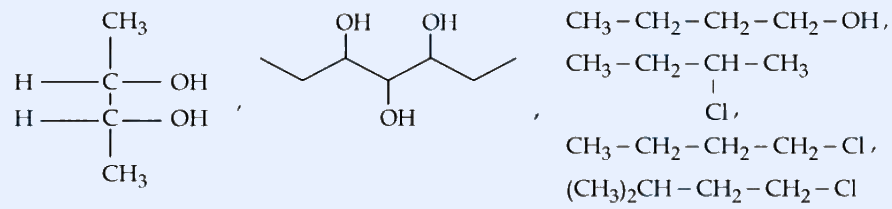
Q54NumericalStereochemistry
Total number of optically active compounds from the following is _______ .
SolutionAnswer: 1
Approach:
Inspect each structure for a chiral centre lacking an internal plane of symmetry.
Step 1:Compounds with an internal mirror plane (meso) or with no carbon bearing four different groups are optically inactive.
Step 2:Exactly one of the listed structures possesses a chiral centre without compensating symmetry.
Step 3:Therefore the count of optically active compounds is 1.
Final answer: 1
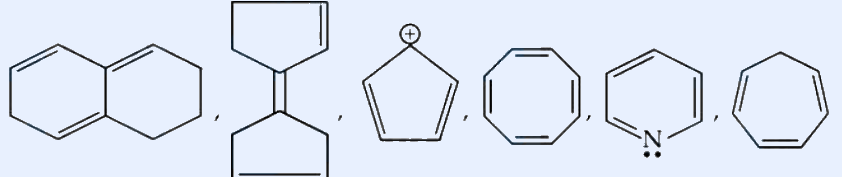
Q55NumericalHydrocarbons
Total number of aromatic compounds among the following compounds is _______ .
SolutionAnswer: 1
Approach:
Apply Huckel's rule of planarity, cyclic conjugation and 4n+2 pi electrons to each structure.
Step 1:Structures that are non-planar, non-conjugated or contain 4n pi electrons are non-aromatic or antiaromatic.
Step 2:Exactly one structure is planar, fully conjugated and contains 4n+2 pi electrons.
Step 3:Therefore the number of aromatic compounds is 1.
Final answer: 1
Q56NumericalSolutions
A solution is prepared by adding 1 mole ethyl alcohol in 9 mole water. The mass percent of solute in the solution is _______ . (Integer answer) (Given : Molar mass in gmo Ethyl alcohol : 46 water: 18)
SolutionAnswer: 22
Approach:
Compute the mass of solute and total mass, then express the solute mass as a percentage.
Step 1:Mass of ethyl alcohol is one mole times its molar mass.
Step 2:Mass of water is nine moles times its molar mass.
Step 3:Compute the mass percent of solute.
Final answer: 22
Q57NumericalSolutions
Molality of an aqueous solution of urea is 4.44 m. Mole fraction of urea in solution is . Value of x is _______ . (Integer answer)
SolutionAnswer: 74
Approach:
Relate molality to mole fraction using moles of solute per kilogram of water.
Step 1:Molality 4.44 m means 4.44 mol urea per 1 kg of water.
Step 2:Substitute into the mole fraction expression.
Step 3:Express in the required form.
Final answer: 74
Q58NumericalCoordination Compounds
Total number of unpaired electrons in the complex ions and is _______ .
SolutionAnswer: 2
Approach:
Determine the metal oxidation state, ligand field strength and resulting number of unpaired electrons for each complex.
Step 1:In [Co(NH3)6]3+, Co(III) is d6 with strong-field NH3, giving a low-spin t2g6 configuration with zero unpaired electrons.
Step 2:In [NiCl4]2-, Ni(II) is d8 with weak-field Cl- in a tetrahedral field, giving two unpaired electrons.
Step 3:Sum the unpaired electrons of both ions.
Final answer: 2
Q59NumericalAldehydes, Ketones and Carboxylic Acids
Two moles of benzaldehyde and one mole of acetone under alkaline conditions using aqueous NaOH after heating gives x as the major product. The number of bonds in the product x is _______ .
SolutionAnswer: 9
Approach:
Identify the cross aldol condensation product of benzaldehyde and acetone, then count all pi bonds in it.
Step 1:The major product is dibenzylideneacetone, PhCH=CH-CO-CH=CH-Ph.
Step 2:Each benzene ring contributes 3 pi bonds, the two C=C contribute 2, and the C=O contributes 1.
Step 3:Therefore the product contains 9 pi bonds.
Final answer: 9
Q60NumericalBiomolecules
Total number of carbon atoms present in tyrosine, an amino acid is _______ .
SolutionAnswer: 9
Approach:
Recall the structural formula of tyrosine and count its carbon atoms.
Step 1:Tyrosine is a p-hydroxyphenyl alanine with the molecular formula C9H11NO3.
Step 2:The aromatic ring has 6 carbons, the CH2 one, the CH one and the COOH one.
Step 3:Therefore tyrosine contains 9 carbon atoms.
Final answer: 9
Mathematics30 questions
Q61Single correctComplex Numbers and Quadratic Equations
The sum of all possible values of , for which is purely imaginary, is equal
(1)
(2)
(3)
(4)
SolutionAnswer: Option 1
Approach:
A complex number is purely imaginary when its real part is zero. Express the quotient in standard form by multiplying by the conjugate of the denominator and set the real part to zero, then collect all solutions in the given interval.
Step 1:Multiply numerator and denominator by the conjugate of the denominator.
Step 2:Set the real part equal to zero for the expression to be purely imaginary.
Step 3:Solve for the angles in the interval .
Step 4:Add all the obtained values of .
Final answer:
Q62Single correctPermutations and Combinations
The number of ways five alphabets can be chosen from the alphabets of the word MATHEMATICS, where the chosen alphabets are not necessarily distinct, is equal to :
(1)
(2)
(3)
(4)
SolutionAnswer: Option 1179
Approach:
MATHEMATICS contains letters with multiplicities M(2), A(2), T(2), H(1), E(1), I(1), C(1), S(1) — eight distinct letters of which three are available twice. Count selections of five letters by cases based on how many repeated pairs are used.
Step 1:All five chosen letters distinct: choose 5 of the 8 distinct letters.
Step 2:Exactly one letter repeated (one pair) and three other distinct letters: choose 1 of 3 repeatable letters and 3 of the remaining 7.
Step 3:Two letters repeated (two pairs) and one other distinct letter: choose 2 of 3 repeatable letters and 1 of the remaining 6.
Step 4:Add the cases.
Final answer: 179
Q63Single correctSequences and Series
In an increasing geometric progression of positive terms, the sum of the second and sixth terms is and the product of the third and fifth terms is 49 . Then the sum of the , and terms is equal to :
(1)
(2)
(3)
(4)
SolutionAnswer: Option 291
Approach:
Use the property that the product of the third and fifth terms equals the square of the fourth term to find the fourth term, then use the sum condition to determine the common ratio and evaluate the required sum.
Step 1:From the product condition, find the fourth term (positive terms).
Step 2:Write the sum condition using .
Step 3:Solve the resulting quadratic in and select the increasing case.
Step 4:Compute the required sum using .
Final answer: 91
Q64Single correctBinomial Theorem
If the term independent of x in the expansion of is 105 , then is equal to :
(1)
(2)
(3)
(4)
SolutionAnswer: Option 24
Approach:
Write the general term of the binomial expansion, set the exponent of to zero to locate the term independent of , equate it to 105 and solve for .
Step 1:Simplify the general term and isolate the power of .
Step 2:Set the exponent of to zero.
Step 3:Equate the independent term to 105.
Step 4:Solve for a and then .
Final answer: 4
Q65Single correctTrigonometry
If the value of is , where a, b, c are natural numbers and , then is equal to :
(1)
(2)
(3)
(4)
SolutionAnswer: Option 252
Approach:
Substitute the exact surd values and , simplify the expression to the form , and read off a,b,c.
Step 1:Compute the numerator.
Step 2:Compute the denominator.
Step 3:Form the ratio and rationalise.
Step 4:Write in the required form and add.
reduces to
Final answer: 52
Q66Single correctCoordinate Geometry
If the image of the point in the line lies on the circle , then r is equal to:
(1)
(2)
(3)
(4)
SolutionAnswer: Option 12
Approach:
Find the reflection of the given point in the line using the standard image formula, then substitute the image coordinates into the circle equation to obtain .
Step 1:For line with point compute the multiplier.
Step 2:Find the image coordinates.
Step 3:Substitute into the circle to find .
Step 4:Take the positive root.
Final answer: 2
Q67Single correctCoordinate Geometry
If the line segment joining the points and subtends an angle at the origin, then the absolute value of the product of all possible values of a is :
(1)
(2)
(3)
(4)
SolutionAnswer: Option 4-4
Approach:
The slopes of the lines from the origin to the two points are and . Apply the tangent-of-angle-between-lines formula with angle , obtain a quadratic in a, and take the product of its roots.
Step 1:Set up the tangent condition with .
Step 2:Remove the modulus to get two linear cases.
Step 3:Combine into a single quadratic in .
Step 4:Take the product of roots and its absolute value.
Final answer: -4
Q68Single correctSets, Relations and Functions
Let and . Let R be a relation on defined by (a, b)R(c, d) if and only if is an even integer. Then the relation R is
(1)
(2)
(3)
(4)
SolutionAnswer: Option 2reflexive and symmetric but not transitive.
Approach:
Test reflexivity, symmetry and transitivity of the relation by analysing the parity of , noting that the parity reduces to that of .
Step 1:Reflexivity: check .
Step 2:Symmetry: if is even then has the same parity.
Step 3:Transitivity: a counterexample with mixed parities breaks the chain.
Step 4:Combine the three results.
Final answer: reflexive and symmetric but not transitive.
Q69Single correctMatrices and Determinants
If and , then is equal to:
(1)
(2)
(3)
(4)
SolutionAnswer: Option 20
Approach:
Write the matrix as a diagonal plus a rank-one update and apply the matrix determinant lemma.
Step 1:The matrix equals a diagonal D = diag(alpha-a, beta-b, gamma-c) plus the rank-one matrix whose every row is (a, b, c).
Step 2:By the matrix determinant lemma and det(D) not zero, the singular condition gives the bracketed sum.
Step 3:Hence the standard sum equals minus one.
Step 4:Since the third printed term has numerator gamma, use gamma/(gamma-c) = 1 + c/(gamma-c).
Final answer: 0
Q70Single correctMatrices and Determinants
If the system of equations , , has infinitely many solutions, then is equal to :
(1)
(2)
(3)
(4)
SolutionAnswer: Option 2-3
Approach:
For infinitely many solutions the coefficient determinant must vanish, giving ; then consistency of the augmented system fixes . Substitute into .
Step 1:Set the coefficient determinant to zero.
Step 2:Impose consistency on an augmented determinant.
Step 3:Substitute the values.
Step 4:Simplify.
Final answer: -3
Q71Single correctSets, Relations and Functions
Let where a and . Then the function is
(1)
(2)
(3)
(4)
SolutionAnswer: Option 1neither one-one nor onto.
Approach:
Compute and piecewise on , form , and examine whether g is injective and whether its range covers .
Step 1:For , , so .
Step 2:For , gives and so .
Step 3:Injectivity fails because is identically zero on .
Step 4:Surjectivity fails because the range is .
Final answer: neither one-one nor onto.
Q72Single correctLimits, Continuity and Differentiability
For a, b , let be a continuous function at . Then is equal to :
(1)
(2)
(3)
(4)
SolutionAnswer: Option 16
Approach:
Continuity at requires the left-hand and right-hand limits to equal . Evaluate both limits in terms of a and b, equate to 3, and solve for the ratio .
Step 1:Left-hand limit.
Step 2:Right-hand limit after rationalising the numerator.
Step 3:Apply continuity with .
Step 4:Solve and form the ratio.
Final answer: 6
Q73Single correctLimits, Continuity and Differentiability
If the function , has a local maximum at and a local minimum at , then and are the roots of the equation :
(1)
(2)
(3)
(4)
SolutionAnswer: Option 1
Approach:
The critical points are the roots of . The local maximum occurs at the smaller root and the local minimum at the larger root. Use the sum and product of these roots to identify and and form their quadratic.
Step 1:Differentiate and set to zero.
Step 2:Roots are (max, smaller) and (min, larger): use sum and product.
Step 3:From , does not satisfy; solve to get matching local max at smaller root.
Step 4:Form the quadratic with roots and .
Final answer:
Q74Single correctIntegral Calculus
Let . Then and are the roots of the equation :
(1)
(2)
(3)
(4)
SolutionAnswer: Option 3
Approach:
Evaluate the definite integral using the substitution , set the result equal to to find , compute and , and form the quadratic with these as roots.
Step 1:Substitute and integrate.
Step 2:Evaluate at the upper limit .
Step 3:Set the definite integral equal to and solve for .
Step 4:Form the quadratic with roots and .
Final answer:
Q75Single correctIntegral Calculus
The area of the region in the first quadrant inside the circle and outside the parabola is equal to :
(1)
(2)
(3)
(4)
SolutionAnswer: Option 4
Approach:
Find the intersection of the circle and parabola in the first quadrant, then subtract the area bounded inside the parabola from the relevant circular region using definite integrals.
Step 1:Find the intersection point in the first quadrant.
Step 2:Area under the parabola from to .
Step 3:Area under the circle from to plus the strip, assembled with the quarter-disc.
Step 4:Combine the regions to obtain the required area.
Final answer:
Q76Single correctDifferential Equations
Let be the solution curve of the differential equation , . Then is equal to :
(1)
(2)
(3)
(4)
SolutionAnswer: Option 4
Approach:
Divide through by and substitute to convert into a linear first-order differential equation in t.
Step 1:Divide the equation by .
Step 2:Substitute , so .
Step 3:The integrating factor is . Multiply and integrate.
Step 4:Apply , giving at .
Step 5:Evaluate at .
Final answer:
Q77Single correctVector Algebra
Let and be a vector such that . If , then is equal to :
(1)
(2)
(3)
(4)
SolutionAnswer: Option 21618
Approach:
Rearrange the cross-product condition so that is parallel to a fixed vector, then use the dot-product condition to fix its magnitude.
Step 1:Write the right side as and bring all terms to one side.
Step 2:Hence is parallel to .
Step 3:Compute and apply the dot condition.
Step 4:Solve for .
Step 5:Compute the squared magnitude.
Final answer: 1618
Q78Single correctVector Algebra
Let and be three vectors. Let be anit vector along . If , then is equal to:
(1)
(2)
(3)
(4)
SolutionAnswer: Option 325
Approach:
Form the unit vector along , impose , square to remove the radical, and solve for .
Step 1:Add the vectors.
Step 2:Compute the dot product with .
Step 3:Apply .
Step 4:Square and simplify.
Step 5:Solve the linear equation, giving , so .
Final answer: 25
Q79Single correctThree Dimensional Geometry
If the shortest distance between the lines and is , then a value of is :
(1)
(2)
(3)
(4)
SolutionAnswer: Option 41
Approach:
The two lines are parallel (direction ratios and ). Use the parallel-line distance formula with the cross product of the connecting vector and the common direction.
Step 1:Both directions reduce to , with .
Step 2:Compute the cross product .
Step 3:Set the distance equal to and square.
Step 4:Simplify to a quadratic in .
Step 5:The roots are and ; the listed value is .
Final answer: 1
Q80Single correctProbability
There are three bags and . Bag contains 5 one-rupee coins and 4 five-rupee coins; Bag contains 4 one-rupee coins and 5 five-rupee coins and Bag contains 3 one-rupee coins and 6 five-rupee coins. A bag is selected at random and a coin drawn from it at random is found to be a one-rupee coin. Then the probability, that it came from bag Y, is :
(1)
(2)
(3)
(4)
SolutionAnswer: Option 4
Approach:
Apply Bayes' theorem with equal prior probability for each bag and the conditional probabilities of drawing a one-rupee coin.
Step 1:Each bag has 9 coins. The chance of a one-rupee coin from X, Y, Z is .
Step 2:Total probability of drawing a one-rupee coin.
Step 3:Apply Bayes' theorem for bag .
Step 4:Simplify the fraction.
Final answer:
Q81NumericalComplex Numbers and Quadratic Equations
The number of distinct real roots of the equation , is
SolutionAnswer: 2
Approach:
Substitute to symmetrize the moduli, then reduce to an equation in .
Step 1:Put . Then , , .
Step 2:Let , so .
Step 3:Case : .
Step 4:Case : , giving .
Step 5:Only , so gives , i.e. and .
Final answer: 2
Q82NumericalSequences and Series
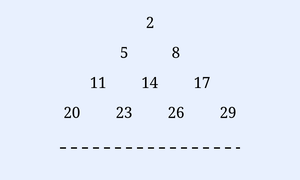
An arithmetic progression is written in the following way
The sum of all the terms of the row is_______
The sum of all the terms of the row is_______
SolutionAnswer: 1505
Approach:
The numbers form a single AP with first term 2 and common difference 3, arranged so row n has n terms. Locate the row's terms and sum them.
Step 1:Rows have terms; rows 1 to 9 contain terms.
Step 2:Row 10 holds 10 terms, the 46th to 55th, with .
Step 3:Sum the 10 terms.
Step 4:Evaluate.
Final answer: 1505
Q83NumericalCoordinate Geometry
Let a ray of light passing through the point reflects on the line and the reflected ray passes through the point . If the equation of the incident ray is , then is equal to_______
SolutionAnswer: 1
Approach:
Reflect the point on the reflected ray about the mirror line; the incident ray passes through and this image point.
Step 1:Reflect in . Here and .
Step 2:The incident ray passes through and the image .
Step 3:Equation: , i.e. .
Step 4:Compute the required expression.
Final answer: 1
Q84NumericalCoordinate Geometry
Let S be the focus of the hyperbola , on the positive x-axis. Let C be the circle with its centre at and passing through the point S. If O is the origin and SAB is a diameter of C, then the square of the area of the triangle OSB is equal to_______
SolutionAnswer: 40
Approach:
Find the focus , use that is the midpoint of diameter to get , then compute the area of triangle and square it.
Step 1:Here , , so and .
Step 2: is the midpoint of S and B.
Step 3:Area of triangle OSB with O at origin equals .
Step 4:Square the area.
Final answer: 40
Q85NumericalLimits, Continuity and Differentiability
If and are the roots of the quadratic equation , then is equal to_______
SolutionAnswer: 6
Approach:
Evaluate both limits, then use sum and product of roots of the quadratic to determine and .
Step 1:As , both , so the first limit is .
Step 2:For , the exponent limit is .
Step 3:Product of roots: gives , so .
Step 4:Sum of roots: , i.e. .
Step 5:Compute the expression.
Final answer: 6
Q86NumericalStatistics
Let a, b, c N and a b c. Let the mean, the mean deviation about the mean and the variance of the 5 observations be and , respectively. Then is equal to_______
SolutionAnswer: 33
Approach:
Use the mean to fix , then the variance to fix , and the mean deviation to pin the values; solve the resulting system for natural numbers.
Step 1:Mean gives .
Step 2:Variance gives .
Step 3:Mean deviation gives .
Step 4:Solve , and over natural numbers with .
Step 5:Compute the required combination.
Final answer: 33
Q87NumericalApplication of Derivatives
Let A be the region enclosed by the parabola and the line . Then the maximum area of the rectangle inscribed in the region A is_______
SolutionAnswer: 128
Approach:
Place an axis-symmetric rectangle with one side on the line and the opposite side at on the parabola; express area as a function of and maximize.
Step 1:At the half-height is ; the rectangle spans from to with height .
Step 2:Write and differentiate.
Step 3:The interior maximum occurs at .
Step 4:Compute the area.
Final answer: 128
Q88NumericalIntegral Calculus
If , where C is the constant of integration, then the value of is_______
SolutionAnswer: 7
Approach:
Rewrite the integrand by factoring out to obtain a function of , then substitute .
Step 1:Write the integrand as .
Step 2:Substitute , so .
Step 3:Match with .
Step 4:Compute the required expression.
Final answer: 7
Q89NumericalDifferential Equations
Let be the solution of the differential equation , . Then is equal to_______
SolutionAnswer: 4
Approach:
Recognize and , divide to obtain an integrable form, then apply the initial condition.
Step 1:Divide the equation by .
Step 2:Integrate term by term.
Step 3:Apply : .
Step 4:Exponentiate: , i.e. .
Step 5:Add the constants.
Final answer: 4
Q90NumericalThree Dimensional Geometry
Let be the image of the point in the line . Then is equal to_______
SolutionAnswer: 11
Approach:
Find the foot of perpendicular from to the line using the direction ratios, then reflect through to get .
Step 1:A general point on the line is with direction .
Step 2:Impose perpendicularity .
Step 3:Compute .
Step 4:Reflect: .
Step 5:Compute the required combination.
Final answer: 11
More JEE Main 2024 papers
Frequently Asked Questions
How many questions are in the JEE Main 2024 April 08, Shift 2 paper?
The JEE Main 2024 April 08, Shift 2 paper has 89 questions — Physics (30), Chemistry (29) and Mathematics (30). Every question is on this page with its correct answer and a step-by-step solution.
What is the marking scheme for JEE Main?
JEE Main awards +4 marks for each correct answer and −1 for a wrong answer, with 0 for questions left unattempted. The paper covers Physics, Chemistry and Mathematics.
Are the answer key and step-by-step solutions provided for the 2024 April 08, Shift 2 paper?
Yes — every question shows the correct answer (answer key) and a detailed step-by-step solution, free to read online.
Can I take the JEE Main 2024 April 08, Shift 2 paper as a timed mock test?
Yes. With a free JEEnify account you can attempt this exact paper as a timed test in the real exam interface, then see your score and weak-area analysis.
Solved this paper? Calculate your JEE Main scoremost important chaptersformula sheetsall free tools.