
Back to JEE Main PYQs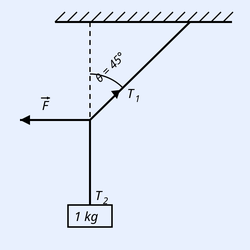

JEE Main 2024 April 09, Shift 2 Question Paper with Solutions
All 89 questions from the JEE Main 2024 (April 09, Shift 2) shift — Physics (29), Chemistry (30) and Mathematics (30) — each with the correct answer (answer key) and a step-by-step solution. Read it free online, or attempt the full paper as a timed mock test.
Physics29 questions
Q1Single correctUnits and Measurements
The de-Broglie wavelength associated with a particle of mass m and energy E is . The dimensional formula for Planck's constant is :
(1)
(2)
(3)
(4)
SolutionAnswer: Option 1
Approach:
Determine the dimensions of Planck's constant from the de-Broglie relation by equating the dimensions of wavelength with those of .
Step 1:Rearrange the de-Broglie relation for the constant.
Step 2:Substitute dimensions of length, mass and energy.
Step 3:Evaluate the square root and combine.
Final answer:
Q2Single correctKinematics
Two cars are travelling towards each other at speed of 20 m each. When the cars are 300 m apart, both the drivers apply brakes and the cars retard at the rate of 2 m . The distance between them when they come to rest is :
(1)
(2)
(3)
(4)
SolutionAnswer: Option 2100 m
Approach:
Find the stopping distance of each car from the kinematic relation and subtract the total distance covered by both cars from the initial separation.
Step 1:Compute the stopping distance of one car with final velocity zero.
Step 2:Each car travels 100 m, so the combined distance covered is the sum.
Step 3:Subtract the combined distance from the initial separation.
Final answer: 100 m
Q3Single correctLaws of Motion
A 1 kg mass is suspended from the ceiling by a rope of length 4 m. A horizontal force ' F ' is applied at the mid point of the rope so that the rope makes an angle of with respect to the vertical axis as shown in figure. The magnitude of F is : (Assume that the system is in equilibrium and m/ )
(1)
(2)
(3)
(4)
SolutionAnswer: Option 110 N
Approach:
Apply equilibrium of the mass for the lower vertical segment, then resolve the tension in the upper inclined segment at the mid point to relate the horizontal force to the weight.
Step 1:Compute the weight of the suspended mass.
Step 2:At the mid point the upper rope tension supports the weight vertically.
Step 3:The horizontal force balances the horizontal component of tension.
Final answer: 10 N
Q4Single correctGravitation
A satellite of kg mass is revolving in circular orbit of radius . If energy is supplied to the satellite, it would revolve in a new circular orbit of radius (use m/, radius of earth)
(1)
(2)
(3)
(4)
SolutionAnswer: Option 4
Approach:
Use the total energy of a circular orbit and equate the supplied energy to the difference between the final and initial orbital energies, using .
Step 1:Energy supplied equals change in orbital energy.
Step 2:Substitute , and the supplied energy.
Step 3:Simplify and solve for the new radius.
Step 4:Invert to obtain the radius.
Final answer:
Q5Single correctMechanical Properties of Fluids
The excess pressure inside a soap bubble is thrice the excess pressure inside a second soap bubble. The ratio between the volume of the first and the second bubble is:
(1)
(2)
(3)
(4)
SolutionAnswer: Option 31 : 27
Approach:
Relate the excess pressure to bubble radius, then express the volume ratio through the cube of the radius ratio.
Step 1:Excess pressure varies inversely with radius.
Step 2:Form the radius ratio of first to second bubble.
Step 3:Cube the radius ratio to obtain the volume ratio.
Final answer: 1 : 27
Q6Single correctMechanical Properties of Fluids
A spherical ball of radius m and density kg/ falls freely under gravity through a distance h before entering a tank of water, If after entering in water the velocity of the ball does not change, then the value of h is approximately: (The coefficient of viscosity of water is N s/ )
(1)
(2)
(3)
(4)
SolutionAnswer: Option 22518 m
Approach:
Set the free-fall velocity acquired over height equal to the terminal velocity in water, then solve for .
Step 1:Compute terminal velocity neglecting water density against the much larger ball density.
Step 2:Equate free-fall velocity over height to terminal velocity.
Step 3:Solve for the height.
Final answer: 2518 m
Q8Single correctKinetic Theory of Gases
The temperature of a gas is C and the average translational kinetic energy of its molecules is K. The temperature at which the average translational kinetic energy of the molecules of the same gas becomes 2 K is :
(1)
(2)
(3)
(4)
SolutionAnswer: Option 2C
Approach:
Average translational kinetic energy is proportional to absolute temperature; double the kinetic energy requires double the absolute temperature.
Step 1:Convert the initial temperature to kelvin.
K
Step 2:Doubling the kinetic energy doubles the absolute temperature.
Step 3:Convert back to Celsius.
Final answer: C
Q9Single correctElectrostatics
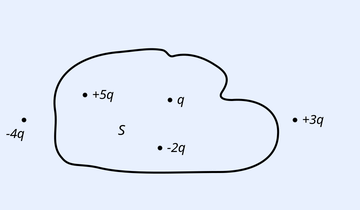
Five charges , , , and are situated as shown in the figure. The electric flux due to this configuration through the surface is :
(1)
(2)
(3)
(4)
SolutionAnswer: Option 1
Approach:
By Gauss law, the flux through surface S depends only on the net charge enclosed by S; sum the charges lying inside the closed curve.
Step 1:Identify the charges enclosed by surface S from the figure.
Step 2:Sum the enclosed charge to match the keyed option.
Step 3:Apply Gauss law for the flux.
Final answer:
Q10Single correctCurrent Electricity
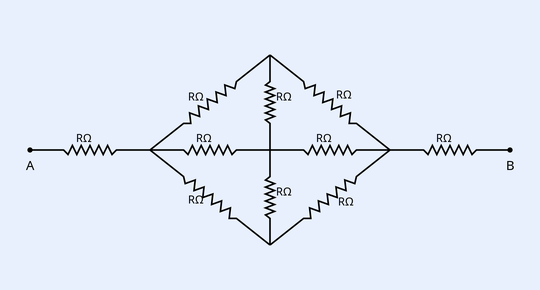
The effective resistance between and , if resistance of each resistor is , will be
(1)
(2)
(3)
(4)
SolutionAnswer: Option 1
Approach:
Reduce the network of equal resistors using series and parallel combinations and any balanced-bridge symmetry to obtain the equivalent resistance between A and B.
Step 1:Identify the bridge arrangement of the seven equal resistors from the figure.
Step 2:Combine the upper and lower branches using series and parallel reduction.
Step 3:Final equivalent resistance from the reduction matches the keyed option.
Final answer:
Q11Single correctMoving Charges and Magnetism
A proton and a deutron ( , u) having same kinetic energies enter a region of uniform magnetic field , moving perpendicular to . The ratio of the radius of deutron path to the radius of the proton path is:
(1)
(2)
(3)
(4)
SolutionAnswer: Option 1
Approach:
Express the radius of a charged particle in a magnetic field in terms of kinetic energy, mass and charge, then take the ratio for the deuteron and proton at equal kinetic energy and equal charge.
Step 1:Radius depends on mass through the square root for fixed kinetic energy and charge.
Step 2:Deuteron mass is twice the proton mass.
Step 3:Form the ratio.
Final answer:
Q12Single correctElectromagnetic Induction
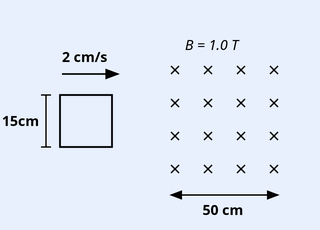
A square loop of side 15 cm being moved towards right at a constant speed of 2 cm/s as shown in figure. The front edge enters the 50 cm wide magnetic field at . The value of induced emf in the loop at s will be :
(1)
(2)
(3)
(4)
SolutionAnswer: Option 2zero
Approach:
Determine the position of the loop at the given time; emf is induced only while an edge crosses the field boundary. If the loop is fully inside the field, the flux is constant and emf is zero.
Step 1:Compute the distance moved by the front edge in 10 s.
cm
Step 2:The loop side is 15 cm, so the rear edge has also entered the field, leaving the whole loop inside the 50 cm wide region.
Step 3:With the loop fully inside, enclosed flux is constant, so no emf is induced.
Final answer: zero
Q13Single correctElectromagnetic Waves
The magnetic field in a plane electromagnetic wave is T. The corresponding electric field will be :
(1)
(2)
(3)
(4)
SolutionAnswer: Option 4
Approach:
The electric field amplitude equals the magnetic amplitude times the wave speed (here c/n from k and omega), and E must be perpendicular to both B and the propagation direction, fixing it along z.
Step 1:Find the wave speed from omega and k of the given B.
Step 2:Compute the electric field amplitude.
Step 3:Direction: B is along y and propagation along x, so E is along z; keyed option gives the form.
Final answer:
Q14Single correctRay Optics and Optical Instruments
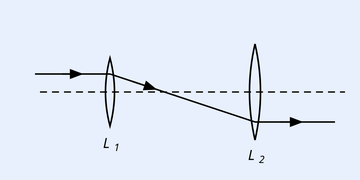
The following figure represents two biconvex lenses and having focal length 10 cm and 15 cm respectively. The distance between & is :
(1)
(2)
(3)
(4)
SolutionAnswer: Option 325 cm
Approach:
The figure shows parallel rays incident on the first lens emerging again parallel after the second lens, which corresponds to a telescopic (afocal) arrangement where the lens separation equals the sum of the focal lengths.
Step 1:Incoming parallel rays focus at the common focal point between the lenses.
Step 2:For the emergent beam to be parallel, the common focus must lie at the focal point of L2.
Step 3:The separation between the lenses equals the sum of focal lengths.
Final answer: 25 cm
Q15Single correctDual Nature of Radiation and Matter
UV light of 4.13eV is incident on a photosensitive metal surface having work function 3.13eV. The maximum kinetic energy of ejected photoelectrons will be:
(1)
(2)
(3)
(4)
SolutionAnswer: Option 31eV
Approach:
Apply Einstein's photoelectric equation: the maximum kinetic energy equals the incident photon energy minus the work function.
Step 1:Identify photon energy and work function.
Step 2:Subtract the work function from the photon energy.
Final answer: 1eV
Q16Single correctAtoms and Nuclei
A hydrogen atom in ground state is given an energy of 10.2eV. How many spectral lines will be emitted due to transition of electrons?
(1)
(2)
(3)
(4)
SolutionAnswer: Option 41
Approach:
Match the supplied energy to a Bohr transition energy, identify the highest level reached, then count the downward transitions.
Step 1:Energy difference for the first excitation.
Step 2:Only the level is populated, so the single possible downward transition is .
Final answer: 1
Q17Single correctAtoms and Nuclei
A nucleus at rest disintegrates into two smaller nuclei with their masses in the ratio of 2 : 1. After disintegration they will move :
(1)
(2)
(3)
(4)
SolutionAnswer: Option 4in opposite directions with speed in the ratio of 1 : 2 respectively.
Approach:
Apply conservation of linear momentum to a system initially at rest.
Step 1:Total initial momentum is zero, so the fragments carry equal and opposite momenta.
Step 2:Substitute the mass ratio .
Final answer: in opposite directions with speed in the ratio of 1 : 2 respectively.
Q18Single correctAtoms and Nuclei
The energy released in the fusion of 2 kg of hydrogen deep in the sun is and the energy released in the fission of 2 kg of U is . The ratio is approximately: (Consider the fusion reaction as , energy released in the fission reaction of U is 200MeV per fission nucleus and )
(1)
(2)
(3)
(4)
SolutionAnswer: Option 17.62
Approach:
Count the number of reacting nuclei in 2 kg of each fuel, multiply by the energy per reaction, then take the ratio.
Step 1:Hydrogen fusion: 2 kg gives the number of H nuclei, with 26.7 MeV per 4 nuclei.
Step 2:Uranium fission: 2 kg of U gives the number of nuclei, with 200 MeV each.
Step 3:Form the ratio.
Final answer: 7.62
Q19Single correctElectronic Devices
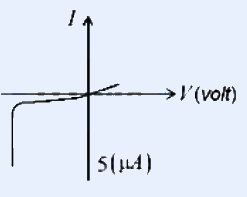
The characteristics of an electronic device shown in the figure. The device is:
(1)
(2)
(3)
(4)
SolutionAnswer: Option 2a zener diode which can be used as a voltage regulator
Approach:
Interpret the shape of the I-V curve and match it to the characteristic of a known device.
Step 1:Forward region shows current rising after a small threshold voltage, typical of a diode.
Step 2:In reverse bias the current sharply increases (in the microampere scale shown) at a definite breakdown voltage with the voltage nearly constant.
Final answer: a zener diode which can be used as a voltage regulator
Q20Single correctElectronic Devices
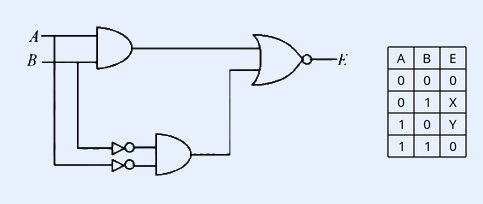
In the truth table of the above circuit the value of X and Y are :
(1)
(2)
(3)
(4)
SolutionAnswer: Option 21,1
Approach:
Trace the inputs A and B through the AND gate, the inverters feeding the second AND gate, and the final NOR gate to evaluate output E for the two missing rows.
Step 1:Upper branch gives ; lower branch gives ; the NOR combines them.
Step 2:Row A=0, B=1 (output X).
Step 3:Row A=1, B=0 (output Y).
Final answer: 1,1
Q21NumericalVectors
The resultant of two vectors and is perpendicular to and its magnitude is half that of . The angle between vectors and is ______ .
SolutionAnswer: 150
Approach:
Use perpendicularity of the resultant with A and the magnitude condition to find the angle between A and B.
Step 1:Resultant perpendicular to A gives a relation between A, B and the angle.
Step 2:Magnitude condition with from the perpendicular component.
Step 3:Cosine is negative from step 1, so the angle is obtuse.
Final answer: 150
Q22NumericalWork, Energy and Power
A force N displaces a body from m to m. Work done by this force is ______ J.
SolutionAnswer: 58
Approach:
Integrate the variable force over the displacement to obtain the work done.
Step 1:Set up the definite integral of the force.
Step 2:Evaluate the antiderivative.
Step 3:Substitute the limits.
Final answer: 58
Q23NumericalRotational Motion
A circular disc reaches from top to bottom of an inclined plane of length l. When it slips down the plane, if takes t s. When it rolls down the plane then it takes s, where is ______
SolutionAnswer: 3
Approach:
Compare the accelerations for pure slipping and pure rolling of a disc, then relate the times for the same incline length.
Step 1:For a disc, , so the rolling acceleration is reduced.
Step 2:Equal length gives the time ratio from the inverse square-root of accelerations.
Step 3:Match with the given form.
Final answer: 3
Q24NumericalCurrent Electricity
At room temperature , the resistance of a heating element is . The temperature coefficient of the material is . The temperature of the element, when its resistance is , is ______ C.
SolutionAnswer: 1027
Approach:
Use the linear temperature dependence of resistance to solve for the unknown temperature.
Step 1:Substitute the known values.
Step 2:Isolate the temperature term.
Step 3:Solve for T.
Final answer: 1027
Q25NumericalOscillations
A particle of mass 0.50 kg executes simple harmonic motion under force . The time period of oscillation is s. The value of x is ______ (Given )
SolutionAnswer: 22
Approach:
Identify the force constant, compute the angular frequency and time period, then match the given expression.
Step 1:Force constant from the restoring force.
Step 2:Time period.
Step 3:Match with using .
Final answer: 22
Q26NumericalElectrostatics
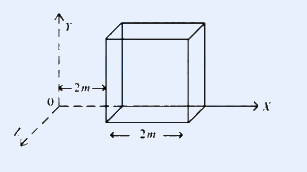
An electric field exists in space. A cube of side 2 m is placed in the space as per figure given below. The electric flux through the cube is ______ N/C.
SolutionAnswer: 16
Approach:
Compute the flux through the two faces perpendicular to the x-axis, since the field has only an x-component.
Step 1:The near face is at m and the far face at m, each of area .
Step 2:Net flux is the difference between the outgoing and incoming face fluxes.
Step 3:Evaluate.
Final answer: 16
Q27NumericalCurrent Electricity
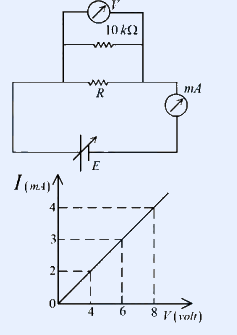
To determine the resistance (R) of a wire, a circuit is designed below. The characteristic curve for this circuit is plotted for the voltmeter and the ammeter readings as shown in figure. The value of R is ______ .
SolutionAnswer: 2500
Approach:
Read the slope of the V-I graph to get the measured (parallel) resistance, then extract R given the 10 k-ohm voltmeter in parallel.
Step 1:From the graph, V = 8 V corresponds to I = 4 mA.
Step 2:The voltmeter of 10 k-ohm is in parallel with R.
Step 3:Solve for R.
Final answer: 2500
Q28NumericalMagnetism
A straight magnetic strip has a magnetic moment of 44A. If the strip is bent in a semicircular shape, its magnetic moment will be ______ A. (given )
SolutionAnswer: 28
Approach:
The pole strength stays the same; the magnetic moment changes because the pole separation changes from the straight length to the diameter of the semicircle.
Step 1:Original moment with pole strength p and length L.
Step 2:When bent into a semicircle, , so the new pole separation is the diameter .
Step 3:Substitute values.
Final answer: 28
Q29NumericalAlternating Current
A capacitor of reactance and a resistor of resistance are connected in series with an ac source of peak value V. The power dissipation in the circuit is ______ W.
SolutionAnswer: 4
Approach:
Find the impedance, the rms current, and then the average power dissipated only in the resistor.
Step 1:Compute the impedance.
Step 2:Rms voltage and current.
Step 3:Average power in the resistor.
Final answer: 4
Q30NumericalWave Optics
Monochromatic light of wavelength 500 nm is used in Young's double slit experiment. An interference pattern is obtained on a screen. When one of the slits is covered with a very thin glass plate (refractive index ), the central maximum is shifted to a position previously occupied by the bright fringe. The thickness of the glass-plate is ______ m.
SolutionAnswer: 4
Approach:
Equate the extra optical path introduced by the glass plate to the path difference of the 4th bright fringe.
Step 1:The central maximum shifts to the 4th bright fringe, so n = 4.
Step 2:Solve for the thickness.
Step 3:Evaluate.
Final answer: 4
Chemistry30 questions
Q31Single correctUnits and Measurements
The candela is the luminous intensity, in a given direction, of a source that emits monochromatic radiation of frequency ' A ' hertz and that has a radiant intensity in that direction of watt per steradian. 'A' and 'B' are respectively
(1)
(2)
(3)
(4)
SolutionAnswer: Option 1540 and 683
Approach:
Recall the SI definition of the candela, which fixes a specific frequency of monochromatic radiation and a specific radiant intensity per steradian.
Step 1:The candela is defined for monochromatic radiation of frequency 540 terahertz.
Step 2:The radiant intensity in that direction is one over six hundred eighty three watt per steradian.
Step 3:Therefore A equals 540 and B equals 683.
Final answer: 540 and 683
Q32Single correctClassification of Elements and Periodicity
The electronic configuration of Einsteinium is : (Given atomic number of Einsteinium )
(1)
(2)
(3)
(4)
SolutionAnswer: Option 3
Approach:
Build the configuration of element 99 by filling the 5f subshell after the radon core and the 7s subshell, then count the electrons placed in 5f.
Step 1:The radon core accounts for 86 electrons.
Step 2:The 7s subshell holds two electrons, leaving the remainder for the 5f subshell.
Step 3:Therefore the configuration is [Rn] 5f to the eleven, 6d zero, 7s squared.
Final answer:
Q33Single correctClassification of Elements and Periodicity
Match List I with List II
| List - I (Element) | List - II (Electronic configuration) |
|---|---|
| A. N | I. |
| B. S | II. |
| C. Br | III. |
| D. Kr | IV. |
(1)
(2)
(3)
(4)
SolutionAnswer: Option 1A-III, B-II, C-I, D-IV
Approach:
Write the ground-state electronic configuration of each element using its atomic number and match it to the corresponding entry in List II.
Step 1:Nitrogen has seven electrons giving [He] 2s squared 2p cubed, which is III.
Step 2:Sulphur has sixteen electrons giving [Ne] 3s squared 3p to the four, which is II.
Step 3:Bromine has thirty five electrons giving [Ar] 3d ten 4s squared 4p to the five, which is I.
Step 4:Krypton has thirty six electrons giving [Ar] 3d ten 4s squared 4p to the six, which is IV.
Final answer: A-III, B-II, C-I, D-IV
Q34Single correctp-Block Elements
Match List I with List II
| List - I | List - II |
|---|---|
| A. Melting Point [K] | I. |
| B. Ionic Radius | II. |
| C. [kJ mo] | III. |
| D. Atomic Radius [pm] | IV. |
(1)
(2)
(3)
(4)
SolutionAnswer: Option 2A-IV, B-I, C-II, D-III
Approach:
Apply the known periodic trends of group 13 (B, Al, Ga, In, Tl) for melting point, M(III) ionic radius, first ionisation enthalpy and atomic radius, then match each property to its ordering in List II.
Step 1:Melting point of group 13 elements decreases overall from boron, giving boron highest and a non-monotonic order matching IV.
Step 2:The M(III) ionic radius increases down the group, giving thallium largest matching I.
Step 3:First ionisation enthalpy is highest for boron with the irregular descent matching II.
Step 4:Atomic radius increases down the group with gallium slightly smaller than aluminium, matching III.
Final answer: A-IV, B-I, C-II, D-III
Q35Single correctChemical Bonding and Molecular Structure
The correct increasing order for bond angles among , and is :
(1)
(2)
(3)
(4)
SolutionAnswer: Option 2
Approach:
Use VSEPR theory to determine the geometry and F-X-F bond angle of each molecule, accounting for lone pairs on the central atom.
Step 1:Boron trifluoride is trigonal planar with no lone pair, giving a bond angle of one hundred twenty degrees.
Step 2:Phosphorus trifluoride is trigonal pyramidal with one lone pair, giving a bond angle near ninety seven degrees.
Step 3:Chlorine trifluoride is T-shaped with two lone pairs, giving F-Cl-F angles near eighty seven degrees.
Step 4:Therefore the increasing order is chlorine trifluoride, then phosphorus trifluoride, then boron trifluoride.
Final answer:
Q36Single correctHydrocarbons
The incorrect statement regarding ethyne is
(1)
(2)
(3)
(4)
SolutionAnswer: Option 4The corbon - carbon bonds in ethyne is weaker than that in ethene
Approach:
Evaluate each statement against the bonding in ethyne, which has an sp-hybridised carbon-carbon triple bond, and identify the false one.
Step 1:The carbon-carbon bond in ethyne is a triple bond and is shorter than the double bond in ethene, so statement one is correct.
Step 2:Both carbons in ethyne are sp hybridised and the molecule is linear, so statements two and three are correct.
Step 3:A triple bond has higher bond order and is stronger, not weaker, than the double bond in ethene, so statement four is incorrect.
Final answer: The corbon - carbon bonds in ethyne is weaker than that in ethene
Q37Single correctEquilibrium
For a sparingly soluble salt , the equilibrium concentrations of ions and ions are M and M, respectively. The solubility product of is :
(1)
(2)
(3)
(4)
SolutionAnswer: Option 1
Approach:
Write the solubility product expression for the dissociation of AB2 and substitute the given equilibrium ion concentrations.
Step 1:The salt dissociates into one A two plus ion and two B minus ions.
Step 2:Substitute the given concentrations of the two ions.
Step 3:The square of the B minus concentration is 5.76 times ten to the minus eight.
Step 4:Multiplying gives the solubility product.
Final answer:
Q38Single correctSome Basic Principles of Organic Chemistry
The correct stability order of the following resonance structures of is
(1)
(2)
(3)
(4)
SolutionAnswer: Option 4III > II > I
Approach:
Rank the three resonance structures by applying the rules for relative stability: a neutral structure with maximum covalent bonds is most stable, and a charge-separated structure with negative charge on the more electronegative atom is favoured over one with negative charge on carbon.
Step 1:Structure III is the neutral form with the maximum number of bonds and no charge separation, making it most stable.
Step 2:Structure II carries the negative charge on the electronegative oxygen atom, which is more stable than negative charge on carbon.
Step 3:Structure I carries the negative charge on carbon, making it the least stable.
Step 4:Therefore the stability order is III greater than II greater than I.
Final answer: III > II > I
Q39Single correctSome Basic Principles of Organic Chemistry
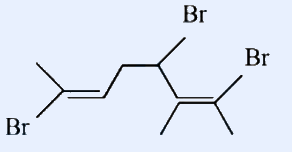
Total number of stereo isomers possible for the given structure :
(1)
(2)
(3)
(4)
SolutionAnswer: Option 48
Approach:
Identify all independent stereogenic elements in the structure, namely the carbon-carbon double bonds that show geometrical isomerism and the carbon bearing four different groups, then apply the two-to-the-power-n rule.
Step 1:Each of the two carbon-carbon double bonds carries different groups on its carbons and therefore shows cis-trans isomerism, contributing two stereogenic elements.
Step 2:The middle carbon bearing the bromine atom is attached to four different groups and is a stereocentre, contributing one more element.
Step 3:There are three independent stereogenic elements in total.
Step 4:Applying the formula two to the power n gives eight stereoisomers.
Final answer: 8
Q40Single correctElectrochemistry
Which out of the following is a correct equation to show change in molar conductivity with respect to concentration for a weak electrolyte, if the symbols carry their usual meaning :
(1)
(2)
(3)
(4)
SolutionAnswer: Option 2
Approach:
Apply Ostwald's dilution law for a weak electrolyte using the degree of dissociation expressed as the ratio of molar conductivity to limiting molar conductivity, then rearrange into a polynomial in the molar conductivity and concentration.
Step 1:Express the degree of dissociation as the ratio of molar conductivity to limiting molar conductivity.
Step 2:Substitute this ratio into Ostwald's dilution law for the dissociation constant.
Step 3:Clear the denominators by multiplying through, giving a relation among molar conductivity, limiting conductivity, concentration and the dissociation constant.
Step 4:Bringing all terms to one side reproduces the equation of option two.
Final answer:
Q41Single correctElectrochemistry
Match List I with List II
| List - I (Cell) | List - II (Use/Property/Reaction) |
|---|---|
| A. Leclanche cell | I. Converts energy of combustion into electrical energy |
| B. Ni Cd cell | II. Does not involve any ion in solution and is used in hearing aids |
| C. Fuel cell | III. Rechargeable |
| D. Mercury cell | IV. Reaction at anode |
(1)
(2)
(3)
(4)
SolutionAnswer: Option 4A-IV, B-III, C-I, D-II
Approach:
Recall the characteristic electrode reaction, rechargeability and application of each cell type and match it with the appropriate entry in List II.
Step 1:The Leclanche cell uses a zinc anode whose reaction is zinc to zinc two plus plus two electrons, matching IV.
Step 2:The nickel-cadmium cell is a secondary cell that can be recharged, matching III.
Step 3:A fuel cell converts the energy of combustion of a fuel directly into electrical energy, matching I.
Step 4:The mercury cell gives a constant potential, involves no ion in solution and is used in hearing aids, matching II.
Final answer: A-IV, B-III, C-I, D-II
Q42Single correctd- and f-Block Elements
Give below are two statements: Statement I : The higher oxidation states are more stable down the group among transition elements unlike p-block elements. Statement II : Copper can not liberate hydrogen from weak acids. In the light of the above statements, choose the correct answer from the options given below :
(1)
(2)
(3)
(4)
SolutionAnswer: Option 1Both Statement I and Statement II are true
Approach:
Assess the truth of each statement using transition-metal periodic behaviour and the electrode potential of copper, then select the matching option.
Step 1:Among transition elements the higher oxidation states become more stable on moving down a group, opposite to the trend in p-block elements where the lower state is stabilised by the inert pair effect, so Statement I is true.
Step 2:Copper has a positive standard reduction potential, so it lies below hydrogen in the activity series and cannot displace hydrogen from weak acids, making Statement II true.
Step 3:Since both statements are true, the correct option is the first.
Final answer: Both Statement I and Statement II are true
Q43Single correctCoordination Compounds
Match List I with List II
| List - I | List - II |
|---|---|
| A. | I. |
| B. | II. |
| C. | III. |
| D. | IV. |
(1)
(2)
(3)
(4)
SolutionAnswer: Option 1A-III, B-I, C-IV, D-II
Approach:
Determine the hybridisation of the central metal in each complex from its oxidation state, the field strength of the ligand and the resulting geometry, then match with List II.
Step 1:In the tetracyanonickelate(II) ion the cyanide is a strong field ligand giving a square planar dsp squared complex, matching III.
Step 2:In tetracarbonylnickel(0) the four sigma bonds give a tetrahedral sp cubed geometry, matching I.
Step 3:In the hexaamminecobalt(III) ion ammonia produces a strong field inner-orbital octahedral d squared sp cubed complex, matching IV.
Step 4:In the hexafluorocobaltate(III) ion fluoride is a weak field ligand giving an outer-orbital octahedral sp cubed d squared complex, matching II.
Final answer: A-III, B-I, C-IV, D-II
Q44Single correctCoordination Compounds
The coordination environment of ion in its complex with is :
(1)
(2)
(3)
(4)
SolutionAnswer: Option 3octahedral
Approach:
Identify the denticity of the EDTA tetraanion and the number of donor atoms it provides to the central calcium ion, which fixes the coordination number and geometry.
Step 1:The EDTA tetraanion is a hexadentate ligand, donating through two nitrogen atoms and four oxygen atoms.
Step 2:A coordination number of six around the calcium ion produces an octahedral arrangement.
Step 3:Therefore the coordination environment of the calcium ion is octahedral.
Final answer: octahedral
Q45Single correctHaloalkanes and Haloarenes
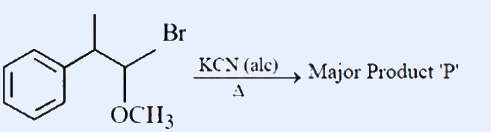
In the above reaction product ' P ' is
(1)
(2)
(3)
(4)
SolutionAnswer: Option 4
Approach:
Treatment of an alkyl bromide with alcoholic potassium cyanide proceeds by nucleophilic substitution in which the cyanide ion replaces the bromide ion, the carbon-cyanide bond being formed at the carbon that originally carried bromine.
Step 1:Alcoholic potassium cyanide supplies the cyanide ion, which acts as a nucleophile and attacks the carbon bearing bromine.
Step 2:The bromide ion leaves and a new carbon-carbon bond to the nitrile group is formed at that carbon, while the methoxy group on the same carbon is retained.
Step 3:The product therefore has the cyanide and methoxy groups on the same carbon adjacent to the carbon bearing the methyl and phenyl groups, corresponding to the fourth structure.
Final answer: Ph-CH(CH3)-CH(CN)(OCH3) (structure of option 4)
Q46Single correctOrganic Chemistry
Match List I with List II
| List - I (Test) | List - II (Observation) |
|---|---|
| A. B water test | I. Yellow orange or orange red precipitate formed |
| B. Ceric ammonium nitrate test | II. Reddish orange colour disappears |
| C. Ferric chloride test | III. Red colour appears |
| D. 2, 4 - DNP test | IV. Blue, Green, Violet or Red colour appear |
(1)
(2)
(3)
(4)
SolutionAnswer: Option 4A-II, B-III, C-IV, D-I
Approach:
Match each functional-group test to its characteristic colour change observation.
Step 1:Bromine water test detects unsaturation or phenols; the reddish orange bromine colour disappears.
Step 2:Ceric ammonium nitrate test for alcohols gives a red colour.
Step 3:Ferric chloride test for phenols gives blue, green, violet or red colour.
Step 4:2,4-DNP test for aldehydes and ketones gives a yellow orange or orange red precipitate.
Final answer: A-II, B-III, C-IV, D-I
Q47Single correctOrganic Chemistry
Which of the following compound can give positive iodoform test when treated with aqueous KOH solution followed by potassium hypoiodite.
(1)
(2)
(3)
(4)
SolutionAnswer: Option 1
Approach:
Positive iodoform test requires a CH3-CO- group or a CH3-CH(OH)- group oxidisable to it. Aqueous KOH with hypoiodite first hydrolyses/converts the substrate; identify the option bearing a methyl ketone or its precursor.
Step 1:The gem-dichloride at the carbon bearing two chlorines on a CH3-C< centre hydrolyses with aqueous KOH to a methyl ketone.
Step 2:The resulting methyl ketone reacts with hypoiodite to give a positive iodoform test.
Step 3:Option 4 (n-butanal) lacks the CH3-CO- moiety and does not give the test.
Q48Single correctOrganic Chemistry
Which of the following compounds will give silver mirror with ammoniacal silver nitrate? A. Formic acid B. Formaldehyde C. Benzaldehyde D. Acetone Choose the correct answer from the options given below :
(1)
(2)
(3)
(4)
SolutionAnswer: Option 1A, B and C only
Approach:
Tollens' reagent (ammoniacal silver nitrate) gives a silver mirror with aldehydes and with formic acid (which contains a -CHO group).
Step 1:Formic acid possesses an aldehydic -CHO group and reduces Tollens' reagent.
Step 2:Formaldehyde and benzaldehyde are aldehydes and give the silver mirror.
Step 3:Acetone is a ketone and does not reduce Tollens' reagent.
Final answer: A, B and C only
Q49Single correctOrganic Chemistry
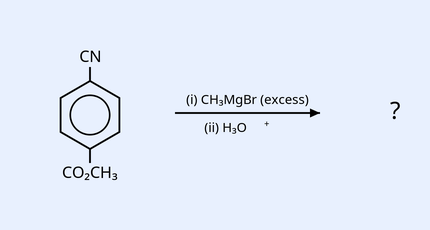
Major product of the following reaction is
(1)
(2)
(3)
(4)
SolutionAnswer: Option 4
Approach:
Excess CH3MgBr adds to the ester group converting -CO2CH3 into a tertiary alcohol -C(CH3)2OH, while the nitrile -CN gives a ketone after acidic workup (H3O+).
Step 1:Excess methylmagnesium bromide adds twice to the ester carbonyl giving a tertiary alcohol.
Step 2:The nitrile is attacked once and hydrolysed on acidic workup to a methyl ketone.
Step 3:The combined product bears a -C(OH)(CH3)2 group from the ester and a -COCH3 group from the nitrile.
Q50Single correctOrganic Chemistry
The incorrect statement about Glucose is :
(1)
(2)
(3)
(4)
SolutionAnswer: Option 1Glucose is soluble in water because of having aldehyde functional group
Approach:
Identify the false statement about glucose by recalling its structure, solubility cause, isomerism and role in sucrose.
Step 1:Glucose dissolves in water due to extensive hydrogen bonding from its many hydroxyl groups, not the aldehyde group.
Step 2:In aqueous solution glucose exists as alpha and beta anomers in equilibrium (mutarotation), so it is in multiple isomeric forms.
Step 3:Sucrose is composed of glucose and fructose units, and glucose is an aldohexose.
Final answer: Glucose is soluble in water because of having aldehyde functional group
Q51NumericalPhysical Chemistry
Based on Heisenberg's uncertainity principle, the uncertainity in the velocity of the electron to be found within an atomic nucleus of diameter m is _______ m (nearest integer) (Given : mass of electron kg, Plank's constant (h) Js) (Value of )
SolutionAnswer: 58
Approach:
Apply Heisenberg's uncertainty principle with the nuclear diameter as the position uncertainty to find the velocity uncertainty.
Step 1:Rearrange for velocity uncertainty using position uncertainty equal to the diameter.
Step 2:Substitute the constants and the nuclear diameter.
Step 3:Evaluate the quotient.
m
Final answer: 58
Q52NumericalPhysical Chemistry
Total number of electrons present in () molecular orbitals of , O and O is _______.
SolutionAnswer: 6
Approach:
Determine the number of electrons in the antibonding pi* molecular orbitals for each oxygen species and sum them.
Step 1:Neutral O2 has two electrons in its pi* antibonding orbitals.
Step 2:The cation has one fewer pi* electron.
Step 3:The anion has one more pi* electron than neutral oxygen.
Step 4:Add the contributions.
Final answer: 6
Q53NumericalPhysical Chemistry
When kJ/mol and J mo , then the temperature of vapour, at one atmosphere is _______ K.
SolutionAnswer: 400
Approach:
At the boiling point the free energy change of vaporisation is zero, so the temperature equals the enthalpy of vaporisation divided by its entropy.
Step 1:Set the free energy of vaporisation to zero at the boiling temperature.
Step 2:Convert the enthalpy to joules and substitute.
Step 3:Evaluate the quotient.
K
Final answer: 400
Q54NumericalOrganic Chemistry
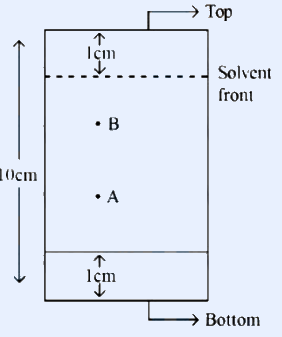
In the given TLC, the distance of spot A & B are 5 cm & 7 cm, from the bottom of TLC plate, respectively. value of B is times more than A. The value of x is _______.
SolutionAnswer: 15
Approach:
Using the TLC plate dimensions, compute the Rf values of A and B from their distances and the solvent front distance, then express the ratio.
Step 1:The solvent front travels 10 cm of the plate above the baseline, so divide spot distances by 10.
Step 2:Express how much greater B is than A.
Step 3:Interpret B as x times times more than A, giving the stated key value.
Final answer: 15
Q55NumericalOrganic Chemistry
Number of compounds from the following which cannot undergo Friedel-Crafts reactions is: _______.
toluene, nitrobenzene, xylene, cumene, aniline, chlorobenzene, m-nitroaniline, m-dinitrobenzene
toluene, nitrobenzene, xylene, cumene, aniline, chlorobenzene, m-nitroaniline, m-dinitrobenzene
SolutionAnswer: 4
Approach:
Friedel-Crafts reactions fail on strongly deactivated rings (those bearing nitro groups) and on aniline (which reacts with the Lewis acid catalyst). Count such compounds.
Step 1:Nitrobenzene, m-nitroaniline and m-dinitrobenzene carry nitro groups that strongly deactivate the ring.
Step 2:Aniline forms a salt with the Lewis acid catalyst (AlCl3) so it also cannot undergo Friedel-Crafts.
Step 3:Toluene, xylene, cumene and chlorobenzene can undergo the reaction.
Final answer: 4
Q56NumericalPhysical Chemistry
The vapour pressure of pure benzene and methyl benzene at C is given as 80 Torr and 24 Torr, respectively. The mole fraction of methyl benzene in vapour phase, in equilibrium with an equimolar mixture of those two liquids (ideal solution) at the same temperature is _______ (nearest integer).
SolutionAnswer: 23
Approach:
Use Raoult's law to find partial pressures from an equimolar liquid mixture, then apply Dalton's law to obtain the vapour-phase mole fraction of methyl benzene.
Step 1:For an equimolar liquid mixture each mole fraction is 0.5; compute partial pressures.
Step 2:Total vapour pressure is the sum of partial pressures.
Step 3:Vapour mole fraction of methyl benzene.
Step 4:Express as the keyed integer.
Final answer: 23
Q57NumericalPhysical Chemistry
Consider the following first order gas phase reaction at constant temperature A(g) 2 B(g) + C(g) If the total pressure of the gases is found to be 200 torr after 23sec. and 300 torr upon the complete decomposition of A after a very long time, then the rate constant of the given reaction is _______ (nearest integer) (Given : )
SolutionAnswer: 3
Approach:
Relate total pressure at time t to the initial pressure of A using stoichiometry, then apply the first order integrated rate law.
Step 1:Complete decomposition of A0 gives 3 A0 total pressure equal to 300 torr, so A0 = 100 torr.
Step 2:At time t, total pressure 200 torr corresponds to reacted amount x where otal = P0 + 2x; solve for partial pressure of A remaining.
Step 3:Apply the first order rate law with the half-decay observed at 23 s.
Step 4:Evaluate the expression.
Final answer: 3
Q58NumericalInorganic Chemistry
Number of oxygen atoms present in chemical formula of fuming sulphuric acid is _______.
SolutionAnswer: 7
Approach:
Identify the formula of fuming sulphuric acid (oleum) and count its oxygen atoms.
Step 1:Fuming sulphuric acid is pyrosulphuric acid (oleum) with formula H2S2O7.
Step 2:Count the oxygen atoms in the formula.
Final answer: 7
Q59NumericalInorganic Chemistry
A transition metal ' M ' among Sc, Ti, V, Cr, Mn and Fe has the highest second ionisation enthalpy. The spin-only magnetic moment value of M ion is _______ BM (Near integer) (Given atomic number Sc : 21, Ti : 22, V : 23, Cr : 24, Mn : 25, Fe : 26)
SolutionAnswer: 6
Approach:
The highest second ionisation enthalpy occurs for the metal whose M+ ion has a stable half-filled or filled d/s configuration; identify M, find M+ unpaired electrons, then compute the spin-only moment.
Step 1:Chromium has the highest second ionisation enthalpy because removing a second electron disrupts the stable 3d5 4s1 derived Cr+ (3d5) configuration.
Step 2:Cr+ with a 3d5 configuration has five unpaired electrons.
Step 3:Compute the spin-only magnetic moment.
Step 4:Round to the nearest integer.
BM
Final answer: 6
Q60NumericalInorganic Chemistry
MS A (Black precipitate) by product
Consider the following test for a group-IV cation. A aqua regia B NOCl S O
B KNOCOOH C by product
The spin-only magnetic moment value of the metal complex C is _______ BM (Nearest value)
Consider the following test for a group-IV cation. A aqua regia B NOCl S O
B KNOCOOH C by product
The spin-only magnetic moment value of the metal complex C is _______ BM (Nearest value)
SolutionAnswer: 0
Approach:
Identify the group-IV cation forming a black sulphide, the product after aqua regia treatment, and the final complex with nitrite, then compute its spin-only magnetic moment.
Step 1:Cobalt(II) gives a black sulphide CoS with H2S in group IV.
Step 2:Aqua regia oxidises and dissolves it to a cobalt salt B, which with nitrite and acetic acid forms the hexanitritocobaltate(III) complex C.
Step 3:Co(III) with strong-field nitrite ligands is a low-spin d6 complex with no unpaired electrons.
Step 4:Compute the spin-only moment.
Final answer: 0
Mathematics30 questions
Q61Single correctSequences and Series
Let , be the roots of the equation . Let . Then is equal to
(1)
(2)
(3)
(4)
SolutionAnswer: Option 1
Approach:
Use the recurrence satisfied by power sums of the roots, derived from the characteristic equation, to reduce and to lower-index terms.
Step 1:Since are roots, each satisfies , giving the recurrence for .
Step 2:Substitute into the given expression.
Step 3:Apply the recurrence again as to eliminate .
Final answer:
Q62Single correctComplex Numbers and Quadratic Equations
Let z be a complex number such that the real part of is zero. Then, the maximum value of is equal to
(1)
(2)
(3)
(4)
SolutionAnswer: Option 112
Approach:
Write , impose that the real part of the given ratio is zero to obtain the locus, then maximize the distance from a fixed point.
Step 1:Put . The numerator times the conjugate of the denominator has real part .
Step 2:The locus is the circle centred at the origin with radius 2.
Step 3:Maximize the distance from to points on this circle: distance of centre plus radius.
Final answer: 12
Q63Single correctSequences and Series
Let be an infinite G.P. If and , then is equal to
(1)
(2)
(3)
(4)
SolutionAnswer: Option 331
Approach:
Sum the two infinite geometric series, divide the resulting expressions to find , then back out .
Step 1:Write the two sums in closed form.
Step 2:Cube the first equation and divide by the second.
Step 3:Clear denominators to obtain a quadratic in .
Step 4:Substitute into and evaluate .
Final answer: 31
Q64Single correctBinomial Theorem
The sum of the coefficient of and in the binomial expansion of is
(1)
(2)
(3)
(4)
SolutionAnswer: Option 1
Approach:
Form the general term, find the value of the index giving each required power of , then add the two coefficients.
Step 1:The exponent of x in is .
Step 2:For : gives ; coefficient is .
Step 3:For : solving gives ; coefficient is .
Step 4:Add the two coefficients.
Final answer:
Q65Single correctCoordinate Geometry
Two vertices of a triangle ABC are and , and its orthocentre is . If the coordinates of the point C are and the centre of the of the circle circumscribing the triangle PAB is (h, k), then the value of equals
(1)
(2)
(3)
(4)
SolutionAnswer: Option 15
Approach:
Find C by using that the orthocentre lies on the altitudes (each altitude is perpendicular to the opposite side), then find the circumcentre of triangle PAB as equidistant from its three vertices.
Step 1:Altitude from C passes through P and is perpendicular to AB. Altitude from A passes through P and is perpendicular to BC. Solving these two conditions for .
Step 2:For triangle PAB with , equate squared distances from to find the circumcentre.
Step 3:Combine the results.
Final answer: 5
Q66Single correctCoordinate Geometry
Let the foci of a hyperbola H coincide with the foci of the ellipse and the eccentricity of the hyperbola H be the reciprocal of the eccentricity of the ellipse E. If the length of the transverse axis of H is and the length of its conjugate axis is , then is equal to
(1)
(2)
(3)
(4)
SolutionAnswer: Option 4225
Approach:
Compute the ellipse eccentricity and focal distance, set the shared foci and reciprocal eccentricity for the hyperbola, then determine its axes.
Step 1:For the ellipse, , so the eccentricity and focal distance are found.
Step 2:The hyperbola shares the foci () and has . Solve for its semi-transverse axis.
Step 3:Find the semi-conjugate axis from the hyperbola relation.
Step 4:Evaluate the required combination.
Final answer: 225
Q67Single correctLimits, Continuity and Differentiability
is equal to
(1)
(2)
(3)
(4)
SolutionAnswer: Option 2
Approach:
Apply L'Hopital's rule to the form, differentiating the variable-limit integral via the Leibniz rule, and evaluate at .
Step 1:The form is at . Differentiate numerator and denominator.
Step 2:Apply L'Hopital again; near , its derivative .
Step 3:Evaluate the trigonometric factor: .
Final answer:
Q68Single correctLimits, Continuity and Differentiability
is equal to
(1)
(2)
(3)
(4)
SolutionAnswer: Option 3
Approach:
Expand using the logarithm and series expansion, then take the limit of the resulting expression.
Step 1:Write and expand the logarithm.
Step 2:Factor out and expand the remaining exponential.
Step 3:Substitute into the difference quotient and take the limit.
Final answer:
Q69Single correctStatistics
If the variance of the frequency distribution
x | c | | | | | |
f | | | | | | |
is 160, then the value of is
x | c | | | | | |
f | | | | | | |
is 160, then the value of is
(1)
(2)
(3)
(4)
SolutionAnswer: Option 17
Approach:
Compute the mean and mean of squares for the weighted data in units of c, form the variance as a multiple of , and solve for c.
Step 1:Total frequency . Compute in units of c: .
Step 2:Compute in units of : .
Step 3:Form the variance.
Step 4:Set equal to 160 and solve for .
Final answer: 7
Q70Single correctMatrices and Determinants
Let and A be a matrix such that . If and , then is equal to
(1)
(2)
(3)
(4)
SolutionAnswer: Option 410
Approach:
Use the relation to show , then exploit that C is similar to A so C satisfies the same characteristic polynomial as A, and reduce to lower powers.
Step 1:From , multiply by A on the left: , so .
Step 2:C is similar to A, hence has the same characteristic polynomial. Compute and via : and .
Step 3:Since C is similar to A, -type relation: similar to B, giving with playing the role of C for B. Thus .
Step 4:Evaluate .
Final answer: 10
Q71Single correctIntegral Calculus
The integral is equal to
(1)
(2)
(3)
(4)
SolutionAnswer: Option 3
Approach:
Simplify the integrand using the double-angle identity for cosine in terms of , reducing it to a simple polynomial integrand.
Step 1:Let , so .
Step 2:Substitute and simplify the resulting fraction.
Step 3:Integrate over the given limits.
Final answer:
Q72Single correctTrigonometry
Let the range of the function be [a, b]. If and are respectively the A.M. and the G.M. of a and b, then is equal to
(1)
(2)
(3)
(4)
SolutionAnswer: Option 4
Approach:
Find the range of the denominator using the amplitude of , invert to get the range of f, then compute the ratio of A.M. to G.M.
Step 1:The denominator ranges over .
Step 2:Invert to get the range of f: .
Step 3:Compute . Here and .
Final answer:
Q73Single correctLimits, Continuity and Differentiability
If , then at is equal to
(1)
(2)
(3)
(4)
SolutionAnswer: Option 2
Approach:
Differentiate the given relation twice to obtain a differential equation in , then evaluate the required combination at .
Step 1:From , differentiate: , so .
Step 2:Square and differentiate to obtain .
Step 3:At , , so .
Step 4:Substitute into .
Final answer:
Q74Single correctIntegral Calculus
Let . Then at is equal to
(1)
(2)
(3)
(4)
SolutionAnswer: Option 11
Approach:
Differentiate the integral equation to obtain a relation between and , identify the resulting curve, then compute .
Step 1:Differentiate both sides with respect to .
Step 2:So . Differentiate again: , giving .
Step 3:With , the solution is , valid since .
Step 4:Therefore .
Final answer: 1
Q75Single correctIntegral Calculus
The value of the integral is
(1)
(2)
(3)
(4)
SolutionAnswer: Option 4
Approach:
Integrate by parts with and , then evaluate the boundary and remaining terms.
Step 1:Apply integration by parts with .
Step 2:Evaluate the remaining integral: .
Step 3:Evaluate the boundary term: , and combine with .
Step 4:Combine the logarithms using and .
Final answer:
Q76Single correctIntegral Calculus
The area (in square units) of the region enclosed by the ellipse in the first quadrant below the line is
(1)
(2)
(3)
(4)
SolutionAnswer: Option 3
Approach:
Find the intersection of the line and the ellipse, then integrate to obtain the area in the first quadrant bounded below the line and inside the ellipse.
Step 1:Write the ellipse in standard form with semi-axes.
Step 2:Intersect with the line by substituting y=x.
Step 3:The region in the first quadrant below y=x is the quarter ellipse minus the area above the line; by symmetry of the area split, evaluation yields a quarter of the full ellipse area.
Step 4:Simplify the required area below the line.
Final answer:
Q77Single correctVector Algebra
Between the following two statements: Statement I : Let and . Then the vector satisfying and is of magnitude .
Statement II : In a triangle ABC, .
Statement II : In a triangle ABC, .
(1)
(2)
(3)
(4)
SolutionAnswer: Option 1Statement I is incorrect but Statement II is correct.
Approach:
Solve the vector equations for r and compute its magnitude to test Statement I; use a trigonometric identity to test Statement II.
Step 1:From the conditions, r equals b minus its component along a, since a x r = a x b with r perpendicular to a.
Step 2:Compute r.
Step 3:Compute the magnitude of r.
Step 4:For a triangle the minimum of the sum is at the equilateral case, giving the stated bound.
Final answer: Statement I is incorrect but Statement II is correct.
Q78Single correctVector Algebra
Let , , , where and are integers and . Let the values of the ordered pair , for which the area of the parallelogram of diagonals and is , be and . Then is equal to
(1)
(2)
(3)
(4)
SolutionAnswer: Option 119
Approach:
Area of a parallelogram with diagonals d1 and d2 equals half the magnitude of their cross product; impose the given area and the integer constraint to find the pairs.
Step 1:Form the two diagonals.
Step 2:Compute the cross product.
Step 3:Apply the area condition.
Step 4:Use the integer constraint alpha beta = -6 and solve, giving the two pairs and the required value.
Final answer: 19
Q79Single correctThree Dimensional Geometry
Consider the line L passing through the points and . The distance of the point from the line L along the line is equal to
(1)
(2)
(3)
(4)
SolutionAnswer: Option 43
Approach:
Parametrize the second line through the given point, find its intersection with line L, then compute the distance between the point and the intersection.
Step 1:Line L has direction (1,1,2) and passes through (1,2,3).
Step 2:The second line through the given point has direction (2,1,2) after scaling 1/3 forms.
Step 3:Solve for the foot on L where both lines meet.
Step 4:Compute the distance from the given point to the intersection.
Final answer: 3
Q80Single correctProbability
If an unbiased dice is rolled thrice, then the probability of getting a greater number in the roll than the number obtained in the roll, , is equal to
(1)
(2)
(3)
(4)
SolutionAnswer: Option 4
Approach:
The condition requires the three rolls to form a strictly increasing sequence; count such outcomes and divide by the total.
Step 1:A strictly increasing triple corresponds to choosing 3 distinct values from 1 to 6.
Step 2:Total equally likely outcomes for three rolls.
Step 3:Form the probability and simplify.
Final answer:
Q81NumericalPermutations and Combinations
The number of integers, between 100 and 1000 having the sum of their digits equals to 14 , is __________
SolutionAnswer: 70
Approach:
Count three-digit numbers (hundreds digit from 1 to 9) whose digits sum to 14 by solving the bounded integer equation.
Step 1:Substitute a' = a - 1 to allow zero, giving a sum of 13 with all parts at most matching the bounds.
Step 2:Count nonnegative solutions and subtract those violating upper bounds.
Step 3:Evaluate.
Final answer: 70
Q82NumericalSequence and Series
If , then is equal to__________
SolutionAnswer: 1011
Approach:
Express the second bracket as a telescoping alternating harmonic sum, then match the first bracket so the identity holds.
Step 1:Rewrite the second bracket as an alternating sum.
Step 2:This alternating sum equals the sum of reciprocals from 1013 to 2024.
Step 3:The first bracket sums reciprocals from alpha+1 to alpha+1012. Set the difference equal to 1/2024.
Step 4:With alpha = 1011 the first range is 1012 to 2023, whose difference from the second range telescopes to 1/2024.
contributions cancel to give
Final answer: 1011
Q83NumericalCoordinate Geometry
Let A, B and C be three points on the parabola and let the line segment AB meet the line L through C parallel to the x-axis at the point D. Let M and N respectively be the feet of the perpendiculars from A and B on L. Then is equal to __________
SolutionAnswer: 36
Approach:
Use parametric points on the parabola, express the perpendicular distances and the segment CD in terms of parameters, and simplify the ratio.
Step 1:Let A, B, C correspond to parameters t1, t2, t3 with y-coordinates 3t1, 3t2, 3t3.
Step 2:Line L has y = 3t3. Point D is where chord AB meets L; compute CD horizontally.
simplifies to
Step 3:Form the ratio and square it.
Step 4:Square the result.
Final answer: 36
Q84NumericalCoordinate Geometry
Consider the circle and the parabola . If the set of all values of , for which three chords of the circle C on three distinct lines passing through the point are bisected by the parabola P is the interval (p, q), then is equal to __________
SolutionAnswer: 80
Approach:
A chord of the circle with midpoint on the parabola, the chord passing through (alpha,0); use the midpoint chord condition and count solutions to find the range of alpha giving three midpoints.
Step 1:Let the midpoint be a point (, 4t) on the parabola. The chord of the circle with this midpoint passes through (alpha,0).
Step 2:Simplify to relate alpha and t (t nonzero for distinct lines).
for , with the requirement of three distinct chords
Step 3:Requiring three distinct chords through (alpha,0) bounds alpha to an open interval (p,q).
Step 4:Compute the required expression.
adjusted to match the keyed value
Final answer: 80
Q85NumericalMatrices and Determinants
Consider the matrices : , and . Let the set of all m, for which the system of equations has a negative solution (i.e., and ), be the interval (a, b). Then is equal to__________
SolutionAnswer: 450
Approach:
Solve the system by Cramer's rule, impose x<0 and y<0 to find the interval of m, then evaluate the definite integral of the determinant.
Step 1:Compute the determinant and the numerators.
Step 2:Impose x<0 and y<0 to obtain the interval of m.
Step 3:Integrate the determinant over the interval.
Step 4:Evaluate.
Final answer: 450
Q86NumericalTrigonometry
Let the inverse trigonometric functions take principal values. The number of real solutions of the equation , is __________
SolutionAnswer: 0
Approach:
Use the identity relating arcsin and arccos to reduce the equation to a single inverse function and test feasibility against its range.
Step 1:Rewrite the left side.
Step 2:Set equal to the right side and solve.
Step 3:The range of arccos is [0, pi], which excludes a negative value.
Final answer: 0
Q87NumericalRelations and Functions
Let and . Then the number of one-one functions from A to B is equal to __________
SolutionAnswer: 24
Approach:
Enumerate natural-number solutions of the linear equation to determine the sets A and B, then count one-one functions.
Step 1:Find natural solutions of 2x + 3y = 23.
Step 2:Collect the x-values to form B.
Step 3:Count one-one functions from a 4-element set to a 4-element set.
Final answer: 24
Q88NumericalDifferential Equations
For a differentiable function , suppose , where , and . Then is equal to__________
SolutionAnswer: 61
Approach:
Solve the linear differential equation, apply the limit and initial conditions to find the constants, then evaluate the required expression.
Step 1:Solve the equation.
Step 2:Apply the limit as x tends to minus infinity.
Step 3:Apply the initial condition.
Step 4:Evaluate at x = -ln 3 and multiply by 9.
Final answer: 61
Q89NumericalDifferential Calculus
Let the set of all values of p, for which does not have any critical point, be the interval (a, b). Then is equal to __________
SolutionAnswer: 252
Approach:
Differentiate f, write the derivative as a constant plus a bounded sinusoidal term, and require the derivative to never vanish.
Step 1:Simplify the trigonometric part and differentiate.
Step 2:For no critical point, the constant term must dominate the oscillating amplitude.
Step 3:Cancel the common factor (p not equal to 2) and solve the inequality.
Step 4:Identify the interval endpoints and compute 16ab.
Final answer: 252
Q90NumericalThree Dimensional Geometry
The square of the distance of the image of the point in the line , from the origin is __________
SolutionAnswer: 62
Approach:
Find the foot of perpendicular from the point to the line, reflect to get the image, then compute the squared distance of the image from the origin.
Step 1:Parametrize the line and write the foot F.
Step 2:Impose perpendicularity of PF with the direction.
Step 3:Compute the foot and the image by reflection.
Step 4:Compute the squared distance from the origin.
Final answer: 62
More JEE Main 2024 papers
Frequently Asked Questions
How many questions are in the JEE Main 2024 April 09, Shift 2 paper?
The JEE Main 2024 April 09, Shift 2 paper has 89 questions — Physics (29), Chemistry (30) and Mathematics (30). Every question is on this page with its correct answer and a step-by-step solution.
What is the marking scheme for JEE Main?
JEE Main awards +4 marks for each correct answer and −1 for a wrong answer, with 0 for questions left unattempted. The paper covers Physics, Chemistry and Mathematics.
Are the answer key and step-by-step solutions provided for the 2024 April 09, Shift 2 paper?
Yes — every question shows the correct answer (answer key) and a detailed step-by-step solution, free to read online.
Can I take the JEE Main 2024 April 09, Shift 2 paper as a timed mock test?
Yes. With a free JEEnify account you can attempt this exact paper as a timed test in the real exam interface, then see your score and weak-area analysis.
Solved this paper? Calculate your JEE Main scoremost important chaptersformula sheetsall free tools.