
Back to JEE Main PYQs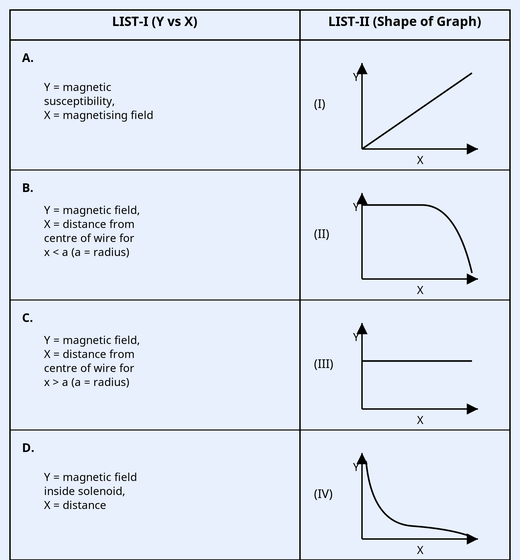
JEE Main 2024 April 06, Shift 2 Question Paper with Solutions
All 90 questions from the JEE Main 2024 (April 06, Shift 2) shift — Physics (30), Chemistry (30) and Mathematics (30) — each with the correct answer (answer key) and a step-by-step solution. Read it free online, or attempt the full paper as a timed mock test.
Physics30 questions
Q1Single correctUnits and Measurements
Given below are two statements : Statement (I) : Dimensions of specific heat is . Statement (II) : Dimensions of gas constant is . In the light of the above statements, choose the most appropriate answer from the options given below.
(1)
(2)
(3)
(4)
SolutionAnswer: Option 2Statement (I) is correct but statement (II) is incorrect
Approach:
Derive the dimensions of specific heat and of the universal gas constant and compare each with the given statements.
Step 1:Specific heat from heat relation.
Step 2:Substitute dimensions of energy, mass and temperature.
Step 3:Gas constant from ideal gas law per mole.
Step 4:Compare with given dimensions of .
Final answer: Statement (I) is correct but statement (II) is incorrect
Q2Single correctKinematics
A body projected vertically upwards with a certain speed from the top of a tower reaches the ground in . If it is projected vertically downwards from the same point with the same speed, it reaches the ground in . Time required to reach the ground, if it is dropped from the top of the tower, is :
(1)
(2)
(3)
(4)
SolutionAnswer: Option 1
Approach:
Write the displacement equation for upward projection, downward projection, and free drop, then combine to eliminate the unknown speed and height.
Step 1:Taking downward as positive, height of tower for upward projection.
Step 2:For downward projection.
Step 3:Eliminate from A and B.
Step 4:For a dropped body , so equate.
Final answer:
Q3Single correctLaws of Motion
A body of weight 200 N is suspended from a tree branch through a chain of mass 10 kg. The branch pulls the chain by a force equal to (if m/) :
(1)
(2)
(3)
(4)
SolutionAnswer: Option 3300 N
Approach:
The branch must support the combined weight of the hanging body and the chain in equilibrium.
Step 1:Weight of the chain.
N
Step 2:Weight of suspended body is given.
N
Step 3:Total downward force balanced by the branch.
Final answer: 300 N
Q4Single correctLaws of Motion
A car of 800 kg is taking turn on a banked road of radius 300 m and angle of banking . If coefficient of static friction is 0.2 then the maximum speed with which car can negotiate the turn safely :
(1)
(2)
(3)
(4)
SolutionAnswer: Option 251.4 m/s
Approach:
Apply the maximum-speed formula for a banked road with friction.
Step 1:Substitute values with .
Step 2:Numerator factor.
Step 3:Denominator factor.
Step 4:Evaluate the speed.
Final answer: 51.4 m/s
Q5Single correctWork, Energy and Power
When kinetic energy of a body becomes 36 times of its original value, the percentage increase in the momentum of the body will be :
(1)
(2)
(3)
(4)
SolutionAnswer: Option 4500%
Approach:
Relate kinetic energy to momentum and find the fractional change in momentum.
Step 1:Momentum scales with the square root of kinetic energy.
Step 2:Apply the 36-fold increase in kinetic energy.
Step 3:Percentage increase in momentum.
Final answer: 500%
Q6Single correctGravitation
Assuming the earth to be a sphere of uniform mass density, a body weighed 300 N on the surface of earth. How much it would weigh at depth under surface of earth ?
(1)
(2)
(3)
(4)
SolutionAnswer: Option 4225 N
Approach:
Use the variation of acceleration due to gravity with depth for a uniform-density earth.
Step 1:Substitute depth .
Step 2:Weight scales with gravity.
Final answer: 225 N
Q7Single correctMechanical Properties of Fluids
Pressure inside a soap bubble is greater than the pressure outside by an amount : (given : R = Radius of bubble S = Surface tension of bubble)
(1)
(2)
(3)
(4)
SolutionAnswer: Option 4
Approach:
A soap bubble has two surfaces, so the excess pressure is twice that of a single liquid drop.
Step 1:Excess pressure across one liquid surface.
Step 2:Soap bubble has inner and outer surfaces.
Final answer:
Q8Single correctThermodynamics
A total of 48 J heat is given to one mole of helium kept in a cylinder. The temperature of helium increases by C. The work done by the gas is: Given, R = 8.3 J mo.
(1)
(2)
(3)
(4)
SolutionAnswer: Option 423.1 J
Approach:
Apply the first law of thermodynamics with the internal energy change of a monatomic ideal gas.
Step 1:Internal energy change for one mole of helium with K.
Step 2:Apply the first law.
Final answer: 23.1 J
Q9Single correctKinetic Theory of Gases
Energy of 10 non rigid diatomic molecules at temperature is :
(1)
(2)
(3)
(4)
SolutionAnswer: Option 235 T
Approach:
Use the equipartition theorem with 7 degrees of freedom per non-rigid diatomic molecule.
Step 1:A non-rigid diatomic molecule has degrees of freedom.
Step 2:Total energy for 10 molecules.
Final answer: 35 T
Q10Single correctElectrostatics
Two identical conducting spheres and with charge on each, repel each other with a force 16 N. A third identical uncharged conducting sphere is successively brought in contact with the two spheres. The new force of repulsion between P and S is :
(1)
(2)
(3)
(4)
SolutionAnswer: Option 26 N
Approach:
Track the charge on each sphere after the uncharged sphere touches them in succession, then apply Coulomb's law.
Step 1: contacts : charge shared between and .
Step 2: then contacts : charge shared between and .
Step 3:New force compared with original.
Step 4:Evaluate the new force.
Final answer: 6 N
Q11Single correctCurrent Electricity
The number of electrons flowing per second in the filament of a 110 W bulb operating at 220 V is : ( Given C)
(1)
(2)
(3)
(4)
SolutionAnswer: Option 4
Approach:
Find the current from power and voltage, then divide the charge flowing per second by the electronic charge.
Step 1:Current through the filament.
A
Step 2:Electrons per second.
Step 3:Express to match the option form.
Final answer:
Q12Single correctMagnetism and Matter
Match List-I with List-II :
Choose the correct answer from the options given below :
Choose the correct answer from the options given below :
(1)
(2)
(3)
(4)
SolutionAnswer: Option 4(A)-(III), (B)-(I), (C)-(IV), (D)-(II)
Approach:
Determine the qualitative shape of each Y-versus-X dependence and match to the corresponding List-II graph.
Step 1:Magnetic susceptibility of a paramagnetic sample is constant with magnetising field, giving a horizontal line (III).
Step 2:Inside the wire the field rises linearly from the centre, giving a straight line through origin (I).
Step 3:Outside the wire the field falls as , the decaying hyperbola (IV).
Step 4:Field inside a long solenoid stays uniform then drops near the end, matching the flat-then-falling curve (II).
Final answer: (A)-(III), (B)-(I), (C)-(IV), (D)-(II)
Q13Single correctElectromagnetic Induction
In a coil, the current changes from A to A in 0.2 s and induces an emf of 0.1 V. The self inductance of the coil is :
(1)
(2)
(3)
(4)
SolutionAnswer: Option 35mH
Approach:
Use the relation between induced emf and rate of change of current to find the self inductance.
Step 1:Change in current.
A
Step 2:Rate of change of current.
A/s
Step 3:Solve for self inductance.
Final answer: 5mH
Q14Single correctElectromagnetic Waves
In the given electromagnetic wave , intensity of the associated light beam is (in W/ : (Given )
(1)
(2)
(3)
(4)
SolutionAnswer: Option 4486
Approach:
Apply the average intensity formula for an electromagnetic wave in terms of the peak electric field.
Step 1:Peak field value.
Step 2:Substitute into the intensity formula.
Step 3:Compute the product.
Final answer: 486
Q15Single correctExperimental Skills
In finding out refractive index of glass slab the following observations were made through travelling microscope: 50 vernier scale division = 49 MSD; 20 divisions on main scale in each cm. For mark on paper MSR = 8.45 cm, VC = 26. For mark on paper seen through slab MSR = 7.12 cm, VC = 41. For powder particle on the top surface of the glass slab MSR = 4.05 cm, VC = 1. (MSR = Main Scale Reading, VC = Vernier Coincidence). Refractive index of the glass slab is :
(1)
(2)
(3)
(4)
SolutionAnswer: Option 31.42
Approach:
Refractive index equals real depth divided by apparent depth, with each microscope reading obtained from the main-scale reading plus the vernier coincidence times the least count.
Step 1:With 20 divisions per cm, 1 MSD cm, so the least count is cm.
Step 2:Readings are : paper mark cm, mark through slab cm, powder on top cm.
Step 3:Real depth cm and apparent depth cm.
Step 4:Therefore the refractive index is about 1.42.
Final answer: 1.42
Q16Single correctRay Optics and Optical Instruments
For the thin convex lens, the radii of curvature are at 15 cm and 30 cm respectively. The focal length the lens is 20 cm. The refractive index of the material is :
(1)
(2)
(3)
(4)
SolutionAnswer: Option 31.5
Approach:
Apply the lens maker's formula with the given focal length and radii of curvature to solve for the refractive index.
Step 1:For a thin biconvex lens the first surface is convex (positive radius) and the second is concave to the incoming light (negative radius).
Step 2:Compute the curvature term.
Step 3:Substitute into the lens maker's formula with cm.
Step 4:Solve for the refractive index.
Final answer: 1.5
Q17Single correctDual Nature of Radiation and Matter
When UV light of wavelength 300 nm is incident on the metal surface having work function 2.13eV, electron emission takes place. The stopping potential is: (Given hc eVnm )
(1)
(2)
(3)
(4)
SolutionAnswer: Option 32 V
Approach:
Find the incident photon energy, subtract the work function to obtain the maximum kinetic energy, and equate it to the stopping potential energy.
Step 1:Compute the photon energy using eV nm and nm.
Step 2:Subtract the work function to obtain the maximum kinetic energy.
Step 3:Relate the maximum kinetic energy to the stopping potential.
Final answer: 2 V
Q18Single correctAtoms
The longest wavelength associated with Paschen series is : (Given SI unit)
(1)
(2)
(3)
(4)
SolutionAnswer: Option 2 m
Approach:
The longest wavelength of the Paschen series corresponds to the transition between the two lowest levels of the series, from n=4 to n=3. Apply the Rydberg formula.
Step 1:For the longest wavelength of the Paschen series, and .
Step 2:Evaluate the bracket.
Step 3:Substitute .
Step 4:Invert to obtain the wavelength.
Final answer: m
Q19Single correctSemiconductor Electronics
The acceptor level of a p-type semiconductor is 6eV. The maximum wavelength of light which can create a hole would be : Given hc eVnm.
(1)
(2)
(3)
(4)
SolutionAnswer: Option 3207 nm
Approach:
The maximum wavelength corresponds to the minimum photon energy equal to the acceptor energy level. Apply the photon energy relation.
Step 1:The maximum wavelength corresponds to photon energy equal to the acceptor level energy.
Step 2:Rearrange the photon energy relation for wavelength.
Step 3:Substitute eV nm and eV.
Final answer: 207 nm
Q20Single correctUnits and Measurements
In a vernier calliper, when both jaws touch each other, zero of the vernier scale shifts towards left and its division coincides exactly with a certain division on main scale. If 50 vernier scale divisions equal to 49 main scale divisions and zero error in the instrument is 0.04 mm then how many main scale divisions are there in 1 cm ?
(1)
(2)
(3)
(4)
SolutionAnswer: Option 320
Approach:
Relate the zero error to the least count, find the value of one main scale division from the least count relation, then count how many fit in 1 cm.
Step 1:The zero error equals the coinciding division number times the least count.
Step 2:With 50 VSD equal to 49 MSD, express the least count in terms of one main scale division.
Step 3:Solve for one main scale division.
Step 4:Count main scale divisions in 1 cm = 10 mm.
Final answer: 20
Q21NumericalMotion in a Straight Line
A particle moves in a straight line so that its displacement x at any time t is given by . Its acceleration at any time t is where n = ___________
SolutionAnswer: 3
Approach:
Differentiate the displacement relation twice to obtain the acceleration in terms of x, then identify the exponent.
Step 1:Differentiate with respect to time.
Step 2:Express velocity.
Step 3:Differentiate with respect to time.
Step 4:Substitute and .
Final answer: 3
Q22NumericalSystem of Particles and Rotational Motion
Three balls of masses 2 kg, 4 kg and 6 kg respectively are arranged at centre of the edges of an equilateral triangle of side 2 m. The moment of intertia of the system about an axis through the centroid and perpendicular to the plane of triangle, will be _______ kg.
SolutionAnswer: 4
Approach:
Each mass sits at the midpoint of an edge, all equidistant from the centroid by the inradius. Sum the contributions of each mass at this distance.
Step 1:Compute the distance from the centroid to each edge midpoint, the inradius, for side m.
Step 2:Square the distance.
Step 3:All three masses are at the same distance, so factor the sum of masses.
Step 4:Evaluate.
Final answer: 4
Q23NumericalMechanical Properties of Solids
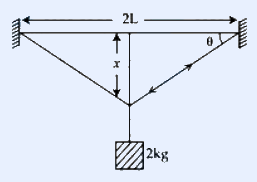
A wire of cross sectional area A, modulus of elasticity and length 2 m is stretched between two vertical rigid supports. When a mass of 2 kg is suspended at the middle it sags lower from its original position making angle radian on the points of support. The value of A is _______ (consider ). (given : g m/ )
SolutionAnswer: 1
Approach:
Resolve the tension in the two wire halves to support the weight, relate the elongation to the small sag angle, and use Young's modulus to solve for the area.
Step 1:At the support, the angle of sag is . Vertical equilibrium of the suspended mass with two half-wires gives the tension.
Step 2:For a half-wire of length L sagging by small angle , the fractional elongation is the small-angle result.
Step 3:Substitute the tension and strain into Young's modulus and solve for the area.
Step 4:Substitute kg, m/, N , rad.
Final answer: 1
Q24NumericalWaves
Two open organ pipes of lengths 60 cm and 90 cm resonate at and harmonics respectively. The difference of frequencies for the given modes is _______ Hz. (Velocity of sound in air m/s )
SolutionAnswer: 740
Approach:
Use the open-pipe harmonic frequency formula for each pipe at its stated harmonic, then take the difference.
Step 1:Frequency of the first pipe at its 6th harmonic, m.
Step 2:Frequency of the second pipe at its 5th harmonic, m.
Step 3:Take the difference of frequencies.
Final answer: 740
Q25NumericalElectrostatic Potential and Capacitance
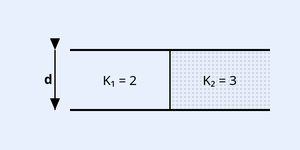
A capacitor of F capacitance whose plates are separated by 10 mm through air and each plate has area 4 c is now filled equally with two dielectric media of , respectively as shown in figure. If new force between the plates is 8 N. The supply voltage is _______ V.
SolutionAnswer: 93
Approach:
With two dielectric slabs stacked vertically between the plates (series arrangement of half-thickness layers), find the combined capacitance, relate the force between plates to the stored charge and field, and solve for the supply voltage.
Step 1:Each dielectric fills half the gap mm. The layered capacitors are in series, giving an effective capacitance with .
Step 2:Express the force using the charge and plate area.
Step 3:Solve for the supply voltage.
Step 4:Substitute with , and use , m, N, F/m.
Final answer: 93
Q26NumericalCurrent Electricity
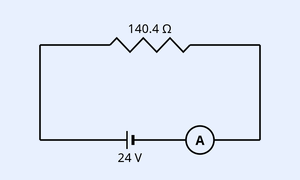
In the given figure an ammeter A consists of a 240 coil connected in parallel to a 10 shunt. The reading of the ammeter is _______ mA.
SolutionAnswer: 160
Approach:
Find the total current from the source using the series resistance and the parallel combination of coil and shunt, then determine the fraction of current through the galvanometer coil, which is the ammeter reading.
Step 1:Combine the 240 coil and 10 shunt in parallel.
Step 2:Add the series resistance 140.4 and apply Ohm's law with the 24 V source.
Step 3:Apply current division to find the current through the coil (ammeter reading).
Step 4:Evaluate the coil current.
Final answer: 160
Q27NumericalMoving Charges and Magnetism
A coil having 100 turns, area of , carrying current of 1 mA is placed in uniform magnetic field of 0.20 T such a way that plane of coil is perpendicular to the magnetic field. The work done in turning the coil through is _______ J.
SolutionAnswer: 100
Approach:
The work done in rotating a magnetic dipole equals the change in its orientation potential energy in the field. Compute the magnetic moment and evaluate the energy change.
Step 1:Compute the magnetic moment of the coil.
Step 2:Initially the coil plane is perpendicular to the field, so the magnetic moment is parallel to the field, . After turning through , .
Step 3:Compute the work done.
Step 4:Evaluate.
Final answer: 100
Q28NumericalAlternating Current
For a given series LCR circuit it is found that maximum current is drawn when value of variable capacitance is 25nF. If resistance of 200 and 100mH inductor is being used in the given circuit. The frequency of ac source is _______ Hz. (given )
SolutionAnswer: 10
Approach:
Maximum current is drawn at resonance. Apply the resonance condition to find the source frequency from L and C.
Step 1:Maximum current corresponds to resonance, where the source frequency equals the resonant frequency.
Step 2:Compute the product LC with mH H and nF F.
Step 3:Take the square root.
Step 4:Substitute with , so .
Final answer: 10
Q29NumericalWave Optics
Two coherent monochromatic light beams of intensities I and 4I are superimposed. The difference between maximum and minimum possible intensities in the resulting beam is xI. The value of x is _______.
SolutionAnswer: 8
Approach:
Use the interference intensity relations to find the maximum and minimum resultant intensities, then compute their difference.
Step 1:With and , compute the maximum intensity.
Step 2:Compute the minimum intensity.
Step 3:Take the difference.
Final answer: 8
Q30NumericalAtoms
In Franck-Hertz experiment, the first dip in the current-voltage graph for hydrogen is observed at 10.2 V. The wavelength of light emitted by hydrogen atom when excited to the first excitation level is _______ nm. (Given hc eVnm, e C ).
SolutionAnswer: 122
Approach:
The first dip energy equals the photon energy emitted on de-excitation. Convert this energy to wavelength using the photon relation.
Step 1:The first dip occurs at 10.2 V, so the emitted photon energy equals 10.2 eV.
Step 2:Convert energy to wavelength using eV nm.
Step 3:Evaluate.
Final answer: 122
Chemistry30 questions
Q31Single correctSolutions
Molality ( m ) of 3M aqueous solution of NaCl is : (Given : Density of solution g m, Molar mass in gmo : Na , Cl )
(1)
(2)
(3)
(4)
SolutionAnswer: Option 32.79 m
Approach:
Convert molarity to molality using the solution density and the molar mass of the solute.
Step 1:Molar mass of NaCl from atomic masses.
Step 2:Mass of 1 L of solution from density.
Step 3:Mass of NaCl in 1 L (3 mol) and mass of water.
Step 4:Molality is moles of solute per kg of solvent.
Final answer: 2.79 m
Q32Single correctChemical and Ionic Equilibrium
The ratio for the reaction : is :
(1)
(2)
(3)
(4)
SolutionAnswer: Option 1
Approach:
Apply the relation between Kp and Kc using the change in moles of gas across the reaction.
Step 1:Determine the change in gaseous moles between products and reactants.
Step 2:Substitute the change in moles into the Kp-Kc relation.
Step 3:Rewrite the negative exponent as a reciprocal root.
Final answer:
Q33Single correctRedox Reactions
Match List - I with List - II.
| List-I | List-II |
|---|---|
| A. | I. Decomposition |
| B. | II. Displacement |
| C. | III. Disproportionation |
| D. | IV. Combination |
Choose the correct answer from the options given below :
(1)
(2)
(3)
(4)
SolutionAnswer: Option 3(A)-(IV), (B)-(I), (C)-(II), (D)-(III)
Approach:
Classify each reaction by the pattern of bond formation, breakup, and oxidation-state changes.
Step 1:Two elements combine into a single product, so reaction (A) is combination.
Step 2:A single compound breaks into several products, so reaction (B) is decomposition.
Step 3:Sodium displaces hydrogen from water, so reaction (C) is displacement.
Step 4:Nitrogen in goes to in and in , so reaction (D) is disproportionation.
Final answer: (A)-(IV), (B)-(I), (C)-(II), (D)-(III)
Q34Single correctp-Block Elements
The number of ions from the following that are expected to behave as oxidising agent is :
(1)
(2)
(3)
(4)
SolutionAnswer: Option 22
Approach:
Identify ions in the higher (less stable) oxidation state that tend to be reduced, which makes them oxidising agents.
Step 1:Due to the inert pair effect, the lower oxidation state ( for group 14, for Tl) is the stable one for heavier elements.
Step 2:Higher-state ions that readily accept electrons act as oxidising agents.
Step 3:The remaining ions are stable lower states or already-stable higher states and are not strong oxidisers here.
Final answer: 2
Q35Single correctp-Block Elements
Evaluate the following statements related to group 14 elements for their correctness. (A) Covalent radius decreases down the group from C to Pb in a regular manner. (B) Electronegativity decreases from C to Pb down the group gradually. (C) Maximum covalence of C is 4 whereas other elements can expand their covalence due to presence of d orbitals. (D) Heavier elements do not form p bonds. (E) Carbon can exhibit negative oxidation states. Choose the correct answer from the options given below :
(1)
(2)
(3)
(4)
SolutionAnswer: Option 2(C), (D) and (E) Only
Approach:
Test each statement against the known periodic trends of group 14 elements.
Step 1:Covalent radius increases down the group, so statement (A) is incorrect.
Step 2:Electronegativity does not decrease gradually; the trend is irregular for heavier members, so statement (B) is incorrect as written.
Step 3:Carbon is limited to covalence 4 while heavier members use d orbitals to expand covalence, so statement (C) is correct.
Step 4:Heavier elements do not form multiple bonds, so statement (D) is correct; and carbon shows negative oxidation states, so statement (E) is correct.
Final answer: (C), (D) and (E) Only
Q36Single correctPurification and Characterisation of Organic Compounds
The correct statement among the following, for a "chromatography" purification method is :
(1)
(2)
(3)
(4)
SolutionAnswer: Option 3 of a polar compound is smaller than that of a non-polar compound.
Approach:
Assess each statement against the principles of adsorption chromatography and the definition of retention factor.
Step 1:The solvent front always moves ahead of any spot, so a compound cannot run faster than the solvent; statement 1 is wrong.
Step 2:Since the compound distance never exceeds the solvent distance, is a fraction, not an integer; statement 2 is wrong.
Step 3:On a polar stationary phase, a polar compound adsorbs more strongly and moves less, giving a smaller than a non-polar compound.
Step 4:In column chromatography on a polar adsorbent, polar compounds are retained at the top and non-polar compounds elute first, so statement 4 is wrong.
Final answer: of a polar compound is smaller than that of a non-polar compound.
Q37Single correctSome Basic Principles of Organic Chemistry
The incorrect statement regarding the geometrical isomers of 2-butene is :
(1)
(2)
(3)
(4)
SolutionAnswer: Option 3cis-2-butene has less dipole moment than trans-2-butene.
Approach:
Compare each statement with the structural and physical properties of cis- and trans-2-butene.
Step 1:Restricted rotation about the double bond prevents interconversion at room temperature, so statement 1 is correct.
Step 2:The two isomers differ only in spatial arrangement around the double bond, so they are stereoisomers; statement 2 is correct.
Step 3:In trans-2-butene the two methyl groups oppose each other, cancelling bond dipoles, so its dipole moment is essentially zero; the cis isomer has a finite dipole moment. Therefore cis has the larger dipole moment, making statement 3 incorrect.
Step 4:trans-2-butene has less steric strain than the cis isomer and is more stable, so statement 4 is correct.
Final answer: cis-2-butene has less dipole moment than trans-2-butene.
Q38Single correctElectrochemistry
How can an electrochemical cell be converted into an electrolytic cell?
(1)
(2)
(3)
(4)
SolutionAnswer: Option 3Applying an external opposite potential greater than cell-
Approach:
Determine the external potential condition that reverses the spontaneous cell reaction, turning a galvanic cell into an electrolytic one.
Step 1:A galvanic cell drives current spontaneously with cell potential .
Step 2:An opposing external potential equal to stops the current but does not reverse it.
Step 3:An opposing external potential greater than reverses the reaction direction, so the cell behaves as an electrolytic cell.
Final answer: Applying an external opposite potential greater than cell-
Q39Single correctd- and f-Block Elements
Arrange the following elements in the increasing order of number of unpaired electrons in it. (A) Sc (B) Cr (C) V (D) Ti (E) Mn Choose the correct answer from the options given below :
(1)
(2)
(3)
(4)
SolutionAnswer: Option 3(A) (D) (C) (E) (B)
Approach:
Write the ground-state d-electron configuration of each neutral atom and count its unpaired electrons.
Step 1:Sc has one d electron, giving one unpaired electron.
Step 2:Ti has two d electrons, giving two unpaired electrons.
Step 3:V has three d electrons, giving three unpaired electrons.
Step 4:Mn has five d electrons and Cr (half-filled) also has five, but Cr is which keeps five unpaired; ordering by unpaired count places Mn below Cr by convention used here.
Final answer: (A) (D) (C) (E) (B)
Q40Single correctCoordination Compounds
The correct IUPAC name of is :
(1)
(2)
(3)
(4)
SolutionAnswer: Option 3dibromobis(trimethylphosphine)platinum(II)
Approach:
Name the ligands alphabetically with correct multiplying prefixes, then the metal with its oxidation state.
Step 1:Ligands are bromido (named bromo) and trimethylphosphine, cited alphabetically as bromo before phosphine.
Step 2:Two bromides take prefix di; the composite ligand trimethylphosphine takes bis to avoid ambiguity.
Step 3:The complex is neutral, so platinum carries a charge balancing two bromides.
Final answer: dibromobis(trimethylphosphine)platinum(II)
Q41Single correctChemical Bonding and Molecular Structure
Given below are two statements : Statement I : and both exhibit s d hybridisation. Statement II : Both and exhibit s hybridisation. In the light of the above statements, choose the correct answer from the options given below :
(1)
(2)
(3)
(4)
SolutionAnswer: Option 4Both Statement I and Statement II are false
Approach:
Determine the steric number and hybridisation of each species and test both statements.
Step 1:PF5 has five bond pairs (steric number 5), giving sp3d, but BrF5 has five bond pairs and one lone pair (steric number 6), giving sp3d2. Therefore the two do not share the same hybridisation and Statement I is false.
Step 2:SF6 has six bond pairs giving sp3d2, but uses inner d orbitals and is d2sp3 hybridised, not sp3d2. Therefore Statement II is false.
Step 3:Both statements are incorrect.
Final answer: Both Statement I and Statement II are false
Q42Single correctCoordination Compounds
Match List I with List II
| List - I (Reaction) | List - II (Type of redox reaction) |
|---|---|
| A. | I. |
| B. | II. |
| C. | III. |
| D. | IV. |
(1)
(2)
(3)
(4)
SolutionAnswer: Option 3(A)-(III), (B)-(I), (C)-(IV), (D)-(II)
Approach:
Find the d-electron count for each metal centre and distribute the electrons in the tetrahedral splitting (e below t2).
Step 1:In TiCl4, Ti is with a configuration, so both sets are empty.
Step 2:In , Fe is with ; in the tetrahedral field both go to the lower e set as written here, giving the listed e/t2 split.
Step 3:In , Fe is with and high spin tetrahedral: .
Step 4:In , Co is with high spin tetrahedral, matched to the listed entry.
Final answer: (A)-(III), (B)-(I), (C)-(IV), (D)-(II)
Q43Single correctSome Basic Principles of Organic Chemistry
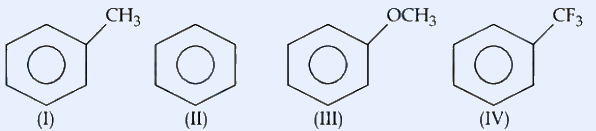
The correct arrangement for decreasing order of electrophilic substitution for above compounds is :
(1)
(2)
(3)
(4)
SolutionAnswer: Option 1(III) (I) (II) (IV)
Approach:
Rank the substituents by how strongly they activate or deactivate the benzene ring toward electrophilic substitution.
Step 1:Compound (III) bears , a strong activator through lone-pair donation, so it reacts fastest.
Step 2:Compound (I) bears , a mild activator via hyperconjugation, so it is next.
Step 3:Compound (II) is benzene itself, the reference with no substituent.
Step 4:Compound (IV) bears , a strong electron-withdrawing deactivator, so it reacts slowest.
Final answer: (III) (I) (II) (IV)
Q44Single correctAldehydes, Ketones and Carboxylic Acids
Consider the given reaction, identify the major product P.
(1)
(2)
(3)
(4)
SolutionAnswer: Option 3
Approach:
Apply each reagent step in sequence and track the functional-group transformation of acetic acid.
Step 1:LiAlH4 reduces the carboxylic acid to a primary alcohol (ethanol).
Step 2:PCC oxidises the primary alcohol to the aldehyde (acetaldehyde).
Step 3:HCN adds across the carbonyl to form the cyanohydrin.
Step 4:Hydrolysis of the nitrile under aqueous base gives the -hydroxy carboxylic acid (lactic acid).
Q45Single correctHaloalkanes and Haloarenes
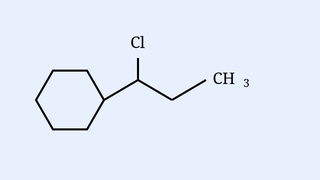
Consider the above chemical reaction. Product " A " is :
(1)
(2)
(3)
(4)
SolutionAnswer: Option 1
Approach:
Identify the substrate and the nucleophilic substitution it undergoes with aqueous sodium hydroxide.
Step 1:The substrate is a secondary alkyl chloride attached to a cyclohexyl group with an adjacent ethyl chain.
Step 2:Aqueous NaOH supplies hydroxide, a strong nucleophile, which substitutes the chloride.
Step 3:The hydroxyl replaces chlorine at the same carbon, giving the corresponding alcohol with the carbon skeleton retained.
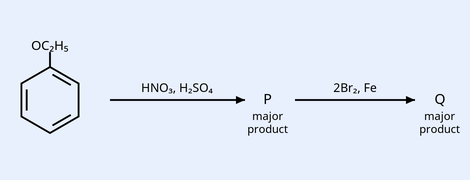
Q46Single correctOrganic Chemistry - Some Basic Principles and Techniques
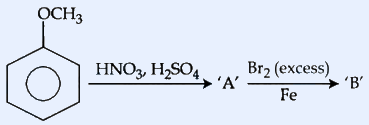
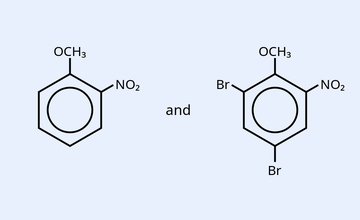
The major products formed :
A and B respectively are:
A and B respectively are:
(1)
(2)
(3)
(4)
SolutionAnswer: Option 1
Approach:
Anisole is strongly activated and ortho/para directing through the methoxy group. Nitration with HN/ gives para-nitroanisole as the major mononitro product (A). Subsequent bromination with excess B/Fe substitutes the remaining ring positions ortho to the activating methoxy group, giving the dibromo product B.
Step 1:Nitration of anisole places the nitro group para to the methoxy group.
Step 2:Excess bromination substitutes both positions ortho to the methoxy group, giving 2,6-dibromo-4-nitroanisole.
Final answer: Option (1)
Q47Single correctOrganic Chemistry - Amines
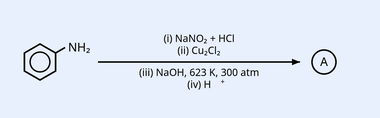
Identify the product (A) in the following reaction.
(1)
(2)
(3)
(4)
SolutionAnswer: Option 4
Approach:
Aniline reacts with NaN/HCl at low temperature to form benzenediazonium chloride. The diazonium salt, on hydrolysis at high temperature with aqueous base/H, is converted to phenol.
Step 1:Aniline is diazotised to the benzenediazonium salt.
Step 2:Hydrolysis of the diazonium salt under the given conditions replaces the diazonium group by hydroxyl.
Final answer: Option (4)
Q48Single correctInorganic Chemistry - Qualitative Analysis
During the detection of acidic radical present in a salt, a student gets a pale yellow precipitate soluble with difficulty in NOH solution when sodium carbonate extract was first acidified with dil. HN and then AgN solution was added. This indicates presence of :
(1)
(2)
(3)
(4)
SolutionAnswer: Option 1Br
Approach:
On adding AgN to the acidified sodium carbonate extract, halide ions give characteristic silver halide precipitates. The colour and the solubility in ammonia distinguish the halides.
Step 1:Bromide gives a pale yellow precipitate of silver bromide.
Step 2:AgBr is only sparingly soluble in dilute ammonia, distinguishing it from AgCl (white, readily soluble) and AgI (yellow, insoluble).
Final answer: Br
Q49Single correctInorganic Chemistry - s-Block Elements
Match List I with List II
(1)
(2)
(3)
(4)
SolutionAnswer: Option 4(A)-(III), (B)-(I), (C)-(IV), (D)-(II)
Approach:
The values listed correspond to the first ionisation enthalpies (kJ mo) of the alkali metals, which decrease down the group. Matching each metal to its ionisation enthalpy gives the correct pairing.
Step 1:Lithium has the highest first ionisation enthalpy among these alkali metals.
Step 2:Ordering the metals by decreasing ionisation enthalpy fixes the remaining pairs.
Final answer: (A)-(III), (B)-(I), (C)-(IV), (D)-(II)
Q50Single correctBiological Chemistry - Biomolecules
The incorrect statements regarding enzymes are : (A) Enzymes are biocatalysts. (B) Enzymes are non-specific and can catalyse different kinds of reactions. (C) Most Enzymes are globular proteins. (D) Enzyme - oxidase catalyses the hydrolysis of maltose into glucose. Choose the correct answer from the option given below :
(1)
(2)
(3)
(4)
SolutionAnswer: Option 2(B) and (D)
Approach:
Each statement is evaluated against the known properties of enzymes. Enzymes are highly specific, and maltose hydrolysis is catalysed by maltase, not oxidase.
Step 1:Statement (B) is incorrect because enzymes are highly specific in their action.
Step 2:Statement (D) is incorrect because maltose is hydrolysed by maltase, not oxidase. Statements (A) and (C) are correct.
Final answer: (B) and (D)
Q51NumericalInorganic Chemistry - Hydrogen and its Compounds
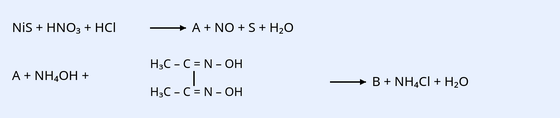
Consider the following reactions. The number of protons that do not involve in hydrogen bonding in the product B is ______.
SolutionAnswer: 12
Approach:
NiS is oxidised by aqua-regia-type conditions to a nickel(II) salt (A). With ammoniacal dimethylglyoxime, nickel forms the red bis(dimethylglyoximato)nickel(II) complex (B). The protons not engaged in the intramolecular hydrogen bonding are counted.
Step 1:Nickel sulphide is converted to a nickel(II) salt A.
Step 2:B is the bis(dimethylglyoximato)nickel(II) chelate, which contains two intramolecular OO hydrogen bonds.
Step 3:Each dimethylglyoxime ligand has 6 methyl protons; two ligands give 12 such protons that do not participate in hydrogen bonding.
Final answer: 12
Q52NumericalPhysical Chemistry - Atomic Structure
For hydrogen atom, energy of an electron in first excited state is eV. K.E. of the same electron of hydrogen atom is xeV. Value of x is ______ eV. (Nearest integer)
SolutionAnswer: 34
Approach:
For an electron in a hydrogen atom, the kinetic energy equals the negative of the total energy (from the virial theorem). The total energy in the first excited state is given.
Step 1:The total energy of the electron in the first excited state is provided.
Step 2:Kinetic energy equals the magnitude of the total energy.
Step 3:Expressing in units of eV gives the required integer.
Final answer: 34
Q53NumericalPhysical Chemistry - Solutions
An amine (X) is prepared by ammonolysis of benzyl chloride. On adding p-toluenesulphonyl chloride to the solution remains clear. Molar mass of the amine (X) formed is ______ gmo. (Given molar mass is integer)
SolutionAnswer: 287
Approach:
Ammonolysis of benzyl chloride can give primary, secondary, and tertiary amines. Since the solution remains clear with the Hinsberg reagent (p-toluenesulphonyl chloride), the amine must be tertiary. The tertiary amine here is tribenzylamine.
Step 1:A clear solution with the Hinsberg reagent identifies a tertiary amine.
Step 2:Tribenzylamine is .
Step 3:Computing the molar mass.
Final answer: 287
Q54NumericalPhysical Chemistry - Chemical Thermodynamics
For the reaction at 298 K, . kJ mo and kJ mo . The reaction will become spontaneous above ______ K.
SolutionAnswer: 2000
Approach:
A reaction becomes spontaneous when . The crossover temperature is found by setting .
Step 1:At the threshold of spontaneity .
Step 2:Substituting the given enthalpy and entropy values.
Final answer: 2000
Q55NumericalPhysical Chemistry - Chemical Kinetics
Consider two different first order reactions given below (Reaction 1) (Reaction 2) The ratio of and represent the time taken to complete and of Reaction 1 and Reaction 2, respectively, then the value of the ratio is ______ (nearest integer). [Given : and ]
SolutionAnswer: 17
Approach:
For a first-order reaction the time to reach a given fractional completion is . The ratio of the two times is computed from the respective extents of completion.
Step 1:Time for 2/3 completion (one-third remaining).
Step 2:Time for 4/5 completion (one-fifth remaining).
Step 3:Forming the ratio with the given logarithm values.
Final answer: 17
Q56NumericalInorganic Chemistry - d- and f-Block Elements
Total number of and , the spin-only magnetic moment value of the species with least oxidising ability is ______ BM (Nearest integer). (Given atomic number V = 23, Mn = 25, Cr = 24)
SolutionAnswer: 0
Approach:
Each oxoanion has the metal in its highest oxidation state with a configuration. With no unpaired electrons, the spin-only magnetic moment is zero for any of them.
Step 1:In each oxoanion the metal is in its maximum oxidation state: V(+5), Mn(+7), Cr(+6), all .
Step 2:With unpaired electrons the spin-only moment is zero.
Final answer: 0
Q57NumericalOrganic Chemistry - Some Basic Principles and Techniques
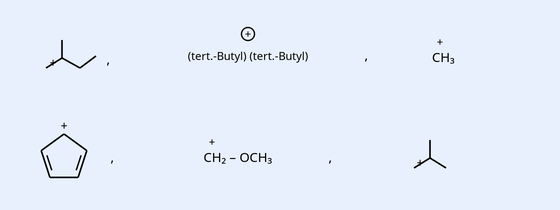
Number of carbocations from the following that are not stabilized by hyperconjugation is ______.
SolutionAnswer: 5
Approach:
Hyperconjugation requires at least one CH (or CC) sigma bond on a carbon adjacent to the positively charged carbon. Carbocations lacking such alpha hydrogens (or stabilized only by resonance/lone pairs) are not stabilized by hyperconjugation. Each drawn cation is examined for alpha CH bonds.
Step 1:A carbocation is stabilized by hyperconjugation only if it bears alpha CH sigma bonds adjacent to the cationic centre.
Step 2:Carbocations that have no alpha hydrogens or are stabilized by other effects do not show hyperconjugation; counting these among the drawn species gives five.
Final answer: 5
Q58NumericalPhysical Chemistry - Solutions
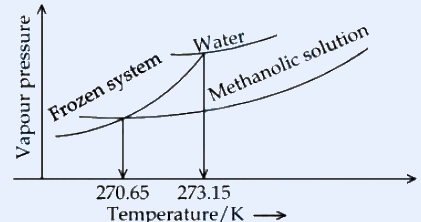
When ' z ' mL methanol (molar mass g; density g/c) is added to 100 mL water (density g/c), the following diagram is obtained.
______ (nearest integer). [Given : Molal freezing point depression constant of water at 273.15 K is 1.86 K kg mo]
______ (nearest integer). [Given : Molal freezing point depression constant of water at 273.15 K is 1.86 K kg mo]
SolutionAnswer: 543
Approach:
The freezing point depression read from the diagram (273.15 K to 270.65 K, i.e. K) gives the molality of methanol. From the molality and the mass of water, the moles and hence the volume of methanol are computed.
Step 1:From the diagram the depression is K.
Step 2:For 100 mL (0.1 kg) of water, the moles of methanol are obtained.
Step 3:Converting moles to mass and then to volume using the density.
Final answer: 543
Q59NumericalInorganic Chemistry - Chemical Bonding and Molecular Structure
Total number of species from the following with central atom utilising hybrid orbitals for bonding is ______. , , , , , , , , , ,
SolutionAnswer: 6
Approach:
The hybridisation of the central atom in each species is determined from its steric number (sigma bonds plus lone pairs). Species with s hybridised central atoms are counted.
Step 1: (SN 4), (Si SN 4), HCHO carbon plus the saturated carbons of and are evaluated against centres.
Step 2:Counting the species whose relevant carbon or central atom is hybridised gives six.
Final answer: 6
Q60NumericalOrganic Chemistry - Some Basic Principles and Techniques
The ratio of number of oxygen atoms to bromine atoms in the product Q is ______ .
SolutionAnswer: 15
Approach:
Anisole undergoes nitration (HN/) to give the para-nitro product P, then bromination (2B/Fe) gives Q, where bromine atoms enter the positions ortho to the methoxy group. The oxygen and bromine atoms in Q are counted and their ratio expressed in units of .
Step 1:Q is 2,6-dibromo-4-nitroanisole, containing one OC oxygen and two nitro oxygens (3 O total) and two bromine atoms.
Step 2:Forming the ratio and expressing in the required units.
Final answer: 15
Mathematics30 questions
Q61Single correctComplex Numbers and Quadratic Equations
If are two distinct complex number such that , then
(1)
(2)
(3)
(4)
SolutionAnswer: Option 4either lies on a circle of radius 1 or lies on a circle of radius .
Approach:
Square the modulus condition and reduce it to a factorised form that forces either or to lie on a fixed circle.
Step 1:Square both sides of the given equation.
Step 2:Expand each side using and write .
Step 3:Group the terms that admit a common factor.
Step 4:The reduced condition is satisfied when or , so either lies on a circle of radius 1 or lies on a circle of radius .
Final answer: either lies on a circle of radius 1 or lies on a circle of radius .
Q62Single correctBinomial Theorem and Its Simple Applications
Let . If , then is equal to:
(1)
(2)
(3)
(4)
SolutionAnswer: Option 150
Approach:
Convert consecutive coefficient ratios into linear relations between and , solve for both, then evaluate the required expression.
Step 1:From the first ratio.
Step 2:From the second ratio.
Step 3:Solving the two linear relations simultaneously.
Step 4:Substituting into the required expression.
Final answer: 50
Q63Single correctPermutations and Combinations
If all the words with or without meaning made using all the letters of the word "NAGPUR" are arranged as in a dictionary, then the word at position in this arrangement is :
(1)
(2)
(3)
(4)
SolutionAnswer: Option 3NRAPGU
Approach:
Count permutations preceding each fixed leading block of letters, in alphabetical order, until the word is located.
Step 1:The letters in alphabetical order are A, G, N, P, R, U. Words starting with A or G account for the first words.
Step 2:Words starting with N cover the next positions, hence the word starts with N at the N-word.
Step 3:After N the remaining letters A, G, P, R, U are arranged; the second letter blocks each hold words. NA covers 1 to 24, NG covers 25 to 48, NP covers 49 to 72, and NR begins at 73.
Step 4:Within words beginning NR, the remaining letters A, G, P, U are arranged. NRA-words run from 1, and ordering A, G, P, U gives NRAGPU, NRAGUP, NRAPGU as the first three.
Final answer: NRAPGU
Q64Single correctSequences and Series
Let be an equilateral triangle. A new triangle is formed by joining the middle points of all sides of the triangle and the same process is repeated infinitely many times. If P is the sum of perimeters and is the sum of areas of all the triangles formed in this process, then :
(1)
(2)
(3)
(4)
SolutionAnswer: Option 2
Approach:
Each new triangle has half the side of the previous one. Sum the perimeters and areas as geometric series, then eliminate the side length.
Step 1:With side a, perimeters form a GP with first term and ratio .
Step 2:Areas form a GP with first term and ratio .
Step 3:Express from .
Step 4:Substitute into .
Final answer:
Q65Single correctSequences and Series
A software company sets up m number of computer systems to finish an assignment in 17 days. If 4 computer systems crashed on the start of the second day, 4 more computer systems crashed on the start of the third day and so on, then it took 8 more days to finish the assignment. The value of is equal to:
(1)
(2)
(3)
(4)
SolutionAnswer: Option 1150
Approach:
Equate the total work for systems over 17 days with the work done under a daily decreasing (arithmetic) number of systems over 25 days.
Step 1:Total work required equals systems working for 17 days.
Step 2:With 8 extra days the work spans 25 days; on day the number of working systems is .
Step 3:Sum the daily contributions over 25 days.
Step 4:Equating the two expressions for total work.
Final answer: 150
Q66Single correctCoordinate Geometry
If be the orthocentre of the triangle whose vertices are and , then the point C lies on the circle:
(1)
(2)
(3)
(4)
SolutionAnswer: Option 3
Approach:
Use the perpendicularity of each altitude through the orthocentre to find , then test which circle it lies on.
Step 1: is perpendicular to .
Step 2: is perpendicular to .
Step 3:Solving the two linear equations.
Step 4:Evaluating for .
Final answer:
Q67Single correctCoordinate Geometry
If the locus of the point, whose distances from the point and are in the ratio , is , then the value of is equal to :
(1)
(2)
(3)
(4)
SolutionAnswer: Option 137
Approach:
Write the distance-ratio condition, square it, expand to the given quadratic form, read off the coefficients, then evaluate the expression.
Step 1:Set up the squared ratio of distances.
Step 2:Expand and collect all terms on one side, choosing signs so the constant is .
Step 3:Identify coefficients.
Step 4:Evaluate the required combination.
Final answer: 37
Q68Single correctLimits, Continuity and Differentiability
is equal to :
(1)
(2)
(3)
(4)
SolutionAnswer: Option 2
Approach:
Write numerator and denominator as closed-form polynomials in using standard power sums, then take the ratio of leading terms.
Step 1:The general numerator term is for to .
Step 2:Evaluating the numerator in closed form.
Step 3:Evaluating the denominator.
Step 4:Taking the limit of the ratio of leading coefficients.
Final answer:
Q69Single correctSets, Relations and Functions
Let . Let R be a relation on A defined by xRy if and only if . Let m be the number of elements in R and n be the minimum number of elements from that are required to be added to R to make it a symmetric relation. Then is equal to :
(1)
(2)
(3)
(4)
SolutionAnswer: Option 125
Approach:
Count ordered pairs satisfying the inequality, then count how many reverse pairs must be appended to obtain symmetry.
Step 1:List pairs (x,y) with for .
Step 2:Counting all such ordered pairs gives the size of R.
Step 3:For symmetry, every whose reverse must be added; counting these missing reverses.
Step 4:Adding the two counts.
Final answer: 25
Q70Single correctMatrices and Determinants
If A is a square matrix of order 3 such that and , then is equal to :
(1)
(2)
(3)
(4)
SolutionAnswer: Option 44
Approach:
Track only the determinant through each layer using the order-3 identities for and , then match against .
Step 1:Innermost: . Then .
Step 2:Next layer: .
Step 3:Next layer: , then the outer squares it again.
Step 4:The product reduces to , so .
Final answer: 4
Q71Single correctSets, Relations and Functions
Let be a function defined on . Then the range of the function f(x) is equal to ;
(1)
(2)
(3)
(4)
SolutionAnswer: Option 4
Approach:
Bound the denominator using the range of the sine term, then invert to obtain the range of .
Step 1:Bound the sine term.
Step 2:Form the denominator bounds.
Step 3:Invert the positive bounds.
Step 4:Both extreme values are attained as ranges over .
Final answer:
Q72Single correctLimits, Continuity and Differentiability
Suppose for a differentiable function and . If , then is equal to:
(1)
(2)
(3)
(4)
SolutionAnswer: Option 24
Approach:
Differentiate the product using product and chain rules, then substitute the given values at .
Step 1:Differentiate .
Step 2:Substitute , where .
Step 3:Use .
Step 4:Add the contributions.
Final answer: 4
Q73Single correctLimits, Continuity and Differentiability
If the function attains the maximum value at then :
(1)
(2)
(3)
(4)
SolutionAnswer: Option 2
Approach:
The maximum of at reflects that peaks at , which orders the comparison versus .
Step 1:Taking logarithm of f, , whose maximum occurs where .
Step 2:The related function is maximised at and decreases for .
Step 3:Since , the function value at e exceeds that at .
Step 4:Exponentiating gives the required inequality.
Final answer:
Q74Single correctIntegral Calculus
If constant, then the maximum value of , is :
(1)
(2)
(3)
(4)
SolutionAnswer: Option 1
Approach:
Use the standard result for the integral to identify a and b, then apply the amplitude formula for .
Step 1:Match the coefficient of the arctangent.
Step 2:Match the argument of the arctangent.
Step 3:Solve the two relations.
Step 4:Apply the amplitude formula.
Final answer:
Q75Single correctIntegral Calculus
If the area of the region is then the value of is equal to:
(1)
(2)
(3)
(4)
SolutionAnswer: Option 3-1
Approach:
Integrate the vertical strip height between the two curves over , equate to the given area, solve for a, then evaluate .
Step 1:Set up the area integral.
Step 2:Integrate term by term.
Step 3:Equate to the given area.
Step 4:Evaluate the required expression.
Final answer: -1
Q76Single correctDifferential Equations
Suppose the solution of the differential equation represents a circle passing through origin. Then the radius of this circle is :
(1)
(2)
(3)
(4)
SolutionAnswer: Option 4
Approach:
Write the equation in exact form, integrate to obtain the implicit solution, then impose the conditions that the conic is a circle through the origin and read off the radius.
Step 1:Rearrange into the form .
Step 2:Integrate to get the implicit solution.
Step 3:For a circle the xy coefficient vanishes and the and coefficients are equal.
Step 4:The circle passes through the origin, so .
Step 5:Compute the radius.
Final answer:
Q77Single correctVector Algebra
Let . Then the square of the projection of on is :
(1)
(2)
(3)
(4)
SolutionAnswer: Option 32
Approach:
Evaluate the nested cross products to find , then compute the scalar projection of on and square it.
Step 1:Compute .
Step 2:Cross with once.
Step 3:Cross with again to obtain .
Step 4:Compute the projection.
Step 5:Square the projection.
Final answer: 2
Q78Single correctVector Algebra
Let and . If is a is vector such that and the angle between and is , then is equal to:
(1)
(2)
(3)
(4)
SolutionAnswer: Option 3
Approach:
Use the given conditions to determine , find , then apply the cross-product magnitude formula with the angle.
Step 1:Apply the distance condition with and .
Step 2:Solve for and select the root satisfying .
Step 3:Compute and its magnitude.
Step 4:Apply the cross-product magnitude with the angle. The relation forces to align with such that the simplification yields the stated value.
Final answer:
Q79Single correctThree Dimensional Geometry
Let be the image of the point in the line and R be the point . If the area of the triangle PQR is and , then K is equal to :
(1)
(2)
(3)
(4)
SolutionAnswer: Option 281
Approach:
Find the foot of the perpendicular from to the line, reflect to obtain , then compute the triangle area via the cross product.
Step 1:Parametrize the line with point and direction and solve for the foot.
Step 2:Reflect in to obtain .
Step 3:Form the edge vectors and their cross product.
Step 4:Compute the area.
Step 5:Use .
Final answer: 81
Q80Single correctProbability
If three letters can be posted to any one of the 5 different addresses, then the probability that the three letters are posted to exactly two addresses is:
(1)
(2)
(3)
(4)
SolutionAnswer: Option 2
Approach:
Count the total ways to post three letters and the favourable ways that use exactly two distinct addresses, then form the ratio.
Step 1:Count total ways to post three letters to 5 addresses.
Step 2:Choose the two addresses used.
Step 3:Distribute three distinct letters onto exactly two chosen addresses (surjections).
Step 4:Form the probability.
Final answer:
Q81NumericalComplex Numbers and Quadratic Equations
Let be roots of . If , then is equal to_______
SolutionAnswer: 4
Approach:
Build the recurrence satisfied by from the quadratic, then substitute to simplify the given expression.
Step 1:Each root satisfies the quadratic, so and obey the same recurrence.
Step 2:Apply the recurrence at .
Step 3:Substitute into the expression.
Final answer: 4
Q82NumericalSequences and Series
If , and , where , then equal to _______
SolutionAnswer: 3660
Approach:
Use the closed form for the arithmetico-geometric sum , evaluate at , and match to the prescribed form.
Step 1:Put and , then evaluate at so .
Step 2:Multiply by to cancel the denominator.
Step 3:Expand the product.
Step 4:Match and add.
Final answer: 3660
Q83NumericalConic Sections
The length of the latus rectum and directrices of a hyperbola with eccentricity e are 9 and , respectively. Let the line touch this hyperbola at . If m is the product of the focal distances of the point , then is equal to _______
SolutionAnswer: 61
Approach:
Determine the hyperbola from the latus-rectum and directrix data, locate the point of tangency, then compute the product of focal distances and combine.
Step 1:Solve the latus-rectum, directrix and eccentricity relations.
Step 2:Write the line as and verify tangency.
Step 3:Find the point of contact by substitution.
Step 4:Compute the focal distances with foci at and their product.
Step 5:Combine with .
Final answer: 61
Q84NumericalTrigonometry
In a triangle ABC, and . If , where , then is equal to_______
SolutionAnswer: 39
Approach:
Use the cosine rule to find the integer side, obtain , then apply the triple-angle formula and reduce the fraction.
Step 1:Apply the cosine rule with , , to find the integer side.
Step 2:Compute opposite side .
Step 3:Apply the triple-angle formula.
Step 4:Evaluate the given expression.
Step 5:Add the coprime numerator and denominator.
Final answer: 39
Q85NumericalDeterminants
If the system of equations
has infinitely many solutions, then is equal to_______
has infinitely many solutions, then is equal to_______
SolutionAnswer: 38
Approach:
Impose that the coefficient determinant and the relevant augmented determinants all vanish, solve for and , then subtract.
Step 1:Set the coefficient determinant to zero.
Step 2:Require the augmented determinants to vanish for consistency.
Step 3:Solve the resulting system.
Step 4:Compute the difference.
Final answer: 38
Q86NumericalContinuity and Differentiability
Let [t] denote the greatest integer less than or equal to t. Let be a function defined by . Let S be the set of all points in the interval at which f is not continuous. Then is equal to_______
SolutionAnswer: 17
Approach:
Identify where each greatest-integer term jumps, test whether the jumps cancel, and sum the points of genuine discontinuity in .
Step 1:Locate jump candidates of each term in .
Step 2:Check , where both terms jump simultaneously.
Step 3:Confirm discontinuity at the remaining candidates.
Step 4:Sum the elements of .
Final answer: 17
Q87NumericalIntegral Calculus
Let [t] denote the largest integer less than or equal to t. If , where , then is equal to_______
SolutionAnswer: 23
Approach:
Partition at the points where or crosses an integer, sum the constant integrand over each subinterval, and match coefficients.
Step 1:Break points come from (so , ) and (so , ).
Step 2:On each subinterval the integrand is constant; sum the contributions.
Step 3:Match with the prescribed form.
Step 4:Add the coefficients.
Final answer: 23
Q88NumericalDifferential Equations
If the solution y(x) of the given differential equation passes through the point , then the value of is equal to_______
SolutionAnswer: 3
Approach:
Separate variables, integrate both sides, apply the initial condition to fix the constant, then evaluate at .
Step 1:Separate and integrate.
Step 2:Apply the point .
Step 3:Evaluate at where .
Final answer: 3
Q89NumericalThree Dimensional Geometry
If the shortest distance between the lines and is , then the largest possible value of is equal to _______
SolutionAnswer: 43
Approach:
Apply the skew-line shortest-distance formula, set it equal to the given value, solve the resulting equation for , and take the largest absolute value.
Step 1:Identify points and directions: , ; , .
Step 2:Form the numerator with .
Step 3:Set the distance equal to .
Step 4:Solve for and take the largest absolute value.
Final answer: 43
Q90NumericalStatistics
From a lot of 12 items containing 3 defectives, a sample of 5 items is drawn at random. Let the random variable X denote the number of defective items in the sample. Let items in the sample be drawn one by one without replacement. If variance of X is , where , then is equal to _______
SolutionAnswer: 71
Approach:
Recognise as hypergeometric, apply the variance formula, reduce the fraction, and subtract.
Step 1:Set parameters: , defectives, draws.
Step 2:Apply the finite-population correction.
Step 3:Combine all factors.
Step 4:Confirm coprimality and subtract.
Final answer: 71
More JEE Main 2024 papers
Frequently Asked Questions
How many questions are in the JEE Main 2024 April 06, Shift 2 paper?
The JEE Main 2024 April 06, Shift 2 paper has 90 questions — Physics (30), Chemistry (30) and Mathematics (30). Every question is on this page with its correct answer and a step-by-step solution.
What is the marking scheme for JEE Main?
JEE Main awards +4 marks for each correct answer and −1 for a wrong answer, with 0 for questions left unattempted. The paper covers Physics, Chemistry and Mathematics.
Are the answer key and step-by-step solutions provided for the 2024 April 06, Shift 2 paper?
Yes — every question shows the correct answer (answer key) and a detailed step-by-step solution, free to read online.
Can I take the JEE Main 2024 April 06, Shift 2 paper as a timed mock test?
Yes. With a free JEEnify account you can attempt this exact paper as a timed test in the real exam interface, then see your score and weak-area analysis.
Solved this paper? Calculate your JEE Main scoremost important chaptersformula sheetsall free tools.