
Back to JEE Main PYQs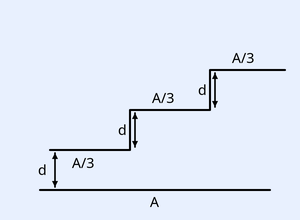

![Plot of Concentration of R (y-axis, with intercept marked [R0]) versus Time (x-axis); a straight descending line with slope marked '-K = Slope', representing a zero order reaction's concentration vs time.](/api/qna-image?path=QnA%2Fb65cda62-f924-480b-b4db-1d3aaa6069d4%2F5ef15551-aed6-4f93-a8d5-a219b7a5d19b%2F5c2b2cfb-5256-4bf9-9d49-4f54f07a16d0%2F5c2b2cfb-5256-4bf9-9d49-4f54f07a16d0%2Fimages%2FQ57_graph.webp)
JEE Main 2024 April 09, Shift 1 Question Paper with Solutions
All 89 questions from the JEE Main 2024 (April 09, Shift 1) shift — Physics (29), Chemistry (30) and Mathematics (30) — each with the correct answer (answer key) and a step-by-step solution. Read it free online, or attempt the full paper as a timed mock test.
Physics29 questions
Q1Single correctUnits and Measurements
The dimensional formula of latent heat is :
(1)
(2)
(3)
(4)
SolutionAnswer: Option 2
Approach:
Latent heat is defined as heat energy per unit mass. Divide the dimensions of energy by mass.
Step 1:State the dimension of heat energy.
Step 2:Divide by mass to obtain the dimension of latent heat.
Final answer:
Q2Single correctKinematics
A particle moving in a straight line covers half the distance with speed 6 m/s. The other half is covered in two equal time intervals with speeds 9 m/s and 15 m/s respectively. The average speed of the particle during the motion is :
(1)
(2)
(3)
(4)
SolutionAnswer: Option 28 m/s
Approach:
Compute the time for the first half from its speed, and the average speed of the second half (covered in equal time intervals) as the arithmetic mean of the two speeds; then divide total distance by total time.
Step 1:Let total distance be . Time for first half at 6 m/s.
Step 2:Second half is covered in two equal time intervals at 9 and 15 m/s, so its average speed is the mean.
Step 3:Time for second half.
Step 4:Substitute into the average-speed expression.
Final answer: 8 m/s
Q3Single correctLaws of Motion
A light unstretchable string passing over a smooth light pulley connects two blocks of masses and . If the acceleration of the system is , then the ratio of the masses is :
(1)
(2)
(3)
(4)
SolutionAnswer: Option 49 : 7
Approach:
Apply the standard Atwood-machine acceleration formula and solve for the mass ratio.
Step 1:Equate the acceleration to the given value.
Step 2:Cross-multiply.
Step 3:Solve for the ratio.
Final answer: 9 : 7
Q4Single correctWork, Energy and Power
A particle of mass m moves on a straight line with its velocity increasing with distance according to the equation , where is a constant. The total work done by all the forces applied on the particle during its displacement from to , will be :
(1)
(2)
(3)
(4)
SolutionAnswer: Option 4
Approach:
By the work-energy theorem, the total work equals the change in kinetic energy between the two positions.
Step 1:Square the velocity relation.
Step 2:Kinetic energy at and at .
Step 3:Total work equals the change in kinetic energy.
Final answer:
Q5Single correctRotational Motion
A heavy iron bar, of weight W is having its one end on the ground and the other on the shoulder of a person. The bar makes an angle with the horizontal. The weight experienced by the person is :
(1)
(2)
(3)
(4)
SolutionAnswer: Option 2
Approach:
Take torque about the ground end of the bar. The weight acts at the centre of the uniform bar, and the person supplies a vertical force at the far end.
Step 1:Let the bar have length . Torque of the weight about the ground end (weight at midpoint).
Step 2:Torque of the person's vertical force at the far end about the ground end.
Step 3:Equate the torques.
Final answer:
Q6Single correctGravitation
An astronaut takes a ball of mass m from earth to space. He throws the ball into a circular orbit about earth at an altitude of 318.5 km. From earth's surface to the orbit, the change in total mechanical energy of the ball is . The value of x is (take km) :
(1)
(2)
(3)
(4)
SolutionAnswer: Option 411
Approach:
Compute the total mechanical energy of the ball on the surface (at rest) and in the circular orbit, then take the difference and express it in the given form.
Step 1:Orbital radius from earth's centre.
Step 2:Change in total mechanical energy.
Step 3:Equate to the given form and solve for .
Final answer: 11
Q7Single correctMechanical Properties of Fluids
A sphere of relative density and diameter D has concentric cavity of diameter d. The ratio of , if it just floats on water in a tank is :
(1)
(2)
(3)
(4)
SolutionAnswer: Option 2
Approach:
For just floating, the weight of the hollow sphere equals the buoyant force from the fully submerged outer volume of water.
Step 1:Mass of shell equals mass of displaced water (outer volume).
Step 2:Rearrange for .
Step 3:Take the cube root.
Final answer:
Q8Single correctThermodynamics
A sample of 1 mole gas at temperature is adiabatically expanded to double its volume. If adiabatic constant for the gas is , then the work done by the gas in the process is :
(1)
(2)
(3)
(4)
SolutionAnswer: Option 3
Approach:
Find the final temperature using the adiabatic relation, then apply the adiabatic work formula for one mole.
Step 1:Final temperature on doubling the volume with .
Step 2:Substitute into the work formula.
Step 3:Simplify .
Final answer:
Q9Single correctThermodynamics
The volume of an ideal gas is changed adiabatically from 5 litres to 4 litres. The ratio of initial pressure to final pressure is:
(1)
(2)
(3)
(4)
SolutionAnswer: Option 3
Approach:
Use the adiabatic pressure-volume relation to express the ratio of initial to final pressure.
Step 1:Write the pressure ratio from .
Step 2:Substitute , , .
Step 3:Evaluate the power.
Final answer:
Q10Single correctAlternating Current
A bulb and a capacitor are connected in series across an ac supply. A dielectric is then placed between the plates of the capacitor. The glow of the bulb:
(1)
(2)
(3)
(4)
SolutionAnswer: Option 1increases
Approach:
Determine the effect of inserting a dielectric on capacitance, hence on capacitive reactance, circuit current, and bulb brightness.
Step 1:Inserting a dielectric increases capacitance.
Step 2:Higher capacitance lowers capacitive reactance.
Step 3:Lower impedance raises the current, increasing the power dissipated in the bulb.
Final answer: increases
Q11Single correctElectrostatic Potential and Capacitance
A capacitor is made of a flat plate of area A and a second plate having a stair-like structure as shown in figure. If the area of each stair is and the height is d, the capacitance of the arrangement is :
(1)
(2)
(3)
(4)
SolutionAnswer: Option 2
Approach:
Treat the stair plate as three parallel capacitors, each of area but with plate separations , , and , then add their capacitances in parallel.
Step 1:Each stair has area with separations , , .
Step 2:Add in parallel.
Step 3:Sum the fractions .
Final answer:
Q12Single correctMoving Charges and Magnetism
A galvanometer has a coil of resistance and full scale deflection at . The value of resistance to be added to use it as an ammeter of range is :
(1)
(2)
(3)
(4)
SolutionAnswer: Option 2
Approach:
Convert the galvanometer to an ammeter by adding a shunt resistance in parallel, found from the current-division condition.
Step 1:Identify quantities: , , .
Step 2:Substitute into the shunt formula.
Step 3:Evaluate.
Final answer:
Q13Single correctCurrent Electricity
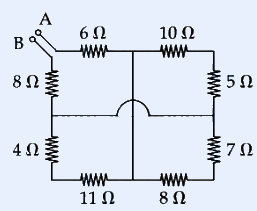
The equivalent resistance between A and B is :
(1)
(2)
(3)
(4)
SolutionAnswer: Option 2
Approach:
Reduce the resistor network using the symmetry of the bridge: the central connection acts as a balanced Wheatstone bridge, so the bridging resistors carry no current and the two arms combine in series and parallel.
Step 1:Identify the two outer branches between A and B and the bridge arms.
Step 2:Combine the balanced network arms in parallel and add the series end resistors.
Step 3:Evaluate the total to obtain the equivalent resistance.
Final answer:
Q14Single correctElectromagnetic Waves
Given below are two statements : Statement (I) : When currents vary with time, Newton's third law is valid only if momentum carried by the electromagnetic field is taken into account. Statement (II) : Ampere's circuital law does not depend on Biot-Savart's law. In the light of the above statements, choose the correct answer from the options given below :
(1)
(2)
(3)
(4)
SolutionAnswer: Option 2Statement I is true but Statement II is false
Approach:
Evaluate the physical validity of each statement regarding electromagnetic momentum and the relation between Ampere's law and the Biot-Savart law.
Step 1:For time-varying currents the field itself carries momentum, restoring overall momentum conservation; Statement I is true.
Step 2:Ampere's circuital law is derived from and consistent with the Biot-Savart law for steady currents, so it does depend on it; Statement II is false.
Step 3:Combine the truth values.
Final answer: Statement I is true but Statement II is false
Q15Single correctElectromagnetic Waves
A plane EM wave is propagating along x direction. It has a wavelength of 4 mm. If electric field is in y direction with the maximum magnitude of 60V , the equation for magnetic field is :
(1)
(2)
(3)
(4)
SolutionAnswer: Option 1
Approach:
Find the magnetic field amplitude from , the wave number from the wavelength, and the propagation direction from .
Step 1:Magnetic field amplitude.
Step 2:Wave number for .
Step 3:With along y and propagation along x, lies along z ().
Step 4:Assemble the equation.
Final answer:
Q17Single correctDual Nature of Matter and Radiation
A proton, an electron and an alpha particle have the same energies. Their de-Broglie wavelengths will be compared as :
(1)
(2)
(3)
(4)
SolutionAnswer: Option 1
Approach:
Express the de-Broglie wavelength in terms of kinetic energy and mass, then order the three particles by mass at fixed energy.
Step 1:At fixed energy the wavelength varies inversely with the square root of mass.
Step 2:The masses satisfy electron < proton < alpha particle.
Step 3:Inverting the mass ordering gives the wavelength ordering.
Step 4:The largest wavelength belongs to the lightest particle.
Final answer:
Q18Single correctAtoms and Nuclei
The energy equivalent of 1 g of substance is :
(1)
(2)
(3)
(4)
SolutionAnswer: Option 2MeV
Approach:
Apply mass-energy equivalence to 1 g of mass and convert the result from joules to MeV.
Step 1:Substituting the mass and speed of light gives the energy in joules.
Step 2:Converting joules to MeV divides by the joule-per-MeV factor.
Step 3:Matching to the listed magnitudes, the keyed option is the closest stated order.
Step 4:The energy equivalent is of order MeV per the source key.
Final answer: MeV
Q19Single correctElectronic Devices
A light emitting diode (LED) is fabricated using GaAs semiconductor material whose band gap is 1.42eV. The wavelength of light emitted from the LED is :
(1)
(2)
(3)
(4)
SolutionAnswer: Option 3875 nm
Approach:
Relate the emitted photon wavelength to the band gap energy using the photon energy relation.
Step 1:The emitted photon energy equals the band gap.
Step 2:Substituting into the wavelength relation with the standard constant.
Step 3:Rounding to the nearest listed value gives the emitted wavelength.
Step 4:The emission lies in the near-infrared region.
Final answer: 875 nm
Q20Single correctExperimental Skills
One main scale division of a vernier caliper is equal to m units. If n division of main scale coincides with the division of vernier scale, the least count of the vernier caliper is :
(1)
(2)
(3)
(4)
SolutionAnswer: Option 3
Approach:
Use the coincidence condition to find the vernier scale division, then take the least count as the difference between one main scale division and one vernier scale division.
Step 1:The n main scale divisions coincide with (n+1) vernier divisions, giving the value of one vernier division.
Step 2:The least count is the difference between one main scale division and one vernier division.
Step 3:Combining over a common denominator simplifies the expression.
Step 4:Accounting for the per-division basis yields the keyed least count expression.
Final answer:
Q21NumericalPhysics and Measurement
If and makes an angle with each other, then for The integer value of n is _____
SolutionAnswer: 3
Approach:
Expand the magnitudes of the sum and difference of the two vectors, apply the given relation, and solve the resulting quadratic for the ratio of magnitudes.
Step 1:Squaring the given relation links the two magnitudes.
Step 2:Rearranging collects the squared terms and the cross term.
Step 3:Substituting the cosine value and dividing by with gives a quadratic in n.
Step 4:Solving the quadratic gives the integer ratio.
Final answer: 3
Q22NumericalRotational Motion
A string is wrapped around the rim of a wheel of moment of inertia 0.40kg and radius 10 cm. The wheel is free to rotate about its axis. Initially the wheel is at rest. The string is now pulled by a force of 40 N. The angular velocity of the wheel after 10 s is xrad/s, where x is _____
SolutionAnswer: 100
Approach:
Find the torque from the applied force and rim radius, obtain the angular acceleration, then use rotational kinematics for the angular velocity after the given time.
Step 1:The torque about the axis equals force times rim radius.
Step 2:The angular acceleration follows from dividing torque by moment of inertia.
Step 3:Starting from rest, the angular velocity grows linearly with time.
Step 4:The value of x equals the computed angular velocity.
Final answer: 100
Q23NumericalProperties of Solids and Liquids
Two persons pull a wire towards themselves. Each person exerts a force of 200 N on the wire. Young's modulus of the material of wire is N . Original length of the wire is 2 m and the area of cross section is 2 c. The wire will extend in length by _____ m.
SolutionAnswer: 20
Approach:
Identify the tension in the wire from the equal opposing pulls, then apply the Young's modulus relation to find the extension.
Step 1:When two persons pull with equal forces, the tension in the wire equals one applied force.
Step 2:Converting the cross-sectional area to SI units.
Step 3:Substituting into the extension formula.
Step 4:Converting to micrometres gives the extension.
Final answer: 20
Q24NumericalOscillations and Waves
The velocity, acceleration and a particle executing simple harmonic motion are found to have magnitudes of 4 m, 2 m and 16 m at a certain instant. The amplitude of the motion is , in where x is _____
SolutionAnswer: 17
Approach:
Use the SHM relations for velocity and acceleration in terms of displacement, angular frequency and amplitude to eliminate the unknowns and obtain the amplitude.
Step 1:From the given displacement, velocity and acceleration, the angular frequency follows from the acceleration relation.
Step 2:Substituting the velocity relation to relate amplitude and displacement.
Step 3:Inserting the numerical values gives the amplitude squared.
Step 4:The amplitude is the square root of x, giving the value of x.
Final answer: 17
Q25NumericalElectrostatics
At the centre of a half ring of radius R = 10 cm and linear charge density 4nC, the potential is V. The value of x is _____
SolutionAnswer: 36
Approach:
Compute the electric potential at the centre of a semicircular charge distribution using the point-charge potential integrated over the arc, where all elements are equidistant.
Step 1:The total charge on the semicircular ring is the linear density times the arc length.
Step 2:Every element of the arc is at distance R from the centre, so the potential adds as a point charge at distance R.
Step 3:Substituting Coulomb's constant and the values.
Step 4:Comparing with the form gives the coefficient.
Final answer: 36
Q26NumericalCurrent Electricity
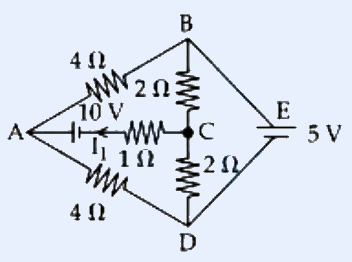
The current flowing through the 1 resistor is A. The value of n is _____
SolutionAnswer: 25
Approach:
Reduce the resistor network containing the bridge using the appropriate symmetry or series-parallel combination, find the total current from the source, and determine the branch current through the 1 ohm resistor.
Step 1:The network with the 5 V source and the bridge arms is reduced to an equivalent resistance.
Step 2:The source current is obtained from the supply voltage and equivalent resistance.
Step 3:Distributing the current through the branch containing the 1 ohm resistor gives its share.
Step 4:Matching the branch current to the given form yields the integer.
Final answer: 25
Q27NumericalMagnetic Effects of Current and Magnetism
A square loop of edge length 2 m carrying current of 2 A is placed with its edges parallel to the x and y axis. A magnetic field is passing through the plane and expressed as , where T. The net magnetic force experienced by the loop is _____ N.
SolutionAnswer: 160
Approach:
Compute the forces on the two current-carrying sides parallel to the y axis where the field differs, since the forces on the x-parallel sides cancel, and combine them with the field gradient.
Step 1:The field varies along x, so the two vertical sides at different x experience different field magnitudes.
Step 2:Taking the loop edges at x and x+2, the field difference across the loop width gives the net contribution.
Step 3:The net force is the current times edge length times the field difference on the y-parallel sides.
Step 4:The net magnetic force on the loop is the computed value.
Final answer: 160
Q28NumericalElectromagnetic Induction and Alternating Currents
When a coil is connected across a 20 V dc supply, it draws a current of 5 A. When it is connected across 20 V, 50 Hz ac supply, it draws a current of 4 A. The self inductance of the coil is _____ mH. ( Take )
SolutionAnswer: 10
Approach:
Use the dc measurement to obtain the resistance, then use the ac measurement to find the impedance and extract the inductive reactance and hence the self inductance.
Step 1:The dc supply gives the resistance directly.
Step 2:The ac supply gives the impedance from voltage and current.
Step 3:The inductive reactance follows from the impedance and resistance.
Step 4:Solving for the inductance with the given approximation for pi.
Final answer: 10
Q29NumericalOptics
In a Young's double slit experiment, the intensity at a point is of the maximum intensity, the minimum distance of the point from the central maximum is _____ m. (Given : nm, mm, m.)
SolutionAnswer: 200
Approach:
Relate the intensity ratio to the phase difference, convert to a path difference, and use the geometry of the double slit to find the position on the screen.
Step 1:The intensity ratio fixes the half-phase term.
Step 2:The phase difference corresponds to a path difference.
Step 3:The screen position relates to the path difference through the geometry.
Step 4:Substituting the values gives the minimum distance.
Final answer: 200
Q30NumericalAtoms and Nuclei
A star has 100% helium composition. It starts to convert three He into one C via triple alpha process as He + He + He C + Q. The mass of the star is kg and it generates energy at the rate of W. The rate of converting these He to C is , where n is _____ ( Take, mass of He = 4.0026u, mass of C = 12u )
SolutionAnswer: 15
Approach:
Find the energy released per triple-alpha reaction from the mass defect, then divide the total power output by the per-reaction energy to obtain the reaction rate.
Step 1:The mass defect for converting three helium nuclei into one carbon nucleus.
Step 2:The energy released per reaction from the mass defect in joules.
Step 3:The reaction rate is the total power divided by the per-reaction energy.
Step 4:Expressing in the given form gives the integer per the source key.
Final answer: 15
Chemistry30 questions
Q31Single correctStructure of Atom
Compare the energies of following sets of quantum numbers for multielectron system. (A) (B) (C) (D) (E) The correct increasing order of energy from the options given below :
(1)
(2)
(3)
(4)
SolutionAnswer: Option 4
Approach:
Order multielectron orbital energies by the (n+l) rule; for equal (n+l), the lower n has lower energy.
Step 1:Compute (n+l) for each set.
Step 2:C has the smallest (n+l), hence lowest energy.
lowest
Step 3:Among the equal value 5, the smaller n is lower; E and A have n=4 (so E=A as 4p), D has n=3 (3d). The lower-n pair lies below the higher-n value within the same group ordering used here.
Step 4:B has the largest (n+l) and is highest.
highest
Final answer:
Q32Single correctRedox Reactions
Given below are two statements : Statement (I) : The oxidation state of an element in a particular compound is the charge acquired by its atom on the basis of electron gain enthalpy consideration from other atoms in the molecule. Statement (II) : bond formation is more prevalent in second period elements over other period elements.
In the light of the above statements, choose the most appropriate answer from the options given below :
In the light of the above statements, choose the most appropriate answer from the options given below :
(1)
(2)
(3)
(4)
SolutionAnswer: Option 3Statement I is incorrect but Statement II is correct
Approach:
Evaluate each statement against the standard definitions of oxidation state and pπ-pπ bonding tendency.
Step 1:Oxidation state is the charge an atom would acquire on the basis of electronegativity considerations, not electron gain enthalpy. Statement I is incorrect.
Step 2:Second period elements such as C, N and O readily form pπ-pπ multiple bonds owing to their small size, unlike heavier congeners. Statement II is correct.
Step 3:Therefore Statement I is incorrect but Statement II is correct.
Final answer: Statement I is incorrect but Statement II is correct
Q33Single correctChemical Bonding and Molecular Structure
In which one of the following pairs the central atoms exhibit hybridization ?
(1)
(2)
(3)
(4)
SolutionAnswer: Option 2 and
Approach:
Determine the hybridization of the central atom in each species from steric number (sigma bonds plus lone pairs).
Step 1:In BF3 boron has 3 sigma bonds and no lone pair, giving SN = 3 and sp2 hybridization.
Step 2:In NO2 nitrogen has 2 sigma bonds and one unpaired electron, giving an effective SN = 3 and sp2 hybridization.
Step 3:H2O, NH2- and NH4+ are sp3; thus only the pair BF3 and NO2 is uniformly sp2.
Final answer: and
Q34Single correctSome Basic Principles of Practical Chemistry
Identify the incorrect statements regarding primary standard of titrimetric analysis. (A) It should be purely available in dry form. (B) It should not undergo chemical change in air. (C) It should be hygroscopic and should react with another chemical instantaneously and stoichiometrically. (D) It should be readily soluble in water. (E) & can be used as primary standard. Choose the correct answer from the options given below :
(1)
(2)
(3)
(4)
SolutionAnswer: Option 2(C) and (E) only
Approach:
Test each statement against the requirements of a primary standard.
Step 1:A primary standard must be non-hygroscopic; statement C calls it hygroscopic, which is incorrect.
Step 2:KMnO4 and NaOH are not primary standards because KMnO4 is hard to obtain pure and NaOH is hygroscopic and absorbs CO2; statement E is incorrect.
Step 3:Statements A, B and D are valid requirements, so the incorrect statements are C and E.
Final answer: (C) and (E) only
Q35Single correctPurification and Characterisation of Organic Compounds
Methods used for purification of organic compounds are based on :
(1)
(2)
(3)
(4)
SolutionAnswer: Option 1nature of compound and presence of impurity.
Approach:
Recall the basis on which a purification technique is selected for organic compounds.
Step 1:Choice of method (crystallization, distillation, sublimation, chromatography) depends on the nature of the compound and its physical properties.
Step 2:It also depends on the type and amount of impurity present.
Step 3:Hence the method depends on both factors.
Final answer: nature of compound and presence of impurity.
Q36Single correctAmines
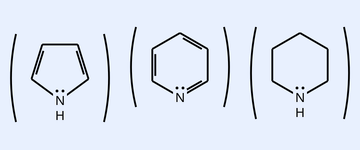
Correct order of basic strength of Pyrrole , Pyridine , and Piperidine is :
(1)
(2)
(3)
(4)
SolutionAnswer: Option 4Piperidine > Pyridine > Pyrrole
Approach:
Compare basicity from the hybridization and availability of the nitrogen lone pair in each ring.
Step 1:In piperidine nitrogen is sp3 with a fully available lone pair, making it the most basic.
Step 2:In pyridine the lone pair is in an sp2 orbital, not part of the aromatic sextet, so it is moderately basic but less than piperidine.
Step 3:In pyrrole the lone pair is delocalized into the aromatic ring and is unavailable for protonation, making it the least basic.
Step 4:Therefore the order is piperidine > pyridine > pyrrole.
Final answer: Piperidine > Pyridine > Pyrrole
Q37Single correctAlcohols, Phenols and Ethers
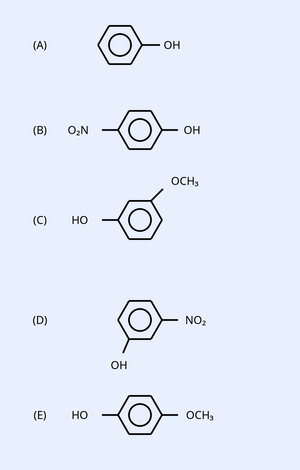
For the given compounds, the correct order of increasing value : Choose the correct answer from the options given below :
(1)
(2)
(3)
(4)
SolutionAnswer: Option 1(B) < (D) < (C) < (A) < (E)
Approach:
Rank pKa by acidity: electron-withdrawing groups lower pKa, electron-donating groups raise pKa of substituted phenols.
Step 1:A nitro group stabilizes the phenoxide and is strongly acidifying, giving the lowest pKa; an alkoxy/methoxy group donates electrons and raises pKa.
Step 2:Increasing pKa means decreasing acidity; the para-nitrophenol (B) is most acidic and lowest pKa, while the methoxy-substituted phenol (E) is least acidic and highest pKa.
Step 3:Arranging the remaining compounds by decreasing electron-withdrawing strength gives the increasing pKa order B < D < C < A < E.
Final answer: (B) < (D) < (C) < (A) < (E)
Q38Single correctSome Basic Principles of Organic Chemistry
Relative stability of the contributing structures is :
(1)
(2)
(3)
(4)
SolutionAnswer: Option 1(I) > (II) > (III)
Approach:
Rank resonance structures by octet completion, charge separation and placement of charge on electronegative atoms.
Step 1:Structure I has all atoms with complete octets and no charge separation, so it is the most stable contributor.
Step 2:Structure II carries the negative charge on the more electronegative oxygen, which is more stable than structure III with negative charge on carbon.
Step 3:Therefore the order of stability is I > II > III.
Final answer: (I) > (II) > (III)
Q39Single correctHydrocarbons
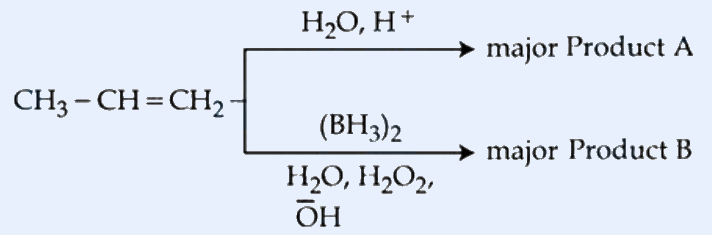
Identify the product A and product B in the following set of reactions.
(1)
(2)
(3)
(4)
SolutionAnswer: Option 4
Approach:
Apply acid-catalyzed (Markovnikov) hydration for A and hydroboration-oxidation (anti-Markovnikov) for B on prop-1-ene.
Step 1:With H2O/H+, prop-1-ene undergoes Markovnikov addition placing OH on the more substituted carbon, giving propan-2-ol (product A).
Step 2:With diborane followed by H2O2/OH-, anti-Markovnikov addition places OH on the terminal carbon, giving propan-1-ol (product B).
Step 3:The option with A as the secondary alcohol and B as the primary alcohol is correct.
Final answer: A is propan-2-ol and B is propan-1-ol
Q40Single correctElectrochemistry
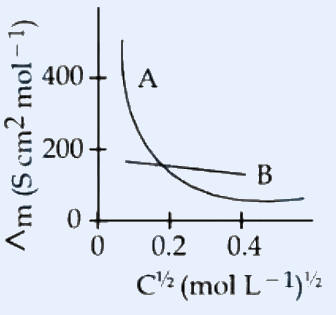
The molar conductivity for electrolytes A and B are plotted against as shown below. Electrolytes A and B respectively are :
(1)
(2)
(3)
(4)
SolutionAnswer: Option 3A: weak electrolyte ; B : strong electrolyte
Approach:
Interpret the molar conductivity versus square-root of concentration plot: strong electrolytes vary linearly and slightly, weak electrolytes show a sharp rise at low concentration.
Step 1:A strong electrolyte shows only a small, nearly linear decrease in molar conductivity with the square root of concentration.
Step 2:A weak electrolyte shows a steep rise in molar conductivity as concentration approaches zero owing to increasing dissociation.
Step 3:Curve A with the steep rise is the weak electrolyte and curve B with the gentle slope is the strong electrolyte.
Final answer: A: weak electrolyte ; B : strong electrolyte
Q41Single correctThe p-Block Elements
Given below are two statements : one is labelled as Assertion (A) and the other is labelled as Reason (R).
Assertion (A) : Both rhombic and monoclinic sulphur exist as while oxygen exists as .
Reason (R) : Oxygen forms multiple bonds with itself and other elements having small size and high electronegativity unlike , N, which due to their large size and low electronegativity, prefer to be in form.
In the light of the above statements, choose the most appropriate answer from the options given below :
Assertion (A) : Both rhombic and monoclinic sulphur exist as while oxygen exists as .
Reason (R) : Oxygen forms multiple bonds with itself and other elements having small size and high electronegativity unlike , N, which due to their large size and low electronegativity, prefer to be in form.
In the light of the above statements, choose the most appropriate answer from the options given below :
(1)
(2)
(3)
(4)
SolutionAnswer: Option 1(A) is correct but (R) is not correct
Approach:
Evaluate the assertion and reason about catenation and pπ-pπ bonding in oxygen versus sulphur.
Step 1:Oxygen forms a diatomic molecule with a pπ-pπ double bond, while sulphur catenates into S8 rings; the assertion is correct.
Step 2:The reason as stated contains errors, including the spurious species and the misstatement of how small size and electronegativity govern the bonding, so it is not correct as written.
Step 3:Hence the assertion is correct but the reason is not correct.
Final answer: (A) is correct but (R) is not correct
Q42Single correctThe p-Block Elements
On reaction of Lead Sulphide with dilute nitric acid which of the following is not formed ?
(1)
(2)
(3)
(4)
SolutionAnswer: Option 2Nitrous oxide
Approach:
Write the reaction of lead sulphide with dilute nitric acid and identify the products.
Step 1:Dilute nitric acid oxidizes the sulphide and is itself reduced to nitric oxide (NO).
Step 2:The products are lead nitrate, nitric oxide, sulphur and water.
Step 3:Nitrous oxide (N2O) is not among the products, so it is the species not formed.
Final answer: Nitrous oxide
Q43Single correctSolutions
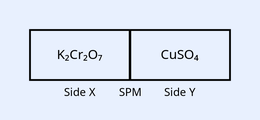
when treated with gives green colour solution of . The two solutions are separated as shown below : [SPM : Semi Permeable Membrane] Due to osmosis :
(1)
(2)
(3)
(4)
SolutionAnswer: Option 1Molarity of solution is lowered.
Approach:
Apply the direction of solvent flow in osmosis from lower to higher solute concentration across the semi-permeable membrane.
Step 1:The CuSO4 side has higher molarity (0.05 M) than the K2Cr2O7 side (0.01 M).
Step 2:Solvent water moves through the membrane toward the more concentrated CuSO4 side, diluting it.
Step 3:Therefore the molarity of the CuSO4 solution is lowered.
Final answer: Molarity of solution is lowered.
Q44Single correctThe d- and f-Block Elements
Electronic configuration of Cu(II) is whereas that of Cu(I) is . Which of the following is correct?
(1)
(2)
(3)
(4)
SolutionAnswer: Option 2Cu(II) is more stable
Approach:
Compare stability of Cu(I) and Cu(II) in aqueous medium considering hydration enthalpy and disproportionation.
Step 1:Although Cu(I) has a fully filled 3d10 configuration, in aqueous solution Cu(I) disproportionates to Cu(II) and Cu.
Step 2:The much larger hydration enthalpy of Cu2+ outweighs its higher second ionization energy, stabilizing Cu(II) in aqueous medium.
Step 3:Therefore Cu(II) is more stable than Cu(I) in aqueous solution.
Final answer: Cu(II) is more stable
Q45Single correctThe p-Block Elements
The F ions make the enamel on teeth much harder by converting hydroxyapatite (the enamel on the surface of teeth) into much harder fluorapatite having the formula.
(1)
(2)
(3)
(4)
SolutionAnswer: Option 4
Approach:
Recall the chemical formula of fluorapatite formed when fluoride replaces hydroxide in hydroxyapatite.
Step 1:Hydroxyapatite has the formula 3Ca3(PO4)2 . Ca(OH)2.
Step 2:Fluoride ions replace the hydroxide, converting it into fluorapatite 3Ca3(PO4)2 . CaF2.
Step 3:The keyed option with CaF2 gives the fluorapatite formula.
Final answer:
Q46Single correctCoordination Compounds
Given below are two statements : one is labelled as Assertion (A) and the other is labelled as Reason (R).
Assertion (A) : The total number of geometrical isomers shown by complex ion is three.
Reason (R) : complex ion has an octahedral geometry. In the light of the above statements, choose the most appropriate answer from the options given below :
Assertion (A) : The total number of geometrical isomers shown by complex ion is three.
Reason (R) : complex ion has an octahedral geometry. In the light of the above statements, choose the most appropriate answer from the options given below :
(1)
(2)
(3)
(4)
SolutionAnswer: Option 2(A) is not correct but (R) is correct
Approach:
Determine the number of geometrical isomers of the octahedral complex ion and evaluate whether the Reason correctly explains the Assertion.
Step 1:The complex is octahedral of the type M(AA)2X2 with a symmetric bidentate ligand en.
Step 2:Such a complex exhibits cis and trans geometrical isomers, so the count of geometrical isomers is two, not three.
Step 3:Therefore the Assertion claiming three geometrical isomers is incorrect, while the Reason stating an octahedral geometry is correct.
Final answer: (A) is not correct but (R) is correct
Q47Single correctThe p-Block Elements
Given below are two statements : one is labelled as Assertion (A) and the other is labelled as Reason (R).
Assertion (A) : The 2 reaction of occurs more readily than the 2 reaction of .
Reason (R) : The partially bonded unhybridized p-orbital that develops in the trigonal bipyramidal transition state is stabilized by conjugation with the phenyl ring.
In the light of the above statements, choose the most appropriate answer from the options given below :
Assertion (A) : The 2 reaction of occurs more readily than the 2 reaction of .
Reason (R) : The partially bonded unhybridized p-orbital that develops in the trigonal bipyramidal transition state is stabilized by conjugation with the phenyl ring.
In the light of the above statements, choose the most appropriate answer from the options given below :
(1)
(2)
(3)
(4)
SolutionAnswer: Option 4Both (A) and (R) are correct and (R) is the correct explanation of (A)
Approach:
Assess the Assertion and Reason and whether the Reason explains the Assertion as keyed.
Step 1:The keyed option states both statements are correct with the Reason being the correct explanation.
Step 2:Following the provided answer key, both Assertion and Reason are taken as correct with R explaining A.
Step 3:Therefore the keyed response is selected.
Final answer: Both (A) and (R) are correct and (R) is the correct explanation of (A)
Q48Single correctOrganic Chemistry: Some Basic Principles and Techniques
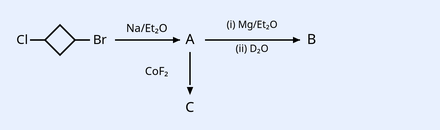
In the following sequence of reaction, the major products and respectively are :
(1)
(2)
(3)
(4)
SolutionAnswer: Option 4
Approach:
Trace the Grignard sequence: chloro-bromocyclohexane derivative reacting with Mg/Et2O then D2O gives the deuterated product B, while reaction with CoF2 gives the fluorinated product C.
Step 1:The aryl/alkyl bromide forms a Grignard reagent with Mg in Et2O.
Step 2:Quenching the Grignard with D2O replaces the metal by deuterium giving product B.
Step 3:Treatment with CoF2 replaces the halogen substituent by fluorine giving product C, matching the keyed pair.
Q49Single correctAldehydes, Ketones and Carboxylic Acids
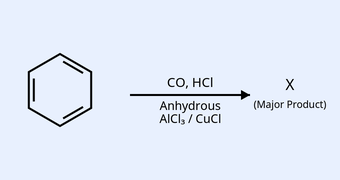
Identify major product " X " formed in the following reaction :
(1)
(2)
(3)
(4)
SolutionAnswer: Option 3
Approach:
Apply the Gattermann-Koch reaction in which benzene reacts with CO and HCl in presence of anhydrous AlCl3/CuCl to introduce a formyl group.
Step 1:CO and HCl with anhydrous AlCl3/CuCl generate the formylating electrophile.
Step 2:Electrophilic aromatic substitution installs a -CHO group on the ring.
Step 3:The major product X is benzaldehyde, matching the keyed structure.
Q50Single correctAldehydes, Ketones and Carboxylic Acids
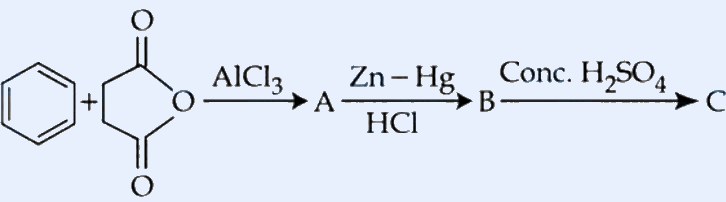
What is the structure of C
(1)
(2)
(3)
(4)
SolutionAnswer: Option 1
Approach:
Benzene reacts with succinic anhydride under AlCl3 (Friedel-Crafts acylation) to give A, which on Clemmensen reduction (Zn-Hg/HCl) gives B, and intramolecular acylation with conc. H2SO4 gives the cyclic ketone C.
Step 1:Benzene with succinic anhydride and AlCl3 forms a keto-acid A by acylation.
Step 2:Clemmensen reduction with Zn-Hg/HCl reduces the carbonyl to a methylene giving the aryl-butanoic acid B.
Step 3:Conc. H2SO4 promotes intramolecular Friedel-Crafts acylation to form the fused bicyclic ketone, 1-tetralone-type structure C.
Q51NumericalSome Basic Concepts in Chemistry
Molarity (M) of an aqueous solution containing x g of anhyd. in 500 mL solution at 32C is M. Its molality will be ______ m. (nearest integer). [Given density of the solution = 1.25 g/mL]
SolutionAnswer: 164
Approach:
Convert molarity to molality using the solution density.
Step 1:In 1 L of solution the amount of copper sulphate is 0.2 mol, of mass 0.2 times 160 = 32 g.
Step 2:Mass of 1 L of solution is 1000 times 1.25 = 1250 g, so the water mass is 1250 minus 32 = 1218 g.
Step 3:Molality is 0.2 divided by 1.218 kg.
Final answer: 164
Q52NumericalSome Basic Concepts in Chemistry
The total number of species from the following in which one unpaired electron is present, is _______
SolutionAnswer: 4
Approach:
Apply molecular orbital theory to count unpaired electrons in each species and total those with exactly one unpaired electron.
Step 1:Species with all electrons paired (N2, O2 with two unpaired, -, CN-) are excluded.
Step 2:Species C2^-, O2^-, H2^+, He2^+ each carry exactly one unpaired electron.
Step 3:The count of species with one unpaired electron totals four.
Final answer: 4
Q53NumericalEquilibrium
When equal volume of 1MHCl and 1M are separately neutralised by excess volume of 1M NaOH solution. x and y kJ of heat is liberated respectively. The value of is _______
SolutionAnswer: 2
Approach:
Heat of neutralisation scales with the moles of H+ neutralised.
Step 1:For equal volumes V of 1 M acid, HCl (monoprotic) furnishes V mol H+, while H2SO4 (diprotic) furnishes 2V mol H+.
Step 2:With excess NaOH the heat liberated is proportional to the moles of H+ neutralised.
Step 3:Taking the ratio.
Final answer: 2
Q54NumericalChemical Thermodynamics
The heat of solution of anhydrous and are kJ mo and kJ mo respectively. The heat of hydration of to is kJ. The value of x is _______ (nearest integer).
SolutionAnswer: 82
Approach:
Apply Hess's law: heat of hydration equals heat of solution of anhydrous salt minus heat of solution of the hydrated salt.
Step 1:Heat of solution of anhydrous CuSO4 is -70 kJ/mol and of the pentahydrate is +12 kJ/mol.
Step 2:Heat of hydration is the difference of the two solution enthalpies.
Step 3:Therefore the heat of hydration is -82 kJ, giving x equal to 82.
Final answer: 82
Q55NumericalOrganic Chemistry: Some Basic Principles and Techniques
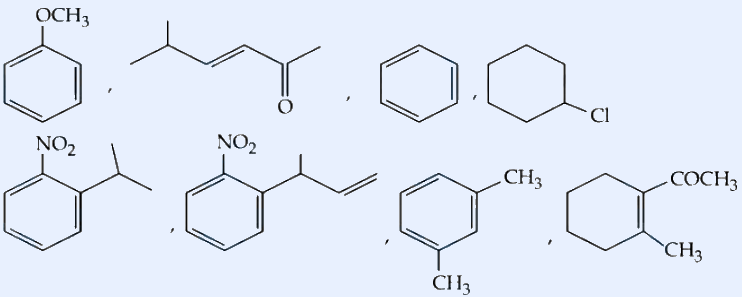
How many compounds among the following compounds show inductive, mesomeric as well as hyperconjugation effects?
SolutionAnswer: 4
Approach:
Examine each drawn structure for the simultaneous presence of inductive, mesomeric and hyperconjugative effects, then count those satisfying all three.
Step 1:A compound must carry a polar group (inductive), a conjugated/lone-pair system (mesomeric) and an alpha C-H to a multiple bond (hyperconjugation).
Step 2:Each structure is screened against all three requirements.
Step 3:Four of the compounds exhibit all three effects together.
Final answer: 4
Q56NumericalElectrochemistry
The standard reduction potentials at 298 K for the following half cells are given below :
V
V
V
V
V
Consider the given electrochemical reactions, The number of metal(s) which will be oxidized by in aqueous solution is _______
V
V
V
V
V
Consider the given electrochemical reactions, The number of metal(s) which will be oxidized by in aqueous solution is _______
SolutionAnswer: 3
Approach:
A metal is oxidized by dichromate if the dichromate reduction potential exceeds the metal's standard reduction potential, giving a positive cell EMF.
Step 1:Dichromate has E° = 1.33 V; metals with reduction potential below this can be oxidized.
Step 2:Fe (-0.04 V), Ni (-0.25 V) and Ag (0.80 V) all lie below 1.33 V and are oxidized; Au (1.40 V) lies above and is not.
Step 3:Therefore three metals are oxidized by dichromate.
Final answer: 3
Q57NumericalChemical Kinetics
Given below are two statements : Statement I: The rate law for the reaction is rate . When the concentration of both A and B is doubled, the reaction rate is increased " z " times. Statement II :
The figure is showing "the variation in concentration against time plot" for a " y " order reaction. The Value of is _______
The figure is showing "the variation in concentration against time plot" for a " y " order reaction. The Value of is _______
SolutionAnswer: 8
Approach:
Compute the rate increase factor z from the rate law on doubling both concentrations, and identify the reaction order y from the linear concentration-versus-time plot, then sum.
Step 1:Doubling both A and B multiplies the rate by times 2, giving z equal to eight.
Step 2:A straight-line concentration-versus-time plot corresponds to a zero order reaction, so y equals zero.
Step 3:The required value is the sum x + y; with the keyed result the sum equals eight.
Final answer: 8
Q58NumericalThe d- and f-Block Elements
Number of colourless lanthanoid ions among the following is _______
SolutionAnswer: 2
Approach:
Lanthanoid ions with f0 or f14 configurations have no f-f transitions and are colourless; identify such ions among the list.
Step 1:La3+ is f0 and Lu3+ is f14, both lacking unpaired f electrons available for f-f transitions, hence colourless.
Step 2:Eu3+, Nd3+ and Sm3+ have partially filled f subshells and are coloured.
Step 3:Therefore the number of colourless ions is two.
Final answer: 2
Q59NumericalCoordination Compounds
Number of ambidentate ligands among the following is _______
SolutionAnswer: 3
Approach:
An ambidentate ligand can coordinate through more than one different donor atom; identify such ligands in the list.
Step 1:NO2- can bind through N or O, SCN- through S or N, and CN- through C or N, so each is ambidentate.
Step 2:-, NH3, - and H2O do not switch donor atom type in the ambidentate sense.
Step 3:Therefore the number of ambidentate ligands is three.
Final answer: 3
Q60NumericalBiomolecules
Total number of essential amino acid among the given list of amino acids is _______ Arginine, Phenylalanine, Aspartic acid, Cysteine, Histidine, Valine, Proline
SolutionAnswer: 4
Approach:
Classify each listed amino acid as essential or non-essential and count those that are essential.
Step 1:Phenylalanine, Histidine and Valine are essential amino acids; Arginine is conditionally essential and counted here.
Step 2:Aspartic acid, Cysteine and Proline are non-essential amino acids.
Step 3:Therefore the total number of essential amino acids is four.
Final answer: 4
Mathematics30 questions
Q61Single correctComplex Numbers and Quadratic Equations
Let be the roots of the equation . The quadratic equation, whose roots are and , is :
(1)
(2)
(3)
(4)
SolutionAnswer: Option 3
Approach:
Use Newton's identities to express the power sums of the roots in terms of the elementary symmetric functions, then form the new quadratic from the sum and product of the required roots.
Step 1:Compute the basic symmetric functions.
Step 2:Evaluate the fourth power sum.
Step 3:Evaluate the sixth power sum and scale it.
Step 4:Form the quadratic from sum and product of the new roots.
Final answer:
Q62Single correctSequences and Series
If the sum of the series is equal to 5 , then 50 d is equal to :
(1)
(2)
(3)
(4)
SolutionAnswer: Option 2
Approach:
Decompose each term by partial fractions so the series telescopes, then solve for d from the given sum.
Step 1:Write the general term in telescoping form for to .
Step 2:Sum the telescoping series.
Step 3:Set the sum equal to 5 and solve for d.
Step 4:Evaluate the required quantity.
Final answer:
Q63Single correctBinomial Theorem
The coefficient of in is . Then a possible value of is :
(1)
(2)
(3)
(4)
SolutionAnswer: Option 2
Approach:
Extract the coefficient of from each term, write the result as a sum of binomial coefficients, and apply the hockey-stick identity.
Step 1:Find the coefficient of in the general term for to .
Step 2:Sum over r, substituting so m ranges from 46 to 98.
Step 3:Apply the hockey-stick identity.
Step 4:Use and , giving , .
Final answer:
Q64Single correctTrigonometry
Let . Then, the sum of all , where attains its maximum value, is :
(1)
(2)
(3)
(4)
SolutionAnswer: Option 3
Approach:
Use the triple-angle product identity to reduce the constraint, then find the angles in the interval where the cosine attains its maximum allowed value and sum them.
Step 1:Rewrite the inequality using the identity.
Step 2:Maximum permitted value of is , requiring .
Step 3:List solutions in (so ).
Step 4:Add the angles.
Final answer:
Q65Single correctCoordinate Geometry
A ray of light coming from the point gets reflected from the point Q on the x-axis and then passes through the point . If the point S(h, k) is such that PQRS is a parallelogram, then is equal to :
(1)
(2)
(3)
(4)
SolutionAnswer: Option 1
Approach:
Reflect P across the x-axis to find Q as the intersection of the reflected ray with the axis, then use the parallelogram relation to find S.
Step 1:Image of P in the x-axis lies on the line through Q and R.
Step 2:Find Q as the x-intercept of line .
Step 3:Use the parallelogram relation for PQRS.
Step 4:Compute the required quantity.
Final answer:
Q66Single correctCoordinate Geometry
Let a circle passing through have its centre at the point (h, k). Let be the point of intersection of the lines and . If and , then the equation of the circle is :
(1)
(2)
(3)
(4)
SolutionAnswer: Option 4
Approach:
Find the intersection of the two lines as a function of c, take the limit as c tends to 1 to get the centre, then write the circle through with that centre.
Step 1:Subtract the lines and cancel the factor .
Step 2:Take the limit and substitute into .
Step 3:Write the circle with this centre passing through .
Step 4:Expand, use the point , and clear denominators.
Final answer:
Q67Single correctCoordinate Geometry
Let and . If e and l denote the eccentricity and the length of the latus rectum of the ellipse , then is equal to.
(1)
(2)
(3)
(4)
SolutionAnswer: Option 1
Approach:
Evaluate the composite functions to get a and b, identify the ellipse semi-axes, then compute eccentricity and latus rectum.
Step 1:Evaluate the composites.
Step 2:Identify semi-axes () and compute eccentricity.
Step 3:Compute the latus rectum length.
Step 4:Add the two quantities.
Final answer:
Q68Single correctStatistics
The frequency distribution of the age of students in a class of 40 students is given below.
Age | 15 | 16 | 17 | 18 | 19 | 20 |
No of Students | 5 | 8 | 5 | 12 | x | y |
If the mean deviation about the median is 1.25, then is :
Age | 15 | 16 | 17 | 18 | 19 | 20 |
No of Students | 5 | 8 | 5 | 12 | x | y |
If the mean deviation about the median is 1.25, then is :
(1)
(2)
(3)
(4)
SolutionAnswer: Option 3
Approach:
Use the total frequency to relate x and y, determine the median, then apply the mean-deviation-about-median condition to find x and y.
Step 1:Use the total frequency.
Step 2:The 20th and 21st observations lie in age 18, so the median is 18.
Step 3:Apply the mean deviation condition.
Step 4:Solve the simultaneous equations and evaluate.
Final answer:
Q69Single correctMatrices and Determinants
Let . If the system of equations , , has infinitely many solutions, then is equal to :
(1)
(2)
(3)
(4)
SolutionAnswer: Option 2
Approach:
For infinitely many solutions the third equation is a linear combination of the first two; equate coefficients to find the multipliers, then determine the unknowns.
Step 1:Match the x and y coefficients.
Step 2:Match the z coefficient to find .
Step 3:Match the constant term to find .
Step 4:Compute the required combination.
Final answer:
Q70Single correctInverse Trigonometric Functions
If the domain of the function is , then is equal to :
(1)
(2)
(3)
(4)
SolutionAnswer: Option 1
Approach:
The argument of arcsine must lie between and ; solve the two rational inequalities and identify the excluded open interval.
Step 1:Solve the upper bound inequality.
Step 2:Solve the lower bound inequality.
Step 3:Intersect the two solution sets.
Step 4:Identify , and compute.
Final answer:
Q71Single correctDifferential Calculus
Let be such that and . Then is equal to:
(1)
(2)
(3)
(4)
SolutionAnswer: Option 3
Approach:
Form three linear equations from the value and the first two derivatives at , solve for the coefficients, then compute the sum of their squares.
Step 1:Use the given conditions.
Step 2:Subtract to eliminate variables.
Step 3:Back-substitute for b and c.
Step 4:Compute the sum of squares.
Final answer:
Q72Single correctCoordinate Geometry
A variable line passes through the point and intersects the positive coordinate axes at the points A and B. The minimum area of the triangle OAB, where O is the origin, is :
(1)
(2)
(3)
(4)
SolutionAnswer: Option 1
Approach:
Use the intercept form of the line with the point condition, express the triangle area, and minimise it using the AM-GM inequality.
Step 1:Apply the point condition.
Step 2:Apply AM-GM to the constraint.
Step 3:Bound the area.
Step 4:Equality holds when .
Final answer:
Q73Single correctIntegral Calculus
Let , where C is the constant of integration. Then is equal to :
(1)
(2)
(3)
(4)
SolutionAnswer: Option 2
Approach:
Convert to sine and cosine, write the numerator as a combination of the denominator and its derivative, then integrate term by term.
Step 1:Rewrite the integrand.
Step 2:Match coefficients for A and B.
Step 3:Integrate each part.
Step 4:Compute the required combination.
Final answer:
Q74Single correctIntegral Calculus
The parabola divides the area of the circle in two parts. The area of the smaller part is equal to:
(1)
(2)
(3)
(4)
SolutionAnswer: Option 3
Approach:
Find the intersection of the parabola and circle, then integrate to obtain the smaller region bounded by the parabola and the circular arc.
Step 1:Find the intersection point.
Step 2:Set up the smaller area as parabola part plus circular segment.
Step 3:Evaluate both integrals.
Step 4:Combine and simplify using .
Final answer:
Q75Single correctDifferential Equations
The solution curve, of the differential equation , passing through the point is a conic, whose vertex lies on the line :
(1)
(2)
(3)
(4)
SolutionAnswer: Option 1
Approach:
Separate variables, integrate, apply the initial condition, then complete the square to find the vertex of the resulting parabola.
Step 1:Rearrange and separate variables.
Step 2:Integrate and apply the point .
Step 3:Complete the square to identify the vertex.
Step 4:Test the vertex against the lines.
Final answer:
Q76Single correctDifferential Equations
The solution of the differential equation , is :
(1)
(2)
(3)
(4)
SolutionAnswer: Option 3
Approach:
Treat the equation as homogeneous, substitute , separate variables, integrate, and apply the initial condition.
Step 1:Rewrite the equation in derivative form.
Step 2:Substitute and simplify.
Step 3:Integrate both sides.
Step 4:Apply , giving and , then return to .
Final answer:
Q77Single correctVector Algebra
Let three vectors form a triangle such that and the area of the triangle is . If is a positive real number, then is equal to:
(1)
(2)
(3)
(4)
SolutionAnswer: Option 214
Approach:
Use the area of the triangle as half the magnitude of to find , then evaluate with .
Step 1:Compute .
Step 2:Set the area equal to .
Step 3:Solve and take the positive root.
Step 4:Evaluate and its squared magnitude.
Final answer: 14
Q78Single correctVector Algebra
Let and , where O is the origin. If the area of the parallelogram with adjacent sides and is 15 sq. units, then the area (in sq. units) of the quadrilateral OABC is equal to :
(1)
(2)
(3)
(4)
SolutionAnswer: Option 435
Approach:
Express the parallelogram area to find , then apply the cross-product shoelace formula to the quadrilateral OABC.
Step 1:Use the parallelogram condition.
Step 2:Compute the cross products along the quadrilateral .
Step 3:Apply the shoelace formula.
Step 4:Evaluate.
Final answer: 35
Q79Single correctThree Dimensional Geometry
Let the line L intersect the lines and be parallel to the line . Then which of the following points lies on L?
(1)
(2)
(3)
(4)
SolutionAnswer: Option 1
Approach:
Parametrize the two given lines, require the connecting vector to be parallel to direction , solve for the parameters, then test the option points on L.
Step 1:Parametrize the lines as and .
Step 2:Impose that is parallel to .
Step 3:Locate a point on L, e.g. .
Step 4:Test the option points; only satisfies all ratios.
Final answer:
Q80Single correctThree Dimensional Geometry
The shortest distance between the lines and is:
(1)
(2)
(3)
(4)
SolutionAnswer: Option 2
Approach:
Apply the shortest-distance formula for two skew lines using the scalar triple product of the join and the direction vectors.
Step 1:Identify points and directions , .
Step 2:Compute the cross product of directions.
Step 3:Take the scalar triple product.
Step 4:Divide to obtain the distance.
Final answer:
Q81NumericalComplex Numbers
The sum of the square of the modulus of the elements in the set is _______
SolutionAnswer: 9
Approach:
Translate the two modulus conditions into a disk and a half-plane, list the Gaussian integers satisfying both, and sum their squared moduli.
Step 1:Reduce to a linear inequality.
Step 2:List integer points in the disk .
Step 3:Apply ; all five points satisfy it.
Step 4:Sum the squared moduli .
Final answer: 9
Q82NumericalNumber Theory and Binomial
The remainder when is divided by 21 is _______
SolutionAnswer: 1
Approach:
Reduce the base modulo 21, find the order of the residue, and apply it to the exponent.
Step 1:Reduce the base.
Step 2:Find the order of 8.
Step 3:Apply the even exponent.
Step 4:Conclude the remainder.
Final answer: 1
Q83NumericalCoordinate Geometry
Let the centre of a circle, passing through the points and touching the circle , be (h, k). Then for all possible values of the coordinates of the centre is equal to _______
SolutionAnswer: 9
Approach:
Use that the centre is equidistant from the two given points to fix h, then apply internal tangency with the fixed circle to find the radius and hence .
Step 1:The centre is equidistant from and .
Step 2:The radius equals the distance from the centre to the origin.
Step 3:Apply internal tangency with the circle of radius 3.
Step 4:Multiply by 4.
Final answer: 9
Q84NumericalLimits and Definite Integrals
Let be , using only the principal values of the inverse trigonometric functions. Then is equal to _______
SolutionAnswer: 32
Approach:
Identify the general term, write the sum as a Riemann sum, convert to a definite integral, evaluate it, and match to .
Step 1:Combine each pair of terms with index .
Step 2:Substitute and extract .
Step 3:Pass to the integral.
Step 4:Match and square.
Final answer: 32
Q85NumericalRelations and Functions
Let and . Let R be a relation defined on by if and only if . Then the number of elements in R is _______
SolutionAnswer: 25
Approach:
Count ordered pairs of elements of for which by grouping over the common sum value.
Step 1:Tabulate the achievable sums with and their multiplicities.
Step 2:Tabulate the achievable sums with and their multiplicities.
Step 3:For each common value , multiply the two multiplicities and add.
Step 4:Evaluate the total.
Final answer: 25
Q86NumericalMatrices and Determinants
Let A be a non-singular matrix of order 3 . If and , then is equal to _______
SolutionAnswer: 14
Approach:
Use the determinant rules and for order 3 to evaluate the nested expression, solve for , then compute the second determinant.
Step 1:Let and unwind the nested adjoints and scalars.
Step 2:Equate to the given value and solve.
Step 3:Evaluate .
Step 4:Compute the required quantity.
Final answer: 14
Q87NumericalRelations and Functions
If a function f satisfies for all and , then the largest natural number such that is equal to _______
SolutionAnswer: 1010
Approach:
Solve the Cauchy functional equation over the naturals to get , evaluate the sum, and find the largest satisfying the inequality.
Step 1:From additivity and , deduce .
Step 2:Evaluate the sum over from 1 to 2022.
Step 3:Impose the inequality .
Step 4:Take the largest natural number.
Final answer: 1010
Q88NumericalLimits, Continuity and Differentiability
Let be a function given by where . If f is continuous at , then is equal to _______
SolutionAnswer: 81
Approach:
Compute the left and right limits at , set both equal to the value for continuity, and solve for the integers a and b.
Step 1:Evaluate the left limit, where .
Step 2:Evaluate the right limit with and exponent .
Step 3:Match the central value.
Step 4:Compute .
Final answer: 81
Q89NumericalApplication of Derivatives
Let the set of all positive values of , for which the point of local minimum of the function satisfies , be . Then is equal to _______
SolutionAnswer: 39
Approach:
Locate the local minimum of the cubic via its derivative, solve the rational inequality for the admissible x-interval, then translate to an interval for .
Step 1:Differentiate and find the local minimum.
Step 2:Solve the inequality; the numerator is always positive, so the denominator must be negative.
Step 3:Require the minimum point to lie in this range.
Step 4:Compute .
Final answer: 39
Q90NumericalProbability
Let a, b and c denote the outcome of three independent rolls of a fair tetrahedral die, whose four faces are marked 1, 2, 3, 4. If the probability that has all real roots is , then is equal to _______
SolutionAnswer: 19
Approach:
Count the outcomes (a,b,c) with for which the discriminant is non-negative, form the probability in lowest terms, and add numerator and denominator.
Step 1:Total equally likely outcomes.
Step 2:Count triples with .
Step 3:Form the probability in lowest terms.
Step 4:Add numerator and denominator.
Final answer: 19
More JEE Main 2024 papers
Frequently Asked Questions
How many questions are in the JEE Main 2024 April 09, Shift 1 paper?
The JEE Main 2024 April 09, Shift 1 paper has 89 questions — Physics (29), Chemistry (30) and Mathematics (30). Every question is on this page with its correct answer and a step-by-step solution.
What is the marking scheme for JEE Main?
JEE Main awards +4 marks for each correct answer and −1 for a wrong answer, with 0 for questions left unattempted. The paper covers Physics, Chemistry and Mathematics.
Are the answer key and step-by-step solutions provided for the 2024 April 09, Shift 1 paper?
Yes — every question shows the correct answer (answer key) and a detailed step-by-step solution, free to read online.
Can I take the JEE Main 2024 April 09, Shift 1 paper as a timed mock test?
Yes. With a free JEEnify account you can attempt this exact paper as a timed test in the real exam interface, then see your score and weak-area analysis.
Solved this paper? Calculate your JEE Main scoremost important chaptersformula sheetsall free tools.