
Back to JEE Main PYQs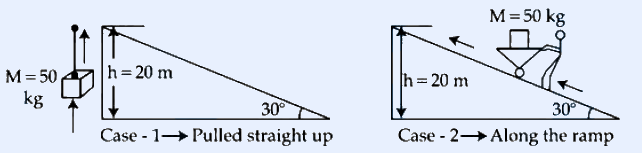
JEE Main 2024 April 05, Shift 1 Question Paper with Solutions
All 88 questions from the JEE Main 2024 (April 05, Shift 1) shift — Physics (29), Chemistry (29) and Mathematics (30) — each with the correct answer (answer key) and a step-by-step solution. Read it free online, or attempt the full paper as a timed mock test.
Physics29 questions
Q1Single correctPhysics and Measurement
The angle between vector and the resultant of and is :
(1)
(2)
(3)
(4)
SolutionAnswer: Option 2
Approach:
Add the two given vectors to find the resultant, then compare its direction with .
Step 1:Add the two vectors.
Step 2:The resultant points along .
Step 3:The angle between and a vector parallel to it is zero.
Final answer:
Q2Single correctPhysics and Measurement
Time periods of oscillation of the same simple pendulum measured using four different measuring clocks were recorded as 4.62 s, 4.632 s, 4.6 s and 4.64 s. The arithmetic mean of these readings in correct significant figure is :
(1)
(2)
(3)
(4)
SolutionAnswer: Option 34.6 s
Approach:
Compute the arithmetic mean, then round to the least number of decimal places among the readings as dictated by significant-figure rules.
Step 1:Sum the four readings.
Step 2:Divide by the number of readings.
Step 3:The least precise reading (4.6 s) has one decimal place, so the mean is rounded to one decimal place.
s
Final answer: 4.6 s
Q3Single correctGravitation
If G be the gravitational constant and u be the energy density then which of the following quantity have the dimensions as that of the :
(1)
(2)
(3)
(4)
SolutionAnswer: Option 4Force per unit mass
Approach:
Write the dimensions of G and energy density u, form , and compare with each option.
Step 1:Form the product uG.
Step 2:Take the square root.
Step 3:Force per unit mass equals acceleration, with dimension .
Final answer: Force per unit mass
Q4Single correctLaws of Motion
A wooden block mass 5 kg rests on a soft horizontal floor. When an iron cylinder of mass 25 kg is placed on the top of the block, the floor yields and the block and the cylinder together go down with an acceleration of 0.1 m. The action force of the system on the floor is equal to:
(1)
(2)
(3)
(4)
SolutionAnswer: Option 2291 N
Approach:
Apply Newton's second law to the combined block-cylinder system moving downward, find the normal reaction from the floor, then use the third law for the action on the floor.
Step 1:Total mass of the system.
kg
Step 2:Apply Newton's second law for downward acceleration with m.
Step 3:Evaluate the reaction.
N
Step 4:By Newton's third law, the system pushes on the floor with this force.
N
Final answer: 291 N
Q5Single correctWork, Energy and Power
A body of mass 50 kg is lifted to a height of 20 m from the ground in the two different ways as shown in the figures. The ratio of work done against the gravity in both the respective cases, will be :
(1)
(2)
(3)
(4)
SolutionAnswer: Option 4
Approach:
Recognize that gravity is a conservative force, so work done against gravity depends only on the change in height, not on the path taken.
Step 1:Case 1, pulled straight up to height h.
Step 2:Case 2, raised along the ramp to the same height h.
Step 3:Form the ratio.
Final answer:
Q6Single correctRotational Motion
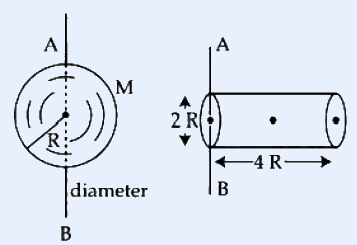
Ratio of radius of gyration of a hollow sphere to that of a solid cylinder of equal mass, for moment of Inertia about their diameter axis AB as shown in figure is . The value of x is :
(1)
(2)
(3)
(4)
SolutionAnswer: Option 467
Approach:
Find the radius of gyration of the hollow sphere about its diameter and of the solid cylinder (radius R, length 4R) about the transverse axis AB through one end, then form their ratio and equate to .
Step 1:Radius of gyration of the hollow sphere about its diameter.
Step 2:For the cylinder, radius R and length , about the transverse axis AB at the end face.
Step 3:Form the ratio of radii of gyration squared.
Step 4:Equate to squared.
Final answer: 67
Q7Single correctGravitation
A simple pendulum doing small oscillations at a place R height above earth surface has time period of s. would be it's time period if it is brought to a point which is at a height 2R from earth surface. Choose the correct relation radius of earth :
(1)
(2)
(3)
(4)
SolutionAnswer: Option 4
Approach:
Express g at heights R and 2R using the inverse-square law, then use to relate the two time periods.
Step 1:At height R the distance from centre is 2R.
Step 2:At height 2R the distance from centre is 3R.
Step 3:Since , form the ratio.
Step 4:Rearrange the ratio.
Final answer:
Q8Single correctGravitation
In hydrogen like system the ratio of coulombian force and gravitational force between an electron and a proton is in the order of :
(1)
(2)
(3)
(4)
SolutionAnswer: Option 1
Approach:
Both forces scale as inverse square of separation, so the ratio is independent of distance and reduces to a ratio of constants and charges/masses.
Step 1:Form the ratio, cancelling the dependence.
Step 2:Substitute , C.
Step 3:Substitute , kg, kg.
Step 4:Divide to obtain the order of magnitude.
Final answer:
Q9Single correctGravitation
Match List I with List II :
| List I | List II |
|---|---|
| A. Kinetic energy of planet | I. |
| B. Gravitation Potential energy of sun-planet system | II. |
| C. Total mechanical energy of planet | III. |
| D. Escape energy at the surface of planet for unit mass object | IV. |
(1)
(2)
(3)
(4)
SolutionAnswer: Option 2(A)-(II), (B)-(I), (C)-(IV), (D)-(III)
Approach:
Use the standard expressions for kinetic, potential and total energy of a planet in a circular orbit of radius a, and the escape energy per unit mass at the planet surface.
Step 1:Kinetic energy of the orbiting planet matches (II).
Step 2:Sun-planet potential energy matches (I).
Step 3:Total mechanical energy matches (IV).
Step 4:Escape energy per unit mass at the planet surface matches (III).
Final answer: (A)-(II), (B)-(I), (C)-(IV), (D)-(III)
Q10Single correctProperties of Solids and Liquids
Given below are two statements :
Statement I : When a capillary tube is dipped into a liquid, the liquid neither rises nor falls in the capillary. The contact angle may be .
Statement II : The contact angle between a solid and a liquid is a property of the material of the solid and liquid as well.
In the light of the above statement, choose the correct answer from the options given below :
Statement I : When a capillary tube is dipped into a liquid, the liquid neither rises nor falls in the capillary. The contact angle may be .
Statement II : The contact angle between a solid and a liquid is a property of the material of the solid and liquid as well.
In the light of the above statement, choose the correct answer from the options given below :
(1)
(2)
(3)
(4)
SolutionAnswer: Option 3Statement I is false but Statement II is true
Approach:
Examine each statement against the physics of capillary action and contact angle.
Step 1:For a contact angle of , , giving the maximum rise, not zero rise; so Statement I is false.
Step 2:The contact angle is determined by the surface tensions of the solid-liquid, solid-gas and liquid-gas interfaces, hence depends on both materials; Statement II is true.
Step 3:Combine the two conclusions.
Final answer: Statement I is false but Statement II is true
Q11Single correctThermodynamics
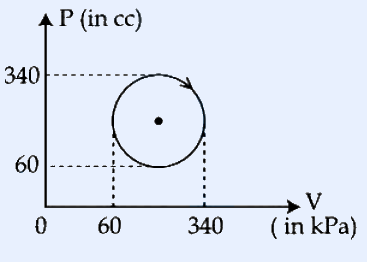
The heat absorbed by a system in going through the given cyclic process is :
(1)
(2)
(3)
(4)
SolutionAnswer: Option 261.6 J
Approach:
For a complete cycle the internal energy change is zero, so the heat absorbed equals the work done, which equals the area enclosed by the circular loop on the P-V diagram.
Step 1:The loop is a circle with V-extent from 60 to 340 kPa and P-extent from 60 to 340 cc.
Step 2:Compute the half-extents in SI units: kPa Pa, cc .
Step 3:Area enclosed equals the work done.
Step 4:Evaluate the heat absorbed.
Final answer: 61.6 J
Q12Single correctKinetic Theory of Gases
If the collision frequency of hydrogen molecules in a closed chamber at C is Z, then the collision frequency of the same system at C is :
(1)
(2)
(3)
(4)
SolutionAnswer: Option 2Z
Approach:
At fixed volume and number density the collision frequency is proportional to the mean molecular speed, which scales as the square root of absolute temperature.
Step 1:Convert temperatures to kelvin.
Step 2:Use the square-root temperature dependence.
Step 3:Express the new collision frequency.
Final answer: Z
Q13Single correctCurrent Electricity
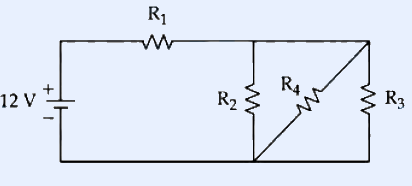
In the given figure and . Battery is ideal with emf 12 V. Equivalent resistant of the circuit and current supplied by battery are respectively :
(1)
(2)
(3)
(4)
SolutionAnswer: Option 2 and 1 A
Approach:
The diagonal connecting wire places R2, R4 and R3 in parallel between the same two nodes; combine that parallel group, add R1 in series, then apply Ohm's law.
Step 1:Combine R2, R4 and R3 in parallel.
Step 2:Add R1 in series with the parallel group.
Step 3:Apply Ohm's law for the battery current.
Final answer: and 1 A
Q14Single correctMagnetic Effects of Current and Magnetism
In a co-axial straight cable, the central conductor and the outer conductor carry equal currents in opposite directions. The magnetic field is zero :
(1)
(2)
(3)
(4)
SolutionAnswer: Option 1outside the cable
Approach:
Apply Ampere's circuital law to a circular loop in each region, using the net enclosed current.
Step 1:Between the conductors the loop encloses only the inner current, giving a non-zero field.
Step 2:Outside the cable the loop encloses both currents, which are equal and opposite.
Step 3:Therefore the field outside the cable is zero.
Final answer: outside the cable
Q15Single correctElectromagnetic Induction and Alternating Currents
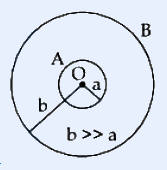
Two conducting circular loops A and B are placed in the same plane with their centers coinciding as shown in figure. The mutual inductance between them is :
(1)
(2)
(3)
(4)
SolutionAnswer: Option 4
Approach:
Drive a current in the larger loop, treat its field as uniform over the small inner loop, compute the flux through the small loop, and identify the mutual inductance.
Step 1:The larger loop has radius a; its field near the common centre is nearly uniform over the small loop of radius b ().
Step 2:Flux through the small inner loop of area .
Step 3:Divide by the current to obtain the mutual inductance.
Final answer:
Q16Single correctAlternating Current
An alternating voltage of amplitude 40 V and frequency 4kHz is applied directly across the capacitor of 12F. The maximum displacement current between the plates of the capacitor is nearly :
(1)
(2)
(3)
(4)
SolutionAnswer: Option 212 A
Approach:
The displacement current between the plates of a capacitor equals the conduction current in the connecting wires, whose peak value is the applied voltage amplitude divided by the capacitive reactance.
Step 1:State the given quantities.
Step 2:Express the peak displacement current as the peak conduction current.
Step 3:Substitute the values.
Step 4:Evaluate.
Final answer: 12 A
Q17Single correctWave Optics
Light emerges out of a convex lens when a source of light kept at its focus. The shape of wavefront of the light is :
(1)
(2)
(3)
(4)
SolutionAnswer: Option 2plane
Approach:
A point source placed at the focus of a convex lens produces a parallel beam after refraction; the wavefront associated with a parallel (collimated) beam is planar.
Step 1:A source at the focus emits diverging spherical wavefronts toward the lens.
Step 2:For object distance equal to the focal length, the refracted rays become parallel to the principal axis.
Step 3:A wavefront is perpendicular to the rays; for parallel rays the surface of constant phase is a plane.
Final answer: plane
Q18Single correctDual Nature of Radiation and Matter
Given below are two statements :
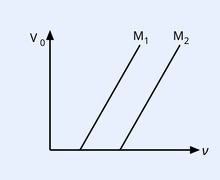
Statement I : Figure shows the variation of stopping potential with frequency for the two photosensitive materials and . The slope gives value of , where h is Planck's constant, e is the charge of electron.
Statement II : will emit photoelectrons of greater kinetic energy for the incident radiation having same frequency.
In the light of the above statements, choose the most appropriate answer from the options given below.
Statement I : Figure shows the variation of stopping potential with frequency for the two photosensitive materials and . The slope gives value of , where h is Planck's constant, e is the charge of electron.
Statement II : will emit photoelectrons of greater kinetic energy for the incident radiation having same frequency.
In the light of the above statements, choose the most appropriate answer from the options given below.
(1)
(2)
(3)
(4)
SolutionAnswer: Option 4Statement I is correct and Statement II is incorrect
Approach:
Apply Einstein's photoelectric equation expressed through stopping potential to interpret the slope of the stopping-potential versus frequency graph and the effect of work function on emitted kinetic energy.
Step 1:Rearrange the photoelectric equation for stopping potential.
Step 2:Identify the slope of the line, which is the same for all materials.
Step 3:From the graph, has the larger threshold frequency, hence the larger work function.
Step 4:For the same incident frequency, the larger work function gives smaller kinetic energy.
Final answer: Statement I is correct and Statement II is incorrect
Q19Single correctAtoms
An electron rotates in a circle around a nucleus having positive charge Ze. Correct relation between total energy (E) of electron to its potential energy (U) is :
(1)
(2)
(3)
(4)
SolutionAnswer: Option 22E = U
Approach:
Use the virial relation for an electron in a Coulomb orbit, where the kinetic energy is half the magnitude of the potential energy, to relate total energy and potential energy.
Step 1:Equate the Coulomb force to the centripetal force for the circular orbit.
Step 2:Write the kinetic and potential energies.
Step 3:Form the total energy.
Step 4:Rearrange to match the options.
Final answer: 2E = U
Q20Single correctSemiconductor Electronics
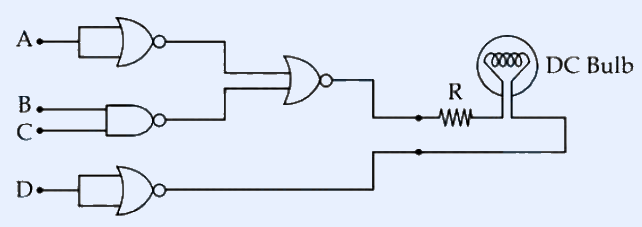
Following gates section is connected in a complete suitable circuit. For which of the following combination, bulb will glow (ON) :
(1)
(2)
(3)
(4)
SolutionAnswer: Option 3A = 1, B = 0, C = 0, D = 0
Approach:
Trace the inputs through the combinational logic network shown in the figure (NAND/NOR/AND stages feeding a final gate driving the bulb) and identify the input combination that produces a logic HIGH output.
Step 1:Evaluate the upper stage that combines inputs A and B.
Step 2:Evaluate the lower stage that combines inputs C and D.
Step 3:Test the option that gives a HIGH final output, A = 1 with B = C = D = 0.
Step 4:The remaining listed combinations leave the final output LOW.
Final answer: A = 1, B = 0, C = 0, D = 0
Q21NumericalMotion in a Straight Line
A body moves on a frictionless plane starting from rest. If is distance moved between and and is distance moved between and , then the ratio is for . The value of x is _______.
SolutionAnswer: 19
Approach:
Use the distance covered in the nth second for motion from rest under uniform acceleration, form the ratio of successive intervals, and match it to the given expression.
Step 1:Write the distance covered in the nth and (n-1)th seconds.
Step 2:Form the ratio.
Step 3:Rewrite the ratio in the required form.
Step 4:Substitute .
Final answer: 19
Q22NumericalLaws of Motion
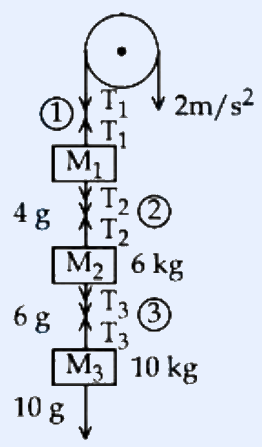
Three blocks having masses 4 kg, 6 kg and 10 kg respectively are hanging from a smooth pully using rope 1,2 and 3 as shown in figure. The tension in the rope 1, when they are moving upward with acceleration of 2 m is _______N ( if g m/ ).
SolutionAnswer: 240
Approach:
Treat the three hanging blocks as a single system supported by rope 1, then apply Newton's second law for vertical motion to find the tension that accelerates the whole system upward.
Step 1:Add the masses supported by rope 1.
Step 2:Apply Newton's second law along the vertical for upward acceleration.
Step 3:Solve for the tension.
Step 4:Evaluate.
Final answer: 240
Q23NumericalMechanical Properties of Solids
The density and breaking stress of a wire are kg/ and N/ respectively. The wire is suspended from a rigid support on a planet where acceleration due to gravity is of the value on the surface of earth. The maximum length of the wire with breaking is _______ m (take, g m/ ).
SolutionAnswer: 600
Approach:
The maximum length is reached when the stress from the wire's own weight equals the breaking stress; equate breaking stress to density times effective gravity times length.
Step 1:Determine the effective gravity on the planet.
Step 2:Set breaking stress equal to self-weight stress at maximum length.
Step 3:Solve for the length.
Step 4:Evaluate.
Final answer: 600
Q24NumericalElectrostatic Potential and Capacitance
Three capacitors of capacitances 25F, 30F and 45F are connected in parallel to a supply of 100 V. Energy stored in the above combination is E. When these capacitors are connected in series to the same supply, the stored energy is E. The value of x is _____.
SolutionAnswer: 86
Approach:
Compute the equivalent capacitance for the parallel and series arrangements, form their ratio (which equals the energy ratio at the same voltage), and match it to the given fraction.
Step 1:Find the parallel equivalent capacitance.
Step 2:Find the series equivalent capacitance.
Step 3:At the same voltage, energy is proportional to capacitance.
Step 4:Compare with the given expression.
Final answer: 86
Q26NumericalExperimental Skills
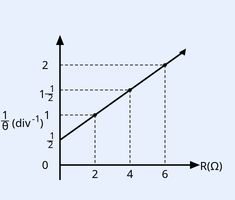
In the experiment to determine the galvanometer resistance by half-deflection method, the plot of vs the resistance (R) of the resistance box is shown in the figure. The figure of merit of the galvanometer is _____ A / division. [The source has emf 2V]
SolutionAnswer: 5
Approach:
In the half-deflection (figure of merit) experiment the deflection relates to current as I = k(theta), giving 1/theta proportional to R through E = I(R + G). Read the slope of the 1/theta versus R line to obtain the figure of merit k.
Step 1:Express the inverse deflection as a linear function of R.
Step 2:Read the slope from the graph using the marked points.
(scaled)
Step 3:Relate slope to the figure of merit with E = 2 V.
Step 4:Evaluate to the stated units.
Final answer: 5
Q27NumericalMoving Charges and Magnetism
A 2 A current carrying straight metal wire of resistance 1, resistivity m, area of cross-section 10 m and mass 500 g is suspended horizontally in mid air by applying a uniform magnetic field . The magnitude of B is _____ T (given, g m/ ).
SolutionAnswer: 5
Approach:
For the wire to be suspended, the upward magnetic force balances gravity. Find the wire length from its resistance, resistivity and cross-section, then equate magnetic force to weight to solve for B.
Step 1:Find the length from the resistance relation.
Step 2:Apply force balance for suspension.
Step 3:Solve for B.
Step 4:Evaluate.
Final answer: 5
Q28NumericalAlternating Current
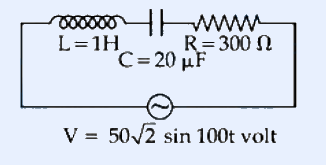
An ac source is connected in given series LCR circuit. The rms potential difference across the capacitor of 20F is _____V.
SolutionAnswer: 50
Approach:
Compute the reactances at the source angular frequency, find the circuit impedance and rms current, then multiply the rms current by the capacitive reactance to get the rms voltage across the capacitor.
Step 1:Identify source values: rad/s and V.
Step 2:Compute the reactances.
Step 3:Compute the impedance and rms current.
Step 4:Compute the rms voltage across the capacitor.
Final answer: 50
Q29NumericalWave Optics
In Young's double slit experiment, carried out with light of wavelength 5000 Å, the distance between the slits is 0.3 mm and the screen is at 200 cm from the slits. The central maximum is at cm. The value of x for third maxima is _____mm.
SolutionAnswer: 10
Approach:
The position of the nth bright fringe in a double-slit pattern is n times the fringe width. Compute the fringe width from wavelength, screen distance and slit separation, then multiply by the order number.
Step 1:List the data in SI units.
Step 2:Write the position of the third maximum.
Step 3:Substitute the values.
Step 4:Evaluate and convert to millimetres.
Final answer: 10
Q30NumericalNuclei
If three helium nuclei combine to form a carbon nucleus then the energy released in this reaction is _____ MeV. (Given 1u MeV/, atomic mass of helium u )
SolutionAnswer: 727
Approach:
The energy released equals the mass defect (three helium masses minus the carbon-12 mass) converted to energy using the mass-energy equivalence with the given conversion factor. The carbon-12 mass is exactly 12 u by definition.
Step 1:Compute the total mass of three helium nuclei.
Step 2:Use the carbon-12 mass of exactly 12 u to find the mass defect.
Step 3:Convert the mass defect to energy.
Step 4:Express in the stated units of MeV.
Final answer: 727
Chemistry29 questions
Q31Single correctSome Basic Concepts of Chemistry
An organic compound has carbon, hydrogen and remainder is oxygen. If its molecular weight is 342, then its molecular formula is :
(1)
(2)
(3)
(4)
SolutionAnswer: Option 3
Approach:
Determine percentage of oxygen, find moles of each element per 100 g, derive the empirical formula, then scale to the molecular weight 342.
Step 1:Oxygen percentage equals the remainder.
Step 2:Moles per 100 g of compound.
Step 3:Divide by the smallest value 3.22.
Step 4:Empirical formula CO has mass 30; scale to 342.
for (sucrose, )
Final answer:
Q32Single correctSome Basic Concepts of Chemistry
The incorrect postulates of the Dalton's atomic theory are : (A) Atoms of different elements differ in mass. (B) Matter consists of divisible atoms. (C) Compounds are formed when atoms of different element combine in a fixed ratio. (D) All the atoms of given element have different properties including mass. (E) Chemical reactions involve reorganisation of atoms. Choose the correct answer from the options given below :
(1)
(2)
(3)
(4)
SolutionAnswer: Option 2(B), (D) only
Approach:
Evaluate each statement against Dalton's atomic theory and identify the ones that contradict it.
Step 1:Statement (A) is a correct postulate: atoms of different elements differ in mass and properties.
Step 2:Statement (B) is incorrect: Dalton stated atoms are indivisible, not divisible.
Step 3:Statement (C) is correct: compounds form when atoms combine in a fixed ratio. Statement (E) is correct: reactions involve rearrangement of atoms.
Step 4:Statement (D) is incorrect: atoms of a given element have identical mass and properties, not different ones.
Final answer: (B), (D) only
Q33Single correctp-Block Elements
Given below are two statements :
Statement I : In group 13, the stability of oxidation state increases down the group.
Statement II : The atomic size of gallium is greater than that of aluminium.
In the light of the above statements, choose the most appropriate answer from the options given below :
Statement I : In group 13, the stability of oxidation state increases down the group.
Statement II : The atomic size of gallium is greater than that of aluminium.
In the light of the above statements, choose the most appropriate answer from the options given below :
(1)
(2)
(3)
(4)
SolutionAnswer: Option 4Statement I is correct but Statement II is incorrect
Approach:
Assess each statement using the inert pair effect and the anomalous atomic radii caused by poor d-electron shielding in group 13.
Step 1:Statement I: due to the inert pair effect, the stability of the oxidation state increases down group 13 (B, Al, Ga, In, Tl).
Step 2:Statement II: gallium follows the 3d transition series, so poor shielding by d-electrons gives gallium an atomic radius slightly smaller than that of aluminium.
Step 3:Statement I is correct while Statement II is incorrect.
Final answer: Statement I is correct but Statement II is incorrect
Q34Single correctClassification of Elements and Periodicity
The statement(s) that are correct about the species and . (A) All are isoelectronic (B) All have the same nuclear charge (C) has the largest ionic radii (D) has the smallest ionic radii Choose the most appropriate answer from the options given below :
(1)
(2)
(3)
(4)
SolutionAnswer: Option 3(A), (C) and (D) only
Approach:
Count the electrons of each species, compare nuclear charges, and order the ionic radii of an isoelectronic series.
Step 1:Each species has 10 electrons, so all are isoelectronic. Statement (A) is correct.
Step 2:Nuclear charges differ (8, 9, 11, 12), so Statement (B) is incorrect.
Step 3:For an isoelectronic series, radius decreases as nuclear charge increases, so is largest and is smallest.
Final answer: (A), (C) and (D) only
Q35Single correctThermodynamics
Given below are two statements : One is labelled as Assertion (A) and the other is labelled as Reason (R)
Assertion (A) : Enthalpy of neutralisation of strong monobasic acid with strong monoacidic base is always kJ mo. Reason (R) : Enthalpy of neutralisation is the amount of heat liberated when one mole of ions furnished by acid combine with one mole of ions furnished by base to form one mole of water. In the light of the above statements, choose the correct answer from the options given below :
Assertion (A) : Enthalpy of neutralisation of strong monobasic acid with strong monoacidic base is always kJ mo. Reason (R) : Enthalpy of neutralisation is the amount of heat liberated when one mole of ions furnished by acid combine with one mole of ions furnished by base to form one mole of water. In the light of the above statements, choose the correct answer from the options given below :
(1)
(2)
(3)
(4)
SolutionAnswer: Option 3Both (A) and (R) are true and (R) is the correct explanation of (A)
Approach:
Evaluate the truth of the Assertion and Reason about enthalpy of neutralisation, then judge whether the Reason explains the Assertion.
Step 1:Assertion: for strong acid and strong base, complete dissociation gives a constant heat release of about kJ mo.
Step 2:Reason: the definition states one mole of combining with one mole of forms one mole of water with heat liberated.
Step 3:Because both strong acid and strong base fully ionise, the only common reaction is formation of water, which fixes the value, so (R) explains (A).
Final answer: Both (A) and (R) are true and (R) is the correct explanation of (A)
Q36Single correctEquilibrium
The following reaction occurs in the Blast furnance where iron ore is reduced to iron metal Using the Le-chatelier's principle, predict which one of the following will not disturb the equilibrium.
(1)
(2)
(3)
(4)
SolutionAnswer: Option 3Addition of
Approach:
Apply Le-Chatelier's principle, recognising that pure solids and pure liquids do not appear in the equilibrium expression and therefore cannot shift the equilibrium.
Step 1:Only gaseous species CO and appear in the equilibrium expression; and Fe(l) are condensed phases.
Step 2:Adding , removing , or removing CO changes a gaseous concentration and shifts the equilibrium.
Step 3:Adding solid does not change its activity, so the equilibrium is undisturbed.
Final answer: Addition of
Q37Single correctp-Block Elements
The number of neutrons present in the more abundant isotope of boron is ' x '. Amorphous boron upon heating with air forms a product, in which the oxidation state of boron is ' y '. The value of is ________
(1)
(2)
(3)
(4)
SolutionAnswer: Option 29
Approach:
Determine the neutron count of the most abundant boron isotope and the oxidation state of boron in the oxide formed on heating in air, then add the two values.
Step 1:The more abundant isotope of boron is , with atomic number 5.
Step 2:Heating amorphous boron in air forms boron trioxide , where boron is in the oxidation state.
Step 3:Add the two values.
Final answer: 9
Q38Single correctChemical Bonding and Molecular Structure
Number of and bonds present in ethylene molecule is respectively :
(1)
(2)
(3)
(4)
SolutionAnswer: Option 45 and 1
Approach:
Count the sigma and pi bonds in the structure of ethylene .
Step 1:Ethylene has four C-H single bonds, each contributing one sigma bond.
Step 2:The carbon-carbon double bond contributes one sigma and one pi bond.
Step 3:Total sigma bonds and pi bonds.
Final answer: 5 and 1
Q39Single correctHydrocarbons
Given below are two statements : one is labelled as Assertion (A) and the other is labelled as Reason (R).
Assertion (A) : Cis form of alkene is found to be more polar than the trans form. Reason (R): Dipole moment of trans isomer of 2-butene is zero. In the light of the above statements, choose the correct answer from the options given below :
Assertion (A) : Cis form of alkene is found to be more polar than the trans form. Reason (R): Dipole moment of trans isomer of 2-butene is zero. In the light of the above statements, choose the correct answer from the options given below :
(1)
(2)
(3)
(4)
SolutionAnswer: Option 2Both (A) and (R) are true and (R) is the correct explanation of (A)
Approach:
Compare the resultant dipole moments of cis and trans alkenes and judge whether the Reason justifies the Assertion.
Step 1:In a cis alkene the bond dipoles point to the same side and add, giving a net dipole moment, so the cis form is more polar.
Step 2:In trans-2-butene the two methyl bond dipoles are oriented oppositely and cancel, giving a net dipole moment of zero.
Step 3:The zero dipole of the trans isomer accounts for the cis form being comparatively more polar, so (R) explains (A).
Final answer: Both (A) and (R) are true and (R) is the correct explanation of (A)
Q40Single correctSome Basic Principles of Organic Chemistry
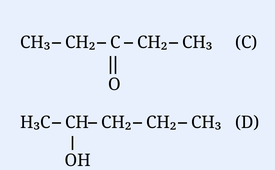
For the Compounds : (A) (B) (C) (D)
The increasing order of boiling point is : Choose the correct answer from the options given below :
The increasing order of boiling point is : Choose the correct answer from the options given below :
(1)
(2)
(3)
(4)
SolutionAnswer: Option 2
Approach:
Compare the intermolecular forces of the four compounds: alkane (B), ether (A), ketone (C) and alcohol (D), and order them by boiling point.
Step 1:Compound (B) is pentane, a non-polar alkane with only weak London forces, so it has the lowest boiling point.
Step 2:Compound (A) is an ether with a weak permanent dipole but no hydrogen bonding, placing it above the alkane.
Step 3:Compound (C) is a ketone (pentan-3-one) with a stronger dipole-dipole interaction from the C=O group.
Step 4:Compound (D) is an alcohol (pentan-2-ol) capable of intermolecular hydrogen bonding, giving the highest boiling point.
Final answer:
Q41Single correctSome Basic Principles of Organic Chemistry
Given below are two statements:
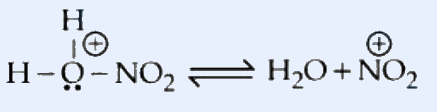
Statement I : Nitration of benzene involves the following step -
Statement II : Use of Lewis base promotes the electrophilic substitution of benzene.
In the light of the above statements, choose the most appropriate answer from the options given below :
Statement I : Nitration of benzene involves the following step -
Statement II : Use of Lewis base promotes the electrophilic substitution of benzene.
In the light of the above statements, choose the most appropriate answer from the options given below :
(1)
(2)
(3)
(4)
SolutionAnswer: Option 1Statement I is correct but Statement II is incorrect
Approach:
Examine the generation of the nitronium ion in nitration and the role of Lewis acids versus Lewis bases in electrophilic aromatic substitution.
Step 1:Statement I shows protonated nitric acid losing water to generate the nitronium electrophile, which is the correct first step of nitration.
Step 2:Electrophilic substitution is promoted by Lewis acids (which generate or strengthen the electrophile), not by Lewis bases.
Step 3:Statement I is correct while Statement II is incorrect.
Final answer: Statement I is correct but Statement II is incorrect
Q42Single correctElectrochemistry
The reaction at cathode in the cells commonly used in clocks involves.
(1)
(2)
(3)
(4)
SolutionAnswer: Option 2reduction of Mn from to
Approach:
Identify the dry (Leclanche) cell used in clocks and determine the manganese oxidation state change at its cathode.
Step 1:The cell commonly used in clocks is the dry cell, where the cathode reduces .
Step 2:Manganese in is in the state and is reduced to , where it is in the state.
Step 3:The cathode reaction reduces Mn from to .
Final answer: reduction of Mn from to
Q43Single correctElectrochemistry
Molar ionic conductivities of divalent cation and anion are 57 S c mo and 73 S c mo respectively. The molar conductivity of solution of an electrolyte with the above cation and anion will be :
(1)
(2)
(3)
(4)
SolutionAnswer: Option 3130 S c mo
Approach:
Apply Kohlrausch's law of independent migration of ions for an electrolyte of divalent cation and divalent anion in a 1:1 ratio.
Step 1:An electrolyte of a divalent cation and divalent anion combines in a 1:1 ratio, giving one cation and one anion per formula unit.
Step 2:Sum the molar ionic conductivities of the cation and anion.
Step 3:The molar conductivity of the electrolyte solution.
Final answer: 130 S c mo
Q44Single correctd- and f-Block Elements
The metal that shows highest and maximum number of oxidation state is :
(1)
(2)
(3)
(4)
SolutionAnswer: Option 2Mn
Approach:
Compare the range of oxidation states available to the given first-row transition metals, which depends on the number of unpaired plus paired and electrons.
Step 1:Manganese has the configuration , giving seven electrons available for bonding.
Step 2:Manganese therefore exhibits oxidation states from up to , the highest among the listed metals.
Step 3:Fe, Co and Ti show smaller maximum oxidation states than , so Mn shows both the highest and the maximum number.
Final answer: Mn
Q45Single correctCoordination Compounds
Which one of the following complexes will exhibit the least paramagnetic behaviour? [Atomic number, ]
(1)
(2)
(3)
(4)
SolutionAnswer: Option 3
Approach:
Find the number of unpaired d-electrons in each ion with the weak-field aqua ligand (high spin), since paramagnetism increases with the number of unpaired electrons.
Step 1:Determine the d-electron count of each divalent ion.
Step 2:With the weak-field ligand all are high spin; count unpaired electrons.
Step 3:The least number of unpaired electrons (3, for ) gives the least paramagnetic behaviour.
Final answer:
Q46Single correctCoordination Compounds
The correct order of ligands arranged in increasing field strength.
(1)
(2)
(3)
(4)
SolutionAnswer: Option 2
Approach:
Rank the ligands by their position in the spectrochemical series, which lists ligands in order of increasing crystal field splitting (field strength).
Step 1:From the spectrochemical series the relevant fragment places the halide and oxygen/nitrogen donors in this order.
Step 2:Check the other options against the series. In option 1 the halide order is reversed; in option 3 hydroxide is placed below water; in option 4 bromide is placed above chloride and hydroxide.
Step 3:Only option 2 is fully consistent with the spectrochemical series.
Final answer:
Q47Single correctHaloalkanes and Haloarenes
Given below are two statement:
Statements I : Bromination of phenol in solvent with low polarity such as or requires Lewis acid catalyst.
Statements II : The Lewis acid catalyst polarises the bromine to generate .
In the light of the above statements, choose the correct answer from the options given below :
Statements I : Bromination of phenol in solvent with low polarity such as or requires Lewis acid catalyst.
Statements II : The Lewis acid catalyst polarises the bromine to generate .
In the light of the above statements, choose the correct answer from the options given below :
(1)
(2)
(3)
(4)
SolutionAnswer: Option 3Statement I is false but Statement II is true
Approach:
Evaluate the truth of each statement about bromination of phenol in low-polarity solvents and the role of the Lewis acid.
Step 1:Phenol is strongly activated by the hydroxyl group, so monobromination in a low-polarity solvent proceeds without any Lewis acid catalyst.
Step 2:When a Lewis acid is used in electrophilic bromination, it polarises the bromine molecule to generate the electrophile.
Step 3:Combining the assessments, Statement I is false and Statement II is true.
Final answer: Statement I is false but Statement II is true
Q48Single correctHaloalkanes and Haloarenes
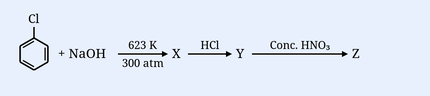
Identify compound (Z) in the following reaction sequence.
(1)
(2)
(3)
(4)
SolutionAnswer: Option 1
Approach:
Trace the Dow process and the subsequent reactions: chlorobenzene with NaOH under high temperature and pressure gives sodium phenoxide, acidification gives phenol, and nitration gives the trinitro product.
Step 1:Chlorobenzene with NaOH at 623 K and 300 atm gives sodium phenoxide (X).
Step 2:Treatment of sodium phenoxide with HCl liberates phenol (Y).
Step 3:Nitration of phenol with concentrated nitric acid gives 2,4,6-trinitrophenol (picric acid) as Z.
Final answer: 2,4,6-trinitrophenol (picric acid)
Q49Single correctAldehydes, Ketones and Carboxylic Acids
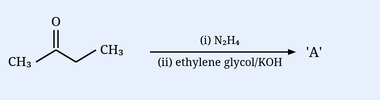
Identify ' ' in the following reaction:
(1)
(2)
(3)
(4)
SolutionAnswer: Option 4
Approach:
The reagents hydrazine followed by base (Wolff-Kishner reduction) convert the carbonyl group of the ketone to a methylene group.
Step 1:The starting carbonyl is butan-2-one (a methyl ethyl ketone framework drawn as -CO--).
Step 2:Hydrazine forms the hydrazone, and ethylene glycol/KOH on heating decomposes it, replacing the C=O with CH2.
Step 3:The carbon skeleton is retained, so butan-2-one is reduced to butane.
Final answer: Butane (option 4)
Q50Single correctBiomolecules
Which of the following gives a positive test with ninhydrin?
(1)
(2)
(3)
(4)
SolutionAnswer: Option 2Egg albumin
Approach:
The ninhydrin test detects free amino groups of amino acids and proteins, giving a violet colour.
Step 1:Ninhydrin reacts with the free amino groups present in amino acids and proteins.
Step 2:Starch and cellulose are polysaccharides and polyvinyl chloride is a synthetic polymer; none contain amino groups.
-
Step 3:Egg albumin is a protein and contains free amino groups, so it responds positively.
Final answer: Egg albumin
Q51NumericalAmines
9.3 g of pure aniline is treated with bromine water at room temperature to give a white precipitate of the product ' P '. The mass of product ' P ' obtaind is 26.4 g. The percentage yield is _________ %.
SolutionAnswer: 80
Approach:
Aniline reacts with bromine water to give 2,4,6-tribromoaniline. Compute moles of aniline, the theoretical mass of product, and compare with the actual mass.
Step 1:Moles of aniline from its molar mass 93 g/mol.
Step 2:Each mole of aniline gives one mole of 2,4,6-tribromoaniline, whose molar mass is 330 g/mol.
Step 3:Substitute the actual and theoretical masses into the yield expression.
Final answer: 80
Q52NumericalStructure of Atom
The value of Rydberg constant is J. The velocity of electron having mass kg in Bohr's first orbit of hydrogen atom = _________ m (nearest integer).
SolutionAnswer: 22
Approach:
Equate the Rydberg constant (in joules) to the ionisation energy of hydrogen's ground state, which equals the kinetic energy of the electron, and solve for the speed.
Step 1:The magnitude of the total energy of the first orbit equals the kinetic energy.
Step 2:Solve for the speed of the electron.
Step 3:Evaluate the square root and express in the required units.
Final answer: 22
Q53NumericalChemical Bonding and Molecular Structure
In the lewis dot structure for , total number of valence electrons around nitrogen is _________
SolutionAnswer: 8
Approach:
Draw the Lewis structure of the nitrite ion and count all valence electrons (bonding plus lone pair) surrounding the central nitrogen atom.
Step 1:In nitrite the nitrogen forms one double bond and one single bond with the two oxygen atoms and carries one lone pair.
Step 2:Count bonding electrons: a double bond contributes 4 electrons and a single bond contributes 2 electrons.
Step 3:Add the 2 electrons of the lone pair on nitrogen.
Final answer: 8
Q54NumericalThermodynamics
The heat of combustion of solid benzoic acid at constant volume is kJ at C. The heat of combustion at constant pressure is kJ, the value of x is _________.
SolutionAnswer: 150
Approach:
Relate the enthalpy of combustion to the internal energy change using the change in moles of gas for benzoic acid combustion, then identify the coefficient of R.
Step 1:Determine the change in moles of gas: 7 moles of gaseous products minus 7.5 moles of gaseous reactants.
Step 2:Apply the enthalpy relation at T = 300 K.
Step 3:Comparing with kJ gives the coefficient of R.
Final answer: 150
Q55NumericalSolutions
An artificial cell is made by encapsulating 0.2M glucose solution within a semipermeable membrane. The osmotic pressure developed when the artificial cell is placed within a 0.05M solution of NaCl at 300 K is _________ bar. (nearest integer). [Given : R = 0.083 Lbarmo ] Assume complete dissociation of NaCl
SolutionAnswer: 25
Approach:
Compute the effective osmolarity inside and outside the cell, take the difference, and apply the osmotic pressure equation to the net concentration.
Step 1:Glucose does not dissociate so its osmolarity is 0.2 M; NaCl dissociates completely (i = 2) giving 0.1 M.
Step 2:The net concentration driving osmosis across the membrane is the difference.
Step 3:Apply the osmotic pressure equation at 300 K.
Final answer: 25
Q56NumericalChemical Kinetics
During Kinetic study of reaction , the following results were obtained :
| A [M] | B [M] | initial rate of formation of D
I | 0.1 | 0.1 |
II | 0.3 | 0.2 |
III | 0.3 | 0.4 |
IV | 0.4 | 0.1 |
Based on above data, overall order of the reaction is _________
| A [M] | B [M] | initial rate of formation of D
I | 0.1 | 0.1 |
II | 0.3 | 0.2 |
III | 0.3 | 0.4 |
IV | 0.4 | 0.1 |
Based on above data, overall order of the reaction is _________
SolutionAnswer: 3
Approach:
Determine the order with respect to each reactant by comparing experiments where one concentration is held constant, then sum the orders.
Step 1:Compare experiments I and IV where B is constant: A increases from 0.1 to 0.4 (factor 4) and the rate increases from to (factor 4).
Step 2:Compare experiments II and III where A is constant: B increases from 0.2 to 0.4 (factor 2) and the rate increases from to (factor 4).
Step 3:Add the individual orders to obtain the overall order.
Final answer: 3
Q57NumericalThe d- and f-Block Elements
The spin-only magnetic moment value of the ion among , , and , that acts as strong oxidising agent in aqueous solution is _________ BM (Near integer). (Given atomic numbers : Ti : 22, V : 23, Cr : 24, Co : 27)
SolutionAnswer: 5
Approach:
Identify which of the listed ions is a strong oxidising agent in aqueous solution, determine its number of unpaired electrons, then apply the spin-only formula.
Step 1:Among the ions, C is the strong oxidising agent in aqueous solution as it tends to be reduced to the more stable C.
Step 2:Cobalt is [Ar]3, so C is 3; in the weak aqueous field this is high spin with 4 unpaired electrons.
Step 3:Apply the spin-only formula.
Final answer: 5
Q58NumericalAmines
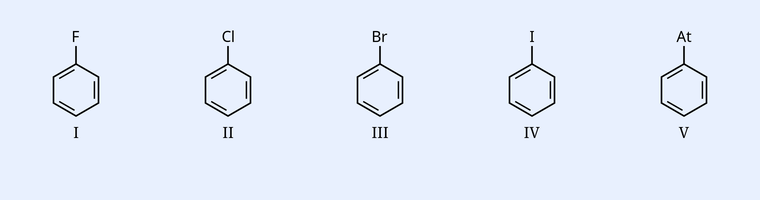
The number of halobenzenes from the following that can be prepared by Sandmeyer's reaction is _________
SolutionAnswer: 2
Approach:
Recall which aryl halides are accessible by the Sandmeyer reaction, which converts an arenediazonium salt to an aryl halide using cuprous halides.
Step 1:The Sandmeyer reaction uses cuprous chloride (CuCl) and cuprous bromide (CuBr) to give chlorobenzene and bromobenzene.
Step 2:Fluorobenzene is prepared by the Balz-Schiemann reaction and iodobenzene by reaction with potassium iodide; astatine compounds are not prepared this way.
Step 3:Count the halobenzenes (chlorobenzene and bromobenzene) obtainable by the Sandmeyer reaction.
Final answer: 2
Q59NumericalAlcohols, Phenols and Ethers
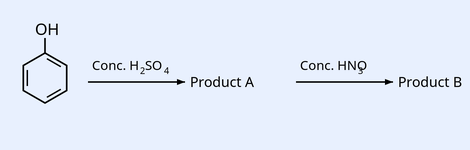
Consider the given chemical reaction sequence :
Total sum of oxygen atoms in Product A and Product B are _________
Total sum of oxygen atoms in Product A and Product B are _________
SolutionAnswer: 14
Approach:
Determine Product A from sulphonation of phenol and Product B from nitration of that product, then count the oxygen atoms in each.
Step 1:Phenol with concentrated sulphuric acid undergoes disulphonation to give 4-hydroxybenzene-1,3-disulphonic acid (Product A), with the hydroxyl oxygen plus two sulphonic acid groups.
Step 2:Nitration of Product A with concentrated nitric acid replaces the sulphonic acid groups, yielding 2,4,6-trinitrophenol (Product B) with the hydroxyl oxygen and three nitro groups.
Step 3:Sum the oxygen atoms of Products A and B.
Final answer: 14
Mathematics30 questions
Q61Single correctComplex Numbers and Quadratic Equations
Consider the following two statements :
Statement I : For any two non-zero complex numbers , , and
Statement II : If x, y, z are three distinct complex numbers and a, b, c are three positive real numbers such that , then .
Between the above two statements,
Statement I : For any two non-zero complex numbers , , and
Statement II : If x, y, z are three distinct complex numbers and a, b, c are three positive real numbers such that , then .
Between the above two statements,
(1)
(2)
(3)
(4)
SolutionAnswer: Option 1Statement I is correct but Statement II is incorrect.
Approach:
Statement I is examined with the triangle inequality applied to unit-modulus vectors; Statement II is tested by checking whether the stated identity equals 1.
Step 1:Each term has unit modulus, so the sum of the two unit vectors has modulus at most 2.
Step 2:Multiplying both sides by the positive quantity preserves the inequality, confirming Statement I.
Step 3:In Statement II the common ratio condition makes the three fractions complex quantities summing to a complex value that is not generally equal to the real number 1.
Step 4:Combining the two evaluations identifies the matching option.
Final answer: Statement I is correct but Statement II is incorrect.
Q62Single correctSequences and Series
If and , then the point (m, n) lies on the line
(1)
(2)
(3)
(4)
SolutionAnswer: Option 2
Approach:
Each series telescopes; the resulting values of and are substituted into the candidate lines.
Step 1:Rationalising each term of the first series gives a telescoping difference of square roots.
Step 2:Splitting each term of the second series by partial fractions telescopes the sum.
Step 3:Substituting the point into the second candidate line.
Step 4:The point satisfies the line .
Final answer:
Q63Single correctTrigonometry
Suppose is a solution of . Then is equal to :
(1)
(2)
(3)
(4)
SolutionAnswer: Option 3
Approach:
The equation is written in terms of using on the given interval, then solved as a quadratic.
Step 1:Isolating the sine term and squaring.
Step 2:Replacing and expanding gives a quadratic in .
Step 3:Solving the quadratic and keeping the positive root valid on .
Step 4:Rewriting the root in the offered form by rationalising against .
Final answer:
Q64Single correctCoordinate Geometry
Let two straight lines drawn from the origin O intersect the line at the points P and Q such that is an isosceles triangle and . If , then the greatest integer less than or equal to l is :
(1)
(2)
(3)
(4)
SolutionAnswer: Option 246
Approach:
The perpendicular distance from the origin to the line is the altitude of the right isosceles triangle, which fixes the equal legs and the hypotenuse.
Step 1:Distance from O to the line gives the altitude from the right angle to the hypotenuse PQ.
Step 2:For a right isosceles triangle the altitude to the hypotenuse equals half the hypotenuse.
Step 3:Summing the squares of the three sides.
Step 4:Taking the greatest integer not exceeding .
Final answer: 46
Q65Single correctCoordinate Geometry
If and are the vertices of a quadrilateral , then its area is :
(1)
(2)
(3)
(4)
SolutionAnswer: Option 2
Approach:
The diagonals are checked; since the figure is a parallelogram, the area equals half the magnitude of the cross product of the diagonals.
Step 1:Computing the diagonal vectors of the quadrilateral.
Step 2:Forming the cross product of the diagonals.
Step 3:Magnitude of the cross product.
Step 4:Halving the magnitude gives the area.
Final answer:
Q66Single correctCoordinate Geometry
Let a circle C of radius 1 and closer to the origin be such that the lines passing through the point and parallel to the coordinate axes touch it. Then the shortest distance of the circle C from the point is :
(1)
(2)
(3)
(4)
SolutionAnswer: Option 34
Approach:
The two lines through parallel to the axes are tangents, so the centre lies one radius inside each; the centre closer to the origin is selected, then the distance to the external point is reduced by the radius.
Step 1:The tangent lines and place the centre at distance 1 from each; the centre nearer the origin is at .
Step 2:Distance from the centre to the point .
Step 3:Subtracting the radius gives the shortest distance from the circle.
Step 4:The shortest distance equals 4.
Final answer: 4
Q67Single correctCoordinate Geometry
If the line , intersect the x-axis and y-axis at the points A and B, respectively. If the equation of the circle having the line segment AB as a diameter is and the length of the latus rectum of the ellipse is , where m and n are coprime, then is equal to
(1)
(2)
(3)
(4)
SolutionAnswer: Option 111
Approach:
The intercepts A and B are found from the diameter circle, fixing ; the ellipse is then put in standard form and its latus rectum computed.
Step 1:The diameter circle passes through the intercepts; its and intercepts are A and B, giving the line through them.
Step 2:Substituting into the ellipse and dividing through.
Step 3:Computing the latus rectum.
Step 4:With and coprime, evaluating .
Final answer: 11
Q68Single correctMatrices and Determinants
Let A and B be two square matrices of order 3 such that and . Then is equal to :
(1)
(2)
(3)
(4)
SolutionAnswer: Option 464
Approach:
The determinant of the product is evaluated using the scalar-multiple, adjoint, and inverse determinant rules for order-3 matrices.
Step 1:Evaluating the determinant of each factor for order .
Step 2:Writing the inverse adjoint determinants as reciprocals.
Step 3:Multiplying all determinant contributions.
Step 4:Simplifying the product.
Final answer: 64
Q69Single correctMatrices and Determinants
If the system of equations , , has infinitely many solutions, then is equal to :
(1)
(2)
(3)
(4)
SolutionAnswer: Option 347
Approach:
For infinitely many solutions the coefficient determinant vanishes, fixing ; consistency of the augmented system then fixes .
Step 1:Expressing the third row as a combination of the first two to satisfy dependence in the coefficients.
Step 2:Using the third coefficient relation to find .
Step 3:Applying the same combination to the constants gives .
Step 4:Evaluating the required expression.
Final answer: 47
Q70Single correctPermutations and Combinations
Let and . Then the total number of one-one maps , such that , is :
(1)
(2)
(3)
(4)
SolutionAnswer: Option 2240
Approach:
Ordered pairs of distinct elements of B summing to 14 are counted for , then the remaining three elements of A are mapped injectively into the leftover elements of B.
Step 1:Listing distinct ordered pairs from B with sum 14.
Step 2:Each choice fixes two images, leaving five elements of B for the remaining three elements of A.
Step 3:Injectively assigning the remaining three elements.
Step 4:Applying the multiplication principle.
Final answer: 240
Q71Single correctDifferential Calculus
Let , and g(x) be a function such that for all . Then is equal to :
(1)
(2)
(3)
(4)
SolutionAnswer: Option 114
Approach:
is the inverse of ; the value at 7 and the inverse-derivative rule give and .
Step 1:Finding the argument that maps to 7.
Step 2:Differentiating .
Step 3:Applying the inverse-derivative rule at 7.
Step 4:Forming the required ratio.
Final answer: 14
Q72Single correctDifferential Calculus
If the function , is continuous at , then is equal to :
(1)
(2)
(3)
(4)
SolutionAnswer: Option 4-4
Approach:
The numerator is expanded as a Maclaurin series; the constant, x, and coefficients must vanish for a finite limit, after which the coefficient gives .
Step 1:Expanding each term to order .
Step 2:Setting the constant and terms of the numerator to zero, and the x term to zero for a finite cube-order limit.
Step 3:Collecting the coefficient of the numerator.
Step 4:Dividing by and taking the limit defines .
Final answer: -4
Q73Single correctDifferential Calculus
Let a rectangle ABCD of sides 2 and 4 be inscribed in another rectangle PQRS such that the vertices of the rectangle ABCD lie on the sides of the rectangle PQRS. Let a and b be the sides of the rectangle PQRS when its area is maximum. Then is equal to :
(1)
(2)
(3)
(4)
SolutionAnswer: Option 172
Approach:
The sides of PQRS are written in terms of the inclination of ABCD, the area is maximised over , and the resulting sides are summed.
Step 1:The outer sides are projections of the inner rectangle's sides at angle .
Step 2:Writing the area and simplifying.
Step 3:Area is maximal when , i.e. .
Step 4:Evaluating .
Final answer: 72
Q74Single correctDifferential Calculus
For the function , where , consider the following two statements :
(I) f is increasing in . (II) f' is decreasing in .
Between the above two statements,
(I) f is increasing in . (II) f' is decreasing in .
Between the above two statements,
(1)
(2)
(3)
(4)
SolutionAnswer: Option 4both (I) and (II) are true
Approach:
The first derivative is tested for positivity on the interval, and the second derivative is tested for negativity to assess monotonicity of .
Step 1:Differentiating .
Step 2:Differentiating again gives a strictly negative second derivative on the interval.
Step 3:Since decreases, its minimum on the closed interval is at the right end, where it stays positive.
Step 4:Positive derivative throughout makes increasing, so both statements hold.
Final answer: both (I) and (II) are true
Q75Single correctIntegral Calculus
The value of is :
(1)
(2)
(3)
(4)
SolutionAnswer: Option 4
Approach:
The integrand is split by parity over the symmetric interval; the odd part integrates to zero and the even part is handled with a king-property substitution.
Step 1:Separating the integrand into two pieces.
Step 2:The first integrand is odd and vanishes over the symmetric interval.
Step 3:The second integrand is even, so it doubles the integral over ; applying reduces it.
Step 4:Evaluating with gives an arctangent.
Final answer:
Q76Single correctIntegral Calculus
The integral is equal to :
(1)
(2)
(3)
(4)
SolutionAnswer: Option 1
Approach:
Express the numerator as a linear combination of the denominator and its derivative, then integrate term by term.
Step 1:Match coefficients of sine and cosine.
Step 2:Split the integrand using the decomposition.
Step 3:Integrate over the interval.
Step 4:Simplify the logarithm.
Final answer:
Q77Single correctDifferential Equations
If is the solution of the differential equation , then is equal to:
(1)
(2)
(3)
(4)
SolutionAnswer: Option 3
Approach:
Solve the first-order linear ODE using an integrating factor, apply the initial condition, then evaluate at the required point.
Step 1:Multiply through by the integrating factor.
Step 2:Integrate the right side.
Step 3:Apply .
Step 4:Evaluate at .
Final answer:
Q78Single correctThree Dimensional Geometry
If the line makes a right angle with the line , then is equal to :
(1)
(2)
(3)
(4)
SolutionAnswer: Option 46
Approach:
Write each line in standard symmetric form to read off direction ratios, then set the dot product to zero for perpendicularity.
Step 1:Rewrite the first line so each coordinate has unit coefficient.
Step 2:Rewrite the second line similarly.
Step 3:Apply the perpendicularity condition.
Step 4:Simplify.
Final answer: 6
Q79Single correctThree Dimensional Geometry
Let d be the distance of the point of intersection of the lines and from the point . Then is equal to :
(1)
(2)
(3)
(4)
SolutionAnswer: Option 475
Approach:
Parameterize both lines, equate to find the common point, then compute the squared distance to the given point.
Step 1:Parameterize the lines.
Step 2:Equate coordinates to find the intersection.
Step 3:Substitute to obtain the point of intersection.
Step 4:Compute the squared distance from and add 6.
Final answer: 75
Q80Single correctProbability
The coefficients a, b, c in the quadratic equation are chosen from the set . The probability of this equation having repeated roots is :
(1)
(2)
(3)
(4)
SolutionAnswer: Option 2
Approach:
Count ordered triples (a,b,c) from the set that satisfy the repeated-root condition , then divide by the total.
Step 1:Count the total number of ordered selections.
Step 2:Require , so b must be even and a perfect square.
Step 3:Enumerate valid triples.
Step 4:Count favourable triples and form the probability.
Final answer:
Q81NumericalPermutations and Combinations
The number of ways of getting a sum 16 on throwing a dice four times is ______
SolutionAnswer: 125
Approach:
Count ordered solutions of with each using the coefficient of in the generating function.
Step 1:Shift variables by setting , requiring with .
Step 2:Apply inclusion-exclusion on the upper bound .
Step 3:Combine the terms.
Final answer: 125
Q82NumericalSequences and Series
Let be in an arithmetic progression of positive terms. Let . If , and , then is equal to ______
SolutionAnswer: 910
Approach:
Use the difference-of-squares pairing in , express it through the first term and common difference, solve the system, then evaluate.
Step 1:Each pair gives , yielding .
Step 2:Impose and .
Step 3:Subtract to get and use the positivity and to fix signs.
Step 4:Compute and .
Final answer: 910
Q83NumericalBinomial Theorem
If the constant term in the expansion of is p, then 108p is equal to ______
SolutionAnswer: 54
Approach:
Find the general term of the binomial power, identify which multiplying factor combines with it to give degree zero, and sum the contributions.
Step 1:The power of x in is .
Step 2:Combine with (degree 0): need .
Step 3:Combine with (degree 1): need , no integer r; combine with : need .
Step 4:Add the contributions and multiply by 108.
Final answer: 54
Q84NumericalConic Sections
Suppose AB is a focal chord of the parabola of length l and slope . If the distance of the chord AB from the origin is d, then is equal to ______
SolutionAnswer: 108
Approach:
Express the focal chord length and the perpendicular distance from the origin in terms of the slope, then multiply.
Step 1:For , , so and the focus is .
Step 2:With slope , the focal chord length is .
Step 3:The chord line through has distance from the origin.
Step 4:Multiply.
Final answer: 108
Q85NumericalDifferential Equations
Let f be a differentiable function in the interval such that and for each . Then is equal to ______
SolutionAnswer: 24
Approach:
Evaluate the limit by differentiation to obtain a first-order linear ODE, solve it with the initial condition, then evaluate.
Step 1:The numerator vanishes at ; differentiating with respect to t and taking gives the limit value.
Step 2:Rewrite in standard linear form.
Step 3:Solve using the integrating factor.
Step 4:Apply to find , then evaluate.
Final answer: 24
Q86NumericalProbability
From a lot of 10 items, which include 3 defective items, a sample of 5 items is drawn at random. Let the random variable X denote the number of defective items in the sample. If the variance of X is , then is equal to ______
SolutionAnswer: 56
Approach:
Recognize X as hypergeometric (sampling without replacement) and apply the variance formula.
Step 1:Identify parameters: , defectives, sample .
Step 2:Substitute into the variance formula.
Step 3:Simplify.
Step 4:Multiply by 96.
Final answer: 56
Q87NumericalQuadratic Equations
The number of distinct real roots of the equation is ______
SolutionAnswer: 3
Approach:
Break the real line into intervals at the modulus breakpoints and solve the resulting polynomial on each piece.
Step 1:On : .
Step 2:On : .
Step 3:On : , neither interior.
Step 4:On : .
Final answer: 3
Q88NumericalFunctions
If , where [t] denotes the greatest integer less than or equal to t and represents the fractional part of t, then is equal to ______
SolutionAnswer: 18
Approach:
Write with integer and , then solve the modulus equation case by case.
Step 1:Substitute to get .
Step 2:Case : , giving , impossible.
Step 3:Case : .
Step 4:Check and the sign assumption hold, giving , then form .
Final answer: 18
Q89NumericalIntegral Calculus
The area of the region enclosed by the parabolas and is ______
SolutionAnswer: 72
Approach:
Find the intersection points, determine the upper curve, and integrate the difference between the bounds.
Step 1:Set the curves equal to find intersection abscissae.
Step 2:Determine the upper curve on ; there.
Step 3:Integrate the difference.
Step 4:Evaluate.
Final answer: 72
Q90NumericalVector Algebra
Let and be a vector such that . If , then is equal to ______
SolutionAnswer: 30
Approach:
Rearrange the cross-product condition to show is parallel to a fixed combination of and , then fix the scalar using .
Step 1:Move all terms to one side.
Step 2:A zero cross product means is parallel to , hence to .
Step 3:Apply with .
Step 4:Compute with .
Final answer: 30
More JEE Main 2024 papers
Frequently Asked Questions
How many questions are in the JEE Main 2024 April 05, Shift 1 paper?
The JEE Main 2024 April 05, Shift 1 paper has 88 questions — Physics (29), Chemistry (29) and Mathematics (30). Every question is on this page with its correct answer and a step-by-step solution.
What is the marking scheme for JEE Main?
JEE Main awards +4 marks for each correct answer and −1 for a wrong answer, with 0 for questions left unattempted. The paper covers Physics, Chemistry and Mathematics.
Are the answer key and step-by-step solutions provided for the 2024 April 05, Shift 1 paper?
Yes — every question shows the correct answer (answer key) and a detailed step-by-step solution, free to read online.
Can I take the JEE Main 2024 April 05, Shift 1 paper as a timed mock test?
Yes. With a free JEEnify account you can attempt this exact paper as a timed test in the real exam interface, then see your score and weak-area analysis.
Solved this paper? Calculate your JEE Main scoremost important chaptersformula sheetsall free tools.