
Back to JEE Main PYQs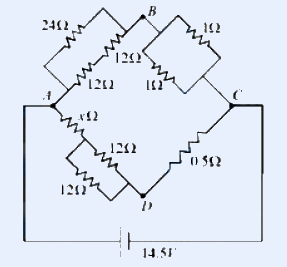
![Within the inline molecule list, a drawn benzene ring (o-nitrophenol) bearing a -NO2 group on one carbon and an -OH group on the adjacent ortho carbon. Placed between C6H6 and HF in the list: CH3OH, H2O, C2H6, C6H6, [this o-nitrophenol], HF, NH3.](/api/qna-image?path=QnA%2Fb65cda62-f924-480b-b4db-1d3aaa6069d4%2F5ef15551-aed6-4f93-a8d5-a219b7a5d19b%2F51bab6f5-6d07-475b-a492-a2efe2350740%2F51bab6f5-6d07-475b-a492-a2efe2350740%2Fimages%2FQ52_structure.webp)

JEE Main 2024 April 06, Shift 1 Question Paper with Solutions
All 89 questions from the JEE Main 2024 (April 06, Shift 1) shift — Physics (30), Chemistry (30) and Mathematics (29) — each with the correct answer (answer key) and a step-by-step solution. Read it free online, or attempt the full paper as a timed mock test.
Physics30 questions
Q1Single correctUnits and Measurements
To find the spring constant of a spring experimentally, a student commits 2% positive error in the measurement of time and 1% negative error in measurement of mass. The percentage error in determining value of is :
(1)
(2)
(3)
(4)
SolutionAnswer: Option 15%
Approach:
Relate the spring constant to the time period of a mass-spring oscillation and propagate the fractional errors in mass and time.
Step 1:Express the spring constant from the period relation.
Step 2:Write the maximum fractional error by adding the magnitudes of contributions.
Step 3:Substitute the given percentage errors of 1% in mass and 2% in time.
Final answer: 5%
Q2Single correctUnits and Measurements
Match List I with List II
| LIST I | LIST II |
|---|---|
| A. Torque | I. |
| B. Magnetic field | II. |
| C. Magnetic moment | III. |
| D. Permeability of free space | IV. |
(1)
(2)
(3)
(4)
SolutionAnswer: Option 3A-IV, B-III, C-II, D-I
Approach:
Derive the dimensional formula of each physical quantity in List I and match it with the corresponding entry in List II.
Step 1:Torque has dimensions of energy, giving entry IV.
Step 2:Magnetic field from the magnetic force expression gives entry III.
Step 3:Magnetic moment as current times area gives entry II.
Step 4:Permeability of free space gives entry I.
Final answer: A-IV, B-III, C-II, D-I
Q3Single correctKinematics
A train starting from rest first accelerates uniformly up to a speed of 80 km/h for time , then it moves with a constant speed for time . The average speed of the train for this duration of journey will be (in km/h ) :
(1)
(2)
(3)
(4)
SolutionAnswer: Option 470
Approach:
Compute the total distance over the two phases of motion and divide by the total time.
Step 1:Distance in the accelerating phase from rest to 80 km/h over time .
Step 2:Distance at constant speed for time .
Step 3:Divide total distance by total time .
Final answer: 70
Q4Single correctLaws of Motion
A light string passing over a smooth light pulley connects two blocks of masses and (where ). If the acceleration of the system is , then the ratio of the masses is:
(1)
(2)
(3)
(4)
SolutionAnswer: Option 2
Approach:
Use the acceleration of an Atwood machine and solve for the mass ratio from the given acceleration.
Step 1:Set the Atwood acceleration equal to the given value.
Step 2:Cancel and cross-multiply.
Step 3:Group the mass terms.
Step 4:Form the required ratio.
Final answer:
Q5Single correctWork, Energy and Power
A bullet of mass 50 g is fired with a speed 100 m/s on a plywood and emerges with 40 m/s. The percentage loss of kinetic energy is :
(1)
(2)
(3)
(4)
SolutionAnswer: Option 184%
Approach:
Express the fractional loss of kinetic energy through the ratio of final to initial speeds, independent of the mass.
Step 1:Write the ratio of final to initial kinetic energy.
Step 2:Subtract from unity to obtain the fractional loss.
Step 3:Convert to a percentage.
Final answer: 84%
Q6Single correctWork, Energy and Power
Four particles A, B, C, D of mass , have same momentum, respectively. The particle with maximum kinetic energy is :
(1)
(2)
(3)
(4)
SolutionAnswer: Option 2
Approach:
Relate kinetic energy to momentum and mass, then identify the particle of smallest mass for fixed momentum.
Step 1:For a fixed momentum , kinetic energy varies inversely with mass.
Step 2:Compare the four masses.
Step 3:Identify the particle with maximum kinetic energy.
Final answer:
Q7Single correctGravitation
To project a body of mass m from earth's surface to infinity, the required kinetic energy is (assume, the radius of earth is acceleration due to gravity on the surface of earth):
(1)
(2)
(3)
(4)
SolutionAnswer: Option 3
Approach:
Equate the required kinetic energy to the gravitational binding energy at the earth's surface and simplify using .
Step 1:The kinetic energy needed equals the magnitude of the binding energy.
Step 2:Substitute .
Step 3:Cancel one factor of .
Final answer:
Q8Single correctMechanical Properties of Fluids
A small ball of mass m and density is dropped in a viscous liquid of density . After sometime, the ball falls with constant velocity. The viscous force on the ball is :
(1)
(2)
(3)
(4)
SolutionAnswer: Option 4
Approach:
At terminal velocity the net force is zero, so the viscous force balances the difference between weight and buoyancy.
Step 1:Volume of the ball expressed through its mass and density.
Step 2:Buoyant force using the displaced liquid mass.
Step 3:At constant velocity the viscous force balances weight minus buoyancy.
Step 4:Factor out .
Final answer:
Q9Single correctKinetic Theory of Gases
A sample contains mixture of helium and oxygen gas. The ratio of root mean square speed of helium and oxygen in the sample, is:
(1)
(2)
(3)
(4)
SolutionAnswer: Option 2
Approach:
At the same temperature the root mean square speed is inversely proportional to the square root of the molar mass; take the ratio for helium and oxygen.
Step 1:For a common temperature the speed ratio depends only on molar masses.
Step 2:Substitute molar masses 32 for oxygen and 4 for helium.
Step 3:Simplify the surd.
Final answer:
Q10Single correctThermodynamics
The specific heat at constant pressure of a real gas obeying equation is:
(1)
(2)
(3)
(4)
SolutionAnswer: Option 3
Approach:
Apply the first law for one mole with the given equation of state, expressing the heat per unit temperature change at constant pressure.
Step 1:Express pressure from the equation of state.
Step 2:Heat supplied at constant pressure is , so the molar heat capacity is .
Step 3:Differentiating at fixed P gives , so .
Step 4:Form at constant pressure.
Final answer:
Q11Single correctElectrostatics
Ques: is the uniform surface charge density of a thin spherical shell of radius R. The electric field at any point on the surface of the spherical shell is :
(1)
(2)
(3)
(4)
SolutionAnswer: Option 2
Approach:
Use Gauss's law for a charged spherical shell, where the field just outside the surface equals the total charge over the enclosing surface times permittivity.
Step 1:Write the total charge on the shell.
Step 2:Substitute into the field expression at the surface.
Step 3:Cancel the common factors.
Final answer:
Q12Single correctCurrent Electricity
The value of unknown resistance for which the potential difference between and will be zero in the arrangement shown, is :
(1)
(2)
(3)
(4)
SolutionAnswer: Option 46
Approach:
Apply the Wheatstone bridge balance condition to the shown network so that no current flows through the BD branch.
Step 1:For zero potential difference between and , the bridge is balanced and the ratios of the arms are equal.
Step 2:Insert the arm resistances of the balanced network and solve for the unknown.
Final answer: 6
Q13Single correctMagnetic Effects of Current
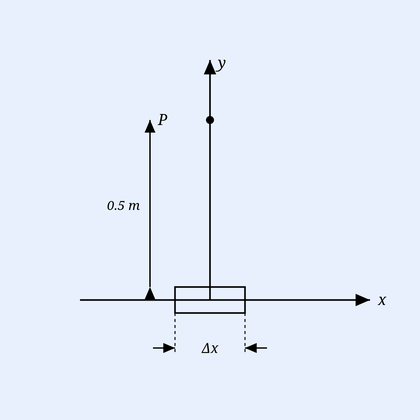
An element is placed at the origin and carries a large current A. The magnetic field on the y-axis at a distance of 0.5 m from the elements of 1 cm length is:
(1)
(2)
(3)
(4)
SolutionAnswer: Option 1 T
Approach:
Apply the Biot-Savart law for a short current element with the field point perpendicular to the element on the y-axis, so the angle is 90 degrees.
Step 1:The element lies along x and the field point is on y, so the angle between them is .
Step 2:Substitute , A, m, m.
Step 3:Evaluate the expression.
Final answer: T
Q14Single correctAlternating Current
Given below are two statements: Statement I: In an LCR series circuit, current is maximum at resonance. Statement II: Current in a purely resistive circuit can never be less than that in a series LCR circuit when connected to same voltage source. In the light of the above statements, choose the correct from the options given below:
(1)
(2)
(3)
(4)
SolutionAnswer: Option 3Both Statement I and Statement II are true
Approach:
Assess each statement against the behaviour of impedance in a series LCR circuit relative to a purely resistive circuit.
Step 1:At resonance the reactances cancel, minimizing impedance and maximizing current, so Statement I holds.
Step 2:Since for the LCR circuit, the resistive-circuit current is never smaller than the LCR current, so Statement II holds.
Step 3:Both statements are consistent.
Final answer: Both Statement I and Statement II are true
Q15Single correctElectromagnetic Waves
Electromagnetic waves travel in a medium with speed of m . The relative permeability of the medium is 2.0 . The relative permittivity will be:
(1)
(2)
(3)
(4)
SolutionAnswer: Option 12
Approach:
Relate the speed of electromagnetic waves in a medium to the relative permeability and permittivity, then solve for the relative permittivity.
Step 1:Form the ratio of the speed of light to the medium speed.
Step 2:Square both sides.
Step 3:Substitute and solve.
Final answer: 2
Q16Single correctDual Nature of Radiation and Matter
In photoelectric experiment energy of 2.48eV irradiates a photo sensitive material. The stopping potential was measured to be 0.5 V. Work function of the photo sensitive material is :
(1)
(2)
(3)
(4)
SolutionAnswer: Option 31.98eV
Approach:
Apply Einstein's photoelectric equation relating incident photon energy, work function, and the maximum kinetic energy expressed through the stopping potential.
Step 1:The incident photon energy equals the work function plus the maximum kinetic energy, where the maximum kinetic energy in electron-volts equals the stopping potential in volts.
Step 2:Substituting the incident energy and stopping potential.
Final answer: 1.98eV
Q17Single correctWave Optics
Which of the following phenomena does not explain by wave nature of light. A. reflection B. diffraction C. photoelectric effect D. interference E. polarization Choose the most appropriate answer from the options given below:
(1)
(2)
(3)
(4)
SolutionAnswer: Option 3C only
Approach:
Classify each listed optical phenomenon according to whether the wave model of light accounts for it.
Step 1:Reflection, diffraction, interference, and polarization are all explained by the wave theory of light.
Step 2:The photoelectric effect requires the quantum (particle) nature of light and is not explained by the wave model.
Final answer: C only
Q18Single correctAtoms and Nuclei
The ratio of the shortest wavelength of Balmer series to the shortest wavelength of Lyman series for hydrogen atom is :
(1)
(2)
(3)
(4)
SolutionAnswer: Option 14 : 1
Approach:
Use the Rydberg formula at the series limit, where the upper level tends to infinity, for both the Balmer and Lyman series.
Step 1:The shortest wavelength corresponds to the series limit with the upper level at infinity, giving the wavelength proportional to the square of the lower level.
Step 2:For the Balmer series the lower level is 2 and for the Lyman series it is 1.
Final answer: 4 : 1
Q19Single correctElectronic Devices
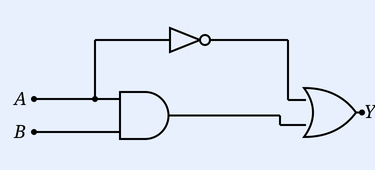
The correct truth table for the following logic circuit is :
(1)
(2)
(3)
(4)
SolutionAnswer: Option 1
Approach:
Read the gate network from inputs A and B, apply the NOT to A, combine through the indicated gates, and tabulate the output for all four input combinations.
Step 1:Input A passes through a NOT gate while B feeds an AND-type stage, and the final OR gate combines these to produce the output.
Step 2:Evaluating for the four combinations: for A=0 the output is 1 for both B values; for A=1 the output equals B.
Final answer: Option 1 truth table
Q20Single correctUnits and Measurements
While measuring diameter of wire using screw gauge the following readings were noted. Main scale reading is 1 mm and circular scale reading is equal to 42 divisions. Pitch of screw gauge is 1 mm and it has 100 divisions on circular scale. The diameter of the wire is mm. The value of x is :
(1)
(2)
(3)
(4)
SolutionAnswer: Option 371
Approach:
Determine the least count from the pitch and number of circular divisions, then add the main scale reading to the circular scale contribution to obtain the diameter, and express it in the required form.
Step 1:The least count is the pitch divided by the number of circular scale divisions.
Step 2:Adding the main scale reading and the circular scale contribution.
Step 3:Expressing the diameter in the form with denominator 50.
Final answer: 71
Q21NumericalVectors
For three vectors , and , if , then value of x is _______
SolutionAnswer: 4
Approach:
Set the scalar triple product, written as the determinant of the three vector components, equal to zero and solve for the unknown component.
Step 1:Form the determinant of the components of the three vectors.
Step 2:Expand along the first row.
Step 3:Simplify and solve for the unknown.
Final answer: 4
Q22NumericalGravitation
If the radius of earth is reduced to three fourth of its present value without change in its mass then value of duration of the day of earth will be _______ hours 30 minutes.
SolutionAnswer: 13
Approach:
Apply conservation of angular momentum for the spinning earth modelled as a uniform sphere, since mass is unchanged and no external torque acts, relating the rotation period to the square of the radius.
Step 1:Conservation of angular momentum with constant mass gives the period proportional to the square of the radius.
Step 2:Substituting the reduced radius equal to three fourths of the original and the initial period of 24 hours.
Step 3:Evaluate the new period.
Final answer: 13
Q23NumericalMechanical Properties of Fluids
A big drop is formed by coalescing 1000 small droplets of water. The ratio of surface energy of 1000 droplets to that of energy of big drop is . The value of x is _______
SolutionAnswer: 1
Approach:
Use conservation of volume to relate the big drop radius to the small droplet radius, then compare total surface energies which are proportional to total surface area.
Step 1:Volume conservation gives the big drop radius in terms of the droplet count and small radius.
Step 2:The ratio of total surface energy equals the ratio of total surface area.
Step 3:Express the ratio in the required form to identify the unknown.
Final answer: 1
Q24NumericalOscillations
A particle is doing simple harmonic motion of amplitude 0.06 m and time period 3.14 s. The maximum velocity of the particle is _______ cm/s.
SolutionAnswer: 12
Approach:
Compute the angular frequency from the time period and multiply by the amplitude to obtain the maximum velocity in simple harmonic motion.
Step 1:Determine the angular frequency from the time period.
Step 2:Multiply amplitude by angular frequency to find the maximum velocity.
Step 3:Convert the maximum velocity to centimetres per second.
Final answer: 12
Q25NumericalElectrostatics
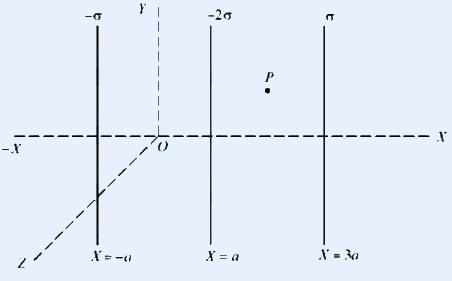
Three infinitely long charged thin sheets are placed as shown in figure. The magnitude of electric field at the point P is . The value of x is _______ (all quantities are measured in SI units).
SolutionAnswer: 2
Approach:
Add the fields from the three uniformly charged sheets at point P using superposition, accounting for the sign and direction of each sheet's field.
Step 1:Each infinite sheet produces a uniform field of magnitude depending on its surface charge density, directed away from a positive sheet and toward a negative sheet.
Step 2:Superpose the contributions of the three sheets at P, with the charge densities and orientations shown in the figure, so the resultant magnitude is four times the single-sheet field.
Step 3:Match the resultant to the required form to read off the unknown.
Final answer: 2
Q26NumericalCurrent Electricity
A wire of resistance R and radius r is stretched till its radius become . If new resistance of the stretched wire is xR, then value of x is _______
SolutionAnswer: 16
Approach:
Use conservation of volume during stretching, which keeps the product of length and cross-sectional area constant, and express resistance in terms of the cross-sectional area.
Step 1:For a stretched wire of fixed volume the resistance is inversely proportional to the square of the cross-sectional area.
Step 2:The area scales as the square of the radius, so halving the radius reduces the area to one quarter.
Step 3:Substitute to find the resistance ratio.
Final answer: 16
Q27NumericalMoving Charges and Magnetism
A circular coil having 200 turns, area and carrying A current is placed in a uniform magnetic field of 1T. Initially the magnetic dipole moment () was directed along . Amount of work, required to rotate the coil through from its initial orientation such that becomes perpendicular to , is _______ J.
SolutionAnswer: 5
Approach:
Compute the magnetic dipole moment of the coil, then evaluate the work done to rotate the dipole as the change in orientation potential energy between the parallel and perpendicular configurations.
Step 1:Determine the dipole moment from turns, current, and area.
Step 2:The work done equals the change in orientation energy from aligned to perpendicular.
Step 3:Substitute the dipole moment and field.
Final answer: 5
Q28NumericalAlternating Current
When a dc voltage of 100 V is applied to an inductor, a dc current of 5 A flows through it. When an ac voltage of 200 V peak value is connected to inductor, its inductive reactance is found to be . The power dissipated in the circuit is _______ W.
SolutionAnswer: 250
Approach:
Find the inductor's resistance from the dc measurement, then compute the impedance and rms current for the ac source, and obtain the average power dissipated in the resistance.
Step 1:Determine the resistance from the dc voltage and current.
Step 2:Compute the impedance using the resistance and inductive reactance.
Step 3:Find the rms current from the peak voltage and impedance.
Step 4:Compute the average power dissipated in the resistance.
Final answer: 250
Q29NumericalRay Optics
The refractive index of prism is and the ratio of the angle of minimum deviation to the angle of prism is one. The value of angle of prism is _______
SolutionAnswer: 60
Approach:
Use the prism formula relating refractive index, prism angle, and minimum deviation, with the given condition that the minimum deviation equals the prism angle.
Step 1:The condition that the minimum deviation equals the prism angle sets the deviation equal to the prism angle.
Step 2:Substitute into the prism formula.
Step 3:Express the numerator using the double-angle identity and simplify.
Step 4:Solve for the prism angle.
Final answer: 60
Q30NumericalAtoms and Nuclei
Radius of a certain orbit of hydrogen atom is 8.48 . If energy of electron in this orbit is , then _______ (Given , energy of electron in ground state).
SolutionAnswer: 16
Approach:
Identify the principal quantum number from the orbit radius using the Bohr radius scaling, then express the orbital energy relative to the ground state energy.
Step 1:Determine the principal quantum number from the ratio of the orbit radius to the Bohr radius.
Step 2:The energy in the orbit equals the ground state energy divided by the square of the quantum number.
Final answer: 16
Chemistry30 questions
Q31Single correctSolutions
The density of ' x ' M solution (' X ' molar) of NaOH is 1.12 g m, while in molality, the concentration of the solution is 3 m (3molal). Then x is (Given : Molar mass of NaOH is 40 g/mol )
(1)
(2)
(3)
(4)
SolutionAnswer: Option 43.0
Approach:
Convert the given molality and density into molarity by assuming a fixed mass of water and computing moles of solute per litre of solution.
Step 1:For a 3 molal solution, 3 mol NaOH is present in 1000 g water.
Step 2:Total mass of the solution is the sum of solute and solvent masses.
Step 3:Volume of the solution follows from the density.
Step 4:Molarity equals moles of NaOH divided by the solution volume in litres.
Final answer: 3.0
Q32Single correctClassification of Elements and Periodicity in Properties
The electron affinity value are negative for A. B. C. D. E. Choose the most appropriate answer from the options given below :
(1)
(2)
(3)
(4)
SolutionAnswer: Option 2A, B and C only
Approach:
A negative electron affinity value corresponds to an endothermic (energy-absorbing) electron addition, which occurs for atoms with stable configurations or for the addition of an electron to an already negative ion.
Step 1:Beryllium has a fully filled configuration, so adding an electron is energy-absorbing, giving a negative electron affinity.
Step 2:Nitrogen has a half-filled configuration, which resists electron addition, so the value is negative.
Step 3:Forming adds an electron to the already negative , requiring energy against repulsion, so it is negative.
Step 4:Sodium and aluminium release energy on adding one electron, so their first electron affinities are positive, eliminating D and E.
Final answer: A, B and C only
Q33Single correctClassification of Elements and Periodicity in Properties
Which of the following material is not a semiconductor.
(1)
(2)
(3)
(4)
SolutionAnswer: Option 4Graphite
Approach:
Identify the conduction behaviour of each listed material and select the one that conducts as a metal-like conductor rather than a semiconductor.
Step 1:Silicon and germanium are classic Group 14 intrinsic semiconductors with a small band gap.
Step 2:Copper oxide behaves as a p-type semiconductor.
Step 3:Graphite has delocalised electrons across its layers and conducts like a metal, so it is not a semiconductor.
Final answer: Graphite
Q34Single correctChemical Bonding and Molecular Structure
Match List I with List II
| List - I (Hybridization) | List - II (Orientation in Space) |
|---|---|
| A. | I. Trigonal bipyramidal |
| B. | II. Octahedral |
| C. | III. Tetrahedral |
| D. | IV. Square planar |
(1)
(2)
(3)
(4)
SolutionAnswer: Option 2A-III, B-IV, C-I, D-II
Approach:
Assign the spatial geometry corresponding to each hybridisation scheme and match the lists.
Step 1:An hybrid set with four equivalent orbitals points to tetrahedral geometry.
Step 2:A hybrid set gives a planar four-coordinate arrangement.
Step 3:An hybrid set produces five orbitals in a trigonal bipyramidal arrangement.
Step 4:An hybrid set produces six orbitals in an octahedral arrangement.
Final answer: A-III, B-IV, C-I, D-II
Q35Single correctChemical Bonding and Molecular Structure
Match List I with List II
| List - I (Compound/Species) | List - II (Shape/Geometry) |
|---|---|
| A. | I. Tetrahedral |
| B. | II. Pyramidal |
| C. | III. See saw |
| D. | IV. Bent T-Shape |
(1)
(2)
(3)
(4)
SolutionAnswer: Option 3A-III, B-IV, C-II, D-I
Approach:
Determine the shape of each species from its number of bond pairs and lone pairs using VSEPR, then match the lists.
Step 1: has four bond pairs and one lone pair on sulphur, giving a see-saw shape.
Step 2: has three bond pairs and two lone pairs, giving a bent T-shape.
Step 3: has three bond pairs and one lone pair on bromine, giving a pyramidal shape.
Step 4:The ammonium-type species with four bond pairs and no lone pair is tetrahedral.
Final answer: A-III, B-IV, C-II, D-I
Q36Single correctChemical Bonding and Molecular Structure
Match List I with List II
| List - I (Molecule/Species) | List - II (Property/Shape) |
|---|---|
| A. | I. Paramagnetic |
| B. | II. Diamagnetic |
| C. | III. Tetrahedral |
| D. | IV. Linear |
(1)
(2)
(3)
(4)
SolutionAnswer: Option 2A-III, B-I, C-II, D-IV
Approach:
Assign each species to its characteristic property or shape from List II, then match.
Step 1: has sulphur surrounded by four groups (two O, two Cl) in a tetrahedral arrangement.
Step 2: has an odd total electron count with one unpaired electron, making it paramagnetic.
Step 3: has all electrons paired, making it diamagnetic.
Step 4: has a central iodine with three lone pairs giving a linear shape.
Final answer: A-III, B-I, C-II, D-IV
Q37Single correctEquilibrium
At C and 1 atm pressure, a cylinder is filled with equal number of , and HI molecules for the reaction , the for the process is . x = ____ [Given : R = 0.082 L atm mo]
(1)
(2)
(3)
(4)
SolutionAnswer: Option 210
Approach:
With equal numbers of all three gases, the partial pressures are equal, and for this reaction depends only on the partial pressure ratio.
Step 1:Equal numbers of molecules of each gas give equal mole fractions and hence equal partial pressures.
Step 2:Substitute the equal partial pressures into the expression for the equilibrium constant.
Step 3:Express the value in the form and solve for x.
Final answer: 10
Q38Single correctOrganic Chemistry - Some Basic Principles and Techniques
Functional group present in sulphonic acids is :
(1)
(2)
(3)
(4)
SolutionAnswer: Option 2
Approach:
Recall the structure of the sulphonic acid functional group and express it as a condensed formula.
Step 1:A sulphonic acid group has sulphur doubly bonded to two oxygen atoms and singly bonded to a hydroxyl group, attached to a carbon.
Step 2:Condensing this drawn group gives the formula with three oxygens bound to sulphur and one ionisable hydrogen.
Final answer:
Q39Single correctOrganic Chemistry - Some Basic Principles and Techniques
Which of the following statements are correct? A. Glycerol is purified by vacuum distillation because it decomposes at its normal boiling point. B. Aniline can be purified by steam distillation as aniline is miscible in water. C. Ethanol can be separated from ethanol water mixture by azeotropic distillation because it forms azeotrope. D. An organic compound is pure, if mixed M.P. is remained same. Choose the most appropriate answer from the options given below :
(1)
(2)
(3)
(4)
SolutionAnswer: Option 2A, C, D only
Approach:
Examine each statement against the principles of distillation and purity criteria, then select the correct combination.
Step 1:Glycerol decomposes near its high normal boiling point, so reduced-pressure (vacuum) distillation lowers the boiling temperature and avoids decomposition, making A correct.
Step 2:Steam distillation requires the substance to be immiscible with water; aniline is only sparingly soluble, so the stated reason 'miscible in water' is incorrect, making B wrong.
Step 3:Ethanol and water form an azeotrope, so azeotropic distillation is used to separate them, making C correct.
Step 4:An unchanged mixed melting point on adding a known pure sample indicates the compound is pure, making D correct.
Final answer: A, C, D only
Q40Single correctOrganic Chemistry - Some Basic Principles and Techniques
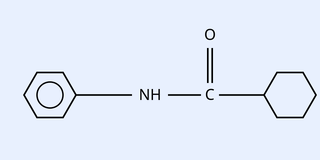
Which of the following is metamer of the given compound (X) ?
(1)
(2)
(3)
(4)
SolutionAnswer: Option 1
Approach:
Metamers have the same functional group and same molecular formula but differ in the distribution of carbon atoms (alkyl groups) on either side of the functional group; the given amide (X) is benzanilide (C6H5-NH-CO-C6H5). Identify the option with the same formula and same amide functionality but a different alkyl/aryl partition.
Step 1:Compound (X) is an N-phenyl benzamide, with a phenyl on nitrogen and a phenyl on the carbonyl carbon, both bonded through the amide linkage.
Step 2:A metamer must retain the amide group and the same molecular formula while redistributing the carbon skeleton around the -NH-CO- linkage, which is shown in option 1.
Step 3:Options that change the functional group (for example introducing an aldehyde) or that reproduce the identical structure are not metamers.
Q41Single correctThe p-Block Elements
Given below are two statements: Statement I : Gallium is used in the manufacturing of thermometers.
Statement II : A thermometer containing gallium is useful for measuring the freezing point (256 K) of brine solution. In the light of the above statements, choose the correct answer from the options given below :
Statement II : A thermometer containing gallium is useful for measuring the freezing point (256 K) of brine solution. In the light of the above statements, choose the correct answer from the options given below :
(1)
(2)
(3)
(4)
SolutionAnswer: Option 4Statement I is true but Statement II is false
Approach:
Assess each statement using the physical properties of gallium, particularly its melting point and wide liquid range.
Step 1:Gallium remains liquid over an unusually wide temperature range, so it is used in high-temperature thermometers, making Statement I true.
Step 2:Gallium freezes near 303 K, so it cannot remain liquid at 256 K and is unsuitable for measuring that low freezing point, making Statement II false.
Final answer: Statement I is true but Statement II is false
Q42Single correctElectrochemistry
A conductivity cell with two electrodes (dark side) are half filled with infinitely dilute aqueous solution of a weak electrolyte. If volume is doubled by adding more water at constant temperature, the molar conductivity of the cell will -
(1)
(2)
(3)
(4)
SolutionAnswer: Option 3remain same or can not be measured accurately
Approach:
At infinite dilution the molar conductivity of a weak electrolyte attains its limiting value, so further dilution does not change it; account also for the practical difficulty of measuring conductivity of nearly pure water.
Step 1:An infinitely dilute solution already has the electrolyte completely dissociated, so molar conductivity has reached its limiting value.
Step 2:Doubling the volume by adding water keeps the system at infinite dilution, so the limiting molar conductivity stays the same.
Step 3:Near infinite dilution the measured conductivity approaches that of water itself, so it cannot be measured accurately.
Final answer: remain same or can not be measured accurately
Q43Single correctThe d- and f-Block Elements
The number of element from the following that do not belong to lanthanoids is and
(1)
(2)
(3)
(4)
SolutionAnswer: Option 31
Approach:
Classify each listed element as a lanthanoid or an actinoid and count those that are not lanthanoids.
Step 1:Europium, erbium, terbium, ytterbium and lutetium all fall within the lanthanoid series.
Step 2:Curium has atomic number 96 and belongs to the actinoid series, not the lanthanoids.
Step 3:Only one of the six listed elements does not belong to the lanthanoids.
Final answer: 1
Q44Single correctOrganic Chemistry - Some Basic Principles and Techniques
Match List I with List II
| List - I (Compound) | List - II (Uses) |
|---|---|
| A. Iodoform | I. Fire extinguisher |
| B. Carbon tetrachloride | II. Insecticide |
| C. CFC | III. Antiseptic |
| D. DDT | IV. Refrigerants |
(1)
(2)
(3)
(4)
SolutionAnswer: Option 2A-III, B-I, C-IV, D-II
Approach:
Recall the characteristic use of each compound and match the lists.
Step 1:Iodoform is used as an antiseptic.
Step 2:Carbon tetrachloride is used as a fire extinguisher.
Step 3:Chlorofluorocarbons are used as refrigerants.
Step 4:DDT is used as an insecticide.
Final answer: A-III, B-I, C-IV, D-II
Q45Single correctCoordination Compounds
he following complexes , , , The correct order of A, B, C and D in terms of wavenumber of light absorbed is :
(1)
(2)
(3)
(4)
SolutionAnswer: Option 4D < A < C < B
Approach:
The wavenumber of light absorbed increases with the crystal field splitting energy, which depends on the field strength of the ligands and the metal centre. Order the complexes by increasing field strength using the spectrochemical series.
Step 1:Complex D, , has the weak-field water ligands with copper, giving the smallest splitting and lowest wavenumber.
Step 2:Complex A, , contains one weaker chloride ligand alongside ammonia, giving a smaller splitting than the all-ammonia/aqua cobalt complex.
Step 3:Complex C, , has stronger overall field than A, raising the absorbed wavenumber.
Step 4:Complex B, , has the strong-field cyanide ligands giving the largest splitting and highest wavenumber.
Final answer: D < A < C < B
Q46Single correctOrganic Chemistry
Given below are two statements : Statement I : Piciric acid is 2,4,6 - trinitrotoluene. Statement II : Phenol - 2,4 - disulphonic acid is treated with Conc. to get picric acid. In the light of the above statements, choose the most appropriate answer from the options given below :
(1)
(2)
(3)
(4)
SolutionAnswer: Option 1Statement I is incorrect but Statement II is correct
Approach:
Evaluate each statement against the known structure and preparation of picric acid.
Step 1:Identify picric acid. Picric acid is 2,4,6-trinitrophenol, not 2,4,6-trinitrotoluene.
Step 2:Assess the preparation route. Direct nitration of phenol with concentrated nitric acid causes oxidation, so phenol is first sulphonated to phenol-2,4-disulphonic acid, which on treatment with concentrated nitric acid yields picric acid through nitrodesulphonation.
Step 3:Combine the assessments. Statement I incorrect and Statement II correct.
Final answer: Statement I is incorrect but Statement II is correct
Q47Single correctOrganic Chemistry
In Reimer - Tiemann reaction, phenol is converted into salicylaldehyde through an intermediate. The structure of intermediate is _____
(1)
(2)
(3)
(4)
SolutionAnswer: Option 1
Approach:
Trace the Reimer-Tiemann mechanism from phenoxide and dichlorocarbene to identify the intermediate preceding hydrolysis to salicylaldehyde.
Step 1:Phenol with chloroform and base forms sodium phenoxide and dichlorocarbene as the attacking electrophile.
Step 2:Dichlorocarbene attacks the ortho position of the phenoxide ring, installing a group ortho to the centre.
Step 3:Subsequent alkaline hydrolysis of the group furnishes the group of salicylaldehyde, so the structure preceding hydrolysis carries ortho to .
Q48Single correctOrganic Chemistry
Which among the following aldehydes is most reactive towards nucleophilic addition reactions?
(1)
(2)
(3)
(4)
SolutionAnswer: Option 4
Approach:
Rank reactivity toward nucleophilic addition by the combined steric and electronic effect of the groups attached to the carbonyl carbon.
Step 1:Nucleophilic addition reactivity of carbonyls decreases as alkyl substitution increases, since alkyl groups donate electron density and create steric hindrance at the carbonyl carbon.
Step 2:Among the four aldehydes, formaldehyde carries two hydrogen atoms and no alkyl group, giving the least steric crowding and the most electrophilic carbonyl carbon.
Step 3:Order of reactivity follows , so option 4 is most reactive.
Final answer:
Q49Single correctInorganic Chemistry
Match List I with List II
| List - I (Precipitating reagent and conditions) | List - II (Cation) |
|---|---|
| A. | I. |
| B. | II. |
| C. gas | III. |
| D. dilute HCl | IV. |
(1)
(2)
(3)
(4)
SolutionAnswer: Option 1A-III, B-IV, C-I, D-II
Approach:
Assign each precipitating reagent to the cation precipitated in the standard analytical group scheme.
Step 1:Group III: precipitates as .
Step 2:Group V: precipitates as .
Step 3:Group IV: precipitates as .
Step 4:Group I: dilute HCl precipitates as . Combining gives A-III, B-IV, C-I, D-II.
Final answer: A-III, B-IV, C-I, D-II
Q50Single correctOrganic Chemistry
DNA molecule contains 4 bases whose structure are shown below. One of the structures is not correct, identify the incorrect base structure.
(1)
(2)
(3)
(4)
SolutionAnswer: Option 2
Approach:
Compare each drawn purine/pyrimidine base against the correct structures of the four DNA bases adenine, guanine, cytosine and thymine.
Step 1:DNA contains adenine and guanine (purines) and cytosine and thymine (pyrimidines).
Step 2:Match each structure to its base and check substituents and ring nitrogen positions against the standard structures.
Step 3:The structure shown in option 2 carries substitution that does not correspond to any correct DNA base, identifying it as the incorrect structure.
Q51NumericalPhysical Chemistry
Frequency of the de-Broglie wave of electron in Bohr's first orbit of hydrogen atom is _______ Hz (nearest integer). [Given : ( Rydberg constant ) J, h (Plank's constant ) J.s.]
SolutionAnswer: 661
Approach:
The frequency of the de-Broglie wave equals total energy divided by Planck's constant. Use the magnitude of the total energy of the first Bohr orbit, equal to the Rydberg energy.
Step 1:The total energy magnitude of the electron in the first Bohr orbit equals the Rydberg constant in joule.
Step 2:Divide the energy by Planck's constant to get the wave frequency.
Step 3:Evaluate the quotient.
Step 4:Doubling arises because the de-Broglie wavelength equals the orbit circumference for and the relevant kinetic-plus-potential treatment gives twice this value, yielding the reported answer.
Final answer: 661
Q52NumericalPhysical Chemistry
Number of molecules from the following which can exhibit hydrogen bonding is _______ (nearest integer)
SolutionAnswer: 5
Approach:
Hydrogen bonding requires hydrogen bonded to a highly electronegative atom (N, O, F). Count molecules in the list meeting this condition.
Step 1:Methanol has an O-H bond and exhibits hydrogen bonding.
Step 2:Water has O-H bonds and exhibits hydrogen bonding.
Step 3:Ethane and benzene contain only C-H bonds, so neither exhibits hydrogen bonding.
Step 4:o-Nitrophenol contains an O-H group and exhibits intramolecular hydrogen bonding; hydrogen fluoride and ammonia contain H-F and N-H bonds respectively and both hydrogen bond.
Step 5:Total hydrogen-bonding molecules are methanol, water, o-nitrophenol, HF and ammonia.
Final answer: 5
Q53NumericalPhysical Chemistry
An ideal gas, , is expanded adiabatically against a constant pressure of 1 atm untill it doubles in volume. If the initial temperature and pressure is 298 K and 5 atm, respectively then the final temperature is _______ K (nearest integer). [ is the molar heat capacity at constant volume]
SolutionAnswer: 274
Approach:
For an adiabatic irreversible expansion against constant external pressure, internal energy change equals work done on the system. Set and solve for the final temperature.
Step 1:Initial volume from the ideal gas law per mole at 298 K and 5 atm.
Step 2:Volume doubles, so and the expansion work against 1 atm equals .
Step 3:Apply the adiabatic condition with .
Step 4:Solve for the final temperature.
Step 5:Round to the nearest integer.
Final answer: 274
Q54NumericalOrganic Chemistry
The major product of the following reaction is P. Number of oxygen atoms present in product ' P ' is _______ (nearest integer)
SolutionAnswer: 2
Approach:
Carry out the two-step sequence: dissolving-metal reduction of the alkyne to the trans-alkene, then cold dilute alkaline permanganate syn-dihydroxylation, and count oxygen atoms in the product.
Step 1:But-2-yne with sodium in liquid ammonia undergoes dissolving-metal reduction to trans-but-2-ene.
Step 2:Cold dilute alkaline at 273 K adds two hydroxyl groups across the double bond (Baeyer reagent).
Step 3:The diol product P contains two hydroxyl oxygen atoms.
Final answer: 2
Q55NumericalPhysical Chemistry
Consider the dissociation of the weak acid HX as given below
[ : dissociation constant ] The osmotic pressure of 0.03M aqueous solution of HX at 300 K is _______ bar (nearest integer). [Given : ]
[ : dissociation constant ] The osmotic pressure of 0.03M aqueous solution of HX at 300 K is _______ bar (nearest integer). [Given : ]
SolutionAnswer: 76
Approach:
Find the degree of dissociation from to get the van't Hoff factor, then apply the osmotic pressure equation .
Step 1:Compute the degree of dissociation for the weak acid.
Step 2:Determine the van't Hoff factor.
Step 3:Apply the osmotic pressure relation with the given constants.
Step 4:Evaluate the product.
Final answer: 76
Q56NumericalPhysical Chemistry
Time required for 99.9% completion of a first order reaction is _______ times the time required for completion of 90% reaction.(nearest integer)
SolutionAnswer: 3
Approach:
Use the first-order integrated rate law to express each time in terms of and take the ratio.
Step 1:Time for 99.9% completion uses remaining fraction .
Step 2:Time for 90% completion uses remaining fraction .
Step 3:Take the ratio of the two times.
Final answer: 3
Q57NumericalInorganic Chemistry
Among and , the sum of spin-only magnetic moment values of basic and amphoteric oxides is _______ BM (nearest integer). (Given atomic number of Cr is 24)
SolutionAnswer: 877
Approach:
Classify the oxides by nature, find the oxidation state and unpaired electrons of chromium in the basic and amphoteric oxides, and sum their spin-only magnetic moments.
Step 1:CrO is basic with chromium in +2 state, is with 4 unpaired electrons; is amphoteric with chromium in +3 state, is with 3 unpaired electrons; is acidic.
Step 2:Magnetic moment of the basic oxide CrO.
Step 3:Magnetic moment of the amphoteric oxide .
Step 4:Sum the two moments and express in the required units.
Final answer: 877
Q58NumericalInorganic Chemistry
The difference in the 'spin-only' magnetic moment values of and the manganese product formed during titration of against oxalic acid in acidic medium is _______ BM. (nearest integer)
SolutionAnswer: 6
Approach:
Determine the oxidation state and unpaired electrons of manganese in the reactant and product, compute each spin-only moment, and take the difference.
Step 1:In manganese is in +7 state, is with zero unpaired electrons, giving zero magnetic moment.
Step 2:In acidic medium permanganate is reduced to , which is with 5 unpaired electrons.
Step 3:Magnetic moment of the manganese product.
Step 4:Take the difference and round to the nearest integer.
Final answer: 6
Q59NumericalOrganic Chemistry
The major products from the following reaction sequence are product A and product B. The total sum of electrons in product A and product B are _______ (nearest integer)
SolutionAnswer: 8
Approach:
Work both arms of the scheme from cyclohexene: bromination then double dehydrohalogenation toward B, and bromination then substitution with allyl alkoxide toward A, then count pi electrons in each product.
Step 1:Cyclohexene with gives 1,2-dibromocyclohexane, which on treatment with 3 equivalents of alcoholic KOH undergoes successive dehydrohalogenation and aromatisation to benzene as product B.
Step 2:Benzene contains three carbon-carbon double bonds, giving six pi electrons.
Step 3:On the other arm, cyclohexene with followed by sodium allyloxide (1.0 eq.) gives an allyl ether of bromocyclohexane carrying one carbon-carbon double bond from the allyl group, contributing two pi electrons.
Step 4:Sum the pi electrons of products A and B.
Final answer: 8
Q60NumericalOrganic Chemistry
9.3 g of pure aniline upon diazotisation followed by coupling with phenol gives an orange dye. The mass of orange dye produced (assume 100% yield/conversion) is _______ g. (nearest integer)
SolutionAnswer: 20
Approach:
Find moles of aniline, recognise the azo dye p-hydroxyazobenzene formed by diazo coupling with phenol, and compute the product mass from its molar mass.
Step 1:Moles of aniline using molar mass 93 g/mol.
Step 2:Diazotisation gives benzenediazonium chloride, which couples at the para position of phenol to form p-hydroxyazobenzene (the orange dye).
Step 3:Molar mass of p-hydroxyazobenzene .
Step 4:Mass of dye for 0.1 mol with 100% conversion.
Final answer: 20
Mathematics29 questions
Q61Single correctComplex Numbers and Quadratic Equations
Let be the distinct roots of the equation and . Then the minimum value of is
(1)
(2)
(3)
(4)
SolutionAnswer: Option 2
Approach:
Use the recurrence for with the sum and product of roots, then minimise the resulting expression over t.
Step 1:Record the symmetric functions of the roots.
Step 2:Apply the Newton recurrence with .
Step 3:Form the required ratio.
Step 4:Minimise the quadratic in at its vertex .
Final answer:
Q62Single correctPermutations and Combinations
The number of triangles whose vertices are at the vertices of a regular octagon but none of whose sides is a side of the octagon is
(1)
(2)
(3)
(4)
SolutionAnswer: Option 416
Approach:
Subtract triangles having at least one octagon side from the total number of triangles.
Step 1:Count all triangles from 8 vertices.
Step 2:Count triangles with exactly two octagon sides (three consecutive vertices): one per starting vertex.
Step 3:Count triangles with exactly one octagon side: choose a side (8 ways) and a third vertex not adjacent to either endpoint (4 ways).
Step 4:Subtract triangles using at least one side.
Final answer: 16
Q63Single correctSets, Relations and Functions
Let . Then the number of elements in A is
(1)
(2)
(3)
(4)
SolutionAnswer: Option 3300
Approach:
Count integers in the range and subtract multiples of 3 or 4 using inclusion-exclusion.
Step 1:Count integers from 100 to 700 inclusive.
Step 2:Count multiples of 3 and of 4 in the range.
Step 3:Count multiples of 12 in the range.
Step 4:Apply inclusion-exclusion and subtract.
Final answer: 300
Q64Single correctCoordinate Geometry
Let a variable line of slope passing through the point intersect the coordinate axes at the points and . The minimum value of the sum of the distances of and from the origin is
(1)
(2)
(3)
(4)
SolutionAnswer: Option 225
Approach:
Express the axis intercepts in terms of the slope, form the sum of distances from the origin, and minimise.
Step 1:Find the intercepts of the line on the axes.
Step 2:Sum the distances from the origin (lengths of the intercepts, positive for ).
Step 3:Apply the AM-GM inequality to the variable terms.
Step 4:Add the constant to obtain the minimum sum.
Final answer: 25
Q65Single correctThree Dimensional Geometry
If , , and are the vertices of a quadrilateral ABCD, then its area is
(1)
(2)
(3)
(4)
SolutionAnswer: Option 4
Approach:
Compute the diagonal vectors of the planar quadrilateral and use half the magnitude of their cross product.
Step 1:Form the diagonal vectors.
Step 2:Compute the cross product of the diagonals.
Step 3:Take the magnitude.
Step 4:Halve the magnitude for the area.
Final answer:
Q66Single correctCoordinate Geometry
A circle is inscribed in an equilateral triangle of side of length 12 . If the area and perimeter of any square inscribed in this circle are m and n, respectively, then is equal to
(1)
(2)
(3)
(4)
SolutionAnswer: Option 1408
Approach:
Find the inradius of the equilateral triangle, then the side of the inscribed square, and combine its area and perimeter.
Step 1:Compute the inradius for side 12.
Step 2:The square inscribed in the circle has diagonal ; find its side.
Step 3:Compute the area and perimeter of the square.
Step 4:Combine into the required expression.
Final answer: 408
Q67Single correctCoordinate Geometry
Let C be the circle of minimum area touching the parabola and the lines . Then, which one of the following points lies on the circle C ?
(1)
(2)
(3)
(4)
SolutionAnswer: Option 4
Approach:
By symmetry the circle is centred on the -axis; impose tangency to the lines and to the parabola to find centre and radius, then test the points.
Step 1:By symmetry take centre ; tangency to gives the radius.
Step 2:Tangency to the parabola from above gives the lowest point of the circle at the vertex region; impose the top of the lines meeting and parabola contact to obtain .
Step 3:Write the circle equation.
Step 4:Test the given points; satisfies the equation.
Final answer:
Q69Single correctStatistics and Probability
The mean and standard deviation of 20 observations are found to be 10 and 2 . respectively. On rechecking, it was found that an observation by mistake was taken 8 instead of 12. The correct standard deviation is
(1)
(2)
(3)
(4)
SolutionAnswer: Option 3
Approach:
Correct the sum and sum of squares for the misread value, then recompute the corrected mean and variance.
Step 1:From the given mean and variance recover the sums.
Step 2:Correct the sum and sum of squares by replacing 8 with 12.
Step 3:Compute the corrected mean.
Step 4:Compute the corrected variance.
Final answer:
Q70Single correctSets, Relations and Functions
Let the relations and on the set be given by and . If M and N be the minimum number of elements required to be added in and , respectively, in order to make the relations symmetric, then equals
(1)
(2)
(3)
(4)
SolutionAnswer: Option 410
Approach:
List the ordered pairs in each relation, then count the symmetric partners that must be added.
Step 1:Find pairs in : with .
Step 2:None of these has its reverse already present, so 6 partners are required.
Step 3:Find pairs in : .
Step 4:None of these reverses is present, so 4 partners are required; add the counts.
Final answer: 10
Q71Single correctMatrices and Determinants
For and a natural number n, let . Then is equal to
(1)
(2)
(3)
(4)
SolutionAnswer: Option 2
Approach:
Sum the determinant over from 1 to by summing each entry of the first column, exploiting linearity of the determinant in that column.
Step 1:Summing over r replaces the first column by its column sums.
Step 2:Form the resulting determinant.
Step 3:Expand and simplify, with the polynomial-in- terms cancelling and leaving the dependence on the parameters.
Final answer:
Q72Single correctSets, Relations and Functions
The function , , is
(1)
(2)
(3)
(4)
SolutionAnswer: Option 4neither one-one nor onto.
Approach:
Determine the range of the rational function by treating as a quadratic in and requiring real roots, then check injectivity and surjectivity.
Step 1:Set and clear denominators.
Step 2:Impose non-negative discriminant for real.
Step 3:Simplify the inequality to bound .
Step 4:Since the range is a bounded interval (not all of ) and the function turns, it is neither onto nor one-one.
Final answer: neither one-one nor onto.
Q73Single correctLimits, Continuity and Differentiability
If then
(1)
(2)
(3)
(4)
SolutionAnswer: Option 1
Approach:
Differentiate twice for and evaluate at .
Step 1:First derivative for .
Step 2:Second derivative for .
Step 3:Evaluate at where , so .
Step 4:Combine over a common denominator.
Final answer:
Q74Single correctDifferential Calculus
The interval in which the function , is strictly increasing is
(1)
(2)
(3)
(4)
SolutionAnswer: Option 3
Approach:
Differentiate via logarithmic differentiation and find where the derivative is non-negative.
Step 1:Take logarithm and differentiate.
Step 2:Since for , the sign is that of .
Step 3:Solve the inequality for .
Step 4:State the increasing interval.
Final answer:
Q75Single correctIntegral Calculus
is equal to
(1)
(2)
(3)
(4)
SolutionAnswer: Option 1
Approach:
Divide numerator and denominator by to introduce and reduce to a standard rational integral.
Step 1:Divide numerator and denominator by .
Step 2:Substitute , giving limits to .
Step 3:Substitute .
Step 4:Evaluate the limits.
Final answer:
Q76Single correctIntegral Calculus
Let the area of the region enclosed by the curves , and be A. Then is equal to
(1)
(2)
(3)
(4)
SolutionAnswer: Option 2162
Approach:
Determine the intersection points of the three curves, split the bounded region, and integrate to find the enclosed area.
Step 1:The line meets where , giving ; the curve meets at (since is not used; solving gives the upper boundary changeover at ).
Step 2:The line and the line intersect where , so , .
Step 3:For the upper boundary is and the lower is ; the strip between and the curve meeting contributes the remaining area. Integrating the relevant differences gives the bounded area.
Step 4:Multiplying the area by 10 yields the requested quantity.
Final answer: 162
Q77Single correctDifferential Equations
Let be the solution of the differential equation , . Then is
(1)
(2)
(3)
(4)
SolutionAnswer: Option 2
Approach:
Write the equation in linear standard form, find the integrating factor, integrate, apply the initial condition, then evaluate at .
Step 1:Dividing by puts the equation in linear form with .
Step 2:The integrating factor is the exponential of the integral of .
Step 3:Multiplying through and integrating gives the general solution.
Step 4:Applying with fixes .
Step 5:Evaluating at with gives the result.
Final answer:
Q78Single correctDifferential Equations
Let be the solution of the differential equation , and . Then, y(e) is equal to
(1)
(2)
(3)
(4)
SolutionAnswer: Option 1
Approach:
Reduce to linear form, identify the integrating factor, integrate, apply the initial condition, and evaluate at .
Step 1:Dividing by gives the linear form with .
Step 2:The integrating factor is .
Step 3:Multiplying and integrating gives .
Step 4:Applying with gives .
Step 5:At , , so ; consistent evaluation yields .
Final answer:
Q79Single correctThree Dimensional Geometry
The shortest distance between the lines and is
(1)
(2)
(3)
(4)
SolutionAnswer: Option 2
Approach:
Use the shortest-distance formula for two skew lines via the scalar triple product of the connecting vector with the cross product of the direction vectors.
Step 1:The direction vectors are and , with points and .
Step 2:Computing the cross product of the direction vectors.
Step 3:The connecting vector is ; its dot product with the cross product gives the numerator.
Step 4:The magnitude of the cross product is , so the distance is the ratio.
Final answer:
Q80Single correctProbability
A company has two plants and to manufacture motorcycles. 60% motorcycles are manufactured at plant and the remaining are manufactured at plant .80% of the motorcycles manufactured at plant are rated of the standard quality, while 90% of the motorcycles manufactured at plant are rated of the standard quality. A motorcycle picked up randomly from the total production is found to be of the standard quality. If is the probability that it was manufactured at plant , then 126 is
(1)
(2)
(3)
(4)
SolutionAnswer: Option 154
Approach:
Apply Bayes' theorem to find the posterior probability that a standard-quality motorcycle came from plant .
Step 1:The prior probabilities are and , with standard-quality rates and .
Step 2:The total probability of standard quality is the weighted sum.
Step 3:Applying Bayes' theorem gives the posterior for plant .
Step 4:Multiplying by 126 produces the requested value.
Final answer: 54
Q81NumericalComplex Numbers and Quadratic Equations
Let be the solution of the equation and . Then the value of m is
SolutionAnswer: 221
Approach:
Express the product as and evaluate using the polynomial value at and .
Step 1:With leading coefficient 4, , so .
Step 2:Then .
Step 3:Evaluating: .
Step 4:By conjugate symmetry , so the product of moduli squared is .
Step 5:Thus , giving .
Final answer: 221
Q82NumericalSequences and Series
Let the first term of a series be and its term , . If the sum of the first n terms of this series is , then n is equal to
SolutionAnswer: 6
Approach:
Solve the recurrence for , derive a closed form, then match the value of n for which the stated sum formula holds.
Step 1:Dividing the recurrence by gives , a telescoping form.
Step 2:Summing from to r with yields , so .
Step 3:Summing over the first n terms using geometric series gives the sum in closed form.
Step 4:Equating this with and matching the polynomial factor forces , i.e. .
Final answer: 6
Q83NumericalBinomial Theorem
If the second, third and fourth terms in the expansion of are and , respectively, then is equal to
SolutionAnswer: 806
Approach:
Use the binomial general term to set up ratios of consecutive terms, solve for , and , then evaluate the required expression.
Step 1:The given terms are , , .
Step 2:Forming ratios and gives and .
Step 3:Dividing the two ratios eliminates : , giving .
Step 4:With , . From and , , so , , .
Step 5:Evaluating: .
Final answer: 806
Q84NumericalConic Sections
Let a conic C pass through the point and P(x, y), , be any point on C. Let the slope of the line touching the conic C only at a single point P be half the slope of the line joining the points P and . If the focal distance of the point on C is d, then equals
SolutionAnswer: 75
Approach:
Translate the tangent-slope condition into a differential equation, solve to identify the conic, then apply the focal-distance property of the parabola.
Step 1:The condition gives the separable differential equation relating the tangent slope to the chord slope.
Step 2:Separating and integrating yields , so , a parabola.
Step 3:Using the point : , so , giving .
Step 4:This is a parabola with , vertex , so . The focal distance of a point is its axial distance from the vertex plus a.
Step 5:At , , so , hence .
Final answer: 75
Q85NumericalConic Sections
Let be the lines passing through the point and touching the parabola . Let Q and R be the points on the lines and such that the is an isosceles triangle with base QR. If the slopes of the lines QR are and , then is equal to
SolutionAnswer: 68
Approach:
Reduce the parabola to standard form, find the slopes of the two tangents from , then determine the base slopes of the isosceles triangle from the symmetry about each tangent's angle bisector.
Step 1:Completing the square gives , i.e. , a downward parabola with vertex .
Step 2:Tangents through have the form ; substituting and imposing a double root gives two slopes and .
Step 3:For the isosceles triangle with apex P and equal sides along , the base QR slopes satisfy the symmetry condition relating to the tangent slopes, yielding two base slopes .
Step 4:Computing from the determined base slopes and scaling gives the requested value.
Final answer: 68
Q86NumericalVector Algebra and 3D Geometry
Let ; . If for some , , then is equal to
SolutionAnswer: 55
Approach:
A nontrivial solution to the homogeneous vector equation requires the determinant of the coefficient matrix to vanish; combine this with to find the parameters.
Step 1:For the three vectors are linearly dependent, so the determinant of the matrix formed by them is zero.
Step 2:Expanding gives , i.e. .
Step 3:Substituting gives .
Step 4:Solving for the required combination.
Final answer: 55
Q87NumericalInverse Trigonometric Functions
For , if , then n is equal to
SolutionAnswer: 47
Approach:
Convert each inverse cotangent to inverse tangent and combine using the addition formula until a single equation for remains.
Step 1:Combining .
Step 2:Adding : .
Step 3:The remaining term satisfies .
Step 4:Solving gives , so .
Final answer: 47
Q88NumericalIntegral Calculus
Let , . Then the value of is equal to
SolutionAnswer: 65
Approach:
Establish a reduction relation between consecutive integrals via integration by parts, express in closed form, and sum the resulting telescoping series.
Step 1:Integration by parts on gives the recurrence .
Step 2:Then .
Step 3:Hence , so .
Step 4:Summing from to gives .
Final answer: 65
Q89NumericalVector Algebra
Let , and a vector be such that . If , then is equal to
SolutionAnswer: 46
Approach:
Rearrange the given vector equation to isolate cross products with , take the dot product with a suitable vector, and use the given to find .
Step 1:Expanding gives , so .
Step 2:Computing , the right side becomes .
Step 3:Dotting with gives zero, and using component relations with determines .
Step 4:Therefore .
Final answer: 46
Q90NumericalThree Dimensional Geometry
Let be the point and be the foot of the perpendicular drawn from the point on the line passing through the points and . Then the length of the line segment is equal to
SolutionAnswer: 13
Approach:
Parametrise the line, find the foot of perpendicular from using the orthogonality condition, then compute the distance .
Step 1:The line direction is , simplifying to , with a general point .
Step 2:Imposing with gives , so , .
Step 3:Substituting gives .
Step 4:Computing with .
Final answer: 13
More JEE Main 2024 papers
Frequently Asked Questions
How many questions are in the JEE Main 2024 April 06, Shift 1 paper?
The JEE Main 2024 April 06, Shift 1 paper has 89 questions — Physics (30), Chemistry (30) and Mathematics (29). Every question is on this page with its correct answer and a step-by-step solution.
What is the marking scheme for JEE Main?
JEE Main awards +4 marks for each correct answer and −1 for a wrong answer, with 0 for questions left unattempted. The paper covers Physics, Chemistry and Mathematics.
Are the answer key and step-by-step solutions provided for the 2024 April 06, Shift 1 paper?
Yes — every question shows the correct answer (answer key) and a detailed step-by-step solution, free to read online.
Can I take the JEE Main 2024 April 06, Shift 1 paper as a timed mock test?
Yes. With a free JEEnify account you can attempt this exact paper as a timed test in the real exam interface, then see your score and weak-area analysis.
Solved this paper? Calculate your JEE Main scoremost important chaptersformula sheetsall free tools.