
Back to JEE Main PYQs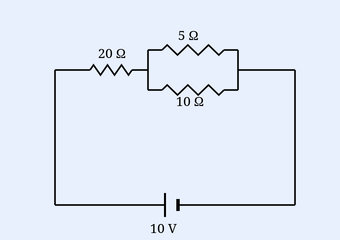
JEE Main 2024 April 05, Shift 2 Question Paper with Solutions
All 88 questions from the JEE Main 2024 (April 05, Shift 2) shift — Physics (30), Chemistry (28) and Mathematics (30) — each with the correct answer (answer key) and a step-by-step solution. Read it free online, or attempt the full paper as a timed mock test.
Physics30 questions
Q1Single correctLaws of Motion
A particle moves in plane under the influence of a force such that its linear momentum is . If k is constant, the angle between and will be :
(1)
(2)
(3)
(4)
SolutionAnswer: Option 3
Approach:
The force equals the time derivative of momentum. The angle between force and momentum follows from their dot product.
Step 1:Differentiate the momentum to find the force.
Step 2:Form the dot product of force and momentum.
Step 3:A zero dot product corresponds to perpendicular vectors.
Final answer:
Q2Single correctUnits and Measurements
What is the dimensional formula of in the equation , where letters have their usual meaning.
(1)
(2)
(3)
(4)
SolutionAnswer: Option 3
Approach:
The terms added in an equation share dimensions. The dimensions of a and b follow from matching with pressure and b with volume.
Step 1:Match with volume.
Step 2:Match with pressure to find the dimensions of a.
Step 3:Divide the dimensions of by those of .
Final answer:
Q3Single correctMotion in a Plane
A man carrying a monkey on his shoulder does cycling smoothly on a circular track of radius 9 m and completes 120 resolutions in 3 minutes. The magnitude of centripetal acceleration of monkey is ( in m/ ) :
(1)
(2)
(3)
(4)
SolutionAnswer: Option 4 m
Approach:
The angular speed follows from the number of revolutions per unit time, and the centripetal acceleration is the product of radius and the square of angular speed.
Step 1:Convert revolutions per minute to frequency in per second.
Step 2:Compute the angular speed.
Step 3:Apply the centripetal acceleration relation.
Final answer: m
Q4Single correctLaws of Motion
A heavy box of mass 50 kg is moving on a horizontal surface. If co-efficient of kinetic friction between the box and horizontal surface is 0.3 then force of kinetic friction is :
(1)
(2)
(3)
(4)
SolutionAnswer: Option 2147 N
Approach:
On a horizontal surface the normal force equals the weight, and kinetic friction is the product of the kinetic friction coefficient and the normal force.
Step 1:Compute the normal force on the horizontal surface.
Step 2:Apply the kinetic friction relation.
Final answer: 147 N
Q5Single correctWork, Energy and Power
A body is moving unidirectionally under the influence of a constant power source. Its displacement in time t is proportional to :
(1)
(2)
(3)
(4)
SolutionAnswer: Option 2
Approach:
Constant power gives velocity as a function of time through the work-energy theorem, and integrating velocity yields the displacement dependence.
Step 1:Constant power means kinetic energy grows linearly with time.
Step 2:Integrate velocity to obtain displacement.
Step 3:Evaluate the integral.
Final answer:
Q6Single correctGravitation
A satellite revolving around a planet in stationary orbit has time period 6 hours. The mass of planet is one-fourth the mass of earth. The radius orbit of planet is : ( Given Radius of geo-stationary orbit for earth is km )
(1)
(2)
(3)
(4)
SolutionAnswer: Option 2 km
Approach:
Kepler's third law relates the orbital radius to the period and the central mass; scaling from the earth's geostationary orbit gives the required radius.
Step 1:Express the orbital radius from Kepler's law.
Step 2:Form the ratio of planet radius to earth geostationary radius.
Step 3:Evaluate the ratio.
Step 4:Substitute the earth geostationary radius.
Final answer: km
Q7Single correctMechanical Properties of Solids
Match List-I with List-II :
| List-I | List-II |
|---|---|
| A. A force that restores an elastic body of unit area to its original state | I. Bulk modulus |
| B. Two equal and opposite forces parallel to opposite faces | II. Young's modulus |
| C. Forces perpendicular everywhere to the surface per unit area same everywhere | III. Stress |
| D. Two equal and opposite forces perpendicular to opposite faces | IV. Shear modulus |
(1)
(2)
(3)
(4)
SolutionAnswer: Option 2(A)-(III), (B)-(IV), (C)-(I), (D)-(II)
Approach:
Each description is identified with the corresponding elastic quantity by its defining force configuration.
Step 1:A restoring force per unit area defines stress, so (A) pairs with (III).
Step 2:Equal and opposite forces parallel to opposite faces produce shear, so (B) pairs with (IV).
Step 3:Forces perpendicular everywhere and uniform over the surface describe volumetric stress, so (C) pairs with (I) bulk modulus.
Step 4:Equal and opposite forces perpendicular to opposite faces produce longitudinal strain, so (D) pairs with (II) Young's modulus.
Final answer: (A)-(III), (B)-(IV), (C)-(I), (D)-(II)
Q8Single correctThermodynamics
During an adiabatic process, if the pressure of a gas is found to be proportional to the cube of its absolute temperature, then the ratio of for the gas is :
(1)
(2)
(3)
(4)
SolutionAnswer: Option 3
Approach:
The adiabatic relation between pressure and temperature fixes the exponent in terms of the heat capacity ratio, which is then solved from the given proportionality.
Step 1:Write the adiabatic relation as a power of temperature.
Step 2:Equate the exponent to the given value 3.
Step 3:Solve for the heat capacity ratio.
Final answer:
Q9Single correctKinetic Theory of Gases
If n is the number density and d is the diameter of the molecule, then the average distance covered by a molecule between two successive collisions (i.e. mean free path) is represented by :
(1)
(2)
(3)
(4)
SolutionAnswer: Option 3
Approach:
The mean free path is the inverse of the product of number density and collision cross-section, with a factor accounting for relative molecular motion.
Step 1:The collision cross-section uses the molecular diameter.
Step 2:Including relative speed introduces a factor of in the collision rate.
Step 3:The mean free path is the inverse of density times cross-section times the factor.
Final answer:
Q10Single correctElectrostatics
The vehicles carrying inflammable fluids usually have metallic chains touching the ground :
(1)
(2)
(3)
(4)
SolutionAnswer: Option 4To conduct excess charge due to air friction to ground and prevent sparking
Approach:
The reasoning rests on charge accumulation from friction and the role of a conducting path to ground.
Step 1:Motion through air builds up static charge on the vehicle.
Step 2:A metallic chain provides a conducting path that earths this charge continuously.
Step 3:Draining the charge prevents sparking near inflammable fluids.
Final answer: To conduct excess charge due to air friction to ground and prevent sparking
Q11Single correctCurrent Electricity
A galvanometer of resistance 100 when connected in series with 400 measures a voltage of upto 10 V. The value of resistance required to convert the galvanometer into ammeter to read upto 10 A is . The value of x is :
(1)
(2)
(3)
(4)
SolutionAnswer: Option 320
Approach:
The voltmeter configuration fixes the galvanometer full-scale current; the shunt for the ammeter then follows from current division.
Step 1:Determine the galvanometer full-scale current from the voltmeter data.
Step 2:Apply the shunt formula for the ammeter range.
Step 3:Evaluate the shunt resistance.
Final answer: 20
Q12Single correctCurrent Electricity
The ratio of heat dissipated per second through the resistance 5 and 10 in the circuit given below is :
(1)
(2)
(3)
(4)
SolutionAnswer: Option 22 : 1
Approach:
The 5 ohm and 10 ohm resistors are in parallel and share the same voltage, so the dissipated powers are inversely proportional to their resistances.
Step 1:The 5 ohm and 10 ohm resistors form a parallel branch sharing one common voltage.
Step 2:Form the ratio of dissipated powers at equal voltage.
Final answer: 2 : 1
Q13Single correctMoving Charges and Magnetism
The electrostatic force and magnetic force acting on a charge q moving with velocity v can be written :
(1)
(2)
(3)
(4)
SolutionAnswer: Option 1
Approach:
The Lorentz force law gives the electric and magnetic contributions on a moving charge in their standard forms.
Step 1:The electrostatic force on a charge is the charge times the electric field.
Step 2:The magnetic force is the charge times the cross product of velocity and magnetic field.
Final answer:
Q14Single correctAlternating Current
A series LCR circuit is subjected to an ac signal of 200 V, 50 Hz. If the voltage across the inductor is 31.4 V, then the current in this circuit is _____ .
(1)
(2)
(3)
(4)
SolutionAnswer: Option 310 A
Approach:
The current equals the inductor voltage divided by the inductive reactance, which is computed from the angular frequency and inductance.
Step 1:Compute the inductive reactance.
Step 2:Divide the inductor voltage by the reactance.
Step 3:Evaluate the current.
Final answer: 10 A
Q15Single correctElectromagnetic Waves
Match List-I with List-II :
| List-I (EM-Wave) | List-II (Wavelength Range) |
|---|---|
| A. Infra-red | I. nm |
| B. Ultraviolet | II. 400 nm to 1 nm |
| C. X-rays | III. 1 mm to 700 nm |
| D. Gamma rays | IV. 1 nm to nm |
(1)
(2)
(3)
(4)
SolutionAnswer: Option 1(A)-(III), (B)-(II), (C)-(IV), (D)-(I)
Approach:
Each electromagnetic wave is matched to its wavelength range by decreasing wavelength across the spectrum.
Step 1:Infra-red has the longest range here, 1 mm to 700 nm, so (A) pairs with (III).
Step 2:Ultraviolet spans 400 nm to 1 nm, so (B) pairs with (II).
Step 3:X-rays span 1 nm to nm, so (C) pairs with (IV).
Step 4:Gamma rays have the shortest wavelength, nm, so (D) pairs with (I).
Final answer: (A)-(III), (B)-(II), (C)-(IV), (D)-(I)
Q16Single correctOptics
Given below are two statements : Statement I : When the white light passed through a prism, the red light bends lesser than yellow and violet. Statement II : The refractive indices are different for different wavelengths in dispersive medium. In the light of the above statements, chose the correct answer from the options given below:
(1)
(2)
(3)
(4)
SolutionAnswer: Option 3Both Statement I and Statement II are true
Approach:
Examine the dependence of refractive index on wavelength and the resulting angular deviation in a prism.
Step 1:In a dispersive medium the refractive index varies with wavelength; shorter wavelengths have larger refractive index.
Step 2:Deviation through a prism increases with refractive index, so red (largest wavelength, smallest n) deviates least.
Step 3:Both statements describe the same physics and are correct.
Final answer: Both Statement I and Statement II are true
Q17Single correctDual Nature of Matter and Radiation
Which of the following statement is not true about stopping potential ?
(1)
(2)
(3)
(4)
SolutionAnswer: Option 2It increases with increase in intensity of the incident light.
Approach:
Apply the photoelectric equation to determine which factors influence the stopping potential.
Step 1:Stopping potential equals the maximum kinetic energy divided by electronic charge.
Step 2:Maximum kinetic energy depends on the incident frequency and the work function, which is set by the emitter material.
Step 3:Intensity changes the number of emitted electrons but not their maximum kinetic energy, so the stopping potential is independent of intensity.
Final answer: It increases with increase in intensity of the incident light.
Q18Single correctAtoms and Nuclei
The angular momentum of an electron in a hydrogen atom is proportional to : (Where is the radius of orbit of electron)
(1)
(2)
(3)
(4)
SolutionAnswer: Option 2
Approach:
Relate the quantized angular momentum and orbital radius in the Bohr model through the quantum number n.
Step 1:Angular momentum is proportional to the principal quantum number.
Step 2:Orbital radius scales with the square of the quantum number.
Step 3:Substitute the dependence of n on r into the angular momentum.
Final answer:
Q19Single correctElectronic Devices
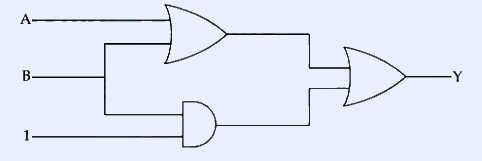
The output of logic circuit given below is 0 only when :
(1)
(2)
(3)
(4)
SolutionAnswer: Option 3
Approach:
Trace the inputs through the two first-stage gates and the final OR gate to obtain the Boolean expression for Y.
Step 1:The top gate is an OR of A and B; the bottom gate is an AND of B and the constant 1.
Step 2:The final OR gate combines both outputs.
Step 3:An OR output is 0 only when both inputs are 0.
Final answer:
Q20Single correctExperimental Skills
A vernier callipers has 20 divisions on the vernier scale, which coincides with division on the main scale. The least count of the instrument is 0.1 mm. One main scale division is equal to _____mm.
(1)
(2)
(3)
(4)
SolutionAnswer: Option 22
Approach:
Use the least count relation for a vernier callipers, where N vernier divisions span (N-1) main scale divisions.
Step 1:20 vernier divisions coincide with 19 main scale divisions, so one vernier division equals 19/20 of a main scale division.
Step 2:Least count is the difference between one main scale division and one vernier division.
Step 3:Set the least count equal to 0.1 mm and solve for one main scale division.
Final answer: 2
Q21NumericalKinematics
The maximum height reached by a projectile is 64 m. If the initial velocity is halved, the new maximum height of the projectile is _____ m.
SolutionAnswer: 16
Approach:
Maximum height of a projectile is proportional to the square of the initial velocity for a fixed angle of projection.
Step 1:Maximum height varies as the square of the initial velocity at constant projection angle.
Step 2:Halving the initial velocity reduces the height by a factor of four.
Step 3:Substitute the original height.
Final answer: 16
Q22NumericalRotational Motion
A hollow sphere is rolling on a plane surface about its axis of symmetry. The ratio of rotational kinetic energy to its total kinetic energy is . The value of x is _____ .
SolutionAnswer: 2
Approach:
Express rotational and total kinetic energy of a rolling hollow sphere using its moment of inertia and the rolling condition.
Step 1:Rotational kinetic energy uses the hollow sphere moment of inertia with the rolling condition.
Step 2:Total kinetic energy is the sum of translational and rotational parts.
Step 3:Form the requested ratio.
Step 4:Compare with x/5.
Final answer: 2
Q23NumericalSolids and Liquids
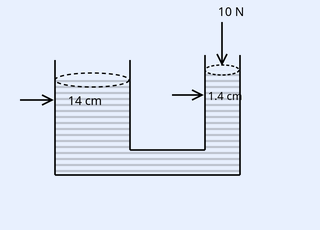
A hydraulic press containing water has two arms with diameters as mentioned in the figure. A force of 10 N is applied on the surface of water in the thinner arm. The force required to be applied on the surface of water in the thicker arm to maintain equilibrium of water is _____N.
SolutionAnswer: 1000
Approach:
Equal pressure transmission through the connected fluid (Pascal's law) relates the two forces through the cross-sectional areas.
Step 1:Pressure is equal in both arms, so force ratio equals area ratio, which scales with the square of the diameter.
Step 2:The thicker arm has diameter 14 cm and the thinner arm 1.4 cm, a ratio of 10.
Step 3:Compute the required force on the thicker arm.
Final answer: 1000
Q24NumericalOscillations and Waves
A sonometer wire of resonating length 90 cm has a fundamental frequency of 400 Hz when kept under some tension. The resonating length of the wire with fundamental frequency of 600 Hz under same tension _____cm.
SolutionAnswer: 60
Approach:
At fixed tension and linear density, the fundamental frequency of a stretched wire is inversely proportional to its length.
Step 1:With tension and mass per unit length unchanged, frequency varies inversely with length.
Step 2:Substitute the known values.
Step 3:Solve for the new length.
Final answer: 60
Q25NumericalElectrostatics
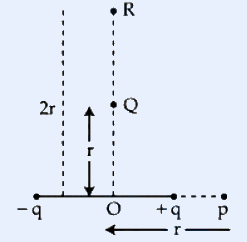
The electric field at point p due to an electric dipole is E. The electric field at point R on equatorial line will be . The value of x :
SolutionAnswer: 16
Approach:
Compare the axial field at point p (distance r) with the equatorial field at point R (distance 2r), using the dipole field expressions.
Step 1:Point p lies on the axis at distance r, giving the axial field E.
Step 2:Point R lies on the equatorial line at distance 2r from the centre.
Step 3:Form the ratio of the two fields.
Step 4:Identify x from = E/x.
Final answer: 16
Q26NumericalCurrent Electricity
A wire of resistance 20 is divided into 10 equal parts, resulting pairs. A combination of two parts are connected in parallel and so on. Now resulting pairs of parallel combination are connected in series. The equivalent resistance of final combination is _____ .
SolutionAnswer: 5
Approach:
Find each part's resistance, combine pairs in parallel, then add the five parallel combinations in series.
Step 1:Dividing 20 ohm into 10 equal parts gives each part a resistance of 2 ohm.
Step 2:Two such parts in parallel give 1 ohm; there are five such parallel pairs.
Step 3:Connecting the five 1 ohm combinations in series.
Final answer: 5
Q27NumericalMagnetism
A solenoid of length 0.5 m has a radius of 1 cm and is made up of ' m ' number of turns. It carries a current of 5 A. If the magnitude of the magnetic field inside the solenoid is T then the value of m is _____.
SolutionAnswer: 500
Approach:
Use the axial magnetic field of a long solenoid to solve for the total number of turns.
Step 1:Express the field in terms of total turns N over length L.
Step 2:Rearrange for N and substitute the values.
Step 3:Evaluate the expression.
Final answer: 500
Q28NumericalEMI and AC
The current in an inductor is given by where t is in second. The magnitude of induced emf produced in the inductor is 12mV. The self-inductance of the inductor _____ mH.
SolutionAnswer: 4
Approach:
Relate the induced emf to the rate of change of current through the self-inductance.
Step 1:Differentiate the current to find its rate of change.
Step 2:Apply the emf relation with the given emf.
Step 3:Solve for the self-inductance.
Final answer: 4
Q29NumericalOptics
In a single slit experiment, a parallel beam of green light of wavelength 550 nm passes through a slit of width 0.20 mm. The transmitted light is collected on a screen 100 cm away. The distance of first order minima from the central maximum will be m. The value of x is :
SolutionAnswer: 275
Approach:
Apply the single slit minima condition to find the position of the first order minimum on the screen.
Step 1:The first order minimum of single slit diffraction is located using n = 1.
Step 2:Substitute wavelength 550 nm, screen distance 1 m and slit width 0.20 mm.
Step 3:Evaluate the position.
Final answer: 275
Q30NumericalAtoms and Nuclei
The shortest wavelength of the spectral lines in the Lyman series of hydrogen spectrum is 915 Å. The longest wavelength of spectral lines in the Balmer series will be _____ Å.
SolutionAnswer: 6588
Approach:
Use the Rydberg formula; the Lyman series limit fixes the Rydberg constant, which then gives the longest Balmer wavelength (the H-alpha transition).
Step 1:The shortest Lyman wavelength corresponds to the transition from infinity to n = 1.
Step 2:The longest Balmer wavelength corresponds to the transition from n = 3 to n = 2.
Step 3:Combine to express the Balmer wavelength in terms of the Lyman limit.
Step 4:Evaluate the wavelength.
Final answer: 6588
Chemistry28 questions
Q31Single correctSome Basic Concepts of Chemistry
The number of moles of methane required to produce 11 g C( g) after complete combustion is : (Given molar mass of methane in gmo : 16)
(1)
(2)
(3)
(4)
SolutionAnswer: Option 40.25
Approach:
Combustion of methane gives one mole of C per mole of C; convert the C mass to moles to find the methane moles.
Step 1:Determine moles of C produced using its molar mass of 44 g mo.
Step 2:From the balanced equation, one mole of C yields one mole of C, so the mole ratio is 1:1.
Step 3:Therefore the methane required equals the moles of C.
Final answer: 0.25
Q32Single correctClassification of Elements and Periodicity in Properties
Given below are two statements : Statement I : The metallic radius of Na is 1.86 A and the ionic radius of Na is lesser than 1.86 A. Statement II : Ions are always smaller in size than the corresponding elements. In the light of the above statements, choose the correct answer from the options given below :
(1)
(2)
(3)
(4)
SolutionAnswer: Option 4Statement I is correct but Statement II is false
Approach:
Evaluate each statement against periodic trends in metallic and ionic radii.
Step 1:A sodium cation loses its outermost electron and gains nuclear pull on remaining electrons, so Na is smaller than the Na atom radius of 1.86 A. Statement I is correct.
Step 2:Anions are larger than their parent atoms because added electrons increase electron-electron repulsion, so the claim that all ions are smaller than the corresponding elements fails. Statement II is false.
Step 3:Therefore Statement I is correct while Statement II is false.
Final answer: Statement I is correct but Statement II is false
Q33Single correctChemical Bonding and Molecular Structure
Match List I with List II
| List I | List II |
|---|---|
| A. ICl | I. T - shape |
| B. IC | II. pyramidal |
| C. Cl | III. Pentagonal bipyramidal |
| D. I | IV. Linear |
(1)
(2)
(3)
(4)
SolutionAnswer: Option 1(A)-(IV), (B)-(I), (C)-(II), (D)-(III)
Approach:
Assign the shape of each interhalogen species from its hybridisation and lone-pair count, then match.
Step 1:ICl is a diatomic interhalogen with two atoms, giving a linear shape, matching (IV).
Step 2:IC has three bond pairs and two lone pairs (A), producing a T-shape, matching (I).
Step 3:Cl has five bond pairs and one lone pair (AE), giving a square pyramidal (pyramidal) shape, matching (II).
Step 4:I has seven bond pairs (A), giving a pentagonal bipyramidal shape, matching (III).
Final answer: (A)-(IV), (B)-(I), (C)-(II), (D)-(III)
Q34Single correctChemical Bonding and Molecular Structure
Given below are two statements : one is labelled as Assertion (A) and the other is labelled as Reason (R).
Assertion (A) : N and N molecule have pyramidal shape with a lone pair of electrons on nitrogen atom. The resultant dipole moment of N is greater than that of N. Reason (R) : In N, the orbital dipole due to lone pair is in the same direction as the resultant dipole moment of the N H bonds. F is the most electronegative element. In the light of the above statements, choose the correct answer from the options given below :
Assertion (A) : N and N molecule have pyramidal shape with a lone pair of electrons on nitrogen atom. The resultant dipole moment of N is greater than that of N. Reason (R) : In N, the orbital dipole due to lone pair is in the same direction as the resultant dipole moment of the N H bonds. F is the most electronegative element. In the light of the above statements, choose the correct answer from the options given below :
(1)
(2)
(3)
(4)
SolutionAnswer: Option 1Both (A) and (R) are true and (R) is the correct explanation of (A)
Approach:
Compare the vector addition of bond and lone-pair dipoles in N versus N.
Step 1:In N the N H bond dipoles point toward nitrogen, the same direction as the lone-pair dipole, so the contributions add and give a large net moment.
Step 2:In N the N F bond dipoles point toward the more electronegative fluorine, opposing the lone-pair dipole, so they partly cancel and give a small net moment.
Step 3:Therefore , making (A) true, and the directional argument in (R) correctly explains it.
Final answer: Both (A) and (R) are true and (R) is the correct explanation of (A)
Q36Single correctThe p-Block Elements
The correct statements from the following are : (A) The decreasing order of atomic radii of group 13 elements is Tl In Ga Al B. (B) Down the group 13 electronegativity decreases from top to bottom. (C) Al dissolves in dil. HCl and liberates but conc. HN renders Al passive by forming a protective oxide layer on the surface. (D) All elements of group 13 exhibits highly stable +1 oxidation state. (E) Hybridisation of Al in ion is s . Choose the correct answer from the options given below :
(1)
(2)
(3)
(4)
SolutionAnswer: Option 3(C) and (E) only
Approach:
Test each statement against group 13 periodic trends and bonding.
Step 1:Group 13 atomic radii do not increase smoothly; Ga is smaller than Al due to poor d-electron shielding, so the strict order Tl In Ga Al B is not correct. (A) is incorrect.
Step 2:Electronegativity in group 13 does not decrease monotonically down the group; it fluctuates, so (B) is incorrect.
Step 3:Aluminium dissolves in dilute HCl to liberate , while concentrated HN passivates it via an oxide layer, so (C) is correct.
Step 4:Only heavier members (Tl) show a stable +1 state, not all group 13 elements, so (D) is incorrect; the octahedral hexaaqua aluminium ion uses s hybridisation, so (E) is correct.
Final answer: (C) and (E) only
Q37Single correctOrganic Chemistry - Some Basic Principles and Techniques
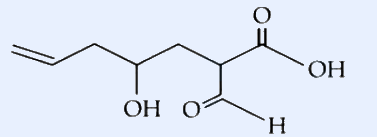
The correct nomenclature for the following compound is :
(1)
(2)
(3)
(4)
SolutionAnswer: Option 22-formyl-4-hydroxyhept-6-enoic acid
Approach:
Identify the principal characteristic group, number the chain to give it the lowest locant, and name the substituents.
Step 1:The carboxylic acid group outranks the aldehyde and hydroxyl groups, so it becomes the principal group and carbon C1, giving the parent name an -oic acid suffix.
Step 2:The longest chain bearing the carboxylic acid has seven carbons; the aldehyde at C2 is named as a formyl substituent and the hydroxyl at C4 as hydroxy.
Step 3:The carbon-carbon double bond lies between C6 and C7, giving the hept-6-ene locant.
Step 4:Combining the parts gives 2-formyl-4-hydroxyhept-6-enoic acid.
Final answer: 2-formyl-4-hydroxyhept-6-enoic acid
Q38Single correctOrganic Chemistry - Some Basic Principles and Techniques
Match List I with List II
| List - I (Pair of compounds) | List - II (Isomerism) |
|---|---|
| A. n-propanol and Isopropanol | I. Metamerism |
| B. Methoxypropane and ethoxyethane | II. Chain Isomerism |
| C. Propanone and propanal | III. Position Isomerism |
| D. Neopentane and Isopentane | IV. Functional Isomerism |
(1)
(2)
(3)
(4)
SolutionAnswer: Option 4(A)-(III), (B)-(I), (C)-(IV), (D)-(II)
Approach:
Classify the isomerism relating each pair of compounds.
Step 1:n-propanol and isopropanol differ only in the position of the hydroxyl group on the same carbon skeleton, which is position isomerism.
Step 2:Methoxypropane and ethoxyethane are ethers with different alkyl groups about the oxygen, which is metamerism.
Step 3:Propanone (ketone) and propanal (aldehyde) share the formula O but contain different functional groups, which is functional isomerism.
Step 4:Neopentane and isopentane differ in carbon-chain branching, which is chain isomerism.
Final answer: (A)-(III), (B)-(I), (C)-(IV), (D)-(II)
Q39Single correctAldehydes, Ketones and Carboxylic Acids
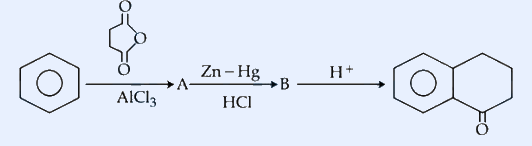
Identify and in the given chemical reaction sequence :
(1)
(2)
(3)
(4)
SolutionAnswer: Option 3
Approach:
Trace the intramolecular Friedel-Crafts acylation, Clemmensen reduction, and acid-catalysed cyclisation that build the fused bicyclic ketone product.
Step 1:Benzene reacts with succinic anhydride and AlC by Friedel-Crafts acylation to give a keto-acid, 4-oxo-4-phenylbutanoic acid, which is intermediate A.
Step 2:Clemmensen reduction with Zn-Hg and HCl reduces the aryl ketone carbonyl to a methylene, giving 4-phenylbutanoic acid, which is intermediate .
Step 3:Acid-catalysed intramolecular Friedel-Crafts acylation of then forms the fused bicyclic ketone 1-tetralone (3,4-dihydronaphthalen-1(2H)-one).
Step 4:Therefore is the phenyl keto-acid and is 4-phenylbutanoic acid, matching the structures in option 3.
Q40Single correctHydrocarbons
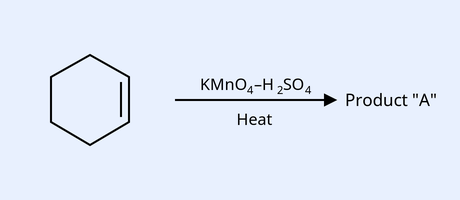
Consider the given chemical reaction :
Product " A " is :
Product " A " is :
(1)
(2)
(3)
(4)
SolutionAnswer: Option 3adipic acid
Approach:
Apply hot acidic potassium permanganate oxidative cleavage to the ring double bond of cyclohexene.
Step 1:Hot acidified KMn cleaves the carbon-carbon double bond of cyclohexene, opening the ring at the alkene.
Step 2:Each former alkene carbon is oxidised to a carboxylic acid, and since both carbons bear hydrogens they become COOH groups joined by the remaining four-carbon chain.
Step 3:The six-carbon dicarboxylic acid HOOC(CH_2COOH is adipic acid.
Final answer: adipic acid
Q41Single correctElectrochemistry
The quantity of silver deposited when one coulomb charge is passed through AgN solution :
(1)
(2)
(3)
(4)
SolutionAnswer: Option 21 electrochemical equivalent of silver
Approach:
Use Faraday's first law to interpret the mass deposited by one coulomb of charge.
Step 1:Faraday's first law states the mass deposited equals the electrochemical equivalent times the charge passed.
Step 2:The electrochemical equivalent is defined as the mass deposited by one coulomb of charge, so setting C gives .
Step 3:Therefore one coulomb deposits exactly one electrochemical equivalent of silver.
Final answer: 1 electrochemical equivalent of silver
Q42Single correctElectrochemistry
For the electro chemical cell If V and V. Which of the following is correct?
(1)
(2)
(3)
(4)
SolutionAnswer: Option 4 M X is a spontaneous reaction
Approach:
Use the standard electrode potentials to find the cell EMF and the direction of the spontaneous reaction.
Step 1:The species with the higher reduction potential acts as the cathode; here V exceeds V, so the /M couple is reduced.
Step 2:Computing the EMF with /M as cathode and the X couple as anode gives a positive value.
Step 3:A positive EMF makes the reduction of together with oxidation at the X electrode spontaneous, so the reaction M X proceeds spontaneously.
Final answer: M X is a spontaneous reaction
Q43Single correctThe d- and f-Block Elements
The number of ions from the following that have the ability to liberate hydrogen from a dilute acid is _____.
T, C and
T, C and
(1)
(2)
(3)
(4)
SolutionAnswer: Option 23
Approach:
An ion liberates hydrogen from dilute acid when its / reduction potential is negative, making the ion a strong reductant.
Step 1:T, and C each have negative / standard potentials, so they are strong enough reducing agents to reduce H to .
Step 2:Each of these ions is oxidised by H from dilute acid, releasing hydrogen gas.
Step 3:Therefore all three ions liberate hydrogen from dilute acid.
Final answer: 3
Q44Single correctPrinciples Related to Practical Chemistry
While preparing crystals of Mohr's salt, dil is added to a mixture of ferrous sulphate and ammonium sulphate, before dissolving this mixture in water, dil is added here to :
(1)
(2)
(3)
(4)
SolutionAnswer: Option 1prevent the hydrolysis of ferrous sulphate
Approach:
Identify the salt prone to hydrolysis among the components and the role of the added acid.
Step 1:Ferrous sulphate is the salt of a weak base and a strong acid, so its ferrous ion tends to hydrolyse in water, forming a basic precipitate.
Step 2:Adding dilute increases H concentration, shifting the hydrolysis equilibrium backward and keeping the ferrous ions in solution.
Step 3:Therefore the acid is added to prevent the hydrolysis of ferrous sulphate.
Final answer: prevent the hydrolysis of ferrous sulphate
Q46Single correctCoordination Compounds
The metal atom present in the complex MABXL (where A, B, X and L are unidentate ligands and M is metal) involves s hybridization. The number of geometrical isomers exhibited by the complex is:
(1)
(2)
(3)
(4)
SolutionAnswer: Option 20
Approach:
An s hybridized metal centre adopts a tetrahedral geometry. Geometrical isomerism is assessed for a tetrahedral MABXL complex.
Step 1:s hybridization fixes the geometry of M as tetrahedral with four ligand positions.
Step 2:In a tetrahedral arrangement every ligand position is adjacent to all others, so no two distinct cis/trans relationships exist among the four different ligands.
Step 3:Tetrahedral complexes do not show geometrical isomerism; therefore the count is zero.
Final answer: 0
Q47Single correctHaloalkanes and Haloarenes
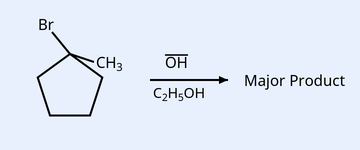
Identify the major product in the following reaction.
(1)
(2)
(3)
(4)
SolutionAnswer: Option 3
Approach:
The substrate is 1-bromo-1-methylcyclopentane, a tertiary halide, treated with alcoholic KOH (/OH), which promotes E2 elimination. Saytzeff's rule selects the more substituted alkene.
Step 1:Alcoholic KOH supplies a strong base favouring elimination over substitution for a tertiary halide.
Step 2:Loss of HBr can give either the endocyclic (ring) double bond bearing the methyl group or the exocyclic methylene double bond.
Step 3:The endocyclic, trisubstituted alkene (1-methylcyclopentene) is more substituted and thermodynamically more stable, hence the Saytzeff major product.
Final answer: 1-methylcyclopent-1-ene (option 3)
Q48Single correctAldehydes, Ketones and Carboxylic Acids
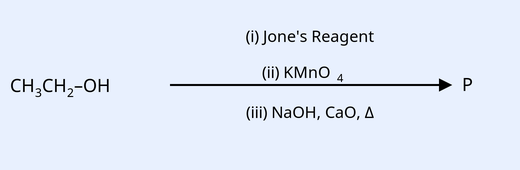
C-OH P
Consider the above reaction sequence and identify the major product P.
Consider the above reaction sequence and identify the major product P.
(1)
(2)
(3)
(4)
SolutionAnswer: Option 4Methane
Approach:
Ethanol is oxidized to acetic acid, then the sodium salt undergoes decarboxylation (soda-lime, NaOH/CaO, ) to give the hydrocarbon with one fewer carbon.
Step 1:Jone's reagent and KMn oxidize ethanol fully to acetic acid.
Step 2:NaOH converts acetic acid to sodium acetate.
Step 3:Soda-lime decarboxylation removes C as carbonate, replacing -COONa by -H.
Final answer: Methane
Q49Single correctHaloalkanes and Haloarenes
Which one of the following reactions is NOT possible?
(1)
(2)
(3)
(4)
SolutionAnswer: Option 4
Approach:
Each option is evaluated for feasibility. The conversion of phenol to chlorobenzene by treatment with HCl is examined.
Step 1:Option 1: anisole with HBr cleaves the ether to give phenol and methyl bromide, a feasible reaction.
Step 2:Option 2: chlorination of anisole with C/AlC gives para-chloroanisole, a feasible electrophilic substitution.
Step 3:Option 3: chlorobenzene with NaOH at high temperature and acidification gives phenol (Dow process), feasible.
Step 4:Option 4: phenol with HCl cannot replace -OH by -Cl because the C(s)-O bond has partial double-bond character and is not cleaved by HCl; this reaction is not possible.
Final answer: Phenol + HCl to chlorobenzene (option 4)
Q50Single correctBiomolecules
Coagulation of egg, on heating is because of :
(1)
(2)
(3)
(4)
SolutionAnswer: Option 2Denaturation of protein occurs
Approach:
Heating disrupts the hydrogen bonds and other weak interactions holding the secondary and tertiary structure of egg albumin, causing denaturation.
Step 1:Egg white contains globular protein (albumin) stabilized by hydrogen bonds and disulphide/electrostatic interactions.
Step 2:Heat breaks these weak interactions, unfolding the secondary and tertiary structure while the primary peptide backbone stays intact.
Step 3:The unfolded chains aggregate and the protein coagulates, losing biological activity.
Final answer: Denaturation of protein occurs
Q51NumericalStructure of Atom
In an atom, total number of electrons having quantum numbers n and m is _______
SolutionAnswer: 6
Approach:
Electrons in the n=4 shell with magnetic quantum number magnitude are counted across all allowed subshells, then restricted to a single spin orientation.
Step 1:For n=4, the allowed subshells are l = 0, 1, 2, 3 (4s, 4p, 4d, 4f).
Step 2:Orbitals with exist for l = 1, 2, 3 (not l = 0), giving two orbitals ( and ) in each of these three subshells.
Step 3:Each orbital holds one electron with , giving 6 such electrons.
Final answer: 6
Q52NumericalChemical Bonding and Molecular Structure
Number of compounds from the following with zero dipole moment is _______
HF, , S, C, N, B, C, CHC, Si, O, Be
HF, , S, C, N, B, C, CHC, Si, O, Be
SolutionAnswer: 6
Approach:
A molecule has zero net dipole moment when its bond dipoles cancel by symmetry. Each species is classified by geometry.
Step 1:Homonuclear and symmetric nonpolar species: (homonuclear), C (linear symmetric), B (trigonal planar), C (tetrahedral), Si (tetrahedral), Be (linear) all have cancelling dipoles.
Step 2:Polar species with net dipole: HF (heteronuclear), S (bent), N (pyramidal), CHC (asymmetric tetrahedral), O (bent) have non-zero dipole.
Step 3:Counting the symmetric, dipole-free molecules gives six.
Final answer: 6
Q53NumericalThermodynamics
Combustion of 1 mole of benzene is expressed at . The standard enthalpy of combustion of 2 mol of benzene is kJ. _______
Given:
1. standard Enthalpy of formation of 1 mol of , for the reaction is 48.5 kJ mo.
2. Standard Enthalpy of formation of 1 mol of , for the reaction is kJ mo.
3. Standard and Enthalpy of formation of 1 mol of , for the reaction is kJ mo.
Given:
1. standard Enthalpy of formation of 1 mol of , for the reaction is 48.5 kJ mo.
2. Standard Enthalpy of formation of 1 mol of , for the reaction is kJ mo.
3. Standard and Enthalpy of formation of 1 mol of , for the reaction is kJ mo.
SolutionAnswer: 6535
Approach:
The standard enthalpy of combustion per mole is obtained from formation enthalpies via Hess's law, then scaled to 2 moles of benzene.
Step 1:For 1 mol benzene combustion, products are 6 C and 3 O; reactant formation term is benzene ( has zero formation enthalpy).
Step 2:Evaluate the product sum.
Step 3:Subtract the benzene formation enthalpy.
Step 4:Scale to 2 moles of benzene.
Final answer: 6535
Q54NumericalSome Basic Principles of Organic Chemistry
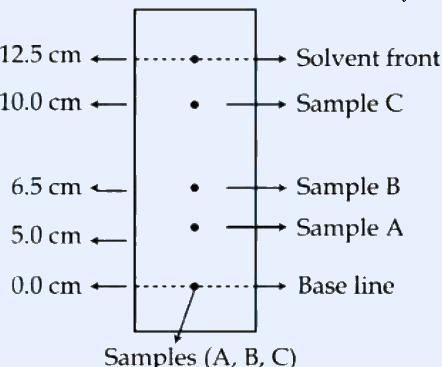
Using the given figure, the ratio of values of sample A and sample C is . Value of x is _______
SolutionAnswer: 50
Approach:
The retardation factor is the ratio of the distance moved by the sample to the distance moved by the solvent front (measured from the base line). The required ratio is .
Step 1:From the figure, the base line is at 0.0 cm and the solvent front at 12.5 cm; sample A spot is at 5.0 cm and sample C spot at 10.0 cm.
Step 2:Compute each relative to the solvent front.
Step 3:Take the ratio.
Final answer: 50
Q55NumericalSolutions
Considering acetic acid dissociates in water, its dissociation constant is . If 5 mL of acetic acid is dissolved in 1 litre water, the solution will freeze at C, provided pure water freezes at C. _______ . (Nearest integer) Given : K kg mo. density of acetic acid is 1.2 g mo. _______ molar mass of water g mo. Acetic acid dissociates as molar mass of acetic acid gmo. density of water g c
CCOOH C H
CCOOH C H
SolutionAnswer: 19
Approach:
The molality of acetic acid is found from its volume and density, the degree of dissociation from the dissociation constant, the van't Hoff factor from that, and finally the freezing point depression.
Step 1:Mass of acetic acid = volume x density = 5 x 1.2 = 6 g; moles = 6/60 = 0.1 mol. With 1 L (1 kg) water, molality m = 0.1 mol k.
Step 2:Concentration C taken as 0.1; degree of dissociation from .
Step 3:van't Hoff factor for 1:1 dissociation.
Step 4:Freezing point depression.
Step 5:Express as and round to nearest integer.
Final answer: 19
Q56NumericalChemical Kinetics
Consider the following single step reaction in gas phase at constant temperature. 2 A B The initial rate of the reaction is recorded as when the reaction starts with 1.5 atm pressure of A and 0.7 atm pressure of B. After some time, the rate is recorded when the pressure of C becomes 0.5 atm. The ratio : is _______ . (Nearest integer)
SolutionAnswer: 315
Approach:
For a single-step (elementary) reaction the rate law follows the stoichiometric coefficients: . Partial pressures are updated by the stoichiometry once 0.5 atm of C has formed.
Step 1:Initial rate uses , .
Step 2:Forming 0.5 atm C consumes 2(0.5) = 1.0 atm A and 0.5 atm B by stoichiometry.
Step 3:Rate at that instant.
Step 4:Form the ratio.
Step 5:Express as .
Final answer: 315
Q57NumericalThe d- and f-Block Elements
The fusion of chromite ore with sodium carbonate in the presence of air leads to the formation of products A and B along with the evolution of C. The sum of spin-only magnetic moment values of A and B is _______ B.M. (Nearest integer) [Given atomic number : C : 6, Na : 11, O : 8, Fe : 26, Cr : 24]
SolutionAnswer: 6
Approach:
Identify products A and B of chromite fusion with N in air, determine the unpaired electrons in each, and sum their spin-only magnetic moments.
Step 1:Roasting with and air gives sodium chromate () and ferric oxide (), releasing .
Step 2:In N chromium is C (), so it has zero unpaired electrons and zero moment.
Step 3:In F iron is F () with 5 unpaired electrons.
Step 4:Sum the moments and round to the nearest integer.
Final answer: 6
Q58NumericalAldehydes, Ketones and Carboxylic Acids
In the Claisen-Schmidt reaction to prepare 351 g of dibenzalacetone using 87 g of acetone, the amount of benzaldehyde required is _______ g. (Nearest integer)
SolutionAnswer: 318
Approach:
Dibenzalacetone forms from one acetone and two benzaldehyde molecules. The mass of benzaldehyde is found from the moles of product (or of acetone) using this 1:2 stoichiometry.
Step 1:Reaction: . Molar masses: acetone 58, benzaldehyde 106, dibenzalacetone 234 g mo.
Step 2:Moles of acetone = 87/58 = 1.5 mol, requiring 2 x 1.5 = 3 mol benzaldehyde.
Step 3:Mass of benzaldehyde.
Final answer: 318
Q59NumericalHydrocarbons
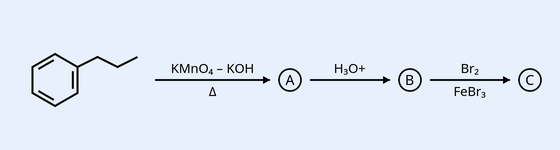
The product (C) in the following sequence of reactions has _______ bonds.
SolutionAnswer: 4
Approach:
The propyl-substituted benzene is oxidized at the side chain to benzoic acid, acidified, then brominated on the ring. The pi bonds in the final product are counted.
Step 1:Hot alkaline KMn oxidizes the alkyl side chain of n-propylbenzene to a carboxyl group, giving potassium benzoate (A); acidification () gives benzoic acid (B).
Step 2:B/FeB carries out electrophilic ring bromination (the -COOH group is meta-directing), giving meta-bromobenzoic acid (C).
Step 3:Count pi bonds: the benzene ring contributes 3 pi bonds and the carboxyl C=O contributes 1 pi bond.
Final answer: 4
Q60NumericalAmines
Xg of ethanamine was subjected to reaction with NaN/HCl followed by hydrolysis to liberate and HCl. The HCl generated was completely neutralised by 0.2 moles of NaOH. X is _______ g.
SolutionAnswer: 9
Approach:
A primary aliphatic amine reacts with nitrous acid to give an alcohol, liberating and HCl in 1:1 mole ratio with the amine. The HCl neutralised gives the moles of amine, hence its mass.
Step 1: with NaN/HCl gives a diazonium intermediate that on hydrolysis yields ethanol, and HCl; per mole of amine one mole of HCl is generated.
Step 2:0.2 mol NaOH neutralises 0.2 mol HCl, so moles of amine = 0.2 mol.
Step 3:Molar mass of ethanamine = 45 g mo; mass = 0.2 x 45.
Final answer: 9
Mathematics30 questions
Q61Single correctComplex Numbers and Quadratic Equations
Let , and . Then the area of the region is :
(1)
(2)
(3)
(4)
SolutionAnswer: Option 1
Approach:
Reduce each set to a real-plane region with , then identify the bounded sector of the disk and apply the circular-sector area formula.
Step 1: is the disk centred at the origin of radius 5.
Step 2:Rationalise the quotient in ; its imaginary part is proportional to .
Step 3: restricts to the right half-plane.
Step 4:Intersecting the two half-plane conditions inside the disk yields the angular sector from to , of central angle .
Step 5:Apply the sector-area formula with .
Final answer:
Q62Single correctPermutations and Combinations
60 words can be made using all the letters of the word BHBJO, with or without meaning. If these words are written as in a dictionary, then the word is :
(1)
(2)
(3)
(4)
SolutionAnswer: Option 2OBBJH
Approach:
Order the letters alphabetically and count words block-by-block until the cumulative total reaches 50.
Step 1:Alphabetical order of the multiset has first letters B, H, J, O.
Step 2:Words starting with B fix one B; the remaining four letters give words. Words starting with H fix one of the unique letters; remaining give words. The same count applies to J.
Step 3:The remaining words begin with O. Order after O: the 49th word is OBBHJ and the 50th is OBBJH.
Final answer: OBBJH
Q63Single correctSequences and Series
For , the least value of K, for which , , are three consecutive terms of an A.P., is equal to :
(1)
(2)
(3)
(4)
SolutionAnswer: Option 310
Approach:
Use the A.P. middle-term condition, substitute , and minimise the resulting expression in .
Step 1:The middle term equals the average of the outer terms.
Step 2:Set and , so .
Step 3:For , gives ; the increasing function attains its least value at .
Final answer: 10
Q64Single correctBinomial Theorem
If the constant term in the expansion of , , is , then is equal to :
(1)
(2)
(3)
(4)
SolutionAnswer: Option 4693
Approach:
Write the general term, set the power of to zero to fix , evaluate the coefficient, and compare with the given form.
Step 1:The exponent of is ; the constant term requires it to vanish.
Step 2:Substitute into the general term.
Step 3:Write and match to .
Step 4:Multiply by 25.
Final answer: 693
Q65Single correctCoordinate Geometry
Let and be two points and P be a variable point above the line AB such that the area of is 10 . If the locus of P is ax + by = 15, then a b is :
(1)
(2)
(3)
(4)
SolutionAnswer: Option 4
Approach:
Express the triangle area via the determinant form, impose the fixed value 10 with above line , normalise to the given right-hand side 15, and read off the coefficients.
Step 1:Form the area of with P(x,y), , .
Step 2:For above , the signed expression is positive, giving the linear locus.
Step 3:Scale to match the right-hand value 15 by multiplying by .
Step 4:Evaluate the required combination.
Final answer:
Q66Single correctCoordinate Geometry
Let and be squares of side 4 and 2 units, respectively. The point is on the line segment AB and the point F is on the diagonal AC. Then the radius r of the circle passing through the point F and touching the line segments BC and CD satisfies:
(1)
(2)
(3)
(4)
SolutionAnswer: Option 4
Approach:
Place the big square in coordinates, locate F on the diagonal, write the centre of a circle tangent to the two sides at the corner C, and impose that it passes through F.
Step 1:Take , , , . The square of side 2 with on gives and , which lies on diagonal .
Step 2:A circle of radius r tangent to and has centre .
Step 3:Impose passage through .
Step 4:Expand and simplify.
Final answer:
Q67Single correctCoordinate Geometry
Let the circle and be a circle having centre at and radius 2 . If the line of the common chord of and intersects the y-axis at the point P, then the square of the distance of P from the centre of is :
(1)
(2)
(3)
(4)
SolutionAnswer: Option 12
Approach:
Write both circles in general form, subtract to get the common-chord (radical) line, intersect with the y-axis, and compute the squared distance to the centre of .
Step 1: has centre . Form with centre and radius 2.
Step 2:Subtract from to obtain the common chord.
Step 3:Intersect with the -axis .
Step 4:Square of the distance from P to centre of .
Final answer: 2
Q68Single correctPermutations and Combinations
Let the set be partitioned into 3 sets A, B, C with equal number of elements such that and . The maximum number of such possible partitions of S is equal to:
(1)
(2)
(3)
(4)
SolutionAnswer: Option 11680
Approach:
Count the elements of , then count the ways to distribute them equally into three labelled disjoint sets using the multinomial coefficient.
Step 1: has 9 distinct elements, so each of A, B, C contains 3 elements.
Step 2:Choose 3 elements for , then 3 for , leaving 3 for .
Step 3:Equivalently the multinomial coefficient.
Final answer: 1680
Q69Single correctMatrices and Determinants
Let and . If is the matrix of cofactors of the elements of A, then is equal to :
(1)
(2)
(3)
(4)
SolutionAnswer: Option 2216
Approach:
Match entries of B to the cofactors of A to determine and , then use for a cofactor matrix so that .
Step 1:Equate a cofactor entry of A to the corresponding entry of B. The cofactor of the position equals , matched to .
Step 2:The cofactor of the position equals , matched to . Solving the entry system gives consistent values.
Step 3:Evaluate at these values.
Step 4:Since , the product determinant is .
Final answer: 216
Q70Single correctMatrices and Determinants
The values of m, n, for which the system of equations
,
,
has infinitely many solutions, satisfy the equation:
,
,
has infinitely many solutions, satisfy the equation:
(1)
(2)
(3)
(4)
SolutionAnswer: Option 1
Approach:
Set the coefficient determinant to zero for infinitely many solutions, then impose consistency to fix , and test the resulting pair against the options.
Step 1:Expand the coefficient determinant and equate to zero.
Step 2:With , require the augmented system to be consistent (rank 2), which fixes .
Step 3:Test the pair in option 1.
Final answer:
Q71Single correctRelations and Functions
Let be defined as : and
Then the function f(g(x)) is
Then the function f(g(x)) is
(1)
(2)
(3)
(4)
SolutionAnswer: Option 1neither one-one nor onto.
Approach:
Form the composite piecewise, determine its range to test surjectivity, and find a repeated value to test injectivity.
Step 1:For , , so .
Step 2:For , , so .
Step 3:The overall range is , so the composite is not onto.
Step 4:The value 1 occurs at (from ) and at (from ), so the map is not one-one.
Final answer: neither one-one nor onto.
Q72Single correctLimits, Continuity and Differentiability
Let be given by , where denotes the greatest integer less than or equal to t. The number of points, where f is not continuous, is :
(1)
(2)
(3)
(4)
SolutionAnswer: Option 44
Approach:
The smooth part is continuous; locate the jump points of and on , including the closed endpoint, and check whether jumps cancel.
Step 1:On , jumps at and .
Step 2: jumps where is a positive integer inside the domain: giving , and additionally at the closed left endpoint where but just inside the interval.
Step 3:At both step functions jump by and the difference stays continuous. At the right-limit value differs from , so the endpoint is a discontinuity; single surviving jumps also occur at .
Step 4:Count the surviving discontinuities.
Final answer: 4
Q73Single correctLimits, Continuity and Differentiability
If , then at , is equal to :
(1)
(2)
(3)
(4)
SolutionAnswer: Option 32
Approach:
Factor the denominator using sum-to-product and double/triple-angle identities to reduce to a simple expression, then differentiate and evaluate at .
Step 1:Expand the denominator in powers of and factor.
Step 2:Cancel the common factor so that .
Step 3:At , , . Compute y, y', y''.
Step 4:Combine the three values.
Final answer: 2
Q74Single correctIntegral Calculus
Let , . If , then equals____
(1)
(2)
(3)
(4)
SolutionAnswer: Option 22120
Approach:
Substitute to transform the integral into the Beta-function form, then read off , , and combine.
Step 1:Put , so and .
Step 2:Rewrite the integral.
Step 3:Identify the parameters with .
Step 4:Compute the required combination.
Final answer: 2120
Q75Single correctIntegral Calculus
The area enclosed between the curves and is :
(1)
(2)
(3)
(4)
SolutionAnswer: Option 1
Approach:
Express both curves piecewise, find their intersection points, and integrate the difference over the enclosed interval.
Step 1: equals for and for ; equals for and for .
Step 2:For both branches meet only at the origin; for set .
Step 3:On , , so integrate the difference.
Step 4:Evaluate.
Final answer:
Q76Single correctDifferential Equations
The differential equation of the family of circles passing through the origin and having centre at the line is :
(1)
(2)
(3)
(4)
SolutionAnswer: Option 1
Approach:
A circle through the origin with centre on the line has centre (a,a) and radius . Form the family, then eliminate the parameter a.
Step 1:Write the family with parameter .
Step 2:Differentiate implicitly with respect to .
Step 3:Equate the two expressions for and cross-multiply.
Step 4:Expand and collect terms in .
Final answer:
Q77Single correctVector Algebra
Consider three vectors . Let , and . If is the angle between the vectors and , then the minimum value of is equal to:
(1)
(2)
(3)
(4)
SolutionAnswer: Option 2124
Approach:
From , is perpendicular to , so . Express via the magnitude relation and minimise over .
Step 1:Use to find .
Step 2:Since , expand the required squared length.
Step 3:On , is largest at , minimising the expression.
Step 4:Add the constant term.
Final answer: 124
Q78Single correctVector Algebra
Let and be three vectors such that . If , then is equal to:
(1)
(2)
(3)
(4)
SolutionAnswer: Option 45
Approach:
Rearrange the vector equation so all cross products group, identify the parallel vector, and combine with the given dot product to extract the required value.
Step 1:Let . The equation becomes .
Step 2:Compute .
Step 3:Hence is parallel to , so .
Step 4:Apply .
Step 5:Evaluate the required dot product.
Final answer: 5
Q79Single correctThree Dimensional Geometry
Let be the image of the point in the line . Then is equal to :
(1)
(2)
(3)
(4)
SolutionAnswer: Option 314
Approach:
Find the foot of the perpendicular from the point to the line, then reflect the point through that foot.
Step 1:Parametrise the line and write the foot .
Step 2:Impose perpendicularity of with , where .
Step 3:Compute the foot .
Step 4:Reflect through .
Step 5:Add the coordinates.
Final answer: 14
Q80Single correctProbability
The coefficients a, b, c in the quadratic equation are from the set . If the probability of this equation having one real root bigger than the other is p, then equals :
(1)
(2)
(3)
(4)
SolutionAnswer: Option 338
Approach:
One real root bigger than the other means two distinct real roots, requiring discriminant . Count ordered triples (a,b,c) over the total .
Step 1:Total ordered triples from the set of size 6.
Step 2:Count favourable triples with . For each value of b, count pairs (a,c) with .
Step 3:Form the probability.
Final answer: 38
Q81NumericalComplex Numbers and Quadratic Equations
The number of real solutions of the equation is______
SolutionAnswer: 3
Approach:
Split the absolute values at the breakpoints and , solve the resulting quadratics on each interval, and retain roots lying in the relevant interval.
Step 1:For : both moduli open positively.
Step 2:For : , .
Step 3:For : both moduli open negatively.
Step 4:Total real solutions.
Final answer: 3
Q82NumericalSequences and Series
If upto , where a and b are integers with , then is equal to______
SolutionAnswer: 76
Approach:
Identify the series as a combination summing to a closed form matching the right side, then read off and and evaluate the required integer combination.
Step 1:Matching the closed form to the series sum identifies the pair giving .
Step 2:Substitute into the target expression.
Step 3:Add the contributions.
Final answer: 76
Q83NumericalTrigonometry
The number of solutions of , where , is______
SolutionAnswer: 2
Approach:
Treat the equation as a quadratic in and factor it, reducing to two simpler equations, then count valid x on .
Step 1:Write and factor the quadratic in .
Step 2:The factor has no solution since .
Step 3:Solve on by comparing the graphs.
Step 4:Count intersections.
Final answer: 2
Q84NumericalConic Sections
Let a line perpendicular to the line touch the parabola at the point P. The distance of the point P from the centre of the circle is______
SolutionAnswer: 10
Approach:
Find the tangent to the shifted parabola with the required slope, locate the point of contact , then compute its distance from the circle's centre.
Step 1:The required line is perpendicular to slope , hence its slope is .
Step 2:Shift coordinates so ; point of contact is .
Step 3:Return to original coordinates.
Step 4:Centre of the circle from .
Step 5:Distance from to the centre.
Final answer: 10
Q85NumericalLimits, Continuity and Differentiability
Let a be a root of the equation . If , where , then is equal to______
SolutionAnswer: 170
Approach:
Use the half-angle identity for , replace by its argument in the limit, and evaluate the resulting square via the derivative of the numerator's argument at .
Step 1:The positive root of is . At , both the argument and vanish.
Step 2:Apply the half-angle identity to the numerator.
Step 3:Replace by its squared argument as the argument tends to .
Step 4:Differentiate: , so . With , ; dividing by gives .
Step 5:Substitute the exact value of a and simplify the full expression to the form .
Final answer: 170
Q86NumericalStatistics
Let the mean and the standard deviation of the probability distribution
X | | 1 | 0 | |
P(X) | | K | | |
be and , respectively. If , then is equal to______
X | | 1 | 0 | |
P(X) | | K | | |
be and , respectively. If , then is equal to______
SolutionAnswer: 5
Approach:
Determine K from the total probability, compute and as functions of , apply to fix , then evaluate .
Step 1:Sum of probabilities equals 1.
Step 2:Compute the mean.
Step 3:Compute and variance.
Step 4:Apply and solve for ; the consistent value gives and .
Step 5:Add.
Final answer: 5
Q87NumericalApplication of Derivatives
Let the maximum and minimum values of , be M and m, respectively. Then is equal to______
SolutionAnswer: 1600
Approach:
Interpret the expression as the squared distance from a fixed point to points on a circle, find the extreme distances, then compute the required difference.
Step 1:The radical requires , i.e. , so . Set ; then , the upper half of a circle centred , radius .
Step 2:The expression equals the squared distance from to the fixed point .
Step 3:Search over the upper semicircle . The minimum distance is to the nearest semicircle point and the maximum to the farthest.
Step 4:Verify the maximum endpoint : .
Step 5:Compute the difference of squares.
Final answer: 1600
Q88NumericalIntegral Calculus
If , , then the value of equals______
SolutionAnswer: 1
Approach:
Evaluate f(t) using the king property to remove the factor, reduce to a standard integral, then integrate over t.
Step 1:Apply ; since is unchanged, the averages to .
Step 2:Evaluate the remaining integral with .
Step 3:Form and integrate over .
Final answer: 1
Q89NumericalDifferential Equations
Let be the solution of the differential equation ; . Then the area enclosed by the curve and the line is______
SolutionAnswer: 18
Approach:
Solve the linear ODE via the integrating factor, simplify , then compute the area between the resulting parabola and the given line.
Step 1:Here , so and I.F. .
Step 2:Apply : at , left side is , so .
Step 3:Find intersection of and .
Step 4:Integrate the difference over .
Step 5:Evaluating the bracket gives the enclosed area.
Final answer: 18
Q90NumericalThree Dimensional Geometry
Let the point lie on the line of the shortest distance between the lines and . Then is equal to______
SolutionAnswer: 25
Approach:
The line of shortest distance is perpendicular to both lines; its direction is the cross product. Find the common perpendicular feet, then locate the point with on that line to read .
Step 1:Direction of the shortest-distance line.
Step 2:Take a point on line 1 and on line 2; require .
Step 3:Solving the proportionality gives the foot on line 1 and the equation of the shortest-distance line through it with direction .
Step 4:Impose to find the parameter, then read .
Final answer: 25
More JEE Main 2024 papers
Frequently Asked Questions
How many questions are in the JEE Main 2024 April 05, Shift 2 paper?
The JEE Main 2024 April 05, Shift 2 paper has 88 questions — Physics (30), Chemistry (28) and Mathematics (30). Every question is on this page with its correct answer and a step-by-step solution.
What is the marking scheme for JEE Main?
JEE Main awards +4 marks for each correct answer and −1 for a wrong answer, with 0 for questions left unattempted. The paper covers Physics, Chemistry and Mathematics.
Are the answer key and step-by-step solutions provided for the 2024 April 05, Shift 2 paper?
Yes — every question shows the correct answer (answer key) and a detailed step-by-step solution, free to read online.
Can I take the JEE Main 2024 April 05, Shift 2 paper as a timed mock test?
Yes. With a free JEEnify account you can attempt this exact paper as a timed test in the real exam interface, then see your score and weak-area analysis.
Solved this paper? Calculate your JEE Main scoremost important chaptersformula sheetsall free tools.