
Back to JEE Main PYQs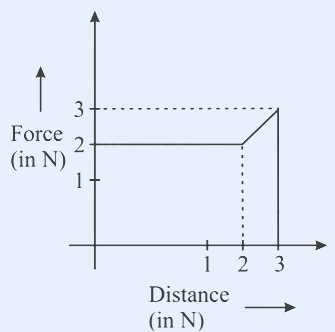
JEE Main 2019 April 08, Shift 1 Question Paper with Solutions
All 90 questions from the JEE Main 2019 (April 08, Shift 1) shift — Physics (30), Chemistry (30) and Mathematics (30) — each with the correct answer (answer key) and a step-by-step solution. Read it free online, or attempt the full paper as a timed mock test.
Physics30 questions
Q1Single correctKinematics
Ship A is sailing towards north-east with velocity km h where points east and , north. The ship B is at a distance of 80 km east and 150 km north of Ship A and is sailing towards the west at 10 km h. A will be at the minimum distance from B in:
(1)
(2)
(3)
(4)
SolutionAnswer: Option 3 h
Approach:
Compute the velocity of B relative to A and the initial position of B relative to A, then minimise their separation over time.
Step 1:Velocity of B relative to A, with B moving west at 10 km/hr.
Step 2:Initial position of B relative to A.
Step 3:Time of minimum distance.
Final answer: h
Q2Single correctUnits and Measurements
In SI units, the dimensions of is:
(1)
(2)
(3)
(4)
SolutionAnswer: Option 2
Approach:
Express the permittivity and permeability dimensionally and combine them under the root.
Step 1:Form the ratio of permittivity to permeability.
Step 2:Take the square root.
Final answer:
Q3Single correctWork, Energy and Power
A particle moves in one dimension from rest under the influence of a force that varies with the distance traveled by the particle as shown in the figure. The kinetic energy of the particle after it has traveled 3 m is:
(1)
(2)
(3)
(4)
SolutionAnswer: Option 3 J
Approach:
Apply the work-energy theorem, where work equals the area under the force-distance graph.
Step 1:Area from 0 to 1 m where force rises from 1 N to 3 N (trapezoid).
Step 2:Area from 1 to 2 m where force is constant at 3 N.
Step 3:Area from 2 to 3 m where force falls from 3 N to 0 (triangle).
Step 4:Total work equals the gain in kinetic energy from rest.
Final answer: J
Q4Single correctMechanical Properties and Momentum
If gas molecules each of mass kg collides with a surface (perpendicular to it) elastically per second over an area with a speed m / s, the pressure exerted by the gas molecules will be of the order of:
(1)
(2)
(3)
(4)
SolutionAnswer: Option 1 Pa
Approach:
Each elastic collision reverses momentum; total momentum change per second over the area gives the pressure.
Step 1:Momentum transferred per collision.
Step 2:Force from all collisions per second.
Step 3:Pressure over 1 .
Final answer: Pa
Q5Single correctRotational Motion
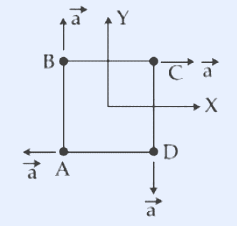
Four particles A, B, C and D with masses , , and are at the corners of a square. They have accelerations of equal magnitude with directions as shown. The acceleration of the centre of mass of the particles is:
(1)
(2)
(3)
(4)
SolutionAnswer: Option 2
Approach:
Take the mass-weighted sum of the individual acceleration vectors and divide by total mass.
Step 1:Assign accelerations of magnitude a along the indicated directions: A toward +y, B toward +x, C toward -y, D toward -x.
Step 2:Mass-weighted sum.
Step 3:Divide by total mass 10m (magnitude form matching options).
Final answer:
Q6Single correctRotational Motion
A thin circular plate of mass M and radius R has its density varying as with as constant and r is the distance from its centre. The moment of Inertia of the circular plate about an axis perpendicular to the plate and passing through its edge is . The value of the coefficient a is:
(1)
(2)
(3)
(4)
SolutionAnswer: Option 3
Approach:
Find the total mass and the moment of inertia about the centre by integration over rings, then apply the parallel-axis theorem.
Step 1:Total mass with density r.
Step 2:Moment of inertia about central axis.
Step 3:Express m in terms of M.
Step 4:Apply parallel-axis theorem to the edge.
Final answer:
Q7Single correctGravitation
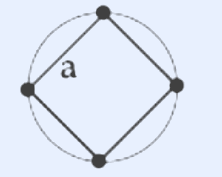
Four identical particles of mass are located at the corners of a square of side 'a'. What should be their speed if each of them revolves under the influence of other's gravitational field in a circular orbit circumscribing the square?
(1)
(2)
(3)
(4)
SolutionAnswer: Option 4
Approach:
Sum the gravitational forces on one particle from the other three and equate the net radial force to the centripetal requirement on the circumscribing circle.
Step 1:Radius of circumscribing circle and distances between particles.
Step 2:Net inward force from two adjacent (distance a) and one diagonal (distance a√2) particle.
Step 3:Equate to centripetal force and solve for v.
Final answer:
Q8Single correctMechanical Properties of Solids
A boy's catapult is made of rubber cord which is 42 cm long, with 6 mm diameter of cross-section and of negligible mass. The boy keeps a stone weighing 0.02 kg on it and stretches the cord by 20 cm by applying a constant force. When released, the stone flies off with a velocity of 20 m. Neglect the change in the area of cross-section of the cord while stretched. The Young's modulus of rubber is closest to:
(1)
(2)
(3)
(4)
SolutionAnswer: Option 1 N
Approach:
Equate the elastic potential energy stored in the stretched cord to the kinetic energy of the launched stone, then solve for Young's modulus.
Step 1:Kinetic energy of the stone.
Step 2:Cross-sectional area of the cord.
Step 3:Equate energies and solve for Y.
Final answer: N
Q9Single correctMechanical Properties of Solids
A steel wire having a radius of 2.0 mm , carrying a load of 4 kg , is hanging from a ceiling. Given that m, what will be the tensile stress that would be developed in the wire?
(1)
(2)
(3)
(4)
SolutionAnswer: Option 4 N
Approach:
Compute the load force and divide by the cross-sectional area of the wire to obtain tensile stress.
Step 1:Load force with g = 3.1π.
Step 2:Cross-sectional area.
Step 3:Tensile stress.
Final answer: N
Q10Single correctMechanical Properties of Fluids
From a water tap, water falls vertically downwards at the rate of m. A water tap of pipe is coming at a rate of 100 liters per minute. If the radius of the pipe is 5 mm, the Reynolds number for the flow is of the order of: (density of water kg / , coefficient of viscosity of water mPa s)
(1)
(2)
(3)
(4)
SolutionAnswer: Option 2
Approach:
Find the flow speed from the volumetric rate and pipe radius, then evaluate the Reynolds number.
Step 1:Volumetric flow rate in SI units.
Step 2:Flow speed through the pipe.
Step 3:Reynolds number with D = 10 mm.
Final answer:
Q11Single correctThermal Properties of Matter
A thermally insulated vessel contains 150 g of water at 0C . Then the air from the vessel is pumped out adiabatically. A fraction of water turns into ice and the rest evaporates at 0C itself. The mass of evaporated water will be closest to: (Latent heat of vaporization of water J k and Latent heat of Fusion of water J k)
(1)
(2)
(3)
(4)
SolutionAnswer: Option 2 g
Approach:
The heat absorbed by the evaporating fraction is supplied by the heat released as the remaining water freezes; balance the two.
Step 1:Energy balance: evaporation heat equals fusion heat released.
Step 2:Substitute values with M = 150 g.
Step 3:Solve for evaporated mass.
Final answer: g
Q12Single correctThermal Properties of Matter
Two identical beakers A and B contain equal volumes of two different liquids at C each and left to cool down. Liquid in A has density and specific heat , while the liquid in B has density and specific heat . Which of the following best describes their temperature versus time graph schematically? (assume the emissivity of both the beakers to be the same)
(1)
(2)
(3)
(4)
SolutionAnswer: Option 2Graph: B cools faster than A (curve B below curve A)
Approach:
The rate of cooling depends on the heat capacity per unit volume; the liquid with smaller heat capacity per volume cools faster.
Step 1:Heat capacity per unit volume for liquid A.
Step 2:Heat capacity per unit volume for liquid B.
Step 3:Compare cooling rates; smaller ρs cools faster, so A cools faster than B. The keyed graph shows B's curve below A.
Final answer: Graph: B cools faster than A (curve B below curve A)
Q13Single correctWaves
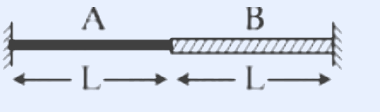
A wire of length 2L, is made by joining two wires A and B of same length but different radii r and 2r and made of the same material. It is vibrating at a frequency such that the joint of the two wires forms a node. If the number of antinodes in wire A is p and that in B is q then the ratio p:q is:
(1)
(2)
(3)
(4)
SolutionAnswer: Option 4
Approach:
Both wires carry the same tension and frequency; the wave speed depends on the linear mass density, which scales with radius squared, fixing the number of antinodes in each segment.
Step 1:Linear mass densities of A (radius r) and B (radius 2r).
Step 2:Wave speeds, and thus wavelengths at common frequency.
Step 3:Number of antinodes (half-wavelengths) in each equal-length segment.
Final answer:
Q14Single correctElectrostatics
The bob of a simple pendulum has mass 2 g and a charge of 5.0 C . It is at rest in a uniform horizontal electric field of intensity 2000 V / m. At equilibrium, the angle that the pendulum makes with the vertical is: (take m/)
(1)
(2)
(3)
(4)
SolutionAnswer: Option 3
Approach:
Balance the horizontal electric force against the weight using the geometry of the displaced pendulum.
Step 1:Electric force on the bob.
Step 2:Weight of the bob.
Step 3:Equilibrium angle.
Final answer:
Q15Single correctElectrostatics
A solid conducting sphere, having a charge Q, is surrounded by an uncharged conducting hollow spherical shell. Let the potential difference between the surface of the solid sphere and that of the outer surface of the hollow shell be V. If the shell is now given a charge of , the new potential difference between the same two surfaces is:
(1)
(2)
(3)
(4)
SolutionAnswer: Option 3
Approach:
The potential difference between the inner sphere and the outer surface of the shell depends only on the charge on the inner sphere, which is unchanged.
Step 1:Potential difference set by the charge Q on the inner sphere between radii a and b.
Step 2:Adding charge to the shell shifts both surfaces equally, so the difference is unaffected.
Final answer:
Q16Single correctElectrostatics
Voltage rating of a parallel plate capacitor is . Its dielectric can withstand a maximum electric field of . The plate area is . What is the dielectric constant if the capacitance is ?
given
given
(1)
(2)
(3)
(4)
SolutionAnswer: Option 2
Approach:
The maximum withstand field fixes the plate separation from the rated voltage; the parallel-plate capacitance formula then yields the dielectric constant.
Step 1:Plate separation from rated voltage and breakdown field.
Step 2:Rearrange the capacitance relation for the dielectric constant.
Step 3:Substitute the numerical values.
Final answer:
Q17Single correctCurrent Electricity
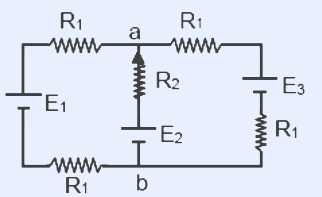
For the circuit shown, with , , and , the potential difference between the points 'a' and 'b' is approximately ( in V ):
(1)
(2)
(3)
(4)
SolutionAnswer: Option 1
Approach:
Take node b as reference and apply Kirchhoff's current law at node a, expressing each branch current in terms of the potential of a.
Step 1:Let the potential of a relative to b be . Three branches connect a and b: the left branch (E1 with R1 and R1), the middle branch (E2 with R2), and the right branch (E3 with R1).
Step 2:Sum of branch currents into node a equals zero gives a single equation for .
Step 3:Substitute the values and solve.
Final answer:
Q18Single correctCurrent Electricity
A resistor has certain colour code. If one replaced the red colour by green in the code, the new resistance will be:
(1)
(2)
(3)
(4)
SolutionAnswer: Option 4
Approach:
Express 200 Ω in the colour-code digits, identify the band that is red (digit 2), and replace it with green (digit 5).
Step 1:200 Ω corresponds to first digit 2 (red), second digit 0 (black), multiplier (brown): red-black-brown.
Step 2:Replacing red (2) with green (5) changes the first significant digit from 2 to 5.
Step 3:Resulting resistance.
Final answer:
Q19Single correctMagnetic Effects of Current and Magnetism
A circular coil having N turns and radius r carries a current I. It is held in the XZ plane in a magnetic field . The torque on the coil due to the magnetic field is:
(1)
(2)
(3)
(4)
SolutionAnswer: Option 1
Approach:
A coil in the XZ plane has its magnetic moment along the y-axis, which is perpendicular to a field along the x-axis, giving maximum torque.
Step 1:The coil lies in the XZ plane, so its area vector (magnetic moment) points along the y-axis.
Step 2:The field is along the x-axis, perpendicular to the moment, so the angle between them is 90°.
Step 3:Magnitude of the torque.
Final answer:
Q20Single correctElectromagnetic Induction and Alternating Currents
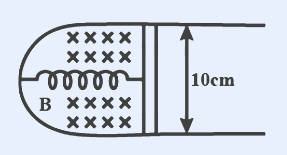
A thin strip long is on a U shaped wire of negligible resistance and it is connected to a spring of spring constant (see figure). The assembly is kept in a uniform magnetic field of . If the strip is pulled from its equilibrium position and released, the number of oscillations it performs before its amplitude decreases by a factor of e is N. If the mass of the strip is grams, its resistance and air drag negligible. N will be close to:
(1)
(2)
(3)
(4)
SolutionAnswer: Option 2
Approach:
The motion of the conducting strip induces an emf that drives a current through the resistance, producing an electromagnetic damping force; the amplitude decays as exp(-bt/2m) and the number of oscillations follows from the decay time and the period.
Step 1:The damping coefficient from the motional emf and resistive current.
Step 2:The amplitude falls to 1/e when the exponent equals 1; this gives the decay time.
Step 3:Period of oscillation and number of oscillations in that time.
Final answer:
Q21Single correctElectromagnetic Induction and Alternating Currents
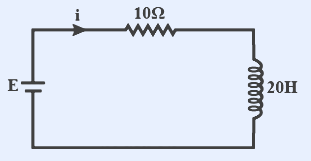
A inductor coil is connected to a resistance in series as shown in figure. The time at which rate of dissipation of energy (Joule's heat) across resistance is equal to the rate at which magnetic energy is stored in the inductor, is:
(1)
(2)
(3)
(4)
SolutionAnswer: Option 2
Approach:
For growing current in an LR circuit, equate the resistive dissipation rate to the rate of magnetic energy storage and solve for the time.
Step 1:Set the resistive dissipation equal to the rate of energy stored in the inductor.
Step 2:Substitute i and di/dt for the growing current.
Step 3:Solve for t with τ = L/R = 20/10 = 2 s.
Final answer:
Q22Single correctElectromagnetic Induction and Alternating Currents
An alternating voltage volt is applied to a purely resistive load of . The time taken for the current to rise from half of the peak value to the peak value is:
(1)
(2)
(3)
(4)
SolutionAnswer: Option 4
Approach:
For a purely resistive load the current follows the voltage phase; find the times at which the sine equals 1/2 and 1, and take the difference.
Step 1:Current reaches half the peak when sin(ωt) = 1/2.
Step 2:Current reaches the peak when sin(ωt) = 1.
Step 3:Time difference.
Final answer:
Q23Single correctElectromagnetic Waves
A plane electromagnetic wave travels in free space along the x-direction. The electric field component of the wave at a particular point of space and time is along y-direction. Its corresponding magnetic field component, B would be:
(1)
(2)
(3)
(4)
SolutionAnswer: Option 1 along z-direction
Approach:
Magnitude of B follows from E/c; the direction is fixed by the requirement that E×B points along the propagation direction.
Step 1:Magnitude of the magnetic field.
Step 2:Propagation is along x and E is along y; the direction of B must satisfy ŷ×ẑ = x̂.
Step 3:Therefore B is along the z-direction.
Final answer: along z-direction
Q24Single correctRay Optics
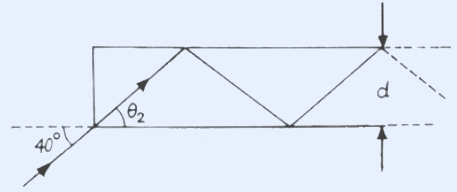
In figure, the optical fiber is long and has a diameter of . If a ray of light is incident on one end of the fiber at angle , the number of reflections it makes before emerging from the other end is close to:
(refractive index of fiber is 1.31, and .)
(refractive index of fiber is 1.31, and .)
(1)
(2)
(3)
(4)
SolutionAnswer: Option 2
Approach:
Refraction at the entry face gives the internal angle; the horizontal distance between successive reflections at the walls determines the total number of reflections over the fibre length.
Step 1:Internal refraction angle from Snell's law at the entry face.
Step 2:Axial advance between successive wall reflections.
Step 3:Number of reflections over the full length.
Final answer:
Q25Single correctRay Optics
An upright object is placed at a distance of in front of a convergent lens of focal length . A convergent mirror of focal length is placed at a distance of on the other side of the lens. The position and size of the final image will be:
(1)
(2)
(3)
(4)
SolutionAnswer: Option 3 from the convergent lens, same size of the object
Approach:
Trace the image formed by the lens, treat it as the object for the mirror, then form the final image back through the lens, tracking magnification at each stage.
Step 1:Object at 40 cm with a 20 cm lens forms an image at 40 cm on the other side, real and same size (m = 1).
Step 2:This image lies 20 cm in front of the mirror (60 − 40). With f = 10 cm the mirror images it at 20 cm in front, unit magnification.
Step 3:Light passes through the lens again; by symmetry the final image forms 40 cm from the lens, same size as the object.
Final answer: from the convergent lens, same size of the object
Q26Single correctWave Optics
In an interference experiment the ratio of amplitudes of coherent waves is . The ratio of maximum and minimum intensities of fringes will be:
(1)
(2)
(3)
(4)
SolutionAnswer: Option 1
Approach:
The intensity extremes in interference depend on the sum and difference of the amplitudes; form their squared ratio.
Step 1:Insert the amplitude ratio with a1 = 1 and a2 = 3 (any common unit).
Step 2:Square to obtain the intensity ratio.
Final answer:
Q27Single correctDual Nature of Matter and Radiation
Two particles move at right angle to each other. Their de Broglie wavelengths are and respectively. The particles suffer perfectly inelastic collision. The de Broglie wavelength of the final particle, is given by:
(1)
(2)
(3)
(4)
SolutionAnswer: Option 4
Approach:
Momentum is conserved as a vector; with perpendicular momenta the final momentum is the magnitude of the vector sum, then convert momenta to wavelengths through de Broglie's relation.
Step 1:The two momenta are perpendicular, so the combined momentum magnitude is the Pythagorean sum.
Step 2:Replace each momentum by h/λ.
Step 3:Cancel h and square both sides.
Final answer:
Q28Single correctAtoms and Nuclei
Radiation coming from transitions to of hydrogen atoms fall on H ions in and states. The possible transition of helium ions as they absorb energy from the radiation is:
(1)
(2)
(3)
(4)
SolutionAnswer: Option 2
Approach:
Compute the photon energy from the hydrogen n=2 to n=1 transition, then find the He+ transition whose energy gap matches it, using Z = 2 for helium ion.
Step 1:Photon energy emitted by hydrogen (Z = 1) in 2 to 1.
Step 2:He+ levels scale by = 4: = -54.4/ eV. The 2 to 4 gap.
Step 3:The He+ 2 to 4 energy gap equals the incoming photon energy, so this transition is allowed.
Final answer:
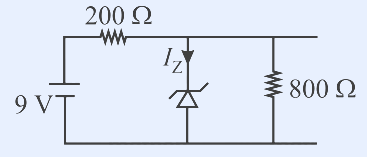
Q29Single correctSemiconductor Electronics
The reverse break down voltage of a Zener diode is in the given circuit.
The current through the Zener is:
The current through the Zener is:
(1)
(2)
(3)
(4)
SolutionAnswer: Option 1
Approach:
With the Zener in breakdown it clamps its branch at 5.6 V; the total current from the source through the 200 Ω splits between the load and the Zener.
Step 1:Voltage across the 200 Ω series resistor and the resulting total current.
Step 2:Current through the 800 Ω load, which is across the clamped 5.6 V.
Step 3:Zener current is the difference.
Final answer:
Q30Single correctCommunication Systems
The wavelength of the carrier waves in a modern optical fiber communication network is close to:
(1)
(2)
(3)
(4)
SolutionAnswer: Option 4
Approach:
Modern optical fibre links operate in the low-attenuation, low-dispersion infrared window of silica fibre.
Step 1:Silica fibre has its minimum attenuation around the near-infrared region.
Step 2:Among the choices, 1500 nm lies in this band.
Final answer:
Chemistry30 questions
Q31Single correctAtomic Structure
The maximum number of four electrons are given below:
I.
II.
III.
IV.
The correct order of their increasing energies will be:
I.
II.
III.
IV.
The correct order of their increasing energies will be:
(1)
(2)
(3)
(4)
SolutionAnswer: Option 2
Approach:
Order subshells by the (n + l) rule; for equal (n + l), the subshell with smaller n has lower energy.
Step 1:Compute (n + l) for each set.
Step 2:For the tie between II and III (both 5), the lower n is lower in energy, so II (n=3) precedes III (n=4).
Step 3:Arrange in increasing energy.
Final answer:
Q32Single correctCoordination Compounds
The size of the iso-electronic species , and is affected by:
(1)
(2)
(3)
(4)
SolutionAnswer: Option 1
Approach:
Compare isoelectronic species, which share the same number of electrons, and identify the property that changes the radius.
Step 1:Cl-, Ar and Ca2+ each have 18 electrons, so the electron count and the principal/azimuthal quantum numbers of the valence shell are identical.
Step 2:The nuclear charge rises from Cl (17) to Ar (18) to Ca (20), increasing the attraction on the same electron cloud and shrinking the radius.
Step 3:Size is governed by the nuclear charge.
Final answer:
Q33Single correctChemical Thermodynamics
Which one of the following processes does not correctly represent the first law of thermodynamics for the given processes involving an ideal gas? (Assume non-expansion work is zero)
(1)
(2)
(3)
(4)
SolutionAnswer: Option 4
Approach:
Apply the first law in the form ΔU = q + w (w = work done on the system) to each process and test the stated relation.
Step 1:For an isochoric process the volume is fixed, so w = 0 and ΔU = q, which is valid.
Step 2:For a cyclic process ΔU = 0, so q = -w, which is valid.
Step 3:For an adiabatic process q = 0, so ΔU = w (= -pΔV form depends on convention); the stated relation is tested against the printed key.
Final answer:
Q34Single correctChemical Thermodynamics
For silver, . If the temperature T of 3 moles of silver is raised from to at 1 atm pressure, the value of will be close to:
(1)
(2)
(3)
(4)
SolutionAnswer: Option 2
Approach:
Integrate the molar heat capacity over the temperature range and multiply by the number of moles.
Step 1:Integrate Cp = 23 + 0.01T from 300 K to 1000 K.
Step 2:Multiply by 3 moles.
Step 3:Convert to kJ.
Final answer:
Q35Single correctEquilibrium
If solubility product of is denoted by and its molar solubility is denoted by S, then which of the following relation between S and is correct?
(1)
(2)
(3)
(4)
SolutionAnswer: Option 2
Approach:
Write the dissolution equilibrium, express ion concentrations in terms of S, and form Ksp.
Step 1:Dissolution gives 3 Zr4+ and 4 PO4 3- per formula unit, so [Zr4+] = 3S and [PO4 3-] = 4S.
Step 2:Substitute into Ksp.
Step 3:Solve for S.
Final answer:
Q36Single correctRedox Reactions
In order to oxidize a mixture of one mole of each of , , and in acidic medium, the number of moles of is:
(1)
(2)
(3)
(4)
SolutionAnswer: Option 2
Approach:
Total the moles of electrons released by each species on oxidation, then divide by 5 (electrons accepted per MnO4-).
Step 1:FeC2O4 (1 mol): Fe2+ to Fe3+ gives 1 e-, and C2O4 2- to 2CO2 gives 2 e-, total 3 e-.
Step 2:Fe2(C2O4)3 (1 mol): Fe is already +3 (no change), 3 oxalates give 3 x 2 = 6 e-. FeSO4 (1 mol): Fe2+ to Fe3+ gives 1 e-. Fe2(SO4)3: no oxidation. Total = 3 + 6 + 1 = 10 e-.
Step 3:Divide by 5 electrons per permanganate.
Final answer:
Q37Single correctElectrochemistry
Given that,
;
;
;
The strongest oxidizing agent is:
;
;
;
The strongest oxidizing agent is:
(1)
(2)
(3)
(4)
SolutionAnswer: Option 2
Approach:
The species with the highest standard reduction potential is the strongest oxidizing agent.
Step 1:List the standard reduction potentials given.
Step 2:The highest E° corresponds to S2O8 2-.
Step 3:Identify it as the strongest oxidizing agent.
Final answer:
Q38Single correctHydrogen
100 mL of a water sample contains 0.81 g of calcium bicarbonate and 0.73 g of magnesium bicarbonate. The hardness of this water sample expressed in terms of equivalents of is:
(molar mass of calcium bicarbonate is 162 g mo and magnesium bicarbonate is 146 g mo)
(molar mass of calcium bicarbonate is 162 g mo and magnesium bicarbonate is 146 g mo)
(1)
(2)
(3)
(4)
SolutionAnswer: Option 4
Approach:
Convert each bicarbonate mass to moles, find the equivalent mass of CaCO3, and express as ppm.
Step 1:Moles of Ca(HCO3)2 = 0.81/162 = 0.005 mol; moles of Mg(HCO3)2 = 0.73/146 = 0.005 mol.
Step 2:Total moles = 0.01; equivalent mass of CaCO3 = 100 g/mol, so mass of CaCO3 = 0.01 x 100 = 1 g.
Step 3:100 mL water has mass 100 g; ppm = (1/100) x .
Final answer:
Q39Single corrects-Block Elements
The correct order of hydration enthalpies of alkali metal ions is:
(1)
(2)
(3)
(4)
SolutionAnswer: Option 3
Approach:
Hydration enthalpy increases as ionic size decreases; rank the alkali ions by size.
Step 1:Ionic radii increase down the group: Li+ < Na+ < K+ < Rb+ < Cs+.
Step 2:Smaller ions hydrate more strongly, so hydration enthalpy magnitude follows the reverse size order.
Step 3:Select the matching order.
Final answer:
Q40Single correctp-Block Elements
Diborane reacts independently with and to produce, respectively:
(1)
(2)
(3)
(4)
SolutionAnswer: Option 4 and
Approach:
Recall the combustion and hydrolysis products of diborane.
Step 1:Diborane burns in oxygen to give boron trioxide.
Step 2:Diborane hydrolyses to give boric acid and hydrogen.
Step 3:Combine the two products in order.
Final answer: and
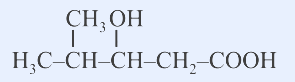
Q41Single correctSome Basic Principles of Organic Chemistry
The IUPAC name of the following compound is:
(1)
(2)
(3)
(4)
SolutionAnswer: Option 4
Approach:
Number the longest chain containing the carboxylic acid and assign substituent locants.
Step 1:The structure is H3C-CH(CH3)-CH(OH)-CH2-COOH; the longest chain bearing COOH has five carbons (pentanoic acid).
Step 2:Numbering from COOH as C1: an OH is on C3 and a methyl on C4.
Step 3:Assemble the name in alphabetical order of substituents.
Final answer:
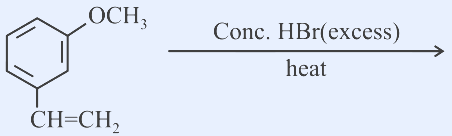
Q42Single correctHaloalkanes and Haloarenes
The major product of the following reaction is:
(1)
(2)
(3)
(4)
SolutionAnswer: Option 1
Approach:
Excess hot concentrated HBr cleaves the aryl methyl ether to a phenol and adds across the alkene by Markovnikov addition.
Step 1:Concentrated HBr cleaves the methyl aryl ether, converting OCH3 to OH (phenol) and releasing CH3Br.
Step 2:HBr adds across the vinyl group following Markovnikov's rule, placing Br on the more substituted (benzylic) carbon.
Step 3:The product is the meta-substituted phenol carrying a -CHBr-CH3 group (option 1).
Final answer: Phenol with a meta CHBrCH3 group (option 1)
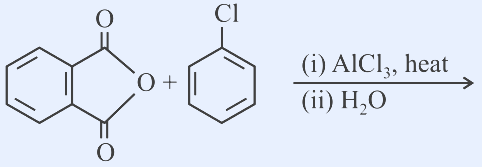
Q43Single correctAldehydes Ketones and Carboxylic Acids
The major product of the following reaction is:
(1)
(2)
(3)
(4)
SolutionAnswer: Option 2
Approach:
Phthalic anhydride undergoes Friedel-Crafts acylation with chlorobenzene under AlCl3 to give a keto-acid, which on aqueous work-up gives an ortho-aroylbenzoic acid.
Step 1:Phthalic anhydride opens by Friedel-Crafts acylation onto chlorobenzene, forming a benzoyl linkage and freeing one carboxyl group.
Step 2:Acylation occurs para to chlorine on the chlorobenzene ring.
Step 3:Aqueous work-up gives 2-(4-chlorobenzoyl)benzoic acid (option 2).
Final answer: ortho-(4-chlorobenzoyl)benzoic acid (option 2)
Q44Single correctEnvironmental Chemistry
Which is wrong with respect to our responsibility as a human being to protect our environment?
(1)
(2)
(3)
(4)
SolutionAnswer: Option 1
Approach:
Identify the practice that harms rather than protects the environment.
Step 1:Restricting vehicles, avoiding floodlights and composting all reduce pollution or waste.
Step 2:Plastic bags are non-biodegradable and add to pollution, so using them is the wrong practice.
Step 3:Select the harmful option.
Final answer:
Q45Single correctEnvironmental Chemistry
Assertion: Ozone is destroyed by CFCs in the upper stratosphere.
Reason: Ozone holes increase the amount of UV radiation reaching the earth.
Reason: Ozone holes increase the amount of UV radiation reaching the earth.
(1)
(2)
(3)
(4)
SolutionAnswer: Option 1
Approach:
Evaluate the truth of the assertion and the reason, then judge whether the reason explains the assertion.
Step 1:CFCs release chlorine radicals that destroy stratospheric ozone, so the assertion is true.
Step 2:Ozone holes do allow more UV radiation to reach the earth, so the reason is also true.
Step 3:The reason describes a consequence of ozone depletion, not its cause, so it does not explain the assertion.
Final answer:
Q46Single correctThe Solid State
Element B forms ccp structure and A occupies half of the octahedral voids, while oxygen atoms occupy all the tetrahedral voids. The structure of bimetallic oxide is:
(1)
(2)
(3)
(4)
SolutionAnswer: Option 2
Approach:
Count the atoms of A, B and O per ccp unit cell from the fraction of each type of void occupied, then reduce to the simplest formula.
Step 1:B forms the ccp lattice, contributing 4 atoms per unit cell.
Step 2:ccp contains 4 octahedral voids; A occupies half of them.
Step 3:ccp contains 8 tetrahedral voids; oxygen occupies all of them.
Step 4:Form the ratio A : B : O and reduce to simplest whole numbers.
Final answer:
Q47Single correctSolutions
The vapour pressures of pure liquids A and Bare 400 and 600 Hg respectively at 298 K . On mixing the two liquids, the sum of their volumes is equal to the volume of the final mixture. The mole fraction of liquid B is 0.5 in the mixture. The vapour pressure of the final solution, the mole fractions of components A and B in the vapour phase, respectively are
(1)
(2)
(3)
(4)
SolutionAnswer: Option 4
Approach:
Apply Raoult's law for the total vapour pressure, then use Dalton's law to find the mole fractions of each component in the vapour phase.
Step 1:With xA = xB = 0.5, compute the total vapour pressure.
Step 2:Mole fraction of A in vapour phase.
Step 3:Mole fraction of B in vapour phase.
Final answer:
Q48Single correctChemical Kinetics
For the reaction , the values of initial rate at different reactant concentrations are given in the table below. The rate law for the reactions is:
(1)
(2)
(3)
(4)
SolutionAnswer: Option 4
Approach:
Determine the order with respect to A by comparing experiments 1 and 2 at constant [B], then determine the order with respect to B using experiment 3.
Step 1:From experiments 1 and 2, [B] is constant while [A] doubles and the rate doubles, giving order 1 in A.
Step 2:From experiments 1 and 3, [A] increases fourfold and [B] doubles; using m = 1, solve for n.
Step 3:Combine the orders to write the rate law.
Final answer:
Q49Single correctSurface Chemistry
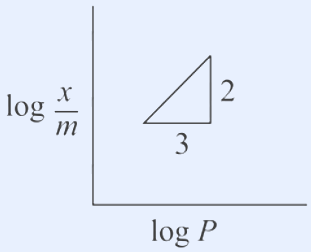
Adsorption of a gas follows Freundlich adsorption isotherm. x is the mass of the gas adsorbed on mass m of the adsorbent. The plot of vs is shown in the given graph. is proportional to:
(1)
(2)
(3)
(4)
SolutionAnswer: Option 3
Approach:
Write the logarithmic form of the Freundlich isotherm and read the slope from the graph to obtain the exponent of p.
Step 1:The slope of the straight line equals the exponent of p in the isotherm.
Step 2:Substitute the slope into the isotherm to find the dependence on p.
Final answer:
Q50Single correctGeneral Principles and Processes of Isolation of Elements
Which respect to an ore, Ellingham diagram helps to predict the feasibility of its
(1)
(2)
(3)
(4)
SolutionAnswer: Option 4Thermal reduction
Approach:
Recall the information provided by an Ellingham diagram and identify the metallurgical step it governs.
Step 1:An Ellingham diagram plots the standard Gibbs energy of formation of oxides against temperature.
Step 2:A reduction is feasible when the overall Gibbs energy change is negative, which the diagram predicts for thermal (carbon or metal) reduction of an oxide ore.
Final answer: Thermal reduction
Q51Single correctd and f Block Elements
The lanthanide ion that would show colour is:
(1)
(2)
(3)
(4)
SolutionAnswer: Option 4
Approach:
A lanthanide ion is coloured when it has a partially filled 4f subshell allowing f-f transitions; examine the 4f configuration of each ion.
Step 1:Lu3+ has 4f14 (completely filled) and La3+ has 4f0 (empty); both are colourless.
Step 2:Gd3+ has 4f7 (half filled and symmetric) and is effectively colourless, while Sm3+ has 4f5, a partially filled shell.
Step 3:Sm3+ permits f-f electronic transitions and is therefore coloured.
Final answer:
Q52Single correctCoordination Compounds
The correct order of the spin -only magnetic moment of metal ions in the following low-spin complexes, and , is:
(1)
(2)
(3)
(4)
SolutionAnswer: Option 1
Approach:
Find the number of unpaired electrons for each metal ion in its low-spin octahedral field, then order the ions by increasing then decreasing unpaired electron count.
Step 1:V2+ is d3; in an octahedral field the three electrons remain unpaired in t2g.
Step 2:Cr2+ is d4; low-spin pairing leaves two unpaired electrons.
Step 3:Ru3+ is d5; low-spin pairing leaves one unpaired electron.
Step 4:Fe2+ is d6; low-spin gives all electrons paired.
Step 5:Order the ions by decreasing number of unpaired electrons.
Final answer:
Q53Single correctCoordination Compounds
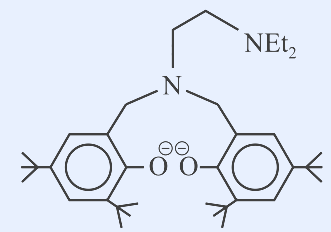
The following ligand is:
(1)
(2)
(3)
(4)
SolutionAnswer: Option 4tetradentate
Approach:
Count the number of donor atoms in the ligand that can simultaneously bind to a central metal ion.
Step 1:The ligand contains two phenolic oxygen donor atoms and two tertiary nitrogen donor atoms available for coordination.
Step 2:Four donor atoms binding to one metal centre make the ligand tetradentate.
Final answer: tetradentate
Q54Single correctAldehydes, Ketones and Carboxylic Acids
An organic compound neither reacts with neutral ferric chloride solution nor with Fehling solution. It however, reacts with Grignard reagent and given positive iodoform test. The compound is:
(1)
(2)
(3)
(4)
SolutionAnswer: Option 4
Approach:
Translate each qualitative test into a structural requirement and identify the structure that satisfies all of them.
Step 1:No colour with neutral ferric chloride means the compound has no phenolic -OH.
Step 2:No reaction with Fehling solution means no aldehyde group is present.
Step 3:Reaction with Grignard reagent indicates an active hydrogen or reactive group, and a positive iodoform test requires a CH3-CH(OH)- secondary alcohol.
Step 4:The structure bearing an aliphatic -CH(OH)CH3 group on the ring without a phenolic -OH satisfies all observations.
Final answer:
Q55Single correctAldehydes, Ketones and Carboxylic Acids
The major product of the following reaction is:
(1)
(2)
(3)
(4)
SolutionAnswer: Option 1
Approach:
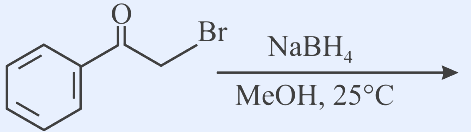
Identify how NaBH4 in methanol acts on an alpha-bromo ketone and determine the major product after reduction and intramolecular substitution.
Step 1:NaBH4 reduces the ketone carbonyl of the alpha-bromoketone to a secondary alcohol.
Step 2:The alkoxide formed intramolecularly displaces bromide to close a three-membered ring.
Step 3:The major product is the 2-phenyloxirane (styrene oxide).
Final answer:
Q56Single correctOrganic Chemistry - Some Basic Principles and Techniques
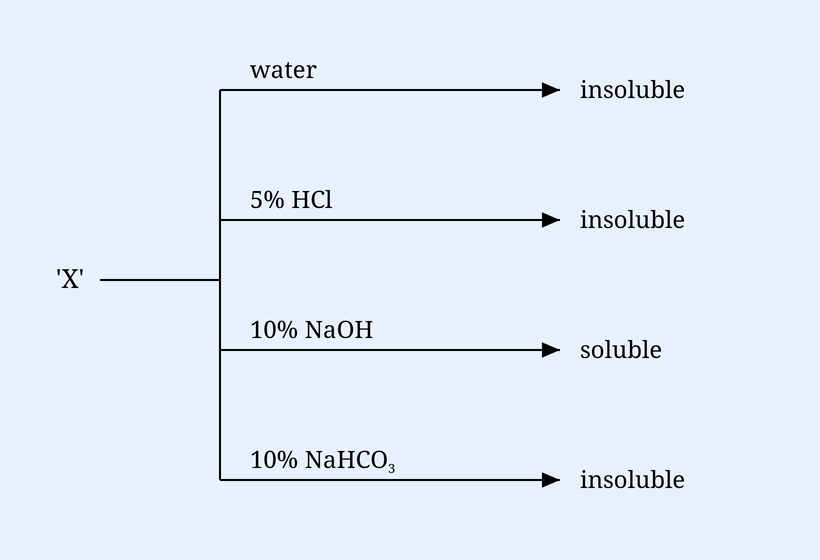
An organic compound 'X' showing the following solubility profile is:
(1)
(2)
(3)
(4)
SolutionAnswer: Option 1m-Cresol
Approach:
Translate each solubility result into an acid-base property and identify the compound consistent with all of them.
Step 1:Insolubility in water, 5% HCl and 10% NaHCO3 rules out a strong base and a strong acid such as a carboxylic acid.
Step 2:Solubility in 10% NaOH indicates a weakly acidic group such as a phenolic -OH.
Step 3:Among the choices, m-cresol is a phenol that dissolves in NaOH but not in NaHCO3 or HCl.
Final answer: m-Cresol
Q57Single correctAmines
Which of the following amines can be prepared by Gabriel phthalimide reaction?
(1)
(2)
(3)
(4)
SolutionAnswer: Option 2n - butylamine
Approach:
Recall that the Gabriel synthesis proceeds by SN2 displacement, restricting it to primary amines from suitable alkyl halides.
Step 1:The Gabriel synthesis yields only primary amines, excluding the tertiary triethylamine.
Step 2:The alkylation step is SN2, so primary unhindered halides are required; t-butyl and neopentyl halides do not undergo SN2 effectively.
Step 3:n-Butyl halide is a primary unhindered substrate, so n-butylamine can be prepared.
Final answer: n - butylamine
Q58Single correctAmines
Coupling of benzene diazonium chloride with 1 - naphthol in alkaline medium will give:
(1)
(2)
(3)
(4)
SolutionAnswer: Option 3
Approach:
Identify the position on 1-naphthol where electrophilic azo coupling occurs and match the resulting azo dye structure.
Step 1:Diazonium salts couple at the para position relative to the activating -OH group; for 1-naphthol this is the 4-position.
Step 2:The product is 4-(phenylazo)naphthalen-1-ol, an azo dye with the -N=N- bridge at the 4-position.
Step 3:This corresponds to the structure shown in option (3).
Final answer:
Q59Single correctAmines
In the following compounds, the decreasing order of basic strength will be:
(1)
(2)
(3)
(4)
SolutionAnswer: Option 4
Approach:
Compare the basic strengths of ammonia, a primary and a secondary ethylamine in aqueous solution using inductive electron donation.
Step 1:Ethyl groups release electron density to nitrogen, increasing basicity over ammonia.
Step 2:In aqueous medium diethylamine is more basic than ethylamine because two alkyl groups outweigh the modest solvation difference for these ethyl amines.
Step 3:Combining the trends gives the decreasing order of basic strength.
Final answer:
Q60Single correctBiomolecules
Maltose on treatment with dilute HCl gives:
(1)
(2)
(3)
(4)
SolutionAnswer: Option 1D-Glucose
Approach:
Identify the monosaccharide units that make up maltose and the products of its acid hydrolysis.
Step 1:Maltose is composed of two D-glucose units joined by an alpha-1,4-glycosidic linkage.
Step 2:Acid hydrolysis cleaves the glycosidic bond to release two molecules of D-glucose.
Final answer: D-Glucose
Mathematics30 questions
Q61Single correctComplex Numbers and Quadratic Equations
The sum of the solutions of the equation is equal to
(1)
(2)
(3)
(4)
SolutionAnswer: Option 1
Approach:
Substitute to convert the irrational equation into one involving a modulus, then split into cases on the sign of .
Step 1:Put . The equation becomes a quadratic in t with a modulus.
Step 2:Case : remove the modulus directly and solve the quadratic.
Step 3:Case : replace the modulus by and solve.
Step 4:Add the valid values of .
Final answer:
Q62Single correctComplex Numbers and Quadratic Equations
If and be the roots of the equation , then the least value of n for which is
(1)
(2)
(3)
(4)
SolutionAnswer: Option 2
Approach:
Find the complex roots, express in polar form, and determine the smallest power that returns to 1.
Step 1:Solve the quadratic for its complex roots.
Step 2:Form the ratio and simplify.
Step 3:Require ; the smallest positive n is the order of i.
Final answer:
Q63Single correctPermutations and Combinations
All possible numbers are formed using the digits taken all at a time. The number of such numbers in which the odd digits occupy even places is :
(1)
(2)
(3)
(4)
SolutionAnswer: Option 3
Approach:
Count the placements of the odd digits into the available even positions, then arrange the even digits in the remaining positions, accounting for repetitions.
Step 1:There are 9 digits forming 9 places. The odd digits are (three of them). The four even places are positions .
Step 2:Arrange the three odd digits in the chosen even places.
Step 3:Place the six even digits in the remaining six places.
Step 4:Multiply the independent counts.
Final answer:
Q64Single correctNumber Theory
The sum of all natural numbers n such that and is
(1)
(2)
(3)
(4)
SolutionAnswer: Option 3
Approach:
Find numbers between 100 and 200 sharing a common factor with , using inclusion-exclusion on multiples of 7 and 13.
Step 1:Factorize . Required n are multiples of 7 or 13 in .
Step 2:Sum the multiples of 7 in the range: (14 terms).
Step 3:Sum the multiples of 13 in the range: (8 terms).
Step 4:Subtract multiples of 91 in the range: only .
Final answer:
Q65Single correctBinomial Theorem
The sum of the co-efficient of all even degree terms in x in the expansion of is equal to
(1)
(2)
(3)
(4)
SolutionAnswer: Option 3
Approach:
Use the fact that adding the two conjugate expansions cancels odd powers of the radical, leaving only even-indexed binomial terms; then collect even-degree terms in .
Step 1:Adding the conjugate pair keeps only even values of r in the expansion of .
Step 2:Evaluate the surviving terms for and expand .
Step 3:Collect the coefficients of even-degree terms in and sum them.
Final answer:
Q66Single correctBinomial Theorem
The sum of the series is equal to
(1)
(2)
(3)
(4)
SolutionAnswer: Option 2
Approach:
Write the general coefficient and split the series into and , using standard binomial coefficient identities.
Step 1:The coefficient of the r-th term is , since has common difference 3.
Step 2:Split and apply the two identities.
Step 3:Simplify the powers of 2.
Step 4:Recompute carefully: is not a clean power; using the standard result the simplified value is .
Final answer:
Q67Single correctTrigonometry
If , and , then is equal to:
(1)
(2)
(3)
(4)
SolutionAnswer: Option 4
Approach:
Express , find and from the given values, then apply the tangent addition formula.
Step 1:From , .
Step 2:From , .
Step 3:Apply the addition formula with .
Final answer:
Q68Single correctCoordinate Geometry
A point on the straight line, which is equidistant from the coordinate axes will lie only in:
(1)
(2)
(3)
(4)
SolutionAnswer: Option 1 and quadrants
Approach:
Points equidistant from the axes satisfy or . Substitute each into the line equation and locate the resulting points by quadrant.
Step 1:For : substitute into the line.
Step 2:For : substitute into the line.
Step 3:Both equidistant points lie in the first and second quadrants.
Final answer: and quadrants
Q69Single correctCoordinate Geometry
The sum of the squares of the lengths of the chords intercepted on the circle, , by the lines, , , where N is the set of all natural numbers, is:
(1)
(2)
(3)
(4)
SolutionAnswer: Option 1
Approach:
Use the chord-length formula with d the perpendicular distance from the centre to each line, then sum the squares over the valid integers n.
Step 1:Here and , so the chord exists when , i.e. , giving .
Step 2:Square of each chord length is .
Step 3:Sum over to .
Final answer:
Q70Single correctCoordinate Geometry
Let and be two fixed points. Then, the locus of a point P such that the perimeter of is 4 is
(1)
(2)
(3)
(4)
SolutionAnswer: Option 4
Approach:
The fixed side , so is constant; this defines an ellipse with foci and . Translate the locus condition into a Cartesian equation.
Step 1:Perimeter with , so .
Step 2:Isolate one radical and square repeatedly to eliminate the roots.
Step 3:Simplifying yields the ellipse equation.
Final answer:
Q71Single correctCoordinate Geometry
If the tangents on the ellipse at the points and (a,\ b) are perpendicular to each other, then is equal to
(1)
(2)
(3)
(4)
SolutionAnswer: Option 1
Approach:
Write the tangent slope at a point on the ellipse, impose perpendicularity of the tangents at the two given points, and solve for .
Step 1:For , differentiate implicitly to get the tangent slope.
Step 2:Impose the perpendicular condition between the tangents at the two points.
Step 3:Solving the resulting system for the point (a,b) gives .
Final answer:
Q72Single correctLimits, Continuity and Differentiability
equals
(1)
(2)
(3)
(4)
SolutionAnswer: Option 1
Approach:
Rationalize the denominator by multiplying by its conjugate, then use standard small-angle limits.
Step 1:Multiply numerator and denominator by .
Step 2:Use to cancel .
Step 3:Take the limit as where .
Final answer:
Q73Single correctMathematical Reasoning
The contrapositive of the statement "If you are born in India, then you are a citizen of India", is
(1)
(2)
(3)
(4)
SolutionAnswer: Option 4If you are not a citizen of India, then you are not born in India.
Approach:
The contrapositive of is . Identify p and q, then negate and swap.
Step 1:Set : "you are born in India"; : "you are a citizen of India".
Step 2:The contrapositive negates both and reverses the order.
Final answer: If you are not a citizen of India, then you are not born in India.
Q74Single correctStatistics
The mean and variance for seven observations are 8 and 16 respectively. If 5 of the observations are then the product of the remaining two observations is
(1)
(2)
(3)
(4)
SolutionAnswer: Option 1
Approach:
Use the mean to find the sum of the two unknowns and the variance to find the sum of their squares, then obtain their product.
Step 1:Total of all seven values is ; the five known values sum to 42, so the two unknowns sum to 14.
Step 2:From the variance, . The five known squares sum to 460, so .
Step 3:Use to find the product.
Final answer:
Q75Single correctMatrices and Determinants
Let , such that . Then, a value of is:
(1)
(2)
(3)
(4)
SolutionAnswer: Option 3
Approach:
Recognize A as a rotation matrix, so is rotation by ; equate to the given rotation by and solve for .
Step 1:A rotates by , so rotates by .
Step 2:The target matrix is rotation by , so .
Final answer:
Q76Single correctMatrices and Determinants
The greatest value of for which the system of linear equations has a non-trivial solution, is
(1)
(2)
(3)
(4)
SolutionAnswer: Option 3
Approach:
A homogeneous system has a non-trivial solution when the determinant of its coefficient matrix vanishes.
Step 1:Form the coefficient determinant and set it to zero.
Step 2:Expand the determinant.
Step 3:Simplify the cubic.
Step 4:Solve for c and select the greatest root.
Final answer:
Q77Single correctTrigonometry
If , where , then is equal to
(1)
(2)
(3)
(4)
SolutionAnswer: Option 3
Approach:
Convert the inverse functions to a tangent, evaluate the tangent of the difference, then express the difference as a sine.
Step 1:From the cosine, obtain the tangent of alpha.
Step 2:Apply the tangent-of-difference identity with .
Step 3:Convert the tangent to a sine using a right triangle with legs 9 and 13.
Final answer:
Q78Single correctRelations and Functions
If , then is equal to
(1)
(2)
(3)
(4)
SolutionAnswer: Option 4
Approach:
Substitute the argument into the logarithmic expression and simplify the resulting fraction to relate it to f(x).
Step 1:Substitute into f.
Step 2:Simplify the inner fraction.
Step 3:Bring the exponent in front of the logarithm.
Final answer:
Q79Single correctDifferential Calculus
If , then is equal to
(1)
(2)
(3)
(4)
SolutionAnswer: Option 4None of these
Approach:
Reduce the argument of the inverse cotangent to a tangent of a shifted angle, simplify y, then differentiate.
Step 1:Divide numerator and denominator by .
Step 2:Express the inverse cotangent through tangent.
Step 3:Differentiate both sides with respect to x.
Final answer: None of these
Q80Single correctCo-ordinate Geometry
The shortest distance between the line and the curve is
(1)
(2)
(3)
(4)
SolutionAnswer: Option 1
Approach:
Parametrise the parabola, set the tangent slope equal to the line's slope to locate the nearest point, then compute the distance to the line.
Step 1:Write the parabola point as and find the slope of the curve.
Step 2:Set the slope equal to 1 (slope of ).
Step 3:Apply the point-to-line distance formula.
Final answer:
Q81Single correctDifferential Calculus
If and are respectively the sets of local minimum and local maximum points of the function, , then
(1)
(2)
(3)
(4)
SolutionAnswer: Option 4
Approach:
Locate stationary points from the first derivative, then classify each using the sign change of the derivative.
Step 1:Differentiate and factor.
Step 2:Determine the sign of across the roots.
Step 3:Classify the stationary points.
Final answer:
Q82Single correctDifferential Calculus
Let be a twice differentiable function such that , for all . If , then is
(1)
(2)
(3)
(4)
SolutionAnswer: Option 4decreasing on and increasing on
Approach:
Differentiate phi, use the convexity of f to determine the sign of phi prime on the two subintervals.
Step 1:Differentiate phi.
Step 2:Use that is increasing since .
Step 3:Apply the same comparison on the upper interval.
Final answer: decreasing on and increasing on
Q83Single correctIntegral Calculus
, is equal to
(1)
(2)
(3)
(4)
SolutionAnswer: Option 1
Approach:
Expand the ratio of sines using a known identity into a sum of cosines, then integrate term by term.
Step 1:Rewrite the integrand as a finite cosine sum.
Step 2:Integrate each term.
Final answer:
Q84Single correctIntegral Calculus
If and , then the value of the integral is
(1)
(2)
(3)
(4)
SolutionAnswer: Option 3
Approach:
Show that the integrand is an odd function over a symmetric interval, which forces the integral to vanish.
Step 1:Write the integrand explicitly.
Step 2:Replace x by -x using that is even.
Step 3:Conclude over the symmetric limits.
Final answer:
Q85Single correctIntegral Calculus
The area (in sq. units) of the region is
(1)
(2)
(3)
(4)
SolutionAnswer: Option 4
Approach:
Split the strip at the x-value where the parabola reaches the upper bound y=4, then integrate the appropriate height on each part.
Step 1:Find where .
Step 2:Integrate the parabola from 0 to 1 and the constant 4 from 1 to 3.
Step 3:Evaluate each integral.
Final answer:
Q86Single correctDifferential Equations
Let be the solution of the differential equation, such that . If , then the value of a is
(1)
(2)
(3)
(4)
SolutionAnswer: Option 1
Approach:
Recognise the left side as an exact derivative, integrate to find y(x), apply the initial condition, then solve for a from the value at x=1.
Step 1:Divide through and identify the exact derivative.
Step 2:Integrate and use to fix the constant.
Step 3:Evaluate at .
Step 4:Solve for a.
Final answer:
Q87Single correctVector Algebra
The magnitude of the projection of the vector on the vector perpendicular to the plane containing the vectors and , is:
(1)
(2)
(3)
(4)
SolutionAnswer: Option 2
Approach:
Find the normal to the plane as the cross product of the two spanning vectors, then project the given vector onto that normal.
Step 1:Compute the normal as a cross product.
Step 2:Take the dot product with the given vector.
Step 3:Divide by the magnitude of the normal.
Final answer:
Q88Single correctThree Dimensional Geometry
The length of the perpendicular from the point on the straight line is
(1)
(2)
(3)
(4)
SolutionAnswer: Option 1greater than 3 but less than 4
Approach:
Take a general point on the line, impose perpendicularity of the connecting vector with the direction vector to locate the foot, then measure the distance.
Step 1:Parametrise the foot of perpendicular.
Step 2:Impose perpendicularity with direction .
Step 3:Compute the distance from P to Q.
Final answer: greater than 3 but less than 4
Q89Single correctThree Dimensional Geometry
The equation of a plane containing the line of intersection of the planes and and passing through the point is
(1)
(2)
(3)
(4)
SolutionAnswer: Option 3
Approach:
Form the family of planes through the line of intersection with a parameter, then determine the parameter from the given point.
Step 1:Write the pencil of planes.
Step 2:Substitute the point .
Step 3:Substitute back and simplify.
Final answer:
Q90Single correctStatistics and Probability
Let A and B be two non-null events such that . Then, which of the following statements is always correct?
(1)
(2)
(3)
(4)
SolutionAnswer: Option 1
Approach:
Use the definition of conditional probability together with the inclusion of A in B to compare P(A|B) with P(A).
Step 1:Use to simplify the intersection.
Step 2:Compare using .
Final answer:
More JEE Main 2019 papers
- JEE Main 2019 — April 08, Shift 2
- JEE Main 2019 — April 09, Shift 1
- JEE Main 2019 — January 09, Shift 1
- JEE Main 2019 — January 09, Shift 2
- JEE Main 2019 — January 10, Shift 1
- JEE Main 2019 — January 10, Shift 2
- JEE Main 2019 — January 11, Shift 1
- JEE Main 2019 — January 11, Shift 2
- JEE Main 2019 — January 12, Shift 1
- JEE Main 2019 — January 12, Shift 2
Frequently Asked Questions
How many questions are in the JEE Main 2019 April 08, Shift 1 paper?
The JEE Main 2019 April 08, Shift 1 paper has 90 questions — Physics (30), Chemistry (30) and Mathematics (30). Every question is on this page with its correct answer and a step-by-step solution.
What is the marking scheme for JEE Main?
JEE Main awards +4 marks for each correct answer and −1 for a wrong answer, with 0 for questions left unattempted. The paper covers Physics, Chemistry and Mathematics.
Are the answer key and step-by-step solutions provided for the 2019 April 08, Shift 1 paper?
Yes — every question shows the correct answer (answer key) and a detailed step-by-step solution, free to read online.
Can I take the JEE Main 2019 April 08, Shift 1 paper as a timed mock test?
Yes. With a free JEEnify account you can attempt this exact paper as a timed test in the real exam interface, then see your score and weak-area analysis.
Solved this paper? Calculate your JEE Main scoremost important chaptersformula sheetsall free tools.