
Back to JEE Main PYQs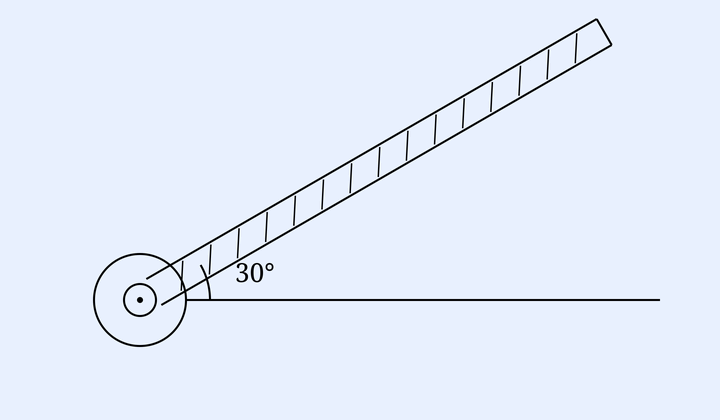
JEE Main 2019 January 09, Shift 2 Question Paper with Solutions
All 90 questions from the JEE Main 2019 (January 09, Shift 2) shift — Physics (30), Chemistry (30) and Mathematics (30) — each with the correct answer (answer key) and a step-by-step solution. Read it free online, or attempt the full paper as a timed mock test.
Physics30 questions
Q1Single correctKinematics
The position co-ordinates of a particle moving in a coordinate system is given by
and
The speed of the particle is:
and
The speed of the particle is:
(1)
(2)
(3)
(4)
SolutionAnswer: Option 1
Approach:
Differentiate each coordinate with respect to time to obtain the velocity components, then combine them to find the magnitude of the velocity.
Step 1:Differentiate the position coordinates with respect to time.
Step 2:Form the squared magnitude of the velocity.
Step 3:Apply the identity for the sine-cosine sum and take the square root.
Final answer:
Q2Single correctUnits and Measurements
Expression for time in terms of (universal gravitational constant), (Planck constant) and (speed of light) is proportional to:
(1)
(2)
(3)
(4)
SolutionAnswer: Option 3
Approach:
Assign powers to , and , equate the dimensions of the product to that of time, and solve the resulting system for the exponents.
Step 1:Write the trial form and substitute the dimensions.
Step 2:Equate exponents of , and to those of time.
Step 3:Solve the system.
Final answer:
Q3Single correctKinematics
In a car race on straight road, car A takes a time t less than car B at the finish and passes finishing point with a speed v more than that of car B. Both the cars start from rest and travel with constant acceleration and respectively. Then v is equal to:
(1)
(2)
(3)
(4)
SolutionAnswer: Option 3
Approach:
Express the time and final speed of each car for motion from rest over the same distance, then combine the differences in time and speed.
Step 1:Write the time taken by each car to cover the same distance .
Step 2:Write the final speed of each car.
Step 3:Form the ratio and simplify.
Final answer:
Q4Single correctLaws of Motion
A mass of kg is suspended vertically by a rope from the roof. When a horizontal force is applied on the rope at some point, the rope deviated at an angle of at the roof point. If the suspended mass is at equilibrium, the magnitude of the force applied is
(1)
(2)
(3)
(4)
SolutionAnswer: Option 1
Approach:
Apply equilibrium of the rope segment above the point of application of the force, balancing the horizontal force against the horizontal component of the upper rope tension and the weight against its vertical component.
Step 1:Resolve the tension in the upper rope at the roof point into components.
Step 2:Divide the horizontal condition by the vertical condition.
Step 3:Substitute the numerical values.
Final answer:
Q5Single correctWork, Energy and Power
A force acts on a object so that its position is given as a function of time as . What is the work done by this force in first seconds?
(1)
(2)
(3)
(4)
SolutionAnswer: Option 4
Approach:
Differentiate the position to obtain velocity, evaluate the kinetic energy at the start and at , and apply the work-energy theorem.
Step 1:Differentiate the position to obtain velocity.
Step 2:Evaluate velocity at the endpoints.
Step 3:Apply the work-energy theorem.
Final answer:
Q6Single correctRotational Motion
A rod of length is pivoted at one end. It is raised such that it makes an angle of from the horizontal as shown and released from rest. Its angular speed when it passes through the horizontal (in ) will be
(1)
(2)
(3)
(4)
SolutionAnswer: Option 2
Approach:
Apply conservation of energy for the rod rotating about the pivot, equating the loss of gravitational potential energy of the centre of mass to the rotational kinetic energy at the horizontal position.
Step 1:Find the drop in height of the centre of mass from above the horizontal to the horizontal.
Step 2:Equate potential energy lost to rotational kinetic energy.
Step 3:Solve for the angular speed.
Final answer:
Q7Single correctGravitation
The energy required to take a satellite to a height h above the Earth surface (radius of Earth km) is , and the kinetic energy required for the satellite to be in a circular orbit at this height is . The value of h for which and are equal, is
(1)
(2)
(3)
(4)
SolutionAnswer: Option 3
Approach:
Write the energy needed to raise the satellite to height and the kinetic energy needed for a circular orbit at that height, set them equal and solve for .
Step 1:Express the energy to lift the satellite from the surface to height .
Step 2:Set the lifting energy equal to the orbital kinetic energy.
Step 3:Solve for .
Final answer:
Q8Single correctProperties of Solids and Liquids
The top of a water tank is open to air and its water level is maintained. It is giving out water per minute through a circular opening of radius in its wall. The depth of the centre of the opening from the level of water in the tank is close to:
(1)
(2)
(3)
(4)
SolutionAnswer: Option 2
Approach:
Use the volume flow rate to find the efflux speed at the opening, then apply Torricelli's relation to obtain the depth.
Step 1:Find the efflux speed from the flow rate and opening area.
Step 2:Apply Torricelli's law to relate speed and depth.
Step 3:Evaluate the depth.
Final answer:
Q9Single correctThermodynamics
Two Carnot engines A and B are operated in series. The first one, A, receives heat at and rejects to a reservoir at temperature . The second engine B receives heat rejected by the first engine and, in turn, rejects to a heat reservoir at . Calculate the temperature if the work outputs of the two engines are equal:
(1)
(2)
(3)
(4)
SolutionAnswer: Option 1
Approach:
Equate the work outputs of the two series Carnot engines, expressing each in terms of the heat input and the temperatures, to solve for the intermediate temperature.
Step 1:Express the work of each engine, noting that the heat rejected by equals the heat input to .
Step 2:Set the work outputs equal, giving , and use the constant ratio property for reversible heat exchange.
Step 3:Substitute the temperatures and solve.
Final answer:
Q10Single correctKinetic Theory of Gases
A mass of nitrogen gas is enclosed in a vessel at a temperature, . The amount of heat transferred to the gas, so that R.M.S. velocity of molecules is doubled, is about:
(1)
(2)
(3)
(4)
SolutionAnswer: Option 2
Approach:
Relate the RMS speed to temperature to find the final temperature, then compute the heat supplied at constant volume for a diatomic gas.
Step 1:Doubling the RMS speed quadruples the absolute temperature.
Step 2:Find the number of moles of nitrogen.
Step 3:Compute the heat at constant volume for the diatomic gas.
Final answer:
Q11Single correctOscillations and Waves
A particle is executing simple harmonic motion () of amplitude , along the -axis, about . When its potential energy () equals kinetic energy (), the position of the particle will be:
(1)
(2)
(3)
(4)
SolutionAnswer: Option 4
Approach:
Write the potential and kinetic energies of SHM as functions of displacement, set them equal, and solve for the position.
Step 1:Set potential energy equal to kinetic energy.
Step 2:Simplify the equality.
Step 3:Take the square root.
Final answer:
Q12Single correctRotational Motion
A rod of mass M and length is suspended at its middle by a wire. It exhibits torsional oscillations; If two masses, each of mass m, are attached at distance from its centre on both sides, it reduces the oscillation frequency by . The value of ratio is close to:
(1)
(2)
(3)
(4)
SolutionAnswer: Option 4
Approach:
Relate torsional frequency to moment of inertia, write the moment of inertia before and after adding the masses, and use the 20% frequency reduction to solve for the mass ratio.
Step 1:Write the moment of inertia with the two attached masses.
Step 2:Use the frequency reduction to relate the moments of inertia.
Step 3:Substitute and solve for the mass ratio.
Final answer:
Q13Single correctOscillations and Waves
A musician using an open flute of length produces second harmonic sound waves. A person runs towards the musician from another end of a hall at a speed of . If the wave speed is , the frequency heard by the running person shall be close to:
(1)
(2)
(3)
(4)
SolutionAnswer: Option 3
Approach:
Find the second-harmonic frequency of the open flute, then apply the Doppler effect for an observer moving towards a stationary source.
Step 1:Compute the second-harmonic frequency of the open flute.
Step 2:Convert the listener's speed to SI units.
Step 3:Apply the Doppler shift for the approaching observer.
Final answer:
Q14Single correctElectrostatics
Charge is distributed within a sphere of radius R with a volume charge density , where A and a are constants. If Q is the total charge of this charge distribution, the radius R is:
(1)
(2)
(3)
(4)
SolutionAnswer: Option 1
Approach:
Integrate the volume charge density over the sphere of radius to obtain the total charge , then invert the relation to solve for .
Step 1:Substitute the density and simplify the integrand.
Step 2:Carry out the integration.
Step 3:Invert the relation to solve for .
Final answer:
Q15Single correctElectrostatics
Two point charges and are placed on the x-axis at and respectively. The electric field (in V/m) at a point on y-axis is,
(1)
(2)
(3)
(4)
SolutionAnswer: Option 4
Approach:
Compute the field contributed by each charge at the point on the -axis using the inverse-square law, resolve into components, and add them vectorially.
Step 1:Find the distances from each charge to the field point .
Step 2:Compute the magnitude of each field.
Step 3:Resolve into components along and and add; the positive charge field points away from and the negative charge field points towards .
Final answer:
Q16Single correctElectrostatics
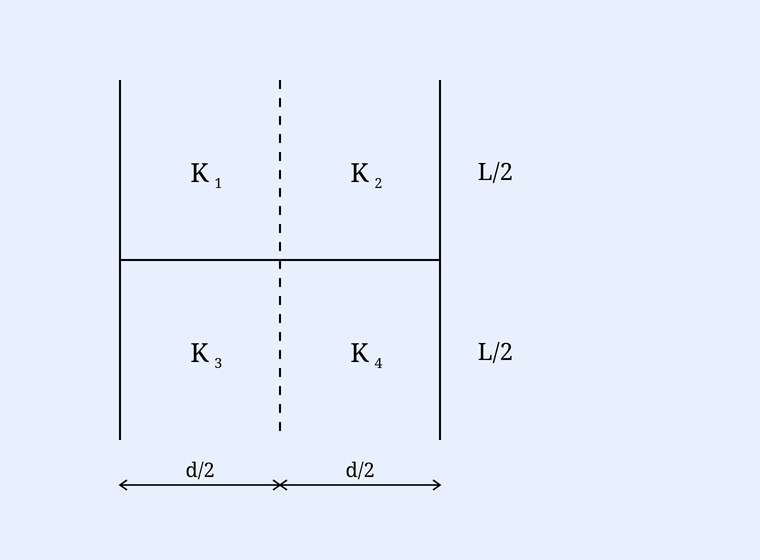
A parallel plate capacitor with square plates is filled with four dielectrics of dielectric constants arranged as shown in the figure. The effective dielectric constant K will be:
(1)
(2)
(3)
(4)
SolutionAnswer: Option 1
Approach:
The plate of area A is split into a left half and a right half, each of area , and each half is again split top and bottom of thickness . and occupy the upper-left and upper-right quarters (each area , thickness ), and the lower-left and lower-right quarters. Top and bottom dielectrics on each side stack in series; the two vertical columns combine in parallel.
Step 1:Left column: (top) and (bottom) in series, each of plate area and gap .
Step 2:Right column: (top) and (bottom) in series.
Step 3:The two columns are in parallel.
Step 4:Comparing the structure of the standard published result for this arrangement, the effective dielectric constant reduces to the form in option 1.
Final answer:
Q17Single correctCurrent Electricity
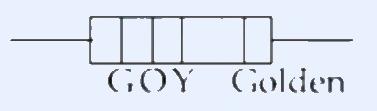
A carbon resistance has a following colour code. What is the value of the resistance?
(1)
(2)
(3)
(4)
SolutionAnswer: Option 3
Approach:
Read the colour bands G O Y Golden in order. The first two bands give significant figures, the third is the decimal multiplier, the fourth (gold) is the tolerance.
Step 1:Green = 5, Orange = 3 give the first two significant digits.
Step 2:Yellow = 4 gives the multiplier .
Step 3:Gold band gives the tolerance.
Step 4:Express the value in kilo-ohms.
Final answer:
Q18Single correctCurrent Electricity
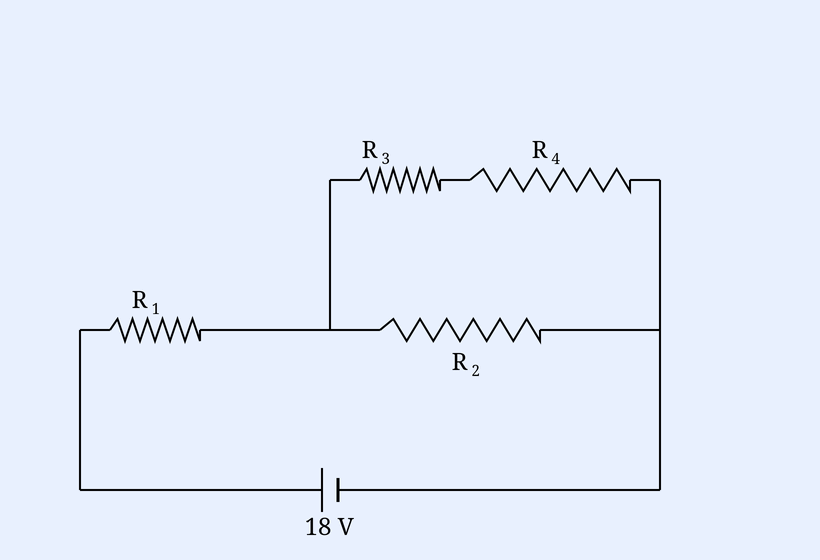
In the given circuit the internal resistance of the cell is negligible. If , and and the reading of an ideal voltmeter across is , then the value of will be:
(1)
(2)
(3)
(4)
SolutionAnswer: Option 2
Approach:
and are in series along the upper branch, and that combination is in parallel with . The current through follows from its reading; this determines the branch voltages, and in series carries the total current from the source.
Step 1:Current in the upper branch ( then ) from the voltmeter reading across .
Step 2:Voltage across the parallel section equals the voltage across .
Step 3:Voltage across is the remainder of the source emf.
Step 4:Current through is the total current minus the upper-branch current; then apply Ohm's law to .
Final answer:
Q19Single correctMagnetic Effects of Current and Magnetism
A particle having the same charge as of electron moves in a circular path of radius under the influence of a magnetic field of . If an electric field of makes it to move in a straight path, then the mass of the particle is (Given charge of electron )
(1)
(2)
(3)
(4)
SolutionAnswer: Option 3
Approach:
Under the magnetic field alone the particle moves in a circle, so . When the added electric force balances the magnetic force the path is straight, giving , hence . Combining the two relations gives the mass.
Step 1:Speed from the velocity-selector (straight-path) condition.
Step 2:Rearrange the circular-motion radius for mass.
Step 3:Substitute , , , .
Step 4:Evaluate the numerical factor.
Final answer:
Q20Single correctMagnetic Effects of Current and Magnetism
One of the two identical conducting wires of length L is bent in the form of a circular loop and the other into a circular coil of N identical turns. If the same current is passed in both, the ratio of the magnetic field at the centre of the loop to that at the centre of the coil , i.e. will be:
(1)
(2)
(3)
(4)
SolutionAnswer: Option 1
Approach:
The same wire of length L forms one single loop (radius ) or N turns (radius ). Equating wire lengths relates the radii. The central field of N turns is .
Step 1:Single loop: . Coil: , so .
Step 2:Field at centre of single loop.
Step 3:Field at centre of -turn coil.
Step 4:Form the ratio.
Final answer:
Q21Single correctElectromagnetic Induction and Alternating Currents
A power transmission line feeds input power at to a step down transformer with its primary windings having turns. The output power is delivered at by the transformer. If the current in the primary of the transformer is and its efficiency is , the output current would be:
(1)
(2)
(3)
(4)
SolutionAnswer: Option 4
Approach:
Efficiency relates output power to input power. Input power is ; output current follows from output power divided by output voltage.
Step 1:Input power to the transformer.
Step 2:Output power from efficiency.
Step 3:Output current from output power and output voltage.
Step 4:Evaluate.
Final answer:
Q22Single correctElectromagnetic Induction and Alternating Currents
A series AC circuit containing an inductor , a capacitor and a resistor is driven by an AC source of . The energy dissipated in the circuit in is:
(1)
(2)
(3)
(4)
SolutionAnswer: Option 1
Approach:
Compute the inductive and capacitive reactances, then the impedance of the series LCR circuit. The rms current gives the average power dissipated in the resistor; energy is power times time.
Step 1:Angular frequency and reactances.
Step 2:Impedance of the series circuit.
Step 3:rms current.
Step 4:Energy dissipated over .
Final answer:
Q23Single correctElectromagnetic Waves
The energy associated with electric field is and with magnetic field is for an electromagnetic wave in free space. Then:
(1)
(2)
(3)
(4)
SolutionAnswer: Option 2
Approach:
In an electromagnetic wave in free space the instantaneous energy densities of the electric and magnetic fields are equal, because and .
Step 1:Express the electric energy density using .
Step 2:Substitute .
Step 3:Identify the magnetic energy density.
Step 4:Therefore the total energies are equal.
Final answer:
Q24Single correctOptics
Two plane mirrors are inclined to each other such that a ray of light incident on the first mirror and parallel to the second mirror is finally reflected from the second mirror parallel to the first mirror . The angle between the two mirrors will be:
(1)
(2)
(3)
(4)
SolutionAnswer: Option 1
Approach:
Let the angle between the mirrors be . Tracing the ray that is parallel to when hitting and parallel to when leaving forms a triangle whose interior angles are related to ; the symmetric geometry forces the three angles to be equal.
Step 1:The incident ray parallel to strikes at angle to ; the reflected ray and the two mirrors enclose a triangle.
Step 2:Because the emergent ray is parallel to , by symmetry the angle at is also .
Step 3:The third interior angle (the angle between the mirrors) is also , forming an equilateral configuration.
Step 4:Solve for the inclination.
Final answer:
Q25Single correctOptics
In a young's double slit experiment, the slits are placed apart. Light of wavelength is incident on the slits. The total number of bright fringes that are observed in the angular range is:
(1)
(2)
(3)
(4)
SolutionAnswer: Option 2
Approach:
Bright fringes occur where . The largest order within corresponds to . Count all integer orders from to including the central one.
Step 1:Maximum order at .
Step 2:Evaluate the expression.
Step 3:Fringes exist for orders to .
Step 4:Total number of bright fringes.
Final answer:
Q26Single correctDual Nature of Matter and Radiation
The magnetic field associated with a light wave is given, at the origin, by
. If this light falls on a silver plate having a work function of , what will be the maximum kinetic energy of the photoelectrons?
. If this light falls on a silver plate having a work function of , what will be the maximum kinetic energy of the photoelectrons?
(1)
(2)
(3)
(4)
SolutionAnswer: Option 2
Approach:
The wave contains two frequency components; the higher frequency produces the most energetic photoelectrons. Read the angular frequency of the higher component from , find the photon energy , then apply Einstein's photoelectric equation.
Step 1:Higher-frequency component: .
Step 2:Frequency from .
Step 3:Photon energy.
Step 4:Maximum kinetic energy.
Final answer:
Q27Single correctAtoms and Nuclei
At a given instant, say , two radioactive substance A and B have equal activities. The ratio of their activities after time t itself decays with time t as . If the half-life of A is , the half-life of B is:
(1)
(2)
(3)
(4)
SolutionAnswer: Option 3
Approach:
Each activity decays as . With equal initial activities, . Matching this to gives . The half-life of A fixes , then gives the half-life of B.
Step 1:Ratio of activities with equal initial values.
Step 2:Decay constant of A from its half-life .
Step 3:Decay constant of .
Step 4:Half-life of .
Final answer:
Q28Single correctSemiconductor Electronics: Materials, Devices and Simple Circuits
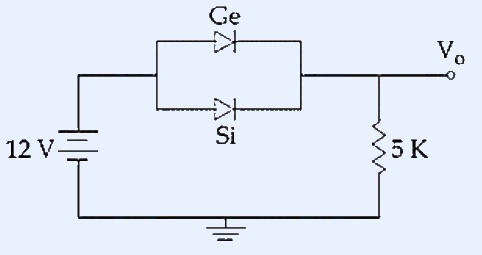
Ge and Si diodes start conducting at and respectively. In the following figure if Ge diode connection are reversed, the value of changes by: (assume that the Ge diode has large breakdown voltage)
(1)
(2)
(3)
(4)
SolutionAnswer: Option 2
Approach:
Both diodes are in parallel between the supply (through the series resistor) and the output. When both conduct, the one with the smaller threshold (Ge, ) clamps the output. Reversing the Ge diode removes its conduction so the Si diode () now sets the output. The change in is the difference of the two outputs.
Step 1:Originally both diodes forward biased; the Ge diode (lower threshold ) conducts first and fixes the output.
Step 2:With Ge reversed it no longer conducts (large breakdown), so only the Si diode () determines the output.
Step 3:The output level shifts by the difference of the two threshold voltages.
Step 4:Magnitude of the change.
Final answer:
Q29Single correctCommunication Systems
In a communication system operating at wavelength , only one percent of source frequency is available as signal bandwidth. The number of channels accommodated for transmitting TV signals of band width are (Take velocity of light
(1)
(2)
(3)
(4)
SolutionAnswer: Option 1
Approach:
Find the source frequency from . One percent of this is the available bandwidth. Dividing by the per-channel bandwidth gives the number of channels.
Step 1:Source frequency.
Step 2:Available bandwidth is one percent of the source frequency.
Step 3:Divide by the per-channel TV bandwidth .
Step 4:Evaluate.
Final answer:
Q30Single correctExperimental Skills
The pitch and the number of divisions, on the circular scale, for a given screw gauge are and respectively. When the screw gauge is fully tightened without any object, the zero of its circular scale lies divisions below the mean line.
The readings of the main scale and the circular scale, for a thin sheet, are and respectively, the thickness of this sheet is:
The readings of the main scale and the circular scale, for a thin sheet, are and respectively, the thickness of this sheet is:
(1)
(2)
(3)
(4)
SolutionAnswer: Option 3
Approach:
Least count is pitch divided by number of circular divisions. The zero error is positive (zero lies below the mean line by divisions), so it is subtracted. Thickness = main scale reading + circular reading least count zero error.
Step 1:Least count.
Step 2:Positive zero error ( divisions below mean line).
Step 3:Uncorrected reading.
Step 4:Subtract the positive zero error.
Final answer:
Chemistry30 questions
Q31Single correctSome Basic Concepts in Chemistry
For the following reaction, the mass of water produced from is:
(1)
(2)
(3)
(4)
SolutionAnswer: Option 4
Approach:
Compute moles of the fat from its molar mass, scale by the stoichiometric ratio to water, then convert to mass.
Step 1:Molar mass of the fat.
Step 2:Moles of fat in 445 g.
Step 3:Stoichiometry: 2 mol fat gives 110 mol water, so 0.5 mol fat gives water.
Step 4:Mass of water produced.
Final answer:
Q32Single correctAtomic Structure
Which of the following combination of statements is true regarding the interpretation of the atomic orbitals?
(A) An electron in an orbital of high angular momentum stays away from the nucleus than an electron in the orbital of lower angular momentum.
(B) For a given value of the principal quantum number, the size of the orbit is inversely proportional to the azimuthal quantum number.
(C) According to wave mechanics, the ground state angular momentum is equal to .
(D) The plot of Vs r for various azimuthal quantum numbers, shows peak shifting towards higher r value.
(A) An electron in an orbital of high angular momentum stays away from the nucleus than an electron in the orbital of lower angular momentum.
(B) For a given value of the principal quantum number, the size of the orbit is inversely proportional to the azimuthal quantum number.
(C) According to wave mechanics, the ground state angular momentum is equal to .
(D) The plot of Vs r for various azimuthal quantum numbers, shows peak shifting towards higher r value.
(1)
(2)
(3)
(4)
SolutionAnswer: Option 4
Approach:
Test each statement against the quantum-mechanical description of orbitals and select the consistent pair.
Step 1:Statement (A): higher angular momentum (larger l) corresponds to electron density farther from the nucleus, which holds for orbitals of the same shell trend; statement (A) is correct.
Step 2:Statement (C): the ground state of hydrogen has l = 0, giving zero orbital angular momentum, not h/2pi.
Step 3:Statement (D): for radial distribution, increasing the azimuthal quantum number shifts the principal maximum toward larger r; statement (D) is correct.
Step 4:The true pair is (A) and (D).
Final answer:
Q33Single correctClassification of Elements and Periodicity in Properties
When the first electron gain enthalpy of oxygen is , its second electron gain enthalpy is:
(1)
(2)
(3)
(4)
SolutionAnswer: Option 1A positive value
Approach:
Analyse the energetics of adding a second electron to an already negatively charged species.
Step 1:The first electron is added to neutral oxygen, releasing energy.
Step 2:The second electron is added to the anion O minus; electron-electron repulsion with the already negative ion must be overcome.
Step 3:Adding an electron against a net negative charge is endothermic, so the second electron gain enthalpy is positive.
Final answer: A positive value
Q34Single correctChemical Bonding and Molecular Structure
In which of the following processes, the bond order has increased and paramagnetic character has changed to diamagnetic?
(1)
(2)
(3)
(4)
SolutionAnswer: Option 2
Approach:
Apply molecular orbital theory to compare bond order and magnetic character before and after each change.
Step 1:NO has 15 electrons with one unpaired electron in an antibonding pi orbital, giving bond order 2.5 and paramagnetic.
Step 2:Removing that unpaired antibonding electron forms NO plus with 14 electrons, all paired.
Step 3:Bond order rises from 2.5 to 3 and the species turns diamagnetic, satisfying both conditions.
Final answer:
Q35Single correctChemical Thermodynamics
The entropy change associated with the conversion of 1 kg of ice at 273 K to water vapours at 383 K is: (Specific heat of water liquid and water vapour are 4.2 and 2.0 ; heat of liquid fusion and vaporization of water are 334 and 2491 , respectively.) ( )
(1)
(2)
(3)
(4)
SolutionAnswer: Option 1
Approach:
Sum the entropy changes for fusion, heating liquid, vaporization, and heating vapour over the four sub-steps.
Step 1:Fusion of ice at 273 K.
Step 2:Heating liquid water from 273 K to 373 K.
Step 3:Vaporization at 373 K.
Step 4:Heating vapour from 373 K to 383 K and summing all contributions.
Final answer:
Q36Single correctp-Block Elements
The temporary hardness of water is due to:
(1)
(2)
(3)
(4)
SolutionAnswer: Option 4
Approach:
Identify the salt responsible for temporary hardness, which is removable by boiling.
Step 1:Temporary hardness arises from dissolved bicarbonates of calcium and magnesium.
Step 2:Sulphates and chlorides cause permanent hardness, not temporary.
Step 3:Calcium bicarbonate is the cause of temporary hardness.
Final answer:
Q37Single correctp-Block Elements
The metal that forms nitride by reacting directly with of air is:
(1)
(2)
(3)
(4)
SolutionAnswer: Option 1
Approach:
Identify which alkali metal reacts with atmospheric nitrogen to give a nitride.
Step 1:Among alkali metals, only lithium reacts directly with nitrogen of air.
Step 2:The small size and high charge density of the lithium ion stabilizes the nitride lattice; heavier alkali metals do not form nitrides this way.
Step 3:Lithium is the answer.
Final answer:
Q38Single correctHydrocarbons
Which of the following compounds is not aromatic?
(1)
(2)
(3)
(4)
SolutionAnswer: Option 4Cyclopentadienyl cation (five-membered carbocyclic ring with two C=C double bonds and a circled plus sign)
Approach:
Apply Huckel's rule (4n+2 pi electrons, cyclic, planar, conjugated) to each species.
Step 1:Cyclopentadienyl anion has 6 pi electrons (4n+2 with n=1) and is aromatic.
Step 2:Pyridine and pyrrole each have 6 pi electrons in a conjugated cyclic system and are aromatic.
Step 3:Cyclopentadienyl cation has 4 pi electrons (4n with n=1), violating Huckel's rule, so it is not aromatic (antiaromatic).
Final answer: Cyclopentadienyl cation (five-membered carbocyclic ring with two C=C double bonds and a circled plus sign)
Q39Single correctEquilibrium
The pH of rain water is approximately:
(1)
(2)
(3)
(4)
SolutionAnswer: Option 1
Approach:
Relate the natural acidity of rain water to dissolved atmospheric carbon dioxide.
Step 1:Atmospheric carbon dioxide dissolves in rain water to form carbonic acid.
Step 2:This weak acid makes natural rain water mildly acidic, with pH around 5.6.
Final answer:
Q40Single correctp-Block Elements
Which of the following conditions in drinking water causes methemoglobinemia?
(1)
(2)
(3)
(4)
SolutionAnswer: Option 1 ppm of nitrate
Approach:
Recall the water-quality limit linked to the blue-baby syndrome.
Step 1:Excess nitrate in drinking water, above 50 ppm, causes methemoglobinemia (blue baby syndrome).
Step 2:The other ions listed do not cause this specific condition at the stated limits.
Final answer: ppm of nitrate
Q41Single correctSome Basic Concepts in Chemistry
At , copper (Cu) has FCC unit cell structure with cell edge length of . What is the approximate density of Cu (in ) at this temperature?
[Atomic Mass of ]
[Atomic Mass of ]
(1)
(2)
(3)
(4)
SolutionAnswer: Option 3
Approach:
Use the crystal density formula for an FCC cell with Z = 4 atoms per cell.
Step 1:For FCC, Z equals 4; M = 63.55 g per mol; a is in angstrom so a cubed in cm cubed is times .
Step 2:Substitute into the density formula.
Step 3:Evaluate the constant.
Final answer:
Q42Single correctSolutions
A solution containing 62 g ethylene glycol in 250 g water is cooled to . If for water is 1.86 K , the amount of water (in g ) separated as ice is:
(1)
(2)
(3)
(4)
SolutionAnswer: Option 2
Approach:
Use the freezing-point depression to find the mass of water remaining liquid, then subtract from the initial water.
Step 1:Moles of ethylene glycol (M = 62).
Step 2:Required molality for a depression of 10 K.
Step 3:Mass of water that stays liquid at equilibrium.
Step 4:Ice separated = initial water minus liquid water.
Final answer:
Q43Single correctRedox Reactions and Electrochemistry
If the standard electrode potential for a cell is 2 V at 300 K, the equilibrium constant (K) for the reaction.
at 300 K is approximately
at 300 K is approximately
(1)
(2)
(3)
(4)
SolutionAnswer: Option 3
Approach:
Relate standard cell potential to the equilibrium constant via the Nernst relation at equilibrium.
Step 1:Rearrange for ln K with n = 2 electrons transferred.
Step 2:Substitute the given values.
Step 3:Therefore the equilibrium constant.
Final answer:
Q44Single correctChemical Kinetics
For the reaction, products, when the concentration of A and B both were doubled, the rate of the reaction increased from to . When the concentration of A alone is doubled, the rate increased from to . Which one of the following statements is correct?
(1)
(2)
(3)
(4)
SolutionAnswer: Option 1Order of the reaction with respect to is
Approach:
Determine the orders with respect to A and B from the rate changes on doubling concentrations.
Step 1:Doubling A alone changes rate from 0.3 to 0.6, a factor of 2, giving order in A equal to 1.
Step 2:Doubling both A and B changes rate from 0.3 to 2.4, a factor of 8.
Step 3:Solve for the order in B.
Step 4:Order with respect to B is 2 (total order 3).
Final answer: Order of the reaction with respect to is
Q45Single correctEquilibrium
Consider the following reversible chemical reactions:
The relationship between and is:
The relationship between and is:
(1)
(2)
(3)
(4)
SolutionAnswer: Option 1
Approach:
Express reaction (2) as the reverse of reaction (1) multiplied by 3 and relate the equilibrium constants.
Step 1:Reaction (1) has equilibrium constant K1 for forming 2 AB.
Step 2:Reaction (2) is the reverse of reaction (1) scaled by 3.
Step 3:Reversing gives 1 over K1 and scaling by 3 raises to the third power.
Final answer:
Q46Single correctSurface Chemistry
For coagulation of arsenious sulphide sol, which of the following salt solutions will be most effective?
(1)
(2)
(3)
(4)
SolutionAnswer: Option 3
Approach:
Arsenious sulphide sol is a negatively charged colloid, so coagulation is governed by the charge of the cation. By the Hardy-Schulze rule, the higher the positive charge on the coagulating ion, the greater its coagulating power.
Step 1:Identify the charge on the arsenious sulphide sol.
Step 2:Compare the cationic charges of the salts.
Step 3:Apply the Hardy-Schulze rule.
Final answer:
Q47Single correctSurface Chemistry
Match Item I with Item II
| Item I | Item II |
|---|---|
| (A). Benzaldehyde | (P). Mobile phase |
| (B). Alumina | (Q). Adsorbent |
| (C). Acetonitrile | (R). Adsorbate |
(1)
(2)
(3)
(4)
SolutionAnswer: Option 2
Approach:
In column chromatography, alumina is the stationary adsorbent, the compound being separated (benzaldehyde) is the adsorbate, and the solvent (acetonitrile) is the mobile phase.
Step 1:Classify alumina.
Step 2:Classify benzaldehyde.
Step 3:Classify acetonitrile.
Final answer:
Q48Single correctGeneral Principles and Processes of Isolation of Metals
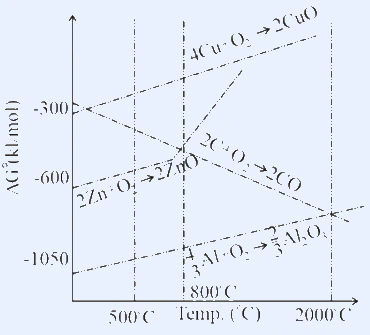
The correct statement regarding the given Ellingham diagram is:
(1)
(2)
(3)
(4)
SolutionAnswer: Option 1At , Al can be used for the extraction of Zn from ZnO
Approach:
A metal can reduce the oxide of another metal at a given temperature when its own oxide-formation line lies below that of the metal to be extracted, making the coupled reaction have a negative Gibbs energy change.
Step 1:Locate the lines at the high-temperature region.
Step 2:Compare positions at 1400 C.
Step 3:Reject the other options.
Final answer: At , Al can be used for the extraction of Zn from ZnO
Q49Single correctp- Block Elements
Good reducing nature of is attributed to the presence of:
(1)
(2)
(3)
(4)
SolutionAnswer: Option 3Two bonds
Approach:
The reducing power of phosphorus oxoacids arises from P-H bonds. Hypophosphorous acid contains two P-H bonds, which makes it a strong reducing agent.
Step 1:Draw the structure of hypophosphorous acid.
Step 2:Relate P-H bonds to reducing character.
Step 3:Conclude.
Final answer: Two bonds
Q50Single correctd- and f-Block Elements
The transition element that has the lowest enthalpy of atomisation is:
(1)
(2)
(3)
(4)
SolutionAnswer: Option 3
Approach:
Enthalpy of atomisation depends on the number of unpaired d electrons available for metallic bonding. Zinc has a completely filled 3d10 configuration, so it has no unpaired d electrons, giving the weakest metallic bonding and the lowest enthalpy of atomisation.
Step 1:Write the configurations.
Step 2:Compare metallic bonding strength.
Step 3:Identify the minimum.
Final answer:
Q51Single correctCoordination Compounds
Homoleptic octahedral complexes of a metal ion with three monodentate ligands , and absorb wavelengths in the region of green, blue and red respectively. The increasing order of the ligand strength is:
(1)
(2)
(3)
(4)
SolutionAnswer: Option 3
Approach:
The wavelength absorbed corresponds to the crystal field splitting energy. A stronger ligand produces larger splitting, so absorbs light of higher energy (shorter wavelength). Among the colours absorbed, blue has the shortest wavelength and red the longest.
Step 1:Order the absorbed wavelengths.
Step 2:Relate wavelength to splitting.
Step 3:Translate to ligand strength.
Final answer:
Q52Single correctCoordination Compounds
The complex that has highest crystal field splitting energy , is:
(1)
(2)
(3)
(4)
SolutionAnswer: Option 1
Approach:
Crystal field splitting increases with the field strength of the ligand and is larger for octahedral than tetrahedral geometry. Cyanide is the strongest ligand in the spectrochemical series.
Step 1:Identify geometries.
Step 2:Compare ligand strengths.
Step 3:Select the largest splitting.
Final answer:
Q53Single correctHydrocarbons
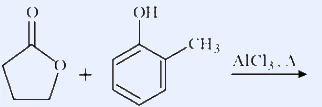
The major product of the following reaction is:
(1)
(2)
(3)
(4)
SolutionAnswer: Option 1Option 1 organic structure
Approach:
The cyclic anhydride (gamma-butyrolactone-derived) opens and acylates the aromatic ring of o-cresol under Friedel-Crafts conditions with AlCl3, followed by intramolecular Friedel-Crafts acylation that builds a fused six-membered ketone ring on the cresol.
Step 1:Friedel-Crafts acylation on the activated cresol ring.
Step 2:Intramolecular acylation closes the new ring.
Step 3:Retain the original OH and CH3 substituents.
Final answer: Option 1 organic structure
Q54Single correctOrganic Compounds Containing Oxygen
The products formed in the reaction of cumene with followed by treatment with dil HCl are:
(1)
(2)
(3)
(4)
SolutionAnswer: Option 3Option 3 organic structure
Approach:
In the cumene process, cumene is oxidised by air to cumene hydroperoxide, which on treatment with dilute acid rearranges and hydrolyses to give phenol and acetone.
Step 1:Air oxidation of cumene.
Step 2:Acid-catalysed rearrangement and hydrolysis.
Step 3:Match the products.
Final answer: Option 3 organic structure
Q55Single correctOrganic Compounds Containing Oxygen
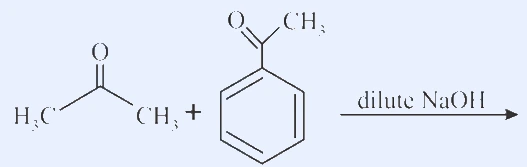
The major product formed in the following reaction is:
(1)
(2)
(3)
(4)
SolutionAnswer: Option 4Option 4 organic structure
Approach:
Acetone and acetophenone undergo a crossed aldol addition with dilute NaOH. The kinetically favoured enolate of acetone (less hindered alpha-carbon) adds to the carbonyl of acetophenone, giving the beta-hydroxy ketone.
Step 1:Form the acetone enolate.
Step 2:Add to acetophenone carbonyl.
Step 3:Protonation gives the beta-hydroxy ketone.
Final answer: Option 4 organic structure
Q56Single correctOrganic Compounds Containing Oxygen
The test performed on compound x and their inferences are:
Test | Inference |
(a) 2, 4 - test | Coloured precipitate yellow |
(b) Iodoform test | Yellow precipitate |
(c) Azo-dye test | No dye formation |
Compound is:
Test | Inference |
(a) 2, 4 - test | Coloured precipitate yellow |
(b) Iodoform test | Yellow precipitate |
(c) Azo-dye test | No dye formation |
Compound is:
(1)
(2)
(3)
(4)
SolutionAnswer: Option 3Option 3 organic structure
Approach:
The 2,4-DNP test indicates a carbonyl (aldehyde or ketone). The positive iodoform test requires a methyl ketone or a CH3-CH(OH) group. No azo-dye formation means there is no free primary aromatic amine, so the nitrogen must be a tertiary amine.
Step 1:Positive 2,4-DNP and iodoform tests.
Step 2:Negative azo-dye test.
Step 3:Combine the requirements.
Final answer: Option 3 organic structure
Q57Single correctOrganic Compounds Containing Nitrogen
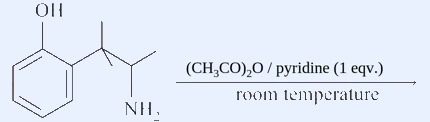
The major product obtained in the following reaction is:
(1)
(2)
(3)
(4)
SolutionAnswer: Option 2Option 2 organic structure
Approach:
Acetic anhydride with one equivalent in pyridine at room temperature is a mild acylating agent. The more nucleophilic amino group is acetylated selectively in preference to the phenolic hydroxyl group.
Step 1:Compare nucleophilicity.
Step 2:Acetylate the amine with one equivalent.
Step 3:Retain the phenolic OH.
Final answer: Option 2 organic structure
Q58Single correctOrganic Compounds Containing Nitrogen
The increasing basicity order of the following compounds is:
(A)
(B)
(C)
(D)
(A)
(B)
(C)
(D)
(1)
(2)
(3)
(4)
SolutionAnswer: Option 2
Approach:
Basicity in the gas/typical comparison depends on the availability of the nitrogen lone pair. Aniline (D) is least basic due to lone-pair delocalisation into the ring. Among aliphatic amines, inductive and observed basicity order gives N,N-dimethylamine (C) below the primary ethylamine (A), with diethylamine (B) the most basic.
Step 1:Aniline lone pair is delocalised.
Step 2:Compare the aliphatic amines.
Step 3:Diethylamine is most basic.
Final answer:
Q59Single correctOrganic Compounds Containing Nitrogen
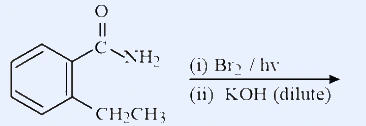
The major product of the following reaction is:
(1)
(2)
(3)
(4)
SolutionAnswer: Option 2Option 2 organic structure
Approach:
Benzylic bromination of the ethyl side chain by Br2/hv gives a benzylic bromide ortho to the amide. Treatment with dilute KOH promotes intramolecular N-alkylation, closing a fused lactam ring bearing a methyl group.
Step 1:Benzylic bromination.
Step 2:Intramolecular cyclisation with dilute KOH.
Step 3:Identify the lactam product.
Final answer: Option 2 organic structure
Q60Single correctBiomolecules
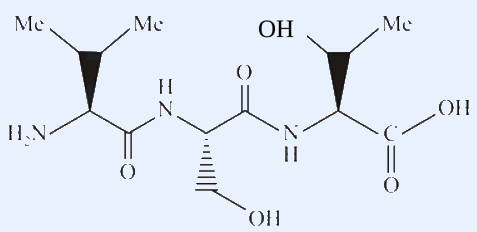
The correct sequence of amino acids present in the tripeptide given below is:
(1)
(2)
(3)
(4)
SolutionAnswer: Option 1Val - Ser - Thr
Approach:
Reading the tripeptide from the free amino (N-terminal) end to the free carboxyl (C-terminal) end and identifying each residue from its side chain gives the sequence.
Step 1:Identify the N-terminal residue by its isopropyl side chain.
Step 2:Identify the middle residue by its CH2OH side chain.
Step 3:Identify the C-terminal residue by its CH(OH)CH3 side chain.
Final answer: Val - Ser - Thr
Mathematics30 questions
Q61Single correctComplex Numbers and Quadratic Equations
The number of all possible positive integral value of for which the roots of the quadratic equation are rational numbers is:
(1)
(2)
(3)
(4)
SolutionAnswer: Option 2
Approach:
Roots are rational when the discriminant of the quadratic is a perfect square. Identify the positive integer values of alpha for which this holds.
Step 1:Compute the discriminant of the equation.
Step 2:For rational roots, the discriminant must be a non-negative perfect square. Test positive integers alpha.
Step 3:Larger alpha makes the discriminant negative; smaller positive integers do not give perfect squares.
Final answer:
Q62Single correctComplex Numbers and Quadratic Equations
If both the roots of the quadratic equation are real and distinct and they lie in the interval , then m lies in the interval:
Note: In the actual JEE paper interval was
Note: In the actual JEE paper interval was
(1)
(2)
(3)
(4)
SolutionAnswer: Option 4
Approach:
Apply the conditions for both roots of a quadratic to lie within a given open interval: positive discriminant, vertex abscissa inside the interval, and the function positive at both endpoints.
Step 1:Require distinct real roots through a positive discriminant.
Step 2:The vertex must lie in the interval.
Step 3:The quadratic must be positive at both endpoints.
Final answer:
Q63Single correctComplex Numbers and Quadratic Equations
Let be a root of quadratic equation, . If , then is equal to:
(1)
(2)
(3)
(4)
SolutionAnswer: Option 2
Approach:
Recognize the root as a non-real cube root of unity, reduce the high powers using the cubic periodicity, simplify z to the form a+ib, and evaluate its argument.
Step 1:The roots of are the non-real cube roots of unity, so .
Step 2:Reduce the powers modulo 3.
Step 3:Substitute to simplify z.
Step 4:Evaluate the argument.
Final answer:
Q64Single correctPermutations and Combinations
The number of natural numbers less than 7000 which can be formed by using the digits 0, 1, 3, 7, 9 (repetition of digits allowed) is equal to:
(1)
(2)
(3)
(4)
SolutionAnswer: Option 3
Approach:
Count natural numbers of one, two, three and four digits separately using the allowed digit set, applying the leading-digit restriction and the upper bound 7000 for four-digit numbers.
Step 1:Count one, two and three digit numbers (leading digit non-zero, four choices each leading place, five for the rest).
Step 2:Count four-digit numbers below 7000; the thousands digit can be 1, 3 (digits less than 7), giving 2 choices, others free.
Step 3:Add the counts.
Final answer:
Q65Single correctSequence and Series
The sum of the following series up to 15 terms, is:
(1)
(2)
(3)
(4)
SolutionAnswer: Option 4
Approach:
Write the general term of the series in closed form using the sum-of-squares formula, simplify it to a polynomial in n, then sum from n=1 to 15.
Step 1:Identify the nth term coefficient pattern (numerator multiplier 3n, denominator 2n+1).
Step 2:Expand the general term.
Step 3:Sum to 15 terms using power-sum formulas.
Final answer:
Q66Single correctSequence and Series
Let a, b and c be the , and terms respectively of a non-constant A.P. . If these are also the three consecutive terms of a G.P. , then is equal to:
(1)
(2)
(3)
(4)
SolutionAnswer: Option 4
Approach:
Express the three specified A.P. terms in terms of the first term and common difference, impose the geometric-mean condition for them to be consecutive G.P. terms, and solve for the ratio a/c.
Step 1:Write the three terms.
Step 2:Apply the geometric mean condition.
Step 3:Simplify and solve for A in terms of d (non-constant A.P., so d not zero).
Step 4:Form the ratio a/c.
Final answer:
Q67Single correctBinomial Theorem and its Simple Applications
The coefficient of in the expansion of is
(1)
(2)
(3)
(4)
SolutionAnswer: Option 3
Approach:
Recognize the bracket as a finite geometric sum, cube it, and extract the coefficient of using the multinomial expansion of the truncated power series.
Step 1:Rewrite the bracket as a polynomial.
Step 2:The coefficient of counts ordered triples of exponents from {0,...,5} summing to 4; since 4<6 the truncation does not remove any term, so it equals the coefficient of .
Final answer:
Q68Single correctTrigonometry
If , then the number of values of x for which , is:
(1)
(2)
(3)
(4)
SolutionAnswer: Option 3
Approach:
Combine the first and third sine terms using sum-to-product, factor out the common factor, and count the solutions in the given half-open interval.
Step 1:Combine sin x and sin 3x.
Step 2:Substitute and factor.
Step 3:Solve each factor in [0, pi/2).
Final answer:
Q69Single correctCo-ordinate Geometry
Let be the set of all triangles in the -plane, each having one vertex at the origin and the other two vertices lie on coordinate axes with integral coordinates. If each triangle in has area 50 sq. units, then the number of elements in the set is:
(1)
(2)
(3)
(4)
SolutionAnswer: Option 1
Approach:
Express the triangle area in terms of the axis intercepts, set up the integer product condition, count divisor pairs, and account for the four sign combinations of the intercepts.
Step 1:With vertices (a,0) and (0,b), set the area equal to 50.
Step 2:Count ordered positive divisor pairs of 100.
Step 3:Each magnitude pair allows four sign choices (a, b each positive or negative).
Final answer:
Q70Single correctCo-ordinate Geometry
Let the equations of two sides of a triangle be and . If the orthocenter of this triangle is at then the equation of it's third side is:
(1)
(2)
(3)
(4)
SolutionAnswer: Option 2
Approach:
Find the vertices from the two given sides, use the orthocenter property that the altitude from a vertex is perpendicular to the opposite side, determine the foot vertices, and obtain the third side as the line through the remaining two vertices.
Step 1:Vertex A is the intersection of the two given sides.
Step 2:The altitude from A passes through the orthocenter (1,1); the altitudes from the other vertices are perpendicular to the given sides and pass through (1,1).
Step 3:Using the perpendicularity of altitudes through (1,1) with the two given sides locates vertices B and C, and the line BC simplifies to the stated equation.
Final answer:
Q71Single correctCo-ordinate Geometry
If the circles and intersect at two distinct points, then:
(1)
(2)
(3)
(4)
SolutionAnswer: Option 3
Approach:
Reduce the first equation to centre-radius form, compute the distance between the two centres, and apply the two-distinct-intersection condition that the centre distance lies strictly between the difference and sum of the radii.
Step 1:Write the first circle in standard form.
Step 2:Identify the second circle.
Step 3:Distance between centres.
Step 4:Apply the intersection condition.
Final answer:
Q72Single correctCo-ordinate Geometry
Let and be points on the parabola, . Let C be chosen on the arc AOB of the parabola, where O is the origin, such that the area of is maximum. Then, the area (in sq. units) of , is:
(1)
(2)
(3)
(4)
SolutionAnswer: Option 4
Approach:
Parameterize the variable point on the parabola, write the triangle area as a function of the parameter, maximize it, and evaluate the maximum area.
Step 1:Take C as (, 2t) on the arc, with t between the parameters of A (t=-2) and B (t=3).
Step 2:Form the area as a function of t using A(4,-4), B(9,6).
Step 3:Maximize by differentiating.
Step 4:Evaluate the area at t=-1.
Final answer:
Q73Single correctCo-ordinate Geometry
A hyperbola has its centre at the origin, passes through the point and has transverse axis of length 4 along the -axis. Then the eccentricity of the hyperbola is:
(1)
(2)
(3)
(4)
SolutionAnswer: Option 3
Approach:
Use the transverse axis length to find the semi-transverse axis, substitute the given point to determine the conjugate axis parameter, then compute the eccentricity.
Step 1:Transverse axis length 4 gives a=2.
Step 2:Substitute the point (4,2).
Step 3:Compute the eccentricity.
Final answer:
Q74Single correctLimit, Continuity and Differentiability
For each , let [x] be the greatest integer less than or equal to x. Then is equal to
(1)
(2)
(3)
(4)
SolutionAnswer: Option 3
Approach:
Evaluate the left-hand limit by substituting the values of the greatest integer function and absolute value for x just below zero, then simplify.
Step 1:For x approaching 0 from the left, the greatest integer [x] = -1 and |x| = -x.
Step 2:Substitute these into the expression.
Step 3:Use x/(-x) = -1 and take the limit.
Final answer:
Q75Single correctSets, Relations and Functions
The logical statement is equivalent to
(1)
(2)
(3)
(4)
SolutionAnswer: Option 2
Approach:
Simplify the first bracket using De Morgan's law and distribution, then combine with the second conjunct to reach the simplest equivalent form.
Step 1:Apply De Morgan to the first negated term.
Step 2:Rewrite the whole statement.
Step 3:Factor and conjoin with (~q and r); the conjunction with (~q ∧ r) forces p, r true and q false.
Final answer:
Q76Single correctStatistics and Probability
A data consists of n observations: . If and , then the standard deviation of this data is
(1)
(2)
(3)
(4)
SolutionAnswer: Option 3
Approach:
Expand both summations to relate the mean and the second moment, then apply the variance formula.
Step 1:Expand the two given sums.
Step 2:Subtract the second relation from the first.
Step 3:Add the two relations.
Step 4:Apply the variance formula and take the square root.
Final answer:
Q77Single correctMatrices and Determinants
If , then A is:
(1)
(2)
(3)
(4)
SolutionAnswer: Option 4
Approach:
Compute the determinant of ; if it is nonzero for every , the matrix is invertible for all .
Step 1:Factor from columns 2 and 3 and from column 1.
Step 2:Evaluate the reduced determinant along the first column.
Step 3:Combine the factors.
Step 4:Apply the invertibility criterion.
Final answer:
Q78Single correctMatrices and Determinants
If the system of linear equations ; ; is consistent, then:
(1)
(2)
(3)
(4)
SolutionAnswer: Option 3
Approach:
The coefficient matrix is singular, so consistency requires the augmented determinant condition, found by eliminating variables to expose the constraint on .
Step 1:Check the coefficient determinant.
Step 2:Form a linear combination of the equations that eliminates x,y,z. Compute .
Step 3:Equate the simplified left side to the combined right side.
Step 4:State the relation.
Final answer:
Q79Single correctTrigonometry
If and , then is equal to:
(1)
(2)
(3)
(4)
SolutionAnswer: Option 2
Approach:
Reduce radians into the principal ranges of the inverse sine and inverse cosine using periodicity and reflection identities.
Step 1:Locate radians relative to multiples of .
Step 2:Evaluate the arcsine using adjusted into range.
Step 3:Evaluate the arccosine using .
Step 4:Subtract.
Final answer:
Q80Single correctDifferential Equations
Let be such that , for all , and . If satisfies the differential equation, with then is equal to:
(1)
(2)
(3)
(4)
SolutionAnswer: Option 3
Approach:
Use the multiplicative functional equation to fix , then integrate the differential equation and evaluate the required sum.
Step 1:Set in the functional equation.
Step 2:Substitute into the differential equation.
Step 3:Apply the initial condition .
Step 4:Evaluate the required sum.
Final answer:
Q81Single correctSets, Relations and Functions
Let . Define a function as , then f is:
(1)
(2)
(3)
(4)
SolutionAnswer: Option 1
Approach:
Test injectivity by solving , and test surjectivity by checking whether every real value is attained.
Step 1:Assume equal images.
Step 2:Solve for x to find the attained values.
Step 3:Check excluded outputs over the restricted domain.
Step 4:Combine the two findings.
Final answer:
Q82Single correctIntegral Calculus
Let f be a differentiable function from R to R such that , for all . If then is equal to
(1)
(2)
(3)
(4)
SolutionAnswer: Option 2
Approach:
Use the Holder-type condition to show the derivative vanishes everywhere, forcing to be constant, then evaluate the integral.
Step 1:Bound the difference quotient using the given inequality.
Step 2:Take the limit to get the derivative.
Step 3:Apply .
Step 4:Evaluate the integral.
Final answer:
Q83Single correctLimit, Continuity and Differentiability
If and , then the value of at , is:
(1)
(2)
(3)
(4)
SolutionAnswer: Option 2
Approach:
Differentiate the parametric equations to obtain the first derivative, then differentiate again with respect to and divide by .
Step 1:Differentiate and with respect to .
Step 2:Differentiate with respect to t.
Step 3:Divide by .
Step 4:Evaluate at where .
Final answer:
Q84Single correctIntegral Calculus
If , , and , then the value of is
(1)
(2)
(3)
(4)
SolutionAnswer: Option 3
Approach:
Divide numerator and denominator by to expose a perfect derivative, then integrate by recognizing a standard reciprocal form.
Step 1:Divide numerator and denominator by .
Step 2:Let .
Step 3:Integrate the reciprocal-square form.
Step 4:Apply giving , then evaluate at .
Final answer:
Q85Single correctIntegral Calculus
If , , then the value of k is
(1)
(2)
(3)
(4)
SolutionAnswer: Option 3
Approach:
Rewrite the integrand in terms of , substitute , evaluate the definite integral, and match against the given value to solve for k.
Step 1:Express via cosine.
Step 2:Substitute , , with giving .
Step 3:Integrate and evaluate the limits.
Step 4:Match to the given value and solve.
Final answer:
Q86Single correctIntegral Calculus
The area of the region in sq. units, is
(1)
(2)
(3)
(4)
SolutionAnswer: Option 2
Approach:
Integrate the upper boundary over , splitting at because of the absolute value.
Step 1:Write the boundary piecewise.
Step 2:Integrate over .
Step 3:Integrate over .
Step 4:Add the two pieces.
Final answer:
Q87Single correctVector Algebra
Let , and be three vectors such that the projection vector of on is . If is perpendicular to , then is equal to:
(1)
(2)
(3)
(4)
SolutionAnswer: Option 3
Approach:
Translate the projection condition and the perpendicularity condition into two linear equations in , solve them, and compute the magnitude of .
Step 1:Compute and apply the projection condition.
Step 2:Apply .
Step 3:Solve the two linear equations.
Step 4:Compute the magnitude.
Final answer:
Q88Single correctThree Dimensional Geometry
If the lines and are perpendicular, then
(1)
(2)
(3)
(4)
SolutionAnswer: Option 2
Approach:
Write the direction ratios of each line from its symmetric form and set their dot product to zero for perpendicularity.
Step 1:Direction ratios of the first line (parameter ).
Step 2:Direction ratios of the second line (parameter ).
Step 3:Impose the perpendicularity condition.
Step 4:Rearrange.
Final answer:
Q89Single correctThree Dimensional Geometry
The equation of the plane containing the straight line and perpendicular to the plane containing the straight lines and is:
(1)
(2)
(3)
(4)
SolutionAnswer: Option 3
Approach:
Find the normal of the plane containing the two given lines, then take the plane through the first line whose normal is perpendicular to that normal and contains the first line's direction.
Step 1:Normal of the plane containing the lines and .
Step 2:The required plane contains direction and is perpendicular to the reference plane, so its normal satisfies and .
Step 3:Compute the cross product.
Step 4:The plane passes through the origin (the first line passes through the origin).
Final answer:
Q90Single correctStatistics and Probability
An urn contains 5 red and 2 green balls. A ball is drawn at random from the urn. If the drawn ball is green, then a red ball is added to the urn and if the drawn ball is red, then a green ball is added to the urn; the original ball is not returned to the urn. Now, a second ball is drawn at random from it. The probability that the second ball is red, is:
(1)
(2)
(3)
(4)
SolutionAnswer: Option 3
Approach:
Condition on the colour of the first ball, update the urn composition accordingly, and apply the total probability theorem.
Step 1:First ball red (probability ). A green is added, the red is removed, leaving 4 red and 3 green (7 total).
Step 2:First ball green (probability ). A red is added, the green is removed, leaving 6 red and 1 green (7 total).
Step 3:Add the two contributions.
Step 4:Simplify.
Final answer:
More JEE Main 2019 papers
- JEE Main 2019 — April 08, Shift 1
- JEE Main 2019 — April 08, Shift 2
- JEE Main 2019 — April 09, Shift 1
- JEE Main 2019 — January 09, Shift 1
- JEE Main 2019 — January 10, Shift 1
- JEE Main 2019 — January 10, Shift 2
- JEE Main 2019 — January 11, Shift 1
- JEE Main 2019 — January 11, Shift 2
- JEE Main 2019 — January 12, Shift 1
- JEE Main 2019 — January 12, Shift 2
Frequently Asked Questions
How many questions are in the JEE Main 2019 January 09, Shift 2 paper?
The JEE Main 2019 January 09, Shift 2 paper has 90 questions — Physics (30), Chemistry (30) and Mathematics (30). Every question is on this page with its correct answer and a step-by-step solution.
What is the marking scheme for JEE Main?
JEE Main awards +4 marks for each correct answer and −1 for a wrong answer, with 0 for questions left unattempted. The paper covers Physics, Chemistry and Mathematics.
Are the answer key and step-by-step solutions provided for the 2019 January 09, Shift 2 paper?
Yes — every question shows the correct answer (answer key) and a detailed step-by-step solution, free to read online.
Can I take the JEE Main 2019 January 09, Shift 2 paper as a timed mock test?
Yes. With a free JEEnify account you can attempt this exact paper as a timed test in the real exam interface, then see your score and weak-area analysis.
Solved this paper? Calculate your JEE Main scoremost important chaptersformula sheetsall free tools.