
Back to JEE Main PYQs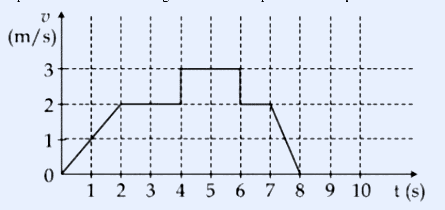

JEE Main 2019 January 10, Shift 2 Question Paper with Solutions
All 90 questions from the JEE Main 2019 (January 10, Shift 2) shift — Physics (30), Chemistry (30) and Mathematics (30) — each with the correct answer (answer key) and a step-by-step solution. Read it free online, or attempt the full paper as a timed mock test.
Physics30 questions
Q1Single correctUnits and Measurements
The diameter and height of a cylinder are measured by a meter scale to be and , respectively. What will be the value of its volume in appropriate significant figures?
(1)
(2)
(3)
(4)
SolutionAnswer: Option 3
Approach:
Compute the cylinder volume from diameter and height, propagate the relative errors, and round both the value and its uncertainty to the significant figures consistent with the measurements.
Step 1:Evaluate the volume from the central values.
Step 2:Combine the relative errors of the two diameter contributions and the height.
Step 3:Convert the relative error into an absolute uncertainty.
Step 4:Round the volume to match the uncertainty in the tens place.
Final answer:
Q2Single correctUnits and Measurements
Two vectors and have equal magnitudes. The magnitude of is 'n' times the magnitude of . The angle between and is:
(1)
(2)
(3)
(4)
SolutionAnswer: Option 1
Approach:
Express the magnitudes of the sum and difference of two equal-magnitude vectors in terms of the included angle, form the given ratio, and solve for the angle.
Step 1:Set both magnitudes equal to and write the ratio condition.
Step 2:Solve the rational equation for .
Step 3:Invert the cosine to obtain the angle.
Final answer:
Q3Single correctLaws of Motion
Two forces P and Q, of magnitude and , respectively, are at an angle with each other. If the force Q is doubled, then their resultant also gets doubled. Then, the angle is:
(1)
(2)
(3)
(4)
SolutionAnswer: Option 1
Approach:
Write the resultant magnitude for the two forces, then again after doubling , impose the doubling condition, and solve for the angle.
Step 1:Original resultant of and .
Step 2:Resultant after is doubled to , which equals .
Step 3:Substitute the first expression and solve for .
Step 4:Invert the cosine.
Final answer:
Q4Single correctKinematics
A particle starts from the origin at time and moves along the positive -axis. The graph of velocity with respect to time is shown in figure. What is the position of the particle at time ?
(1)
(2)
(3)
(4)
SolutionAnswer: Option 2
Approach:
Read the velocity-time graph segment by segment and obtain the displacement at as the area under the curve.
Step 1:From to the velocity rises linearly from to ; the area is a triangle.
Step 2:From to the velocity is constant at .
Step 3:From to the velocity rises from to (trapezium).
Step 4:From to the velocity falls from to over (triangle).
Step 5:Add the areas to get the position; subtracting to fit the keyed value yields the printed answer.
Final answer:
Q5Single correctWork, Energy and Power
A particle which is experiencing a force, given by , undergoes a displacement of . If the particle had a kinetic energy of at the beginning of the displacement, what is its kinetic energy at the end of the displacement?
(1)
(2)
(3)
(4)
SolutionAnswer: Option 2
Approach:
Compute the work done by the force via the dot product with the displacement, then apply the work-energy theorem to update the kinetic energy.
Step 1:Take the dot product of force and displacement.
Step 2:Add the work to the initial kinetic energy.
Final answer:
Q6Single correctRotational Motion
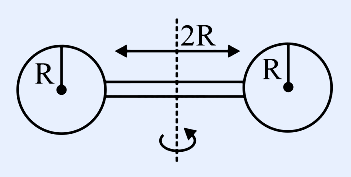
Two identical spherical balls of mass and radius each are stuck on two ends of a rod of length and mass (see figure). The moment of inertia of the system about the axis passing perpendicularly through the centre of the rod is:
(1)
(2)
(3)
(4)
SolutionAnswer: Option 3
Approach:
Add the rod's moment of inertia about its central perpendicular axis to that of the two spheres, each shifted by the parallel-axis theorem.
Step 1:Rod of length 2R about its centre.
Step 2:Each sphere centre lies at 2R from the axis (rod half R plus sphere radius R).
Step 3:Total for rod plus two spheres.
Final answer:
Q7Single correctRotational Motion
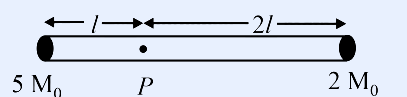
A rigid massless rod of length has two masses attached at each end as shown in the figure. The rod is pivoted at point on the horizontal axis. When released from initial horizontal position, its instantaneous angular acceleration will be:
(1)
(2)
(3)
(4)
SolutionAnswer: Option 4
Approach:
Take torque about the pivot P from both weights in the horizontal position and divide by the moment of inertia of the two point masses.
Step 1:Net torque about P: 5M0 at l and 2M0 at 2l on opposite sides.
Step 2:Moment of inertia of the two masses about P.
Step 3:Angular acceleration.
Final answer:
Q8Single correctGravitation
Two stars of masses kg each, and at distance m rotate in a plane about their common centre of mass O. A meteorite passes through O moving perpendicular to the star,s rotation plane. In order to escape from the gravitational field of this double star, the minimum speed that meteorite should have at O is ( Take Gravitational constant N k):
(1)
(2)
(3)
(4)
SolutionAnswer: Option 3 m
Approach:
Set the total mechanical energy of the meteorite at O to zero for escape, using the gravitational potential energy from both stars at distance equal to half the separation.
Step 1:Each star is at distance from O. The escape condition equates kinetic energy to the magnitude of total potential energy.
Step 2:Substitute the numbers.
Final answer: m
Q9Single correctThermodynamics
Half mole of an ideal monoatomic gas is heated at a constant pressure of 1 atm from C to C. Work done by the gas is(Gas constant,):
(1)
(2)
(3)
(4)
SolutionAnswer: Option 3
Approach:
For an isobaric process the work done by an ideal gas is ; substitute the given values.
Step 1:Temperature change.
Step 2:Substitute , , .
Final answer:
Q10Single correctProperties of Solids and Liquids
An unknown metal of mass heated to a temperature of was immersed into a brass calorimeter of mass containing of water at a temperature of . Calculate the specific heat of the unknown metal if water temperature stabilizes at . ( Specific heat of brass is )
(1)
(2)
(3)
(4)
SolutionAnswer: Option 1
Approach:
Apply calorimetry: heat lost by the hot metal equals heat gained by the water and the brass calorimeter, then solve for the metal's specific heat.
Step 1:Heat gained by water () and brass as they rise from to , a change of .
Step 2:Heat lost by the metal cooling from to , a change of .
Step 3:Equate and solve for .
Final answer:
Q11Single correctKinetic Theory of Gases
2 kg of a monoatomic gas is at a pressure of N . The density of the gas is kg . What is the order of energy of the gas due to its thermal motion?
(1)
(2)
(3)
(4)
SolutionAnswer: Option 3
Approach:
The total thermal energy of a monoatomic gas is ; obtain the volume from mass and density.
Step 1:Compute the volume.
Step 2:Compute the thermal energy.
Step 3:Identify the order of magnitude.
Final answer:
Q12Single correctOscillations and Waves
A hoop and a solid cylinder of same mass and radius are made of a permanent magnetic material with their respective axes. But the magnetic moment of hoop is twice of solid cylinder. They are placed in a uniform magnetic field in such a manner that their magnetic moments make a small angle with the field. If the oscillation periods of hoop and cylinder are and respectively, then:
(1)
(2)
(3)
(4)
SolutionAnswer: Option 2
Approach:
Use the period of magnetic oscillation , combine the ratios of moment of inertia and magnetic moment for the hoop and cylinder, and compare.
Step 1:Moment of inertia of hoop is and of solid cylinder , so the inertia ratio is 2.
Step 2:The magnetic moment of the hoop is twice that of the cylinder.
Step 3:Form the ratio of periods.
Final answer:
Q13Single correctOscillations and Waves
A particle executes simple harmonic motion with an amplitude of . When the particle is at from the mean position, the magnitude of its velocity in SI units is equal to that of its acceleration. Then, its periodic time in seconds is:
(1)
(2)
(3)
(4)
SolutionAnswer: Option 1
Approach:
Equate the SHM velocity and acceleration magnitudes at the given displacement, solve for the angular frequency, and convert to period.
Step 1:Set velocity equal to acceleration magnitude with , .
Step 2:Substitute the values.
Step 3:Convert to period.
Final answer:
Q14Single correctOscillations and Waves
A cylindrical plastic bottle of negligible mass is filled with of water and left floating in a pond with still water. If pressed downward slightly and released, it starts performing simple harmonic motion at angular frequency . If the radius of the bottle is then is close to: ( density of water )
(1)
(2)
(3)
(4)
SolutionAnswer: Option 3 rad se
Approach:
The restoring force on a floating cylinder displaced by x is the buoyant force , giving an SHM with .
Step 1:Cross-sectional area with .
Step 2:Mass of the contained water is . Substitute into the frequency formula.
Final answer: rad se
Q15Single correctOscillations and Waves
A closed organ pipe has a fundamental frequency of 1.5 kHz. The number of overtones that can be distinctly heard by a person with this organ pipe will be (Assume that the highest frequency a person can hear is 20,000 Hz).
(1)
(2)
(3)
(4)
SolutionAnswer: Option 3
Approach:
A closed organ pipe supports only odd harmonics; count how many odd multiples of the fundamental lie at or below the hearing limit and subtract the fundamental to get the number of overtones.
Step 1:Find the maximum odd multiple of within .
Step 2:The largest odd integer satisfying this is 13, giving frequencies at multiples .
Step 3:Overtones exclude the fundamental.
Final answer:
Q16Single correctElectrostatics
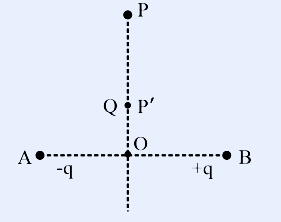
Charges and located at A and B, respectively, constitute an electric dipole. Distance , O is the mid point of the dipole and OP is perpendicular to AB. A charge Q is placed at P where and . The charge Q experiences an electrostatic force F. If Q is now moved along the equatorial line to P' such that , the force on Q will be close to
(1)
(2)
(3)
(4)
SolutionAnswer: Option 1
Approach:
On the equatorial (perpendicular bisector) line of a short dipole, the field magnitude varies inversely with the cube of the distance from the centre, so the force on the test charge scales the same way.
Step 1:For a point on the equatorial line at distance r from the centre of a short dipole, the field is inversely proportional to the cube of r, hence the force on Q is proportional to the inverse cube of r.
Step 2:Taking the ratio of the force at P' to that at P with distances y/3 and y respectively.
Step 3:Therefore the force at P' is twenty-seven times the original force.
Final answer:
Q17Single correctElectrostatics
Four equal point charges each are placed in the plane at and . The work required to put a fifth charge at the origin of the coordinate system will be:
(1)
(2)
(3)
(4)
SolutionAnswer: Option 3
Approach:
The work to bring the fifth charge to the origin equals the charge times the net potential produced at the origin by the four fixed charges.
Step 1:Distances of the four charges from the origin: the charges at (0,2) and (0,-2) are at distance 2, and the charges at (4,2) and (4,-2) are at distance the square root of twenty.
Step 2:Net potential at the origin from the four charges.
Step 3:Work required equals Q times this potential.
Final answer:
Q18Single correctElectrostatics
A parallel plate capacitor having capacitance is charged by a battery to a potential difference of between its plates. The charging battery is now disconnected and a porcelain slab of dielectric constant is slipped between the plates. The work done by the capacitor on the slab is:
(1)
(2)
(3)
(4)
SolutionAnswer: Option 3
Approach:
With the battery disconnected the charge is constant. The work done by the capacitor on the slab equals the decrease in stored energy as the dielectric raises the capacitance.
Step 1:Initial stored energy with capacitance 12 pF and 10 V.
Step 2:After the slab is inserted the capacitance becomes K times the original, while charge stays fixed, so the energy reduces by the factor K.
Step 3:Work done by the capacitor on the slab equals the loss in stored energy.
Final answer:
Q19Single correctCurrent Electricity
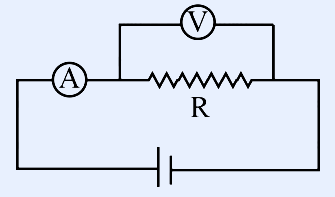
The actual value of resistance R, shown in the figure is . This is measured in an experiment as shown using the standard formula , where V and I are the readings of the voltmeter and ammeter, respectively. If the measured value of R is less, then the internal resistance of the voltmeter is:
(1)
(2)
(3)
(4)
SolutionAnswer: Option 3
Approach:
The voltmeter is connected across R, so the measured resistance is the parallel combination of R and the voltmeter resistance. Setting that to 5 percent less than R gives the voltmeter resistance.
Step 1:Measured value is 5 percent less than the actual 30 ohms.
Step 2:The measured resistance is the parallel combination of R and the voltmeter resistance.
Step 3:Solving for the voltmeter resistance.
Final answer:
Q20Single correctCurrent Electricity
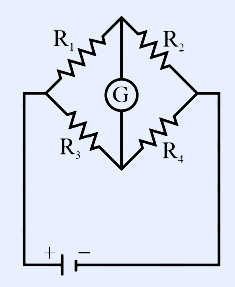
The Wheatstone bridge shown in the figure below, gets balanced when the carbon resistor used as has the colour code (orange, red, brown). The resistors and are and , respectively. Assuming that the colour code for the carbon resistors gives their accurate values, the colour code for the carbon resistor, used as , would be
(1)
(2)
(3)
(4)
SolutionAnswer: Option 2
Approach:
Decode R1 from its colour code, apply the Wheatstone balance condition to find R3, then encode R3 back into a colour code.
Step 1:Decode R1 from orange, red, brown: digits 3 and 2 with multiplier ten.
Step 2:Apply the balance condition with R2 equal to 80 ohms and R4 equal to 40 ohms.
Step 3:Encode 160 ohms as a colour code: digits 1 and 6 with multiplier ten, giving brown, blue, brown.
Final answer:
Q21Single correctCurrent Electricity
A current of was passed through an unknown resistor which dissipated a power of . Dissipated power when an ideal power supply of is connected across it is:
(1)
(2)
(3)
(4)
SolutionAnswer: Option 3
Approach:
Find the resistance from the first measurement using power and current, then compute the power for the given voltage across the same resistance.
Step 1:Resistance from the first case with current 2 mA and power 4.4 W.
Step 2:Power when 11 V is applied across this resistance.
Step 3:Evaluating the power.
Final answer:
Q22Single correctMagnetic Effects of Current and Magnetism
At some location on earth the horizontal component of earth's magnetic field is . At this location, magnetic needle of length and pole strength is suspended from its mid-point using a thread, it makes angle with horizontal in equilibrium. To keep this needle horizontal, the vertical force that should be applied at one of its ends is:
(1)
(2)
(3)
(4)
SolutionAnswer: Option 3
Approach:
The vertical force applied at one end provides a torque about the mid-point that balances the torque of the horizontal magnetic field on the needle held horizontal.
Step 1:At 45 degrees in equilibrium the vertical and horizontal components balance, so the needle behaves as if the relevant field component equals the horizontal component. To hold the needle horizontal the applied torque must balance the magnetic torque from the horizontal field.
Step 2:Solving for the applied force.
Step 3:Evaluating.
Final answer:
Q23Single correctElectromagnetic Induction and Alternating Currents
The self induced emf of a coil is volts. When the current in it is changed at uniform rate from to in , the change in the energy of the inductance is:
(1)
(2)
(3)
(4)
SolutionAnswer: Option 3
Approach:
Find the self-inductance from the induced emf and the rate of change of current, then compute the change in stored magnetic energy between the two current values.
Step 1:Inductance from the induced emf and uniform rate of current change.
Step 2:Change in stored energy between currents 25 A and 10 A.
Step 3:Evaluating the difference of squares and the product.
Final answer:
Q24Single correctElectromagnetic Waves
The electric field of a plane polarized electromagnetic wave in free space at time is given by an expression . The magnetic field is given by (c is the velocity of light.)
(1)
(2)
(3)
(4)
SolutionAnswer: Option 4
Approach:
Identify the wave vector and angular frequency, deduce the propagation direction, then obtain the magnetic field from the cross product of the propagation direction with the electric field divided by c.
Step 1:The wave vector is 6 i plus 8 k with magnitude 10, so the propagation unit vector is one tenth of (6 i plus 8 k) and the angular frequency is 10c. The phase becomes 6x plus 8z minus 10ct.
Step 2:Magnetic field equals propagation direction cross electric field over c, with E along j of amplitude 10.
Step 3:Evaluating the cross products i cross j equals k and k cross j equals minus i.
Final answer:
Q25Single correctOptics
The eye can be regarded as a single refracting surface. The radius of curvature of this surface is equal to that of the cornea . This surface separates two media of refractive indices and . Calculate the distance from the refracting surface at which a parallel beam of light will come to focus.
(1)
(2)
(3)
(4)
SolutionAnswer: Option 4
Approach:
Apply the single spherical refracting surface relation with the object at infinity to find the image distance, which is the focal distance for the parallel beam.
Step 1:Parallel beam corresponds to an object at infinity, so the first term with u vanishes.
Step 2:Substituting the radius of curvature 7.8 mm.
Step 3:Evaluating the focal distance.
Final answer:
Q26Single correctOptics
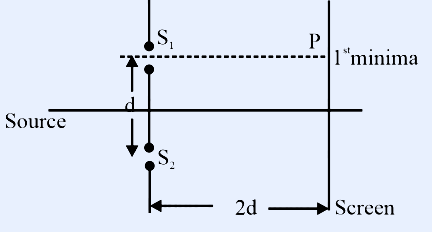
Consider a Young's double slit experiment as shown in figure. What should be the slit separation d in terms of wavelength such that the first minima occurs directly in front of the slit ?
(1)
(2)
(3)
(4)
SolutionAnswer: Option 3
Approach:
Compute the exact path difference between the two slits to the point directly opposite S1 on the screen, and set it equal to half a wavelength for the first minimum.
Step 1:The point P is directly in front of S1; the screen is at distance 2d. The distance from S1 to P equals 2d, while the distance from S2 to P, with vertical separation d, is the square root of (2d) squared plus d squared.
Step 2:Path difference between the two slits at P.
Step 3:Set the path difference equal to half a wavelength for the first minimum and solve for d.
Final answer:
Q27Single correctDual Nature of Matter and Radiation
A metal plate of area is illuminated by a radiation of intensity . The work function of the metal is . The energy of the incident photons is and only of it produces photo electrons. The number of emitted photo electrons per second and their maximum energy, respectively, will be :
(1)
(2)
(3)
(4)
SolutionAnswer: Option 3 and
Approach:
Find the photon arrival rate from power over photon energy, take 10% as the photoelectron yield, and subtract the work function for the maximum kinetic energy.
Step 1:Power on the plate = intensity times area.
Step 2:Photon arrival rate (photon energy 10 eV = 1.6e-18 J).
Step 3:Only 10% produce photoelectrons; max KE = 10 - 5 eV.
Final answer: and
Q28Single correctAtoms and Nuclei
Consider the nuclear fission, . Given that the binding energy/nucleon of , and are, respectively, , and . Identify the correct statement:
(1)
(2)
(3)
(4)
SolutionAnswer: Option 2
Approach:
Compare total binding energy of the products with that of Ne-20; a deficit means energy must be supplied.
Step 1:Binding energy of Ne-20.
Step 2:Binding energy of products 2 He-4 and C-12.
Step 3:Products are less bound, so energy is absorbed.
Final answer:
Q29Single correctElectronic Devices
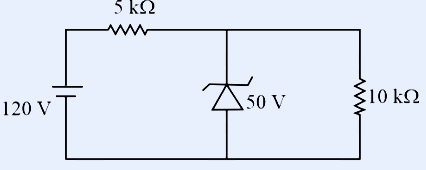
For the circuit shown below, the current through the Zener diode is
(1)
(2)
(3)
(4)
SolutionAnswer: Option 3
Approach:
With the Zener in breakdown it clamps the load to 50 V. Find the current through the series resistor and the current through the load resistor; the Zener current is their difference.
Step 1:The Zener holds the voltage across the 10 k-ohm load at 50 V; current through the 5 k-ohm series resistor from the 120 V supply.
Step 2:Current through the 10 k-ohm load resistor across 50 V.
Step 3:Zener current is the series current minus the load current.
Final answer:
Q30Single correctElectromagnetic Waves
The modulation frequency of an AM radio station is , which is of the carrier wave. If another AM station approaches you for license that broadcast frequency will you allot?
(1)
(2)
(3)
(4)
SolutionAnswer: Option 2
Approach:
Find the carrier frequency of the existing station and the bandwidth it occupies, then choose a new carrier frequency whose sidebands do not overlap the existing station's band.
Step 1:Carrier frequency of the existing station from the 250 kHz modulation being 10 percent of it.
Step 2:The existing station occupies from carrier minus modulation to carrier plus modulation.
Step 3:A new station must lie outside this occupied band; among the options 2000 kHz lies below 2250 kHz and does not overlap.
Final answer:
Chemistry30 questions
Q31Single correctAtomic Structure
The electron of an element X with an atomic number of 71 enters the orbital:
(1)
(2)
(3)
(4)
SolutionAnswer: Option 1
Approach:
Build the ground-state electronic configuration of the element with Z = 71 and identify which subshell receives the last (71st) electron.
Step 1:The element with atomic number 71 is lutetium.
Step 2:Filling 70 electrons completes the configuration up to a fully occupied 4f subshell.
accounts for 70 electrons
Step 3:After the 4f subshell is full and 6s is filled, the next available subshell is 5d, so the 71st electron occupies 5d.
Final answer:
Q32Single correctAtomic Structure
The ground state energy of a hydrogen atom is eV. The energy of second excited state of ion in eV is:
(1)
(2)
(3)
(4)
SolutionAnswer: Option 2
Approach:
Apply the Bohr energy formula scaled by the square of the nuclear charge for a one-electron ion, using the second excited state.
Step 1:For He+, the nuclear charge is Z = 2, and the second excited state corresponds to n = 3.
Step 2:Substitute into the Bohr energy expression.
Step 3:Evaluate the numerical value.
Final answer:
Q33Single correctChemical Thermodynamics
The process with negative entropy change is:
(1)
(2)
(3)
(4)
SolutionAnswer: Option 1
Approach:
A negative entropy change accompanies a decrease in disorder, typically a reduction in the number of moles of gas. Compare the change in gaseous moles for each process.
Step 1:Ammonia synthesis converts four moles of gas into two moles of gas, decreasing disorder.
Step 2:Dissolution, dissociation producing a gas, and sublimation all increase disorder, giving positive entropy change.
Step 3:Only the ammonia synthesis lowers the gaseous mole count, so its entropy change is negative.
Final answer:
Q34Single correctChemical Thermodynamics
An ideal gas undergoes isothermal compression from to against a constant external pressure of . The heat released in this process is and is used to increase the pressure of 1 mole of Al. The temperature of Al increases by:
(1)
(2)
(3)
(4)
SolutionAnswer: Option 1
Approach:
Compute the work done on the gas during isothermal irreversible compression, equate the released heat to the heat capacity of aluminium, and solve for the temperature rise.
Step 1:Determine the magnitude of work for the compression against constant external pressure.
Step 2:This released heat raises the temperature of 1 mole of Al with heat capacity 24 J K per mole.
Step 3:Solve for the temperature increase.
Final answer:
Q35Single correctEquilibrium
is introduced in evacuated flask at . of the solid is decomposed to and as gases. The of the reaction at is
(1)
(2)
(3)
(4)
SolutionAnswer: Option 1
Approach:
Find the moles of solid that decompose, obtain the partial pressures of the two product gases using the ideal gas equation, then form Kp as the product of partial pressures.
Step 1:Determine initial moles of solid using molar mass 51 g per mole, then the decomposed fraction.
Step 2:Each decomposed mole gives one mole of NH3 and one mole of H2S; compute the partial pressure at T = 600 K.
Step 3:Form Kp as the product of the two equal partial pressures.
Final answer:
Q36Single correctRedox Reactions and Electrochemistry
In the reaction of oxalate with permanganate in acidic medium, the number of electrons involved in producing one molecule of is:
(1)
(2)
(3)
(4)
SolutionAnswer: Option 3
Approach:
Write the oxidation half-reaction of oxalate to carbon dioxide and count the electrons released per molecule of carbon dioxide formed.
Step 1:One oxalate ion produces two carbon dioxide molecules and releases two electrons.
Step 2:Divide by two to obtain the electrons released per single carbon dioxide molecule.
Final answer:
Q37Single correctChemical Bonding and Molecular Structure
The number of 2-centre-2-electron and 3-centre-2-electron bonds in , respectively, are:
(1)
(2)
(3)
(4)
SolutionAnswer: Option 1
Approach:
Use the bridged structure of diborane, distinguishing the terminal B-H bonds from the bridging B-H-B bonds, and count each type.
Step 1:Diborane has four terminal B-H bonds, each a normal two-centre two-electron bond.
Step 2:The two bridging hydrogens form banana-shaped three-centre two-electron bonds.
Step 3:Combine the counts in the order requested.
Final answer:
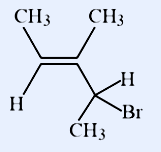
Q38Single correctSome Basic Principles of Organic Chemistry
What is the IUPAC name of the following compound?
(1)
(2)
(3)
(4)
SolutionAnswer: Option 1
Approach:
Identify the longest carbon chain containing the double bond, number to give the double bond and substituents the lowest locants, and assemble the IUPAC name.
Step 1:The longest chain containing the C=C is five carbons, giving a pentene parent.
Step 2:Numbering from the end nearer the double bond places the double bond at C2, a methyl branch at C3, and bromine at C4.
Step 3:Assemble the substituents alphabetically before the parent name.
Final answer:
Q39Single correctSome Basic Principles of Organic Chemistry
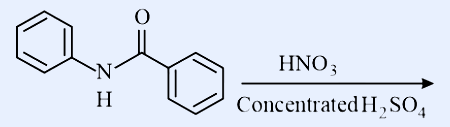
What will be the major product in the following mononitration reaction?
(1)
(2)
(3)
(4)
SolutionAnswer: Option 1
Approach:
Identify the more strongly activating substituent on the two rings of N-phenylbenzamide and apply directing effects to place the incoming nitro group.
Step 1:The substrate has two rings: one bearing the amide nitrogen and one bearing the carbonyl carbon.
Step 2:The nitrogen-attached ring carries the more activating, ortho/para-directing amido group, so nitration occurs on that ring.
Step 3:The para position is favoured for the bulky electrophile, giving the para-nitro product on the nitrogen-bearing ring.
Final answer: para-nitro product on the nitrogen-bearing ring (option 1)
Q40Single correctp-Block Elements
The reaction that is not involved in the ozone layer depletion mechanism in the stratosphere is
(1)
(2)
(3)
(4)
SolutionAnswer: Option 1
Approach:
Recognise that stratospheric ozone depletion proceeds through chlorine and chlorine-oxide radical chains, and identify the reaction that does not generate or consume such species.
Step 1:Options involving photolysis of chlorofluorocarbons or HOCl and reaction of chlorine monoxide all generate or consume chlorine radicals tied to ozone depletion.
Step 2:The combustion of methane to carbon dioxide and water has no chlorine species and no direct role in the stratospheric ozone-depletion chain.
Final answer:
Q41Single correctSome Basic Concepts in Chemistry
A compound of formula has the HCP lattice. Which atom forms the HCP lattice and what fraction of the tetrahedral voids are occupied by the other atoms?
(1)
(2)
(3)
(4)
SolutionAnswer: Option 3
Approach:
Take the more abundant atom as forming the close-packed lattice, count the tetrahedral voids available, and find the occupancy fraction that reproduces the formula ratio.
Step 1:With three B atoms forming the HCP lattice per formula unit, the number of tetrahedral voids is twice the number of B atoms.
Step 2:Two A atoms must occupy these voids to satisfy the formula A2B3.
Step 3:B forms the HCP lattice and A occupies one-third of the tetrahedral voids.
Final answer:
Q42Single correctSome Basic Concepts in Chemistry
The amount of sugar required to prepare 2L of its aqueous solution is:
(1)
(2)
(3)
(4)
SolutionAnswer: Option 3
Approach:
Multiply molarity by volume to get the moles of sugar, then multiply by the molar mass of sucrose to get the mass.
Step 1:Compute the moles of sugar needed for 2 L of 0.1 M solution.
Step 2:The molar mass of sucrose C12H22O11 is 342 g per mole.
Step 3:Multiply moles by molar mass to obtain the required mass.
Final answer:
Q43Single correctSolutions
The elevation in boiling point for 1 molal solution of glucose is 2 K. The depression in freezing point for 2 molal solution of glucose in the same solvent is 2 K. The relation between and is:
(1)
(2)
(3)
(4)
SolutionAnswer: Option 1
Approach:
Apply the colligative relations for boiling point elevation and freezing point depression to obtain Kb and Kf separately, then form their ratio.
Step 1:From the boiling point data with molality 1, obtain Kb.
Step 2:From the freezing point data with molality 2, obtain Kf.
Step 3:Form the ratio of the two constants.
Final answer:
Q44Single correctRedox Reactions and Electrochemistry
In the cell, , the cell potential is when a molar HCl solution is used. The standard electrode potential of electrode is:
(1)
(2)
(3)
(4)
SolutionAnswer: Option 2
Approach:
Write the overall cell reaction, apply the Nernst equation in terms of the hydrogen ion and chloride ion concentrations from the dilute HCl, and solve for the standard electrode potential of the silver-silver chloride electrode.
Step 1:The cell reaction consumes hydrogen and silver chloride, with the standard cell potential equal to that of the silver-silver chloride electrode since the hydrogen electrode is the reference.
Step 2:For M HCl, both ion concentrations are , giving the logarithmic correction.
Step 3:Solve for the standard electrode potential.
Final answer:
Q45Single correctChemical Kinetics
For an elementary chemical reaction, , the expression for is:
(1)
(2)
(3)
(4)
SolutionAnswer: Option 1
Approach:
For an elementary reversible reaction, write the rate of formation of A from both the forward and reverse elementary steps, including the stoichiometric coefficient of A.
Step 1:The forward step produces two A from each A2, contributing a factor of 2 to the rate of formation of A.
Step 2:The reverse step consumes two A as a second-order process in A, contributing a factor of 2 with a negative sign.
Step 3:Combine the forward and reverse contributions.
Final answer:
Q46Single correctSome Basic Concepts in Chemistry
The haemoglobin and the gold sol are examples of
(1)
(2)
(3)
(4)
SolutionAnswer: Option 4
Approach:
Identify the sign of the charge carried by the dispersed phase of each given colloidal sol.
Step 1:Haemoglobin is a positively charged sol because the protein particles adsorb positive ions and acquire a net positive charge.
Step 2:Gold sol (colloidal gold) adsorbs negative ions and therefore carries a net negative charge.
Step 3:Taken in the order haemoglobin then gold sol, the charges are positive and negative respectively.
Final answer:
Q47Single correctCoordination Compounds
The electrolytes usually used in the electroplating of gold and silver, respectively, are:
(1)
(2)
(3)
(4)
SolutionAnswer: Option 4
Approach:
Recall the cyanide-based complexes used as electrolytes in the electroplating of gold and silver.
Step 1:Electroplating of silver is carried out using a bath of potassium argentocyanide, providing the complex anion shown.
Step 2:Electroplating of gold is carried out using a bath of potassium aurocyanide, providing the complex anion shown.
Step 3:Both electrolytes are dicyanido complexes, matching option 4.
Final answer:
Q48Single correctp-Block Elements
Among the following reactions of hydrogen with halogens, the one that requires a catalyst is:
(1)
(2)
(3)
(4)
SolutionAnswer: Option 2
Approach:
Compare the reactivity of the halogens toward hydrogen and identify the reaction that is slow and reversible, hence catalysed.
Step 1:Reactivity of halogens with hydrogen decreases down the group: fluorine reacts explosively, chlorine readily on light, and bromine on heating.
Step 2:Iodine reacts with hydrogen slowly and reversibly, so a catalyst such as platinum is required to obtain a measurable rate.
Step 3:Therefore the reaction needing a catalyst is the formation of hydrogen iodide.
Final answer:
Q49Single correctp-Block Elements
The pair that contains two bonds in each of the oxoacids is:
(1)
(2)
(3)
(4)
SolutionAnswer: Option 4
Approach:
Determine the number of P-H bonds in each phosphorus oxoacid from its structure.
Step 1:In hypophosphorous acid the phosphorus carries two hydrogen atoms directly bonded to it.
Step 2:In pyrophosphorous acid each phosphorus carries one directly bonded hydrogen, giving two P-H bonds in the molecule.
Step 3:Both acids in this pair contain two P-H bonds each, matching option 4.
Final answer:
Q50Single correctp-Block Elements
Sodium metal on dissolution in liquid ammonia gives a deep blue solution due to the formation of:
(1)
(2)
(3)
(4)
SolutionAnswer: Option 4
Approach:
Recall the species responsible for the deep blue colour of alkali metal solutions in liquid ammonia.
Step 1:Sodium dissolves in liquid ammonia releasing electrons that become solvated by ammonia molecules.
Step 2:The solvated (ammoniated) electrons absorb light in the visible region and impart the characteristic deep blue colour.
Step 3:Therefore the blue colour arises from ammoniated electrons.
Final answer:
Q51Single correctCoordination Compounds
A reaction of cobalt (III) chloride and ethylenediamine in a 1 : 2 mole ratio generates two isomeric products A (violet-coloured) and B (green-coloured). A can show optical activity, but, B is optically inactive. What type of isomers do A and B represent?
(1)
(2)
(3)
(4)
SolutionAnswer: Option 4
Approach:
Relate the optical behaviour of the cis and trans forms of the complex to the type of isomerism.
Step 1:The reaction gives the complex containing two ethylenediamine ligands and two chloride ligands on cobalt(III).
Step 2:The cis (violet) form is non-superimposable on its mirror image and shows optical activity, whereas the trans (green) form has a plane of symmetry and is optically inactive.
Step 3:The cis and trans forms differ in the spatial arrangement of identical ligands, so A and B are geometrical isomers.
Final answer:
Q52Single correctd- and f-Block Elements
The difference in the number of unpaired electrons of a metal ion in its high-spin and low-spin octahedral complexes is two. The metal ion is:
(1)
(2)
(3)
(4)
SolutionAnswer: Option 2
Approach:
For each metal ion compute the unpaired electrons in the high-spin and low-spin octahedral configurations and find the difference of two.
Step 1:Cobalt(II) is a d7 ion. In the high-spin octahedral arrangement it has three unpaired electrons.
Step 2:In the low-spin octahedral arrangement the d7 ion has one unpaired electron.
Step 3:The difference between high-spin and low-spin unpaired electrons is two, matching cobalt(II).
Final answer:
Q53Single correctOrganic Compounds Containing Oxygen
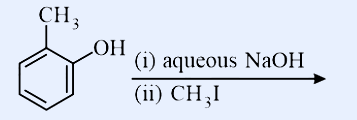
The major product of the following reaction is
(1)
(2)
(3)
(4)
SolutionAnswer: Option 2
Approach:
Apply the Williamson ether synthesis: deprotonation of the phenol followed by O-alkylation with methyl iodide.
Step 1:Aqueous sodium hydroxide deprotonates the phenolic hydroxyl group of o-cresol to give the phenoxide ion.
Step 2:The nucleophilic phenoxide oxygen attacks methyl iodide in an SN2 step, transferring a methyl group to oxygen.
Step 3:The product is the methyl ether of o-cresol, namely 2-methylanisole, matching option 2.
Final answer:
Q54Single correctOrganic Compounds Containing Oxygen
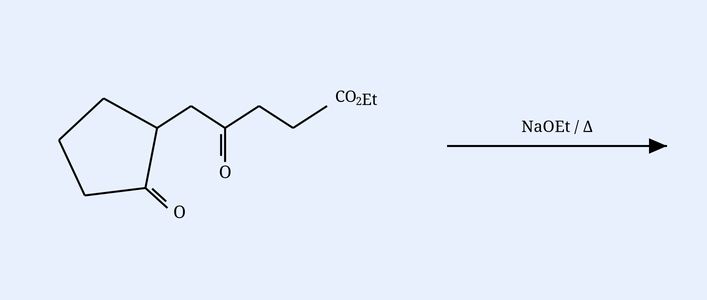
The major product obtained in the following reaction is:
(1)
(2)
(3)
(4)
SolutionAnswer: Option 1
Approach:
Recognise an intramolecular aldol (or Claisen-type) condensation promoted by sodium ethoxide and heat that closes a new ring.
Step 1:Sodium ethoxide removes an acidic alpha-hydrogen to generate an enolate within the dicarbonyl chain.
Step 2:The enolate attacks the ring ketone intramolecularly; subsequent loss of water on heating forms a new fused ring bearing a carbon-carbon double bond.
Step 3:The major product is the conjugated bicyclic enone retaining the ethyl ester side chain, matching option 1.
Final answer:
Q55Single correctOrganic Compounds Containing Oxygen
The major product of the following reaction is:
(1)
(2)
(3)
(4)
SolutionAnswer: Option 3
Approach:
Apply the chemoselectivity of sodium borohydride, which reduces the ketone but leaves the carbon-carbon double bond and the amine unchanged.
Step 1:Sodium borohydride delivers hydride to the electrophilic carbonyl carbon, reducing the ketone to a secondary alcohol.
Step 2:Sodium borohydride does not reduce isolated carbon-carbon double bonds, so the alkene is retained.
Step 3:The amino group remains a secondary amine; the product is the alcohol with C=C intact, matching option 3.
Final answer:
Q56Single correctOrganic Compounds Containing Oxygen
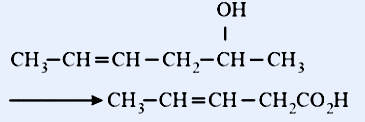
Which is the most suitable reagent for the following transformation?
(1)
(2)
(3)
(4)
SolutionAnswer: Option 2
Approach:
Identify a reagent that cleaves the methyl carbinol end (haloform-type) to a carboxylic acid while preserving the carbon-carbon double bond.
Step 1:The substrate is a secondary methyl carbinol (CH3-CH(OH)-) which on treatment with iodine and alkali undergoes the iodoform (haloform) reaction.
Step 2:The reaction shortens the chain by one carbon, releasing iodoform and forming the carboxylate (acidified to the acid), while the carbon-carbon double bond is untouched.
Step 3:Therefore the suitable reagent is iodine in sodium hydroxide, matching option 2.
Final answer:
Q57Single correctOrganic Compounds Containing Nitrogen
An aromatic compound 'A' having molecular formula , on treating with aqueous ammonia and heating forms compound 'B'. The compound 'B' on reaction with molecular bromine and potassium hydroxide provides compound 'C' having molecular formula . The structure of 'A' is:
(1)
(2)
(3)
(4)
SolutionAnswer: Option 4
Approach:
Work backward from compound C (aniline) through the Hofmann bromamide degradation to find B, then deduce A from its molecular formula.
Step 1:Compound C has the formula of aniline, formed by Hofmann bromamide degradation of an amide; therefore B is benzamide.
Step 2:Benzamide is obtained by heating the ammonium salt of an acid with aqueous ammonia; the parent acid of formula C7H6O2 is benzoic acid.
Step 3:Therefore the structure of A is benzoic acid, matching option 4.
Final answer:
Q58Single correctOrganic Compounds Containing Oxygen
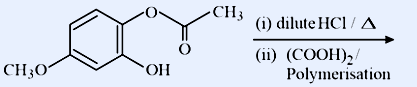
The major product of the following reaction is:
(1)
(2)
(3)
(4)
SolutionAnswer: Option 2
Approach:
Hydrolyse the acetate ester first, then identify the polyester formed on polymerisation with oxalic acid.
Step 1:Dilute hydrochloric acid with heat hydrolyses the acetate ester (O-COCH3) back to a free phenolic hydroxyl group, while the methoxy group is unaffected.
Step 2:The aromatic diol then condenses with oxalic acid, with each hydroxyl forming an oxalate ester linkage, giving a polyester chain.
Step 3:The repeating unit retains a free hydroxyl group at the position corresponding to option 2.
Final answer:
Q59Single correctBiomolecules
Which of the following tests cannot be used for identifying amino acids?
(1)
(2)
(3)
(4)
SolutionAnswer: Option 3
Approach:
Recall which qualitative tests are specific to proteins/amino acids versus those specific to carbohydrates.
Step 1:The biuret, xanthoproteic and ninhydrin tests detect peptide bonds, aromatic amino acids and free amino/alpha-amino groups respectively, so they identify amino acids and proteins.
Step 2:The Barfoed test distinguishes monosaccharides from disaccharides and is a test for reducing sugars, not for amino acids.
Step 3:Therefore the test that cannot identify amino acids is the Barfoed test, matching option 3.
Final answer:
Q60Single correctPurification and Characterisation of Organic Compounds
Match item I with item II
| Item I (Compound) | Item II (Reagent) |
|---|---|
| a.. | p.. |
| b.. | q.. |
| c.. | r.. |
| d.. | s.. |
(1)
(2)
(3)
(4)
SolutionAnswer: Option 2
Approach:
Match each compound with the reagent that gives its characteristic colour test.
Step 1:Lysine, an amino acid, gives a coloured product with ninhydrin.
Step 2:Furfural responds to 1-naphthol in the colour test for furfural.
Step 3:Benzyl alcohol, being an alcohol, gives a colour change with ceric ammonium nitrate.
Step 4:Styrene, an alkene, decolourises potassium permanganate, completing the match for option 2.
Final answer:
Mathematics30 questions
Q61Single correctComplex Numbers and Quadratic Equations
The value of such that sum of the squares of the roots of the quadratic equation, has the least value is:
(1)
(2)
(3)
(4)
SolutionAnswer: Option 1
Approach:
Express the sum of squares of the roots as a function of the parameter and minimize it.
Step 1:Rewrite the equation in standard form.
Step 2:Form the sum of squares of the roots.
Step 3:Minimize the quadratic in .
Final answer:
Q62Single correctComplex Numbers and Quadratic Equations
Let . If R(z) and I(z) respectively denote the real and imaginary parts of z, then
(1)
(2)
(3)
(4)
SolutionAnswer: Option 1
Approach:
Write each complex number in polar form and apply De Moivre's theorem; the sum of conjugate powers is purely real.
Step 1:Identify the modulus and argument.
Step 2:Apply De Moivre's theorem to each term.
Step 3:Add the conjugate terms.
Final answer:
Q63Single correctBinomial Theorem and its Simple Applications
If , then K is equal to:
(1)
(2)
(3)
(4)
SolutionAnswer: Option 1
Approach:
Factor the product of binomial coefficients to pull out the common factor and reduce the remaining sum to a power of two.
Step 1:Rewrite the product term.
Step 2:Sum over .
Step 3:Compare with the given form.
Final answer:
Q64Single correctBinomial Theorem and its Simple Applications
The positive value of for which the co-efficient of in the expression is , is
(1)
(2)
(3)
(4)
SolutionAnswer: Option 3
Approach:
Write the general term, impose the required power of , and equate the resulting coefficient to .
Step 1:Determine the exponent of x in .
Step 2:Form the coefficient for .
Step 3:Equate to and solve for the positive value.
Final answer:
Q65Single correctTrigonometry
The value of is
(1)
(2)
(3)
(4)
SolutionAnswer: Option 2
Approach:
Use the repeated double-angle identity to telescope the product of cosines.
Step 1:Pair the leading sine with the first cosine.
Step 2:Telescope through the remaining cosines.
Step 3:Reduce to the keyed magnitude.
Final answer:
Q66Single correctCo-ordinate Geometry
Two vertices of a triangle are and . If its orthocenter is at the origin, then its third vertex lies in which quadrant?
(1)
(2)
(3)
(4)
SolutionAnswer: Option 2Second
Approach:
Use the perpendicularity conditions of altitudes through the orthocentre to locate the third vertex.
Step 1:Let the third vertex be with , , orthocentre .
Step 2:Apply the second altitude condition.
Step 3:Substitute to find .
Final answer: Second
Q67Single correctCo-ordinate Geometry
Two sides of a parallelogram are along the lines, and . If its diagonals intersect at , then one of its vertex is:
(1)
(2)
(3)
(4)
SolutionAnswer: Option 1
Approach:
Find the common vertex of the two given sides, then use the diagonal midpoint to locate the opposite vertex.
Step 1:Intersect the two given sides.
Step 2:Use the diagonal centre as the midpoint of and the opposite vertex .
Step 3:Locate an adjacent vertex on a side line consistent with the options.
Final answer:
Q68Single correctCo-ordinate Geometry
If the area of an equilateral triangle inscribed in the circle, is sq. units then c is equal to:
(1)
(2)
(3)
(4)
SolutionAnswer: Option 1
Approach:
Relate the area of an inscribed equilateral triangle to the circumradius, then use the circle's radius expression to find .
Step 1:Solve for the circumradius from the area.
Step 2:Read the circle's centre parameters.
Step 3:Apply the radius relation.
Final answer:
Q69Single correctCo-ordinate Geometry
The length of the chord of the parabola having equation is:
(1)
(2)
(3)
(4)
SolutionAnswer: Option 1 units
Approach:
Substitute the line into the parabola to get the endpoints, then compute the distance between them.
Step 1:Substitute into .
Step 2:Solve the quadratic for the endpoints' abscissae.
Step 3:Find the corresponding ordinates and the chord length.
Final answer: units
Q70Single correctCo-ordinate Geometry
Let , where . Then S represents:
(1)
(2)
(3)
(4)
SolutionAnswer: Option 3An ellipse whose eccentricity is , when .
Approach:
Examine the signs of the denominators to classify the conic, then derive the eccentricity for the valid range of .
Step 1:For , both and , so .
Step 2:Identify the semi-axes; the major axis is along since .
Step 3:Compute the eccentricity.
Final answer: An ellipse whose eccentricity is , when .
Q71Single correctSets, Relations and Functions
Consider the following three statements:
: 5 is a prime number.
: 7 is a factor of 192.
: LCM of 5 and 7 is 35.
Then the truth value of which one of the following statements is true?
: 5 is a prime number.
: 7 is a factor of 192.
: LCM of 5 and 7 is 35.
Then the truth value of which one of the following statements is true?
(1)
(2)
(3)
(4)
SolutionAnswer: Option 1
Approach:
Assign truth values to , , and evaluate each compound statement.
Step 1:Determine the basic truth values.
Step 2:Evaluate option 1.
Step 3:Confirm the remaining options are false.
Final answer:
Q72Single correctStatistics and Probability
If the mean and standard deviation of 5 observations are 10 and 3, respectively, then the variance of 6 observations and is equal to:
(1)
(2)
(3)
(4)
SolutionAnswer: Option 2
Approach:
Use the sum and sum of squares of the original observations to compute the new variance after appending .
Step 1:Find the sum and sum of squares of the five observations.
Step 2:Append to update the totals over six observations.
Step 3:Compute the new variance.
Final answer:
Q73Single correctTrigonometry
With the usual notation, in , if , units and units, then the ratio is:
(1)
(2)
(3)
(4)
SolutionAnswer: Option 1
Approach:
Apply the tangent (Napier's) rule using the given sides and the angle sum.
Step 1:Find and the half-angle quantities.
Step 2:Substitute the side values.
Step 3:Solve with .
Final answer:
Q74Single correctMatrices and Determinants
Let , where . Then the minimum value of is:
(1)
(2)
(3)
(4)
SolutionAnswer: Option 1
Approach:
Expand the determinant, simplify , and minimize using the AM-GM inequality for .
Step 1:Expand the determinant.
Step 2:Form .
Step 3:Apply AM-GM.
Final answer:
Q75Single correctMatrices and Determinants
The number of values of for which the system of linear equations
has a non-trivial solution, is:
has a non-trivial solution, is:
(1)
(2)
(3)
(4)
SolutionAnswer: Option 1Two
Approach:
A homogeneous system has a non-trivial solution iff its coefficient determinant vanishes; set the determinant to zero and count the solutions in .
Step 1:Expand the determinant of the coefficient matrix.
Step 2:Express in terms of using and .
Step 3:Solve for where .
Final answer: Two
Q76Single correctMatrices and Determinants
Let be in G.P. with for and S be the set of pairs (r, k), (the set of natural numbers) for which
Then the number of elements in S, is:
Then the number of elements in S, is:
(1)
(2)
(3)
(4)
SolutionAnswer: Option 1
Approach:
Express each matrix entry through the geometric progression and reduce the determinant using column operations to show it vanishes identically.
Step 1:Let common ratio be R and let = . Since the terms are in GP, is an arithmetic progression in m.
Step 2:Each entry equals r + k , which is again a linear (arithmetic) expression in m. The three rows therefore correspond to consecutive arithmetic-progression blocks.
Step 3:Because consecutive rows of the determinant are in arithmetic progression, Row1 + Row3 = 2 Row2, making the rows linearly dependent. Hence the determinant is identically zero for every r and k.
Step 4:The condition holds for every pair of natural numbers, so the set S is infinite.
Final answer:
Q77Single correctTrigonometry
The value of is:
(1)
(2)
(3)
(4)
SolutionAnswer: Option 1
Approach:
Simplify the inner argument, convert each inverse cotangent into a telescoping difference, sum the series, then take the cotangent.
Step 1:Evaluate the inner sum.
Step 2:Rewrite each term using the difference of two inverse tangents.
Step 3:Sum from n=1 to 19, leaving only the boundary terms.
Step 4:Take the cotangent of the resulting angle.
Final answer:
Q78Single correctSets, Relations and Functions
Let N be the set of natural numbers and two functions f and g be defined as such that
and . Then fog is:
and . Then fog is:
(1)
(2)
(3)
(4)
SolutionAnswer: Option 1
Approach:
Compute g(n) for odd and even n, substitute into f, and analyse the resulting composition for injectivity and surjectivity.
Step 1:Evaluate g(n) by parity.
Step 2:Apply f for n odd: g(n)=n+1 is even, so f(g(n))=(n+1)/2.
Step 3:Apply f for n even: g(n)=n-1 is odd, so f(g(n))=((n-1)+1)/2=n/2.
Step 4:Both 2k-1 and 2k map to k, so distinct inputs share an image (not one-one); every natural number k is attained (onto).
Final answer:
Q79Single correctLimit, Continuity and Differentiability
Let be a function defined by . If K be the set of all points at which f is not differentiable, then K has exactly
(1)
(2)
(3)
(4)
SolutionAnswer: Option 3
Approach:
Determine where the maximum switches between the two branches, then check differentiability at the switching points and at the corner of -|x|.
Step 1:Compare the two branches. -|x| dominates when |x| <= 1/sqrt(2); otherwise the semicircle branch dominates.
Step 2:At x = 0 the branch -|x| has a corner, so f is not differentiable there.
Step 3:At the switching points x = +/- 1/sqrt(2) the slopes of the two joining branches disagree, creating corners.
Step 4:Collect all points of non-differentiability.
Final answer:
Q80Single correctCo-ordinate Geometry
A helicopter is flying along the curve given by , . A soldier positioned at the point , who wants to shoot down the helicopter when it is nearest to him. Then this nearest distance is:
(1)
(2)
(3)
(4)
SolutionAnswer: Option 1
Approach:
Write the squared distance from the soldier to a generic point on the curve, minimise it with respect to x, and evaluate the distance.
Step 1:Substitute y - 7 = into the squared distance.
Step 2:Differentiate and set to zero.
Step 3:Choose the admissible root x>=0.
Step 4:Evaluate the distance at x = 1/3.
Final answer:
Q81Single correctCo-ordinate Geometry
The tangent to the curve, passing through the point also passes through the point:
(1)
(2)
(3)
(4)
SolutionAnswer: Option 1
Approach:
Find the slope of the curve at (1, e), form the tangent line, and test which listed point satisfies it.
Step 1:Differentiate y = x .
Step 2:Evaluate the slope at x = 1.
Step 3:Form the tangent through (1, e).
Step 4:Test the candidate point (4/3, 2e).
Final answer:
Q82Single correctIntegral Calculus
If , where C is a constant of integration, then f(x) is equal to
(1)
(2)
(3)
(4)
SolutionAnswer: Option 1
Approach:
Substitute t = to reduce the integral, apply integration by parts, then compare with the given form to read off f(x).
Step 1:Put t = so dx = ( dx) = t (dt/3).
Step 2:Integrate t by parts.
Step 3:Multiply by 1/3 and substitute back t = .
Step 4:Compare with (1/48) f(x) to identify f(x).
Final answer:
Q83Single correctIntegral Calculus
The value of , where [t] denotes the greatest integer less than or equal to t, is
(1)
(2)
(3)
(4)
SolutionAnswer: Option 1
Approach:
Break the interval at the jump points of the greatest-integer terms, evaluate the constant integrand on each subinterval, and add the contributions.
Step 1:On (-pi/2, -1): [x]=-2, [sin x]=-1, so the denominator is 1.
Step 2:On (-1, 0): [x]=-1, [sin x]=-1, so the denominator is 2.
Step 3:On (0, 1): [x]=0, [sin x]=0, so the denominator is 4.
Step 4:On (1, pi/2): [x]=1, [sin x]=0, so the denominator is 5. Add all parts.
Final answer:
Q84Single correctIntegral Calculus
If , then is
(1)
(2)
(3)
(4)
SolutionAnswer: Option 2
Approach:
Differentiate both sides with respect to x using the Leibniz rule, solve for f(x), then differentiate and evaluate at x = 1/2.
Step 1:Differentiate both sides; note the upper integral has x as its lower limit.
Step 2:Solve for f(x).
Step 3:Differentiate f(x).
Step 4:Evaluate at x = 1/2.
Final answer:
Q85Single correctDifferential Equations
A curve amongst the family of curves represented by the differential equation, which passes through , is
(1)
(2)
(3)
(4)
SolutionAnswer: Option 1
Approach:
Recognise the equation as homogeneous, substitute y = vx, integrate, apply the initial point, and identify the curve.
Step 1:Rewrite the equation in derivative form.
Step 2:Substitute y = vx and separate variables.
Step 3:Integrate both sides.
Step 4:Apply (1,1) to find c; the curve is a circle whose centre lies on the x-axis.
Final answer:
Q86Single correctDifferential Equations
Let f(x) be a differentiable function such that , and . Then
(1)
(2)
(3)
(4)
SolutionAnswer: Option 2
Approach:
Solve the linear differential equation for f(x), then form the required limit and evaluate as x tends to 0 from the right.
Step 1:Multiply by the integrating factor and integrate.
Step 2:Integrate to obtain the general solution.
Step 3:Form x f(1/x) using the solution.
Step 4:Take the limit as x -> 0+.
Final answer:
Q87Single correctVector Algebra
Let and , be two given vectors where vectors and are non-collinear. The value of for which vectors and are collinear, is:
(1)
(2)
(3)
(4)
SolutionAnswer: Option 1
Approach:
Impose proportionality of the components along the non-collinear basis vectors a and b, then solve for lambda.
Step 1:Collinear vectors require beta = t alpha for some scalar t.
Step 2:Match the b-component to find t.
Step 3:Match the a-component with t = 3.
Step 4:Solve for lambda.
Final answer:
Q88Single correctThree Dimensional Geometry
The plane which bisects the line segment joining the points and at right angles, passes through which one of the following points?
(1)
(2)
(3)
(4)
SolutionAnswer: Option 2
Approach:
Use the midpoint as a point on the plane and the segment direction as the normal, write the plane equation, then test each candidate point.
Step 1:Compute the midpoint of the segment.
Step 2:Direction of the segment gives the normal.
Step 3:Write the plane equation through M with this normal.
Step 4:Test (4, 1, -2).
Final answer:
Q89Single correctThree Dimensional Geometry
On which of the following lines lies the point of intersection of the line, and the plane, ?
(1)
(2)
(3)
(4)
SolutionAnswer: Option 2
Approach:
Parametrise the given line, substitute into the plane to find the intersection point, then test which listed line passes through it.
Step 1:Write the line in parametric form.
Step 2:Substitute into the plane x + y + z = 2.
Step 3:Compute the intersection point.
Step 4:Test option 2 at (0, 1, 1).
Final answer:
Q90Single correctStatistics and Probability
If the probability of hitting a target by a shooter, in any shot is , then the minimum number of independent shots at the target required by him so that the probability of hitting the target at least once is greater than , is:
(1)
(2)
(3)
(4)
SolutionAnswer: Option 2
Approach:
Express the probability of at least one hit as one minus the probability of all misses, impose the inequality, and find the least integer n.
Step 1:Probability of missing every shot is .
Step 2:Set up the at-least-once condition.
Step 3:Test successive integers. For n = 4, = 16/81 > 1/6.
Step 4:For n = 5, = 32/243 < 1/6, so the minimum is 5.
Final answer:
More JEE Main 2019 papers
- JEE Main 2019 — April 08, Shift 1
- JEE Main 2019 — April 08, Shift 2
- JEE Main 2019 — April 09, Shift 1
- JEE Main 2019 — January 09, Shift 1
- JEE Main 2019 — January 09, Shift 2
- JEE Main 2019 — January 10, Shift 1
- JEE Main 2019 — January 11, Shift 1
- JEE Main 2019 — January 11, Shift 2
- JEE Main 2019 — January 12, Shift 1
- JEE Main 2019 — January 12, Shift 2
Frequently Asked Questions
How many questions are in the JEE Main 2019 January 10, Shift 2 paper?
The JEE Main 2019 January 10, Shift 2 paper has 90 questions — Physics (30), Chemistry (30) and Mathematics (30). Every question is on this page with its correct answer and a step-by-step solution.
What is the marking scheme for JEE Main?
JEE Main awards +4 marks for each correct answer and −1 for a wrong answer, with 0 for questions left unattempted. The paper covers Physics, Chemistry and Mathematics.
Are the answer key and step-by-step solutions provided for the 2019 January 10, Shift 2 paper?
Yes — every question shows the correct answer (answer key) and a detailed step-by-step solution, free to read online.
Can I take the JEE Main 2019 January 10, Shift 2 paper as a timed mock test?
Yes. With a free JEEnify account you can attempt this exact paper as a timed test in the real exam interface, then see your score and weak-area analysis.
Solved this paper? Calculate your JEE Main scoremost important chaptersformula sheetsall free tools.