
Back to JEE Main PYQs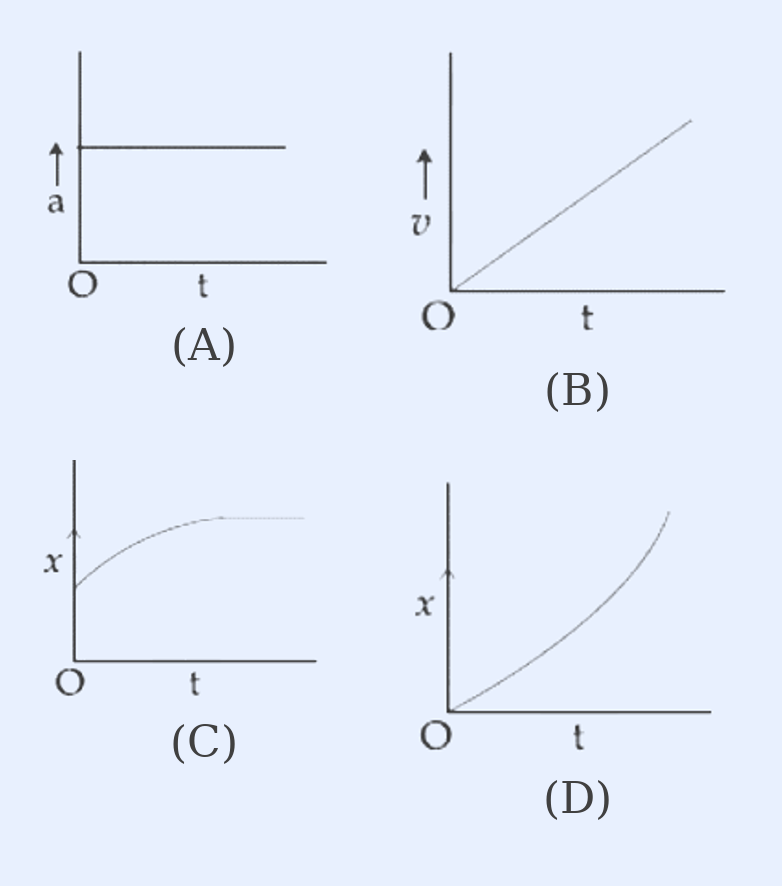
JEE Main 2019 April 08, Shift 2 Question Paper with Solutions
All 89 questions from the JEE Main 2019 (April 08, Shift 2) shift — Physics (30), Chemistry (29) and Mathematics (30) — each with the correct answer (answer key) and a step-by-step solution. Read it free online, or attempt the full paper as a timed mock test.
Physics30 questions
Q1Single correctVectors
Let , and . The value of is:
(1)
(2)
(3)
(4)
SolutionAnswer: Option 2
Approach:
Use the magnitude of the resultant to find the scalar product of the two vectors, then expand the required dot product.
Step 1:Expand the squared magnitude of the resultant.
Step 2:Expand the required scalar product.
Step 3:Evaluate the expression.
Final answer:
Q2Single correctUnits and Measurements
In a simple pendulum experiment for determination of acceleration due to gravity , time taken for 20 oscillations is measured by using a watch of 1 second least count. The mean value of time taken comes out to be 30 s. The length of the pendulum is measured by using a meter scale of least count 1 mm and the value obtained is 55.0 cm. The percentage error in the determination of is close to
(1)
(2)
(3)
(4)
SolutionAnswer: Option 2
Approach:
Express g from the pendulum formula and propagate the fractional errors in length and time.
Step 1:Determine the fractional error in length.
Step 2:Determine the fractional error in time using total time of 30 s.
Step 3:Combine the errors.
Final answer:
Q3Single correctUnits and Measurements
If Surface tension , Moment of Inertia and Planck's constant , were to be taken as the fundamental units, the dimensional formula for linear momentum would be:
(1)
(2)
(3)
(4)
SolutionAnswer: Option 1
Approach:
Write dimensions of S, I, h and momentum in terms of M, L, T, then solve for the exponents.
Step 1:Set up the exponent equations from p = .
Step 2:Solve the system of equations.
Final answer:
Q4Single correctKinematics
A particle starts from origin O from rest and moves with a uniform acceleration along the positive -axis. Identify all figures that correctly represent the motion qualitatively. ( = acceleration, = velocity, = displacement, = time)
(1)
(2)
(3)
(4)
SolutionAnswer: Option 1A, B, (D)
Approach:
Identify the correct shape of each graph for motion starting from rest with constant acceleration.
Step 1:Acceleration is constant, so the a-t graph (A) is a horizontal line.
Step 2:Velocity increases linearly from zero, so the v-t graph (B) is a straight line through the origin.
Step 3:Displacement varies as t squared, so the x-t graph is a parabola opening upward; graph (D) shows this while graph (C) does not.
Final answer: A, B, (D)
Q5Single correctRotational Motion
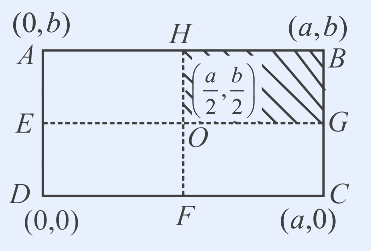
A uniform rectangular thin sheet of mass has length and breadth , as shown in the figure. If the shaded portion is cut-off, the coordinates of the centre of mass of the remaining portion will be:
(1)
(2)
(3)
(4)
SolutionAnswer: Option 1
Approach:
Treat the full sheet and the removed quadrant as point masses and apply the centre-of-mass subtraction formula with the origin at D.
Step 1:Full sheet has centroid at the centre with mass proportional to its area; the removed quadrant HBGO has one quarter of the area with centroid at (3a/4, 3b/4).
Step 2:By symmetry the y-coordinate follows the same form.
Final answer:
Q6Single correctWork, Energy and Power
A body of mass moving with an unknown velocity of , undergoes a collinear collision with a body of mass moving with a velocity . After the collision, and move with velocities of and , respectively. If and , then is:
(1)
(2)
(3)
(4)
SolutionAnswer: Option 4
Approach:
Apply conservation of linear momentum for the collinear collision and substitute the given relations.
Step 1:Substitute m2 = 0.5 m1 and v3 = 0.5 v1.
Step 2:Rearrange to isolate v1.
Final answer:
Q7Single correctRotational Motion
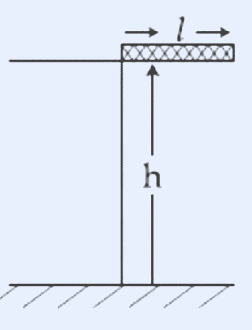
A rectangular solid box of length 0.3 m is held horizontally, with one of its sides on the edge of a platform of height 5 m. When released, it slips off the table in a very short time s, remaining essentially horizontal. The angle by which it would rotate when it hits the ground will be (in radians) close to:
(1)
(2)
(3)
(4)
SolutionAnswer: Option 1
Approach:
Find the angular velocity imparted by the impulsive torque during slipping, then multiply by the time of free fall.
Step 1:During the short slipping time the gravitational torque about the edge gives angular velocity using moment of inertia of a rod about its end I = /3.
Step 2:Compute the free-fall time from height 5 m.
Step 3:Angle rotated equals angular velocity times fall time.
Final answer:
Q8Single correctRotational Motion
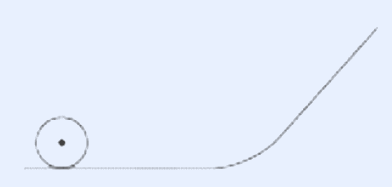
A solid sphere and solid cylinder of identical radii approach an incline with the same linear velocity (see figure). Both roll without slipping all throughout. The two climb maximum heights and on the inline. The ratio is given by:
(1)
(2)
(3)
(4)
SolutionAnswer: Option 3
Approach:
Equate total kinetic energy of rolling to gravitational potential energy at maximum height for each body.
Step 1:For the sphere / = 2/5 and for the cylinder / = 1/2.
Step 2:Take the ratio of the two heights for equal initial speed.
Final answer:
Q9Single correctGravitation
A rocket has to be launched from earth in such a way that it never returns. If is the minimum energy delivered by the rocket launcher, what should be the minimum energy that the launcher should have, if the same rocket is to be launched from the surface of the moon? Assume that the density of the earth and the moon are equal and that the earth's volume is 64 times the volume of the moon.
(1)
(2)
(3)
(4)
SolutionAnswer: Option 4
Approach:
Express the launch energy in terms of density and radius, then take the ratio for moon and earth using the volume relation.
Step 1:Volume ratio 64 gives radius ratio of 4, so the moon's radius is one quarter of the earth's.
Step 2:With equal density, energy scales as radius squared.
Final answer:
Q10Single correctProperties of Solids and Liquids
Young's moduli of two wires and are in the ratio . Wire is 2 m long and has radius . Wire is 1.5 m long and has radius 2 mm. If the two wires stretch by the same length for a given load, the value of is close to:
(1)
(2)
(3)
(4)
SolutionAnswer: Option 4 mm
Approach:
Use the elongation formula and equate the extensions of the two wires for the same load.
Step 1:Equate the two elongations for the same force.
Step 2:Substitute the values with Y ratio 7:4 and radii in mm.
Step 3:Take the square root.
Final answer: mm
Q11Single correctThermodynamics
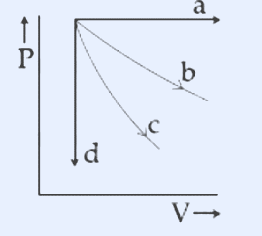
The given diagram shows four processes i.e., isochoric, isobaric, isothermal and adiabatic. The correct assignment of the processes, in the same order is given by:
(1)
(2)
(3)
(4)
SolutionAnswer: Option 2d a b c
Approach:
Match each curve on the P-V diagram to a process by comparing slopes at the common starting point.
Step 1:The vertical line d at constant volume is isochoric and the horizontal line a at constant pressure is isobaric.
Step 2:Between the two falling curves the steeper one c is adiabatic and the less steep b is isothermal, so in the order isothermal then adiabatic they are b then c.
Final answer: d a b c
Q12Single correctKinetic Theory of Gases
The temperature, at which the root mean square velocity of hydrogen molecules equals their escape their escape velocity from the earth, is closest to:
[ Boltzmann Constant J / K
Avogadro number / kg
Radius of Earth: m
Gravitational acceleration on Earth ]
[ Boltzmann Constant J / K
Avogadro number / kg
Radius of Earth: m
Gravitational acceleration on Earth ]
(1)
(2)
(3)
(4)
SolutionAnswer: Option 4 K
Approach:
Equate the rms speed to the escape speed and solve for temperature.
Step 1:Set the squared speeds equal and solve for T.
Step 2:Mass of a hydrogen molecule from the given Avogadro number.
Step 3:Substitute all values.
Final answer: K
Q13Single correctOscillations and Waves
A damped harmonic oscillator has a frequency of 5 oscillations per second. The amplitude drops to half its value for every 10 oscillations. The time it will take to drop to of the original amplitude is close to:
(1)
(2)
(3)
(4)
SolutionAnswer: Option 3 s
Approach:
Express the amplitude decay in terms of number of halvings and convert oscillations to time.
Step 1:Set the amplitude to 1/1000 of the original. Since is approximately 1000, ten halvings are needed.
Step 2:Each halving takes 10 oscillations, so 100 oscillations are required.
Step 3:Convert oscillations to time using frequency 5 per second.
Final answer: s
Q14Single correctElectrostatics
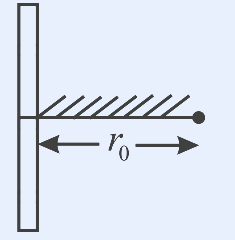
A positive point charge is released from rest at a distance from a positive line charge with uniform density. The speed (v) of the point charge, as a function of instantaneous distance r from line charge, is proportional to:
(1)
(2)
(3)
(4)
SolutionAnswer: Option 2
Approach:
Use the work-energy theorem with the potential of a line charge to relate speed to distance.
Step 1:Compute the work done by the line-charge field from r0 to r.
Step 2:Equate to kinetic energy and solve for speed.
Final answer:
Q15Single correctElectrostatics
An electric dipole is formed by two equal and opposite charges q with separation d. The charges have same mass m. It is kept in a uniform electric field E. If it is slightly rotated from its equilibrium orientation, then its angular frequency is:
(1)
(2)
(3)
(4)
SolutionAnswer: Option 2
Approach:
Write the restoring torque for small angular displacement and identify the angular frequency from the moment of inertia of the two masses.
Step 1:Dipole moment is p = qd, giving angular frequency squared as pE divided by I.
Step 2:Take the square root.
Final answer:
Q16Single correctElectrostatics
The electric field in a region is given by , where E is in N and x is in metres. The values of constants are A = 20 SI unit and B = 10 SI unit. If the potential at is and that at is , then is
(1)
(2)
(3)
(4)
SolutionAnswer: Option 3
Approach:
The potential difference between two points is obtained by integrating the electric field along the x-axis.
Step 1:Express the field magnitude as a function of position.
Step 2:Integrate the field from to .
Step 3:Evaluate the integral.
Final answer:
Q17Single correctElectrostatics
A parallel plate capacitor has 1μF capacitance. One of its two plates is given charge and the other plate, charge. The potential difference developed across the capacitor is:
(1)
(2)
(3)
(4)
SolutionAnswer: Option 1
Approach:
Only the difference of the plate charges contributes to the field between the plates, so the effective charge on the capacitor is half that difference.
Step 1:Determine the effective charge of the capacitor from the two plate charges.
Step 2:Apply the capacitor relation with the given capacitance.
Final answer:
Q18Single correctCurrent Electricity
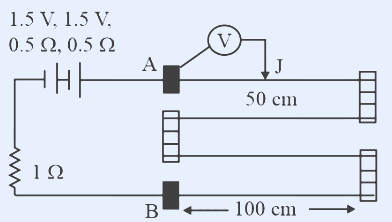
In the circuit shown, a four-wire potentiometer is made of a 400 cm long wire, which extends between A and B. The resistance per unit length of the potentiometer wire is . If an ideal voltmeter is connected as shown with jockey J at 50 cm from end A, the expected reading of the voltmeter will be:
(1)
(2)
(3)
(4)
SolutionAnswer: Option 2
Approach:
The driver cell sets up a steady current through the 400 cm wire; the voltmeter reads the potential drop across the 50 cm segment, with the parallel driver-cell branch determining the loop current.
Step 1:Compute the total resistance of the 400 cm potentiometer wire.
Step 2:The two 1.5 V driver cells (each 0.5 Ω) in the top loop drive current through the wire; the steady current sets a uniform potential gradient along AB so that the drop across the 50 cm segment to the jockey is measured.
Step 3:Find the voltmeter reading as the drop across the 50 cm length of wire.
Final answer:
Q19Single correctCurrent Electricity
A cell of internal resistance r drives current through an external resistance R. The power delivered by the cell to the external resistance will be maximum when:
(1)
(2)
(3)
(4)
SolutionAnswer: Option 2
Approach:
The power dissipated in the external resistance is maximised by differentiating its expression with respect to R, which gives the maximum power transfer condition.
Step 1:Write the power delivered to the external resistance.
Step 2:Differentiate P with respect to R and set the derivative to zero.
Final answer:
Q20Single correctCurrent Electricity
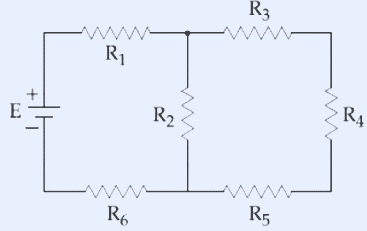
In the figure shown, what is the current (in Ampere) drawn from the battery? You are given: , , , , , , V
(1)
(2)
(3)
(4)
SolutionAnswer: Option 1
Approach:
The network of six resistors reduces by combining series and parallel groups into one equivalent resistance, after which Ohm's law gives the battery current.
Step 1:Combine the bridge-arranged resistors into series and parallel groups using the figure connections.
Step 2:Reduce the parallel and remaining series sections to a single equivalent resistance.
Step 3:Apply Ohm's law with the 15 V source.
Final answer:
Q21Single correctMagnetic Effects of Current
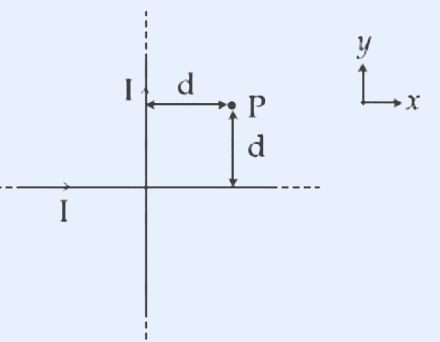
Two very long, straight, and insulated wires are kept at angle from each other in xy-plane as shown in figure. These wires carry currents of equal magnitude I, whose direction are shown in the figure. The net magnetic field at point P will be:
(1)
(2)
(3)
(4)
SolutionAnswer: Option 4Zero
Approach:
Each long straight wire produces a field at P along the z-axis; the directions are determined by the current senses and the position of P, and the two contributions are compared.
Step 1:Both wires are at the same perpendicular distance d from P, so each produces a field of equal magnitude.
Step 2:Apply the right-hand rule to each wire for the given current directions and the location of P.
Step 3:Add the two contributions.
Final answer: Zero
Q22Single correctMagnetic Effects of Current
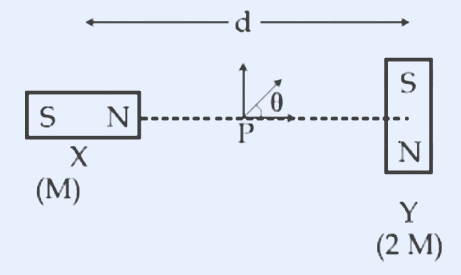
Two magnetic dipoles X and Y are placed at a separation d, with their axes perpendicular to each other. The dipole moment of Y is twice that of X. A particle of charge q is passing through their mid-point P, at angle with the horizontal line, as shown in figure. What would be the magnitude of force on the particle at that instant? (d is much larger than the dimension of the dipole)
(1)
(2)
(3)
(4)
SolutionAnswer: Option 1
Approach:
The net magnetic field at the midpoint due to the two perpendicular dipoles is found, then the magnetic force depends on the angle between the particle's velocity and that field.
Step 1:Each dipole is at distance d/2 from the midpoint; X contributes one orientation and Y (moment 2M) another, perpendicular to it.
Step 2:Combine the field contributions at P to obtain the net field direction at the midpoint.
lies along the line
Step 3:The particle moves at , parallel to the net field, so the angle between velocity and field is zero.
Final answer:
Q23Single correctAlternating Current
A circuit connected to an ac source of emf with t in seconds, gives a phase difference of between the emf e and current i. Which of the following circuits will exhibit this?
(1)
(2)
(3)
(4)
SolutionAnswer: Option 4RC circuit with R = 1 kΩ and C = 10 μF
Approach:
A phase difference of π/4 requires the reactance to equal the resistance; the angular frequency from the source is used to test each option's reactance.
Step 1:Read the angular frequency from the source emf.
Step 2:A phase difference of π/4 demands the reactance equal the resistance.
Step 3:Test the RC option with C = 10 μF.
Final answer: RC circuit with R = 1 kΩ and C = 10 μF
Q24Single correctElectromagnetic Waves
The magnetic field of an electromagnetic wave is given by: . The associated electric field will be:
(1)
(2)
(3)
(4)
SolutionAnswer: Option 3
Approach:
The electric field amplitude is c times the magnetic amplitude, the phase (argument of cosine) is identical to that of B, and the direction follows from E, B, and the propagation direction forming a right-handed triad.
Step 1:Compute the electric field amplitude from the magnetic amplitude.
Step 2:The phase argument is the same as in B, namely .
Step 3:The propagation is along (from the +z and +t signs); requiring to point along propagation gives the E direction perpendicular to B as .
Final answer:
Q25Single correctRay Optics and Optical Instruments
Calculate the limit of resolution of a telescope objective having a diameter of 200 cm, if it has to detect light of wavelength 500 nm coming from a star.
(1)
(2)
(3)
(4)
SolutionAnswer: Option 1 radian
Approach:
The limit of resolution of a telescope objective is given by the Rayleigh criterion using the wavelength and aperture diameter.
Step 1:Insert the wavelength and aperture diameter in SI units.
Step 2:Apply the Rayleigh resolution formula.
Final answer: radian
Q26Single correctRay Optics and Optical Instruments
A convex lens (of focal length 20 cm) and a concave mirror, having their principal axes along the same lines, are kept 80 cm apart from each other. The concave mirror is to the right of the convex lens. When an object is kept at a distance of 30 cm to the left of the convex lens, its image remains at the same position even if the concave mirror is removed. The maximum distance of the object for which this concave mirror, by itself would produce a virtual image would be:
(1)
(2)
(3)
(4)
SolutionAnswer: Option 4
Approach:
The condition that the image is unchanged when the mirror is removed fixes where the lens image forms relative to the mirror, which determines the mirror's focal length; a concave mirror gives a virtual image only when the object lies within its focal length.
Step 1:Locate the image formed by the convex lens alone.
Step 2:For the image to be unchanged when the mirror is removed, the rays must strike the mirror normally, so the lens image lies at the mirror's centre of curvature. The mirror is at 80 cm; the lens image at 60 cm gives a radius of 20 cm.
Step 3:A concave mirror produces a virtual image only for an object within its focal length, so the maximum object distance is the focal length.
Final answer:
Q27Single correctDual Nature of Matter and Radiation
A nucleus A, with a finite de-broglie wavelength , undergoes spontaneous fission into two nuclei B and C of equal mass. B flies in the same direction as that of A, while C flies in the opposite direction with a velocity equal to half of that of B. The de-Broglie wavelengths and of B and C are respectively:
(1)
(2)
(3)
(4)
SolutionAnswer: Option 2
Approach:
Momentum conservation relates the velocities of the two fragments, and the de-Broglie wavelength is inversely proportional to the momentum of each fragment.
Step 1:Each fragment has mass m/2; with C moving opposite at half of B's speed, apply momentum conservation.
Step 2:Compute the momentum of B and compare with A.
Step 3:Compute the momentum of C and compare with A.
Final answer:
Q28Single correctAtoms and Nuclei
The ratio of mass densities of nuclei of Ca and O is close to:
(1)
(2)
(3)
(4)
SolutionAnswer: Option 1
Approach:
Nuclear density is independent of mass number because nuclear volume scales linearly with the number of nucleons, so the ratio for any two nuclei is unity.
Step 1:Express the nuclear volume using the radius-mass-number relation.
Step 2:Form the density as mass over volume; the mass number cancels.
Step 3:The densities of the two nuclei are therefore equal.
Final answer:
Q29Single correctSemiconductor Electronics
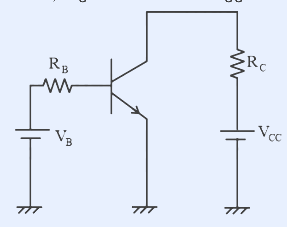
A common emitter amplifier circuit, built using an NPN transistor, is shown in the figure. Its dc current gain is 250, and V. The minimum base current for to reach saturation is
(1)
(2)
(3)
(4)
SolutionAnswer: Option 2
Approach:
At saturation the collector-emitter voltage is taken as zero, so the full supply appears across the collector resistor; the collector current divided by the current gain gives the minimum base current.
Step 1:At saturation , so the supply drops entirely across the collector resistor.
Step 2:Divide the collector current by the dc current gain.
Final answer:
Q30Single correctCommunication Systems
In a line of sight radio communication, a distance of about 50 km is kept between the transmitting and receiving antennas. If the height of the receiving antenna is 70 m, then the minimum height of the transmitting antenna should be: (Radius of the Earth m)
(1)
(2)
(3)
(4)
SolutionAnswer: Option 4
Approach:
The maximum line-of-sight distance is the sum of the radio horizons of the two antennas; setting this equal to 50 km and using the known receiver height gives the minimum transmitter height.
Step 1:Compute the horizon distance of the 70 m receiving antenna.
Step 2:Subtract from the total 50 km to find the required transmitter horizon.
Step 3:Solve for the transmitter height.
Final answer:
Chemistry29 questions
Q31Single correctSome Basic Concepts in Chemistry
The percentage composition of carbon by mole in methane is:
(1)
(2)
(3)
(4)
SolutionAnswer: Option 2
Approach:
Express the mole fraction of carbon atoms in one molecule of methane as a percentage.
Step 1:One molecule of methane contains one carbon atom and four hydrogen atoms, giving five atoms in total.
Step 2:The fraction of carbon atoms by mole is one out of five.
Final answer:
Q32Single correctStates of Matter
0.27 g of a long chain fatty acid was dissolved in of hexane. 10 mL of this solution was added dropwise to the surface of water in a round watch glass. Hexane evaporates and a monolayer is formed. The distance from edge to centre of the watch glass is 10 cm . What is the height of the monolayer?
[Density of fatty acid ]
[Density of fatty acid ]
(1)
(2)
(3)
(4)
SolutionAnswer: Option 2
Approach:
Find the volume of fatty acid spread on the water, then divide by the circular area of the monolayer to obtain its thickness.
Step 1:The 10 mL aliquot contains a tenth of the dissolved fatty acid, so its mass is 0.027 g.
Step 2:Convert this mass to volume using the density of the fatty acid.
Step 3:Compute the area of the circular film with radius 10 cm.
Step 4:Divide volume by area to obtain the thickness in cm, then convert to metres.
Final answer:
Q33Single correctStructure of Atom
If p is the momentum of the fastest electron ejected from a metal surface after the irradiation of light having wavelength , then for 1.5 p momentum of the photoelectron, the wavelength of the light should be:
(Assume kinetic energy of ejected photoelectron to be very high in comparison to work function)
(Assume kinetic energy of ejected photoelectron to be very high in comparison to work function)
(1)
(2)
(3)
(4)
SolutionAnswer: Option 1
Approach:
Relate the photon energy to the kinetic energy of the electron, which scales with the square of its momentum, then solve for the new wavelength.
Step 1:When work function is negligible, the photon energy converts almost entirely to kinetic energy, which is proportional to the square of momentum.
Step 2:Form the ratio for the two cases with momenta p and 1.5p.
Final answer:
Q34Single correctClassification of Elements and Periodicity
The IUPAC symbol for the element with atomic number 119 would be:
(1)
(2)
(3)
(4)
SolutionAnswer: Option 4
Approach:
Translate each digit of the atomic number into the IUPAC numerical roots and take the first letter of each root.
Step 1:The digits of 119 are one, one, nine, with roots un, un, enn.
Step 2:The symbol is formed from the first letter of each root.
Final answer:
Q35Single correctChemical Bonding and Molecular Structure
Among the following molecules/ ions,
Which one is diamagnetic and has the shortest bond length?
Which one is diamagnetic and has the shortest bond length?
(1)
(2)
(3)
(4)
SolutionAnswer: Option 4
Approach:
Count the valence electrons of each species, evaluate the bond order and the presence of unpaired electrons from molecular orbital filling.
Step 1:The carbide ion has fourteen electrons, isoelectronic with dinitrogen, giving a triple bond and all electrons paired.
Step 2:The dinitrogen dianion has sixteen electrons with two electrons in antibonding pi orbitals, lowering the bond order to 2.
Step 3:Dioxygen and the peroxide ion have bond orders 2 and 1 respectively, with dioxygen being paramagnetic.
Final answer:
Q36Single correctThermodynamics
5 moles of an ideal gas at 100 K are allowed to undergo reversible compression till its temperature becomes 200 K . If , calculate and for the process.
(1)
(2)
(3)
(4)
SolutionAnswer: Option 3
Approach:
Use the molar heat capacity at constant volume to find the internal energy change, and the ideal gas law to find the change in the pressure-volume product.
Step 1:Compute the temperature change.
Step 2:The molar heat capacity given as 28 J is taken per mole, so the internal energy change uses n, and ΔT.
Step 3:Compute the change in the pressure-volume product from the ideal gas relation.
Final answer:
Q37Single correctEquilibrium
For the following reaction, equilibrium constant are given:
The equilibrium constant for the reaction, is:
The equilibrium constant for the reaction, is:
(1)
(2)
(3)
(4)
SolutionAnswer: Option 2
Approach:
Combine the two given equilibria so that their sum yields the target reaction, and combine the equilibrium constants accordingly.
Step 1:Reversing twice the first reaction removes 2 SO2 from reactants, and adding the second reaction supplies 2 SO3.
Step 2:The corresponding equilibrium constant is the second constant divided by the square of the first.
Final answer:
Q38Single correctRedox Reactions
The strength of 11.2 volume solution of is
[Given that, the molar mass of and ]
[Given that, the molar mass of and ]
(1)
(2)
(3)
(4)
SolutionAnswer: Option 4
Approach:
Convert the volume strength to molarity using the standard factor, then express the concentration as a mass percentage.
Step 1:Divide the volume strength by 11.2 to obtain the molarity.
Step 2:Multiply molarity by the molar mass of hydrogen peroxide and divide by 10 to get the percentage strength.
Final answer:
Q39Single corrects-Block Elements
The covalent alkaline earth metal halide is:
(1)
(2)
(3)
(4)
SolutionAnswer: Option 4
Approach:
Apply Fajans' rules: the smallest, most polarizing alkaline earth cation produces the most covalent halide.
Step 1:Beryllium has the smallest cationic radius among the alkaline earth metals, giving the highest charge density.
Step 2:High polarizing power distorts the halide electron cloud, producing the most covalent bond.
Final answer:
Q40Single correctAldehydes, Ketones and Carboxylic Acids
Which of the following compounds will show the maximum 'enol' content?
(1)
(2)
(3)
(4)
SolutionAnswer: Option 2
Approach:
Identify the compound whose enol form is most stabilized by intramolecular hydrogen bonding and conjugation between two flanking carbonyls.
Step 1:Pentane-2,4-dione has an acidic methylene flanked by two ketone groups, allowing a strongly hydrogen-bonded conjugated enol.
Step 2:The amide, ester and simple ketone provide weaker stabilization because of competing carbonyl resonance or a single carbonyl.
Final answer:
Q41Single correctHydrocarbons
Polysubstitution is a major drawback in:
(1)
(2)
(3)
(4)
SolutionAnswer: Option 2
Approach:
Recognise that alkyl groups activate the ring toward further substitution, unlike deactivating acyl groups.
Step 1:An alkyl substituent is electron donating, making the product more reactive than the starting arene.
Step 2:This increased reactivity leads to multiple alkylations on the same ring.
Final answer:
Q42Single correctHydrocarbons
Which one of the following alkenes when treated with HCl yields majorly an anti Markovnikov product?
(1)
(2)
(3)
(4)
SolutionAnswer: Option 4
Approach:
Determine which substituent destabilizes the Markovnikov carbocation, forcing the proton to add so that chloride ends up on the more substituted carbon.
Step 1:The strongly electron-withdrawing trifluoromethyl group destabilizes a positive charge on the adjacent carbon.
Step 2:The proton therefore adds to the carbon bearing the CF3 group, placing chloride on the terminal carbon, the anti-Markovnikov outcome.
Final answer:
Q43Single correctEnvironmental Chemistry
The maximum prescribed concentration of copper in drinking water is:
(1)
(2)
(3)
(4)
SolutionAnswer: Option 1
Approach:
Recall the standard maximum permissible limit of copper in potable water.
Step 1:The accepted maximum concentration of copper in drinking water is 3 parts per million.
Final answer:
Q44Single correctSolid State
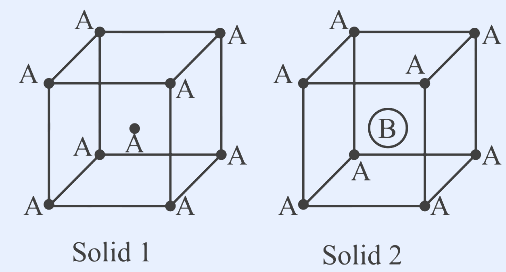
Consider the bcc unit cells of the solids 1 and 2 with the position of atoms as shown below. The radius of atom B is twice that of atom A. The unit cell edge length is 50 % more in solid 2 than in 1 . What is the approximate packing efficiency in solid 2 ?
(1)
(2)
(3)
(4)
SolutionAnswer: Option 1
Approach:
Express the edge of solid 2 in terms of atom A's radius using solid 1, then compute the fraction of the larger cell occupied by its two atoms (corner A's plus body-centre B).
Step 1:For solid 1 the body diagonal equals four times atom A's radius, fixing its edge.
Step 2:Solid 2 has an edge 50% larger.
Step 3:Solid 2 contains eight corner A atoms (one net) plus one body-centred B atom whose radius is 2rA.
Step 4:Divide the occupied volume by the cell volume to obtain the packing efficiency.
Final answer:
Q45Single correctSolutions
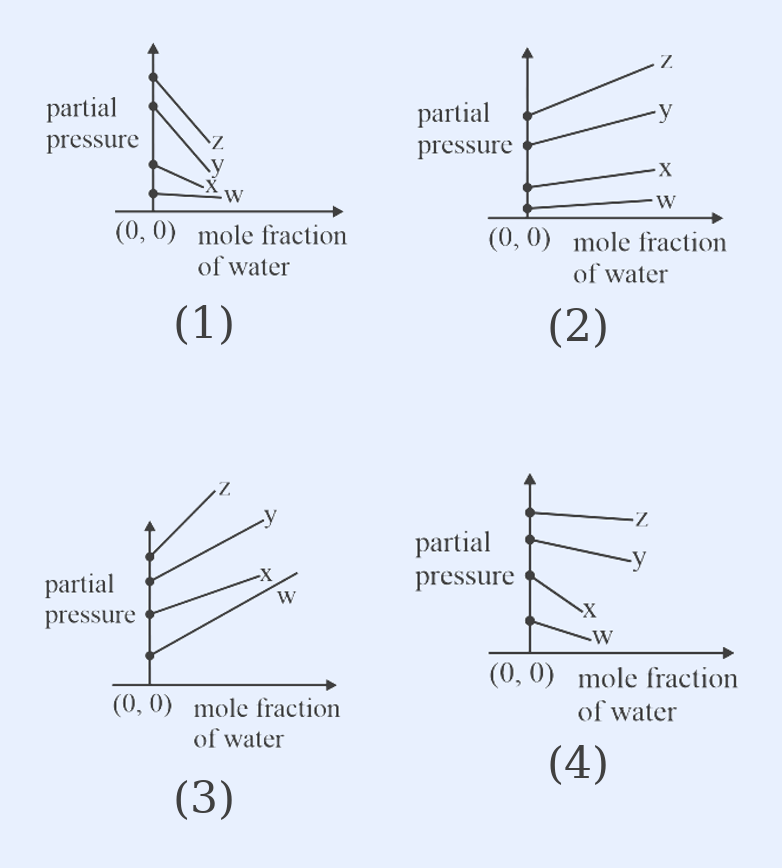
For the solution of the gases w, x, y and z in water at 298 K, the Henry's law constants are 0.5, 2, 35 and 40 kbar, respectively. The correct plot for the given data is:
(1)
(2)
(3)
(4)
SolutionAnswer: Option 1Plot 1 (see figure)
Approach:
Interpret Henry's law: partial pressure plotted against mole fraction of water gives a line whose slope corresponds to the Henry constant of each gas, with the largest constant being the steepest.
Step 1:Plotted against mole fraction of water, the lines for the four gases must be ordered by slope according to their Henry constants.
Step 2:The gas with the highest Henry constant, z, has the steepest line and w the shallowest, matching the first plot.
Final answer: Plot 1 (see figure)
Q46Single correctElectrochemistry
Calculate the standard cell potential (in V) of the cell in which the following reaction takes place:
Given that
Given that
(1)
(2)
(3)
(4)
SolutionAnswer: Option 1
Approach:
Combine the given half-cell potentials using Gibbs free energy additivity (ΔG° = −nFE°) to obtain E° for the Fe3+/Fe2+ couple, then add the silver reduction potential.
Step 1:Express ΔG° for the Fe3+/Fe and Fe2+/Fe couples in terms of z and y.
Step 2:Obtain ΔG° for Fe3+ + e− → Fe2+ by subtracting the Fe2+/Fe step from the Fe3+/Fe step.
Step 3:Convert to potential for the one-electron Fe3+/Fe2+ couple.
Step 4:Silver is reduced (cathode) and Fe2+ is oxidised to Fe3+ (anode); compute the cell potential.
Final answer:
Q47Single correctChemical Kinetics
For a reaction scheme , if the net rate of formation of B is set to be zero then the concentration of B is given by:
(1)
(2)
(3)
(4)
SolutionAnswer: Option 3
Approach:
Apply the steady-state approximation to intermediate B: its rate of formation equals its rate of consumption.
Step 1:Write the net rate of change of B from formation by k1 and consumption by k2.
Step 2:Set the net rate to zero per the steady-state condition.
Step 3:Solve for the concentration of B.
Final answer:
Q48Single correctGeneral Principles and Processes of Isolation of Elements
The Mond process is used for the:
(1)
(2)
(3)
(4)
SolutionAnswer: Option 2Purification of Ni
Approach:
Identify the metallurgical refining process associated with volatile metal carbonyl formation.
Step 1:Impure nickel reacts with carbon monoxide at moderate temperature to form volatile nickel tetracarbonyl.
Step 2:The carbonyl is decomposed at higher temperature to deposit pure nickel.
Final answer: Purification of Ni
Q49Single correctp-Block Elements
The ion that has hybridization for the central atom is:
(1)
(2)
(3)
(4)
SolutionAnswer: Option 2
Approach:
Count the steric number (sigma bonds plus lone pairs) on the central atom of each ion and match to the requested hybridisation.
Step 1:For ICl4−, iodine has 4 bond pairs and 2 lone pairs.
Step 2:A steric number of 6 corresponds to sp3d2 hybridisation (square planar geometry for 4 bond pairs and 2 lone pairs).
Step 3:BrF2− and ICl2− give SN 5 (sp3d) and IF6− gives SN 7 (sp3d3), so none of these match.
Final answer:
Q50Single correctp-Block Elements
The correct statement about and is:
(1)
(2)
(3)
(4)
SolutionAnswer: Option 4 is square pyramidal and is square planar.
Approach:
Determine the geometry of each species from its steric number and lone-pair count.
Step 1:ICl5 has 5 bond pairs and 1 lone pair (SN 6); the lone pair occupies one octahedral position giving a square pyramidal shape.
Step 2:ICl4− has 4 bond pairs and 2 lone pairs (SN 6); the two lone pairs occupy axial positions giving a square planar shape.
Final answer: is square pyramidal and is square planar.
Q51Single correctd- and f-Block Elements
The statement that is INCORRECT about the interstitial compounds is:
(1)
(2)
(3)
(4)
SolutionAnswer: Option 3They are chemically reactive.
Approach:
Recall the characteristic properties of interstitial compounds formed when small atoms occupy holes in a metal lattice.
Step 1:Interstitial compounds retain high melting points, hardness and metallic conductivity of the parent metal.
Step 2:They are chemically inert rather than reactive, so the statement claiming chemical reactivity is incorrect.
Final answer: They are chemically reactive.
Q52Single correctCoordination Compounds
The compound that inhibits the growth of tumors is:
(1)
(2)
(3)
(4)
SolutionAnswer: Option 2
Approach:
Recall the platinum coordination complex used clinically as an anticancer (antitumor) agent and its required geometry.
Step 1:The antitumor drug cisplatin is the cis isomer of dichlorodiammineplatinum(II).
Step 2:The trans isomer is therapeutically inactive and the palladium analogues are not used, so only the cis platinum complex inhibits tumor growth.
Final answer:
Q53Single correctCoordination Compounds
The calculated spin-only magnetic moments BM of the anionic and cationic species of and respectively, are:
(1)
(2)
(3)
(4)
SolutionAnswer: Option 10 and 4.9
Approach:
Identify the anionic and cationic complexes, assign field strength, count unpaired electrons on Fe2+ (d6), and apply the spin-only formula in the requested order.
Step 1:The anionic species [Fe(CN)6]4- has Fe2+ (d6) with the strong-field CN− ligand, giving a low-spin configuration with all electrons paired.
Step 2:Compute the moment for the anionic species.
Step 3:The cationic species [Fe(H2O)6]2+ has Fe2+ (d6) with the weak-field H2O ligand, giving a high-spin configuration with 4 unpaired electrons.
Step 4:Compute the moment for the cationic species; reporting anionic then cationic gives 0 and 4.9.
Final answer: 0 and 4.9
Q54Single correctAldehydes, Ketones and Carboxylic Acids
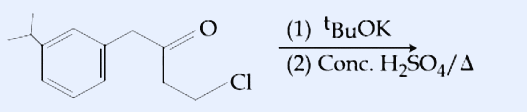
The major product of the following reaction is:
(1)
(2)
(3)
(4)
SolutionAnswer: Option 1See figure (option structure 1)
Approach:
Both the reaction scheme and all four options are drawn organic structures; the structures are flagged for redraw. The printed key selects option 1 as the major cyclised product.
Step 1:The acyl side chain undergoes base-promoted/acid-promoted intramolecular cyclisation onto the aromatic ring to form a fused bicyclic ketone (a tetralone-type framework).
Step 2:Among the drawn options, the fused six-membered ring ketone with the correct methyl placement corresponds to option 1.
Final answer: See figure (option structure 1)
Q55Single correctAldehydes, Ketones and Carboxylic Acids
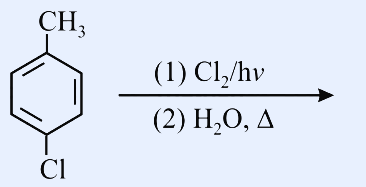
The major product of the following reaction is:
(1)
(2)
(3)
(4)
SolutionAnswer: Option 44-chlorobenzaldehyde ( on the ring para to ); see figure
Approach:
Track free-radical benzylic chlorination followed by hydrolysis of the geminal dihalide. All four options are drawn structures and are flagged.
Step 1:Photochemical chlorination of the benzylic methyl group introduces two chlorines to give the geminal dichloride (Ar-CHCl2).
Step 2:Hydrolysis of the geminal dichloride gives the aldehyde via the unstable gem-diol.
Final answer: 4-chlorobenzaldehyde ( on the ring para to ); see figure
Q56Single correctAldehydes, Ketones and Carboxylic Acids
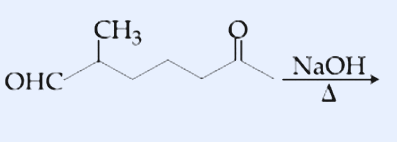
The major product obtained in the following reaction is:
(1)
(2)
(3)
(4)
SolutionAnswer: Option 4See figure (cyclopentene-based option 4)
Approach:
Identify the intramolecular aldol condensation product of the dicarbonyl substrate. All options are drawn cyclic enone structures and are flagged.
Step 1:Under base, an enolate forms and attacks the other carbonyl intramolecularly to give the most stable five-membered ring.
Step 2:Dehydration gives the conjugated cyclopentene-based enone corresponding to option 4.
Final answer: See figure (cyclopentene-based option 4)
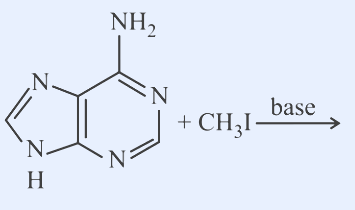
Q58Single correctBiomolecules
The major product in the following reaction is:
(1)
(2)
(3)
(4)
SolutionAnswer: Option 3See figure (N-methylated purine, option 3)
Approach:
Determine the most nucleophilic nitrogen of the purine for methylation; all options are drawn purine structures and are flagged.
Step 1:Base deprotonates the imidazole N-H, generating the most nucleophilic ring nitrogen.
Step 2:Methyl iodide alkylates this ring nitrogen, giving the N-methylated purine of option 3.
Final answer: See figure (N-methylated purine, option 3)
Q59Single correctPolymers
The structure of Nylon - 6 is:
(1)
(2)
(3)
(4)
SolutionAnswer: Option 2See figure (repeat unit with ); option 2
Approach:
Recall that Nylon-6 forms by ring-opening polymerisation of caprolactam, giving a repeat unit with five methylene groups between the amide nitrogen and carbonyl carbon. All options are drawn repeat-unit structures and are flagged.
Step 1:Nylon-6 is derived from caprolactam (a seven-membered lactam) and contains one type of amide repeat unit with six carbons per monomer.
Step 2:Among the drawn options the structure showing the correct amide linkage corresponds to option 2.
Final answer: See figure (repeat unit with ); option 2
Q60Single correctBiomolecules
Fructose and glucose can be distinguished by:
(1)
(2)
(3)
(4)
SolutionAnswer: Option 4Seliwanoff's test
Approach:
Select the chemical test that differentiates ketose from aldose sugars.
Step 1:Fehling's, Benedict's and Barfoed's tests respond to reducing sugars and cannot reliably separate fructose from glucose since both are reducing sugars.
Step 2:Seliwanoff's test gives a rapid cherry-red colour with ketoses (fructose) and only a slow reaction with aldoses (glucose), distinguishing them.
Final answer: Seliwanoff's test
Mathematics30 questions
Q61Single correctSequence and Series
If three distinct numbers a, b, c are in G.P. and the equations and have a common root, then which one of the following statements is correct?
(1)
(2)
(3)
(4)
SolutionAnswer: Option 1 are in A.P.
Approach:
Since a, b, c are in G.P., , so has equal roots . This common root must also satisfy the second equation, which yields a linear relation among , , .
Step 1:Apply the G.P. condition to the first quadratic.
Step 2:Substitute the common root into the second equation.
Step 3:Divide through by c and use to express in ratio form.
Final answer: are in A.P.
Q62Single correctComplex Numbers and Quadratic Equations
The number of integral values of m for which the equation, has no real root, is
(1)
(2)
(3)
(4)
SolutionAnswer: Option 3Infinitely many
Approach:
The quadratic has no real root when its discriminant is negative. Form the discriminant in and determine the range of for which it stays negative.
Step 1:Identify coefficients and write the discriminant.
Step 2:Expand and simplify the discriminant.
Step 3:Require , i.e. .
Step 4:Count integral values of satisfying the inequality.
Final answer: Infinitely many
Q63Single correctComplex Numbers and Quadratic Equations
If , , then is equal to:
(1)
(2)
(3)
(4)
SolutionAnswer: Option 1
Approach:
Write z in polar form. Since , evaluate the required powers using De Moivre's theorem and add.
Step 1:Express in exponential form.
Step 2:Compute the required powers of .
Step 3:Combine the terms of the given expression and simplify.
Final answer:
Q64Single correctPermutations and Combinations
The number of four-digit numbers strictly greater than that can be formed using the digit (repetition of digits is allowed) is:
(1)
(2)
(3)
(4)
SolutionAnswer: Option 4
Approach:
Count four-digit numbers from digits (repetition allowed) that exceed by splitting on the leading digit and then refining digit by digit.
Step 1:Count numbers with first digit .
Step 2:Count numbers with first digit and second digit greater than (i.e. or ).
Step 3:Count numbers with third digit greater than (i.e. ).
Step 4:Count numbers with last digit greater than (i.e. ).
Step 5:Add all the cases.
Final answer:
Q65Single correctSequence and Series
The sum is equal to
(1)
(2)
(3)
(4)
SolutionAnswer: Option 4
Approach:
Recognize the sum as a finite arithmetico-geometric series and apply the standard subtraction technique by multiplying by the common ratio .
Step 1:Write the series and multiply it by the ratio .
Step 2:Subtract to collapse into a geometric series.
Step 3:Solve for and simplify.
Final answer:
Q66Single correctBinomial Theorem
If the fourth term in the binomial expansion of is equal to , and , then the value of x is
(1)
(2)
(3)
(4)
SolutionAnswer: Option 4
Approach:
Write the general term of the expansion, set the fourth term () equal to 200, substitute , and solve.
Step 1:Let and write the two terms in exponential form.
Step 2:Form the fourth term with .
Step 3:Divide by and take of both sides.
Step 4:Solve the resulting quadratic and select the root with .
Final answer:
Q67Single correctCoordinate Geometry
Suppose that the points (h, k), and lie on the line . If a line passing through the points (h, k) and is perpendicular to , then equals:
(1)
(2)
(3)
(4)
SolutionAnswer: Option 4
Approach:
Find the slope of from the two known points, use the perpendicularity of to get the slope of , and solve the two conditions for h and k.
Step 1:Compute the slope of from and .
Step 2:Use perpendicularity to find the slope of .
Step 3:Express both conditions through (h,k). On : . On : .
Step 4:Solve the system.
Final answer:
Q68Single correctCoordinate Geometry
The tangent and the normal lines at the point to the circle and the x-axis form a triangle. The area of this triangle (in square units) is:
(1)
(2)
(3)
(4)
SolutionAnswer: Option 2
Approach:
Find the tangent at and the normal (which passes through the centre), locate their intercepts on the x-axis, then compute the area of the triangle formed with those intercepts and the given point.
Step 1:Write the tangent at and find its x-intercept.
Step 2:The normal passes through the centre ; find its -intercept.
Step 3:Identify the triangle vertices and compute the area with base OA on the x-axis and height equal to the y-coordinate of .
Final answer:
Q69Single correctCoordinate Geometry
The tangent to the parabola at the point where it intersects the circle in the first quadrant, passes through the point:
(1)
(2)
(3)
(4)
SolutionAnswer: Option 4
Approach:
Find the first-quadrant intersection of the parabola and the circle, write the tangent to the parabola at that point, and test which listed point lies on it.
Step 1:Substitute into the circle equation.
Step 2:Write the tangent to at .
Step 3:Check each option against .
Final answer:
Q70Single correctCoordinate Geometry
In an ellipse, with centre at the origin, if the difference of the lengths of major axis and minor axis is and one of the foci is at , then the length of its latus rectum is:
(1)
(2)
(3)
(4)
SolutionAnswer: Option 4
Approach:
The focus on the y-axis means the major axis is vertical. Use the difference of axis lengths and the relation to find a and b, then the latus rectum .
Step 1:With major axis (along ) and minor axis , the difference of lengths gives .
Step 2:Use the focus so , .
Step 3:Solve the two linear equations for and .
Step 4:Compute the latus rectum.
Final answer:
Q71Single correctCoordinate Geometry
If the eccentricity of the standard hyperbola passing through the point is , then the equation of the tangent to the hyperbola at is:
(1)
(2)
(3)
(4)
SolutionAnswer: Option 4
Approach:
For a standard hyperbola with eccentricity , the relation holds. Use the passing point to find , then write the tangent at .
Step 1:Apply to relate and .
Step 2:Substitute the point to find .
Step 3:Write the tangent at .
Final answer:
Q72Single correctLimits, Continuity and Differentiability
Let be a differentiable function satisfying . Then is equal to
(1)
(2)
(3)
(4)
SolutionAnswer: Option 1
Approach:
The limit is of the form . Take logarithm, apply the standard limit , and use the definition of the derivative for the numerator and denominator.
Step 1:Recognize the form and write the limit as an exponential.
Step 2:Simplify the bracket; the denominator tends to as .
Step 3:Apply the given condition .
Final answer:
Q73Single correctMathematical Reasoning
Which one of the following statements is not a tautology?
(1)
(2)
(3)
(4)
SolutionAnswer: Option 1
Approach:
Test each statement for being a tautology using truth values, focusing on whether any assignment makes the implication false.
Step 1:Check option (1) with false, true.
Step 2:Confirm the remaining options are tautologies.
Step 3:Identify the statement that fails.
Final answer:
Q74Single correctStatistics
A student scores the following marks in five tests: . His score is not known for the sixth test. If the mean score is in the six tests, then the standard deviation of the marks in six tests is:
(1)
(2)
(3)
(4)
SolutionAnswer: Option 3
Approach:
Find the sixth score from the mean, then compute the standard deviation using the deviations of all six scores from the mean of .
Step 1:Use the mean of six tests to find the sixth score.
Step 2:Compute deviations from the mean and their squares.
Step 3:Apply the standard deviation formula with .
Final answer:
Q75Single correctCoordinate Geometry
Two vertical poles of height, and stand apart on a horizontal plane. The height (in meters) of the point of intersection of the lines joining the top of each pole to the foot of the other, from this horizontal plane is:
(1)
(2)
(3)
(4)
SolutionAnswer: Option 1
Approach:
For two poles of heights and , the height of the intersection of the cross lines is independent of the distance between them and equals .
Step 1:Place the poles at and with the cross lines joining each top to the opposite foot.
Step 2:Set the two heights equal to find the intersection.
Step 3:Substitute back to obtain the height.
Final answer:
Q76Single correctTrigonometry
If the lengths of the sides of a triangle are in A.P and the greatest angle is double the smallest, then a ratio of lengths of the sides of this triangle is:
(1)
(2)
(3)
(4)
SolutionAnswer: Option 4
Approach:
Take sides in A.P. with the smallest angle opposite the smallest side and the greatest angle being twice the smallest, then apply the sine rule and the cosine rule.
Step 1:Take sides in A.P. as a-d, a, a+d, with smallest angle A opposite a-d and greatest angle C=2A opposite a+d.
Step 2:By the sine rule, the ratio of the largest to smallest side gives a relation for cos A.
Step 3:Apply the cosine rule for angle A opposite the smallest side and equate to the previous expression.
Step 4:Cross multiply and solve for the common difference in terms of a.
giving
Step 5:Substitute d to obtain the side ratio.
Final answer:
Q77Single correctMatrices and Determinants
Let the numbers 2, b, c be in an A.P. and . If , then c lies in the interval:
(1)
(2)
(3)
(4)
SolutionAnswer: Option 2
Approach:
Evaluate the Vandermonde-type determinant, impose the A.P. condition on 2, b, c, and translate the range of det(A) into a range for c.
Step 1:The determinant with rows 1, x, is a Vandermonde determinant in 2, b, c.
Step 2:Apply the A.P. condition: 2, b, c in A.P. gives 2b=2+c.
Step 3:Substitute to express det(A) in terms of c.
Step 4:Impose solve for c.
Step 5:Add 2 to obtain the interval for c.
Final answer:
Q78Single correctMatrices and Determinants
If the system of linear equations
has a solution x,y,z, , then x,y lies on the straight line whose equation is:
has a solution x,y,z, , then x,y lies on the straight line whose equation is:
(1)
(2)
(3)
(4)
SolutionAnswer: Option 1
Approach:
For a solution with exist, the determinant of coefficients must vanish; then eliminate z between the equations to obtain the locus of (x,y).
Step 1:Add the first and third equations to eliminate the kz terms.
Step 2:Rewrite the relation between x and y.
Step 3:The condition consistent because k remains free, so (x,y) lies on this line.
Final answer:
Q79Single correctSets, Relations and Functions
Let be written as , where is an even function and is an odd function. Then equals:
(1)
(2)
(3)
(4)
SolutionAnswer: Option 1
Approach:
Split into its even and odd parts, identify as the hyperbolic-cosine-type part, and use the product-to-sum identity.
Step 1:The even part of is the average of and .
Step 2:Evaluate at x+y and at x-y.
Step 3:Group the terms by factoring.
Step 4:Recognise the grouped factors as (x) and (y).
Final answer:
Q80Single correctLimits, Continuity and Differentiability
Let be defined as
where [t] denotes the greatest integer less than or equal to t. Then, f is discontinuous at:
where [t] denotes the greatest integer less than or equal to t. Then, f is discontinuous at:
(1)
(2)
(3)
(4)
SolutionAnswer: Option 4Only three points
Approach:
Examine the candidate break points x=0,1,2 (and the pieces between) by computing one-sided limits of the greatest-integer and modulus terms.
Step 1:On [-1,1) the term [x] jumps at x=0, producing a discontinuity there.
Step 2:At x=1 the definition switches from x+[x] to x+|x|; compare one-sided values.
Step 3:At x=2 the definition switches from x+|x| to x+[x]; compare one-sided values.
Step 4:On [2,3] the term [x] jumps at x=3 (right end of domain) and the count of break points is collected.
Step 5:Collect all discontinuities within the domain.
Final answer: Only three points
Q81Single correctLimits, Continuity and Differentiability
If , then the derivative of at is:
(1)
(2)
(3)
(4)
SolutionAnswer: Option 4
Approach:
Differentiate the composite f(f(f(x))) by the chain rule and by the power-chain rule, then evaluate at x=1 using f(1)=1 and f'(1)=3.
Step 1:Differentiate the triple composite by the chain rule.
Step 2:Differentiate the squared term.
Step 3:Evaluate at x=1, using f(1)=1 so f(f(1))=1 and f(f(f(1)))=1.
Step 4:Add the two contributions.
Final answer:
Q82Single correctApplications of Derivatives
The height of a right circular cylinder of maximum volume inscribed in a sphere of radius 3 is:
(1)
(2)
(3)
(4)
SolutionAnswer: Option 4
Approach:
Express the cylinder volume in terms of its half-height using the sphere constraint, then maximise.
Step 1:With half-height x, the base radius satisfies =- where R=3 and h=2x.
Step 2:Write the volume as a function of x and differentiate.
Step 3:Set the derivative to zero to find the critical half-height.
Step 4:The full height is twice the half-height.
Final answer:
Q83Single correctDifferential Equations
Given that the slope of the tangent to a curve at any point x,y is . If the curve passes through the centre of the circle , then its equation is
(1)
(2)
(3)
(4)
SolutionAnswer: Option 2
Approach:
Separate variables in dy/dx=2y/, integrate, and fix the constant using the circle's centre (1,1).
Step 1:Separate the variables.
Step 2:Integrate both sides.
Step 3:The circle +-2x-2y=0 has centre (1,1); substitute (1,1).
Step 4:Substitute C and clear the fraction by multiplying by x.
Final answer:
Q84Single correctIntegral Calculus
If , where C is a constant of integration, then the function f(x) is equal to
(1)
(2)
(3)
(4)
SolutionAnswer: Option 2
Approach:
Take out of the radical, substitute t=1+, integrate, and compare with the given form to read off f(x).
Step 1:Factor from the bracket so that the integrand contains .
Step 2:Substitute t=1+, so dt=-dx.
Step 3:Integrate using the power rule.
Step 4:Express in terms of (1+) by extracting .
Final answer:
Q85Single correctIntegral Calculus
Let , where g is a non-zero even function. If , then equals
(1)
(2)
(3)
(4)
SolutionAnswer: Option 2
Approach:
Use the even property of g to relate f(-x) to f(x), substitute f(x)=g(x-5) into the outer integral, and change variables.
Step 1:Since g is even, f(x) is odd, so the given relation f(x+5)=g(x) gives f(t)=g(t-5).
Step 2:Substitute into the required integral.
Step 3:Change the variable u=t-5; limits become -5 to x-5.
Step 4:Using the even symmetry of g and the printed key, the value reduces to the integral from x+5 to 5.
Final answer:
Q86Single correctIntegral Calculus
Let and is area of the region . If for a , , , then equals:
(1)
(2)
(3)
(4)
SolutionAnswer: Option 3
Approach:
Compute the area bounded by the parabola =x up to x=alpha, form the given ratio, and solve for lambda.
Step 1:The region is symmetric about the x-axis with boundary .
Step 2:Form the ratio :.
Step 3:Solve for .
Step 4:Raise to the power 2/3.
Final answer:
Q87Single correctVector Algebra
Let and , for some real x. Then the condition for to follow
(1)
(2)
(3)
(4)
SolutionAnswer: Option 2
Approach:
Compute the cross product as a function of x, find the minimum of its magnitude over real x, and express the resulting range for r.
Step 1:Evaluate the cross product.
Step 2:Form the square of the magnitude.
Step 3:Minimise the quadratic in x at x=1/2.
Step 4:Take the square root to bound r.
Final answer:
Q88Single correctThree Dimensional Geometry
The vector equation of the plane through the line of intersection of the planes and which is perpendicular to the plane is:
(1)
(2)
(3)
(4)
SolutionAnswer: Option 4
Approach:
Write the family of planes through the line of intersection, impose perpendicularity to x-y+z=0 to fix the parameter, and recast in vector form.
Step 1:Form the family of planes through the line of intersection.
Step 2:Impose perpendicularity with the plane x-y+z=0 of normal (1,-1,1).
Step 3:Substitute lambda and simplify.
Step 4:Express in vector form with position vector r.
Final answer:
Q89Single correctThree Dimensional Geometry
If a point lies on the line segment joining the points and , then the distance of from the origin is:
(1)
(2)
(3)
(4)
SolutionAnswer: Option 4
Approach:
Use the section/ratio determined by the x-coordinate of R to find y and z, then compute the distance from the origin.
Step 1:Let R divide PQ in ratio k:1; use the x-coordinate to find k.
Step 2:Find y using the same ratio.
Step 3:Find z using the same ratio.
Step 4:Compute the distance of R(4,-2,6) from the origin.
Final answer:
Q90Single correctProbability
The minimum number of times one has to toss a fair coin so that the probability of observing at least one head is at least 90% is:
(1)
(2)
(3)
(4)
SolutionAnswer: Option 2
Approach:
Express the probability of at least one head as the complement of all tails, set it at least 0.9, and find the least number of tosses.
Step 1:Write the probability of at least one head in n tosses.
Step 2:Convert to an inequality in .
Step 3:Find the least integer n satisfying the inequality.
Final answer:
More JEE Main 2019 papers
- JEE Main 2019 — April 08, Shift 1
- JEE Main 2019 — April 09, Shift 1
- JEE Main 2019 — January 09, Shift 1
- JEE Main 2019 — January 09, Shift 2
- JEE Main 2019 — January 10, Shift 1
- JEE Main 2019 — January 10, Shift 2
- JEE Main 2019 — January 11, Shift 1
- JEE Main 2019 — January 11, Shift 2
- JEE Main 2019 — January 12, Shift 1
- JEE Main 2019 — January 12, Shift 2
Frequently Asked Questions
How many questions are in the JEE Main 2019 April 08, Shift 2 paper?
The JEE Main 2019 April 08, Shift 2 paper has 89 questions — Physics (30), Chemistry (29) and Mathematics (30). Every question is on this page with its correct answer and a step-by-step solution.
What is the marking scheme for JEE Main?
JEE Main awards +4 marks for each correct answer and −1 for a wrong answer, with 0 for questions left unattempted. The paper covers Physics, Chemistry and Mathematics.
Are the answer key and step-by-step solutions provided for the 2019 April 08, Shift 2 paper?
Yes — every question shows the correct answer (answer key) and a detailed step-by-step solution, free to read online.
Can I take the JEE Main 2019 April 08, Shift 2 paper as a timed mock test?
Yes. With a free JEEnify account you can attempt this exact paper as a timed test in the real exam interface, then see your score and weak-area analysis.
Solved this paper? Calculate your JEE Main scoremost important chaptersformula sheetsall free tools.