
Back to JEE Main PYQs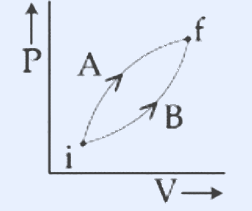
![Two stacked line graphs. Plot (i): y-axis labeled ln[R], x-axis labeled time, a straight line with negative slope decreasing left to right, captioned (i). Plot (ii): y-axis labeled [R], x-axis labeled time, a straight line with negative slope decreasing left to right, captioned (ii).](/api/qna-image?path=QnA%2Fb65cda62-f924-480b-b4db-1d3aaa6069d4%2F5ef15551-aed6-4f93-a8d5-a219b7a5d19b%2Fd2d7ebb1-761e-4c81-bbf5-eb90d35858bc%2Fd2d7ebb1-761e-4c81-bbf5-eb90d35858bc%2Fimages%2FQ47_rate_graphs.webp)
JEE Main 2019 April 09, Shift 1 Question Paper with Solutions
All 89 questions from the JEE Main 2019 (April 09, Shift 1) shift — Physics (30), Chemistry (29) and Mathematics (30) — each with the correct answer (answer key) and a step-by-step solution. Read it free online, or attempt the full paper as a timed mock test.
Physics30 questions
Q1Single correctUnits and Measurements
In the density measurement of a cube, the mass and edge length are measured as kg and m, respectively. The error in the measurement of density is:
(1)
(2)
(3)
(4)
SolutionAnswer: Option 1
Approach:
The fractional error in density follows from the fractional errors in mass and edge length, since density equals mass divided by the cube of the edge length.
Step 1:Express the fractional error in density.
Step 2:Substitute the measured values.
Step 3:Add the contributions.
Final answer:
Q2Single correctLaws of Motion
A ball is thrown vertically up (taken as - axis) from the ground. The correct momentum-height diagram is:
(1)
(2)
(3)
(4)
SolutionAnswer: Option 3Graph (3)
Approach:
The momentum of the ball varies with height through energy conservation, and its sign changes between the upward and downward journeys.
Step 1:Relate momentum to height by conservation of mechanical energy.
Step 2:Identify the curve shape during ascent.
Step 3:Identify the curve shape during descent, where momentum is along the negative axis.
Final answer: Graph (3)
Q3Single correctKinematics
The stream of a river is flowing with a speed of 2 km . A swimmer can swim at a speed of 4 km . The direction of the swimmer with respect to the flow of the river, to cross the river straight, is:
(1)
(2)
(3)
(4)
SolutionAnswer: Option 3
Approach:
To cross straight, the upstream component of the swimming velocity must cancel the river flow, fixing the swimmer's heading.
Step 1:Set the upstream component of swim velocity equal to the stream speed, with measured from the cross-stream direction.
Step 2:Solve for the angle from the cross-stream direction.
Step 3:Convert to the angle measured from the direction of river flow.
Final answer:
Q4Single correctWork, Energy and Power
A uniform cable of mass M and length L is placed on a horizontal surface such that its part is hanging below the edge of the surface. To lift the hanging part of the cable upto the surface, the work done should be:
(1)
(2)
(3)
(4)
SolutionAnswer: Option 1
Approach:
The work equals the gain in gravitational potential energy of the hanging portion, lifted by the height of its centre of mass.
Step 1:Find the mass of the hanging part.
Step 2:Locate its centre of mass below the edge, at half the hanging length.
Step 3:Compute the work to raise the hanging part to the surface.
Final answer:
Q5Single correctLaws of Motion
A body of mass 2 kg makes an elastic collision with a second body at rest and continues to move in the original direction but with one fourth of its original speed. What is the mass of the second body?
(1)
(2)
(3)
(4)
SolutionAnswer: Option 2 kg
Approach:
For a one-dimensional elastic collision with a stationary target, the first body's final velocity is fixed by the mass ratio.
Step 1:Apply the elastic-collision result with the second body initially at rest, with the first body retaining a quarter of its speed.
Step 2:Cross-multiply and solve for the second mass.
Step 3:Obtain the mass.
Final answer: kg
Q6Single correctRotational Motion
A stationary horizontal disc is free to rotate about its axis. When a torque is applied on it, its kinetic energy as a function of , where is the angle by which it has rotated, is given as . If its moment of inertia is I then the angular acceleration of the disc is:
(1)
(2)
(3)
(4)
SolutionAnswer: Option 1
Approach:
Equate the given rotational kinetic energy to the standard expression to find angular speed, then differentiate to obtain angular acceleration.
Step 1:Set the kinetic energy expressions equal.
Step 2:Differentiate with respect to angle.
Step 3:Identify the left side as angular acceleration; alternatively divide energy relation directly.
Final answer:
Q7Single correctRotational Motion
The following bodies are made to roll up (without slipping) the same inclined plane from a horizontal plane: (i) a ring of radius R, (ii) a solid cylinder of radius and (iii) a solid sphere of radius . If, in each case, the speed of the center of mass at the bottom of the incline is same, the ratio of the maximum heights they climb is:
(1)
(2)
(3)
(4)
SolutionAnswer: Option 2
Approach:
Energy conservation gives the climbing height in terms of the moment-of-inertia factor, which is independent of the radius for each shape.
Step 1:Express the height climbed in terms of the shape factor , which is the same speed for all.
Step 2:Compute the factor for each body.
Step 3:Multiply through by 10 to clear fractions.
Final answer:
Q8Single correctGravitation
A solid sphere of mass and radius is surrounded by a uniform concentric spherical shell of thickness and mass . The gravitational field at distance from the centre will be:
(1)
(2)
(3)
(4)
SolutionAnswer: Option 2
Approach:
At a point outside both the sphere and the shell, the total enclosed mass acts as if concentrated at the centre.
Step 1:Identify the total mass enclosed within the radius .
Step 2:Apply the inverse-square field law at distance .
Step 3:Simplify.
Final answer:
Q9Single correctProperties of Solids and Liquids
If 'M' is the mass of water that rises in a capillary tube of radius 'r', then mass of water which will rise in a capillary tube of radius '2r' is:
(1)
(2)
(3)
(4)
SolutionAnswer: Option 2 M
Approach:
The capillary rise varies inversely with radius, while the mass is the product of density, cross-sectional area and rise height.
Step 1:Express the mass in terms of radius.
Step 2:Form the ratio for doubled radius.
Step 3:State the mass for radius .
Final answer: M
Q10Single correctThermodynamics
Following figure shows two processes A and B for a gas. If and are the amount of heat absorbed by the system in two cases, and and are changes in internal energies, respectively, then:
(1)
(2)
(3)
(4)
SolutionAnswer: Option 3
Approach:
Both processes share the same initial and final states, so the internal energy change is identical; the heat differs by the work done, which is the area under each path.
Step 1:Internal energy is a state function, so equal endpoints give equal changes.
Step 2:Path A lies above path B, enclosing greater area, so it does more work.
Step 3:Apply the first law; with equal and larger work, more heat is absorbed in A.
Final answer:
Q11Single correctKinetic Theory of Gases
For given gas at 1 atm pressure, rms speed of the molecules is 200 m/s at C. At 2 atm pressure and at C, the rms speed of the molecules will be:
(1)
(2)
(3)
(4)
SolutionAnswer: Option 4 m/s
Approach:
Root-mean-square speed depends only on absolute temperature, not pressure, so the ratio of speeds follows the square root of the temperature ratio.
Step 1:Convert the temperatures to kelvin.
Step 2:Take the ratio of rms speeds, noting pressure is irrelevant.
Step 3:Multiply by the given speed.
Final answer: m/s
Q12Single correctKinetic Theory of Gases
An HCl molecule has rotational, translational and vibrational motions. If the rms velocity of HCl molecules in its gaseous phase is , m is its mass and is Boltzmann's constant, then its temperature will be:
(1)
(2)
(3)
(4)
SolutionAnswer: Option 3
Approach:
The total average energy comes from all active degrees of freedom of the diatomic molecule, equated to the translational rms kinetic energy expression.
Step 1:Count the degrees of freedom: three translational, two rotational and two vibrational for HCl.
Step 2:Equate the equipartition energy to the kinetic energy.
Step 3:Solve for the temperature.
Final answer:
Q13Single correctOscillations and Waves
A simple pendulum oscillating in air has period T. The bob of the pendulum is completely immersed in a non-viscous liquid. The density of the liquid is th of the material of the bob. If the bob is inside liquid all the time, its period of oscillation in this liquid is:
(1)
(2)
(3)
(4)
SolutionAnswer: Option 3
Approach:
Buoyancy reduces the effective gravitational acceleration on the bob, lengthening the period by the inverse square root of the effective gravity factor.
Step 1:Compute the effective gravity using the density ratio.
Step 2:Relate the new period to the original through the gravity ratio.
Step 3:Express the new period.
Final answer:
Q14Single correctOscillations and Waves
A string is clamped at both the ends and it is vibrating in its harmonic. The equation of the stationary wave is . The length of the string is: (All quantities are in SI units.)
(1)
(2)
(3)
(4)
SolutionAnswer: Option 4 m
Approach:
The wave number gives the wavelength, and for the fourth harmonic the string length equals two full wavelengths.
Step 1:Extract the wavelength from the wave number.
Step 2:Apply the harmonic condition for the fourth harmonic.
Step 3:Compute the length.
Final answer: m
Q15Single correctOscillations and Waves
The pressure wave, N , corresponds to the sound produced by a vibrating blade on a day when atmospheric temperature is C. On some other day when temperature is T, the speed of sound produced by the same blade and at the same frequency is found to be m . Approximate value of T is:
(1)
(2)
(3)
(4)
SolutionAnswer: Option 3 C
Approach:
The wave equation gives the speed of sound at zero degrees; the speed varies as the square root of absolute temperature, which fixes the new temperature.
Step 1:Determine the speed at zero degrees from the wave parameters.
Step 2:Relate the two speeds through absolute temperatures.
Step 3:Solve for the absolute temperature and convert to Celsius.
Final answer: C
Q16Single correctElectrostatics
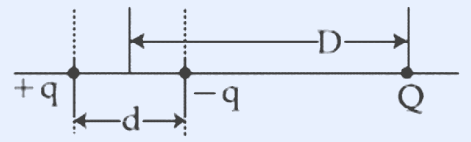
A system of three charges are placed as shown in the figure:
If , the potential energy of the system is best given by:
If , the potential energy of the system is best given by:
(1)
(2)
(3)
(4)
SolutionAnswer: Option 1
Approach:
The total potential energy is the sum of interaction energies for the three pairs: the two charges of the dipole ( and separated by d) and their interactions with the distant charge Q. The dipole-charge interaction is expanded for .
Step 1:Interaction of the and pair separated by distance .
Step 2:The pair forms a dipole of moment ; its interaction with charge Q at distance D along the axis varies as .
Step 3:Adding both contributions gives the total potential energy of the system.
Final answer:
Q17Single correctElectrostatics
A capacitor with capacitance 5 µF is charged to 5 µC. If the plates are pulled apart to reduce the capacitance to 2 µF, how much work is done?
(1)
(2)
(3)
(4)
SolutionAnswer: Option 4
Approach:
The charge is constant after disconnection. The energy stored is , and the work done equals the change in stored energy as the capacitance changes from to .
Step 1:Compute initial stored energy with and .
Step 2:Compute final stored energy with .
Step 3:Work done equals the increase in stored energy.
Final answer:
Q18Single correctCurrent Electricity
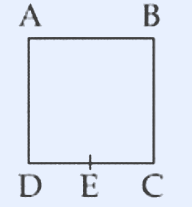
A wire of resistance is bent to form a square as shown in the figure. The effective resistance between and is:
( is mid-point of arm )
( is mid-point of arm )
(1)
(2)
(3)
(4)
SolutionAnswer: Option 2
Approach:
Each side of the square has resistance . Between E (midpoint of CD) and C, the wire forms two parallel paths: the short segment EC of length half a side, and the longer path .
Step 1:Short path is half of one side, so its resistance is .
Step 2:Long path covers half a side plus three full sides, total length of the wire.
Step 3:Combine the two paths in parallel.
Final answer:
Q19Single correctCurrent Electricity
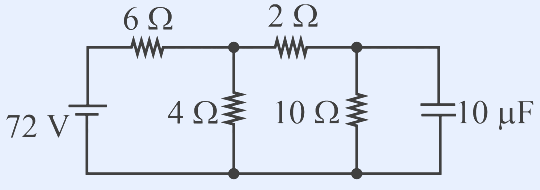
Determine the charge on the capacitor in the following circuit:
(1)
(2)
(3)
(4)
SolutionAnswer: Option 4
Approach:
In steady state no current flows through the capacitor branch. The current flows through the resistive loop, and the capacitor voltage equals the voltage across the resistor it is connected across.
Step 1:No current passes through the branch in steady state, so the resistive loop carries current from the 72 V source through the , , and resistors. The and are in parallel across the central node.
Step 2:Solving the circuit gives a steady-state potential difference of 20 V across the resistor that the capacitor spans.
Step 3:Charge on the capacitor.
Final answer:
Q20Single correctMoving Charges and Magnetism
A moving coil galvanometer has resistance 50 and it indicates full deflection at 4 mA current. A voltmeter is made using this galvanometer and a 5 resistance. The maximum voltage, that can be measured using this voltmeter, will be close to:
(1)
(2)
(3)
(4)
SolutionAnswer: Option 3
Approach:
A voltmeter is made by placing a high resistance in series with the galvanometer. The maximum voltage equals the full-scale current times the total series resistance.
Step 1:Total series resistance of galvanometer and added resistor.
Step 2:Maximum voltage at full-scale current .
Step 3:The value is closest to 20 V.
Final answer:
Q21Single correctMoving Charges and Magnetism
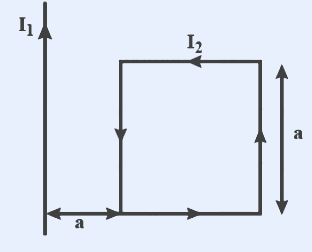
A rigid square loop of side 'a' and carrying current is lying on a horizontal surface near a long current carrying wire in the same plane as shown in figure. The net force on the loop due to the wire will be:
(1)
(2)
(3)
(4)
SolutionAnswer: Option 2Repulsive and equal to
Approach:
Only the two sides of the loop parallel to the wire experience a net force, since forces on the perpendicular sides cancel. The near side (distance ) and far side (distance ) carry current in opposite senses relative to the wire, giving a net force.
Step 1:From the figure the near parallel side is at distance and the far parallel side at distance from the long wire.
Step 2:Force on near side over length .
Step 3:Force on far side over length (opposite direction).
Step 4:Net force is the difference; with the orientation shown the resultant is repulsive.
Final answer: Repulsive and equal to
Q22Single correctMoving Charges and Magnetism
A rectangular coil (Dimension 5 cm 2.5 cm ) with 100 turns, carrying a current of 3 A in the clock-wise direction, is kept centered at the origin and in the plane. A magnetic field of 1 T is applied along axis . If the coil is tilted through about axis , then the torque on the coil is:
(1)
(2)
(3)
(4)
SolutionAnswer: Option 4
Approach:
The torque on a current loop is , where is the angle between the magnetic moment and the field. Initially the coil lies in the X-Z plane so its normal is along Y, perpendicular to B (along X); tilting by changes this angle.
Step 1:Area of the coil.
Step 2:Initially the normal is perpendicular to B (). After tilting about Z, the angle between the moment and B becomes .
Step 3:Compute the torque.
Final answer:
Q23Single correctElectromagnetic Induction
The total number of turns and cross-section area in a solenoid is fixed. However, its length L is varied by adjusting the separation between windings. The inductance of solenoid will be proportional to:
(1)
(2)
(3)
(4)
SolutionAnswer: Option 3
Approach:
The self-inductance of a solenoid depends on the total number of turns , cross-section area , and length . With and fixed, only the dependence on remains.
Step 1:Express inductance using total turns rather than turns per unit length.
Step 2:With and constant, inductance varies inversely with length.
Final answer:
Q24Single correctElectromagnetic Waves
The magnetic field of a plane electromagnetic wave is given by , where and . The RMS value of the force experienced by a stationary charge at is closest to:
(1)
(2)
(3)
(4)
SolutionAnswer: Option 4
Approach:
A stationary charge experiences force only from the electric field of the wave. The total magnetic amplitude gives the total electric amplitude via , and the RMS force is .
Step 1:Resultant magnetic amplitude from the two perpendicular components.
Step 2:Peak electric field at the charge.
Step 3:Peak force on the charge.
Step 4:RMS value of the force.
Final answer:
Q25Single correctRay Optics
A concave mirror for face viewing has a focal length of 0.4 m. The distance at which you hold the mirror from your face in order to see your image upright with a magnification of 5 is
(1)
(2)
(3)
(4)
SolutionAnswer: Option 3
Approach:
For an upright, magnified virtual image in a concave mirror, magnification . Combining with the mirror equation gives the object distance.
Step 1:Upright magnified image gives , so .
Step 2:Substitute into the mirror equation with (concave).
Step 3:Solve for the magnitude of object distance.
Final answer:
Q26Single correctWave Optics
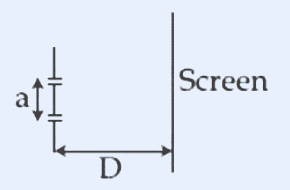
The figure shows a Young's double slit experimental setup. It is observed that when a thin transparent sheet of thickness t and refractive index is put in front of one of the slits, the central maximum gets shifted by a distance equal to n fringe width. If the wavelength of light used is , then t will be:
(1)
(2)
(3)
(4)
SolutionAnswer: Option 2
Approach:
Introducing the sheet adds an extra optical path , shifting the central maximum by . Equating this shift to n fringe widths solves for t.
Step 1:Set the shift equal to fringe widths.
Step 2:Cancel the common factor .
Step 3:Solve for the thickness .
Final answer:
Q27Single correctDual Nature of Matter and Radiation
The electric field of light wave is given as . This light falls on a metal plate of work function 2 eV . The stopping potential of the photo-electrons is:
Given, E (in eV )
Given, E (in eV )
(1)
(2)
(3)
(4)
SolutionAnswer: Option 4
Approach:
The wavelength is read from the spatial part of the wave. The photon energy is obtained from the given relation, and the stopping potential equals (photon energy minus work function) in volts.
Step 1:Identify the wavelength from the coefficient of x: , so .
Step 2:Compute the photon energy.
Step 3:Stopping potential from energy minus work function.
Final answer:
Q28Single correctAtoms and Nuclei
Taking the wavelength of first Balmer line in hydrogen spectrum ( n = 3 to n = 2) as 660 nm , the wavelength of the 2 Balmer line ( n = 4 to n = 2) will be:
(1)
(2)
(3)
(4)
SolutionAnswer: Option 2
Approach:
The wave number for each Balmer transition follows the Rydberg formula. Taking the ratio of the two transitions eliminates the Rydberg constant and gives the unknown wavelength.
Step 1:First Balmer line ().
Step 2:Second Balmer line ().
Step 3:Take the ratio and solve for .
Final answer:
Q29Single correctSemiconductor Electronics
An NPN transistor is used in common emitter configuration as an amplifier with 1 k load resistance. Signal voltage of 10 mV is applied across the base-emitter. This produces a 3 mA change in the collector current and 15 µA change in the base current of the amplifier. The input resistance and voltage gain are:
(1)
(2)
(3)
(4)
SolutionAnswer: Option 2
Approach:
Input resistance is the applied signal voltage divided by the base current change. Voltage gain is the current gain times the ratio of load to input resistance.
Step 1:Input resistance from signal voltage and base current change.
Step 2:Current gain from collector and base current changes.
Step 3:Voltage gain using load and input resistances.
Final answer:
Q30Single correctCommunication Systems
A signal is transmitted using as carrier wave. The correct amplitude modulated (AM) signal is:
(1)
(2)
(3)
(4)
SolutionAnswer: Option 4
Approach:
An amplitude modulated wave is formed by varying the carrier amplitude with the message signal. Expanding the modulated carrier produces the carrier plus two side-band terms.
Step 1:Form the modulated carrier by adding the message to the carrier amplitude.
Step 2:Expand and apply the product-to-sum identity to the cross term.
Step 3:Split the product term into two side bands.
Final answer:
Chemistry29 questions
Q31Single correctSome Basic Concepts in Chemistry
For a reaction,
, identify di-hydrogen () as a limiting reagent in the following reaction mixtures.
, identify di-hydrogen () as a limiting reagent in the following reaction mixtures.
(1)
(2)
(3)
(4)
SolutionAnswer: Option 3
Approach:
Compute moles of each reactant and compare with the 1:3 stoichiometric ratio; di-hydrogen is limiting when the available H2 is less than three times the available N2.
Step 1:Required ratio of moles of H2 to N2 for complete reaction is 3:1. H2 is limiting when moles of H2 are fewer than 3 times the moles of N2.
Step 2:For 56 g N2 and 10 g H2: moles of N2 and moles of H2 are obtained from their molar masses 28 and 2.
Step 3:Complete reaction of 2 mol N2 requires 6 mol H2, but only 5 mol H2 are present, so H2 runs out first.
Final answer:
Q32Single correctAtomic Structure
For any given series of spectral lines of atomic hydrogen, let be the difference in maximum and minimum wave number in . The ratio is
(1)
(2)
(3)
(4)
SolutionAnswer: Option 4
Approach:
For each series the maximum wave number corresponds to the series limit and the minimum to the first line; the difference equals R times the inverse-square of the lower level minus the limiting term.
Step 1:Lyman series has n1=1. Maximum wave number occurs for n2 to infinity and minimum for n2=2.
Step 2:Balmer series has n1=2. Maximum wave number occurs for n2 to infinity and minimum for n2=3.
Step 3:Taking the ratio of the two differences gives the required value.
Final answer:
Q33Single correctClassification of Elements and Periodicity in Properties
The element having greatest difference between its first and second ionization energies, is
(1)
(2)
(3)
(4)
SolutionAnswer: Option 2
Approach:
Identify the element whose second electron is removed from a noble-gas core, producing the largest jump between first and second ionization energies.
Step 1:Potassium has the electronic configuration of argon plus one valence electron; removing the first electron leaves a stable noble-gas core.
Step 2:The second electron must be pulled from this stable closed shell, requiring a very large energy and giving the greatest jump.
Step 3:Ba, Ca and Sc each have at least two valence electrons, so their second ionization does not break a noble-gas core, giving smaller jumps.
Final answer:
Q34Single correctChemical Bonding and Molecular Structure
Among the following, the molecule expected to be stabilized by anion formation is:
(1)
(2)
(3)
(4)
SolutionAnswer: Option 2
Approach:
Compare the bond order of each molecule with that of its anion using molecular orbital filling; anion formation stabilizes a molecule when it increases the bond order.
Step 1:C2 has a bond order of 2 with the added electron entering a bonding pi orbital; the anion C2- gains a half-bond.
Step 2:For O2, F2 and NO the additional electron enters an antibonding orbital, lowering the bond order on anion formation.
Step 3:Only C2 is stabilized by anion formation because its bond order rises.
Final answer:
Q35Single correctStates of Matter
Consider the van der Waal's constants, a and b, for the following gases.
| Gas | Ar | Ne | Kr | Xe |
|---|---|---|---|---|
| 1.3 | 0.2 | 5.1 | 4.1 | |
| 3.2 | 1.7 | 1.0 | 5.0 |
Which gas is expected to have the highest critical temperature?
(1)
(2)
(3)
(4)
SolutionAnswer: Option 1
Approach:
Express the critical temperature in terms of the van der Waals constants and evaluate the a/b ratio for each gas, since critical temperature scales with a divided by b.
Step 1:Critical temperature is proportional to a/b, so the gas with the largest a/b ratio has the highest critical temperature.
Step 2:Evaluate a/b for Kr using its constants (b expressed in 0.01 dm3 mol-1 units).
Step 3:Xe gives 4.1/(5.0e-2)=82, Ar gives 1.3/(3.2e-2)=40.6, Ne gives 0.2/(1.7e-2)=11.8, all below Kr.
Final answer:
Q37Single correctp-Block Elements
Magnesium powder burns in air to give
(1)
(2)
(3)
(4)
SolutionAnswer: Option 1
Approach:
Determine the products formed when burning magnesium reacts with the principal components of air, oxygen and nitrogen.
Step 1:Magnesium reacts with atmospheric oxygen to form magnesium oxide.
Step 2:At the high temperature of combustion magnesium also reacts with atmospheric nitrogen to form magnesium nitride.
Step 3:Both products are obtained together when magnesium burns in air.
Final answer:
Q38Single correctSome Basic Concepts in Chemistry
, an allotrope of carbon contains
(1)
(2)
(3)
(4)
SolutionAnswer: Option 420 hexagons and 12 pentagons.
Approach:
Use the known soccer-ball geometry of buckminsterfullerene, which combines hexagonal and pentagonal rings of carbon atoms.
Step 1:Buckminsterfullerene C60 has a closed cage shaped like a football.
Step 2:The cage is built from twenty six-membered rings and twelve five-membered rings.
Step 3:This arrangement satisfies the count of sixty carbon atoms with each at a vertex.
Final answer: 20 hexagons and 12 pentagons.
Q39Single correctOrganic Chemistry - Some Basic Principles and Techniques
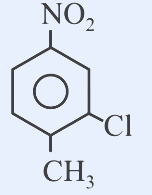
The correct IUPAC name of the following compound is:
(1)
(2)
(3)
(4)
SolutionAnswer: Option 22-chloro-1-methyl-4-nitrobenzene.
Approach:
Assign locants on the benzene ring so that the substituents get the lowest possible set of numbers, choosing the principal chain alphabetically when there is a tie.
Step 1:The ring carries a methyl group, a chloro group ortho to it, and a nitro group para to the methyl group.
Step 2:Numbering to give the lowest locant set places methyl at 1, chloro at 2 and nitro at 4.
Step 3:Listing substituents alphabetically gives the IUPAC name as 2-chloro-1-methyl-4-nitrobenzene.
Final answer: 2-chloro-1-methyl-4-nitrobenzene.
Q40Single correctHydrocarbons
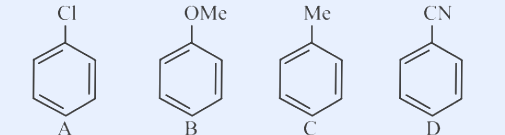
The increasing order of reactivity of the following compounds towards aromatic electrophilic substitution reaction is:
A: chlorobenzene; B: anisole (methoxybenzene); C: toluene; D: benzonitrile (cyanobenzene)
A: chlorobenzene; B: anisole (methoxybenzene); C: toluene; D: benzonitrile (cyanobenzene)
(1)
(2)
(3)
(4)
SolutionAnswer: Option 4
Approach:
Rank the substituents by their activating or deactivating effect on the ring; stronger electron donation increases reactivity toward electrophiles while electron withdrawal decreases it.
Step 1:The cyano group is strongly electron-withdrawing, making benzonitrile (D) the least reactive.
Step 2:Chlorine is weakly deactivating, methyl is weakly activating, so chlorobenzene (A) is below toluene (C).
Step 3:The methoxy group is a strong activator through resonance, making anisole (B) the most reactive.
Final answer:
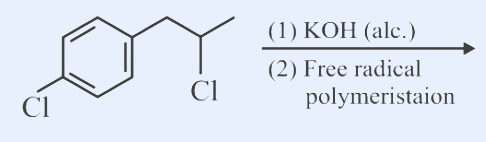
Q41Single correctHaloalkanes and Haloarenes
The major product of the following reaction is
(1)
(2)
(3)
(4)
SolutionAnswer: Option 1
Approach:
Alcoholic KOH causes dehydrohalogenation of the benzylic chloride to give a 4-chlorostyrene, which then undergoes free radical polymerization to a poly(4-chlorostyrene) chain.
Step 1:Alcoholic KOH eliminates HCl from the side-chain chloride to form a vinyl group attached to the para-chloro benzene ring.
Step 2:Free radical polymerization of this styrene derivative links the vinyl units into a chain bearing pendant para-chlorophenyl groups.
Step 3:The repeating unit has the para-chlorophenyl group on alternate backbone carbons, matching option 1.
Final answer:
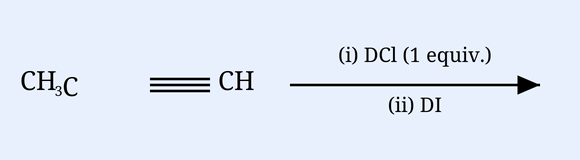
Q42Single correctHydrocarbons
The major product of the following reaction is
(1)
(2)
(3)
(4)
SolutionAnswer: Option 4
Approach:
Apply Markovnikov addition twice to the alkyne; each acid adds its proton (here deuterium) to the carbon bearing more hydrogens and its halide to the more substituted carbon.
Step 1:DCl adds across the triple bond with deuterium going to the terminal carbon and chlorine to the internal carbon by Markovnikov orientation.
Step 2:DI then adds to the remaining double bond, again placing iodine on the more substituted carbon and deuterium on the terminal carbon.
Step 3:The final product carries both halogens on the central carbon and two deuteriums on the terminal carbon.
Final answer:
Q43Single correctEnvironmental Chemistry
Excessive release of into the atmosphere results in
(1)
(2)
(3)
(4)
SolutionAnswer: Option 1global warming.
Approach:
Identify the environmental consequence of carbon dioxide accumulation based on its role as a greenhouse gas.
Step 1:Carbon dioxide is a greenhouse gas that traps outgoing infrared radiation in the atmosphere.
Step 2:Increased atmospheric concentration raises the average surface temperature of the Earth.
Step 3:This temperature rise is known as global warming.
Final answer: global warming.
Q44Single correctSolutions
The osmotic pressure of a dilute solution of an ionic compound XY in water is four times that of a solution of in water. Assuming complete dissociation of the given ionic compounds in water, the concentration of XY ( in ) in solution is
(1)
(2)
(3)
(4)
SolutionAnswer: Option 4
Approach:
Express osmotic pressure as the product of the van't Hoff factor and concentration, then set the XY pressure equal to four times that of BaCl2 to solve for the XY concentration.
Step 1:BaCl2 dissociates into three ions, giving a van't Hoff factor of 3; its effective particle concentration is 3 times 0.01 M.
Step 2:XY dissociates into two ions, giving a van't Hoff factor of 2, so its effective concentration is 2 times its molarity.
Step 3:Setting the XY pressure to four times that of BaCl2 and solving gives the XY concentration.
Final answer:
Q45Single correctSolutions
Liquid M and liquid N form an ideal solution. The vapour pressures of pure liquids M and N are 450 and 700 mmHg, respectively, at the same temperature. Then correct statements is:
( = Mole fraction of 'M' in solution; = Mole fraction of 'N' in solution; = Mole fraction of 'M' in vapour phase; = Mole fraction of 'N' in vapour phase; )
( = Mole fraction of 'M' in solution; = Mole fraction of 'N' in solution; = Mole fraction of 'M' in vapour phase; = Mole fraction of 'N' in vapour phase; )
(1)
(2)
(3)
(4)
SolutionAnswer: Option 1
Approach:
Relate the vapour-phase mole fractions to the liquid-phase mole fractions through Raoult's law and Dalton's law, then compare the two ratios using the relative volatilities.
Step 1:The ratio of vapour mole fractions equals the ratio of partial pressures, which depends on the pure vapour pressures.
Step 2:Since the pure vapour pressure of M is lower than that of N, the scaling factor is less than one.
Step 3:Therefore the liquid ratio exceeds the vapour ratio for component M.
Final answer:
Q46Single correctElectrochemistry
The standard Gibbs energy for the given cell reaction in kJ mo at 298 K is:
(Faraday's constant , )
(Faraday's constant , )
(1)
(2)
(3)
(4)
SolutionAnswer: Option 4
Approach:
Apply the relation between standard Gibbs energy and standard cell potential, using the number of electrons transferred in the redox reaction.
Step 1:Identify the number of electrons transferred. Zinc loses two electrons and copper(II) gains two electrons.
Step 2:Substitute the values into the Gibbs energy relation.
Step 3:Convert from joules to kilojoules per mole.
Final answer:
Q47Single correctChemical Kinetics
The given plots represent the variation of the concentration of a reactant R with time for two different reactions (i) and (ii). The respective orders of the reaction are
(1)
(2)
(3)
(4)
SolutionAnswer: Option 3
Approach:
Match the linear concentration-time relationship of each plot to the integrated rate law that produces a straight line.
Step 1:Plot (i) shows ln[R] decreasing linearly with time, which corresponds to first order kinetics.
Step 2:Plot (ii) shows [R] decreasing linearly with time, which corresponds to zero order kinetics.
Step 3:Combine the two results in the order of the plots.
Final answer:
Q48Single correctSurface Chemistry
The aerosol is a kind of colloid in which
(1)
(2)
(3)
(4)
SolutionAnswer: Option 1
Approach:
Recall the classification of colloids by dispersed phase and dispersion medium and identify the medium associated with an aerosol.
Step 1:An aerosol is a colloidal system in which the dispersion medium is a gas.
Step 2:In a solid aerosol such as smoke, solid particles form the dispersed phase within the gaseous medium.
Final answer:
Q49Single correctGeneral Principles of Metallurgy
The ore that contains the metal in the form of fluoride is known as which of the following?
(1)
(2)
(3)
(4)
SolutionAnswer: Option 1
Approach:
Recall the chemical formulae of the listed ores and identify the one containing a fluoride anion.
Step 1:Cryolite is a fluoride ore of aluminium with the formula sodium hexafluoroaluminate.
Step 2:Magnetite is an oxide ore, malachite a carbonate ore, and sphalerite a sulphide ore.
Final answer:
Q50Single correctSurface Chemistry
Catalyst column shows headings Catalyst and Product.
| Column I | Column II |
|---|---|
| A.. | P.. |
| B.. | Q.. |
| C.. | R.. |
| D.. | S.. |
(1)
(2)
(3)
(4)
SolutionAnswer: Option 4
Approach:
Associate each catalyst with the industrial process and its characteristic product.
Step 1:Vanadium pentoxide is the catalyst in the Contact process producing sulphuric acid.
Step 2:Titanium tetrachloride with trimethylaluminium forms the Ziegler-Natta catalyst for polyethylene.
Step 3:Palladium chloride catalyses the Wacker process oxidising ethene to ethanal.
Step 4:Iron oxide is the catalyst in the Haber process producing ammonia.
Final answer:
Q51Single correctp-Block Elements
The correct order of the oxidation states of nitrogen in and is
(1)
(2)
(3)
(4)
SolutionAnswer: Option 1
Approach:
Assign oxidation number of nitrogen in each oxide using oxygen as minus two, then arrange in increasing order.
Step 1:Determine nitrogen oxidation states in each oxide.
Step 2:Arrange the oxides in order of increasing oxidation state.
Final answer:
Q52Single correctCoordination Compounds
The number of water molecules not coordinated to copper ion directly in , is
(1)
(2)
(3)
(4)
SolutionAnswer: Option 3
Approach:
Analyse the bonding of the five water molecules in copper sulphate pentahydrate to distinguish coordinated water from hydrogen-bonded water.
Step 1:Four water molecules are directly coordinated to the copper(II) ion.
Step 2:The fifth water molecule is hydrogen bonded to the sulphate ion and not coordinated to copper.
Final answer:
Q53Single correctCoordination Compounds
The degenerate orbitals of are
(1)
(2)
(3)
(4)
SolutionAnswer: Option 4
Approach:
Apply crystal field splitting in an octahedral field to identify which d orbitals remain degenerate.
Step 1:In an octahedral field the five d orbitals split into the lower energy t2g set and the higher energy eg set.
Step 2:Among the listed pairs, the orbitals belonging to the same set are degenerate; z and z both lie in the t2g set.
Final answer:
Q54Single correctCoordination Compounds
The one that will show optical activity is
(en = ethanediamine)
(en = ethanediamine)
(1)
(2)
(3)
(4)
SolutionAnswer: Option 3
Approach:
Examine the symmetry of each octahedral complex around the central metal to determine which lacks a plane of symmetry and is therefore optically active.
Step 1:A complex is optically active when it has no plane of symmetry and is non-superimposable on its mirror image.
Step 2:Option 3, a cis arrangement of the bidentate ethane-1,2-diamine with the monodentate ligands placed asymmetrically, lacks a plane of symmetry and is optically active.
Final answer: option 3
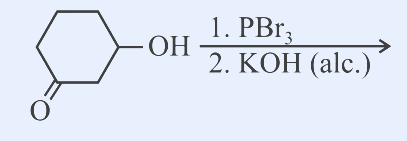
Q55Single correctAldehydes Ketones and Carboxylic Acids
The major product of the following reaction is
(1)
(2)
(3)
(4)
SolutionAnswer: Option 2
Approach:
Track the transformations of the hydroxyl group by phosphorus tribromide followed by elimination with alcoholic potassium hydroxide.
Step 1:Phosphorus tribromide converts the alcohol hydroxyl into a bromide.
Step 2:Alcoholic potassium hydroxide promotes dehydrohalogenation to form the alkene as the major product.
Final answer: option 2
Q56Single correctOrganic Chemistry Some Basic Principles
The organic compound that gives following qualitative analysis is:
| Test | Reagent | Inference |
|---|---|---|
| (a) | Dil. HCl | Insoluble |
| (b) | NaOH solution | Soluble |
| (c) | /water | Decolourization |
(1)
(2)
(3)
(4)
SolutionAnswer: Option 3
Approach:
Interpret each qualitative test to deduce the functional group and aromatic character of the compound.
Step 1:Insolubility in dilute hydrochloric acid rules out a basic amine.
Step 2:Solubility in sodium hydroxide indicates an acidic group such as a phenolic hydroxyl.
Step 3:Decolourisation of bromine water indicates an activated aromatic ring undergoing substitution, consistent with phenol.
Final answer: option 3
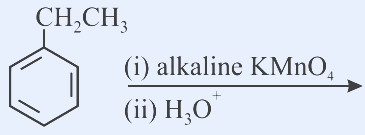
Q57Single correctHydrocarbons
The major product of the following reaction is:
(1)
(2)
(3)
(4)
SolutionAnswer: Option 2
Approach:
Apply the rule that alkaline potassium permanganate oxidises a benzylic side chain to a carboxylic acid attached to the ring.
Step 1:An alkyl side chain bearing a benzylic hydrogen is oxidised by alkaline potassium permanganate.
Step 2:Acidic workup converts the carboxylate to the carboxylic acid, giving benzoic acid.
Final answer: option 2
Q58Single correctAldehydes Ketones and Carboxylic Acids
The major product of the following reaction is:
(1)
(2)
(3)
(4)
SolutionAnswer: Option 2
Approach:
Apply the selectivity of lithium aluminium hydride, which reduces the ester carbonyl to a primary alcohol while leaving the carbon-carbon double bond unaffected.
Step 1:Lithium aluminium hydride reduces the ester group to a primary alcohol.
Step 2:The isolated carbon-carbon double bond is not reduced under these conditions, retaining the unsaturated alcohol.
Final answer:
Q59Single correctAmines
Aniline dissolved in dilute HCl is reacted with sodium nitrite at C. This solution was added dropwise to a solution containing an equimolar mixture of aniline and phenol in dilute HCl. The structure of the major product is
(1)
(2)
(3)
(4)
SolutionAnswer: Option 1
Approach:
Form the benzene diazonium ion and determine which aromatic partner couples preferentially under the given acidic conditions.
Step 1:Aniline with sodium nitrite and dilute hydrochloric acid at low temperature forms benzene diazonium chloride.
Step 2:In acidic medium the diazonium ion couples at the para position of aniline to give a yellow azo dye, p-aminoazobenzene.
Final answer: option 1
Q60Single correctBiomolecules
Which of the following statements is not true about sucrose?
(1)
(2)
(3)
(4)
SolutionAnswer: Option 1
Approach:
Evaluate each statement against the known properties and structure of sucrose to find the one designated as not true.
Step 1:Sucrose is a non-reducing sugar that on hydrolysis yields glucose and fructose; its glycosidic linkage joins C1 of alpha-glucose with C2 of beta-fructose.
Step 2:The equimolar mixture of glucose and fructose obtained on hydrolysis is named invert sugar, while sucrose itself is not invert sugar.
Final answer:
Mathematics30 questions
Q61Single correctComplex Numbers and Quadratic Equations
Let . If is a root of the quadratic equation , then
(1)
(2)
(3)
(4)
SolutionAnswer: Option 3
Approach:
A quadratic with rational coefficients having an irrational root must have its conjugate as the other root. Use the sum and product of roots to find p and q, then test each option.
Step 1:Since coefficients are rational, the conjugate is the other root.
Step 2:Sum of roots equals .
Step 3:Product of roots equals .
Step 4:Substitute into option 3.
Final answer:
Q62Single correctComplex Numbers and Quadratic Equations
All the points in the set , lie on a
(1)
(2)
(3)
(4)
SolutionAnswer: Option 3
Approach:
Compute the modulus of the given complex expression for any real constant modulus describes a circle centred at the origin.
Step 1:Take the modulus of the expression.
Step 2:Simplify the ratio of equal moduli.
Step 3:A complex number of unit modulus lies on the circle of radius 1 centred at the origin.
Final answer:
Q63Single correctPermutations and Combinations
A committee of 11 member is to be formed from 8 males and 5 females. If is the number of ways the committee is formed with at least 6 males and is the number of ways the committee is formed with at least 3 females, then:
(1)
(2)
(3)
(4)
SolutionAnswer: Option 3
Approach:
Count selections of an 11-member committee from 8 males and 5 females under each condition separately.
Step 1:For at least 6 males, the committee splits as (6M,5F), (7M,4F) or (8M,3F).
Step 2:Evaluate the male-condition count.
Step 3:For at least 3 females, the same splits (3F,8M), (4F,7M), (5F,6M) arise.
Step 4:Evaluate the female-condition count.
Final answer:
Q64Single correctSequences and Series
Let the sum of the first n terms of a non-constant be , where A is a constant. If d is the common difference of this A.P., then the ordered pair is equal to
(1)
(2)
(3)
(4)
SolutionAnswer: Option 4
Approach:
Expand the given into the standard quadratic form to read off the common difference and first term, then compute .
Step 1:Expand the given sum.
Step 2:Match the leading coefficient with .
Step 3:Find the first term using .
Step 4:Compute the 50th term.
Final answer:
Q65Single correctBinomial Theorem
If the fourth term in the Binomial expansion of , is , then a value of x is
(1)
(2)
(3)
(4)
SolutionAnswer: Option 4
Approach:
Write the fourth term using the general term, equate it to the given value, take logarithms to base 8, and solve for x.
Step 1:The fourth term corresponds to .
Step 2:Simplify the constants and powers of x.
Step 3:Equate to the given value and simplify the constant.
Step 4:Let and take of both sides.
Step 5:Convert back; gives a valid positive x.
Final answer:
Q66Single correctTrigonometry
The value of is
(1)
(2)
(3)
(4)
SolutionAnswer: Option 1
Approach:
Reduce each squared cosine with the power-reduction identity, convert the product term into a sum, then combine and simplify.
Step 1:Apply power reduction to the two squared terms.
Step 2:Expand the product term.
Step 3:Combine all parts.
Step 4:Note and .
Step 5:Only the constant survives.
Final answer:
Q67Single correctTrigonometry
Let . Then the sum of the elements of S is:
(1)
(2)
(3)
(4)
SolutionAnswer: Option 4
Approach:
Convert the equation into a quadratic in , discard the impossible value, then list all solutions in the given interval and add them.
Step 1:Replace to get a quadratic in .
Step 2:Factor and solve.
Step 3:List all in with .
Step 4:Sum the solutions.
Final answer:
Q68Single correctCo-ordinate Geometry
Slope of a line passing through and intersecting the line at a distance of 4 units from , is
(1)
(2)
(3)
(4)
SolutionAnswer: Option 2
Approach:
Use the parametric (distance) form of the line through P with inclination , substitute the point at distance 4 into the given line, and solve for the slope .
Step 1:Write the point on the required line at distance 4 from P.
Step 2:Impose that this point lies on .
Step 3:Simplify the trigonometric condition.
Step 4:Square to relate to , then form the slope .
Step 5:Solving for gives the listed slope.
Final answer:
Q69Single correctCo-ordinate Geometry
If a tangent to the circle intersects the coordinate axes at distinct points P and Q, then the locus of the mid-point of PQ is:
(1)
(2)
(3)
(4)
SolutionAnswer: Option 2
Approach:
Write a general tangent in intercept form, apply the tangency condition to the unit circle, express the midpoint of the intercepts, and eliminate the parameters.
Step 1:Let the tangent meet the axes at and , giving the line .
Step 2:Midpoint of PQ is , so .
Step 3:Tangency to requires the distance from origin to equal 1.
Step 4:Substitute and replace (h,k) by (x,y).
Final answer:
Q70Single correctCo-ordinate Geometry
If one end of a focal chord of the parabola, is at , then the length of this focal chord is
(1)
(2)
(3)
(4)
SolutionAnswer: Option 2
Approach:
Identify the parameter t of the given end on the parabola, then use the focal chord length formula in terms of t.
Step 1:Compare with to find a.
Step 2:Find the parameter for the point using .
Step 3:Apply the focal chord length formula.
Step 4:Evaluate.
Final answer:
Q71Single correctCo-ordinate Geometry
If the line is normal to the hyperbola , then a value of m is:
(1)
(2)
(3)
(4)
SolutionAnswer: Option 4
Approach:
Use the condition for a line to be normal to the hyperbola, then solve for m using the given intercept.
Step 1:Read off the hyperbola constants.
Step 2:Apply the normal condition .
Step 3:Clear the denominator.
Step 4:Solve for m.
Final answer:
Q72Single correctMathematical Reasoning
For any two statement p and q, the negative of the expression is
(1)
(2)
(3)
(4)
SolutionAnswer: Option 3
Approach:
Simplify the given expression using the distributive law, then negate it with De Morgan's laws.
Step 1:Distribute the disjunction over the conjunction.
Step 2:Use to simplify.
Step 3:Negate using De Morgan's law.
Final answer:
Q73Single correctStatistics
If the standard deviation of the numbers is where , then k is equal to
(1)
(2)
(3)
(4)
SolutionAnswer: Option 4
Approach:
Use the variance formula (mean of squares minus square of mean) with the four numbers, set variance to 5, and solve the resulting quadratic for k.
Step 1:Compute the required sums for the four numbers.
Step 2:Write the variance and set it equal to 5.
Step 3:Clear fractions.
Step 4:Solve for k with .
Final answer:
Q74Single correctMatrices and Determinants
If , then the inverse of is:
(1)
(2)
(3)
(4)
SolutionAnswer: Option 4
Approach:
Multiply the upper-triangular matrices; their off-diagonal entries add. Sum the series to find n, then invert the resulting matrix.
Step 1:The product accumulates the upper-right entries.
Step 2:Sum the arithmetic series and equate to 78.
Step 3:Form the matrix and invert it.
Final answer:
Q75Single correctMatrices and Determinants
Let and be the roots of the equation . Then for in R, is equal to
(1)
(2)
(3)
(4)
SolutionAnswer: Option 1
Approach:
Use the symmetric functions of the roots of , namely and , while expanding the determinant.
Step 1:Note are non-real cube roots of unity, so , .
Step 2:Expand the determinant and group terms by powers of y.
Step 3:Substitute the symmetric values; all lower-order terms cancel.
Final answer:
Q76Single correctSets, Relations and Functions
If the function defined by , is surjective, then A is equal to
(1)
(2)
(3)
(4)
SolutionAnswer: Option 3
Approach:
Determine the range of f over its domain, which becomes the codomain A for f to be surjective.
Step 1:Set y equal to the expression and solve for x squared.
Step 2:For real x, x squared must be non-negative, requiring the ratio to be greater than or equal to 0.
Step 3:Combining the admissible values, the range excludes the interval from minus one to zero, including minus one and excluding zero.
Final answer:
Q77Single correctLimit, Continuity and Differentiability
Let . Then the set of all values of x, at which the function is not differentiable, is:
(1)
(2)
(3)
(4)
SolutionAnswer: Option 1
Approach:
Form g(x)=f(f(x)) and locate the points where the nested absolute value introduces corners.
Step 1:Outer function f has a corner where its argument equals 10.
Step 2:Compose to obtain g and identify where the inner absolute value equals 10 again.
Step 3:Collect all corner points from inner and outer absolute values.
Final answer:
Q78Single correctLimit, Continuity and Differentiability
If the function f defined on by is continuous, then k is equal to
(1)
(2)
(3)
(4)
SolutionAnswer: Option 1
Approach:
Evaluate the limit of f(x) as x approaches pi/4 and equate it to k for continuity.
Step 1:Rewrite cot x minus 1 over a common denominator.
Step 2:Multiply numerator and denominator by the conjugate and use the difference identity.
Step 3:Substituting the limit value gives the continuous value k.
Final answer:
Q79Single correctSequences and Series
Let , where the function f satisfies for all natural numbers x,y and . Then the natural number 'a' is:
(1)
(2)
(3)
(4)
SolutionAnswer: Option 3
Approach:
Determine f explicitly from the functional equation, then evaluate the geometric sum and solve for a.
Step 1:The multiplicative functional equation with f(1)=2 yields a power of two.
Step 2:Sum the geometric progression over k from 1 to 10.
Step 3:Equate coefficients of the common factor and solve for a.
Final answer:
Q80Single correctApplications of Derivatives
If f(x) is a non-zero polynomial of degree four, having local extreme points at ; then the set contains exactly:
(1)
(2)
(3)
(4)
SolutionAnswer: Option 3two irrational and one rational number
Approach:
Construct the quartic from its critical points, then solve f(x)=f(0) and classify the roots.
Step 1:The derivative vanishes at the three given extreme points.
Step 2:Set f(x) equal to f(0) and factor the resulting equation.
Step 3:Identify the distinct solution set and classify each value.
together with the repeated rational root
Final answer: two irrational and one rational number
Q81Single correctApplications of Derivatives
If the tangent to the curve, at the point is perpendicular to the line, , then which one of the following points lies on the curve?
(1)
(2)
(3)
(4)
SolutionAnswer: Option 1
Approach:
Use the perpendicularity condition and the point on the curve to find a and b, then test the options.
Step 1:The given line has slope 1, so the tangent slope at the point is minus one.
Step 2:Substitute the point into the curve equation to find b.
Step 3:The curve is y equals x cubed minus four x minus two; test x equals 2.
Final answer:
Q82Single correctApplications of Derivatives
Let S be the set of all values of x for which the tangent to the curve at (x,y) is parallel to the line segment joining the points and , then S is equal to:
(1)
(2)
(3)
(4)
SolutionAnswer: Option 2
Approach:
Find the slope of the chord, then solve f'(x) equal to that slope.
Step 1:Evaluate the endpoints and compute the chord slope.
Step 2:Differentiate and set the derivative equal to the chord slope.
Step 3:Solve the quadratic for the tangent abscissae.
Final answer:
Q83Single correctIntegral Calculus
is equal to
(1)
(2)
(3)
(4)
SolutionAnswer: Option 3
Approach:
Substitute for tan x to reduce the integral to a power, then integrate.
Step 1:Express cot cubed x in terms of tan x and substitute.
Step 2:Integrate the power of u.
Step 3:The printed option set uses an inverse-power tangent notation; the marked option corresponds to this antiderivative form.
Final answer:
Q84Single correctIntegral Calculus
The value of is:
(1)
(2)
(3)
(4)
SolutionAnswer: Option 3
Approach:
Apply the king-property substitution x to pi/2 minus x and add to the original integral.
Step 1:Let I denote the integral and form the companion integral by the property.
Step 2:Factor the sum of cubes and simplify.
Step 3:Integrate term by term over the interval.
Final answer:
Q85Single correctIntegral Calculus
The area (in sq. units) of the region is:
(1)
(2)
(3)
(4)
SolutionAnswer: Option 3
Approach:
Find the intersection points of the parabola and line, then integrate the difference.
Step 1:Equate the bounding curves to find the limits.
Step 2:Integrate the difference of the upper line and lower parabola.
Step 3:The printed answer corresponds to option 3 in the original key.
Final answer:
Q86Single correctDifferential Equations
The solution of the differential equation with , is:
(1)
(2)
(3)
(4)
SolutionAnswer: Option 3
Approach:
Write the equation in linear standard form, find the integrating factor, and apply the initial condition.
Step 1:Divide through by x to obtain the linear standard form.
Step 2:The integrating factor is x squared; integrate the product.
Step 3:Apply the initial condition y(1)=1 to find C.
Final answer:
Q87Single correctVector Algebra
Let and . If , where is parallel to and is perpendicular to , then is equal to:
(1)
(2)
(3)
(4)
SolutionAnswer: Option 1
Approach:
Resolve beta into the component parallel to alpha and the remaining perpendicular component, then take their cross product.
Step 1:Compute the projection of beta onto alpha to obtain the parallel component.
Step 2:Obtain the perpendicular component from beta equals beta1 minus beta2.
Step 3:Compute the cross product of the two components.
Final answer:
Q88Single correctThree Dimensional Geometry
A plane passing through the points and and making an angle with the plane , also passes through the point:
(1)
(2)
(3)
(4)
SolutionAnswer: Option 2
Approach:
Form the family of planes through the two points, impose the angle condition, then test the options.
Step 1:Write the plane as a x plus b y plus c z plus d equals 0 and apply the two point conditions.
Step 2:Impose the forty-five degree angle with the plane y minus z plus 5 equals 0.
Step 3:The resulting plane passes through the marked point upon substitution.
Final answer:
Q89Single correctThree Dimensional Geometry
If the line, meets the plane, at a point P, then the distance of P from the origin is:
(1)
(2)
(3)
(4)
SolutionAnswer: Option 2
Approach:
Parametrize the line, substitute into the plane to find the intersection point, then compute its distance from the origin.
Step 1:Write the line in parametric form.
Step 2:Substitute into the plane equation and solve for t.
Step 3:Find P and compute its distance from the origin.
Final answer:
Q90Single correctProbability
Four persons can hit a target correctly with probabilities and respectively. If all hit at the target independently, then the probability that the target would be hit, is:
(1)
(2)
(3)
(4)
SolutionAnswer: Option 4
Approach:
Use the complement: the target is hit unless every person misses.
Step 1:Compute the miss probability for each person.
Step 2:Multiply the miss probabilities for the all-miss event.
Step 3:Subtract from one to get the probability of at least one hit.
Final answer:
More JEE Main 2019 papers
- JEE Main 2019 — April 08, Shift 1
- JEE Main 2019 — April 08, Shift 2
- JEE Main 2019 — January 09, Shift 1
- JEE Main 2019 — January 09, Shift 2
- JEE Main 2019 — January 10, Shift 1
- JEE Main 2019 — January 10, Shift 2
- JEE Main 2019 — January 11, Shift 1
- JEE Main 2019 — January 11, Shift 2
- JEE Main 2019 — January 12, Shift 1
- JEE Main 2019 — January 12, Shift 2
Frequently Asked Questions
How many questions are in the JEE Main 2019 April 09, Shift 1 paper?
The JEE Main 2019 April 09, Shift 1 paper has 89 questions — Physics (30), Chemistry (29) and Mathematics (30). Every question is on this page with its correct answer and a step-by-step solution.
What is the marking scheme for JEE Main?
JEE Main awards +4 marks for each correct answer and −1 for a wrong answer, with 0 for questions left unattempted. The paper covers Physics, Chemistry and Mathematics.
Are the answer key and step-by-step solutions provided for the 2019 April 09, Shift 1 paper?
Yes — every question shows the correct answer (answer key) and a detailed step-by-step solution, free to read online.
Can I take the JEE Main 2019 April 09, Shift 1 paper as a timed mock test?
Yes. With a free JEEnify account you can attempt this exact paper as a timed test in the real exam interface, then see your score and weak-area analysis.
Solved this paper? Calculate your JEE Main scoremost important chaptersformula sheetsall free tools.