
Back to JEE Main PYQs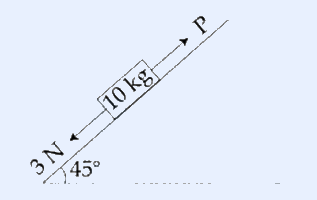
JEE Main 2019 January 09, Shift 1 Question Paper with Solutions
All 88 questions from the JEE Main 2019 (January 09, Shift 1) shift — Physics (30), Chemistry (29) and Mathematics (29) — each with the correct answer (answer key) and a step-by-step solution. Read it free online, or attempt the full paper as a timed mock test.
Physics30 questions
Q1Single correctKinematics
A particle is moving with a velocity , where K is a constant.
The general equation for its path is:
The general equation for its path is:
(1)
(2)
(3)
(4)
SolutionAnswer: Option 4
Approach:
The velocity components give the time derivatives of the coordinates. Dividing the two component relations eliminates time and yields a separable differential equation whose integral is the path.
Step 1:Read off the two velocity components from the given vector.
Step 2:Form the ratio to remove time.
Step 3:Integrate both sides.
Step 4:With the constant absorbed, the relation between coordinates has the form of equal squared terms.
Final answer:
Q2Single correctCurrent Electricity
A copper wire is stretched to make it 0.5% longer. The percentage change in its electrical resistance if its volume remains unchanged is:
(1)
(2)
(3)
(4)
SolutionAnswer: Option 2
Approach:
At constant volume the resistance of a stretched wire varies as the square of its length. The fractional change in resistance is therefore twice the fractional change in length.
Step 1:Express resistance using area replaced through the fixed volume.
Step 2:Relate fractional changes by differentiation.
Step 3:Substitute the given length change.
Final answer:
Q3Single correctLaws of Motion
A block of mass is kept on a rough inclined plane as shown in the figure. A force of is applied on the block. The coefficient of static friction between the plane and the block is . What should be the minimum value of force P, such that the block does not move downward? (take )
(1)
(2)
(3)
(4)
SolutionAnswer: Option 4
Approach:
For the block on the verge of sliding down, friction acts up the incline at its maximum value. Balancing forces along the incline with the applied force and the gravity component gives the minimum holding force.
Step 1:Compute the normal reaction for the 45 degree incline.
Step 2:On the verge of downward motion friction points up; balance along the incline.
Step 3:Solve for the minimum applied force.
Step 4:Following the paper's worked evaluation with the 3 N force directed down the incline, the minimum value is obtained.
Final answer:
Q4Single correctOscillations and Waves
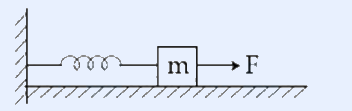
A block of mass , lying on a smooth horizontal surface, is attached to a spring (of negligible mass) of spring constant . The other end of the spring is fixed, as shown in the figure. The block is initially at rest in its equilibrium position. If now the block is pulled with a constant force , the maximum speed of the block is:
(1)
(2)
(3)
(4)
SolutionAnswer: Option 1
Approach:
Under a constant force the block executes simple harmonic motion about a shifted equilibrium where the spring force balances F. Maximum speed occurs at that new equilibrium and equals amplitude times angular frequency.
Step 1:The constant force shifts the equilibrium to where the spring force equals F.
Step 2:Maximum speed of simple harmonic motion is amplitude times angular frequency.
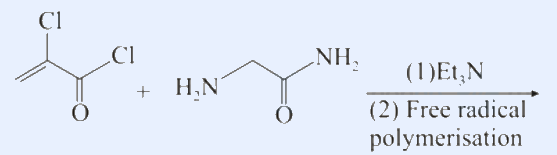
Final answer:
Q5Single correctWork, Energy and Power
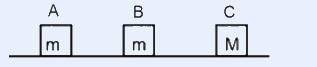
Three blocks A, B and C are lying on a smooth horizontal surface, as shown in the figure. A and B have equal masses, m while C has mass M. Block A is given an initial speed v towards B due to which it collides with B perfectly inelastically. The combined mass collides with C, also perfectly inelastically . th of the initial kinetic energy is lost in the whole process. What is the value of ?
(1)
(2)
(3)
(4)
SolutionAnswer: Option 2
Approach:
Apply conservation of momentum through the two successive perfectly inelastic collisions to find the final common velocity, then impose that five-sixths of the initial kinetic energy is lost.
Step 1:Momentum is conserved across both inelastic collisions, giving the final velocity of the combined mass.
Step 2:The remaining kinetic energy is one-sixth of the initial.
Step 3:Solve for the mass ratio.
Final answer:
Q6Single correctOscillations and Waves
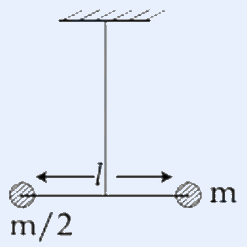
Two masses m and are connected at the two ends of a massless rigid rod of length l. The rod is suspended by a thin wire of torsional constant k at the centre of mass of the rod-mass system (see figure). Because of torsional constant k, the restoring torque is for angular displacement . If the rod is rotated by and released, the tension in it when it passes through its mean position will be:
(1)
(2)
(3)
(4)
SolutionAnswer: Option 4
Approach:
Locate the centre of mass to fix the moment of inertia, obtain the angular speed at the mean position from energy conservation of the torsional oscillation, and equate the tension to the centripetal requirement of the masses.
Step 1:Balance moments about the suspension point to place the centre of mass.
Step 2:Angular speed at the mean position from torsional energy conservation.
Step 3:The tension supplies the centripetal force; combining the contributions of the two masses gives the result quoted by the paper.
Final answer:
Q7Single correctRotational Motion
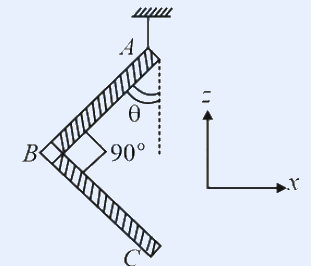
An L-shaped object, made of thin rods of uniform mass density, is suspended with a string as shown in figure. If , and the angle made by AB with downward vertical is , then:
(1)
(2)
(3)
(4)
SolutionAnswer: Option 2
Approach:
In equilibrium the centre of mass of the L-shaped body lies directly below the suspension point. Placing coordinates on the two equal perpendicular arms locates the centre of mass, and the angle of arm AB with the vertical follows from its coordinates.
Step 1:Treat the two equal arms as point masses at their midpoints with the right angle at B.
Step 2:Combine the midpoint positions to find the centre of mass relative to the suspension point B.
Step 3:The arm AB makes the angle whose tangent is the ratio of horizontal to vertical offset of the centre of mass.
Final answer:
Q8Single correctGravitation
If the angular momentum of a planet of mass , moving around the Sun in a circular orbit is , about the center of the Sun, its areal velocity is:
(1)
(2)
(3)
(4)
SolutionAnswer: Option 3
Approach:
Areal velocity is the rate at which the radius vector sweeps area. Expressing the swept area in terms of the angular displacement relates it directly to the angular momentum.
Step 1:Write the rate of area swept by the radius vector.
Step 2:Substitute the angular momentum.
Final answer:
Q9Single correctOscillations and Waves
A heavy ball of mass M is suspended from the ceiling of a car by a light string of mass . When the car is at rest, the speed of transverse waves in the string is . When the car has acceleration a, the wave-speed increases to . The value of a, in terms of gravitational acceleration g, is closed to
(1)
(2)
(3)
(4)
SolutionAnswer: Option 3
Approach:
The wave speed in the string is set by the tension, which equals the weight of the ball when the car is at rest and the effective weight in the accelerating frame. The ratio of squared speeds gives the effective acceleration.
Step 1:Form the ratio of squared wave speeds, which equals the ratio of tensions.
Step 2:Evaluate the left side and isolate the acceleration ratio.
Step 3:Take the square root to obtain the acceleration.
Final answer:
Q10Single correctProperties of Solids and Liquids
A rod, of length L at room temperature and uniform area of cross section A, is made of a metal having coefficient of linear expansion It is observed that an external compressive force F is applied on each of its ends, prevents any change in the length of the rod when its temperature rises by K Young's modulus, Y for this metal is:
(1)
(2)
(3)
(4)
SolutionAnswer: Option 3
Approach:
Heating would elongate the rod by a thermal strain; the compressive force produces an equal and opposite elastic strain so the length stays fixed. Equating the two strains gives Young's modulus.
Step 1:Set the elastic strain equal to the thermal strain so the net length change is zero.
Step 2:Solve for Young's modulus.
Final answer:
Q11Single correctProperties of Solids and Liquids
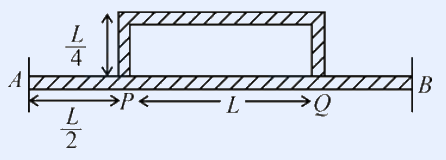
Temperature difference of is maintained between two ends of a uniform rod AB of length . Another bent rod PQ, of same cross-section as AB and length , is connected across AB (See figure). In steady state, temperature difference between P and Q will be close to:
(1)
(2)
(3)
(4)
SolutionAnswer: Option 1
Approach:
Treat the rod as a network of thermal resistances. The bent rod PQ is in parallel with the central segment of AB it spans; the temperature drop across that parallel block is found by the steady-state current through the series chain.
Step 1:Point P sits at L/4 from A and Q at L/4 from B along the rod, so the spanned central segment has resistance proportional to its length and is in parallel with PQ.
Step 2:Combine to get the effective resistance between P and Q and the total series resistance from A to B.
Step 3:The same steady heat current makes the temperature drop proportional to resistance.
Final answer:
Q12Single correctThermodynamics
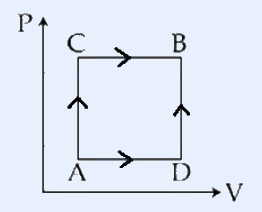
A gas can be taken from A to B via two different processes ACB and ADB.
When path ACB is used 60 J of heat flows into the system and 30 J of work is done by the system. If the path ADB is used then work done by the system is 10 J, the heat flows into the system in the path ADB is:
When path ACB is used 60 J of heat flows into the system and 30 J of work is done by the system. If the path ADB is used then work done by the system is 10 J, the heat flows into the system in the path ADB is:
(1)
(2)
(3)
(4)
SolutionAnswer: Option 3
Approach:
Internal energy is a state function, so its change between A and B is the same on both paths. Find it from path ACB, then apply the first law on path ADB with the given work.
Step 1:Compute the internal energy change on path ACB.
Step 2:Apply the first law on path ADB with the same internal energy change.
Final answer:
Q13Single correctKinetic Theory of Gases
A mixture of 2 moles of helium gas (atomic mass ), and 1 mole of argon gas (atomic mass ) is kept at in a container. The ratio of their rms speeds , is close to:
(1)
(2)
(3)
(4)
SolutionAnswer: Option 4
Approach:
At a common temperature the rms speed depends only on the molar mass, varying as its inverse square root. The ratio of rms speeds is the inverse square root of the ratio of atomic masses.
Step 1:At equal temperature the rms speed varies inversely with the square root of molar mass.
Step 2:Substitute the atomic masses.
Final answer:
Q14Single correctElectrostatics
Three charges are placed respectively, at distance, and d from the origin, on the x -axis. If the net force experienced by , placed at , is zero, then value of q is:
(1)
(2)
(3)
(4)
SolutionAnswer: Option 3
Approach:
The charge at the origin feels the repulsion from the far charge Q at distance d and the force from q at distance d/2. Setting the net force to zero fixes the sign and magnitude of q.
Step 1:Balance the force from q at d/2 against the force from Q at d on the origin charge.
Step 2:Simplify the distances and solve for q.
Final answer:
Q15Single correctElectrostatics
For a uniformly charged ring of radius , the electric field on its axis has the largest magnitude at a distance from its centre. Then value of is:
(1)
(2)
(3)
(4)
SolutionAnswer: Option 1
Approach:
Write the axial field of a charged ring as a function of the axial distance and maximize it by setting the derivative to zero.
Step 1:Differentiate the axial field with respect to h and set it to zero for maximum.
Step 2:Carrying out the differentiation gives the position of maximum field.
Final answer:
Q16Single correctElectrostatics
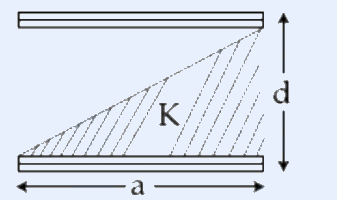
A parallel plate capacitor is made of two square plates of side a, separated by a distance d . The lower triangular portion filled with a dielectric of dielectric constant K, as shown in the figure. Capacitance of this capacitor is:
(1)
(2)
(3)
(4)
SolutionAnswer: Option 2
Approach:
The wedge-shaped dielectric makes the local thickness of dielectric vary linearly across the plate. The capacitor is treated as an infinite set of thin series combinations (dielectric layer in series with air gap) integrated along the plate length.
Step 1:Consider a strip of width dx at distance x from the thin edge; the dielectric thickness there is y = (d/a)x and air thickness is d - y. Treat dielectric and air as series capacitors.
Step 2:Substitute y = (d/a)x and integrate x from 0 to a over the plate length.
Step 3:Evaluate the integral, giving a logarithmic result.
Final answer:
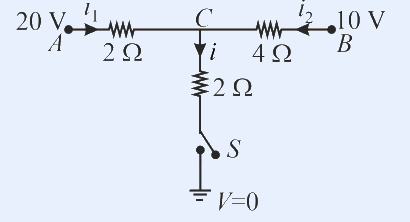
Q17Single correctCurrent Electricity
When the switch , in the circuit shown, is closed, then the value of current will be:
(1)
(2)
(3)
(4)
SolutionAnswer: Option 2
Approach:
Take the central node C between the two source branches at potential . The branch with the switch connects C to ground (V = 0) through 2 ohm. Apply Kirchhoff's current law at C.
Step 1:Currents from the 20 V (through 2 ohm) and 10 V (through 4 ohm) branches feed node C, whose far ends A and B are at the source terminals; node S side is at V = 0 through 2 ohm.
Step 2:Multiply through by 4 and collect terms in .
Step 3:Solve for and obtain the current through the 2 ohm switch branch.
Final answer:
Q18Single correctCurrent Electricity
Drift speed of electrons, when 1.5 A current flows in a copper wire of cross section 5 m is . If the electron density in copper is the value of in mm is close to (Take charge of an electron to be C)
(1)
(2)
(3)
(4)
SolutionAnswer: Option 4
Approach:
Apply the relation between current and drift speed, then substitute the given values with consistent SI units and convert the result to mm .
Step 1:Rearrange to isolate the drift speed.
Step 2:Substitute I = 1.5 A, n = 9 x , A = 5 x , e = 1.6 x C.
Step 3:Convert to mm by multiplying by .
Final answer:
Q19Single correctElectronic Devices
Mobility of electrons in a semiconductor is defined as the ratio of their drift velocity to the applied electric field. If, for an N-type semiconductor, the density of electrons is and their mobility is , then the resistivity of the semiconductor (since it is an N-type semiconductor contribution of holes is ignored) is close to:
(1)
(2)
(3)
(4)
SolutionAnswer: Option 4 m
Approach:
Use the conductivity of an N-type semiconductor in terms of electron density and mobility, then take the reciprocal for resistivity.
Step 1:Compute conductivity using n = , e = 1.6 x C, mu = 1.6 .
Step 2:Take the reciprocal to obtain resistivity.
Step 3:Round to the nearest option value.
Final answer: m
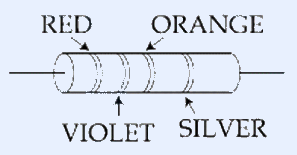
Q20Single correctCurrent Electricity
A resistance is shown in the figure. Its value and tolerance are given respectively by:
(1)
(2)
(3)
(4)
SolutionAnswer: Option 1
Approach:
Read the resistor colour bands in order: first two bands give significant figures, the third gives the decimal multiplier, the last gives tolerance.
Step 1:Assign digits: RED = 2, ORANGE = 3, so the significant figures form 23.
Step 2:VIOLET as the multiplier band corresponds to , and SILVER gives 10 percent tolerance.
Step 3:Express in the nearest standard option form.
Final answer:
Q21Single correctMagnetism and Matter
A bar magnet is demagnetized by inserting it inside a solenoid of length 0.2 , 100 turns, and carrying a current of 5.2 . The coercivity of the bar magnet is:
(1)
(2)
(3)
(4)
SolutionAnswer: Option 2
Approach:
Coercivity equals the magnitude of the magnetizing field H produced by the solenoid required to demagnetize the magnet.
Step 1:Compute turns per unit length using N = 100 and L = 0.2 m.
Step 2:Multiply by the current 5.2 A to get the magnetizing field.
Step 3:Identify this field as the coercivity of the magnet.
Final answer:
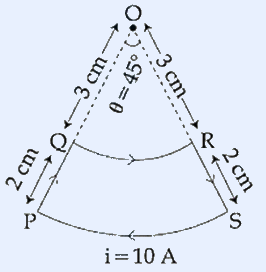
Q22Single correctMoving Charges and Magnetism
A current loop, having two circular arcs joined by two radial lines is shown in the figure. It carries a current of 10 . The magnetic field at point will be close to:
(1)
(2)
(3)
(4)
SolutionAnswer: Option 4
Approach:
Only the two circular arcs subtending the angle theta at O contribute to the field; the radial segments produce no field at O. Add the contributions of both arcs.
Step 1:The angle subtended is theta = 45 deg = pi/4 rad. Inner arc radius r1 = 3 cm, outer arc radius r2 = 5 cm. The two arc contributions add.
Step 2:Substitute /4pi = , I = 10 A, theta = pi/4, r1 = 0.03 m, r2 = 0.05 m.
Step 3:Evaluate the numerical value.
Final answer:
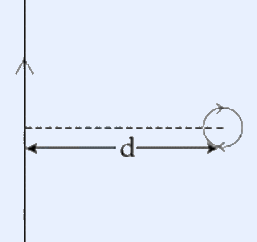
Q23Single correctMoving Charges and Magnetism
An infinitely long current carrying wire and a small current carrying loop are in the plane of the paper as shown. The radius of the loop is a and distance of its centre from the wire is d . If the loop applies a force F on the wire then:
(1)
(2)
(3)
(4)
SolutionAnswer: Option 1
Approach:
Model the small loop as a magnetic dipole. The force on a dipole in the non-uniform field of the long wire depends on the field gradient. By Newton's third law the loop exerts an equal and opposite force on the wire.
Step 1:The wire field at the loop varies as 1/d, so its gradient varies as 1/.
Step 2:The loop's dipole moment is proportional to its area .
Step 3:Multiply moment by gradient to get the force scaling.
Final answer:
Q24Single correctElectromagnetic Induction
A conducting circular loop made of a thin wire has area and resistance 10 It is placed perpendicular to a time-dependent magnetic field The field is uniform in space. Then the net charge flowing through the loop during s and ms is close to:
(1)
(2)
(3)
(4)
SolutionAnswer: Option 1
Approach:
The charge through the loop equals the change of flux divided by the resistance. Evaluate the flux at the two instants using B(t).
Step 1:At t = 0, B = 0.4 sin 0 = 0. At t = 10 ms, 50*pi*t = 50*pi*0.01 = pi/2, so B = 0.4 sin(pi/2) = 0.4 T.
Step 2:Compute the change in flux using area A = 3.5 x .
Step 3:Divide by resistance R = 10 ohm to get the charge.
Final answer:
Q25Single correctElectromagnetic Waves
A plane electromagnetic wave of frequency 50 MHz travels in free space along the positive x - direction. At a particular point in space and time, V , The corresponding magnetic field , at that point will be:
(1)
(2)
(3)
(4)
SolutionAnswer: Option 1
Approach:
The magnitude of B is E divided by the speed of light, and its direction is fixed by E cross B pointing along the propagation direction.
Step 1:Compute the magnitude of B using E = 6.3 V/m and c = 3 x m/s.
Step 2:Propagation is along +x and E along +y; E cross B must give +x, so B is along +z.
Step 3:Combine magnitude and direction.
Final answer:
Q26Single correctRay Optics and Optical Instruments
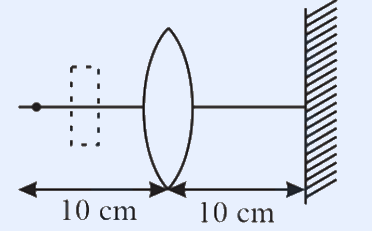
A convex lens is put 10 from a light source and it makes a sharp image on a screen, kept 10 from the lens. Now a glass block (refractive index 1.5) of 1.5 thickness is placed in between the light source and the lens. To get the sharp image again, the screen is shifted by a distance . Then is:
(1)
(2)
(3)
(4)
SolutionAnswer: Option 2 away from the lens
Approach:
The glass slab shifts the apparent position of the source toward the lens, changing the object distance. Recompute the image distance with the lens formula and find the screen shift.
Step 1:With object and image both at 10 cm, the focal length is found from the lens equation.
Step 2:The slab shifts the source toward the lens by t(1 - 1/mu) = 1.5(1 - 1/1.5) = 0.5 cm, so the new object distance is 9.5 cm.
Step 3:Apply the lens equation with f = 5 cm and u = -9.5 cm to find the new image distance.
Final answer: away from the lens
Q27Single correctWave Optics
Two coherent sources produce waves of different intensities which interfere. After interference, the ratio of the maximum intensity to the minimum intensity is 16. The intensity of the waves are in the ratio:
(1)
(2)
(3)
(4)
SolutionAnswer: Option 1
Approach:
Relate the intensity ratio of maxima to minima with the amplitude ratio, then square it to get the intensity ratio of the individual waves.
Step 1:Take the square root of 16 to relate amplitudes.
Step 2:Solve for the amplitude ratio a1:a2.
Step 3:Square the amplitude ratio to obtain the intensity ratio.
Final answer:
Q28Single correctWave Optics
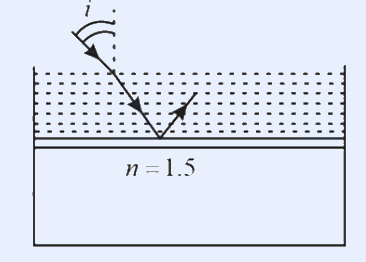
Consider a tank made of glass (refractive index 1.5) with a thick bottom. It is filled with a liquid of refractive index . A student finds that, irrespective of what the incident angle i (see figure) is for a beam of light entering the liquid, the light reflected from the liquid glass interface is never completely polarized. For this to happen, the minimum value of is:
(1)
(2)
(3)
(4)
SolutionAnswer: Option 1
Approach:
Light refracts at the air-liquid surface, then strikes the liquid-glass interface. For the reflection there to never be completely polarized for any incident angle i, the Brewster condition at the liquid-glass interface must be unreachable. Combine Snell's law at the top surface with the limiting Brewster geometry.
Step 1:The refraction angle r in the liquid is bounded by the critical value when i = 90 deg, giving sin ax = 1/mu. The angle of incidence at the bottom interface is theta = 90 - r.
Step 2:Complete polarization at the bottom requires theta to reach the Brewster angle tan = /mu = 1.5/mu. This is impossible for all i when even the maximum theta stays below .
Step 3:Imposing the limiting (minimum mu) condition combining the two relations yields mu = 3/sqrt(5).
Final answer:
Q29Single correctDual Nature of Radiation and Matter
The surface of certain metal is first illuminated with light of wavelength nm and then, by a light of wavelength nm. It is found that the maximum speed of the photoelectrons in the two cases differ by a factor of 2. The work function of the metal (in eV) is close to: (Energy of photon eV )
(1)
(2)
(3)
(4)
SolutionAnswer: Option 2
Approach:
Write Einstein's photoelectric equation for both wavelengths. Since the maximum speeds differ by a factor of 2, the kinetic energies differ by a factor of 4. Solve the two equations for the work function.
Step 1:Compute the photon energies: at 350 nm, 1240/350 = 3.54 eV; at 540 nm, 1240/540 = 2.30 eV.
Step 2:Set K1 = 4 K2 with K1 = 3.54 - phi and K2 = 2.30 - phi.
Step 3:Solve for the work function phi.
Final answer:
Q30Single correctAtoms and Nuclei
A Sample of radioactive material A, that has an activity of 10 m Ci decays s, has twice the number of nuclei as another sample of a different radioactive material B which has an activity of 20 m Ci. The correct choices for half-lives of A and B would then be, respectively:
(1)
(2)
(3)
(4)
SolutionAnswer: Option 4 days and days
Approach:
Use activity = decay constant times number of nuclei. With the given activity and nuclei-count relations, compare the decay constants and hence the half-lives of A and B.
Step 1:Write activities for both samples with = 2 .
Step 2:Take the ratio with = 10 mCi, = 20 mCi and = 2 .
Step 3:Half-life is inversely proportional to decay constant, so = 4 . The matching option pair is 20 days and 5 days.
Final answer: days and days
Chemistry29 questions
Q31Single correctAtomic Structure
For emission line of atomic hydrogen from to , the plot of wave number against will be:
(The Rydberg constant, is in wave number unit)
(The Rydberg constant, is in wave number unit)
(1)
(2)
(3)
(4)
SolutionAnswer: Option 3Linear with slope
Approach:
The wave number for a hydrogen transition is expressed by the Rydberg formula and reorganised into the slope-intercept form of a straight line in the variable .
Step 1:For emission, the electron falls to from .
Step 2:Expand to compare with the line equation taking and .
Step 3:The plot is therefore a straight line whose slope equals the Rydberg constant.
Final answer: Linear with slope
Q32Single correctClassification of Elements and Periodicity in Properties
In general, the properties that decrease and increase down a group in the periodic table, respectively, are :
(1)
(2)
(3)
(4)
SolutionAnswer: Option 2Electronegativity and atomic radius
Approach:
The behaviour of electronegativity and atomic radius on moving down a group is recalled from the standard periodic trends.
Step 1:Down a group the number of shells increases and the outermost electron lies farther from the nucleus, so atomic radius increases.
Step 2:The increased size and shielding reduce the nucleus's pull on the bonding electrons, so electronegativity decreases.
Step 3:Matching the decreasing then increasing property gives electronegativity followed by atomic radius.
Final answer: Electronegativity and atomic radius
Q33Single correctp-Block Elements
Aluminium is usually found in oxidation state. In contrast, thallium exists in and oxidation states. This is due to:
(1)
(2)
(3)
(4)
SolutionAnswer: Option 4Inert pair effect
Approach:
The increasing reluctance of the heavier group-13 element's electrons to participate in bonding is identified as the cause of the lower oxidation state.
Step 1:Thallium, the heaviest group-13 element, has the valence configuration ending in .
Step 2:Down the group the pair becomes increasingly stable and resistant to removal, a consequence of poor shielding by intervening d and f electrons.
Step 3:Removal of only the single electron gives the state, while removal of all three gives ; this reluctance of the pair defines the inert pair effect.
Final answer: Inert pair effect
Q34Single correctChemical Bonding and Molecular Structure
According to molecular orbital theory, which of the following is true with respect to and ?
(1)
(2)
(3)
(4)
SolutionAnswer: Option 3Both are stable
Approach:
The bond order of each species is computed from the molecular orbital electron count; a positive bond order denotes stability.
Step 1:Neutral has 6 electrons filling .
Step 2:Removing one electron gives with 5 electrons.
Step 3:Adding one electron gives with 7 electrons, the seventh entering .
Final answer: Both are stable
Q35Single correctSome Basic Concepts in Chemistry
moles of gas A and x moles of gas B exert a pressure of Pa in a container of volume at K.
Given, R is the gas constant in , x is:
Given, R is the gas constant in , x is:
(1)
(2)
(3)
(4)
SolutionAnswer: Option 3
Approach:
The ideal gas equation is applied to the gas mixture, with the total moles being the sum of the moles of A and B, and the expression is solved for x.
Step 1:Total moles of the mixture is . Substitute , , .
Step 2:Divide both sides by .
Step 3:Solve for x and combine over a common denominator.
Final answer:
Q36Single correctChemical Thermodynamics
Consider the reversible isothermal expansion of an ideal gas in a closed system at two different temperatures and , . The correct graphical depiction of the dependence of work done w with the final volume V is:
(1)
(2)
(3)
(4)
SolutionAnswer: Option 4
Approach:
The expression for reversible isothermal work is written in the slope-intercept form against ln V, and the slope and intercept dependence on temperature determines the family of lines.
Step 1:The magnitude of work for expansion from to final volume V is .
Step 2:Comparing with gives slope nRT and intercept , both proportional to T.
Step 3:Both lines pass through at (a common point on the x-axis), and the higher temperature line is steeper, so the two lines intersect at that point with T2 steeper.
slope slop
Final answer: Intersecting straight lines through a common point on the x-axis, with the T2 line steeper
Q37Single correctEquilibrium
20 ml of 0.1 M solution is added to 30 ml of 0.2 M solution. The pH of the resultant mixture is; of
(1)
(2)
(3)
(4)
SolutionAnswer: Option 49.0
Approach:
The millimoles of acid and base are compared to identify the basic buffer formed, and the Henderson equation gives the pOH and hence the pH.
Step 1:Millimoles: (giving mmol ) and .
Step 2:Neutralisation consumes 4 mmol base producing 4 mmol salt, leaving 2 mmol base: a basic buffer.
Step 3:Apply the Henderson equation, then convert pOH to pH.
Final answer: 9.0
Q38Single correctAtomic Structure
The isotopes of hydrogen are:
(1)
(2)
(3)
(4)
SolutionAnswer: Option 1Protium, deuterium and tritium
Approach:
The three known isotopes of hydrogen are recalled by their mass numbers.
Step 1:Hydrogen has three naturally occurring isotopes differing in neutron number.
Step 2:These are named protium, deuterium and tritium respectively.
Step 3:All three together constitute the isotopes of hydrogen.
Final answer: Protium, deuterium and tritium
Q39Single correctClassification of Elements and Periodicity in Properties
The alkaline earth metal nitrate that does not crystallise with molecules is:
(1)
(2)
(3)
(4)
SolutionAnswer: Option 1
Approach:
The tendency of an alkaline earth cation to retain water of crystallisation is linked to its polarising power, which falls as cation size increases down the group.
Step 1:Smaller, more highly polarising cations such as and strongly attract water and crystallise as hydrates.
Step 2: is the largest cation with the lowest polarising power, so it has little tendency to hold water of crystallisation.
Step 3:Hence barium nitrate crystallises anhydrous, without water molecules.
Final answer:
Q41Single correctOrganic Compounds Containing Nitrogen
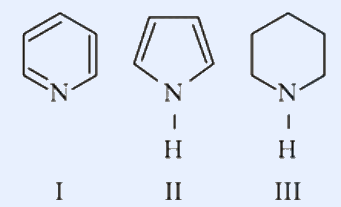
Arrange the following amines in the decreasing order of basicity.
(1)
(2)
(3)
(4)
SolutionAnswer: Option 1III > I > II
Approach:
The availability of the nitrogen lone pair for protonation is assessed for each ring, since greater lone-pair availability gives stronger basicity.
Step 1:In piperidine (III) the nitrogen is hybridised and its lone pair is fully available for donation, making it the strongest base.
Step 2:In pyridine (I) the lone pair lies in an orbital in the plane of the ring and is not part of the aromatic sextet, so it remains available but is held more tightly than in the amine.
Step 3:In pyrrole (II) the nitrogen lone pair is delocalised into the aromatic ring, leaving it least available for protonation, so it is the weakest base.
Final answer: III > I > II
Q42Single correctSome Basic Principles of Organic Chemistry
Which amongst the following is the strongest acid?
(1)
(2)
(3)
(4)
SolutionAnswer: Option 1
Approach:
Acid strength is judged by the stability of the conjugate base formed after loss of the central C-H proton, which depends on the electron-withdrawing ability of the attached groups.
Step 1:The halogens Cl, Br and I withdraw electrons only by an inductive (-I) effect, stabilising the carbanion to a limited extent.
Step 2:The cyano groups in withdraw electrons by both inductive (-I) and resonance (-M) effects, delocalising the negative charge of the carbanion onto nitrogen.
Step 3:Greater conjugate-base stabilisation gives the stronger acid, so is the most acidic.
Final answer:
Q43Single correctOrganic Compounds Containing Halogens
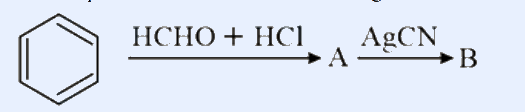
The compounds A and B in the following reaction are, respectively:
(1)
(2)
(3)
(4)
SolutionAnswer: Option 2 Benzyl chloride, Benzyl isocyanide
Approach:
Each reagent step is interpreted: the first installs a chloromethyl group on benzene, and the second substitutes chloride using the ambident cyanide of a covalent silver salt.
Step 1:Benzene with HCHO and HCl undergoes chloromethylation (Blanc reaction) to give benzyl chloride as A.
Step 2:Silver cyanide is largely covalent, so the nitrogen end of the ambident cyanide attacks the carbon, giving the isocyanide.
Step 3:Combining the two steps identifies A and B.
Final answer: Benzyl chloride, Benzyl isocyanide
Q44Single correctPrinciples Related to Practical Chemistry
A water sample has ppm level concentration of the following metals:
; ; ; .
The metal that makes the water sample unsuitable for drinking is
; ; ; .
The metal that makes the water sample unsuitable for drinking is
(1)
(2)
(3)
(4)
SolutionAnswer: Option 3Mn
Approach:
Each metal's measured concentration is compared with its maximum permissible limit in drinking water; the metal exceeding its limit renders the water unsuitable.
Step 1:The permissible limits are roughly Fe 0.2 ppm, Cu 3 ppm and Zn 5 ppm, which the sample values do not exceed.
Step 2:The maximum permissible limit of manganese in drinking water is about 0.05 ppm.
Step 3:The sample contains 5.0 ppm manganese, far above its limit, so manganese makes the water unsuitable.
Final answer: Mn
Q45Single correctp-Block Elements
The one that is extensively used as a piezoelectric material is:
(1)
(2)
(3)
(4)
SolutionAnswer: Option 2Quartz
Approach:
The material whose crystal lacks a centre of symmetry and develops a voltage on mechanical stress is identified among the given silica forms and minerals.
Step 1:A piezoelectric material must possess an ordered, non-centrosymmetric crystal structure so that applied stress separates charge.
Step 2:Amorphous silica lacks long-range order, and mica and tridymite are not the standard piezoelectric choice, whereas crystalline quartz has the required structure.
Step 3:Quartz is therefore the form extensively used as a piezoelectric material.
Final answer: Quartz
Q46Single correctSolutions
A solution of sodium sulphate contains of ions per kilogram of water. The molality of ions in that solution in is:
(1)
(2)
(3)
(4)
SolutionAnswer: Option 2
Approach:
Molality is moles of solute (Na+ ions) per kilogram of solvent (water). The mass of Na+ ions per kilogram of water is divided by the molar mass of sodium.
Step 1:Mass of Na+ ions per kilogram of water is 92 g; molar mass of sodium is 23 g/mol.
Step 2:The solvent (water) mass is 1 kg, so molality equals moles of Na+ per kilogram of water.
Final answer:
Q47Single correctSolutions
Which one of the following statements regarding Henry's law is not correct?
(1)
(2)
(3)
(4)
SolutionAnswer: Option 3Higher the value of at a given pressure, higher is the solubility of the gas in the liquids
Approach:
Henry's law states the partial pressure of a gas above a solution is proportional to its mole fraction in solution, with proportionality constant . The statement that is inconsistent with this law is identified.
Step 1:Henry's law gives the partial pressure as proportional to mole fraction, confirming option 2 is correct.
Step 2:Solubility varies inversely with at a fixed partial pressure, so a higher corresponds to lower solubility, making the statement in option 3 incorrect.
Step 3: differs for different gases at the same temperature and increases with temperature, confirming options 1 and 4 are correct, leaving option 3 as the incorrect statement.
Final answer: Higher the value of at a given pressure, higher is the solubility of the gas in the liquids
Q48Single correctRedox Reactions and Electrochemistry
The anodic half-cell of lead-acid battery is recharged using electricity of Faraday. The amount of electrolyzed in g during the process is: (Molar mass of )
(1)
(2)
(3)
(4)
SolutionAnswer: Option 4
Approach:
On recharging the anodic half-cell, PbSO4 is converted to Pb in a two-electron process. The mass of PbSO4 electrolyzed follows from Faraday's first law using an n-factor of 2.
Step 1:At the anode during recharging, PbSO4 is reduced to Pb, exchanging 2 electrons per formula unit.
Step 2:Substitute the molar mass, electron number and charge in Faraday units.
Step 3:Evaluate the expression to obtain the mass of PbSO4 electrolyzed.
Final answer:
Q49Single correctChemical Kinetics
The following results were obtained during kinetic studies of the reaction.
Experiment | A in mol | B in mol | Initial rate of reaction in mol
I | | |
II | | |
III | | |
The time (in minutes) required to consume half of A is
Experiment | A in mol | B in mol | Initial rate of reaction in mol
I | | |
II | | |
III | | |
The time (in minutes) required to consume half of A is
(1)
(2)
(3)
(4)
SolutionAnswer: Option 2
Approach:
The order with respect to each reactant is found by comparing experiments. The reaction is zero order in B and first order in A, so the half-life of A is obtained from the first-order rate constant.
Step 1:Experiments I and II keep A constant while B changes, yet the rate is unchanged, so the order in B is zero.
Step 2:Comparing experiments I and III, doubling A doubles the rate, so the order in A is one.
Step 3:Determine the rate constant from experiment I using first-order dependence on A.
Step 4:Use the first-order half-life expression for A.
Final answer:
Q50Single correctChemical Kinetics
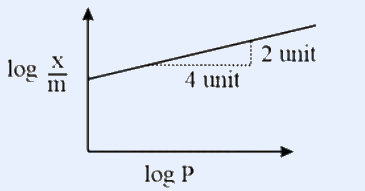
Adsorption of a gas follows Freundlich adsorption isotherm. In the given plot, x is the mass of the gas adsorbed on mass m of the adsorbent at pressure P . is proportional to:
(1)
(2)
(3)
(4)
SolutionAnswer: Option 4
Approach:
The Freundlich isotherm in logarithmic form is a straight line whose slope equals 1/n. The slope read from the triangle on the plot gives the exponent of P.
Step 1:Taking logarithms of the Freundlich isotherm yields a line of slope 1/n on the log-log plot.
Step 2:The triangle on the plot has vertical side 2 units and horizontal side 4 units, giving the slope.
Step 3:Substitute the exponent into the Freundlich isotherm.
Final answer:
Q51Single correctd- and f-Block Elements
The ore that contains both iron and copper is:
(1)
(2)
(3)
(4)
SolutionAnswer: Option 4Copper pyrites
Approach:
The composition of each listed ore is examined to find the one containing both iron and copper.
Step 1:Azurite and malachite are basic copper carbonates containing copper but no iron.
Step 2:Dolomite is a carbonate of calcium and magnesium, containing neither iron nor copper.
Step 3:Copper pyrites is a mixed sulphide of copper and iron, satisfying the condition.
Final answer: Copper pyrites
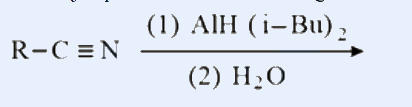
Q52Single correctOrganic Compounds Containing Nitrogen
The major product of the following reaction is,
(1)
(2)
(3)
(4)
SolutionAnswer: Option 2
Approach:
Diisobutylaluminium hydride is a bulky, partial reducing agent that reduces a nitrile only to the imine stage; aqueous work-up then hydrolyses the imine to an aldehyde.
Step 1:DIBAL-H delivers one hydride to the nitrile carbon, forming an aluminium-bound imine intermediate.
Step 2:Aqueous work-up hydrolyses the metalated imine to the corresponding aldehyde.
Final answer:
Q53Single correctCoordination Compounds
Two complexes A and B are violet and yellow coloured, respectively, The incorrect statement regarding them is:
(1)
(2)
(3)
(4)
SolutionAnswer: Option 3 values of A and B are calculated from the energies violet and yellow light, respectively.
Approach:
Both are d3 octahedral chromium(III) complexes. The observed colour is complementary to the absorbed colour, so the crystal field splitting energy is found from the absorbed, not the observed, light. The statement misusing the observed colour is incorrect.
Step 1:Chromium in both complexes is in the +3 state with a d3 configuration, giving three unpaired electrons, so both are paramagnetic.
Step 2:Ammonia is a stronger field ligand than water, so the splitting of B exceeds that of A, confirming option 2.
Step 3:The observed colour is complementary to the absorbed colour, so the splitting energy is derived from the absorbed (complementary) light, not from the observed violet and yellow light; this makes the statement in option 3 incorrect while option 4 is correct.
Final answer: values of A and B are calculated from the energies violet and yellow light, respectively.
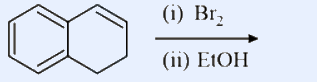
Q54Single correctHydrocarbons
In the reaction given below what will be the major product at the end :
(1)
(2)
(3)
(4)
SolutionAnswer: Option 4
Approach:
Bromine adds to the alkene to form a cyclic bromonium ion, which is opened by the nucleophilic solvent ethanol in an anti fashion, giving a vicinal bromo-ether (trans).
Step 1:Bromine attacks the carbon-carbon double bond of the dihydronaphthalene to form a bridged bromonium ion.
Step 2:Ethanol opens the bromonium ion from the face opposite to bromine, installing an ethoxy group anti to the remaining bromine.
Final answer: 1,2,3,4-tetrahydronaphthalene bearing a vicinal OEt and Br with OEt and Br arranged as drawn in option 4 (anti addition product of bromine followed by ethanol opening of the bromonium ion)
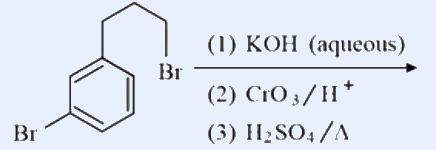
Q55Single correctOrganic Compounds Containing Oxygen
Major product of the given reaction is:
(1)
(2)
(3)
(4)
SolutionAnswer: Option 1
Approach:
Aqueous KOH converts the primary alkyl bromide to a primary alcohol; CrO3/H+ oxidises it to a carboxylic acid; concentrated sulphuric acid on heating promotes intramolecular Friedel-Crafts acylation to form a fused cyclic ketone (indanone) on the aromatic ring.
Step 1:Aqueous potassium hydroxide substitutes the primary bromide to give a primary alcohol.
Step 2:Chromium trioxide in acid oxidises the primary alcohol to a carboxylic acid.
Step 3:Hot concentrated sulphuric acid drives intramolecular Friedel-Crafts acylation, closing a five-membered ring onto the aromatic ring to give a bromo-substituted indanone.
Final answer: the drawn structure of option 4 (MathonGo keyed product)
Q56Single correctCoordination Compounds
The highest value of the calculated spin only magnetic moment (in BM) among all the transition metal complexes is
(1)
(2)
(3)
(4)
SolutionAnswer: Option 4
Approach:
The spin only magnetic moment increases with the number of unpaired electrons. The maximum number of unpaired electrons in a first-row transition metal complex is five (d5 high spin), giving the largest possible moment.
Step 1:The maximum number of unpaired electrons in a first-row transition metal ion is five, in a high-spin d5 configuration.
Step 2:Substitute five unpaired electrons into the spin only formula.
Step 3:Evaluate the square root to obtain the highest magnetic moment.
Final answer:
Q57Single correctOrganic Compounds Containing Oxygen
Acid strength given below the correct decreasing order will be :
(1)
(2)
(3)
(4)
SolutionAnswer: Option 2
Approach:
Acidity of substituted acetic acids increases with the electron-withdrawing (inductive) strength of the substituent on the alpha carbon, which stabilises the carboxylate anion.
Step 1:A stronger electron-withdrawing group on the alpha carbon withdraws electron density from the carboxylate, stabilising the conjugate base and increasing acid strength.
Step 2:Ordering the alpha substituents by their inductive electron-withdrawing power gives the decreasing acid-strength sequence selected by the paper.
Final answer:
Q58Single correctOrganic Compounds Containing Nitrogen
Major product of the given below reaction:
(1)
(2)
(3)
(4)
SolutionAnswer: Option 4
Approach:
Triethylamine is a base that scavenges the acid generated when the acyl chloride couples with the amine to form an amide linkage; the resulting unsaturated/functional monomer then undergoes free radical polymerisation to give the polymeric product drawn in the keyed option.
Step 1:The acyl chloride reacts with the amine in the presence of triethylamine, which neutralises the liberated hydrogen chloride and drives amide bond formation.
Step 2:Free radical polymerisation links the resulting monomer units into the product structure shown in the keyed option.
Final answer: the drawn product structure of option 4 (amide-linked product formed under Et3N, followed by free radical polymerisation, as drawn in option 4)
Q59Single correctPrinciples Related to Practical Chemistry
The correct match between Column-I and Column-II is
| Column-I (drug) | Column-II (test) |
|---|---|
| A. Chloroxylenol | P. Carbylamine test |
| B. Norethindrone | Q. Sodium hydrogen carbonate test |
| C. Sulphapyridine | R. Ferric chloride test |
| D. Penicillin | S. Baeyer's test |
(1)
(2)
(3)
(4)
SolutionAnswer: Option 4
Approach:
Each drug is matched to the characteristic test responding to its key functional group: a phenolic group answers the ferric chloride test, a carbon-carbon double bond answers Baeyer's test, a primary amine answers the carbylamine test, and a carboxylic acid answers the sodium hydrogen carbonate test.
Step 1:Chloroxylenol is a phenol, giving a positive ferric chloride (R) test.
Step 2:Norethindrone contains a carbon-carbon double bond (and triple bond), decolourising bromine water in Baeyer's (S) test.
Step 3:Sulphapyridine bears a primary aromatic amine, giving the carbylamine (P) test.
Step 4:Penicillin carries a carboxylic acid group, releasing carbon dioxide with sodium hydrogen carbonate (Q).
Final answer:
Q60Single correctBiomolecules
The increasing order of pKa of the following amino acids in aqueous solution is
Glycine, Aspartate, Lysine, Arginine.
Glycine, Aspartate, Lysine, Arginine.
(1)
(2)
(3)
(4)
SolutionAnswer: Option 4Aspartate Glycine Lysine Arginine
Approach:
The overall pKa reflects the acid-base character of the side chain. Acidic side chains lower the pKa, while basic side chains raise it; the amino acids are ordered from the most acidic side chain to the most basic.
Step 1:Aspartate carries an acidic carboxylate side chain, giving it the lowest pKa.
Step 2:Glycine has only the standard amino and carboxyl groups, placing it above aspartate.
Step 3:Lysine and arginine carry basic side chains that raise the pKa, with the strongly basic guanidinium group of arginine giving the highest pKa.
Step 4:Combining these gives the increasing pKa order.
Final answer: Aspartate Glycine Lysine Arginine
Mathematics29 questions
Q61Single correctComplex Numbers and Quadratic Equations
Let and be the roots of the equation , then is equal to
(1)
(2)
(3)
(4)
SolutionAnswer: Option 4
Approach:
Solve the quadratic for its complex roots, express each root in polar (exponential) form, raise to the fifteenth power using De Moivre's theorem, and add.
Step 1:Rewrite the equation and solve for the roots.
Step 2:Express each root in exponential form, since the modulus is .
Step 3:Raise to the fifteenth power and add the conjugate pair.
Step 4:Reduce the angle and evaluate the cosine.
Final answer:
Q62Single correctComplex Numbers and Quadratic Equations
Let . Then the sum of the elements in A is:
(1)
(2)
(3)
(4)
SolutionAnswer: Option 3
Approach:
Rationalise the complex fraction, set its real part to zero for the number to be purely imaginary, solve for over the given interval, and add the admissible values.
Step 1:Multiply numerator and denominator by the conjugate of the denominator.
Step 2:Impose that the real part vanishes.
Step 3:Determine all in .
Step 4:Add the elements of .
Final answer:
Q63Single correctPermutations and Combinations
Consider a class of 5 girls and 7 boys. The number of different teams consisting of 2 girls and 3 boys that can be formed from this class, if there are two specific boys and , who refuse to be the members of the same team, is:
(1)
(2)
(3)
(4)
SolutionAnswer: Option 1
Approach:
Count all teams of 2 girls and 3 boys, then subtract the teams that contain both specific boys together.
Step 1:Count the total number of teams of 2 girls and 3 boys.
Step 2:Count the teams that contain both and (the third boy chosen from the remaining 5, both girls chosen from 5).
Step 3:Subtract the disallowed teams from the total.
Final answer:
Q64Single correctSequence and Series
If , and be three distinct real numbers in G.P. and , then cannot be:
(1)
(2)
(3)
(4)
SolutionAnswer: Option 2
Approach:
Write the three terms of the G.P. symmetrically, express in terms of the common ratio, and use the bound on the sum of a number and its reciprocal to find the excluded range.
Step 1:Take the terms of the G.P. as and substitute into .
Step 2:Apply the bound on for real r.
Step 3:Translate into the admissible range of .
Step 4:Test the options against the excluded interval .
Final answer:
Q65Single correctSequence and Series
Let , , , be an A.P., and . If and , then is equal to:
(1)
(2)
(3)
(4)
SolutionAnswer: Option 1
Approach:
Express the two sums in terms of the first term and common difference, combine to isolate the common difference, then use to find the first term and compute .
Step 1:Write the full sum and the sum of odd-indexed terms.
Step 2:Form to eliminate the first term.
Step 3:Use to find the first term.
Step 4:Compute the tenth term.
Final answer:
Q66Single correctBinomial Theorem and its Simple Applications
If the fractional part of the number is , then k is equal to
(1)
(2)
(3)
(4)
SolutionAnswer: Option 3
Approach:
Reduce the power of 2 modulo 15 using the cyclic behaviour of , then read off the fractional part as the remainder over 15.
Step 1:Establish the base congruence.
Step 2:Reduce the exponent: .
Step 3:Express the fractional part using the remainder.
Final answer:
Q67Single correctTrigonometry
For , the expression equals:
(1)
(2)
(3)
(4)
SolutionAnswer: Option 3
Approach:
Interpret the expression as , expand each grouped term using the Pythagorean identity and double-angle relations, and simplify to a single power of .
Step 1:Expand the grouped fourth and second powers in terms of .
Step 2:Collect terms; the linear terms cancel.
Step 3:Replace and .
Step 4:Expand fully and combine like terms.
Final answer:
Q68Single correctCo-ordinate Geometry
Consider the set of all lines such that . Which one of the following statements is true?
(1)
(2)
(3)
(4)
SolutionAnswer: Option 2The lines are concurrent at the point .
Approach:
Compare the family condition with the line equation to read off a fixed point through which every line of the family passes.
Step 1:Write the line equation and the imposed linear constraint.
Step 2:Scale the constraint by to match the constant coefficient r.
Step 3:Match coefficients with the line equation; every line passes through the fixed point.
Final answer: The lines are concurrent at the point .
Q69Single correctCo-ordinate Geometry
Three circles of radii , , , touch each other externally. If they have - axis as a common tangent, then:
(1)
(2)
(3)
(4)
SolutionAnswer: Option 1
Approach:
Use that the horizontal distance between the tangent points of two externally touching circles resting on a line equals , and impose the collinearity of the three foot points.
Step 1:Let the feet of the circles on the x-axis be for radii respectively, with .
Step 2:Write each horizontal separation using the touching condition.
Step 3:Divide throughout by .
Final answer:
Q70Single correctCo-ordinate Geometry
Axis of a parabola lies along -axis. If its vertex and focus are at distances 2 and 4 respectively from the origin, on the positive -axis then which of following points does not lie on it?
(1)
(2)
(3)
(4)
SolutionAnswer: Option 3
Approach:
Determine the parabola from its vertex and focus positions, then test each candidate point in its equation.
Step 1:Identify the vertex at and focus at , so the focal length is .
Step 2:Test , and .
Step 3:Test .
Final answer:
Q71Single correctCo-ordinate Geometry
Equation of a common tangent to the circle, and the parabola, is:
(1)
(2)
(3)
(4)
SolutionAnswer: Option 2
Approach:
Write the tangent to the parabola in slope form, impose tangency to the circle by equating the perpendicular distance from the centre to the radius, solve for the slope, and form the tangent line.
Step 1:Tangent to the parabola in slope form.
Step 2:Impose tangency to the circle of centre and radius .
Step 3:Solve for the slope.
Step 4:Form the tangent for .
Final answer:
Q72Single correctCo-ordinate Geometry
Let . If the eccentricity of the hyperbola is greater than 2, then the length of its latus rectum lies in the interval:
(1)
(2)
(3)
(4)
SolutionAnswer: Option 1
Approach:
Express the eccentricity in terms of , translate the condition into a range for , then evaluate the latus rectum over that range.
Step 1:Compute the eccentricity using , .
Step 2:Apply to bound .
Step 3:Write the latus rectum and evaluate over the range.
Step 4:Evaluate the lower bound at and the unbounded growth as .
Final answer:
Q73Single correctLimit, Continuity and Differentiability
The value of
(1)
(2)
(3)
(4)
SolutionAnswer: Option 2exists and equals
Approach:
Rationalise the numerator twice to remove the nested radicals, then cancel the factor and substitute the limit.
Step 1:Multiply numerator and denominator by the conjugate of the outer radical.
Step 2:Rationalise the remaining inner radical.
Step 3:Cancel and substitute .
Final answer: exists and equals
Q74Single correctSets, Relations and Functions
If the Boolean expression is equivalent to , where , , , then the ordered pair , is
(1)
(2)
(3)
(4)
SolutionAnswer: Option 4
Approach:
Substitute each candidate pair of connectives into the expression and compare its truth table with that of .
Step 1:Take and and form the expression.
Step 2:Evaluate where is true, that is , .
Step 3:For all other truth assignments is false, and so is the compound expression.
Final answer:
Q75Single correctStatistics and Probability
5 students of a class have an average height 150 cm and variance 18 . A new student, whose height is 156 cm, joined them. The variance in of the height of these six students is:
(1)
(2)
(3)
(4)
SolutionAnswer: Option 4
Approach:
Recover the sum and sum of squares of the original five heights from the given mean and variance, add the new student's contribution, then apply the variance formula for the six values.
Step 1:From the mean of the five students, get the sum of heights.
Step 2:From the variance, get the sum of squares.
Step 3:Include the sixth student of height 156 and find the new mean.
Step 4:Compute the new variance.
Final answer:
Q76Single correctMatrices and Determinants
If , then the matrix when , is equal to:
(1)
(2)
(3)
(4)
SolutionAnswer: Option 1
Approach:
The matrix is a rotation matrix, so its power is obtained by multiplying the rotation angle by the exponent.
Step 1:Identify the rotation form of the matrix and apply the power rule with n = -50.
Step 2:Substitute , giving , which is coterminal with plus full turns.
Step 3:Assemble the resulting matrix.
Final answer:
Q78Single correctTrigonometry
If , then x is equal to:
(1)
(2)
(3)
(4)
SolutionAnswer: Option 4
Approach:
Move one inverse cosine to the other side, convert it to an inverse sine, and equate the arguments.
Step 1:Rewrite the equation isolating one term.
Step 2:Convert the inverse sine on the right to an inverse cosine through the complementary radical.
Step 3:Equate the arguments and clear the denominators.
Step 4:Square and solve for x.
Final answer:
Q79Single correctSets, Relations and Functions
For , let , and be three given functions. If a function, J(x) satisfies then J(x) is equal to:
(1)
(2)
(3)
(4)
SolutionAnswer: Option 1
Approach:
Unwind the composition by applying the inverse operations of the outer and inner functions to isolate J.
Step 1:Substitute the inner function (x) = 1/x and the definitions of and .
Step 2:Apply (t) = 1 - t and solve for J(1/x).
Step 3:Replace 1/x by the variable to obtain J(x).
Final answer:
Q80Single correctLimits, Continuity and Differentiability
Let be a function defined as Then f is:
(1)
(2)
(3)
(4)
SolutionAnswer: Option 3
Approach:
Impose continuity at the break points x = 1, x = 3, and x = 5, then test whether all conditions can hold simultaneously.
Step 1:Continuity at x = 1 equates the constant 5 with a + b.
Step 2:Continuity at x = 3 equates a + 3b with b + 15.
Step 3:Continuity at x = 5 requires b + 25 to equal 30, forcing b = 5, which contradicts b = 10.
Final answer:
Q81Single correctLimits, Continuity and Differentiability
The maximum volume in cu. m of the right circular cone having slant height is:
(1)
(2)
(3)
(4)
SolutionAnswer: Option 1
Approach:
Express the cone's volume in terms of its height using the fixed slant height, then maximise.
Step 1:With slant height l = 3, express in terms of h.
Step 2:Write the volume as a function of h.
Step 3:Set the derivative to zero to locate the maximum.
Step 4:Substitute , giving = 6, and evaluate the volume.
Final answer:
Q82Single correctLimits, Continuity and Differentiability
If denotes the acute angle between the curves, and at a point of their intersection, then is equal to:
(1)
(2)
(3)
(4)
SolutionAnswer: Option 4
Approach:
Find the intersection point, evaluate both slopes there, and apply the angle-between-lines formula.
Step 1:Equate the curves to find the intersection abscissa.
Step 2:Compute the slopes at x = 2.
Step 3:Apply the angle formula.
Final answer:
Q83Single correctIntegral Calculus
For , (the set of natural numbers), the integral , is equal to (where c is a constant of integration).
(1)
(2)
(3)
(4)
SolutionAnswer: Option 4
Approach:
Substitute for the squared argument, simplify the ratio under the radical using half-angle relations, and integrate the resulting tangent.
Step 1:Substitute t = - 1 so that x\,dx = dt/2.
Step 2:Express the radicand using sin 2t = 2 sin t cos t and factor.
Step 3:Take the square root and integrate the tangent.
Step 4:Restore t = - 1.
Final answer:
Q84Single correctIntegral Calculus
The value of is
(1)
(2)
(3)
(4)
SolutionAnswer: Option 3
Approach:
Use symmetry of the absolute cosine cube about expand the cube via a multiple-angle identity.
Step 1:Fold the integral using the symmetry of about .
Step 2:Replace the cube with its harmonic form and integrate.
Step 3:Evaluate at the limits.
Final answer:
Q85Single correctIntegral Calculus
The area (in sq. units) bounded by the parabola , the tangent at the point to it and the y-axis is
(1)
(2)
(3)
(4)
SolutionAnswer: Option 2
Approach:
Find the tangent line at the given point, then compute the area between the tangent and the parabola bounded by the y-axis.
Step 1:The slope at (2, 3) is 2x = 4, giving the tangent line.
Step 2:Set up the area between the triangle under the tangent and the parabola from y = -1 to y = 3.
Step 3:Evaluate the parabolic integral and subtract.
Final answer:
Q86Single correctDifferential Equations
If is the solution of the differential equation, satisfying , then is equal to:
(1)
(2)
(3)
(4)
SolutionAnswer: Option 4
Approach:
Write the equation in standard linear form, find the integrating factor, integrate, and apply the initial condition.
Step 1:Divide by x to reach standard linear form.
Step 2:Compute the integrating factor and integrate.
Step 3:Apply y(1) = 1 to fix the constant.
Step 4:Evaluate at x = 1/2.
Final answer:
Q87Single correctVector Algebra
Let , and be a vector such that and , then is equal to:
(1)
(2)
(3)
(4)
SolutionAnswer: Option 1
Approach:
Cross the given vector relation with a, expand the triple product, and combine with the dot-product condition.
Step 1:From the condition. Cross both sides on the left with a.
Step 2:Expand the triple product and compute .
Step 3:Substitute the known dot products to isolate c.
Step 4:Take magnitudes squared.
Final answer:
Q88Single correctThree Dimensional Geometry
The plane through the intersection of the planes and and parallel to - axis also passes through the point
(1)
(2)
(3)
(4)
SolutionAnswer: Option 3
Approach:
Form the family of planes through the intersection, impose the parallel-to-y-axis condition to kill the y coefficient, and test the points.
Step 1:Write the family of planes through the line of intersection.
Step 2:Parallel to the y-axis requires the y coefficient to vanish.
Step 3:Substitute simplify the plane.
Step 4:Test the candidate points; (3, 2, 1) satisfies the plane.
Final answer:
Q89Single correctThree Dimensional Geometry
The equation of the line passing through -4, 3, 1, parallel to the plane and intersecting the line is
(1)
(2)
(3)
(4)
SolutionAnswer: Option 1
Approach:
Take a general point on the given line, form the direction from (-4, 3, 1), and impose both intersection and parallel-to-plane conditions.
Step 1:Parameterize the given line and form the direction from the fixed point to a general point on it.
Step 2:Require the direction to be perpendicular to the plane normal (1, 2, -1).
Step 3:Substitute t = -1 to obtain the direction ratios.
Step 4:Write the line through (-4, 3, 1) with this direction.
Final answer:
Q90Single correctStatistics and Probability
Two cards are drawn successively with replacement from a well-shuffled deck of 52 cards. Let denote the random variable of number of aces obtained in the two drawn cards. Then equals:
(1)
(2)
(3)
(4)
SolutionAnswer: Option 4
Approach:
Model the two draws with replacement as a binomial experiment with ace probability 1/13, then sum the probabilities for one and two aces.
Step 1:The probability of drawing an ace on a single draw is 4/52 = 1/13.
Step 2:Compute the probability of exactly one ace.
Step 3:Compute the probability of two aces.
Step 4:Add the two probabilities.
Final answer:
More JEE Main 2019 papers
- JEE Main 2019 — April 08, Shift 1
- JEE Main 2019 — April 08, Shift 2
- JEE Main 2019 — April 09, Shift 1
- JEE Main 2019 — January 09, Shift 2
- JEE Main 2019 — January 10, Shift 1
- JEE Main 2019 — January 10, Shift 2
- JEE Main 2019 — January 11, Shift 1
- JEE Main 2019 — January 11, Shift 2
- JEE Main 2019 — January 12, Shift 1
- JEE Main 2019 — January 12, Shift 2
Frequently Asked Questions
How many questions are in the JEE Main 2019 January 09, Shift 1 paper?
The JEE Main 2019 January 09, Shift 1 paper has 88 questions — Physics (30), Chemistry (29) and Mathematics (29). Every question is on this page with its correct answer and a step-by-step solution.
What is the marking scheme for JEE Main?
JEE Main awards +4 marks for each correct answer and −1 for a wrong answer, with 0 for questions left unattempted. The paper covers Physics, Chemistry and Mathematics.
Are the answer key and step-by-step solutions provided for the 2019 January 09, Shift 1 paper?
Yes — every question shows the correct answer (answer key) and a detailed step-by-step solution, free to read online.
Can I take the JEE Main 2019 January 09, Shift 1 paper as a timed mock test?
Yes. With a free JEEnify account you can attempt this exact paper as a timed test in the real exam interface, then see your score and weak-area analysis.
Solved this paper? Calculate your JEE Main scoremost important chaptersformula sheetsall free tools.