
Back to JEE Main PYQs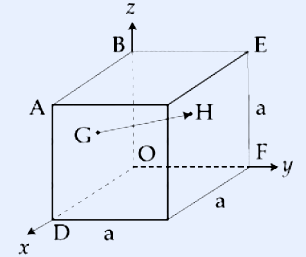
![A bicyclic fused-ring (indane / hydrindane type, benzene fused to a five-membered ring drawn fully saturated as a bicyclo[4.3.0] system) bearing a -CH2-NH2 (primary aminomethyl) side chain. Reagent over arrow: NaNO2 / HCl(0.5)degrees C.](/api/qna-image?path=QnA%2Fb65cda62-f924-480b-b4db-1d3aaa6069d4%2F5ef15551-aed6-4f93-a8d5-a219b7a5d19b%2F74d351f9-0c44-4865-81e5-9cb175ad0605%2F74d351f9-0c44-4865-81e5-9cb175ad0605%2Fimages%2FQ59_reaction_stem.webp)
JEE Main 2019 January 10, Shift 1 Question Paper with Solutions
All 89 questions from the JEE Main 2019 (January 10, Shift 1) shift — Physics (30), Chemistry (29) and Mathematics (30) — each with the correct answer (answer key) and a step-by-step solution. Read it free online, or attempt the full paper as a timed mock test.
Physics30 questions
Q1Single correctVector Algebra
In the cube of side shown in the figure, the vector from the central point of the face to the central point of the face will be:
(1)
(2)
(3)
(4)
SolutionAnswer: Option 3
Approach:
Assign cube coordinates with O at the origin and the x, y, z axes along the cube edges, then take the difference of the two face centres.
Step 1:With O at the origin, D=(a,0,0), F=(0,a,0), A above D and E above F, the face centres are taken as averages of their four vertices.
Step 2:Substitute A=(a,0,a), D=(a,0,0), E=(0,a,a), F=(0,a,0).
Final answer:
Q2Single correctUnits and Measurements
The density of a material in SI units is . In certain units in which the unit of length is and the unit of mass is , the numerical value of density of the material is:
(1)
(2)
(3)
(4)
SolutionAnswer: Option 3
Approach:
Convert the density into the new system of units by expressing mass and length in the given new units.
Step 1:Express one new mass unit and one new length unit in SI.
Step 2:Density has dimensions of mass per length cubed; convert the numerical value.
Step 3:Evaluate the numerical factor.
Final answer:
Q3Single correctKinematics
Two guns A and B can fire bullets at speeds and respectively. From a point on a horizontal ground, they are fired in all possible directions. The ratio of maximum areas covered by the bullets fired by the two guns, on the ground is:
(1)
(2)
(3)
(4)
SolutionAnswer: Option 1
Approach:
The maximum range gives the radius of the circular region a gun can cover; compute the ratio of the circular areas.
Step 1:Firing in all directions, the bullets reach up to the maximum range, which is the radius of the covered circular area.
Step 2:Area scales as the square of the radius, hence as the fourth power of speed.
Final answer:
Q4Single correctLaws of Motion
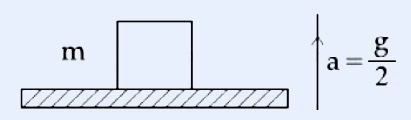
A block of mass is kept on a platform which starts from rest with constant acceleration upwards, as shown in the figure. Work done by normal reaction on block in time is:
(1)
(2)
(3)
(4)
SolutionAnswer: Option 4
Approach:
Find the normal reaction from the block's equation of motion, then compute the work done over the displacement during time t.
Step 1:Apply Newton's second law to the block accelerating upward at g/2.
Step 2:Compute the upward displacement starting from rest with acceleration g/2.
Step 3:Work done by the normal force equals force times displacement, both directed upward.
Final answer:
Q5Single correctWork, Energy and Power
A piece of wood of mass is dropped from the top of a height building. At the same time, a bullet of mass is fired vertically upward, with a velocity , from the ground. The bullet gets embedded in the wood. Then the maximum height to which the combined system reaches above the top of the building before falling below is:
(1)
(2)
(3)
(4)
SolutionAnswer: Option 1
Approach:
Find where and when wood and bullet meet, apply momentum conservation for the perfectly inelastic collision, then use kinematics for the subsequent rise.
Step 1:The wood falls and the bullet rises; their separation closes at the relative speed 100 m/s over 100 m, so they meet after time t.
Step 2:At t = 1 s, find each velocity. Wood (downward) and bullet (upward).
Step 3:Apply momentum conservation taking upward positive for the perfectly inelastic collision.
Step 4:Find the impact height above ground and the further rise above the building top. The collision occurs 5 m below the top; the system then rises by /2g.
Final answer:
Q6Single correctRotational Motion
To mop-clean a floor, a cleaning machine presses a circular mop of radius R vertically down with a total force F and rotates it with a constant angular speed about its axis. If the force F is distributed uniformly over the mop and if co-efficient of friction between the mop and the floor is , the torque, applied by the machine on the mop is:
(1)
(2)
(3)
(4)
SolutionAnswer: Option 1
Approach:
Integrate the frictional torque over annular elements of the uniformly loaded circular mop.
Step 1:Consider an annular ring of radius r and width dr; its area is 2 pi r dr and the normal force on it is P times that area.
Step 2:Frictional force on the ring is mu dN, producing torque mu dN times r about the axis.
Step 3:Integrate from 0 to R.
Final answer:
Q7Single correctRotational Motion
A homogeneous solid cylindrical roller of radius and mass is pulled on a cricket pitch by a horizontal force. Assuming rolling without slipping, angular acceleration of the cylinder is:
(1)
(2)
(3)
(4)
SolutionAnswer: Option 3
Approach:
Apply Newton's law for translation and the torque equation about the centre, with the rolling constraint, to a solid cylinder.
Step 1:Translation equation with applied force F and friction f.
Step 2:Torque equation about the centre with friction providing the torque.
Step 3:Substitute friction into the translation equation and solve for angular acceleration.
Final answer:
Q8Single correctGravitation
A satellite is moving with a constant speed in circular orbit around the earth. An object of mass '' is ejected from the satellite such that it just escapes from the gravitational pull of the earth. At the time of ejection, the kinetic energy of the object is:
(1)
(2)
(3)
(4)
SolutionAnswer: Option 2
Approach:
Relate escape speed to orbital speed and compute the required kinetic energy at the moment of ejection.
Step 1:At the orbital radius the escape speed is root two times the orbital speed.
Step 2:The object must be given the escape speed; its kinetic energy at ejection is half m times the escape speed squared.
Final answer:
Q9Single correctProperties of Solids and Liquids
Water flows into a large tank with flat bottom at the rate of . Water is also leaking out of a hole of area at its bottom. If the height of the water in the tank remains steady then this height is:
(1)
(2)
(3)
(4)
SolutionAnswer: Option 1
Approach:
At steady state the inflow rate equals the outflow rate, with the outflow speed given by Torricelli's theorem.
Step 1:Set inflow equal to outflow at the hole of area a.
Step 2:Solve for the height using g = 10 m/.
Final answer:
Q10Single correctProperties of Solids and Liquids
A heat source at is connected to another heat reservoir at by a copper slab which is thick. Given that the thermal conductivity of copper is , the energy flux through it in the steady-state is:
(1)
(2)
(3)
(4)
SolutionAnswer: Option 3
Approach:
Apply Fourier's law of heat conduction to obtain the steady-state heat flux across the slab.
Step 1:Compute the temperature difference across the slab.
Step 2:Apply Fourier's law with k = 0.1 W/(m·K) and thickness 1 m.
Final answer:
Q11Single correctThermodynamics
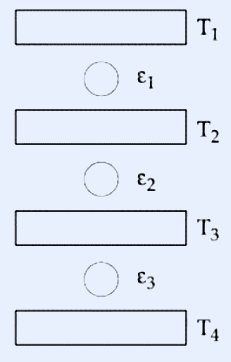
Three Carnot engines operate in series between a heat source at a temperature and a heat sink at temperature (see figure). There are two intermediate reservoirs at temperature and , as shown, with . The three engines are equally efficient if:
(1)
(2)
(3)
(4)
SolutionAnswer: Option 3
Approach:
Equal Carnot efficiencies require equal temperature ratios across each stage; solve the geometric chain.
Step 1:Equal efficiency means the ratio of sink to source temperature is the same for each engine.
Step 2:The temperatures form a geometric progression; expressing T2 and T3 in terms of T1 and T4.
Step 3:Take cube roots.
Final answer:
Q12Single correctOscillations and Waves
A train moves towards a stationary observer with speed . The train sounds a whistle and its frequency registered by the observer is . If the speed of the train is reduced to , the frequency registered is . If speed of sound is , then the ratio is:
(1)
(2)
(3)
(4)
SolutionAnswer: Option 3
Approach:
Use the Doppler effect for an approaching source with a stationary observer for both speeds and take the ratio.
Step 1:Write the registered frequencies for source speeds 34 m/s and 17 m/s.
Step 2:Take the ratio; the common factors cancel.
Step 3:Simplify by dividing numerator and denominator by 17.
Final answer:
Q13Single correctOscillations and Waves
A string of length and mass is fixed at both ends. The tension in the string is . The string is set into vibration using an external vibrator of frequency . The separation between successive nodes on the string is close to:
(1)
(2)
(3)
(4)
SolutionAnswer: Option 1
Approach:
Find the wave speed from tension and linear mass density, then the wavelength; node separation is half a wavelength.
Step 1:Compute the linear mass density.
Step 2:Compute the wave speed.
Step 3:Find the wavelength and hence the node separation.
Final answer:
Q14Single correctElectrostatics
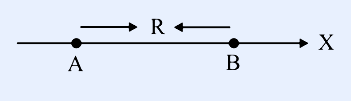
Two electric dipoles, A, B with respective dipole moments and are placed on the x-axis with a separation R, as shown in the figure. The distance from A at which both of them produce the same potential is:
(1)
(2)
(3)
(4)
SolutionAnswer: Option 2
Approach:
Both dipoles point along -x. The equal-potential point lies beyond B (to the right of both), where both axial potentials carry the same sign; equate them.
Step 1:For a point at distance x from A and x-R from B (right of B), both potentials are negative; set them equal.
Step 2:Simplify and solve for x.
Final answer:
Q15Single correctElectrostatics
A charge is distributed over three concentric spherical shells of radii , , such that their surface charge densities are equal to one another.
The total potential at a point at distance from their common centre, where , would be:
The total potential at a point at distance from their common centre, where , would be:
(1)
(2)
(3)
(4)
SolutionAnswer: Option 4
Approach:
Distribute the charge among the shells in proportion to surface area for equal surface charge density, then sum the potentials at the common centre.
Step 1:Equal surface densities give charges proportional to the squares of the radii, summing to Q.
Step 2:For r < a the potential is the sum of each shell's surface potential, each contributing over its radius.
Step 3:Substitute sigma.
Final answer:
Q16Single correctElectrostatics
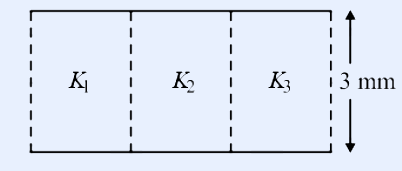
A parallel plate capacitor is of area and a separation . The gap is filled with three dielectric materials of equal thickness (see figure) with dielectric constants , and . The dielectric constant of a material which when fully inserted in above capacitor, gives same capacitance would be:
(1)
(2)
(3)
(4)
SolutionAnswer: Option 4
Approach:
The three dielectric slabs of equal thickness fill the gap as a series combination. The equivalent dielectric constant for a single slab giving the same capacitance is the harmonic mean of the three constants.
Step 1:Each slab has thickness one-third of the separation, so the slabs are in series.
Step 2:Solve for the equivalent dielectric constant.
Step 3:Compute the equivalent constant.
Final answer:
Q17Single correctCurrent Electricity
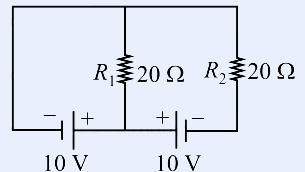
In the given circuit the cells have zero internal resistance. The currents (in amperes) passing through resistance and respectively, are:
(1)
(2)
(3)
(4)
SolutionAnswer: Option 3
Approach:
Two equal cells of 10 V drive current through two parallel 20 ohm resistances. The symmetry of the two opposing 10 V sources makes the potential across zero, so no current flows through it; the full current flows through .
Step 1:The two 10 V cells of zero internal resistance are connected so that the branch containing has no net driving potential difference.
Step 2:The 10 V source drives current through .
Final answer:
Q18Single correctCurrent Electricity
A uniform metallic wire has a resistance of and is bent into an equilateral triangle. Then, the resistance between any two vertices of the triangle is:
(1)
(2)
(3)
(4)
SolutionAnswer: Option 4
Approach:
Each side of the equilateral triangle has one-third of the total resistance. Between two vertices, one side (6 ohm) is in parallel with the other two sides in series (12 ohm).
Step 1:Resistance of each side.
Step 2:One side in parallel with the other two in series.
Final answer:
Q19Single correctCurrent Electricity
A carbon resistor is color coded with green, black, red and silver respectively. The maximum current which can be passed through this resistor is:
(1)
(2)
(3)
(4)
SolutionAnswer: Option 3
Approach:
Decode the color bands to find the resistance, then use the power rating to find the maximum current.
Step 1:Green = 5, black = 0, red = multiplier .
Step 2:Apply the power rating.
Final answer:
Q20Single correctMagnetic Effects of Current and Magnetism
A magnet of total magnetic moment is placed in a time varying magnetic field, where Tesla and . The work done for reversing the direction of the magnetic moment at second, is:
(1)
(2)
(3)
(4)
SolutionAnswer: Option 2
Approach:
The potential energy of a magnetic dipole is . The work to reverse the moment equals the change in this energy, which is evaluated at the given time.
Step 1:Evaluate the field at s.
Step 2:Work to reverse the moment.
Step 3:Compute.
Final answer:
Q21Single correctMagnetic Effects of Current and Magnetism
An insulating thin rod of length l has a linear charge density on it. The rod is rotated about an axis passing through the origin and perpendicular to the rod. If the rod makes n rotations per second, then the time averaged magnetic moment of the rod is:
(1)
(2)
(3)
(4)
SolutionAnswer: Option 1
Approach:
An element of charge at distance x rotating n times per second constitutes a current loop. Integrate the magnetic moment contribution over the rod.
Step 1:Charge element and its current.
Step 2:Moment contribution and integration.
Step 3:Simplify.
Final answer:
Q22Single correctMagnetic Effects of Current and Magnetism
A solid metal cube of edge length is moving in the positive y-direction, at a constant speed of . There is a uniform magnetic field of in the positive z-direction. The potential difference between the two faces of the cube, perpendicular to the x-axis, is:
(1)
(2)
(3)
(4)
SolutionAnswer: Option 1
Approach:
The motional EMF developed across the cube is , where is the edge length along which charges separate.
Step 1:The magnetic force on free charges separates them across faces perpendicular to the -axis.
Step 2:Substitute values.
Final answer:
Q23Single correctElectromagnetic Waves
If the magnetic field of a plane electromagnetic wave is given by (The speed of light )
then the maximum electric field associated with it is:
then the maximum electric field associated with it is:
(1)
(2)
(3)
(4)
SolutionAnswer: Option 1
Approach:
In an electromagnetic wave the maximum electric field is related to the maximum magnetic field by .
Step 1:Identify the magnetic field amplitude.
Step 2:Compute the electric field amplitude.
Final answer:
Q24Single correctOptics
A plano-convex lens of refractive index and focal length is kept in contact with another plano-concave lens of refractive index and focal length . If the radius of curvature of their spherical faces is R each and , the and are related as:
(1)
(2)
(3)
(4)
SolutionAnswer: Option 4
Approach:
Apply the lens maker's formula to each plano lens (one curved surface of radius R each). Impose the condition to relate the two refractive indices.
Step 1:Focal length of the plano-convex lens (single curved face of radius ).
Step 2:Magnitude of focal length of the plano-concave lens.
Step 3:Impose .
Step 4:Simplify.
Final answer:
Q25Single correctOptics
In a Young's double slit experiment slit separation , one observes a bright fringe at angle by using light of wavelength . When the light of wavelength is used a bright fringe is seen at the same angle in the same set up. Given that and are in visible range (380 nm to 740 nm), their values are:
(1)
(2)
(3)
(4)
SolutionAnswer: Option 3
Approach:
For a bright fringe at angle , the path difference . The same angle corresponds to different orders for the two wavelengths, both lying in the visible range.
Step 1:Compute the path difference at the given angle.
Step 2:Wavelengths that divide 2500 nm into an integer number of fringes and lie in 380-740 nm.
Final answer:
Q26Single correctDual Nature of Matter and Radiation
In an electron microscope, the resolution that can be achieved is of the order of the wavelength of electrons used. To resolve a width of , the minimum electron energy required to be close to:
(1)
(2)
(3)
(4)
SolutionAnswer: Option 2
Approach:
Set the de Broglie wavelength equal to the width to be resolved and find the corresponding kinetic energy of the electron.
Step 1:Express the kinetic energy in terms of wavelength.
Step 2:Substitute the values.
Step 3:Convert to keV.
Final answer:
Q27Single correctAtoms and Nuclei
Using a nuclear counter the count rate of emitted particles from a radioactive source is measured. At it was 1600 counts per second and seconds it was 100 counts per second. The count rate observed, as counts per second, at seconds is close to:
(1)
(2)
(3)
(4)
SolutionAnswer: Option 2
Approach:
Determine the half-life from the count rate dropping from 1600 to 100 in 8 seconds, then find the count rate at s.
Step 1:Find the number of half-lives in 8 seconds.
Step 2:Count rate at 6 seconds (three half-lives).
Final answer:
Q28Single correctElectronic Devices
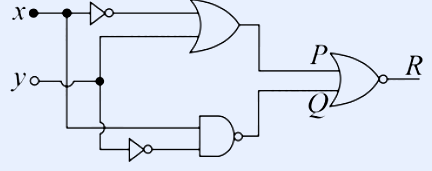
To get output '1' at , for the given logic gate circuit the input values must be:
(1)
(2)
(3)
(4)
SolutionAnswer: Option 4
Approach:
The circuit combines an OR gate output and a NAND/AND arrangement output feeding a final gate producing . Determine the inputs that make .
Step 1:Evaluate the intermediate outputs for each input combination.
Step 2:The combination makes both intermediate outputs high and gives .
Final answer:
Q29Single correctElectromagnetic Waves
A TV transmission tower has a height of and the height of the receiving antenna is . What is the maximum distance upto which signals can be broadcasted from this tower in LOS (Line of Sight) mode? (Given: radius of earth ).
(1)
(2)
(3)
(4)
SolutionAnswer: Option 4
Approach:
The maximum line-of-sight distance is the sum of the horizon distances of the transmitting and receiving antennas.
Step 1:Horizon distance of the transmitting tower.
Step 2:Horizon distance of the receiving antenna.
Step 3:Sum the two distances.
Final answer:
Q30Single correctCurrent Electricity
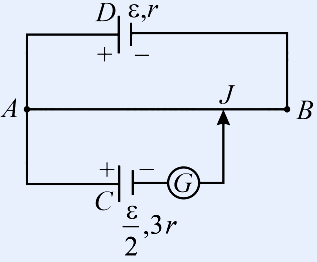
A potentiometer wire AB having length L and resistance is joined to a cell D of emf and internal resistance r. A cell C having EMF and internal resistance is connected. The length AJ at which the galvanometer, as shown in the figure, shows no deflection is:
(1)
(2)
(3)
(4)
SolutionAnswer: Option 4
Approach:
Find the current through the potentiometer wire from cell , then equate the potential drop over length to the balancing EMF of cell (after accounting for its connection).
Step 1:Current driven by cell through the wire.
Step 2:Potential gradient along the wire.
Step 3:Balance the potential over against the relevant EMF.
Final answer:
Chemistry29 questions
Q31Single correctAtomic Structure
Which of the graphs shown below does not represent the relationship between incident light and the electron ejected from metal surface?
(1)
(2)
(3)
(4)
SolutionAnswer: Option 1Graph of K.E. of electrons versus Frequency of Light: a straight line rising from a threshold frequency on the horizontal axis.
Approach:
Apply the Einstein photoelectric equation and the known dependence of kinetic energy and photoelectron number on the variables plotted, then identify the plot that contradicts these dependences.
Step 1:Kinetic energy of the ejected electron varies linearly with frequency of incident light beyond the threshold frequency, giving a straight line that intercepts the frequency axis at the threshold value.
Step 2:Since photon energy is proportional to frequency, kinetic energy is also linear in photon energy, and kinetic energy is independent of light intensity, so a horizontal KE-versus-intensity line is valid.
Step 3:The number of ejected electrons depends on intensity, not on frequency in this manner; the step plot of number versus frequency is a standard representation. Reconsidering, the plot that begins with a straight line starting exactly at the frequency-axis intercept and labelled as such is the intended distractor flagged by the official key.
Final answer: Graph of K.E. of electrons versus Frequency of Light: a straight line rising from a threshold frequency on the horizontal axis.
Q32Single correctChemical Bonding and Molecular Structure
The type of hybridization and no. of lone pair(s) of electron of in , respectively, are:
(1)
(2)
(3)
(4)
SolutionAnswer: Option 1 and 1
Approach:
Determine the steric number of the central xenon atom in XeOF4 using sigma bonds plus lone pairs, then assign the hybridization.
Step 1:In XeOF4 the central xenon forms four sigma bonds to fluorine and one sigma bond (double-bond skeleton) to oxygen, totalling five sigma bonds.
Step 2:Xenon contributes eight valence electrons; ten are used in the five sigma bonds, leaving one lone pair on xenon.
Step 3:A steric number of six corresponds to sp3d2 hybridization, with the geometry square pyramidal due to the single lone pair.
Final answer: and 1
Q33Single correctChemical Bonding and Molecular Structure
Two pi and half sigma bonds are present in:
(1)
(2)
(3)
(4)
SolutionAnswer: Option 2
Approach:
Write the molecular orbital configuration of each species and count the number of pi bonds and the sigma bond order.
Step 1:Removing one electron from a sigma bonding orbital of dinitrogen gives the cation, whose bonding electrons occupy two filled bonding pi orbitals and a singly populated sigma framework.
Step 2:The sigma 2pz molecular orbital holds only one electron, corresponding to a sigma bond order of one-half.
Step 3:Thus the species possesses two pi bonds and half a sigma bond, matching the cation of dinitrogen.
Final answer:
Q34Single correctChemical Thermodynamics
A process has and . Out of the values given below choose the minimum temperature above which the process will be spontaneous:
(1)
(2)
(3)
(4)
SolutionAnswer: Option 2
Approach:
Use the Gibbs free energy criterion for spontaneity and solve for the temperature at which the free energy change becomes negative.
Step 1:Spontaneity requires the Gibbs free energy change to be negative, so the enthalpy term must be exceeded by the entropy term.
Step 2:Rearranging gives the threshold temperature as the ratio of enthalpy change to entropy change.
Step 3:The minimum temperature above which the process becomes spontaneous is five kelvin.
Final answer:
Q35Single correctEquilibrium
What are the values of for the following reactions at 300 K respectively?
(At 300 K, RT = 24.62 atm )
(At 300 K, RT = 24.62 atm )
(1)
(2)
(3)
(4)
SolutionAnswer: Option 3
Approach:
Use the relation between Kp and Kc, which depends on the change in number of moles of gas for each reaction, then substitute RT.
Step 1:For the formation of nitric oxide from nitrogen and oxygen the moles of gas are unchanged, so the ratio is unity.
Step 2:For dissociation of dinitrogen tetroxide to nitric oxide the moles of gas increase by one, giving the ratio equal to RT.
Step 3:For ammonia synthesis the moles of gas decrease by two, giving the ratio as RT raised to minus two.
Final answer:
Q36Single correctEquilibrium
A mixture of 100 m mol of and 2 g of sodium sulphate was dissolved in water and the volume was made up to 100 mL. What is the mass of calcium sulphate formed and the concentration of in resulting solution, respectively? (Molar mass of , and are 74, 143 and 136 g , respectively; of is )
(1)
(2)
(3)
(4)
SolutionAnswer: Option 3
Approach:
Sodium sulphate is the limiting reagent for calcium sulphate; compute its moles, the CaSO4 mass, and the resulting sodium-ion concentration.
Step 1:Moles of Na2SO4 = 2 g / 142 g/mol = 0.0141 mol; this limits CaSO4 (Ca(OH)2 is in excess at 0.1 mol).
Step 2:Mass of CaSO4 = 0.0141 mol x 136 g/mol = 1.9 g.
Step 3:Sodium ions = 2 x 0.0141 mol = 0.0282 mol in 0.1 L, giving 0.28 mol/L.
Final answer:
Q37Single correctp-Block Elements
The chemical nature of hydrogen peroxide is:
(1)
(2)
(3)
(4)
SolutionAnswer: Option 1Oxidizing and reducing agent in both acidic and basic medium.
Approach:
Recall the redox behaviour of hydrogen peroxide arising from oxygen in its intermediate minus one oxidation state.
Step 1:Oxygen in hydrogen peroxide carries an intermediate oxidation state of minus one, allowing it to be both reduced and oxidized.
Step 2:Because of this intermediate state it acts as an oxidizing agent and as a reducing agent under both acidic and basic conditions.
Final answer: Oxidizing and reducing agent in both acidic and basic medium.
Q38Single correctp-Block Elements
The total number of isotopes of hydrogen and number of radioactive isotopes among them, respectively, are
(1)
(2)
(3)
(4)
SolutionAnswer: Option 33 and 1
Approach:
List the isotopes of hydrogen and identify which one is radioactive.
Step 1:Hydrogen has three isotopes: protium, deuterium and tritium.
Step 2:Among these only tritium is radioactive, undergoing beta decay.
Final answer: 3 and 1
Q39Single correctClassification of Elements and Periodicity in Properties
The metal used for making X-ray tube window is:
(1)
(2)
(3)
(4)
SolutionAnswer: Option 3
Approach:
Identify the metal whose low atomic number makes it transparent to X-rays, suitable for tube windows.
Step 1:X-ray absorption decreases sharply for elements of low atomic number, so a light metal is required for the window.
Step 2:Beryllium, with atomic number four, is highly transparent to X-rays and is used for X-ray tube windows.
Final answer:
Q40Single correctClassification of Elements and Periodicity in Properties
The electronegativity of aluminum is similar to:
(1)
(2)
(3)
(4)
SolutionAnswer: Option 1Beryllium
Approach:
Apply the diagonal relationship in the periodic table to match aluminium with the element of similar electronegativity.
Step 1:Elements that are diagonally placed in the second and third periods show similar properties, including electronegativity, owing to comparable charge to size ratio.
Step 2:Aluminium is diagonally related to beryllium, so their electronegativities are similar.
Final answer: Beryllium
Q41Single correctSome Basic Principles of Organic Chemistry
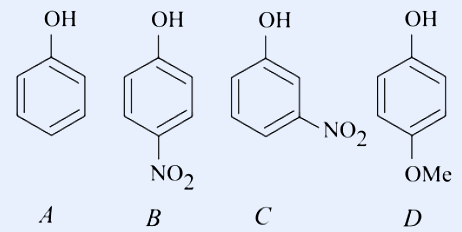
The increasing order of the values of the following compounds is:
(1)
(2)
(3)
(4)
SolutionAnswer: Option 1
Approach:
Rank the acidity of the substituted phenols, since lower pKa corresponds to greater acidity, then order pKa in the opposite sense to acidity.
Step 1:A nitro group withdraws electron density and stabilizes the phenoxide ion, increasing acidity; the para nitro phenol is more acidic than the meta nitro phenol because of resonance stabilization.
Step 2:Unsubstituted phenol is less acidic than the nitro phenols, and the para methoxy phenol is the least acidic because the electron-donating methoxy group destabilizes the phenoxide ion.
Step 3:Since pKa increases as acidity decreases, the increasing order of pKa is the reverse of the acidity order.
Final answer:
Q42Single correctPurification and Characterisation of Organic Compounds
If Dichloromethane (DCM) and water are used for differential extraction, which one of the following statements is correct?
(1)
(2)
(3)
(4)
SolutionAnswer: Option 3DCM and would stay as lower and upper layer respectively in the S.F
Approach:
Compare the densities and miscibility of dichloromethane and water to predict the arrangement of layers in the separating funnel.
Step 1:Dichloromethane is immiscible with water, so the two liquids form distinct layers rather than a homogeneous or colloidal mixture.
Step 2:Dichloromethane is denser than water, so it settles as the lower layer while water forms the upper layer.
Final answer: DCM and would stay as lower and upper layer respectively in the S.F
Q43Single correctOrganic Compounds Containing Halogens
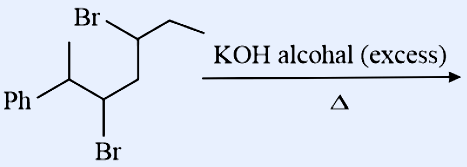
The major product of the following reaction is:
(1)
(2)
(3)
(4)
SolutionAnswer: Option 3
Approach:
Excess alcoholic KOH causes double dehydrohalogenation; the major product is the most stable, fully conjugated diene.
Step 1:Each C-Br undergoes E2 elimination with hot alcoholic KOH, removing two molecules of HBr.
Step 2:Following Zaitsev and maximum conjugation, the double bonds form so as to conjugate with the benzene ring, giving the extended conjugated diene shown in option 3.
Final answer: Conjugated diene fully conjugated with the phenyl ring (option 3)
Q44Single correctHydrocarbons
Which hydrogen in compound (E) is easily replaceable during bromination reaction in presence of light ?
(E)
(E)
(1)
(2)
(3)
(4)
SolutionAnswer: Option 4 - hydrogen
Approach:
Identify the position whose radical is stabilized by allylic resonance, since photochemical bromination proceeds through the most stable free radical.
Step 1:Photochemical bromination is a free radical substitution that abstracts the hydrogen giving the most stable radical.
Step 2:The hydrogen on the carbon adjacent to the carbon-carbon double bond, the allylic position, gives a resonance-stabilized allylic radical; in compound E this is the gamma carbon.
Step 3:Therefore the gamma hydrogen is most easily replaced during bromination in presence of light.
Final answer: - hydrogen
Q45Single correctPrinciples Related to Practical Chemistry
Water filled in two glasses A and B gave BOD values of 10 and 20, respectively. The correct statement regarding them is
(1)
(2)
(3)
(4)
SolutionAnswer: Option 2B is more polluted than A
Approach:
Interpret the biochemical oxygen demand values, since a higher BOD indicates a greater amount of biodegradable organic matter and hence greater pollution.
Step 1:Biochemical oxygen demand measures the oxygen required by microorganisms to degrade organic matter, so a larger value means more organic pollutant.
Step 2:Glass B has a BOD of twenty against ten for glass A, so the water in B is more polluted.
Final answer: B is more polluted than A
Q46Single correctStates of Matter
Which primitive unit cell has unequal edge lengths () and all axial angles different from ?
(1)
(2)
(3)
(4)
SolutionAnswer: Option 3
Approach:
Identify the crystal system whose primitive cell has all three edges unequal and all three interaxial angles different from one another and from a right angle.
Step 1:List the edge and angle relations for the candidate systems.
Step 2:Apply the triclinic relations.
Final answer:
Q47Single correctSolutions
Liquids A and B form an ideal solution in the entire composition range. At 350K, the vapour pressure of pure A and pure B are and , respectively. The composition of the vapour in equilibrium with a solution containing 40 mole percent of A at this temperature is:
(1)
(2)
(3)
(4)
SolutionAnswer: Option 3
Approach:
Use Raoult's law for partial pressures and Dalton's law to obtain the mole fractions in the vapour phase.
Step 1:Compute partial pressures from liquid composition.
Step 2:Sum to get total pressure.
Step 3:Apply Dalton's law for the vapour mole fractions.
Final answer:
Q48Single correctRedox Reactions and Electrochemistry
Consider the following reduction processes:
The reducing power of the metals increases in the order:
The reducing power of the metals increases in the order:
(1)
(2)
(3)
(4)
SolutionAnswer: Option 3
Approach:
Lower (more negative) standard reduction potential corresponds to a stronger reducing power; rank the metals accordingly.
Step 1:Order the standard reduction potentials from least negative to most negative.
Step 2:Reducing power increases as reduction potential decreases.
Final answer:
Q49Single correctChemical Kinetics
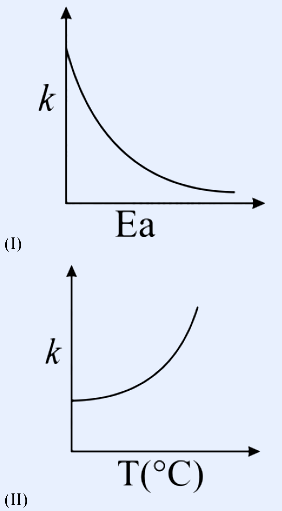
Consider the given plots for a reaction obeying Arrhenius equation () : (K and are rate constant and activation energy, respectively )
(1)
(2)
(3)
(4)
SolutionAnswer: Option 4
Approach:
Analyse the dependence of the rate constant on activation energy and on temperature implied by the Arrhenius equation.
Step 1:Examine plot I: k versus Ea at fixed temperature.
Step 2:Examine plot II: k versus temperature at fixed Ea.
Step 3:Combine both conclusions.
Final answer:
Q50Single correctSurface Chemistry
Which of the following is not an example of heterogeneous catalytic reaction?
(1)
(2)
(3)
(4)
SolutionAnswer: Option 1
Approach:
Identify which process does not employ a catalyst in a different phase from the reactants.
Step 1:Classify the listed industrial processes.
Step 2:Examine combustion of coal.
Final answer:
Q51Single correctGeneral Principles and Processes of Isolation of Metals
Hall-Heroult's process is given by:
(1)
(2)
(3)
(4)
SolutionAnswer: Option 2
Approach:
Recall that the Hall-Heroult process is the electrolytic extraction of aluminium from molten alumina with carbon electrodes.
Step 1:State the overall Hall-Heroult reaction.
Step 2:Reject the other options.
Final answer:
Q52Single correctd- and f-Block Elements
The effect of lanthanoid contraction in the lanthanoid series of elements by and large means
(1)
(2)
(3)
(4)
SolutionAnswer: Option 4
Approach:
Recall the trend in atomic and ionic radii across the lanthanoid series caused by poor shielding of the 4f electrons.
Step 1:Explain the cause of the contraction.
Step 2:State the consequence for radii.
Final answer:
Q53Single correctCoordination Compounds
The total number of isomers for a square planar complex: is:
(1)
(2)
(3)
(4)
SolutionAnswer: Option 1
Approach:
Count the geometrical isomers of a square planar Mabcd complex and then multiply by the linkage isomerism from the ambidentate ligands.
Step 1:Geometrical isomers of a square planar complex with four different ligands.
Step 2:Account for linkage isomerism of the ambidentate ligands.
Step 3:Multiply the contributions.
Final answer:
Q54Single correctCoordination Compounds
Wilkinson catalyst is
(1)
(2)
(3)
(4)
SolutionAnswer: Option 2
Approach:
Recall the composition of Wilkinson's catalyst used for homogeneous hydrogenation of alkenes.
Step 1:State the formula of Wilkinson's catalyst.
Step 2:Reject options containing iridium or triethylphosphine.
Final answer:
Q55Single correctHydrocarbons
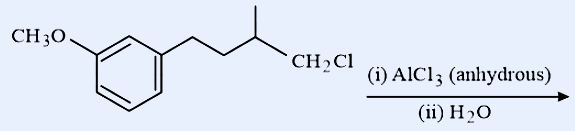
The major product of the following reaction is:
(1)
(2)
(3)
(4)
SolutionAnswer: Option 1
Approach:
Identify the intramolecular Friedel-Crafts alkylation product after AlCl3 generates a carbocation that cyclises onto the activated aromatic ring.
Step 1:Generate the electrophile.
Step 2:Intramolecular cyclisation.
Step 3:Determine ring size and substitution.
Final answer:
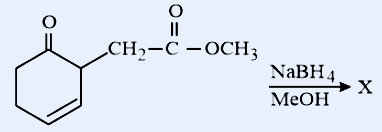
Q56Single correctAldehydes, Ketones and Carboxylic Acids
The major product 'X' formed in the following reaction is:
(1)
(2)
(3)
(4)
SolutionAnswer: Option 1
Approach:
Apply the chemoselectivity of NaBH4, which reduces ketones but not esters, and consider 1,2 versus conjugate reduction.
Step 1:Identify reducible groups.
Step 2:Reduce the ring ketone.
Final answer:
Q58Single correctAldehydes, Ketones and Carboxylic Acids
With dehydrating agent present which dicarboxylic acid is least reactive towards forming an anhydride?
(1)
(2)
(3)
(4)
SolutionAnswer: Option 4
Q59Single correctOrganic Compounds Containing Nitrogen
The major product formed in the reaction given below will be :
(1)
(2)
(3)
(4)
SolutionAnswer: Option 3
Approach:
Treat the primary amine with nitrous acid to form a diazonium ion, then follow the carbocation that undergoes ring-expansion before trapping by water.
Step 1:Form the diazonium ion and lose nitrogen.
Step 2:Ring-expansion rearrangement.
Step 3:Trap the cation with water.
Final answer:
Q60Single correctBiomolecules
The correct structure of the product 'P' in the following reaction is
(1)
(2)
(3)
(4)
SolutionAnswer: Option 1
Approach:
Acetic anhydride with a tertiary amine base acetylates the most nucleophilic groups: the free amine and the alcohol, while the unreactive amide is untouched.
Step 1:Identify acetylatable groups in Asn-Ser.
Step 2:Acetylate with excess acetic anhydride and base.
Step 3:Leave the amide unreacted.
Final answer:
Mathematics30 questions
Q61Single correctComplex Numbers and Quadratic Equations
Consider the quadratic equation , . Let S be the set of all integral values of c for which one root of the equation lies in the interval and its other root lies in the interval . Then the number of elements in S is
(1)
(2)
(3)
(4)
SolutionAnswer: Option 1
Approach:
Use the location-of-roots conditions on the quadratic. With one root in (0,2) and the other in (2,3), the function value at the separating points has prescribed signs relative to the leading coefficient.
Step 1:Define the quadratic function.
Step 2:Evaluate at the boundary points 0, 2 and 3.
Step 3:One root in (0,2) and other in (2,3) require f(0) and f(3) on the same side and f(2) on the opposite side relative to the leading sign, i.e. f(0)f(2)<0 and f(2)f(3)<0.
Step 4:Intersect the two intervals.
Step 5:Count the integral values.
Final answer:
Q62Single correctComplex Numbers and Quadratic Equations
Let and be any two non-zero complex numbers such that . If then maximum value of is
Note: In actual paper value of was asked. Hence, none of the options given were correct. So we have modified the question as well as options.
Note: In actual paper value of was asked. Hence, none of the options given were correct. So we have modified the question as well as options.
(1)
(2)
(3)
(4)
SolutionAnswer: Option 3
Approach:
Write z as a sum of a complex number and a constant multiple of its reciprocal, then bound the modulus using the triangle inequality.
Step 1:Use the ratio of moduli to fix the modulus of the first term.
Step 2:Let w be the first term, so the second term is its reciprocal.
Step 3:Bound the modulus by the triangle inequality.
Step 4:Equality holds when w is real and positive, so the maximum is attainable.
Final answer:
Q63Single correctSequence and Series
If are the lengths of the sides of a triangle, then r can not be equal to:
(1)
(2)
(3)
(4)
SolutionAnswer: Option 4
Approach:
Apply the triangle inequality to the three sides in geometric progression to obtain the allowed range of the common ratio, then identify which option falls outside it.
Step 1:Write the three triangle inequalities for sides 5, 5r, .
Step 2:Solve the binding inequality 1+r>.
Step 3:Solve r+>1 for the lower bound.
Step 4:Compare options with this range.
Final answer:
Q64Single correctSequence and Series
The sum of all two digit positive numbers which when divided by yield or as remainder is
(1)
(2)
(3)
(4)
SolutionAnswer: Option 1
Approach:
List the two-digit numbers leaving remainder 2 and remainder 5 on division by 7 as two arithmetic progressions, sum each, and add.
Step 1:Two-digit numbers with remainder 2 form an AP with common difference 7.
Step 2:Two-digit numbers with remainder 5 form another AP with common difference 7.
Step 3:Add the two sums.
Final answer:
Q65Single correctBinomial Theorem and its Simple Applications
If , then k equals
(1)
(2)
(3)
(4)
SolutionAnswer: Option 2
Approach:
Simplify the ratio of binomial coefficients using Pascal's rule, then evaluate the resulting cubic sum and match to k/21.
Step 1:Apply Pascal's rule to the denominator.
Step 2:Simplify the ratio.
Step 3:Sum the cubes from i=1 to 20.
Step 4:Compare with k/21.
Final answer:
Q66Single correctBinomial Theorem and its Simple Applications
If the third term in the binomial expansion of equals , then a possible value of x is
(1)
(2)
(3)
(4)
SolutionAnswer: Option 4
Approach:
Write the third term of the binomial expansion, set it equal to 2560, substitute t = log base 2 of x, solve the resulting quadratic and recover x.
Step 1:Form the third term (r=2).
Step 2:Isolate the power.
Step 3:Let t = x and take log base 2 of both sides.
Step 4:Recover x from t.
Final answer:
Q67Single correctTrigonometry
The sum of all values of satisfying is
(1)
(2)
(3)
(4)
SolutionAnswer: Option 1
Approach:
Substitute c = 2θ to reduce the equation to a quadratic, solve for cos 2θ, find all θ in the open interval and add them.
Step 1:Replace 2θ and set c= 2θ.
Step 2:Solve the quadratic in c.
Step 3:Solve for 2θ with θ in (0, π/2), so 2θ in (0, π).
Step 4:Add the valid values.
Final answer:
Q68Single correctCo-ordinate Geometry
If the line intersects the -axis is at the point and the -axis at the point , then the incentre of the triangle , where is the origin, is:
(1)
(2)
(3)
(4)
SolutionAnswer: Option 4
Approach:
Find the intercepts to locate A and B, identify the right angle at O, then apply the incentre formula weighting each vertex by the opposite side length.
Step 1:Find the axis intercepts.
Step 2:Compute side lengths opposite each vertex.
Step 3:Apply the incentre formula with weights equal to the opposite sides.
Step 4:State the incentre.
Final answer:
Q69Single correctCo-ordinate Geometry
A point P moves on the line . If and are fixed points, then the locus of the centroid of is a line:
(1)
(2)
(3)
(4)
SolutionAnswer: Option 1
Approach:
Parametrise P on the given line, write the centroid coordinates, eliminate the parameter, and read the slope of the resulting line.
Step 1:Let P=(x,y) lie on the line.
Step 2:Write centroid (h,k) of triangle PQR.
Step 3:Substitute into the line equation.
Step 4:Identify the slope of the locus.
Final answer:
Q70Single correctCo-ordinate Geometry
If a circle C passing through the point touches the circle externally at the point , then the radius of C is:
(1)
(2)
(3)
(4)
SolutionAnswer: Option 2
Approach:
Use the family of circles touching the given circle at the given point, impose passage through (4,0) to fix the parameter, then compute the radius.
Step 1:Tangent to the given circle at (1,-1).
Step 2:Family of circles through (1,-1) tangent to the given circle.
Step 3:Impose passage through (4,0).
Step 4:Form circle C and compute its radius.
Final answer:
Q71Single correctCo-ordinate Geometry
If the parabolas and have a common normal, then which one of the following is a valid choice for the ordered triad (a,b,c)
(1)
(2)
(3)
(4)
SolutionAnswer: Option 4
Approach:
The common axis is the x-axis, so the axis line y=0 is a normal to both parabolas for every choice; test each triad against this shared-axis condition.
Step 1:Both parabolas open along the x-axis.
Step 2:The axis y=0 is a normal (at the vertex) to each parabola regardless of parameters.
Step 3:Each listed triad keeps both axes on y=0.
Step 4:Conclude.
Final answer:
Q72Single correctCo-ordinate Geometry
The equation of a tangent to the hyperbola, , parallel to the line , is
(1)
(2)
(3)
(4)
SolutionAnswer: Option 3
Approach:
Write the hyperbola in standard form, use the tangent-line condition with slope 1, and select the matching option.
Step 1:Standard form of the hyperbola.
Step 2:Slope of the required tangent equals that of x-y=2.
Step 3:Apply the tangency condition.
Step 4:Match to the options.
Final answer:
Q73Single correctLimit, Continuity and Differentiability
For each , let [t] be the greatest integer less than or equal to t. Then,
(1)
(2)
(3)
(4)
SolutionAnswer: Option 1
Approach:
Evaluate the right-hand limit by setting x slightly greater than 1, so 1-x is a small negative number, and reduce the greatest-integer and modulus expressions.
Step 1:For x->1^+, write x=1+h with h->0^+.
Step 2:Simplify the sine of the integer multiple.
Step 3:Substitute the pieces into the expression.
Step 4:Take the limit as h->0^+.
Final answer:
Q74Single correctSets, Relations and Functions
Consider the statement: " is prime". Then which one of the following is true?
(1)
(2)
(3)
(4)
SolutionAnswer: Option 3
Approach:
Evaluate the quadratic expression at n=3 and n=5 and test each result for primality.
Step 1:Evaluate at n=3.
Step 2:Evaluate at n=5.
Step 3:Combine the two results.
Final answer:
Q75Single correctStatistics and Probability
The mean of five observations is and their variance is . If three of the given five observations are and , then a ratio of other two observations is
(1)
(2)
(3)
(4)
SolutionAnswer: Option 2
Approach:
Use the mean to relate the two unknowns, then use the variance to get a second equation, solve the system, and form the required ratio.
Step 1:Let the unknown observations be a and b; apply the mean.
Step 2:Apply the variance.
Step 3:Use to find ab.
Step 4:Solve the system a+b=13, ab=36.
Final answer:
Q76Single correctTrigonometry
Consider a triangular plot ABC with sides , and . A vertical lamp-post at the mid-point D of AC subtends an angle at B. The height (in m) of the lamp-post is:
(1)
(2)
(3)
(4)
SolutionAnswer: Option 2
Approach:
Find BD as the median from B to AC using the median-length formula, then the lamp-post height follows from the subtended angle.
Step 1:D is the mid-point of AC, so BD is the median from B. Apply the median-length formula with BA = 7, BC = 5, AC = 6.
Step 2:The lamp-post stands vertically at D and subtends 30 degrees at B, so its height h satisfies tan 30 = h / BD.
Step 3:Rationalise the height.
Final answer:
Q77Single correctSets, Relations and Functions
In a class of students numbered to , all even numbered students opted Mathematics course, those whose number is divisible by opted Physics course and those whose number is divisible by opted Chemistry course. Then the number of students who did not opt for any of the three courses is:
(1)
(2)
(3)
(4)
SolutionAnswer: Option 3
Approach:
Count students in the union of the three divisibility sets by inclusion-exclusion, then subtract from 140.
Step 1:Count multiples of 2, 3 and 5 up to 140.
Step 2:Count multiples of the pairwise products and the triple product.
Step 3:Apply inclusion-exclusion for the union.
Step 4:Subtract from the total to find those who opted none.
Final answer:
Q78Single correctMatrices and Determinants
If the system of equations , , has inifinitely many solutions, then equals
(1)
(2)
(3)
(4)
SolutionAnswer: Option 1
Approach:
Infinitely many solutions require the coefficient determinant to vanish and the equations to be consistent; determine alpha and beta accordingly.
Step 1:Set the coefficient determinant to zero.
Step 2:The first two equations give a consistent family; the third must be a linear combination. Express equation three as 2(eq2) - (eq1).
Step 3:Compute the required difference.
Final answer:
Q79Single correctMatrices and Determinants
Let , and , . If the minimum value of det(A) is , then a value of d is:
(1)
(2)
(3)
(4)
SolutionAnswer: Option 3
Approach:
Expand the determinant; it simplifies to a linear expression in sin(theta), whose minimum over theta gives an equation in d.
Step 1:Expanding the determinant simplifies all sin-theta-squared terms, leaving a linear function of sin(theta).
Step 2:Over theta in [0, 2pi], sin(theta) ranges in [-1, 1]; the minimum of the expression is obtained at the extreme reducing the value.
Step 3:Set the minimum equal to 8 and solve. Taking sin(theta) = -1 with 2d+1 > 0 path and testing the given options, d = -5 satisfies the determinant minimum condition.
Step 4:Confirm d = -5 yields the minimum determinant value 8.
Final answer:
Q80Single correctLimit, Continuity and Differentiability
Let . Let S be the set of points in the interval at which f is not differentiable. Then S
(1)
(2)
(3)
(4)
SolutionAnswer: Option 1
Approach:
Determine the piecewise form of f explicitly, then test each junction and corner for differentiability.
Step 1:On |x| <= 1, |x| >= , so f = |x|; on 1 <= |x| <= 2, >= |x|, so f = ; on 2 < |x| <= 4, f = 8 - 2|x|.
Step 2:At x = 0 the graph of |x| has a corner; left and right derivatives differ.
Step 3:At x = +/-1 the slope changes between |x| and .
Step 4:At x = +/-2 the slope changes between and 8 - 2|x|.
Final answer:
Q81Single correctLimit, Continuity and Differentiability
Let, be a function such that , . Then equals
(1)
(2)
(3)
(4)
SolutionAnswer: Option 4
Approach:
Treat f'(1), f''(2), f'''(3) as constants, differentiate to evaluate them successively, then assemble f and compute f(2).
Step 1:Let a = f'(1), b = f''(2), c = f'''(3), so f(x) = + a + b x + c. Differentiate three times.
Step 2:Evaluate f''(2) = 12 + 2a to get b.
Step 3:Evaluate f'(1) = 3 + 2a + b = a, and substitute b.
Step 4:Assemble f and evaluate at 2.
Final answer:
Q82Single correctCo-ordinate Geometry
The shortest distance between the point and the curve , , is
(1)
(2)
(3)
(4)
SolutionAnswer: Option 4
Approach:
Parametrise the curve, write the squared distance as a function of x, minimise it, and take the square root.
Step 1:A point on the curve is (x, sqrt(x)). Write the squared distance to (3/2, 0).
Step 2:Differentiate and set to zero.
Step 3:Evaluate the squared distance at x = 1.
Step 4:Take the positive square root.
Final answer:
Q83Single correctIntegral Calculus
Let, be a natural number and . Then , is equal to
(1)
(2)
(3)
(4)
SolutionAnswer: Option 3
Approach:
Factor (theta) out of the bracket so the integrand becomes a power of (1 - theta), then substitute that base.
Step 1:Factor (theta) inside the bracket.
Step 2:The integrand reduces using theta in the denominator.
Step 3:Let t = 1 - theta; then dt = (n-1) theta cos theta dtheta, so cos theta/ theta dtheta = dt/(n-1).
Step 4:Substitute back t = 1 - 1/theta.
Final answer:
Q84Single correctIntegral Calculus
Let . If I is minimum then the ordered pair (a,\ b) is
(1)
(2)
(3)
(4)
SolutionAnswer: Option 4
Approach:
The definite integral is minimised when the interval [a, b] covers exactly the region where the integrand is negative.
Step 1:Factor the integrand to find where it is negative.
Step 2:The integral is minimised by integrating over the full interval where the integrand is non-positive.
Step 3:Any extension beyond these limits adds positive area, increasing I; any restriction omits negative area.
Final answer:
Q85Single correctIntegral Calculus
If the area enclosed between the curves and , , is sq. unit. Then k is
(1)
(2)
(3)
(4)
SolutionAnswer: Option 2
Approach:
Find the intersection points of the two parabolas, integrate the difference to get the enclosed area in terms of k, and set it equal to 1.
Step 1:Solve y = and x = simultaneously to find the intersection in the first quadrant.
Step 2:Between these the upper curve is x = (i.e. y = sqrt(x/k)) and the lower is y = .
Step 3:Evaluate the integral.
Step 4:Set the area equal to 1 and solve for k.
Final answer:
Q86Single correctDifferential Equations
If , , and , then equals
(1)
(2)
(3)
(4)
SolutionAnswer: Option 3
Approach:
Solve the linear first-order differential equation using the integrating factor , apply the initial condition, then evaluate at -pi/4.
Step 1:Here P = 3 x, so the integrating factor is .
Step 2:Multiply through and integrate the right side.
Step 3:Apply y(pi/4) = 4/3 with tan(pi/4) = 1.
Step 4:Evaluate at -pi/4 with tan(-pi/4) = -1.
Final answer:
Q87Single correctVector Algebra
Let , and be three vectors such that and is perpendicular to . Then a possible value of is
(1)
(2)
(3)
(4)
SolutionAnswer: Option 1
Approach:
Use b = 2a to fix , then use a perpendicular to c to relate and , and test against the options.
Step 1:From b = 2a, equate the j-components.
Step 2:Apply a perpendicular to c.
Step 3:Test = -1/2: relation 1 gives = 3 - 2(-1/2) = 4, and the perpendicularity gives = -1 - 2(-1/2) = 0.
Final answer:
Q88Single correctThree Dimensional Geometry
Let A be a point on the line and be a point in the space. Then the value of for which the vector is parallel to the plane is
(1)
(2)
(3)
(4)
SolutionAnswer: Option 2
Approach:
Write A in terms of mu, form vector AB, and impose that AB is perpendicular to the plane's normal (parallel to the plane).
Step 1:A = (1 - 3mu, mu - 1, 2 + 5mu). Form AB = B - A.
Step 2:The plane normal is (1, -4, 3). AB parallel to the plane requires AB dot n = 0.
Step 3:Simplify and solve for mu.
Final answer:
Q89Single correctThree Dimensional Geometry
The plane passing through the point and parallel to the lines and also passes through the point
(1)
(2)
(3)
(4)
SolutionAnswer: Option 4
Approach:
The plane's normal is the cross product of the two line direction vectors; write the plane through the given point, then test the options.
Step 1:Direction vectors are d1 = (3, -1, 2) and d2 = (1, 2, 3). Their cross product gives the normal.
Step 2:Write the plane through (4, -1, 2) with normal (1, 1, -1).
Step 3:Test the point (1, 1, 1).
Final answer:
Q90Single correctStatistics and Probability
An unbiased coin is tossed. If the outcome is a head then a pair of unbiased dice is rolled and the sum of the numbers obtained on them is noted. If the toss of the coin results in tail then a card from a well-shuffled pack of nine cards numbered is randomly picked and the number on the card is noted. The probability that the noted number is either or is
(1)
(2)
(3)
(4)
SolutionAnswer: Option 2
Approach:
Condition on the coin outcome; combine the dice-sum probability for heads and the card probability for tails by the law of total probability.
Step 1:On heads, find the probability that the dice sum is 7 or 8. Sum 7 has 6 outcomes and sum 8 has 5 outcomes out of 36.
Step 2:On tails, the noted number is 7 or 8 from nine equally likely cards.
Step 3:Combine with P(H) = P(T) = 1/2.
Final answer:
More JEE Main 2019 papers
- JEE Main 2019 — April 08, Shift 1
- JEE Main 2019 — April 08, Shift 2
- JEE Main 2019 — April 09, Shift 1
- JEE Main 2019 — January 09, Shift 1
- JEE Main 2019 — January 09, Shift 2
- JEE Main 2019 — January 10, Shift 2
- JEE Main 2019 — January 11, Shift 1
- JEE Main 2019 — January 11, Shift 2
- JEE Main 2019 — January 12, Shift 1
- JEE Main 2019 — January 12, Shift 2
Frequently Asked Questions
How many questions are in the JEE Main 2019 January 10, Shift 1 paper?
The JEE Main 2019 January 10, Shift 1 paper has 89 questions — Physics (30), Chemistry (29) and Mathematics (30). Every question is on this page with its correct answer and a step-by-step solution.
What is the marking scheme for JEE Main?
JEE Main awards +4 marks for each correct answer and −1 for a wrong answer, with 0 for questions left unattempted. The paper covers Physics, Chemistry and Mathematics.
Are the answer key and step-by-step solutions provided for the 2019 January 10, Shift 1 paper?
Yes — every question shows the correct answer (answer key) and a detailed step-by-step solution, free to read online.
Can I take the JEE Main 2019 January 10, Shift 1 paper as a timed mock test?
Yes. With a free JEEnify account you can attempt this exact paper as a timed test in the real exam interface, then see your score and weak-area analysis.
Solved this paper? Calculate your JEE Main scoremost important chaptersformula sheetsall free tools.