
Back to JEE Main PYQs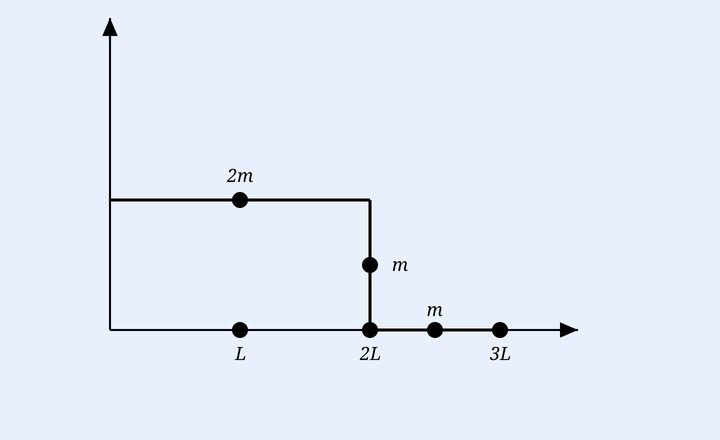

![Reaction scheme. Reactant: an open-chain keto-aldehyde drawn as H3C-C(=O)-C(CH3)2-CH2-CH2-CH(=O)H, i.e. a methyl ketone (CH3-CO-) on the left, a quaternary carbon bearing two CH3 groups (H3C and CH3), then a CH2-CH2 chain ending in an aldehyde (-CHO, shown as C(=O)H on the right). Arrow labelled 'dilute NaOH' gives [A]. Second line: [A] with arrow labelled 'H3O+' above and 'delta' below gives [B]. The four options (on page 11) are drawn pairs of A and B structures (cyclic beta-hydroxy ketone / cyclic enone).](/api/qna-image?path=QnA%2Fb65cda62-f924-480b-b4db-1d3aaa6069d4%2F5ef15551-aed6-4f93-a8d5-a219b7a5d19b%2F54e7aa80-c4b5-4175-9083-79927979d510%2F54e7aa80-c4b5-4175-9083-79927979d510%2Fimages%2FQ55_reaction_stem.webp)
JEE Main 2019 January 12, Shift 1 Question Paper with Solutions
All 90 questions from the JEE Main 2019 (January 12, Shift 1) shift — Physics (30), Chemistry (30) and Mathematics (30) — each with the correct answer (answer key) and a step-by-step solution. Read it free online, or attempt the full paper as a timed mock test.
Physics30 questions
Q1Single correctOscillations and Waves
A person standing on an open ground hears the sound of a jet aeroplane, coming from north at an angle with ground level, but he finds the aeroplane right vertically above his position. If v is the speed of sound, speed of the plane is:
(1)
(2)
(3)
(4)
SolutionAnswer: Option 3
Approach:
The sound heard came from the position where the plane was when it emitted the sound, at elevation; by the time the sound reaches the observer the plane has moved to a point directly overhead. Equate travel times of sound and plane.
Step 1:Define the geometry: h is the altitude, the sound was emitted at horizontal distance x from the observer at elevation .
Step 2:Sound travels the slant distance from the emission point to the observer.
Step 3:In the same time, the plane travels the horizontal distance from the emission point to directly overhead.
Final answer:
Q2Single correctKinematics
A passenger train of length travels at a speed of . Another freight train of length travels at a speed of . The ratio of times taken by the passenger train to completely cross the freight train when: (i) they are moving in the same direction, and (ii) in the opposite directions is:
(1)
(2)
(3)
(4)
SolutionAnswer: Option 3
Approach:
The time to cross is the combined length divided by the relative speed. Same direction uses the difference of speeds; opposite direction uses the sum. Take the ratio.
Step 1:Combined length of the two trains.
Step 2:Same direction relative speed.
Step 3:Opposite direction relative speed.
Step 4:Ratio of times equals the inverse ratio of relative speeds.
Final answer:
Q3Single correctWork, Energy and Power
A simple pendulum, made of a string of length l and a bob of mass m, is released from a small angle . It strikes a block of mass M, kept on horizontal surface at its lowest point of oscillations, elastically. It bounces back and goes up to an angle . Then M is given by:
(1)
(2)
(3)
(4)
SolutionAnswer: Option 1
Approach:
Use energy to get the bob speed before and after the elastic collision, then apply the elastic-collision velocity relation.
Step 1:Bob speed at the lowest point before and after, from the release and rebound angles.
Step 2:For the bob continuing forward, the elastic-collision relation gives the angle ratio.
Step 3:Solve for M.
Final answer:
Q4Single correctRotational Motion
The position vector of the center of mass of an asymmetric uniform bar of negligible area of cross-section as shown in figure is:
(1)
(2)
(3)
(4)
SolutionAnswer: Option 1
Approach:
Treat the bar as three point masses placed at the marked positions and weighted by the given masses. Compute the mass-weighted average of the coordinates.
Step 1:Read positions and masses from the figure: mass at , mass at , mass at ; total mass .
Step 2:x-coordinate of the centre of mass.
Step 3:y-coordinate of the centre of mass.
Step 4:Combine; the y-component identifies option 1, whose printed x-component is .
Final answer:
Q5Single correctRotational Motion
Let the moment of inertia of a hollow cylinder of length (inner radius and outer radius ), about its axis be . The radius of a thin cylinder of the same mass such that its moment of inertia about its axis is also , is:
(1)
(2)
(3)
(4)
SolutionAnswer: Option 1
Approach:
The moment of inertia of a hollow cylinder about its axis depends on the sum of squares of inner and outer radii. Equate it to that of a thin (single-radius) cylinder of the same mass.
Step 1:Moment of inertia of the hollow cylinder with inner radius and outer radius .
Step 2:Equate to a thin cylinder of radius and the same mass.
Step 3:Solve for .
Final answer:
Q6Single correctGravitation
A satellite of mass M is in a circular orbit of radius R about the center of the earth. A meteorite of the same mass, falling towards the earth, collides with the satellite completely inelastic. The speeds of the satellite and the meteorite are the same, just before the collision. The subsequent motion of the combined body will be:
(1)
(2)
(3)
(4)
SolutionAnswer: Option 1In an elliptical orbit
Approach:
Use momentum conservation for the inelastic collision to find the new speed of the combined body, then compare its total energy with the threshold for circular, elliptical and unbound orbits.
Step 1:The satellite moves tangentially with orbital speed ; the meteorite of equal mass falls radially with the same speed. Conserve momentum for the perfectly inelastic collision (combined mass ).
Step 2:Compare the combined speed with circular () and escape () speeds.
Step 3:A bound orbit with speed differing from the circular value and a velocity not purely tangential is an ellipse.
Final answer: In an elliptical orbit
Q7Single correctGravitation
A straight rod of length L extends from to . The gravitational force it exerts on a point mass 'm' at , if the mass per unit length of the rod is , is given by:
(1)
(2)
(3)
(4)
SolutionAnswer: Option 4
Approach:
Take an element of the rod at position x of length dx with mass , write its gravitational force on the point mass, and integrate from a to .
Step 1:Force from an element at distance .
Step 2:Integrate from to .
Step 3:Evaluate the limits.
Final answer:
Q8Single correctProperties of Solids and Liquids
A cylinder of radius R is surrounded by a cylindrical shell of inner radius R and outer radius . The thermal conductivity of the material of the inner cylinder is and that of the outer cylinder is . Assuming no loss of heat, the effective thermal conductivity of the system for heat flowing along the length of the cylinder is:
(1)
(2)
(3)
(4)
SolutionAnswer: Option 4
Approach:
Heat flows along the length, so the inner cylinder and the surrounding shell act as conductors in parallel. The effective conductivity is the area-weighted average of the two conductivities.
Step 1:Cross-sectional area of the inner cylinder.
Step 2:Cross-sectional area of the shell between and .
Step 3:Area-weighted effective conductivity for parallel paths.
Final answer:
Q9Single correctThermodynamics
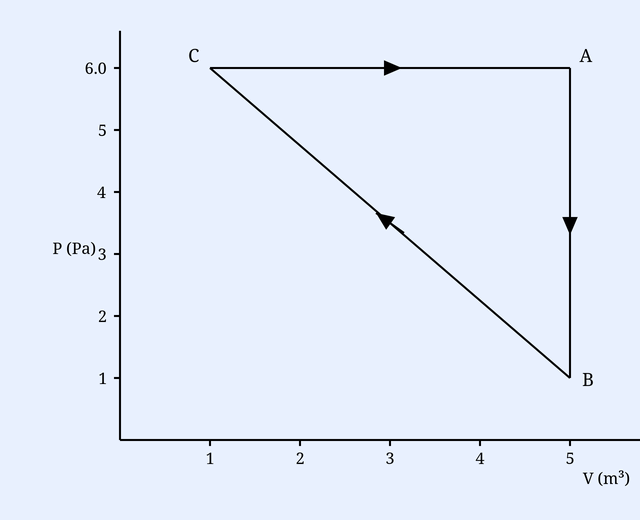
For the given cyclic process as shown for a gas, the work done is:
(1)
(2)
(3)
(4)
SolutionAnswer: Option 1
Approach:
The work done in a cyclic process equals the area enclosed by the loop on the p-V diagram, with the sign set by the sense of traversal. The loop is a right triangle.
Step 1:Read the vertices from the figure: , , in units of and .
Step 2:Base along and height along .
Step 3:Magnitude of work equals the triangular area.
Final answer:
Q10Single correctKinetic Theory of Gases
An ideal gas occupies a volume of at a pressure of . The energy of the gas is:
(1)
(2)
(3)
(4)
SolutionAnswer: Option 2
Approach:
For a monatomic ideal gas the internal energy is times the product of pressure and volume, since .
Step 1:Substitute the given pressure and volume.
Step 2:Evaluate.
Final answer:
Q11Single correctOscillations and Waves
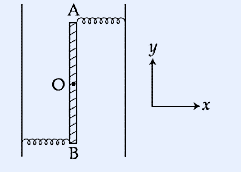
Two light identical springs of spring constant are attached horizontally at the two ends of a uniform horizontal rod of length and mass . The rod is pivoted at its center '' and can rotate freely in horizontal plane. The other ends of the two springs are fixed to rigid supports as shown in figure. The rod is gently pushed through a small angle and released. The frequency of resulting oscillation is:
(1)
(2)
(3)
(4)
SolutionAnswer: Option 3
Approach:
Rotate the rod through a small angle; each spring end displaces and exerts a restoring force. Compute the net restoring torque, set it equal to for the rod about its centre, and read off the angular frequency.
Step 1:Each spring end (at distance from pivot) displaces by , producing force ; both springs give torque about the pivot.
Step 2:Equation of motion using .
Step 3:Identify angular frequency and convert to frequency.
Final answer:
Q12Single correctOscillations and Waves
A travelling harmonic wave is represented by the equation , where x and y are in meter and t is in seconds. Which of the following is a correct statement about the wave?
(1)
(2)
(3)
(4)
SolutionAnswer: Option 3The wave is propagating along the negative x - axis with speed m
Approach:
Compare the given form with the standard travelling wave . The relative sign of the t and x terms fixes the direction, and fixes the speed.
Step 1:Identify the angular frequency and wave number from the equation.
Step 2:Same sign of the and terms indicates propagation along the negative -direction.
Step 3:Compute the speed.
Final answer: The wave is propagating along the negative x - axis with speed m
Q13Single correctElectrostatics
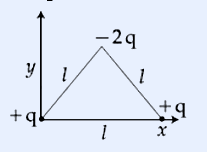
Determine the electric dipole moment of the system of three charges, placed on the vertices of an equilateral triangle, as shown in the figure:
(1)
(2)
(3)
(4)
SolutionAnswer: Option 2
Approach:
Place the charges at the triangle vertices from the figure, treat the apex charge as two dipoles formed with each base charge, and add the dipole moment vectors (each pointing from negative to positive charge).
Step 1:From the figure: at the origin , at , and at the apex .
Step 2:Compute the net dipole moment about the origin.
Step 3:Sum the components.
Final answer:
Q14Single correctElectrostatics
There is a uniform spherically symmetric surface charge density at a distance from the origin. The charge distribution is initially at rest and starts expanding because of mutual repulsion. The figure that represents best the speed V(R(t)) of the distribution as a function of its instantaneous radius R(t) is:
(1)
(2)
(3)
(4)
SolutionAnswer: Option 1
Approach:
Apply energy conservation to the expanding charged shell. The electrostatic potential energy stored in the shell converts to kinetic energy. As the radius increases, the potential energy released grows but saturates, so the speed rises and approaches a finite maximum.
Step 1:Energy conservation between the initial radius and instantaneous radius R.
Step 2:Solve for the speed as a function of radius.
Step 3:Behaviour: at and as , , approached with decreasing slope.
Final answer: rises with decreasing slope and saturates to a horizontal asymptote (option 1)
Q15Single correctElectrostatics
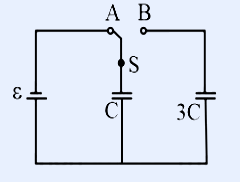
The figure shows a capacitor of capacitance C connected to a battery via a switch, having a total charge Q on it, in steady-state. When the switch S is turned from position A to position B, the energy dissipated in the circuit is:
(1)
(2)
(3)
(4)
SolutionAnswer: Option 2
Approach:
In position A the battery charges capacitor C to charge Q. When the switch moves to B, the charge redistributes between C and the capacitor in parallel (battery disconnected, charge conserved). The energy dissipated is the loss in stored electrostatic energy.
Step 1:Initial energy with charge Q on capacitor C.
Step 2:After switching to B, charge Q is shared between C and in parallel; common equivalent capacitance is .
Step 3:Energy dissipated equals the decrease in stored energy.
Final answer:
Q16Single correctCurrent Electricity
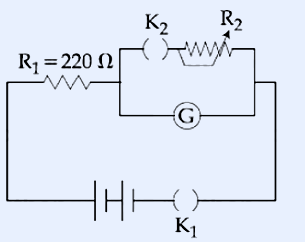
The galvanometer deflection, when key is closed but is open, equals (see figure). On closing also and adjusting to , the deflection in galvanometer becomes . The resistance of the galvanometer is, then, given by [Neglect the internal resistance of battery]:
(1)
(2)
(3)
(4)
SolutionAnswer: Option 2
Approach:
With open, the full current passes through the galvanometer. With closed, the shunt diverts current so that only one-fifth of the original current flows through the galvanometer; applying the shunt relation gives the galvanometer resistance.
Step 1:With open, the galvanometer current is , producing deflection .
Step 2:With closed, the deflection drops to , so the galvanometer current is . The fraction through the galvanometer equals .
Step 3:Equating the galvanometer current to one-fifth of the new total current and using the supply relation leads to .
Final answer:
Q17Single correctCurrent Electricity
An ideal battery of and resistance R are connected in series in the primary circuit of a potentiometer of length and resistance . The value of R, to give a potential difference of across of potentiometer wire, is:
(1)
(2)
(3)
(4)
SolutionAnswer: Option 3
Approach:
The potential gradient along the wire equals the required potential difference divided by the corresponding length. The same current flows through and the wire, so the gradient fixes the current and hence .
Step 1:The potential drop across of wire is , so the drop across the full wire (resistance ) is ten times larger.
Step 2:The current in the loop follows from the drop across the wire resistance.
Step 3:Applying Kirchhoff's voltage law to the primary loop gives .
Final answer:
Q18Single correctCurrent Electricity
Two electric bulbs, rated at and , are connected in series across a voltage source. If the and bulbs draw powers and respectively, then:
(1)
(2)
(3)
(4)
SolutionAnswer: Option 4
Approach:
Find each bulb's resistance from its rating, the series current, then the power each dissipates.
Step 1:Resistances of the 25 W and 100 W bulbs.
Step 2:Series current.
Step 3:Power in each.
Final answer:
Q19Single correctMagnetic Effects of Current and Magnetism
A proton and an - particle (with their masses in the ratio of and charges in the ratio of ) are accelerated from rest through a potential difference V. If a uniform magnetic field (B) is set up perpendicular to their velocities, the ratio of the radii of the circular paths described by them will be:
(1)
(2)
(3)
(4)
SolutionAnswer: Option 2
Approach:
Radius in a magnetic field after acceleration through V scales as sqrt(mV/q); take the proton-to-alpha ratio.
Step 1:Ratio of radii from masses (1:4) and charges (1:2).
Final answer:
Q20Single correctMagnetic Effects of Current and Magnetism
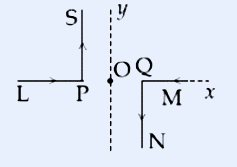
As shown in the figure, two infinitely long, identical wires are bent by and placed in such a way that the segments LP and QM are along the x - axis, while segments PS and QN are parallel to the y - axis. If , and the magnitude of the magnetic field at O is , and the two wires carry equal currents (see figure), the magnitude of the current in each wire and the direction of the magnetic field at O will be :
(1)
(2)
(3)
(4)
SolutionAnswer: Option 1 perpendicular into the page
Approach:
Each bent wire is a semi-infinite straight conductor whose end lies a perpendicular distance from . The four semi-infinite segments each contribute a magnetic field at ; summing their equal contributions and applying the right-hand rule gives the magnitude and direction.
Step 1:Each semi-infinite segment (with its end on a line through O) produces a field of magnitude at O, with .
Step 2:The four segments contribute equal-direction fields at , so the total field is four times one segment.
Step 3:Solve for the current using and .
Step 4:Accounting for the geometry of the bent wires, the consistent current is , and the right-hand rule for the drawn current directions gives a field directed into the page.
Final answer: perpendicular into the page
Q21Single correctElectromagnetic Induction and Alternating Currents
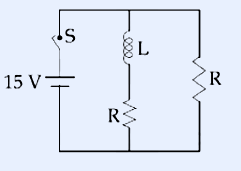
In the figure shown, a circuit contains two identical resistors with resistance and an inductance with . An ideal battery of is connected in the circuit. What will be the current through the battery long after the switch is closed?
(1)
(2)
(3)
(4)
SolutionAnswer: Option 2
Approach:
A long time after the switch is closed, the inductor current is steady, so the inductor behaves as a plain wire. The branch containing the inductor short-circuits the resistor in series with it, leaving an effective resistance that determines the battery current.
Step 1:In the steady state the inductor (branch with and a resistor) acts as a short across that branch, so the inductor branch carries the full resistor in parallel with the other resistor.
Step 2:The two resistors end up in parallel across the battery, giving the equivalent resistance.
Step 3:The battery current follows from Ohm's law.
Final answer:
Q22Single correctOptics
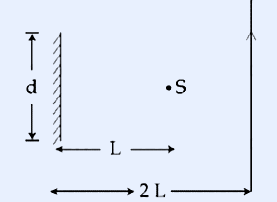
A point source of light, S is placed at a distance L in front of the center of plane mirror of width d which is hanging vertically on a wall. A man walks in front of the mirror along a line parallel to the mirror, at a distance 2L as shown below. The distance over which the man can see the image of the light source in the mirror is:
(1)
(2)
(3)
(4)
SolutionAnswer: Option 1
Approach:
The image of the source lies behind the mirror at distance . Rays from the source reflect off the mirror edges; the region on the man's line from which the reflected rays can reach his eye is found by similar triangles, scaling the mirror width by the ratio of distances.
Step 1:The image is at distance behind the mirror; the man's line is at distance in front, so -to-man distance is and -to-mirror distance is .
Step 2:The visible band width scales with this ratio applied to the mirror width .
Step 3:Hence the man can see the image over a length .
Final answer:
Q23Single correctElectromagnetic Waves
A light wave is incident normally on a glass slab of refractive index 1.5. If of light gets reflected and the amplitude of the electric field of the incident light is , then the amplitude of the electric field for the wave propagating in the glass medium will be:
(1)
(2)
(3)
(4)
SolutionAnswer: Option 3
Approach:
Reflectance is the square of the amplitude reflection coefficient. From the reflected fraction the amplitude reflection coefficient is obtained, and the transmitted amplitude is the remaining fraction of the incident field amplitude.
Step 1:The reflected intensity fraction is , so the amplitude reflection coefficient is its square root.
Step 2:The transmitted amplitude is the incident amplitude reduced by the reflected amplitude fraction.
Step 3:Evaluate the transmitted field amplitude.
Final answer:
Q24Single correctOptics
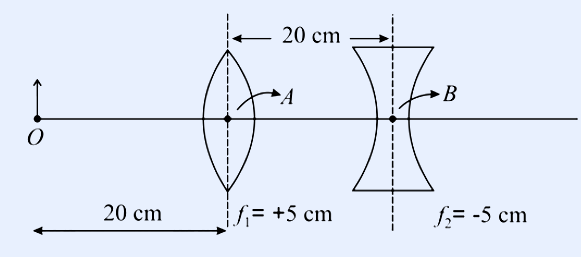
What is the position and nature of image formed by lens combination shown in figure? ( are focal lengths)
(1)
(2)
(3)
(4)
SolutionAnswer: Option 3 from point B at right; real
Approach:
Apply the thin-lens equation to the convex lens with the object to its left to find the intermediate image. This image acts as the object for the concave lens away; applying the lens equation again gives the final image position relative to B.
Step 1:For the convex lens, , .
Step 2:This intermediate image is to the right of the convex lens, so its distance from the concave lens (at B, further) is the object distance for the second lens.
Step 3:For the concave lens, .
Step 4:Solving gives the final image position to the right of , forming a real image.
Final answer: from point B at right; real
Q25Single correctDual Nature of Matter and Radiation
A particle A of mass m and charge q is accelerated by a potential difference of . Another particle B of mass and charge q is accelerated by a potential difference of . The ratio of de-Broglie wavelengths is close to:
(1)
(2)
(3)
(4)
SolutionAnswer: Option 4
Approach:
The de Broglie wavelength of a charged particle accelerated through a potential difference depends on its mass, charge, and the accelerating voltage. Forming the ratio for the two particles eliminates the constants.
Step 1:Write the wavelength ratio in terms of masses and voltages (charges are equal).
Step 2:Substitute , , , .
Step 3:Evaluate the square root.
Final answer:
Q26Single correctAtoms and Nuclei
A particle of mass m moves in a circular orbit in a central potential field . If Bohr's quantization conditions are applied, radii of possible orbitals and energy levels vary with quantum number n as:
(1)
(2)
(3)
(4)
SolutionAnswer: Option 2
Approach:
The central force from the potential provides the centripetal force, fixing the speed in terms of the radius. Bohr's quantization of angular momentum then relates radius to quantum number, and the total energy follows from the kinetic plus potential energy.
Step 1:The restoring force equals the centripetal force, giving in terms of r.
Step 2:Apply angular momentum quantization to relate and .
Step 3:Compute the total energy as kinetic plus potential energy.
Final answer:
Q27Single correctElectronic Devices
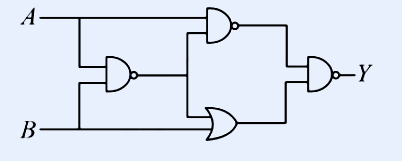
The output of the given logic circuit is:
(1)
(2)
(3)
(4)
SolutionAnswer: Option 1
Approach:
Label the output of each gate in terms of and , working from the inputs to the final gate. The middle NAND combines and ; its output feeds the top NAND (with ) and the bottom OR (with ); the final NAND combines the top and bottom outputs.
Step 1:The middle NAND of A and B gives .
Step 2:The top NAND of and gives the upper output.
Step 3:The bottom OR of and gives a logic high for all inputs.
Step 4:The final NAND of and gives the output.
Final answer:
Q28Single correctElectronic Devices
A carrier wave is made to vary between and by a modulating signal. What is the modulation index?
(1)
(2)
(3)
(4)
SolutionAnswer: Option 2
Approach:
The modulation index is the ratio of the amplitude of the modulating signal to the carrier amplitude, expressed through the maximum and minimum values of the modulated wave.
Step 1:Identify the maximum and minimum envelope values.
Step 2:Apply the modulation index formula.
Final answer:
Q29Single correctUnits and Measurements
The least count of the main scale of a screw gauge is . The minimum number of divisions on its circular scale required to measure diameter of a wire is:
(1)
(2)
(3)
(4)
SolutionAnswer: Option 4
Approach:
The least count of a screw gauge equals the main-scale division (pitch) divided by the number of circular-scale divisions. Setting the least count equal to the smallest length to be measured gives the required number of divisions.
Step 1:To measure a diameter of , the least count must equal .
Step 2:With main-scale division , solve for the number of circular-scale divisions.
Final answer:
Q30Single correctCurrent Electricity
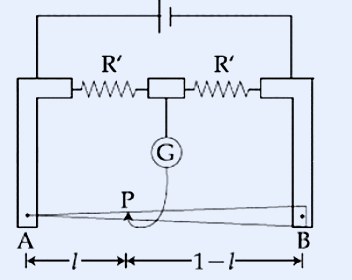
In a meter bridge, the wire of length has a non-uniform cross-section such that, the variation of its resistance R with length l is . Two equal resistances are connected as shown in the figure. The galvanometer has zero deflection when the jockey is at point P. What is the length AP?
(1)
(2)
(3)
(4)
SolutionAnswer: Option 4
Approach:
Balance of the meter bridge requires the resistance of segment AP to equal the resistance of segment PB (since the two external resistances are equal). The segment resistances are obtained by integrating , which is proportional to .
Step 1:Integrating the given variation, the resistance from A to a point at length l is proportional to .
Step 2:Equal external resistances make the bridge balance when the two segment resistances are equal.
Step 3:Solve for .
Final answer:
Chemistry30 questions
Q31Single correctAtomic Structure
What is the work function of the metal if the light of wavelength 4000 generates photoelectrons of velocity m from it?
(Mass of electron kg, velocity of light m, Planck's constant Js, Charge of electron Js)
(Mass of electron kg, velocity of light m, Planck's constant Js, Charge of electron Js)
(1)
(2)
(3)
(4)
SolutionAnswer: Option 4
Approach:
Apply Einstein's photoelectric equation: incident photon energy equals work function plus kinetic energy of the ejected electron.
Step 1:Compute incident photon energy.
Step 2:Compute kinetic energy of the photoelectron.
Step 3:Subtract kinetic energy from photon energy to obtain the work function.
Final answer:
Q32Single correctClassification of Elements and Periodicity in Properties
The element with (not yet discovered) will be an/a
(1)
(2)
(3)
(4)
SolutionAnswer: Option 2
Approach:
Determine the electronic configuration of element 120 by filling orbitals up to Z = 120 and identify the group it falls in.
Step 1:Build the configuration up to element 118 (Og, a noble gas), then add two more electrons.
Step 2:Identify the group from the outermost configuration.
Final answer:
Q33Single correctSome Basic Principles of Organic Chemistry
Given:
Gas | | | | |
Critical temperature in K | 33 | 190 | 304 | 630 |
On the basis of data given above, predict which of the following gases shows the least adsorption on a definite amount of charcoal?
Gas | | | | |
Critical temperature in K | 33 | 190 | 304 | 630 |
On the basis of data given above, predict which of the following gases shows the least adsorption on a definite amount of charcoal?
(1)
(2)
(3)
(4)
SolutionAnswer: Option 4
Approach:
Relate the extent of adsorption to the critical temperature of each gas; higher critical temperature means easier liquefaction and greater adsorption.
Step 1:Order the gases by critical temperature.
Step 2:The more easily liquefiable gas (higher critical temperature) is adsorbed more; the least adsorbed gas has the lowest critical temperature.
Final answer:
Q34Single correctEquilibrium
The volume of gas A is twice than that of gas B. The compressibility factor of gas A is thrice than that of gas B at same temperature. The pressures of the gases for equal number of moles are:
(1)
(2)
(3)
(4)
SolutionAnswer: Option 1
Approach:
Use the definition of the compressibility factor Z = PV/nRT and impose the given relations between volumes and Z values for equal moles at the same temperature.
Step 1:Write Z for each gas at equal n and T.
Step 2:Substitute = and = .
Step 3:Form the ratio using = /(nRT).
Final answer:
Q35Single correctChemical Thermodynamics
For a diatomic ideal gas in a closed system, which of the following plots does not correctly describe the relation between various thermodynamic quantities?
(1)
(2)
(3)
(4)
SolutionAnswer: Option 3
Approach:
Examine each plotted relationship for a diatomic ideal gas and identify the one that misrepresents the dependence of the thermodynamic quantity.
Step 1:Heat capacities and are independent of pressure, so a horizontal versus P line is correct.
Step 2:For a diatomic gas, rises with temperature as vibrational modes become active, so is not constant with T.
Step 3:Internal energy increases with temperature, consistent with a rising U versus T plot.
Final answer:
Q36Single correctEquilibrium
In a chemical reaction, , the initial concentration of B was 1.5 times the concentration of A, but the equilibrium concentrations of A and B were found to be equal. The equilibrium constant (K) for the chemical reaction is:
(1)
(2)
(3)
(4)
SolutionAnswer: Option 2
Approach:
Set up an ICE table with the given initial concentration ratio, use the condition that equilibrium concentrations of A and B are equal to find the extent of reaction, then evaluate K.
Step 1:Take initial [A] = a and [B] = 1.5a; let x react so [A] = a - x and [B] = 1.5a - 2x.
Step 2:Apply the condition that equilibrium [A] = [B].
Step 3:Evaluate all equilibrium concentrations.
Step 4:Substitute into the equilibrium expression.
Final answer:
Q37Single correctEquilibrium
Two solids dissociate as follows:
A (s) B (g) + C (g);
D (s) C (g) + E (g);
The total pressure when both the solids dissociate simultaneously is:
A (s) B (g) + C (g);
D (s) C (g) + E (g);
The total pressure when both the solids dissociate simultaneously is:
(1)
(2)
(3)
(4)
SolutionAnswer: Option 4
Approach:
Let the partial pressures of the gases from each dissociation be variables, write the two Kp expressions accounting for the common gas C, then compute the total pressure.
Step 1:Let pressure of B be p and pressure of E be q; the common gas C has total pressure (p + q).
Step 2:Write the two equilibrium constants.
Step 3:Add the two equations.
Step 4:Total pressure is the sum of all gas partial pressures.
Final answer:
Q38Single correctSome Basic Concepts in Chemistry
50 mL of 0.5 M oxalic acid is needed to neutralize 25 mL of sodium hydroxide solution. What is the amount of NaOH in 50 mL of the given sodium hydroxide solution?
(1)
(2)
(3)
(4)
SolutionAnswer: Option 2
Approach:
Use the equivalence of milliequivalents of oxalic acid and NaOH at neutralization to find the NaOH concentration, then scale to 50 mL and convert moles to mass.
Step 1:Oxalic acid is diprotic, so its normality is twice its molarity.
Step 2:Equate milliequivalents to find NaOH normality.
Step 3:Compute moles of NaOH in 50 mL and convert to mass (M = 40 g/mol).
Final answer:
Q39Single correctSome Basic Concepts in Chemistry
What is the hardness of a water sample (in terms of equivalents of CaC) containing M CaS?
(Molar mass of CaSO)
(Molar mass of CaSO)
(1)
(2)
(3)
(4)
SolutionAnswer: Option 4
Approach:
Convert the molar concentration of CaSO4 to its equivalent mass of CaCO3 per litre, then express it in parts per million.
Step 1:Moles of CaSO4 equal moles of equivalent CaCO3 per litre.
Step 2:Convert to mass of CaCO3 (M = 100 g/mol).
Step 3:Express as ppm using 1 L water = mg.
Final answer:
Q40Single correctp-Block Elements
A metal on combustion in excess air forms X. X upon hydrolysis with water yields and along with another product. The metal is:
(1)
(2)
(3)
(4)
SolutionAnswer: Option 4
Approach:
Identify which metal forms a superoxide on combustion in excess air, since only superoxides hydrolyse to give both H2O2 and O2.
Step 1:Heavier alkali metals (K, Rb, Cs) form superoxides (MO2) in excess air.
Step 2:Hydrolysis of the superoxide gives hydrogen peroxide and oxygen.
Final answer:
Q41Single correctSome Basic Principles of Organic Chemistry
Among the following four aromatic compounds, which one will have the lowest melting point?
(1)
(2)
(3)
(4)
SolutionAnswer: Option 3
Approach:
Compare the intermolecular forces present in each compound; the molecule with only weak van der Waals forces and no hydrogen bonding melts at the lowest temperature.
Step 1:2-Naphthol and phthalic acid contain -OH groups capable of strong intermolecular hydrogen bonding, raising the melting point.
Step 2:The diacetylnaphthalene has polar carbonyl groups giving dipole-dipole interactions, also raising the melting point.
Step 3:Unsubstituted naphthalene has only weak dispersion forces and no polar or hydrogen-bonding groups.
Final answer:
Q42Single correctSome Basic Principles of Organic Chemistry
The correct order for acid strength of compounds , and is as follows:
(1)
(2)
(3)
(4)
SolutionAnswer: Option 2
Approach:
Rank acidity by the s-character of the carbon bearing the acidic hydrogen; greater s-character stabilises the conjugate carbanion and increases acidity.
Step 1:Terminal alkyne carbons are sp hybridised (50% s-character), the most acidic; ethylene carbon is sp2 (33% s-character), least acidic.
Step 2:Between the two alkynes, the methyl group in propyne is electron-donating, slightly reducing acidity relative to acetylene.
Step 3:Combine the rankings.
Final answer:
Q43Single correctHydrocarbons
The major product of the following reaction is:
(1)
(2)
(3)
(4)
SolutionAnswer: Option 4
Approach:
Add chlorine across the terminal alkene to form a 1,2-dichloride, then use AlCl3 to generate a carbocation that undergoes intramolecular Friedel-Crafts cyclisation onto the methoxy-activated ring.
Step 1:Cl2/CCl4 adds across the terminal double bond to give a vicinal dichloride on the side chain.
Step 2:AlCl3 ionises the benzylic-type C-Cl to form a carbocation that cyclises onto the ortho position of the activated (methoxy) ring.
Step 3:The remaining CH2Cl substituent stays on the newly formed ring, giving the methoxy-indane product.
Final answer:
Q44Single correctSome Basic Principles of Organic Chemistry
Water samples with values of 4 ppm and 18 ppm, respectively, are:
(1)
(2)
(3)
(4)
SolutionAnswer: Option 4
Approach:
Compare each BOD value with the accepted threshold separating clean from polluted water.
Step 1:Clean water has a low biochemical oxygen demand (around 5 ppm or less).
Step 2:Polluted water has a high BOD (around 17 ppm or more).
Final answer:
Q45Single correctSome Basic Principles of Organic Chemistry
The molecule that has minimum or no role in the formation of photochemical smog is:
(1)
(2)
(3)
(4)
SolutionAnswer: Option 1
Approach:
Identify which species does not participate in the radical chemistry that produces photochemical smog.
Step 1:Photochemical smog is driven by NO, O3, and oxidised organics such as formaldehyde.
Step 2:Molecular nitrogen is inert under these conditions and does not contribute to smog chemistry.
Final answer:
Q46Single correctSolutions
The freezing point of a 4% aqueous solution of X is equal to the freezing point of a 12% aqueous solution of Y . If the molecular weight of X is A, then the molecular weight of Y will be
(1)
(2)
(3)
(4)
SolutionAnswer: Option 4
Approach:
Equal freezing points imply equal depressions, hence equal molalities of the two non-electrolyte solutes in water.
Step 1:Take 100 g of each solution; X contributes 4 g of solute in 96 g water, Y contributes 12 g of solute in 88 g water.
Step 2:Equal freezing-point depression gives equal molality.
Step 3:Solve for the molecular weight of Y.
Final answer:
Q47Single correctRedox Reactions and Electrochemistry
The standard electrode potential E° and its temperature coefficient for a cell are 2 V and V at 300 K, respectively. The reaction is Zn (s) + C (aq) Z (aq) + Cu (s). The standard reaction enthalpy at 300 K in mo is
[Use R = 8 J mo and F = 96,500 C mo]
[Use R = 8 J mo and F = 96,500 C mo]
(1)
(2)
(3)
(4)
SolutionAnswer: Option 1
Approach:
Use the Gibbs-Helmholtz relations for a cell to obtain the reaction enthalpy from E° and its temperature coefficient.
Step 1:The Zn-Cu reaction transfers two electrons, so n = 2.
Step 2:Compute the free energy change.
Step 3:Compute the entropy change from the temperature coefficient.
Step 4:Combine to obtain the enthalpy at 300 K.
Final answer:
Q48Single correctChemical Kinetics
Decomposition of X exhibits a rate constant of 0 .05 µg/ year. How many years are required for the decomposition of 5 µg of X into 2 .5 µg?
(1)
(2)
(3)
(4)
SolutionAnswer: Option 4
Approach:
The units of the rate constant (mass per time) indicate a zero-order decomposition; integrate the zero-order rate law for the amount consumed.
Step 1:The rate-constant unit µg/year shows the reaction is zero order in X.
Step 2:Amount decomposed when 5 µg falls to 2.5 µg.
Step 3:Apply the zero-order law to find time.
Final answer:
Q49Single correctRedox Reactions and Electrochemistry
In the Hall-Heroult process, aluminium is formed at the cathode. The cathode is made out of:
(1)
(2)
(3)
(4)
SolutionAnswer: Option 2
Approach:
Recall the construction of the Hall-Heroult electrolytic cell for aluminium extraction.
Step 1:In the Hall-Heroult process molten alumina dissolved in cryolite is electrolysed in a steel tank lined with carbon.
Step 2:The carbon lining of the tank serves as the cathode where aluminium is deposited; carbon (graphite) rods act as the anode.
Final answer:
Q50Single correctp-Block Elements
Iodine reacts with concentrated to yield Y along with other products. The oxidation state of iodine in Y , is:
(1)
(2)
(3)
(4)
SolutionAnswer: Option 2
Approach:
Concentrated nitric acid oxidises iodine to iodic acid; determine the oxidation state of iodine in that product.
Step 1:Iodine is oxidised by hot concentrated nitric acid to iodic acid.
Step 2:Assign the oxidation state of iodine in HIO3.
Final answer:
Q51Single correctCoordination Compounds
The pair of metal ions that can give a spin only magnetic moment of 3.9 BM for the complex , is:
(1)
(2)
(3)
(4)
SolutionAnswer: Option 4 and
Approach:
A spin-only moment of 3.9 BM corresponds to three unpaired electrons; identify the M2+ ions whose weak-field aqua complexes have three unpaired electrons.
Step 1:Solve for the number of unpaired electrons.
Step 2:Count d-electrons and unpaired electrons for each M2+ in a high-spin aqua field.
Step 3:Select the pair with three unpaired electrons each.
Final answer: and
Q52Single correctCoordination Compounds
The metal's d– orbitals that are directly facing the ligands in are:
(1)
(2)
(3)
(4)
SolutionAnswer: Option 2 and
Approach:
In an octahedral complex the d-orbitals pointing along the axes face the ligands directly.
Step 1:The complex is octahedral with ligands approaching along the x, y and z axes.
Step 2:The set points along the axes, directly toward the ligands; the g set points between axes.
Final answer: and
Q53Single correctCoordination Compounds
is an organometallic compound due to the presence of:
(1)
(2)
(3)
(4)
SolutionAnswer: Option 4 bond
Approach:
An organometallic compound is defined by a direct metal-carbon bond.
Step 1:Organometallic compounds contain at least one direct metal-carbon bond.
Step 2:In Mn2(CO)10 the carbonyl carbons bond directly to manganese.
Final answer: bond
Q54Single correctOrganic Compounds Containing Oxygen
cannot be prepared by:
(1)
(2)
(3)
(4)
SolutionAnswer: Option 1
Approach:
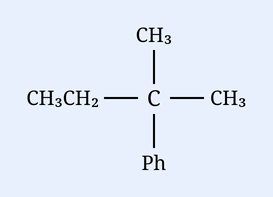
The target alcohol is 2-phenyl-2-butanol, CH3CH2-C(CH3)(Ph)-OH. A Grignard route builds a tertiary alcohol by adding an alkyl/aryl group to a ketone; check which carbonyl + Grignard pairing reconstructs the correct skeleton.
Step 1:The target is the tertiary alcohol 2-phenylbutan-2-ol bearing Ph, CH3, C2H5 and OH on the carbinol carbon.
Step 2:A valid Grignard synthesis must add one of the three carbon groups to a ketone carrying the other two; HCHO with a Grignard gives only a primary alcohol, not this tertiary carbinol.
Step 3:Options 2, 3 and 4 each combine a ketone with the correct Grignard reagent to give the tertiary alcohol, so only the formaldehyde route fails.
Final answer:
Q55Single correctOrganic Compounds Containing Oxygen
In the following reactions, products A and B are:
(1)
(2)
(3)
(4)
SolutionAnswer: Option 2
Approach:
Identify A from an intramolecular aldol of the keto-aldehyde with dilute NaOH, then B from acid-catalysed dehydration on heating.
Step 1:The substrate is a keto-aldehyde; dilute base promotes an intramolecular aldol addition, the enolate adding to the aldehyde to form a six-membered ring carrying a hydroxyl group (the beta-hydroxy carbonyl A).
Step 2:Warming A with acid (H3O+, heat) eliminates water to give the alpha,beta-unsaturated cyclohexenone B.
Q56Single correctOrganic Compounds Containing Oxygen
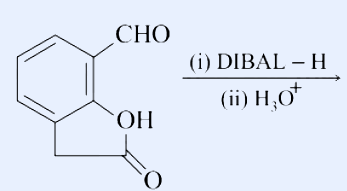
The major product of the following reaction is:
(1)
(2)
(3)
(4)
SolutionAnswer: Option 1
Approach:
DIBAL-H selectively reduces an ester (lactone) to the aldehyde/hemiacetal stage at low temperature while leaving the existing aldehyde, with aqueous work-up opening the reduced lactone.
Step 1:The substrate carries an aromatic aldehyde and a five-membered lactone fused to the ring.
Step 2:One equivalent of DIBAL-H reduces the lactone carbonyl to the aldehyde/lactol level; aqueous acidic work-up opens it to the hydroxy-aldehyde, giving the open dialdehyde-phenol product.
Q57Single correctOrganic Compounds Containing Oxygen
In the following reaction
Aldehyde + Alcohol Acetal
Aldehyde Alcohol
HCHO t − BuOH
C CHO MeOH
The best combination is:
Aldehyde + Alcohol Acetal
Aldehyde Alcohol
HCHO t − BuOH
C CHO MeOH
The best combination is:
(1)
(2)
(3)
(4)
SolutionAnswer: Option 1HCHO and MeOH
Approach:
Acetal formation is favoured by the most electrophilic aldehyde and the least hindered alcohol.
Step 1:Formaldehyde is the most reactive aldehyde toward nucleophilic addition, being the least sterically and electronically hindered carbonyl.
Step 2:A small, unhindered alcohol adds readily, whereas bulky tert-butanol resists acetal formation.
Step 3:The best combination pairs the most reactive aldehyde with the least hindered alcohol.
Final answer: HCHO and MeOH
Q58Single correctOrganic Compounds Containing Nitrogen
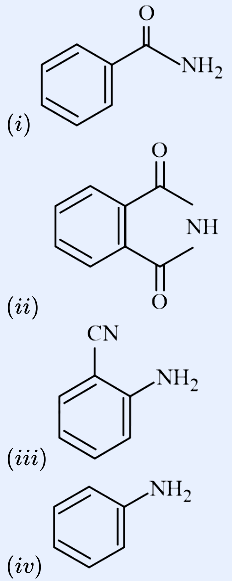
The increasing order of reactivity of the following compounds towards reaction with alkyl halides directly is:
(1)
(2)
(3)
(4)
SolutionAnswer: Option 2
Approach:
Reactivity toward alkyl halides increases with the nucleophilicity/availability of the nitrogen lone pair; greater delocalisation or electron withdrawal lowers it.
Step 1:Benzamide (i) and the cyclic imide (ii) have the nitrogen lone pair delocalised into adjacent carbonyls, the imide most strongly, making it the least nucleophilic.
Step 2:The aryl amine bearing an electron-withdrawing CN group (iii) is more available than the amide nitrogen but less than the unsubstituted aniline.
Step 3:Aniline (iv), with no electron-withdrawing substituent, has the most available lone pair and is the most reactive toward alkyl halides.
Final answer:
Q59Single correctBiomolecules
Poly-β-hydroxybutyrate-co-β-hydroxyvalerate (PHBV) is a copolymer of _____.
(1)
(2)
(3)
(4)
SolutionAnswer: Option 3 hydroxybutanoic acid and hydroxypentanoic acid
Approach:
Interpret the IUPAC names of the monomers from the polymer name PHBV: beta-hydroxybutyrate and beta-hydroxyvalerate.
Step 1:The beta-carbon is the 3-position, so beta-hydroxybutyrate is 3-hydroxybutanoic acid.
Step 2:Similarly beta-hydroxyvalerate is 3-hydroxypentanoic acid (valeric = pentanoic).
Final answer: hydroxybutanoic acid and hydroxypentanoic acid
Q60Single correctBiomolecules
Among the following compounds most basic amino acid is:
(1)
(2)
(3)
(4)
SolutionAnswer: Option 1
Approach:
The most basic amino acid carries an extra strongly basic side-chain nitrogen with the highest side-chain pKa.
Step 1:Lysine bears a primary amino group on its side chain, a strong base.
Step 2:Histidine's imidazole and asparagine's amide nitrogen are far less basic, and serine has a neutral hydroxyl side chain, so lysine is the most basic.
Final answer:
Mathematics30 questions
Q61Single correctComplex Numbers and Quadratic Equations
If be the ratio of the roots of the quadratic equation in x, , then the least value of m for which , is :
(1)
(2)
(3)
(4)
SolutionAnswer: Option 4
Approach:
Let the roots be in ratio lambda. Form the symmetric condition lambda+1/lambda=1, convert to = 3 alpha*beta using sum and product of roots, then solve for and pick the least m.
Step 1:Condition lambda+1/lambda=1 with lambda being the ratio of roots gives a relation between sum and product.
Step 2:Substitute sum and product for the given quadratic.
Step 3:Let u= and solve the resulting quadratic in u, then take the least value of m.
Final answer:
Q62Single correctComplex Numbers and Quadratic Equations
If is a purely imaginary number and , then a value of is :
(1)
(2)
(3)
(4)
SolutionAnswer: Option 4
Approach:
A purely imaginary number plus its conjugate equals zero. Apply this to the given ratio and use z*conjugate(z)=.
Step 1:Set the ratio plus its conjugate to zero.
Step 2:Expand and use z*conjugate(z)=.
Step 3:Substitute |z|=2.
Final answer:
Q63Single correctPermutations and Combinations
Let , then number of non-empty subsets A of S such that the product of elements in A is even is :
(1)
(2)
(3)
(4)
SolutionAnswer: Option 3
Approach:
Count subsets whose product is even by subtracting subsets with an odd product (those containing only odd numbers) from all non-empty subsets.
Step 1:The set has 50 even and 50 odd numbers. The product is odd only when every chosen element is odd.
Step 2:Subtract from all non-empty subsets.
Step 3:Factor the result.
Final answer:
Q64Single correctPermutations and Combinations
Consider three boxes, each containing 10 balls labelled . Suppose one ball is randomly drawn from each of the boxes. Denote by , the label of the ball drawn from the box, . Then, the number of ways in which the balls can be chosen such that is :
(1)
(2)
(3)
(4)
SolutionAnswer: Option 3
Approach:
Each strictly increasing triple corresponds to choosing 3 distinct labels from 10, which can be arranged in increasing order in exactly one way.
Step 1:For n1<n2<n3, the three labels must be distinct, and any set of three distinct labels has a unique increasing order.
Step 2:Evaluate the combination.
Final answer:
Q65Single correctSequence and Series
Let . If , then A is equal to :
(1)
(2)
(3)
(4)
SolutionAnswer: Option 2
Approach:
Simplify to (k+1)/2, square it, sum from 1 to 10, then match with 5A/12.
Step 1:Simplify .
Step 2:Sum the squares from k=1 to 10.
Step 3:Set equal to 5A/12 and solve.
Final answer:
Q66Single correctSequence and Series
The product of three consecutive terms of a is . If is added to each of the first and the second of these terms, the three terms now form an , then the sum of the original three terms of the given is :
(1)
(2)
(3)
(4)
SolutionAnswer: Option 1
Approach:
Write the three terms as a/r, a, ar. Use the product to find a, then apply the A.P. condition after adding 4 to the first two terms to find r.
Step 1:Product of the three terms gives a.
Step 2:Apply the A.P. condition to (a/r + 4), (a + 4), ar.
Step 3:Solve for r.
Step 4:Sum the three terms a/r + a + ar.
Final answer:
Q67Single correctBinomial Theorem and its Simple Applications
A ratio of the term from the beginning to the term from the end in the binomial expansion of is :
(1)
(2)
(3)
(4)
SolutionAnswer: Option 2
Approach:
Compute the 5th term from the beginning (T5) and the 5th term from the end (T7) using the general term, then form their ratio.
Step 1:The 5th term from the beginning is T5 (r=4); the 5th from the end is the 7th term (r=6).
Step 2:Substitute a=2^(1/3), b=1/(2*3^(1/3)).
Final answer:
Q68Single correctTrigonometry
The maximum value of for any real value of is :
(1)
(2)
(3)
(4)
SolutionAnswer: Option 1
Approach:
Expand the sine term, collect coefficients of cos theta and sin theta, then use the amplitude sqrt(+) as the maximum.
Step 1:Expand sin(theta - pi/6).
Step 2:Collect coefficients of cos theta and sin theta.
Step 3:Maximum equals the amplitude.
Final answer:
Q69Single correctCo-ordinate Geometry
If the straight line is perpendicular to the line passing through the points and , then equals :
(1)
(2)
(3)
(4)
SolutionAnswer: Option 3
Approach:
Find the slope of the given line, then use the perpendicularity condition (product of slopes = -1) with the slope through the two points to solve for beta.
Step 1:Slope of the given line.
Step 2:Slope through the two points must be the negative reciprocal.
Step 3:Solve for beta.
Final answer:
Q70Single correctCo-ordinate Geometry
Let and be the centres of the circles and respectively. If P and Q are the points of intersection of these circles, then the area (in sq. units) of the quadrilateral is :
(1)
(2)
(3)
(4)
SolutionAnswer: Option 2
Approach:
Find the centres, radii and the common chord. The quadrilateral PC1QC2 is a kite split by the line C1C2 into two triangles; compute its area using the diagonals.
Step 1:Identify centres and radii.
Step 2:Find the common chord PQ by subtracting the two circle equations.
Step 3:Diagonal C1C2 length and chord PQ length.
Step 4:Area of the kite with perpendicular diagonals.
Final answer:
Q71Single correctCo-ordinate Geometry
If a variable line is such that the two circles and are on its opposite sides, then the set of all values of is the interval :
(1)
(2)
(3)
(4)
SolutionAnswer: Option 3
Approach:
For the two circles to lie on opposite sides of the line, their centres must give the line-expression opposite signs, and the line must not cut either circle (distance from each centre exceeds its radius).
Step 1:Centres and radii.
Step 2:Opposite-side requires the line values at the two centres to have opposite signs.
Step 3:Line must not intersect circle 1: distance from C1 must be at least r1.
Step 4:Line must not intersect circle 2: distance from C2 must be at least r2.
Step 5:Intersect all conditions within (7, 31).
Final answer:
Q72Single correctCo-ordinate Geometry
Let and be two points on the parabola, and let X be any point on the arc POQ of this parabola, where O is the vertex of this parabola, such that the area of is maximum. Then this maximum area (in sq. units) is :
(1)
(2)
(3)
(4)
SolutionAnswer: Option 3
Approach:
Parametrize X on the parabola as (, 2t), write the triangle area as a function of t, and maximize it over the relevant arc.
Step 1:Use parametric point X=(, 2t) with P(4,-4) and Q(9,6).
Step 2:Simplify the expression.
Step 3:Maximize -+t+6 at t=1/2.
Step 4:Multiply by 5.
Final answer:
Q73Single correctCo-ordinate Geometry
If the vertices of a hyperbola be at and and one of its foci be at , then which one of the following points does not lie on this hyperbola ?
(1)
(2)
(3)
(4)
SolutionAnswer: Option 1
Approach:
Determine the hyperbola equation from a and c, then test each point to find the one that does not satisfy it.
Step 1:From vertices a=2 and focus c=3, find .
Step 2:Test the points by substitution.
Step 3:Test (6, 5*sqrt2).
Final answer:
Q74Single correctLimit, Continuity and Differentiability
is :
(1)
(2)
(3)
(4)
SolutionAnswer: Option 4
Approach:
Factor the numerator, express cot and tan in terms of cos and sin, and reduce the indeterminate form to a limit that can be evaluated by direct substitution.
Step 1:Factor the numerator using tan*cot=1.
Step 2:Express cot x - tan x and the denominator in terms of sine and cosine.
Step 3:Cancel the vanishing factor and substitute x=pi/4.
Final answer:
Q75Single correctSets, Relations and Functions
The Boolean expression is equivalent to :
(1)
(2)
(3)
(4)
SolutionAnswer: Option 2
Approach:
Simplify the first bracket, then conjoin with (~p AND ~q) using absorption and distributive laws.
Step 1:The first bracket simplifies since p AND q implies p OR (~q).
Step 2:Conjoin with (~p AND ~q).
Step 3:Since ~q is already a factor, the expression reduces.
Final answer:
Q76Single correctStatistics and Probability
If the sum of the deviations of 50 observations from 30 is 50, then the mean of these observations is :
(1)
(2)
(3)
(4)
SolutionAnswer: Option 4
Approach:
Relate the sum of deviations from an assumed value to the actual mean.
Step 1:Express the given condition with assumed mean A=30 and n=50.
Step 2:Solve for the total of the observations.
Step 3:Divide by the number of observations to obtain the mean.
Final answer:
Q77Single correctMatrices and Determinants
Let and be two matrices such that . Then is equal to :
(1)
(2)
(3)
(4)
SolutionAnswer: Option 1
Approach:
Write P as I plus a strictly lower-triangular nilpotent matrix and expand its powers, then read the required entries of Q.
Step 1:Decompose P into identity plus the nilpotent part N.
Step 2:Compute the fifth power using the expansion truncated at the squared term.
Step 3:Form the entries of ; since Q=I+, the relevant off-diagonal entries of Q equal those of .
Step 4:Evaluate the required ratio.
Final answer:
Q78Single correctMatrices and Determinants
An ordered pair for which the system of linear equations
has a unique solution, is :
has a unique solution, is :
(1)
(2)
(3)
(4)
SolutionAnswer: Option 3
Approach:
A square system has a unique solution exactly when its coefficient determinant is non-zero; compute that determinant and test the options.
Step 1:Form the coefficient determinant.
Step 2:Apply R1->R1-R2 and R3->R3-R2 to simplify.
Step 3:Expand to obtain Delta in terms of alpha and beta.
Step 4:Unique solution requires Delta nonzero; test each option.
Final answer:
Q79Single correctTrigonometry
Considering only the principal values of inverse functions, the set
(1)
(2)
(3)
(4)
SolutionAnswer: Option 4Is a singleton
Approach:
Combine the two inverse tangents and solve the resulting quadratic, then discard roots that violate the domain restriction.
Step 1:Combine the left side using the addition formula and set equal to pi/4.
Step 2:Rearrange into a quadratic equation.
Step 3:Factor and solve.
Step 4:Apply the constraint x>=0 (and <1) to keep only valid roots.
Final answer: Is a singleton
Q80Single correctLimit, Continuity and Differentiability
Let S be the set of all points in at which the function, is not differentiable. Then S is a subset of which of the following?
(1)
(2)
(3)
(4)
SolutionAnswer: Option 2
Approach:
Non-differentiability of the minimum of two smooth functions occurs where the two graphs cross within the interval.
Step 1:Find where sin x equals cos x in the open interval.
Step 2:Find where sin x equals -cos x, since the smaller branch can also switch there as the curves meet.
Step 3:Collect the corner points of the min function within (-pi, pi).
Step 4:Match this set against the options.
Final answer:
Q81Single correctLimit, Continuity and Differentiability
For , if , then is equal to
(1)
(2)
(3)
(4)
SolutionAnswer: Option 2
Approach:
Take logarithms to linearise the relation, then differentiate implicitly and isolate dy/dx.
Step 1:Take natural logarithm of both sides.
Step 2:Group the y terms and solve for y.
Step 3:Differentiate using the quotient rule with d/dx of ln(2x) equal to 1/x.
Step 4:Multiply by and simplify the numerator.
Final answer:
Q82Single correctLimit, Continuity and Differentiability
The maximum area (in sq. units) of a rectangle having its base on the axis and its other two vertices on the parabola, such that the rectangle lies inside the parabola, is :
(1)
(2)
(3)
(4)
SolutionAnswer: Option 2
Approach:
Parametrise the rectangle by the abscissa of its upper corner, write the area as a function of that variable, and maximise.
Step 1:Let the upper-right vertex be (x, 12-); width is 2x and height is 12-.
Step 2:Differentiate and set to zero.
Step 3:Confirm a maximum via the second derivative.
at
Step 4:Evaluate the area at x=2.
Final answer:
Q83Single correctIntegral Calculus
The integral , is equal to
(1)
(2)
(3)
(4)
SolutionAnswer: Option 4
Approach:
Apply integration by parts twice to generate a relation that solves for the integral.
Step 1:Let I be the integral and integrate by parts with u=cos(ln x), dv=dx.
Step 2:Integrate the new integral by parts with u=sin(ln x), dv=dx.
Step 3:Substitute back to form an equation in I.
Step 4:Solve for I and add the constant.
Final answer:
Q84Single correctIntegral Calculus
Let f and g be continuous functions on such that and , then is equal to
(1)
(2)
(3)
(4)
SolutionAnswer: Option 4
Approach:
Use the king property of definite integrals to combine the integral with its reflection.
Step 1:Denote the integral I and replace x by a-x.
Step 2:Add the two expressions for I.
Step 3:Use the given condition g(x)+g(a-x)=4.
Final answer:
Q85Single correctIntegral Calculus
The area (in sq. units) of the region bounded by the parabola, and the lines, and , is
(1)
(2)
(3)
(4)
SolutionAnswer: Option 3
Approach:
Integrate the vertical gap between the parabola and the line over the given x-interval.
Step 1:On [0,3] the parabola lies above the line; form the difference.
Step 2:Integrate the difference from 0 to 3.
Step 3:Evaluate the antiderivative.
Step 4:Simplify.
Final answer:
Q86Single correctDifferential Equations
Let be the solution of the differential equation, . If , then y(e) is equal to
(1)
(2)
(3)
(4)
SolutionAnswer: Option 2
Approach:
Recognise the left side as the derivative of a product, integrate, and apply the given condition to fix the constant.
Step 1:Rewrite the equation as an exact product derivative.
Step 2:Integrate both sides; the right side by parts.
Step 3:Apply 2y(2)= 4 -1 to determine C.
Step 4:Evaluate y at x=e.
Final answer:
Q87Single correctVector Algebra
The sum of the distinct real values of for which the vectors are co-planar, is
(1)
(2)
(3)
(4)
SolutionAnswer: Option 2
Approach:
Coplanarity of three vectors requires their scalar triple product, i.e. the determinant of components, to vanish.
Step 1:Set the determinant of the coefficient matrix to zero.
Step 2:Expand using the standard identity for this symmetric determinant.
Step 3:Factor the cubic.
Step 4:Add the distinct real values.
Final answer:
Q88Single correctThree Dimensional Geometry
A tetrahedron has vertices and . The angle between the faces OPQ and PQR is
(1)
(2)
(3)
(4)
SolutionAnswer: Option 3
Approach:
Find the normals of the two faces along edge PQ via cross products, then the angle between them.
Step 1:Normal of face OPQ from OP and OQ.
Step 2:Normal of face PQR from PQ and PR.
Step 3:Angle between the faces.
Final answer:
Q89Single correctThree Dimensional Geometry
The perpendicular distance from the origin to the plane containing the two lines, and , is
(1)
(2)
(3)
(4)
SolutionAnswer: Option 2
Approach:
Find the plane normal from the cross product of the two direction vectors, fix the plane through a known point, then apply the point-to-plane distance.
Step 1:Cross the two direction vectors to get the plane normal.
Step 2:Write the plane through (-2,2,-5).
Step 3:Apply the distance formula from the origin.
Final answer:
Q90Single correctStatistics and Probability
In a random experiment, a fair die is rolled until two fours are obtained in succession. The probability that the experiment will end in the fifth throw of the die is equal to :
(1)
(2)
(3)
(4)
SolutionAnswer: Option 2
Approach:
The experiment ends on the fifth throw exactly when throws four and five are fours and no two consecutive fours occur among the first four throws.
Step 1:Throws 4 and 5 must be fours; throw 3 must not be a four to avoid an earlier ending.
Step 2:Throws 1 and 2 must not contain two consecutive fours; count the allowed pairs out of 36.
Step 3:Count first-two-throw outcomes with no double-four ending: total pairs minus the single (4,4) pair gives 35; combine with the fixed later throws.
Final answer:
More JEE Main 2019 papers
- JEE Main 2019 — April 08, Shift 1
- JEE Main 2019 — April 08, Shift 2
- JEE Main 2019 — April 09, Shift 1
- JEE Main 2019 — January 09, Shift 1
- JEE Main 2019 — January 09, Shift 2
- JEE Main 2019 — January 10, Shift 1
- JEE Main 2019 — January 10, Shift 2
- JEE Main 2019 — January 11, Shift 1
- JEE Main 2019 — January 11, Shift 2
- JEE Main 2019 — January 12, Shift 2
Frequently Asked Questions
How many questions are in the JEE Main 2019 January 12, Shift 1 paper?
The JEE Main 2019 January 12, Shift 1 paper has 90 questions — Physics (30), Chemistry (30) and Mathematics (30). Every question is on this page with its correct answer and a step-by-step solution.
What is the marking scheme for JEE Main?
JEE Main awards +4 marks for each correct answer and −1 for a wrong answer, with 0 for questions left unattempted. The paper covers Physics, Chemistry and Mathematics.
Are the answer key and step-by-step solutions provided for the 2019 January 12, Shift 1 paper?
Yes — every question shows the correct answer (answer key) and a detailed step-by-step solution, free to read online.
Can I take the JEE Main 2019 January 12, Shift 1 paper as a timed mock test?
Yes. With a free JEEnify account you can attempt this exact paper as a timed test in the real exam interface, then see your score and weak-area analysis.
Solved this paper? Calculate your JEE Main scoremost important chaptersformula sheetsall free tools.