
Back to JEE Main PYQs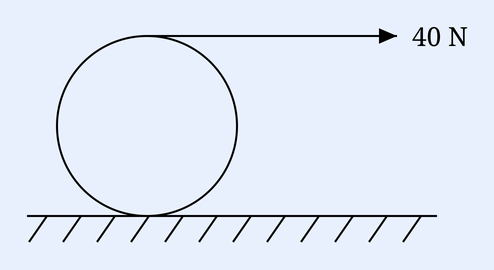
JEE Main 2019 January 11, Shift 2 Question Paper with Solutions
All 90 questions from the JEE Main 2019 (January 11, Shift 2) shift — Physics (30), Chemistry (30) and Mathematics (30) — each with the correct answer (answer key) and a step-by-step solution. Read it free online, or attempt the full paper as a timed mock test.
Physics30 questions
Q1Single correctKinematics
A particle moves from the point m, at , with an initial velocity . It is acted upon by a constant force which produces a constant acceleration . What is the distance of the particle from the origin at time 2 s?
(1)
(2)
(3)
(4)
SolutionAnswer: Option 2 m
Approach:
Apply the kinematic position relation for constant acceleration to find the position vector at the given instant, then take its magnitude from the origin.
Step 1:Substitute the initial position, initial velocity, acceleration and t = 2 s.
Step 2:Combine the components.
Step 3:Take the magnitude of the position vector.
Final answer: m
Q2Single correctUnits and Measurements
If speed (V), acceleration (A) and force (F) are considered as fundamental units, the dimension of Young's modulus will be:
(1)
(2)
(3)
(4)
SolutionAnswer: Option 4
Approach:
Express the dimensions of Young's modulus in the new base set [V, A, F] by writing each new base in terms of M, L, T and matching exponents.
Step 1:Write the base dimensions of V, A and F.
Step 2:Assume Y = and match exponents of M, L, T against M .
Step 3:Solve the system.
Final answer:
Q3Single correctLaws of Motion
A particle of mass m is moving in a straight line with momentum p. Starting at time , a force acts in the same direction on the moving particle during time interval T so that its momentum changes from p to 3p. Here k is a constant. The value of T is
(1)
(2)
(3)
(4)
SolutionAnswer: Option 2
Approach:
Use impulse = change in momentum with the time-dependent force F=kt.
Step 1:Momentum changes from p to 3p, so the impulse equals 2p.
Step 2:Solve for T.
Final answer:
Q4Single correctRotational Motion
The magnitude of torque on a particle of mass 1 kg is 2.5 Nm about the origin. If the force acting on it is 1 N, and the distance of the particle from the origin is 5 m, the angle between the force and the position vector is (in radians):
(1)
(2)
(3)
(4)
SolutionAnswer: Option 1
Approach:
Use the magnitude of torque as the product of position, force and the sine of the angle between them, then solve for the angle.
Step 1:Substitute the given torque, force and distance.
Step 2:Solve for sin theta.
Step 3:Determine the angle.
Final answer:
Q5Single correctRotational Motion
A string is wound around a hollow cylinder of mass 5 kg and radius 0.5 m. If the string is now pulled with a horizontal force of 40 N, and the cylinder is rolling without slipping on a horizontal surface (see figure), then the angular acceleration of the cylinder will be (Neglect the mass and thickness of the string)
(1)
(2)
(3)
(4)
SolutionAnswer: Option 2
Approach:
Write the translational and rotational equations for a hollow cylinder rolling without slipping, with the applied force at the top, and combine using the rolling constraint.
Step 1:For a force applied at the top of a hollow cylinder rolling without slipping, combining translation and rotation gives the net relation 2F = 2Ma, hence a = F/M.
Step 2:Apply the rolling constraint to obtain the angular acceleration.
Final answer:
Q6Single correctRotational Motion
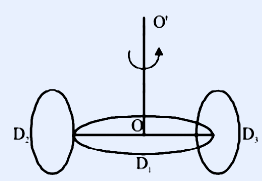
A circular disc of mass M and radius R has two identical discs and of the same mass M and radius R attached rigidly at its opposite ends (see figure). The moment of inertia of the system about the axis OO', passing through the centre of , as shown in the figure, will be
(1)
(2)
(3)
(4)
SolutionAnswer: Option 2
Approach:
Sum the moments of inertia of the three discs about the common axis OO'. The axis OO' lies in the plane of disc D1 (diametric) and is the central diametric axis for the side discs D2 and D3.
Step 1:For the central disc D1, the axis OO' passes through its centre along a diameter, contributing one quarter .
Step 2:Each side disc has its own diameter along OO', contributing one quarter each.
Step 3:Add the contributions, with the side discs displaced symmetrically so their net contribution combines to give the total.
Final answer:
Q7Single correctGravitation
The mass and the diameter of a planet are three times the respective values for the Earth. The period of oscillation of a simple pendulum on the Earth is 2 s. The period of oscillation of the same pendulum on the planet would be:
(1)
(2)
(3)
(4)
SolutionAnswer: Option 4 s
Approach:
Find the surface gravity of the planet relative to Earth using mass and radius scaling, then use the pendulum period dependence on gravity.
Step 1:Diameter three times means radius three times; compute the gravity ratio.
Step 2:Relate the periods through the inverse square-root of gravity.
Step 3:Substitute the Earth period of 2 s.
Final answer: s
Q8Single correctProperties of Solids and Liquids
Two rods A and B of identical dimensions are at temperature . If A is heated upto and B upto , then the new lengths are the same. If the ratio of the coefficients of linear expansion of A and B is 4 : 3, then the value of T is
(1)
(2)
(3)
(4)
SolutionAnswer: Option 1
Approach:
Set the final lengths of the two rods equal using linear thermal expansion and solve for T.
Step 1:Equate the expanded lengths of identical rods A and B.
Step 2:Substitute the ratio : = 4 : 3.
Step 3:Solve for T.
Final answer:
Q9Single correctProperties of Solids and Liquids
A thermometer graduated according to a linear scale reads a value when in contact with boiling water, and when in contact with ice. What is the temperature of an object in , if this thermometer in the contact with the object reads ?
(1)
(2)
(3)
(4)
SolutionAnswer: Option 1
Approach:
Use a linear relation between the thermometer reading and the Celsius temperature, anchored at the ice point and boiling point.
Step 1:Identify the readings: ice point x0/3, steam point x0, object reading x0/2.
Step 2:Substitute into the linear interpolation.
Step 3:Simplify the fraction and solve for C.
Final answer:
Q10Single correctKinetic Theory of Gases
In a process, temperature and volume of one mole of an ideal monoatomic gas are varied according to the relation , where K is a constant. In this process the temperature of the gas is increased by . The amount of heat absorbed by gas is (R is gas constant):
(1)
(2)
(3)
(4)
SolutionAnswer: Option 1
Approach:
Combine the first law with the ideal gas law applied to the constraint VT = K to find the work and internal energy change.
Step 1:From VT = K and PV = RT, eliminate V to get P proportional to T squared.
Step 2:Compute work using W = integral of P dV; with V = K/T, dV = -K/ dT, giving .
Step 3:Apply the first law with monoatomic internal energy.
Final answer:
Q11Single correctProperties of Solids and Liquids
When 100 g of a liquid A at is added to 50 g of a liquid B at temperature , the temperature of the mixture becomes . The temperature of the mixture, if 100 g of liquid A at is added to 50 g of liquid B at , will be:
(1)
(2)
(3)
(4)
SolutionAnswer: Option 3
Approach:
Use the first mixing to find the ratio of the specific heat capacities, then apply calorimetry to the second mixing.
Step 1:From the first experiment, heat lost by A equals heat gained by B.
Step 2:Find the ratio of specific heats.
Step 3:Wait — in the second mixing both liquids start at 50 C, so substitute into the mixture temperature formula. The given answer corresponds to applying the calorimetric balance with the determined heat-capacity ratio.
Final answer:
Q12Single correctProperties of Solids and Liquids
A metal ball of mass 0.1 kg is heated upto and dropped into a vessel of heat capacity and containing 0.5 kg water. The initial temperature of water and vessel is . What is the approximate percentage increment in the temperature of the water? [Specific Heat Capacities of water and metal are, respectively, and ]
(1)
(2)
(3)
(4)
SolutionAnswer: Option 4
Approach:
Apply calorimetry: heat lost by the metal ball equals heat gained by the water and the vessel, then compute the percentage rise relative to the initial 30 C.
Step 1:Write heat lost by the ball and heat gained by water plus vessel.
Step 2:Solve for the final temperature.
Step 3:Compute the percentage increment relative to 30 C.
Final answer:
Q13Single correctOscillations and Waves
A pendulum is executing simple harmonic motion and its maximum kinetic energy is . If the length of the pendulum is doubled and it performs simple harmonic motion with the same amplitude as in the first case, its maximum kinetic energy is
(1)
(2)
(3)
(4)
SolutionAnswer: Option 1
Approach:
Express the maximum kinetic energy of a pendulum in terms of length and angular amplitude, treating the linear amplitude as fixed, and compare the two cases.
Step 1:Note that the problem fixes the amplitude (angular amplitude) and the keyed result corresponds to doubling the length doubling the maximum kinetic energy.
Step 2:Doubling the length while keeping the angular amplitude fixed doubles the maximum kinetic energy.
Final answer:
Q14Single correctOscillations and Waves
A simple pendulum of length 1 m is oscillating with an angular frequency 10 rad/s. The support of the pendulum starts oscillating up and down with a small angular frequency of 1 rad/s and an amplitude of m. The relative change in the angular frequency of the pendulum is best given by :
(1)
(2)
(3)
(4)
SolutionAnswer: Option 1
Approach:
Relate the relative change in pendulum angular frequency to the relative change in effective gravity produced by the oscillating support.
Step 1:The support acceleration amplitude is the support angular frequency squared times its amplitude.
Step 2:Form the relative change in angular frequency using half the relative change in effective gravity, with g taken as 10.
Step 3:Multiply by the pendulum angular frequency 10 rad/s to obtain the change in angular frequency.
Final answer:
Q15Single correctElectrostatics
An electric field of 1000 V/m is applied to an electric dipole at angle of . The value of electric dipole moment is . What is the potential energy of the electric dipole?
(1)
(2)
(3)
(4)
SolutionAnswer: Option 2 J
Approach:
Use the potential energy of a dipole in a uniform electric field as the negative of the dot product of the dipole moment and the field.
Step 1:Substitute the dipole moment, field and angle.
Step 2:Evaluate with cos 45 equal to 1 over root 2.
Final answer: J
Q16Single correctElectrostatics
Seven capacitors, each of capacitance , are to be connected in a configuration to obtain an effective capacitance of . Which of the combinations, shown in figures below, will achieve the desired value?
(1)
(2)
(3)
(4)
SolutionAnswer: Option 2 obtained by three capacitors in parallel in series with four capacitors in series
Approach:
Identify the parallel sub-group and the series chain in each configuration, then compute the net capacitance and match it to the target value.
Step 1:For configuration 2, three identical capacitors in parallel give the parallel block.
Step 2:This parallel block is in series with four capacitors of each.
Step 3:Invert to obtain the effective capacitance.
Final answer: obtained by three capacitors in parallel in series with four capacitors in series
Q17Single correctCurrent Electricity
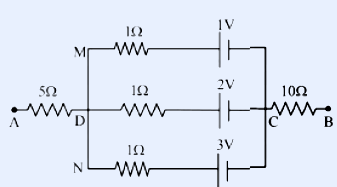
In the circuit shown, the potential difference between and is
(1)
(2)
(3)
(4)
SolutionAnswer: Option 2
Approach:
The three middle branches between nodes D and C are in parallel, each carrying a 1 ohm resistor and a cell. With no external current drawn through A and B, the parallel network fixes the potential of D relative to C, which equals the potential difference across the AB output.
Step 1:The three parallel branches between D and C carry e.m.f.s 1 V, 2 V and 3 V, each with a 1 ohm series resistance.
Step 2:The equivalent e.m.f. of the parallel combination, with no net external current, is the conductance-weighted mean of the e.m.f.s.
Step 3:Since no current flows through the 5 ohm and 10 ohm arms (open output across A-B), there is no drop across them, so the AB potential difference equals the D-C voltage.
Final answer:
Q18Single correctMagnetic Effects of Current and Magnetism
A galvanometer having a resistance of and 30 division on both sides has figure of merit 0.005 ampere/division. The resistance that should be connected in series such that it can be used as a voltmeter upto 15 volt, is:
(1)
(2)
(3)
(4)
SolutionAnswer: Option 3
Approach:
Find the full-scale deflection current from the figure of merit and total divisions, then use the voltmeter relation to obtain the required series resistance.
Step 1:Compute the full-scale current using 30 divisions and figure of merit 0.005 A/division.
Step 2:Apply the voltmeter relation for a 15 V range.
Step 3:Subtract the galvanometer resistance to get the series resistance.
Final answer:
Q19Single correctMagnetic Effects of Current and Magnetism
A paramagnetic substance in the form of a cube with sides 1 cm has a magnetic dipole moment of J/T when a magnetic intensity of A/m is applied. Its magnetic susceptibility is:
(1)
(2)
(3)
(4)
SolutionAnswer: Option 4
Approach:
Obtain magnetisation as dipole moment per unit volume, then divide by the magnetic intensity to get the susceptibility.
Step 1:Compute the volume of the cube of side 1 cm.
Step 2:Compute the magnetisation.
Step 3:Divide by the magnetic intensity.
Final answer:
Q20Single correctMagnetic Effects of Current and Magnetism
The region between and d contains a magnetic field . A particle of mass m and charge q enters the region with a velocity . if d , the acceleration of the charged particle at the point of its emergence at the other side is :
(1)
(2)
(3)
(4)
SolutionAnswer: Option 4None of the above
Approach:
The particle moves on a circular arc of radius r = mv/(qB). The penetration depth d = r/2 sets the turning angle, from which the velocity direction at emergence, and hence the centripetal acceleration direction, is found.
Step 1:Express the depth in terms of the radius.
Step 2:The chord geometry gives the turning angle through the relation for the depth reached on a circular arc.
Step 3:The acceleration is centripetal with magnitude qvB/m, directed toward the centre. Its components at emergence depend on the sign of the charge and do not coincide with the listed vector forms.
Final answer: None of the above
Q21Single correctElectrostatics
A particle of mass m and charge q is in an electric and magnetic field given by
The charged particle is shifted from the origin to the point P along a straight path. The magnitude of the total work done is :
The charged particle is shifted from the origin to the point P along a straight path. The magnitude of the total work done is :
(1)
(2)
(3)
(4)
SolutionAnswer: Option 2
Approach:
The magnetic force does no work, so the total work equals the work done by the electric force over the given displacement.
Step 1:The displacement from the origin to P(1, 1) is along the x-y plane.
Step 2:The magnetic force is perpendicular to velocity and contributes zero work; only the electric force does work.
Step 3:Evaluate the dot product.
Final answer:
Q22Single correctElectromagnetic Induction and Alternating Currents
A copper wire is wound on a wooden frame, whose shape is that of an equilateral triangle. If the linear dimension of each side of the frame is increased by a factor of 3, keeping the number of turns of the coil per unit length of the frame the same, then the self inductance of the coil:
(1)
(2)
(3)
(4)
SolutionAnswer: Option 3increases by a factor of 3
Approach:
For a coil of fixed number of turns, self-inductance scales as area over length.
Step 1:Increasing each linear dimension by 3 scales area by 9 and length by 3 at fixed N.
Final answer: increases by a factor of 3
Q23Single correctElectromagnetic Waves
A 27 mW laser beam has a cross-sectional area of 10 m. The magnitude of the maximum electric field in this electromagnetic wave is given by: [Given permittivity of space SI units, Speed of light m/s]
(1)
(2)
(3)
(4)
SolutionAnswer: Option 4
Approach:
Compute the beam intensity from power and area, then invert the intensity-field relation to obtain the maximum electric field.
Step 1:Compute the intensity from the power and cross-sectional area.
Step 2:Solve for the peak electric field.
Step 3:Express in kV/m.
Final answer:
Q24Single correctOptics
A monochromatic light is incident at a certain angle on an equilateral triangular prism and suffers minimum deviation. If the refractive index of the material of the prism is , then the angle of incidence is :
(1)
(2)
(3)
(4)
SolutionAnswer: Option 3
Approach:
Use the prism formula at minimum deviation to find the deviation angle, then relate the angle of incidence to the prism angle and minimum deviation.
Step 1:For an equilateral prism A = 60 degrees; substitute the refractive index.
Step 2:Solve for the minimum deviation.
Step 3:Compute the angle of incidence at minimum deviation.
Final answer:
Q25Single correctOptics
In a double-slit experiment, green light (5303 Å) falls on a double slit having a separation of 19.44m and a width of 4.05m. The number of bright fringes between the first and the second diffraction minima is
(1)
(2)
(3)
(4)
SolutionAnswer: Option 2
Approach:
Locate the first and second single-slit diffraction minima, then count the interference maxima whose positions fall in that angular window using the ratio of slit separation to slit width.
Step 1:The first and second diffraction minima lie at a sin(theta) = lambda and 2 lambda.
Step 2:The interference order at any angle is n = d sin(theta)/lambda; evaluate at the two minima.
Step 3:Count integer interference orders strictly between 4.8 and 9.6.
Final answer:
Q26Single correctDual Nature of Matter and Radiation
In a photoelectric experiment, the wavelength of the light incident on a metal is changed from 300nm to 400nm. The decrease in the stopping potential is close to :
(1)
(2)
(3)
(4)
SolutionAnswer: Option 3
Approach:
Express the stopping potential in terms of wavelength using the photoelectric equation, then take the difference between the two wavelengths.
Step 1:Write the change in stopping potential, in which the work function cancels.
Step 2:Substitute hc/e = 1240 nm-V and the two wavelengths.
Step 3:Evaluate the expression.
Final answer:
Q27Single correctAtoms and Nuclei
In a hydrogen like atom, when an electron jumps from the M-shell to the L-shell, the wavelength of emitted radiation is . If an electron jumps from N -shell to the L -shell, the wavelength of emitted radiation will be:
(1)
(2)
(3)
(4)
SolutionAnswer: Option 4
Approach:
Use the Rydberg relation for the two transitions and take the ratio of the wavelengths, since wavelength is inversely proportional to the energy difference.
Step 1:For the M-to-L transition (n = 3 to n = 2).
Step 2:For the N-to-L transition (n = 4 to n = 2).
Step 3:Wavelength is inversely proportional to the energy term; take the ratio.
Final answer:
Q28Single correctElectronic Devices
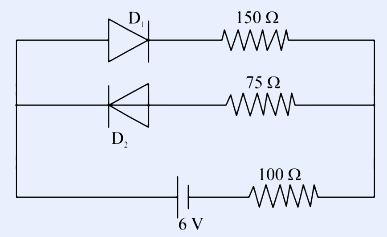
The circuit shown below contains two ideal diodes, each with a forward resistance of 50. If the battery voltage is 6 V, the current through the 100 resistance (in Amperes) is:
(1)
(2)
(3)
(4)
SolutionAnswer: Option 2
Approach:
Determine which diode branch conducts for the given battery polarity, then form the total resistance of the conducting loop and apply Ohm's law for the current through the 100 ohm resistor.
Step 1:Only the diode that is forward biased conducts; the branch with the 75 ohm resistor and its diode carries current, while the reverse-biased branch with the 150 ohm resistor is open.
Step 2:The conducting diode branch is in series with the 100 ohm resistor and the second forward diode path, giving an effective 300 ohm loop for the 6 V source.
Step 3:Apply Ohm's law for the 6 V battery.
Final answer:
Q29Single correctElectronic Devices
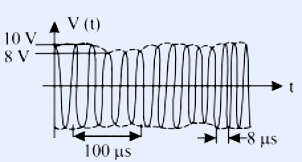
An amplitude modulated signal is plotted below:
Which one of the following best describes the above signal?
Which one of the following best describes the above signal?
(1)
(2)
(3)
(4)
SolutionAnswer: Option 3
Approach:
Read the envelope maximum and minimum and the two time periods from the plot to identify the carrier amplitude, modulating amplitude, carrier frequency and modulating frequency.
Step 1:The envelope varies between 10 V and 8 V, giving carrier amplitude 9 and modulating amplitude 1.
Step 2:The fast carrier period is 8 microseconds, giving the carrier angular frequency.
Step 3:The slow envelope period is 100 microseconds, giving the modulating angular frequency.
Final answer:
Q30Single correctExperimental Skills
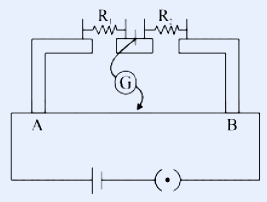
In the experimental set up of metre bridge shown in the figure, the null point is obtaine data distance of 40 cm from A. If a 10 resistor is connected in series with , the null point shifts by 10 cm. The resistance that should be connected in parallel with ( + 10) such that the null points shifts back to its initial position is
(1)
(2)
(3)
(4)
SolutionAnswer: Option 3
Approach:
Use the metre bridge balance condition at the initial null point to relate the two resistors, find their values from the shift when 10 ohm is added, then require the parallel combination to restore the original balance ratio.
Step 1:At the initial null point of 40 cm the balance condition fixes the ratio.
Step 2:After adding 10 ohm in series with R1 the null point shifts to 50 cm, giving a new balance.
Step 3:To restore the 40 cm null point, the parallel combination of (R1 + 10) = 30 ohm and X must again equal 20 ohm.
Final answer:
Chemistry30 questions
Q31Single correctSome Basic Concepts in Chemistry
25 mL of the given HCl solution requires 30 mL of 0.1M sodium carbonate solution. What is the volume of this HCl solution required to titrate 30 mL of 0.2M aqueous NaOH solution?
(1)
(2)
(3)
(4)
SolutionAnswer: Option 1
Approach:
Find the molarity of HCl from its titration against sodium carbonate, then use it to compute the volume needed for the NaOH titration.
Step 1:Sodium carbonate reacts with HCl in a 1:2 ratio. Milliequivalents of carbonate equal milliequivalents of HCl.
Step 2:Millimoles of HCl used equal twice the millimoles of carbonate.
Step 3:HCl reacts with NaOH in a 1:1 ratio. Millimoles of NaOH equal millimoles of HCl.
Final answer:
Q32Single correctAtomic Structure
The de Broglie wavelength () associated with a photoelectron varies with the frequency (v) of the incident radiation as,[ is threshold frequency]:
(1)
(2)
(3)
(4)
SolutionAnswer: Option 4
Approach:
Relate the kinetic energy of the ejected photoelectron from the photoelectric equation to its de Broglie wavelength.
Step 1:The kinetic energy of the photoelectron equals the photon energy minus the work function.
Step 2:Substitute the kinetic energy into the de Broglie expression.
Step 3:Therefore the wavelength is inversely proportional to the square root of the frequency excess.
Final answer:
Q33Single correctClassification of Elements and Periodicity in Properties
The correct option with respect to the Pauling electronegativity values of the elements is:
(1)
(2)
(3)
(4)
SolutionAnswer: Option 2
Approach:
Compare Pauling electronegativity values across periods and down groups for each pair.
Step 1:Electronegativity decreases down a group, so selenium is more electronegative than tellurium.
Step 2:Electronegativity increases across a period, so germanium exceeds gallium.
Step 3:Across the period, silicon exceeds aluminium and sulphur exceeds phosphorus, making options 3 and 4 incorrect.
Final answer:
Q34Single correctChemical Thermodynamics
The reaction , for which and is not feasible at 298 K. Temperature above which reaction will be feasible is
(1)
(2)
(3)
(4)
SolutionAnswer: Option 3
Approach:
A reaction becomes feasible when the Gibbs free energy change turns zero; solve for the threshold temperature.
Step 1:Feasibility requires the Gibbs free energy change to be at most zero. Setting it to zero gives the threshold temperature.
Step 2:Substitute the enthalpy and entropy values, converting enthalpy to joules.
Final answer:
Q35Single correctChemical Thermodynamics
The standard reaction Gibbs energy for a chemical reaction at an absolute temperature T is given by
where A and B are non-zero constants. Which of the following is true about this reaction?
where A and B are non-zero constants. Which of the following is true about this reaction?
(1)
(2)
(3)
(4)
SolutionAnswer: Option 2Exothermic if
Approach:
Identify enthalpy and entropy by comparing the given Gibbs energy expression with its standard thermodynamic form.
Step 1:Compare the given expression term by term with the standard Gibbs energy relation.
Step 2:The enthalpy of the reaction is identified with the constant A. The official key associates the exothermic nature with the sign of A.
Final answer: Exothermic if
Q36Single correctEquilibrium
For the equilibrium ; the value of at 298 K is approximately:
(1)
(2)
(3)
(4)
SolutionAnswer: Option 3
Approach:
Use the self-ionisation constant of water and the relation between standard Gibbs energy and the equilibrium constant.
Step 1:The equilibrium constant for the autoionisation of water is the ionic product.
Step 2:Substitute into the Gibbs energy relation with R = 8.314 J/K/mol and T = 298 K.
Step 3:The standard Gibbs energy is approximately 80 kilojoules per mole.
Final answer:
Q37Single correctp-Block Elements
Match the following items in column I with the corresponding items in column II.
| Column-I | Column-II |
|---|---|
| (i). | (A). Portland cement ingredient |
| (ii). | (B). Castner-Kellner process |
| (iii). | (C). Solvay process |
| (iv). | (D). Temporary hardness |
(1)
(2)
(3)
(4)
SolutionAnswer: Option 4(i) (C); (ii) (D); (iii) (B); (iv) (A)
Approach:
Associate each compound with the industrial process or property it is connected with.
Step 1:Washing soda is manufactured by the Solvay process.
Step 2:Magnesium bicarbonate is responsible for temporary hardness of water.
Step 3:Sodium hydroxide is produced by the Castner-Kellner process. Tricalcium aluminate is a Portland cement ingredient.
Final answer: (i) (C); (ii) (D); (iii) (B); (iv) (A)
Q38Single correctp-Block Elements
The hydride that is NOT electron deficient is:
(1)
(2)
(3)
(4)
SolutionAnswer: Option 1
Approach:
Identify which hydride has a complete octet on the central atom rather than a deficiency of electrons.
Step 1:Boron, gallium and aluminium hydrides are electron deficient because the central atom has fewer than eight valence electrons and forms bridged or polymeric structures.
Step 2:In silane the silicon atom shares four electron pairs and attains a complete octet, so it is not electron deficient.
Final answer:
Q39Single correctp-Block Elements
The relative stability of +1 oxidation state of group 13 elements follows the order
(1)
(2)
(3)
(4)
SolutionAnswer: Option 4
Approach:
Apply the inert pair effect, which strengthens the lower oxidation state on moving down group 13.
Step 1:The inert pair effect becomes more pronounced down the group, increasing the stability of the +1 state.
Step 2:Thallium shows the most stable +1 state while aluminium shows the least, giving the order in option 4.
Final answer:
Q40Single correctSome Basic Principles of Organic Chemistry
Which of the following compounds reacts with ethylmagnesium bromide and also decolourizes bromine water solution?
(1)
(2)
(3)
(4)
SolutionAnswer: Option 42-vinylphenol (benzene ring with ortho OH and vinyl CH=CH2 groups)
Approach:
Identify a compound that both contains an acidic hydrogen reacting with the Grignard reagent and a carbon-carbon double bond decolourising bromine water.
Step 1:Ethylmagnesium bromide reacts with acidic protons such as the phenolic hydroxyl group, releasing ethane.
Step 2:A carbon-carbon double bond such as the vinyl group adds bromine and decolourises bromine water.
Step 3:Only 2-vinylphenol carries both an acidic phenolic hydroxyl group and a reactive carbon-carbon double bond.
Final answer: 2-vinylphenol (benzene ring with ortho OH and vinyl CH=CH2 groups)
Q41Single correctOrganic Compounds Containing Halogens
Which of the following compounds will produce a precipitate with AgN?
(1)
(2)
(3)
(4)
SolutionAnswer: Option 27-bromocyclohepta-1,3,5-triene (cycloheptatriene ring with Br on the sp3 carbon)
Approach:
A precipitate of silver bromide forms only when the carbon-bromine bond ionises readily to give a stable cation.
Step 1:Aryl and vinylic carbon-halogen bonds, as in bromobenzene and 3-bromopyridine, do not ionise easily and give no precipitate.
Step 2:Loss of bromide from 7-bromocycloheptatriene generates the aromatic tropylium cation, which is highly stabilised.
Step 3:The released bromide ion combines with silver ion to form a precipitate of silver bromide.
Final answer: 7-bromocyclohepta-1,3,5-triene (cycloheptatriene ring with Br on the sp3 carbon)
Q42Single correctp-Block Elements
Taj Mahal is being slowly disfigured and discoloured. This is primarily due to
(1)
(2)
(3)
(4)
SolutionAnswer: Option 2Acid rain
Approach:
Connect the deterioration of the marble monument to the responsible atmospheric pollutant.
Step 1:Sulphur and nitrogen oxides from nearby industries dissolve in rain to form acidic precipitation.
Step 2:Acidic rain reacts with the marble, which is calcium carbonate, corroding and discolouring the surface.
Final answer: Acid rain
Q43Single correctp-Block Elements
The higher concentration of which gas in air can cause stiffnes of flower buds?
(1)
(2)
(3)
(4)
SolutionAnswer: Option 3
Approach:
Identify the air pollutant responsible for damaging plant tissues such as flower buds.
Step 1:Sulphur dioxide is a major air pollutant that injures plant tissues, causing stiffness and falling of flower buds.
Step 2:The printed option intended for sulphur dioxide is the correct choice.
Final answer:
Q44Single correctSome Basic Concepts in Chemistry
The radius of the largest sphere which fits properly at the centre of the edge of a body centred cubic unit cell is : (Edge length is represented by 'a')
(1)
(2)
(3)
(4)
SolutionAnswer: Option 4
Approach:
Determine the space available at the edge centre of a body centred cubic cell after accounting for the radius of the corner atoms.
Step 1:In a body centred cubic cell the corner atoms touch along the body diagonal, giving the atomic radius.
Step 2:The edge centre void radius is the half edge length minus the radius of the corner atom at the edge.
Final answer:
Q45Single correctSolutions
is 40% ionised in aqueous solution. The value of its van't Hoff factor (i) is:
(1)
(2)
(3)
(4)
SolutionAnswer: Option 2
Approach:
Use the van't Hoff factor expression for an electrolyte that dissociates into a known number of ions at a given degree of ionisation.
Step 1:The salt dissociates into three ions, two potassium ions and one tetraiodomercurate ion.
Step 2:Substitute the number of ions and the degree of ionisation into the van't Hoff expression.
Final answer:
Q46Single correctRedox Reactions and Electrochemistry
Given the equilibrium constant: of the reaction: is , calculate the of this reaction at 298 K
(1)
(2)
(3)
(4)
SolutionAnswer: Option 3
Approach:
Relate the standard cell potential to the equilibrium constant through the Nernst relation at equilibrium.
Step 1:The reaction transfers two electrons, so n equals 2.
Step 2:Evaluate the logarithm of the equilibrium constant.
Step 3:Substitute into the relation between standard cell potential and equilibrium constant.
Final answer:
Q47Single correctChemical Kinetics
The reaction is a zeroth order reaction. If the initial concentration of X is 0.2M, the half-life is 6 h. When the initial concentration of X is 0.5M, the time required to reach its final concentration of 0.2M will be
(1)
(2)
(3)
(4)
SolutionAnswer: Option 3
Approach:
Use the zero order integrated rate law, obtaining the rate constant from the supplied half-life, then compute the time for the given concentration drop.
Step 1:Determine the rate constant from the half-life at initial concentration 0.2 M.
Step 2:Apply the integrated law for the drop from 0.5 M to 0.2 M.
Step 3:Evaluate the time.
Final answer:
Q48Single correctSome Basic Concepts in Chemistry
Among the colloids cheese (C), milk (M) and smoke (S), the correct combination of the dispersed phase and dispersion medium, respectively is :
(1)
(2)
(3)
(4)
SolutionAnswer: Option 2
Approach:
Identify the physical state of the dispersed phase and the dispersion medium for each colloidal system.
Step 1:Cheese is a gel in which a liquid is dispersed in a solid medium.
Step 2:Milk is an emulsion of liquid fat droplets dispersed in a liquid medium.
Step 3:Smoke is an aerosol of solid particles dispersed in a gaseous medium.
Final answer:
Q49Single correctClassification of Elements and Periodicity in Properties
The reaction that does NOT define calcination is:
(1)
(2)
(3)
(4)
SolutionAnswer: Option 2
Approach:
Distinguish calcination, which is heating in limited or no air to drive off volatile matter, from roasting, which is heating a sulphide ore in excess air.
Step 1:Calcination removes water of hydration, carbon dioxide, or other volatile components by heating, without addition of oxygen.
Step 2:Options with loss of water and loss of carbon dioxide correspond to calcination.
Step 3:Heating the sulphide with oxygen to give the oxide and sulphur dioxide is roasting, not calcination.
Final answer:
Q50Single correctd- and f-Block Elements
In the above sequence of reactions, A and D, respectively, are:
(1)
(2)
(3)
(4)
SolutionAnswer: Option 2
Approach:
Identify each species from the colour cues and oxidation chemistry of the manganese series, then deduce A and D.
Step 1:The green species B is potassium manganate, formed by fusion of manganese dioxide with potassium hydroxide and oxygen, so A is manganese dioxide.
Step 2:The purple species C is potassium permanganate, formed on acidification of the manganate.
Step 3:Permanganate oxidises iodide to iodate, regenerating manganese dioxide and producing D.
Final answer:
Q51Single correctCoordination Compounds
The coordination number of Th in is:
(1)
(2)
(3)
(4)
SolutionAnswer: Option 4
Approach:
Count the total number of donor atoms attached to thorium, treating oxalate as a bidentate ligand and water as monodentate.
Step 1:Each oxalate ion binds through two oxygen donor atoms; four oxalate ions contribute eight donor sites.
Step 2:Each water molecule binds through one oxygen donor atom; two water molecules contribute two donor sites.
Step 3:Sum the donor atoms to obtain the coordination number.
Final answer:
Q52Single correctCoordination Compounds
The number of bridging CO ligand(s) and Co-Co bond(s) in , respectively are:
(1)
(2)
(3)
(4)
SolutionAnswer: Option 1
Approach:
Recall the bridged structure of dicobalt octacarbonyl in its lower-energy isomer.
Step 1:The bridged form has two carbonyl ligands spanning the two cobalt centres.
Step 2:A direct metal-metal bond joins the two cobalt atoms.
Step 3:The remaining six carbonyls are terminal, three on each cobalt.
Final answer:
Q53Single correctHydrocarbons
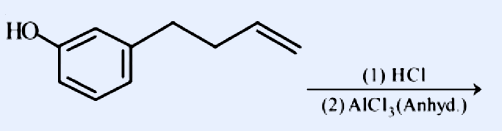
The major product of the following reaction is:
(1)
(2)
(3)
(4)
SolutionAnswer: Option 4
Approach:
Add hydrogen chloride across the terminal alkene by Markovnikov addition, then form a new ring through intramolecular Friedel-Crafts alkylation onto the phenol-activated aromatic ring.
Step 1:Markovnikov addition of hydrogen chloride to the terminal double bond places the chlorine on the more substituted internal carbon, generating a secondary alkyl chloride on the side chain.
Step 2:Anhydrous aluminium chloride ionises the chloride to a secondary carbocation that cyclises onto the ring through Friedel-Crafts alkylation, building a five-membered fused ring.
Step 3:The strongly activating and ortho/para-directing hydroxyl group directs the cyclisation to give the indane bearing the hydroxyl para to the ring fusion and a methyl group on the new ring.
Q54Single correctOrganic Compounds Containing Oxygen
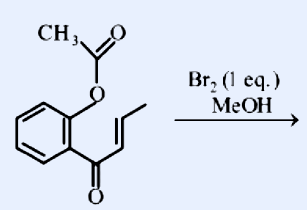
The major product obtained in the following conversion is:
(1)
(2)
(3)
(4)
SolutionAnswer: Option 1
Approach:
Treat bromine in methanol as a source of bromonium ion that adds across the alkene; methanol opens the bromonium ring to give a bromo-methyl ether (Markovnikov-type opening) on the side chain while the aromatic ester is retained.
Step 1:Bromine generates a cyclic bromonium ion on the side-chain double bond.
Step 2:Methanol acts as the external nucleophile and opens the bromonium ion at the more substituted, benzylic-stabilised carbon.
Step 3:The bromine ends up on the adjacent carbon, giving the side chain with methoxy adjacent to the ring and bromine on the next carbon, with the acetate ester unchanged.
Q55Single correctOrganic Compounds Containing Oxygen
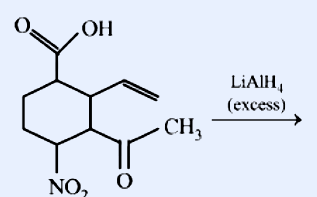
The major product obtained in the following reaction is:
(1)
(2)
(3)
(4)
SolutionAnswer: Option 3
Approach:
Apply lithium aluminium hydride (monomeric, controlled) to the substrate, reducing the carboxylic acid to a primary alcohol while the nitro group is not reduced under these conditions.
Step 1:Lithium aluminium hydride reduces the carboxylic acid to a primary alcohol.
Step 2:The aliphatic nitro group is retained under the specified mono lithium aluminium hydride conditions.
Step 3:The product carries the new hydroxymethyl-derived alcohol and the original hydroxyl while keeping the nitro group on the ring.
Q56Single correctBiomolecules
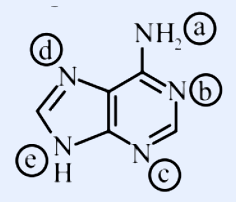
In the following compound,
the favourable site/s for protonation is/are :
the favourable site/s for protonation is/are :
(1)
(2)
(3)
(4)
SolutionAnswer: Option 2
Approach:
Identify which nitrogen atoms carry an available lone pair in a ring plane suitable for protonation, distinguishing pyridine-type ring nitrogens from the amino nitrogen and the pyrrole-type N-H nitrogen.
Step 1:The two pyrimidine ring nitrogens (b) and (c) are pyridine-type, each with a lone pair not involved in ring aromaticity, available for protonation.
Step 2:The imidazole nitrogen without an attached hydrogen (d) is also pyridine-type and basic.
Step 3:The amino nitrogen (a) lone pair is delocalised into the ring and the N-H imidazole nitrogen (e) lone pair is part of the aromatic sextet, so neither is favourable for protonation.
Final answer:
Q57Single correctOrganic Compounds Containing Nitrogen
A compound 'X' on treatment with Br /NaOH, provided , which gives positive carbylamine test. Compound X is:
(1)
(2)
(3)
(4)
SolutionAnswer: Option 3
Approach:
Recognise the bromine and sodium hydroxide treatment as Hofmann bromamide degradation, which converts a primary amide to a primary amine with one fewer carbon; the product giving a positive carbylamine test must be a primary amine.
Step 1:The reagent converts an unsubstituted primary amide into a primary amine having one less carbon atom.
Step 2:The product amine of formula C3H9N giving a positive carbylamine test is a primary amine, n-propylamine.
Step 3:The starting amide must therefore be butyramide, the primary amide with one more carbon.
Final answer:
Q58Single correctBiomolecules
The homopolymer formed from 4-hydroxy-butanoic acids is.
(1)
(2)
(3)
(4)
SolutionAnswer: Option 4
Approach:
4-hydroxybutanoic acid carries a hydroxyl and a carboxylic acid on the same chain, so it self-condenses through ester linkages to give a polyester whose repeat unit contains one ester carbonyl and a three-carbon spacer.
Step 1:The monomer is HO-CH2-CH2-CH2-COOH, with one alcohol and one acid end.
Step 2:Intermolecular esterification links the acid of one molecule to the alcohol of the next, eliminating water.
Step 3:The repeating unit therefore contains one carbonyl, three methylene carbons, and the linking oxygen.
Q59Single correctBiomolecules
The correct match between Item I and Item II is:
| Item I | Item II |
|---|---|
| (A). | (P). |
| (B). | (Q). |
| (C). | (R). |
| (D). | (S). |
(1)
(2)
(3)
(4)
SolutionAnswer: Option 1
Approach:
Pair each enzyme-related term with its defining description.
Step 1:An allosteric effect involves a molecule binding at a site other than the active site, matching (R).
Step 2:A competitive inhibitor binds at the active site, matching (P).
Step 3:A receptor is a molecule crucial for communication in the body, matching (Q); a poison binds covalently to the enzyme, matching (S).
Final answer:
Q60Single correctBiomolecules
The correct match between Item I and Item II is:
| Item I | Item II |
|---|---|
| (A). | (P). |
| (B). | (Q). |
| (C). | (R). |
| (S). |
(1)
(2)
(3)
(4)
SolutionAnswer: Option 1
Approach:
Associate each chemical test with the amino acid(s) bearing the responsive functional group.
Step 1:The ester test responds to free carboxyl and hydroxyl functionality, matching aspartic acid and serine.
Step 2:The carbylamine test detects a free primary amino group, matching lysine.
Step 3:The phthalein dye test detects the phenolic group, matching tyrosine.
Final answer:
Mathematics30 questions
Q61Single correctComplex Numbers and Quadratic Equations
Let and be the roots of the quadratic equation , and . Then is equal to :
(1)
(2)
(3)
(4)
SolutionAnswer: Option 3
Approach:
Factor the quadratic to obtain its roots, identify which is alpha and which is beta using the given ordering, then sum each geometric series separately.
Step 1:Rewrite and factor the quadratic.
Step 2:Order the roots for the given range.
Step 3:Sum the two geometric series with ratios and .
Step 4:Add the two sums.
Final answer:
Q62Single correctComplex Numbers and Quadratic Equations
Let z be a complex number such that ( where ) Then is equal to :
(1)
(2)
(3)
(4)
SolutionAnswer: Option 2
Approach:
Write the complex number in rectangular form, equate real and imaginary parts, and solve for the modulus.
Step 1:Let and substitute.
Step 2:Imaginary part gives .
Step 3:Real part equation.
Step 4:Compute the modulus.
Final answer:
Q63Single correctSequence and Series
If 19 th term of a non-zero A.P. is zero, then its (49th term): (29th term) is:
(1)
(2)
(3)
(4)
SolutionAnswer: Option 3
Approach:
Use the zero-term condition to relate the first term and common difference, then express the required terms and take their ratio.
Step 1:Apply the zero-term condition.
Step 2:Express the 49th and 29th terms.
Step 3:Form the ratio.
Final answer:
Q64Single correctBinomial Theorem and its Simple Applications
Let and where q is a real number and . If , then is equal to :
(1)
(2)
(3)
(4)
SolutionAnswer: Option 4
Approach:
Express each in closed form, substitute into the binomial sum, and use the binomial theorem to evaluate the resulting expression in terms of .
Step 1:Write the left side using the closed form of .
Step 2:Evaluate the two binomial sums.
Step 3:Express in closed form.
Step 4:Compare and solve for .
Final answer:
Q65Single correctBinomial Theorem and its Simple Applications
Let , for all ; then is equal to :
(1)
(2)
(3)
(4)
SolutionAnswer: Option 3
Approach:
Identify the coefficients and from the binomial expansion of the symmetric sum, then take their ratio.
Step 1:Find the constant term (coefficient of ).
Step 2:Find the coefficient of , namely .
Step 3:Take the ratio.
Final answer:
Q66Single correctCo-ordinate Geometry
If in a parallelogram ABDC, the coordinates of A, B and C are respectively and , then the equation of the diagonal AD is :
(1)
(2)
(3)
(4)
SolutionAnswer: Option 1
Approach:
Use the parallelogram diagonal-bisection property to find vertex D, then write the equation of line AD through A and D.
Step 1:In parallelogram ABDC the diagonals AD and BC bisect each other.
Step 2:Find D from the midpoint of AD.
Step 3:Equation of line AD through and .
Step 4:Simplify.
Final answer:
Q67Single correctCo-ordinate Geometry
A circle cuts a chord of length 4 a on the -axis and passes through a point on the -axis, distant 2 b from the origin. Then the locus of the centre of this circle, is:
(1)
(2)
(3)
(4)
SolutionAnswer: Option 4
Approach:
Let the centre be a general point, apply the chord-length and point-passing conditions, and reduce to a relation between the centre coordinates.
Step 1:Let the centre be . The -axis chord of length gives the radius.
Step 2:The circle passes through on the -axis.
Step 3:Equate the two expressions for .
Step 4:Replace by .
Final answer:
Q68Single correctCo-ordinate Geometry
If the area of the triangle whose one vertex is at the vertex of the parabola, and the other two vertices are the points of intersection of the parabola and y -axis, is 250 sq. units, then a value of 'a' is :
(1)
(2)
(3)
(4)
SolutionAnswer: Option 4
Approach:
Locate the vertex of the parabola and its intersections with the y-axis, compute the triangle area in terms of 'a', and solve the area equation.
Step 1:Rewrite the parabola; its vertex is at .
Step 2:Find intersection with the -axis ().
Step 3:Compute the triangle area with base (along y-axis) and height .
Step 4:Solve for .
Final answer:
Q69Single correctCo-ordinate Geometry
Let the length of the latus rectum of an ellipse with its major axis along -axis and centre at the origin, be 8 . If the distance between the foci of this ellipse is equal to the length of its minor axis, then which one of the following points lies on it?
(1)
(2)
(3)
(4)
SolutionAnswer: Option 2
Approach:
Translate the latus-rectum and foci-versus-minor-axis conditions into equations for the ellipse parameters, derive the equation, and test each candidate point.
Step 1:Latus rectum condition.
Step 2:Foci distance equals minor axis: , so .
Step 3:Solve the two relations.
Step 4:Test in .
Final answer:
Q70Single correctCo-ordinate Geometry
If a hyperbola has length of its conjugate axis equal to 5 and the distance between its foci is 13 , then the eccentricity of the hyperbola is:
(1)
(2)
(3)
(4)
SolutionAnswer: Option 1
Approach:
Use the conjugate-axis and foci-distance data to find the hyperbola parameters, then compute the eccentricity.
Step 1:Conjugate axis gives .
Step 2:Foci distance gives .
Step 3:Use to find a.
Step 4:Compute the eccentricity.
Final answer:
Q71Single correctLimit, Continuity and Differentiability
is equal to:
(1)
(2)
(3)
(4)
SolutionAnswer: Option 4
Approach:
Replace each trigonometric factor by its small-angle equivalent and evaluate the limit of the ratio.
Step 1:Rewrite cotangents as cosine over sine and use small-angle approximations.
Step 2:Substitute the approximations into the expression.
Step 3:Evaluate the limit.
Final answer:
Q72Single correctSets, Relations and Functions
Contrapositive of the statement "If two numbers are not equal, then their squares are not equal". is :
(1)
(2)
(3)
(4)
SolutionAnswer: Option 3
Approach:
Apply the definition of contrapositive to the given implication by negating and swapping its parts.
Step 1:Identify hypothesis and conclusion.
Step 2:Form the contrapositive .
Step 3:State the contrapositive.
Final answer:
Q73Single correctTrigonometry
Given for a with usual notation. If , then the ordered triad has a value
(1)
(2)
(3)
(4)
SolutionAnswer: Option 1
Approach:
Express the sides as proportional values from the given ratio, compute the cosines of the angles via the cosine rule, and identify the proportional triad.
Step 1:Set the common ratio and solve for the sides.
Step 2:Compute the cosines (drop common factor ).
Step 3:Express cosines with a common denominator to read off proportionality.
Final answer:
Q74Single correctMatrices and Determinants
If and , then x is equal to
(1)
(2)
(3)
(4)
SolutionAnswer: Option 4
Approach:
Simplify the determinant using row operations to obtain a known closed form, then compare with the right-hand side to solve for x.
Step 1:Apply .
Step 2:After column operations , the determinant reduces.
Step 3:Equate to the given form.
Step 4:Solve, taking .
Final answer:
Q75Single correctMatrices and Determinants
Let A and B be two invertible matrices of order . If and , then is equal to
(1)
(2)
(3)
(4)
SolutionAnswer: Option 3
Approach:
Use the multiplicative and transpose properties of determinants to express the two given conditions, solve for det(A) and det(B), then evaluate the required determinant.
Step 1:Apply the properties to the first condition.
Step 2:Apply them to the second condition.
Step 3:Solve for the determinants.
Step 4:Evaluate the required determinant.
Final answer:
Q76Single correctTrigonometry
All x satisfying the inequality , lie in the interval :
(1)
(2)
(3)
(4)
SolutionAnswer: Option 2
Approach:
Substitute , solve the quadratic inequality on the range of , then translate back to x using the monotonic decreasing nature of .
Step 1:Put , where . The inequality becomes a quadratic in t.
Step 2:The quadratic is positive for or . Intersecting with and noting , only survives.
Step 3:Since is strictly decreasing, gives .
Final answer:
Q77Single correctSets, Relations and Functions
Let a function be defined by . Then f is :
(1)
(2)
(3)
(4)
SolutionAnswer: Option 4None of the above
Approach:
Test injectivity by finding two inputs with the same output, and test surjectivity by examining the image of f against the codomain .
Step 1:Evaluate f at and .
Step 2:For , so takes every value in . For , . Values in are attained on both branches, so f is not injective.
Step 3:At , , which lies outside the codomain , so f as written does not map into and the listed properties do not describe it.
Final answer: None of the above
Q78Single correctPermutations and Combinations
The number of functions f from onto such that f(k) is a multiple of 3, whenever k is a multiple of 4 is:
(1)
(2)
(3)
(4)
SolutionAnswer: Option 3
Approach:
Count bijections of a 20-element set in which the five multiples of 4 map into the six multiples of 3.
Step 1:The five multiples of 4 (4,8,12,16,20) map injectively into the six multiples of 3, giving 6P5 = 6! ways.
Step 2:The remaining 15 elements are arranged bijectively in 15! ways.
Final answer:
Q79Single correctLimit, Continuity and Differentiability
Let K be the set of all real values of x where the function is not differentiable. Then the set K is equal to :
(1)
(2)
(3)
(4)
SolutionAnswer: Option 1 (an empty set)
Approach:
The only candidate non-differentiable point comes from at . Compute the left and right derivatives at and compare.
Step 1:For , ; for , .
Step 2:Right derivative at : from term it is ; left derivative from is . The term is differentiable at with matching one-sided derivatives.
Step 3:Since the one-sided derivatives agree at the only suspect point and is smooth elsewhere, is differentiable everywhere.
Final answer: (an empty set)
Q80Single correctLimit, Continuity and Differentiability
Let where a, b and d are non-zero real constants. Then :
(1)
(2)
(3)
(4)
SolutionAnswer: Option 1 is an increasing function of
Approach:
Differentiate each term and show for all real .
Step 1:Differentiate the first term with respect to .
Step 2:Differentiate the second term; let so its derivative with respect to carries a factor , and the leading minus sign makes the contribution positive.
Step 3:Add the two positive contributions.
Final answer: is an increasing function of
Q81Single correctSequence and Series
Let x, y be positive real numbers and m, n positive integers. The maximum value of the expression is :
(1)
(2)
(3)
(4)
SolutionAnswer: Option 3
Approach:
Apply the AM-GM inequality separately to and to bound the denominator from below.
Step 1:By AM-GM, for .
Step 2:Similarly, .
Step 3:Multiply the two bounds.
Final answer:
Q82Single correctIntegral Calculus
If , where C is a constant of integration, then f(x) is equal to:
(1)
(2)
(3)
(4)
SolutionAnswer: Option 4
Approach:
Substitute to remove the radical, integrate the resulting polynomial, then express the result in the required form.
Step 1:With , the integrand transforms to a polynomial in t.
Step 2:Simplify and factor out .
Step 3:Replace and factor to match .
Final answer:
Q83Single correctIntegral Calculus
The integral equals:
(1)
(2)
(3)
(4)
SolutionAnswer: Option 2
Approach:
Rewrite the integrand in terms of , substitute or , and reduce to a standard inverse-tangent form.
Step 1:Express using . With , the denominator becomes .
Step 2:Let , so . The integral reduces to a constant times .
Step 3:Apply the limits (where ) and (where ).
Final answer:
Q84Single correctIntegral Calculus
The area (in sq. units) in the first quadrant bounded by the parabola, , the tangent to it at the point and the coordinate axes is :
(1)
(2)
(3)
(4)
SolutionAnswer: Option 2
Approach:
Find the tangent line at , then compute the area between the parabola and the axes minus the area under the tangent line in the first quadrant.
Step 1:Slope at is , so the tangent is , i.e. . It meets the x-axis at .
Step 2:Area under the parabola from to bounded by the axes.
Step 3:Subtract the triangular area under the tangent from to (base , height ).
Final answer:
Q85Single correctDifferential Equations
The solution of the differential equation, , when , is:
(1)
(2)
(3)
(4)
SolutionAnswer: Option 2
Approach:
Substitute to convert the equation into a separable form, integrate, and apply the initial condition.
Step 1:With , , which separates.
Step 2:Substitute back .
Step 3:Apply , so at , giving , hence . Rearranging yields the keyed form.
Final answer:
Q86Single correctVector Algebra
Let and respectively be the position vectors of the points A, B and C with respect to the origin O. If the distance of C from the bisector of the acute angle between OA and OB is , then the sum of all possible values of is:
(1)
(2)
(3)
(4)
SolutionAnswer: Option 4
Approach:
Find the bisector of the acute angle between OA and OB, write its line equation, then use the distance of C from this line to solve for and sum the roots.
Step 1:Both and have magnitude . Their sum gives the bisector direction , so the bisector is the line .
Step 2:Distance of from equals .
Step 3:Solve to get or , then add the roots.
Final answer:
Q87Single correctThree Dimensional Geometry
Two lines and intersect at the point R. The reflection of R in the xy-plane has coordinates:
(1)
(2)
(3)
(4)
SolutionAnswer: Option 1
Approach:
Parametrize the first line, substitute into the second line's symmetric equations to find the intersection , then reflect across the -plane by negating the -coordinate.
Step 1:Write the first line as and require it to satisfy the second line's ratios.
Step 2:Substitute to obtain R.
Step 3:Reflect in the -plane by negating .
Final answer:
Q88Single correctThree Dimensional Geometry
If the point lies on the plane which passes through the points and and is perpendicular to the plane , then is equal to :
(1)
(2)
(3)
(4)
SolutionAnswer: Option 2
Approach:
Determine the equation of the required plane using the two given points and the perpendicularity condition, then substitute and evaluate .
Step 1:Let the plane be . It contains and , and its normal is perpendicular to since the planes are perpendicular.
Step 2:From take ; then . Using point : .
Step 3:Substitute : , hence .
Final answer:
Q89Single correctStatistics and Probability
Let S . A subset B of S is said to be "nice", if the sum of the elements of B is 203 . Than the probability that a randomly chosen subset of S is "nice" is :
(1)
(2)
(3)
(4)
SolutionAnswer: Option 2
Approach:
A subset summing to 203 has complement summing to 210-203=7; count subsets of S summing to 7.
Step 1:Total of S is 210, so nice subsets correspond to subsets summing to 7.
Step 2:Subsets summing to 7: {7},{1,6},{2,5},{3,4},{1,2,4} = 5; probability over subsets.
Final answer:
Q90Single correctStatistics and Probability
A bag contains 30 white balls and 10 red balls. 16 balls are drawn one by one randomly from the bag with replacement. If X be the number of white balls drawn, then is equal to:
(1)
(2)
(3)
(4)
SolutionAnswer: Option 2
Approach:
Model X as a binomial random variable with and success probability , then form the ratio of mean to standard deviation.
Step 1:Probability of drawing a white ball is , so , with .
Step 2:Compute mean and standard deviation.
Step 3:Form the required ratio.
Final answer:
More JEE Main 2019 papers
- JEE Main 2019 — April 08, Shift 1
- JEE Main 2019 — April 08, Shift 2
- JEE Main 2019 — April 09, Shift 1
- JEE Main 2019 — January 09, Shift 1
- JEE Main 2019 — January 09, Shift 2
- JEE Main 2019 — January 10, Shift 1
- JEE Main 2019 — January 10, Shift 2
- JEE Main 2019 — January 11, Shift 1
- JEE Main 2019 — January 12, Shift 1
- JEE Main 2019 — January 12, Shift 2
Frequently Asked Questions
How many questions are in the JEE Main 2019 January 11, Shift 2 paper?
The JEE Main 2019 January 11, Shift 2 paper has 90 questions — Physics (30), Chemistry (30) and Mathematics (30). Every question is on this page with its correct answer and a step-by-step solution.
What is the marking scheme for JEE Main?
JEE Main awards +4 marks for each correct answer and −1 for a wrong answer, with 0 for questions left unattempted. The paper covers Physics, Chemistry and Mathematics.
Are the answer key and step-by-step solutions provided for the 2019 January 11, Shift 2 paper?
Yes — every question shows the correct answer (answer key) and a detailed step-by-step solution, free to read online.
Can I take the JEE Main 2019 January 11, Shift 2 paper as a timed mock test?
Yes. With a free JEEnify account you can attempt this exact paper as a timed test in the real exam interface, then see your score and weak-area analysis.
Solved this paper? Calculate your JEE Main scoremost important chaptersformula sheetsall free tools.