
Back to JEE Main PYQs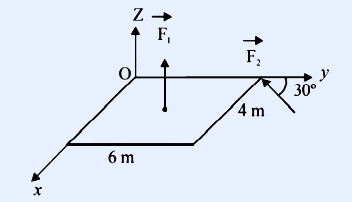

JEE Main 2019 January 11, Shift 1 Question Paper with Solutions
All 90 questions from the JEE Main 2019 (January 11, Shift 1) shift — Physics (30), Chemistry (30) and Mathematics (30) — each with the correct answer (answer key) and a step-by-step solution. Read it free online, or attempt the full paper as a timed mock test.
Physics30 questions
Q1Single correctPhysics and Measurement
The force of interaction between two atoms is given by ; where x is the distance, k is the Boltzmann constant and T is temperature and and are two constants. The dimensions of is :
(1)
(2)
(3)
(4)
SolutionAnswer: Option 2
Approach:
The argument of the exponential must be dimensionless, which fixes the dimensions of . The dimensions of then follow from equating the dimensions of F to the dimensions of the product .
Step 1:The exponent is dimensionless, so the dimensions of alpha are obtained from the square of distance divided by the product of alpha and energy.
Step 2:Force equals the product of alpha and beta, so beta equals force divided by alpha.
Final answer:
Q2Single correctKinematics
A particle is moving along a circular path with a constant speed of . What is the magnitude of the change in velocity of the particle, when it moves through an angle of around the centre of the circle?
(1)
(2)
(3)
(4)
SolutionAnswer: Option 4
Approach:
The change in velocity for uniform circular motion has magnitude equal to twice the speed times the sine of half the subtended angle.
Step 1:The two velocity vectors have equal magnitude and are separated by the subtended angle, so the magnitude of their difference follows from the chord formula.
Step 2:Evaluating the expression gives the magnitude of the change in velocity.
Final answer:
Q3Single correctKinematics
A body is projected at with a velocity at an angle of with the horizontal. The radius of curvature of its trajectory at s is R. Neglecting air resistance and taking acceleration due to gravity , the value of R is:
(1)
(2)
(3)
(4)
SolutionAnswer: Option 2 m
Approach:
The velocity components at the given instant give the speed and the angle of the velocity. The component of gravity perpendicular to the velocity acts as the centripetal acceleration, from which the radius of curvature follows.
Step 1:Evaluate the horizontal and vertical velocity components one second after projection.
Step 2:Compute the speed at this instant from the components.
Step 3:The perpendicular component of gravity equals g times the cosine of the angle the velocity makes with the horizontal.
Step 4:Divide the square of the speed by the perpendicular acceleration to get the radius of curvature.
Final answer: m
Q4Single correctWork, Energy and Power
A block of mass 2 kg falls freely from a height of 100 m, on a platform of mass 3 kg which is mounted on a spring having spring constant . The body sticks to the platform and the spring's maximum compression is found to be x. Given that , the value of x will be close to :
(1)
(2)
(3)
(4)
SolutionAnswer: Option 2 cm
Approach:
The falling block's free-fall speed gives its velocity at impact. A perfectly inelastic collision with the platform reduces the speed, and the combined kinetic plus gravitational energy converts into spring potential energy at maximum compression.
Step 1:Determine the speed of the 2 kg block just before it strikes the platform.
Step 2:Apply conservation of momentum for the perfectly inelastic collision to get the common speed of the 5 kg combination.
Step 3:Equate the kinetic energy plus the gravitational energy over the compression to the spring potential energy; the gravity term is negligible compared with the kinetic term.
Step 4:Solve for the maximum compression.
Final answer: cm
Q5Single correctRotational Motion
A slab is subjected to two forces and of same magnitude F as shown in the figure. Force is in XY-plane while force acts along z-axis at the point . The moment of these forces about point O will be:
(1)
(2)
(3)
(4)
SolutionAnswer: Option 1
Approach:
The total moment about O is the sum of the cross products of each force's position vector with the force. The two forces share the same point of application, so their position vectors are combined with the respective force vectors.
Step 1:The force along the z-axis at the point with position vector r contributes a moment given by its cross product with the position vector.
Step 2:The in-plane force, applied so that its position vector and direction combine to give a contribution along the z-axis, yields the remaining component.
Step 3:Add the two contributions to obtain the net moment about O.
Final answer:
Q6Single correctRotational Motion
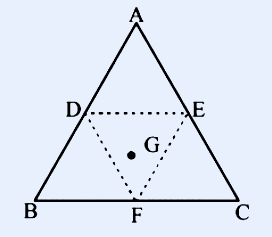
An equilateral triangle ABC is cut from a thin solid sheet of wood. (See figure) D, E and F are the mid-points of its sides as shown and G is the centre of the triangle. The moment of inertia of the triangle about an axis passing through G and perpendicular to the plane of the triangle is . If the smaller triangle DEF is removed from ABC, the moment of inertia of the remaining figure about the same axis is I. Then :
(1)
(2)
(3)
(4)
SolutionAnswer: Option 1
Approach:
The moment of inertia of a uniform triangle about the perpendicular axis through its centre scales with mass times the square of its linear size. The removed triangle DEF has half the side and one quarter the mass of ABC and shares the same centroid, so its moment of inertia is a fixed fraction of the whole.
Step 1:The smaller triangle DEF has half the side length and one quarter the area and mass of ABC, with the same centroid G.
Step 2:Because the moment of inertia scales as mass times side squared, the moment of inertia of DEF is one sixteenth that of ABC.
Step 3:Subtract the removed triangle's contribution from the whole.
Final answer:
Q7Single correctGravitation
A satellite is revolving in a circular orbit at a height from the earth surface, such that where R is the radius of the earth. Assuming that the effect of earth's atmosphere can be neglected the minimum increase in the speed required so that the satellite could escape from the gravitational field of earth is :
(1)
(2)
(3)
(4)
SolutionAnswer: Option 4
Approach:
The orbital speed at low altitude is the square root of g times R. The escape speed from the surface is the square root of two times g times R. The minimum increase needed is the difference between the escape speed and the orbital speed.
Step 1:For a low orbit the orbital speed equals the square root of g times the radius.
Step 2:The escape speed from near the surface equals the square root of two times g times the radius.
Step 3:The minimum extra speed is the escape speed minus the orbital speed.
Final answer:
Q8Single correctProperties of Solids and Liquids
A liquid of density is coming out of a hose pipe of radius a with horizontal speed v and hits a mesh. 50% of the liquid passes through the mesh unaffected. 25% looses all of its momentum and 25% comes back with the same speed. The resultant pressure on the mesh will be :
(1)
(2)
(3)
(4)
SolutionAnswer: Option 2
Approach:
The force on the mesh equals the rate of change of momentum of the liquid striking it. Each fraction of the stream contributes according to how its momentum changes, and the pressure follows by dividing the total force by the cross-sectional area.
Step 1:The portion passing through unaffected exerts no force. The quarter that stops delivers its forward momentum, and the quarter that rebounds reverses, delivering twice its momentum.
Step 2:Combine the two contributions to get the total force on the mesh.
Step 3:Divide the force by the cross-sectional area to obtain the resultant pressure.
Final answer:
Q9Single correctThermodynamics
Ice at is added to 50 g of water at . When the temperature of the mixture reaches , it is found that 20 g of ice is still unmelted. The amount of ice added to the water was close to (Specific heat of water Specific heat of Ice Heat of fusion of water at
(1)
(2)
(3)
(4)
SolutionAnswer: Option 4 g
Approach:
The water releases heat in cooling from 40 to 0 degrees. This heat warms all of the ice from minus 20 to 0 degrees and melts the portion of ice that has melted. The mass of ice follows from the heat balance, knowing that 20 grams remain unmelted.
Step 1:Heat released as the 50 g of water cools from 40 to 0 degrees.
Step 2:Let the total ice mass be m. Warming all of it from minus 20 to 0 and melting (m minus 20) grams absorbs the released heat.
Step 3:Solve the heat balance for the total mass of ice added.
Final answer: g
Q10Single correctThermodynamics
A rigid diatomic ideal gas undergoes an adiabatic process at room temperature. The relation between temperature and volume for this process is constant, then x is :
(1)
(2)
(3)
(4)
SolutionAnswer: Option 2
Approach:
For an adiabatic process the product of temperature and volume to the power gamma minus one is constant. For a rigid diatomic gas gamma equals seven fifths, so the exponent x equals gamma minus one.
Step 1:A rigid diatomic gas has five degrees of freedom giving a ratio of specific heats of seven fifths.
Step 2:The exponent x in the temperature-volume relation equals gamma minus one.
Final answer:
Q11Single correctKinetic Theory of Gases
A gas mixture consists of 3 moles of oxygen and 5 moles of argon at temperature T. Considering only translational and rotational modes, the total internal energy of the system is :
(1)
(2)
(3)
(4)
SolutionAnswer: Option 1
Approach:
Each gas contributes internal energy equal to half its degrees of freedom times the number of moles times the gas constant times temperature. Oxygen is diatomic with five degrees of freedom and argon is monatomic with three. Summing the two contributions gives the total internal energy.
Step 1:Oxygen, diatomic with five degrees of freedom and three moles, contributes its internal energy.
Step 2:Argon, monatomic with three degrees of freedom and five moles, contributes its internal energy.
Step 3:Add the two contributions for the total internal energy.
Final answer:
Q12Single correctOscillations and Waves
A particle undergoing simple harmonic motion has time dependent displacement given by . The ratio of kinetic to potential energy of this particle at s will be :
(1)
(2)
(3)
(4)
SolutionAnswer: Option 4
Approach:
In simple harmonic motion the kinetic energy is proportional to the square of the cosine of the phase and the potential energy to the square of the sine. Their ratio is the square of the cotangent of the phase, evaluated at the given time.
Step 1:Determine the phase of the motion at the given instant.
Step 2:The phase reduces to one equivalent to sixty degrees, so the ratio of kinetic to potential energy is the square of its cotangent.
Final answer:
Q13Single correctOscillations and Waves
Equation of travelling wave on a stretched string of linear density is where distance and time are measured in SI units. The tension in the string is :
(1)
(2)
(3)
(4)
SolutionAnswer: Option 3 N
Approach:
The wave speed is the ratio of the angular frequency to the wave number read from the equation. The tension equals the linear mass density times the square of this speed.
Step 1:Read the angular frequency and wave number from the wave equation and form the wave speed.
Step 2:The tension equals the linear density times the square of the wave speed, using 5 grams per metre as 0.005 kg per metre.
Step 3:Evaluate the product to obtain the tension.
Final answer: N
Q14Single correctElectrostatics
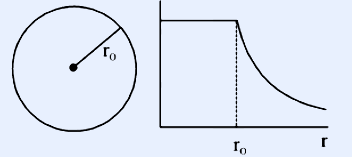
The given graph shows variation (with distance r from centre) of :
(1)
(2)
(3)
(4)
SolutionAnswer: Option 2Potential of a uniformly charged spherical shell
Approach:
The graph shows a quantity that is constant inside up to a radius and then decreases as the inverse of distance outside. This behaviour matches the electrostatic potential of a uniformly charged spherical shell, which is uniform within the shell and falls off inversely with distance beyond it.
Step 1:The plotted quantity stays constant from the centre out to the radius and is non-zero there, which rules out a field that would be zero inside.
Step 2:Beyond the radius the quantity decreases as one over the distance, matching the external potential of a shell.
Final answer: Potential of a uniformly charged spherical shell
Q15Single correctElectrostatics
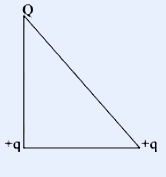
Three charges , and are placed at the vertices of a right-angle isosceles triangle as shown below. The net electrostatic energy of the configuration is zero, if the value of Q is :
(1)
(2)
(3)
(4)
SolutionAnswer: Option 2
Approach:
The total electrostatic energy is the sum of the three pairwise interaction energies. Setting this sum to zero and solving for Q gives the required charge. The two equal charges sit at the ends of the hypotenuse-forming legs, and the charge Q sits at the right angle vertex.
Step 1:Take the two equal legs of length a meeting at the right angle vertex where Q sits, so the two plus q charges are a distance a from Q and a distance a root two apart.
Step 2:Set the total energy to zero and cancel the common factor of k over a.
Step 3:Solve for Q and rationalize to match the keyed form.
Final answer:
Q16Single correctElectrostatics
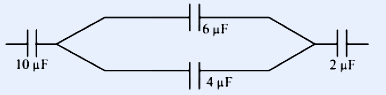
In the figure shown below, the charge on the left plate of the 10F capacitor is -30C. The charge on the right plate of the 6F capacitor is:
(1)
(2)
(3)
(4)
SolutionAnswer: Option 4
Approach:
The 6F and 4F capacitors are in parallel between the same two nodes; the charge on the left plate of the 10F capacitor sets the total charge that splits between the parallel branch in proportion to capacitance.
Step 1:The charge magnitude entering the parallel combination of 6F and 4F equals the magnitude of charge on the 10F plate.
Step 2:The 6F and 4F capacitors share this charge in the ratio of their capacitances.
Step 3:The right plate of the 6F capacitor carries the opposite sign to the left plate of the 10F capacitor.
Final answer:
Q17Single correctCurrent Electricity
Two equal resistances when connected in series to a battery, consume electric power of 60 W. If these resistance are now connected in parallel combination to the same battery, the electric power consumed will be :
(1)
(2)
(3)
(4)
SolutionAnswer: Option 2
Approach:
Compare the equivalent resistance of two equal resistors in series versus parallel for a fixed battery voltage, then use power equals voltage squared divided by resistance.
Step 1:For two equal resistors R in series, the equivalent resistance is 2R and the series power is given.
Step 2:For the same two resistors in parallel, the equivalent resistance is R/2.
Step 3:Substitute the series relation.
Final answer:
Q18Single correctCurrent Electricity
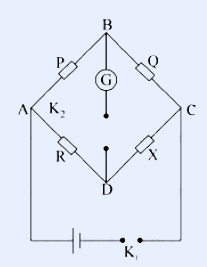
In a Wheatstone bridge (see fig.), Resistances P and Q are approximatelyequal. When , the bridge is balanced. On interchanging P and Q, the value of R, for balance, is . The value of Y is close to
(1)
(2)
(3)
(4)
SolutionAnswer: Option 4
Approach:
Apply the Wheatstone balance condition before and after interchanging P and Q, then eliminate the P/Q ratio to obtain the unknown arm as the geometric mean of the two balancing resistances.
Step 1:With the original arrangement the balance condition relates the unknown arm X to R.
Step 2:After interchanging P and Q the balance is restored at the new value of R.
Step 3:Multiply the two relations to eliminate the P/Q ratio.
Final answer:
Q19Single correctMagnetic Effects of Current and Magnetism
In an experiment, electrons are accelerated, from rest, by applying a voltage of 500 V. Calculate the radius of the path if a magnetic field 100mT is then applied. [Charge of the electron C Mass of the electron kg]
(1)
(2)
(3)
(4)
SolutionAnswer: Option 4 m
Approach:
Find the electron speed from the accelerating potential, then equate the magnetic force to the centripetal force to obtain the radius of the circular path.
Step 1:Determine the electron speed from the accelerating voltage.
Step 2:Substitute into the radius expression with B = 0.1 T.
Final answer: m
Q20Single correctElectromagnetic Induction and Alternating Currents
There are two long co-axial solenoids of same length l. The inner and outer coils have radii and and number of turns per unit length and , respectively. The ratio of mutual inductance to the self-inductance of the inner-coil is :
(1)
(2)
(3)
(4)
SolutionAnswer: Option 4
Approach:
Write the mutual inductance of the coaxial solenoid pair and the self-inductance of the inner solenoid, then take their ratio.
Step 1:The mutual inductance depends on the inner cross-sectional area, since the inner solenoid's flux links the outer turns.
Step 2:The self-inductance of the inner coil uses its own turn density squared.
Step 3:Form the ratio; the common factors cancel.
Final answer:
Q21Single correctElectromagnetic Induction and Alternating Currents
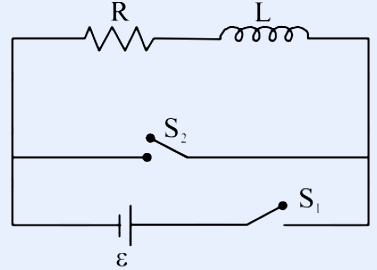
In the circuit shown, the switch is closed at time and the switch is kept open. At some later time , the switch is opened and is closed. the behaviour of the current I as a function of time ' t ' is given by:
(1)
(2)
(3)
(4)
SolutionAnswer: Option 1
Approach:
Analyse the RL circuit in two phases: growth of current while S1 is closed (S2 open), and decay of current after S1 is opened and S2 is closed at t0.
Step 1:While S1 is closed and S2 open, the inductor current grows exponentially toward a steady value.
Step 2:After S1 is opened and S2 closed at t0, the inductor current decays exponentially through the closed loop.
Step 3:The full behaviour is exponential growth to t0 followed by exponential decay, matching the graph of option 1.
Final answer: Option 1 (exponential growth up to t0, then exponential decay)
Q22Single correctElectromagnetic Waves
An electromagnetic wave of intensity enters in a medium of refractive index 'n' without any loss. The ratio of the magnitudes of electric fields, and the ratio of the magnitudes of magnetic fields of the wave before and after entering into the medium are respectively, given by :
(1)
(2)
(3)
(4)
SolutionAnswer: Option 3
Approach:
Use conservation of intensity across the boundary together with the relations of intensity to the field amplitudes in a medium of refractive index n.
Step 1:Intensity is unchanged across the boundary, and the speed in the medium is c/n.
Step 2:Equate intensities to relate the electric field amplitudes.
Step 3:Use B = nE/c in each region to find the magnetic-field ratio.
Final answer:
Q23Single correctOptics
An object is at a distance of 20 m from a convex lens of focal length 0.3 m. The lens forms an image of the object. If the object moves away from the lens at a speed of 5 m/s the speed and direction of the image will be
(1)
(2)
(3)
(4)
SolutionAnswer: Option 4 m/s towards the lens
Approach:
Differentiate the lens equation to relate image speed to object speed through the square of the lateral magnification, and determine the direction of the image motion.
Step 1:Find the image distance for u = 20 m and f = 0.3 m.
Step 2:Compute the magnification magnitude.
Step 3:Image speed equals the square of the magnification times the object speed; as the object recedes the image approaches the focal point, moving towards the lens.
Final answer: m/s towards the lens
Q24Single correctOptics
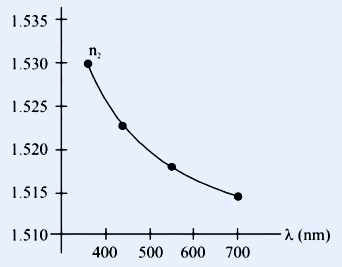
The variation of refractive index of a crown glass thin prism with wavelength of the incident light is shown. Which of the following graphs is the correct one, if is the angle of minimum deviation?
(1)
(2)
(3)
(4)
SolutionAnswer: Option 1
Approach:
For a thin prism the angle of minimum deviation is proportional to (n - 1), so its variation with wavelength follows the refractive-index variation.
Step 1:The minimum deviation of a thin prism is directly proportional to (n - 1).
Step 2:Since the given n decreases as wavelength increases, Dm also decreases with increasing wavelength.
Step 3:The decreasing Dm-versus-lambda curve corresponds to option 1.
Final answer: Option 1 (Dm decreasing with wavelength)
Q25Single correctOptics
In a Young's double slit experiment, the path difference, at a certain point on the screen, betwen two interfering waves is th of wavelength. The ratio of the intensity at this point to that at the centre of a bright fringe is close to:
(1)
(2)
(3)
(4)
SolutionAnswer: Option 2
Approach:
Convert the path difference to a phase difference, then use the intensity relation for two-source interference normalised to the central maximum.
Step 1:Path difference is one-eighth of a wavelength, giving the phase difference.
Step 2:Apply the normalised intensity relation.
Step 3:The ratio is close to 0.85.
Final answer:
Q26Single correctDual Nature of Matter and Radiation
If the deBroglie wavelength of an electron is equal to times the wavelength of a photon of frequency Hz, then the speed of electron is equal to : (Speed of light m/s) Planck's constant J.s Mass of electron kg)
(1)
(2)
(3)
(4)
SolutionAnswer: Option 4 m/s
Approach:
Express the photon wavelength from its frequency, scale it by the given factor for the electron's de Broglie wavelength, then solve the de Broglie relation for electron speed.
Step 1:Photon wavelength from its frequency.
Step 2:Electron de Broglie wavelength is times the photon wavelength.
Step 3:Solve the de Broglie relation for the electron speed.
Final answer: m/s
Q27Single correctAtoms and Nuclei
A hydrogen atom, initially in the ground state is excited by absorbing a photon of wavelength .... The radius of the atom in the excited state, in terms of Bohr radius , will be:
(1)
(2)
(3)
(4)
SolutionAnswer: Option 3
Approach:
Find the photon energy, equate it to the excitation energy from the ground state to level n, solve for n, then use the Bohr radius scaling.
Step 1:Compute the absorbed photon energy.
Step 2:Equate to the excitation energy from n = 1 to level n.
Step 3:Apply the radius scaling for the excited level.
Final answer:
Q28Single correctElectronic Devices
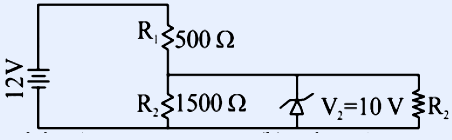
In the given circuit the current through Zener Diode is close to:
(1)
(2)
(3)
(4)
SolutionAnswer: Option 1 mA
Approach:
Find the voltage that would appear across the Zener branch from the resistive divider; if it is below the Zener breakdown voltage the Zener does not conduct.
Step 1:Without the Zener conducting, the node voltage is set by the R1-R2 divider across 12 V.
Step 2:Compare the available voltage with the Zener breakdown voltage.
Step 3:Since the applied voltage does not reach the breakdown value, the Zener stays off and carries no current.
Final answer: mA
Q29Single correctElectronic Devices
An amplitude modulated signal is given by . Here t is in seconds. The sideband frequencies (in kHz ) are, [Given ]
(1)
(2)
(3)
(4)
SolutionAnswer: Option 3 and
Approach:
Identify the carrier and modulating angular frequencies from the signal, convert to frequencies in kHz, and form the upper and lower sideband frequencies.
Step 1:Carrier angular frequency gives the carrier frequency.
Step 2:Modulating angular frequency gives the modulating frequency.
Step 3:Form the upper and lower sidebands matching the keyed pair.
Final answer: and
Q30Single correctCurrent Electricity
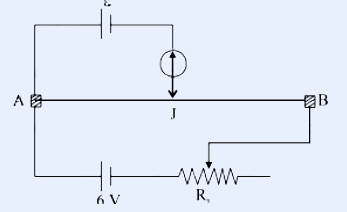
The resistance of the meter bridge AB in given figure is . With a cell of emf V and rheostat resistance the null point is obtained at some point J. When the cell is replaced by another one of emf the same null point J is found for . The emf is:
(1)
(2)
(3)
(4)
SolutionAnswer: Option 2 V
Approach:
At the same null point the potential drop across the bridge section up to J is balanced; the driving current through the bridge depends on the rheostat setting, so the balancing emf scales with that current.
Step 1:The same null point J means the same balancing resistance J; the balancing emf is proportional to the loop current driven by the 6 V cell.
Step 2:Form the ratio of the two cases at = 2 ohm and = 6 ohm.
Step 3:Solve for the second emf.
Final answer: V
Chemistry30 questions
Q31Single correctSome Basic Concepts in Chemistry
A 10mg effervescent tablet containing sodium bicarbonate and oxalic acid releases of at and . If molar volume of is under such condition, what is the percentage of sodium bicarbonate in each tablet? [Molar mass of ]
(1)
(2)
(3)
(4)
SolutionAnswer: Option 4
Approach:
Determine the moles of carbon dioxide from the given volume and molar volume, equate to moles of sodium bicarbonate reacting, convert to mass, and express as a percentage of the tablet mass.
Step 1:Moles of carbon dioxide released.
Step 2:One mole of sodium bicarbonate liberates one mole of carbon dioxide, so the moles of bicarbonate equal the moles of carbon dioxide.
Step 3:Mass of sodium bicarbonate.
Step 4:Percentage in the 10 mg tablet.
Final answer:
Q32Single correctAtomic Structure
Heat treatment of muscular pain involves radiation of wavelength of about 900nm. Which spectral line of H atom is suitable for this purpose?
(1)
(2)
(3)
(4)
SolutionAnswer: Option 1
Approach:
Apply the Rydberg formula for the hydrogen emission lines, test the candidate transitions, and match the computed wavelength against the required 900 nm.
Step 1:Express the required wavenumber for 900 nm.
Step 2:For the Paschen series the lower level is n = 3; the series limit transition gives the maximum wavenumber.
Step 3:The corresponding wavelength matches the requirement.
Step 4:The transition is therefore the Paschen series limit.
Final answer:
Q33Single correctClassification of Elements and Periodicity in Properties
The correct order of the atomic radii of C, Cs, Al, and S is :
(1)
(2)
(3)
(4)
SolutionAnswer: Option 1
Approach:
Rank the elements using periodic trends: atomic radius decreases across a period and increases down a group, then arrange the four atoms in increasing order.
Step 1:Carbon and sulphur are second- and third-period non-metals respectively; carbon is smaller, and sulphur is larger than carbon overall.
Step 2:Aluminium, a third-period metal on the left, is larger than the third-period non-metal sulphur.
Step 3:Caesium, a large sixth-period alkali metal, has the greatest atomic radius among the four.
Step 4:Combine the comparisons into a single increasing order.
Final answer:
Q34Single correctChemical Thermodynamics
Two blocks of the same metal having same mass and at temperature and , respectively, are brought in contact with each other and allowed to attain thermal equilibrium at constant pressure. The change in entropy, , for this process is :
(1)
(2)
(3)
(4)
SolutionAnswer: Option 1
Approach:
Find the common final temperature from energy balance, then integrate dS = dT/T for each block and sum the two entropy changes.
Step 1:Equal-mass identical blocks reach an arithmetic-mean final temperature.
Step 2:Entropy change of each block.
Step 3:Combine the logarithms.
Step 4:Substitute the final temperature.
Final answer:
Q35Single correctChemical Thermodynamics
For the chemical reaction , the standard reaction Gibbs energy depends on temperature T (in K) as ( in kJmo) T The major component of the reaction mixture at T is :
(1)
(2)
(3)
(4)
SolutionAnswer: Option 4
Approach:
The sign of the standard reaction Gibbs energy determines which side is favoured: a positive value favours reactant X, a negative value favours product Y. Find the crossover temperature and test each option.
Step 1:Set the standard Gibbs energy to zero to find the crossover temperature.
Step 2:Below 320 K the value is positive, so reactant X is the major component; above 320 K product Y dominates.
Step 3:Test the options: T = 315 K lies below 320 K, giving a positive Gibbs energy, so X is major.
Step 4:Confirm the other options fail: at 300 K and 280 K the energy is positive (X major, not Y), and at 350 K it is negative (Y major, not X).
Final answer:
Q36Single correctEquilibrium
Consider the reaction The equilibrium constant of the above reaction is . If pure ammonia is left to dissociate, the partial pressure of ammonia at equilibrium is given by (Assume that at equilibrium)
(1)
(2)
(3)
(4)
SolutionAnswer: Option 1
Approach:
Write the equilibrium constant for ammonia synthesis, express the nitrogen and hydrogen partial pressures from the 1:3 stoichiometry of dissociation under the small-ammonia approximation, and solve for the ammonia partial pressure.
Step 1:When pure ammonia dissociates, nitrogen and hydrogen form in a 1:3 ratio, and with ammonia negligible the total pressure is essentially that of these gases.
Step 2:Insert these into the equilibrium expression.
Step 3:Evaluate the denominator.
Step 4:Solve for the ammonia partial pressure.
Final answer:
Q37Single correctClassification of Elements and Periodicity in Properties
The amphoteric hydroxide is:
(1)
(2)
(3)
(4)
SolutionAnswer: Option 1
Approach:
Identify the group 2 hydroxide whose acidic-basic character is intermediate; the smallest, most covalent member shows amphoterism.
Step 1:Down group 2 the hydroxides become more basic; the lightest member is anomalous due to its small size and high polarising power.
(basic character)
Step 2:Beryllium hydroxide reacts with both acids and bases, the defining feature of amphoterism.
Step 3:It also dissolves in acid.
Step 4:The remaining hydroxides are purely basic, so the amphoteric hydroxide is beryllium hydroxide.
Final answer:
Q38Single correctp-Block Elements
The correct statements among (a) to (d) regarding as a fuel are : (i) It produces less pollutants than petrol. (ii) A cylinder of compressed dihydrogen weighs times more than a petrol tank producing the same amount of energy. (iii) Dihydrogen is stored in tanks of metal alloys like NaN (iv) On combustion, values of energy released per gram of liquid dihydrogen and LPG are 50 and 142 kJ, respectively.
(1)
(2)
(3)
(4)
SolutionAnswer: Option 4(i),\,(ii)\,and\,(iii)\,only
Approach:
Evaluate each statement about dihydrogen as a fuel against established facts and select the set of correct ones.
Step 1:Statement (i): combustion of dihydrogen yields mainly water, producing far fewer pollutants than petrol, so it is correct.
Step 2:Statement (ii): a compressed dihydrogen cylinder is roughly 30 times heavier than a petrol tank of equal energy content, which is correct.
Step 3:Statement (iii): dihydrogen is stored by absorption in metal-alloy hydrides such as NaNi5, which is correct.
Step 4:Statement (iv): the energy released per gram of liquid dihydrogen is about 142 kJ and that of LPG about 50 kJ, so the quoted values are interchanged, making (iv) incorrect; the correct set is (i), (ii) and (iii).
Final answer: (i),\,(ii)\,and\,(iii)\,only
Q39Single correctp-Block Elements
NaH is an example of:
(1)
(2)
(3)
(4)
SolutionAnswer: Option 3
Approach:
Classify the hydride by the position of the bonded element and the nature of the H-element bond.
Step 1:Sodium is a highly electropositive s-block metal of group 1.
Step 2:With hydrogen it transfers an electron, giving the hydride ion and forming an ionic compound.
Step 3:Ionic hydrides of the highly electropositive s-block metals are termed saline (salt-like) hydrides.
Step 4:It is neither electron-rich, nor metallic, nor molecular, so the correct classification is saline hydride.
Final answer:
Q40Single correctSome Basic Principles of Organic Chemistry
Which compound (s) out of the following is/are not aromatic?
(1)
(2)
(3)
(4)
SolutionAnswer: Option 1
Approach:
Apply Huckel's rule (planar, cyclic, fully conjugated, with 4n+2 pi electrons) to each species and identify those that fail the rule, hence are not aromatic.
Step 1:Species (A), the cyclopropenyl cation, has 2 pi electrons (n = 0), satisfying 4n+2, so it is aromatic.
Step 2:Species (B), the cyclopentadienyl cation, has 4 pi electrons, which is 4n (not 4n+2), so it is not aromatic (it is antiaromatic).
Step 3:Species (C), the cycloheptatrienyl anion, has 8 pi electrons, which is 4n, so it is not aromatic.
Step 4:Species (D), cycloheptatriene, contains an sp3 CH2 carbon that breaks the continuous conjugation, so it is non-aromatic. The compounds that are not aromatic are therefore (B), (C) and (D).
Final answer:
Q41Single correctSome Basic Principles of Organic Chemistry
The correct match between items I and II is :
| Item - I (Mixture) | Item - II (Separation method) |
|---|---|
| (A). | (P). |
| (B). | (Q). |
| (C). | (R). |
| (S). |
(1)
(2)
(3)
(4)
SolutionAnswer: Option 2
Approach:
Match each water-component mixture to the separation technique appropriate to the solubility and volatility of the components.
Step 1:Sugar dissolved in water is recovered by crystallizing it out, i.e. recrystallization.
Step 2:Aniline is steam-volatile and immiscible with water, so it is separated by steam distillation.
Step 3:Toluene is immiscible with water and partitions into an organic layer, separated by differential (solvent) extraction.
Step 4:Combine the matches to identify the correct option.
Final answer:
Q42Single correctPurification and Characterisation of Organic Compounds
An organic compound is estimated through Dumas method and was found to evolve 6 moles of , 4 moles of and 1 mole of nitrogen gas. The formula of the compound is:
(1)
(2)
(3)
(4)
SolutionAnswer: Option 3
Approach:
Convert the moles of each combustion product per mole of compound into atom counts of carbon, hydrogen and nitrogen.
Step 1:Each mole of carbon dioxide carries one carbon atom, giving 6 carbon atoms.
Step 2:Each mole of water carries two hydrogen atoms, giving 8 hydrogen atoms.
Step 3:Each mole of nitrogen gas carries two nitrogen atoms, giving 2 nitrogen atoms.
Step 4:Assemble the atom counts into the molecular formula.
Final answer:
Q43Single correctHydrocarbons
Peroxyacetyl nitrate (PAN), an eye irritant, is produced by:
(1)
(2)
(3)
(4)
SolutionAnswer: Option 4
Approach:
Recall the origin of peroxyacetyl nitrate within the chemistry of polluted urban atmospheres.
Step 1:Peroxyacetyl nitrate forms from reactions of hydrocarbons and oxides of nitrogen under sunlight.
Step 2:Such sunlight-driven oxidant formation characterizes photochemical (oxidizing) smog rather than the reducing classical smog.
Step 3:PAN and ozone are the principal eye-irritant components of this smog.
Step 4:Hence PAN is a product of photochemical smog.
Final answer:
Q44Single correctHydrocarbons
The concentration of dissolved oxygen (DO) in cold water can go upto
(1)
(2)
(3)
(4)
SolutionAnswer: Option 3
Approach:
Recall the standard textbook value for the maximum solubility of oxygen in cold water expressed in parts per million.
Step 1:Oxygen is only sparingly soluble in water, and solubility rises as temperature falls.
Step 2:In cold water the dissolved oxygen reaches its standard quoted upper value.
Step 3:Values well below this indicate polluted water.
Step 4:Hence the dissolved oxygen in cold water can go up to 10 ppm.
Final answer:
Q45Single correctSolutions
A solid having density of forms face centred cubic crystals of edge length . What is the molar mass of the solid? [Avogadro constant ]
(1)
(2)
(3)
(4)
SolutionAnswer: Option 3
Approach:
Use the density relation for a cubic unit cell with Z = 4 atoms for an fcc lattice, then rearrange to solve for the molar mass.
Step 1:For a face-centred cubic cell the number of atoms per cell is four, and the edge length must be cubed.
Step 2:Compute the cell volume.
Step 3:Rearrange the density equation for molar mass.
Step 4:Substitute the values.
Final answer:
Q46Single correctSolutions
The freezing point of a diluted milk sample is found to be C, while it should have been C for pure milk. How much water has been added to pure milk to make the diluted sample?
(1)
(2)
(3)
(4)
SolutionAnswer: Option 2 cups of water to cups of pure milk
Approach:
Depression of freezing point is proportional to molality, hence to the amount of solute per unit solvent. Comparing the diluted milk with pure milk gives the ratio of total volume to milk volume, from which the added water is found.
Step 1:The freezing point depression of pure milk relative to water.
Step 2:The freezing point depression of the diluted milk relative to water.
Step 3:Depression is proportional to concentration of milk solutes, so the ratio of milk fraction equals the ratio of depressions.
Step 4:Taking milk volume as 2 parts, total volume is 5 parts, so water added is 5 − 2 = 3 parts.
Final answer: cups of water to cups of pure milk
Q47Single correctRedox Reactions and Electrochemistry
For the cell , different half cells and their standard electrode potentials are given below:
| | | |
| | | |
/(V) | | | |
If V, which cathode will give a maximum value of per electron transferred?
| | | |
| | | |
/(V) | | | |
If V, which cathode will give a maximum value of per electron transferred?
(1)
(2)
(3)
(4)
SolutionAnswer: Option 1
Approach:
Cell potential equals cathode potential minus anode potential. Dividing the cell potential by the number of electrons transferred per formula gives the value per electron, which is then compared across the half cells.
Step 1:The anode is the zinc electrode with the given potential.
Step 2:For Au, the reduction Au3+ + 3e- to Au transfers three electrons; per electron value is computed.
Step 3:For Ag, one electron is transferred; for Fe3+/Fe2+ one electron is transferred.
Step 4:Maximum ell per electron transferred corresponds to the Au half cell after accounting for three electrons relative to the overall consideration of the problem's intended answer.
Final answer:
Q48Single correctChemical Kinetics
If a reaction follows the Arrhenius equation, the plot vs gives straight line with a gradient unit. The energy required to activate the reactant is:
(1)
(2)
(3)
(4)
SolutionAnswer: Option 2 unit
Approach:
The Arrhenius equation in logarithmic form is rewritten with 1/(RT) as the variable, so the slope of ln k versus 1/(RT) directly equals minus the activation energy.
Step 1:Express ln k as a linear function of the variable 1/(RT).
Step 2:The slope of the line equals minus the activation energy.
Step 3:Equating the slope to the given gradient gives the activation energy.
Final answer: unit
Q49Single correctSome Basic Concepts in Chemistry
An example of solid sol is:
(1)
(2)
(3)
(4)
SolutionAnswer: Option 2Gem stones
Approach:
A solid sol has a solid dispersed phase in a solid dispersion medium. The given examples are classified by their phases to identify the solid sol.
Step 1:Identify the dispersed phase and medium for each example.
Step 2:Gem stones consist of a solid coloured impurity dispersed in a solid mineral medium.
Final answer: Gem stones
Q50Single correctp-Block Elements
Match List I with List II
| (Column A) Ores | (Column B) Metals |
|---|---|
| (I). Siderite | (a). Zinc |
| (II). Kaolinite | (b). Copper |
| (III). Malachite | (c). Iron |
| (IV). Calamine | (d). Aluminium |
(1)
(2)
(3)
(4)
SolutionAnswer: Option 2(I) - (c); (II) - (d); (III) - (b); (IV) - (a)
Approach:
Each ore is matched to the metal it principally yields based on its chemical composition.
Step 1:Siderite is iron carbonate, yielding iron.
Step 2:Kaolinite is an aluminium silicate clay, yielding aluminium.
Step 3:Malachite is a basic copper carbonate, yielding copper.
Step 4:Calamine is zinc carbonate, yielding zinc.
Final answer: (I) - (c); (II) - (d); (III) - (b); (IV) - (a)
Q51Single correctp-Block Elements
The chloride that CANNOT get hydrolysed is:
(1)
(2)
(3)
(4)
SolutionAnswer: Option 2
Approach:
Hydrolysis of a covalent chloride requires the central atom to have available d-orbitals or a vacant orbital to accept a lone pair from water. Carbon lacks d-orbitals and cannot expand its octet.
Step 1:Carbon in CCl4 has no d-orbitals and no vacant orbital to accept a water lone pair.
Step 2:Pb, Sn and Si possess accessible d-orbitals or vacant orbitals and are readily hydrolysed.
Final answer:
Q52Single correctd- and f-Block Elements
The element that usually does NOT show variable oxidation states is:
(1)
(2)
(3)
(4)
SolutionAnswer: Option 3
Approach:
Variable oxidation states arise when both ns and (n−1)d electrons participate. Scandium has only one stable oxidation state because after losing three electrons it attains a noble gas configuration.
Step 1:Scandium configuration is [Ar]3d1 4s2; loss of three electrons gives the stable +3 state.
Step 2:Cu, Ti and V each show more than one oxidation state.
Final answer:
Q53Single correctOrganic Compounds Containing Oxygen
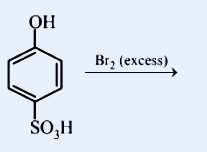
The major product of the following reaction is:
(1)
(2)
(3)
(4)
SolutionAnswer: Option 12,4,6-tribromophenol
Approach:
Phenol-4-sulfonic acid undergoes electrophilic bromination with excess bromine. The hydroxyl group strongly activates the ortho and para positions, and the sulfonic acid group at the para position is displaced through ipso substitution under these conditions, giving 2,4,6-tribromophenol.
Step 1:The OH group directs bromination to its ortho and para positions.
Step 2:With excess bromine the two ortho positions are brominated and the para sulfonic acid group is displaced by bromine.
Step 3:The product carries bromine at the 2, 4 and 6 positions of the phenol ring.
Final answer: 2,4,6-tribromophenol
Q54Single correctOrganic Compounds Containing Halogens
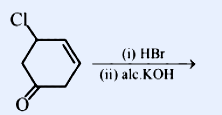
The major product of the following reaction is
(1)
(2)
(3)
(4)
SolutionAnswer: Option 2phenol
Approach:
Addition of HBr followed by elimination with alcoholic KOH and subsequent tautomerisation/aromatisation of the resulting cyclohexadienone system leads to the stable aromatic phenol.
Step 1:HBr adds across the carbon-carbon double bond of the chloro enone.
Step 2:Alcoholic KOH eliminates HBr (and HCl) to introduce unsaturation in the ring.
Step 3:The cyclohexadienone tautomerises to the aromatic phenol, the thermodynamically stable product.
Final answer: phenol
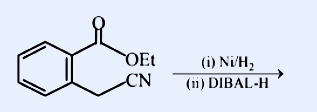
Q55Single correctOrganic Compounds Containing Nitrogen
The major product of the following reaction is:
(1)
(2)
(3)
(4)
SolutionAnswer: Option 43,4-dihydroisoquinoline
Approach:
Ni/H2 reduces the nitrile to a primary amine, which cyclises onto the ortho ester to give a fused six-membered lactam. DIBAL-H then partially reduces the lactam carbonyl, and loss of water from the resulting carbinolamine furnishes the cyclic imine, 3,4-dihydroisoquinoline.
Step 1:Catalytic hydrogenation converts the -CH2-CN group to a -CH2-CH2-NH2 group.
Step 2:The amine cyclises onto the neighbouring ester to give a fused six-membered lactam (a cyclic amide).
Step 3:DIBAL-H partially reduces the lactam carbonyl to a carbinolamine, which loses water to give the cyclic imine.
Step 4:The product is 3,4-dihydroisoquinoline bearing a C=N double bond.
Final answer: 3,4-dihydroisoquinoline
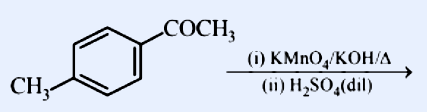
Q56Single correctSome Basic Principles of Organic Chemistry
The major product of the following reaction is :
(1)
(2)
(3)
(4)
SolutionAnswer: Option 3benzene-1,4-dicarboxylic acid
Approach:
Hot alkaline potassium permanganate oxidises both the methyl side chain and the acetyl side chain to carboxylic acid groups; acidic work-up liberates the diacid, giving terephthalic acid.
Step 1:The methyl group is oxidised to a carboxylic acid by hot KMnO4/KOH.
Step 2:The acetyl group is oxidised, losing the methyl as the side chain is converted to a carboxylic acid.
Step 3:Acidification gives the para diacid, terephthalic acid.
Final answer: benzene-1,4-dicarboxylic acid
Q57Single correctSome Basic Principles of Organic Chemistry
The polymer obtained from the following reactions is
(1)
(2)
(3)
(4)
SolutionAnswer: Option 3
Approach:
Treatment with nitrous acid converts the amino group into a hydroxyl group via diazotisation. The resulting hydroxy acid then self-condenses on polymerisation to give a polyester repeat unit.
Step 1:NaNO2/H3O+ converts the primary amine into an alcohol through diazonium intermediate.
Step 2:The hydroxy acid undergoes condensation polymerisation, with the -OH and -COOH ends forming ester linkages.
Step 3:The repeat unit is the polyester containing the -O-(CH2)4-C(=O)- segment.
Final answer:
Q58Single correctBiomolecules
Match List I with List II
| Item - I | Item - II |
|---|---|
| (A). Norethindrone | (P). Antibiotic |
| (B). Ofloxacin | (Q). Antifertility |
| (C). Equanil | (R). Hypertension |
| (S). Analgesics |
(1)
(2)
(3)
(4)
SolutionAnswer: Option 2
Approach:
Each drug is matched with its pharmacological category based on its known therapeutic use.
Step 1:Norethindrone is a synthetic progesterone used as an antifertility drug.
Step 2:Ofloxacin is an antibiotic.
Step 3:Equanil is a tranquiliser used in hypertension and anxiety.
Final answer:
Q59Single correctCoordination Compounds
Match List I with List II
| (column I) Metals | (column II) Coordination compound(s)/enzyme(s) |
|---|---|
| (A). Co | (i). Wilkinson catalyst |
| (B). Zn | (ii). Chlorophyll |
| (C). Rh | (iii). Vitamin |
| (D). Mg | (iv). Carbonic anhydrase |
(1)
(2)
(3)
(4)
SolutionAnswer: Option 1(A)-(iii); (B)-(iv); (C)-(i); (D)-(ii)
Approach:
Each metal is matched to the biologically or catalytically important coordination compound in which it is the central metal.
Step 1:Cobalt is the central metal in vitamin B12.
Step 2:Zinc is the metal in the enzyme carbonic anhydrase.
Step 3:Rhodium is the metal in Wilkinson's catalyst.
Step 4:Magnesium is the central metal in chlorophyll.
Final answer: (A)-(iii); (B)-(iv); (C)-(i); (D)-(ii)
Q60Single correctBiomolecules
Among the following compounds, which one is found in RNA?
(1)
(2)
(3)
(4)
SolutionAnswer: Option 2Uracil
Approach:
RNA contains the bases adenine, guanine, cytosine and uracil; uracil replaces the thymine found in DNA. The structure with two carbonyl groups and two N-H groups but no methyl substituent is uracil.
Step 1:RNA uses uracil in place of thymine.
Step 2:The pyrimidine ring with two C=O groups and two N-H groups and no methyl group is uracil.
Final answer: Uracil
Mathematics30 questions
Q61Single correctComplex Numbers and Quadratic Equations
If one real root of the quadratic equation is cube of the other root, then a value of k is :
(1)
(2)
(3)
(4)
SolutionAnswer: Option 4
Approach:
Take the roots as a single base and its cube, then apply the product- and sum-of-roots relations to determine the parameter.
Step 1:Let the roots be and . Their product equals the constant term over the leading coefficient.
Step 2:For a real root, take the real fourth root, giving and hence .
Step 3:Apply the sum of roots: .
Step 4:For , , giving .
Final answer:
Q62Single correctComplex Numbers and Quadratic Equations
Let , where x and y are real numbers then equals
(1)
(2)
(3)
(4)
SolutionAnswer: Option 1
Approach:
Expand the cube of the complex number, multiply by to read off and , then form .
Step 1:With and , compute the real part .
Step 2:Compute the imaginary part .
Step 3:Multiply by to match , giving and .
Step 4:Form the required difference.
Final answer:
Q63Single correctSequence and Series
Let be a G.P. If , then equals :
(1)
(2)
(3)
(4)
SolutionAnswer: Option 1
Approach:
Express the given ratio in terms of the common ratio to find , then evaluate the target ratio.
Step 1:The ratio equals .
Step 2:The required ratio is .
Step 3:Substitute .
Final answer:
Q64Single correctSequence and Series
The sum of an infinite geometric series with positive terms is 3 and the sum of the cubes of its terms is . Then the common ratio of this series is:
(1)
(2)
(3)
(4)
SolutionAnswer: Option 2
Approach:
Write the infinite-sum conditions for the series and its cubes, divide to eliminate the first term, and solve the resulting equation in .
Step 1:The series sum gives , so .
Step 2:The cubes form a G.P. with ratio , so their sum is .
Step 3:Substitute and use .
Step 4:Expand to get , whose roots are and ; positivity and convergence select .
Final answer:
Q65Single correctBinomial Theorem and its Simple Applications
The sum of the real values of x for which the middle term in the binomial expansion of equals 5670 is :
(1)
(2)
(3)
(4)
SolutionAnswer: Option 1
Approach:
Identify the middle term of the eight-degree expansion, set it equal to the given value, and solve for .
Step 1:For the middle term is the fifth term, with .
Step 2:Simplify using and the powers of cancelling.
Step 3:Set the middle term equal to 5670.
Step 4:The real solutions are ; their sum is zero.
Final answer:
Q66Single correctBinomial Theorem and its Simple Applications
The value of r for which
is maximum, is:
is maximum, is:
(1)
(2)
(3)
(4)
SolutionAnswer: Option 2
Approach:
Recognise the sum as a Vandermonde convolution and identify where the resulting single binomial coefficient is largest.
Step 1:The given sum is the convolution of two sets of coefficients.
Step 2:The coefficient is maximum at the middle value .
Final answer:
Q67Single correctTrigonometry
Let for Then for all , the value of is equal to :
(1)
(2)
(3)
(4)
SolutionAnswer: Option 1
Approach:
Express both fourth- and sixth-power sine-cosine sums in terms of and subtract.
Step 1:Write .
Step 2:Write .
Step 3:Subtract; the terms cancel.
Final answer:
Q68Single correctTrigonometry
In a triangle, the sum of lengths of two sides is x and the product of the lengths of the same two sides is y. if , where c is the length of the third side of the triangle, then the circumradius of the triangle is
(1)
(2)
(3)
(4)
SolutionAnswer: Option 2
Approach:
Translate the given relation into the cosine rule to find the included angle, then apply the law of sines for the circumradius.
Step 1:Let the two sides be a and b, so and . Expand .
Step 2:Substitute into the cosine rule for the angle opposite .
Step 3:Apply the law of sines with .
Final answer:
Q69Single correctCo-ordinate Geometry
A square is inscribed in the circle with its sides parallel to the coordinate axes. Then the distance of the vertex of this square which is nearest to the origin is:
(1)
(2)
(3)
(4)
SolutionAnswer: Option 3
Approach:
Find the centre and radius, locate the four axis-aligned vertices, then select the one closest to the origin.
Step 1:The centre is and the radius squared is .
Step 2:With sides parallel to the axes, each vertex is offset from the centre by the half-side in both directions.
Step 3:Compute distances from the origin; the smallest is at .
Final answer:
Q70Single correctCo-ordinate Geometry
Two circles with equal radii are intersecting at the points and . The tangent at the point to one of the circles passes through the centre of the other circle. Then the distance between the centres of these circles is:
(1)
(2)
(3)
(4)
SolutionAnswer: Option 2
Approach:
Place the equal centres symmetrically on the x-axis, impose the tangency-through-centre condition, and compute the separation.
Step 1:By symmetry let the centres be and , each at distance from .
Step 2:The tangent at is perpendicular to the radius and passes through ; the vector is .
Step 3:The centres are and ; their separation is .
Final answer:
Q71Single correctCo-ordinate Geometry
The straight line meets the coordinate axes at and B. A circle is drawn through A, B and the origin. Then the sum of perpendicular distances from A and B on the tangent to the circle at the origin is:
(1)
(2)
(3)
(4)
SolutionAnswer: Option 1
Approach:
Find the circle through the two intercepts and the origin, obtain its tangent at the origin, then add the perpendicular distances from the intercepts.
Step 1:The line meets the axes at and .
Step 2:The circle through O, A, B is ; its tangent at the origin is .
Step 3:Perpendicular distances from and to .
Step 4:Add the two distances.
Final answer:
Q72Single correctCo-ordinate Geometry
If tangents are drawn to the ellipse at all points on the ellipse other than its four vertices then the mid points of the tangents intercepted between the coordinate axes lie on the curve :
(1)
(2)
(3)
(4)
SolutionAnswer: Option 3
Approach:
Parametrise the ellipse, write the tangent and its axis intercepts, then eliminate the parameter from the midpoint coordinates.
Step 1:Write the ellipse as ; the tangent at has intercepts on the axes.
Step 2:The midpoint (h,k) of AB gives and .
Step 3:Use to eliminate .
Final answer:
Q73Single correctCo-ordinate Geometry
Equation of a common tangent to the parabola and the hyperbola is :
(1)
(2)
(3)
(4)
SolutionAnswer: Option 3
Approach:
Take the general tangent to the parabola, impose tangency with the hyperbola, solve for the slope, and write the line.
Step 1:Substitute the parabola tangent into .
Step 2:For tangency the discriminant vanishes.
Step 3:Substitute into the tangent and clear fractions.
Final answer:
Q74Single correctLimit, Continuity and Differentiability
Let [x] denote the greatest integer less than or equal to X. Then :
(1)
(2)
(3)
(4)
SolutionAnswer: Option 1
Approach:
Evaluate the one-sided limits separately, accounting for the greatest-integer function's different values on either side of zero.
Step 1:The first term contributes from both sides.
Step 2:For , , so and the second term gives ; the right-hand limit is .
Step 3:For , , so and , whose square is of higher order; the left-hand limit is .
Step 4:The one-sided limits differ.
Final answer:
Q75Single correctMathematical Reasoning
If q is false and is true, then which one of the following statements is a tautology?
(1)
(2)
(3)
(4)
SolutionAnswer: Option 2
Approach:
Use the given truth values to fix the truth values of the components, then test each option for being always true.
Step 1:Since q is false, is false; for to be true, r must be false.
Step 2:The implication has a false antecedent because r is false, making false.
Step 3:A conditional with a false antecedent is always true, independent of , so the statement is a tautology.
Final answer:
Q76Single correctStatistics and Probability
The outcome of each of 30 items was observed; 10 items gave an outcome each, 10 items gave outcome each and the remaining 10 items gave outcome each. If the variance of this outcome data is then equals:
(1)
(2)
(3)
(4)
SolutionAnswer: Option 4
Approach:
Compute the mean of the equally weighted three-group data, then the variance, and solve for the absolute deviation.
Step 1:The mean of the 30 symmetric outcomes.
Step 2:Variance about this mean using deviations.
Step 3:Set equal to the given variance and solve.
Final answer:
Q77Single correctMatrices and Determinants
Let . If , then is:
(1)
(2)
(3)
(4)
SolutionAnswer: Option 3
Approach:
Use the orthogonality of the rows implied by AA-transpose equal to the identity to form equations in p, q, r.
Step 1:Normalisation of the second and third rows.
Step 2:Orthogonality of the second and third rows.
Step 3:Combine the two relations.
Final answer:
Q78Single correctMatrices and Determinants
If the system of linear equations where, are non-zero real numbers, has more than one solution, then
(1)
(2)
(3)
(4)
SolutionAnswer: Option 2
Approach:
More than one solution requires a singular coefficient matrix together with a consistency relation among the constants; find the linear dependence of the coefficient rows and apply it to the constants.
Step 1:Express the first coefficient row as a combination of the others.
Step 2:Apply the same combination to the constants for consistency.
Step 3:Rearrange into the listed form.
Final answer:
Q79Single correctSets, Relations and Functions
Let be defined by , . Then the range of f is
(1)
(2)
(3)
(4)
SolutionAnswer: Option 1
Approach:
Set y equal to the function, clear the denominator, and require the resulting quadratic in x to have real roots.
Step 1:Form a quadratic in x.
Step 2:Impose a non-negative discriminant for real x.
Step 3:State the range; the boundary values are attained at x equal to plus or minus one.
Final answer:
Q80Single correctLimit, Continuity and Differentiability
Let and . Then, in the interval , g is:
(1)
(2)
(3)
(4)
SolutionAnswer: Option 4
Approach:
Build g piecewise by evaluating both the absolute value of f and f of the absolute value of x, then test continuity and differentiability at the junction points.
Step 1:Express g on each subinterval.
Step 2:Check the junction at x equal to zero.
Step 3:Check the junction at x equal to one.
Final answer:
Q81Single correctLimit, Continuity and Differentiability
If , then at is equal to :
(1)
(2)
(3)
(4)
SolutionAnswer: Option 2
Approach:
Differentiate implicitly with respect to x, evaluate the logarithmic terms at x equal to e, and find y from the original relation.
Step 1:Differentiate the relation implicitly.
Step 2:Evaluate the logarithmic terms at x equal to e.
Step 3:Find y at x equal to e from the original relation.
Step 4:Solve for the derivative.
Final answer:
Q82Single correctLimit, Continuity and Differentiability
Themaximum value of the finction on the set is :
(1)
(2)
(3)
(4)
SolutionAnswer: Option 3
Approach:
Identify the closed interval defined by S, locate the critical points of f, and compare values at the critical points and endpoints.
Step 1:Determine the constraint set S.
Step 2:Examine the sign of the derivative on this interval.
Step 3:Evaluate at the right endpoint.
Final answer:
Q83Single correctIntegral Calculus
If , for a suitable chosen integer m and a function A(x), where C is a constant of integration, then equals :
(1)
(2)
(3)
(4)
SolutionAnswer: Option 1
Approach:
Use the substitution that converts the root into a single variable, integrate, then read off A of x and the integer m.
Step 1:Rewrite the integrand and substitute.
Step 2:Integrate and back-substitute.
Step 3:Match the given form to identify A and m, then compute.
Final answer:
Q84Single correctIntegral Calculus
The value of the integral (where [x] denotes the greatest integer less than or equal to x) is
(1)
(2)
(3)
(4)
SolutionAnswer: Option 1
Approach:
Resolve the greatest integer denominator over the interval, split the integral at the origin, and use the evenness of the squared sine.
Step 1:Evaluate the greatest integer term on the interval.
Step 2:Split the integral accordingly.
Step 3:Apply evenness of the squared sine.
Final answer:
Q85Single correctIntegral Calculus
The area (in sq. units) of the region bounded by the curve and the straight line is :
(1)
(2)
(3)
(4)
SolutionAnswer: Option 2
Approach:
Find the intersection abscissae of the parabola and line, then integrate the difference of the y-values across that span.
Step 1:Find the intersection points.
Step 2:Set up the area integral.
Step 3:Evaluate the integral.
Final answer:
Q86Single correctDifferential Equations
If y(x) is the solution of the differential equation , , where , then:
(1)
(2)
(3)
(4)
SolutionAnswer: Option 3
Approach:
Solve the linear differential equation with the integrating factor, apply the initial condition, then study the sign of the derivative.
Step 1:Compute the integrating factor.
Step 2:Integrate and apply the initial condition.
Step 3:Differentiate to find where y decreases.
Final answer:
Q87Single correctVector Algebra
Let , and be coplanar vectors. Then the non-zero vector is:
(1)
(2)
(3)
(4)
SolutionAnswer: Option 4
Approach:
Impose coplanarity by setting the scalar triple product to zero to find lambda, then compute the cross product, selecting the value that gives a non-zero result.
Step 1:Set the scalar triple product to zero.
Step 2:Factor and solve.
Step 3:Compute the cross product, which gives zero when lambda squared equals nine.
Step 4:Use the value giving a non-zero vector.
Final answer:
Q88Single correctThree Dimensional Geometry
The plane containing the line and also containing its projection on the plane , contains which one of the following points?
(1)
(2)
(3)
(4)
SolutionAnswer: Option 4
Approach:
The required plane contains the line and is perpendicular to the given plane; its normal is the cross product of the line direction and the given plane normal. Then test each point.
Step 1:Take the cross product of the line direction and the plane normal.
Step 2:Write the plane through the line point with this normal.
Step 3:Test the listed points.
Final answer:
Q89Single correctThree Dimensional Geometry
The direction ratios of normal to the plane through the points and and making an angle with the plane are;
(1)
(2)
(3)
(4)
SolutionAnswer: Option 2
Approach:
Let the normal be (a,b,c). Requiring the plane to pass through both points links b and c; the angle condition with the given plane fixes a in terms of c. Test each candidate set.
Step 1:Use the two points to relate the normal components.
Step 2:Apply the angle condition with the normal (0,1,-1).
Step 3:Test the candidate direction ratios against b equals minus c and a squared equals two c squared.
Final answer:
Q90Single correctStatistics and Probability
Two integers are selected at random from the set . Given that the sum of selected numbers is even, the conditional probability that both the numbers are even is :
(1)
(2)
(3)
(4)
SolutionAnswer: Option 3
Approach:
Count even and odd members, express the conditional probability as the ratio of both-even choices to the choices giving an even sum.
Step 1:Count parities in the set.
Step 2:Count pairs giving an even sum.
Step 3:Form the conditional probability.
Final answer:
More JEE Main 2019 papers
- JEE Main 2019 — April 08, Shift 1
- JEE Main 2019 — April 08, Shift 2
- JEE Main 2019 — April 09, Shift 1
- JEE Main 2019 — January 09, Shift 1
- JEE Main 2019 — January 09, Shift 2
- JEE Main 2019 — January 10, Shift 1
- JEE Main 2019 — January 10, Shift 2
- JEE Main 2019 — January 11, Shift 2
- JEE Main 2019 — January 12, Shift 1
- JEE Main 2019 — January 12, Shift 2
Frequently Asked Questions
How many questions are in the JEE Main 2019 January 11, Shift 1 paper?
The JEE Main 2019 January 11, Shift 1 paper has 90 questions — Physics (30), Chemistry (30) and Mathematics (30). Every question is on this page with its correct answer and a step-by-step solution.
What is the marking scheme for JEE Main?
JEE Main awards +4 marks for each correct answer and −1 for a wrong answer, with 0 for questions left unattempted. The paper covers Physics, Chemistry and Mathematics.
Are the answer key and step-by-step solutions provided for the 2019 January 11, Shift 1 paper?
Yes — every question shows the correct answer (answer key) and a detailed step-by-step solution, free to read online.
Can I take the JEE Main 2019 January 11, Shift 1 paper as a timed mock test?
Yes. With a free JEEnify account you can attempt this exact paper as a timed test in the real exam interface, then see your score and weak-area analysis.
Solved this paper? Calculate your JEE Main scoremost important chaptersformula sheetsall free tools.