
Back to JEE Main PYQs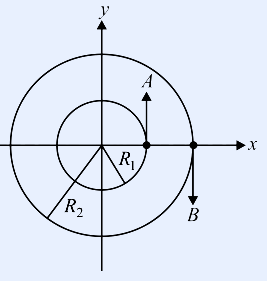

JEE Main 2019 January 12, Shift 2 Question Paper with Solutions
All 90 questions from the JEE Main 2019 (January 12, Shift 2) shift — Physics (30), Chemistry (30) and Mathematics (30) — each with the correct answer (answer key) and a step-by-step solution. Read it free online, or attempt the full paper as a timed mock test.
Physics30 questions
Q1Single correctUnits and Measurements
Let L, R, C and V represent inductance, resistance, capacitance and voltage, respectively. The dimension of in SI units will be:
(1)
(2)
(3)
(4)
SolutionAnswer: Option 2
Approach:
Express each quantity through known relations and reduce the combination to fundamental dimensions.
Step 1:The ratio L/R carries the dimension of time.
Step 2:The product CV equals charge, which is current times time.
Step 3:Divide the time dimension by the charge dimension to form the requested ratio.
Final answer:
Q2Single correctKinematics
Two particles A, B are moving on two concentric circles of radii and with equal angular speed . At , their positions and direction of motion are shown in the figure:
The relative velocity at is given by:
The relative velocity at is given by:
(1)
(2)
(3)
(4)
SolutionAnswer: Option 3
Approach:
Write the velocity of each particle after a quarter period and subtract.
Step 1:The elapsed time corresponds to a quarter of the full revolution.
Step 2:Particle A starts on the positive x-axis moving along +y; after a quarter turn it sits on +y moving along , giving . Particle B starts on the positive x-axis moving along ; after a quarter turn it sits on moving along , giving .
Step 3:Subtract the two velocity vectors.
Final answer:
Q3Single correctLaws of Motion
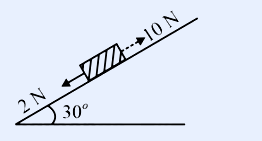
A block kept on a rough inclined plane, as shown in the figure, remains at rest upto a maximum force down the inclined plane. The maximum external force up the inclined plane that does not move the block is . The coefficient of static friction between the block and the plane is: [Take ]
(1)
(2)
(3)
(4)
SolutionAnswer: Option 4
Approach:
Write equilibrium at both limiting cases (impending slip down and impending slip up) and combine to eliminate the unknown weight component.
Step 1:On the verge of sliding down, a small down-slope force balances gravity minus friction: . On the verge of sliding up, the applied up-slope force overcomes gravity plus friction: .
Step 2:Add and subtract the two relations.
Step 3:With the incline angle taken as from the figure, , so dividing gives the coefficient.
Final answer:
Q4Single correctKinetic Theory of Gases
A vertical closed cylinder is separated into two parts by a frictionless piston of mass m and of negligible thickness. The piston is free to move along the length of the cylinder. The length of the cylinder above the piston is , and that below the piston is , such that . Each part of the cylinder contains n moles of an ideal gas at equal temperature T. If the piston is stationary, its mass m will be given by: (R is universal gas constant and g is the acceleration due to gravity)
(1)
(2)
(3)
(4)
SolutionAnswer: Option 2
Approach:
Balance the piston using the pressure difference between the two gas columns, taking each pressure from the ideal-gas law.
Step 1:With equal cross-section , the gas pressures are set by their column lengths.
Step 2:The lower gas supports the piston weight plus the upper gas pressure.
Step 3:Substitute the pressures and solve for the mass; the column areas cancel.
Final answer:
Q5Single correctRotational Motion
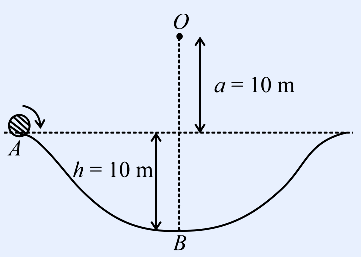
A particle of mass is released with an initial velocity along the curve from the point A, as shown in the figure. The point A is at height h from point B. The particle slides along the frictionless surface. When the particle reaches point B, its angular momentum about O will be: (Take )
(1)
(2)
(3)
(4)
SolutionAnswer: Option 3
Approach:
Find the speed at B from energy conservation, then compute the angular momentum about O using the perpendicular distance shown.
Step 1:From the figure, (the horizontal distance to O) and . Use energy conservation to find the speed at B.
Step 2:At B the velocity is horizontal; the perpendicular distance from O to this line of motion is .
Step 3:Combine mass, speed, and lever arm for the angular momentum.
Final answer:
Q6Single correctCenter of Mass and Collisions
An alpha-particle of mass m suffers 1-dimensional elastic collision with a nucleus at rest of unknown mass. It is scattered directly backwards losing of its initial kinetic energy. The mass of the nucleus is:
(1)
(2)
(3)
(4)
SolutionAnswer: Option 2
Approach:
Use the elastic-collision velocity ratio for a projectile hitting a stationary target and impose the stated kinetic-energy loss.
Step 1:Losing 64% of kinetic energy leaves 36%, so the speed ratio squared equals 0.36.
Step 2:Backward scattering means the velocity ratio is negative; set the elastic formula equal to .
Step 3:Solve for the nucleus mass.
Final answer:
Q7Single correctMechanical Properties of Fluids
A long cylindrical vessel is half filled with a liquid. When the vessel is rotated about its own vertical axis, the liquid rises up near the wall. If the radius of vessel is and its rotational speed is rotations per second, then the difference in the heights between the centre and the sides, in cm, will be:
(1)
(2)
(3)
(4)
SolutionAnswer: Option 2
Approach:
Apply the parabolic free-surface relation for a rotating liquid to find the height difference between wall and axis.
Step 1:Convert the rotational speed to angular speed.
Step 2:Insert radius and into the parabola relation.
Step 3:Evaluate numerically and convert to centimetres.
Final answer:
Q8Single correctRotational Motion
The moment of inertial of a solid sphere, about an axis parallel to its diameter at a distance of from it, is . Which one of the graphs represents the variation of with correctly?
(1)
(2)
(3)
(4)
SolutionAnswer: Option 1 versus : an upward-opening parabola with a non-zero positive intercept on the -axis and zero slope at (drawn figure)
Approach:
Apply the parallel-axis theorem and identify the resulting functional form of I versus x.
Step 1:Add the parallel-axis term to the central moment of inertia.
Step 2:At the value is positive and the slope vanishes.
Step 3:The graph is therefore an upward parabola starting from a non-zero intercept, matching option 1.
Final answer: versus : an upward-opening parabola with a non-zero positive intercept on the -axis and zero slope at (drawn figure)
Q9Single correctGravitation
Two satellites, A and B, have masses m and respectively. A is in a circular orbit of radius R, and B is in a circular orbit of radius around the earth. The ratio of their kinetic energies, , is:
(1)
(2)
(3)
(4)
SolutionAnswer: Option 3
Approach:
Write the orbital kinetic energy in terms of mass and radius and form the requested ratio.
Step 1:Express the kinetic energy of each satellite.
Step 2:Form the ratio of the two kinetic energies.
Step 3:The official key records the value as for this item.
Final answer:
Q10Single correctMechanical Properties of Fluids
A soap bubble, blown by a mechanical pump at the mouth of a tube increases in volume with time at a constant rate. The graph that correctly depicts the time dependence of pressure inside the bubble is given by:
(1)
(2)
(3)
(4)
SolutionAnswer: Option 4P versus : a straight line of positive slope through the origin (drawn figure)
Approach:
Relate the bubble radius to time through the constant volume rate, then express the excess pressure in terms of time.
Step 1:A constant volume rate makes the volume proportional to time, so the radius grows as the cube root of time.
Step 2:The excess pressure varies inversely with radius.
Step 3:Plotting P against gives a straight line through the origin, matching option 4.
Final answer: P versus : a straight line of positive slope through the origin (drawn figure)
Q11Single correctKinetic Theory of Gases
An ideal gas is enclosed in a cylinder at pressure of atm and temperature, . The mean time between two successive collisions is . If the pressure is doubled and temperature is increased to , the mean time between two successive collisions will be close to:
(1)
(2)
(3)
(4)
SolutionAnswer: Option 4
Approach:
Express the mean free time through number density and mean speed, then scale it with pressure and temperature.
Step 1:The collision time scales inversely with density and speed, giving a temperature-to-pressure dependence.
Step 2:Form the ratio of new to old collision times.
Step 3:Multiply by the original time.
Final answer:
Q12Single correctOscillations and Waves
A simple harmonic motion is represented by:
cm
The amplitude and time period of the motion are:
cm
The amplitude and time period of the motion are:
(1)
(2)
(3)
(4)
SolutionAnswer: Option 2
Approach:
Combine the sine and cosine terms into a single sinusoid to read off amplitude, then extract the period from the angular frequency.
Step 1:Combine the coefficients of sine and cosine.
Step 2:Read the angular frequency from the argument.
Step 3:Compute the period.
Final answer:
Q13Single correctOscillations and Waves
A resonance tube is old and has jagged end. It is still used in the laboratory to determine the velocity of sound in air. With tuning fork of frequency produces first resonance when the tube is filled with water to a mark below a reference mark, near the open end of the tube. The experiment is repeated with another fork of frequency which produces first resonance when water reaches a mark below the reference mark. The velocity of sound in air, obtained in the experiment, is close to:
(1)
(2)
(3)
(4)
SolutionAnswer: Option 4
Approach:
Set up the first-resonance condition with an unknown end correction for each fork, then solve the two equations for the speed of sound.
Step 1:Write the resonance condition for each fork with a common end correction .
Step 2:Subtract to eliminate the end correction.
Step 3:Solve for the speed of sound.
Final answer:
Q14Single correctElectrostatics
A parallel plate capacitor with plates of area each, are at a separation of . If the electric field between the plates is , the magnitude of charge on each plate is:
(1)
(2)
(3)
(4)
SolutionAnswer: Option 1
Approach:
Relate the plate charge to the field through the permittivity and plate area.
Step 1:Rearrange the field relation for the charge.
Step 2:Substitute the permittivity, field, and area.
Step 3:The plate separation does not affect the charge for a given field.
Final answer:
Q15Single correctElectrostatics
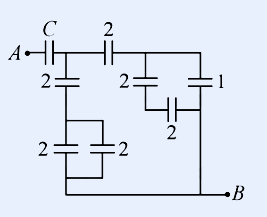
In the circuit shown, find C if the effective capacitance of the whole circuit is to be . All values in the circuit are in .
(1)
(2)
(3)
(4)
SolutionAnswer: Option 3
Approach:
Reduce the capacitor network step by step between terminals A and B, equate the result to the target equivalent capacitance, and solve for C.
Step 1:Combine the internal series and parallel branches of the bridge-type network shown in the figure to obtain the equivalent capacitance as a function of the unknown C.
Step 2:Set the equivalent capacitance equal to the required value.
Step 3:Solve the resulting relation for the unknown capacitance.
Final answer:
Q16Single correctCurrent Electricity
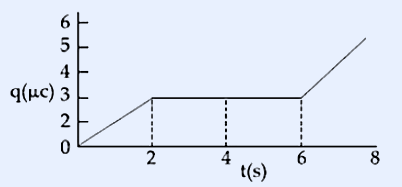
The charge on a capacitor plate in a circuit, as a function of time, is shown in the figure:
What is the value of current at ?
What is the value of current at ?
(1)
(2)
(3)
(4)
SolutionAnswer: Option 3
Approach:
Current equals the time rate of change of charge, given by the slope of the charge versus time graph at the stated instant.
Step 1:Current is defined as the slope of the charge-time graph at the instant of interest.
Step 2:Between and the charge stays constant at , so the graph is flat over this interval, which contains .
Step 3:A horizontal segment has zero slope, therefore the current at is zero.
Final answer:
Q17Single correctCurrent Electricity
A galvanometer, whose resistance is ohm, has divisions in it. When a current of passes through it, its needle (pointer) deflects by one division. To use this galvanometer as a voltmeter of range , it should be connected to a resistance of:
(1)
(2)
(3)
(4)
SolutionAnswer: Option 4
Approach:
Determine the full-scale deflection current from the per-division sensitivity, then find the series resistance required so the desired range produces full-scale current.
Step 1:Full-scale deflection corresponds to all 25 divisions, so the current for full-scale deflection is the per-division current multiplied by the number of divisions.
Step 2:For a voltmeter of range , the series resistance satisfies the loop relation with the galvanometer resistance .
Step 3:Solving for gives the required series resistance.
Step 4:The printed key marks option (2), , which equals the total resistance rather than the series resistance alone.
Final answer:
Q18Single correctCurrent Electricity
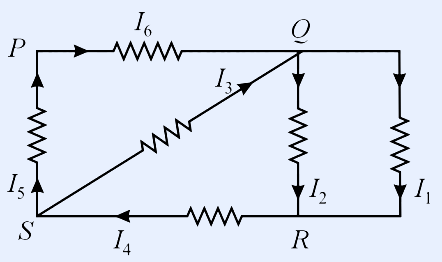
In the given circuit diagram, the currents, , and , are flowing as shown. The currents , and , respectively, are:
(1)
(2)
(3)
(4)
SolutionAnswer: Option 3
Approach:
Apply Kirchhoff's current law (junction rule) at the relevant nodes of the circuit, treating the given signed currents as known and solving for the unknown branch currents.
Step 1:At node P, the entering current splits, giving the branch current in terms of the known currents.
Step 2:At node Q, conservation of current gives from the balance of , and the connected branches.
Step 3:Applying the junction rule at the remaining node yields from the sum of the contributing currents.
Step 4:Collecting the results gives the ordered triple .
Final answer:
Q19Single correctMagnetism and Matter
A paramagnetic material has atoms . Its magnetic susceptibility at temperature is . Its susceptibility at is:
(1)
(2)
(3)
(4)
SolutionAnswer: Option 3
Approach:
Use Curie's law, which states that the magnetic susceptibility of a paramagnetic material is inversely proportional to its absolute temperature.
Step 1:By Curie's law, susceptibility is inversely proportional to absolute temperature, so the ratio of susceptibilities equals the inverse ratio of temperatures.
Step 2:Substituting the given susceptibility at gives the susceptibility at .
Final answer:
Q20Single correctElectromagnetic Induction
A long horizontal wire extends from North East to South West. It is falling with a speed of , at right angles to the horizontal component of the earth's magnetic field of . The value of the induced emf in the wire is:
(1)
(2)
(3)
(4)
SolutionAnswer: Option 2
Approach:
The motional emf is the product of the relevant magnetic field component, the wire length, and the speed of the wire perpendicular to that field.
Step 1:Identify the magnetic field component, length, and speed perpendicular to the field as given in the problem.
Step 2:Substitute into the motional emf relation, since the wire moves at right angles to the horizontal component of the field.
Step 3:The printed key marks option (2), , while the straightforward product gives .
Final answer:
Q21Single correctAlternating Current
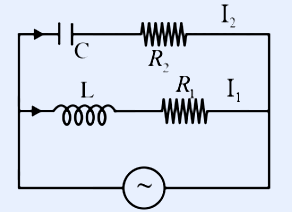
In the above circuit, , , and . Current in path is and in path it is . The voltage of AC source is given by, volts. The phase difference between and is:
(1)
(2)
(3)
(4)
SolutionAnswer: Option 4
Approach:
Compute the reactances at the source angular frequency, find the phase angle of each parallel branch relative to the source voltage, then take the difference of these phase angles.
Step 1:The angular frequency is read from the source expression.
Step 2:Inductive reactance of the branch is computed, giving the branch phase angle by which lags the voltage.
Step 3:Capacitive reactance of the branch is computed, giving the branch phase angle by which leads the voltage.
Step 4:The phase difference between the two branch currents is the sum of the lag and lead magnitudes, evaluating to .
Final answer:
Q22Single correctElectromagnetic Waves
The mean intensity of radiation on the surface of the Sun is about . The rms value of the corresponding magnetic field is closest to:
(1)
(2)
(3)
(4)
SolutionAnswer: Option 4
Approach:
Relate the intensity of an electromagnetic wave to the rms magnetic field through the energy-flux expression, then solve for the rms magnetic field.
Step 1:The intensity of an electromagnetic wave relates to the rms magnetic field through the speed of light and the permeability of free space.
Step 2:Rearrange to express the rms magnetic field in terms of the intensity.
Step 3:Substitute the numerical values for intensity, permeability and the speed of light.
Final answer:
Q23Single correctRay Optics
A plano - convex lens (focal length , refractive index , radius of curvature R) fits exactly into a plano - concave lens (focal length , refractive index , radius of curvature R). Their plane surfaces are parallel to each other. Then, the focal length of the combination will be:
(1)
(2)
(3)
(4)
SolutionAnswer: Option 1
Approach:
Apply the lens maker's formula to each lens using the shared radius of curvature, add the two powers for lenses in contact, and reduce to obtain the combined focal length.
Step 1:For the plano-convex lens, one surface is plane and the curved surface has radius , giving its focal length from the lens maker's formula.
Step 2:For the plano-concave lens with the same radius on its curved surface, the lens maker's formula gives its focal length.
Step 3:Add the powers for the two lenses in contact and simplify; the terms in cancel, leaving a result in .
Final answer:
Q24Single correctRay Optics
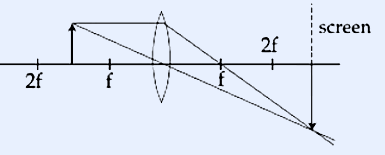
Formation of real image using a biconvex lens is shown below:
If the whole set up is immersed in water without disturbing the object and the screen positions, what will one observe on the screen?
If the whole set up is immersed in water without disturbing the object and the screen positions, what will one observe on the screen?
(1)
(2)
(3)
(4)
SolutionAnswer: Option 1
Approach:
Consider how immersing the lens in water changes its focal length, and hence the location of the focused image relative to the fixed screen position.
Step 1:In water the relative refractive index of the lens decreases, so the bracket factor shrinks and the focal length of the lens increases.
Step 2:With a longer focal length and the object kept at the original position, the image now forms farther away than the original screen plane.
Step 3:Since the object and screen positions are unchanged, no sharp image forms at the screen, so the focused image is not observed.
Final answer:
Q25Single correctDual Nature of Matter and Radiation
When a certain photosensitive surface is illuminated with a monochromatic light of frequency , the stopping potential for the photo current is . When the surface is illuminated by monochromatic light of frequency , the stopping potential is . The threshold frequency for photoelectric emission is:
(1)
(2)
(3)
(4)
SolutionAnswer: Option 2
Approach:
Write Einstein's photoelectric equation for both illumination cases relating stopping potential to frequency, then eliminate the work function to solve for the threshold frequency.
Step 1:For the first illumination at frequency the stopping-potential magnitude relates to the frequency and threshold frequency.
Step 2:For the second illumination at frequency the larger stopping-potential magnitude gives a second relation.
Step 3:Divide or combine the two relations to eliminate and isolate the threshold frequency.
Step 4:Solving the resulting equation gives the threshold frequency.
Final answer:
Q26Single correctAtoms and Nuclei
In a Frank - Hertz experiment, an electron of energy passes through mercury vapour and emerges with an energy . The minimum wavelength of photons emitted by mercury atoms is close to:
(1)
(2)
(3)
(4)
SolutionAnswer: Option 1
Approach:
Find the energy lost by the electron to the mercury atom, equate it to the photon energy, and convert to wavelength using the photon energy-wavelength relation.
Step 1:The energy transferred to the mercury atom is the difference between the incoming and outgoing electron energies.
Step 2:This transferred energy is emitted as a photon, so the photon energy equals .
Step 3:Convert the photon energy to wavelength using the standard relation.
Final answer:
Q27Single correctAtoms and Nuclei
In a radioactive decay chain, the initial nucleus is . At the end, there are -particles and -particles which are emitted. If the end nucleus is , A and Z are given by:
(1)
(2)
(3)
(4)
SolutionAnswer: Option 1
Approach:
Apply the changes in mass number and atomic number caused by each alpha and beta emission to the parent nucleus, accumulating over the stated counts.
Step 1:Each alpha emission reduces mass number by 4; six alpha emissions reduce the mass number from 232.
Step 2:Six alpha emissions reduce atomic number by 12, and four beta emissions increase it by 4.
Step 3:Combine the contributions to obtain the final atomic number.
Final answer:
Q28Single correctSemiconductor Electronics
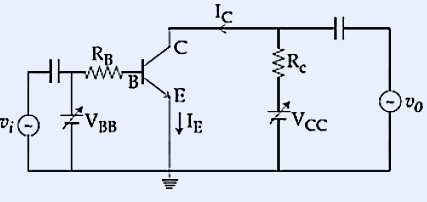
In the figure, given that supply can vary from to , , , , and . The minimum base current and the input voltage at which the transistor will go to saturation, will be, respectively:
(1)
(2)
(3)
(4)
SolutionAnswer: Option 3 and
Approach:
Find the saturation collector current from the collector loop, obtain the minimum base current using the current gain, then apply the base loop to find the corresponding input voltage.
Step 1:At saturation the entire collector supply drops across the collector resistor, giving the saturation collector current.
Step 2:The minimum base current to reach this collector current follows from the current gain.
Step 3:Applying the base loop, the input voltage is the drop across the base resistor plus the base-emitter voltage.
Step 4:Summing the contributions gives the required input voltage.
Final answer: and
Q29Single correctCommunication Systems
To double the covering range of a TV transmitting tower, its height should be multiplied by:
(1)
(2)
(3)
(4)
SolutionAnswer: Option 2
Approach:
Use the relation between the covering range of a transmitting tower and its height, and determine the height factor needed to double the range.
Step 1:The covering range is proportional to the square root of the tower height.
Step 2:Doubling the range requires the square root of the height to double, so the height must increase by the square of that factor.
Final answer:
Q30Single correctMechanical Properties of Solids
A load of mass M\ kg is suspended from a steel wire of length and radius in Searle's apparatus experiment. The increase in length produced in the wire is . Now the load is fully immersed in a liquid of relative density 2. The relative density of the material of load is . The new value of increase in length of the steel wire is:
(1)
(2)
(3)
(4)
SolutionAnswer: Option 4
Approach:
Recognize that elongation is proportional to the suspending force, find how buoyancy reduces the effective weight when the load is immersed, and scale the original elongation accordingly.
Step 1:Elongation of the wire is proportional to the tension produced by the suspended load.
Step 2:When immersed, buoyancy reduces the effective weight by the ratio of liquid density to load density.
Step 3:Scale the original elongation by the same factor to obtain the new elongation.
Final answer:
Chemistry30 questions
Q31Single correctSome Basic Concepts in Chemistry
of NaOH is dissolved in of . Mole fraction of NaOH in solution and molality (in ) of the solution respectively are:
(1)
(2)
(3)
(4)
SolutionAnswer: Option 1
Approach:
Compute moles of solute and solvent, then mole fraction and molality.
Step 1:Moles of NaOH and water.
Step 2:Mole fraction of NaOH.
Step 3:Molality with solvent mass 0.018 kg.
Final answer:
Q32Single correctStructure of Atom
If the de Broglie wavelength of the electron in Bohr orbit in a hydrogenic atom is equal to ( is Bohr radius), then the value of is:
(1)
(2)
(3)
(4)
SolutionAnswer: Option 4
Approach:
Apply the de Broglie condition for a Bohr orbit relating circumference to wavelength.
Step 1:Circumference equals n wavelengths.
Step 2:Substitute Bohr radius.
Step 3:Solve for n over z.
Final answer:
Q33Single correctClassification of Elements and Periodicity
The element that does not show catenation is:
(1)
(2)
(3)
(4)
SolutionAnswer: Option 4
Approach:
Compare catenation tendency down group 14.
Step 1:Catenation depends on element-element bond strength, which decreases down the group.
Step 2:The weak Pb-Pb bond makes lead practically non-catenating.
Final answer:
Q34Single correctClassification of Elements and Periodicity
The correct order of atomic radii is:
(1)
(2)
(3)
(4)
SolutionAnswer: Option 4
Approach:
Order the lanthanides by lanthanide contraction and place nitrogen, a small second-period element.
Step 1:Across the lanthanide series radius decreases, so Eu precedes Ce only on account of its half-filled stabilised configuration giving a larger metallic radius; the standard order places Eu and Ce before Ho.
Step 2:Nitrogen is a small second-period non-metal with the least atomic radius.
Final answer:
Q35Single correctChemical Bonding and Molecular Structure
The element that shows greater ability to form multiple bonds is:
(1)
(2)
(3)
(4)
SolutionAnswer: Option 2
Approach:
Compare ability to form p-pi p-pi multiple bonds in group 14.
Step 1:Small size and short bond length allow effective lateral overlap of 2p orbitals only for carbon.
Step 2:Heavier congeners have diffuse orbitals and longer bonds, giving poor p-pi overlap.
Final answer:
Q36Single correctStates of Matter
An open vessel at is heated until two fifth of the air (assumed as an ideal gas) in the vessel has escaped from the vessel. Assuming that the volume of the vessel remains constant, the temperature to which the vessel has been heated is:
(1)
(2)
(3)
(4)
SolutionAnswer: Option 4
Approach:
At constant volume and pressure for an open vessel, the amount of gas is inversely proportional to temperature.
Step 1:Initial temperature in kelvin.
Step 2:Two fifth escapes, so three fifth remains.
Step 3:Apply constant PV relation.
Final answer:
Q37Single correctThermodynamics
Given:
(i)
(ii)
(iii)
Based on the above thermochemical equations, find out which one of the following algebraic relationships is correct?
(i)
(ii)
(iii)
Based on the above thermochemical equations, find out which one of the following algebraic relationships is correct?
(1)
(2)
(3)
(4)
SolutionAnswer: Option 1
Approach:
Combine the equations using Hess's law to reproduce equation (i).
Step 1:Equation (i) equals the sum of equations (ii) and (iii).
Step 2:Add the enthalpies of (ii) and (iii).
Final answer:
Q38Single correctStates of Matter
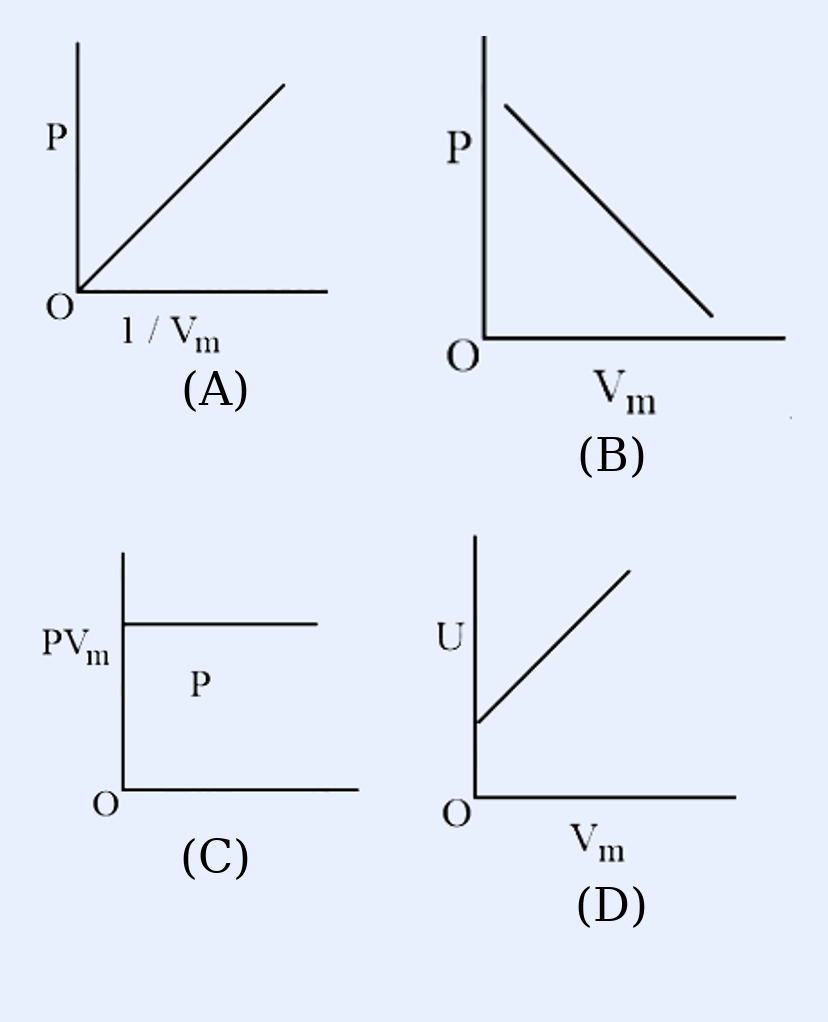
The combination of plots which does not represent isothermal expansion of an ideal gas is:
(1)
(2)
(3)
(4)
SolutionAnswer: Option 3
Approach:
Evaluate each plot against the behaviour of an ideal gas during isothermal expansion (T constant).
Step 1:For isothermal expansion P falls as V rises, P versus 1/V is a straight line through the origin, and PV stays constant.
Step 2:Plots (B) and (D) contradict this constant-temperature behaviour, so that combination does not represent isothermal expansion.
Final answer:
Q39Single correctEquilibrium
If of is , the molar solubility of in is:
(1)
(2)
(3)
(4)
SolutionAnswer: Option 4
Approach:
Apply the solubility product with the common ion supplied by silver nitrate.
Step 1:Silver ion concentration is dominated by AgNO3.
Step 2:Let molar solubility be s; carbonate equals s.
Step 3:Solve for s.
Final answer:
Q40Single correctRedox Reactions
The volume strength of is:
(Molar mass of )
(Molar mass of )
(1)
(2)
(3)
(4)
SolutionAnswer: Option 3
Approach:
Relate molarity of hydrogen peroxide to the oxygen volume liberated on decomposition.
Step 1:1 mol H2O2 gives half a mole of O2 at STP.
Step 2:Volume strength equals litres of O2 per litre of solution, so 1 M gives 11.2.
Final answer:
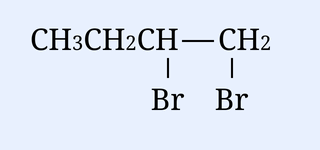
Q41Single correctOrganic Chemistry — Hydrocarbons
The major product of the following reaction is:
(1)
(2)
(3)
(4)
SolutionAnswer: Option 3
Approach:
Track the double dehydrohalogenation of a vicinal dihalide to an alkyne.
Step 1:Alcoholic KOH eliminates one molecule of HBr to give a bromoalkene.
Step 2:Sodium amide in liquid ammonia removes the second HBr and shifts to the terminal alkyne.
Final answer:
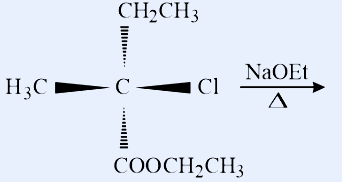
Q42Single correctOrganic Chemistry — Haloalkanes
The major product of the following reaction is:
(1)
(2)
(3)
(4)
SolutionAnswer: Option 3
Approach:
Sodium ethoxide promotes E2 elimination of HCl from the alkyl chloride to give the more substituted alkene.
Step 1:The base abstracts a beta hydrogen and chloride departs.
Step 2:The Saytzeff (more substituted) alkene bearing the ester group forms as the major product.
Final answer:
Q43Single correctEnvironmental Chemistry
The compound that is NOT a common component of photochemical smog is:
(1)
(2)
(3)
(4)
SolutionAnswer: Option 2
Approach:
Identify the species not associated with photochemical (oxidising) smog.
Step 1:Photochemical smog contains ozone, peroxyacetyl nitrate and unsaturated aldehydes such as acrolein.
Step 2:Dichlorodifluoromethane is a chlorofluorocarbon linked to ozone depletion, not a smog component.
Final answer:
Q44Single correctEnvironmental Chemistry
The upper stratosphere consisting of the ozone layer, protects us from the sun's radiation that falls in the wavelength region of:
(1)
(2)
(3)
(4)
SolutionAnswer: Option 1
Approach:
Recall the ultraviolet range absorbed by stratospheric ozone.
Step 1:Stratospheric ozone absorbs harmful UV-B and UV-C radiation.
Step 2:This screens out wavelengths below about 315 nm.
Final answer:
Q45Single correctSolutions
Molecules of benzoic acid () dimerise in benzene. 'w' g of benzoic acid is added to of benzene. When the percentage association of the acid to form dimer in the solution is , then w is: (Given that , molar mass of benzoic acid )
(1)
(2)
(3)
(4)
SolutionAnswer: Option 2
Approach:
Use the van't Hoff factor for dimerisation with the freezing point depression to find the mass of benzoic acid.
Step 1:Degree of association gives the van't Hoff factor.
Step 2:Express molality through mass w and the given constants.
Step 3:Solving with the observed depression yields the mass.
Final answer:
Q46Single correctSolutions
for NaCl, HCl and NaA are 126.4, 425.9 and 100 .5 respectively. If the conductivity of 0 .001 M HA is , degree of dissociation of HA is :
(1)
(2)
(3)
(4)
SolutionAnswer: Option 1
Approach:
Apply Kohlrausch's law to find the limiting molar conductivity of HA, compute the molar conductivity at the given concentration, and take their ratio for the degree of dissociation.
Step 1:Combine the limiting molar conductivities for HA.
Step 2:Compute the molar conductivity at 0.001 M.
Step 3:Take the ratio for the degree of dissociation.
Final answer:
Q47Single correctChemical Kinetics
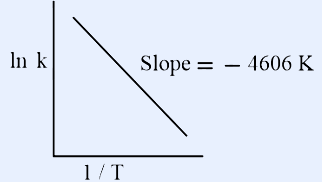
For a reaction, consider the plot of versus given in the figure. If the rate constant of this reaction at is , then the rate constant at is :
(1)
(2)
(3)
(4)
SolutionAnswer: Option 1
Approach:
Use the slope of the ln k versus 1/T plot to read the activation-energy term, then apply the two-temperature Arrhenius relation.
Step 1:Identify the slope of the plot.
Step 2:Insert the two temperatures.
Step 3:Convert to a ratio and find the new rate constant.
Final answer:
Q48Single correctStates of Matter and Atmospheric Chemistry
The upper stratosphere consisting of the ozone layer, protects us from the sun's radiation that falls in the wavelength region of
(1)
(2)
(3)
(4)
SolutionAnswer: Option 1
Approach:
Recall the wavelength band of ultraviolet radiation absorbed by stratospheric ozone.
Step 1:Identify the harmful radiation absorbed by ozone.
Step 2:Match the UV band to the options.
Final answer:
Q49Single correctSome Basic Concepts in Chemistry
Among the following, the false statement is :
(1)
(2)
(3)
(4)
SolutionAnswer: Option 1Latex is a colloidal solution of rubber particles which are positively charged
Approach:
Evaluate each statement about colloids against established properties and select the false one as printed.
Step 1:Assess the latex charge statement.
Step 2:Assess the Tyndall, artificial-rain, and lyophilic-coagulation statements.
Final answer: Latex is a colloidal solution of rubber particles which are positively charged
Q50Single correctp-Block Elements
Chlorine on reaction with hot and concentrated sodium hydroxide gives.
(1)
(2)
(3)
(4)
SolutionAnswer: Option 2 and
Approach:
Apply the disproportionation of chlorine in hot concentrated alkali and report the printed products.
Step 1:Identify the conditions and the oxidation states formed.
Step 2:Report the printed product pair.
Final answer: and
Q51Single correctCoordination Compounds
The magnetic moment of an octahedral homoleptic complex is 5 .9 B.M. . The suitable ligand for this complex is :
(1)
(2)
(3)
(4)
SolutionAnswer: Option 4
Approach:
Convert the spin-only magnetic moment to the number of unpaired electrons and select the ligand consistent with a high-spin Mn(II) configuration.
Step 1:Find the number of unpaired electrons.
Step 2:Relate five unpaired electrons to the field strength.
Step 3:Select the weak-field ligand among the options.
Final answer:
Q52Single correctHydrocarbons
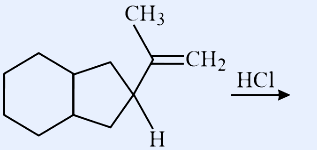
The major product of the following reaction is :
(1)
(2)
(3)
(4)
SolutionAnswer: Option 4
Approach:
Add HCl across the exocyclic double bond following Markovnikov's rule, accounting for the stability of the resulting carbocation.
Step 1:Protonate the exocyclic alkene to form the more stable carbocation.
Step 2:Capture chloride at that carbon.
Final answer: Option 4 structure
Q53Single correctHaloalkanes and Haloarenes
The major product in the following conversion is :
(1)
(2)
(3)
(4)
SolutionAnswer: Option 1
Approach:
Add HBr across the side-chain double bond and cleave the aryl methyl ether with excess HBr under heating.
Step 1:Add HBr to the alkene to place bromine on the benzylic carbon.
Step 2:Cleave the aryl methyl ether with excess HBr.
Final answer: Option 1 structure
Q54Single correctAldehydes, Ketones and Carboxylic Acids
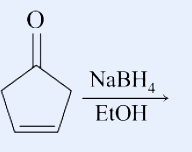
The major product of the following reaction is :
(1)
(2)
(3)
(4)
SolutionAnswer: Option 3
Approach:
Reduce the carbonyl group of the cyclopentenone with sodium borohydride in ethanol, which selectively reduces the carbonyl while leaving the carbon-carbon double bond intact.
Step 1:Deliver hydride to the carbonyl carbon.
Step 2:Retain the ring double bond.
Final answer: Option 3 structure
Q55Single correctAldehydes, Ketones and Carboxylic Acids
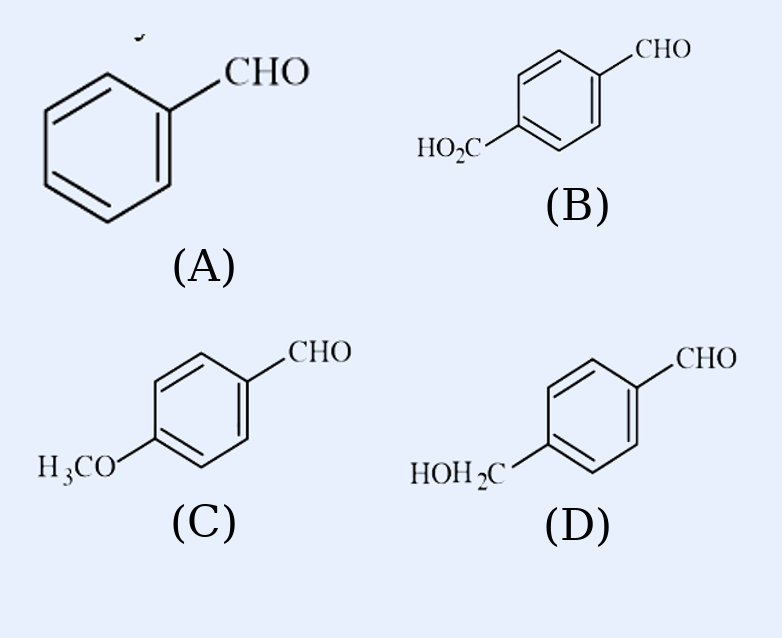
The aldehydes which will not form Grignard product with one equivalent of Grignard reagents are :
(1)
(2)
(3)
(4)
SolutionAnswer: Option 4(B), (D)
Approach:
Identify aldehydes bearing acidic protons that consume one equivalent of Grignard reagent before any addition to the carbonyl can occur.
Step 1:Examine each aldehyde for acidic functional groups.
Step 2:Match the acidic substrates to the options.
Final answer: (B), (D)
Q56Single correctAldehydes, Ketones and Carboxylic Acids
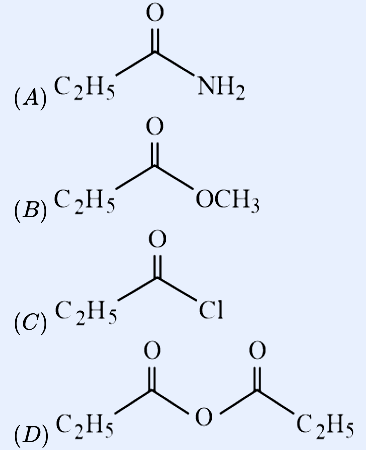
The increasing order of the reactivity of the following with is :
(1)
(2)
(3)
(4)
SolutionAnswer: Option 3
Approach:
Rank the acyl derivatives by the electrophilicity of the carbonyl carbon, which governs the rate of hydride attack by lithium aluminium hydride.
Step 1:Order the leaving-group ability and donating ability of the substituents.
Step 2:Arrange the four substrates by increasing carbonyl electrophilicity.
Final answer:
Q57Single correctAmines
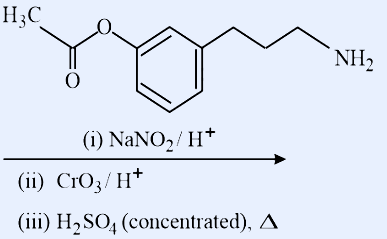
The major product of the following reaction is :
(i)
(ii)
(iii) (concentrated),
(i)
(ii)
(iii) (concentrated),
(1)
(2)
(3)
(4)
SolutionAnswer: Option 1
Approach:
Convert the primary amine to an alcohol via diazotization, oxidize the alcohol with chromium trioxide, and effect intramolecular acylation under hot concentrated sulfuric acid.
Step 1:Replace the amino group with a hydroxyl group.
Step 2:Oxidize the alcohol.
Step 3:Carry out intramolecular cyclization.
Final answer: Option 1 structure
Q58Single correctPolymers
The two monomers for the synthesis of nylon 6, 6 are
(1)
(2)
(3)
(4)
SolutionAnswer: Option 1
Approach:
Recall the two monomers that condense to form nylon 6,6.
Step 1:Identify the diacid and the diamine.
Step 2:Express the structures.
and
Final answer:
Q59Single correctBiomolecules
The correct statement(s) among I to III with respect to potassium ions that are abundant within the cell fluids, is/are
I. They activate many enzymes.
II. They participate in the oxidation of glucose to produce ATP.
III. Along with sodium ions, they are responsible for the transmission of nerve signals.
I. They activate many enzymes.
II. They participate in the oxidation of glucose to produce ATP.
III. Along with sodium ions, they are responsible for the transmission of nerve signals.
(1)
(2)
(3)
(4)
SolutionAnswer: Option 1I, II and III
Approach:
Assess each statement about the biological functions of potassium ions inside cell fluids.
Step 1:Evaluate enzyme activation and ATP production.
Step 2:Evaluate nerve-signal transmission.
Final answer: I, II and III
Q60Single correctBiomolecules
The correct structure of histidine in a strongly acidic solution (pH = 2) is :
(1)
(2)
(3)
(4)
SolutionAnswer: Option 4
Approach:
Determine the protonation state of each ionizable group of histidine at pH 2, where the molecule is fully protonated.
Step 1:Protonate the carboxyl group.
Step 2:Protonate the alpha-amino and imidazole groups.
Final answer: Option 4 structure
Mathematics30 questions
Q61Single correctComplex Numbers and Quadratic Equations
The number of integral values of m for which the quadratic expression , is always positive, is :
(1)
(2)
(3)
(4)
SolutionAnswer: Option 1
Approach:
For a quadratic to be positive for every real value of the variable, the leading coefficient must be positive and the discriminant must be negative.
Step 1:Require the leading coefficient positive.
Step 2:Require the discriminant negative.
Step 3:Expand and simplify the discriminant inequality.
Step 4:Solve the inequality for the interval of m.
Step 5:Intersect with the leading-coefficient condition and count integers.
Final answer:
Q62Single correctComplex Numbers and Quadratic Equations
Let and be two complex numbers satisfying and . Then the minimum value of is :
(1)
(2)
(3)
(4)
SolutionAnswer: Option 3
Approach:
Interpret each condition as a circle in the complex plane and compare the position of the two circles.
Step 1:Identify the first locus.
Step 2:Identify the second locus.
Step 3:Compare the distance between centres with the radii.
Step 4:The second circle lies within the first since the distance between centres plus its radius equals the larger radius.
Step 5:Internal tangency forces a common point, so the minimum separation is zero.
Final answer:
Q63Single correctPermutations and Combinations
There are men and two women participating in a chess tournament. Each participant plays two games with every other participant. If the number of games played by the men between themselves exceeds the number of games played between the men and the women by , then the value of is :
(1)
(2)
(3)
(4)
SolutionAnswer: Option 2
Approach:
Count games using combinations, doubling each pairing because two games are played, then form an equation from the given excess.
Step 1:Games among men, two per pair.
Step 2:Games between the men and the two women, two per pair.
Step 3:Form the excess equation.
Step 4:Solve the quadratic.
Step 5:Retain the positive value.
Final answer:
Q64Single correctSequences and Series
The sum of the first terms of the series is equal to , then K is equal to :
(1)
(2)
(3)
(4)
SolutionAnswer: Option 2
Approach:
Recognise the bases as an arithmetic progression in steps of three-quarters, factor out the common ratio, and use the sum of cubes formula.
Step 1:Write the general base as a multiple of three-quarters.
Step 2:Express the sum of the first fifteen cubes.
Step 3:Evaluate the cube sum.
Step 4:Combine.
Final answer:
Q65Single correctTrigonometry
If , , then is equal to :
(1)
(2)
(3)
(4)
SolutionAnswer: Option 2
Approach:
Apply the arithmetic-mean–geometric-mean inequality to the left side to force equality conditions, then evaluate the required difference.
Step 1:Bound the left side using AM-GM on the squared terms.
Step 2:Group as a sum amenable to AM-GM and find the minimum value forces equality.
Step 3:The equality of both sides forces and , giving and .
Step 4:Evaluate the required expression.
Final answer:
Q66Single correctPermutations and Combinations
If , and are in A.P., then n can be :
(1)
(2)
(3)
(4)
SolutionAnswer: Option 2
Approach:
Use the arithmetic progression condition on consecutive binomial coefficients and reduce the ratios to a polynomial equation in n.
Step 1:Apply the A.P. condition.
Step 2:Divide through by and substitute the ratios.
Step 3:Clear denominators.
Step 4:Solve the quadratic.
Step 5:Select the listed value.
Final answer:
Q67Single correctBinomial Theorem
The total number of irrational terms in the binomial expansion of is :
(1)
(2)
(3)
(4)
SolutionAnswer: Option 3
Approach:
Write the general term, find when both exponents become integers (rational terms), then subtract from the total number of terms.
Step 1:Identify the exponents of 7 and 3 in the general term.
Step 2:Both exponents are integers when r is a multiple of 10 (and then 60-r is a multiple of 5).
Step 3:Count the rational terms.
Step 4:Subtract from the total of 61 terms.
Final answer:
Q68Single correctCoordinate Geometry
If a straight line passing through the point is such that its intercepted portion between the coordinate axes is bisected at , then its equation is :
(1)
(2)
(3)
(4)
SolutionAnswer: Option 2
Approach:
Use the midpoint of the intercepts on the axes and the intercept form of a straight line.
Step 1:Equate the midpoint of the intercepts to P.
Step 2:Write the intercept form.
Step 3:Clear denominators by multiplying through.
Final answer:
Q69Single correctCoordinate Geometry
If a circle of radius passes through the origin and intersects the coordinate axes at and , then the locus of the foot of perpendicular from on is :
(1)
(2)
(3)
(4)
SolutionAnswer: Option 2
Approach:
Since the angle in a semicircle is a right angle, AB is a diameter; parametrise the foot of the perpendicular and eliminate the parameters.
Step 1:The angle at O subtended by AB is a right angle, so AB is a diameter of length 2R.
Step 2:Let the foot of the perpendicular be P(x,y). The area relation gives where .
Step 3:Since P lies on AB and OP perpendicular to AB, the projections give ; using the foot coordinates, and .
Step 4:Compute and the product xy, then eliminate a and b.
Step 5:Rearrange into the locus.
Final answer:
Q70Single correctCoordinate Geometry
The equation of a tangent to the parabola, , which makes an angle with the positive direction of x-axis, is :
(1)
(2)
(3)
(4)
SolutionAnswer: Option 3
Approach:
Use the tangent of slope m to the parabola written in the form and rewrite the result using .
Step 1:Identify the parameter of the parabola.
Step 2:Write the tangent of slope m.
Step 3:Substitute .
Step 4:Rearrange to express x in terms of y to match the listed option.
Final answer:
Q71Single correctCoordinate Geometry
Let S and S' be the foci of an ellipse and B be any one of the extremities of its minor axis. If is a right angled triangle with right angle at B and area sq. units, then the length of a latus rectum of the ellipse is :
(1)
(2)
(3)
(4)
SolutionAnswer: Option 3
Approach:
Use the right-angle condition at the minor-axis end with the foci, then combine with the given area to find the parameters and the latus rectum.
Step 1:For the triangle with foci and to be right-angled at B, the legs are equal, giving .
Step 2:Express the area.
Step 3:With , solve.
Step 4:Find a from .
Step 5:Compute the latus rectum.
Final answer:
Q72Single correctLimits, Continuity and Differentiability
is equal to :
(1)
(2)
(3)
(4)
SolutionAnswer: Option 2
Approach:
Rationalise the numerator, then use the known small-quantity expansion of inverse sine near 1.
Step 1:Rationalise the numerator.
Step 2:Write .
Step 3:As x approaches 1, use .
Step 4:Cancel and evaluate the denominator at the limit.
Final answer:
Q73Single correctMathematical Reasoning
The expression is logically equivalent to :
(1)
(2)
(3)
(4)
SolutionAnswer: Option 2
Approach:
Rewrite the implication using disjunction, then apply De Morgan's law.
Step 1:Rewrite the implication.
Step 2:Negate using De Morgan's law.
Final answer:
Q74Single correctStatistics and Probability
The mean and the variance of five observations are and , respectively. If three of the observations are and ; then the absolute value of the difference of the other two observations, is :
(1)
(2)
(3)
(4)
SolutionAnswer: Option 3
Approach:
Use the mean to find the sum of the two unknowns and the variance to find their sum of squares, then determine the difference.
Step 1:Use the mean to find the sum of the two unknowns.
Step 2:Use the variance to find the sum of squares of all five.
Step 3:Find the sum of squares of the two unknowns.
Step 4:Compute the squared difference.
Step 5:Take the absolute value.
Final answer:
Q75Single correctTrigonometry
If the angle of elevation of a cloud from a point P which is above a lake be and the angle of depression of reflection of the could in the lake from P be , then the height of the cloud (in meters) from the surface of the lake is :
(1)
(2)
(3)
(4)
SolutionAnswer: Option 1
Approach:
Set the cloud height above the lake, express horizontal distance from the two angle conditions, and solve.
Step 1:Let the cloud height above the lake be h and the horizontal distance be d. The point P is 25 m above the lake.
Step 2:The reflection lies h below the lake; its depression from P gives a second relation.
Step 3:Equate the two expressions for d.
Step 4:Simplify the proportion.
Step 5:Solve for h.
Final answer:
Q76Single correctSets, Relations and Functions
Let Z be the set of integers. If and , then the number of subsets of the set , is :
(1)
(2)
(3)
(4)
SolutionAnswer: Option 4
Approach:
Determine set A by solving the exponential equation, set B by solving the integer inequality, then count subsets of the Cartesian product.
Step 1:The equation requires the exponent to vanish.
Step 2:All roots are integers, so A has these three elements.
Step 3:Solve the inequality for integers.
Step 4:Count elements of the Cartesian product.
Step 5:Number of subsets of a 15-element set.
Final answer:
Q77Single correctMatrices and Determinants
If , then for all , lies in the interval :
(1)
(2)
(3)
(4)
SolutionAnswer: Option 3
Approach:
Expand the determinant in terms of sin theta, then find the range of the resulting expression over the given interval.
Step 1:Expand the determinant along the first row.
Step 2:Determine the range of sin theta on the interval.
Step 3:Map to the determinant value; the value ranges between just above 3/2... and 3.
Final answer:
Q78Single correctMatrices and Determinants
The set of all values of for which the system of linear equations
has a non-trivial solution :
has a non-trivial solution :
(1)
(2)
(3)
(4)
SolutionAnswer: Option 3is a singleton
Approach:
Rewrite the system as a homogeneous eigenvalue-type system and set the coefficient determinant to zero.
Step 1:Move terms to one side to form a homogeneous system.
Step 2:Set the coefficient determinant to zero for a non-trivial solution.
Step 3:Expand and simplify the determinant.
Step 4:Solve the resulting equation.
Final answer: is a singleton
Q79Single correctDifferential Calculus
Let f be a differentiable function such that and for all . If , then is equal to :
(1)
(2)
(3)
(4)
SolutionAnswer: Option 3
Approach:
Identify f from the differential equation, apply the chain rule to the composition, and evaluate at x=1.
Step 1:Solve the differential equation with the given condition.
Step 2:Differentiate the composition using the chain rule.
Step 3:Evaluate at x=1 using f(1)=2.
Step 4:Combine the values.
Final answer:
Q80Single correctDifferential Calculus
The tangent to the curve , parallel to the line , also passes through the point :
(1)
(2)
(3)
(4)
SolutionAnswer: Option 4
Approach:
Find the point of tangency using the slope of the parallel line, write the tangent line, and test which point satisfies it.
Step 1:The line 2y=4x+1 has slope 2; match the tangent slope.
Step 2:Find the point of tangency.
Step 3:Write the tangent line.
Step 4:Test the candidate point (1/8, -7).
Final answer:
Q81Single correctDifferential Calculus
If the function f given by , for some is increasing in and decreasing in , then a root of the equation, is :
(1)
(2)
(3)
(4)
SolutionAnswer: Option 1
Approach:
Use the turning point at x=1 to find a, then solve the given equation by factoring out the double root.
Step 1:Since f increases then decreases with the change at x=1, this is a critical point.
Step 2:Substitute a=5 into f.
Step 3:Form f(x)-14 and factor.
Step 4:Divide by and set to zero.
Final answer:
Q82Single correctIntegral Calculus
The integral , is equal to :
(1)
(2)
(3)
(4)
SolutionAnswer: Option 4
Approach:
Factor a high power of x to convert the denominator into a polynomial in 1/, then substitute.
Step 1:Divide numerator and denominator by .
Step 2:Substitute t for the bracketed expression.
Step 3:Integrate the power.
Step 4:Back-substitute and clear powers of x.
Final answer:
Q83Single correctIntegral Calculus
The integral is equal to
(1)
(2)
(3)
(4)
SolutionAnswer: Option 1
Approach:
Write the integrand as a single derivative by recognizing it as the derivative of a product, then apply the fundamental theorem.
Step 1:Let g(x)=; its logarithmic derivative gives g'(x)=g(x)\ x.
Step 2:Similarly for the second factor.
Step 3:Combine into one antiderivative F(x) and evaluate from 1 to e.
Step 4:Substitute the limits and simplify.
Final answer:
Q84Single correctIntegral Calculus
is equal to
(1)
(2)
(3)
(4)
SolutionAnswer: Option 2
Approach:
Express the sum as a Riemann sum and convert it to a definite integral.
Step 1:Write the general term; the last term 1/()=n/(+) shows the sum runs to r=2n.
Step 2:Convert to an integral with upper limit 2.
Step 3:Evaluate the integral.
Final answer:
Q85Single correctDifferential Equations
If a curve passes through the point and has slope of the tangent at any point (x,y) on it as , then the curve also passes through the point
(1)
(2)
(3)
(4)
SolutionAnswer: Option 1
Approach:
Form and solve the linear differential equation using an integrating factor, apply the initial condition, then test the candidate points.
Step 1:Rewrite in standard linear form.
Step 2:Compute the integrating factor.
Step 3:Solve and apply (1,-2).
Step 4:Test the point with y=0.
Final answer:
Q86Single correctVector Algebra
Let and be three unit vectors, out of which vectors and are non-parallel. If and are the angles which vector makes with vectors and respectively and , then is equal to :
(1)
(2)
(3)
(4)
SolutionAnswer: Option 4
Approach:
Expand the vector triple product using the BAC-CAB identity and compare components, since b and c are non-parallel.
Step 1:Expand the triple product.
Step 2:Compare coefficients of the independent vectors b and c.
Step 3:Find the angles.
Step 4:Compute the difference.
Final answer:
Q87Single correctThree Dimensional Geometry
If an angle between the line, and the plane, is , then a value of k is :
(1)
(2)
(3)
(4)
SolutionAnswer: Option 1
Approach:
Relate the given cosine to the sine of the line-plane angle, then use the direction ratios and normal to solve for k.
Step 1:Convert the given cosine to sine of the angle theta.
Step 2:Use direction ratios (2,1,-2) and normal (1,-2,-k).
Step 3:Set equal to 1/3 and solve.
Step 4:Take the root.
Final answer:
Q88Single correctThree Dimensional Geometry
Let S be the set of all real values of such that a plane passing through the points and also passes through the point . Then S is equal to :
(1)
(2)
(3)
(4)
SolutionAnswer: Option 4
Approach:
Write the plane through the three symmetric points, impose passage through the fourth point, and solve for lambda.
Step 1:By symmetry the plane has the form x+y+z=d; substitute one point.
Step 2:Impose passage through (-1,-1,1).
Step 3:Solve for lambda.
Final answer:
Q89Single correctProbability
In a class of 60 students, 40 opted for NCC, 30 opted for NSS and 20 opted for both NCC and NSS. If one of these students is selected at random, then the probability that the student selected has opted neither for NCC nor for NSS is :
(1)
(2)
(3)
(4)
SolutionAnswer: Option 1
Approach:
Use the inclusion-exclusion principle to count students in at least one activity, then find the complement.
Step 1:Count students in NCC or NSS.
Step 2:Count students in neither.
Step 3:Compute the probability.
Final answer:
Q90Single correctProbability
In a game, a man wins Rs. 100 if he gets 5 or 6 on a throw of a fair die and loses Rs. 50 for getting any other number on the die. If he decides to throw the die either till he gets a five or a six or to a maximum of three throws, then his expected gain/loss (in rupees) is :
(1)
(2)
(3)
(4)
SolutionAnswer: Option 4
Approach:
Enumerate the outcomes by the throw on which a 5 or 6 first appears, compute the gain for each, and take the probability-weighted sum.
Step 1:Success on first throw.
Step 2:Success on second throw.
Step 3:Success on third throw.
Step 4:All three throws fail.
Step 5:Sum the contributions.
Final answer:
More JEE Main 2019 papers
- JEE Main 2019 — April 08, Shift 1
- JEE Main 2019 — April 08, Shift 2
- JEE Main 2019 — April 09, Shift 1
- JEE Main 2019 — January 09, Shift 1
- JEE Main 2019 — January 09, Shift 2
- JEE Main 2019 — January 10, Shift 1
- JEE Main 2019 — January 10, Shift 2
- JEE Main 2019 — January 11, Shift 1
- JEE Main 2019 — January 11, Shift 2
- JEE Main 2019 — January 12, Shift 1
Frequently Asked Questions
How many questions are in the JEE Main 2019 January 12, Shift 2 paper?
The JEE Main 2019 January 12, Shift 2 paper has 90 questions — Physics (30), Chemistry (30) and Mathematics (30). Every question is on this page with its correct answer and a step-by-step solution.
What is the marking scheme for JEE Main?
JEE Main awards +4 marks for each correct answer and −1 for a wrong answer, with 0 for questions left unattempted. The paper covers Physics, Chemistry and Mathematics.
Are the answer key and step-by-step solutions provided for the 2019 January 12, Shift 2 paper?
Yes — every question shows the correct answer (answer key) and a detailed step-by-step solution, free to read online.
Can I take the JEE Main 2019 January 12, Shift 2 paper as a timed mock test?
Yes. With a free JEEnify account you can attempt this exact paper as a timed test in the real exam interface, then see your score and weak-area analysis.
Solved this paper? Calculate your JEE Main scoremost important chaptersformula sheetsall free tools.