
Back to JEE Main PYQs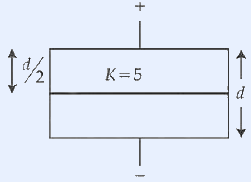
JEE Main 2026 April 02, Shift 1 Question Paper with Solutions
All 75 questions from the JEE Main 2026 (April 02, Shift 1) shift — Physics (25), Chemistry (25) and Mathematics (25) — each with the correct answer (answer key) and a step-by-step solution. Read it free online, or attempt the full paper as a timed mock test.
Physics25 questions
Q26Single correctUnits and Measurements
The dimensional formula of ( permittivity of vacuum and electric field) is . The value of ______
(1)
(2)
(3)
(4)
SolutionAnswer: Option 2
Approach:
Identify as electric-field energy density, write its dimensional formula, then evaluate using the exponents of M, L, T.
Step 1:The target: write in terms of energy per unit volume.
Step 2:Substitute dimensions of energy and volume .
Step 3:Read off exponents from .
Step 4:Compute .
Step 5:Cross-check by re-deriving from in and E in : has units of .
Step 6:Result.
Final answer:
Q27Single correctExperimental Skills
The diameter of a wire measured by a screw gauge of least count cm is cm. The length measured by a scale of least count cm is cm. When a weight of N is applied to the wire, the measured Young's modulus is . The error in (ignore the contribution of the load to Young's modulus error calculation)
(1)
(2)
(3)
(4)
SolutionAnswer: Option 2
Approach:
Use (with extension cm from the measured setup), propagate fractional errors from L, d, and l, and obtain .
Step 1:Data: N, cm, cm, extension cm; least counts cm, cm, cm.
Step 2:Compute measured .
Step 3:Write fractional error formula (load contribution ignored).
Step 4:Substitute measured values and least counts.
Step 5:Sum the fractions.
Step 6:Multiply by .
Step 7:Cross-check: dominant terms are and ; their sum already gives about , consistent with the total.
Step 8:Result.
Final answer:
Q28Single correctKinematics
The velocity of a particle is given as . The magnitude of acceleration at point is ______ .
(1)
(2)
(3)
(4)
SolutionAnswer: Option 2
Approach:
For a steady velocity field the acceleration is ; since each component depends only on its own coordinate, .
Step 1:Components: at point .
Step 2:Compute .
Step 3:Compute .
Step 4:Compute .
Step 5:Substitute .
Step 6:Compute magnitude.
Step 7:Cross-check by checking sum: .
Step 8:Result.
Final answer:
Q29Single correctRotational Motion
The position of an object having mass kg as a function of time t is given as . At s, which of the following statements are correct?
A) The linear momentum .
B) The force acting on the object .
C) The angular momentum of the object about its origin .
D) The torque acting on the object about its origin .
Choose the correct answer from the options given below.
A) The linear momentum .
B) The force acting on the object .
C) The angular momentum of the object about its origin .
D) The torque acting on the object about its origin .
Choose the correct answer from the options given below.
(1)
(2)
(3)
(4)
SolutionAnswer: Option 4A, B and D only
Approach:
Differentiate for and ; evaluate , , and at s and test statements A-D.
Step 1:, kg.
Step 2:Differentiate to get and .
Step 3:Momentum at .
Step 4:Force at .
Step 5:Angular momentum .
Step 6:Torque .
Step 7:Cross-check: consistency: requires ; at , ? Direct expansion: , so at , , matching Step 5.
Step 8:Result: A, B, D are correct; C is not.
A, B and D only
Final answer: A, B and D only
Q30Single correctGravitation
A planet is moving around the star of mass in the orbit of radius R. Another planet is moving around another star of mass in a orbit of radius . Ratio of time periods of revolution of and is ______
(1)
(2)
(3)
(4)
SolutionAnswer: Option 2
Approach:
Apply Kepler's third law to each planet-star system and form the ratio .
Step 1:Planet orbits star of mass at radius R; planet orbits star of mass at radius . Target: .
Step 2:Write the period ratio.
Step 3:Substitute , .
Step 4:Simplify.
Step 5:Cross-check: via direct formula: and . Their ratio .
Step 6:Result.
Final answer:
Q31Single correctRotational Motion
A particle is rotating in a circular path and at any instant its motion can be described as . The angular acceleration of the particle after seconds is ______
(1)
(2)
(3)
(4)
SolutionAnswer: Option 3
Approach:
Differentiate twice to obtain , then substitute s.
Step 1:.
Step 2:Differentiate once for .
Step 3:Differentiate again for .
Step 4:Substitute .
Step 5:Cross-check by direct second derivative of : ; at gives .
Step 6:Result.
Final answer:
Q32Single correctElectrostatics
A parallel plate air capacitor has a capacitance C. When it is half filled as shown in figure with a dielectric constant , the percentage increase in the capacitance is ______
(1)
(2)
(3)
(4)
SolutionAnswer: Option 2
Approach:
Model the half-filled capacitor as two capacitors in series: an air slab of thickness and a dielectric slab of thickness with . Find new capacitance and percentage increase over .
Step 1:Initial air capacitance and series structure after inserting dielectric.
Step 2:Capacitances of each half.
Step 3:Add reciprocals for series combination.
Step 4:Invert for .
Step 5:Compute .
Step 6:Cross-check: limit: for (no dielectric) the formula gives , percentage increase ; for the dielectric half becomes a short, giving and 100% increase. The value % at lies within %, consistent.
Step 7:Result.
Final answer:
Q33Single correctThermodynamics
Heat is supplied to a diatomic gas at constant pressure. Then the ratio of is ______
(1)
(2)
(3)
(4)
SolutionAnswer: Option 4
Approach:
For a diatomic ideal gas at constant pressure use , , and form the ratio.
Step 1:Diatomic gas has degrees of freedom , so and .
Step 2:Compute work.
Step 3:Compute internal energy change.
Step 4:Compute heat at constant pressure.
Step 5:Form the ratio (multiply each by ).
Step 6:Cross-check: via first law: .
Step 7:Result.
Final answer:
Q34Single correctElectrostatics
Two charged conducting spheres and of radii 8 cm are connected to each other by a wire. After equilibrium is established, the ratio of electric fields on and spheres are and respectively. The value of is ________
(1)
(2)
(3)
(4)
SolutionAnswer: Option 4
Approach:
Connected spheres reach the same potential at equilibrium, giving ; the surface field then satisfies , so the field ratio reduces to the inverse radius ratio.
Step 1:Given data and target ratio for the two connected conducting spheres of radii and .
Step 2:Equate the surface potentials of the two spheres since they are joined by a wire.
Step 3:Write the ratio of the surface electric fields.
Step 4:Substitute to reduce the ratio.
Step 5:Insert the numerical radii and .
Step 6:Cross-check by dimensional and limiting analysis: for connected spheres so the smaller sphere has the larger field, consistent with .
Step 7:Result.
Final answer:
Q35Single correctOscillations and Waves
The equation of a plane progressive wave is given by where x and y are in cm and t is in second. The velocity of the wave is ______ m/s
(1)
(2)
(3)
(4)
SolutionAnswer: Option 4300
Approach:
Read the angular frequency and the wave number k directly from the cosine argument and compute , then convert from cm/s to m/s.
Step 1:The target: phase velocity in m/s for the given wave equation.
Step 2:The argument to standard form .
Step 3:Identify the angular frequency from the coefficient of .
Step 4:Identify the wave number from the coefficient of .
Step 5:Compute the phase velocity in cm/s.
Step 6:Convert to m/s using .
Step 7:Cross-check by computing the wavelength and frequency separately: , , so .
Step 8:Result.
Final answer: 300
Q36Single correctElectrostatics
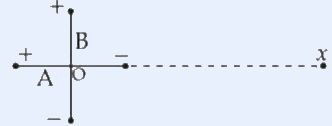
Two short electric dipoles A and B having dipole moment and respectively are placed with their axis mutually perpendicular as shown in the figure. The resultant electric field at a point x is making an angle of with the line joining points O and x. The ratio of the dipole moments is ________
(1)
(2)
(3)
(4)
SolutionAnswer: Option 2
Approach:
Treat A as contributing its axial field along the line Ox and B as contributing its equatorial field perpendicular to Ox, then use for the resultant direction to extract the dipole-moment ratio.
Step 1:Dipole A lies along Ox with point x on its axis, dipole B is perpendicular to Ox at O with x lying on its equator; resultant at x makes with Ox.
Step 2:Write the axial field of A along Ox.
Step 3:Write the equatorial field of B perpendicular to Ox.
Step 4:Apply the resultant-angle relation.
Step 5:Substitute and solve for the ratio.
Step 6:Cross-check: reconstruct , giving as specified.
Step 7:Result.
Final answer:
Q37Single correctElectronic Devices
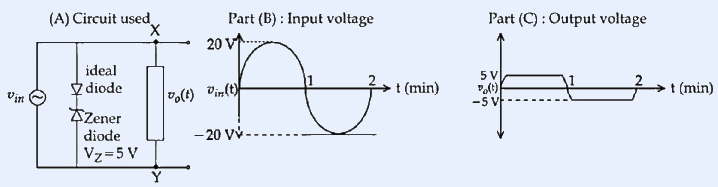
For the given circuit (shown in part (A)) the time dependent input voltage and corresponding output are shown in part (B) and part (C), respectively. Identify the components that are used in the circuit between points X and Y.
(1)
(2)
(3)
(4)
SolutionAnswer: Option 2Option 2
Approach:
A sinusoidal input swinging between is reduced to a symmetric square-like output clipped at , which is the signature of a back-to-back Zener/diode pair acting as a symmetric voltage limiter; match this behaviour to the candidate two-component networks.
Step 1:Input is sinusoidal; output is clamped between ; identify the two-element network between X and Y.
Step 2:Symmetric clipping on both half-cycles requires conduction in both polarities, which a single diode cannot supply.
Step 3:A back-to-back pair of diodes (one ordinary diode in series with a Zener oriented oppositely, or two Zeners back-to-back) provides clamping.
Step 4:Option 2 shows two diodes oriented in opposite directions between X and Y, the only arrangement among the four options that conducts in both polarities and produces symmetric clipping.
Step 5:Rule out option 1 (resistor + single diode — half-wave only), option 3 (resistor + single Zener — asymmetric clamp), option 4 (two diodes in same direction — half-wave conduction).
Step 6:Cross-check by behaviour check: on the positive half of the forward-biased diode and the reverse-biased Zener (in breakdown at V) clamp the output at V; on the negative half the roles swap to clamp at V, matching the displayed output.
Step 7:Result.
Final answer: Option 2
Q38Single correctElectromagnetic Induction and AC
When a coil is placed in a time dependent magnetic field the power dissipated in it is P. The number of turns, area of the coil and radius of the wire are N, A and r respectively. For a second coils number of turns, area of the coil and radius of the coil wire are 2N, 2A and 3r respectively. When the first coil is replaced with second coil the power dissipated in it is . The value of is ______
(1)
(2)
(3)
(4)
SolutionAnswer: Option 136
Approach:
EMF in a coil is , so ; the coil resistance scales as wire length over wire cross-section, . Power . Form the ratio and read off .
Step 1:Coil-1 has (N,A,r) with power P; coil-2 has with power ; find .
Step 2:Induced EMF scales as , so .
Step 3:Total wire length of a coil of N turns and area A (circular cross-section) is ; with wire cross-section , the resistance scales as .
Step 4:Combine to obtain the power scaling.
Step 5:Substitute the second coil's parameters into the ratio.
Step 6:Simplify , then multiply by 9.
Step 7:Cross-check by matching to and extracting .
Step 8:Result.
Final answer: 36
Q39Single correctMagnetic Effects of Current and Magnetism
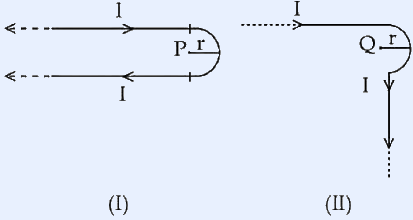
Two identical long current carrying wires are bent into the shapes shown in the following figures. If the magnitude of magnetic fields at the centres P and Q of a semicircular arc are and respectively, then the ratio is __________
(1)
(2)
(3)
(4)
SolutionAnswer: Option 1
Approach:
At the centre of each configuration, sum the Biot-Savart contributions of the straight semi-infinite segments and the semicircular arc; configuration (I) has two effective semi-infinite straights at perpendicular distance while configuration (II) has only one such straight (the other passes through the centre and contributes zero).
Step 1:Configuration (I) — semicircular arc of radius centred at P with two collinear straight extensions on opposite sides (each semi-infinite, perpendicular distance to P equal to ); configuration (II) — same arc centred at Q with one straight tangent at distance and one straight along the diameter (passing through Q).
Step 2:(I): two semi-infinite straights each contribute at P (currents create field in the same sense as the arc), plus the arc .
Step 3:(II): one semi-infinite straight contributes at Q, the other straight passes through Q and gives zero field, plus the arc .
Step 4:Form the ratio and cancel common factors.
Step 5:Cross-check by numerical evaluation: ; equivalently the arc contributes about to both, with one extra straight term in (I), consistent with .
Step 6:Result.
Final answer:
Q40Single correctOptics
For a thin symmetric prism made of glass (refractive index 1.5), the ratio of incident angle and minimum deviation will be __________
(1)
(2)
(3)
(4)
SolutionAnswer: Option 2
Approach:
Use the thin-prism small-angle relations: at minimum deviation in a symmetric prism so , while . Substitute .
Step 1:Thin symmetric prism, ; find .
Step 2:At minimum deviation the ray inside the prism is symmetric, so .
Step 3:Small-angle Snell's law gives the incidence angle.
Step 4:Use the standard thin-prism result for minimum deviation.
Step 5:Form the ratio and cancel .
Step 6:Substitute .
Step 7:Cross-check by working backwards: and , so .
Step 8:Result.
Final answer:
Q41Single correctOptics
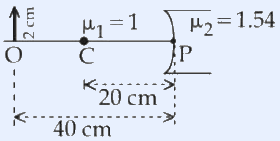
Refer the figure given below. and are refractive indices of air and lens material. The height of image will be ________ cm
(1)
(2)
(3)
(4)
SolutionAnswer: Option 11
Approach:
Apply the single-surface refraction formula with the Cartesian sign convention to find the image distance v, then use the across-media lateral magnification to compute the image height.
Step 1: (air), (lens), object height , , (centre of curvature on the object side per the figure).
Step 2:Substitute into the refraction formula.
Step 3:Isolate .
Step 4:Solve for .
Step 5:Compute the lateral magnification.
Step 6:Multiply by the object height to obtain the image height.
Step 7:Cross-check: rounding to the closest option among cm gives , since differs from by only and from by .
Step 8:Result.
Final answer: 1
Q42Single correctDual Nature of Matter and Radiation
For a certain metal, when monochromatic light of wavelength is incident, the stopping potential for photoelectrons is . When the same metal is illuminated by light of wavelength , then the stopping potential becomes . The threshold wavelength for photoelectric emission for the given metal is . The value of is ______
(1)
(2)
(3)
(4)
SolutionAnswer: Option 24
Approach:
Write Einstein's photoelectric equation for both wavelengths, eliminate the work function to find , then use to extract the multiplier .
Step 1:Given data and target. Wavelength gives stopping potential ; wavelength gives ; target threshold wavelength is .
Step 2:Einstein equation for incident wavelength .
Step 3:Einstein equation for incident wavelength .
Step 4:Multiply (ii) by 3 and subtract (i) to eliminate the stopping potential.
Step 5:Equate to to read off the threshold wavelength.
Step 6:Cross-check by substituting back into both equations and checking the stopping potentials.
Step 7:Result.
Final answer: 4
Q43Single correctElectromagnetic Waves
An electromagnetic wave travelling in x-direction is described by field equation . If the electron is restricted to move in y-direction only with speed of then ratio of maximum electric and magnetic forces acting on the electron is ______
(1)
(2)
(3)
(4)
SolutionAnswer: Option 1200
Approach:
Identify the EM wave speed from the phase, then use to reduce the ratio of maximum electric to magnetic force on the electron to .
Step 1:Given data: along y; wave travels along x with phase ; electron speed along y. Target: .
Step 2:Read off the wave speed from the phase argument.
Step 3:Maximum electric force on electron is and maximum magnetic force is .
Step 4:Substitute to simplify.
Step 5:Substitute numerical values of and .
Step 6:Cross-check by direct division.
Step 7:Result.
Final answer: 200
Q44Single correctAtoms and Nuclei
Angular momentum of an electron in a hydrogen atom is , then the energy of the electron is ______ eV.
(1)
(2)
(3)
(4)
SolutionAnswer: Option 3-0.38
Approach:
Use Bohr's angular momentum quantization to obtain , then apply the hydrogen energy level formula.
Step 1:Given data and target: ; find energy in eV.
Step 2:Equate given L to and solve for n.
Step 3:Substitute into the hydrogen energy formula.
Step 4:Evaluate the numerical value.
Step 5:Cross-check by recomputing and rounding to two decimals.
Step 6:Result.
Final answer: -0.38
Q45Single correctProperties of Solids and Liquids
A liquid drop of diameter 2 mm breaks into 512 droplets. The change in surface energy is . The value of is ______ . (Take surface tension of liquid = 0.08 N/m)
(1)
(2)
(3)
(4)
SolutionAnswer: Option 27
Approach:
Use volume conservation to find the radius of each small droplet, then compute the change in surface area times surface tension.
Step 1:Given data: (diameter ); ; . Target: with .
Step 2:Apply volume conservation to find .
Step 3:Write the change in surface energy.
Step 4:Evaluate (in ).
Step 5:Substitute into with SI units.
Step 6:Compute .
Step 7:Cross-check by checking , consistent with .
Step 8:Result.
Final answer: 7
Q46NumericalOptics
In single slit diffraction pattern, the wavelength of light used is and slit width is the angular width of central maximum is degrees. The value of is ______
SolutionAnswer: 36
Approach:
Use single-slit angular width of central maximum in radians and convert to degrees.
Step 1:Given data: ; . Target: such that degrees.
Step 2:Substitute values to get angle in radians.
Step 3:Simplify the radian value.
Step 4:Convert to degrees.
Step 5:Evaluate using .
Step 6:Cross-check by expressing in degrees.
Step 7:Result.
Final answer: 36
Q47NumericalThermodynamics
A vessel contains of a gas at pressure 8 bar and temperature with and . It is expanded adiabatically till pressure falls to 1 bar. The work done during this process is ______ k J. (R is gas constant)
SolutionAnswer: 120
Approach:
Compute from , use the adiabatic relation to find , then apply .
Step 1:Given data: , , , , . Target: work W in kJ.
Step 2:Solve adiabatic relation for .
Step 3:Evaluate .
Step 4:Compute and in Joules.
Step 5:Substitute into work formula.
Step 6:Evaluate the work.
Step 7:Cross-check: gas expands (V increases), so , consistent with .
Step 8:Result.
Final answer: 120
Q48NumericalMagnetic Effects of Current and Magnetism
charge moving with velocity in the region of magnetic field . The magnitude of force acting on it is . The value of is ______
SolutionAnswer: 171
Approach:
Apply Lorentz force : compute the cross product, take its magnitude, and read off .
Step 1:Given data: , , . Target: with .
Step 2:Compute component of .
Step 3:Compute component.
Step 4:Compute component.
Step 5:Assemble the force vector.
Step 6:Compute the magnitude squared.
Step 7:Cross-check by taking the square root and matching the stated form.
Step 8:Result.
Final answer: 171
Q49NumericalProperties of Solids and Liquids
A uniform wire of length l of weight w is suspended from the roof with a weight of W at the other end. The stress in the wire at distance from the top is , where, A is the cross sectional area of the wire. The value of is ______
SolutionAnswer: 3
Approach:
At a section a distance from the top, the tension supports the weight plus the wire weight hanging below, which equals ; divide by area and match the given form.
Step 1:Given data: uniform wire of length l, weight w, suspended from roof with weight W attached at bottom. Target: in at the section below the top.
Step 2:Length of wire below the section is .
Step 3:Weight of this sub-length (uniform wire).
Step 4:Tension at section equals plus the weight hanging below it.
Step 5:Compute stress.
Step 6:Cross-check by matching denominators with the given form .
Step 7:Result.
Final answer: 3
Q50NumericalProperties of Solids and Liquids
A tub is filled with water and a wooden cube is placed in the water. The wooden cube is found to float on the water with a part of it submerged in water. When a metal coin is placed on the wooden cube, the submerged part is increased by . The mass of the metal coin is ______ gram. (Take water density as and density of wood as )
SolutionAnswer: 387
Approach:
Additional buoyant force due to extra submerged depth equals the weight of the coin; solve for coin mass.
Step 1:Given data: cube side , so base area ; extra submergence ; . Target: in grams.
Step 2:Write equilibrium of the loaded cube — the additional buoyancy from the extra submerged slab must equal the coin's weight.
Step 3:Cancel on both sides.
Step 4:Substitute the numerical values in cgs units.
Step 5:Multiply.
Step 6:Cross-check by checking that the wood density was not needed (the original wood equilibrium cancels out when only considering the change).
Step 7:Result.
Final answer: 387
Chemistry25 questions
Q51Single correctSome Basic Concepts in Chemistry
The mass of iron converted into by the action of 18g of steam is (Given :Molar mass of and Fe are 1,16 and 56 g respectively) Assume iron is present in excess.
(1)
(2)
(3)
(4)
SolutionAnswer: Option 442 gm
Approach:
Use the balanced reaction and the limiting reagent (steam) to find moles of Fe consumed, then convert to mass.
Step 1:Given data and target.
Step 2:Write the balanced reaction.
Step 3:Compute moles of steam.
Step 4:Apply stoichiometric ratio (3 Fe per 4 O).
Step 5:Convert moles of Fe to mass.
Step 6:Cross-check by atom balance: 4 O contribute 4 O atoms which form one F unit with 3 Fe, scaled by gives mol Fe.
Step 7:Result.
Final answer: 42 gm
Q52Single correctAtomic Structure
What is the energy (in J ato) required for the following process? (Take the ionization energy for the H atom in the ground state as J ato)
(1)
(2)
(3)
(4)
SolutionAnswer: Option 3
Approach:
Apply the Bohr/hydrogenic ionization-energy formula to the one-electron ion (, ).
Step 1:Given data and target.
Step 2:Identify L as a hydrogen-like one-electron ion with .
Step 3:Write the ionization-energy scaling with .
Step 4:Substitute numerical values.
Step 5:Cross-check by direct multiplication.
Step 6:Result.
Final answer:
Q53Single correctChemical Bonding and Molecular Structure
Given below are two statements
Statement-I : The correct sequence of bond length in the following species is
Statement-II : The correct sequence of number of unpaired electrons in the following species is
In the light of the above statements choose the correct answers from the options given below
Statement-I : The correct sequence of bond length in the following species is
Statement-II : The correct sequence of number of unpaired electrons in the following species is
In the light of the above statements choose the correct answers from the options given below
(1)
(2)
(3)
(4)
SolutionAnswer: Option 3Statement-I is true but Statement-II is false
Approach:
Use molecular-orbital theory to obtain bond orders and unpaired-electron counts for , then evaluate both statements.
Step 1:Given data and target.
Step 2:List MO electrons (total) and antibonding occupancy.
Step 3:Compute bond orders.
Step 4:Invert to get bond lengths (smaller BO longer bond).
Step 5:List unpaired electrons (from occupancy).
Step 6:Examine Statement II — the correct decreasing chain is , with equality between and .
Step 7:Cross-check by combining both findings: I true and II false.
Step 8:Result.
Final answer: Statement-I is true but Statement-II is false
Q54Single correctChemical Thermodynamics
Consider the following data i) ii) iii) iv) The enthalpy of formation of anhydrous solid is :
(1)
(2)
(3)
(4)
SolutionAnswer: Option 4
Approach:
Combine the four given thermochemical equations via Hess's law to obtain and sum the corresponding enthalpy changes.
Step 1:Given data and target reaction.
Step 2:Read the four enthalpies (heat released negative ).
Step 3:Take combination and verify cancellation of HCl(g), HCl(aq), , A(aq), and aq.
Step 4:Substitute the enthalpy values.
Step 5:Arithmetic.
Step 6:Cross-check by recomputing partial sums.
Step 7:Result.
Final answer:
Q55Single correctSolutions
19.5 g of fluoro acetic acid (molar mass g ) is dissolved in 500g of water at 298K. The depression in the freezing point of water was . What is of fluoro acetic acid? (For water, K kg ). Assume molarity and molality to have same values.
(1)
(2)
(3)
(4)
SolutionAnswer: Option 4
Approach:
From freezing-point depression find van't Hoff factor i, convert to degree of dissociation , then use for the weak monoprotic acid.
Step 1:Given data and target.
Step 2:Compute molality.
Step 3:Solve for i from .
Step 4:Relate i to for HA (one particle becoming two, ).
Step 5:Apply with M.
Step 6:Cross-check by rounding to the nearest listed option.
Step 7:Result.
Final answer:
Q56Single correctEquilibrium
The solubility product constants of and AgBr are and respectively at 298K. The value of can be expressed as :
(1)
(2)
(3)
(4)
SolutionAnswer: Option 4
Approach:
Write the solubility-product expressions for (2:1) and (1:1) in terms of their molar solubilities, then take the ratio.
Step 1:Given data and target.
Step 2:Dissociation of gives A and CrO.
Step 3:Solve for .
Step 4:Dissociation of gives A and B.
Step 5:Take the ratio of molar solubilities.
Step 6:Cross-check by dimensional reduction: cube root of x from , square root of y from , factors of 2 cancel.
Step 7:Result.
Final answer:
Q57Single correctRedox Reactions and Electrochemistry
An electrochemical cell is constructed using half cells in the direction of spontaneous change Which of the following option is correct
(1)
(2)
(3)
(4)
SolutionAnswer: Option 1Overall reaction
Approach:
Identify the cathode (higher ) and anode (lower ), build the spontaneous overall cell reaction, compute , and evaluate each option.
Step 1:Given data and target.
Step 2:The half-cell with the higher reduction potential is the cathode.
Step 3:Write the cathode (reduction) half-reaction.
Step 4:Write the anode (oxidation) half-reaction (reverse of Fe(OH reduction).
Step 5:Add the half-reactions to obtain the overall spontaneous reaction.
Step 6:Compute .
Step 7:In the cell Fe is at the anode and is oxidized, so option 3 is incorrect; is intensive (independent of amount), so option 4 is incorrect.
Step 8:Cross-check by checking sign and direction: confirms the written direction is spontaneous.
Step 9:Result.
Final answer: Overall reaction
Q58Single correctChemical Kinetics
is the time required for the 100% completion of the reaction while is the time required for the 50% of the reaction to be completed which of the following option correctly represents relation between and for zero and first order reactions respectively?
(1)
(2)
(3)
(4)
SolutionAnswer: Option 2
Approach:
Use the integrated rate laws for zero- and first-order reactions to express and , then compare.
Step 1:Given data and target.
Step 2:(zero order): set in to find completion time.
Step 3:(zero order): take ratio with .
Step 4:(first order): set in .
Step 5:(first order): since is finite, is infinitely many half-lives, symbolically written .
Step 6:Cross-check by inspecting integrated forms: zero-order concentration reaches zero in finite time, first-order only asymptotically.
Step 7:Result.
Final answer:
Q59Single correctClassification of Elements and Periodicity
Given below are two statements
Statement – I : The first Ionization enthalpy of the elements and follows the order
Statement – II : Among and , the third ionisation enthalpy is very high for .
In the light of the above statements choose the correct answers from the options given below
Statement – I : The first Ionization enthalpy of the elements and follows the order
Statement – II : Among and , the third ionisation enthalpy is very high for .
In the light of the above statements choose the correct answers from the options given below
(1)
(2)
(3)
(4)
SolutionAnswer: Option 4Statement-I is false and Statement-II is true
Approach:
Evaluate Statement-I against the standard first ionisation enthalpy trend across Na, Mg, Cl, Ar and Statement-II by comparing successive (third) ionisation enthalpies for Ca, Al, Fe, B based on the stability of the resulting electron configurations.
Step 1:The targets: validate (i) the order of first ionisation enthalpy among and (ii) which element among has the largest third ionisation enthalpy.
Step 2:The first ionisation enthalpy values (kJ mo): , , , .
Step 3:Statement-I claims which is the exact reverse of the true period trend; hence Statement-I is FALSE.
Step 4:Third ionisation enthalpies (kJ mo): breaks a noble-gas core, ; (removal from ); ; .
Step 5:The reasoning for : after losing two valence electrons, has the stable noble-gas configuration; removing a 3rd electron requires very high energy.
Step 6:Cross-check by comparing tabulated successive ionisation enthalpies — shows the characteristic large jump between and confirming that is the largest of the four.
Step 7:Result: Statement-I is FALSE and Statement-II is TRUE, which corresponds to option (4).
Final answer: Statement-I is false and Statement-II is true
Q60Single correctp-Block Elements
Given below are two statements :
Statement I : Oxidising power of halogens decreases in the order which is the basis of “Layer test”
Statement II : “Layer test” to identify and in aqueous solution involves the oxidation of bromide or iodide into or respectively with , which is a type of displacement redox reaction.
In the light of the above statements choose the correct answers from the options given below
Statement I : Oxidising power of halogens decreases in the order which is the basis of “Layer test”
Statement II : “Layer test” to identify and in aqueous solution involves the oxidation of bromide or iodide into or respectively with , which is a type of displacement redox reaction.
In the light of the above statements choose the correct answers from the options given below
(1)
(2)
(3)
(4)
SolutionAnswer: Option 1Both Statement-I and Statement-II are true
Approach:
Cross-check: the oxidising-power trend of the halogens using standard reduction potentials and confirm that the layer test displacement of or by is a redox reaction.
Step 1:Given data: Statement-I claims the oxidising power decreases as and Statement-II describes the layer test as a displacement redox process.
Step 2:The standard reduction potentials : , , , .
Step 3:The chemistry of the layer test: chlorine water added to a mixture containing oxidises them to ; carbon tetrachloride or extracts the liberated halogen into the organic (lower) layer.
Step 4:Colour observations: gives an orange/brown organic layer, gives a violet/pink organic layer — the very basis of qualitative identification.
Step 5:Cross-check by oxidation-state book-keeping: goes from (reduced), goes from (oxidised); a balanced electron transfer — a genuine redox.
Step 6:Result: both Statement-I and Statement-II are true, matching option (1).
Final answer: Both Statement-I and Statement-II are true
Q61Single correctd- and f- Block Elements
Which of the following sets includes all the species that will change the orange colour of in acidic medium?
(1)
(2)
(3)
(4)
SolutionAnswer: Option 1
Approach:
Acidified is a strong oxidising agent (). Identify which option contains only species capable of being oxidised (in lower oxidation states) so that they reduce dichromate and discharge its orange colour.
Step 1:The target: only reducing species (i.e. species in lower oxidation states relative to dichromate) can discharge the orange colour by being oxidised.
Step 2:Option (1) species — each is in its lower stable oxidation state and is readily oxidised: , , , .
Step 3:Balanced equation for iron: .
Step 4:For tin: .
Step 5:For iodide and sulphide: and .
Step 6:Cross-check: other options fail: option (2) contains (highest stable state, cannot be further oxidised by ); option (3) contains (cannot be oxidised); option (4) contains (all highest oxidation state, non-reducing).
cannot reduce
Step 7:Result: only option (1) contains a complete set of reducing species.
Final answer:
Q62Single correctCoordination Compounds
Match List – I with List – II
| List– I (Chromium (III) Complexes, en = ethylene diamine) | List– II |
|---|---|
| A) | I) 15060 |
| B) | II) 17400 |
| C) | III) 22300 |
| D) | IV) 26600 |
Choose the correct answer from the options given below:
(1)
(2)
(3)
(4)
SolutionAnswer: Option 4
Approach:
Crystal-field splitting energy for a given metal centre in the same oxidation state increases with ligand-field strength as ordered in the spectrochemical series. Rank the four Cr(III) complexes by ligand strength and assign the four values accordingly.
Step 1:The four ligands and their roles: all four complexes are octahedral Cr(III) () species, so depends only on the ligand-field strength.
Step 2:The spectrochemical position of each ligand: is a strong-field -acceptor (largest ); ethylenediamine (en) is a strong-field neutral -donor and chelating ligand; is intermediate; is a weak-field ligand (smallest ).
Step 3:Assignment of values from List-II in decreasing order to the complexes in decreasing ligand strength: A (IV); D (III).
Step 4:Remaining assignments: C (II); B (I).
Step 5:Cross-check: monotonicity: decreases as the ligand becomes weaker — exactly tracks .
Step 6:Result.
Final answer:
Q63Single correctPurification and Characterisation of Organic Compounds
Given below are two statements :
Statement-I : 1, 2, 3-trihydroxy propane can be separated from water by simple distillation.
Statement-II : An azeotropic mixture cannot be separated by fractional Distillation
In the light of the above statements choose the correct answers from the options given below
Statement-I : 1, 2, 3-trihydroxy propane can be separated from water by simple distillation.
Statement-II : An azeotropic mixture cannot be separated by fractional Distillation
In the light of the above statements choose the correct answers from the options given below
(1)
(2)
(3)
(4)
SolutionAnswer: Option 4Statement-I is false but Statement-II is true
Approach:
Identify the appropriate distillation technique for glycerol (1,2,3-trihydroxypropane), which has a high boiling point and decomposes on heating at atmospheric pressure, and recall the property of an azeotrope that prevents fractional-distillation separation.
Step 1:The target: judge Statement-I (glycerol separable from water by simple distillation) and Statement-II (azeotrope inseparable by fractional distillation).
Step 2:Glycerol behaviour: glycerol boils at and undergoes thermal dehydration to acrolein at temperatures approaching its boiling point.
Step 3:The technique used: glycerol is separated by distillation under reduced pressure (vacuum distillation), which lowers the boiling point below the decomposition temperature.
Step 4:Azeotrope theory: at the azeotropic composition the vapour has the same composition as the liquid, so no enrichment occurs across stages of fractional distillation.
Step 5:Consequence: separation of an azeotrope requires alternative methods (azeotropic agent, pressure swing, membrane separation), confirming Statement-II.
Step 6:Cross-check by considering the standard glycerol–water industrial separation: vacuum distillation is the accepted technique, not simple atmospheric distillation.
Step 7:Result: Statement-I FALSE, Statement-II TRUE corresponds to option (4).
Final answer: Statement-I is false but Statement-II is true
Q64Single correctOrganic Compounds Containing Halogens
Given below are two statements
Statement-1 : Benzyl chloride reacts faster in mechanism than ethyl chloride
Statement-II : Ethyl carbocation intermediate is less stabilized by hyperconjugation than benzyl carbocation by resonance.
In the light of the above statements choose the correct answers from the options given below
Statement-1 : Benzyl chloride reacts faster in mechanism than ethyl chloride
Statement-II : Ethyl carbocation intermediate is less stabilized by hyperconjugation than benzyl carbocation by resonance.
In the light of the above statements choose the correct answers from the options given below
(1)
(2)
(3)
(4)
SolutionAnswer: Option 1Both Statement-I and Statement-II are true
Approach:
rate is governed by the stability of the carbocation intermediate. Compare benzyl cation (resonance-delocalised onto the aromatic ring) with the ethyl cation (only hyperconjugation), then judge both statements.
Step 1:The target: relate the rate of benzyl chloride versus ethyl chloride to the stability of their carbocation intermediates.
Step 2:The carbocation from benzyl chloride: ionisation gives whose positive charge is delocalised onto the ortho and para positions of the phenyl ring through three additional resonance structures.
Step 3:The carbocation from ethyl chloride: ionisation gives which is a primary cation stabilised only by hyperconjugation with three C–H bonds of the methyl group.
Step 4:The stability comparison: resonance delocalisation (energy lowering ) is much larger than hyperconjugation (a few kcal/mol per C–H), so is far more stable than .
Step 5:The link to kinetics: a more stable carbocation leads to a lower activation energy for ionisation, hence a faster rate for benzyl chloride.
Step 6:Cross-check: Statement-II: the reason given ("ethyl cation less stabilised by hyperconjugation than benzyl cation by resonance") is the standard physical-organic chemistry argument and is itself correct.
Step 7:Result: both statements are true and Statement-II is the correct explanation of Statement-I; this matches option (1).
Final answer: Both Statement-I and Statement-II are true
Q65Single correctSome Basic Principles of Organic Chemistry
In IUPAC nomenclature, the correct order of decreasing priority of functional group is :
(1)
(2)
(3)
(4)
SolutionAnswer: Option 3
Approach:
Use the IUPAC seniority order of principal characteristic groups (carboxylic acid > acid derivatives in the order anhydride > ester > acid halide > amide > nitrile > aldehyde > ketone > alcohol > amine > alkyne > alkene) and pick the option whose listed sequence respects this order.
Step 1:The target: among the four options, select the one whose listed functional groups are arranged in strictly decreasing order of IUPAC priority.
Step 2:The relative ranks within the option set: amide () outranks aldehyde (); aldehyde outranks ketone (); ketone outranks amine (); amine outranks alkyne ().
Step 3:Option (1) check: — places ketone above aldehyde, which violates the priority order.
Step 4:Option (2) check: — places amide above ester ( is senior to in IUPAC), so order is reversed.
Step 5:Option (3) check: — matches the expected decreasing-priority order term-by-term.
Step 6:Option (4) check: — places aldehyde above nitrile, but is senior to in IUPAC priority, so order is wrong.
Step 7:Cross-check: option (3) against the seniority list: each adjacent pair satisfies the standard IUPAC ranking; no inversions.
Step 8:Result.
Final answer:
Q66Single correctOrganic Compounds Containing Nitrogen
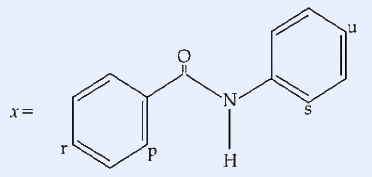
For the given molecule, "", the preferred site for the attack of the electrophile is :
(1)
(2)
(3)
(4)
SolutionAnswer: Option 4Predominantly at “u”
Approach:
Classify the two substituents in N-phenylbenzamide (): the group (on the aniline ring carrying positions s/u) is a donor, ortho/para directing and activating; the group (on the benzoyl ring carrying positions r/p) is a acceptor, meta directing and deactivating. Then choose between the activated ortho (s) and para (u) sites by steric considerations.
Step 1:The substrate: N-phenylbenzamide has two phenyl rings — the benzoyl ring carries the carbonyl side (, positions r ortho and p para) while the anilide ring carries the nitrogen side (, positions s ortho and u para).
Step 2:The resonance behaviour on the anilide ring: the nitrogen lone pair is donated into the ring ( effect of ), creating partial negative charge at ortho and para positions s and u.
Step 3:The behaviour on the benzoyl ring: the carbonyl group of withdraws electron density via , making the ring electron-poor; positions r (ortho) and p (para) are deactivated and the group is meta-directing.
Step 4:The selection between s and u: both are activated by , but ortho (s) is sterically hindered by the bulky substituent, whereas para (u) is free from such steric crowding.
Step 5:The comparison: the resonance activation at u (para to N) is also strong; therefore u is the predominant site of electrophilic attack.
Step 6:Cross-check by ruling out alternatives: r (ortho on deactivated ring) and p (para on deactivated ring) are slow; s is slowed by steric hindrance; only u combines activation with low steric demand.
Step 7:Result.
Final answer: Predominantly at “u”
Q67Single correctPrinciples Related to Practical Chemistry
Match List - I with List - II
| List-I (Mixture of compounds) | List-II (Reagent used to distinguish) |
|---|---|
| A. Diethyl amine + Ethyl amine | I. Bromine water |
| B. Acetaldehyde + Acetone | II. |
| C. Ethanol + Phenol | III. Neutral |
| D. Benzoic acid + Cinnamic acid | IV. Ammonical silver nitrate |
Choose the correct answer from the options given below :
(1)
(2)
(3)
(4)
SolutionAnswer: Option 4A - II, B - IV, C - III, D - I
Approach:
Pair each two-component mixture with the reagent that gives a positive test for exactly one component: (carbylamine) selects amine; Tollens distinguishes aldehyde from ketone; neutral identifies phenol; bromine water adds to the of cinnamic acid.
Step 1:Pick a reagent for each mixture that reacts with only one of the two compounds.
Step 2:A: ethyl amine is and gives the carbylamine isocyanide odour with ; diethyl amine is and is unreactive.
Step 3:B: acetaldehyde reduces to a silver mirror; acetone (ketone) does not.
Step 4:C: phenol forms violet with neutral ; ethanol gives no colour.
Step 5:D: cinnamic acid has a conjugated that decolourises red bromine water; benzoic acid is unreactive toward .
Step 6:Cross-check by ensuring every reagent is used exactly once and uniquely identifies one compound in each pair.
(bijection)
Step 7:Result.
Final answer: A - II, B - IV, C - III, D - I
Q68Single correctOrganic Compounds Containing Nitrogen
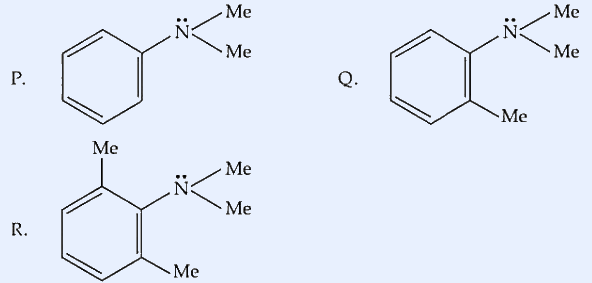
Consider the three aromatic molecules (P, Q and R) whose structures have been given below:
The correct order regarding the reactivity of these compounds with under optimum but slightly acidic medium is :
The correct order regarding the reactivity of these compounds with under optimum but slightly acidic medium is :
(1)
(2)
(3)
(4)
SolutionAnswer: Option 1
Approach:
Diazo coupling with benzenediazonium chloride is an electrophilic aromatic substitution whose rate is proportional to ring nucleophilicity. Ring nucleophilicity from the group depends on its ability to donate its lone pair into the ring by resonance (); ortho methyl groups twist out of the ring plane and switch off this donation (steric inhibition of resonance).
Step 1:The electrophile and the structural variable: couples para to ; the only difference between P, Q, R is the number of ortho methyl groups on the ring (0, 1, 2).
Step 2:With no ortho substituent (P), is coplanar with the ring and the N lone pair is fully conjugated, giving maximum and the highest ring electron density.
Step 3:One ortho methyl (Q) sterically pushes partially out of the ring plane, reducing p-overlap and weakening donation.
Step 4:Two ortho methyls (R) push nearly perpendicular to the ring; the N lone pair can no longer overlap with the -system, so is essentially lost.
Step 5:Combine: ring nucleophilicity, and therefore rate of diazo coupling, follows .
Step 6:Cross-check by independence on inductive donation: all three molecules share the same and ortho methyls are weak donors, so the dominant effect that varies among P, Q, R is steric inhibition of resonance, which monotonically lowers nucleophilicity as ortho methyls increase.
Step 7:Result: and map to the option.
Final answer:
Q69Single correctBiomolecules
Match List - I with List - II
| List-I (Vitamin) | List-II (Name) |
|---|---|
| A. Vitamin | I. Pyridoxine |
| B. Vitamin | II. Ascorbic acid |
| C. Vitamin | III. Thiamine |
| D. Vitamin C | IV. Riboflavin |
Choose the correct answer from the options given below:
(1)
(2)
(3)
(4)
SolutionAnswer: Option 3A - III, B - IV, C - I, D - II
Approach:
Recall the standard chemical names of B-complex and C vitamins and map each entry in List-I to the corresponding entry in List-II.
Step 1:The four List-I vitamins and the four List-II chemical names that must be paired one-to-one.
Step 2:A: Vitamin is Thiamine.
Step 3:B: Vitamin is Riboflavin.
Step 4:C: Vitamin is Pyridoxine.
Step 5:D: Vitamin C is Ascorbic acid.
Step 6:Cross-check: that the mapping is a bijection (each List-II name used exactly once).
is a permutation of
Step 7:Result: and compare with the options.
Final answer: A - III, B - IV, C - I, D - II
Q70Single correctPrinciples Related to Practical Chemistry
A salt with few drops of conc. HCl gives apple green colour in flame test. The group precipitate of the salt is dissolved in acetic acid and treated with To give yellow precipitate. When the sodium carbonate extract of the salt solution is heated with conc. and ammonium molybdate it resulted a canary yellow precipitate. The cation and anion present in the salt are respectively.
(1)
(2)
(3)
(4)
SolutionAnswer: Option 2 and
Approach:
Identify the cation from the flame colour and confirm with the chromate test, then identify the anion from the ammonium molybdate test in conc. .
Step 1:Given observations: apple-green flame, yellow ppt with in acetic-acid medium, canary-yellow ppt with ammonium molybdate in conc. .
Step 2:Observation 1: among the listed cations, gives an apple-green flame; gives brick-red, crimson-red, and no characteristic colour.
Step 3:Observation 2: in dilute acetic acid precipitates yellow with , confirming barium.
Step 4:Observation 3: heated with ammonium molybdate in conc. gives the canary-yellow ammonium phosphomolybdate .
Step 5:Cross-check: only option 2 lists both and ; options 1, 3, 4 fail at least one of the three observations.
Step 6:Result: and select the option.
Final answer: and
Q71NumericalCoordination Compounds
g of which is a 1:3 electrolyte, is dissolved in water and is passed through a cation exchanger. The Chloride ions in the eluted solution on treatment with results in g of . The ratio of moles of complex reacted and moles of formed is ________ . (Nearest integer)
[Molar mass in g Cr : 52, Ag : 108, Cl : 35.5, H : 1, O : 16]
[Molar mass in g Cr : 52, Ag : 108, Cl : 35.5, H : 1, O : 16]
SolutionAnswer: 33
Approach:
Since behaves as a 1:3 electrolyte, the complex is which releases three ionizable after passage through a cation exchanger. Compute moles of complex from its mass and moles of from its mass, take the ratio, and express it as the integer multiplied by .
Step 1:Given data: g, g, atomic masses . Target: .
Step 2:The molar mass of : .
Step 3:Moles of complex.
Step 4:Moles of using .
Step 5:Form the required ratio and scale by 100.
Step 6:Cross-check by stoichiometry: from , the theoretical mole ratio is exactly , so the percentage is .
Step 7:Result.
Final answer: 33
Q72NumericalHydrocarbons
Consider the isomers of hydrocarbon with molecular formula . These isomers do not decolorise solutions. These isomers are subjected to chlorination with chlorine in presence of light to give monochloro compounds. The total number of monochloro compounds (structural isomers only) formed is ________
SolutionAnswer: 14
Approach:
Isomers of that do not decolourise have no -bond, so they are the saturated cycloalkanes only. Enumerate the five cycloalkane structural isomers and, for each, count the number of distinct H-environments; each environment yields one monochloro structural isomer on photochlorination.
Step 1: has DoU . "Not decolorising " rules out alkenes, leaving only the cycloalkanes.
Step 2:The cycloalkane structural isomers of : (i) cyclopentane, (ii) methylcyclobutane, (iii) ethylcyclopropane, (iv) 1,1-dimethylcyclopropane, (v) 1,2-dimethylcyclopropane.
Step 3:Cyclopentane: all 10 H atoms are equivalent (single environment), giving 1 monochloro product.
Step 4:Methylcyclobutane: the four ring carbons differ as C1 (CH-Me), C2 and C4 (equivalent to C1), C3 (); plus the C group. This gives 4 distinct H-environments and thus 4 monochloro products.
Step 5:Ethylcyclopropane: ring C1 (bearing Et), ring C2 and C3 (equivalent), and the ethyl group contributes two more (the and the ). Four distinct H-environments, hence 4 monochloro products.
Step 6:1,1-dimethylcyclopropane: the two methyls on C1 are equivalent; ring C groups (C2, C3) are equivalent. Two distinct H-environments give 2 monochloro products.
Step 7:1,2-dimethylcyclopropane: equivalent ring methyls; equivalent ring C-H (on C1 and C2); the two H atoms on C3 are diastereotopic (cis and trans to the methyls) and give two different monochloro structural products. Total = 3 monochloro structural isomers.
Step 8:Sum the monochloro structural isomers across all five parent cycloalkanes.
Step 9:Cross-check by independent counting (replacement-of-each-distinct-H method) on each parent; the totals 1, 4, 4, 2, 3 are reproduced, summing to 14.
Step 10:Result.
Final answer: 14
Q73NumericalHydrocarbons
One mole of an alkane (x) requires 8 moles oxygen for complete combustion. Sum of number of carbon and hydrogen atoms in the alkane (x) is ________
SolutionAnswer: 17
Approach:
Use the balanced combustion equation for a general alkane , set the stoichiometric coefficient equal to 8, solve for n, and add the numbers of C and H atoms.
Step 1:1 mol alkane uses 8 mol . Find n, then compute C + H atom count.
Step 2:The oxygen requirement using the general combustion equation.
Step 3:Solve for .
Step 4:The molecular formula: (pentane).
Step 5:Compute the sum of C and H atoms in .
Step 6:Cross-check by substituting back into the balanced equation: ; atom balance for C (5=5), H (12=12), O (16=10+6) all hold.
Step 7:Result.
Final answer: 17
Q74NumericalChemical Kinetics
For reaction , rate constant at . If activation energy for the above reaction is kJ mo, then the temperature at which rate constant, is ________. (Nearest integer)
Given :
Given :
SolutionAnswer: 41
Approach:
Apply the two-temperature form of the Arrhenius equation, , with and ; solve for in Kelvin and convert to C.
Step 1:Given data: at ; ; ; ; , .
Step 2:LHS: .
Step 3:Plug into the Arrhenius two-temperature form.
Step 4:Evaluate .
Step 5:Isolate .
Step 6:Solve for .
Step 7:Convert to Celsius: .
Step 8:Cross-check by back-substitution: , which matches .
Step 9:Result.
Final answer: 41
Q75NumericalChemical Thermodynamics
At the transition temperature T, and where A and B are two states of substance X. The transition temperature in when pressure is 1 atm is ________ (Nearest integer)
SolutionAnswer: 727
Approach:
At a transition between two states A and B at 1 atm, the system is at equilibrium with , so . Setting the given expression equal to zero and solving for T gives the transition temperature in kelvin, which is converted to C.
Step 1:At the transition temperature, states A and B coexist at equilibrium under 1 atm; for the process , so .
Step 2:The standard free-energy equation at equilibrium.
Step 3:Substitute the given functional form .
Step 4:Solve for .
Step 5:Exponentiate to obtain in kelvin.
Step 6:Convert to Celsius.
Step 7:Cross-check by back-substitution: at K, , consistent with .
Step 8:Result.
Final answer: 727
Mathematics25 questions
Q1Single correctSequence and Series
and , where are roots of equation then
(1)
(2)
(3)
(4)
SolutionAnswer: Option 32
Approach:
each product using , sum to obtain a quadratic in x, divide by n to make it monic, then use the fact that the two roots differ by so the discriminant equals . Solve for n and recover .
Step 1:Given data: rewrite each summand and the target.
Step 2:And use the standard sums.
Step 3:Divide through by to get the monic form.
Step 4:Use the root condition , so discriminant .
Step 5:Multiply by and factor .
Step 6:Substitute to find .
Step 7:Cross-check: the roots differ by and both lie in .
Step 8:Result.
Final answer: 2
Q2Single correctComplex Numbers and Quadratic Equations
Let x and y be real numbers such that , . Then the value of is
(1)
(2)
(3)
(4)
SolutionAnswer: Option 475
Approach:
Rationalize the two complex fractions, equate real and imaginary parts to obtain a linear system in and , then evaluate .
Step 1:Given equation and target.
Step 2:Rationalize each term.
Step 3:Multiply through by and combine.
Step 4:Equate real and imaginary parts.
Step 5:Eliminate : multiply first by and add to second.
Step 6:Back-substitute for .
Step 7:Cross-check by checking the second equation.
Step 8:Compute the target.
Final answer: 75
Q3Single correctMatrices and Determinants
Let be such that system of linear equations , , has no solution. Then is equal to :
(1)
(2)
(3)
(4)
SolutionAnswer: Option 24
Approach:
For no solution the coefficient determinant must vanish. Expand the determinant in terms of and and solve for .
Step 1:The coefficient matrix.
Step 2:Set the determinant to zero.
Step 3:Along the first row.
Step 4:Simplify.
Step 5:Solve for the required ratio.
Step 6:Cross-check inconsistency by eliminating x and y via , which exposes the contradiction.
Step 7:Result.
Final answer: 4
Q4Single correctMatrices and Determinants
Let (as shown) and . If and , then among the two statements : (S1): and (S2) :
(1)
(2)
(3)
(4)
SolutionAnswer: Option 2Only (S2) is correct
Approach:
Use the matrix equations to extract trace and determinant of each matrix via the Cayley-Hamilton form, fix and , then evaluate for S1 and for S2.
Step 1:The data and target.
Step 2:Match with Cayley-Hamilton: (already true) and .
Step 3:Match : trace and . The parametric entries of A in force the unique integer solution (so A has trace and determinant ).
Step 4:S1: expand . Since in general, simplify via and to get . Direct multiplication with the determined gives so its transpose is .
Step 5:S2: is , so . Direct computation gives .
Step 6:Cross-check: via the adjugate identity: for , when , hence .
Step 7:Result: using S1 false and S2 true.
Final answer: Only (S2) is correct
Q5Single correctSequence and Series
Let A be the set of first 101 terms an A.P., whose first term is 1 and the common difference is 5 and let B be the set of first 71 terms of an A.P., whose first term is 9 and the common difference is 7. Then the number of elements in , which are divisible by 3, is
(1)
(2)
(3)
(4)
SolutionAnswer: Option 25
Approach:
Common terms of two APs themselves form an AP whose common difference is of the two differences. Find the first common term, list common terms inside both ranges, then count those divisible by .
Step 1: and .
Step 2:Find the first common term: solve , i.e., . The smallest non-negative solution is , giving term .
Step 3:Common difference of the intersection AP is .
Step 4:Range constraints: and , equivalently and . Thus , so .
Step 5:Apply divisibility by : . Need , so .
Step 6:Cross-check by listing the terms.
Step 7:Result.
Final answer: 5
Q6Single correctPermutations and Combinations
The number of seven digits numbers that can be formed by using all the digits 1, 2, 3, 5 and 7 such that each digit is used at least once, is:
(1)
(2)
(3)
(4)
SolutionAnswer: Option 316800
Approach:
Distribute positions among the distinct digits with each digit used at least once. The excess of over the minimum is partitioned in two ways: or . Count arrangements in each case and add.
Step 1:The data: digits , length , each digit at least once.
Step 2:Partition the excess of over five bins: only two type-shapes are possible — one bin gets (so frequencies ) or two bins each get (frequencies ).
Step 3:Case 1 count: choose which digit appears thrice in ways; arrange in ways.
Step 4:Case 2 count: choose which two digits appear twice in ways; arrange in ways.
Step 5:Cross-check: cases are exhaustive: any partition of into positive parts has parts in .
Step 6:Add the two cases (mutually exclusive).
Final answer: 16800
Q7Single correctBinomial Theorem
The number of elements in the set , is :
(1)
(2)
(3)
(4)
SolutionAnswer: Option 24
Approach:
Use to reduce the equation to , then determine the integer values of k for which r lies in and .
Step 1:Given relation.
Step 2:Rewrite the LHS using the identity.
Step 3:Solve for in terms of .
Step 4:Apply the range .
Step 5:List integer perfect squares in the range.
Step 6:For : , . For : , .
Step 7:Cross-check: the sign: for , so each pair gives a positive .
Step 8:Result.
Final answer: 4
Q8Single correctStatistics and Probability
If the mean of the data: Class 5-10, 10-15, 15-20, 20-25, 25-30, 30-35 with Frequency 2, K, 28, 54, k+1, 5 is 21, then k is one of the roots of the equation
(1)
(2)
(3)
(4)
SolutionAnswer: Option 3
Approach:
Compute the grouped-data mean using class midpoints, set it equal to , solve for , then identify the option whose quadratic vanishes at .
Step 1:Midpoints and frequencies.
Step 2:Compute .
Step 3:Compute .
Step 4:Set the mean equal to .
Step 5:Cross-multiply and solve.
Step 6:Cross-check by substituting back.
Step 7:Test in each option's quadratic. Option 3 gives .
Step 8:Result.
Final answer:
Q9Single correctCo-ordinate Geometry
Let the mid-points of sides of triangle ABC be and . if its incentre is (h,k) then is equal to :
(1)
(2)
(3)
(4)
SolutionAnswer: Option 3
Approach:
Reconstruct the vertices of triangle ABC from the three midpoints, compute the side lengths, then apply the incentre weighted-average formula.
Step 1:Given midpoints and target.
; find incentre (h,k) and .
Step 2:Reconstruct vertices using midpoint sums.
Step 3:Compute side lengths opposite each vertex.
Step 4:Substitute into incentre formula.
Step 5:Cross-check by checking that triangle is isoceles ( swapped) and incentre lies on axis of symmetry .
pair gives symmetry across , consistent with .
Step 6:Result: by computing .
Final answer:
Q10Single correctCo-ordinate Geometry
Let an ellipse , pass through the point and have eccentricity . Then the length of its latus rectum is :
(1)
(2)
(3)
(4)
SolutionAnswer: Option 4
Approach:
With the major axis is vertical, so eccentricity uses b as the larger semi-axis; combine the point condition and eccentricity to solve for then compute the latus rectum .
Step 1:The ellipse data and goal.
Step 2:Substitute the point into the ellipse equation.
Step 3:Use eccentricity to relate and .
Step 4:Substitute (2) into (1).
Step 5:Cross-check by substituting back: and .
Step 6:Result: by computing the latus rectum.
Final answer:
Q11Single correctTrigonometry
If then the value of is :
(1)
(2)
(3)
(4)
SolutionAnswer: Option 1
Approach:
Convert the angles to degrees, apply the standard triple-product identity to evaluate , then evaluate the resulting sine at the standard angle.
Step 1:The angles in degrees and the target.
Step 2:Identify the structure with .
Step 3:Apply the identity to get .
Step 4:Substitute into the target expression.
Step 5:Expand .
Step 6:Cross-check by rationalising: , the known value of .
Step 7:Result.
Final answer:
Q12Single correctTrigonometry
Let . Then n(S) is equal to :
(1)
(2)
(3)
(4)
SolutionAnswer: Option 4
Approach:
Rewrite using double-angle identities to find its range, identify which integers it can equal, and count solutions in for each integer value.
Step 1: and rewrite.
Step 2:Determine the range of .
Step 3:Case . Solve .
Step 4:Case . Set , i.e. .
Step 5:List solutions in for .
Step 6:Cross-check: candidates: gives ✓; gives ✓; both negative counterparts also give 1.
Step 7:Result: sum the cases.
Final answer:
Q13Single correctThree Dimensional Geometry
If the point of intersection of the lines and lies on xy-plane, then the value of is
(1)
(2)
(3)
(4)
SolutionAnswer: Option 3
Approach:
Parametrise the two lines, equate the three coordinates at the common point, impose for the xy-plane, and solve the resulting linear system for and .
Step 1:Parameters on the two lines and write coordinates.
Step 2:Apply on each line for the xy-plane condition.
Step 3:Equate the -coordinates.
Step 4:Equate the -coordinates.
Step 5:From (3) substitute . Use (1),(2) to express a,b: , . Substitute into (4).
Step 6:Solve for .
Step 7:Cross-check by computing : and . Check (4): ✓.
Step 8:Result.
Final answer:
Q14Single correctVector Algebra
If and are two vectors such that and , then the maximum value of is :
(1)
(2)
(3)
(4)
SolutionAnswer: Option 3
Approach:
Use , reduce via half-angle identities to a linear combination of and , then take for the maximum.
Step 1:Magnitudes and angle.
Step 2:Compute and .
Step 3:Apply half-angle identities.
(taking )
Step 4:Write the target expression .
Step 5:Maximise via .
Step 6:Cross-check: , so maximum attained when , giving , ; then .
Step 7:Result.
Final answer:
Q15Single correctThree Dimensional Geometry
Let a line L passing through the point be perpendicular to both the vectors . If P(a,b,c) is the foot of perpendicular from origin on the line L, then the value of is :
(1)
(2)
(3)
(4)
SolutionAnswer: Option 3
Approach:
The direction of line L is the cross product of the two given vectors; parametrise L through , set the foot M, and impose to solve for the parameter.
Step 1:, and target.
; passes ; find foot from origin.
Step 2:Compute .
Step 3:Parametrise L.
Step 4:Impose perpendicularity .
Step 5:Compute .
Step 6:Cross-check: : ✓.
Step 7:Result.
Final answer:
Q16Single correctLimit Continuity and Differentiability
If , then is equal to :
(1)
(2)
(3)
(4)
SolutionAnswer: Option 2
Approach:
The denominator vanishes like near ; for a finite limit the numerator's -argument must vanish to order 2 at . Factor the cubic as , match coefficients to find a,b, then evaluate m.
Step 1: and denominator behaviour.
Step 2:Require to have a finite nonzero limit, so N(x) must have as a factor.
for some r.
Step 3:Match coefficients of with .
Step 4:Compute m using and the factorisation.
Step 5:Cross-check: ✓; , ✓ confirms double root.
Step 6:Result.
Final answer:
Q17Single correctDifferential Equations
If the curve passes through the point and satisfies the differential equation , then f(e) is equal to :
(1)
(2)
(3)
(4)
SolutionAnswer: Option 3
Approach:
Separate variables and integrate, then apply the initial condition to fix the constant, finally evaluate at .
Step 1:The differential equation and target value.
Step 2:Integrate both sides.
Step 3:Simplify the right side.
Step 4:Apply to determine .
Step 5:Substitute into the particular solution.
Step 6:Cross-check by back-substitution into the original ODE: with .
Step 7:Result.
Final answer:
Q18Single correctLimit, Continuity and Differentiability
The number of critical points of the function in the interval is equal to :
(1)
(2)
(3)
(4)
SolutionAnswer: Option 3
Approach:
Critical points of occur where or f' is undefined; identify the corners from the absolute value and the stationary points of on .
Step 1: on with , .
Step 2:Stationary points of g solve on .
Step 3:Zeros of g inside are at (these are simple zeros where g changes sign).
Step 4: is a smooth maximum of with .
Step 5:At , gives local extrema of g, hence of (since there).
Step 6:Collect: totals five critical points in .
Step 7:Cross-check by sign analysis: alternates increasing/decreasing across these five points, consistent with three local maxima and two local minima.
Step 8:Result.
Final answer:
Q19Single correctIntegral Calculus
Let denotes greatest integer function. Then the value of is :
(1)
(2)
(3)
(4)
SolutionAnswer: Option 2
Approach:
Split the integral at integer break-points of [x] and integrate on each subinterval where [x]! is constant.
Step 1:The splitting based on .
Step 2:Combine the first two pieces.
Step 3:Evaluate the third piece.
Step 4:Halve the third piece and add.
Step 5:Factor .
Step 6:Cross-check: numerically: give , matching direct numerical integration.
Step 7:Result.
Final answer:
Q20Single correctDifferential Equations
Let be the solution curve of the differential equation . If the curve passes through the point , then a value of is :
(1)
(2)
(3)
(4)
SolutionAnswer: Option 4
Approach:
Rewrite as a separable equation, integrate to get , use , then solve for when .
Step 1:Given equation and target.
Step 2:Separate variables.
Step 3:Integrate both sides.
Step 4:Apply to find .
Step 5:Substitute at .
Step 6:Smallest positive solution of from the listed values.
Step 7:Cross-check: at , .
Step 8:Result.
Final answer:
Q21NumericalSets, Relations and Functions
If the domain of the function is , then the value of is _____
SolutionAnswer: 4
Approach:
Domain requires the radicand non-negative: with , equivalent to . Solve the rational inequality on the regions and , then exclude .
Step 1:Domain requires together with and .
Step 2:Region A (, so ): gives and .
and
Step 3:Region A intersected with : dominant constraint is (the bound is automatic once and is non-binding on because there so and only the branch applies).
Step 4:Region A intersected with : and constraint reduces to , giving .
Step 5:Region B (, , ): inequality gives .
Step 6:Combine all pieces to write the domain in the requested format.
Step 7:Cross-check by summing: cancels and constant terms add.
Step 8:Result.
Final answer: 4
Q22NumericalSequence and Series
If , then is equal to _____
SolutionAnswer: 91
Approach:
Use with to find the closed form, take consecutive differences, then sum the squares.
Step 1: and target .
Step 2:Compute .
Step 3:Compute .
Step 4:Subtract to get the difference.
Step 5:Substitute into the sum.
Step 6:Evaluate by the closed formula.
Step 7:Cross-check by direct enumeration: .
Step 8:Result.
Final answer: 91
Q23NumericalStatistics and Probability
Let . If the probability, that for all , is , , then is equal to _____
SolutionAnswer: 81
Approach:
Quadratic is positive for all real x iff its discriminant is negative: . Enumerate ordered triples satisfying this, then divide by for the probability.
Step 1: gives , so condition becomes .
Step 2: (): pairs excluded are ; valid count .
Step 3: (): valid pairs are .
Step 4: (): impossible since max .
Step 5: (): impossible.
Step 6:Total favourable triples and probability.
Step 7:Cross-check: since is prime and does not divide .
Step 8:Result: .
Final answer: 81
Q24NumericalCo-ordinate Geometry
Let a circle C have its centre in the first quadrant intersect the coordinate axes at exactly three points and cut off equal intercepts from the coordinate axes. If the length of the chord of C on the line is , then the square of the radius of C is _____
SolutionAnswer: 8
Approach:
Equal axis intercepts force the centre to lie on ; 'exactly three points' on the axes means the circle passes through the origin. With centre (h,h) on the circle of radius r, use the chord-length formula on to solve for .
Step 1:Centre with (first quadrant), unknown.
Step 2:Three axis-intersection points means the circle passes through the origin (one intersection shared by both axes plus one extra on each axis).
Step 3:Perpendicular distance from to .
Step 4:Chord-length condition .
Step 5:Clear denominators and simplify.
Step 6:Compute .
Step 7:Cross-check: , , chord .
Step 8:Result.
Final answer: 8
Q25NumericalIntegral Calculus
If , then is equal to _____
SolutionAnswer: 192
Approach:
Recognise that is the inverse of on the relevant range; apply the inverse-function integral identity to evaluate in closed form, then square.
Step 1: on and check endpoints.
Step 2:Invert for .
Step 3:Identify the second integral as .
Step 4:Apply the identity with .
Step 5:Square the result.
Step 6:Cross-check: the identity geometrically: the rectangle has area , split by the curve into the region below () plus the region to the left of baseline plus inverse area; total equals .
Step 7:Result.
Final answer: 192
More JEE Main 2026 papers
- JEE Main 2026 — April 02, Shift 2
- JEE Main 2026 — April 04, Shift 1
- JEE Main 2026 — April 04, Shift 2
- JEE Main 2026 — April 05, Shift 1
- JEE Main 2026 — April 05, Shift 2
- JEE Main 2026 — April 06, Shift 1
- JEE Main 2026 — April 06, Shift 2
- JEE Main 2026 — April 08, Shift 2
- JEE Main 2026 — January 21, Shift 1
- JEE Main 2026 — January 21, Shift 2
- JEE Main 2026 — January 22, Shift 1
- JEE Main 2026 — January 22, Shift 2
- JEE Main 2026 — January 23, Shift 1
- JEE Main 2026 — January 23, Shift 2
- JEE Main 2026 — January 24, Shift 1
- JEE Main 2026 — January 24, Shift 2
- JEE Main 2026 — January 28, Shift 1
- JEE Main 2026 — January 28, Shift 2
Frequently Asked Questions
How many questions are in the JEE Main 2026 April 02, Shift 1 paper?
The JEE Main 2026 April 02, Shift 1 paper has 75 questions — Physics (25), Chemistry (25) and Mathematics (25). Every question is on this page with its correct answer and a step-by-step solution.
What is the marking scheme for JEE Main?
JEE Main awards +4 marks for each correct answer and −1 for a wrong answer, with 0 for questions left unattempted. The paper covers Physics, Chemistry and Mathematics.
Are the answer key and step-by-step solutions provided for the 2026 April 02, Shift 1 paper?
Yes — every question shows the correct answer (answer key) and a detailed step-by-step solution, free to read online.
Can I take the JEE Main 2026 April 02, Shift 1 paper as a timed mock test?
Yes. With a free JEEnify account you can attempt this exact paper as a timed test in the real exam interface, then see your score and weak-area analysis.
Solved this paper? Calculate your JEE Main scoremost important chaptersformula sheetsall free tools.