
Back to JEE Main PYQs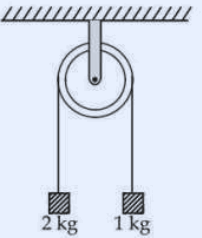
![Graph with vertical axis labelled ln([R_0]/[R]) and horizontal axis labelled Time; a straight line passes through the origin with positive slope.](/api/qna-image?path=QnA%2Fb65cda62-f924-480b-b4db-1d3aaa6069d4%2F5ef15551-aed6-4f93-a8d5-a219b7a5d19b%2Fe4c089c3-d890-40eb-ad36-8c3a77dc39c9%2Fe4c089c3-d890-40eb-ad36-8c3a77dc39c9%2Fimages%2FQ57_E_graph.webp)

JEE Main 2026 April 02, Shift 2 Question Paper with Solutions
All 75 questions from the JEE Main 2026 (April 02, Shift 2) shift — Physics (25), Chemistry (25) and Mathematics (25) — each with the correct answer (answer key) and a step-by-step solution. Read it free online, or attempt the full paper as a timed mock test.
Physics25 questions
Q26Single correctPhysics and Measurement
Dimensions of universal gravitational constant (G) in terms of Planck's constant (h), distance (L), mass (M) and time (T) are ___________
(1)
(2)
(3)
(4)
SolutionAnswer: Option 2
Approach:
Assume is proportional to multiplied by unknown powers of , , , then equate the dimensions on both sides.
Step 1:Given fundamental quantities h, L, M, T as the basis; target is to write [G] in this basis. Known: and .
Step 2:Substitute the dimensional expressions for and into the ansatz.
Step 3:Combine the powers on the right-hand side.
Step 4:Equate exponents of , , and separately.
Step 5:Reconstruct [G] from and check it reduces to .
Step 6:Write the final dimensional form of .
Final answer:
Q27Single correctLaws of Motion
A 0.5 kg mass is in contact against the inner wall of a cylindrical drum of 4 m rotating about its vertical axis. The minimum rotational speed of the drum to enable the mass to remain stuck to the wall (without falling) is . The coefficient of friction between the drum's inner wall surface and mass is ________ (Take )
(1)
(2)
(3)
(4)
SolutionAnswer: Option 1
Approach:
At the minimum spin rate, limiting friction equals weight while the wall's normal reaction supplies the centripetal force.
Step 1:Given , drum radius , minimum angular speed , . Target: coefficient of static friction .
Step 2:For the mass to be on the verge of slipping downward, friction up the wall balances weight.
Step 3:The horizontal normal force is the centripetal force.
Step 4:Combine the two equations to eliminate .
Step 5:Substitute numerical values.
Step 6:Compute and check equals .
Step 7:Friction coefficient between mass and inner wall.
Final answer:
Q28Single correctLaws of Motion
Two blocks of masses 2 kg and 1 kg respectively, are tied to the ends of a string which passes over a light frictionless pulley as shown in the figure below. The masses are hold at rest at the same horizontal level and then released. The distance traversed by the centre of mass in 2 s is _______ m.
(1)
(2)
(3)
(4)
SolutionAnswer: Option 3
Approach:
Find Atwood acceleration of each block, derive the centre-of-mass acceleration, then apply uniformly-accelerated motion from rest for 2 s.
Step 1:Given (heavier, descends), (lighter, rises), , time , both released from rest. Target: distance traversed by the centre of mass.
Step 2:Apply Atwood's formula for the common magnitude of acceleration of each block.
Step 3:Take downward as positive. Heavier block accelerates down with , lighter block accelerates up with . Substitute into the centre-of-mass formula.
Step 4:Substitute to get in terms of g and the masses.
Step 5:Apply for motion from rest over .
Step 6:Units check ; numerical value matches option (3).
Step 7:Centre-of-mass displacement in 2 s.
Final answer:
Q29Single correctMagnetic Effects of Current and Magnetism
A particle having charge moving in x-y plane in fields of and experiences a force of . The velocity of the particle at that instant is ______ .
(1)
(2)
(3)
(4)
SolutionAnswer: Option 1
Approach:
Write the Lorentz force with an unknown velocity , expand the cross product , and match components of the resulting force to find x and y.
Step 1:Given , , , . Target: in the x-y plane.
Step 2:Compute the magnetic force per unit charge .
Step 3:Form the total Lorentz force expression.
Step 4:Divide the supplied by to obtain force per charge.
Step 5:Equate the components: .
Step 6:Equate the components: .
Step 7:Substitute back. . Add to obtain .
Step 8:Assemble velocity vector.
Final answer:
Q30Single correctElectronic Devices
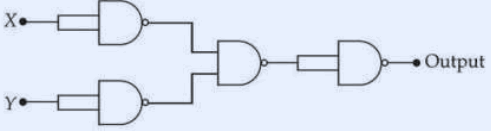
If X and Y are the inputs, the given circuit works as ________
(1)
(2)
(3)
(4)
SolutionAnswer: Option 4NOR gate
Approach:
Trace the output of each NAND stage with Boolean algebra and De Morgan's theorem to collapse the network into a single equivalent gate.
Step 1:Inputs are and . Circuit: NAND(X,X) feeds first node, NAND(Y,Y) feeds second node, both outputs feed a NAND, whose output passes through a final NAND tied-input stage to give Output.
Step 2:First two NAND gates have their two inputs tied, so each acts as an inverter.
Step 3:Third NAND takes and .
Step 4:Apply De Morgan's theorem to .
Step 5:Final NAND has its two inputs both equal to , acting as an inverter.
Step 6:Build the truth table. For output ; output ; output ; output . This matches a NOR gate exactly.
Step 7:The combinational network is logically equivalent to a NOR gate.
Final answer: The circuit is equivalent to a NOR gate.
Q31Single correctGravitation
If a body of mass 1 kg falls on the earth from infinity, it attains velocity (v) and kinetic energy (k) on reaching the surface of earth. The values of v and k respectively are _____ (Take radius of earth to be 6400 km and )
(1)
(2)
(3)
(4)
SolutionAnswer: Option 1
Approach:
Apply energy conservation between infinity (where both PE and KE vanish) and the earth's surface. The resulting speed is the escape speed.
Step 1:Given , , ; initial state at infinity (, ). Target: speed v and kinetic energy k at the surface.
Step 2:Total mechanical energy is conserved between and the surface.
Step 3:Replace with using surface gravity, then isolate kinetic energy.
Step 4:Compute the kinetic energy numerically.
Step 5:Solve for v.
Step 6:Evaluate the square root.
Step 7:This matches the standard escape velocity of earth , and reproduces k.
Step 8:Speed and kinetic energy at the surface.
Final answer:
Q32Single correctExperimental Skills
In a screw gauge the zero of main scale reference line coincides with the fifth division of the circular scale when two studs are in contact. There are 100 divisions in the circular scale and pitch of screw gauge is 0.1 mm. When diameter of a sphere is measured, the reading of main scale is 5 mm and 50th division of circular scale coincides with the reference line of main scale. The diameter of sphere is __________ mm.
(1)
(2)
(3)
(4)
SolutionAnswer: Option 1
Approach:
Compute least count, identify the sign of the zero error from the stud coincidence, and subtract it from the observed reading.
Step 1:Given pitch , CSD divisions, observed MSR , CSR divisions. Zero check: with studs in contact, the 5th circular division coincides with the main-scale reference line (zero of main scale lies above the reference, so circular scale is ahead). Target: corrected diameter.
Step 2:Compute the least count.
Step 3:Because the circular scale is 5 divisions ahead of zero when studs touch, the gauge reads extra; this is a positive zero error.
Step 4:Compute the observed (uncorrected) reading on the sphere.
Step 5:Subtract the positive zero error from the observed reading.
Step 6:Add the zero error back: , which reproduces the observed reading.
Step 7:Diameter of the sphere.
Final answer: Diameter of sphere
Q33Single correctProperties of Solids and Liquids
The surface tension of a soap bubble is . The work done in increasing the diameter of bubble from 2 cm to 6 cm is . The value of is ________. (Take )
(1)
(2)
(3)
(4)
SolutionAnswer: Option 3
Approach:
A soap bubble has two free surfaces. Work done equals surface tension times the increase in total surface area, where .
Step 1:Given , initial diameter , final diameter . Convert to radii in metres. Target: where .
Step 2:Write the work expression for a soap bubble, accounting for inner and outer surfaces.
Step 3:Compute .
Step 4:Substitute into the work formula.
Step 5:Multiply the constants.
Step 6:Units: . Matching the form gives .
Step 7:Value of .
Final answer:
Q34Single correctKinetic Theory of Gases
A mixture of carbon dioxide and oxygen has volume , temperature 300 K, pressure 100 kPa and mass 13.2 g. The number of moles of carbon dioxide and oxygen gases in the mixture respectively are ___________
(1)
(2)
(3)
(4)
SolutionAnswer: Option 3 and
Approach:
Use the ideal gas equation for the mixture to obtain the total number of moles, then combine with the total-mass equation using the molar masses of C and to solve a 2x2 linear system.
Step 1:, , , , , , . Target: (C) and ().
Step 2:Substitute into ideal gas equation to obtain total moles.
Step 3:Write mass-conservation equation with molar masses in g.
Step 4:Eliminate using and solve.
Step 5:Obtain from the total-moles equation.
Step 6:Back-substitute into the mass equation; total mass should equal 13.2 g.
Step 7:The moles of C and are 0.21 and 0.12 respectively, matching option (3).
Final answer:
Q35Single correctProperties of Solids and Liquids
If an air bubble of diameter 2 mm rises steadily through a liquid of density at a rate of , then the coefficient of viscosity of the liquid is _______ Poise. (Take )
(1)
(2)
(3)
(4)
SolutionAnswer: Option 1
Approach:
Apply Stokes' law at the terminal (steady) state: the upward buoyant force on the air bubble is balanced by the downward viscous drag. Solve for the dynamic viscosity and convert to Poise.
Step 1:Diameter ; ; ; . Target: viscosity in Poise.
Step 2:At terminal velocity, neglecting the small weight of the air bubble, buoyancy equals viscous drag.
Step 3:Solve algebraically for .
Step 4:Substitute numerical values to compute in SI units.
Step 5:Convert from Pas to Poise using .
Step 6:Dimensional check , consistent.
Step 7:The coefficient of viscosity is about 0.88 Poise, matching option (1).
Final answer:
Q36Single correctWork, Energy and Power
A spherical ball of mass 2 kg falls from a height of 10 m and is brought to rest after penetrating 10 cm into sand. The average force exerted by sand on the ball is _______ N.
(1)
(2)
(3)
(4)
SolutionAnswer: Option 32000
Approach:
Use the work-energy theorem over the full motion (rest to rest): total work by gravity plus work by sand equals zero. With the penetration depth small compared to the height of fall, the average sand force follows directly.
Step 1:, , , . Target: average force F exerted by sand on the ball.
Step 2:Since the ball starts and ends at rest, and net work vanishes (approximate gravity drop as h because ).
Step 3:Solve for the sand force.
Step 4:Dimensional check , consistent.
Step 5:The average force exerted by sand is 2000 N, matching option (3).
Final answer:
Q37Single correctElectromagnetic Waves
An electromagnetic wave travels in free space in the x-direction. At a particular point in space and time, T is associated with this wave. The value of corresponding electric field at this point is ________ V/m.
(1)
(2)
(3)
(4)
SolutionAnswer: Option 2
Approach:
In a plane EM wave the magnitudes are linked by , and the direction of propagation equals . Use both relations to determine .
Step 1:Propagation , magnetic field , . Target: vector .
Step 2:Compute from .
Step 3: is perpendicular to and lies in the direction; choose the sign making . Test .
Step 4:Combine magnitude with direction.
Step 5:Poynting check , i.e. along , the propagation direction.
Step 6:, matching option (2).
Final answer:
Q38Single correctCurrent Electricity
Two resistors of and are connected in series with a battery of 100 V. A bulb rated at 200 V, 100 W is connected across the resistance. The potential drop across the bulb is ________ V.
(1)
(2)
(3)
(4)
SolutionAnswer: Option 250
Approach:
Obtain the bulb's resistance from its rated voltage and power, combine it in parallel with the 400 resistor it is connected across, and use voltage division across the 200 series resistor and the parallel block.
Step 1: (series), (across which bulb is fitted), bulb rating , , source . Target: potential drop across the bulb.
Step 2:Bulb resistance from rated values.
Step 3:Bulb (400 ) is in parallel with 400 resistor.
Step 4:Total circuit resistance across the 100 V source.
Step 5:Voltage across the parallel block equals voltage across the bulb.
Step 6:Source current ; voltage across parallel block , consistent.
Step 7:The potential drop across the bulb is 50 V, matching option (2).
Final answer:
Q39Single correctElectrostatics
Two metal plates (A, B) are kept horizontally with separation of cm, with plate A on the top. An atomizer jet sprays oil (density ) droplets of radius 1 mm horizontally. All oil droplets carry a charge . The potentials and are required on plates A and B respectively in order to ensure the droplets do not descend. The values of and are ____ (Neglect the air resistance to the droplets and take )
(1)
(2)
(3)
(4)
SolutionAnswer: Option 1100 V and 580 V
Approach:
Balance the electric force on a positively charged droplet with gravity. For the upward electric force, the field must point downward, so the bottom plate B is held at higher potential than the top plate A. Compute the required from the force-balance equation.
Step 1:, , , , . Target: and .
as above
Step 2:Set the upward electric force on the positive charge equal to its weight.
Step 3:Substitute the numerical values into the equation.
Step 4:Cancel and simplify the right side.
Step 5:Solve for the potential difference.
Step 6:Scan the four options for one whose difference is 480 V with . Option (1) gives .
Step 7:With and , ; weight ; electric force , equal to the weight.
Step 8:The required potentials are and , matching option (1).
Final answer:
Q40Single correctElectrostatics
Two point charges and are located at and , respectively on the x-axis. The ratio of electric flux due to these charges through two spheres of radii 3 cm and 5 cm with their centers at the origin is __________
(1)
(2)
(3)
(4)
SolutionAnswer: Option 34 : 3
Approach:
Apply Gauss's law: the net electric flux through any closed surface depends only on the algebraic sum of the charges enclosed by it. Determine which charges lie inside each sphere and take the ratio.
Step 1:Charges at and at . Sphere 1 has radius 3 cm centred at origin; sphere 2 has radius 5 cm centred at origin. Target: .
positions and sphere radii as above
Step 2:For sphere 1 (): so is enclosed; so is outside.
Step 3:For sphere 2 (): both and , so both charges are enclosed.
Step 4:Write the two fluxes from Gauss's law.
Step 5:Take the ratio (the cancels).
Step 6:Charges outside a closed surface contribute zero net flux, so only enclosed charges matter; the ratio uses only the enclosed totals and the factor cancels in the ratio.
Step 7:The ratio of fluxes is 4 : 3, matching option (3).
Final answer:
Q41Single correctOptics
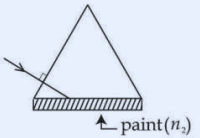
One side of an equilateral prism is painted by a transparent material of refractive index . The refractive index of prism is 1.6. The minimum value of required for total internal reflection from painted face is ____________
(1)
(2)
(3)
(4)
SolutionAnswer: Option 4
Approach:
From the equilateral-prism geometry, a ray entering the left face hits the painted base at . The threshold for total internal reflection is given by Snell's law at the critical angle with the refracted ray along the interface; solve for the minimum paint index .
Step 1:Prism index , prism angle , internal angle of incidence on the painted base (from the geometry shown). Target: minimum that just permits total internal reflection.
Step 2:At the threshold (critical condition) Snell's law gives , i.e. the refracted ray would graze the painted surface.
Step 3:Substitute .
Step 4:Rewrite in the form supplied by the options.
Step 5:Numerically , matching .
Step 6:The minimum paint refractive index is , matching option (4). For total internal reflection at this interface the paint index must be at least this value.
Final answer:
Q42Single correctElectromagnetic Induction and Alternating Currents
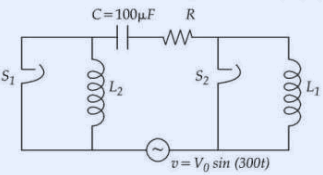
The figure given below shows an LCR series circuit with two switches and . When switch is closed keeping open, the phase difference () between the current and source voltage is and phase difference is when is closed keeping open. The value of is ___________ H.
(1)
(2)
(3)
(4)
SolutionAnswer: Option 2
Approach:
Write the series LCR phase equation for each switch configuration, take the ratio to eliminate R, and use rad/s with to evaluate .
Step 1:Source rad/s, F; phases (first config) and (second config); target in henry.
Step 2:Configuration 1 has inductor in series → .
Step 3:Configuration 2 has inductor in series → .
Step 4:Divide (1) by (2) to remove .
Step 5:Cross-multiply and rearrange to isolate .
Step 6:Substitute and F.
Step 7:Substitute back: with , the ratio of values returns 1/3.
Step 8:Required value H, matching option 2.
Final answer: H
Q43Single correctElectromagnetic Induction and Alternating Currents
A circular current loop of radius R is placed inside a square loop of side length L () such that they are co-planar and their centers coincide. The permeability of free space is . The mutual inductance between circular loop and square loop is __________
(1)
(2)
(3)
(4)
SolutionAnswer: Option 4
Approach:
Since , treat the square's field over the tiny circle as the uniform value at the square's centre. Sum contributions from the four finite sides, compute flux through the circular loop, and use .
Step 1:Square side L, current i in square, inner co-planar circle radius R with centred at same point; target mutual inductance M.
Step 2:At the centre, each side is at perpendicular distance and subtends at the centre.
Step 3:Contribution from one side of the square.
Step 4:Net field at centre from all four sides (each contributes equally and in the same sense).
Step 5:Treat B as uniform over the small circle; flux through circular loop of area .
Step 6:Dimensions of → , correct unit of inductance.
Step 7:, matching option 4.
Final answer:
Q44Single correctAtoms and Nuclei
The binding energy per nucleon of is _________ MeV. {Take , , , }
(1)
(2)
(3)
(4)
SolutionAnswer: Option 27.84
Approach:
Compute mass defect , convert to MeV using , divide by A.
Step 1: protons, neutrons, , given masses in u; target BE per nucleon in MeV.
Step 2:Total mass of the constituent nucleons.
Step 3:Mass defect.
Step 4:Total binding energy.
Step 5:Divide by mass number .
Step 6:Heavy nuclei lie below the iron peak (~8.8 MeV) on the BE/A curve; 7.84 MeV is the standard tabulated value for Bi.
Step 7:BE per nucleon MeV, matching option 2.
Final answer: 7.84 MeV
Q45Single correctOscillations and Waves
The equation of motion of a particle is given by cm. The particle will come to rest at time and it will have zero acceleration at time . The and respectively are _____________
(1)
(2)
(3)
(4)
SolutionAnswer: Option 1
Approach:
Differentiate to find v(t) and a(t). The particle is at rest when ; acceleration is zero when . Solve for the smallest positive t in each case.
Step 1: cm with rad/s and phase ; target smallest where and smallest where .
Step 2:Set , take the smallest positive root → argument equals .
Step 3:Solve for .
Step 4:Set , smallest positive root → argument equals .
Step 5:Solve for .
Step 6:At argument so (rest, extreme position); at argument so (mean position, zero acceleration). Time gap , consistent with SHM phase between extreme and mean.
Step 7: s, matching option 1.
Final answer: s, s
Q46NumericalOptics
If a Young's doubles lit experiment, the intensity at some point on the screen is found to be times of the maximum of the interference pattern. The path difference between the interfering waves at this point is where is wavelength of the incident light. The value of x is
SolutionAnswer: 6
Approach:
Use the YDSE intensity formula to convert intensity ratio to phase difference, then use to obtain the path difference.
Step 1:Intensity ratio ; target x in .
Step 2:Apply YDSE intensity law.
Step 3:Take inverse cosine for smallest positive value.
Step 4:Convert phase to path difference.
Step 5:Substitute back: , then , recovering the given ratio.
Step 6:Comparing with gives .
Final answer: 6
Q47NumericalAtoms and Nuclei
Using Bohr's model, calculate the ratio of the magnetic fields generated due to the motion of the electrons in the 2nd and 4th orbits of hydrogen atom.
SolutionAnswer: 32
Approach:
Treat the orbiting electron as a circular current loop. Equivalent current ; magnetic field at the nucleus . Use Bohr scaling and to get .
Step 1:Hydrogen (); compare B at the nucleus for versus ; target ratio .
Step 2:Equivalent current of an electron orbiting at speed on radius .
Step 3:Magnetic field at the nucleus.
Step 4:Substitute Bohr scaling for hydrogen.
Step 5:Form the requested ratio.
Step 6:Dimensional/scaling check — means doubling n reduces B by factor , so .
Step 7:Required ratio is 32.
Final answer: 32
Q48NumericalThermodynamics
5 moles of unknown gas is heated at constant volume from C to C. The molar specific heat of this gas at constant pressure and . The change in the internal energy of the gas is ............ calorie.
SolutionAnswer: 300
Approach:
Use Mayer's relation to obtain in , converting R to calories via ; then .
Step 1: mol, , , , isochoric process; target in calories.
Step 2:Convert to calories.
Step 3:Apply Mayer's relation.
Step 4:Compute internal energy change.
Step 5:For an ideal gas depends only on temperature, so this value would also apply to any process between the same two states. Units check: .
Step 6: cal.
Final answer: 300
Q49NumericalOptics
If sunlight is focused on a paper using convex lens, it starts burning the paper in shortest time when the lens is kept at 30 cm above the paper. If the radius of curvature of the lens is 60 cm then the refractive index of the lens material is . The value of is......
SolutionAnswer: 20
Approach:
Burning is fastest when intensity at the spot is maximum, i.e. sunlight (parallel rays) converges at the focal point, so cm. Apply the lens-maker's formula for a symmetric biconvex lens of equal radii .
Step 1:Distance of burning spot from lens = focal length cm; equiconvex lens with both radii of curvature cm; target in form .
Step 2:Simplify lens-maker's formula for an equiconvex lens.
Step 3:Substitute numerical values.
Step 4:Solve for .
Step 5:Back-substitute , cm into : cm, matching the burning distance.
Step 6:Express , so .
Final answer: 20
Q50NumericalRotational Motion
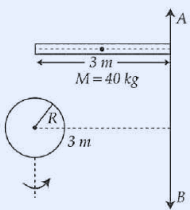
Moment of inertia about an axis AB for a rod of mass 40 kg and length 3 m is same as that of a solid sphere of mass of 10 kg and radius R about an axis parallel to AB axis with separation of 3 m as shown in figure below. The value of R is given as . The value of is..........
SolutionAnswer: 60
Approach:
Per the official setup, equate the rod's moment of inertia about axis AB with the sphere's moment of inertia about an axis through the sphere's centre parallel to AB, then solve for R in the form .
Step 1:Rod kg, m, axis AB perpendicular to rod at its end; sphere kg, radius R, axis through its centre parallel to AB; target in .
Step 2:Moment of inertia of the rod about axis AB.
Step 3:Moment of inertia of the solid sphere about its diameter (axis through centre parallel to AB).
Step 4:Equate the two moments of inertia.
Step 5:Write in the prescribed form.
Step 6:Dimensional check — ; numeric back: .
Step 7:Comparing with , .
Final answer: 60
Chemistry25 questions
Q51Single correctSome Basic Concepts in Chemistry
The ratio of mass percentage (W/W) C:H in a hydrocarbon is 12:1. It has two carbon atoms. The weight (in g) of C(g) formed when 3.38 g of this hydrocarbon is completely burnt in Oxygen is: (Given: Molar mass in g mo — C: 12, H: 1, O: 16)
(1)
(2)
(3)
(4)
SolutionAnswer: Option 211.44
Approach:
Determine molecular formula from C:H mass ratio with given carbon count, then use combustion stoichiometry to find moles of C produced and its mass.
Step 1:Given mass ratio : = 12:1 and the hydrocarbon contains two carbon atoms; sample mass = 3.38 g.
Step 2:Convert mass ratio to atom ratio using atomic masses (C = 12, H = 1).
Step 3:With two C atoms, the hydrocarbon has two H atoms, giving molecular formula (ethyne).
Step 4:Compute moles of hydrocarbon in 3.38 g sample.
Step 5:Apply combustion stoichiometry; each mole of yields 2 mol C.
Step 6:Mass of C = moles molar mass ().
Step 7:Mass of C produced is 11.44 g, matching option 2.
Final answer: 11.44 g
Q52Single correctEquilibrium
The first and second ionization constants of weak dibasic acid A are and respectively. 0.1 mol of A was dissolved in 1 L of 0.1 M HCl solution. The concentration of HA in the resultant solution is:
(1)
(2)
(3)
(4)
SolutionAnswer: Option 3 M
Approach:
Use first ionization equilibrium of A with H supplied by strong acid HCl to obtain [HA] directly from expression.
Step 1:Given dibasic weak acid A with , ; 0.1 mol A dissolved in 1 L of 0.1 M HCl.
Step 2:HCl fully dissociates, providing [H] 0.1 M. The very small ensures A ionization is strongly suppressed, so [A] 0.1 M and [H] 0.1 M.
Step 3:Rearrange expression to solve for [HA].
Step 4:Second ionization contribution M, which is negligible relative to [HA].
Step 5: in the resultant solution equals M, matching option 3.
Final answer: M
Q53Single correctChemical Bonding and Molecular Structure
S is isostructural with:
A. BrF
B. C
C. IF
D. Xe
E. Xe
Choose the correct answer from the option given below:
A. BrF
B. C
C. IF
D. Xe
E. Xe
Choose the correct answer from the option given below:
(1)
(2)
(3)
(4)
SolutionAnswer: Option 2C and E only
Approach:
Apply VSEPR to determine the geometry of S (see-saw, AE) and compare each candidate species' steric number and lone-pair count to find those with the same shape.
Step 1:S has central S with 6 valence electrons, four S–F bonds and one lone pair (AE, sd hybridization, see-saw geometry).
Step 2:BrF—Br has 7 valence e +1 (charge) = 8; four bonds + two lone pairs (A) → square planar; not see-saw.
Step 3:C—C has 4 bond pairs, no lone pair (A) → tetrahedral.
Step 4:IF—I has 7 valence e −1 (charge) = 6; four bonds + one lone pair (AE) → see-saw.
Step 5:Xe—Xe has 8 valence e; four bonds + two lone pairs (A) → square planar.
Step 6:Xe—Xe forms two Xe=O and two Xe–F -bonds with one lone pair (AE) → see-saw.
Step 7:Only IF and Xe share AE geometry with S (see-saw).
Step 8:The isostructural species are C and E only.
Final answer: C and E only
Q54Single correctChemical Thermodynamics
Gas 'A' undergoes change from state 'X' to state 'Y', in this process, the heat absorbed and work done by the gas is 10 J and 18 J respectively. Now gas is brought back to state 'X' by another process during which 6 J of heat is evolved. In the reverse process of 'Y' to 'X':
(1)
(2)
(3)
(4)
SolutionAnswer: Option 414 J of the work is done on the gas 'A' by the surrounding
Approach:
Apply the first law of thermodynamics over the cyclic process; internal energy is a state function so . Use sign conventions consistently and solve for the work in the reverse step.
Step 1:Process X Y absorbs heat = +10 J and the gas does work = +18 J on surroundings.
Step 2:Compute change in internal energy for the forward process using .
Step 3:For the reverse process Y X, internal energy change is opposite in sign.
Step 4:Heat is evolved (released) during Y X, so = 6 J. Apply first law to solve for w.
Step 5:Negative w means work is done on the gas by the surroundings; magnitude = 14 J.
Step 6:Sum heats and works over cycle: , consistent with state function.
Step 7:14 J of work is done on the gas by the surroundings, matching option 4.
Final answer: 14 J of the work is done on the gas 'A' by the surrounding
Q55Single correctSolutions
Solution A is prepared by dissolving 1 g of a protein (molar mass = 50000 g mo) in 0.5 L of water at 300 K. Its osmotic pressure is x bar. Solution B is made by dissolving 2 g of same protein in 1 L of water at 300 K. Osmotic pressure of solution B is y bar. Entire solution of A is mixed with entire solution of B at same temperature. The osmotic pressure of resultant solution is z bar. x, y and z respectively are (R = 0.083 L bar mo ):
(1)
(2)
(3)
(4)
SolutionAnswer: Option 1
Approach:
Use van't Hoff equation with molar concentration computed from mass/molar-mass per unit volume; for the mixture, compute the total moles divided by total volume.
Step 1:Protein molar mass M = 50000 g mo, T = 300 K, R = 0.083 L bar mo .
Step 2:Solution A—1 g protein in 0.5 L. Moles mol; M.
Step 3:Compute .
Step 4:Solution B—2 g protein in 1 L. Moles mol; M (same as A).
Step 5: bar.
Step 6:Mixing A and B gives total moles mol in total volume L, so M.
Step 7: bar.
Step 8:Since both A and B have identical molar concentrations, the mixture concentration equals either parent; osmotic pressure stays unchanged.
Step 9: bar each, matching option 1.
Final answer:
Q56Single correctEquilibrium
At 2C, 20.0 mL of 0.2 M weak monoprotic acid HX is titrated against 0.2 M NaOH. The pH of the solution (a) at the start of the titration (when NaOH has not been added) and (b) when 10 mL of NaOH is added respectively are: Given: ,
(1)
(2)
(3)
(4)
SolutionAnswer: Option 22.0, 3.3
Approach:
Use weak-acid approximation for the starting pH, and the Henderson–Hasselbalch equation at the half-neutralization point where [HX] = [X], giving pH = p.
Step 1:20.0 mL of 0.2 M HX ( mmol), , ; titrant 0.2 M NaOH.
Step 2:No NaOH added. Apply weak-acid approximation with C = 0.2 M.
Step 3:PH at start.
Step 4:10 mL of 0.2 M NaOH = 2 mmol OH added, which converts half of HX into NaX (half-equivalence point).
Step 5:At half-equivalence, [HX] = [X], so Henderson–Hasselbalch reduces to pH = p.
Step 6:Approximation holds since 1 , validating the weak-acid formula.
Step 7:(a) pH = 2.0, (b) pH = 3.3 — option 2.
Final answer: 2.0, 3.3
Q57Single correctChemical Kinetics
Consider the reaction , for which the rate constant at 30C is . Which of the following statements are true?
A. When concentration of 'X' is increased to four times, the rate of reaction becomes 16 times.
B. The reaction is a second order reaction.
C. The half-life period is independent of the concentration of X.
D. Decomposition of is an example of the above reaction.
E. vs Time is valid for the above reaction.
A. When concentration of 'X' is increased to four times, the rate of reaction becomes 16 times.
B. The reaction is a second order reaction.
C. The half-life period is independent of the concentration of X.
D. Decomposition of is an example of the above reaction.
E. vs Time is valid for the above reaction.
(1)
(2)
(3)
(4)
SolutionAnswer: Option 1A and B only
Approach:
Identify reaction order from the units of the rate constant; test each statement against the second-order rate law, its integrated form, half-life expression, and known kinetic behaviour of decomposition.
Step 1:Rate constant . Units of k for an n-th order reaction are ; corresponds to .
Step 2:For r = k[X, if [X] becomes 4[X], rate becomes (4 = 16 times original.
Step 3:Established in step 1 that the reaction is second order.
Step 4:For second order, = 1/(k[X), which depends on initial concentration.
Step 5:Gas-phase decomposition of is a classical first-order reaction (r = k[]), not second order.
Step 6:Ln([]/[R]) vs t is the integrated rate law for first order; second order requires 1/[X] vs t.
Step 7:Only A and B remain true; C, D, E violate second-order kinetics.
Step 8:Correct option is A and B only, matching option 1.
Final answer: A and B only
Q58Single correctClassification of Elements and Periodicity in Properties
The correct set that contain all kinds (basic, acids, amphoteric and neutral) of Oxides is:
(1)
(2)
(3)
(4)
SolutionAnswer: Option 3O, C, A and NO
Approach:
Classify each oxide in every option as basic, acidic, amphoteric, or neutral and pick the option that contains exactly one representative from each of the four categories.
Step 1:Identify standard classifications. Basic: NO, O. Acidic: C. Amphoteric: A, A. Neutral: CO, NO, O.
Step 2:NO (basic), O (basic), A (amphoteric), A (amphoteric). Missing acidic and neutral.
Step 3:A (amph), A (amph), CO (neutral), NO (neutral). Missing basic and acidic.
Step 4:O (basic), C (acidic), A (amphoteric), NO (neutral). All four categories present.
Step 5:NO (basic), O (neutral), A (amph), CO (neutral). Missing acidic.
Step 6:C is the anhydride of HCl (strongly acidic); NO is a well-known neutral oxide (does not react with acids or bases under normal conditions); A dissolves in both HCl and NaOH (amphoteric); O reacts with water to give KOH (basic).
Step 7:Only option 3 contains all four kinds of oxides.
Final answer: O, C, A and NO
Q59Single correctClassification of Elements and Periodicity in Properties
Given below are two statements:
Statement I: The second ionization enthalpy of B, Al and Ga is in order of B > Al > Ga.
Statement II: The correct order in terms of first ionization enthalpy is Si < Ge < Pb < Sn.
In the light of the above statement, choose the correct answer from the option given below:
Statement I: The second ionization enthalpy of B, Al and Ga is in order of B > Al > Ga.
Statement II: The correct order in terms of first ionization enthalpy is Si < Ge < Pb < Sn.
In the light of the above statement, choose the correct answer from the option given below:
(1)
(2)
(3)
(4)
SolutionAnswer: Option 2Both statement I and statement II are false
Approach:
Evaluate the two statements against standard second-IE data for Group 13 (B, Al, Ga) and first-IE data for Group 14 (Si, Ge, Sn, Pb), accounting for poor d-shielding in Ga and inert-pair stabilisation in Pb.
Step 1:List I (kJ mo) for Group 13 elements B, Al, Ga from standard data.
Step 2:Rank I from the values; B (small size, high ) tops, Ga sits above Al because the intervening 3 shell shields poorly and raises on the 4s electron of Ga.
Step 3:Compare with the proposed Statement I order B > Al > Ga.
Step 4:List I (kJ mo) for Group 14 elements Si, Ge, Sn, Pb from standard data.
Step 5:Rank I; Si > Ge owing to smaller size; Pb > Sn because 6 inert pair is poorly shielded by 4 raising .
Step 6:Compare with the proposed Statement II order Si < Ge < Pb < Sn (the reverse direction).
Step 7:Both statements contradict the standard IE data, so both are false.
Final answer: Both Statement I and Statement II are false
Q60Single correctd- and f-Block Elements
Given below are two statements:
Statement I: Among Zn, Mn, Sc and Cu, the energy required to remove the third valence electron is highest for Zn and lowest for Sc.
Statement II: The correct order of the following complexes in terms of CFSE is .
In the light of the above statement, choose the correct answer from the option given below:
Statement I: Among Zn, Mn, Sc and Cu, the energy required to remove the third valence electron is highest for Zn and lowest for Sc.
Statement II: The correct order of the following complexes in terms of CFSE is .
In the light of the above statement, choose the correct answer from the option given below:
(1)
(2)
(3)
(4)
SolutionAnswer: Option 1Both statement I and statement II are true
Approach:
Compare I values across Sc, Mn, Cu, Zn using the configurations of ions, then rank CFSE of the three Co complexes using the dependence of on oxidation state and ligand field strength.
Step 1:Write the configurations for Sc, Mn, Cu, Zn.
Step 2:I removes the third electron from . Z has the very stable 3 shell, so I is highest. S has a single 3d electron easily removed leaving a noble-gas [Ar] core, so I is lowest.
Step 3:Order shows highest I for Zn and lowest for Sc, matching Statement I.
Step 4:For Statement II, list the three Co complexes and note oxidation state and ligand type. : Co(II), weak-field O. : Co(III), weak-field O. : Co(III), stronger-field ethylenediamine.
Step 5:For the same metal and same ligand, raising the charge from +2 to +3 contracts orbitals and increases , hence has larger than . Among Co(III) complexes, en is higher in the spectrochemical series than O, so has the largest .
Step 6:Order of CFSE matches the proposed inequality in Statement II.
Step 7:Both statements are consistent with standard data, so the correct option is Option 1.
Final answer: Both Statement I and Statement II are true
Q61Single correctCoordination Compounds
Which of the following complexes will show coordination isomerism?
A.
B.
C.
D.
E.
A.
B.
C.
D.
E.
(1)
(2)
(3)
(4)
SolutionAnswer: Option 2B, D and E only
Approach:
Coordination isomerism arises in salts with both cationic and anionic complex spheres when the two metal centres differ, allowing ligand exchange between the spheres to give a distinct isomer; screen each complex for this condition.
Step 1:Identify the metal in the cation and in the anion of each salt.
Step 2:Apply the criterion that coordination isomerism requires two different metals in the two spheres so that ligand interchange yields a structurally distinct salt.
Step 3: has Ag in both spheres; interchange gives the same compound back.
Step 4: has Co and Cr; interchange gives .
Step 5: has Co in both spheres (same oxidation state implied), no new isomer on interchange.
Step 6: has Fe and Co; interchange gives , a distinct salt.
Step 7: has Co and Fe; interchange gives , distinct from E.
Step 8:Coordination isomerism is observed in B, D and E only, matching Option 2.
Final answer: B, D and E only
Q62Single correctPurification and Characterisation of Organic Compounds
Complete combustion of X g of an organic compound gave 0.25 g of C and 0.12 g of O. If the % of carbon is 25% and of hydrogen is 4.89%, then g (Nearest integer). (Molar mass of C, H and O are 12, 1 and 16 g mo respectively)
(1)
(2)
(3)
(4)
SolutionAnswer: Option 1273
Approach:
Convert the masses of C and O into masses of C and H, then use the given percentage of each element to back-calculate the sample mass X, retaining the value rounded to the nearest integer of g.
Step 1:Note the given quantities g, g, %C , %H , with M(C), M(H), M(O).
Step 2:Compute mass of carbon obtained in combustion.
Step 3:Compute mass of hydrogen obtained in combustion.
Step 4:Use the carbon percentage to solve for X.
Step 5:Use the hydrogen percentage to solve for X.
Step 6:With the exact carbon mass 0.0682 g and %C , g, consistent with the hydrogen channel.
Step 7:Convert X to the requested units of g.
Final answer: g
Q63Single correctSome Basic Principles of Organic Chemistry
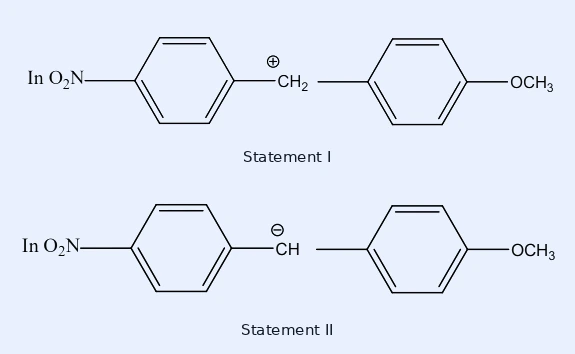
Given below are two statements:
Statement I: For the structure shown below as Statement I (a para-nitro/para-methoxy diphenyl methyl carbocation), the carbocation is stabilised by the effect of the group.
Statement II: For the structure shown below as Statement II (the corresponding carbanion), the carbanion is stabilised by the effect of the group.
In the above statement, choose the correct answer from the option given below:
Statement I: For the structure shown below as Statement I (a para-nitro/para-methoxy diphenyl methyl carbocation), the carbocation is stabilised by the effect of the group.
Statement II: For the structure shown below as Statement II (the corresponding carbanion), the carbanion is stabilised by the effect of the group.
In the above statement, choose the correct answer from the option given below:
(1)
(2)
(3)
(4)
SolutionAnswer: Option 1Both statement I and statement II are true
Approach:
Apply the standard rules that carbocations are stabilised by electron-releasing groups via and carbanions by electron-withdrawing groups via , examining each substituent through the para-aryl ring directly conjugated with the charged centre.
Step 1:Identify the para substituents on the two aryl rings and the charged benzylic centre in each statement. donates a lone pair to the ring (); withdraws via its system ().
Step 2:For Statement I, the lone pair on delocalises through the para-methoxyphenyl ring into the empty p-orbital of the adjacent C, distributing the positive charge over the methoxy oxygen.
Step 3:The presence of a para on a benzylic cation is the classic resonance stabilisation case; hence Statement I is TRUE.
Step 4:For Statement II, the carbanion lone pair delocalises through the para-nitrophenyl ring into the of , placing the negative charge on the strongly electronegative oxygens of nitro.
Step 5: delocalisation of a benzylic carbanion onto para is the standard textbook example; hence Statement II is TRUE.
Step 6:Both statements correctly identify the dominant resonance stabilisation in each species, matching Option 1.
Final answer: Both Statement I and Statement II are true
Q64Single correctHydrocarbons
The compound (X) on
(i) heating in the presence of anhydrous and HCl gas gives 2,4-dimethyl pentane,
(ii) aromatization gives toluene, and
(iii) cyclisation gives methyl cyclohexane.
The correct name of compound (X) is:
(i) heating in the presence of anhydrous and HCl gas gives 2,4-dimethyl pentane,
(ii) aromatization gives toluene, and
(iii) cyclisation gives methyl cyclohexane.
The correct name of compound (X) is:
(1)
(2)
(3)
(4)
SolutionAnswer: Option 3Heptane
Approach:
All three transformations (Lewis-acid catalysed isomerisation, dehydrocyclisation to toluene, cyclisation to methylcyclohexane) are diagnostic of a straight-chain alkane; deduce that X is n-heptane and reject the alkene/triene options because they would not undergo skeletal isomerisation to 2,4-dimethyl pentane.
Step 1:Count the carbons in the products. Toluene () and methylcyclohexane () both carry 7 C atoms; 2,4-dimethylpentane is also .
Step 2:Anhydrous /HCl is a textbook Lewis-acid catalyst for skeletal isomerisation of saturated alkanes; alkenes/polyenes would polymerise or undergo addition under these conditions, not branch to 2,4-DMP.
Step 3:Aromatisation (dehydrocyclisation) of n-heptane over at 773 K loses 4 to give toluene.
Step 4:Catalytic cyclisation of n-heptane closes the chain to methylcyclohexane with loss of one .
Step 5:Hept-2-ene, hepta-1,3,5-triene and hepta-2,4,6-triene are unsaturated and would not survive to give 2,4-DMP; only n-heptane satisfies all three transformations.
Step 6:Compound X is n-heptane (Option 3).
Final answer: Heptane
Q65Single correctOrganic Compounds Containing Halogens
Correct statement regarding alkyl halides (R-X) among the following are:
A. Alcohol being less polar solvent as compared to water, alcoholic KOH favours elimination reaction with R-X.
B. Order of reactivity towards mechanism: .
C. Non substituted aryl halides exhibit properties similar to alkyl halides.
D. Vinyl chloride is an example of haloalkene and allyl chloride is an example of haloalkyne.
E. R-Cl can be prepared by reaction of R-OH with , but Ar-Cl cannot be prepared by reacting Ar-OH with .
A. Alcohol being less polar solvent as compared to water, alcoholic KOH favours elimination reaction with R-X.
B. Order of reactivity towards mechanism: .
C. Non substituted aryl halides exhibit properties similar to alkyl halides.
D. Vinyl chloride is an example of haloalkene and allyl chloride is an example of haloalkyne.
E. R-Cl can be prepared by reaction of R-OH with , but Ar-Cl cannot be prepared by reacting Ar-OH with .
(1)
(2)
(3)
(4)
SolutionAnswer: Option 3A and E only
Approach:
Test each statement against standard alkyl/aryl halide chemistry: solvent polarity controls vs ; benzylic-cation stability governs ; aryl halide resonance differs from alkyl halides; allyl chloride is a haloalkane; Darzen's procedure works for alcohols but not phenols.
Step 1:List each statement A-E and the diagnostic chemistry needed to test it.
as given
Step 2:Ethanol is less polar than water; in the less polar medium is less solvated but more basic, favouring deprotonation () over nucleophilic substitution. So alcoholic KOH causes elimination of R-X.
Step 3:The intermediate cation in is the diphenyl methyl cation (stabilised by two aryl rings), whereas benzyl chloride gives only the benzyl cation (one aryl ring). The diphenyl cation is more stable, so reacts faster, not slower. The stated order is reversed.
Step 4:Aryl halides have partial C-X double-bond character from resonance of the halogen lone pair into the ring, making them much less reactive in nucleophilic substitution than alkyl halides; properties are NOT similar.
Step 5:Vinyl chloride is correctly a haloalkene, but allyl chloride has Cl on an s carbon and is a haloalkane (not haloalkyne).
Step 6: converts R-OH to R-Cl smoothly with gaseous S and HCl by-products. With Ar-OH the C-O bond has partial double-bond character (resonance into the ring), so the OH cannot be displaced and Ar-Cl is not obtained.
Step 7:Cross-check the true/false assignments — A true (alcohol vs water medium for ), E true ( with R-OH); B, C, D shown false above. Two correct statements confirms option 3.
Step 8:Only A and E are correct, matching Option 3.
Final answer: A and E only
Q66Single correctAldehydes, Ketones and Carboxylic Acids
An organic compound x, where the molar ratio of C, O and H are equal, on treatment with 50% KOH under reflux followed by acidification produced y. The most likely structure of y is: [Molar mass of x is 58 g mo]
(1)
(2)
(3)
(4)
SolutionAnswer: Option 3 (hydroxy-acetic acid / glycolic acid)
Approach:
Use the equal C:O:H molar ratio and the molar mass 58 g mo to fix the molecular formula as ; assign x as glyoxal (OHC-CHO), apply the intramolecular Cannizzaro reaction with 50% KOH that simultaneously oxidises one CHO to COO and reduces the other to COH, and acidify to obtain glycolic acid as y.
Step 1:Let the molecular formula be with the equal-ratio condition; the molar mass is .
Step 2:Set to find n.
Step 3: with two oxygens and only two hydrogens fits OHC-CHO (glyoxal) - a dialdehyde with no -H, exactly the condition for the Cannizzaro reaction with concentrated KOH.
Step 4:Under 50% KOH reflux, an intramolecular Cannizzaro occurs - hydroxide attacks one CHO and a hydride migrates from that tetrahedral intermediate to the other CHO; one carbonyl is oxidised to carboxylate and the other reduced to primary alcohol on the same molecule.
Step 5:Acidification protonates the carboxylate to give the free carboxylic acid.
Step 6:Glycolic acid has formula , which is balanced versus the reactants (); only option 3 shows both -OH on C and -COOH on the same skeleton.
Step 7:Y is glycolic acid, HOOC-C-OH, matching Option 3.
Final answer: (glycolic acid)
Q67Single correctAldehydes, Ketones and Carboxylic Acids
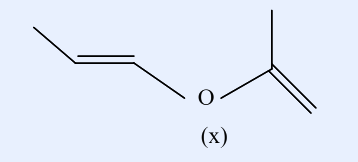
A molecule (x) with the following structure, under mild acid condition, is hydrolysed to produce (Y) and (Z). Identify the correct statement about (Y) and (Z).
A. Both (Y) and (Z) have same molar mass.
B. (Y) and (Z) can be distinguished from each other by NaHC.
C. (Y) and (Z) react with HCN with same rate.
D. (Y) and (Z) undergo addition reaction with 2,4-DNP.
A. Both (Y) and (Z) have same molar mass.
B. (Y) and (Z) can be distinguished from each other by NaHC.
C. (Y) and (Z) react with HCN with same rate.
D. (Y) and (Z) undergo addition reaction with 2,4-DNP.
(1)
(2)
(3)
(4)
SolutionAnswer: Option 4A and D only
Approach:
Hydrolyse the unsymmetrical bis-enol ether to two enols, tautomerise to a propanal (Y) and an acetone (Z), then test each statement A-D against carbonyl chemistry of an aldehyde versus a ketone.
Step 1:Ether (x) = (E)-CCH=CH-O-C(C)=C (1-propenyl isopropenyl ether); identify (Y), (Z) and test statements A-D about identity, NaHC, HCN and 2,4-DNP.
Step 2:Protonate and hydrolyse the enol ether to give two enols.
Step 3:Tautomerise each enol to its carbonyl form.
Step 4:Evaluate statement A (molar mass) by computing M for Y and Z.
Step 5:Evaluate statement B (NaHC). Neither aldehyde nor ketone bears -COOH; both fail to react with NaHC.
Step 6:Evaluate statement C (HCN rate). Aldehydes (less steric, more ) react with HCN faster than ketones; propanal acetone.
Step 7:Evaluate statement D (2,4-DNP). Both aldehydes and ketones undergo nucleophilic addition with 2,4-DNP to give hydrazones.
Step 8:Collect true statements and back-substitute. True ; this matches option 4.
Step 9:The correct statements are A and D only.
Final answer: Option 4 - A and D only
Q68Single correctOrganic Compounds Containing Halogens
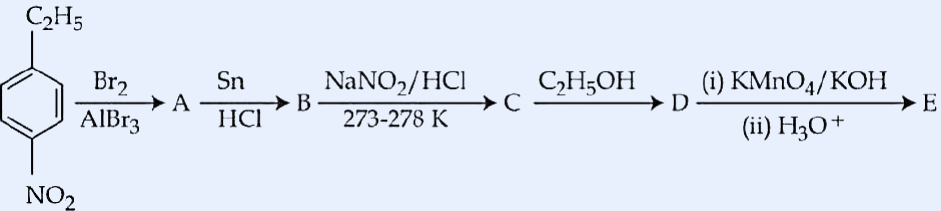
Identify compounds A and E in the following reaction sequence:
(1)
(2)
(3)
(4)
SolutionAnswer: Option 2A = 2-bromo-1-ethyl-4-nitrobenzene (Br ortho to -, N para to -); E = 2-bromobenzoic acid (o-bromobenzoic acid)
Approach:
March through the five steps using directing effects, functional-group inter-conversion (Sn/HCl, diazonium, deamination by ethanol) and side-chain oxidation by KMn to identify each intermediate; identify A after Step-1 and E after Step-5.
Step 1:Substrate is p-nitroethylbenzene ( at , N at ); target A = product of B/AlB; target E = product after Sn/HCl, NaN/HCl(273-278 K), OH, KMn/KOH then .
Step 2:In B/AlB, - is o/p activator and -N is m-deactivator. The para position to - is blocked by -N; both ortho positions to - are also meta to -N (mutually reinforcing). Br enters one ortho position to -.
Step 3:Sn/HCl reduces the aromatic -N to -N (other groups unaffected).
Step 4:NaN/HCl at 273-278 K converts -N to a stable diazonium salt -N.
Step 5:OH reduces the diazonium group, replacing -N by -H (deamination), so the N position becomes H.
Step 6:KMn/KOH then oxidises the entire aromatic side-chain (-) to -COOH; ring -Br is unchanged.
Step 7:A = 2-bromo-1-ethyl-4-nitrobenzene and E = o-bromobenzoic acid. Match to options A and E; only option 2 has both.
Step 8:The correct pair is option 2.
Final answer: Option 2 - A = 2-bromo-1-ethyl-4-nitrobenzene; E = o-bromobenzoic acid
Q69Single correctBiomolecules
Identify the correct pair having amino acid (A) and the hormone (B) that is an iodinated derivative of the amino acid (A). (T and Y represent one letter code for amino acids)
(1)
(2)
(3)
(4)
SolutionAnswer: Option 3A = Y; B = Thyroxine
Approach:
Use the NCERT statement that thyroxine is the iodinated derivative of the amino acid tyrosine (one-letter code Y); insulin is a 51-residue polypeptide and is not an iodinated single amino acid.
Step 1:Pair (A, B) where B is the hormone formed by iodination of amino acid A; one-letter codes T (Threonine) and Y (Tyrosine) are used.
Step 2:Identify the hormone that is an iodinated amino-acid derivative. Insulin is a 51-residue protein hormone (no iodine); thyroxine () is 3,5,3',5'-tetraiodo derivative of tyrosine.
Step 3:Tyrosine carries one-letter code Y, so A = Y.
Step 4:Only option 3 carries A = Y and B = Thyroxine simultaneously.
Step 5:The correct pair is A = Y (tyrosine), B = Thyroxine.
Final answer: Option 3 - A = Y (tyrosine); B = Thyroxine
Q70Single correctd- and f-Block Elements
Among , , and , the ion that shows a positive borax bead test and has the highest ionization enthalpy is:
(1)
(2)
(3)
(4)
SolutionAnswer: Option 4
Approach:
Apply two criteria sequentially: (i) the borax bead test demands a coloured transition-metal ion with partly filled d-orbitals; (ii) among the surviving ions, the one whose formation needs the highest cumulative ionization enthalpy is the answer.
Step 1:Choose ion from that gives a positive borax bead test and has the highest ionization enthalpy.
Step 2:Write electronic configurations. ; ; ; .
Step 3: is (filled), so it is colourless and fails the borax bead test; eliminate it.
Step 4:, and all have partly filled d-orbitals and give coloured borax beads (F/F yellow/brown, C green).
Step 5:Compare cumulative IE. To form F requires I+I+I of Fe; F and C require only I+I. The third IE of Fe is large (removal from stable 3 to 3 shell), making the highest in the set.
Step 6:F satisfies both filters (positive borax bead + highest IE), confirming option 4.
Step 7:The required ion is F.
Final answer: - Option 4
Q71NumericalDual Nature of Matter and Radiation
The surface of sodium metal is irradiated with radiation of wavelength x nm. The kinetic energy of ejected electrons is J. The work function of sodium is eV. The value of x is nm (Nearest integer). (Given: Js; J; )
SolutionAnswer: 5
Approach:
Apply Einstein's photoelectric equation , solve for in metres, convert to nm and then express in the requested form nm.
Step 1:Given eV, J, Js, m , J; find in the form nm.
Step 2:Convert the work function to joules.
Step 3:Substitute in Einstein's equation.
Step 4:Add the right-hand-side energies on a common basis.
Step 5:Solve for .
Step 6:Convert to nanometres.
Step 7:Dimensional and back-substitution. J, matching J.
Step 8:The stem requests written as nm. With nm nm, .
Final answer: (i.e. nm nm)
Q72NumericalChemical Kinetics
Consider the following gas phase reaction being carried out in a closed vessel at C:
time (min) | total pressure of the system (mm Hg) |
30 | 300 |
| 600 |
The pressure of C(g) at minutes time interval would be mm Hg (nearest integer).
time (min) | total pressure of the system (mm Hg) |
30 | 300 |
| 600 |
The pressure of C(g) at minutes time interval would be mm Hg (nearest integer).
SolutionAnswer: 20
Approach:
Set up an ICE-like table of partial pressures; use the condition to obtain the initial pressure of A, then the min condition to obtain the extent x, hence .
Step 1:At only A is present with pressure ; let be the pressure of A consumed at min. From stoichiometry, pressure of B and x of C form. At all A is consumed.
Step 2:Apply total-pressure condition at : .
Step 3:Apply total-pressure condition at min: .
Step 4:Identify at min: mm Hg.
Step 5:Substitute back at : ; ; ; sum mm Hg, matching the data.
Step 6:The partial pressure of at min is mm Hg.
Final answer: 20 mm Hg
Q73NumericalElectrochemistry
Consider the following two half-cell reactions along with the standard reduction potential given:
A fuel cell was set up using the above two reactions such that the cell operates under the standard condition of bar pressure and K temperature. The fuel cell works with efficiency. If the work derived from the cell using mol of is used to compress an ideal gas isothermally against a constant pressure of , then the change in the volume of the gas, (nearest integer). (Given: )
A fuel cell was set up using the above two reactions such that the cell operates under the standard condition of bar pressure and K temperature. The fuel cell works with efficiency. If the work derived from the cell using mol of is used to compress an ideal gas isothermally against a constant pressure of , then the change in the volume of the gas, (nearest integer). (Given: )
SolutionAnswer: 560
Approach:
Compute , then maximum electrical work for electrons per mole of COH; apply efficiency; equate available work to for isothermal compression to find .
Step 1:Cathode = reduction (higher V); anode = C/COH (lower V, written here as reduction but operating in oxidation direction); per mole of COH; efficiency ; kPa Pa; C mo.
Step 2:Compute the standard cell EMF.
Step 3:Compute for 1 mol COH using .
Step 4:Apply % efficiency to get available work.
Step 5:Equate available work to and solve for .
Step 6:Dimensional check : J J .
Step 7:Nearest-integer change in volume.
Final answer: 560
Q74Numericald- and f-Block Elements
Number of paramagnetic ions among the following d- and f-block metal ions is
(Atomic number of Mn = 25, Cu = 29, Yb = 70, Sc = 21, La = 57, Gd = 64, Lu = 71, Ti = 22, Ce = 58)
(Atomic number of Mn = 25, Cu = 29, Yb = 70, Sc = 21, La = 57, Gd = 64, Lu = 71, Ti = 22, Ce = 58)
SolutionAnswer: 3
Approach:
Write the d-/f-electronic configuration of each ion and count those with at least one unpaired electron; such ions are paramagnetic.
Step 1:Classify each ion of the list using its valence-shell d- or f-occupancy and count paramagnetic species.
Step 2:D-block configurations. (5 unpaired, para); (1 unpaired, para); (0 unpaired, dia); (dia); (dia).
Step 3:F-block configurations. (dia); (dia); (7 unpaired, para); (dia); (dia).
Step 4:Collect all paramagnetic ions.
Step 5:Cross-check unpaired-electron counts. M 5e, C 1e, G 7e; all others 0 unpaired electrons. Count of paramagnetic ions .
Step 6:Number of paramagnetic ions .
Final answer: 3
Q75NumericalOrganic Compounds Containing Nitrogen
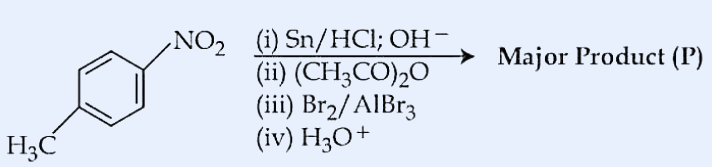
Consider the following reactions sequence
When the product (P) is subjected to Carius analysis using , g of the product (P) will produce g of the precipitate of AgBr (Nearest integer).
(Given: molar mass in g mo, C : 12, H : 1, O : 16, N : 14, Br : 80, Ag : 108)
When the product (P) is subjected to Carius analysis using , g of the product (P) will produce g of the precipitate of AgBr (Nearest integer).
(Given: molar mass in g mo, C : 12, H : 1, O : 16, N : 14, Br : 80, Ag : 108)
SolutionAnswer: 1
Approach:
Trace the four steps to identify product P, write its molecular formula, then use the Carius relation (one Br per molecule) to compute the mass of AgBr obtained from 1.0 g of P via the molar-mass ratio .
Step 1:Substrate p-nitrotoluene (-C at , -N at ); four-step sequence (i) Sn/HCl, OH (ii) (CO (iii) B/AlB (iv) ; target = mass of AgBr from 1.0 g of P.
Step 2:Sn/HCl reduces -N to -NH and OH liberates -N, giving p-toluidine.
Step 3:Acetic anhydride acetylates -N to -NHCOC, lowering its activating power and protecting it during electrophilic bromination.
Step 4:With -NHCOC (strong o/p-director) at and -C (weaker o/p-director) at , the para position to -NHCOC is blocked. Bromination occurs at the ortho position to the dominant director (-NHCOC), giving the 2-bromo derivative.
Step 5: hydrolyses the amide back to the free amine, leaving the C-Br intact.
Step 6:Compute molar masses.
Step 7:Apply the Carius mass relation (one Br per molecule, so ).
Step 8:Dimensional check via moles. mol ; mass AgBr g, matches.
Step 9:Rounding g to the nearest integer gives g of AgBr.
Final answer: 1 g
Mathematics25 questions
Q1Single correctComplex Numbers and Quadratic Equations
Let be the roots of the equation and be the roots of the equation . If the roots of the equation are and , then m is equal to
(1)
(2)
(3)
(4)
SolutionAnswer: Option 4
Approach:
Apply Vieta's formulas to both quadratics to determine , then construct the new quadratic from the prescribed roots and read off m.
Step 1:Given are roots of and are roots of . The roots of are and . Target: value of m.
Step 2:Solve the two linear equations and . Multiply the second by to get ; subtract the first to obtain .
Step 3:Compute using the product relation.
Step 4:Evaluate the prescribed roots of .
Step 5:Apply product of roots to where product equals .
Step 6:Sum of roots gives which equals the coefficient in , confirming the pair are correct roots.
Step 7:Hence , matching option (4).
Final answer:
Q2Single correctComplex Numbers and Quadratic Equations
Let the circles and , be such that lies within . If moves on , moves on and , then is equal to
(1)
(2)
(3)
(4)
SolutionAnswer: Option 3
Approach:
Use that for circle lying inside , the extreme values of occur along the line joining the centres, giving and where d is the distance between centres and R the radius of .
Step 1: is centred at with radius r; is centred at with radius . Given lies within and . Target: .
Step 2:Compute the distance between centres.
Step 3:Apply the minimum-distance condition along the line joining the centres: .
Step 4:Compute the maximum distance along the same line on the opposite side.
Step 5: for two such circles, giving , which is consistent.
Step 6:The maximum distance equals , matching option (3).
Final answer:
Q3Single correctMatrices and Determinants
If the system of equations has infinitely many solutions, then the point (a, b) lies on the line
(1)
(2)
(3)
(4)
SolutionAnswer: Option 2
Approach:
Impose the consistency conditions for infinitely many solutions: the coefficient determinant and any one substitution determinant must vanish; solve them to obtain and , then check the candidate lines.
Step 1:Coefficient matrix with RHS . Target: (a,b).
Step 2:Compute along the first row.
Step 3:Set to obtain a.
Step 4:Replace the third column by the RHS to form and expand.
Step 5:Set .
Step 6:Compute to test the candidate lines.
Step 7:Substitute into : , identity holds. The other candidates fail.
Step 8:The point lies on , matching option (2).
Final answer: lies on
Q4Single correctSequence and Series
Let be an A.P. and be an increasing G.P. If and , then is equal to
(1)
(2)
(3)
(4)
SolutionAnswer: Option 4
Approach:
Parametrise the A.P. and G.P. with , common difference d, common ratio r; reduce the two given conditions to a quadratic in r, pick the increasing-GP root, then evaluate .
Step 1:A.P. has and common difference d, so . G.P. has and common ratio with for an increasing G.P., so . Target: .
Step 2:Use with and .
Step 3:Use with and , and substitute .
Step 4:Factorise the quadratic.
Step 5:For an increasing G.P. starting at require , so and hence .
Step 6:Compute and and add them.
Step 7:Substitute back into the given condition , matching the problem statement.
Step 8:Hence , matching option (4).
Final answer:
Q5Single correctSequence and Series
The sum up to 8 terms, is:
(1)
(2)
(3)
(4)
SolutionAnswer: Option 2
Approach:
Simplify the general term using the closed forms for the sum of cubes and the sum of the first odd numbers, then sum to .
Step 1:The term is . Target: .
Step 2:Apply the two closed forms.
Step 3:Sum to terms by linearity.
Step 4:Substitute . Here .
Step 5:Direct check of values sums to .
Step 6:, matching option (2).
Final answer:
Q6Single correctBinomial Theorem
If for , , then m equals:
(1)
(2)
(3)
(4)
SolutionAnswer: Option 3
Approach:
Use the symmetry to rewrite each term as for ; the coefficients identify the sum as the Vandermonde convolution of with .
Step 1:Given for . Target: integer m with .
Step 2:Apply symmetry to each term.
Step 3:Combine with coefficients .
Step 4:Apply Vandermonde's identity with .
Step 5:Check at : LHS , since .
Step 6:Matching gives , option (3).
Final answer:
Q7Single correctPermutations and Combinations
Let denote the total number of triangles formed by joining the vertices of an n-sided regular polygon. If , then the sum of all distinct prime divisors of n is
(1)
(2)
(3)
(4)
SolutionAnswer: Option 3
Approach:
Express and use Pascal's identity to solve for n, then list the distinct prime divisors.
Step 1: counts triangles from n polygon vertices. Given . Target: sum of distinct prime divisors of n.
Step 2:Apply Pascal's identity with .
Step 3:Set the difference equal to and solve.
(positive root)
Step 4:Factorise ; distinct primes are .
Step 5:Sum the distinct primes.
Step 6:Check , matching the given condition.
Step 7:The sum of all distinct prime divisors of is , matching option (3).
Final answer: Sum of distinct prime divisors of is
Q8Single correctStatistics and Probability
A man throws a fair coin repeatedly. He gets 10 points for each head he throws and 5 points for each tail he throws. If the probability that he gets exactly 30 points is , then is equal to
(1)
(2)
(3)
(4)
SolutionAnswer: Option 3
Approach:
Find all (h,t) pairs with , count the orderings of each composition, weight by , and add. Since each ordering corresponds to a distinct sample path that achieves exactly as a partial sum, this gives the required probability.
Step 1:Let h = number of heads, t = number of tails so far. Each head adds , each tail adds 5, so a total of requires , i.e. . Target: .
Step 2:Enumerate non-negative integer solutions .
Step 3:For each (h,t) count the orderings ending with the toss that brings the total to . Since every ordering of h heads and t tails attains the total exactly at the final toss of that block, the probability contribution is .
Step 4:Sum over the four pairs.
Step 5:Common denominator gives .
Step 6:Since is prime and does not divide , , so .
Step 7:Cross-check via recursion with , for : , matching.
Step 8:Hence , matching option (3).
Final answer:
Q9Single correctStatistics and Probability
The mean and variance of observations are 8 and 16, respectively. If the sum of the first observations is 48 and the sum of squares of the first observations is 496, then the value of is
(1)
(2)
(3)
(4)
SolutionAnswer: Option 4
Approach:
Translate mean and variance into sums, isolate , then reduce to a quadratic in n.
Step 1:Let the n observations be with and .
Step 2:Mean gives , so .
Step 3:Variance gives and .
Step 4:Multiply out and simplify the quadratic.
Step 5:Solve using the quadratic formula; discriminant .
Step 6:The valid number of observations is .
Final answer:
Q10Single correctCoordinate Geometry
Let a circle pass through the origin and its centre be the point of intersection of two mutually perpendicular lines and . If the line intersects the circle at the points A and B, then is equal to
(1)
(2)
(3)
(4)
SolutionAnswer: Option 3
Approach:
Use perpendicularity of the two lines to fix , find their intersection (the centre), compute the radius from the origin, and apply the chord-length formula.
Step 1:Slope of is and slope of is .
Step 2:Set , giving ; testing yields , so .
Step 3:Substitute : the lines become and . Solve to get the centre.
Step 4:Circle passes through origin, so radius equals .
Step 5:Perpendicular distance from to chord .
Step 6:Apply chord-length formula.
Step 7:The square of chord length is .
Final answer:
Q11Single correctCo-ordinate Geometry
Let O be the origin, and P and Q be two points on the rectangular hyperbola such that the mid point of the line segment PQ is . Then the area of the triangle OPQ equals:
(1)
(2)
(3)
(4)
SolutionAnswer: Option 3
Approach:
Use the mid-point chord identity to obtain the chord line, find its intersections with , and compute the triangle area.
Step 1:Midpoint is on the hyperbola .
Step 2:Plug in to get , i.e. .
Step 3:Substitute into .
Step 4:Compute intersection points and .
Step 5:Midpoint of P and Q is .
Step 6:Area of using the origin-vertex formula.
Final answer:
Q12Single correctCo-ordinate Geometry
Let the parabola passing through the point be such that the distance between its vertex and the x-axis is minimum. Then the value of is:
(1)
(2)
(3)
(4)
SolutionAnswer: Option 2
Approach:
Use the point on the parabola to relate and , reduce vertex distance to a single-variable function in , and minimise.
Step 1:Parabola passes through .
Step 2:For , , , vertex y-coordinate is . Substitute .
Step 3:Complete the square: .
Step 4:Distance from x-axis is .
Step 5:Minimise d(p): with equality at , giving and .
Step 6:Compute .
Final answer:
Q13Single correctTrigonometry
Let and . Then n(S) is:
(1)
(2)
(3)
(4)
SolutionAnswer: Option 1
Approach:
Simplify to a function of , then determine which integers are attainable subject to the domain restriction.
Step 1:Set .
Step 2:Factor .
Step 3:Multiply by to cancel .
Step 4:Domain restriction excludes , where . Together with defined (i.e. , also ), the achievable range is .
Step 5:Therefore .
Step 6:The only integer satisfying would need , but , so no integer a works.
Step 7:The set is empty, so .
Final answer:
Q14Single correctVector Algebra
Let the vectors and . For some , let . If and , then is equal to:
(1)
(2)
(3)
(4)
SolutionAnswer: Option 2
Approach:
Convert the two dot-product conditions into a linear system in via linearity, solve, then compute .
Step 1:Take and .
Step 2:Compute and .
Step 3:Compute and .
Step 4:Add both equations to eliminate : , then .
Step 5:Form .
Step 6:Check and , both consistent.
Step 7:Magnitude squared.
Final answer:
Q15Single correctThree Dimensional Geometry
Let the point A be the foot of perpendicular drawn from the point on the line . If the mid point of the line segment PA is , then the value of is equal to:
(1)
(2)
(3)
(4)
SolutionAnswer: Option 1
Approach:
Parameterise A on the line, apply the midpoint formula to express in terms of the parameter r, then enforce to solve.
Step 1:Let on the line; direction and .
Step 2:Midpoint conditions give , , .
Step 3:Compute . Substitute the relations: , , .
Step 4:Enforce : .
Step 5:Substitute : , , .
Step 6:; midpoint of and A is , matching.
Step 7:Compute the required sum.
Final answer:
Q16Single correctVector Algebra
Two adjacent sides of a parallelogram PQRS are given by and . If the side PS is rotated about the point P by an acute angle in the plane of the parallelogram so that it becomes perpendicular to the side PQ, then is equal to:
(1)
(2)
(3)
(4)
SolutionAnswer: Option 2
Approach:
Find the angle between and using the dot product, determine the rotation that makes them perpendicular, then evaluate the trig expression via .
Step 1:; magnitudes .
Step 2:Cosine of angle between PQ and PS.
Step 3:Rotate PS by acute to make angle ; reducing the obtuse angle of to requires .
Step 4:Apply with , , so and .
Step 5:Evaluate at : .
Step 6:The required value is .
Final answer:
Q17Single correctIntegral Calculus
The value of is equal to:
(1)
(2)
(3)
(4)
SolutionAnswer: Option 3
Approach:
Use the period of (which is ) to reduce the long integral, then simplify the integrand via a power-reduction identity and integrate.
Step 1:Let . It has period , and .
Step 2:Simplify .
Step 3:Evaluate and .
Step 4:Multiply by the number of periods.
Step 5:Total integral equals .
Final answer:
Q18Single correctLimit, Continuity and Differentiability
Let f(x) be a polynomial of degree and have extrema at and . If , then is equal to:
(1)
(2)
(3)
(4)
SolutionAnswer: Option 4
Approach:
Use the finite-limit condition to fix the low-order coefficients of the degree-5 polynomial, then impose the extrema conditions to solve for the remaining coefficients and compute the required difference.
Step 1:From the coefficients of in f vanish and the coefficient of equals , so the degree-5 polynomial has the form below.
Step 2:Differentiate and impose extrema conditions and .
Step 3:Solve the simultaneous equations.
Step 4:Evaluate f at using the fact that f is an odd function.
Step 5:Compute the required difference.
Final answer:
Q19Single correctIntegral Calculus
Let . If and , then is equal to:
(1)
(2)
(3)
(4)
SolutionAnswer: Option 3
Approach:
Split the numerator into the derivative of the denominator plus a constant, integrate via a log term and partial fractions, fix the constant from , then evaluate and identify .
Step 1:Write the numerator as where is the derivative of . Matching coefficients gives .
Step 2:Split the integral into the log-derivative piece and the constant-numerator piece, then use partial fractions on the second piece.
Step 3:Use . At , and , giving .
Step 4:Evaluate . At , and .
Step 5:Add and .
Final answer:
Q20Single correctDifferential Equations
Let be the solution of the differential equation . Then is equal to:
(1)
(2)
(3)
(4)
SolutionAnswer: Option 2
Approach:
Recognise the Bernoulli form in x(y), substitute to linearise, solve via integrating factor, fix the constant from , then evaluate at .
Step 1:Divide the given ODE by to put it in standard Bernoulli form.
Step 2:Divide by and substitute (so ).
Step 3:Integrating factor is . Multiply through.
Step 4:Integrate both sides.
Step 5:Apply to find .
Step 6:Solve for x and substitute .
Final answer:
Q21NumericalSets, Relations and Functions
Let . Let R be a relation on the set given by (x, y) R (z, w) if and only if x divides z and . Then the number of elements in R is
SolutionAnswer: 120
Approach:
Decouple the two independent constraints: count ordered pairs (x,z) with in A, and ordered pairs (y,w) with in A, then multiply.
Step 1:The conditions (in the first coordinate) and (in the second coordinate) are independent, so factorises.
Step 2:For each , count multiples of x lying in : gives ; gives ; , , each give .
Step 3:With , the number of ordered pairs (y,w) satisfying equals .
Step 4:Multiply the independent counts.
Step 5:The relation has ordered pairs.
Final answer: 120
Q22NumericalMatrices and Determinants
Consider the matrices and . If matrices P and Q are such that and , then the absolute value of the sum of the diagonal elements of is ..........
SolutionAnswer: 34
Approach:
Invert A, set and , compute each matrix, then form and take the absolute value of its trace.
Step 1:Compute and .
Step 2:Compute .
Step 3:Compute .
Step 4:Use linearity of trace.
Step 5:Take the absolute value.
Final answer: 34
Q23NumericalCo-ordinate Geometry
Let A be the point and circles with variable diameter AB touch the circle internally. Let the curve C be the locus of the point B. If the eccentricity of C is e, then is equal to ..........
SolutionAnswer: 18
Approach:
Translate internal tangency between the variable circle (diameter ) and the fixed circle of radius into a focal-distance relation; the resulting locus is an ellipse from which is read off.
Step 1:Let . The variable circle has centre M at the midpoint of AB and radius . Internal tangency to (centre O, radius ) requires .
Step 2:Multiply both sides by .
Step 3:This is the locus definition of an ellipse with foci and and major-axis length .
Step 4:Compute the eccentricity.
Step 5:Compute .
Final answer: 18
Q24NumericalIntegral Calculus
If the area of the region bounded by and is A, then is equal to ..........
SolutionAnswer: 24
Approach:
Convert the hyperbola to standard form, find intersection of the line with the right branch, integrate the difference between the upper hyperbola arc and the line from to , then substitute into the requested expression.
Step 1:Divide by to obtain the standard form.
Step 2:Find intersection of the line with the hyperbola. From the line, , so , while from the hyperbola . Equating gives .
Step 3:For on the right branch, the upper arc is and the line gives . Comparing at shows , so the hyperbola is the upper boundary.
Step 4:Evaluate the linear part.
Step 5:Evaluate the radical part using the standard integral with .
Step 6:Combine to obtain .
Step 7:Evaluate the requested expression .
Final answer: 24
Q25NumericalLimit, Continuity and Differentiability
The number of points in the interval at which the function , where denotes the greatest integer function, is discontinuous, is ..........
SolutionAnswer: 10
Approach:
Let . Since g is strictly increasing on , is discontinuous exactly at the unique preimages of integers lying strictly inside ; count those integers.
Step 1:Set and compute the endpoint values on .
Step 2: on , so is strictly increasing and continuous; therefore takes each integer in its range at exactly one interior point.
Step 3:Count integers n with (endpoints are non-integer so the boundary contributes nothing). The integers are .
Step 4:At each such level n there is a unique with ; at the function [g] jumps from to n, so f is discontinuous there.
Step 5:The function is discontinuous at points of .
Final answer: 10
More JEE Main 2026 papers
- JEE Main 2026 — April 02, Shift 1
- JEE Main 2026 — April 04, Shift 1
- JEE Main 2026 — April 04, Shift 2
- JEE Main 2026 — April 05, Shift 1
- JEE Main 2026 — April 05, Shift 2
- JEE Main 2026 — April 06, Shift 1
- JEE Main 2026 — April 06, Shift 2
- JEE Main 2026 — April 08, Shift 2
- JEE Main 2026 — January 21, Shift 1
- JEE Main 2026 — January 21, Shift 2
- JEE Main 2026 — January 22, Shift 1
- JEE Main 2026 — January 22, Shift 2
- JEE Main 2026 — January 23, Shift 1
- JEE Main 2026 — January 23, Shift 2
- JEE Main 2026 — January 24, Shift 1
- JEE Main 2026 — January 24, Shift 2
- JEE Main 2026 — January 28, Shift 1
- JEE Main 2026 — January 28, Shift 2
Frequently Asked Questions
How many questions are in the JEE Main 2026 April 02, Shift 2 paper?
The JEE Main 2026 April 02, Shift 2 paper has 75 questions — Physics (25), Chemistry (25) and Mathematics (25). Every question is on this page with its correct answer and a step-by-step solution.
What is the marking scheme for JEE Main?
JEE Main awards +4 marks for each correct answer and −1 for a wrong answer, with 0 for questions left unattempted. The paper covers Physics, Chemistry and Mathematics.
Are the answer key and step-by-step solutions provided for the 2026 April 02, Shift 2 paper?
Yes — every question shows the correct answer (answer key) and a detailed step-by-step solution, free to read online.
Can I take the JEE Main 2026 April 02, Shift 2 paper as a timed mock test?
Yes. With a free JEEnify account you can attempt this exact paper as a timed test in the real exam interface, then see your score and weak-area analysis.
Solved this paper? Calculate your JEE Main scoremost important chaptersformula sheetsall free tools.