
Back to JEE Main PYQs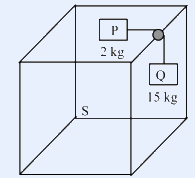

JEE Main 2026 April 06, Shift 1 Question Paper with Solutions
All 75 questions from the JEE Main 2026 (April 06, Shift 1) shift — Physics (25), Chemistry (25) and Mathematics (25) — each with the correct answer (answer key) and a step-by-step solution. Read it free online, or attempt the full paper as a timed mock test.
Physics25 questions
Q26Single correctUnits and Measurements
The density of a uniform cylinder is determined by measuring its mass m, length l and diameter d. The measured values of m, l and d are g, mm and mm, respectively. Calculated percentage fractional error in is _____ .
(1)
(2)
(3)
(4)
SolutionAnswer: Option 2
Approach:
The density of a uniform cylinder of mass m, length l and diameter d is . The objective is the maximum percentage fractional error in obtained by propagating the given uncertainties through this multiplicative formula.
Step 1:Identify the multiplicative form of and the corresponding error contributions: mass with multiplier 1, diameter with multiplier 2, length with multiplier 1.
Step 2:Compute the mass fractional error.
Step 3:Compute twice the diameter fractional error.
Step 4:Compute the length fractional error.
Step 5:Sum all contributions to obtain the percentage fractional error in .
Final answer:
Q27Single correctUnits and Measurements
The potential energy of a particle changes with distance x from a fixed origin as , where A and B are constant with appropriate dimensions. The dimensions of AB are _____ .
(1)
(2)
(3)
(4)
SolutionAnswer: Option 4
Approach:
The given expression equates potential energy to . Applying dimensional homogeneity to the sum fixes the dimensions of B, while equating the right-hand side to the dimensions of energy fixes the dimensions of A. The product AB then follows.
Step 1:Since and are added, they share the same dimensions.
Step 2:Form the dimensions of the right-hand side using .
Step 3:Equate with the dimensions of energy and solve for .
Step 4:Multiply the dimensions of A and B.
Final answer:
Q28Single correctWork, Energy and Power
The rain drop of mass 1 g, starts with zero velocity from a height of 1 km . It hits the ground with a speed of 5 m/s. The work done by the unknown resistive force is _____ J. (take m/)
(1)
(2)
(3)
(4)
SolutionAnswer: Option 4
Approach:
A 1 g drop falls from rest through 1 km and arrives at the ground with 5 m/s. The work-energy theorem relates the sum of the work done by gravity and by the unknown resistive force to the change in kinetic energy, isolating the resistive work.
Step 1:Convert all data to SI units.
Step 2:Compute the work done by gravity over the fall.
Step 3:Compute the change in kinetic energy.
Step 4:Apply the work-energy theorem to extract the resistive work.
Final answer:
Q29Single correctLaws of Motion
Two blocks (P and Q) with respectively masses 2 kg and 1.5 kg are joined by a massless thread. These blocks are mounted on a frictionless pulley which is fixed on the edge of a cube (S), as shown in the figure below. Block P is positioned on the top surface which has no friction and block Q is in contact with side-surface, having coefficient friction . The cube (S) moves towards the right with acceleration of , where g is gravitational acceleration. During this movement the block P and Q remain stationary. The value of is _____ (take m/)
(1)
(2)
(3)
(4)
SolutionAnswer: Option 2
Approach:
Block P sits on the smooth top of a cube moving rightward at ; block Q hangs against the right vertical face, connected to P by a string over a pulley at the top-right edge. With kg, kg and both blocks at rest in the cube frame, applying Newton's second law in the non-inertial frame of the cube reduces the problem to two coupled equilibrium equations that fix the tension, the normal reaction on Q, and finally the required coefficient of friction.
Step 1:In the cube frame each block experiences a pseudo-force of magnitude directed opposite to the cube's acceleration, i.e. to the left.
Step 2:For block P on the smooth horizontal top, the only horizontal forces are the tension T (pulling P rightward toward the pulley at the right edge) and the pseudo-force (leftward). Equilibrium yields T.
Step 3:For block Q against the right vertical face, the only horizontal force on it (apart from the wall reaction) is the pseudo-force pushing it into the wall, fixing the normal reaction.
Step 4:Vertical equilibrium of Q: tension T (upward) and static friction f (upward) balance the weight (downward).
Step 5:The minimum coefficient of friction is fixed by .
Final answer:
Q30Single correctProperties of Solids and Liquids
A lift of mass 1600 kg is supported by thick iron wire. If the maximum stress which the wire can withstand is and its radius is 4 mm, then maximum acceleration the lift can take is_____ m/. (Take m/ and )
(1)
(2)
(3)
(4)
SolutionAnswer: Option 1
Approach:
The wire reaches its breaking limit when its tensile stress equals the prescribed maximum. Setting the maximum tension equal to stress times cross-sectional area and substituting into Newton's second law for an upward-accelerating lift gives the maximum acceleration.
Step 1:Compute the cross-sectional area of the wire with .
Step 2:Maximum tension corresponds to maximum stress.
Step 3:Apply Newton's second law to the lift accelerating upward; .
Step 4:Solve for the maximum acceleration.
Final answer:
Q31Single correctRotational Motion
A solid sphere of radius 4 cm and mass 5 kg is rotating (rotation axis is passing through the centre of the sphere) with an angular velocity of 1200 rpm. It is brought to rest in 10 s by applying a constant torque. The torque applied and the number of rotations it made before it comes to rest are _____ and _____ respectively.
(1)
(2)
(3)
(4)
SolutionAnswer: Option 4
Approach:
The sphere of mass 5 kg and radius 4 cm decelerates uniformly from rpm to rest in s. The torque follows from with and ; the number of rotations follows from .
Step 1:Convert the initial angular speed to SI units.
Step 2:Compute the moment of inertia of the sphere.
Step 3:Compute the constant angular deceleration.
Step 4:Calculate the required torque.
Step 5:Compute the total angular displacement before coming to rest.
Step 6:Convert the angle to number of revolutions.
Final answer: Torque ; rotations .
Q32Single correctWork, Energy and Power
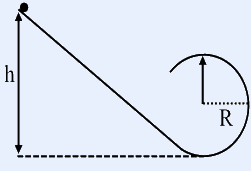
A smooth inclined plane ends in a vertical circular loop, as shown in the figure. A small body is released from height h as shown. If the body exerts a force of three times its weight on the plane at the highest point of circle then the height . The value of is _____ .
(1)
(2)
(3)
(4)
SolutionAnswer: Option 2
Approach:
A small body released from rest from height above the bottom of a smooth vertical loop of radius is observed to press the track at the top of the loop with . Newton's third law fixes the track's reaction on the body as directed toward the centre. Combining the radial equation at the top with energy conservation between the release point and the top of the loop gives in terms of .
Step 1:By Newton's third law, the track pushes the body with the same magnitude that the body pushes the track. With the body pressing with at the top, the track's normal reaction on the body is , directed radially inward (downward at the top).
Step 2:At the top, and gravity both point toward the loop centre. Apply Newton's second law in the radial direction.
Step 3:Measure from the bottom of the loop, per the figure. The top of the loop lies a height above the bottom.
Step 4:Energy conservation from rest at height to the top of the loop on smooth surfaces.
Step 5:Identify from .
Final answer:
Q33Single correctRotational Motion
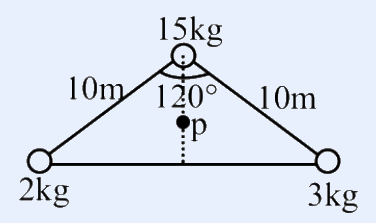
The position of center of mass of three masses 2 kg, 3 kg and 15 kg placed with respect to mid point (p) of normal bisector, as shown in the figure is _____ .
(1)
(2)
(3)
(4)
SolutionAnswer: Option 1
Approach:
Three point masses sit at the vertices of an isosceles triangle whose equal sides (10 m each) meet at the apex at , with 15 kg at the apex, 2 kg at the bottom-left vertex and 3 kg at the bottom-right vertex. Point p is the midpoint of the perpendicular from the apex to the base midpoint. Compute the centre of mass in a convenient frame at the base midpoint M, then translate to p.
Step 1:Geometry: with an apex angle of and equal sides of length 10 m, the perpendicular from the apex to the base has length m, and each half of the base equals m.
Step 2:Set the origin at the base midpoint M with the x-axis along the base and the y-axis upward. Then 2 kg lies at , 3 kg at and 15 kg at .
Step 3:Compute the x-coordinate of the centre of mass with respect to M.
Step 4:Compute the y-coordinate of the centre of mass with respect to M.
Step 5:Point is the midpoint of the segment from M (at ) to the apex (at ); hence lies at in the M-frame.
Step 6:Translate the centre of mass to the -frame.
Final answer:
Q34Single correctProperties of Solids and Liquids
The two wires A and B of equal cross-section but of different materials are joined together. The ratio of Young's modulus of wire A and wire B is 20/11. When the joined wire is kept under certain tension the elongations in the wires A and B are equal. If the length of wire A is 2.2 m , then the length of wire B is _____ m .
(1)
(2)
(3)
(4)
SolutionAnswer: Option 3
Approach:
Two wires of equal area but different Young's moduli are joined in series. The same tension acts on both segments. With elongations of A and B equal, the elongation formula directly relates their lengths to their Young's moduli.
Step 1:Write elongations of the two segments under common force and area .
Step 2:Impose and cancel .
Step 3:Substitute and , so .
Final answer:
Q35Single correctKinetic Theory of Gases
Two closed vessels of same volume are joined through a narrow tube and both vessels are filled with air of pressure 90 kPa and temperature 400 K. Keeping the temperature of one vessel constant at 400 K the second vessel temperature is raised to 500 K. The final pressure in the vessels is _____ kPa .
(1)
(2)
(3)
(4)
SolutionAnswer: Option 1
Approach:
Two identical vessels of volume are connected by a narrow tube, so the gas in both vessels shares a common pressure at all times. Because no gas is added or removed, the total number of moles is conserved between the initial and final states.
Step 1:Initially both vessels are at kPa and K, so the total initial moles are .
Step 2:In the final state both vessels share pressure ; vessel 1 remains at 400 K while vessel 2 is held at 500 K.
Step 3:Conservation of moles gives the working equation.
Step 4:Simplify the bracket.
Step 5:Solve for the final pressure.
Final answer:
Q36Single correctOptics
In interference experiment the path difference between two interfering waves at a point A on the screen is , where is the wavelength of these waves, and at another point B the path difference is . The ratio of intensities at points A and B is _____ .
(1)
(2)
(3)
(4)
SolutionAnswer: Option 3
Approach:
Two-source interference gives an intensity where . Compute the phase difference at A and B from the given path differences and take the ratio of intensities.
Step 1:Convert the given path differences to phase differences.
Step 2:Compute the intensity at A.
Step 3:Compute the intensity at B.
Step 4:Take the ratio.
Final answer:
Q37Single correctOscillations and Waves
A particle is executing simple harmonic motion. Its amplitude is A and time period is 5 sec. The time required by it to move from to is _____ sec.
(1)
(2)
(3)
(4)
SolutionAnswer: Option 3
Approach:
Choose the SHM solution that starts at the extreme position when : . Solve for the time at which x first equals and convert from phase to time using .
Step 1:Anchor the solution at when .
Step 2:Impose the condition and solve for the phase.
Step 3:Insert to convert phase to time.
Step 4:Substitute s.
Final answer:
Q38Single correctElectrostatics
A thin half ring of radius 35 cm is uniformly charged with a total charge of Q coulomb. If the magnitude of the electric field at centre of the half ring is 100V/m, then the value of Q is ______ nC . ( and )
(1)
(2)
(3)
(4)
SolutionAnswer: Option 12.14
Approach:
For a uniformly charged semicircular ring of radius R and total charge Q, integrating the perpendicular components of dE along the arc yields at the centre. Invert this to express Q in terms of the measured field.
Step 1:Use linear charge density and integrate the perpendicular components of from to .
Step 2:Solve for Q in terms of E, R, .
Step 3:Substitute , , , .
Step 4:Evaluate factor by factor.
Step 5:Round to two decimal places and convert to nC.
Final answer:
Q39Single correctElectronic Devices
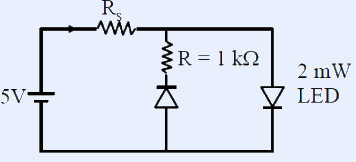
The maximum rated power of the LED is 2 mW and it is used in the circuit with input voltage of 5 V as shown in the figure below. The current through resistance is 0.5 mA . The minimum value of the resistance , to ensure that the LED is not damaged is ______ k.
(1)
(2)
(3)
(4)
SolutionAnswer: Option 22
Approach:
sets the current that reaches the LED branch. The problem states the series current through is 0.5 mA and asks for the smallest that still keeps the LED at or below its rated 2 mW. At the limit the LED dissipates exactly 2 mW, fixing its forward voltage; the remaining supply voltage drops across .
Step 1:At the rated operating point the entire 0.5 mA passes through the LED.
Step 2:Equate the LED power to its rating to find its forward voltage.
Step 3:Apply KVL to obtain the drop across .
Step 4:Ohm's law gives the minimum that keeps the LED at or below the rated 2 mW.
Final answer:
Q40Single correctElectromagnetic Waves
A point light source emits E.M. waves in free space. A detector, placed at a distance of Lm, measures the intensity as . The detector is now shifted to another location on the same spherical surface ensuring the angle between original location and new location as . The measured intensity at new location will be ____ .
(1)
(2)
(3)
(4)
SolutionAnswer: Option 2
Approach:
An isotropic point source in free space radiates uniformly in all directions, so the intensity depends only on the radial distance. Both detector positions sit on the same sphere centred on the source, hence at the same radial distance.
Step 1:For an isotropic source, the intensity at any field point depends only on the radial distance .
Step 2:Both detector positions lie on a sphere of radius centred on the source, hence at identical .
Step 3:Therefore the new intensity equals the original.
Final answer:
Q41Single correctOptics
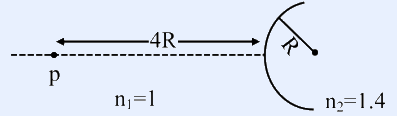
A spherical interface lens of radius R separates two media of refractive indices 1 and 1.4 respectively as shown in the figure below. A point source is placed at a distance of 4R in front of spherical interface. The magnitude of the magnification of point source image is ______ .
(1)
(2)
(3)
(4)
SolutionAnswer: Option 11.66
Approach:
A point source 4R in front of a convex spherical refracting surface (radius R; centre of curvature on the side, hence ) forms a single image. Use the single-surface refraction formula to find the image distance and the standard magnification formula for refraction at a single surface to obtain the lateral magnification.
Step 1:Adopt the Cartesian sign convention with light travelling left to right; object is on the left, so . The centre of curvature lies on the right (denser) side, giving .
Step 2:Substitute into the refraction equation.
Step 3:Solve for .
Step 4:Compute the lateral magnification.
Step 5:Take the magnitude.
Final answer:
Q42Single correctMagnetic Effects of Current and Magnetism
A small cube of side 1 mm is placed at the centre of a circular loop of radius 10 cm carrying a current of 2 A. The magnetic energy stored inside the cube is J. The value of is ______. ( Tm / A, )
(1)
(2)
(3)
(4)
SolutionAnswer: Option 16.28
Approach:
The cube ( side) sits at the centre of a circular loop carrying 2 A, where the field is uniform to a very good approximation on the cube's scale (1 mm vs loop radius 100 mm). Compute the central field, the magnetic energy density , and multiply by the cube's volume to get the stored energy.
Step 1:Compute the magnetic field at the centre of the loop.
Step 2:Compute the magnetic energy density.
Step 3:Volume of the cube of side 1 mm.
Step 4:Multiply density and volume.
Step 5:Match with .
Final answer:
Q43Single correctElectromagnetic Induction and Alternating Currents
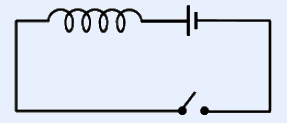
An inductor of inductance 10 mH having resistance of 100 is connected to battery of E.M.F. 1.0 V through a switch as shown in the figure below. After switch is closed, the ratio of instantaneous voltages across the inductor when the current passing through it is 2 mA and 4 mA is ______.
(1)
(2)
(3)
(4)
SolutionAnswer: Option 14/3
Approach:
In a series RL circuit driven by a battery of emf , Kirchhoff's voltage law gives the instantaneous voltage across the inductor as . Evaluate this at the two prescribed currents and take the ratio.
Step 1:Write the instantaneous inductor voltage.
Step 2:Evaluate at with V and .
Step 3:Evaluate at .
Step 4:Take the ratio.
Final answer:
Q44Single correctAtoms and Nuclei
The ratio of momentum of the photons of the 1 and 2 line of Balmer series of Hydrogen atoms is . The possible values of and are :
(1)
(2)
(3)
(4)
SolutionAnswer: Option 420 and 27
Approach:
The first and second Balmer lines correspond to and respectively. The Rydberg formula gives for each line. Since the photon momentum is , the momentum ratio equals the wavenumber ratio.
Step 1:Wavenumber of the first Balmer line ().
Step 2:Wavenumber of the second Balmer line ().
Step 3:Take the ratio using .
Step 4:Identify and .
Final answer:
Q45Single correctElectromagnetic Induction and Alternating Currents
A LCR series circuit driven with = 90V at frequency = 30Hz has resistance R = 80, an inductance with inductive reactance = 20.0 and capacitance with capacitive reactance = 80.0. The power factor of the circuit is ____ .
(1)
(2)
(3)
(4)
SolutionAnswer: Option 10.8
Approach:
The power factor of a series LCR circuit equals where . Substitute the given resistance and reactances directly.
Step 1:Compute the net reactance.
Step 2:Compute the impedance.
Step 3:Compute the power factor.
Final answer:
Q46NumericalCurrent Electricity
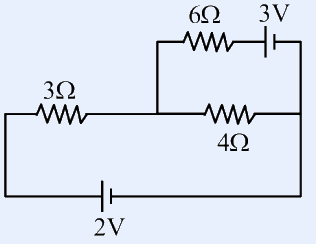
Refer to the circuit diagram given below. The heat generated across the 6 resistance in 100 second is J. The value of is ______. (Nearest integer)
SolutionAnswer: 3477
Approach:
The network has two batteries (2 V on the bottom, 3 V in series with the 6 in the top branch) and three resistors (3 , 6 , 4 ). Apply mesh analysis with mesh currents in the loop containing the 2 V, 3 and 4 , and in the loop containing the 4 , 6 and 3 V. Solve for (the current through the 6 branch) and compute .
Step 1:Define mesh currents (left loop, clockwise) and (right loop, clockwise). The 4 resistor is shared and carries in the direction of . Apply KVL around the left loop containing the 2 V source, 3 and 4 .
Step 2:Apply KVL around the right loop containing the 4 , 6 and 3 V (with the 3 V source opposing as indicated by the polarity in the figure).
Step 3:From mesh 1, . Substitute into mesh 2.
Step 4:Multiply by 7 and solve for .
Step 5:The current through the 6 resistor equals . Compute the Joule heat over 100 s.
Step 6:Match the prescribed form .
Final answer:
Q47NumericalOptics
An unpolarized light of intensity passes through polarizer and then through a certain optically active solution and finally it goes to analyser. If the angle between analyser and polariser is and intensity of light emerged from analyser is , the angle of rotation of the light by the solution with respect to analyser is ______ degrees.
SolutionAnswer: 30
Approach:
Track the intensity after each optical element. Unpolarized light loses half its intensity at the polarizer; the optically active solution rotates the polarization plane by an angle without altering intensity; Malus's law at the parallel analyser sets the final intensity.
Step 1:After the polarizer the intensity is halved and the light is linearly polarized along the polarizer axis.
Step 2:The optically active solution rotates the polarization direction by an angle but leaves intensity unchanged.
Step 3:The analyser is parallel to the polarizer ( between them), so the angle between the rotated polarization and the analyser axis is . Apply Malus's law.
Step 4:Solve for .
Final answer:
Q48NumericalAtoms and Nuclei
The energy released when kg of is converted into by proton bombardment is eV. The value of is _____. (Nearest integer) (Mass of u , mass of u , mass of proton = 1.008u and 1u = 931 MeV/ and Avogadro number = )
SolutionAnswer: 6
Approach:
Identify the reaction (proton bombardment of produces two nuclei by mass and charge balance). Find the mass defect per reaction and convert to energy using . Multiply by the total number of nuclei in the given sample to get the total energy.
Step 1:Reaction (mass and charge balanced: and ).
Step 2:Mass defect per reaction.
Step 3:Convert mass defect to energy per reaction.
Step 4:Count the nuclei in . With molar mass , the number of moles is .
Step 5:Total energy released.
Step 6:Match (nearest integer).
Final answer:
Q49NumericalElectrostatics
A three coulomb charge moves from the point (0, 2, 5) to the point (5, 1, 2) in an electric field expressed as N / C. The work done in moving the charge is _____ J.
SolutionAnswer: 186
Approach:
Each component of depends only on the corresponding coordinate, so is conservative and the line integral separates into three one-dimensional integrals along the coordinate axes. Multiply by the charge to get the work done by the field.
Step 1:Because depends only on x, only on y, and only on z, is conservative and the line integral is path-independent; choose axis-aligned segments.
Step 2:Evaluate the -integral.
Step 3:Evaluate the -integral.
Step 4:Evaluate the -integral.
Step 5:Sum the contributions and multiply by the charge.
Final answer:
Q50NumericalProperties of Solids and Liquids
A certain gas is isothermally compressed to of its initial volume ( = 3 litre) by applying required pressure. If the bulk modulus of the gas is 3 1 N/, the magnitude of work done on the gas is ___ J.
SolutionAnswer: 600
Approach:
The problem treats the bulk modulus B as a constant characterizing the gas during compression. The change in volume is . The magnitude of the work done on the gas is taken as .
Step 1:Compute the magnitude of the volume change.
Step 2:Insert .
Final answer:
Chemistry25 questions
Q51Single correctSome Basic Concepts in Chemistry
An oxide of iron contains % iron, its empirical formula, is: (Given : Molar mass of Fe and O are 56 and respectively.)
(1)
(2)
(3)
(4)
SolutionAnswer: Option 2
Approach:
The mass percentages of Fe and O are given; the target is the empirical formula. The method is to take 100 g of the oxide, convert masses to moles using the molar masses, divide by the smaller mole count, and scale to the nearest integers.
Step 1:Take 100 g of the oxide so percent values become masses in grams.
Step 2:Convert each mass to moles using the supplied molar masses.
Step 3:Divide both mole counts by the smaller value to find the relative ratio.
Step 4:Multiply both sides by 2 to clear the non-integer second term.
Step 5:Write the empirical formula from the integer subscripts.
Final answer:
Q52Single correctAtomic Structure
If shortest wavelength of hydrogen atom in Lyman series is x, then longest wavelength in Balmer series of is:
(1)
(2)
(3)
(4)
SolutionAnswer: Option 1
Approach:
The Rydberg formula gives wavelengths for hydrogen-like ions in terms of the principal quantum numbers and nuclear charge. Apply it to the Lyman-series limit of H (shortest ) and to the first Balmer line of (longest Balmer ), then take the ratio to eliminate .
Step 1:Identify the transition for the shortest Lyman wavelength of H: lower level , upper level , .
Step 2:Identify the transition for the longest Balmer wavelength of : lower level , upper level (smallest energy gap within the Balmer series), .
Step 3:Evaluate the bracket and simplify.
Step 4:Substitute from step 1.
Step 5:Invert to obtain .
Final answer:
Q53Single correctAtomic Structure
Match the LIST-I with LIST-II
| List-I (Orbital) | List-II (Radial nodes and nodal plane) |
|---|---|
| A. 2s | I. 1 Radial node + two nodal planes |
| B. 3s | II. 1 Radial node + one nodal plane |
| C. 3p | III. 2 Radial nodes + No nodal plane |
| D. 4d | IV. 1 Radial node + No nodal plane |
(1)
(2)
(3)
(4)
SolutionAnswer: Option 4A-IV, B-III, C-II, D-I
Approach:
For each orbital, compute the number of radial nodes from and the number of angular nodal planes from , then match to the descriptions in List-II.
Step 1:For 2s, and . Compute radial nodes and angular nodal planes.
Step 2:For 3s, and .
Step 3:For 3p, and .
Step 4:For 4d, and .
Step 5:Collect the four matches into a single set.
Final answer: A-IV, B-III, C-II, D-I
Q54Single correctChemical Bonding and Molecular Structure
The pairs among that do not have similar Lewis dot structure are
(1)
(2)
(3)
(4)
SolutionAnswer: Option 2A and E
Approach:
For each pair, count total valence electrons and decide whether the two species draw to the same Lewis dot pattern (same skeleton, same lone-pair distribution, same bond orders). The pairs that fail this isoelectronic / isostructural test are the answer.
Step 1:Pair A: has valence , S with one lone pair, pyramidal. has valence , C with no lone pair, trigonal planar. Different electron counts and different lone-pair counts on central atom.
Step 2:Pair B: has valence ; one OO single bond, three lone pairs on each O. has valence ; one FF single bond, three lone pairs on each F. Same Lewis pattern.
Step 3:Pair C: has valence ; CN triple bond with one lone pair on each terminal. CO has valence ; CO triple bond with one lone pair on each terminal.
Step 4:Pair D: has valence ; three NH bonds with one lone pair on N (pyramidal). has valence ; three OH bonds with one lone pair on O (pyramidal).
Step 5:Pair E: has Cr in (); the dot structure has two CrO and two Cr in equivalent resonance, no d-electron on metal. has Mn in formal oxidation state but Mn is one position to the right of Cr, so the species carries one extra electron at the metal centre (). The dot patterns therefore differ in electron count on Mn.
Step 6:Collect the dissimilar pairs.
Final answer: A and E
Q55Single correctChemical Thermodynamics
Arrange the following isothermal processes in order of the magnitude of the work involved between states 1 and 2.
A. Expansion in single stage .
B. Expansion in multi stages .
C. Compression in single stage .
D. Compression in multi stages .
Choose the correct option.
A. Expansion in single stage .
B. Expansion in multi stages .
C. Compression in single stage .
D. Compression in multi stages .
Choose the correct option.
(1)
(2)
(3)
(4)
SolutionAnswer: Option 3
Approach:
Between fixed initial and final states the work magnitude is the area of the corresponding rectangle (or staircase) on a - plot. The single-stage compression rectangle sits highest above the isotherm and the single-stage expansion rectangle lowest below it; multi-stage paths approach the reversible isotherm from above (compression) and below (expansion). Rank the four areas accordingly.
Step 1:Single-stage compression (C) uses the highest external pressure throughout, so its rectangle on the p-V diagram has the largest area above the isotherm.
Step 2:Multi-stage compression (D) replaces the single rectangle with a staircase that hugs the isotherm from above; its area is smaller than but still exceeds the reversible value .
Step 3:Multi-stage expansion (B) is a staircase below the isotherm that approaches the reversible value from below; its area exceeds that of single-stage expansion.
Step 4:Single-stage expansion (A) is performed against the lowest external pressure , giving the smallest rectangle below the isotherm.
Step 5:Combine the four inequalities.
Final answer:
Q56Single correctSolutions
When 0.25 moles of a non-volatile, non-ionizable solute was dissolved in 1 mole of a solvent the vapour pressure of solution was % of vapour pressure of pure solvent. What is % ?
(1)
(2)
(3)
(4)
SolutionAnswer: Option 4
Approach:
For a non-volatile, non-ionising solute the solution vapour pressure equals the solvent mole fraction times the pure-solvent vapour pressure (Raoult's law). Compute the solvent mole fraction from the given mole counts and express it as a percentage.
Step 1:Insert the given mole counts ( mol, mol) into the mole fraction.
Step 2:Evaluate the ratio.
Step 3:From Raoult's law the ratio equals .
Step 4:Convert to a percentage.
Final answer:
Q57Single correctEquilibrium
One mole each of He and A(g) are taken in a 10 L closed flask and heated to 400 K to establish the following equilibrium. . for this reaction at 400 K is 4.0. The partial pressures (in atm) of He and B(g) are respectively (at equilibrium) (Assume He, A(g) and B(g) behave as ideal gases) (Given : )
(1)
(2)
(3)
(4)
SolutionAnswer: Option 13.28, 2.624
Approach:
He is inert and obeys directly. For the equilibrium with the equilibrium-constant expression in molarities yields [B] from ; converting [B] to partial pressure uses .
Step 1:Compute the partial pressure of He, which is unaffected by the chemical equilibrium because it is inert.
Step 2:Compute the initial concentration of A.
Step 3:Let y be the equilibrium concentration of B. Then at equilibrium. Substitute into .
Step 4:Solve for .
Step 5:Convert [B] to partial pressure via .
Step 6:Assemble the (He, B) pressure pair.
Final answer: 3.28, 2.624
Q58Single correctRedox Reactions and Electrochemistry
Consider the following data.
Electrolyte | (in ) |
| |
| |
| |
is sparingly soluble in water. If the conductivity of the saturated solution is then the solubility product of can be given as (Here )
Electrolyte | (in ) |
| |
| |
| |
is sparingly soluble in water. If the conductivity of the saturated solution is then the solubility product of can be given as (Here )
(1)
(2)
(3)
(4)
SolutionAnswer: Option 1
Approach:
Build of by combining the three tabulated electrolytes via Kohlrausch's law (cancelling and C ion conductivities). Convert the saturated-solution conductivity to molar solubility using , then square because BaS is a 1:1 salt.
Step 1:Combine the three electrolytes so that the ion conductivities of and C cancel: has the net composition .
Step 2:Convert the conductivity S c into molar solubility. The factor of 1000 arises because uses c for volume whereas solubility is in mol (1 L = 1000 c).
Step 3:BaS dissociates 1:1 into B and SO, so .
Step 4:Expand the square.
Final answer:
Q59Single correctp-Block Elements
Given below are two statements: Statement I: Aluminium is more electropositive than thallium as the standard electrode potential value of is negative and is positive. Statement II: The sum of first three ionization enthalpies of boron is very high when compared to that of aluminium. Due to this reason boron forms covalent compounds only and aluminium forms ion. In the light of the above statements, choose the correct answer from the options given below
(1)
(2)
(3)
(4)
SolutionAnswer: Option 1Both Statement I and Statement II are true
Approach:
Statement I is checked against the standard electrode potentials of A/Al and T/Tl and the rule that the more negative corresponds to the more electropositive metal. Statement II is checked against the sum of the first three ionisation enthalpies of B and Al and the resulting Fajan / energetics argument for covalent vs ionic behaviour.
Step 1:Standard electrode potentials: V (negative) and V (positive). The positive value for T/Tl follows from the inert-pair effect, which destabilises T relative to T.
Step 2:Therefore Statement I, which asserts both signs and the electropositive ordering, is correct.
Step 3:Standard sums of the first three ionisation enthalpies (kJ mo): B , Al . B's much smaller size and absence of inner d-shielding push its sum well above Al's.
Step 4:The energy released on hydration/lattice formation by A (high charge density) can offset the 5137 kJ mo ionisation cost, so A is observed in ionic solids such as Al and in aqueous A. For B the 6887 kJ mo cost is too large for hydration/lattice energy to recover, so B is restricted to covalent compounds (B, BC, ).
Step 5:Both statements are independently true; the correct option is the one stating so.
Final answer: Both Statement I and Statement II are true
Q60Single correctd- and f-Block Elements
The correct statements among the following are. A. Basic vanadium oxide is used in the manufacture of . B. The spin-only magnetic moment value of the transition metal halide employed in Ziegler-Natta polymerization is 2.84 BM . C. The p-block metal compound employed in Ziegler-Natta polymerization has the metal in oxidation state. D. The number of electrons present in the outer most ' d ' orbital of metal halide employed in Wacker process is 8 . Choose the correct answer from the options given below:
(1)
(2)
(3)
(4)
SolutionAnswer: Option 3C and D Only
Approach:
Evaluate each statement against the standard catalysts in the named industrial processes: contact process for , Ziegler-Natta polymerisation, and Wacker oxidation.
Step 1:Statement A: the catalyst for the contact process is , which is acidic/amphoteric, not basic. The claim of a basic vanadium oxide as the contact-process catalyst is therefore wrong.
Step 2:Statement B: the Ziegler-Natta transition-metal halide is (Ti in +4 oxidation state, configuration ). With unpaired electrons, the spin-only magnetic moment is BM, not 2.84 BM.
Step 3:Statement C: the p-block co-catalyst in Ziegler-Natta polymerisation is triethylaluminium, , with Al in the +3 oxidation state.
Step 4:Statement D: the Wacker process uses (with as re-oxidant). Pd is in the +2 oxidation state with configuration , so the outermost d orbital contains 8 electrons.
Step 5:Combine the verdicts.
Final answer: C and D Only
Q61Single correctCoordination Compounds
Match the LIST-I with LIST-II
| List-I (Electronic configuration of tetrahedral metal ion) | List-II (Crystal Field Stabilization Energy ) |
|---|---|
| A. | I. |
| B. | II. |
| C. | III. |
| D. | IV. |
(1)
(2)
(3)
(4)
SolutionAnswer: Option 3A-III, B-IV, C-I, D-II
Approach:
In a tetrahedral field the lower set e stabilises each electron by while the upper set destabilises each electron by . Fill the orbitals in the high-spin order (e first, then , pairing only after both sets are singly occupied) and sum CFSE for each configuration, then match to List-II.
Step 1: in a tetrahedral field has configuration (both electrons in the lower set, each contributing ).
Step 2: high-spin tetrahedral has configuration .
Step 3: tetrahedral has configuration .
Step 4: is the remaining row. The standard high-spin tetrahedral configuration gives , which is not present in List-II. Among the available entries the one not yet assigned is I (); this pairing is fixed by elimination of the other three rows.
Step 5:Assemble the mapping.
Final answer: A-III, B-IV, C-I, D-II
Q62Single correctCoordination Compounds
Which of the following are true about the energy of the given d-orbitals of a tetrahedral complex? A. . B. . C. . D. . Choose the correct answer from the given below:
(1)
(2)
(3)
(4)
SolutionAnswer: Option 1A, B and D only
Approach:
In a tetrahedral field the d-orbitals split into a lower e set ( and , degenerate at ) and an upper set (, and , degenerate at ). Test each statement against this ordering.
Step 1:Group the d-orbitals into the two sets.
Step 2:Statement A asserts . Both and are in (equal) and is in e (lower). Both parts hold.
Step 3:Statement B asserts . Both and are in (equal) and is in e (lower). Both parts hold.
Step 4:Statement C asserts . Since and are degenerate e members, the strict inequality is false. Also (a member) is higher in energy than either e member, so the second inequality is reversed.
Step 5:Statement D asserts . Both e members are degenerate and lower than every member; this is exactly the tetrahedral splitting.
Step 6:Collect the true statements.
Final answer: A, B and D only
Q63Single correctPurification and Characterisation of Organic Compounds
value for 2-methylpropene in a solvent system (Ethyl acetate + ether) is 0.42 . 2-methylpropene is treated with dilute to give major organic product (X). value for (X) in the same solvent system under identical condition will be:
(1)
(2)
(3)
(4)
SolutionAnswer: Option 40.12
Approach:
Identify the major product of acid-catalysed hydration of 2-methylpropene (Markovnikov addition via the more stable carbocation), compare its polarity to the starting alkene, and use the silica-stationary-phase rule that polar solutes are more strongly retained and therefore travel less far.
Step 1:Hydration of 2-methylpropene with dilute proceeds via the more stable carbocation , giving the Markovnikov product tert-butyl alcohol.
Step 2:Compare polarities. The alkene has only -electrons (weakly polar), while tert-butyl alcohol carries an group capable of hydrogen bonding to silica (highly polar).
Step 3:On a polar silica TLC plate, the more polar solute is retained more strongly, advances less with the solvent front, and therefore has a smaller .
Step 4:Among the four supplied option values , only is below .
Final answer: 0.12
Q64Single correctSome Basic Principles of Organic Chemistry
Given below are two statements:
Statement I: 2,6-diethylcyclohexanone and 6-methyl-2-n-propylcyclohexanone are metamers.
Statement II: 2,2,6,6 - tetramethylcyclohexanone exhibits keto-enol tautomerism.
In the light of the above statements, choose the correct answer from the options given below
Statement I: 2,6-diethylcyclohexanone and 6-methyl-2-n-propylcyclohexanone are metamers.
Statement II: 2,2,6,6 - tetramethylcyclohexanone exhibits keto-enol tautomerism.
In the light of the above statements, choose the correct answer from the options given below
(1)
(2)
(3)
(4)
SolutionAnswer: Option 3Statement I is true but Statement II is false
Approach:
For Statement I, derive the molecular formulae of the two ketones and verify that they share the carbonyl functional group with different alkyl distributions around it (definition of metamerism). For Statement II, identify the -carbons of 2,2,6,6-tetramethylcyclohexanone and check whether any -H remains for enolisation.
Step 1:Build the molecular formula of 2,6-diethylcyclohexanone. The cyclohexanone ring is ; adding two ethyl groups (net after removing two ring H) gives .
Step 2:Build the molecular formula of 6-methyl-2-n-propylcyclohexanone. Methyl + n-propyl add to .
Step 3:Both are ketones with the same C=O functional group, with the two -positions carrying different alkyl groups (Et/Et versus Me/n-Pr), satisfying the metamerism criterion.
Step 4:Identify -carbons in 2,2,6,6-tetramethylcyclohexanone: and (the two ring carbons adjacent to the carbonyl). Each bears two methyl groups and is bonded to the ring on the remaining two positions, leaving zero hydrogen on either -carbon.
Step 5:Keto-enol tautomerism requires removal of an -H to form the enol . With zero -H, enolisation cannot occur.
Step 6:Combine: Statement I true, Statement II false.
Final answer: Statement I is true but Statement II is false
Q65Single correctHydrocarbons
Given below are two statements:
Statement I: Methane can be prepared by decarboxylation of sodium ethanoate, Kolbe's electrolysis of sodium acetate and reaction of with water.
Statement II: Methane cannot be prepared from unsaturated hydrocarbons and by Wurtz reaction.
In the light of the above statements, choose the correct answer from the options given below
Statement I: Methane can be prepared by decarboxylation of sodium ethanoate, Kolbe's electrolysis of sodium acetate and reaction of with water.
Statement II: Methane cannot be prepared from unsaturated hydrocarbons and by Wurtz reaction.
In the light of the above statements, choose the correct answer from the options given below
(1)
(2)
(3)
(4)
SolutionAnswer: Option 4Statement I is false but Statement II is true
Approach:
Write the product of each named reaction on sodium acetate / methyl-Grignard / methyl halide and decide whether each preparation listed in the two statements yields methane.
Step 1:Test the first sub-claim of Statement I — soda-lime decarboxylation of sodium acetate. The product is methane.
Step 2:Test the second sub-claim — Kolbe's electrolysis of sodium acetate. Two methyl radicals couple at the anode, giving ethane rather than methane.
Step 3:The presence of one false sub-claim makes Statement I false even though the third sub-claim () is valid.
Step 4:For Statement II, reduction of unsaturated hydrocarbons preserves the carbon skeleton, so the smallest possible alkane product has ; methane (n=1) cannot be obtained this way.
Step 5:The Wurtz reaction couples two alkyl halides, so the smallest alkane it can produce (from ) is ethane. Methane cannot be made by Wurtz.
Step 6:Combine the verdicts: Statement I false, Statement II true.
Final answer: Statement I is false but Statement II is true
Q66Single correctHydrocarbons
Given below are two statements:
Statement I: 3-phenylpropene reacts with HBr and gives secondary alkyl bromide having a chiral carbon atom as the major product.
Statement II: Aryl chlorides and aryl cyanides can be prepared by Sandmeyer reaction as well as Gattermann reaction.
In the light of the above statements, choose the correct answer from the options given below
Statement I: 3-phenylpropene reacts with HBr and gives secondary alkyl bromide having a chiral carbon atom as the major product.
Statement II: Aryl chlorides and aryl cyanides can be prepared by Sandmeyer reaction as well as Gattermann reaction.
In the light of the above statements, choose the correct answer from the options given below
(1)
(2)
(3)
(4)
SolutionAnswer: Option 3Statement I is true but Statement II is false
Approach:
For Statement I, identify the major HBr-addition product of 3-phenylpropene by selecting the most stable carbocation intermediate (benzylic), then check whether the brominated carbon is secondary and chiral. For Statement II, compare the substrate scope of the Sandmeyer (CuCl/CuBr/CuCN) and Gattermann (Cu/HCl or Cu/HBr) reactions.
Step 1:Protonation of 3-phenylpropene at the terminal carbon gives a benzylic carbocation , which is far more stable than the alternative non-benzylic cation. Bromide attacks the benzylic carbon.
Step 2:The brominated carbon is attached to Ph, Br, and H — four different substituents — so it is a chiral centre.
Step 3:The same brominated carbon is bonded to two carbons (the phenyl ring carbon and the methylene of the ethyl group) plus one H, so it is a secondary carbon.
Step 4:Sandmeyer scope: reacting with CuCl, CuBr or CuCN gives ArCl, ArBr or ArCN respectively, so the reaction covers both aryl halides and aryl cyanides.
Step 5:Gattermann scope: using Cu powder in HCl or HBr converts to ArCl or ArBr only. There is no CuCN / HCN variant; aryl cyanides are not obtained by Gattermann.
Step 6:Because Gattermann fails for cyanides, Statement II is false.
Step 7:Combine the verdicts: Statement I true, Statement II false.
Final answer: Statement I is true but Statement II is false
Q67Single correctSome Basic Principles of Organic Chemistry
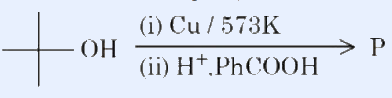
Consider the following sequence of reactions.
The major product P is:
The major product P is:
(1)
(2)
(3)
(4)
SolutionAnswer: Option 3
Approach:
tert-Butanol has no -hydrogen on the carbinol carbon, so Cu/573 K cannot dehydrogenate it; instead it dehydrates to isobutylene. Protonation of isobutylene in step (ii) regenerates the tertiary carbocation, which is captured by benzoate, yielding tert-butyl benzoate.
Step 1:Identify the substrate: is a tertiary alcohol with no hydrogen on the carbon bearing the OH group, so the standard Cu/573 K dehydrogenation pathway (which removes the -C-H and the O-H to give a carbonyl) is unavailable.
Step 2:In step (ii), benzoic acid provides a proton. Markovnikov addition places the proton on the terminal of isobutylene, generating the very stable tertiary cation.
Step 3:The benzoate anion () attacks the tertiary carbocation at oxygen, forming the C-O bond of an ester.
Step 4:Match P with the structural options. Options (1) and (2) are aromatic carboxylic acids that cannot arise from a tert-butanol+PhCOOH coupling. Option (4) (allyl benzoate) would require an allylic cation, which is not formed here. Only option (3), , matches the deduced structure.
Final answer: (tert-butyl benzoate)
Q68Single correctSome Basic Principles of Organic Chemistry
Arrange the following compounds according to increasing order of boiling points.
(1)
(2)
(3)
(4)
SolutionAnswer: Option 3
Approach:
All four compounds have similar molar masses, so boiling-point differences are dominated by intermolecular hydrogen bonding. Rank the strength of H-bonding: none (alkane) one N–H per molecule ( amine) two N–H per molecule ( amine) strong O–H...O ( alcohol).
Step 1:C = n-butane has no H-bond donor, only London dispersion forces; the lowest boiling point of the four (tabulated ).
Step 2:D = diethylamine is a secondary amine with only one N–H donor per molecule, giving weak hydrogen-bonded networks (tabulated ).
Step 3:B = n-butylamine is a primary amine with two N–H donors per molecule, so H-bonding is stronger than in D (tabulated ).
Step 4:A = n-butan-1-ol has O–H...O hydrogen bonds, which are markedly stronger than N–H...N because O is more electronegative, giving the highest boiling point (tabulated ).
Step 5:Assemble the increasing-order sequence.
Final answer:
Q69Single correctSome Basic Principles of Organic Chemistry
Match the LIST-I with LIST-II
Choose the correct answer from the options given below:
Choose the correct answer from the options given below:
| List-I (Deficiency Disease) | List-II (Vitamin) |
|---|---|
| A. Scurvy | I. Pyridoxine |
| B. Convulsions | II. Vitamin A |
| C. Cheilosis | III. Ascorbic Acid |
| D. Xerophthalmia | IV. Riboflavin |
(1)
(2)
(3)
(4)
SolutionAnswer: Option 3A-III, B-I, C-IV, D-II
Approach:
Pair each deficiency disease with the vitamin whose absence is the established cause, using standard biochemistry assignments.
Step 1:A — Scurvy is caused by chronic deficiency of vitamin C, the chemical name of which is ascorbic acid.
Step 2:B — Convulsions are linked to deficiency of vitamin , the chemical name pyridoxine.
Step 3:C — Cheilosis (cracking at the corners of the mouth) is associated with deficiency of vitamin , the chemical name riboflavin.
Step 4:D — Xerophthalmia (dryness of cornea / conjunctiva) is caused by deficiency of vitamin A.
Step 5:Combine the four pairings.
Final answer: A-III, B-I, C-IV, D-II
Q70Single correctSome Basic Principles of Organic Chemistry
Match the LIST-I with LIST-II
Choose the correct answer from the options given below:
Choose the correct answer from the options given below:
| List-I (Amino acid) | List-II (Positive reaction/Test for functional group present in side chain of amino acid) |
|---|---|
| A. Glutamine | I. Hinsberg's test |
| B. Lysine | II. Neutral test |
| C. Tyrosine | III. Ceric ammonium nitrate test |
| D. Serine | IV. Hoffman bromamide degradation |
(1)
(2)
(3)
(4)
SolutionAnswer: Option 2A-IV, B-I, C-II, D-III
Approach:
Identify the dominant functional group in the side chain of each amino acid, then match it to the chemical test whose positive response is diagnostic of that group: primary amide Hoffmann bromamide; primary amine Hinsberg; phenol neutral FeC; alcohol ceric ammonium nitrate (CAN).
Step 1:A — Glutamine has the side chain , which contains a primary amide. Hoffmann bromamide degradation acts on primary amides ().
Step 2:B — Lysine has the side chain , a primary amine. The Hinsberg test (PhSCl in aq. NaOH) is the classic test for primary amines, yielding an alkali-soluble sulfonamide.
Step 3:C — Tyrosine carries a p-hydroxyphenyl side chain (), i.e. a phenolic group. Neutral gives the characteristic violet/blue colour with phenols.
Step 4:D — Serine has the side chain , a primary aliphatic alcohol. Ceric ammonium nitrate gives a red colouration with alcohols.
Step 5:Combine the four pairings.
Final answer: A-IV, B-I, C-II, D-III
Q71NumericalClassification of Elements and Periodicity in Properties
First and second ionization enthalpies of lithium are and respectively. Energy required to convert 3.5 mg lithium (g) into is ____ kJ. (nearest integer) [Molar mass of ]
SolutionAnswer: 4
Approach:
The given mass and molar mass yield the number of moles of Li(g). Converting one mole of Li(g) all the way to L(g) costs the sum of the first and second ionisation enthalpies. Multiply the two.
Step 1:Convert 3.5 mg to grams: .
Step 2:Compute moles of Li using with .
Step 3:Add the first two ionisation enthalpies to get the energy needed per mole.
Step 4:Multiply moles by energy per mole.
Step 5:Round to the nearest integer.
Final answer:
Q72NumericalSome Basic Principles of Organic Chemistry
Consider the following sequence of reactions.
Yellow Product (X).
The percentage of nitrogen in the yellow product (X) formed is ____ %. (Nearest Integer)
(Given Molar mass in )
Yellow Product (X).
The percentage of nitrogen in the yellow product (X) formed is ____ %. (Nearest Integer)
(Given Molar mass in )
SolutionAnswer: 21
Approach:
Identify the yellow rearrangement product of diazoaminobenzene on warming with aniline / HCl as p-aminoazobenzene, derive its molecular formula, then compute the mass percentage of nitrogen.
Step 1:Diazoaminobenzene in the presence of aniline and HCl on warming (40-45 C) undergoes intramolecular rearrangement. The terminal unit attacks the para position of one of the aniline rings, generating yellow p-aminoazobenzene.
Step 2:Count atoms in X: two phenyl rings (12 C, 9 H including the 4+5 ring H's after substitution), one azo linkage, and one terminal (2 H). Total: 12 C, 11 H, 3 N.
Step 3:Compute molar mass.
Step 4:Apply the percent-nitrogen formula.
Step 5:Round to the nearest integer.
Final answer:
Q73NumericalHydrocarbons
4.7 g of phenol is heated with Zn to give product X. If this reaction goes to % completion then the number of moles of compound X formed will be ____ . (Nearest Integer)
(Given molar mass in )
(Given molar mass in )
SolutionAnswer: 3
Approach:
Phenol on heating with zinc dust is reductively deoxygenated to benzene with 1:1 stoichiometry. Compute moles of phenol from the given mass and molar mass, apply the 60% conversion factor, and read off the coefficient of .
Step 1:Compute the molar mass of phenol .
Step 2:Compute initial moles of phenol.
Step 3:The phenol-to-benzene stoichiometry is 1:1; applying % conversion gives the moles of X (benzene) formed.
Step 4:Express in the form .
Final answer:
Q74NumericalChemical Kinetics
Sucrose hydrolyses in acidic medium into glucose and fructose by first order rate law with hour. The percentage of sucrose remaining after 6 hours is ____ . (Nearest integer)
(Given : and )
(Given : and )
SolutionAnswer: 25
Approach:
For a first-order reaction, the fraction of reactant left after n half-lives is . Find how many half-lives fit into 6 hours and convert to percentage.
Step 1:Compute the number of half-lives.
Step 2:Apply the first-order decay law for an integer number of half-lives.
Step 3:Convert to a percentage.
Step 4:Round to the nearest integer.
Final answer:
Q75NumericalChemical Thermodynamics
Consider the reaction at 300 K. If and K are and at the same temperature, then the magnitude of for the reaction in is ____ . (Nearest integer)
(Given : )
(Given : )
SolutionAnswer: 34
Approach:
Compute from the given K using the supplied values, then apply (in consistent J units) to extract , and report its magnitude.
Step 1:Express using .
Step 2:Combine with the factor to get .
Step 3:Convert to natural logarithm using .
Step 4:Compute in J mo.
Step 5:Convert to J mo and substitute into the Gibbs equation.
Step 6:Solve for .
Step 7:Take the magnitude as requested.
Final answer:
Mathematics25 questions
Q1Single correctSets, Relations and Functions
Let denote the greatest integer function. If the domain of the function is , then is equal to :
(1)
(2)
(3)
(4)
SolutionAnswer: Option 25
Approach:
Find values of x for which the argument of arcsine lies in [-1,1], using piecewise behaviour of the greatest integer function.
Step 1:Translate the arcsine constraint into an inequality on .
Step 2:On the interval with , write .
Step 3:Require to overlap , giving and .
with , so
Step 4:Check each n. For , gives all in . For , gives . For , gives .
Step 5:Identify and compute .
Final answer: 5
Q2Single correctComplex Numbers and Quadratic Equations
Let one root of the quadratic equation in x : be twice the other. Then the length of the latus rectum of the parabola is equal to:
(1)
(2)
(3)
(4)
SolutionAnswer: Option 412
Approach:
Use Vieta with roots to determine k, then read off the latus rectum of .
Step 1:Let the roots be and . Apply Vieta with .
Step 2:Square the sum-of-roots relation and combine with the product relation.
Step 3:Substitute and solve for .
Step 4:The parabola becomes , so .
Final answer: 12
Q3Single correctCo-ordinate Geometry
Let and be two distinct roots of the equation . Let the sets , and . Then is equal to:
(1)
(2)
(3)
(4)
SolutionAnswer: Option 326
Approach:
Use and with the eccentricity range for each conic to find the admissible a-intervals.
Step 1:Case 1: both roots are hyperbola eccentricities, so with product . Each must lie in .
Step 2:Sum on . Endpoints give at or ; minimum at gives . Distinct roots require strict inequality.
Step 3:Case 2: (ellipse) and (hyperbola). Examine on .
Step 4:Compute end-behaviour: as , ; as , .
Step 5:Combine the three boundary values.
Final answer: 26
Q4Single correctComplex Numbers and Quadratic Equations
Let the set of all values of such that the equation , has at least one solution, be the interval . Then is equal to :
(1)
(2)
(3)
(4)
SolutionAnswer: Option 1-10
Approach:
Write , separate real and imaginary parts, eliminate , then require the resulting quadratic in to have real solutions.
Step 1:Substitute so and . Split into real and imaginary equations.
Step 2:From the imaginary part, . Substitute into the real part.
Step 3:Expand and collect.
Step 4:Impose .
Step 5:Solve the quadratic inequality.
Step 6:Compute .
Final answer: -10
Q5Single correctSequence and Series
The value of is:
(1)
(2)
(3)
(4)
SolutionAnswer: Option 21856
Approach:
Split the alternating sum into the sum of all cubes minus twice the sum of even cubes (since odd minus even equals total minus twice even).
Step 1:Total sum of cubes from to .
Step 2:Sum of even cubes from to : factor out.
Step 3:Form the alternating sum as total minus twice the even sum.
Final answer: 1856
Q6Single correctSequence and Series
The sum of the first ten terms of an A.P. is and the sum of the first two terms of a G.P. is . If the first term of the A.P. is equal to the common ratio of the G.P. and the first term of the G.P. is equal to common difference of the A.P., then the sum of all possible values of the first term of the G.P. is:
(1)
(2)
(3)
(4)
SolutionAnswer: Option 1
Approach:
Translate the verbal conditions into two equations linking AP first term , AP common difference , GP first term and GP common ratio ; obtain a quadratic in and use Vieta.
Step 1:From the AP sum condition: .
Step 2:Identify and . Use the GP two-term sum.
Step 3:Solve for from the AP equation and substitute.
Step 4:Clear denominators.
Step 5:Sum of roots gives the sum of all possible values of .
Final answer:
Q7Single correctPermutations and Combinations
The number of 4-letter words, with or without meaning, each consisting of two vowels and two consonants that can be formed from the letters of the word INCONSEQUENTIAL, without repeating any letter, is:
(1)
(2)
(3)
(4)
SolutionAnswer: Option 43600
Approach:
Identify the distinct vowels and consonants in INCONSEQUENTIAL, choose two of each (no repetition of a letter), then arrange the four chosen letters.
Step 1:List the distinct letters of INCONSEQUENTIAL. Vowels: (five distinct). Consonants: (six distinct).
Step 2:Choose vowels and consonants without repetition.
Step 3:Arrange the four chosen letters into a word.
Step 4:Total number of words.
Final answer: 3600
Q8Single correctBinomial Theorem and its Simple Applications
If the coefficients of the middle terms in the binomial expansions of and , are equal, then the value of is:
(1)
(2)
(3)
(4)
SolutionAnswer: Option 4
Approach:
Locate the single middle term in each even-power expansion, write its coefficient, and equate.
Step 1:For , the middle term corresponds to index .
Step 2:For , the middle term corresponds to index .
Step 3:Equate the two coefficients and solve for .
Step 4:Simplify using .
Final answer:
Q9Single correctStatistics and Probability
A data consists of observations . If and , then the ratio of mean to standard deviation of this data is:
(1)
(2)
(3)
(4)
SolutionAnswer: Option 23:1
Approach:
Expand the two given sums to obtain and , then compute mean, variance and their ratio.
Step 1:Expand both given expressions.
Step 2:Subtract to obtain , then add to obtain .
Step 3:Compute mean.
Step 4:Compute variance and standard deviation.
Step 5:Form the ratio.
Final answer: 3:1
Q10Single correctStatistics and Probability
A bag contains coins -N fair coins, and one coin with 'Head' on both sides. A coin is selected at random and tossed. If the probability of getting 'Head' is , then N is equal to:
(1)
(2)
(3)
(4)
SolutionAnswer: Option 27
Approach:
Apply the law of total probability over the choice of coin.
Step 1:Probability of selecting a fair coin is , probability of selecting the double-headed coin is .
Step 2:Combine with conditional Head probabilities.
Step 3:Set equal to and solve.
Final answer: 7
Q11Single correctCo-ordinate Geometry
If the eccentricity e of the hyperbola , passing through , satisfies , then the length of the latus rectum of the hyperbola is:
(1)
(2)
(3)
(4)
SolutionAnswer: Option 110
Approach:
Solve for e from the given quadratic, find via the relation and the point on the curve, then evaluate the latus rectum of the second hyperbola.
Step 1:Rearrange the eccentricity equation.
Step 2:Compute and relate a,b.
Step 3:Use the point on the first hyperbola.
Step 4:Second hyperbola has and .
Step 5:Compute latus rectum.
Final answer: 10
Q12Single correctCo-ordinate Geometry
Let chord PQ of length of the parabola be such that the ordinates of points P and Q are in the ratio . If the chord PQ subtends an angle at the focus of the parabola, then is equal to:
(1)
(2)
(3)
(4)
SolutionAnswer: Option 1
Approach:
Parameterise P and Q with ordinates t and , use the chord-length condition to find t, then compute from the cross and dot product at the focus.
Step 1:On , write . Let .
Step 2:Apply the chord length condition.
Step 3:Solve the quadratic in .
Step 4:Compute coordinates: . Focus since .
Step 5:Compute from the cross-product magnitude.
Final answer:
Q13Single correctTrigonometry
Let and . Then is equal to:
(1)
(2)
(3)
(4)
SolutionAnswer: Option 27
Approach:
Apply the inverse-tangent sum identity, reduce to a linear relation between and , then substitute .
Step 1:Set . The identity gives .
Step 2:Expand and .
Step 3:Rearrange.
Step 4:Substitute .
Step 5:Multiply by .
Final answer: 7
Q14Single correctTrigonometry
Let . Then is equal to:
(1)
(2)
(3)
(4)
SolutionAnswer: Option 2
Approach:
Rewrite the equation using half-angle identities and factor to obtain two simple trigonometric equations, then enumerate solutions in the given interval.
Step 1:Substitute half-angle forms on both sides of the equation.
Step 2:Factor out the common term .
Step 3:Solve for .
Step 4:Solve for .
Step 5:Add the four solutions.
Final answer:
Q15Single correctThree Dimensional Geometry
Let the image of the point in the line , be . If , is the point on L such that the distance of S from the foot of perpendicular from the point P on L is , then is equal to:
(1)
(2)
(3)
(4)
SolutionAnswer: Option 321
Approach:
Parametrize the line, compute the foot of perpendicular from P, equate the reflected point to the given image to find , , , then locate at the required distance along the line.
Step 1:Parametrize L as and impose .
Step 2:Write the image and match with .
Step 3:Use in the parameter formula to find .
Step 4:Determine from the third coordinate.
Step 5:For on L, impose .
Step 6:Compute .
Final answer: 21
Q16Single correctThree Dimensional Geometry
Let a line L be perpendicular to both the lines and . If is the acute angle between the lines L and , then is equal to:
(1)
(2)
(3)
(4)
SolutionAnswer: Option 2
Approach:
Find the direction of L via the cross product of the directions of and , then compute between L and and convert to .
Step 1:Compute with , .
Step 2:Take and compute dot product and magnitudes.
Step 3:Compute and then .
Step 4:Compute .
Final answer:
Q17Single correctLimit, Continuity and Differentiability
The value of is:
(1)
(2)
(3)
(4)
SolutionAnswer: Option 23
Approach:
Expand in a Maclaurin series to identify the leading-order behaviour of numerator and denominator.
Step 1:Approximate the numerator using at leading order.
Step 2:Compute the denominator using the next-order term of .
Step 3:Take the ratio as .
Final answer: 3
Q18Single correctIntegral Calculus
The value of the integral is:
(1)
(2)
(3)
(4)
SolutionAnswer: Option 2
Approach:
Exploit the standard symmetry property for integrals of the form , then evaluate the reduced integral using power-reduction.
Step 1:Apply the symmetry property with (even) and (odd).
Step 2:Substitute the power-reduction identity.
Step 3:Integrate term by term.
Step 4:Plug in the limits.
Final answer:
Q19Single correctIntegral Calculus
The area of the region is:
(1)
(2)
(3)
(4)
SolutionAnswer: Option 29
Approach:
Identify the region as bounded by the y-axis, the parabola , and the line . Split the integration in y at the intersection of the parabola and the line.
Step 1:Rewrite the parabola constraint as and find its intersection with .
Step 2:For , the binding upper bound on x is the parabola; for , the line.
Step 3:Evaluate the first piece.
Step 4:Evaluate the second piece.
Step 5:Sum the two pieces.
Final answer: 9
Q20Single correctIntegral Calculus
Let e be the base of natural logarithm and let and be two bijective functions such that f is strictly decreasing and g is strictly increasing. If , then the area of the region is:
(1)
(2)
(3)
(4)
SolutionAnswer: Option 1
Approach:
Determine the bijections from the monotonicity conditions, identify , then compute the area between and from to .
Step 1:Use monotonicity. f strictly decreasing forces ; g strictly increasing forces .
Step 2:Hence , and on , holds throughout.
Step 3:Set up the area integral.
Step 4:Integrate.
Step 5:Combine over a common denominator.
Final answer:
Q21NumericalMatrices and Determinants
Let satisfy for some . Then is equal to ____.
SolutionAnswer: 4
Approach:
Use the determinant of A and the standard identities for and to reduce the equation to a linear combination of , A, and I.
Step 1:Compute by expansion along the last row.
Step 2:Apply the identities for a matrix.
Step 3:Compute directly.
Step 4:The given equation becomes . Match the entry.
Step 5:Match the entry to find .
Step 6:Compute .
Final answer: 4
Q22NumericalCo-ordinate Geometry
Let the centre of the circle be in the first quadrant and lie on the line . Let the area of an equilateral triangle inscribed in the circle be . Then the square of the length of the chord of the circle on the line is ____ .
SolutionAnswer: 80
Approach:
Determine the radius from the equilateral triangle area, use the centre-on-line constraint to find the centre, then apply the chord-length formula on the line .
Step 1:Equate the area to to find .
Step 2:Write the centre as . The centre on the line gives , so .
Step 3:Solve the quadratic in .
Step 4:Choose the value placing the centre in the first quadrant ().
Step 5:Compute the perpendicular distance from to and then the chord length.
Step 6:Square the chord length.
Final answer: 80
Q23NumericalVector Algebra
If and be three vectors such that and , then is equal to ____ .
SolutionAnswer: 3
Approach:
Solve the cross-product equation together with the dot-product condition for component-wise, then evaluate the required scalar.
Step 1:Let . The equation gives the system , , .
Step 2:Apply .
Step 3:Compute .
Step 4:Assemble the required scalar.
Final answer: 3
Q24NumericalSequence and Series
For the functions and , let . If the first term of a G.P. is , its common ratio is and the sum of its first terms is , then is equal to ____ .
SolutionAnswer: 1279
Approach:
Determine the relation between and from the equality of the extremum values, then evaluate the geometric series.
Step 1:Find by AM-GM.
Step 2:Find on . Since , the maximum is (attained as ).
Step 3:Equate the two extrema.
Step 4:Compute the first term and common ratio of the G.P.
Step 5:Apply the sum-of-G.P. formula.
Step 6:Identify coprime and add.
Final answer: 1279
Q25NumericalDifferential Equations
Let be the solution of the differential equation . If , then the greatest integer less than is ____ .
SolutionAnswer: 3
Approach:
Reduce the equation to linear first-order form by factoring and rationalizing, recognize the LHS as , then integrate and apply the initial condition.
Step 1:Factor and divide the equation by .
Step 2:Rationalize the right-hand side.
Step 3:Recognize the LHS as and integrate.
Step 4:Apply .
Step 5:Evaluate at .
Step 6:Solve for and take the floor.
Final answer: 3
More JEE Main 2026 papers
- JEE Main 2026 — April 02, Shift 1
- JEE Main 2026 — April 02, Shift 2
- JEE Main 2026 — April 04, Shift 1
- JEE Main 2026 — April 04, Shift 2
- JEE Main 2026 — April 05, Shift 1
- JEE Main 2026 — April 05, Shift 2
- JEE Main 2026 — April 06, Shift 2
- JEE Main 2026 — April 08, Shift 2
- JEE Main 2026 — January 21, Shift 1
- JEE Main 2026 — January 21, Shift 2
- JEE Main 2026 — January 22, Shift 1
- JEE Main 2026 — January 22, Shift 2
- JEE Main 2026 — January 23, Shift 1
- JEE Main 2026 — January 23, Shift 2
- JEE Main 2026 — January 24, Shift 1
- JEE Main 2026 — January 24, Shift 2
- JEE Main 2026 — January 28, Shift 1
- JEE Main 2026 — January 28, Shift 2
Frequently Asked Questions
How many questions are in the JEE Main 2026 April 06, Shift 1 paper?
The JEE Main 2026 April 06, Shift 1 paper has 75 questions — Physics (25), Chemistry (25) and Mathematics (25). Every question is on this page with its correct answer and a step-by-step solution.
What is the marking scheme for JEE Main?
JEE Main awards +4 marks for each correct answer and −1 for a wrong answer, with 0 for questions left unattempted. The paper covers Physics, Chemistry and Mathematics.
Are the answer key and step-by-step solutions provided for the 2026 April 06, Shift 1 paper?
Yes — every question shows the correct answer (answer key) and a detailed step-by-step solution, free to read online.
Can I take the JEE Main 2026 April 06, Shift 1 paper as a timed mock test?
Yes. With a free JEEnify account you can attempt this exact paper as a timed test in the real exam interface, then see your score and weak-area analysis.
Solved this paper? Calculate your JEE Main scoremost important chaptersformula sheetsall free tools.