
Back to JEE Main PYQs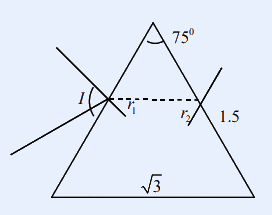
and are added to a 1 L flask and it is found that the system attains the above equilibrium at T(K) with the number of moles of , and Z(g) being 3, 3 and 9 mol respectively (equilibrium moles). Under this condition of equilibrium, of Z(g) is added to the flask and the temperature is maintained at T(K). Then the number of moles of Z(g) in the flask when the new equilibrium is established is ______. (Nearest integer)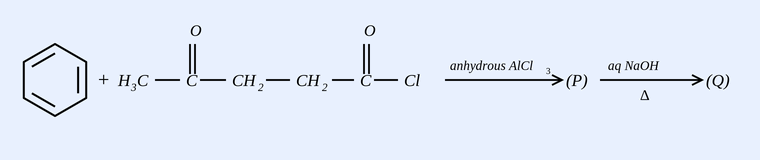
JEE Main 2026 January 23, Shift 2 Question Paper with Solutions
All 75 questions from the JEE Main 2026 (January 23, Shift 2) shift — Physics (25), Chemistry (25) and Mathematics (25) — each with the correct answer (answer key) and a step-by-step solution. Read it free online, or attempt the full paper as a timed mock test.
Physics25 questions
Q26Single correctLaws of Motion
A body of mass 14 kg initially at rest explodes and breaks into three fragments of masses in the ratio 2:2:3. The two pieces of equal masses fly off perpendicular to each other with a speed of 18 m/s each. The velocity of the heavier fragment is.. m/s
(1)
(2)
(3)
(4)
SolutionAnswer: Option 1
Approach:
Given a 14 kg body at rest splitting in the ratio 2:2:3, with the two equal fragments moving at 18 m/s perpendicular to each other, the target is the speed of the heavier fragment. Total linear momentum is conserved and remains zero, so the heavy fragment carries momentum equal and opposite to the resultant of the two light fragments.
Step 1:Distribute the 14 kg mass in the ratio 2:2:3.
Step 2:Compute the momentum magnitude of each 4 kg fragment.
Step 3:Add the two perpendicular momenta to find their resultant magnitude.
Step 4:The 6 kg fragment carries momentum that cancels this resultant, keeping the total zero.
Final answer: m/s
Q27Single correctElectrostatics
A parallel plate capacitor with plate separation 5 mm is charged by a battery. On introducing a mica sheet of 2mm and maintaining the connections of the plates with the terminals of the battery, It is found that it draws 25% more charge from the battery. The dielectric constant of mica is
(1)
(2)
(3)
(4)
SolutionAnswer: Option 4
Approach:
Given a capacitor of gap mm kept connected to the battery while a mica slab of thickness mm is inserted, drawing 25% more charge, the target is the dielectric constant . At fixed voltage the charge is proportional to capacitance, so the capacitance ratio equals 1.25.
Step 1:Relate the charge ratio at constant voltage to the capacitance ratio.
Step 2:Form the capacitance ratio with slab thickness mm in gap mm.
Step 3:Isolate the denominator.
Step 4:Solve for the dielectric constant .
Final answer:
Q28Single correctThermodynamics
One mole of an ideal diatomic gas expands from volume V to 2V isothermally at a temperature C and does W joule of work. If the gas undergoes same magnitude of expansion adiabatically from C doing the same amount of work W, the its final temperature will be (close to) ()
(1)
(2)
(3)
(4)
SolutionAnswer: Option 2
Approach:
Given one mole of a diatomic gas expanding isothermally from to at K doing work , then doing the same adiabatically from K, the target is the final adiabatic temperature. The isothermal work fixes ; the adiabatic work equals the drop in internal energy.
Step 1:Write the isothermal work at 300 K for one mole expanding to twice the volume.
Step 2:Express the adiabatic work as the decrease in internal energy of the diatomic gas.
Step 3:Equate the two expressions for and cancel .
Step 4:Solve for the final temperature in kelvin.
Step 5:Convert to degrees Celsius.
Final answer: C
Q29Single correctOptics
A prism of angle and refractive index is coated with thin film of refractive index 1.5 only at the back exit surface. To have total internal reflection at the back exit surface the incident angle must be.... ( and )
(1)
(2)
(3)
(4)
SolutionAnswer: Option 3between and
Approach:
Given a prism of apex angle and refractive index , with a film of index 1.5 on the back exit face, the target is the incidence angle range that produces total internal reflection there. TIR requires the internal angle at the back face to reach the critical angle for the glass-film boundary, which fixes the limiting entry refraction angle and hence the limiting incidence.
Step 1:Find the critical angle at the back surface for the glass-film boundary.
Step 2:Apply the prism angle relation at the TIR threshold.
Step 3:Use Snell's law at the entry face with the limiting .
Step 4:Decreasing i lowers and raises above , so TIR persists for all incidence angles below the threshold.
Final answer: between and
Q30Single correctOptics
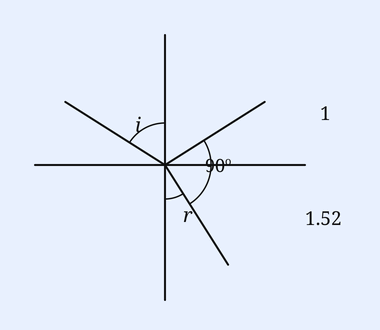
When an unpolarised light falls at a particular angle on a glass plate (placed in air), it is observed that the reflected beam is linearly polarized. The angle of refracted beam with respect to the normal is... (), refractive indices of air and glass are 1.00 and 1.52 respectively.
(1)
(2)
(3)
(4)
SolutionAnswer: Option 3
Approach:
Given that reflected light from a glass plate ( in air) is fully linearly polarized at a particular incidence, the target is the refraction angle. Full polarization occurs only at the Brewster angle, where the reflected and refracted rays are mutually perpendicular, making the refraction angle the complement of the Brewster angle.
Step 1:Find the Brewster (polarizing) angle from the index ratio.
Step 2:Apply the perpendicularity of reflected and refracted rays at the Brewster angle.
Final answer:
Q31Single correctLaws of Motion
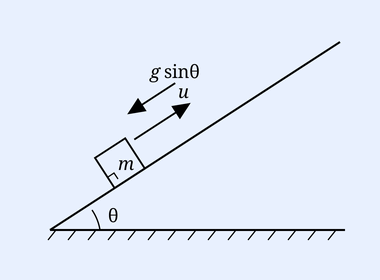
A block is sliding down on an inclined plane of slope and at an instant t=0 this block is given an upward momentum so that it starts moving up on the inclined surface with velocity u. The distance (S) travelled by the block before its velocity become zero, is... (g=gravitational acceleration)
(1)
(2)
(3)
(4)
SolutionAnswer: Option 1
Approach:
Given a block that slides down a rough incline of slope and is then projected up with speed u, the target is the distance S travelled before stopping. Spontaneous sliding down sets the limiting condition , so during upward motion both gravity and friction retard the block, doubling the gravitational deceleration.
Step 1:Spontaneous downward sliding sets the limiting balance of friction and the gravity component along the incline.
Step 2:During upward motion gravity and friction both act down the incline; add their decelerations.
Step 3:Apply the kinematic equation from speed to rest.
Step 4:Solve for the distance .
Final answer:
Q32Single correctMagnetic Effects of Current and Magnetism
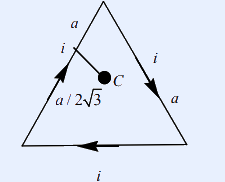
The current passing through a conducting loop in the form of equilateral triangle of side cm is 2A. The magnetic field at its centroid is T. The value of is...(given SI units)
(1)
(2)
(3)
(4)
SolutionAnswer: Option 2
Approach:
Given an equilateral triangular loop of side cm carrying A, the target is the coefficient in the centroid field T. Each side is a finite straight wire at perpendicular distance from the centroid, subtending on each side; the three identical contributions add.
Step 1:Find the perpendicular distance from the centroid to a side for cm.
Step 2:Each side subtends on both sides of the foot of perpendicular at the centroid.
Step 3:Write the field contributed by one side.
Step 4:Three sides contribute equally in the same direction and add.
Final answer:
Q33Single correctProperties of Solids and Liquids
A small metallic sphere of diameter 2 mm and density 10.5 g/c is dropped in glycerine having viscosity 10 Poise and density 1.5 g/c respectively. The terminal velocity attained by the sphere is...cm/s. ( and m/)
(1)
(2)
(3)
(4)
SolutionAnswer: Option 2
Approach:
Given a sphere of diameter 2 mm, density g/c, dropped in glycerine of viscosity 10 Poise and density g/c, the target is the terminal velocity. At terminal velocity the net force is zero, so weight balances buoyancy plus Stokes drag, giving the standard terminal-velocity formula evaluated in SI units and converted to cm/s.
Step 1:Convert all quantities to SI units (diameter 2 mm gives radius 1 mm).
Step 2:Substitute into the terminal-velocity formula.
Step 3:Evaluate the numerical value.
Step 4:Convert to cm/s.
Final answer: cm/s
Q34Single correctElectromagnetic Induction and Alternating Currents
A circular loop of radius 7 cm is placed in uniform magnetic field of 0.2T directed perpendicular to plane of loop. The loop is converted into a square loop in 0.5s. The EMF induced in the loop is...mV
(1)
(2)
(3)
(4)
SolutionAnswer: Option 2
Approach:
Given a circular loop of radius 7 cm in a perpendicular field of 0.2 T reshaped into a square in 0.5 s, the target is the induced emf. The wire perimeter is conserved, fixing the square's side; the resulting area change alters the flux, and the induced emf equals the magnitude of the flux-change rate.
Step 1:Equate the circle's circumference to the square's perimeter to find the side.
Step 2:Compute the two enclosed areas.
Step 3:Find the magnitude of the area change.
Step 4:Apply Faraday's law with T over s.
Final answer: mV
Q35Single correctUnits and Measurements
To compare EMF of two cells using potentiometer the balancing lengths obtained are 200cm and 150cm. The least count of scale is 1cm. The percentage error in the ratio of EMFs is...
(1)
(2)
(3)
(4)
SolutionAnswer: Option 1
Approach:
Given potentiometer balancing lengths cm and cm with scale least count 1 cm, the target is the percentage error in the emf ratio. The emf ratio equals the length ratio; for a quotient the fractional errors add, each length carrying an uncertainty of one least count.
Step 1:Take each length uncertainty equal to the least count, 1 cm.
Step 2:Add the fractional errors for the ratio.
Step 3:Express as a percentage.
Final answer:
Q36Single correctThermodynamics
The internal energy of a monoatomic gas is 3nRT. One mole of helium is kept in a cylinder having internal cross section area of 17c and fitted with a light movable frictionless piston. The gas is heated slowly by supplying 126J heat. If the temperature rises by C, then the piston will move ...cm. (Atmospheric pressure Pa)
(1)
(2)
(3)
(4)
SolutionAnswer: Option 3
Approach:
Given one mole of helium with internal energy , in a cylinder of cross section 17 c with a light frictionless piston, heated by 126 J for a 4 K rise, the target is the piston displacement. The piston keeps the pressure at atmospheric (isobaric), so the first law splits the heat into the internal-energy change and the constant-pressure work .
Step 1:Compute the internal-energy change for one mole with a 4 K rise.
Step 2:Apply the first law to find the work done by the gas.
Step 3:Equate the isobaric work to .
Step 4:Solve for the piston displacement.
Final answer: cm
Q37Single correctElectrostatics
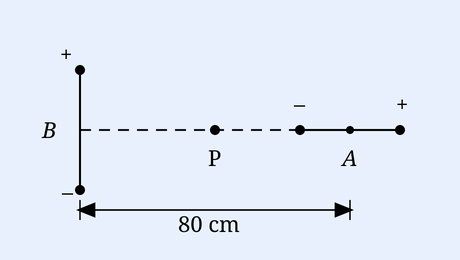
Two shorts dipoles (A,B), A having charges C and length 1cm and B having charges C and length 1cm are placed with their centres 80cm apart as shown in the figure. The electric field at a point P, equi-distant from the centres of both dipoles is..........N/C.
(1)
(2)
(3)
(4)
SolutionAnswer: Option 2
Approach:
Given short dipole A (C, 1 cm, aligned along the centre line) and dipole B (C, 1 cm, perpendicular to it), centres 80 cm apart with P at the midpoint, the target is the field at P. From the figure P lies on the axial line of A and the equatorial line of B, so the two contributions are perpendicular and combine as a resultant.
Step 1:Find the two dipole moments and the common distance from each centre to P.
Step 2:Field of A is axial, field of B is equatorial; write both magnitudes.
Step 3:Combine the perpendicular components.
Step 4:Insert and .
Final answer: N/C
Q38Single correctKinematics
A paratrooper jumps from an aeroplane and opens a parachute after 2s of free fall and starts deaccelerating with 3m/. At 10m height from ground, while descending with the help of parachute, the speed of paratrooper is 5m/s. The initial height of the airplane is...m. (g=10m/)
(1)
(2)
(3)
(4)
SolutionAnswer: Option 1
Approach:
Given a 2 s free fall, then deceleration at 3 m/ until the speed is 5 m/s at 10 m above ground, the target is the airplane height. The motion has three vertical segments: free-fall length , deceleration-phase length , and the final 10 m; their sum is the height.
Step 1:Free fall for 2 s gives the speed at parachute opening.
Step 2:Distance covered during the 2 s free fall.
Step 3:Apply the velocity-squared relation through the deceleration phase from 20 m/s to 5 m/s at m/ retarding.
Step 4:Add the three vertical segments.
Final answer: m
Q39Single correctKinetic Theory of Gases
An air bubble of volume 2.9c rises from the bottom of a swimming pool of 5m deep. At the bottom of the pool water temperature is C. The volume of the bubble when it reaches the surface, where the water temperature is C, is .....c. (g=10m/, density of water kg/. And 1 atm pressure is Pa)
(1)
(2)
(3)
(4)
SolutionAnswer: Option 3
Approach:
Given an air bubble of volume c at the pool bottom (depth m, K) rising to the surface ( K), with m/, kg/, Pa. The target is the surface volume , obtained by applying the combined gas law between the two states.
Step 1:Compute the absolute pressure at the bottom of the pool.
Step 2:State the surface conditions and the two absolute temperatures.
Step 3:Rearrange the combined gas law for the surface volume.
Step 4:Evaluate the numerical product.
Final answer:
Q40Single correctElectromagnetic Induction and Alternating Currents
Suppose a long solenoid of 100cm length, radius 2cm having 500turns per unit length, carries a current A, where rad/s. A circular conducting loop (B) of radius 1cm coaxially slided through the solenoid at a speed v=1cm/s. The r.m.s current through the loop when the coil B is inserted 10cm inside the solenoid is A. The value of is...[Resistance of the loop ]
(1)
(2)
(3)
(4)
SolutionAnswer: Option 3
Approach:
Given a long solenoid with turns/m carrying A, rad/s, with a coaxial loop of radius cm m and resistance inside it. Inside a long solenoid the field is uniform, so the flux linking the small loop is independent of axial position; the time-varying current induces an emf whose peak gives the peak current, and its rms value fixes .
Step 1:Write the uniform solenoid field with per metre.
Step 2:Compute the flux through the loop of radius m; the field is uniform so position inside the solenoid is irrelevant.
Step 3:Differentiate the flux to obtain the peak emf with rad/s.
Step 4:Divide by for the peak current and identify from A.
Final answer:
Q41Single correctAtoms and Nuclei
Which of the following pair of nuclei are isobars of the element ?
(1)
(2)
(3)
(4)
SolutionAnswer: Option 1 and
Approach:
Isobars are nuclei sharing the same mass number A while differing in atomic number Z. Each option's pair is tested against the conditions and .
Step 1:Test pair 1.
Step 2:Test pair 2.
Step 3:Test pair 3.
Step 4:Test pair 4.
Final answer: and
Q42Single correctKinematics
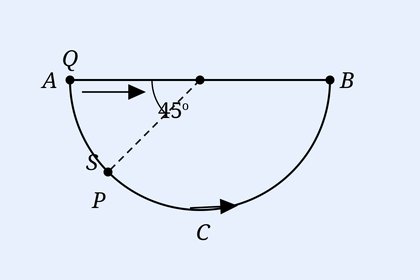
A bead P sliding on a frictionless semi-circular string (ACB) and it is at point S at t=0 and at this instant the horizontal component of its velocity is v. Another bead Q of the same mass as P is ejected from point A at t=0 along the horizontal string AB, with the speed v, friction between the beads and the respective strings may be neglected in both cases. Let and be the respective times taken by beads P and Q to reach the point B, then the relation between and is.
(1)
(2)
(3)
(4)
SolutionAnswer: Option 3
Approach:
Given bead P on the frictionless semicircular wire ACB (diameter AB horizontal, arc dipping below) starting at point S with horizontal velocity component , and bead Q launched at A along the straight wire AB with speed , both reaching B. Both beads cross the identical horizontal span AB; comparing their horizontal velocity components throughout the motion determines which arrival time is shorter.
Step 1:Bead Q travels the horizontal span AB at constant speed along the straight wire.
Step 2:On the arc P dips below AB; by energy conservation its speed rises as it descends, so its horizontal velocity component stays at least over the whole path.
Step 3:Integrate the inverse horizontal speed over the common span AB for P and compare with Q.
Final answer:
Q43Single correctElectronic Devices
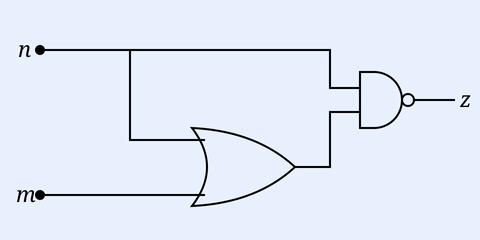
For the given logic gate circuit. Which of the following is the correct truth table?
(1)
(2)
(3)
(4)
SolutionAnswer: Option 1 | | |
| | |
| | |
| | |
| | |
| | |
| | |
| | |
| | |
Approach:
Given a circuit where input n feeds one input of a final NAND gate directly, while n and m feed an OR gate whose output feeds the other NAND input. The output is simplified by Boolean algebra and tabulated for all four (n,m) combinations to identify the matching truth table.
Step 1:Form the OR output and AND it with inside the NAND.
Step 2:Apply the absorption law to the term inside the bar.
Step 3:The output reduces to the complement of alone.
Step 4:Tabulate over the four input rows.
Final answer: | | |
| | |
| | |
| | |
| | |
| | |
| | |
| | |
| | |
Q44Single correctElectromagnetic Waves
The ratio of speeds of electromagnetic waves in vacuum and a medium, having dielectric constant k=3 and permeability of is. ( = permeability of vacuum)
(1)
(2)
(3)
(4)
SolutionAnswer: Option 1
Approach:
Given a medium with dielectric constant (relative permittivity) and permeability so . The target is the ratio of the EM-wave speed in vacuum to that in the medium, obtained from the speed expression .
Step 1:Form the speed ratio and substitute , .
Step 2:Insert and .
Final answer:
Q45Single correctElectrostatics
Two charges C and C are placed at (-9,0,0) cm and (9,0,0) cm respectively in an external field , Where N/C. Considering the potential at infinity to be 0, the electrostatic energy of the configuration is...J.
(1)
(2)
(3)
(4)
SolutionAnswer: Option 3
Approach:
Given C at cm and C at cm in an external radial field of potential with . The total electrostatic energy is the mutual pair energy plus the energy of each charge in the external field, with the zero of potential at infinity.
Step 1:Compute the mutual energy using the separation m.
Step 2:Evaluate the external potential at each charge, both m from the origin.
Step 3:Compute each charge's energy in the external field.
Step 4:Sum the mutual energy and both external-field energies.
Final answer:
Q46NumericalRotational Motion
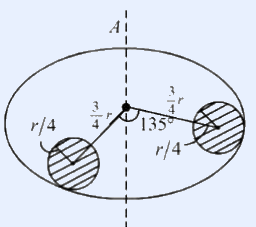
Suppose there is a uniform circular disc of mass M kg and radius r m shown in figure. The shaded regions are cut out from the disc. The moment of inertia of the remainder about the axis A of the disc is given by . The value of x is...
SolutionAnswer: 109
Approach:
Given a uniform disc of mass and radius with two circular holes, each of radius and centre at distance from the disc centre, cut out. The remainder's moment of inertia about the central axis A equals the full-disc value minus the two holes' contributions; each hole's mass scales with area and the parallel-axis theorem transfers its inertia to axis A.
Step 1:Moment of inertia of the intact disc about axis A through its centre.
Step 2:Each hole has mass and self moment of inertia about its own centre.
Step 3:Transfer each hole's inertia to axis A using ; the angular placement does not enter since only the distance from the axis matters.
Step 4:Subtract both holes from the full disc and read off .
Final answer:
Q47NumericalOptics
The size of the images of an object, formed by a thin lens are equal when the object is placed at two different positions 8cm and 24cm from the lens. The focal length of the lens is.........cm.
SolutionAnswer: 16
Approach:
Given a thin lens producing images of equal size when the object sits at cm and cm. Equal image sizes at two object distances mean the magnification magnitudes match with opposite signs (one real, one virtual); writing m in terms of f and the object distance yields an equation for f.
Step 1:Impose equal-magnitude, opposite-sign magnifications for the two object distances.
Step 2:Cancel the common factor and equate the reciprocals.
Step 3:Solve the linear equation for .
Final answer:
Q48NumericalOscillations and Waves
The velocity of sound in air is doubled when the temperature is raised from C to C. The value of is............
SolutionAnswer: 819
Approach:
Given the speed of sound in air doubling as the temperature rises from C ( K) to C ( K). The speed of sound varies as the square root of absolute temperature, so the doubling condition fixes the temperature ratio and hence .
Step 1:Apply the doubling condition with absolute temperatures.
Step 2:Square both sides and clear the denominator.
Step 3:Solve for the final Celsius temperature.
Final answer:
Q49NumericalAtoms and Nuclei
The average energy released per fission for the nucleus of is 190MeV. When all the atoms of 47g pure undergo fission process, the energy released is MeV. The value of is... (Avogadro number per mole)
SolutionAnswer: 228
Approach:
Given MeV released per fission of , molar mass g/mol, mass g, and per mole. The number of nuclei follows from the mole concept; multiplying by the per-fission energy gives the total, matched to MeV.
Step 1:Find the number of moles in 47 g of U-235.
Step 2:Convert moles to number of nuclei.
Step 3:Multiply by the energy released per fission.
Step 4:Compare with the form MeV.
Final answer:
Q50NumericalUnits and Measurements
A ball of radius r and density dropped through a viscous liquid of density and viscosity attains its terminal velocity at time t, given by , where A is a constant and a,b,c and d are integers. The value of is.
SolutionAnswer: 1
Approach:
Given the terminal-velocity time with A dimensionless and integer exponents. Dimensional homogeneity requires the product of powers of to reduce to [T]; matching the powers of mass, length and time yields a,b,c,d and hence the ratio .
Step 1:Write the dimensional equation for the relation.
Step 2:Match the power of mass.
Step 3:Match the power of time.
Step 4:Match the power of length to obtain .
Step 5:Form the requested ratio with , , .
Final answer:
Chemistry25 questions
Q51Single correctRedox Reactions and Electrochemistry
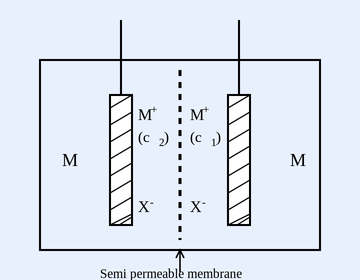
Consider the above electrochemical cell where a metal electrode (M) is undergoing redox reaction by forming . The cation is present in two different concentrations and as shown above. Which of the following statement is correct for generating a positive cell potential?
(1)
(2)
(3)
(4)
SolutionAnswer: Option 3
Approach:
Given a concentration cell with the same metal M in both compartments at cation concentrations and , identify the concentration condition that makes via the Nernst relation, where oxidation occurs at the anode and at the cathode.
Step 1:In a concentration cell the standard potentials of the two identical half-cells cancel, so and the entire emf comes from the concentration term.
Step 2:Oxidation defines the anode and reduction defines the cathode; with the Nernst term reduces to a single logarithm.
Step 3:A positive cell potential requires the logarithm of the cathode-to-anode ratio to be positive, so the cathode compartment must be the more concentrated one.
Step 4:Placing at the cathode then forces to be the larger concentration, i.e. , for a positive cell potential.
Final answer: present at cathode with
Q52Single correctAtomic Structure
Identify the INCORRECT statements from the following:
A. Notation represents 24 protons and 12 neutrons.
B. Wavelength of a radiation of frequency is m.
C. One radiation has wavelength and energy , Other radiation has wavelength and energy . .
D. Number of photons of light of wavelength 2000 pm that provides 1 J of energy is .
Choose the correct answer from the options given below:
A. Notation represents 24 protons and 12 neutrons.
B. Wavelength of a radiation of frequency is m.
C. One radiation has wavelength and energy , Other radiation has wavelength and energy . .
D. Number of photons of light of wavelength 2000 pm that provides 1 J of energy is .
Choose the correct answer from the options given below:
(1)
(2)
(3)
(4)
SolutionAnswer: Option 1
Approach:
Each statement is tested independently using nuclear notation, the wave relation , the inverse proportionality , and the photon count ; the statements failing their checks form the incorrect set.
Step 1:In the subscript is the atomic number (proton count) and the superscript is the mass number, so protons and neutrons , contradicting the claim of 24 protons and 12 neutrons.
Step 2:Compute the wavelength for frequency .
Step 3:Energy varies inversely with wavelength, so the ratio equals , which is the reverse of the stated .
Step 4:Compute the energy per photon for and divide by it.
Step 5:Statements A and C fail their checks, while B and D reproduce the quoted values, so the incorrect set is A and C.
Final answer: A and C Only
Q53Single correctCoordination Compounds
Identify the CORRECT set of details from the following:
A. : Inner orbital complex; hybridized
B. : Outer orbital complex; hybridized
C. : Outer orbital complex; hybridized
D. : Outer orbital complex; hybridized
E. : Inner orbital complex; hybridized
Choose the correct answer from the options given below:
A. : Inner orbital complex; hybridized
B. : Outer orbital complex; hybridized
C. : Outer orbital complex; hybridized
D. : Outer orbital complex; hybridized
E. : Inner orbital complex; hybridized
Choose the correct answer from the options given below:
(1)
(2)
(3)
(4)
SolutionAnswer: Option 2
Approach:
Valence bond theory assigns hybridization from the metal d-electron count and ligand field strength: strong-field ligands give inner-orbital (, ) complexes and weak-field ligands give outer-orbital () complexes; each statement is checked against the spectrochemical order.
Step 1:: is and is a strong-field ligand, pairing the d-electrons to vacate two inner orbitals, giving an inner-orbital complex.
Step 2:: is and is a weak-field ligand, so the electrons remain unpaired and outer orbitals are used, giving an outer-orbital complex.
Step 3:: is but is a weak-field ligand, so no inner pairing occurs and the complex is outer-orbital , contradicting the stated .
Step 4:: is and is weak-field, giving an outer-orbital high-spin complex.
Step 5:: is and is strong-field, pairing electrons to free one orbital for a square-planar inner complex, not the stated .
Final answer: A, B & D Only
Q54Single correctClassification of Elements and Periodicity in Properties
Elements X and Y belong to group 15. The difference between the electronegativity values of 'X' and phosphorus is higher than that of the difference between phosphorus and 'Y'. 'X' & 'Y' are respectively
(1)
(2)
(3)
(4)
SolutionAnswer: Option 4N \;&\; As
Approach:
Given X and Y in group 15 with , use the group-15 electronegativity trend to locate X far from P and Y close to P.
Step 1:Electronegativity decreases down group 15 because atomic size increases and effective nuclear pull on bonding electrons weakens.
Step 2:Nitrogen lies two periods above phosphorus, so is a large separation, making X = N satisfy the larger-difference requirement.
Step 3:Arsenic lies immediately below phosphorus, so is a small separation, making Y = As satisfy the smaller-difference requirement.
Step 4:The inequality holds, so the pair is X = N and Y = As.
Final answer: N & As
Q55Single correctRedox Reactions and Electrochemistry
The oxidation state of chromium in the final product in the reaction between KI and acidified solution is:
(1)
(2)
(3)
(4)
SolutionAnswer: Option 1
Approach:
Determine chromium's oxidation state in acidified , then track its change when iodide ( from KI) reduces it, to fix the chromium oxidation state in the final product.
Step 1:In , with oxygen at , the two chromium atoms satisfy , giving for each chromium.
Step 2:In acidic medium iodide is oxidised to iodine () and supplies electrons that reduce dichromate; the half-reaction shows each Cr gains three electrons.
Step 3:The chromium-bearing product is the chromium(III) ion, so the final oxidation state of chromium is .
Final answer:
Q56Single correctClassification of Elements and Periodicity in Properties
Given below are two statements:
Statement I: The second ionisation enthalpy of Na larger than the corresponding ionisation enthalpy of Mg.
Statement II: the ionic radius of is larger than that of .
In the light of the above statements, choose the correct answer form the options given below
Statement I: The second ionisation enthalpy of Na larger than the corresponding ionisation enthalpy of Mg.
Statement II: the ionic radius of is larger than that of .
In the light of the above statements, choose the correct answer form the options given below
(1)
(2)
(3)
(4)
SolutionAnswer: Option 1
Approach:
Statement I compares the second ionisation enthalpy of Na (ionising the noble-gas-core ) with the first ionisation enthalpy of Mg; Statement II compares the radii of the isoelectronic anions and using effective nuclear charge.
Step 1:The second ionisation of sodium removes an electron from , which has the stable neon configuration , requiring a very large energy input.
Step 2:Magnesium's first ionisation removes a electron from a neutral atom outside a noble-gas core, costing far less than breaking into the closed octet of , so and Statement I is true.
Step 3: and are isoelectronic with 10 electrons; oxygen has 8 protons versus fluorine's 9, so feels a smaller nuclear pull, giving it a larger ionic radius.
Step 4:Both statements are consistent with the underlying trends, so both are true.
Final answer: Both statement I and statement II are true
Q57Single correctOrganic Compounds Containing Oxygen
which of the following statements are TRUE about Haloform reaction?
A. Sodium hypochlorite reacts with KI to give KOI.
B. KOI is a reducing agent.
C. -unsaturated methylketone will give iodoform reaction.
D. Isopropyl alcohol will not give iodoform test
E. Methanoic acid will give positive iodoform test
Choose the correct answer from the options given below:
A. Sodium hypochlorite reacts with KI to give KOI.
B. KOI is a reducing agent.
C. -unsaturated methylketone will give iodoform reaction.
D. Isopropyl alcohol will not give iodoform test
E. Methanoic acid will give positive iodoform test
Choose the correct answer from the options given below:
(1)
(2)
(3)
(4)
SolutionAnswer: Option 2
Approach:
Each statement about the haloform (iodoform) reaction is tested: the in-situ generation of hypoiodite, its oxidising character, the structural requirement of a or group, and the behaviour of the named compounds; the surviving statements are the TRUE set.
Step 1:Sodium hypochlorite transfers its active oxygen to iodide, oxidising it to hypoiodite, so KOI forms and statement A is true.
Step 2:Hypoiodite releases nascent oxygen () and therefore behaves as an oxidising agent, contradicting statement B's claim that it is a reducing agent.
Step 3:The -unsaturated methyl ketone carries a terminal group, which is exactly the moiety the iodoform reaction requires, so statement C is true.
Step 4:Isopropyl alcohol contains the unit, which is oxidised in situ to a methyl ketone and gives a positive iodoform test, so statement D ('will not give') is false.
Step 5:Methanoic acid HCOOH has no or group, so it gives a negative iodoform test, making statement E ('positive test') false.
Final answer: A & C Only
Q58Single correctOrganic Compounds Containing Oxygen
A mixed ether (P), when heated with excess of hot concentrated hydrogen iodide produces two different alkyl iodides which when treated with aq. give compounds (Q) and (R) Both (Q) and (R) give yellow precipitate with . Identify the mixed ether(P):
(1)
(2)
(3)
(4)
SolutionAnswer: Option 1Ethyl sec-butyl ether ()
Approach:
Hot concentrated HI cleaves the mixed ether into two alkyl iodides; aqueous NaOH converts them to alcohols Q and R, and both must give a yellow iodoform precipitate with NaOI, which requires each alcohol to carry the (methyl-carbinol) unit. The option whose both fragments satisfy this is selected.
Step 1:Excess hot concentrated HI cleaves the C-O bonds of the mixed ether, converting each alkyl-oxygen fragment into an alkyl iodide.
Step 2:Each alkyl iodide on hydrolysis with aqueous NaOH gives an alcohol; for both Q and R to give iodoform, each alcohol must hold the or -precursor group.
Step 3:For ethyl sec-butyl ether , the ethyl fragment yields ethanol and the sec-butyl fragment yields butan-2-ol ; ethanol and butan-2-ol both carry the methyl-carbinol grouping and give iodoform.
Step 4:Among the alternatives, the tert-amyl fragment (option 3) gives a tertiary alcohol with no unit, and the benzyl / 1-phenylpropyl fragments (options 2 and 4) yield alcohols lacking the methyl-carbinol group, so each of those options has at least one fragment that fails the iodoform test.
Final answer: Ethyl sec-butyl ether ()
Q59Single correctSome Basic Principles of Organic Chemistry
Given below are two statements:
Statement I: is more stable than as nine hyperconjugation interactions are possible in .
Statement II: is less stable than as only three hyperconjugation interactions are possible in .
In the light of the above statements, choose the correct answer from the options given below
Statement I: is more stable than as nine hyperconjugation interactions are possible in .
Statement II: is less stable than as only three hyperconjugation interactions are possible in .
In the light of the above statements, choose the correct answer from the options given below
(1)
(2)
(3)
(4)
SolutionAnswer: Option 4
Approach:
Hyperconjugation stabilises a carbocation through C-H bonds, and the condition for any hyperconjugation is at least one C-H bond on a carbon adjacent to the positive centre. Count these interactions for and and test each statement.
Step 1:In three methyl carbons are attached to the cationic carbon, each providing three C-H bonds, giving hyperconjugation interactions and high stability, so Statement I is true.
Step 2:In the positive carbon bears only hydrogens directly and has no adjacent carbon, hence no C-H bonds and zero hyperconjugation interactions.
Step 3:Statement II asserts three hyperconjugation interactions in the methyl cation, but the correct count is zero; the methyl cation is indeed the less stable, yet not for the reason given, so Statement II is false.
Step 4:Statement I (9 interactions, more stable) is true and Statement II (3 interactions) is false.
Final answer: Statement I is true but statement II is false
Q60Single correctOrganic Compounds Containing Nitrogen
Given below are two statements:
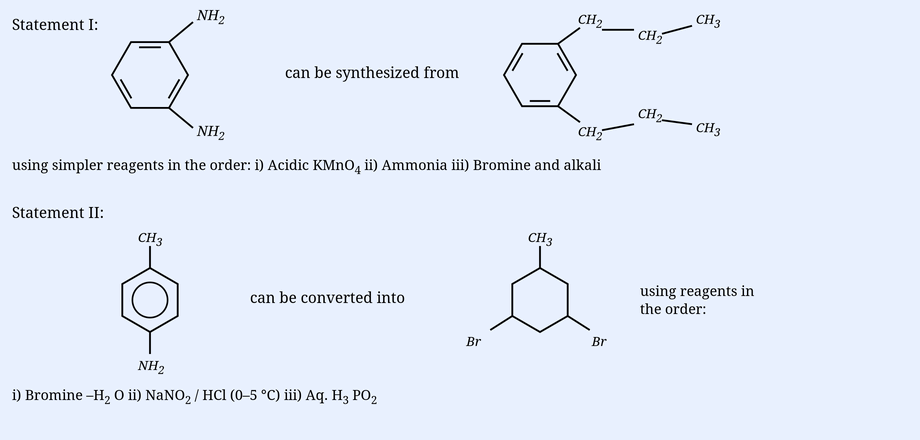
Statement I: benzene-1,2-diamine can be synthesized from ortho-di(n-propyl)benzene using simpler reagents in the order i) Acidic ii) Ammonia iii) Bromine and alkali
Statement II: In the order i) Bromine ii) iii) Aq. , p-toluidine can be converted into 3,5-dibromotoluene
In the light of the above statements, choose the correct answer from the options given below
Statement I: benzene-1,2-diamine can be synthesized from ortho-di(n-propyl)benzene using simpler reagents in the order i) Acidic ii) Ammonia iii) Bromine and alkali
Statement II: In the order i) Bromine ii) iii) Aq. , p-toluidine can be converted into 3,5-dibromotoluene
In the light of the above statements, choose the correct answer from the options given below
(1)
(2)
(3)
(4)
SolutionAnswer: Option 2
Approach:
Statement I is traced through side-chain oxidation, amide formation and double Hofmann degradation; Statement II is traced through ring bromination of p-toluidine, diazotisation of its amino group and reductive deamination, which install two bromine atoms and remove the amino group to give 3,5-dibromotoluene.
Step 1:Acidic oxidises both n-propyl side chains of ortho-di(n-propyl)benzene down to carboxyl groups, giving benzene-1,2-dicarboxylic acid (phthalic acid).
Step 2:Ammonia converts both carboxyl groups (via the ammonium salt on heating) to amide groups, giving the diamide.
Step 3:Bromine and alkali drive a double Hofmann bromamide degradation, converting each into with loss of one carbon, yielding benzene-1,2-diamine, so Statement I is true.
Step 4:Statement II starts from p-toluidine. Bromine water brominates the two positions ortho to the strongly activating group (the 3 and 5 positions relative to the methyl). then diazotises the amino group, and aqueous reductively removes the diazonium group as , leaving 3,5-dibromotoluene, so Statement II is true.
Final answer: Both Statement I and Statement II are true
Q61Single correctPurification and Characterisation of Organic Compounds
In Carius method 0.2425 g of an organic compound gave 0.5253 g silver chloride. The percentage of chlorine in the organic compound is
(1)
(2)
(3)
(4)
SolutionAnswer: Option 1
Approach:
Given of compound yielding of AgCl in the Carius method, find the mass of chlorine from the Cl-to-AgCl mass fraction and express it as a percentage of the sample mass.
Step 1:Insert the molar masses (Cl , AgCl ) and the measured masses into the percentage relation.
Step 2:Evaluate the AgCl-to-sample mass ratio.
Step 3:Evaluate the chlorine mass fraction in AgCl.
Step 4:Multiply the two factors and convert to a percentage.
Final answer:
Q62Single correctOrganic Compounds Containing Nitrogen
A student has been given a compound 'x' of molecular formula- . 'x' is sparingly soluble in water. However, on addition of dilute mineral acid 'x' becomes soluble in water. 'x' when treated with and KOH\,(alc), 'y' is produced. 'y' has a specific unpleasant smell. On treatment with benzenesulphonyl chloride 'x' gives a compound 'z' which is soluble in alkali. The number of different "H" atoms present in 'z' is:
(1)
(2)
(3)
(4)
SolutionAnswer: Option 1
Approach:
Identify compound 'x' () from its solubility in acid, the carbylamine smell with , and the alkali-soluble Hinsberg product; then count the chemically distinct hydrogen environments in that product 'z'.
Step 1:Molecular formula with basicity (dissolves in dilute mineral acid) and a positive carbylamine (isocyanide) test on marks 'x' as a primary aromatic amine, aniline.
Step 2:Aniline reacts with benzenesulphonyl chloride to give N-phenylbenzenesulphonamide 'z'; its acidic N-H makes it soluble in alkali, matching the clue.
Step 3:The benzenesulphonyl ring is monosubstituted, so its five aromatic hydrogens fall into three distinct environments: ortho, meta and para to the group.
Step 4:The aniline-derived ring is also monosubstituted, contributing three further distinct aromatic environments: ortho, meta and para to the group.
Step 5:The single N-H proton is a separate environment, giving distinct hydrogen atoms in z.
Final answer: 7
Q63Single correctBiomolecules
Both human DNA and RNA are chiral molecules. The chirality in DNA and RNA arises due to the presence of
(1)
(2)
(3)
(4)
SolutionAnswer: Option 1
Approach:
Locate the source of chirality in DNA and RNA among the three nucleotide building blocks (base, sugar, phosphate) by eliminating the achiral components.
Step 1:Both nucleic acids are polymers of nucleotides, each composed of a nitrogenous base, a pentose sugar, and a phosphate group.
Step 2:The phosphate group is symmetric and achiral, and the nitrogenous bases are essentially planar and achiral, so neither can be the source of molecular chirality.
Step 3:The pentose sugars (D-ribose in RNA and D-2-deoxyribose in DNA) contain stereogenic carbon centres of the D-configuration, which impart chirality to the nucleic acids.
Final answer: D-sugar component
Q64Single correctChemical Thermodynamics
It is noticed that is more stable than but is less stable than . Observe the following reactions.
(1)
(2)
Identify the correct set from the following
(1)
(2)
Identify the correct set from the following
(1)
(2)
(3)
(4)
SolutionAnswer: Option 2
Approach:
Given the relative stabilities and , each reaction converts a oxide to a oxide; the target is the sign of for each, fixed by which oxidation state the products favour.
Step 1:Reaction (1) converts lead from (in ) and (in Pb) into the state (in PbO). The product oxidation state is the more stable one for lead.
Step 2:Because is more stable than , formation of PbO is thermodynamically favoured, so is negative.
Step 3:Reaction (2) converts tin into the state. For tin the state is the more stable one, so producing is unfavourable and is positive.
Step 4:Combining the two signs gives the matching set.
Final answer:
Q65Single correctOrganic Compounds Containing Halogens
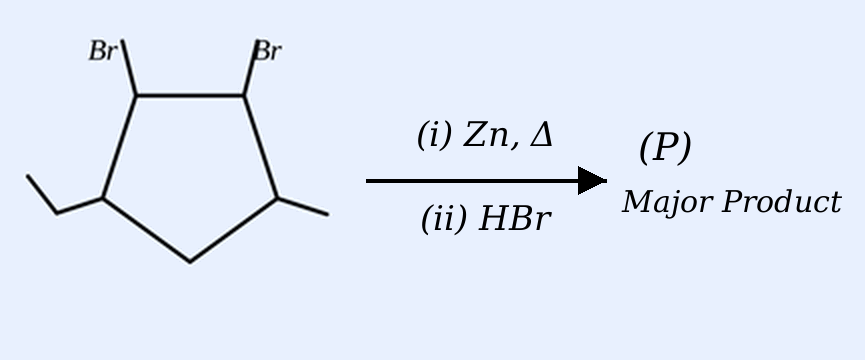
Identify (P)
(1)
(2)
(3)
(4)
SolutionAnswer: Option 3Cyclopentane ring bearing an ethyl group and a carbon holding both a methyl and a bromine (tertiary alkyl bromide)
Approach:
The substrate is a cyclopentane carrying an ethyl group, a methyl group, and two bromine atoms on adjacent (vicinal) carbons. Treatment by (i) then (ii) HBr is traced through the alkene and the most stable carbocation to identify the major product (P).
Step 1:Zinc on heating removes the two vicinal bromine atoms as , installing a ring double bond between the two former C-Br carbons to give a substituted cyclopentene.
Step 2:HBr protonates the double bond. Markovnikov orientation places so that the positive charge sits on the more substituted ring carbon, generating a secondary carbocation.
Step 3:A 1,2-hydride shift relocates the positive charge onto the ring carbon bearing the methyl group, converting the secondary cation into a more stable tertiary carbocation.
Step 4:Bromide adds to the tertiary carbon, producing a tertiary alkyl bromide in which one ring carbon holds both the methyl and the bromine, with the ethyl group on a separate ring carbon.
Final answer: Cyclopentane with an ethyl group on one carbon and a methyl plus bromine on the same (tertiary) carbon
Q66Single correctChemical Kinetics
Observe the following reactions at T(K).
I. products
II.
Both the reactions are started at 10.00am. The rates of these reactions at 10.10am are same. The value of at 10.10 am is . The concentration of A at 10.10 am is . What is the first order rate constant (in ) of reaction I?
I. products
II.
Both the reactions are started at 10.00am. The rates of these reactions at 10.10am are same. The value of at 10.10 am is . The concentration of A at 10.10 am is . What is the first order rate constant (in ) of reaction I?
(1)
(2)
(3)
(4)
SolutionAnswer: Option 1
Approach:
Given for reaction II, equal rates of I and II at 10.10 am, and , the target is the first-order rate constant k of reaction I. The bromide disappearance is converted to the reaction rate via its stoichiometric coefficient and then divided by [A].
Step 1:In reaction II the coefficient of is 5, so the rate of reaction equals one-fifth of the bromide consumption rate.
Step 2:The two reaction rates are equal at 10.10 am, so the rate of reaction I takes the same value.
Step 3:Apply the first-order rate law for products and divide by [A] to isolate k.
Final answer:
Q67Single correctOrganic Compounds Containing Oxygen
Iodoform test can differentiate between
A. Methanol and Ethanol
B. and
C. Cyclohexene and cyclohexanone
D. Diethyl ether and Pentan -3- one
E. Anisole and acetone
Choose the correct answer from the options given below.
A. Methanol and Ethanol
B. and
C. Cyclohexene and cyclohexanone
D. Diethyl ether and Pentan -3- one
E. Anisole and acetone
Choose the correct answer from the options given below.
(1)
(2)
(3)
(4)
SolutionAnswer: Option 3
Approach:
The iodoform test () is positive only for a group (methyl ketone) or a group (methyl carbinol). A pair is differentiable only when exactly one of its two members is positive.
Step 1:Pair A: methanol () has no -CH and tests negative; ethanol () bears the group and tests positive. Exactly one positive, so A is differentiable.
Step 2:Pair B: ethanoic acid () and propanoic acid () are carboxylic acids lacking a methyl carbonyl/carbinol; both test negative, so B is not differentiable.
Step 3:Pair C: cyclohexene has no carbonyl, and cyclohexanone is a cyclic ketone with no group; both test negative, so C is not differentiable.
Step 4:Pair D: diethyl ether is unreactive, and pentan-3-one () is a symmetrical ketone with no methyl directly on the carbonyl; both test negative, so D is not differentiable.
Step 5:Pair E: anisole () tests negative, while acetone () carries the group and tests positive. Exactly one positive, so E is differentiable.
Final answer: A & E Only
Q68Single correctAtomic Structure
The work functions of two metals ( and ) are in the 1:2 ratio. When these metals are exposed to photons of energy 6 eV, the kinetic energy of liberated electrons of is in the ratio of 2.642:1. The work function (in eV) of and are respectively.
(1)
(2)
(3)
(4)
SolutionAnswer: Option 2
Approach:
Given photon energy , work-function ratio , and kinetic-energy ratio , the target is and . Einstein's photoelectric equation gives , and the kinetic-energy ratio yields one equation in .
Step 1:With and , the ejected-electron kinetic energies for the two metals are written.
Step 2:Impose the given kinetic-energy ratio.
Step 3:Cross-multiply and collect terms in .
Step 4:Apply the ratio to obtain the second work function.
Final answer: 2.3, 4.6
Q69Single correctChemical Kinetics
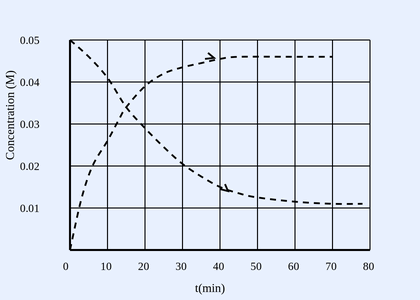
Given above is the concentration vs time plot for a dissociation reaction . Based on the data of the initial phase of the reaction (initial 10 min), the value of n is.....
(1)
(2)
(3)
(4)
SolutionAnswer: Option 1
Approach:
For the dissociation , each mole of A consumed produces n moles of B, so . The initial-phase (first 10 min) concentration changes are read from the plot and the ratio gives n.
Step 1:From the falling curve for A, the concentration drops from at to at min, so the amount of A consumed in the initial phase is .
Step 2:From the rising curve for B, the product concentration grows from to over the same first 10 minutes.
Step 3:Apply the stoichiometric relation to obtain .
Final answer: 3
Q70Single correctChemical Bonding and Molecular Structure
Which statements are NOT TRUE about ?
A. It has a see-saw shape
B. Xe has 5 electron pairs in its valence shell in .
C. The O-Xe-O bond angle is close to
D. The F-Xe-F bond angle is close to
E. Xe has 16 valence electrons in
Choose the correct answer from the options given below
A. It has a see-saw shape
B. Xe has 5 electron pairs in its valence shell in .
C. The O-Xe-O bond angle is close to
D. The F-Xe-F bond angle is close to
E. Xe has 16 valence electrons in
Choose the correct answer from the options given below
(1)
(2)
(3)
(4)
SolutionAnswer: Option 4
Approach:
The geometry of follows from VSEPR. Xe (8 valence electrons) forms two bonds and two bonds and retains one lone pair, giving a steric number of 5 (trigonal bipyramidal arrangement, see-saw shape). Each statement is tested against this picture; the NOT-TRUE ones are collected.
Step 1:Statement A: with two doubly-bonded O, two singly-bonded F and one lone pair, adopts a trigonal-bipyramidal electron arrangement and a see-saw molecular shape. Statement A is true.
Step 2:Statement B claims Xe has 5 electron pairs in its valence shell. The valence shell holds two double bonds (four bond pairs), two bonds (two bond pairs) and one lone pair, totalling seven electron pairs, not five. Statement B is not true.
Step 3:Statement C: the two oxygen atoms occupy equatorial positions of the trigonal bipyramid, so the angle is near , far from . Statement C is not true.
Step 4:Statement D: the two fluorine atoms occupy the axial positions, giving an angle close to (slightly bent by the equatorial lone pair). Statement D is true.
Step 5:Statement E claims Xe has 16 valence electrons in . A neutral Xe atom (group 18) has 8 valence electrons, so 16 is incorrect. Statement E is not true.
Final answer: B, C and E only
Q71NumericalEquilibrium
and are added to a 1 L flask and it is found that the system attains the above equilibrium at T(K) with the number of moles of , and Z(g) being 3, 3 and 9 mol respectively (equilibrium moles). Under this condition of equilibrium, of Z(g) is added to the flask and the temperature is maintained at T(K). Then the number of moles of Z(g) in the flask when the new equilibrium is established is ______. (Nearest integer)
SolutionAnswer: 15
Approach:
The 1 L flask makes moles numerically equal to molar concentrations. is computed from the first equilibrium (). After adding 10 mol Z, the reverse extent x is found from the unchanged , and the new moles of Z are evaluated.
Step 1:Evaluate from the first equilibrium amounts in the 1 L flask.
Step 2:Adding 10 mol Z raises it to 19 mol and drives the equilibrium in reverse by an extent x. Each reverse unit consumes 2 mol Z and produces 1 mol each of and .
Step 3:Apply . Since both sides are perfect squares with positive quantities, take the positive square root.
Step 4:Solve the linear equation and evaluate the new moles of .
Final answer: 15
Q72NumericalCoordination Compounds
Total number of unpaired electrons present in the central metal atoms/ions of , , , and is ______.
SolutionAnswer: 2
Approach:
For each complex the central-metal oxidation state and -electron count are found, then the ligand field strength and geometry fix the number of unpaired electrons; the five contributions are summed.
Step 1:: Ni is in oxidation state 0; the strong-field CO ligands pair the electrons into a configuration, tetrahedral geometry. No unpaired electrons.
Step 2:: is ; is a weak-field ligand giving a tetrahedral complex, where the arrangement () leaves two unpaired electrons.
Step 3:: is ; as a metal it forms a square-planar complex in which all eight d-electrons are paired. No unpaired electrons.
Step 4:: is ; strong-field forces a square-planar complex with all electrons paired. No unpaired electrons.
Step 5:: is , square planar and diamagnetic. Summing all five contributions gives the total.
Final answer: 2
Q73NumericalHydrocarbons
Consider the following reaction of benzene.
In compound (Q), the percentage of oxygen is ______ %. (Nearest integer)
In compound (Q), the percentage of oxygen is ______ %. (Nearest integer)
SolutionAnswer: 10
Approach:
The reagent is 4-oxopentanoyl chloride, . Friedel-Crafts acylation joins its end to benzene, forming a phenyl diketone (P). Aqueous NaOH with heat drives an intramolecular aldol condensation, losing one to give a cyclic enone (Q); the oxygen percentage of Q is then found.
Step 1:Anhydrous promotes Friedel-Crafts acylation at the acid-chloride carbon, giving 1-phenylpentane-1,4-dione (P).
Step 2:Aqueous NaOH with heat triggers an intramolecular aldol condensation between the two carbonyls, eliminating one water molecule to form a cyclic enone (Q).
Step 3:Compute the molar mass of Q using C = 12, H = 1, O = 16.
Step 4:Q contains one oxygen atom; evaluate the oxygen percentage.
Final answer: 10
Q74NumericalSolutions
Two liquids A and B form an ideal solution. At 320K, the vapour pressure of the solution. Containing 3 mol of A and 1 mol of B is . At the same temperature, if 1 mol of A is further added to this solution, vapour pressure of the solution increases by . Vapour pressure (in mm Hg) of B in pure state is ______. (Nearest integer)
SolutionAnswer: 200
Approach:
A and B form an ideal solution, so Raoult's law gives the total vapour pressure as the mole-fraction-weighted sum of the pure-component pressures. The two given compositions (500 mm Hg, then 520 mm Hg after adding 1 mol A) provide two equations solved for and .
Step 1:First solution (3 mol A, 1 mol B): , , total pressure 500 mm Hg.
Step 2:Adding 1 mol A gives 4 mol A and 1 mol B: , , and the pressure rises by 20 to 520 mm Hg.
Step 3:Subtract equation (1) from equation (2) to eliminate .
Step 4:Substitute into equation (1) to obtain .
Final answer: 200
Q75NumericalRedox Reactions and Electrochemistry
of potassium dichromate is required to oxidise of Mohr's salt solution in acidic medium. Here ______.
SolutionAnswer: 375
Approach:
At the equivalence point the milliequivalents of potassium dichromate equal those of Mohr's salt (ferrous ammonium sulfate). Using the n-factors (6 for dichromate, 1 for Fe(II)) and the equivalence relation gives an equation solved for x.
Step 1:In acidic medium dichromate reduces for both chromium atoms, a gain of 6 electrons, so its n-factor is 6; Mohr's salt loses 1 electron, n-factor 1.
Step 2:Equate milliequivalents of dichromate ( of ) and Mohr's salt ( of ).
Step 3:Evaluate the right side and simplify the left side.
Step 4:Solve for .
Final answer: 375
Mathematics25 questions
Q1Single correctCo-ordinate Geometry
Let PQ be a chord of the hyperbola , perpendicular to the x-axis such that OPQ is an equilateral triangle, O being the centre of the hyperbola. If the eccentricity of the hyperbola is , then the area of the triangle OPQ is
(1)
(2)
(3)
(4)
SolutionAnswer: Option 1
Approach:
The hyperbola has and eccentricity , and a vertical chord PQ forms an equilateral triangle OPQ with centre O at the origin. The target is the area of triangle OPQ, obtained by fixing , locating P and Q from the equilateral condition, and applying the half-base-times-height formula.
Step 1:Determine from the eccentricity with .
Step 2:Place the vertical chord at , so and with , symmetric about the x-axis. Then .
Step 3:For triangle OPQ to be equilateral, the line OP makes with the x-axis, giving .
Step 4:Substitute into the hyperbola equation using .
Step 5:Compute the area with base and height equal to the x-coordinate .
Final answer:
Q2Single correctMatrices and Determinants
The system of linear equations
has
has
(1)
(2)
(3)
(4)
SolutionAnswer: Option 1Infinitely many solutions for and
Approach:
A system in x,y,z carries parameters a,b. The target is the condition on a,b governing the nature of the solution, found by evaluating the coefficient determinant and testing consistency at its zero.
Step 1:Compute the determinant of the coefficient matrix by expansion along the first row.
Step 2:For the determinant is nonzero, so the system has a unique solution for every b.
Step 3:Set and reduce: gives , i.e. ; gives .
Step 4:Consistency at requires the two relations to coincide, fixing .
Step 5:At the third equation duplicates a combination of the first two, leaving one free variable.
Final answer: Infinitely many solutions for and
Q3Single correctStatistics and Probability
If the mean and the variance of the data
Class | 4-8 | 8-12 | 12-16 | 16-20 |
Freaquency | 3 | | 4 | 7 |
are and 19 respectively, then the value of is
Class | 4-8 | 8-12 | 12-16 | 16-20 |
Freaquency | 3 | | 4 | 7 |
are and 19 respectively, then the value of is
(1)
(2)
(3)
(4)
SolutionAnswer: Option 3
Approach:
A grouped frequency distribution has one unknown frequency , variance 19, and unknown mean . The target is , found by expressing mean and variance through class mid-values, solving for , then computing .
Step 1:Take mid-values with frequencies ; the total frequency is .
Step 2:Form the weighted sums of and .
Step 3:Write the variance equation and clear the denominator .
Step 4:Expand: , which simplifies the right side to .
Step 5:Collect terms into a quadratic and solve.
Step 6:Compute the mean at () and add.
Final answer:
Q4Single correctComplex Numbers and Quadratic Equations
If , , then is equal to
(1)
(2)
(3)
(4)
SolutionAnswer: Option 2
Approach:
The complex number lies on the unit circle. The target is , evaluated by writing z in polar form, applying De Moivre's theorem, and reducing the angle modulo .
Step 1:Identify the modulus and argument: and .
Step 2:Raise to the st power; the angle is .
Step 3:Reduce the angle modulo : .
Step 4:Subtract i and raise to the th power, using .
Final answer:
Q5Single correctLimit, Continuity and Differentiability
If
is continuous at , then is equal to
is continuous at , then is equal to
(1)
(2)
(3)
(4)
SolutionAnswer: Option 2
Approach:
The piecewise function carries parameters and must be continuous at . The target is , found by computing the left- and right-hand limits (handling separately) and matching them to .
Step 1:For , and , so the numerator is .
Step 2:Take the right-hand limit, where .
Step 3:For , and , so the numerator is .
Step 4:Take the left-hand limit, where .
Step 5:Continuity forces LHL RHL, which fixes .
Step 6:The common limit equals ; then add the parameters.
Final answer:
Q6Single correctTrigonometry
Let and . Then the value of is equal to
(1)
(2)
(3)
(4)
SolutionAnswer: Option 2
Approach:
Here lies in the second quadrant with . The target expression is condensed into via compound-angle identities, then evaluated using .
Step 1:Set and and regroup the expression.
Step 2:Evaluate , and use , .
Step 3:Insert into and clear fractions.
Step 4:Solve the quadratic; since gives , take the positive root.
Step 5:From with in the first quadrant, the right triangle has legs and hypotenuse .
Step 6:Substitute into the condensed expression.
Final answer:
Q7Single correctIntegral Calculus
Let and . If , where , , then is equal to
(1)
(2)
(3)
(4)
SolutionAnswer: Option 1
Approach:
The indefinite integral has an initial condition fixing the constant. The target is from , obtained by factoring the radicand, finding the antiderivative, and applying the initial condition.
Step 1:Factor the radicand and the linear factor .
Step 2:Differentiate the trial antiderivative using .
Step 3:Record the antiderivative with an integration constant.
Step 4:Apply the initial condition at , where .
Step 5:Evaluate at : , so .
Step 6:Sum the natural numbers, with satisfied.
Final answer:
Q8Single correctCo-ordinate Geometry
An equilateral triangle OAB is inscribed in the parabola with the vertex O at the vertex of the parabola. Then the minimum distance of the circle having AB as a diameter from the origin is
(1)
(2)
(3)
(4)
SolutionAnswer: Option 4
Approach:
An equilateral triangle OAB is inscribed in with vertex O at the origin. The target is the shortest distance from the origin to the circle on side AB as diameter, found by locating A and B, then taking the centre distance minus the radius.
Step 1:By symmetry A and B are reflections across the x-axis, so OA makes with the axis. With (), the slope gives .
Step 2:Compute the coordinates of A and B.
Step 3:The circle on AB as diameter has centre at the midpoint and radius equal to half of .
Step 4:Compute the distance from the origin to the centre.
Step 5:The minimum distance from the origin to the circle is the centre distance minus the radius.
Final answer:
Q9Single correctStatistics and Probability
Bag A contains 9 white and 8 black balls, while bag B contains 6 white and 4 black balls. One ball is randomly picked up from the bag B and mixed up with the balls in the bag A. Then a ball is randomly drawn from the bag A. If the probability, that the ball drawn is white, is , , then is equal to
(1)
(2)
(3)
(4)
SolutionAnswer: Option 1
Approach:
One ball is transferred from bag B (6 white, 4 black) into bag A (9 white, 8 black), after which a ball is drawn from A. The target is from the probability of drawing white, computed by conditioning on the colour transferred.
Step 1:Probabilities of the transferred ball from B (10 balls total).
Step 2:After transfer bag A holds 18 balls: 10 white if white was transferred, 9 white if black was transferred.
Step 3:Apply the total probability theorem.
Step 4:Reduce the fraction to lowest terms.
Step 5:Add numerator and denominator.
Final answer:
Q10Single correctSets, Relations and Functions
Let . Let R be a relation on A defined by if and only if is a multiple of 3.
Given below are two statements:
Statement-I: .
Statement-II: R is an equivalence relation.
In the light of the above statements, choose the correct answer from the option given below
Given below are two statements:
Statement-I: .
Statement-II: R is an equivalence relation.
In the light of the above statements, choose the correct answer from the option given below
(1)
(2)
(3)
(4)
SolutionAnswer: Option 4Statement I is incorrect but Statement II is correct
Approach:
On , the relation R holds when is a multiple of 3, i.e. . The target is to judge the count n(R) and whether R is an equivalence relation, by partitioning A into residue classes.
Step 1: a multiple of 3 is equivalent to ; partition A by residue.
Step 2:Congruence modulo 3 is reflexive, symmetric and transitive, so is an equivalence relation; Statement-II holds.
Step 3:Count ordered pairs: each class contributes related pairs.
Step 4:Since , Statement-I is false.
Final answer: Statement I is incorrect but Statement II is correct
Q11Single correctVector Algebra
Let a,b,c be three vectors such that . If , , , and the angle between b and c is , then is equal to
(1)
(2)
(3)
(4)
SolutionAnswer: Option 1
Approach:
Three vectors satisfy with and angle between b and c. The target is , found by deducing , fixing the scalar from magnitudes, then dotting with c.
Step 1:Rewrite the relation as a single cross product equal to zero, so is parallel to .
Step 2:Compute from the given angle.
Step 3:Take magnitudes squared of using .
Step 4:Dot the relation with c.
Step 5:Take absolute values with .
Final answer:
Q12Single correctSets, Relations and Functions
Consider two sets and . Then the number of onto functions is equal to
(1)
(2)
(3)
(4)
SolutionAnswer: Option 2
Approach:
Set A is defined by an integer modulus inequality and set B by a real equation excluding . The target is the number of onto functions , found by listing both sets and applying the surjection count for a two-element codomain.
Step 1:Solve : with , gives , hence .
Step 2:Collect the integer solutions to form A.
Step 3:For B, the product vanishes when or , with excluded.
Step 4:Collect the valid elements of B (at the numerator factor forces the product to zero).
Step 5:Count onto functions from a 6-element set to a 2-element set.
Final answer:
Q13Single correctCo-ordinate Geometry
If the points of intersection of the ellipses and lie on a circle of radius r and centre (a,b), then the value of is
(1)
(2)
(3)
(4)
SolutionAnswer: Option 2
Approach:
Two conics and intersect, and the common points lie on a circle. The target is , found by forming the combination whose and coefficients are equal (a circle through the intersections), then reading its centre and radius.
Step 1:In the coefficient is and the coefficient is ; equate them for a circle.
Step 2:Form by adding the two equations term by term.
Step 3:Divide by 3 to reach the standard circle form.
Step 4:Read the centre (a,b) from and compute .
Step 5:Compute the requested expression.
Final answer:
Q14Single correctPermutations and Combinations
The number of ways, in which 16 oranges can be distributed to four childrens such that each child gets at least one orange, is
(1)
(2)
(3)
(4)
SolutionAnswer: Option 1
Approach:
Given 16 identical oranges distributed among 4 distinct children with each receiving at least one. The target is the number of such distributions, obtained as the count of positive integer solutions via stars and bars.
Step 1:Model the distribution as positive integer solutions of an equation with oranges and children.
Step 2:Apply the stars-and-bars formula for the at-least-one constraint.
Step 3:Evaluate the binomial coefficient.
Final answer:
Q15Single correctIntegral Calculus
The area of the region enclosed between the circles and is
(1)
(2)
(3)
(4)
SolutionAnswer: Option 4
Approach:
Given two equal circles of radius centred at and , a distance apart. The target is the area of their common lens region, obtained by integrating the difference of the bounding arcs between the intersection abscissae.
Step 1:Find the intersection of the circles. Subtracting the equations and gives , so and .
Step 2:Between and the lens is bounded above by the lower circle's upper arc and below by the upper circle's lower arc .
Step 3:Evaluate using the antiderivative; by symmetry it is twice the value on .
Step 4:Substitute and also compute .
Step 5:Factor the result.
Final answer:
Q16Single correctVector Algebra
Let , , and . If and the length of the projection of b on c is p, then is equal to
(1)
(2)
(3)
(4)
SolutionAnswer: Option 3
Approach:
Given , , , , and the condition . The target is where ; first determine , then form the projection.
Step 1:Compute by expanding the determinant.
Step 2:Apply to solve for .
Step 3:With , ; compute and .
Step 4:Form the projection length and square it.
Step 5:Multiply by .
Final answer:
Q17Single correctTrigonometry
The least value of is
(1)
(2)
(3)
(4)
SolutionAnswer: Option 2
Approach:
Given the expression to minimize. The target is its least value, obtained by reducing it to a constant plus a single sinusoid in and applying the amplitude bound.
Step 1:Replace the squared terms and the product term with double-angle equivalents.
Step 2:Combine the cosine and constant terms over a common denominator.
Step 3:Simplify to a constant plus a sinusoid.
Step 4:The sinusoid has amplitude , so it ranges over ; f is least when this sinusoid attains .
Final answer:
Q18Single correctComplex Numbers and Quadratic Equations
The sum of all the real solutions of the equation is equal to
(1)
(2)
(3)
(4)
SolutionAnswer: Option 3
Approach:
Given the equation with variable bases. The target is the sum of its real solutions, found by factoring the arguments, substituting a single logarithmic variable, and solving the resulting quadratic under domain constraints.
Step 1:Factor both arguments.
Step 2:Split the logarithms of products and powers.
Step 3:Set , so , and clear fractions.
Step 4:Solve the perfect-square quadratic.
Step 5:Convert back: means .
Step 6:Check domains and add. For the bases are and ; for the bases are and , all positive and , so both are admissible.
Final answer:
Q19Single correctSequence and Series
Let . If and , then is equal to
(1)
(2)
(3)
(4)
SolutionAnswer: Option 2
Approach:
Given the partial sum , with and . The target is , obtained by extracting the general term from the sum and applying both conditions.
Step 1:Derive the general term from the sum.
Step 2:Apply .
Step 3:Apply with and .
Step 4:Substitute into .
Step 5:Find and add.
Final answer:
Q20Single correctCo-ordinate Geometry
Let and be two diagonally opposite vertices of a rhombus, whose sides AD and BC are parallel to the line . If and are the other two vertices, then is equal to
(1)
(2)
(3)
(4)
SolutionAnswer: Option 2
Approach:
Given opposite vertices and of a rhombus with the remaining vertices and . The target is ; since the diagonals of a rhombus bisect each other, the coordinate sum of B and D is fixed by the midpoint of AC.
Step 1:The diagonals and share the same midpoint .
Step 2: is also the midpoint of , giving the coordinate sums of and .
Step 3:Add all four coordinates.
Step 4:Take the absolute value.
Final answer:
Q21NumericalMatrices and Determinants
Let and B be a matrix such that . Then the sum of the diagonal elements of is equal to ________.
SolutionAnswer: 3
Approach:
Given the skew-symmetric matrix A and B defined by . The target is the sum of the diagonal elements of , obtained by recognizing B as the Cayley transform of A, which is orthogonal.
Step 1:The given A satisfies , so it is skew-symmetric.
Step 2:Solve for from the defining relation.
Step 3:Transpose B using and .
Step 4:Multiply to obtain ; the polynomials and in A commute, so they rearrange.
Step 5:Sum the diagonal of the identity.
Final answer:
Q22NumericalIntegral Calculus
The number of elements in the set is ________.
SolutionAnswer: 16
Approach:
Given the integral equation with . The target is the number of solutions, obtained by evaluating the integral in closed form and solving the resulting trigonometric equation.
Step 1:Set and differentiate; the boundary term vanishes.
Step 2:Differentiate again; the boundary term appears.
Step 3:Solve with and . The general solution is ; the conditions give .
Step 4:Set .
Step 5:Solve in : with .
Step 6:Count the admissible .
Final answer:
Q23NumericalThree Dimensional Geometry
If the image of the point in the line is Q, and the image of Q in the line is P, then is equal to ________.
SolutionAnswer: 3
Approach:
Given whose mirror image in line is Q, and the image of Q in line is P. The target is , obtained by computing each reflection through the foot of perpendicular and forcing the composition to return P.
Step 1:Reflect in (point , direction ). Write the foot and impose .
Step 2:Form .
Step 3:Reflect Q in (point , direction ); the foot is with , and the image is .
Step 4:Set the image of equal to , giving three equations in .
Step 5:Solve the system. The third equation gives ; substituting into the others yields .
Step 6:Add the values.
Final answer:
Q24NumericalDifferential Equations
If the solution curve of the differential equation , , passes through the point , then the local maximum value of f is ________.
SolutionAnswer: 16
Approach:
Given for through . The target is the local maximum of f, obtained by solving the linear ODE with an integrating factor, fixing the constant, and locating the maximum.
Step 1:Divide by and use to simplify the last term.
Step 2:Compute the integrating factor for (so ).
Step 3:Multiply through; the left side becomes a total derivative.
Step 4:Apply the point .
Step 5:Write the solution and complete the square in .
Step 6:The maximum of occurs at , i.e. , where the squared term vanishes.
Final answer:
Q25NumericalPermutations and Combinations
Let S denote the set of 4-digit numbers abcd such that and P denoted the set of 5-digit numbers having product of its digits equal to 20. Then is equal to ________.
SolutionAnswer: 260
Approach:
Given = 4-digit numbers with , and = 5-digit numbers whose digit product is . The target is , obtained by a selection count for and by factoring into digit multisets for .
Step 1:For S, any choice of 4 distinct digits from arranges uniquely in strictly decreasing order; the leading digit is the largest, which is nonzero, so every choice is valid.
Step 2:For P, the product forbids any zero digit and requires the factor , which can only be the digit (since any other single digit's contribution beyond one ); the remaining four digits then multiply to .
Step 3:Distribute the product over four digits (): either as or , giving the digit multisets.
Step 4:Count arrangements of each multiset across the 5 digit positions.
Step 5:Sum the arrangements for (no leading-zero issue since no digit is ).
Step 6:Add the two counts.
Final answer:
More JEE Main 2026 papers
- JEE Main 2026 — April 02, Shift 1
- JEE Main 2026 — April 02, Shift 2
- JEE Main 2026 — April 04, Shift 1
- JEE Main 2026 — April 04, Shift 2
- JEE Main 2026 — April 05, Shift 1
- JEE Main 2026 — April 05, Shift 2
- JEE Main 2026 — April 06, Shift 1
- JEE Main 2026 — April 06, Shift 2
- JEE Main 2026 — April 08, Shift 2
- JEE Main 2026 — January 21, Shift 1
- JEE Main 2026 — January 21, Shift 2
- JEE Main 2026 — January 22, Shift 1
- JEE Main 2026 — January 22, Shift 2
- JEE Main 2026 — January 23, Shift 1
- JEE Main 2026 — January 24, Shift 1
- JEE Main 2026 — January 24, Shift 2
- JEE Main 2026 — January 28, Shift 1
- JEE Main 2026 — January 28, Shift 2
Frequently Asked Questions
How many questions are in the JEE Main 2026 January 23, Shift 2 paper?
The JEE Main 2026 January 23, Shift 2 paper has 75 questions — Physics (25), Chemistry (25) and Mathematics (25). Every question is on this page with its correct answer and a step-by-step solution.
What is the marking scheme for JEE Main?
JEE Main awards +4 marks for each correct answer and −1 for a wrong answer, with 0 for questions left unattempted. The paper covers Physics, Chemistry and Mathematics.
Are the answer key and step-by-step solutions provided for the 2026 January 23, Shift 2 paper?
Yes — every question shows the correct answer (answer key) and a detailed step-by-step solution, free to read online.
Can I take the JEE Main 2026 January 23, Shift 2 paper as a timed mock test?
Yes. With a free JEEnify account you can attempt this exact paper as a timed test in the real exam interface, then see your score and weak-area analysis.
Solved this paper? Calculate your JEE Main scoremost important chaptersformula sheetsall free tools.