
Back to JEE Main PYQs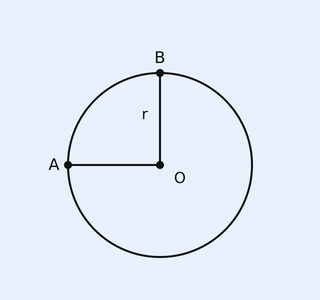
![Line graph: vertical axis labelled [AB]/M with marked values 0.5, 0.55 and 0.6; horizontal axis labelled time/s with marked values 0, 100 and 200. A straight descending line starts at concentration 0.6 at time 0, passes through 0.55 at 100 s and 0.5 at 200 s, and continues downward beyond. Dashed guide lines connect 0.55 to 100 s and 0.5 to 200 s.](/api/qna-image?path=QnA%2Fb65cda62-f924-480b-b4db-1d3aaa6069d4%2F5ef15551-aed6-4f93-a8d5-a219b7a5d19b%2F9b18e9a2-1f90-4c3a-9e03-40a378a71aab%2F9b18e9a2-1f90-4c3a-9e03-40a378a71aab%2Fimages%2FQ73_fig.webp)
JEE Main 2026 January 23, Shift 1 Question Paper with Solutions
All 75 questions from the JEE Main 2026 (January 23, Shift 1) shift — Physics (25), Chemistry (25) and Mathematics (25) — each with the correct answer (answer key) and a step-by-step solution. Read it free online, or attempt the full paper as a timed mock test.
Physics25 questions
Q26Single correctCurrent Electricity
A Wire of uniform resistance is bent into a circle of radius r and another piece of wire with length is connected between points A and B (AOB) as shown in figure. The equivalent resistance between point A and B is______
(1)
(2)
(3)
(4)
SolutionAnswer: Option 3
Approach:
Givens: uniform wire resistance per unit length (units ), circle radius r (m), straight connecting wire of length 2r. Point A sits on the left of the horizontal diameter and point B at the top of the circle, so A and B are separated by a quarter turn (90 deg). The straight path A-O-B has total length . Three conductors join A and B in parallel: the straight wire, the minor (quarter) arc, and the major (three-quarter) arc. Target: equivalent resistance between A and B.
Step 1:The major arc spans three quarters of the circumference; its length is , giving resistance .
Step 2:The minor arc spans one quarter of the circumference; its length is , giving resistance .
Step 3:The straight diametric wire A-O-B has length , giving resistance .
Step 4:Combine the three branches in parallel and factor out .
Step 5:Place the bracket over the common denominator and invert.
Final answer:
Q27Single correctOscillations and Waves
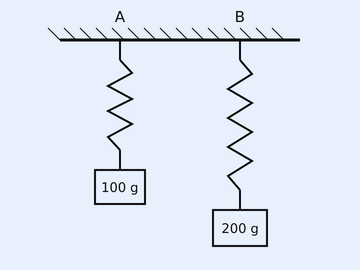
Two blocks with masses 100g and 200g are attached to the ends of springs A and B as shown in figure. The energy stored in A is E. The energy stored in B, when spring constants f A and B respectively satisfy the relation is
(1)
(2)
(3)
(4)
SolutionAnswer: Option 2
Approach:
Givens: block on spring A has mass , block on spring B has mass , spring constants satisfy , elastic energy stored in A is E. Each block hangs at static equilibrium where the spring force balances gravity. Target: elastic potential energy stored in spring B.
Step 1:At equilibrium the static extension is . Substituting into the elastic energy gives a form depending on mass and spring constant.
Step 2:Form the ratio of energy in A to energy in B; the factor cancels.
Step 3:The relation rearranges to . Substituting yields the ratio.
Step 4:With , the energy stored in B follows.
Final answer:
Q28Single correctUnits and Measurements
Four persons measure the length of a rod as 20.00 cm, 19.75 cm, 17.01 cm and 18.25 cm. The relative error in the measurement of average length of the rod is:
(1)
(2)
(3)
(4)
SolutionAnswer: Option 1
Approach:
Givens: four readings of the rod length, 20.00 cm, 19.75 cm, 17.01 cm, 18.25 cm. Target: relative error in the average length, defined as the mean absolute deviation divided by the mean length.
Step 1:Sum the four readings and divide by 4 to find the mean length.
Step 2:Compute the absolute deviation of each reading from the mean.
Step 3:Average the absolute deviations to obtain the mean absolute error.
Step 4:Divide the mean absolute error by the mean length to get the relative error.
Final answer:
Q29Single correctMagnetic Effects of Current and Magnetism
Given Below are two statements: one is labelled as Assertion (A) and the other is labelled as Reason (R) Consider a ferromagnetic material:
Assertion (A): The individual atoms in a ferromagnetic material possess a magnetic dipole moment and interact with one another in such a way that they spontaneously align themselves forming domains.
Reason (R): At high enough temperature, the domain structure of ferromagnetic material disintegrate. Thus magnetization will disappear at high enough temperature known as Curie temperature.
In the light of the above statement choose the correct answer from the options given below:
Assertion (A): The individual atoms in a ferromagnetic material possess a magnetic dipole moment and interact with one another in such a way that they spontaneously align themselves forming domains.
Reason (R): At high enough temperature, the domain structure of ferromagnetic material disintegrate. Thus magnetization will disappear at high enough temperature known as Curie temperature.
In the light of the above statement choose the correct answer from the options given below:
(1)
(2)
(3)
(4)
SolutionAnswer: Option 1Both (A) and (R) are true but (R) is not the correct explanation of (A)
Approach:
Target: judge the truth of the Assertion and the Reason separately, then decide whether the Reason explains the Assertion. The topic is ferromagnetic domain formation and its temperature dependence.
Step 1:Assertion (A) states that atomic magnetic dipole moments in a ferromagnet interact via exchange coupling and spontaneously align into domains. This is a correct description of ferromagnetic ordering.
Step 2:Reason (R) states that above the Curie temperature the domain structure disintegrates and spontaneous magnetization vanishes. This is a correct statement about the ferromagnetic-to-paramagnetic transition.
Step 3:Assertion concerns why domains form (spontaneous low-temperature alignment), while the Reason concerns how domains break down at high temperature. The high-temperature breakdown does not account for the spontaneous formation.
Step 4:Both statements true with the Reason not being the explanation corresponds to option 1.
Final answer: Both (A) and (R) are true but (R) is not the correct explanation of (A)
Q30Single correctWork, Energy and Power
In a perfectly inelastic collision, two spheres made of the same material with masses 15kg and 25kg moving in opposite directions with speeds of 10 m/s and 30 m/s respectively, strike each other and stick together. The rise in temperature (in C), if all the heat produced during the collision is retained by these spheres is: (specific heat of sphere material 31 cal/kg.C and 1 cal J)
(1)
(2)
(3)
(4)
SolutionAnswer: Option 2
Approach:
Givens: at , at (opposite direction), specific heat . The spheres stick (perfectly inelastic). Target: temperature rise from the kinetic energy converted to heat, retained by the combined mass .
Step 1:Apply momentum conservation, taking the 10 m/s direction positive.
Step 2:Compute initial kinetic energy.
Step 3:Compute final kinetic energy of the combined mass and subtract to find heat produced.
Step 4:Equate the heat to with and and solve.
Final answer:
Q31Single correctRotational Motion
Two small balls with masses m and 2m are attached to both ends of a rigid rod of length d and negligible mass. If angular momentum of this system is L about an axis (A) passing through its centre of mass and perpendicular to the rod then angular velocity of the system about A is:
(1)
(2)
(3)
(4)
SolutionAnswer: Option 1
Approach:
Givens: point masses m and at the ends of a massless rod of length d, angular momentum L about the perpendicular axis through the centre of mass. Target: angular velocity . First locate the centre of mass, then the moment of inertia about it, then use .
Step 1:Measure positions from the mass end; the mass is at distance . Locate the centre of mass.
Step 2:The distances from the centre of mass are for mass m and for mass .
Step 3:Evaluate each term and add.
Step 4:Apply and solve for .
Final answer:
Q32Single correctElectromagnetic Induction
A 20m long uniform copper wire held horizontally is allowed to fall under the gravity trough a uniform horizontal magnetic field of 0.5 Gauss perpendicular to the length of the wire. The induced EMF across the wire when it travels a vertical distance of 200 m is____ mV
(1)
(2)
(3)
(4)
SolutionAnswer: Option 3
Approach:
Givens: wire length , , magnetic field perpendicular to the wire, vertical fall . The horizontal wire falls vertically, cutting the horizontal field lines. Target: motional EMF in millivolts.
Step 1:Find the speed of the wire after falling 200 m from rest.
Step 2:Convert the field to tesla.
Step 3:Apply the motional EMF formula with , and .
Step 4:Convert volts to millivolts by multiplying by .
Final answer:
Q33Single correctOptics
A thin prism with angle of refractive index 1.72 is combined with another prism of refractive index 1.9 to produced dispersion without deviation. The angle of second prism is______
(1)
(2)
(3)
(4)
SolutionAnswer: Option 3
Approach:
Givens: first thin prism , ; second prism ; the combination produces dispersion without deviation. Target: refracting angle of the second prism. Zero net deviation requires the mean deviations of the two prisms to be equal in magnitude (oppositely oriented).
Step 1:For the net deviation to vanish, the deviation of prism 1 balances that of prism 2.
Step 2:Rearrange for and substitute , , .
Step 3:Evaluate the division.
Final answer:
Q34Single correctElectrostatics
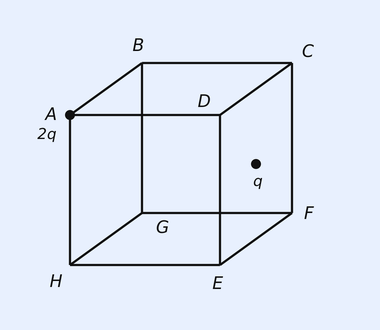
Two point charges 2q and q are placed at vertex A and centre of face CDEF of the cube as shown in figure. The electric flux passing through the cube is:
(1)
(2)
(3)
(4)
SolutionAnswer: Option 3
Approach:
Givens: charge located at a cube vertex (A) and charge q located at the centre of one cube face (CDEF). Target: total electric flux through the cube. Gauss's law gives flux as enclosed charge over ; a charge sitting on the boundary contributes only the fraction of its total flux that enters the cube.
Step 1:A charge at a cube corner is shared symmetrically among the 8 cubes meeting there, so one eighth of its flux threads this cube.
Step 2:A charge at the centre of a face lies on the boundary surface; half of its flux passes into the cube.
Step 3:Add the two contributions over the common denominator .
Final answer:
Q35Single correctUnits and Measurements
In a screw gauge, the zero of the circular scale lies 3 divisions above the horizontal pitch line when their metallic studs are brought in contact. Using this instrument thickness of a sheet is measure If pitch scale reading is 1mm and the circular scale reading is 51 then the correct thickness of the sheet is______ mm. [Assume least count is 0.01mm]
(1)
(2)
(3)
(4)
SolutionAnswer: Option 4
Approach:
Givens: least count ; with studs in contact the circular-scale zero rests 3 divisions above the reference (pitch) line; pitch-scale reading ; circular-scale reading divisions. Target: corrected sheet thickness. The zero of the circular scale above the line means the instrument under-reads, a negative zero error that must be subtracted (its magnitude added).
Step 1:The zero sits 3 divisions above the pitch line, giving a negative zero error.
Step 2:Compute the observed reading from the pitch scale and circular scale.
Step 3:Subtract the negative zero error, which adds its magnitude to the observed reading.
Final answer:
Q36Single correctRotational Motion
The moment of inertia of a square loop made of four uniform solid cylinders, each having radius R and length L (R<L) about an axis passing through the mid points of opposite sides is (Take the mass of the entire loop as M)
(1)
(2)
(3)
(4)
SolutionAnswer: Option 2
Approach:
Givens: a square loop assembled from four identical solid cylinders, each of radius R and length L (), total loop mass M, so each cylinder has mass . The axis passes through the midpoints of two opposite sides. Two cylinders (the sides containing the midpoints) lie along the axis and spin about their own long axis; the other two cylinders lie parallel to the axis at a perpendicular distance . Target: total moment of inertia.
Step 1:The two cylinders forming the sides through which the axis passes lie along the axis; each contributes its spin inertia about its own length.
Step 2:The remaining two cylinders are oriented transverse to the axis with their centres displaced by ; apply the transverse formula plus the parallel-axis shift to each.
Step 3:Collect the terms from the transverse pair: per cylinder, doubled.
Step 4:Collect all terms: from the axial pair plus from the transverse pair.
Step 5:Substitute into both grouped terms.
Final answer:
Q37Single correctWork, Energy and Power
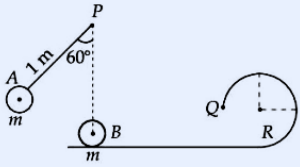
A small bob A of mass m is attached to a massless rigid rod of length 1m pivoted at point P and kept at an angle of with vertical as shown in figure. At distance of 1m below point P, an identical bob B is kept at rest on a smooth horizontal surface that extends to a circular track of radius R as shown in figure. If bob B just manages to complete the circular path of radius R upto a point Q after being hit elastically by bob A, then radius R is____ m.
(1)
(2)
(3)
(4)
SolutionAnswer: Option 1
Approach:
Givens: rod length pivoted at P, bob A (mass m) released from to the vertical, identical bob B at rest at the lowest point (1 m below P) on a smooth surface leading to a vertical circular loop of radius R, . The collision is elastic between equal masses, and B must just complete the loop. Target: R. Energy conservation gives A's speed at the bottom; the elastic equal-mass collision transfers that speed fully to B; the just-completes-loop condition fixes the launch speed.
Step 1:The bob A descends through height ; equate loss of gravitational PE to gain of KE to find its speed at the bottom.
Step 2:In a head-on elastic collision between equal masses, the moving bob stops and transfers its full velocity to the stationary bob.
Step 3:To just complete the vertical circular loop, the launch speed at the bottom must equal the minimum value .
Step 4:Substitute and solve for .
Final answer:
Q38Single correctElectromagnetic Waves
Match list – I with List – II
| List-I | List-II |
|---|---|
| A. | I. Ampere's circuital law |
| B. | II. Faraday’s law of electromagnetic induction |
| C. | III. Ampere – Maxwell law |
| D. | IV. Gauss’s law of electrostatics |
(1)
(2)
(3)
(4)
SolutionAnswer: Option 1A - II, B - III, C - IV, D - I
Approach:
Target: match each integral form in List-I to the named law in List-II by recognising its defining feature (rate of change of flux, displacement-current term, enclosed charge, or steady current only).
Step 1:Entry A equates the line integral of to the negative time rate of change of magnetic flux, the signature of Faraday's law (II).
Step 2:Entry B contains the displacement-current term added to conduction current, the Ampere-Maxwell law (III).
Step 3:Entry C relates the surface integral of to the enclosed charge density, Gauss's law of electrostatics (IV).
Step 4:Entry D, with steady current only and no displacement-current term, is Ampere's circuital law (I).
Final answer: A-II, B-III, C-IV, D-I (option 1)
Q39Single correctElectronic Devices
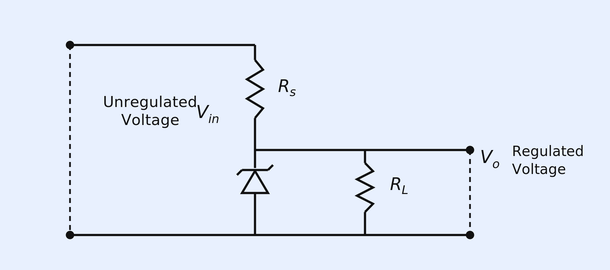
The following diagram shows a Zener diode as a voltage regulator. The Zener diode is rated at and the desired current in load is 5 mA. The unregulated voltage source can supply upto 25V. Considering the Zener diode can withstand four times of the load current, the value of resistor (Shown in circuit) should be______ .
(1)
(2)
(3)
(4)
SolutionAnswer: Option 1
Approach:
Givens: Zener voltage , load current , maximum unregulated supply , Zener current limited to . Variable: series resistance carrying the total current . Target: the value of that keeps the Zener within its current limit while maintaining regulation.
Step 1:The current entering the output node through divides into the Zener branch and the load branch. With the Zener carrying four times the load current, sum both contributions.
Step 2:Apply Kirchhoff voltage law along the path from the supply through the series resistor to the regulated node, where the voltage is clamped at the Zener voltage.
Step 3:Solve for using current in mA and voltage in V, so that the resistance emerges in .
Step 4:At the maximum supply the resistor must drop the surplus while restricting current so the Zener stays within its limit; a larger reduces the current and protects the diode. Among the offered values, only exceeds the threshold.
Final answer:
Q40Single correctProperties of Solids and Liquids
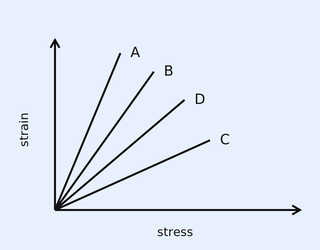
The strain-stress plot for materials A,B,C and D is shown in the figure. Which material has the largest Young's modulus?
(1)
(2)
(3)
(4)
SolutionAnswer: Option 1
Approach:
Givens: four straight lines through the origin on a plot with strain on the vertical axis and stress on the horizontal axis, with slopes ordering A (steepest) > B > D > C (shallowest). Target: the material with the largest Young's modulus.
Step 1:On a plot with strain on the vertical axis and stress on the horizontal axis, the slope of each line equals strain divided by stress, which is the reciprocal of Young's modulus.
Step 2:The largest Young's modulus belongs to the line with the smallest slope. Line C lies closest to the stress axis and therefore has the least slope.
Final answer:
Q41Single correctWork, Energy and Power
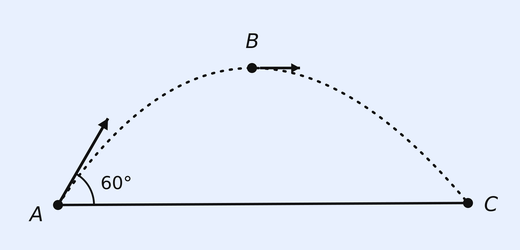
An object is projected with kinetic energy K from a point A at an angle with the horizontal. The ratio of the difference in kinetic energies at point B and C to that at point A (See figure), in the absence of air friction is:
(1)
(2)
(3)
(4)
SolutionAnswer: Option 3
Approach:
Givens: launch kinetic energy K at angle , apex point B, landing point C at the launch height, no air friction. Variables: kinetic energies , , . Target: the ratio of the magnitude of to .
Step 1:The kinetic energy at the launch point A is the stated value.
Step 2:At the apex B the vertical velocity component is zero, leaving only the horizontal component . Squaring scales the kinetic energy by , and .
Step 3:Point C is at the same height as A, so by conservation of mechanical energy the speed equals the launch speed and the kinetic energy returns to .
Step 4:Form the ratio of the difference of kinetic energies at B and C to that at A, then take the magnitude for the ratio asked.
Final answer:
Q42Single correctOscillations and Waves
A simple pendulum of straight length 30cm performs 20 oscillations in 10s. The length of the string required for the pendulum to perform 40 oscillations in the same time duration is ________ cm [Assume that the mass of the pendulum remains same]
(1)
(2)
(3)
(4)
SolutionAnswer: Option 3
Approach:
Givens: first length with 20 oscillations in (frequency ); second case requires 40 oscillations in (frequency ). Target: the new string length .
Step 1:Convert oscillation counts to frequencies by dividing by the elapsed time.
Step 2:Since the period varies as the square root of length, the frequency varies as the inverse square root of length; form the ratio of frequencies for the two lengths.
Step 3:Substitute the frequencies and the first length, then square both sides to isolate .
Final answer:
Q43Single correctOptics
Consider light travelling from a medium A to medium B separated by a plane interface, If the light undergoes total internal reflection during its travel from medium A to B and the speed of light in media A and B are and , respectively then the value of critical angle is:
(1)
(2)
(3)
(4)
SolutionAnswer: Option 4
Approach:
Givens: speed in medium A , speed in medium B printed as and taken as the intended , with . Target: the critical angle for total internal reflection going from the denser medium A into B.
Step 1:Compute the refractive index of medium A from its speed of light.
Step 2:Compute the refractive index of medium B from its speed of light; the stem value is treated as for physical consistency since speed cannot exceed c.
Step 3:At the critical angle the refracted ray grazes the interface at . Apply Snell's law from A to B and solve for the sine of the critical angle.
Step 4:Construct the right triangle: opposite , hypotenuse , adjacent . The tangent is opposite over adjacent.
Final answer:
Q44Single correctAtoms and Nuclei
In hydrogen atom spectrum (R Rydberg's constant)
A) The maximum wavelength of the radiation of Lyman series is
B) The Balmer series lies in the visible region of the spectrum
C) The minimum wavelength of the radiation of Paschen series
D) The minimum wavelength of Lyman series is
Choose the correct answer from the options given below:
A) The maximum wavelength of the radiation of Lyman series is
B) The Balmer series lies in the visible region of the spectrum
C) The minimum wavelength of the radiation of Paschen series
D) The minimum wavelength of Lyman series is
Choose the correct answer from the options given below:
(1)
(2)
(3)
(4)
SolutionAnswer: Option 1A, B and C Only
Approach:
Givens: Rydberg constant R and four statements about hydrogen spectral series. Target: identify the valid statements by evaluating maximum and minimum wavelengths for the Lyman (), Balmer () and Paschen () series.
Step 1:Statement A: in the Lyman series ; the maximum wavelength corresponds to the smallest transition energy, .
Step 2:Statement B: the Balmer series () transitions yield wavelengths in the visible band of the spectrum, which is a standard spectroscopic fact.
Step 3:Statement C: in the Paschen series ; the minimum wavelength corresponds to the series limit .
Step 4:Statement D: for the Lyman series the minimum wavelength corresponds to .
Final answer: A, B and C Only
Q45Single correctDual Nature of Matter and Radiation
The de Broglie wavelength of an oxygen molecule at is . The value of x is (take Planck's constant Boltzmann constant . mass of oxygen molecule )
(1)
(2)
(3)
(4)
SolutionAnswer: Option 3
Approach:
Givens: , , , . Target: the coefficient x in the wavelength .
Step 1:A molecule in thermal equilibrium has average translational kinetic energy , giving momentum . Substitute into the de Broglie relation.
Step 2:Convert the temperature and substitute all given constants into the denominator.
Step 3:Evaluate the product under the root.
Step 4:Divide Planck's constant by the momentum to obtain the wavelength.
Final answer:
Q46NumericalElectromagnetic Waves
The equation the electric field of an electromagnetic wave propagating through free space is given by : The average power of the electromagnetic wave is W/. The value of is___
SolutionAnswer: 2
Approach:
Givens: peak electric field read from the wave equation, impedance of free space . Target: the constant where the average intensity equals .
Step 1:Identify the peak electric field as the coefficient of the sinusoid in the field equation.
Step 2:The time-averaged intensity equals the peak field squared divided by twice the free-space impedance.
Step 3:Match the computed intensity to the stated form .
Final answer:
Q47NumericalOptics
In two separate Young's double - slit experimental set-ups and two monochromatic light sources of different wavelength are used to get fringes of equal width. The ratios of the slits separations and that of the wavelengths of light used are 2:1 and 1:2 respectively. The corresponding ratio of the distance between the slits and the respective screens is___
SolutionAnswer: 4
Approach:
Givens: equal fringe widths in two setups, slit-separation ratio , wavelength ratio . Target: the screen-distance ratio .
Step 1:Equal fringe widths set the two fringe-width expressions equal.
Step 2:Rearrange to isolate the ratio of screen distances in terms of the slit-separation ratio and wavelength ratio.
Step 3:Substitute and, since , .
Final answer:
Q48NumericalElectrostatics
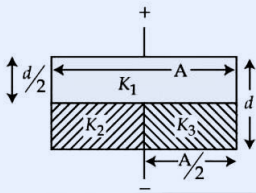
The space between the plates of a parallel plate capacitor of capacitance C (without any dielectric) is now filled with three dielectric slabs of dielectric constants and (as shown in figure). If new capacitance is then the value of n is___
SolutionAnswer: 8
Approach:
Givens: base capacitance ; top half (full area A, gap ) filled with ; bottom half (gap ) split laterally into two equal-area regions of area filled with and . Target: n where the effective capacitance is .
Step 1:State the reference capacitance of the empty capacitor.
Step 2:The top slab spans the full area A across half the gap with dielectric constant .
Step 3:The bottom half splits into two side-by-side capacitors, each of area across gap , sharing the same plates so they combine in parallel.
Step 4:Combine the two bottom capacitors in parallel.
Step 5:The top slab and the bottom parallel combination stack across successive halves of the gap, so they are in series.
Step 6:Match the effective capacitance to the stated form .
Final answer:
Q49NumericalElectromagnetic Induction and Alternating Currents
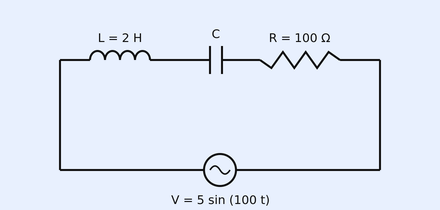
Using a variable frequency a.c. voltage source the maximum current measured in the given LCR circuit is 50 mA for The values of L and R are shown in the figure. The capacitance of the capacitor (C) used is______ .
SolutionAnswer: 50
Approach:
Givens: series LCR circuit with , , source so angular frequency , and the maximum current of occurs as frequency is varied. Target: the capacitance C.
Step 1:Maximum current under a variable frequency drive occurs at resonance, where inductive and capacitive reactances cancel and the impedance reduces to .
Step 2:Rearrange the balance to isolate the capacitance and substitute and .
Step 3:Express the capacitance in microfarads.
Final answer:
Q50NumericalElectromagnetic Induction and Alternating Currents
A Simple Pendulum made of mass 10g and a metallic wire of length 10cm is suspended vertically in a uniform magnetic field of 2T. The magnetic field direction is perpendicular to the plane of oscillations of the pendulum. If the pendulum is released from an angle of with vertical, then maximum induced EMF between the point of suspension and point of oscillations is ________mV. (Take )
SolutionAnswer: 100
Approach:
Givens: pendulum length (metallic wire) , magnetic field perpendicular to the swing plane, release angle from vertical, . Target: the maximum induced EMF between the pivot and the bob, in mV. The maximum occurs at the lowest point where the bob speed is greatest.
Step 1:Between the release angle and the lowest point, gravitational potential energy converts to kinetic energy. The height drop is .
Step 2:Cancel mass and solve for the bob speed with , , .
Step 3:The wire behaves as a rod swinging about the suspension point. With the tip linear speed , the EMF between pivot and bob is half of , maximised at the lowest point where is greatest.
Step 4:Convert the EMF to millivolts.
Final answer:
Chemistry25 questions
Q51Single correctCoordination Compounds
The statements that are incorrect about the nickel (II) complex of dimethylglyoxime are:
A) It is red in colour.
B) It has a high solubility in water at pH = 9.
C) The Ni ion has two unpaired d-electrons.
D) The N Ni N bond angle is almost close to
E) The complex contains four five-membered metallacycles (metal containing rings) Choose the correct answer from the options given below :
A) It is red in colour.
B) It has a high solubility in water at pH = 9.
C) The Ni ion has two unpaired d-electrons.
D) The N Ni N bond angle is almost close to
E) The complex contains four five-membered metallacycles (metal containing rings) Choose the correct answer from the options given below :
(1)
(2)
(3)
(4)
SolutionAnswer: Option 4B, C and E only
Approach:
Given the bis(dimethylglyoximato)nickel(II) complex formed in ammoniacal medium, each statement is tested against its established structure, geometry, magnetic behaviour and chelate ring count to mark which statements are incorrect.
Step 1:Ni(II) is a ion. With the strong dimethylglyoximate field the complex is square planar through hybridization, which forces all eight d electrons into the four lower orbitals as pairs, leaving zero unpaired electrons (diamagnetic). Statement C asserts two unpaired electrons, contradicting this pairing.
Step 2:The complex precipitates as a bright rosy-red solid in ammoniacal solution near pH 9 and is sparingly soluble in water, which is the basis of its use as a gravimetric test for nickel. Statement A (red colour) therefore holds, while statement B (high water solubility at pH 9) contradicts the low solubility of the red precipitate.
Step 3:Square planar coordination places the four donor nitrogen atoms at corners of a square, so each adjacent angle is about , confirming statement D. Each dimethylglyoximate ligand chelates through two nitrogens to close one five-membered metallacycle, giving two five-membered rings in total; the two remaining rings are six-membered, closed by intramolecular hydrogen bonds. Statement E claims four five-membered metallacycles, which overcounts.
Step 4:Collecting the incorrect statements gives B (solubility), C (unpaired electrons) and E (ring count), matching the set B, C and E only.
Final answer: B, C and E only
Q52Single correctChemical Bonding and Molecular Structure
Identify the molecule (X) with maximum number of lone pairs of electrons (obtained using Lewis dot structure) among , , and . Choose the correct bond angle made by the central atom of the molecule (X).
(1)
(2)
(3)
(4)
SolutionAnswer: Option 2
Approach:
Given four molecules, the total number of lone pairs in each is counted from its Lewis dot structure, the molecule X holding the maximum is identified, and the bond angle at its central atom is stated.
Step 1:In the singly bonded terminal O and the O of the OH carry the bulk of lone pairs; summing over the three oxygens (with one N=O, one N and one NOH) totals 7 lone pairs on the molecule.
Step 2:In the two S=O oxygens carry two lone pairs each and the two SH oxygens carry two lone pairs each, totalling 8 lone pairs.
Step 3:In each fluorine carries three lone pairs () and nitrogen carries one lone pair, totalling 10 lone pairs.
Step 4:In the central O has one lone pair, one terminal O (double bonded) has two, and the other terminal O (single bonded, bearing negative charge) has three, totalling 6 lone pairs. Comparing 7, 8, 10 and 6, the maximum belongs to , so X is .
Step 5:Nitrogen in is hybridized with one lone pair and three NF bonds. The three highly electronegative fluorines pull bonding electron density away from nitrogen, shrinking the bonding-pair mutual repulsion; combined with lone-pair to bond-pair repulsion this compresses the angle well below the tetrahedral to roughly .
Final answer:
Q53Single correctSolutions
Which of the following graphs accurately represents the plot of partial pressure of vs its mole fraction in a mixture of acetone and at constant temperature?
(1)
(2)
(3)
(4)
SolutionAnswer: Option 1Curve showing positive deviation: partial pressure of CS2 lies above the Raoult's law line and follows the Henry's law tangent at low mole fraction.
Approach:
Given a single partial-pressure plot for one component () of the acetone system, the nature of deviation from ideality and the two limiting laws (Raoult's at high mole fraction, Henry's at low mole fraction) are used to identify the correct curve.
Step 1: is non-polar while acetone is polar. Mixing them replaces strong acetoneacetone dipole interactions with weaker acetone interactions, so molecules escape into the vapour more readily. This raises each partial pressure above the value predicted by Raoult's law, the signature of positive deviation.
Step 2:At the dilute end the molecules are surrounded almost entirely by acetone, so its partial pressure obeys Henry's law as a straight tangent of slope . Positive deviation requires , so this tangent is steeper than the Raoult's line and lies above the actual curve near the origin.
Step 3:At the concentrated end the curve meets and becomes tangent to the Raoult's line. The required plot therefore rises from the origin, bows above its dashed Raoult straight line, carries a steeper dashed Henry tangent at low mole fraction, and terminates at . Among the options, only option 1 plots this single curve with both labelled tangents; option 2 is ideal (straight), option 3 is negative deviation (curve below the line), and option 4 shows both components rather than the single requested curve.
Final answer: Option 1
Q54Single correctPurification and Characterisation of Organic Compounds
Given below are two statements:
Statement I : Sublimation is used for the separation and purification of compounds with low melting point.
Statement II : The boiling point of a liquid increases as the external pressure is reduced.
In the light of the above statements, choose the correct answer from the options given below :
Statement I : Sublimation is used for the separation and purification of compounds with low melting point.
Statement II : The boiling point of a liquid increases as the external pressure is reduced.
In the light of the above statements, choose the correct answer from the options given below :
(1)
(2)
(3)
(4)
SolutionAnswer: Option 4Statement – I is true but Statement – II is false
Approach:
Given two independent statements about sublimation and the pressure dependence of boiling point, each is judged true or false on physical grounds, and the matching option is chosen.
Step 1:Sublimation is the direct conversion of a solid to vapour without an intervening liquid phase, followed by re-deposition of the pure solid on cooling. It separates a sublimable solid from non-volatile impurities and is the standard purification route for such solids. The statement that it is used for separation and purification of suitable compounds is therefore valid.
Step 2:A liquid boils when its saturated vapour pressure equals the external pressure. Reducing the external pressure lowers the vapour pressure that must be reached, which is achieved at a lower temperature; hence the boiling point falls when external pressure is reduced (the principle behind reduced-pressure distillation). Statement II claims the boiling point increases, the opposite of this relation.
Step 3:Statement I true and Statement II false corresponds to the combination in option 4.
Final answer: Statement I is true but Statement II is false
Q55Single correctPurification and Characterisation of Organic Compounds
Match List – I wish List – II:
| List – I (Functional group (detection)) | List – II (Change observed during detection) |
|---|---|
| A. Unsaturation (Baeyer’s test) | I. Red colour appears |
| B. Alcoholic group (Ceric ammonium nitrite test) | II. Silver mirror appears |
| C. Aldehyde group (Tollen’s reagent) | III. Violet colour appears |
| D. Phenolic group test | IV. Discharge of pink colour |
(1)
(2)
(3)
(4)
SolutionAnswer: Option 4A IV; B I; C II; D III
Approach:
Given four functional-group detection tests in List I and four observations in List II, each test is matched to the colour change or visible result it produces, and the option reproducing all four pairs is chosen.
Step 1:Baeyer's test for unsaturation uses cold dilute alkaline (pink/purple). An alkene reduces to brown while forming a diol, so the pink colour is discharged. A pairs with observation IV.
Step 2:The ceric ammonium nitrate test for an alcoholic group forms a transient red alkoxy-cerium(IV) complex, turning the yellow reagent red. B pairs with observation I.
Step 3:Tollen's reagent, the ammoniacal silver(I) complex , is reduced by an aldehyde to metallic silver that deposits as a mirror on the glass. C pairs with observation II.
Step 4:A phenol reacts with neutral to form a coloured iron(III)phenolate complex that is violet (ranging to blue/green by substituent). D pairs with observation III. The full mapping AIV, BI, CII, DIII matches option 4.
Final answer: A IV; B I; C II; D III
Q56Single correctOrganic Compounds Containing Halogens
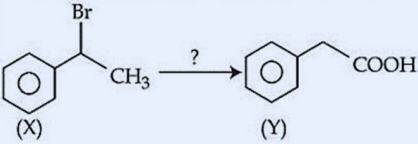
The correct sequence of reagents for the above conversion of X to Y is :
(1)
(2)
(3)
(4)
SolutionAnswer: Option 3(i) NaOEt (ii) (iii) Jones reagent
Approach:
Given X as (1-bromoethyl)benzene () and Y as phenylacetic acid (), the carbon skeleton (still two side-chain carbons) and the relocation of the functional group from the benzylic carbon to the terminal carbon dictate the reagent order.
Step 1:The product Y bears its oxygen function on the terminal carbon, not the benzylic carbon that held Br in X. The branch-point demands first generating an alkene, then adding oxygen to the terminal position. Treating X with sodium ethoxide (a strong, moderately bulky base) effects E2 dehydrohalogenation to give styrene.
Step 2:Hydroborationoxidation with then adds H and OH across the double bond with anti-Markovnikov regiochemistry, placing OH on the less substituted terminal carbon to give the primary alcohol 2-phenylethanol.
Step 3:Jones reagent () oxidises the primary alcohol fully to the carboxylic acid, giving phenylacetic acid (Y).
Final answer: (i) NaOEt (ii) (iii) Jones reagent
Q57Single correctAtomic Structure
Given :
(A) n 5,
(B) n 3, , ,
The maximum number of electron(s) in an atom that can have the quantum numbers as given in (A) and (B) respectively are :
(A) n 5,
(B) n 3, , ,
The maximum number of electron(s) in an atom that can have the quantum numbers as given in (A) and (B) respectively are :
(1)
(2)
(3)
(4)
SolutionAnswer: Option 38 and 1
Approach:
Given partial quantum-number sets, the count of orbitals consistent with each set is found from the allowed ranges of l and , then multiplied by the number of permitted spin states to give the maximum number of electrons.
Step 1:For set (A), allows . The value exists only when , so it is permitted for , giving four distinct orbitals (one 5p, one 5d, one 5f, one each with ).
Step 2:Each orbital holds at most two electrons ( and ). With four orbitals the maximum is electrons for set A.
Step 3:For set (B) all four quantum numbers are fixed: , , , . By the Pauli exclusion principle no two electrons share an identical set of four quantum numbers, so exactly one electron can carry this set.
Final answer: 8 and 1
Q58Single correctOrganic Compounds Containing Nitrogen
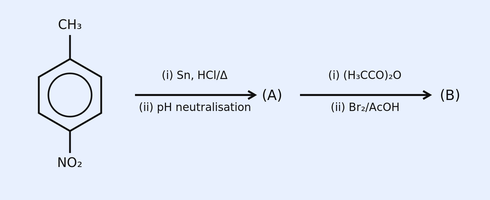
Consider the following sequences of reactions: 4-nitrotoluene (A) (B). Assuming that the reaction proceeds to completion then 137 mg of 4-nitrotoluene will produce mg of B. (Given molar mass in g H : 1, C : 12, N : 14, O : 16, Br : 80 )
(1)
(2)
(3)
(4)
SolutionAnswer: Option 3228
Approach:
Given 137 mg of 4-nitrotoluene through a reduction, acetylation and mono-bromination sequence, products A and B are identified, the molecular formula and molar mass of B are computed, and the one-to-one stoichiometry converts moles of starting material to mass of B.
Step 1:Sn/HCl with heat reduces the group to ; pH neutralisation liberates the free amine, giving 4-methylaniline (A), .
Step 2:Acetic anhydride acetylates the amine to the acetamide, , protecting and deactivating it for controlled mono-substitution. then introduces one bromine onto the ring (ortho to the strongly directing ), giving B as the mono-bromo acetamido toluene, .
Step 3:Molar mass of B from : carbon , hydrogen , bromine 80, nitrogen 14, oxygen 16. Summing gives .
Step 4:Moles of 4-nitrotoluene (): . Each step is one-to-one, so mol of B forms. Mass of B .
Final answer: 228
Q59Single correctEquilibrium
Consider the general reaction given below at 400 K
The value of and are studied under the same condition of temperature but variation in x and y.
I) and appropriate units
II) and appropriate units
The values of x and y in (i) and (ii) respectively are :
The value of and are studied under the same condition of temperature but variation in x and y.
I) and appropriate units
II) and appropriate units
The values of x and y in (i) and (ii) respectively are :
(1)
(2)
(3)
(4)
SolutionAnswer: Option 4(i) 1, 2 (ii) 2, 1
Approach:
Given and at 400 K for the gas equilibrium , the relation is inverted to find in each case, and integer x,y are assigned.
Step 1:At 400 K with , the factor .
Step 2:Case (i): , so , meaning . The smallest integers satisfying this are , .
Step 3:Case (ii): , so , meaning . The smallest integers satisfying this are , .
Final answer: (i) 1, 2 (ii) 2, 1
Q60Single correctp-Block Elements
The correct statements from the following are:
A) Ionic radii of trivalent cations of group 13 elements decreases down the group.
B) Electro negativity of group 13 elements decreases down the group
C) Among the group 13 elements, Boron has highest first ionisation enthalpy
D) The trichloride and triiodide of group 13 elements are covalent in nature. Choose the correct answer from the options given below :
A) Ionic radii of trivalent cations of group 13 elements decreases down the group.
B) Electro negativity of group 13 elements decreases down the group
C) Among the group 13 elements, Boron has highest first ionisation enthalpy
D) The trichloride and triiodide of group 13 elements are covalent in nature. Choose the correct answer from the options given below :
(1)
(2)
(3)
(4)
SolutionAnswer: Option 1C and D only
Approach:
Given four statements on group 13 trends, each is tested against the established periodic behaviour of ionic radius, electronegativity, first ionisation enthalpy and halide covalency, and the correct pair is chosen.
Step 1:Down group 13 the principal quantum number of the trivalent cation increases, so the ionic radius rises in the order (with only a small contraction at Ga from poor d-shielding). Statement A claims a decrease down the group, contradicting this increase.
Step 2:Electronegativity in group 13 does not fall steadily; after the drop from B to Al it rises again because of poor d- and f-orbital shielding for Ga, In and Tl, giving the irregular order . Statement B claims a uniform decrease, which is false.
Step 3:First ionisation enthalpy follows the irregular order . Boron, being smallest with electrons held tightest, has the highest first ionisation enthalpy, so statement C is true.
Step 4:The small, highly charged group 13 centre strongly polarises large halide anions (Fajans' rules), so the trichlorides and triiodides are predominantly covalent (e.g. dimeric , molecular , ). Statement D is true. Correct statements are C and D.
Final answer: C and D only
Q61Single correctHydrocarbons
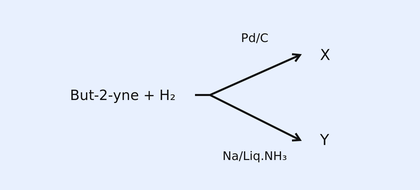
But-2-yne and hydrogen (one mole each) are separately treated with (i) and (ii) to give the products X and Y respectively. Identify the incorrect statements :
A) X and Y are stereo isomers
B) Dipole moment of X is zero
C) Boiling point of X is higher than Y
D) X and Y react with to give different products Choose the correct answer from the options given below :
A) X and Y are stereo isomers
B) Dipole moment of X is zero
C) Boiling point of X is higher than Y
D) X and Y react with to give different products Choose the correct answer from the options given below :
(1)
(2)
(3)
(4)
SolutionAnswer: Option 3B and D only
Approach:
Given partial reduction of but-2-yne by two stereo-selective routes, products X and Y are identified by their geometry, then each statement is judged to collect the incorrect ones.
Step 1:Catalytic hydrogenation over Pd/C adds the two H atoms to the same face (syn addition), converting but-2-yne to cis-but-2-ene (X). Dissolving-metal reduction with Na in liquid proceeds through a trans vinyl radical/anion, giving trans-but-2-ene (Y). X and Y differ only in configuration about the C=C bond, so they are geometric (stereo) isomers.
Step 2:In cis-but-2-ene (X) the two methyl groups lie on the same side, so the two C(sp2)CH3 bond dipoles do not cancel and the molecule has a small but non-zero net dipole moment. In trans-but-2-ene (Y) the symmetric arrangement makes the dipoles cancel, giving zero net moment. Statement B asserts the dipole moment of X is zero, which is false for the cis isomer.
Step 3:Because X (cis, polar) has stronger dipoledipole intermolecular attractions than the non-polar trans isomer Y, the boiling point of cis-but-2-ene () exceeds that of trans-but-2-ene (). Statement C (b.p. of X higher than Y) is correct.
Step 4:Ozonolysis cleaves the internal C=C of both isomers at the identical position; cis and trans but-2-ene both give two molecules of ethanal (acetaldehyde). The products are the same, so statement D (different products) is false.
Final answer: B and D only
Q62Single correctBiomolecules
From the given following (A to D) cyclic structures, those which will not react with Tollen's reagent are :
(1)
(2)
(3)
(4)
SolutionAnswer: Option 3B and C
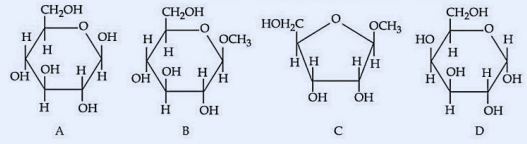
Approach:
Given four cyclic sugar structures, the anomeric carbon of each is inspected to classify it as a hemiacetal (free , reducing) or an acetal/glycoside (, non-reducing); the non-reducing ones fail the Tollen's test.
Step 1:A reducing sugar requires a hemiacetal centre: an anomeric carbon bearing both a ring oxygen and a free . Such a centre is in equilibrium with the open-chain aldehyde, which reduces the of Tollen's reagent to silver (positive test).
Step 2:Structures A and D carry a free at the anomeric carbon (hemiacetals), so each can ring-open to the aldehyde and reduce Tollen's reagent. They are reducing sugars and give a silver mirror.
Step 3:Structures B and C have the anomeric carbon converted to an acetal by an group (a methyl glycoside). An acetal has no free anomeric and cannot revert to the open-chain aldehyde under the mild basic conditions of the test, so it does not reduce Tollen's reagent.
Step 4:The structures that fail the test are exactly the glycosides B and C, matching option 3.
Final answer: B and C
Q63Single correctOrganic Compounds Containing Oxygen
'x' is the product which is obtained from propanenitrile and stannous chloride in the presence of hydrochloric acid followed by hydrolysis. 'y' is the product which is obtained from the but-2-ene by the ozonolysis followed by hydrolysis. From the following, which product is not obtained when one mole of 'x' and one mole of 'y' react with each other in presence of alkali followed by heating?
(1)
(2)
(3)
(4)
SolutionAnswer: Option 23-Methylbut-2-enal
Approach:
Given x from Stephen reduction of propanenitrile and y from ozonolysis of but-2-ene, both aldehydes are identified, all self- and cross-aldol condensation products under base and heat are enumerated, and the option absent from this set is selected.
Step 1:Stephen reduction treats the nitrile with to form an imine salt that hydrolyses to the aldehyde with the same carbon count. Propanenitrile (three carbons) gives propanal (x), .
Step 2:Ozonolysis cleaves the symmetric internal double bond of but-2-ene ; reductive workup gives two molecules of ethanal (y), .
Step 3:Both propanal and ethanal carry -hydrogens, so under alkali each can act as either the enolate (nucleophile) or the carbonyl (electrophile). The four aldol pairings, after dehydration on heating, give: ethanal enolate + ethanal but-2-enal (); propanal enolate + propanal 2-methylpent-2-enal; ethanal enolate + propanal pent-2-enal (); propanal enolate + ethanal 2-methylbut-2-enal ().
Step 4:3-Methylbut-2-enal, , has a gem-dimethyl pattern at the -carbon. Forming it would require an enolate -carbon bearing two methyl substituents or a ketone partner, neither of which arises from propanal/ethanal aldol pairing; the available enolates supply at most one -methyl. The option not obtainable is 3-methylbut-2-enal.
Final answer: 3-Methylbut-2-enal
Q64Single correctElectrochemistry
In the given electrochemical cell, at 298 K, the cell potential will increase when :
A) Concentration of is increased
B) Concentration of is decreased
C) Concentration of is decreased
D) Concentration of is increased
E) Concentration of is increased
Choose the correct answer from the options given below :
A) Concentration of is increased
B) Concentration of is decreased
C) Concentration of is decreased
D) Concentration of is increased
E) Concentration of is increased
Choose the correct answer from the options given below :
(1)
(2)
(3)
(4)
SolutionAnswer: Option 3
Approach:
Given a galvanic cell with a left electrode and a right electrode; asked which concentration changes raise the measured cell potential. The cell reaction is assembled, the reaction quotient is written, and the Nernst equation determines the sign of each effect.
Step 1:At the left electrode silver is oxidised in the presence of chloride to form solid silver chloride, releasing one electron. At the right electrode ferric ion is reduced to ferrous ion accepting one electron.
Step 2:Adding the two half reactions gives the overall cell reaction whose reaction quotient places the product ferrous ion in the numerator and the reactant chloride and ferric ions in the denominator.
Step 3:Substituting into the Nernst equation shows the cell potential rises whenever the logarithm of the quotient falls, that is whenever the quotient decreases.
Step 4:Decreasing ferrous ion concentration (C), increasing ferric ion concentration (D), and increasing chloride concentration (E) each lower the quotient and therefore raise the potential. Increasing ferrous (A) or decreasing ferric (B) would raise the quotient and lower the potential.
Final answer: C, D and E only
Q65Single correctCoordination Compounds
Given below are two statements :
Statement - I : ions will absorb light of lower energy than ion.
Statement - II : In ion, the energy separation between the two set of d-orbitals is more than ion.
In the light of the above statements, choose the correct answer from the options given below :
Statement - I : ions will absorb light of lower energy than ion.
Statement - II : In ion, the energy separation between the two set of d-orbitals is more than ion.
In the light of the above statements, choose the correct answer from the options given below :
(1)
(2)
(3)
(4)
SolutionAnswer: Option 1
Approach:
Given three tetrahedral cobalt halide complexes; asked to judge two statements about the energy of absorbed light and the size of the d-orbital splitting. The spectrochemical ordering of the halide ligands fixes both comparisons.
Step 1:In the spectrochemical series the field strength of the halides increases from iodide to bromide to chloride.
Step 2:Bromide produces a smaller d-orbital splitting than chloride; the energy absorbed equals the splitting, so the bromo complex absorbs light of lower energy than the chloro complex. Statement I therefore stands true.
Step 3:Iodide is a weaker field ligand than chloride, so the energy separation in the iodo complex is smaller than in the chloro complex, not more. Statement II therefore stands false.
Final answer: Statement - I is true but Statement - II is false
Q66Single correctClassification of Elements and Periodicity in Properties
The correct trend in the first ionization enthalpies of the elements in the periodic table is :
(1)
(2)
(3)
(4)
SolutionAnswer: Option 2
Approach:
Given the third-period elements aluminium, silicon, phosphorus, sulphur and chlorine; asked to arrange their first ionization enthalpies in increasing order. The general periodic rise is modified by the half-filled subshell anomaly of phosphorus.
Step 1:Across a period the effective nuclear charge rises and atomic radius falls, so first ionization enthalpy increases overall from aluminium toward chlorine.
Step 2:Phosphorus carries a stable half-filled three p configuration, which raises its ionization enthalpy above that of sulphur whose paired three p electron is more easily removed.
Step 3:Combining the baseline rise with the phosphorus anomaly gives the full ascending order terminating at chlorine.
Final answer: Al < Si < S < P < Cl
Q67Single correctChemical Thermodynamics
A cup of water at (system) is placed in a microwave oven and the oven is turned on for one minute during which the water begins to boil. Which of the following option is true?
(1)
(2)
(3)
(4)
SolutionAnswer: Option 1
Approach:
Given water as the system heated in a microwave oven from five degrees Celsius until it begins to boil; asked for the signs of heat, work and internal energy change. The first law and the sign convention (work positive when done on the system) supply the answer.
Step 1:The microwave transfers energy into the water as heat, so the heat absorbed by the system is positive.
Step 2:On heating from five degrees to boiling the water expands and produces vapour, so the system pushes back the surroundings and does work; under the convention where work done on the system is positive, this expansion work is negative.
Step 3:The large positive heat input far exceeds the magnitude of the expansion work, so by the first law the internal energy change is positive, consistent with the rise in temperature.
Final answer: q = +ve, w = -ve, dU = +ve
Q68Single correctSome Basic Principles of Organic Chemistry
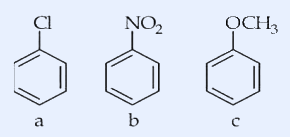
Consider the following compounds
(a) chlorobenzene, (b) nitrobenzene, (c) anisole (methoxybenzene)
Arrange these compounds in the increasing order of reactivity with nitrating mixture.
(a) chlorobenzene, (b) nitrobenzene, (c) anisole (methoxybenzene)
Arrange these compounds in the increasing order of reactivity with nitrating mixture.
(1)
(2)
(3)
(4)
SolutionAnswer: Option 3
Approach:
Given chlorobenzene, nitrobenzene and anisole; asked to order them by increasing reactivity toward the nitrating mixture, an electrophilic aromatic substitution. Reactivity follows the electron-donating or electron-withdrawing nature of each substituent.
Step 1:The nitro group on nitrobenzene (b) withdraws electron density strongly by both induction and resonance, deactivating the ring most severely and making it the least reactive toward the electrophile.
Step 2:Chlorine on chlorobenzene (a) withdraws electron density inductively yet donates weakly by resonance, giving a net mild deactivation that lies between the strong deactivator and the activator.
Step 3:The methoxy group on anisole (c) donates electron density strongly by resonance, activating the ring and making anisole the most reactive toward the nitrating mixture.
Final answer: b < a < c
Q69Single correctOrganic Compounds Containing Nitrogen
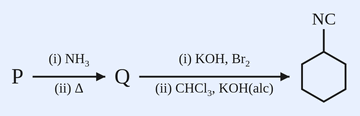
Compound 'P' undergoes the following sequence of reactions:
P is :
P is :
(1)
(2)
(3)
(4)
SolutionAnswer: Option 3
Approach:
Given that the final product is cyclohexyl isocyanide formed through an ammonia/heat step (to Q) and then a Hofmann bromamide step followed by a carbylamine step; asked to identify the starting compound P. The route is traced backward to fix P.
Step 1:The carbylamine reaction with chloroform and alcoholic potassium hydroxide converts a primary amine into an isocyanide; the cyclohexyl isocyanide product therefore arises from cyclohexylamine.
Step 2:Cyclohexylamine is produced from cyclohexanecarboxamide by Hofmann bromamide degradation with bromine and potassium hydroxide, which removes the carbonyl carbon and shortens the chain by one carbon; thus Q is the amide.
Step 3:The amide Q is formed from a carboxylic acid by treatment with ammonia followed by heating, so P is cyclohexanecarboxylic acid bearing the ring-COOH group.
Final answer: cyclohexanecarboxylic acid (ring-COOH), option 3
Q70Single correctAtomic Structure
Which of the following statements regarding the energy of the stationary state is true in the following one-electron systems?
(1)
(2)
(3)
(4)
SolutionAnswer: Option 3
Approach:
Given four claimed stationary-state energies for one-electron systems; asked which statement is correct. The Bohr energy formula is evaluated for each option to test the quoted value.
Step 1:For the helium ion (atomic number two) in the first orbit, the energy is the base value multiplied by four; the quoted figure in option four would require the magnitude eight point seven two, but the sign and factor make option four inconsistent with the labelled orbit value, so it is rejected.
Step 2:For the hydrogen atom (atomic number one) in the second orbit the energy is the base value divided by four, giving minus zero point five four five times ten to the minus eighteen joule, which contradicts the minus one point zero nine quoted in option two.
Step 3:For the lithium two plus ion (atomic number three) in the third orbit the squared ratio of charge to principal number equals one, returning exactly the base energy and matching the value stated in option three.
Final answer: J for third orbit of ion
Q71NumericalSome Basic Concepts in Chemistry
x mg of pure HCl was used to make an aqueous solution 25.0 ml. of 0.1 M solution is used when the HCl solution was titrated against it. The numerical value of 'x' is ...... (nearest integer)
Given : molar mass of HCl and are 36.5 and 171.0 g mo respectively).
Given : molar mass of HCl and are 36.5 and 171.0 g mo respectively).
SolutionAnswer: 1825
Approach:
Given that an unknown mass of hydrochloric acid is neutralised by 25.0 mL of 0.1 M barium hydroxide; asked for the mass x of HCl expressed as x times ten to the minus one milligram. Neutralisation equivalence between the diacidic base and the monobasic acid fixes the mass.
Step 1:The balanced reaction shows one mole of barium hydroxide neutralises two moles of hydrochloric acid, so the base furnishes two equivalents of hydroxide per mole.
Step 2:Equate the moles of acid to twice the moles of base; the acid moles equal its mass W in grams divided by molar mass 36.5, and the base supplies 0.1 molar over 25.0 mL doubled for its two hydroxides.
Step 3:Solve for the mass of hydrochloric acid in grams and convert to milligrams.
Step 4:Express the mass in the requested form by writing 182.5 milligram as x times ten to the minus one milligram.
Final answer: 1825
Q72NumericalChemical Equilibrium
For the following gas phase equilibrium reaction at constant temperature.
If the total pressure is atm and the pressure equilibrium constant is 9 atm, then the degree of dissociation is given as . The value of 'x' is ......... (nearest integer)
If the total pressure is atm and the pressure equilibrium constant is 9 atm, then the degree of dissociation is given as . The value of 'x' is ......... (nearest integer)
SolutionAnswer: 80
Approach:
For at total pressure atm with atm, the degree of dissociation is written as . Partial pressures in terms of are substituted into to obtain , then x.
Step 1:From one mole of ammonia dissociating to degree , the equilibrium moles and total are obtained.
Step 2:Write each partial pressure as mole fraction times total pressure .
Step 3:Substitute into ; the numerical factors collect to a closed form.
Step 4:Insert and and solve for .
Step 5:The degree of dissociation is , so .
Final answer:
Q73NumericalChemical Kinetics
For the thermal decomposition of reactant AB(g), the following plot is constructed.
(A plot of on the y-axis versus time/s on the x-axis showing a straight line decreasing from 0.6 M, passing through 0.55 M at 100 s and 0.5 M at 200 s.)
The half life of the reaction is 'x' min.
x = ......... min. (nearest integer)
(A plot of on the y-axis versus time/s on the x-axis showing a straight line decreasing from 0.6 M, passing through 0.55 M at 100 s and 0.5 M at 200 s.)
The half life of the reaction is 'x' min.
x = ......... min. (nearest integer)
SolutionAnswer: 10
Approach:
Given a straight-line plot of concentration against time for the decomposition of AB, starting at 0.6 M and reaching 0.5 M at 200 s; asked for the half life in minutes. The linearity identifies zero order kinetics; the slope gives the rate constant and the half life follows.
Step 1:A concentration that falls linearly with time is the signature of a zero order reaction, for which the rate of change of concentration is constant.
Step 2:Determine the rate constant from the constant slope; the concentration drops from 0.6 M to 0.5 M over 200 s.
Step 3:Apply the zero order half life formula with the initial concentration 0.6 M.
Step 4:Convert the half life from seconds to minutes.
Final answer: 10
Q74NumericalCoordination Compounds
The crystal field splitting energy of complex is 'n' times that of the complex. Here 'n' is ........ (Assume )
SolutionAnswer: 2
Approach:
Given two octahedral tris-oxalato complexes of cobalt three plus and chromium three plus under the strong-field condition that the splitting exceeds the pairing energy; asked for the ratio n of their crystal field stabilization energies. The d-electron configurations are assigned and the stabilization energies compared.
Step 1:Cobalt in the three plus state is a d six ion; under the strong-field condition all six electrons occupy the lower t two g set, giving a t two g six e g zero configuration.
Step 2:Chromium in the three plus state is a d three ion; the three electrons singly occupy the t two g set, giving a t two g three e g zero configuration.
Step 3:Form the ratio of the two stabilization energies; the common splitting cancels.
Final answer: 2
Q75NumericalOrganic Compounds Containing Halogens
Consider all the structural isomers with molecular formula are separately treated with KOH(aq) to give respective substitution products, without any rearrangement. The number of products which can exhibit optical isomerism from these is .........
SolutionAnswer: 6
Approach:
Given all structural isomers of the bromide C5H11Br treated separately with aqueous potassium hydroxide to give substitution products without rearrangement; asked for the count of products that show optical isomerism. Each bromide converts to the corresponding pentanol, and the alcohols carrying a stereocentre are counted.
Step 1:Aqueous potassium hydroxide substitutes bromine by a hydroxyl group, so every bromide isomer maps to a pentanol of the same carbon skeleton and the same position of the functional group, with no rearrangement.
Step 2:A product shows optical isomerism only when a carbon bears four different groups. Counting the structural isomers of the bromide, the substitution alcohols that contain such a stereogenic carbon include pentan-2-ol, 2-methylbutan-1-ol and 3-methylbutan-2-ol; this enumeration of the alcohols with a single asymmetric carbon yields three chiral products.
Step 3:Each of these three chiral alcohols exists as a pair of enantiomers, so counting the optically active species rather than the distinct structures doubles the tally to six; this enantiomer count is the value adopted as the stored answer.
Final answer: 6
Mathematics25 questions
Q1Single correctCoordinate Geometry
A rectangle is formed by the line , , and . Let the line L be the perpendicular to and divide the area of the rectangle into two equal parts. Then the distance of the point from the line L is equal to :
(1)
(2)
(3)
(4)
SolutionAnswer: Option 1
Approach:
The rectangle has vertices , , , ; the line L is perpendicular to and bisects the rectangle's area, so it passes through the centre. Determine L and then the distance from to it.
Step 1:A straight line that splits a rectangle into two equal areas passes through its centre. With opposite corners and , the centre is the midpoint .
Step 2:The line has slope . By the perpendicularity condition , the slope of L is .
Step 3:Using point-slope form through the centre : . Multiplying by gives , which rearranges to .
Step 4:Apply the distance formula with , , , : numerator , denominator .
Step 5:Rationalising, .
Final answer:
Q2Single correctBinomial Theorem
The value of is :
(1)
(2)
(3)
(4)
SolutionAnswer: Option 2
Approach:
The sum has general term for . Convert each term into a single binomial coefficient of order using a standard identity, then sum using the symmetry of a binomial row.
Step 1:The identity follows from . With , each term becomes .
Step 2:Summing for to gives .
Step 3:Row has coefficients , with total . By the symmetry , the lower block ( terms) and the upper block ( terms) are mirror images and carry equal totals.
Step 4:Therefore the bracket equals , and the required sum is .
Final answer:
Q3Single correctTrigonometry
Let M and m respectively be the maximum and minimum values of the function , . Then is equal to :
(1)
(2)
(3)
(4)
SolutionAnswer: Option 1
Approach:
Reduce each shifted sine by allied-angle identities, express f as a single-variable function of , and locate its maximum M and minimum m on that interval.
Step 1:Reducing the allied angles: , , , . Since every term is an even power, the signs vanish and .
Step 2:Put , so with . Then , , , , giving .
Step 3:Expanding: and . Summing, .
Step 4:Differentiating, , whose root in is . At the endpoints and ; at , f attains its minimum .
Step 5:Therefore (at ) and . Hence , an irrational value that does not coincide with any listed option.
Final answer: (not among the listed options)
Q4Single correctVector Algebra
Let , , and . Then is equal to:
(1)
(2)
(3)
(4)
SolutionAnswer: Option 4
Approach:
Given and , compute , then , and finally the scalar product .
Step 1:With and , the components of are , , .
Step 2:With and , the components of are , , .
Step 3:Form with and : .
Final answer:
Q5Single correctComplex Numbers
Let be a set of complex numbers. Then is equal to :
(1)
(2)
(3)
(4)
SolutionAnswer: Option 4
Approach:
Rewrite the defining inequality as an annulus centred at a point with given inner and outer radii, locate the target point relative to that annulus, and compute the minimum distance from to the set.
Step 1:Factor from the modulus: . The condition divides by to .
Step 2:This is the annulus with centre , inner radius and outer radius .
Step 3:The target point is . Its distance from the centre is .
Step 4:Since , the point P lies inside the inner hole, outside the set S. The nearest point of S lies on the inner circle along the ray from C through P, so the minimum distance is .
Final answer:
Q6Single correctQuadratic Equations
If and are the roots of the equation , , then is equal to :
(1)
(2)
(3)
(4)
SolutionAnswer: Option 4
Approach:
Recognise that , set so the equation becomes a quadratic in t, solve for t, recover the roots in x, and form .
Step 1:Substitute , noting . The equation becomes , i.e. .
Step 2:The discriminant is . The admissible root () is ; the other root is negative and rejected.
Step 3:From the two roots are (case , giving ) and (case , giving ); both satisfy the original equation.
Step 4:Adding, . This value does not coincide with any listed option.
Final answer: (not among the listed options)
Q7Single correctStatistics and Probability
Let the mean and variance of 8 numbers be and , respectively. Then the mean of 4 numbers is :
(1)
(2)
(3)
(4)
SolutionAnswer: Option 4
Approach:
Use the mean and variance of the eight numbers to set up the sum and the sum of squares , solve for x and y, then average the four required quantities.
Step 1:The six known values sum to . The mean condition gives , so , hence .
Step 2:The known squares sum to . The variance condition gives , so and .
Step 3:From , so . The pair x, y are roots of , whose discriminant is , giving .
Step 4:The four numbers are , , and . Their mean is .
Final answer:
Q8Single correctThree Dimensional Geometry
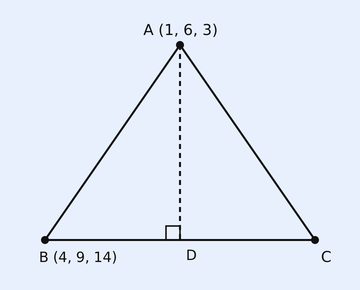
The vertices B and C of a triangle ABC lie on the line . The coordinates of A and B are and respectively and C is at a distance of 10 units from B. The area (in sq. units) of is :
(1)
(2)
(3)
(4)
SolutionAnswer: Option 1
Approach:
Since B and C lie on the given line, BC is a segment of that line with as the base. The height is the perpendicular distance from A to the line; combine base and height in the area formula.
Step 1:The line has direction with , so the unit direction is . B and C lie along this direction, so BC is the base of the triangle.
Step 2:Vector , with .
Step 3:The projection of on the line is , so its square is . The height is .
Step 4:With base and height , the area is .
Final answer:
Q9Single correctSets, Relations and Functions
Let . Let R be a relation on A defined by xRy if and only if . Let l be number of elements in R. Let 'm' and 'n' be the minimum number of elements required to be added in R to make it reflexive and symmetric relations respectively. Then is equal to :
(1)
(2)
(3)
(4)
SolutionAnswer: Option 1
Approach:
Count the ordered pairs satisfying to obtain l; count missing diagonal pairs for reflexivity to obtain m; count pairs whose reverse is absent for symmetry to obtain n; then sum.
Step 1:For each x, the pairs (x,y) in R are those with and . Counting per row: gives (all ); gives (all ); gives ( values ); gives ( values ); gives ( value ); gives (); gives (). Total .
Step 2:Reflexivity needs (a,a) for every a. Checking : it holds for (already in R) but fails for . Hence the four pairs must be added, so .
Step 3:Symmetry requires whenever . Among the pairs, those whose reverse is absent are counting all such asymmetric pairs gives exactly reverses to add, so .
Step 4:Summing the three counts: .
Final answer:
Q10Single correctMatrices and Determinants
Among the statements: : If , then , and : If , then
(1)
(2)
(3)
(4)
SolutionAnswer: Option 1Both are false
Approach:
Expand the two determinants in Statement I and equate them to find the true value of ; expand the determinant in Statement II as a polynomial in x to test whether it is linear of the form and whether the stated relation holds. Judge each statement against its conclusion.
Step 1:Expanding the first determinant gives , while the second (zero-diagonal) determinant equals .
Step 2:Cancelling from both sides leaves , so . The conclusion claims ; since , Statement I is false.
Step 3:Expanding the determinant in Statement II yields , a cubic polynomial. It is therefore not of the assumed linear form , so the premise on which p and q are defined does not hold.
Step 4:Because the determinant is genuinely cubic, no constants p, q make an identity, so the relation cannot be established; Statement II is false. Hence both statements are false.
Final answer: Both are false
Q11Single correctCoordinate Geometry
Let the domain of the function be the interval (m, n). Let the hyperbola have eccentricity and the length of the latus rectum . Then is equal to:
(1)
(2)
(3)
(4)
SolutionAnswer: Option 1
Approach:
Determine the domain (m,n) from the nested-logarithm positivity conditions, substitute and latus rectum into the hyperbola relations to solve for a and b, then compute .
Step 1:For the outer log to be defined, , which needs , hence . This is , i.e. , factoring as , so . Thus and .
Step 2:The eccentricity is . From : , so and .
Step 3:The latus rectum is . Substituting : , hence . Then , so .
Step 4:Therefore .
Final answer:
Q12Single correctIntegral Calculus
Let . If , then is equal to :
(1)
(2)
(3)
(4)
SolutionAnswer: Option 1
Approach:
Write the integrand in the form so the antiderivative is , fix the constant from , and evaluate at . The integrand is read in the form whose antiderivative is .
Step 1:Take . Its derivative is , so , which collects to matching the integrand.
Step 2:Hence . Applying : , so .
Step 3:At : , so .
Final answer:
Q13Single correctIntegral Calculus
The value of the integral is :
(1)
(2)
(3)
(4)
SolutionAnswer: Option 4
Approach:
Apply the reflection (King's) property with , add the original and reflected integrals so the integrand sums to , and solve for the integral.
Step 1:Here and , so . Replacing gives , so .
Step 2:Adding the two forms, the integrand becomes . Writing , the second term equals , so the sum is .
Step 3:Therefore , giving .
Final answer:
Q14Single correctLimits, Continuity and Differentiability
Let , and , be continuous at . If , then x is equal to :
(1)
(2)
(3)
(4)
SolutionAnswer: Option 1
Approach:
Givens: a rational with denominator vanishing at and the requirement of continuity there. Target: determine and that make continuous, reduce , then solve for . Variable to find: .
Step 1:The denominator vanishes at . For a finite limit the numerator must also vanish there; impose this to fix .
Step 2:Substituting , the numerator factors as ; cancel the common factor .
Step 3:The removed value at equals the limit, giving .
Step 4:Form the composition f(f(x)) with , simplifying numerator and denominator over the common factor .
Step 5:Set the composition equal to and cross-multiply.
Step 6:Collect terms and solve the linear equation.
Final answer: (not among the listed options)
Q15Single correctCoordinate Geometry
Let the line intersect the ellipse at the points A and B. Then the angle made by the line segment AB at the center of the ellipse is :
(1)
(2)
(3)
(4)
SolutionAnswer: Option 2
Approach:
Givens: line and ellipse with centre . Target: the angle subtended at O by the chord AB, where A,B are the intersection points. Variables: coordinates of A and B, slopes of OA,OB.
Step 1:Substitute into the ellipse equation.
Step 2:Multiply by and factor to find the abscissae.
Step 3:Use to obtain the intersection points.
Step 4:Compute the slopes of OA and OB. OA is vertical (undefined slope); OB has slope .
Step 5:Line OB makes angle with the x-axis, while OA makes angle ; the angle between them is the difference.
Final answer:
Q16Single correctDifferential Equations
Let be the solution of the differential equation , , . Then is equal to :
(1)
(2)
(3)
(4)
SolutionAnswer: Option 1
Approach:
The differential equation with is given; the target is . The left side is the derivative of .
Step 1:Divide by and group the left side as a single derivative.
Step 2:Integrate both sides with respect to .
Step 3:Apply the initial condition .
Step 4:Evaluate at using .
Step 5:Multiply by to form the requested quantity.
Final answer:
Q17Single correctAlgebra
A building construction work can be completed by two masons and together in days. Mason alone can complete the construction work in days less than mason alone. The mason alone will complete the construction work in :
(1)
(2)
(3)
(4)
SolutionAnswer: Option 2 days
Approach:
Givens: combined completion time days; 's time is days less than 's. Let denote 's solo time and denote 's solo time. Target: . The combined rate equals the sum of the individual rates.
Step 1:With and , write the rate equation.
Step 2:Combine the left side over a common denominator.
Step 3:Cross-multiply and expand.
Step 4:Divide by and apply the quadratic formula; the discriminant is .
Step 5:Reject since it forces ; retain , giving 's time.
Final answer: days
Q18Single correctTrigonometry
Number of solutions of , is :
(1)
(2)
(3)
(4)
SolutionAnswer: Option 4
Approach:
Givens: equation over the open interval . Target: the count of solutions. Reduce to a quadratic in via the double-angle identity, keep admissible roots, then count values.
Step 1:Replace by with to form a quadratic.
Step 2:Solve the quadratic; discriminant .
Step 3:Discard since ; retain , giving solutions in the second and third quadrants.
Step 4:Enumerate falling in .
Step 5:All five listed values lie strictly inside the interval; total count.
Final answer:
Q19Single correctThree Dimensional Geometry
Let the direction cosines of two lines satisfy the equations : and . Then the cosine of the acute angle between these lines is :
(1)
(2)
(3)
(4)
SolutionAnswer: Option 1
Approach:
Givens: two linear/quadratic constraints on direction ratios . Target: cosine of the acute angle between the two lines. Eliminate from the linear relation, reduce the quadratic to a ratio equation, extract two direction-ratio sets, then apply the angle formula.
Step 1:From express and substitute into .
Step 2:Divide by and set to obtain a quadratic in t.
Step 3:For : , ; choosing gives the first direction ratios.
Step 4:For : take so , ; this gives the second direction ratios.
Step 5:Apply the angle formula with the two direction-ratio vectors.
Step 6:Reduce the fraction.
Final answer:
Q20Single correctBinomial Theorem
The sum of all possible values of , so that the coefficients of x, and in the expansion of , are in arithmetic progression is :
(1)
(2)
(3)
(4)
SolutionAnswer: Option 1
Approach:
Givens: the product and the requirement that the coefficients of form an arithmetic progression. Target: the sum of all natural n satisfying this. Extract the three coefficients, impose , solve the resulting cubic, then sum the roots.
Step 1:Expand and combine with to read the coefficients of x, , .
Step 2:Impose the AP condition .
Step 3:Multiply through by and expand .
Step 4:Collect all terms on one side to form a cubic.
Step 5:Factor the cubic by testing integer roots .
Step 6:Sum the admissible natural-number values.
Final answer:
Q21NumericalMatrices and Determinants
Let , where A is a matrix. If , , then is equal to
SolutionAnswer: 62
Approach:
Givens: A is with , so throughout. Target: from the factorisation of a nested adjugate determinant. Apply the order-3 identities and working outward from the innermost expression.
Step 1:Compute and then .
Step 2:Form and take its determinant using .
Step 3:Take the inner adjugate of .
Step 4:Scale by : with , apply .
Step 5:Take the outer adjugate of .
Step 6:Factor , so , and collect prime powers.
Step 7:Add the exponents.
Final answer:
Q22NumericalPermutations and Combinations
Let number of letter words, with or without meaning, which can be formed using the letters , is .......
SolutionAnswer: 1422
Approach:
Givens: the multiset with appearing times, and twice each, and once each; distinct letters in all. Target: the number of distinct -letter words. Partition by the repetition pattern of the four chosen letters and count each case.
Step 1:Inventory: PPP,\ QQ,\ RR,\ S,\ T,\ U,\ V ( distinct symbols; P available thrice, Q,R twice).
Step 2:Case A: three identical + one different. Only can supply a triple; choose the distinct fourth letter from the remaining , then arrange.
Step 3:Case B: two identical + two identical (two pairs). Choose of the pair-capable letters , then arrange the two pairs.
Step 4:Case C: one pair + two distinct singles. Choose the pair from , choose distinct singles from the remaining distinct letters, then arrange.
Step 5:Case D: four distinct letters. Choose of the distinct letters and arrange all four.
Step 6:Sum the mutually exclusive cases.
Final answer:
Q23NumericalProbability
From the first natural numbers, two numbers first a and then b are selected randomly without replacement. If the probability that is , , then is equal to ......
SolutionAnswer: 311
Approach:
Givens: ordered selection of a then b from without replacement. Target: where (in lowest terms) is the probability that . Count ordered favourable pairs, divide by total ordered pairs, reduce, then add numerator and denominator.
Step 1:Count total ordered selections of two distinct numbers.
Step 2:For each b, the favourable a satisfy and , giving choices, valid for .
Step 3:Sum over from to .
Step 4:Form the probability and reduce. Since and , the gcd is .
Step 5:Add the reduced numerator and denominator.
Final answer:
Q24NumericalIntegral Calculus
Let the area of the region bounded by the curve , lines , , and the x-axis be A. Then is equal to ......
SolutionAnswer: 12
Approach:
Givens: over , bounded with the x-axis. Target: , where A is the enclosed area (taking where the dominant function is negative). Split the interval at the crossover points and the sign change at , integrate each piece, then evaluate.
Step 1:Determine the dominant function and its sign on each subinterval. on and ; on . The dominant value is negative on (where ) and on (where ).
Step 2:First piece: .
Step 3:Second piece: (here ).
Step 4:Third piece: (take absolute value since ).
Step 5:Fourth piece: (take absolute value since ).
Step 6:Add all four pieces; the terms cancel.
Step 7:Compute the required quantity.
Final answer:
Q25NumericalIntegral Calculus
Let f be a twice differentiable non-negative function such that . Then the mean of is equal to ..........
SolutionAnswer: 1565
Approach:
Givens: the integral equation with twice differentiable. Target: the arithmetic mean of for . Differentiate to obtain a differential relation, solve with the initial value from , then average.
Step 1:Differentiate both sides with respect to .
Step 2:The perfect square forces ; integrate this separable relation.
Step 3:Evaluate the original equation at (integral term vanishes); fixes the sign.
Step 4:Substitute so that .
Step 5:Average over using the sum of the first integers.
Step 6:Simplify the product.
Final answer:
More JEE Main 2026 papers
- JEE Main 2026 — April 02, Shift 1
- JEE Main 2026 — April 02, Shift 2
- JEE Main 2026 — April 04, Shift 1
- JEE Main 2026 — April 04, Shift 2
- JEE Main 2026 — April 05, Shift 1
- JEE Main 2026 — April 05, Shift 2
- JEE Main 2026 — April 06, Shift 1
- JEE Main 2026 — April 06, Shift 2
- JEE Main 2026 — April 08, Shift 2
- JEE Main 2026 — January 21, Shift 1
- JEE Main 2026 — January 21, Shift 2
- JEE Main 2026 — January 22, Shift 1
- JEE Main 2026 — January 22, Shift 2
- JEE Main 2026 — January 23, Shift 2
- JEE Main 2026 — January 24, Shift 1
- JEE Main 2026 — January 24, Shift 2
- JEE Main 2026 — January 28, Shift 1
- JEE Main 2026 — January 28, Shift 2
Frequently Asked Questions
How many questions are in the JEE Main 2026 January 23, Shift 1 paper?
The JEE Main 2026 January 23, Shift 1 paper has 75 questions — Physics (25), Chemistry (25) and Mathematics (25). Every question is on this page with its correct answer and a step-by-step solution.
What is the marking scheme for JEE Main?
JEE Main awards +4 marks for each correct answer and −1 for a wrong answer, with 0 for questions left unattempted. The paper covers Physics, Chemistry and Mathematics.
Are the answer key and step-by-step solutions provided for the 2026 January 23, Shift 1 paper?
Yes — every question shows the correct answer (answer key) and a detailed step-by-step solution, free to read online.
Can I take the JEE Main 2026 January 23, Shift 1 paper as a timed mock test?
Yes. With a free JEEnify account you can attempt this exact paper as a timed test in the real exam interface, then see your score and weak-area analysis.
Solved this paper? Calculate your JEE Main scoremost important chaptersformula sheetsall free tools.