
Back to JEE Main PYQs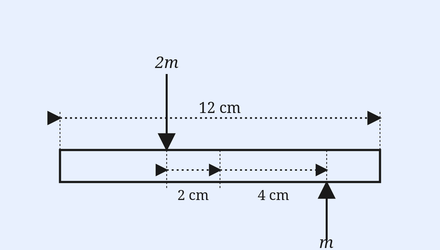

JEE Main 2026 January 22, Shift 2 Question Paper with Solutions
All 75 questions from the JEE Main 2026 (January 22, Shift 2) shift — Physics (25), Chemistry (25) and Mathematics (25) — each with the correct answer (answer key) and a step-by-step solution. Read it free online, or attempt the full paper as a timed mock test.
Physics25 questions
Q26Single correctGravitation
Given below are two statements:
Statement-I: A satellite is moving around earth in the orbit very close to the earth surface. The time period of revolution of satellite depends upon the density of earth.
Statement-II: The time period of revolution of the satellite is (for satellite very close to the earth surface), where radius of earth and g acceleration due to gravity.
In the light of the above statements, choose the correct answer from the options given below:
Statement-I: A satellite is moving around earth in the orbit very close to the earth surface. The time period of revolution of satellite depends upon the density of earth.
Statement-II: The time period of revolution of the satellite is (for satellite very close to the earth surface), where radius of earth and g acceleration due to gravity.
In the light of the above statements, choose the correct answer from the options given below:
(1)
(2)
(3)
(4)
SolutionAnswer: Option 2Both Statement I and Statement II are true
Approach:
Derive the period of a satellite skimming the surface from the orbital force balance to confirm Statement-II, then substitute the surface gravity expressed through mean density to expose the density dependence claimed in Statement-I.
Step 1:For a satellite grazing the surface the gravitational pull supplies the centripetal force, giving the orbital speed and hence the period.
Step 2:Replace g by its density form .
Step 3:The radius cancels, leaving the period a function of mean density alone, confirming Statement-I.
Final answer: Both Statement I and Statement II are true
Q27Single correctRotational Motion
A uniform bar of length 12 cm and mass lies on a smooth horizontal table. Two-point masses m and are moving in opposite direction with same speed of v and in the same plane as the bar, as showing figure. These masses strike the bar simultaneously and got stuck to it. After collision the entire system is rotating with the angular frequency . The ratio of v and is:
(1)
(2)
(3)
(4)
SolutionAnswer: Option 1
Approach:
Conserve angular momentum about the bar centre of mass. Both incoming masses give angular momentum of the same rotational sense; equate to the final moment of inertia of the rod plus the two embedded masses times .
Step 1:Mass strikes at 4 cm from centre and mass at 2 cm from centre, both adding angular momentum about the centre.
Step 2:Final moment of inertia of the rod plus the two stuck masses.
Step 3:Apply and solve the ratio.
Final answer:
Q28Single correctElectromagnetic Waves
A Laser beam has intensity of . The amplitude of magnetic field associated with beam is ...... T. (Take and )
(1)
(2)
(3)
(4)
SolutionAnswer: Option 3
Approach:
Express the beam intensity through the magnetic field amplitude using and solve for B, with .
Step 1:Rearrange the intensity relation for and substitute the data.
Step 2:Evaluate the numeric value of .
Step 3:Take the square root for the amplitude.
Final answer:
Q29Single correctAtoms and Nuclei
The smallest wavelength of Lyman series is 91 nm. The difference between the largest wavelengths of and series is nearly ...... nm.
(1)
(2)
(3)
(4)
SolutionAnswer: Option 3
Approach:
Fix nm from the series limit of the Lyman series, then compute the longest (largest) wavelength of the Balmer () and Paschen () series and take their difference.
Step 1:Smallest Lyman wavelength corresponds to the series limit , fixing .
Step 2:Largest Balmer wavelength uses .
Step 3:Largest Paschen wavelength uses .
Step 4:Take the difference of the two longest wavelengths.
Final answer:
Q30Single correctOscillations and Waves
In an open organ pipe and are and harmonic frequencies, respectively. If Hz then length of the pipe is ______ mm. (Take velocity of sound in air is 330 m/s).
(1)
(2)
(3)
(4)
SolutionAnswer: Option 1
Approach:
For an open organ pipe the harmonic frequency is . Use the difference of the 6th and 3rd harmonics to solve for L, then convert to millimetres.
Step 1:Write the difference of the 6th and 3rd harmonic frequencies.
Step 2:Substitute m and solve for L.
Step 3:Convert the length to millimetres.
Final answer:
Q31Single correctElectromagnetic Induction and Alternating Currents
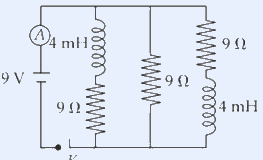
Figure shows the circuit that contains three resistances ( each) and two inductors (4 mH each). The reading of ammeter at the moment switch K is turned ON, is ____ A.
(1)
(2)
(3)
(4)
SolutionAnswer: Option 1
Approach:
At the switching instant an inductor with no prior current acts as an open circuit. The two outer branches each contain an inductor and are blocked, leaving only the central bare resistor in the conducting path across the V source.
Step 1:At both inductor-containing branches behave as open circuits and carry no current.
Step 2:The source drives current through the lone resistance read by the ammeter.
Step 3:This is the ammeter reading at the instant the switch is turned ON.
Final answer:
Q32Single correctOptics
The wavelength of light, while it is passing through the water of 540 nm. The refractive index of water is . The wavelength of the same light when it is passing through a transparent medium having refractive index of is ______ nm.
(1)
(2)
(3)
(4)
SolutionAnswer: Option 3
Approach:
Wavelength in a medium is inversely proportional to its refractive index, so . Apply this with the water value and the two given indices.
Step 1:Take nm in water with and the new medium .
Step 2:Solve for .
Step 3:Evaluate the wavelength in the new medium.
Final answer:
Q33Single correctCurrent Electricity
An electric power line having total resistance of , delivers 1kW of power at 250 V. The percentage efficiency of transmission line is ______
(1)
(2)
(3)
(4)
SolutionAnswer: Option 1
Approach:
Find the line current from the delivered power and voltage, compute the loss in the line, then express efficiency as power delivered divided by total power supplied.
Step 1:Compute the current flowing in the transmission line.
Step 2:Power dissipated in the line resistance.
Step 3:Percentage wastage and resulting efficiency.
Final answer:
Q34Single correctElectrostatics
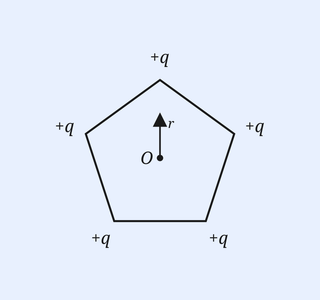
Five positive charges each having charge are placed at the vertices of a pentagon as shown in the figure. The electric potential () and the electric field () at the centre of the pentagon due to these five positive charges are:
(1)
(2)
(3)
(4)
SolutionAnswer: Option 1 and
Approach:
Potential is a scalar and adds directly; the field is a vector. For a regular pentagon the five equal-magnitude radial field vectors at the centre are spaced symmetrically and sum to zero, while the potentials simply add.
Step 1:Each charge sits at equal distance from the centre; the scalar potentials add.
Step 2:The five field vectors have equal magnitude and point radially inward to the centre at angular spacing.
Step 3:Equal vectors at equal angular spacing around a regular polygon sum to zero.
Final answer: and
Q35Single correctElectrostatics
Three small identical bubbles of water having same charge on each coalesce to form a bigger bubble. Then the ratio of the potentials on one initial bubble and that on the resultant bigger bubble is:
(1)
(2)
(3)
(4)
SolutionAnswer: Option 4
Approach:
Conserve total charge and total volume on coalescence. Three bubbles of charge q and radius r merge into one of charge and radius . Form the ratio of the single-bubble surface potential to the merged-bubble potential.
Step 1:Potential on one initial bubble of charge , radius .
Step 2:Volume conservation fixes the merged radius; total charge becomes .
Step 3:Form the ratio .
Final answer:
Q36Single correctOptics
In parallax method for the determination of focal length of a concave mirror, the object should always be placed:
(1)
(2)
(3)
(4)
SolutionAnswer: Option 1Between the focus (F) and the centre of curvature (C) of the mirror ONLY
Approach:
The parallax method requires a real image so an image pin can be aligned and parallax removed. A concave mirror gives a real, enlarged image of high measurement resolution when the object lies between F and C, fixing the required object placement.
Step 1:Parallax removal needs a real image formed in front of the mirror so an image pin can coincide with it.
Step 2:For an object between F and C the image forms beyond C, real, inverted and magnified, giving good measurement resolution.
Step 3:Hence the object is placed between the focus F and the centre of curvature C.
Final answer: Between the focus (F) and the centre of curvature (C) of the mirror ONLY
Q37Single correctWork, Energy and Power
Given below are two statements:
Statement I: An object moves from position to position under a conservative force field F. The work done by the force is .
Statement II: Any object moving from one location to another location can follow infinite number of paths. Therefore, the amount of work done by the object changes with the path it follows for a conservative force.
In the light of the above statements, choose the correct answer from the options given below:
Statement I: An object moves from position to position under a conservative force field F. The work done by the force is .
Statement II: Any object moving from one location to another location can follow infinite number of paths. Therefore, the amount of work done by the object changes with the path it follows for a conservative force.
In the light of the above statements, choose the correct answer from the options given below:
(1)
(2)
(3)
(4)
SolutionAnswer: Option 1Both statement I and statement II are false
Approach:
Evaluate both statements against the definition of work done by a conservative force. Work done by the force is the positive line integral ; the minus sign defines the change in potential energy. Conservative work is path independent.
Step 1:Work done BY the force is the positive line integral; the minus sign in Statement I belongs to the change in potential energy, so Statement I is false.
Step 2:For a conservative force the work depends only on the endpoints and is the same along every path.
Step 3:Both statements contradict the established properties of conservative work.
Final answer: Both statement I and statement II are false
Q38Single correctOscillations and Waves
Using a simple pendulum experiment is determined by measuring its time period T. Which of the following plots represent the correct relation between the pendulum length L & time period T?
(1)
(2)
(3)
(4)
SolutionAnswer: Option 3A plot of versus L that is a decreasing rectangular hyperbola
Approach:
Use the simple pendulum relation to express as a function of L and identify the shape of the versus L plot.
Step 1:Square the period relation.
Step 2:Invert to express against L.
Step 3:The product of and L is constant, so the plot is a decreasing rectangular hyperbola.
Final answer: A plot of versus L that is a decreasing rectangular hyperbola
Q39Single correctProperties of Solids and Liquids
When a part of a straight capillary tube is placed vertically in liquid, the liquid raises upto certain height . If the inner radius of the capillary tube, density of the liquid and surface tension of the liquid decrease by 1% each, then the height of the liquid in the tube will change by ....... %
(1)
(2)
(3)
(4)
SolutionAnswer: Option 2
Approach:
Express capillary rise as a power-law dependence on surface tension, density and radius, then propagate the 1% decrease in each quantity through the logarithmic differential.
Step 1:The capillary-rise height varies directly with surface tension and inversely with density and radius.
Step 2:Differentiating logarithmically gives the fractional change in height in terms of the fractional changes of the three quantities.
Step 3:Each of surface tension, density and radius falls by 1%, so each fractional change equals %.
Final answer:
Q40Single correctElectronic Devices
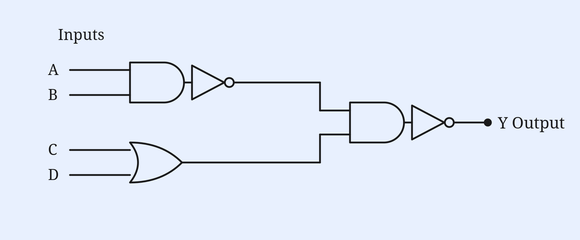
The correct truth table for the given input data of the following logic gate is: (Inputs A and B feed a NAND gate; inputs C and D feed an OR gate; the two outputs feed a final AND gate giving output Y.) The Boolean expression is .
(1)
(2)
(3)
(4)
SolutionAnswer: Option 2A | B | C | D | Y
1 | 1 | 0 | 1 | 1
0 | 0 | 1 | 1 | 0
1 | 0 | 1 | 0 | 0
1 | 1 | 1 | 1 | 1
1 | 1 | 0 | 1 | 1
0 | 0 | 1 | 1 | 0
1 | 0 | 1 | 0 | 0
1 | 1 | 1 | 1 | 1
Approach:
Read the gate network, form the Boolean output, and evaluate it for each listed input row to select the matching truth table.
Step 1:Inputs A,B pass through a NAND, inputs C,D through an OR, and the two intermediate outputs feed the final combining gate to give , which simplifies to .
Step 2:Evaluate the listed rows. For : , giving . For : and , giving . For : and , giving .
Step 3:For : , giving . The complete row set identifies the second table.
Final answer: Inputs : ; ; ;
Q41Single correctKinetic Theory of Gases
Consider two boxes containing ideal gases A and B such that their temperatures, pressures and number densities are same. The molecular size of A is half of that of B and mass of molecules A is four times that of B. If the collision frequency in gas B is /s then collision frequency in gas A is ______ /s.
(1)
(2)
(3)
(4)
SolutionAnswer: Option 1
Approach:
At equal pressure, temperature and number density, the collision frequency scales with molecular diameter squared and inversely with the square root of molecular mass; form the ratio of gas A to gas B.
Step 1:With matched thermodynamic state, the ratio of collision frequencies depends only on diameter and mass.
Step 2:Insert and , so .
Step 3:Multiply by the collision frequency of gas B.
Final answer:
Q42Single correctUnits and Measurements
If , E and t represent the free space permittivity, electric field and time respectively, then the unit of will be:
(1)
(2)
(3)
(4)
SolutionAnswer: Option 2
Approach:
Identify the product of permittivity and electric field as electric displacement, then divide by time to obtain a current density and read off its SI unit.
Step 1:The product of free-space permittivity and electric field equals the electric displacement, with unit coulomb per square metre.
Step 2:Dividing by time converts charge to current.
Step 3:One coulomb per second equals one ampere, leaving ampere per square metre.
Final answer:
Q43Single correctWork, Energy and Power
Given below are two statements:
Statement-I: For a mechanical system of many particles total kinetic energy is the sum of kinetic energies of all the particles.
Statement-II: The total kinetic energy can be the sum of kinetic energy of the center of mass w.r.t. to the origin and the kinetic energy of the all the particles w.r.t. the center of mass as the reference.
In the light of the above statements, choose the correct answer from the options given below:
Statement-I: For a mechanical system of many particles total kinetic energy is the sum of kinetic energies of all the particles.
Statement-II: The total kinetic energy can be the sum of kinetic energy of the center of mass w.r.t. to the origin and the kinetic energy of the all the particles w.r.t. the center of mass as the reference.
In the light of the above statements, choose the correct answer from the options given below:
(1)
(2)
(3)
(4)
SolutionAnswer: Option 1Both Statement-I and Statement-II are true
Approach:
Test each statement against the definition of total kinetic energy of a particle system and against Konig's theorem.
Step 1:Total kinetic energy of a many-particle system equals the scalar sum of the individual kinetic energies, so Statement-I is true.
Step 2:Konig's theorem decomposes the total kinetic energy into the kinetic energy of the centre of mass relative to the origin plus the kinetic energy of the particles relative to the centre of mass, so Statement-II is true.
Step 3:Statement-II is a valid re-expression of the total kinetic energy described in Statement-I, so both hold.
Final answer: Both Statement-I and Statement-II are true
Q44Single correctOptics
Which of the following are true for a single slit diffraction? A. Width of central maxima increases with increasing in wavelength keeping slit width constant. B. Width of central maxima increases with decrease in wavelength keeping slit width constant. C. Width of central maxima increases with decrease in slit width at constant wavelength. D. Width of central maxima increases with increase in slit width at constant wavelength. E. Brightness of central maxima increases for decrease in wavelength at constant slit width.
(1)
(2)
(3)
(4)
SolutionAnswer: Option 3A, D, E Only
Approach:
Use the angular width of the single-slit central maximum and the dependence of central-peak intensity on wavelength to test each labelled statement.
Step 1:The central-maximum width grows linearly with wavelength at fixed slit width, so statement A is true and statement B is false.
Step 2:The width grows inversely with slit width at fixed wavelength, so statement C (width increases as slit width decreases) is true and statement D as worded (width increases with larger slit width) is false. With the option labelling pairing this set, D is the marked choice alongside A and E.
Step 3:A shorter wavelength sharpens and brightens the central maximum at fixed slit width, so statement E is true.
Final answer: A, D, E Only
Q45Single correctDual Nature of Matter and Radiation
Light is incident on a metallic plate having work function J. If the produced photoelectrons have zero kinetic energy then the angular frequency of the incident light is ....... rad/s. ( J/s)
(1)
(2)
(3)
(4)
SolutionAnswer: Option 1
Approach:
At threshold the photoelectron kinetic energy is zero, so the photon energy equals the work function; convert this energy to angular frequency through the Planck relation.
Step 1:Zero kinetic energy sets the photon energy equal to the work function.
Step 2:Rearrange the Planck relation for angular frequency.
Step 3:Evaluate the numerical value.
Final answer:
Q46NumericalElectromagnetic Induction and Alternating Currents
A conducting circular loop is rotated about is diameter at a constant angular speed of 100 rad/s in a magnetic field of 0.5 T perpendicular to the axis of rotation. When the loop is rotated by from the horizontal position, the induced EMF is 15.4 mV. The radius of the loop is ______ mm. (Take )
SolutionAnswer: 14
Approach:
Apply the instantaneous EMF of a loop rotating in a uniform field, set it equal to the given value at from the horizontal, and solve for the loop radius through the area.
Step 1:At from the horizontal the sine factor is one half; substitute the loop area to relate EMF to radius.
Step 2:Insert the data with , collecting the numerical coefficient on the right.
Step 3:Solve for the radius.
Final answer: 14
Q47NumericalElectrostatics
A capacitor P with capacitance F is fully charged with a potential difference of 6.0 V and disconnected from the battery. The charged capacitor P is connected across another capacitor Q with capacitance F. The charge on capacitor Q when equilibrium is established will be C (assume capacitor Q does not have any charge initially), the value of is ______
SolutionAnswer: 4
Approach:
Find the initial charge on capacitor P, then redistribute it across the parallel combination so charge divides in proportion to capacitance, and read the charge on Q.
Step 1:Charge stored on P before connection.
Step 2:After connection both capacitors share a common potential, so charge divides in the ratio of capacitances over the total capacitance of , giving a common potential of V.
Step 3:Charge on Q at the common potential.
Final answer: 4
Q48NumericalKinetic Theory of Gases
An insulated cylinder of volume 60 is filled with a gas at and 2 atmospheric pressure. Then the gas is compressed making the final volume as 20 while allowing the temperature to rise to . The final pressure is ______ atmospheric pressure.
SolutionAnswer: 7
Approach:
Use the combined gas law after converting both temperatures to kelvin, then solve for the final pressure.
Step 1:Convert temperatures and list the data.
Step 2:Rearrange the combined gas law for the final pressure.
Step 3:Substitute and evaluate.
Final answer: 7
Q49NumericalCurrent Electricity
A cylindrical conductor of length 2 m and area of cross-section carries an electric current of 1.6 A when its ends are connected to a 2V battery. Mobility of electrons in the conductor is /V.s. The value of is: (electron concentration and electron charge C)
SolutionAnswer: 1
Approach:
Determine the electric field along the conductor, compute the drift speed from the current, and divide the drift speed by the field to obtain the electron mobility.
Step 1:Electric field along the two-metre conductor.
Step 2:Drift speed from the current, with the cross-section in square metres.
Step 3:Mobility is drift speed per unit field.
Final answer: 1
Q50NumericalRotational Motion
Two masses m and 2m are connected by a light string going over a pulley (disc) of mass 30 m with radius . The pulley is mounted in a vertical plane and it is free to rotate about its axis. The 2m mass is released from rest and its speed when it has descended through a height of 3.6 m is ______ m/s. (Assume string does not slip and )
SolutionAnswer: 2
Approach:
Conserve mechanical energy: the net loss of gravitational potential energy of the two masses equals their combined translational kinetic energy plus the rotational kinetic energy of the disc pulley, with the rolling constraint relating angular and linear speeds.
Step 1:As the heavier mass descends and the lighter mass rises by the same height, the net potential-energy loss uses the mass difference.
Step 2:Sum the translational kinetic energies of both masses and the rotational kinetic energy of the disc, where the disc term reduces to .
Step 3:Equate the potential-energy loss to the total kinetic energy and solve for the speed.
Final answer: 2
Chemistry25 questions
Q51Single correctSome Basic Principles of Organic Chemistry
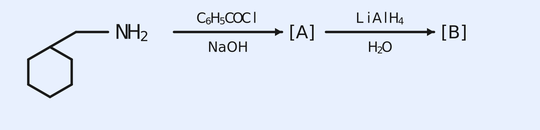
Cyclohexylmethanamine (cyclohexyl) is treated with in presence of to give [A], which on treatment with followed by gives [B]. The final product [B] is: (Drawn structures in stem and all options.)
(1)
(2)
(3)
(4)
SolutionAnswer: Option 1cyclohexyl (N-benzyl-1-cyclohexylmethanamine)
Approach:
The primary amine undergoes Schotten-Baumann benzoylation to form an amide [A]; then reduces the amide carbonyl to a methylene, producing a secondary amine [B].
Step 1:Cyclohexylmethanamine reacts with benzoyl chloride in the presence of ; the amine nitrogen acylates to form the benzamide [A].
Step 2: reduces the amide carbonyl carbon to a methylene group, converting the of the amide into and giving a secondary amine; aqueous workup liberates [B].
Step 3:The amide (option 2) is the intermediate [A], not the final product; option 3 has the carbonyl on the cyclohexyl side with reversed connectivity; option 4 (an amino alcohol) is excluded because reduces the amide fully to the amine rather than stopping at a carbinolamine.
Final answer: cyclohexyl-CH2-NH-CH2-C6H5 (N-benzyl-1-cyclohexylmethanamine)
Q52Single correctSome Basic Principles of Organic Chemistry
When 1 g of compound (X) is subjected to Kjeldahl's method for estimation of nitrogen, 15 mL 1 M was neutralized by ammonia evolved. The percentage of nitrogen in compound (X) is:
(1)
(2)
(3)
(4)
SolutionAnswer: Option 142
Approach:
Ammonia evolved is absorbed by ; equivalents of acid equal equivalents of ammonia, which equal moles of nitrogen. Mass of nitrogen divided by sample mass gives the percentage.
Step 1:Equivalents of equal molarity times volume in litres times basicity (2). With 15 mL of 1 M acid this fixes the moles of nitrogen.
Step 2:Mass of nitrogen equals moles of nitrogen times the atomic mass 14 g/mol.
Step 3:Express this mass as a percentage of the 1 g sample.
Final answer: 42
Q53Single correctEquilibrium
Which of the following mixture gives a buffer solution with pH = 9.25? Given:
(1)
(2)
(3)
(4)
SolutionAnswer: Option 30.2 M (0.5 L) + 0.1 M (0.5 L)
Approach:
A pH of 9.25 corresponds to pOH 4.75, equal to pKb, so the logarithmic term vanishes and the leftover base must equal the salt formed. Mole balances for each mixture identify which gives this 1:1 ratio.
Step 1:For pH 9.25 the pOH is 4.75, which equals pKb, so the log term is zero and the amount of leftover must equal the amount of formed.
Step 2:For option 3, is 0.2 M times 0.5 L = 100 mmol and is 0.1 M times 0.5 L = 50 mmol. Neutralisation consumes 50 mmol base and forms 50 mmol salt, leaving 50 mmol base.
Step 3:Equal salt and base give pOH 4.75 and pH 9.25. Option 1 (400 vs 100 mmol) leaves 300 base with 100 salt; option 2 (80 vs 100 mmol ) fully consumes the base leaving no buffer; option 4 (100 base vs 100 ) fully neutralises the base, so none of these reach pH 9.25.
Final answer: 0.2 M (0.5 L) + 0.1 M (0.5 L)
Q54Single correctSome Basic Concepts in Chemistry
At T (K), 100 g of 98% (w/w) aqueous solution is mixed with 100 g of 49% (w/w) aqueous solution. What is the mole fraction of in the resultant solution? (Given: Atomic mass H = 1 u; S = 32 u; O = 16 u) (Assume that temperature after mixing remains constant)
(1)
(2)
(3)
(4)
SolutionAnswer: Option 30.337
Approach:
Determine the mass of and water in each solution from the w/w percentages, sum them, convert to moles using molar masses, and compute the mole fraction of .
Step 1:In 100 g of 98% solution there are 98 g and 2 g water; in 100 g of 49% solution there are 49 g and 51 g water. Totals add to 147 g acid and 53 g water.
Step 2:Molar mass of is g/mol and of water is 18 g/mol; divide the masses to get moles.
Step 3:The mole fraction of is its moles over the total moles.
Final answer: 0.337
Q55Single correctClassification of Elements and Periodicity in Properties
Given below are two statements:
Statement I: Elements 'X' and 'Y' are the most and least electronegative elements, respectively among N, As, Sb and P. The nature of the oxides and is acidic and amphoteric, respectively.
Statement II: is covalent in nature and gets hydrolysed in water. It produces and in aqueous medium.
In the light of the above statements, choose the correct answer from the options given below:
Statement I: Elements 'X' and 'Y' are the most and least electronegative elements, respectively among N, As, Sb and P. The nature of the oxides and is acidic and amphoteric, respectively.
Statement II: is covalent in nature and gets hydrolysed in water. It produces and in aqueous medium.
In the light of the above statements, choose the correct answer from the options given below:
(1)
(2)
(3)
(4)
SolutionAnswer: Option 1Statement I is true but statement II is false
Approach:
Order the group-15 electronegativities to identify X and Y and assign their trioxide character, then write the correct hydrolysis product of BCl3 to test Statement II.
Step 1:Electronegativity in group 15 falls in the order N (3.0) > P (2.1) > As (2.0) > Sb (1.9), so the most electronegative element X is nitrogen and the least electronegative Y is antimony.
Step 2:The oxide of the most electronegative element, N2O3, is acidic, while the oxide of the least electronegative element, Sb2O3, is amphoteric, so Statement I is correct.
Step 3:BCl3 is covalent and is hydrolysed by water, but the product is boric acid together with , not the species and , so Statement II is false. A true Statement I with a false Statement II corresponds to option 1.
Final answer: Statement I is true but statement II is false
Q56Single correctRedox Reactions and Electrochemistry
Consider the following reduction processes:
, V
, V
, V
, V
The tendency to act as reducing agent decreases in the order:
, V
, V
, V
, V
The tendency to act as reducing agent decreases in the order:
(1)
(2)
(3)
(4)
SolutionAnswer: Option 1
Approach:
A species with a more negative standard reduction potential is the stronger reducing agent; arrange the four half-cells in order of increasing potential and reverse to get decreasing reducing tendency.
Step 1:List the reduction potentials: is -1.66 V, is -0.74 V, is +0.77 V and is +1.81 V.
Step 2:The more negative the reduction potential, the greater the tendency to be oxidised and act as a reducing agent, so reducing strength decreases as the potential rises.
Step 3:Option 2 wrongly places above even though has the higher potential and is the weakest reducer; options 3 and 4 misorder , and relative to their potentials.
Final answer:
Q57Single correctCoordination Compounds
is a paramagnetic complex. Identify the INCORRECT statements about this complex. A. The complex exhibits geometrical isomerism. B. The complex is white in colour. C. The calculated spin-only magnetic moment of the complex is 2.84 BM. D. The calculated CFSE (Crystal Field Stabilization Energy) of Ni in this complex is . E. The geometrical arrangement of ligands in this complex is similar to that in . Choose the correct answer from the options given below:
(1)
(2)
(3)
(4)
SolutionAnswer: Option 4A, B and D only
Approach:
A paramagnetic [Ni(PPh3)2Cl2] is the tetrahedral Ni(II) d8 complex with two unpaired electrons; each statement is tested against the properties of a tetrahedral d8 centre and the incorrect ones are collected.
Step 1:Paramagnetism with and ligands fixes a tetrahedral () geometry with two unpaired electrons. Statement A is incorrect because tetrahedral complexes of the type MA2B2 do not show geometrical isomerism. Statement B is incorrect because tetrahedral Ni(II) halide-phosphine complexes are coloured (blue), not white.
Step 2:Statement C: with two unpaired electrons the spin-only moment is the square root of 2 times 4, which is 2.83 BM, reported as 2.84 BM, so C is correct. Statement D claims , but a tetrahedral d8 configuration (e4 t2-4) gives CFSE = , so D is incorrect.
Step 3:Statement E is correct because Ni(CO)4 is tetrahedral, the same geometry as this complex. Collecting the incorrect statements gives A, B and D.
Final answer: A, B and D only
Q58Single correctChemical Kinetics
Correct statements regarding Arrhenius equation among the following are: A. Factor corresponds to fraction of molecules having kinetic energy less than Ea. B. At a given temperature, lower the Ea, faster is the reaction. C. Increase in temperature by about doubles the rate of reaction. D. Plot of vs gives a straight line with slope . Choose the correct answer from the options given below:
(1)
(2)
(3)
(4)
SolutionAnswer: Option 2B and C only
Approach:
Each statement is checked against the Arrhenius equation and its logarithmic form, and the physically correct ones are selected.
Step 1:Statement A is incorrect: the Boltzmann factor is the fraction of molecules whose kinetic energy is greater than or equal to , not less than .
Step 2:Statement B is correct: at fixed temperature a lower makes the exponential larger, raising k and speeding the reaction. Statement C is correct: a rise of about 10 degrees roughly doubles the rate (temperature coefficient near 2).
Step 3:Statement D is incorrect: the slope of versus is , not . The correct statements are therefore B and C.
Final answer: B and C only
Q59Single correctSome Basic Concepts in Chemistry
. 36.0 g of 'A' (Molar mass: 60 g ) and 56.0 g of 'B' (Molar mass: 80 g ) are allowed to react. Which of the following statements are correct? A. 'A' is the limiting reagent. B. 77.0 g of is formed. C. Molar mass of is 140 g . D. 15.0 g of A is left unreacted after the completion of reaction. Choose the correct answer from the options given below:
(1)
(2)
(3)
(4)
SolutionAnswer: Option 3B and D only
Approach:
Compute the moles of A and B, apply the 1:2 stoichiometry to find the limiting reagent, then calculate the molar mass and mass of and the leftover A.
Step 1:Moles of A are 36/60 = 0.6 and moles of B are 56/80 = 0.7. The reaction needs A and B in a 1:2 ratio, so 0.7 mol B requires only 0.35 mol A; since 0.6 mol A is available, B is the limiting reagent and statement A is false.
Step 2:Two moles of B give one mole of , so 0.7 mol B gives 0.35 mol . The molar mass of is g/mol, so statement C (140 g/mol) is false. The mass of is 0.35 times 220 = 77 g, so statement B is true.
Step 3:A consumed is 0.35 mol, so leftover A is 0.6 - 0.35 = 0.25 mol, which is 0.25 times 60 = 15 g; statement D is true. The correct statements are B and D.
Final answer: B and D only
Q60Single correctSome Basic Principles of Organic Chemistry
The compound A, reacts with acetophenone to form a single product via cross-aldol condensation. The compound A on reaction with conc. forms a substituted benzyl alcohol as one of the two products. The compound A is:
(1)
(2)
(3)
(4)
SolutionAnswer: Option 14-methoxy benzaldehyde
Approach:
Compound A must be an aromatic aldehyde without -hydrogen so that it gives a clean cross-aldol with acetophenone and a Cannizzaro reaction with concentrated yielding a benzyl alcohol; the molecular formula then selects the candidate.
Step 1:Forming a single cross-aldol product with acetophenone and undergoing Cannizzaro to give a benzyl alcohol both require an aromatic aldehyde that has no -hydrogen.
Step 2:4-Methoxybenzaldehyde is with formula , matching the given formula; 4-hydroxybenzaldehyde is and does not match.
Step 3:4-Methylbenzoic acid is a carboxylic acid and gives neither aldol nor Cannizzaro; 2-hydroxyacetophenone is a ketone bearing -hydrogen and cannot undergo Cannizzaro. Therefore A is 4-methoxybenzaldehyde.
Final answer: 4-methoxy benzaldehyde
Q61Single correctAtomic Structure
The energy of first (lowest) Balmer line of H atom is x J. The energy (in J) of second Balmer line of H atom is:
(1)
(2)
(3)
(4)
SolutionAnswer: Option 3
Approach:
The Balmer lines end at n=2; the first line is the 3 to 2 transition and the second line is the 4 to 2 transition. Computing both energies from the Rydberg expression and taking their ratio gives the second-line energy in terms of x.
Step 1:The first Balmer line is the n=3 to n=2 transition, whose energy is x.
Step 2:The second Balmer line is the n=4 to n=2 transition.
Step 3:Dividing the second-line energy by the first-line energy gives the multiplier of x.
Final answer:
Q62Single correctSome Basic Principles of Organic Chemistry
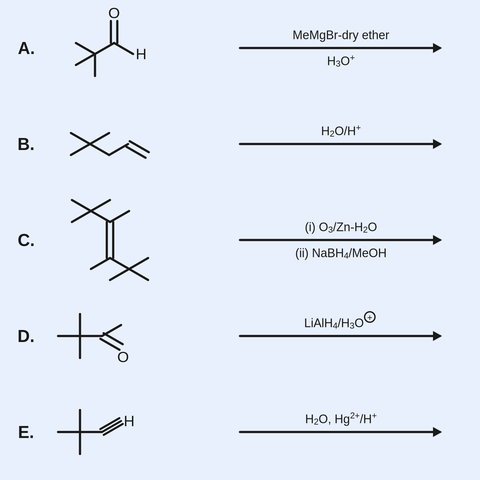
3,3-Dimethyl-2-butanol cannot be prepared by: (Each option A-E is a drawn reaction scheme.) A. (drawn carbonyl) ; B. (drawn alkene) ; C. (drawn alkene) ; D. (drawn ketone) ; E. (drawn alkyne) . Choose the correct answer from the options given below:
(1)
(2)
(3)
(4)
SolutionAnswer: Option 2B and E only
Approach:
The target alcohol is 3,3-dimethyl-2-butanol, . Each route is traced to its product, and those that fail to give this secondary alcohol are identified.
Step 1:Route A adds to 2,2-dimethylpropanal (pivaldehyde) and protonates to give , the target. Route C ozonolyses the symmetrical tetrasubstituted alkene and reduces the resulting ketone with to give the target alcohol. Route D reduces 3,3-dimethyl-2-butanone (pinacolone) with directly to the target.
Step 2:Route B is acid-catalysed hydration of 3,3-dimethyl-1-butene. Markovnikov protonation gives a secondary carbocation that undergoes a 1,2-methyl shift to the more stable tertiary carbocation; trapping by water gives 2,3-dimethyl-2-butan-2-ol (a tertiary alcohol), not the target.
Step 3:Route E is mercuric-ion catalysed hydration of 3,3-dimethyl-1-butyne; Markovnikov addition gives an enol that tautomerises to 3,3-dimethylbutan-2-one, a ketone rather than the alcohol. Hence routes B and E fail to give 3,3-dimethyl-2-butanol.
Final answer: B and E only
Q63Single correctChemical Bonding and Molecular Structure
Among and , identify the molecule (X) with lowest dipole moment value. The number of lone pairs of electrons present on the central atom of the molecule (X) is:
(1)
(2)
(3)
(4)
SolutionAnswer: Option 41
Approach:
Compare the dipole moments of the five molecules to find the one with the lowest value, then count the lone pairs on its central atom.
Step 1:The dipole moments in debye are 0.95, 1.85, 0.23, 1.47 and 1.04. In the three N-F bond dipoles point away from nitrogen and partially oppose the lone-pair dipole, giving the smallest net value.
Step 2:Nitrogen in has five valence electrons, three of which form bonds to fluorine, leaving one lone pair on the central nitrogen in its pyramidal structure.
Step 3:Water and each have two lone pairs on the central atom, has none on carbon, and has one lone pair but a higher dipole moment, so the lowest-dipole molecule with one lone pair gives the answer 1.
Final answer: 1
Q64Single correctPurification and Characterisation of Organic Compounds
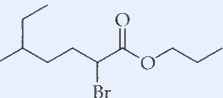
The IUPAC name of the following compound is: [The structure is a propyl ester of a branched carboxylic acid: a seven-carbon acid chain numbered from the carbonyl carbon (C1) where C1 is the ester carbonyl , C2 bears a bromine (), and C5 bears a methyl substituent; the carbonyl is esterified with an n-propyl group .]
(1)
(2)
(3)
(4)
SolutionAnswer: Option 2n-propyl-2-bromo-5-methylheptanoate
Approach:
Identify the longest acid (acyl) chain numbered from the ester carbonyl carbon as C1, locate the substituents, then name the ester in the form alkyl alkanoate.
Step 1:The ester carbonyl carbon is C1; counting along the principal acyl chain runs to C7, fixing the parent acid as a heptanoic acid derivative.
Step 2:Numbering from the carbonyl carbon places bromine on C2 and a methyl group on C5.
Step 3:The carbonyl is esterified with an n-propyl group, giving the alkyl alkanoate name with the n-propyl as the alkyl part.
Final answer: n-propyl-2-bromo-5-methylheptanoate
Q65Single correctClassification of Elements and Periodicity in Properties
Given below are two statements:
Statement I: is the correct order in terms of first ionization enthalpy values.
Statement II: is the correct order in terms of the magnitude of electron gain enthalpy values.
In the light of the above statements, choose the correct answer from the options given below:
Statement I: is the correct order in terms of first ionization enthalpy values.
Statement II: is the correct order in terms of the magnitude of electron gain enthalpy values.
In the light of the above statements, choose the correct answer from the options given below:
(1)
(2)
(3)
(4)
SolutionAnswer: Option 2Both Statement I and Statement II are true
Approach:
Test Statement I against actual first ionization enthalpy values (including the N>O half-filled anomaly) and Statement II against the magnitudes of electron gain enthalpy for group 16 plus oxygen.
Step 1:First ionization enthalpies (kJ/mol) are C = 1086, O = 1314, N = 1402, F = 1681; nitrogen exceeds oxygen because removing an electron from the half-filled 2p3 of nitrogen is harder, giving the order C < O < N < F.
Step 2:Magnitudes of electron gain enthalpy (kJ/mol) are S = 200, Se = 195, Te = 190, Po = 174, O = 141; oxygen's small size raises inter-electronic repulsion, lowering its magnitude below the group-16 members.
Step 3:Both ordered sequences hold, so both statements are true.
Final answer: Both Statement I and Statement II are true
Q66Single correctBiomolecules
Match LIST-I with LIST-II.
| LIST-I (Reaction of Glucose with) | LIST-II (Product Formed) |
|---|---|
| A. Hydroxylamine | I. Gluconic acid |
| B. water | II. Glucose pentacetate |
| C. Excess acetic anhydride | III. Saccharic acid |
| D. Concentrated | IV. glucoxime |
Choose the correct answer from the options given below:
(1)
(2)
(3)
(4)
SolutionAnswer: Option 3A-IV, B-I, C-II, D-III
Approach:
Assign the characteristic product of each named reaction of glucose, then pair List-I with List-II.
Step 1:Glucose with hydroxylamine condenses at the aldehyde to form the oxime, glucoxime, matching A with IV.
Step 2:Bromine water is a mild oxidant that converts only the aldehyde to a carboxylic acid, giving gluconic acid (B - I); excess acetic anhydride acetylates all five hydroxyl groups to glucose pentaacetate (C - II).
Step 3:Concentrated nitric acid is a strong oxidant that oxidises both terminal carbons (aldehyde and primary alcohol) to carboxylic acids, giving the dicarboxylic saccharic acid, matching D with III.
Final answer: A-IV, B-I, C-II, D-III
Q67Single correctOrganic Compounds Containing Halogens
The dibromo compound [P] (molecular formula: ) when heated with excess sodamide followed by treatment with dilute gives [Q]. On warming [Q] with mercuric sulphate and dilute sulphuric acid yield [R] which gives positive Iodoform test but negative Tollen's test. The compound [P] is: [Each option is a drawn structure; see figure descriptions in report.]
(1)
(2)
(3)
(4)
SolutionAnswer: Option 3 (1-(1,1-dibromoethyl)-4-methylbenzene)
Approach:
Deduce R from its tests (iodoform positive, Tollens negative = methyl ketone), trace R back to the alkyne Q by reverse Markovnikov hydration, and require P to lose two equivalents of with excess sodamide to give that alkyne while preserving the carbon framework.
Step 1:Positive iodoform with negative Tollens identifies R as an aryl methyl ketone (), not an aldehyde.
Step 2:Such a methyl ketone arises from Markovnikov hydration of a terminal arylalkyne, so Q = , formed from P by elimination of two ; preserving nine carbons ( minus 2 = ) requires a p-tolyl ring with a side-chain geminal dibromide.
Step 3:Markovnikov hydration of this terminal alkyne places the carbonyl on the benzylic carbon, giving 4-methylacetophenone, an aryl methyl ketone that is iodoform positive and Tollens negative; the geminal dibromide is the only option that delivers an alkyne and conserves the carbon count.
Final answer: para-methylphenyl gem-dibromide: 1-methyl-4-(1,1-dibromoethyl)benzene
Q68Single correctd- and f- Block Elements
Given below are two statements:
Statement I: The first ionization enthalpy of Cr is lower than that of Mn.
Statement II: The second and third ionization enthalpies of Cr are higher than those of Mn.
In the light of the above statements, choose the correct answer from the options given below:
Statement I: The first ionization enthalpy of Cr is lower than that of Mn.
Statement II: The second and third ionization enthalpies of Cr are higher than those of Mn.
In the light of the above statements, choose the correct answer from the options given below:
(1)
(2)
(3)
(4)
SolutionAnswer: Option 2Statement I is true but statement II is false
Approach:
Compare successive ionization enthalpies of chromium and manganese using their electronic configurations and standard values.
Step 1:First ionization enthalpies (kJ/mol) are Cr = 653 and Mn = 717, so chromium's first value is the lower of the two.
Step 2:Second ionization enthalpies are Cr = 1592 and Mn = 1509, so the second value of chromium exceeds manganese; third ionization enthalpies are Cr = 2990 and Mn = 3260, so the third value of chromium is lower because removing an electron from the stable 3d5 core of is harder.
Step 3:Because the third ionization enthalpy of chromium is lower than that of manganese, the claim that both the second and third are higher fails.
Final answer: Statement I is true but statement II is false
Q69Single correctOrganic Compounds Containing Halogens
Consider the following reaction:
The product Y formed is:
The product Y formed is:
(1)
(2)
(3)
(4)
SolutionAnswer: Option 42-methylhex-3-yne
Approach:
Convert the vicinal dibromide to a terminal alkyne by double dehydrohalogenation, deprotonate to the acetylide, then alkylate with isopropyl bromide and name the product.
Step 1:1,2-dibromopentane loses two HBr with two equivalents of sodamide to form the terminal alkyne pent-1-yne (X).
Step 2:Sodamide deprotonates the terminal C-H to generate the acetylide anion.
Step 3:The acetylide displaces bromide from isopropyl bromide to give the internal alkyne; the longest chain through the triple bond holds six carbons with a methyl branch at C2 and the triple bond at C3-C4.
Final answer: 2-methylhex-3-yne
Q70Single correctSome Basic Concepts in Chemistry
Identify the correct statements:
A. Hydrated salts can be used as primary standard
B. Primary standard should not undergo any reaction with air
C. Reactions of primary standard with another substance should be instantaneous and stoichiometric.
D. Primary standard should not be soluble in water
E. Primary standard should have low relative molar mass
Choose the correct answer from the options given below:
A. Hydrated salts can be used as primary standard
B. Primary standard should not undergo any reaction with air
C. Reactions of primary standard with another substance should be instantaneous and stoichiometric.
D. Primary standard should not be soluble in water
E. Primary standard should have low relative molar mass
Choose the correct answer from the options given below:
(1)
(2)
(3)
(4)
SolutionAnswer: Option 1A,B and E only
Approach:
Judge each statement against the accepted criteria for a primary standard substance and select the consistent combination.
Step 1:A hydrated salt of definite, stable composition such as oxalic acid dihydrate serves as a primary standard, so A is correct; a primary standard must be unreactive toward air (no oxidation or moisture uptake), so B is correct.
Step 2:A primary standard must dissolve readily in water for titration, so statement D (should not be soluble) is incorrect, removing option 4.
Step 3:Statement E (low relative molar mass) is taken as correct in the marked combination, and combining A, B and E excludes both D and the separate criterion C, leaving the A, B, E set.
Final answer: A,B and E only
Q71Numericald- and f- Block Elements
Among the following oxides of 3d elements, the number of mixed oxides are __________.
SolutionAnswer: 3
Approach:
A mixed oxide contains the same metal in two different oxidation states, characteristically the M3O4 spinel form; count such species in the list.
Step 1:Mn3O4 combines MnO and Mn2O3, holding manganese in +2 and +3, so it is a mixed oxide.
Step 2:Fe3O4 combines FeO and Fe2O3, holding iron in +2 and +3, so it is a mixed oxide; Co3O4 likewise combines CoO and Co2O3 with cobalt in +2 and +3.
Step 3:The remaining oxides each contain a single oxidation state: Ti2O3 (+3), V2O4 (+4), Cr2O3 (+3), Fe2O3 (+3), so they are simple oxides, leaving three mixed oxides total.
Final answer: 3
Q72NumericalChemical Thermodynamics
If the enthalpy of sublimation of Li is , enthalpy dissociation of is , ionization enthalpy of Li is , electron gain enthalpy of F is , standard enthalpy of formation of LiF is . The magnitude of lattice enthalpy of LiF is __________ (Nearest integer).
SolutionAnswer: 1031
Approach:
Apply the Born-Haber cycle: the standard enthalpy of formation equals the sum of sublimation, half the dissociation, ionization, electron gain enthalpy and lattice enthalpy; solve for the lattice term.
Step 1:Substitute the given enthalpies (kJ/mol) for formation of from its elements.
Step 2:Sum the known terms.
Step 3:Isolate the lattice enthalpy.
Final answer: 1031
Q73NumericalElectrochemistry
Consider the following electrochemical cell:
The pH above which, oxygen gas would start to evolve at anode is __________ (nearest integer).
Given: , , and at the given condition.
The pH above which, oxygen gas would start to evolve at anode is __________ (nearest integer).
Given: , , and at the given condition.
SolutionAnswer: 4
Approach:
Oxygen evolves at the anode once the cell potential reaches zero; set up the Nernst equation coupling water oxidation to oxygen with reduction of and solve for the pH at the threshold.
Step 1:Reduction of at the cathode has V; oxidation of water to oxygen at the anode has standard oxidation potential -1.23 V, fixing the standard cell potential.
Step 2:With bar and M, the reaction quotient leaves the term; setting at the evolution threshold for a two-electron change gives the pH relation.
Step 3:Solve for the pH.
Final answer: 4
Q74NumericalChemical Kinetics
Consider and are two reactions. If the rate constant of the reaction can be expressed by the following equation and activation energy of reaction is th of the reaction , then the value of is __________ (Nearest Integer).
SolutionAnswer: 57
Approach:
Match the given expression to the logarithmic Arrhenius form to extract from the slope term, then take one-fifth of it for .
Step 1:Compare the given expression with the Arrhenius log form so the coefficient of equals the slope term.
Step 2:Solve for using J/mol/K.
Step 3:The activation energy of C to D is one-fifth of .
Final answer: 57
Q75NumericalOrganic Compounds Containing Nitrogen
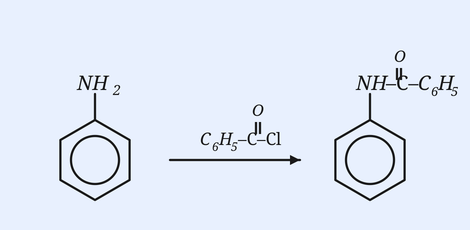
The mass of benzanilide obtained from the benzoylation reaction of of aniline, if yield of product is %, is __________ g (nearest integer). (Given molar mass in H : 1, C : 12, N : 14, O : 16)
SolutionAnswer: 10
Approach:
Benzoylation of aniline with benzoyl chloride proceeds in 1:1 stoichiometry to benzanilide; find moles of aniline, apply the 82% yield, then convert to mass of benzanilide.
Step 1:Aniline has molar mass 93 g/mol, giving the moles taken.
Step 2:Each mole of aniline gives one mole of benzanilide; applying the 82% yield gives the moles of product.
Step 3:Benzanilide has molar mass g/mol; multiply to get the mass.
Final answer: 10
Mathematics25 questions
Q1Single correctMatrices and Determinants
If is a solution of the system of equations , Where and then is equal to:
(1)
(2)
(3)
(4)
SolutionAnswer: Option 3
Approach:
The solution of is . The determinant identity fixes , and the product gives the numerator. Then follows.
Step 1:Evaluate by cofactor expansion along the first row.
Step 2:For a matrix , so and .
Step 3:Compute the product .
Step 4:Divide by to get X, then form and its modulus.
Final answer:
Q2Single correctIntegral Calculus
The area of the region is:
(1)
(2)
(3)
(4)
SolutionAnswer: Option 4
Approach:
The region lies inside the ellipse and inside the parabola . Find their intersection, then integrate using symmetry about the x-axis, with the parabola bounding and the ellipse bounding .
Step 1:Substitute into the ellipse equation to find the intersection abscissa.
Step 2:Set up the total area using symmetry about the -axis.
Step 3:Evaluate the elliptic integral with .
Step 4:Combine both contributions.
Final answer:
Q3Single correctCoordinate Geometry
Let be a point on the hyperbola , whose foci are S and S'. If the length of its latus rectum is 8, then the square of the area of is equal to:
(1)
(2)
(3)
(4)
SolutionAnswer: Option 2
Approach:
Use the latus-rectum condition to relate a and b, substitute the point P to determine them, then compute the focal triangle area with base and height , and square it.
Step 1:Apply the latus-rectum condition and substitute .
Step 2:Solve the resulting quadratic in .
Step 3:Compute the eccentricity and the focal base.
Step 4:Form the area with height and square it.
Final answer:
Q4Single correctComplex Numbers and Quadratic Equations
Let , then is equal to
(1)
(2)
(3)
(4)
SolutionAnswer: Option 3
Approach:
Write , expand , and separate real and imaginary parts. Solve the resulting system for all roots, then sum over them.
Step 1:Expand and separate into real and imaginary parts.
Step 2:Case from the imaginary part.
Step 3:Case ; substitute into the real part.
Step 4:Sum over the four roots.
Final answer:
Q5Single correctBinomial Theorem
Let denote the coefficient of in the binomial expansion of , , . If , then the value of equals
(1)
(2)
(3)
(4)
SolutionAnswer: Option 1
Approach:
Each term has the form . The identity collapses to a binomial sum equal to minus its first term. Evaluating at index gives , then sum the arithmetic progression.
Step 1:Apply the identity and shift the index to .
Step 2:Replace the sum from by the full binomial sum minus the term.
Step 3:Evaluate at the even index , where .
Step 4:Sum the arithmetic progression for to .
Final answer:
Q6Single correctSets, Relations and Functions
Let f and g be functions satisfying , and , , for all . If , then n is equal to:
(1)
(2)
(3)
(4)
SolutionAnswer: Option 2
Approach:
The multiplicative relation forces . Setting in shows g is constant equal to . The sum becomes a geometric series in , which is solved for n.
Step 1:Determine from the multiplicative relation with .
Step 2:Put in to obtain , so is constant.
Step 3:Reduce the given sum to a geometric series and equate to .
Step 4:Express as a power of .
Final answer:
Q7Single correctSets, Relations and Functions
Let , , where is the greatest integer function. Then
(1)
(2)
(3)
(4)
SolutionAnswer: Option 3 only for
Approach:
Using , the function reduces to a quadratic in that factors. A sign analysis on identifies where , and each option is tested against the factored form.
Step 1:Simplify and factor.
Step 2:Sign of : the product is negative between the roots and .
Step 3:Test the integral option over .
Step 4:Test the zero-count and the options.
Final answer: only for
Q8Single correctComplex Numbers and Quadratic Equations
Let be the roots of the quadratic equation , . If , then the sum of all possible values of is
(1)
(2)
(3)
(4)
SolutionAnswer: Option 1
Approach:
Express through the sum and product of roots, then square the bound on to obtain an interval for . Collect the integer values and sum them.
Step 1:Square the bound on the absolute difference of roots.
Step 2:Express in terms of .
Step 3:Solve the double inequality for .
Step 4:Take integer values of and sum them.
Final answer:
Q9Single correctStatistics and Probability
If the mean deviation about the median of the numbers is , then is equal to
(1)
(2)
(3)
(4)
SolutionAnswer: Option 2
Approach:
The data has an even count, so the median is the mean of the th and 501st terms. The absolute deviations are symmetric about the median; summing them and dividing by gives the mean deviation, set equal to to solve for k.
Step 1:Find the median.
Step 2:The deviations for are symmetric; the upper half gives ( terms), doubled by symmetry.
Step 3:Form the mean deviation and equate to .
Step 4:Compute .
Final answer:
Q10Single correctLimit, Continuity and Differentiability
If , then is equal to:
(1)
(2)
(3)
(4)
SolutionAnswer: Option 2
Approach:
Expand numerator and denominator as Maclaurin series. The denominator begins at order , so the constant and linear terms of the numerator must vanish, and the ratio of the coefficients must equal . These conditions fix a, c, and .
Step 1:Expand the denominator to its leading order.
Step 2:Set the numerator's constant and linear coefficients to zero.
Step 3:Require the coefficient ratio to equal .
Step 4:Substitute to find , then compute the required sum.
Final answer:
Q11Single correctMatrices and Determinants
Let n be the number obtained on rolling a fair die. If the probability that the system , , has a unique solution is , then the sum of k and all possible values of n is
(1)
(2)
(3)
(4)
SolutionAnswer: Option 4
Approach:
The linear system has a unique solution exactly when the coefficient determinant is non-zero. Factor the determinant in , exclude the die outcomes that make it zero, count the favourable outcomes to get , then add to all valid .
Step 1:Form the coefficient determinant and factor it.
Step 2:Identify where among die outcomes.
Step 3:Compute the probability and read .
Step 4:Add to all valid values of .
Final answer:
Q12Single correctSets, Relations and Functions
Let the domain of the function be . Then is equal to:
(1)
(2)
(3)
(4)
SolutionAnswer: Option 2
Approach:
Impose definedness of the nested logarithm by chaining positivity conditions inward, giving an interval from the first term. Impose the inverse-sine condition . Intersect the two solution sets to obtain the domain and its endpoints.
Step 1:Chain the logarithm conditions with (minimum ).
Step 2:Translate into an interval for x.
Step 3:Apply the inverse-sine condition by squaring.
Step 4:Intersect the two sets and add the endpoints.
Final answer:
Q13Single correctCoordinate Geometry
Let L be the line and let S be set of all points (a,b,c) on L, whose distance from the line along the line L is . Then is equal to
(1)
(2)
(3)
(4)
SolutionAnswer: Option 1
Approach:
The second line has direction and lies in the plane . Its intersection with is the foot from which distance along is measured. Parametrize , impose , solve for the parameter, and sum the coordinate totals of the resulting points.
Step 1:Find on satisfying (the plane of the second line).
Step 2:Take a general point on with parameter and impose .
Step 3:Solve the quadratic.
Step 4:Sum over both points.
Final answer:
Q14Single correctCoordinate Geometry
Among the statements,
(S1): If and are two vertices of a triangle, whose orthocentre is then its third vertex is and
(S2): If positive numbers are three consecutive terms of an A.P., then the lines are concurrent at
(S1): If and are two vertices of a triangle, whose orthocentre is then its third vertex is and
(S2): If positive numbers are three consecutive terms of an A.P., then the lines are concurrent at
(1)
(2)
(3)
(4)
SolutionAnswer: Option 2Both are correct
Approach:
Test each statement independently. For (S1), the orthocentre at the origin forces each altitude through O to be perpendicular to the opposite side, fixing the third vertex. For (S2), convert the A.P. relation into a linear constraint on the coefficients and read off the fixed point of concurrency.
Step 1:For (S1), let the third vertex be with orthocentre . The altitude through and is perpendicular to , and the altitude through and is perpendicular to .
Step 2:Impose giving , and giving . Solving the two line conditions for C.
Step 3:For (S2), in A.P. gives , i.e. . Matching with shows every such line passes through the point .
Step 4:Combining both results: the third vertex satisfies both orthocentre conditions and the point of concurrency is .
Final answer: Both are correct
Q15Single correctSets, Relations and Functions
Let denote the greatest integer function, and let . Let . Then equals
(1)
(2)
(3)
(4)
SolutionAnswer: Option 3
Approach:
Identify the points in where is discontinuous (where jumps and the factor does not vanish), then evaluate at each such point and sum.
Step 1:In , attains the integers at . At the factor removes any jump, so it is excluded.
Step 2:At each of these six points the one-sided limits of differ, so is discontinuous and the set is determined.
Step 3:Evaluate . For , so ; for , the smaller of and is taken.
Step 4:Add the six values; the pair and the pair cancel.
Final answer:
Q16Single correctDifferential Equations
If satisfies the differential equation and , then is equal to :
(1)
(2)
(3)
(4)
SolutionAnswer: Option 4
Approach:
Separate the variables, integrate the right side with the substitution , fix the constant from , and evaluate at to obtain .
Step 1:Substitute , so . The right side reduces to .
Step 2:Exponentiate to obtain the implicit general solution.
Step 3:Apply : , , , and , giving .
Step 4:Evaluate at : , , . With , square both sides.
Final answer:
Q17Single correctSets, Relations and Functions
The number of elements in the relation is
(1)
(2)
(3)
(4)
SolutionAnswer: Option 377
Approach:
For each integer x satisfying , count the integers y with , then sum over all admissible x.
Step 1: requires , so . For : , giving values.
Step 2:For : , giving values each.
Step 3:For : , giving each. For : , giving each.
Step 4:Since gives , no further x qualifies. Sum all counts.
Final answer: 77
Q18Single correctVector Algebra
Let and be two vectors, Let and d be a vector of magnitude in yz-plane. If , then the maximum possible value of is equal to :
(1)
(2)
(3)
(4)
SolutionAnswer: Option 4208
Approach:
Compute , impose to find the integer , then maximize over vectors d of magnitude in the yz-plane using the Cauchy-Schwarz bound on the available components.
Step 1:Expand the determinant.
Step 2:Impose .
Step 3:Solve and select the integer root, since .
Step 4:Let with . Then , and the maximum of its square equals .
Final answer: 208
Q19Single correctCoordinate Geometry
Let the locus of the mid-point of the chord through the origin O of the parabola be curve S. Let P be any point on S. Then the locus of the point, which internally divides OP in ratio , is:
(1)
(2)
(3)
(4)
SolutionAnswer: Option 2
Approach:
Find the locus S of midpoints of chords through the origin using the midpoint-chord equation , parametrize a point P on S, then apply the section formula for the internal division of OP and eliminate the parameter.
Step 1:The chord of with midpoint is . Requiring it to pass through .
Step 2:Parametrize on .
Step 3: divides internally in (with as the unit-weight end).
Step 4:Eliminate t using and .
Final answer:
Q20Single correctCoordinate Geometry
Let S and S' be the foci of the ellipse and be a point on the ellipse in the first quadrant. If , then is equal to:
(1)
(2)
(3)
(4)
SolutionAnswer: Option 313
Approach:
Use the focal-distance sum and the focal radii to convert the given relation into an equation for , then obtain from the ellipse equation and add.
Step 1:Rewrite the relation using .
Step 2:For the ellipse , , , . The product of focal radii is .
Step 3:Substitute into the ellipse equation .
Step 4:Add the two squares.
Final answer: 13
Q21Numerical
Let be the greatest integer function. If , then is equal to __________
SolutionAnswer: 36
Approach:
Compute as the integral of the fractional part of over by subtracting the floor contribution, then evaluate the periodic trigonometric integral over using its -period and King's reflection property.
Step 1:The floor equals on , of lengths . Subtract its integral from .
Step 2:The integrand has period , so the integral over is times that over , which by even symmetry about is twice the integral over .
Step 3:By King's property J also equals the version; adding gives . Substituting evaluates this to .
Step 4:Substitute back.
Final answer: 36
Q22Numerical
Let a vector , make an obtuse angle with the vector and an angle , with positive z-axis. If the set of all possible values of is , then is equal to___
SolutionAnswer: 5
Approach:
Translate the angle-with-positive-z-axis condition into an interval for via the z direction cosine, impose the obtuse-angle condition , and intersect the two solution sets.
Step 1:The angle with the positive z-axis lies in , so . With the direction cosine is positive.
Step 2:Square: .
Step 3:Obtuse angle: . Divide by .
Step 4:Intersect with , giving , so , , .
Final answer: 5
Q23Numerical
Let S be the set of first 11 natural numbers. Then the number of elements in is _____________
SolutionAnswer: 1979
Approach:
Count by complement on the full power set: subtract the all-odd subsets (odd product) and the single-even-element subsets (which fail ) from the total number of subsets of an 11-element set.
Step 1: has odd and even members. A subset has even product iff it contains at least one even number.
Step 2:Subsets with even product (any size) equal total minus all-odd subsets.
Step 3:Among these, the singletons have size and must be excluded.
Step 4:Subtract the five singletons (the empty set is already excluded as an all-odd/empty-product subset).
Final answer: 1979
Q24Numerical
Let and , where and . If , then is equal to __________
SolutionAnswer: 20
Approach:
Write , determine and with signs fixed by the angle ranges, apply the tangent addition formula, and match the simplified expression to the given form.
Step 1:Since and , the angle is obtuse with .
Step 2:Since with , the angle is acute and .
Step 3:Apply the addition formula with and simplify numerator and denominator.
Step 4:Compare with to read off r and s.
Final answer: 20
Q25Numerical
Suppose a, b, c are in A.P. and are in G.P. If and , then is equal to __________
SolutionAnswer: 9
Approach:
Use the A.P. form with to fix b, apply the G.P. condition to determine , select for , and compute the required expression.
Step 1: gives , with and .
Step 2:The G.P. condition with becomes .
Step 3:The branch gives ; the branch gives , rejected.
Step 4:Compute , then scale by .
Final answer: 9
More JEE Main 2026 papers
- JEE Main 2026 — April 02, Shift 1
- JEE Main 2026 — April 02, Shift 2
- JEE Main 2026 — April 04, Shift 1
- JEE Main 2026 — April 04, Shift 2
- JEE Main 2026 — April 05, Shift 1
- JEE Main 2026 — April 05, Shift 2
- JEE Main 2026 — April 06, Shift 1
- JEE Main 2026 — April 06, Shift 2
- JEE Main 2026 — April 08, Shift 2
- JEE Main 2026 — January 21, Shift 1
- JEE Main 2026 — January 21, Shift 2
- JEE Main 2026 — January 22, Shift 1
- JEE Main 2026 — January 23, Shift 1
- JEE Main 2026 — January 23, Shift 2
- JEE Main 2026 — January 24, Shift 1
- JEE Main 2026 — January 24, Shift 2
- JEE Main 2026 — January 28, Shift 1
- JEE Main 2026 — January 28, Shift 2
Frequently Asked Questions
How many questions are in the JEE Main 2026 January 22, Shift 2 paper?
The JEE Main 2026 January 22, Shift 2 paper has 75 questions — Physics (25), Chemistry (25) and Mathematics (25). Every question is on this page with its correct answer and a step-by-step solution.
What is the marking scheme for JEE Main?
JEE Main awards +4 marks for each correct answer and −1 for a wrong answer, with 0 for questions left unattempted. The paper covers Physics, Chemistry and Mathematics.
Are the answer key and step-by-step solutions provided for the 2026 January 22, Shift 2 paper?
Yes — every question shows the correct answer (answer key) and a detailed step-by-step solution, free to read online.
Can I take the JEE Main 2026 January 22, Shift 2 paper as a timed mock test?
Yes. With a free JEEnify account you can attempt this exact paper as a timed test in the real exam interface, then see your score and weak-area analysis.
Solved this paper? Calculate your JEE Main scoremost important chaptersformula sheetsall free tools.