
Back to JEE Main PYQs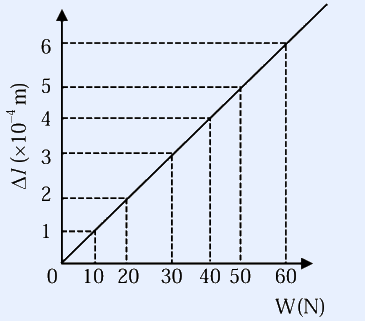
JEE Main 2026 April 06, Shift 2 Question Paper with Solutions
All 74 questions from the JEE Main 2026 (April 06, Shift 2) shift — Physics (24), Chemistry (25) and Mathematics (25) — each with the correct answer (answer key) and a step-by-step solution. Read it free online, or attempt the full paper as a timed mock test.
Physics24 questions
Q26Single correctUnits and Measurements
The percentage error in the calculated volume of a sphere, if there is % error in its diameter measurement, is _____ .
(1)
(2)
(3)
(4)
SolutionAnswer: Option 3
Approach:
Volume of a sphere is proportional to the cube of its diameter, so the percentage error in volume is three times the percentage error in diameter.
Step 1:Given: percentage error in diameter is %. Target: percentage error in the calculated volume of the sphere.
Step 2:Express volume in terms of diameter so the power of is explicit.
Step 3:Apply the error propagation rule for a quantity raised to the power three.
Step 4:Substitute the diameter percentage error of %.
Final answer:
Q27Single correctUnits and Measurements
Match List - I with List - II.
| List - I | List - II |
|---|---|
| A. Boltzmann constant | I. |
| B. Stefan's constant | II. |
| C. Planck's constant | III. |
| D. Gravitational constant | IV. |
(1)
(2)
(3)
(4)
SolutionAnswer: Option 3A-III, B-IV, C-II, D-I
Approach:
Derive the dimensional formula of each constant from a characteristic physical relation and match it to the unique entry in List - II.
Step 1:Target: assign each List-I constant a dimensional formula from List-I. Boltzmann constant equals energy per unit temperature.
Step 2:Stefan's constant from the Stefan-Boltzmann law: power per unit area divided by temperature to the fourth power.
Step 3:Planck's constant equals energy divided by frequency.
Step 4:Gravitational constant from Newton's law of gravitation.
Final answer: A-III, B-IV, C-II, D-I
Q28Single correctRotational Motion
A solid sphere (A) of mass and a spherical shell (B) of mass m, both having same radius, are placed on a rough surface. When a force of same magnitude is applied tangentially at the highest points of A and B, they start rolling without slipping with an acceleration of and , respectively. The ratio of and is _____ .
(1)
(2)
(3)
(4)
SolutionAnswer: Option 1
Approach:
For a body rolling without slipping under a force applied at the top point, combine Newton's second law for translation with the torque equation about the centre to obtain the linear acceleration, then form the ratio for the two bodies.
Step 1:Given: equal force F applied at the top of each body; solid sphere A has mass , spherical shell B has mass m, equal radii, rolling without slipping. Target: ratio . Set up translation with friction f at the contact and torque about the centre; rolling gives .
Step 2:Eliminate f: the torque equation gives . Adding to the translation equation yields .
Step 3:Solid sphere A: , so .
Step 4:Spherical shell B: , so .
Step 5:Form the ratio of the two accelerations.
Final answer:
Q29Single correctWork, Energy and Power
A body of mass kg moves along a straight line with a velocity . The work done by the body during displacement from to m is ___ J.
(1)
(2)
(3)
(4)
SolutionAnswer: Option 3
Approach:
By the work-energy theorem the net work equals the change in kinetic energy between the initial and final positions, using the position-dependent speed.
Step 1:Given: mass kg, speed , displacement from to m. Target: work done.
Step 2:Evaluate the speed at the initial position .
Step 3:Evaluate the speed at the final position m.
Step 4:Apply the work-energy theorem.
Final answer:
Q30Single correctThermodynamics
A cylinder with adiabatic walls is closed at both ends and is divided into two compartments by a frictionless adiabatic piston. Ideal gas is filled in both (left and right) the compartments at same P, V, T. Heating is started from left side until pressure changes to . If initial volume of each compartment was litres then the final volume in right-hand side compartment is _____ litres. (for this ideal gas )
(1)
(2)
(3)
(4)
SolutionAnswer: Option 2
Approach:
The right compartment is bounded by adiabatic walls and an adiabatic piston, so as the rising common pressure compresses it the process is adiabatic; apply between its initial and final states.
Step 1:Given: right gas initial state , final pressure (equal on both sides at mechanical equilibrium), . Target: final right-side volume .
Step 2:Apply the adiabatic relation between initial and final states of the right gas.
Step 3:Evaluate and simplify.
Step 4:Solve for by raising both sides to the power .
Final answer:
Q31Single correctElectromagnetic Waves
For an electromagnetic wave propagating through vacuum, and represent propagation vector, electric field and angular frequency, respectively. The magnetic field associated with this wave is represented by :
(1)
(2)
(3)
(4)
SolutionAnswer: Option 2
Approach:
For a plane electromagnetic wave the magnetic field is perpendicular to both and , the triad is right-handed, and ; express this using and .
Step 1:Given: propagation vector , electric field , angular frequency , vacuum propagation. Target: expression for .
Step 2:Write the standard EM-wave relation: points along with magnitude .
Step 3:Replace the unit vector and the speed .
Step 4:Compare with the listed options.
Final answer:
Q32Single correctKinematics
Two identical bodies A and B of equal masses have initial velocities and respectively. The body A has acceleration while the acceleration of the other body B is zero. The centre of mass of the two bodies moves in ____ path.
(1)
(2)
(3)
(4)
SolutionAnswer: Option 3straight line
Approach:
Compute the velocity and acceleration of the centre of mass; if the centre-of-mass acceleration is parallel to its velocity, the motion has no transverse component and the path is a straight line.
Step 1:Given: equal masses; , , , . Target: shape of the centre-of-mass path.
Step 2:Compute the initial velocity of the centre of mass.
Step 3:Compute the acceleration of the centre of mass.
Step 4:Both and lie along , so they are parallel; with acceleration parallel to velocity the motion is rectilinear.
Final answer: straight line
Q33Single correctProperties of Solids and Liquids
Figure represents the extension () of a wire of length 1 meter, suspended from the ceiling of the room at one end with a load W connected to the other end. If the cross-sectional area of the wire is then the Young's modulus of the wire is ______ .
(1)
(2)
(3)
(4)
SolutionAnswer: Option 3
Approach:
Young's modulus equals stress over strain, . The load-extension graph is linear, so the constant slope is read from a clear grid point and combined with the given length and area.
Step 1:Known quantities: wire length , cross-sectional area , applied force , and extension read from the graph.
Step 2:Read the linear graph at the end grid point: at load the extension is . Compute the slope of the load-extension line.
Step 3:Substitute the slope, length and area into the Young's modulus expression, since .
Step 4:Evaluate the product to obtain Young's modulus.
Final answer:
Q34Single correctProperties of Solids and Liquids
A cylindrical vessel of 40 cm radius is completely filled with water and its capacity is 528 d (dm : decimeter) The vessel is placed on a solid block of exactly same height as vessel. If a small hole is made at 70 cm below the top of water level, then horizontal range of water falling on the ground in the beginning is ______ cm.
(1)
(2)
(3)
(4)
SolutionAnswer: Option 2
Approach:
Torricelli's theorem gives the efflux speed from the depth of the hole below the surface. The jet then undergoes horizontal projectile motion, falling the vertical height from the hole to the ground. The vessel height needed for that height is obtained from the cylinder volume.
Step 1:Set up the geometry. Volume , radius , depth of hole below the surface .
Step 2:Find the vessel height from the cylinder volume.
Step 3:Locate the hole above the ground. The hole is below the top, i.e. above the vessel base. The vessel rests on a block of equal height , so the hole is above the ground.
Step 4:Combine efflux speed and fall time into the range and substitute.
Final answer:
Q35Single correctKinetic Theory of Gases
If 2 mole of an ideal monoatomic gas at temperature , is mixed with 6 mole of another ideal monoatomic gas at temperature then the temperature of mixture is :
(1)
(2)
(3)
(4)
SolutionAnswer: Option 4
Approach:
When two samples of the same monoatomic gas mix without heat loss, total internal energy is conserved. Since with the same , the common cancels and the mixture temperature is the mole-weighted mean of the two temperatures.
Step 1:Given data: mol at and mol at , both monoatomic with the same .
Step 2:Apply conservation of internal energy; the common cancels.
Step 3:Substitute the values.
Step 4:Simplify the fraction.
Final answer:
Q36Single correctOscillations and Waves
A spring stretches by 2 mm when it is loaded with a mass of 200 g . From equilibrium position the mass is further pulled down by 2 mm and released. The frequency associated with the system and maxmimum energy in the spring are ______ Hz and ______ J, respectively. (Take g = 10 m/)
(1)
(2)
(3)
(4)
SolutionAnswer: Option 1 and
Approach:
The static extension under the load gives the spring constant. The oscillation frequency follows from and . The maximum elastic energy stored in the spring occurs at the lowest point, where the total stretch is the static extension plus the pull-down amplitude.
Step 1:Given data: , static extension , pull-down amplitude , .
Step 2:Compute the spring constant from the static equilibrium .
Step 3:Compute the oscillation frequency.
Step 4:Maximum energy stored in the spring occurs at the lowest point, where the total elongation is .
Final answer: Hz and J
Q37Single correctElectrostatics
The electric potential as a function of x, y is given by V. The electric field at a point (2,3) m is ______ V/m.
(1)
(2)
(3)
(4)
SolutionAnswer: Option 1
Approach:
The electric field is the negative gradient of the potential. Take the partial derivatives of V with respect to x and y, form , and evaluate at the given point.
Step 1:Set up the potential field and target point: V, evaluated at .
Step 2:Compute the partial derivatives of .
Step 3:Form the field as the negative gradient.
Step 4:Evaluate at .
Final answer: V/m
Q38Single correctMagnetic Effects of Current and Magnetism
A current of 30 A each flows in opposite directions in two conducting wires, placed parallel to each other at a distance of 8 cm. The magnetic field at the mid point between the two wires is ______ T.
(1)
(2)
(3)
(4)
SolutionAnswer: Option 2300
Approach:
Each long straight wire produces a field at the midpoint. Because the currents are antiparallel, the two field vectors at the midpoint point the same way and add, so the total is twice the single-wire field.
Step 1:Given data: separation , so midpoint distance ; current ; .
Step 2:Compute the field from one wire at the midpoint.
Step 3:For antiparallel currents the two midpoint fields are codirectional, so they add.
Step 4:Convert to microtesla.
Final answer:
Q39Single correctElectromagnetic Induction and Alternating Currents
A square loop of side 2 cm is placed in a time varying magnetic field with magnitude as Tesla. The normal to the plane of loop makes an angle of with the field. The maximum induced emf produced in the loop is ______ mV.
(1)
(2)
(3)
(4)
SolutionAnswer: Option 424
Approach:
Express the magnetic flux through the loop including the angle between the normal and the field, differentiate with respect to time to obtain the induced emf, and read off its amplitude.
Step 1:Set up the loop area for side 2 cm = 0.02 m.
Step 2:Write the flux using and the angle between the normal and the field.
Step 3:Differentiate the flux to obtain the induced emf.
Step 4:Identify the amplitude of the cosine term as the maximum emf.
Final answer: 24 mV
Q40Single correctElectrostatics
A sphere of capacitance 100 pF is charged to a potential of 100 V. Another identical uncharged metal sphere is brought in contact with the charged sphere, then the change in the total energy stored on these spheres, when they touch is J. The value of is ______. (combined capacitance of spheres is 200 pF)
(1)
(2)
(3)
(4)
SolutionAnswer: Option 2
Approach:
Find the initial energy on the charged sphere, then apply charge conservation on the combined 200 pF capacitance after contact, and take the magnitude of the energy change.
Step 1:Set up the initial charge on the first sphere.
Step 2:Compute the initial stored energy.
Step 3:After contact the same charge Q resides on the combined 200 pF capacitance.
Step 4:Take the magnitude of the change in total energy and read off .
Final answer: 5/2
Q41Single correctAtoms and Nuclei
The energy released if hydrogen atoms are combined to form is ____ MeV. (Take binding energies per nucleon of and as 1.1 MeV and 7.2 MeV, respectively)
(1)
(2)
(3)
(4)
SolutionAnswer: Option 224.4
Approach:
Two deuterium nuclei (2 nucleons each) fuse into helium-4. The energy released equals the total binding energy of the product minus the total binding energy of the reactants.
Step 1:Write the fusion reaction supplying the 4 nucleons of He-4 from two deuterons.
Step 2:Compute the total binding energy of the two deuterons.
Step 3:Compute the total binding energy of the He-4 product.
Step 4:Subtract to obtain the energy released.
Final answer: 24.4 MeV
Q42Single correctOptics
Angle of minimum deviation is equal to the half of the angle of prism in an equilateral prism. The refractive index of the prism is ______.
(1)
(2)
(3)
(4)
SolutionAnswer: Option 3
Approach:
Apply the prism formula relating refractive index to the angle of prism A and the angle of minimum deviation, with and .
Step 1:State the angles: equilateral prism gives and .
Step 2:Substitute the angles into the prism formula.
Step 3:Evaluate the trigonometric values.
Step 4:Confirm the numerical value of the refractive index.
Final answer:
Q43Single correctElectronic Devices
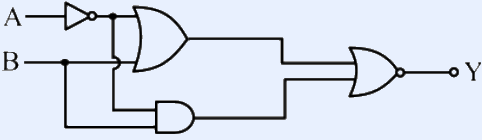
Refer to the logic circuit given below. For two inputs (, ) and (, ), output (Y) will .
(1)
(2)
(3)
(4)
SolutionAnswer: Option 30, 0
Approach:
Trace each gate from the inputs: A passes through a NOT gate to give its complement, which together with B feeds a top OR gate and a bottom AND gate, whose outputs feed a final NOR gate. Form the Boolean expression for Y and evaluate it for both input pairs.
Step 1:Input A passes through the NOT gate to give its complement, which branches to both the top OR gate and the bottom AND gate; input B also feeds both gates.
Step 2:The top OR gate takes inputs and B.
Step 3:The bottom AND gate takes inputs and B.
Step 4:The final NOR gate combines and . Since is absorbed into , the output reduces to .
Step 5:Evaluate for , : , so , , and .
Step 6:Evaluate for , : , so , , and .
Final answer: 0, 0 respectively
Q44Single correctLaws of Motion
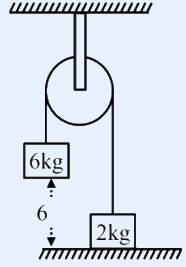
The velocity at which 6 kg mass (shown in figure) strikes the ground when it is released from a height of 6 m above the ground is ____ m/s. Assume pulley is massless and string is light and inextensible. (Take )
(1)
(2)
(3)
(4)
SolutionAnswer: Option 17.74
Approach:
Model the two blocks over a massless pulley as an Atwood machine. Determine the system acceleration, then apply kinematics to the 6 kg block falling 6 m to find its impact speed.
Step 1:Set up the system with kg falling and kg rising, and compute the acceleration.
Step 2:The 6 kg block starts from rest and accelerates downward through h = 6 m.
Step 3:Take the square root to obtain the impact speed.
Step 4:State the impact velocity of the 6 kg mass.
Final answer: 7.74 m/s
Q46NumericalLaws of Motion
A block takes t time to slide down a plane inclined at to the horizontal. If the surface is made smooth (frictionless), the block takes time to slide down the plane. The coefficient of friction between the block and the inclined plane is . The value of is _____.
SolutionAnswer: 75
Approach:
The block starts from rest in both cases and covers the same distance down the incline. The rough-surface acceleration is and the smooth-surface acceleration is . Equating the distances relates the accelerations through the given times, then solve for .
Step 1:Set up the situation: same distance s is travelled from rest in time t (rough) and time (smooth). Equate distances: .
Step 2:Substitute the two accelerations with , where .
Step 3:Rearrange to isolate : , giving .
Step 4:Since , obtain .
Final answer: 75
Q47NumericalDual Nature of Matter and Radiation
The de Broglie wavelength for an electron accelerated through the potential difference of volt is . When the potential difference is changed to volt, the associated de Broglie wavelength is increased by 50%. If , then the value of is _______.
SolutionAnswer: 4
Approach:
The de Broglie wavelength of an electron accelerated through potential V obeys , so . Apply the 50% increase in wavelength to obtain the ratio of potentials.
Step 1:Set up the proportionality , which gives the ratio .
Step 2:A 50% increase in wavelength means , so the wavelength ratio is .
Step 3:Square both sides to obtain the potential ratio.
Step 4:Compare with to obtain the value of .
Final answer: 4
Q48NumericalMagnetic Effects of Current and Magnetism
A moving coil galvanometer when shunted with resistance gives a full scale deflection for a current of 500 mA. When a resistance of is connected in series it gives a full scale deflection for 10 V potential applied on it. The value of resistance of galvanometer coil is _____ .
SolutionAnswer: 50
Approach:
Full-scale deflection corresponds to a fixed galvanometer current . Express from the series (voltmeter) case and from the shunted (ammeter) case, equate, and solve for the coil resistance G.
Step 1:Set up the series case: full-scale current .
Step 2:For the shunted case the line current is A and shunt . The galvanometer current satisfies .
Step 3:Substitute into .
Step 4:Solve the linear equation for .
Final answer: 50
Q49NumericalCurrent Electricity
Two cells of emfs 1 V and 2 V and internal resistance and , respectively connected in parallel, gave a current of 1 A through an external resistance. If the polarity of one cell is reversed, then value of current through the external resistance will be A. The value of is _____.
SolutionAnswer: 3
Approach:
Replace the two parallel cells by a single equivalent emf and internal resistance. Determine the external resistance from the given 1 A current, then recompute the current after reversing one cell's polarity.
Step 1:Set up the equivalent source with : V and .
Step 2:Apply the given current A to find R: .
Step 3:Reverse the polarity of the 1 V cell so V; the internal resistances are unchanged: V.
Step 4:Compute the new current and compare with .
Final answer: 3
Q50NumericalOptics
A concave mirror of focal length 10 cm forms an image which is double the size of object when the object is placed at two different positions. The distance between the two positions of the object is _____ cm.
SolutionAnswer: 10
Approach:
A magnitude-2 magnification arises in two distinct cases for a concave mirror: a real inverted image () and a virtual erect image (). Find the object distance in each case and take the difference.
Step 1:Set up Case 1 (real image): . Apply the mirror formula with cm: , so .
Step 2:Case 2 (virtual image): . Mirror formula: , so .
Step 3:The two object positions lie at 15 cm and 5 cm from the mirror.
Step 4:Compute the separation between the two object positions.
Final answer: 10
Chemistry25 questions
Q51Single correctSome Basic Concepts in Chemistry
Which of the following contain the same number of atoms? (Given : Molar mass in of H, He, O and S are 1, 4, 16 and 32 respectively) A. 2 g of gas; B. 4 g of gas; C. 1400 mL of at STP; D. of He at STP; E. 0.0625 mol of gas. Choose the correct answer from the options given below :
(1)
(2)
(3)
(4)
SolutionAnswer: Option 4A, C and E only
Approach:
For each sample find the number of moles, multiply by the number of atoms per molecule to get total atoms (in units of ), and compare. STP molar volume is taken as 22400 mL/mol.
Step 1:A: 2 g mol; each molecule has 2 atoms, so atoms .
Step 2:B: 4 g mol with 3 atoms per molecule gives . C: 1400 mL at STP mol with 2 atoms gives .
Step 3:D: 0.05 L mL He at STP mol, monatomic, giving . E: 0.0625 mol atoms.
Step 4:A, C and E each contain atoms, so these three samples have the same number of atoms.
Final answer: A, C and E only
Q52Single correctAtomic Structure
The Bohr radius of a hydrogen like species is 70.53 pm. The species and the stationary state () are respectively (Given : Hydrogen atom Bohr radius is 52.9 pm)
(1)
(2)
(3)
(4)
SolutionAnswer: Option 4
Approach:
The radius of the n-th orbit of a hydrogen-like species is with pm. Determine the required ratio and identify the species and state that satisfy it.
Step 1:Set up the required ratio .
Step 2:For , . Then , giving .
Step 3:Check by direct substitution: .
Step 4:Rule out the alternatives: gives pm, far from 70.53 pm. Compute the species and state.
Final answer:
Q53Single correctChemical Bonding and Molecular Structure
Given below are two statements :
Statement I : The number of compounds among and in which sulphur does not obey the Octet rule is 3.
Statement II : Among , , and , the number of sets in which all the molecules have one lone pair of electrons on the central atom is 1.
In the light of the above statements, choose the correct answer from the options given below :
Statement I : The number of compounds among and in which sulphur does not obey the Octet rule is 3.
Statement II : Among , , and , the number of sets in which all the molecules have one lone pair of electrons on the central atom is 1.
In the light of the above statements, choose the correct answer from the options given below :
(1)
(2)
(3)
(4)
SolutionAnswer: Option 4Statement I is false but Statement II is true
Approach:
Determine which sulphur species exceed the octet, then count central-atom lone pairs for each set to evaluate both statements.
Step 1:Statement I asks how many of SO2, SO3, SF4, SF6, H2S have sulphur not obeying the octet rule. Statement II asks how many of the four sets have every molecule possessing exactly one central-atom lone pair.
Step 2:Electron count around sulphur: SO2 has 10 electrons, SO3 has 12, SF4 has 10, SF6 has 12 (all expanded valence shell); H2S has 8 electrons (obeys octet). Thus 4 compounds violate the octet rule.
Step 3:Central-atom lone pairs: H2O has 2, ClF3 has 2, SF4 has 1, NH3 has 1, BrF5 has 1, XeF4 has 2. Evaluate each set for all molecules having exactly one lone pair.
Step 4:Set [H2O, ClF3, SF4] gives (2,2,1) - fails. Set [NH3, BrF5, SF4] gives (1,1,1) - all one lone pair. Set [BrF5, ClF3, XeF4] gives (1,2,2) - fails. Set [XeF4, ClF3, H2O] gives (2,2,2) - fails. Exactly one set qualifies, so Statement II is true.
Step 5:Statement I is false and Statement II is true.
Final answer: Statement I is false but Statement II is true
Q54Single correctChemical Thermodynamics
Match List - I with List - II. Given and are initial and final volumes respectively. Choose the correct answer from the options given below :
| List - I (Isothermal process) | List - II (Expression) |
|---|---|
| A. Reversible expansion | I. |
| B. Free expansion | II. |
| C. Irreversible Compression | III. |
| D. Cyclic reversible | IV. |
(1)
(2)
(3)
(4)
SolutionAnswer: Option 3A-II, B-I, C-III, D-IV
Approach:
Apply the isothermal first-law result for each process type and match it to its characteristic expression.
Step 1:Each List-I process is an isothermal change; identify the heat or work expression that uniquely characterises it from List-II.
Step 2:A Reversible expansion: for an isothermal reversible expansion the heat absorbed equals , which is expression II.
Step 3:B Free expansion: expansion into vacuum does zero work and for an ideal gas the temperature is unchanged, so q = 0, which is expression I.
Step 4:C Irreversible compression: work done against constant external pressure is as written with final , matching expression III. D Cyclic reversible process: the state returns to start so the reversible-heat integral gives , matching expression IV.
Step 5:Collecting the pairings gives A-II, B-I, C-III, D-IV.
Final answer: A-II, B-I, C-III, D-IV
Q55Single correctSolutions
Given below are two statements :
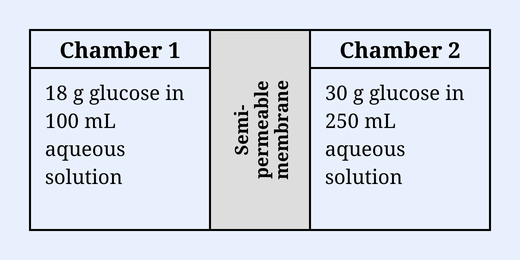
Statement I: molecules move from the chamber 1 to chamber 2.
Statement II: The osmotic pressure of a solution prepared by dissolving 50 mg of potassium sulphate (molar mass = 174 g/mol) in 2 L of water (at C) is 0.0107 bar. (Given : bar and assume complete dissociation of electrolyte).
In the light of the above statements, choose the correct answer from the options given below :
Statement I: molecules move from the chamber 1 to chamber 2.
Statement II: The osmotic pressure of a solution prepared by dissolving 50 mg of potassium sulphate (molar mass = 174 g/mol) in 2 L of water (at C) is 0.0107 bar. (Given : bar and assume complete dissociation of electrolyte).
In the light of the above statements, choose the correct answer from the options given below :
(1)
(2)
(3)
(4)
SolutionAnswer: Option 4Statement I is false but Statement II is true
Approach:
Compare the molar glucose concentrations of the two chambers to fix the direction of solvent flow, then compute the osmotic pressure of the K2SO4 solution.
Step 1:Glucose molar mass is 180 g/mol. Chamber 1: moles = 18/180 = 0.1 mol in 0.100 L gives 1.0 M. Chamber 2: moles = 30/180 = 0.1667 mol in 0.250 L gives 0.667 M.
Step 2:Across a semipermeable membrane water flows from the dilute side to the concentrated side, i.e. from chamber 2 to chamber 1. The claim that water moves from chamber 1 to chamber 2 is therefore wrong.
Step 3:K2SO4: moles = 0.050 g / 174 = 2.874e-4 mol; concentration C = 2.874e-4 / 2 = 1.437e-4 M. Complete dissociation gives van't Hoff factor i = 3.
Step 4:Osmotic pressure pi = i C R T = 3 x 1.437e-4 x 0.083 x 300 K = 0.01073 bar, which rounds to 0.0107 bar.
Step 5:Statement I is false and Statement II is true.
Final answer: Statement I is false but Statement II is true
Q56Single correctEquilibrium
Given is a concentrated solution of a weak electrolyte of concentration 'c' and dissociation constant 'K'. The degree of dissociation is given by :
(1)
(2)
(3)
(4)
SolutionAnswer: Option 2
Approach:
Write the dissociation equilibrium of , express the equilibrium ion concentrations in terms of c and the degree of dissociation, then solve the equilibrium-constant expression for .
Step 1:Set up the system: at concentration c dissociates with degree into x cations and y anions; for a concentrated weak electrolyte is small, so .
Step 2:Equilibrium concentrations: , , and undissociated species .
Step 3:Substitute into .
Step 4:Solve for : , hence .
Step 5:Substituting reduces the result to , the familiar Ostwald form, confirming the expression.
Final answer:
Q57Single correctRedox Reactions and Electrochemistry
For a general redox reaction
Anode :
Cathode :
Which of the following statement is incorrect?
Anode :
Cathode :
Which of the following statement is incorrect?
(1)
(2)
(3)
(4)
SolutionAnswer: Option 4If the reaction is carried out reversibly, the electrical work done is equal to the ratio of charge and potential difference through which charge is moved.
Approach:
Test each statement against the balanced cell reaction, the Nernst equation, and the definition of electrical work to find the false one.
Step 1:Statement 1: multiplying the anode half-reaction by n2 and the cathode half-reaction by n1 balances the electrons (n1 n2 each side) and gives the stated overall reaction. This is correct.
Step 2:Statement 2: because the electrons released at the anode equal those gained at the cathode after balancing, they cancel and do not appear in the overall equation. This is correct.
Step 3:Statement 3: rearranging the Nernst equation gives , so a plot versus is linear with slope proportional to . This is correct.
Step 4:Statement 4: electrical work is the product of charge and potential difference, W = q x deltaV, not their ratio. The statement claims a ratio, which is dimensionally and physically wrong.
Step 5:Only statement 4 is false, so it is the requested incorrect statement.
Final answer: If the reaction is carried out reversibly, the electrical work done is equal to the ratio of charge and potential difference through which charge is moved.
Q58Single correctClassification of Elements and Periodicity in Properties
In a period, the first ionisation enthalpy of the element at extreme left and the negative electron gain enthalpy of the extreme right element, except noble gases, are respectively.
(1)
(2)
(3)
(4)
SolutionAnswer: Option 3lowest and highest
Approach:
Use the across-period trends of first ionisation enthalpy and electron gain enthalpy to characterise the leftmost and rightmost (non-noble-gas) elements.
Step 1:Identify the elements: the extreme left of a period is the group-1 alkali metal, and the extreme right excluding noble gases is the group-17 halogen.
Step 2:First ionisation enthalpy increases left to right, so the alkali metal at the extreme left has the lowest first ionisation enthalpy in the period.
Step 3:Halogens have the most negative electron gain enthalpy, so the extreme-right element (excluding noble gases) has the highest negative electron gain enthalpy.
Step 4:Combining the two, the species has the lowest first ionisation enthalpy and the highest negative electron gain enthalpy.
Final answer: lowest and highest
Q59Single correctp-Block Elements
Given below are two statements :
Statement I: is the correct trend in terms of bond angle.
Statement II: and are ionic in nature.
In the light of the above statements, choose the correct answer from the options given below :
Statement I: is the correct trend in terms of bond angle.
Statement II: and are ionic in nature.
In the light of the above statements, choose the correct answer from the options given below :
(1)
(2)
(3)
(4)
SolutionAnswer: Option 3Statement I is true but Statement II is false
Approach:
Compare the central-oxygen bond angles of the three oxides and assess the bonding character of the group-14 tetrafluorides.
Step 1:Statement I concerns bond-angle ordering of F2O, H2O, Cl2O. Statement II concerns whether SiF4, SnF4 and PbF4 are all ionic.
Step 2:Bond angles: is about , is , is about . In the highly electronegative F atoms draw bonding pairs away from O, contracting the angle; in the large, less electronegative Cl atoms create bond-pair repulsion that widens it. The ordering is therefore correct.
Step 3:For the tetrafluorides, is a covalent molecular compound (high charge, small gives strong covalent character per Fajans' rules). Although and have appreciable ionic character, is not ionic, so the blanket statement that all three are ionic is false.
Step 4:Statement I is true and Statement II is false.
Final answer: Statement I is true but Statement II is false
Q60Single correctd- and f-Block Elements
The correct order of first and second ionisation enthalpy values of Cr and Mn are :
A.
B.
C.
D.
Choose the correct answer from the options given below :
A.
B.
C.
D.
Choose the correct answer from the options given below :
(1)
(2)
(3)
(4)
SolutionAnswer: Option 2B and C only
Approach:
Compare first and second ionisation enthalpies of Cr () and Mn () using their electronic configurations and the stability of half-filled .
Step 1:State the neutral configurations: Cr is and Mn is . First ionisation enthalpy depends on how strongly the outermost electron is held.
Step 2:For first ionisation, Cr loses its single electron forming the stable ion, which releases that electron readily, giving Cr a lower . Mn must ionise from a filled with higher effective nuclear charge, so . Statement C is correct and A is incorrect.
Step 3:After first ionisation (stable half-filled) and . The second electron from comes from the stable set and needs high energy, while loses its loosely bound electron easily, so . Statement B is correct and D is incorrect.
Step 4:The valid statements are B and C, matching experimental values : Mn (717) > Cr (653) and : Cr (1592) > Mn (1509) kJ mo.
Final answer: B and C only
Q61Single correctCoordination Compounds
Which of the following sequences of hybridisation, geometry and magnetic nature are correct for the given coordination compounds ?
A. , tetrahedral, paramagnetic
B. , octahedral, paramagnetic
C. , tetrahedral, paramagnetic
D. , square planar, diamagnetic
Choose the correct answer from the options given below :
A. , tetrahedral, paramagnetic
B. , octahedral, paramagnetic
C. , tetrahedral, paramagnetic
D. , square planar, diamagnetic
Choose the correct answer from the options given below :
(1)
(2)
(3)
(4)
SolutionAnswer: Option 4A, B and D only
Approach:
Evaluate hybridisation, geometry and magnetic nature of each Ni complex using valence bond theory and the field strength of the ligands.
Step 1:Assign oxidation states and d-electron counts: in A, B and D nickel is ; in C nickel is .
Step 2:A: with weak-field uses , tetrahedral, with 2 unpaired electrons, paramagnetic. B: uses , octahedral, with 2 unpaired electrons, paramagnetic. Both labels are correct.
Step 3:C: has fully paired, , tetrahedral and diamagnetic; the label 'paramagnetic' is incorrect. D: with strong-field pairs the electrons, giving , square planar, diamagnetic, which is correct.
Step 4:The correct sequences are A, B and D only.
Final answer: A, B and D only
Q62Single correctPurification and Characterisation of Organic Compounds
Given below are two statements :
Statement I: A mixture of (sugar) and NaCl can be separated by dissolving sugar in alcohol, due to differential solubility.
Statement II: Rose essence from rose petals is seperated by steam distillation due to its high volatility and insolubility in .
In the light of the above statements, choose the correct answer from the options given below :
Statement I: A mixture of (sugar) and NaCl can be separated by dissolving sugar in alcohol, due to differential solubility.
Statement II: Rose essence from rose petals is seperated by steam distillation due to its high volatility and insolubility in .
In the light of the above statements, choose the correct answer from the options given below :
(1)
(2)
(3)
(4)
SolutionAnswer: Option 1Both Statement I and Statement II are true
Approach:
Assess each statement against the principles of differential solubility and steam distillation.
Step 1:Set up the separation criteria: differential solubility separates two solids when one dissolves in a chosen solvent and the other does not; steam distillation separates a volatile, water-immiscible compound by co-distilling it with steam.
Step 2:Statement I: Sugar is soluble in alcohol whereas NaCl is essentially insoluble in alcohol. Treating the mixture with alcohol dissolves only the sugar, allowing separation by filtration, so the statement is true.
Step 3:Statement II: Rose essence (essential oil) is volatile in steam and immiscible with water, the exact requirement for steam distillation, so the statement is true.
Step 4:Both statements correctly describe valid separation techniques.
Final answer: Both Statement I and Statement II are true
Q63Single correctSome Basic Principles of Organic Chemistry
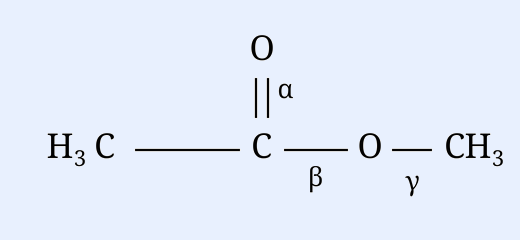
Shown below is the structure of methyl acetate with three different and carbon - oxygen bonds. The correct order of bond lengths of these bonds is :
(1)
(2)
(3)
(4)
SolutionAnswer: Option 2
Approach:
Rank the three C-O bonds in methyl acetate by bond order, using the inverse relation between bond order and bond length and the partial double-bond character introduced by resonance.
Step 1:Identify the three bonds from the structure : is the carbonyl , is the carbonyl-carbon to ester-oxygen , and is the ester-oxygen to methyl bond.
Step 2:The bond is a double bond (bond order ), giving it the highest bond order and therefore the shortest length.
Step 3:Resonance of the lone pair on the ester oxygen into the carbonyl gives the bond partial double-bond character (bond order between 1 and 2), making it shorter than a pure single bond. The bond () has no double-bond character (bond order 1) and is the longest.
Step 4:Increasing bond length follows the decreasing bond order, giving .
Final answer:
Q64Single correctOrganic Compounds Containing Oxygen
'' is the product which is obtained by the hydrolysis of prop-1-yne in the presence of mercuric sulphate under dilute acidic medium at 333 K. '' is the product which is obtained by the reaction of ethane nitrile with methyl magnesium bromide in dry ether followed by hydrolysis. IUPAC name of product obtained from '' and '' in the presence of barium hydroxide followed by heating is :
(1)
(2)
(3)
(4)
SolutionAnswer: Option 24 - Methylpent-3-en-2-one
Approach:
Identify x and y, then carry out the aldol condensation between them in presence of barium hydroxide followed by dehydration on heating to obtain the -unsaturated ketone, and name it.
Step 1:Identify x: Markovnikov hydration of prop-1-yne with in dilute acid at 333 K adds water across the triple bond and tautomerises to give acetone.
Step 2:Identify y: ethane nitrile adds to form a ketimine magnesium salt, which on acidic hydrolysis gives acetone.
Step 3:x and y are both acetone. With , the -carbon of one acetone adds to the carbonyl of the other (aldol), and heating eliminates water to give the -unsaturated ketone mesityl oxide .
Step 4:Numbering the five-carbon chain from the carbonyl end gives a ketone at C-2, a double bond at C-3 and a methyl branch at C-4, so the IUPAC name is 4-methylpent-3-en-2-one.
Final answer: 4 - Methylpent-3-en-2-one
Q65Single correctOrganic Compounds Containing Halogens
An optically active alkyl bromide , reacts with ethanolic KOH to form major compound [A] which reacts with bromine to give compound [B]. Compound [B] reacts with ethanolic KOH and sodamide to give compound [C]. One molecule of water adds to compound [C] on warming with mercuric sulphate and dilute sulphuric acid at 333 K to form compound [D]. The functional group in compound D will be confirmed by :
(1)
(2)
(3)
(4)
SolutionAnswer: Option 1Haloform test
Approach:
Track the sequence of transformations from the optically active 2-bromobutane to identify compound D and the test that confirms its functional group.
Step 1:Optically active is 2-bromobutane. With ethanolic KOH it undergoes dehydrohalogenation to give but-2-ene [A] (major, Saytzeff).
Step 2:But-2-ene adds bromine to give 2,3-dibromobutane [B].
Step 3:Double dehydrohalogenation with ethanolic KOH and sodamide gives but-2-yne [C].
Step 4:Hydration of but-2-yne with at 333 K gives butan-2-one [D], a methyl ketone, confirmed by the haloform (iodoform) test.
Final answer: Haloform test
Q66Single correctOrganic Compounds Containing Oxygen
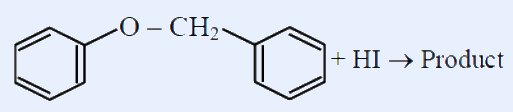
Consider the following reaction.
Statement I: In the above reaction, product formed will be a mixture of benzyl alcohol and iodobenzene.
Statement II: In the above reaction, the bond is cleaved to give the product.
In the light of the above statements, choose the correct answer from the options given below :
Statement I: In the above reaction, product formed will be a mixture of benzyl alcohol and iodobenzene.
Statement II: In the above reaction, the bond is cleaved to give the product.
In the light of the above statements, choose the correct answer from the options given below :
(1)
(2)
(3)
(4)
SolutionAnswer: Option 4Statement I is false but Statement II is true
Approach:
Apply the mechanism of ether cleavage by HI for an aryl-alkyl (benzyl phenyl) ether.
Step 1:In benzyl phenyl ether, the C-O bond on the side that forms the more stable carbocation (benzyl) breaks; the benzyl group leaves as benzyl iodide and phenol is retained because the C(aryl)-O bond is not cleaved by iodide.
Step 2:The bond cleaved is the alkyl side bond, so Statement II is true.
Step 3:The claimed products (benzyl alcohol + iodobenzene) require cleavage of the aryl-O bond, which does not occur; therefore Statement I is false.
Final answer: Statement I is false but Statement II is true
Q67Single correctOrganic Compounds Containing Nitrogen
(1)
(2)
(3)
(4)
SolutionAnswer: Option 1Benzene
Approach:
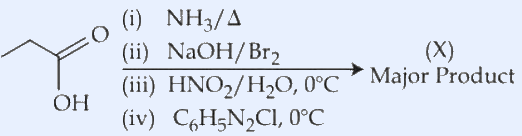
Follow propanoic acid through amide formation, Hofmann bromamide degradation, diazotization, and coupling/decomposition.
Step 1:Propanoic acid with gives propanamide.
Step 2:Hofmann bromamide degradation with removes one carbon, giving ethylamine.
Step 3:Reaction of the aliphatic primary amine with at gives an unstable diazonium salt that loses to give ethanol.
Step 4:Benzene diazonium chloride with a reducing/active-hydrogen species undergoes loss of (replacement of diazonium by H), giving benzene as the major product.
Final answer: Benzene
Q68Single correctOrganic Compounds Containing Nitrogen
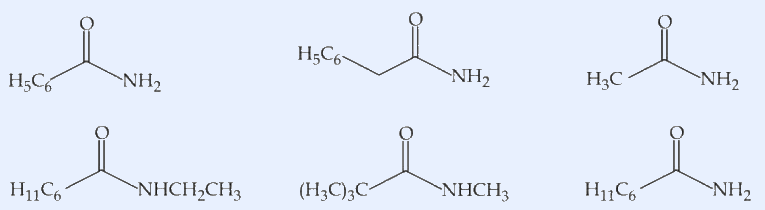
The number of compounds from the following which can undergo reaction with (alcoholic) to give respective products and these respective products can also be obtained separately by Gabriel phthalimide reaction is :
(1)
(2)
(3)
(4)
SolutionAnswer: Option 33
Approach:
Identify which amides give Hofmann degradation to primary amines that could also be made by Gabriel synthesis (i.e. aliphatic primary amines without aryl-N or substituted amides).
Step 1:Only primary unsubstituted amides () undergo Hofmann bromamide degradation to primary amines. The N-substituted amides ( and ) are excluded.
Step 2:Of these, the Hofmann product must be an aliphatic primary amine to also be obtainable by Gabriel synthesis. Benzamide gives aniline (aryl amine) which cannot be made by Gabriel, so it is excluded.
Step 3:The remaining give aliphatic/benzylic primary amines obtainable by Gabriel: phenylacetamide gives benzylamine, acetamide gives methylamine, cyclohexanecarboxamide gives cyclohexylamine.
Final answer: 3
Q69Single correctBiomolecules
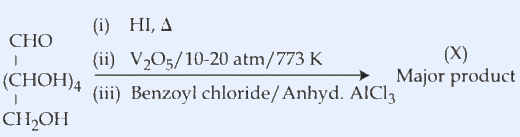
Consider the following reactions. Total number of electrons in the bonds and lone pair of electrons in the product (X) is :
(1)
(2)
(3)
(4)
SolutionAnswer: Option 418
Approach:
Identify the major product X by following each step of the reaction sequence, then count the total electrons present in bonds plus the electrons in lone pairs of product X.
Step 1:Glucose on prolonged reaction with HI and heat is fully reduced; all the -OH groups and the -CHO group are removed to give the straight-chain alkane n-hexane.
Step 2:n-Hexane undergoes aromatization (cyclisation and dehydrogenation) over V2O5 at high temperature and pressure to give benzene.
Step 3:Benzene undergoes Friedel-Crafts acylation with benzoyl chloride in presence of anhydrous AlCl3 to give diphenyl ketone (benzophenone), the product X.
Step 4:Count the pi bonds in benzophenone: each of the two benzene rings contributes 3 pi bonds and the carbonyl group contributes 1 pi bond, giving 7 pi bonds in total. Electrons in pi bonds = 7 x 2 = 14.
Step 5:Count the lone pairs: only the carbonyl oxygen carries lone pairs, namely 2 lone pairs. Electrons in lone pairs = 2 x 2 = 4.
Step 6:Add the pi-bond electrons and lone-pair electrons to obtain the required total.
Final answer: 18
Q70Single correctp-Block Elements
Treatment of a gas 'X' with a freshly prepared ferrous sulphate solution gives a compound 'Y' as a brown ring. The compounds X and Y are.
(1)
(2)
(3)
(4)
SolutionAnswer: Option 1 and
Approach:
Recall the brown ring test for nitrates and the nature of the brown complex formed.
Step 1:In the brown ring test, nitrate is reduced by in presence of conc. to give nitric oxide () gas, which is gas X.
Step 2:NO combines with freshly prepared ferrous sulphate to form the brown complex (nitrosyl iron sulphate).
Step 3:Thus X is NO and Y is [Fe(NO)]SO4.
Final answer: NO and [Fe(NO)]SO4
Q71NumericalCoordination Compounds
An excess of is added to 100 mL of a 0.05 M solution of tetraaquadichloridochromium (III) chloride. The number of moles of AgCl precipitated will be ______ . (Nearest integer)
SolutionAnswer: 5
Approach:
Identify ionizable chloride ions outside the coordination sphere and compute moles of AgCl.
Step 1:Tetraaquadichloridochromium(III) chloride is . Two chlorides are coordinated (inside sphere) and one chloride is ionizable (outside sphere).
Step 2:Moles of complex = mol.
Step 3:Only the 1 ionizable precipitates as , so moles = .
Final answer: 5
Q72NumericalHydrocarbons
An alkane requires 8 moles of oxygen for complete combustion and on chlorination with , gives only one monochlorinated product (Z). The total number of primary carbon atoms in (Y) is ______.
SolutionAnswer: 4
Approach:
Use the combustion oxygen requirement to find the alkane formula, then use the single-monochloro-product condition to fix its structure and count primary carbons.
Step 1:Set required equal to 8 moles: , so , . The alkane is .
Step 2:Only one monochlorinated product is obtained when all hydrogens are equivalent. Among C5H12 isomers, neopentane (2,2-dimethylpropane) has all 12 H equivalent.
Step 3:Neopentane has 4 terminal CH3 groups, i.e. 4 primary carbons (the central carbon is quaternary).
Final answer: 4
Q73NumericalRedox Reactions and Electrochemistry
500 mL of solution in basic medium when mixed with 500 mL of 1.5 M KI solution, oxidises iodide ions to liberate molecular iodine. This liberated iodine is then titrated with a standard thiosulphate solution in presence of starch till the end point. If 300 mL of thiosulphate was consumed, then the value of x is ______.
SolutionAnswer: 1
Approach:
In basic medium is reduced to (3-electron change); compute liberated, then equate to thiosulphate by the iodine-thiosulphate reaction.
Step 1:Moles of = mol. In basic medium , gaining 3 electrons each, so total electrons = mol.
Step 2:Each loses 1 electron (), so moles of = electrons/2 = mol. (KI is in excess: 0.75 mol available.)
Step 3: reacts with thiosulphate 1:2, so moles of = mol in 300 mL = 0.300 L.
Step 4:Concentration x = 0.30 mol / 0.300 L = 1 M.
Final answer: 1
Q74NumericalEquilibrium
In a closed flask at 600 K, one mole of attains equilibrium as given below : . At equilibrium, was dissociated and the total pressure is 1 atm. The magnitude of (in ) at this temperature is ______. (Nearest Integer) (Given: ; )
SolutionAnswer: 8
Approach:
Compute equilibrium mole fractions and partial pressures from 75% dissociation, find , then use .
Step 1:Start with 1 mol ; 75% dissociates, so 0.75 mol reacts. At equilibrium: = 0.25 mol, = = 1.5 mol. Total = 1.75 mol.
Step 2:Partial pressures (total P = 1 atm): P(X2Y4) = 0.25/1.75 = 1/7; P(XY2) = 1.5/1.75 = 6/7.
Step 3:.
Step 4:. . J kJ. Magnitude kJ/mol.
Final answer: 8
Q75NumericalChemical Kinetics
Decomposition of a hydrocarbon follows the equation . The activation energy of reaction is ______ . (Nearest Integer) Given:
SolutionAnswer: 232
Approach:
Compare the given Arrhenius expression with k = A e^(-Ea/RT) to extract Ea.
Step 1:Compare exponents: -Ea/(RT) = -28000/T, so Ea/R = 28000 K.
Step 2:Solve for : J/mol.
Step 3:Convert to kJ/mol: J = kJ kJ/mol.
Final answer: 232
Mathematics25 questions
Q1Single correctSets, Relations and Functions
Let be defined as . Then f is :
(1)
(2)
(3)
(4)
SolutionAnswer: Option 4neither one-one nor onto
Approach:
Establish the domain via the denominator's sign, then test surjectivity by finding the bounded range using the discriminant and test injectivity from the structure of the rational function.
Step 1:The denominator has discriminant with positive leading coefficient, so it is strictly positive and f is defined for every real x. Target: determine whether f is injective and/or surjective on .
Step 2:Set and clear the denominator: , giving .
Step 3:For a real preimage x the discriminant in x must satisfy . This is a downward inequality that holds only on a bounded interval of y, so the range is a proper bounded subset of and f is not onto.
Step 4:The function has a horizontal asymptote as and attains interior extreme values, so it is non-monotonic; an interior output value is produced by two distinct inputs. Hence f is not injective.
Step 5:Verification by consistency: a bounded range excludes surjectivity and a non-monotonic continuous rational function excludes injectivity, jointly fixing the classification.
Final answer: neither one-one nor onto
Q2Single correctComplex Numbers and Quadratic Equations
Consider the quadratic equation . Let be the minimum value of the product of its roots and be the maximum value of the sum of its roots. Then the sum of the first six terms of the G.P., whose first term is and the common ratio is , is :
(1)
(2)
(3)
(4)
SolutionAnswer: Option 3
Approach:
Substitute , express the product and sum of roots as functions of k, optimise them over , then sum the resulting geometric progression.
Step 1:Let , so with minimum at . The equation is . Target: , .
Step 2:Product of roots and sum of roots .
Step 3:The product k is minimised at , so . The sum is maximised at the smallest , so . The common ratio is .
Step 4:Sum the first six terms: .
Step 5:Verification by substitution: the six terms sum to .
Final answer:
Q3Single correctComplex Numbers and Quadratic Equations
Let . Then is equal to :
(1)
(2)
(3)
(4)
SolutionAnswer: Option 1162
Approach:
Solve the quadratic in by the quadratic formula, convert each root to polar form, then apply De Moivre's theorem to the 8th power and add.
Step 1:Apply the quadratic formula with . The discriminant is .
Step 2:Each root has modulus , hence . Their arguments are for and for .
Step 3:By De Moivre, and . Thus .
Step 4:Add the contributions: .
Step 5:Verification by substitution: , so ; the same holds for .
Final answer: 162
Q4Single correctMatrices and Determinants
The sum of all possible values of , for which the system of equations : , , has a non-trivial solution, is equal to :
(1)
(2)
(3)
(4)
SolutionAnswer: Option 4
Approach:
A homogeneous system has a non-trivial solution exactly when its coefficient determinant vanishes; evaluate the determinant, solve the trigonometric equation, and add all roots in .
Step 1:The coefficient matrix is . Evaluating along the first column gives .
Step 2:Using , the term . Setting gives .
Step 3:Substituting yields , i.e. . Since , either or .
Step 4:In : gives ; gives . Their sum is .
Step 5:Verification by substitution: at , and , giving , confirming the root.
Final answer:
Q5Single correctMatrices and Determinants
Let and . If , then the value of is :
(1)
(2)
(3)
(4)
SolutionAnswer: Option 3149
Approach:
Write with N strictly lower triangular and nilpotent of index 3, so the binomial expansion of terminates after the term.
Step 1:Set . Then and .
Step 2:Therefore , with , so .
Step 3:Read off entries: , , and .
Step 4:Evaluate the requested ratio: .
Step 5:Verification by consistency: since .
Final answer: 149
Q6Single correctSequence and Series
The sum upto 10 terms is equal to:
(1)
(2)
(3)
(4)
SolutionAnswer: Option 3
Approach:
Express the general th term using the sum-of-squares formula, then sum the resulting polynomial in from to using standard summation identities.
Step 1:The nth term is .
Step 2:Sum over to : with and .
Step 3:Combine the numerator: .
Step 4:Simplify: .
Step 5:Verification by substitution: the first three terms , , match , , from the series, confirming the term formula.
Final answer:
Q7Single correctPermutations and Combinations
A building has ground floor and 10 more floors. Nine persons enter in a lift at the ground floor. The lift goes up to the floor. The number of ways, in which any 4 persons exit at a floor and the remaining 5 persons exit at a different floor, if the lift does not stop at the first and the second floors, is equal to :
(1)
(2)
(3)
(4)
SolutionAnswer: Option 37056
Approach:
Count the floors at which the lift can stop, choose which persons form the group of 4, then assign distinct floors to the two groups using the multiplication principle.
Step 1:The lift cannot stop at the 1st or 2nd floor, so the usable floors are 3, 4, 5, 6, 7, 8, 9, 10, giving 8 stopping floors.
Step 2:Choose which 4 of the 9 persons exit together: ; the remaining 5 form the other group automatically.
Step 3:Assign a floor to the group of 4 and a different floor to the group of 5; these are ordered distinct choices: .
Step 4:By the multiplication principle the total count is .
Step 5:Verification by consistency: the two groups are distinguishable (sizes 4 and 5), so floor assignment is ordered, matching ; the product is integral and within range.
Final answer: 7056
Q8Single correctStatistics and Probability
Let the mean and the variance of seven observations , be 8 and 16 respectively. Then the quadratic equation whose roots are and is :
(1)
(2)
(3)
(4)
SolutionAnswer: Option 2
Approach:
Use the mean condition to relate and , the variance condition to fix their values, then construct the quadratic from the transformed roots.
Step 1:Given seven observations with mean 8 and variance 16; unknowns and with . Target: quadratic with roots and .
Step 2:Apply the mean condition.
Step 3:Apply the variance condition to find the sum of squares.
Step 4:Subtract the fixed squares to isolate the unknowns.
Step 5:Use the identity to find the product, then solve for the values.
Step 6:Form the transformed roots and build the quadratic.
Final answer:
Q9Single correctStatistics and Probability
A bag contains 6 blue and 6 green balls. Pairs of balls are drawn without replacement until the bag is empty. The probability that each drawn pair consists of one blue and one green ball is:
(1)
(2)
(3)
(4)
SolutionAnswer: Option 3
Approach:
Count the total number of ways to partition the 12 balls into 6 unordered pairs and the number of those partitions in which every pair has one blue and one green ball.
Step 1:Treat the 12 balls as distinct; the process partitions them into 6 unordered pairs. Target: probability each pair is one blue and one green.
Step 2:Total number of ways to split 12 distinct balls into 6 unordered pairs.
Step 3:Favourable count: pairing each blue ball with a distinct green ball is a bijection of the 6 blue onto the 6 green balls.
Step 4:Form the probability and simplify.
Final answer:
Q10Single correctCo-ordinate Geometry
Let C be a circle having centre in the first quadrant and touching the x-axis at a distance of 3 units from the origin. If the circle C has an intercept of length on y-axis, then the length of the chord of the circle C on the line is :
(1)
(2)
(3)
(4)
SolutionAnswer: Option 3
Approach:
Determine the circle from its tangency to the x-axis and the given y-axis intercept length, then compute the chord on the given line using the perpendicular distance from the centre.
Step 1:The circle touches the x-axis at distance 3 from the origin with centre in the first quadrant, so the centre is and the radius equals .
Step 2:Apply the y-axis intercept condition with the centre x-coordinate equal to 3.
Step 3:Compute the perpendicular distance from the centre to the line .
Step 4:Apply the chord-length formula.
Final answer:
Q11Single correctCo-ordinate Geometry
The eccentricity of an ellipse E with centre at the origin O is and its directrices are . Let be a hyperbola whose eccentricity is equal to the length of semi-major axis of E, and whose length of latus rectum is equal to the length of minor axis of E. Then the distance between the foci of H is :
(1)
(2)
(3)
(4)
SolutionAnswer: Option 4
Approach:
Determine the ellipse axes from its eccentricity and directrix, transfer the semi-major axis and minor axis to the hyperbola's eccentricity and latus rectum, then compute the distance between the hyperbola's foci.
Step 1:Ellipse E has eccentricity and directrix . Target: distance between the foci of hyperbola H.
Step 2:Solve for the semi-major axis A of the ellipse.
Step 3:Compute the minor semi-axis and full minor axis of the ellipse.
Step 4:Transfer the values to the hyperbola: its eccentricity equals A and its latus rectum equals the minor axis.
Step 5:Use the eccentricity relation to find the ratio of axes, then solve for a.
Step 6:Compute the distance between the foci of H.
Final answer:
Q12Single correctCo-ordinate Geometry
Let be a directrix of an ellipse E, whose centre is at the origin and eccentricity is . Let , , be a focus of E and AB be a chord passing through P. Then the locus of the mid point of AB is :
(1)
(2)
(3)
(4)
SolutionAnswer: Option 1
Approach:
Find the ellipse from its directrix and eccentricity, locate the positive focus, then derive the locus of midpoints of focal chords using the midpoint-chord relation .
Step 1:Ellipse E centred at the origin with eccentricity and directrix . Target: locus of the midpoint of a chord through the positive focus.
Step 2:Solve for the ellipse parameters.
Step 3:Locate the focus with positive abscissa.
Step 4:For a midpoint (h,k) the chord is ; impose that it passes through .
Step 5:Simplify and replace by .
Final answer:
Q13Single correctTrigonometry
If , , then the value of x is :
(1)
(2)
(3)
(4)
SolutionAnswer: Option 1
Approach:
Convert each inverse-trigonometric expression into an algebraic expression in x and solve the resulting equation on the interval (0,1).
Step 1:Given the equation in x on . Target: the value of x. Set for the left side and for the right side.
Step 2:Evaluate the left-hand side.
Step 3:Evaluate the right-hand side using for .
Step 4:Equate the two sides and cancel the positive factor x.
Step 5:Solve for x.
Final answer:
Q14Single correctThree Dimensional Geometry
The shortest distance between the lines and is:
(1)
(2)
(3)
(4)
SolutionAnswer: Option 3
Approach:
Apply the shortest-distance formula for skew lines using the two direction vectors and the vector joining points on the lines.
Step 1:Read off points and direction vectors of the two lines, and form the joining vector.
Step 2:Compute the cross product of the direction vectors.
Step 3:Compute the magnitude of the cross product.
Step 4:Compute the scalar triple product in the numerator.
Step 5:Apply the shortest-distance formula.
Final answer:
Q15Single correctVector Algebra
Let and . Then the square of the area of the triangle with adjacent sides determined by the vectors and is :
(1)
(2)
(3)
(4)
SolutionAnswer: Option 3
Approach:
Use bilinearity to reduce the cross product of the side vectors to a multiple of a cross b, compute that cross product, then form the triangle area and square it.
Step 1:Given and ; side vectors are and . Target: square of the triangle area.
Step 2:Evaluate the cross product of the side vectors using bilinearity; the self terms vanish.
Step 3:Compute the cross product a cross b.
Step 4:Compute the magnitude and hence the area of the triangle.
Step 5:Square the area.
Final answer:
Q16Single correctLimit, Continuity and Differentiability
Let for some . If the set of all possible values of q, such that the roots of the equation lie in , be the interval , then equals:
(1)
(2)
(3)
(4)
SolutionAnswer: Option 317
Approach:
Use the tangent approximation to reduce the limit, force the numerator to carry a factor (x-2) so the limit is finite, determine r and p, then impose the conditions for both roots of the quadratic to lie in (0,2).
Step 1:Since as , the expression behaves like . For a finite limit the numerator must vanish at .
Step 2:With the numerator factors as , so the limit equals .
Step 3:The quadratic is . Both roots lie in when , , the vertex , and .
Step 4:Thus , and .
Final answer: 17
Q17Single correctMatrices and Determinants
Let be a singular matrix. Let . If M and m are respectively the maximum and the minimum values of f in , then is equal to:
(1)
(2)
(3)
(4)
SolutionAnswer: Option 268
Approach:
Determine from the singularity condition , then evaluate f explicitly and use its monotonicity on to locate the extrema.
Step 1:Evaluate the determinant along the first row and set it to zero.
Step 2:On , has , so f is strictly increasing; the minimum is at and the maximum at .
Step 3:Evaluate at the endpoints.
Step 4:Compute .
Final answer: 68
Q18Single correctIntegral Calculus
Let be such that , for all and . Let be a differentiable function such that . Then is equal to:
(1)
(2)
(3)
(4)
SolutionAnswer: Option 3
Approach:
Use the multiplicative functional equation to deduce f(x)=1, differentiate the integral relation to obtain a first-order linear ODE in g, and solve it with the initial value forced at x=1.
Step 1:Setting gives ; dividing by yields for all x.
Step 2:With the relation is . Differentiate both sides.
Step 3:Multiply by the integrating factor to get . Integrating, . At the right side of the original relation is 0, so , giving .
Step 4:Evaluate at .
Final answer:
Q19Single correctIntegral Calculus
The area of the region is:
(1)
(2)
(3)
(4)
SolutionAnswer: Option 1
Approach:
Find the intersection points of the parabola and the line , then integrate the difference of the upper and lower boundaries over that interval.
Step 1:Set the boundaries equal to find limits of integration.
Step 2:On the line lies above the parabola , so the integrand is their difference.
Step 3:Integrate term by term.
Step 4:Combine the fractions.
Final answer:
Q20Single correctIntegral Calculus
The value of the integral is equal to:
(1)
(2)
(3)
(4)
SolutionAnswer: Option 22\ 2
Approach:
Rewrite the denominator as a perfect square, split the numerator into odd and even parts, discard the odd part by symmetry, and evaluate the remaining even integral.
Step 1:The denominator is , an even function. The numerator splits into the odd term and the even term .
Step 2:Apply even symmetry to the remaining part; for , .
Step 3:Integrate.
Step 4:Simplify.
Final answer:
Q21NumericalSets, Relations and Functions
Let . Then the minimum number of elements, required to be added in R to make it a transitive relation, is ______.
SolutionAnswer: 15
Approach:
Translate the inequality into a bound on x+y to list R, then compute its transitive closure and subtract the existing pairs to count the additions needed.
Step 1:The condition gives , so with . Counting ordered pairs gives .
Step 2:The valid coordinate values are . Whenever (a,b) and (b,c) both lie in R, transitivity forces (a,c), which need not satisfy .
Step 3:The transitive closure consists of all ordered pairs (a,c) with reachable through a common middle value; this yields pairs in total.
Step 4:The minimum number of pairs to add equals the closure size minus the existing size.
Final answer: 15
Q22NumericalBinomial Theorem and its Simple Applications
If , then is equal to ______.
SolutionAnswer: 30
Approach:
Factor and re-express it as a sum of and , then apply the binomial theorem and match the exponent of to identify the coefficients .
Step 1:Since , it follows that .
Step 2:Raise to the 10th power with and .
Step 3:The total power of is , matching the given form, so .
Step 4:Compute the required ratio using and .
Final answer: 30
Q23NumericalCo-ordinate Geometry
Let the line intersect the circle at the points Q and R. If is a point on C such that , then is equal to ______.
SolutionAnswer: 18
Approach:
A point P on the circle equidistant from chord endpoints Q and R lies on the perpendicular bisector of QR, which passes through the centre perpendicular to the chord; intersecting this diameter with the circle gives the candidate points.
Step 1:The circle has centre and radius . The chord lies on (slope ); forces onto the diameter through the centre perpendicular to the chord (slope ).
Step 2:Substitute into the circle to locate P.
Step 3:Solve for the coordinates of the two candidate points.
Step 4:Evaluate , then square.
Final answer: 18
Q24NumericalThree Dimensional Geometry
Let the image of the point in the line be the point R and the image of the point in the line be the point S. Then the square of the area of the parallelogram PQRS is ______.
SolutionAnswer: 162
Approach:
Reflect each point across its line by finding the foot of the perpendicular and using R = 2F - P, then compute the parallelogram area from the cross product of adjacent side vectors.
Step 1:For P(0,-5,0) and line through with direction : , so and .
Step 2:For Q(0,-1/2,0) and line through with direction : , so and .
Step 3:Adjacent sides from P are and ; their cross product gives the area vector.
Step 4:The area is the magnitude of this vector; square it.
Final answer: 162
Q25NumericalLimit, Continuity and Differentiability
Let and Then the number of points, where the function is discontinuous, is ______.
SolutionAnswer: 3
Approach:
Identify the points where f changes definition (x=0) and where f(x) crosses 0 (the branch point of g), then test the one-sided limits of g(f(x)) at each such candidate.
Step 1:The branch of g switches when its argument f(x) crosses . For , at ; for , at ; and f itself changes definition at .
Step 2:At : as , so ; at , so . Left limit value.
Step 3:At : as , so ; as , so . The two one-sided limits differ.
Step 4:At : as , so ; at , so . Left limit differs from the value. The three discontinuities are at .
Final answer: 3
More JEE Main 2026 papers
- JEE Main 2026 — April 02, Shift 1
- JEE Main 2026 — April 02, Shift 2
- JEE Main 2026 — April 04, Shift 1
- JEE Main 2026 — April 04, Shift 2
- JEE Main 2026 — April 05, Shift 1
- JEE Main 2026 — April 05, Shift 2
- JEE Main 2026 — April 06, Shift 1
- JEE Main 2026 — April 08, Shift 2
- JEE Main 2026 — January 21, Shift 1
- JEE Main 2026 — January 21, Shift 2
- JEE Main 2026 — January 22, Shift 1
- JEE Main 2026 — January 22, Shift 2
- JEE Main 2026 — January 23, Shift 1
- JEE Main 2026 — January 23, Shift 2
- JEE Main 2026 — January 24, Shift 1
- JEE Main 2026 — January 24, Shift 2
- JEE Main 2026 — January 28, Shift 1
- JEE Main 2026 — January 28, Shift 2
Frequently Asked Questions
How many questions are in the JEE Main 2026 April 06, Shift 2 paper?
The JEE Main 2026 April 06, Shift 2 paper has 74 questions — Physics (24), Chemistry (25) and Mathematics (25). Every question is on this page with its correct answer and a step-by-step solution.
What is the marking scheme for JEE Main?
JEE Main awards +4 marks for each correct answer and −1 for a wrong answer, with 0 for questions left unattempted. The paper covers Physics, Chemistry and Mathematics.
Are the answer key and step-by-step solutions provided for the 2026 April 06, Shift 2 paper?
Yes — every question shows the correct answer (answer key) and a detailed step-by-step solution, free to read online.
Can I take the JEE Main 2026 April 06, Shift 2 paper as a timed mock test?
Yes. With a free JEEnify account you can attempt this exact paper as a timed test in the real exam interface, then see your score and weak-area analysis.
Solved this paper? Calculate your JEE Main scoremost important chaptersformula sheetsall free tools.