
Back to JEE Main PYQs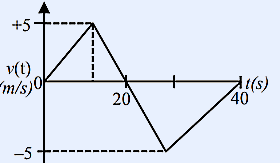
![Plot of half-life $t_{1/2}$ (s, y-axis) versus initial concentration $[A]_0$ (mol/L, x-axis). A single straight line passes through the origin and rises linearly. Two data points are highlighted by dashed projection lines: the lower-left point $([A]_0 = 1.5\times 10^{-3},\ t_{1/2} = x)$ and the upper-right point $([A]_0 = 4\times 10^{-3},\ t_{1/2} = 240\,s)$. The straight-line, origin-through behaviour is the signature of zero-order kinetics, for which $t_{1/2}\propto [A]_0$.](/api/qna-image?path=QnA%2Fb65cda62-f924-480b-b4db-1d3aaa6069d4%2F5ef15551-aed6-4f93-a8d5-a219b7a5d19b%2F8e8d2b4d-d7e9-5ee0-a6e7-b423fb4aa00d%2F8e8d2b4d-d7e9-5ee0-a6e7-b423fb4aa00d%2Fimages%2FQ75_half_life_vs_initial_concentration_plot.webp)
JEE Main 2026 April 05, Shift 2 Question Paper with Solutions
All 74 questions from the JEE Main 2026 (April 05, Shift 2) shift — Physics (25), Chemistry (25) and Mathematics (24) — each with the correct answer (answer key) and a step-by-step solution. Read it free online, or attempt the full paper as a timed mock test.
Physics25 questions
Q26Single correctUnits and Measurements
Match List - I with List - II. where (Planck's constant), (gravitational constant) and (speed of light in vacuum) as fundamental units. Choose the correct answer from the options given below:
| List-I | List-II |
|---|---|
| A. Meter (L) | I. |
| B. Second (S) | II. |
| C. Kilogram (M) | III. |
| D. Kelvin (K) | IV. |
(1)
(2)
(3)
(4)
SolutionAnswer: Option 2A-IV, B-II, C-I, D-III
Approach:
Given fundamental units (Planck constant), (gravitational constant), (speed of light) plus Boltzmann constant . Target: identify the dimensional combination representing length (Meter), time (Second), mass (Kilogram) and temperature (Kelvin). Principle: dimensional analysis using Planck units.
Step 1:Dimensional check for length using G,h,c gives since . Hence Meter (A) corresponds to List-II entry IV.
Step 2:For time, divide Planck length by c, equivalent to since . Therefore Second (B) corresponds to entry II.
Step 3:For mass, the combination has dimensions of . Therefore Kilogram (C) corresponds to entry I.
Step 4:Temperature requires Boltzmann constant K. Treating L as the unit of length, the combination reduces to after substituting , giving the Planck temperature squared. Therefore Kelvin (D) corresponds to entry III.
Final answer:
Q27Single correctUnits and Measurements
In an experiment to determine the resistance of a given wire using Ohm's law, the voltmeter and ammeter readings are noted as 10 V and 5 A, respectively. The least counts of voltmeter and ammeter are 500 mV and 200 mA, respectively. The estimated error in the resistance measurement is _____ .
(1)
(2)
(3)
(4)
SolutionAnswer: Option 40.18
Approach:
Given voltmeter reading , ammeter reading , least counts and . Target: estimated absolute error . Principle: error propagation for the quotient .
Step 1:Compute the measured resistance.
Step 2:Compute the relative errors from the least counts.
Step 3:Add the fractional errors.
Step 4:Multiply by to obtain the absolute error.
Final answer:
Q28Single correctWork, Energy and Power
A mass of 1 kg is kept on an inclined plane with 30 inclination with respect to the horizontal plane and it is at rest initially. Then the whole assembly is moved up with constant velocity of 4 m/s. The work done by the frictional force in time 2 s is _____ J. (Take )
(1)
(2)
(3)
(4)
SolutionAnswer: Option 120
Approach:
Given mass , incline angle , vertical assembly speed , time , , block at rest on the incline. Target: work done by friction on the block. Principle: static friction equals gravity component along incline; work is dot product with the displacement vector.
Step 1:Since the block is at rest on the incline while the assembly moves uniformly, the net force on the block is zero. Friction up the incline balances the gravity component down the incline.
Step 2:Compute the displacement of the block; the assembly moves vertically upward at constant velocity.
vertically
Step 3:Friction on the block points up along the incline, which itself makes with the horizontal; therefore friction makes with the horizontal. The block's displacement is purely vertical (upward) because the assembly is translated vertically at . The angle between the friction vector and the vertical displacement equals .
Step 4:Apply the work formula.
Final answer:
Q29Single correctKinematics
The velocity (v) versus time (t) plot of a particle is shown in the figure, for a time interval of 40 s. The total distance travelled by the particle and the average velocity during this period are, respectively _____.
(1)
(2)
(3)
(4)
SolutionAnswer: Option 3100 m and zero
Approach:
Given a velocity-time plot with a triangular positive pulse rising from to at and back to zero at , then a symmetric negative pulse reaching at and returning to zero at . Target: total distance and average velocity over . Principle: distance equals area between and the time axis; displacement equals signed area.
Step 1:Compute the area of the positive triangular pulse spanning to with peak height .
Step 2:Compute the magnitude of the negative triangular pulse spanning to with depth .
Step 3:Total distance is the sum of magnitudes; displacement is the signed sum.
Step 4:Average velocity from displacement and total time.
Final answer:
Q30Single correctRotational Motion
A wheel initially at rest is subjected to a uniform angular acceleration about its axis. In the first 2 s it rotates through an angle and in the next 2 s it rotates through an angle . The ratio is _____.
(1)
(2)
(3)
(4)
SolutionAnswer: Option 23
Approach:
Given a wheel starting from rest under uniform angular acceleration , rotating through in the first and in the next . Target: ratio . Principle: rotational kinematics with constant angular acceleration from rest.
Step 1:Angle traversed in the first .
Step 2:Total angle traversed in .
Step 3:Angle in the next obtained by subtraction.
Step 4:Ratio of the two angles.
Final answer:
Q31Single correctRotational Motion
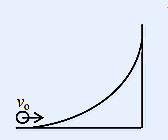
An object of uniform density rolls up the curved path with the initial velocity as shown in the figure. If the maximum height attained by the object is (g = acceleration due to gravity), the object is a _____.
(1)
(2)
(3)
(4)
SolutionAnswer: Option 4solid sphere
Approach:
Given an object rolling without slipping up a curved track with initial speed , reaching maximum height . Target: identify the object via its moment-of-inertia coefficient . Principle: energy conservation between the bottom (translational + rotational kinetic energy) and the top (gravitational potential energy), with the rolling constraint .
Step 1:Apply energy conservation from the bottom to the maximum height with surface assumed smooth enough for energy conservation under rolling.
Step 2:Substitute the given height.
Step 3:Solve for .
Step 4:The coefficient identifies the object as a solid sphere.
Final answer:
Q32Single correctGravitation
A body of mass m is taken from the surface of earth to a height equal to twice the radius of earth (). The increase in potential energy will be _____. (g is acceleration due to gravity at the surface of earth)
(1)
(2)
(3)
(4)
SolutionAnswer: Option 4
Approach:
Given a body of mass m raised from Earth's surface () to a height above the surface (so ). Target: increase in gravitational potential energy expressed in terms of g at the surface. Principle: exact gravitational potential energy formula combined with .
Step 1:Identify initial and final distances from Earth's centre.
Step 2:Compute the change in potential energy.
Step 3:Substitute to eliminate GM.
Final answer:
Q33Single correctProperties of Solids and Liquids
Eight mercury drops, each of radius r, coalesce to form a bigger drop. The surface energy released in this process is _____ (S is the surface tension of mercury).
(1)
(2)
(3)
(4)
SolutionAnswer: Option 2
Approach:
Given 8 mercury drops each of radius coalescing into one larger drop, surface tension . Target: surface energy released. Principle: volume conservation determines the radius of the merged drop; the released energy equals times the decrease in total surface area.
Step 1:Equate total volume before and after merging.
Step 2:Compute initial total surface area of the 8 small drops.
Step 3:Compute final surface area of the merged drop.
Step 4:Released surface energy equals surface tension times the decrease in area.
Final answer:
Q34Single correctKinetic Theory of Gases
An ideal gas at pressure P and temperature T is expanding such that constant. The coefficient of volume expansion of the gas is _____.
(1)
(2)
(3)
(4)
SolutionAnswer: Option 3
Approach:
Given an ideal gas obeying undergoing a process with . Target: coefficient of volume expansion . Principle: eliminate P between the two relations to express V as a function of T alone, then differentiate.
Step 1:From the process constraint, express as a function of .
Step 2:Substitute into the ideal gas law to express as a function of .
Step 3:Differentiate with respect to .
Step 4:Compute the coefficient of volume expansion.
Final answer:
Q35Single correctOscillations and Waves
Match List - I with List - II.
| List - I | List - II |
|---|---|
| A. | I. Periodic with time period but not simple harmonic motion (SHM) |
| B. | II. Periodic with time period but Not SHM |
| C. | III. Periodic with time period and SHM |
| D. | IV. Non-periodic |
(1)
(2)
(3)
(4)
SolutionAnswer: Option 1A-III, B-I, C-IV, D-II
Approach:
Givens: four time functions in List-I. Target: identify periodicity and SHM nature, then pair with List-II descriptors. Principle: a function is SHM when its second derivative is proportional to a sinusoidal function about a fixed mean with a single angular frequency; a sum of two harmonics is periodic only if the ratio of their periods is rational.
Step 1:Reduce A using the power-reduction identity to expose its harmonic content.
Step 2:Apply the relevant identity to B using the triple-angle identity; the result is a superposition of two SHMs.
Step 3:Examine C using the rational-ratio test.
Periods: for , for ; .
Step 4:Examine D using LCM of periods.
Periods: and ; LCM ; superposition of two SHMs of different angular frequencies is periodic but not SHM.
Final answer: A-III, B-I, C-IV, D-II
Q36Single correctElectromagnetic Induction and Alternating Currents
A metal rod of length L rotates about one end at origin with a uniform angular velocity . The magnetic field radially falls off as ; being a positive constant. The emf induced (neglecting the centripetal force on electrons in the rod) is:
(1)
(2)
(3)
(4)
SolutionAnswer: Option 1
Approach:
Givens: rod of length L rotating with angular velocity about one end at origin in a radial magnetic field . Target: emf across the rod. Principle: motional emf with integrated along the rod.
Step 1:Set up the elemental emf at radial position r with element speed .
Step 2:Integrate from to using integration by parts.
Step 3:Apply limits and simplify.
Final answer:
Q37Single correctCurrent Electricity
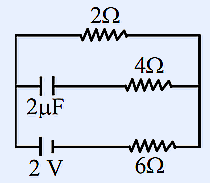
Under steady state condition the potential difference across the capacitor in the circuit is _____ V.
(1)
(2)
(3)
(4)
SolutionAnswer: Option 1
Approach:
Givens: 2 V battery in series with 6 ; across the source terminals, two parallel branches: a 2 resistor and a series combination of 4 and 2 F. Target: steady-state voltage across the capacitor. Principle: in DC steady state the capacitor draws zero current, so the branch containing it carries no current and the 4 resistor has zero drop.
Step 1:Apply the steady-state condition to the capacitor branch.
, so the entire current from the battery flows through the 6 source resistor and the 2 parallel resistor.
Step 2:Compute the loop current using Kirchhoff's voltage law on the active loop (2 V source, 6 , 2 ).
Step 3:Determine the capacitor voltage. The capacitor sits in parallel with the 2 resistor through the (zero-drop) 4 resistor, so equals the drop across the 2 resistor.
Final answer:
Q38Single correctMagnetic Effects of Current and Magnetism
A particle of charge q and mass m is projected from origin with an initial velocity . There exists a uniform magnetic field and a space varying electric field within the region . After travelling a distance such that x-coordinate has changed from to , the change in the kinetic energy is _____.
(1)
(2)
(3)
(4)
SolutionAnswer: Option 1
Approach:
Givens: charge q and mass m, initial velocity , uniform , position-dependent confined to . Target: change in kinetic energy between and . Principle: by the work-energy theorem only the net work matters; the magnetic force is perpendicular to and contributes zero work.
Step 1:Identify zero work from the magnetic force since at every instant.
Step 2:Express the electric work along the x-direction; the component of displacement does not couple to .
Step 3:Evaluate the integral.
Final answer:
Q39Single correctElectromagnetic Waves
Given below are two statements: one is labelled as Assertion (A) and the other is labelled as Reason (R). Assertion (A): The electromagnetic wave exerts pressure on the surface on which they are allowed to fall. Reason (R): There is no mass associated with the electromagnetic waves. In the light of the above statements, choose the correct answer from the options given below:
(1)
(2)
(3)
(4)
SolutionAnswer: Option 2Both (A) and (R) are true but (R) is not the correct explanation of (A)
Approach:
Givens: Assertion that EM waves exert pressure on absorbing/reflecting surfaces; Reason that EM waves carry no mass. Target: evaluate truth values and the causal link. Principle: radiation pressure arises from momentum flux carried by EM waves, independent of any rest-mass consideration.
Step 1:Evaluate Assertion (A).
EM waves transport linear momentum density (with the Poynting vector); striking a surface, this momentum is transferred at rate for absorption (and for perfect reflection).
Step 2:Evaluate Reason (R).
Photons, the quanta of EM radiation, have zero rest mass: . Thus no rest mass is associated with EM waves.
Step 3:Examine the causal link.
Radiation pressure is produced by momentum transfer , which exists for massless quanta because relativistic momentum requires only nonzero energy. Hence the absence of mass is not the cause of pressure; pressure follows from energy/momentum flux.
Final answer: Both (A) and (R) are true but (R) is not the correct explanation of (A)
Q40Single correctOptics
A thin convex lens and a thin concave lens are kept in contact and are co-axial. Which of the following statements is correct for this combination of two lenses?
(1)
(2)
(3)
(4)
SolutionAnswer: Option 1behaves as concave lens if
Approach:
Givens: thin convex lens (focal length ) in contact and coaxial with thin concave lens (focal length ). Target: identify the correct statement about the combination. Principle: thin lenses in contact combine through power addition; the sign of determines whether the system is converging or diverging.
Step 1:Substitute the signed focal lengths with the standard sign convention.
Step 2:Analyse the sign of under the condition .
Since implies , the difference .
Step 3:Inspect the remaining option about interchanging positions.
The combination formula is symmetric in , so interchanging the lenses leaves f unchanged.
Final answer: Behaves as a concave (diverging) lens when .
Q41Single correctOptics
An object AB is placed 15 cm on the left of a convex lens P of focal length 10 cm. Another convex lens Q is now placed 15 cm right of lens P. If the focal length of lens Q is 15 cm, the final image is _____.
(1)
(2)
(3)
(4)
SolutionAnswer: Option 2real, formed at 7.5 cm right of lens , with a size same as that of
Approach:
Givens: object AB at 15 cm left of convex lens P ( cm); convex lens Q ( cm) at 15 cm right of P. Target: location, nature, and size of the final image. Principle: apply the thin-lens equation successively, treating the image from P as the object for Q with appropriate sign of object distance. Sign convention used throughout: light travels left to right; distances measured from the lens are positive to the right and negative to the left; a real object lies on the incident side (), while a real image and a virtual object lie on the transmitted side ().
Step 1:Compute the image formed by lens P with cm (real object on incident side) and cm (converging lens).
Step 2:Locate with respect to lens Q, which sits 15 cm to the right of P. Because , lies on the transmitted side of Q — the converging rays from P would have met past Q. Q intercepts the rays before they converge, so acts as a virtual object whose distance from Q is taken as positive.
Distance of from Q on the transmitted side .
Step 3:Apply the lens equation for Q with cm.
Step 4:Compute the overall linear magnification.
; ; .
Final answer: Real image, 7.5 cm to the right of lens , with size equal to that of .
Q42Single correctOptics
The maximum intensity in a Young's double slit experiment is . Distance between the slits (d) is , where is the wavelength of light used. The intensity of the fringe, exactly opposite to one of the slits on the screen, placed at is _____.
(1)
(2)
(3)
(4)
SolutionAnswer: Option 2
Approach:
Givens: YDSE with maximum intensity , slit separation , screen distance . Target: intensity at the point directly opposite one of the slits, at from the central axis. Principle: small-angle path difference converts to phase difference ; intensity follows .
Step 1:Place the screen point opposite one slit at vertical distance from the central axis.
Step 2:Substitute and .
Step 3:Convert the path difference to phase and evaluate the intensity.
;
Final answer:
Q43Single correctDual Nature of Matter and Radiation
An electron is travelling with a velocity v in free space and when it enters a medium, its velocity is reduced by 20%. The de Broglie wavelength of electron in the medium is , where is its de Broglie wavelength in free space. The value of is _____ .
(1)
(2)
(3)
(4)
SolutionAnswer: Option 31.25
Approach:
Given: free-space electron speed v with de Broglie wavelength ; in the medium the speed is reduced by 20% so . Target: the ratio where is the wavelength in the medium. Principle: de Broglie relation with non-relativistic electron mass.
Step 1:Express the free-space wavelength using the de Broglie relation.
Step 2:Express the wavelength in the medium with the reduced speed .
Step 3:Form the ratio to identify .
Final answer:
Q44Single correctAtoms and Nuclei
Assuming the experimental mass of as 12 u, the mass defect of atom is _____ . (Mass of proton , mass of neutron , and c is the speed of the light in vacuum).
(1)
(2)
(3)
(4)
SolutionAnswer: Option 289.03
Approach:
Given: experimental atomic mass of is ; ; ; conversion . Target: mass defect of expressed in . Principle: mass defect equals total mass of constituent nucleons minus the nuclear (here, atomic) mass.
Step 1:Sum the masses of six protons and six neutrons.
Step 2:Subtract the experimental atomic mass to obtain the mass defect in atomic mass units.
Step 3:Convert the mass defect to using .
Final answer:
Q45Single correctElectronic Devices
In a semiconductor p-n diode, the doping concentrations on p-side and n-side are and , respectively. Which one of the following statements is true?
(1)
(2)
(3)
(4)
SolutionAnswer: Option 2The depletion region width is more on p -side compared to that in n-side
Approach:
Given: doping concentrations on the p-side and on the n-side. Target: identify the correct statement about the relative widths of the depletion region. Principle: in an abrupt p-n junction the total ionized charge on each side of the metallurgical interface must be equal in magnitude.
Step 1:Apply charge neutrality of the depletion region: the negative acceptor charge on the p-side equals the positive donor charge on the n-side per unit junction area.
Step 2:Substitute the given concentrations to compute the ratio of depletion widths.
Step 3:Interpret the result: the depletion width extends much further into the lightly doped p-region than into the heavily doped n-region.
Final answer:
Q46NumericalProperties of Solids and Liquids
A copper wire of length 3 m is stretched by 3 mm by applying an external force. The volume of the wire is . The elastic potential energy stored in the wire in stretched condition would be _____ J. (Given Young modulus of copper )
SolutionAnswer: 33
Approach:
Given: copper wire of original length , extension , volume , Young's modulus . Target: elastic potential energy U stored in the stretched wire (in joules). Principle: energy density of an elastically strained solid is for longitudinal strain .
Step 1:Compute the longitudinal strain produced in the wire.
Step 2:Form the elastic energy density using Young's modulus and the strain.
Step 3:Multiply the energy density by the volume of the wire to obtain the total stored elastic energy.
Final answer:
Q47NumericalProperties of Solids and Liquids
The heat extracted out of x gram of water initially at to cool it down to is sufficient to evaporate gram of water also initially at . The value of x (closest integer) is _____ . (Take latent heat of water , specific heat capacity of water )
SolutionAnswer: 922
Approach:
Given: of water at is cooled to ; the heat removed is supplied to of water initially at to heat it to and then vaporise it completely; specific heat capacity ; latent heat of vaporisation . Target: closest integer value of x. Principle: conservation of energy between heat lost by the cooling water and heat absorbed by the heating–then–vaporising water.
Step 1:Express the heat extracted from the cooling mass (working with mass in grams, ).
Step 2:Express the heat required to raise the remaining from to and then vaporise it. The latent heat per gram is .
Step 3:Equate the two heats and solve for .
Step 4:Divide to obtain the value of and round to the nearest integer.
Final answer:
Q48NumericalElectromagnetic Induction and Alternating Currents
A series LCR circuit with , and is connected to a variable frequency a.c. source. The inductive reactance at resonant frequency is _____ .
SolutionAnswer: 200
Approach:
Given: series LCR circuit with , , , driven at variable angular frequency . Target: inductive reactance at the resonant frequency. Principle: at series resonance , with , leading to .
Step 1:Combine with to remove the explicit frequency.
Step 2:Substitute the numerical values of and .
Step 3:Take the square root to obtain the reactance at resonance.
Final answer:
Q49NumericalCurrent Electricity
When an external resistance of is connected across terminals of a cell, a current of flows through it. When the resistor is replaced by a resistor, a current of flows through it. The internal resistance of the cell is _____ .
SolutionAnswer: 1
Approach:
Given: an external resistance produces a current ; replacing it with yields . Target: internal resistance r of the cell. Principle: a cell of EMF and internal resistance r obeys for any external load R.
Step 1:Write the EMF equation for each load using the same EMF .
Step 2:Equate the two expressions for and expand.
Step 3:Solve the linear equation for the internal resistance.
Final answer:
Q50NumericalElectromagnetic Induction and Alternating Currents
A circular loop of radius 20 cm and resistance is placed in a time varying magnetic field . At , for the plane of the loop being perpendicular to the magnetic field, the induced current in the loop at is . The value of is _____ . (Take )
SolutionAnswer: 44
Approach:
Given: circular loop of radius and resistance placed perpendicular to a time-varying field ; the loop's plane is normal to , so the field is along the area vector. Induced current at is expressed as ; . Target: integer . Principle: Faraday's law of electromagnetic induction with .
Step 1:Compute the loop area and differentiate the field with respect to time.
Step 2:Evaluate at and compute the magnitude of the induced EMF.
Step 3:Apply Ohm's law to obtain the induced current.
Step 4:Substitute and match with the given form .
Final answer:
Chemistry25 questions
Q51Single correctSome Basic Concepts in Chemistry
What volume of hydrogen gas at STP would be liberated by action of 50 mL of of 50% purity (density = 1.3 ) on 20 g of zinc? Given: Molar mass of H, O, S, Zn are 1, 16, 32, 65 g respectively.
(1)
(2)
(3)
(4)
SolutionAnswer: Option 36.892 L
Approach:
Given 50 mL of solution of density 1.3 g/mL and 50% purity reacting with 20 g of Zn. The principle is stoichiometric limiting reagent analysis for ; required is the volume of liberated at STP.
Step 1:Compute total mass of acid solution and then mass of pure available.
Step 2:Convert reactant masses to moles using molar masses: , .
Step 3:Identify the limiting reagent. The 1:1 stoichiometry of makes Zn limiting since . Therefore moles of produced equal moles of Zn consumed.
Step 4:Convert moles of to volume at STP using .
Final answer:
Q52Single correctAtomic Structure
Which of the following statement(s) is/are true? A. If two orbitals have the same value of (n + l), then the orbital with lower value of n will have lower energy. B. Energies of the orbitals in the same subshell increase with increase in atomic number. C. The size of orbital is less than the size of orbital. D. Among 5f, 6s, 4d, 5p and 5d, no one of the orbitals have 2 radial nodes. Choose the correct answer from the options given below:
(1)
(2)
(3)
(4)
SolutionAnswer: Option 2A and C only
Approach:
Each of statements A through D concerns orbital energies, sizes, or radial nodes. Each is to be evaluated using Madelung's rule, hydrogenic size scaling, screening effects on subshell energy, and the radial-node count .
Step 1:Evaluate A. For two orbitals with the same , Madelung rule states the orbital with smaller has lower energy (e.g., 2p with lies below 3s). Therefore A is TRUE.
Step 2:Evaluate B. Increase in atomic number enhances effective nuclear charge on each subshell, lowering (making more negative) the orbital energy rather than raising it. Therefore B is FALSE.
Step 3:Evaluate C. Mean radial size of a hydrogenic orbital scales with ; hence the orbital is larger than the orbital. Therefore C is TRUE.
Step 4:Evaluate D. Apply to each orbital: 5f has node; 6s has nodes; 4d has node; 5p has nodes; 5d has nodes. Since 5d possesses exactly 2 radial nodes, the claim that none has 2 nodes is FALSE.
Step 5:Combine the truth values: only A and C are true.
Final answer: A and C only
Q53Single correctChemical Bonding and Molecular Structure
The covalent radii of atoms A and B are and respectively. The covalent bond length and total length of AB molecule are respectively:
(1)
(2)
(3)
(4)
SolutionAnswer: Option 1
Approach:
Given a diatomic molecule AB with covalent radii and . Bond length between bonded atoms is the sum of covalent radii. Total molecular length spans from the outer edge of atom A to the outer edge of atom B, requiring inclusion of both radii on the ends in addition to the internal bond.
Step 1:Identify the covalent bond length. For an A-B covalent bond, the internuclear distance equals the sum of the covalent radii of the two atoms.
Step 2:Construct the total length of the AB molecule. Starting at the far edge of atom A, traverse radius to reach nucleus A, then bond length to reach nucleus B, then radius to reach the far edge of atom B.
Step 3:Pair the bond length with the total length to match the option format.
Final answer:
Q54Single correctChemical Thermodynamics
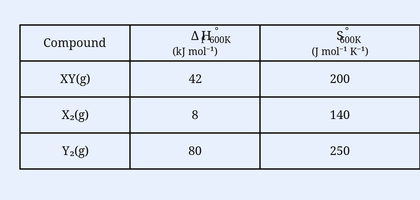
Consider the following data for the reaction at 600 K. The (in ) for the reaction is:
(1)
(2)
(3)
(4)
SolutionAnswer: Option 2
Approach:
Given table values (kJ/mol) and (J/mol K) for XY, , at and reaction . The principle: compute , , then . Given kJ/mol, find X.
Step 1:Compute using product XY (coefficient 2) and reactants , (each coefficient 1).
Step 2:Compute analogously.
Step 3:Apply Gibbs equation at K, converting entropy to kJ/(mol K) for consistency.
Step 4:Equate from the problem statement to solve for X.
Final answer:
Q55Single correctChemical Thermodynamics
The correct order of molar heat capacities measured at 298 K and 1 bar is:
(1)
(2)
(3)
(4)
SolutionAnswer: Option 2Bromine(l) > Copper(s) > Helium(g)
Approach:
Required: rank molar heat capacities of Cu(s), B(l) and He(g) at 298 K and 1 bar. Principle: monoatomic ideal gas has only 3 translational degrees of freedom giving ; a metallic solid follows Dulong-Petit giving ; a diatomic liquid with strong intermolecular interactions and additional rotational/vibrational contributions stores far more energy per Kelvin per mole.
Step 1:Estimate for He(g) using monoatomic ideal-gas relation.
Step 2:Estimate for Cu(s) using Dulong-Petit law at room temperature (Cu sits close to the classical limit).
Step 3:Estimate for B(l). The liquid stores translational, rotational, librational and vibrational energy plus the energy required to weaken intermolecular interactions; tabulated value is J/(mol K), far above Cu and He.
Step 4:Rank the three values in descending order.
Final answer: Bromine(l) > Copper(s) > Helium(g)
Q56Single correctEquilibrium
The reaction was initiated with the amount 'a' of A(g). At equilibrium it is found that the amount of A(g) remaining is at a total pressure of p. The equilibrium constant of the reaction can be calculated from the expression:
(1)
(2)
(3)
(4)
SolutionAnswer: Option 2
Approach:
Given with initial moles a of A, equilibrium moles of A, x each of B and C, and total pressure p. Required: closed-form in terms of a, x, p. Principle: use mole fractions to obtain partial pressures, then apply law of mass action.
Step 1:Sum equilibrium moles. With A: , B: x, C: x the total is .
Step 2:Write the partial pressure of each species via its mole fraction and total pressure .
Step 3:Insert into the mass-action expression for .
Step 4:Simplify. Multiply numerator and denominator: .
Final answer:
Q57Single correctRedox Reactions and Electrochemistry
One half cell in a voltaic cell is constructed from a silver rod dipped in silver nitrate solution of unknown concentration. The other half cell consists of a zinc rod dipped in 1 molar solution of . A voltage of 1.60 V is measured at 298 K for this cell. What is the concentration of ions used in terms of , where ? Given: .
(1)
(2)
(3)
(4)
SolutionAnswer: Option 2
Approach:
Given a galvanic cell Zn|Z(1 M) ‖ Ag(x M)|Ag at 298 K with V, V, V, V. Principle: apply Nernst equation to the spontaneous net reaction () and solve for .
Step 1:Compute taking Ag/Ag as cathode (reduction) and Z/Zn as anode (oxidation).
Step 2:Identify from the balanced net reaction and write the reaction quotient: .
Step 3:Apply the Nernst equation with V.
Step 4:Isolate .
Final answer:
Q58Single correctp-Block Elements
Given below are two statements. Statement I: The number of pairs among , , and that contain oxides of same nature (acidic, basic, neutral or amphoteric) is 4. Statement II: Among , , CO and , the most basic and acidic oxides are and , respectively. In the light of the above statements, choose the correct answer from the options given below:
(1)
(2)
(3)
(4)
SolutionAnswer: Option 1Both Statement I and Statement II are true
Approach:
Statement I lists four pairs of oxides; for each pair, identify the acid-base character of both members and count how many pairs share a common nature. Statement II compares the strengths of , , CO and to verify that the most basic is and the most acidic is . Principles: nature of metal/non-metal oxides, periodic-table trends, and dependence on oxidation state.
Step 1:Pair 1 : dissolves in both acids and bases (amphoteric); likewise reacts with acids and with fused alkali (amphoteric). Both amphoteric; same nature.
Step 2:Pair 2 : is the anhydride of (strongly acidic); is the anhydride of (strongly acidic). Same nature.
Step 3:Pair 3 : is a typical alkali-metal oxide (basic). contains V in its low oxidation state , where the oxide is basic (lower oxidation states of d-block oxides are basic; higher oxidation states such as are amphoteric/acidic). Same nature.
Step 4:Pair 4 : CO is a classic neutral oxide; is likewise a neutral oxide. Same nature.
Step 5:Count: all four pairs share the same character within the pair. Therefore the count is 4 and Statement I is TRUE.
Step 6:Evaluate Statement II among : is the most basic (group-1 oxide); is the most acidic (highest oxidation state of Cl, anhydride of ). Statement II is TRUE.
Step 7:Both statements true; select the corresponding option.
Final answer: Both Statement I and Statement II are true
Q59Single correctp-Block Elements
Given below are two statements:
Statement I: Aluminium upon reaction with NaOH forms ion.
Statement II: The geometry of , and is square planar, pyramidal and linear respectively.
In the light of the above statements, choose the correct answer from the options given below:
Statement I: Aluminium upon reaction with NaOH forms ion.
Statement II: The geometry of , and is square planar, pyramidal and linear respectively.
In the light of the above statements, choose the correct answer from the options given below:
(1)
(2)
(3)
(4)
SolutionAnswer: Option 4Statement I is false but Statement II is true
Approach:
Evaluate Statement I by recalling the product of the Al/NaOH reaction and Statement II by applying VSEPR to ICl4-, ClO3- and IBr2-.
Step 1:Aluminium with aqueous sodium hydroxide produces sodium tetrahydroxoaluminate, not the hexahydroxo species.
Step 2:VSEPR for : central I has 7 valence electrons plus 1 from the charge, minus 4 used in -bonds to Cl, giving 4 non-bonding electrons (2 lone pairs).
Step 3:VSEPR for and .
Step 4:Combine evaluations of the two statements.
Final answer: Statement I is false but Statement II is true
Q60Single correctd- and f-Block Elements
Given below are two statements:
Statement I: Presence of large number of unpaired electrons in transition metal atoms results in higher enthalpies of their atomisation.
Statement II: and are the d-orbital splittings in and complex ions respectively.
In the light of the above statements, choose the correct answer from the options given below:
Statement I: Presence of large number of unpaired electrons in transition metal atoms results in higher enthalpies of their atomisation.
Statement II: and are the d-orbital splittings in and complex ions respectively.
In the light of the above statements, choose the correct answer from the options given below:
(1)
(2)
(3)
(4)
SolutionAnswer: Option 1Both Statement I and Statement II are true
Approach:
Link atomisation enthalpy to unpaired d-electron count, then identify the geometry of each complex and apply the corresponding crystal-field splitting pattern.
Step 1:Atomisation enthalpy in transition metals scales with metal-metal bonding from unpaired d-electrons.
Step 2: is six-coordinate octahedral, so the octahedral CFT pattern applies.
Step 3: is four-coordinate tetrahedral, so the tetrahedral CFT pattern applies.
Step 4:Combine both evaluations.
Final answer: Both Statement I and Statement II are true
Q61Single correctCoordination Compounds
Identify the correct statements from the following:
A. is the most stable complex among , and .
B. The stability of is greater than that of .
C. The hybridization of Fe in is .
D. exhibits linkage isomerism.
E. and ligands are NOT ambidentate ligands.
Choose the correct answer from the options given below:
A. is the most stable complex among , and .
B. The stability of is greater than that of .
C. The hybridization of Fe in is .
D. exhibits linkage isomerism.
E. and ligands are NOT ambidentate ligands.
Choose the correct answer from the options given below:
(1)
(2)
(3)
(4)
SolutionAnswer: Option 3A, C and D only
Approach:
Test each statement against the chelate effect, hybridization of low-spin Fe(II) hexacyano complex, linkage isomerism criteria and ambidentate behaviour of /.
Step 1:Statement A: among , and , the oxalato complex uses a chelating bidentate ligand and is therefore the most stable.
Step 2:Statement B: ethylenediamine is bidentate while ammonia is monodentate, so the en complex is more stable than the ammine complex.
Step 3:Statement C: in the metal centre is (), and is a strong-field ligand giving a low-spin octahedral complex.
Step 4:Statement D: is ambidentate (binds through N as nitro or O as nitrito), so a complex containing ligands exhibits linkage isomerism.
Step 5:Statement E: (nitro/nitrito) and (thiocyanato-S/isothiocyanato-N) are textbook ambidentate ligands; the assertion that they are NOT ambidentate is false.
Step 6:Compile the correct statements.
Final answer: A, C and D only
Q62Single correctPurification and Characterisation of Organic Compounds
Match List - I with List - II.
| List - I (Purification technique) | List - II (Used to separate) |
|---|---|
| A. Simple distillation | I. Steam volatile compound |
| B. Fractional distillation | II. Two liquids with large difference in boiling points |
| C. Steam distillation | III. Liquid decomposing at its boiling point |
| D. Distillation under reduced pressure | IV. Two liquids with close boiling points |
(1)
(2)
(3)
(4)
SolutionAnswer: Option 2A-II, B-IV, C-I, D-III
Approach:
Match each distillation technique to the separation scenario it is designed to address.
Step 1:Simple distillation is suitable when the components boil at temperatures differing by more than about .
Step 2:Fractional distillation uses a fractionating column for liquids whose boiling points are close.
Step 3:Steam distillation co-distils volatile, water-immiscible compounds with steam below their normal boiling points.
Step 4:Reduced-pressure distillation lowers the boiling point so heat-sensitive liquids distil before decomposing.
Step 5:Assemble the matching.
Final answer: A-II, B-IV, C-I, D-III
Q63Single correctHydrocarbons
IUPAC name of the some alkenes are given below. Find out the correct stability order.
A. 2-Methylbut-2-ene
B. cis-But-2-ene
C. 2,3-Dimethylbut-2-ene
D. Prop-1-ene
Choose the correct answer from the options given below:
A. 2-Methylbut-2-ene
B. cis-But-2-ene
C. 2,3-Dimethylbut-2-ene
D. Prop-1-ene
Choose the correct answer from the options given below:
(1)
(2)
(3)
(4)
SolutionAnswer: Option 1
Approach:
Classify each alkene by the number of alkyl substituents on the doubly bonded carbons; greater substitution gives greater hyperconjugative stabilization.
Step 1:Determine the substitution pattern at the for each alkene.
Step 2:More alkyl groups on the supply more hyperconjugative -hydrogens, stabilizing the -bond.
Step 3:Compare the trisubstituted A with the cis-disubstituted B and the terminal D.
Step 4:Combine ordering relations.
Final answer:
Q64Single correctHydrocarbons
Identify the correct IUPAC name of hydrocarbon (x) containing three primary carbon atoms and with molar mass .
(1)
(2)
(3)
(4)
SolutionAnswer: Option 32-Methylbutane
Approach:
Use the molar mass to fix the molecular formula, then test each candidate against the molar mass and primary-carbon count.
Step 1:Solve to identify the carbon count for an acyclic alkane of molar mass .
Step 2:Evaluate candidate (1) 1,1-dimethylcyclopropane: a cyclopropane ring gives a cyclic alkane formula .
Step 3:Count primary (terminal ) carbons in the remaining isomers.
Step 4:Confirm 2-methylbutane satisfies both criteria.
Final answer: 2-Methylbutane
Q65Single correctOrganic Compounds Containing Halogens
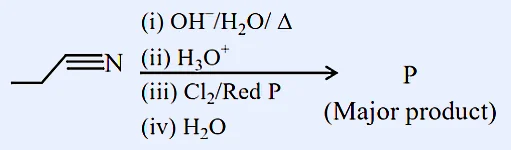
Complete the following reaction sequence and give the name of major product 'P'.
(1)
(2)
(3)
(4)
SolutionAnswer: Option 12-Chloropropanoic acid
Approach:
Hydrolyse propanenitrile to propanoic acid, then carry out Hell-Volhard-Zelinsky -chlorination followed by aqueous workup to obtain the -chloroacid.
Step 1:Steps (i) and (ii): basic hydrolysis of propanenitrile followed by acid workup gives propanoic acid.
Step 2:Step (iii): Hell-Volhard-Zelinsky -chlorination on propanoic acid using generates an -chloroacyl chloride.
Step 3:Step (iv): hydrolysis of the -chloroacyl chloride by delivers the -chloroacid.
Step 4:Identify P by IUPAC name.
Final answer: 2-Chloropropanoic acid
Q66Single correctOrganic Compounds Containing Oxygen
Given below are two statements:
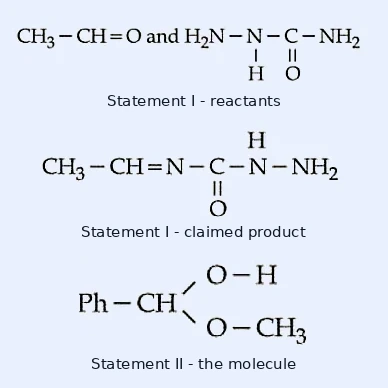
Statement I: The condensation reaction between the reactants shown below (Statement I - reactants), under optimum pH, will produce the product shown below (Statement I - claimed product).
Statement II: The molecule shown below (Statement II - the molecule) will generate in the presence of dilute acid.
In the light of the above statements, choose the correct answer from the options given below:
Statement I: The condensation reaction between the reactants shown below (Statement I - reactants), under optimum pH, will produce the product shown below (Statement I - claimed product).
Statement II: The molecule shown below (Statement II - the molecule) will generate in the presence of dilute acid.
In the light of the above statements, choose the correct answer from the options given below:
(1)
(2)
(3)
(4)
SolutionAnswer: Option 4Statement I is false but Statement II is true
Approach:
Generate the true semicarbazone connectivity from acetaldehyde and semicarbazide for Statement I, and apply the acid-catalysed hydrolysis of a hemiacetal for Statement II.
Step 1:The terminal of semicarbazide is the nucleophile; it attacks the carbonyl carbon of acetaldehyde and water is eliminated to give the semicarbazone.
Step 2:Compare the cited structure with the genuine semicarbazone: the carbon bearing the in semicarbazide sits between two nitrogens, whereas the cited formula places a group bonded only to one nitrogen.
Step 3:Statement II: is a hemiacetal; dilute aqueous acid protonates the , ejects methanol and regenerates the aldehyde.
Step 4:Combine evaluations of the two statements.
Final answer: Statement I is false but Statement II is true
Q67Single correctOrganic Compounds Containing Nitrogen
Given below are two statements: Statement I: Heating benzamide with bromine in an ethanolic solution of sodium hydroxide will give benzylamine. Statement II: Nitration of aniline with at 288 K produces m-nitroaniline in higher amount than o-nitroaniline (pH adjusted). In the light of the above statements, choose the correct answer from the options given below:
(1)
(2)
(3)
(4)
SolutionAnswer: Option 4Statement I is false but Statement II is true
Approach:
Evaluate each statement on the basis of Hofmann bromamide degradation and electrophilic nitration of aniline at low temperature.
Step 1:Hofmann bromamide degradation of benzamide produces the amine with one carbon less than the starting amide, i.e., aniline, not benzylamine.
Step 2:In at 288 K, aniline is largely protonated to the anilinium ion, , which is strongly deactivating and meta-directing.
Step 3:Under these conditions m-nitroaniline (~47%) exceeds o-nitroaniline (~2%), confirming Statement II.
Final answer: Statement I is false but Statement II is true
Q68Single correctBiomolecules
Identify the incorrect statement about tertiary structure of proteins.
(1)
(2)
(3)
(4)
SolutionAnswer: Option 3The structure remains intact when exposed to pH changes.
Approach:
Identify which statement contradicts the known properties of protein tertiary structure.
Step 1:Tertiary structure of proteins arises from interactions between R-groups: hydrogen bonds, disulphide (-S-S-) links, van der Waals and electrostatic attractions, supporting Option 2.
Step 2:Tertiary structures fall in fibrous and globular classes (Option 1) and arise from the folding of a linear polypeptide that already has secondary structure (Option 4).
Step 3:pH changes disturb the ionic and hydrogen-bonding interactions and cause denaturation of the tertiary structure; hence Option 3 is incorrect.
Final answer: The structure remains intact when exposed to pH changes.
Q69Single correctBiomolecules
Given below are two statements:
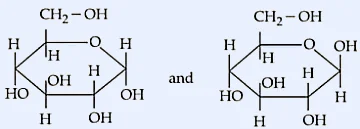
Statement I: The structures shown below are two anomers of D-(+)-glucose.
Statement II: The open chain forms of D-glucose and D-fructose contain three similar chiral carbons at and .
In the light of the above statements, choose the correct answer from the options given below:
Statement I: The structures shown below are two anomers of D-(+)-glucose.
Statement II: The open chain forms of D-glucose and D-fructose contain three similar chiral carbons at and .
In the light of the above statements, choose the correct answer from the options given below:
(1)
(2)
(3)
(4)
SolutionAnswer: Option 1Both Statement I and Statement II are true
Approach:
Examine the anomeric relationship in glucopyranose and compare configurations at , , of open-chain D-glucose and D-fructose.
Step 1:- and -D-glucopyranose differ only in the configuration at the anomeric carbon , hence they are anomers of D-(+)-glucose.
Step 2:Open-chain D-glucose Fischer projection: (OH on left), (OH on right), (OH on right). Open-chain D-fructose Fischer projection: (OH on left), (OH on right), (OH on right).
Step 3:Therefore both molecules share three similar chiral carbons at , , , confirming Statement II.
Final answer: Both Statement I and Statement II are true
Q70Single correctPrinciples Related to Practical Chemistry
A paper dipped in a dil. solution of 'X' upon treatment with gas turns into green. The compound 'X' is:
(1)
(2)
(3)
(4)
SolutionAnswer: Option 4
Approach:
Identify the substance whose acidified solution undergoes a colour change from orange to green upon reduction by .
Step 1:In acidic medium exists as orange dichromate, , with Cr in +6 oxidation state.
Step 2: acts as a reducing agent and reduces Cr(VI) to Cr(III), which is green in aqueous acidic solution.
Step 3:Other options fail this specific test: KI-starch turns blue (with oxidisers, but does not), would decolourise (purple to colourless), and gives a white/black precipitate with not green with .
Final answer:
Q71NumericalCoordination Compounds
The total number of unpaired electrons present in the (low spin), (high spin), (high spin) and (low spin) octahedral complex systems is ____.
SolutionAnswer: 15
Approach:
Apply crystal field splitting in an octahedral field and count unpaired electrons for each specified configuration.
Step 1:For octahedral: configuration is giving 3 unpaired electrons.
Step 2:For low spin: pairing in first, giving with 2 unpaired; for high spin: with 5 unpaired.
Step 3:For high spin: with 4 unpaired; for low spin: with 1 unpaired. Sum: .
Final answer: 15
Q72NumericalOrganic Compounds Containing Halogens
RMgI when treated with ice cold water liberated a gas which occupied at STP. The gas produced is further reacted with iodine in presence of to give compound (X). Compound (X) in presence of Na and dry ether produced compound (Y). Molar mass of compound (Y) is ____ . (Nearest integer)
SolutionAnswer: 30
Approach:
Identify the alkane gas from its molar volume, then trace iodination by followed by Wurtz coupling with Na/dry ether to find compound (Y).
Step 1:Gas occupies at STP. Using , molar mass of gas , identifying it as . Hence R = and the Grignard is .
Step 2:Methane upon iodination in presence of (which re-oxidises HI back to , driving the equilibrium forward) gives methyl iodide as compound (X).
Step 3:Wurtz reaction of with Na in dry ether couples two methyl groups giving ethane as compound (Y), with molar mass .
Final answer: 30
Q73NumericalSolutions
20 g hemoglobin in a 1 L aqueous solution (A) at 300 K is separated from pure water by semi permeable membrane. At equilibrium the height of solution in a tube dipped in a solution (A) is found to be 80.0 mm higher than the tube dipped in water. The molar mass of hemoglobin is ____ . (Nearest integer) (Given: , , density of solution )
SolutionAnswer: 62
Approach:
Compute osmotic pressure from the height of liquid column using , then apply the van't Hoff equation to obtain moles and hence molar mass of hemoglobin.
Step 1:Convert the height into osmotic pressure: , , .
Step 2:Apply van't Hoff equation with , , to obtain moles of hemoglobin.
Step 3:Divide given mass 20 g by moles to obtain molar mass and convert to kg/mol.
Final answer: 62
Q74NumericalElectrochemistry
At 298 K, the molar conductivity of MX solution (aqueous) is . The conductance of same solution is . The value of x is ____ . (Given: cell constant ; molar mass of MX is , density of aqueous solution of MX at 298 K is )
SolutionAnswer: 15
Approach:
Determine conductivity from conductance and cell constant, derive molar concentration from molar conductivity, then convert to percentage (w/w).
Step 1:Compute conductivity: .
Step 2:Apply to find molarity of MX in mol/L.
Step 3:Mass of MX per litre . With density , 1 L of solution weighs 1000 g, hence .
Final answer: 15
Q75NumericalChemical Kinetics
For a reaction at T\,K, the half life is plotted as a function of initial concentration of A as given below.
The value of x in the given figure is ____ s. (Nearest integer)
The value of x in the given figure is ____ s. (Nearest integer)
SolutionAnswer: 90
Approach:
Use the order test . The plot is a straight line through the origin (linear increase of with ), which identifies the reaction as zero order (); the corresponding half-life relation is , hence the ratio is constant across the line. Use this constant to solve for x from the two highlighted points.
Step 1:Read the two highlighted data points from the plot: at the half-life is , and at the half-life is .
Step 2:Identify the order. A straight line of vs passing through the origin is consistent only with , i.e., (zero order). For zero-order kinetics, is constant along the line.
Step 3:Equate the ratio at the two points and solve for x.
Final answer: 90
Mathematics24 questions
Q1Single correctComplex Numbers and Quadratic Equations
Let be the roots of the equation and be the roots of the equation . If are in G.P., then equals:
(1)
(2)
(3)
(4)
SolutionAnswer: Option 334
Approach:
Apply Vieta relations to both quadratics, parametrise the four roots as a four-term G.P. with first term and common ratio r, then solve the resulting system for r and to recover p and q.
Step 1:Identify the given data: are roots of and are roots of , with in G.P. The target is .
Step 2:Parametrise the four-term G.P. as . Therefore and .
Step 3:Divide the second equation by the first to eliminate .
Step 4:Branch : , giving , , . Then and , so , a non-integer value.
Step 5:Branch : . The four terms become , producing the integer-valued root products required by the problem.
Step 6:Compute and from the products of roots.
Step 7:Evaluate .
Final answer:
Q2Single correctComplex Numbers and Quadratic Equations
Let be the distinct solutions of the equation . Then is equal to:
(1)
(2)
(3)
(4)
SolutionAnswer: Option 434
Approach:
Solve the complex quadratic by the quadratic formula, extract the principal square root of the resulting complex discriminant, and then compute the sum of squared moduli of the two roots.
Step 1:Apply the quadratic formula with , , . The discriminant is .
Step 2:Set with . Squaring gives and , hence .
Step 3:Substitute into : . Multiplying by gives , a quadratic in .
Step 4:Therefore and , giving .
Step 5:Substitute back to obtain the two roots.
Step 6:Compute the squared moduli.
Step 7:Add the two squared moduli.
Final answer:
Q4Single correctMatrices and Determinants
Let M be a matrix such that , and . If , then equals:
(1)
(2)
(3)
(4)
SolutionAnswer: Option 14
Approach:
Recover the columns of M from the three given image equations using as the i-th column, assemble M, then solve the linear system and add the components.
Step 1:Read the second image equation: . Hence the second column of M is .
Step 2:Read the third image equation: . Hence the third column of M is .
Step 3:From the first image equation, . Substituting gives .
Step 4:Assemble the matrix from its three columns.
Step 5:Form the system by reading off rows.
Step 6:Substitute into the third equation: . Subtracting from gives , hence .
Step 7:Add the components.
Final answer:
Q5Single correctSequence and Series
If the sum of the first terms of the series is , , then is:
(1)
(2)
(3)
(4)
SolutionAnswer: Option 3276
Approach:
Factor the denominator via the Sophie Germain identity, split the general term into a difference of consecutive reciprocals through partial fractions, and exploit telescoping to sum the first ten terms.
Step 1:The k-th term is . Apply the Sophie Germain factorisation to the denominator.
Step 2:The difference of the two factors equals . Therefore appears as the numerator difference, enabling partial fractions.
Step 3:Divide by to obtain as a telescoping difference.
Step 4:Identify . Then , so .
Step 5:Apply the telescoping formula for .
Step 6:Check . Factorisations: and . The two prime sets are disjoint, so the fraction is already in lowest terms.
Step 7:Add numerator and denominator.
Final answer:
Q6Single correctSequence and Series
Let be arithmetic means between the numbers and . Then the mean of is equal to:
(1)
(2)
(3)
(4)
SolutionAnswer: Option 4134
Approach:
Form the arithmetic progression of terms from to with inserted means, write the general inserted term, identify the sub-AP of even-indexed means, and apply the mean-of-AP formula.
Step 1:Inserting arithmetic means between and produces an AP whose first term is , last term is , and which has terms in total.
Step 2:Write the -th inserted mean.
Step 3:The selection is itself an arithmetic progression with first term , common difference , and terms (since the indices form an AP of length ).
Step 4:Compute the first and last terms of the sub-AP.
Step 5:Apply the mean-of-AP formula: the mean equals the average of the first and last terms.
Step 6:Simplify.
Final answer:
Q7Single correctBinomial Theorem and its Simple Applications
The coefficient of in the expansion of , , is:
(1)
(2)
(3)
(4)
SolutionAnswer: Option 23360
Approach:
Write the binomial general term of , combine the exponents of x, solve for the index r that gives exponent , then evaluate the numerical coefficient.
Step 1:Identify , , and write the general term.
Step 2:Separate constants and powers of .
Step 3:Set the exponent equal to and solve for .
Step 4:Substitute to compute the coefficient.
Step 5:Evaluate and .
Step 6:Multiply to obtain the coefficient of .
Final answer:
Q8Single correctStatistics and Probability
The probabilities that players A and B of a team are selected for the captaincy for a tournament are and , respectively. If A is selected the captain, the probability that the team wins the tournament is and if B is selected the captain, the probability that the team wins the tournament is . Then the probability, that the team wins the tournament, is:
(1)
(2)
(3)
(4)
SolutionAnswer: Option 20.76
Approach:
Model the captaincy as a partition into two mutually exclusive events and with , then apply the law of total probability to the winning event .
Step 1:Set up the events. Let be the event that player A is chosen captain and that player B is chosen. The two events partition the sample space, with and summing to .
Step 2:Record the conditional probabilities of winning given each captain choice.
Step 3:Apply the law of total probability.
Step 4:Compute each product separately.
Step 5:Sum the contributions.
Final answer:
Q9Single correctPermutations and Combinations
A box contains blue, yellow and red balls. The number of ways of drawing balls containing at least two balls of each colour is:
(1)
(2)
(3)
(4)
SolutionAnswer: Option 14100
Approach:
Reduce the problem to counting non-negative integer solutions of (after subtracting the mandatory from each colour) with appropriate upper bounds, enumerate the resulting triples, and sum the products of combinations.
Step 1:Set up constraints: choose B blue, Y yellow, R red with , , , , and supply bounds , , .
Step 2:Substitute with . The equation becomes with bounds . All non-negative triples summing to trivially satisfy the upper bounds.
Step 3:Enumerate the six triples (B',Y',R') summing to and convert back to (B,Y,R): , , , , , .
Step 4:Evaluate the multiplication-principle product for each case. Case : . Case : . Case : .
Step 5:Continue: case : . Case : . Case : .
Step 6:Sum across all six cases.
Final answer:
Q10Single correctStatistics and Probability
A variable X takes values with frequencies , respectively. If the mean of this data is , then its median is:
(1)
(2)
(3)
(4)
SolutionAnswer: Option 156
Approach:
Given variable X with values and frequencies for and mean ; target is the median. Apply binomial identities and to solve for n, then locate the median from cumulative frequencies.
Step 1:Compute the total frequency using the binomial sum identity.
Step 2:Compute the weighted sum where .
Step 3:Form the mean by dividing the weighted sum by the total frequency.
Step 4:Equate the mean to and solve the resulting quadratic for .
Step 5:With , total frequency is ; the median position is at .
Step 6:Build cumulative frequencies to locate where the cumulative count first reaches .
Step 7:Add to the cumulative count to cross .
Step 8:The values are sorted in non-decreasing order in k (since ), so cumulative frequencies built in the order correspond to sorted data. The median position lies in the half-open block belonging to , hence the median value is .
Final answer:
Q11Single correctCo-ordinate Geometry
Let the point P be the vertex of the parabola . If a line passing through the point P intersects the circle at the points R and S, then the maximum value of is:
(1)
(2)
(3)
(4)
SolutionAnswer: Option 220
Approach:
Find vertex P of and centre/radius of the circle . For a chord through P meeting the circle at R,S, express in terms of the perpendicular distance from the centre to the chord, then maximise.
Step 1:Complete the square in , giving the vertex .
Step 2:Rewrite the circle in standard form: , centre , radius .
Step 3:Compute ; since , P lies outside the circle.
Step 4:Let M be the foot of perpendicular from C to chord RS and . Then and .
Step 5:Since , P lies beyond M outside the segment RS, so and both positive.
Step 6:Square the sum: , which is maximised when (chord through the centre).
Final answer:
Q12Single correctCo-ordinate Geometry
Let the directrix of the parabola cut the x-axis at the point A. Let , , be a point on P such that the slope of AB is . If BC is a focal chord of P, then six times the area of is:
(1)
(2)
(3)
(4)
SolutionAnswer: Option 2160
Approach:
Identify A from the directrix of , use the slope condition to pin down B via the parametric form, find C from the focal-chord relation, then compute the triangle's area by coordinates.
Step 1:Compare with to get ; the directrix is , so .
Step 2:Parameterise with , . The slope condition gives .
Step 3:Cross-multiply and rearrange to a quadratic in .
Step 4:Solve: , giving or .
Step 5:Apply : gives (valid), gives (rejected). Hence .
Step 6:For the focal chord through B, the other endpoint C has parameter .
Step 7:Apply the area-by-coordinates formula with , , .
Step 8:Simplify: ; total inside absolute value .
Step 9:Multiply by as required by the question.
Final answer:
Q13Single correctCo-ordinate Geometry
Let the eccentricity e of a hyperbola satisfy the equation . If the foci of the hyperbola are and , then the length of its latus rectum is:
(1)
(2)
(3)
(4)
SolutionAnswer: Option 3
Approach:
Solve the quadratic for e, retain the root exceeding for a hyperbola, deduce a from the focal distance, find via , and compute the latus rectum .
Step 1:Solve by the quadratic formula.
Step 2:Since a hyperbola requires , retain .
Step 3:Distance between foci and is ; hence .
Step 4:Compute via .
Step 5:Apply the latus rectum formula .
Final answer:
Q14Single correctThree Dimensional Geometry
Let a triangle PQR be such that P and Q lie on the line and are at a distance of units from . If is the centroid of , then is equal to:
(1)
(2)
(3)
(4)
SolutionAnswer: Option 36
Approach:
Find the foot of perpendicular M from to the given line. Since P,Q on the line are equidistant from M and at distance from R, . The centroid is , from which follows.
Step 1:Read off a point and direction of the line : , , .
Step 2:Compute and .
Step 3:Foot of perpendicular .
Step 4:Compute .
Step 5:With and , P and Q are reflections through M along the line, so .
Step 6:Centroid: .
Step 7:Sum the coordinates of the centroid.
Final answer:
Q15Single correctThree Dimensional Geometry
If the distance of the point from the image of the point in the line is , then the sum of all possible values of is equal to:
(1)
(2)
(3)
(4)
SolutionAnswer: Option 36
Approach:
Compute the image of about the line by finding its foot of perpendicular N and using . Equate the distance from to P' to and sum the roots.
Step 1:Read and from the line ; .
Step 2:Compute and . Parameter .
Step 3:Foot of perpendicular .
Step 4:Image .
Step 5:Distance squared from to P': .
Step 6:Set and isolate .
Step 7:The two roots are ; their sum is .
Final answer:
Q16Single correctSets, Relations and Functions
Let and . Then the number of elements, in the relation , is _____.
(1)
(2)
(3)
(4)
SolutionAnswer: Option 236
Approach:
The condition factorises: choose with independently of with . Count ordered pairs from a 3-element set with each non-strict inequality and multiply.
Step 1:For (size ), count ordered pairs with : pairs with are and pairs with are .
Step 2:For (size ), count ordered pairs with by the same enumeration: .
Step 3:The two conditions are independent (one constrains the first components, the other the second), so the total count multiplies.
Final answer:
Q17Single correctLimit, Continuity and Differentiability
Let . Then the number of solutions of the equation , is :
(1)
(2)
(3)
(4)
SolutionAnswer: Option 33
Approach:
Evaluate the limit defining f(x) by Taylor-expanding and to leading order in y, then count the real solutions of by analysing the difference function on the regions where is bounded.
Step 1:Substitute the leading-order expansions of and as .
Step 2:Multiply the two expansions and divide by to obtain f(x).
Step 3:The equation reduces to . Since , any real solution satisfies , i.e. .
Step 4:Let . Both summands are odd, so g is odd; non-zero solutions come in pairs and is one solution since .
Step 5:Examine . Near , exceeds , so . At , while , giving . By continuity there is exactly one positive root in ; for the right side exceeds , ruling out further positive roots.
Step 6:By oddness, exactly one negative solution exists, mirroring the positive one. Adding the solution gives three real roots in total.
Final answer:
Q18Single correctIntegral Calculus
Let , f(a), be in A.P. and be the minimum value of f(a). Then the value of the integral is :
(1)
(2)
(3)
(4)
SolutionAnswer: Option 2
Approach:
Apply the A.P. middle-term condition to express f(a), minimise via AM-GM at to obtain , then evaluate the definite integral by the substitution .
Step 1:From the A.P. condition, isolate as the average of the outer terms.
Step 2:Since both convex expressions attain their global minimum simultaneously at , the AM-GM bound yields .
Step 3:Substituting gives limits and . Setting , , transforms the integrand.
Step 4:Applying the standard antiderivative and evaluating at the limits.
Final answer:
Q19Single correctDifferential Equations
Let be a differentiable function defined as . Then the value of is :
(1)
(2)
(3)
(4)
SolutionAnswer: Option 1
Approach:
Evaluate from the integral equation, differentiate to derive a linear ODE in f, integrate using factor , fix the constant, then compute .
Step 1:Substituting collapses both the integral and the factor to zero.
Step 2:Differentiating the given relation by Leibniz and the product rule on .
Step 3:Multiplying by integrating factor and recognising the RHS as a perfect derivative.
Step 4:Applying fixes the integration constant.
Step 5:Computing from the explicit formula.
Final answer:
Q20Single correctLimit, Continuity and Differentiability
Let f(x) and g(x) be twice differentiable functions satisfying for all , and . Then is equal to :
(1)
(2)
(3)
(4)
SolutionAnswer: Option 2
Approach:
Since identically, the difference is a linear polynomial; determine its coefficients from the data at and , then evaluate at .
Step 1:Unpacking the chained equalities gives the four boundary values.
Step 2:Since on , integrating twice produces a linear difference.
Step 3:Substituting for the slope and for the intercept.
Step 4:Evaluating at .
Final answer:
Q21NumericalSets, Relations and Functions
Let and . Then the number of elements in the relation is ____.
SolutionAnswer: 18
Approach:
Enumerate the nine elements of , iterate over all ordered pairs, and tally those for which divides .
Step 1:Listing the elements of .
Step 2:For each ordered pair , compute and , then check .
Step 3:The nine diagonal pairs trivially satisfy , contributing .
Step 4:Exhaustive enumeration of the off-diagonal hits identifies nine ordered pairs satisfying : ; ; ; ; ; ; ; ; .
Step 5:Sum diagonal and off-diagonal contributions.
Final answer:
Q22NumericalCo-ordinate Geometry
From the point , two rays are sent making angles of with the line . These rays get reflected from the mirror . If the equations of the reflected rays are and , , then the value of is ____.
SolutionAnswer: 7
Approach:
Identify the two incident rays by adjusting the slope of by , locate their intersections with the mirror, reflect the source point across the mirror, then write each reflected ray through its incidence point and the image.
Step 1:Slope of is (inclination ). Adjusting by produces inclinations of and .
Ray 1: ;\ Ray 2:
Step 2:Intersecting each ray with .
;\
Step 3:Reflecting source across : here , .
Step 4:Reflected ray 1 joins and the image; direction , slope .
Step 5:Reflected ray 2 joins and the image; direction , slope .
Step 6:Computing the required combination.
Final answer:
Q23NumericalTrigonometry
If , then n(S) is equal to ____.
SolutionAnswer: 19
Approach:
Convert both products to sums, reduce to , solve the two resulting families on , then subtract overlapping solutions via inclusion-exclusion.
Step 1:Expanding both sides by the product-to-sum identity.
LHS;\ RHS
Step 2:Applying the cosine equality general solution.
Step 3:Counting solutions of each family inside .
Family 1: , giving values. Family 2: , giving values.
Step 4:Identifying overlap. Common solutions satisfy with , giving and .
Common count
Step 5:Applying inclusion-exclusion.
Final answer:
Q24NumericalIntegral Calculus
Let be a function such that , . Let the maximum value of f on be . If the area of the region bounded by the curves and , is , then is equal to ____.
SolutionAnswer: 16
Approach:
Generate a second linear relation by replacing x with , solve the pair for f(x), extract amplitude , equate the area between and to , and compute .
Step 1:Substituting in the functional relation.
Step 2:Solving the linear pair by eliminating : multiply the new equation by and subtract the original.
Step 3:Reading off the amplitude.
Step 4:Curves meet at and ; on the parabola lies above the cubic since .
Step 5:Equating area to and solving.
Final answer:
Q25NumericalDifferential Equations
Let be the solution of the differential equation , . If , then equals ____.
SolutionAnswer: 48
Approach:
Rewrite the equation in standard linear form , multiply by integrating factor , substitute , fix the constant from , evaluate , then compute .
Step 1:Dividing the given relation by produces the standard linear form.
Step 2:Multiplying by collapses the LHS into an exact derivative.
Step 3:Substituting , , and integrating term by term.
Step 4:Imposing with .
Step 5:Evaluating at with .
Step 6:Matching with and raising to the fourth power.
Final answer:
More JEE Main 2026 papers
- JEE Main 2026 — April 02, Shift 1
- JEE Main 2026 — April 02, Shift 2
- JEE Main 2026 — April 04, Shift 1
- JEE Main 2026 — April 04, Shift 2
- JEE Main 2026 — April 05, Shift 1
- JEE Main 2026 — April 06, Shift 1
- JEE Main 2026 — April 06, Shift 2
- JEE Main 2026 — April 08, Shift 2
- JEE Main 2026 — January 21, Shift 1
- JEE Main 2026 — January 21, Shift 2
- JEE Main 2026 — January 22, Shift 1
- JEE Main 2026 — January 22, Shift 2
- JEE Main 2026 — January 23, Shift 1
- JEE Main 2026 — January 23, Shift 2
- JEE Main 2026 — January 24, Shift 1
- JEE Main 2026 — January 24, Shift 2
- JEE Main 2026 — January 28, Shift 1
- JEE Main 2026 — January 28, Shift 2
Frequently Asked Questions
How many questions are in the JEE Main 2026 April 05, Shift 2 paper?
The JEE Main 2026 April 05, Shift 2 paper has 74 questions — Physics (25), Chemistry (25) and Mathematics (24). Every question is on this page with its correct answer and a step-by-step solution.
What is the marking scheme for JEE Main?
JEE Main awards +4 marks for each correct answer and −1 for a wrong answer, with 0 for questions left unattempted. The paper covers Physics, Chemistry and Mathematics.
Are the answer key and step-by-step solutions provided for the 2026 April 05, Shift 2 paper?
Yes — every question shows the correct answer (answer key) and a detailed step-by-step solution, free to read online.
Can I take the JEE Main 2026 April 05, Shift 2 paper as a timed mock test?
Yes. With a free JEEnify account you can attempt this exact paper as a timed test in the real exam interface, then see your score and weak-area analysis.
Solved this paper? Calculate your JEE Main scoremost important chaptersformula sheetsall free tools.