
Back to JEE Main PYQs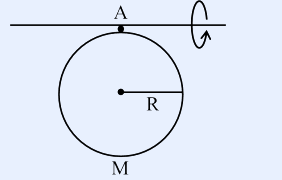
![Rectangular container divided vertically by a semipermeable membrane labeled AB. Left compartment labeled 'side x' contains 0.1 M, 1 L K4[Fe(CN)6]; right compartment labeled 'side y' contains 0.1 M, 1 L FeCl3.](/api/qna-image?path=QnA%2Fb65cda62-f924-480b-b4db-1d3aaa6069d4%2F5ef15551-aed6-4f93-a8d5-a219b7a5d19b%2F05ed8d75-0c0a-4d6a-82f3-77ddd4732ca6%2F05ed8d75-0c0a-4d6a-82f3-77ddd4732ca6%2Fimages%2FQ54_diagram.webp)
![Plot of [R] (mol L^-1) on the y-axis vs t/s on the x-axis starting from a common initial concentration [R]_0. Three curves labelled 1, 2, 3 decrease with time; curve 1 is a straight line (zero order), curve 2 is an exponential decay (first order), and curve 3 is a slower decay (second order or higher) below curves 1 and 2.](/api/qna-image?path=QnA%2Fb65cda62-f924-480b-b4db-1d3aaa6069d4%2F5ef15551-aed6-4f93-a8d5-a219b7a5d19b%2F05ed8d75-0c0a-4d6a-82f3-77ddd4732ca6%2F05ed8d75-0c0a-4d6a-82f3-77ddd4732ca6%2Fimages%2FQ63_concentration_vs_time.webp)
JEE Main 2026 April 04, Shift 2 Question Paper with Solutions
All 75 questions from the JEE Main 2026 (April 04, Shift 2) shift — Physics (25), Chemistry (25) and Mathematics (25) — each with the correct answer (answer key) and a step-by-step solution. Read it free online, or attempt the full paper as a timed mock test.
Physics25 questions
Q26Single correctUnits and Measurements
Match the LIST-I with LIST-II
| List-I | List-II |
|---|---|
| A. Planck's constant | I. |
| B. Stopping potential | II. |
| C. Work function | III. |
| D. Threshold frequency | IV. |
(1)
(2)
(3)
(4)
SolutionAnswer: Option 1A-III, B-IV, C-I, D-II
Approach:
Derive the dimensional formula of each List-I quantity and match with List-II.
Step 1:From , the dimension of Planck's constant equals energy divided by frequency.
Step 2:Stopping potential carries the dimension of electric potential; substituting charge as .
Step 3:Work function is an energy quantity.
Step 4:Threshold frequency is a frequency, with the dimension of inverse time.
Final answer: A-III, B-IV, C-I, D-II
Q27Single correctKinematics
Two cars A and B are moving in the same direction along a straight line with speeds 100km/h and 80km/h, respectively such that car A is moving ahead of car B. A person in car B throws a stone with a speed v so that it hits the car A with a speed of 5m/s. The value of v is ____ km/h.
(1)
(2)
(3)
(4)
SolutionAnswer: Option 338
Approach:
Apply one-dimensional relative-velocity analysis along the line of travel and convert the impact speed into the same unit (km/h).
Step 1:Set the forward direction (B toward A) as positive. The stone is thrown from B with speed v relative to B, so its ground speed becomes km/h.
Step 2:Compute the speed of the stone relative to car A by subtracting A's ground speed.
Step 3:Convert the impact speed to km/h: , and equate.
Final answer: 38
Q28Single correctLaws of Motion
At t = 0, a body of mass 100 g starts moving under the influence of a force from the origin. After 2 s its position is . The ratio x : y is ____ .
(1)
(2)
(3)
(4)
SolutionAnswer: Option 45 : 4
Approach:
Compute the constant acceleration from , find the position vector at s using (rest start at origin), and match component-wise.
Step 1:Convert mass to SI and compute acceleration with kg.
Step 2:Substitute s into starting from rest at the origin.
Step 3:Equate components with : ; .
Final answer: 5 : 4
Q29Single correctKinematics
If x and y coordinates of a projectile as a function of time (t) are given as and , respectively, then the angle (in degrees) made by the projectile with horizontal when t = 2s is ____ .
(1)
(2)
(3)
(4)
SolutionAnswer: Option 245
Approach:
Differentiate the position coordinates to obtain velocity components, evaluate at s, and apply .
Step 1:Differentiate and with respect to t.
Step 2:Substitute s.
Step 3:Apply the direction relation.
Final answer: 45
Q30Single correctGravitation
The height in terms of radius of the earth (R), at which the acceleration due to gravity becomes , where g is acceleration due to gravity on earth's surface, is
(1)
(2)
(3)
(4)
SolutionAnswer: Option 3
Approach:
Apply the altitude variation of g, , and solve for h.
Step 1:Set in the altitude formula.
Step 2:Cancel and take the positive square root.
Step 3:Solve for .
Final answer:
Q31Single correctProperties of Solids and Liquids
A metal string A is suspended from a rigid support and its free end is attached to a block of mass M. Second block having mass 2M is suspended at the bottom of the first block using a string B. The area of cross sections of strings A and B are same. The ratio of lengths of strings of A to B is 2 and the ratio of their Young's moduli () is 0.5. The ratio of elongations in A to B is ____ .
(1)
(2)
(3)
(4)
SolutionAnswer: Option 46
Approach:
Compute the tension in each string from free-body considerations, then apply and form the ratio.
Step 1:String A supports both blocks, so its tension is . String B supports only the lower block, so .
Step 2:Write the ratio using equal cross-sectional areas.
Step 3:Substitute and (so ).
Final answer: 6
Q32Single correctProperties of Solids and Liquids
A water spray gun is attached to a hose of cross sectional area . The gun comprises of 10 perforations each of cross sectional area . If the water flows in the hose with the speed of , calculate the speed at which the water flows out from each perforation. (Neglect any edge effects)
(1)
(2)
(3)
(4)
SolutionAnswer: Option 210 m/s
Approach:
Apply the continuity equation for incompressible flow; the total outlet area equals 10 times the area of a single perforation.
Step 1:Convert areas to a common unit. Hose area: . Total perforation area: .
Step 2:Convert hose speed: , then apply continuity for the exit speed.
Step 3:Since the perforations are identical, each outlet carries the same speed.
Final answer: 10 m/s
Q33Single correctKinetic Theory of Gases
Given below are two statements: one is labelled as Assertion A and the other is labelled as Reason R
Assertion A: If the average kinetic energy of and molecules, kept in two different sized containers are same, then their temperatures will be same.
Reason R: The r.m.s. speed of and molecules are same at same temperature.
Choose the correct answer from the options given below
Assertion A: If the average kinetic energy of and molecules, kept in two different sized containers are same, then their temperatures will be same.
Reason R: The r.m.s. speed of and molecules are same at same temperature.
Choose the correct answer from the options given below
(1)
(2)
(3)
(4)
SolutionAnswer: Option 3A is true but R is false
Approach:
Evaluate A via the equipartition result and evaluate R via the mass-dependent formula .
Step 1:Assertion A: Average translational kinetic energy depends only on temperature (and is independent of mass or container size). Hence equal for and forces equal T. A is TRUE.
Step 2:Reason R: RMS speed scales as . With molar masses and , the ratio at common T is , so the rms speeds are not equal. R is FALSE.
Step 3:Combining the two evaluations yields the correct option: A is true but R is false.
Final answer: A is true but R is false
Q34Single correctProperties of Solids and Liquids
The temperature of a metal strip having coefficient of linear expansion is increased from to resulting in increase of its length by . The temperature is further increased from to such that the increase in its length is . Given and , the value of is
(1)
(2)
(3)
(4)
SolutionAnswer: Option 4
Approach:
Apply linear thermal expansion successively, using the already-expanded length as the base for the second expansion.
Step 1:From , rearrange to obtain . Hence both temperature increments are equal.
Step 2:First expansion from initial length L: . The new length is ; the second expansion uses this length.
Step 3:Expand and substitute .
Final answer:
Q35Single correctOscillations and Waves
A uniform disc of radius R and mass M is free to oscillate about the axis A as shown in the figure. For small oscillations the time period is ____ . (g is acceleration due to gravity)
(1)
(2)
(3)
(4)
SolutionAnswer: Option 1
Approach:
Model the disc as a physical pendulum oscillating about a horizontal tangent in the plane of the disc through the topmost point. Apply the parallel-axis theorem to find the moment of inertia and use the physical-pendulum time-period formula.
Step 1:Identify the geometric quantities. The pivot axis A is tangent to the disc at the topmost point and lies in the plane of the disc, so the distance from the centre of mass to the axis is .
Step 2:Apply the parallel-axis theorem starting from the diameter through the centre (which is parallel to the tangent axis). The moment of inertia about this tangent axis is
Step 3:Insert and into the physical-pendulum formula and simplify.
Final answer:
Q36Single correctElectrostatics
A rigid dipole undergoes a simple harmonic motion about its centre in the presence of an electric field . If another electric field is introduced to the system, what will be the percentage change in the frequency of the oscillation (approximate)?
(1)
(2)
(3)
(4)
SolutionAnswer: Option 173%
Approach:
Use the small-oscillation angular frequency of a rigid dipole, , with E the magnitude of the net uniform field; compute the percentage change from to .
Step 1:With only , the initial angular frequency satisfies .
Step 2:After adding , the net field is with magnitude
Step 3:Take the ratio of new to old angular frequencies (with and unchanged).
Step 4:Compute the percentage change in frequency.
Final answer: 73%
Q37Single correctElectrostatics
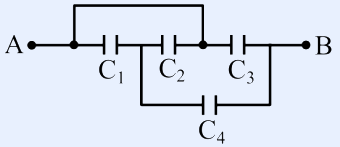
From the circuit given below, the capacitance between terminals A and B shown in the circuit is _____ . (take and )
(1)
(2)
(3)
(4)
SolutionAnswer: Option 27/2
Approach:
Reduce the network in stages: combine the series branch ( and ) first, add the parallel , then add the parallel across A-B.
Step 1:Combine and in the upper branch (series).
Step 2: is in parallel with the branch between A and B.
Step 3:Finally is in parallel with across the terminals A-B.
Final answer: 7/2
Q38Single correctElectrostatics
Given below are two statements: one is labelled as Assertion A and the other is labelled as Reason R
Assertion A: In electrostatics, a conductor does not store any net charge inside.
Reason R: Inside the capacitor (with no dielectric medium), the free charge carriers, if placed between the plates of capacitor, experience force and drift.
Choose the correct answer from the options given below
Assertion A: In electrostatics, a conductor does not store any net charge inside.
Reason R: Inside the capacitor (with no dielectric medium), the free charge carriers, if placed between the plates of capacitor, experience force and drift.
Choose the correct answer from the options given below
(1)
(2)
(3)
(4)
SolutionAnswer: Option 2Both A and R are true but R is NOT the correct explanation of A
Approach:
Evaluate the truth value of A using electrostatic equilibrium and Gauss's law, evaluate R using the Coulomb force on a free charge in the inter-plate field, then test whether R logically explains A.
Step 1:Assertion A: In electrostatic equilibrium, everywhere inside a conductor. Applying Gauss's law to any closed surface drawn entirely inside the conductor gives . Hence no net charge resides in the interior; all excess charge sits on the surface. A is TRUE.
Step 2:Reason R: Between the plates of a charged parallel-plate capacitor (vacuum), a uniform field is present. Any free charge placed in this region experiences and drifts toward the oppositely charged plate. R is TRUE.
Step 3:Causal evaluation: A refers to the absence of net charge inside the bulk of a conductor (a result of electrostatic equilibrium inside material), while R refers to the motion of free charges in the empty inter-plate region of a capacitor. The two statements describe different physical systems; R does not provide the cause of A.
Final answer: Both A and R are true but R is NOT the correct explanation of A
Q39Single correctMagnetic Effects of Current and Magnetism
A solenoid has a core made of material with relative permeability 400. The magnetic field produced in the interior of solenoid is 1.0 T. The magnetic intensity in SI units is . The value of is ___. (Free space permeability SI units.)
(1)
(2)
(3)
(4)
SolutionAnswer: Option 2
Approach:
Apply the constitutive relation inside the magnetic medium and solve for H.
Step 1:Given: interior magnetic field , relative permeability , and . Target: magnetic intensity H expressed as .
Step 2:Rearrange the constitutive relation for .
Step 3:Substitute the numerical values into the denominator.
Step 4:Bring the factor of into the numerator and cast in the prescribed form.
Final answer:
Q40Single correctElectromagnetic Waves
A magnetic field vector in an electromagnetic wave is represented by . Its associated electric field vector is _____ .
(1)
(2)
(3)
(4)
SolutionAnswer: Option 1
Approach:
Identify the propagation direction from the wave's phase, use for the amplitude, and fix the sign so that points along the propagation direction.
Step 1:Given: . The phase with corresponds to propagation along .
Step 2:By the E-B amplitude relation, the electric-field amplitude is and , hence .
Step 3:Transverse condition: is perpendicular to both and , so .
Step 4:Choosing : , which matches . Hence the sign in front of the amplitude is negative.
Step 5:Combine amplitude, direction, and the same phase as .
Final answer:
Q41Single correctOptics
A convex lens is made from glass material having refractive index of 1.4 with same radius of curvature on both sides. The ratio of its focal length and radius of curvature is ___ .
(1)
(2)
(3)
(4)
SolutionAnswer: Option 41.25
Approach:
Apply the lensmaker's formula to a symmetric biconvex lens with both surface radii of equal magnitude.
Step 1:Given: refractive index , both surface radii equal in magnitude to . Target: ratio .
Step 2:By the Cartesian sign convention for a symmetric biconvex lens, the first (convex toward incident light) surface has , and the second has .
Step 3:Substitute the radii into the curvature factor.
Step 4:Plug and the curvature factor into the lensmaker's equation.
Step 5:Invert to obtain and form the ratio .
Final answer: 1.25
Q42Single correctOptics
An unpolarized light of certain intensity passes through a combination of two polarizers whose transmission axes are at 30º and 90º, respectively, with respect to the horizontal axis. A third polarizer with its transmission axis at 60º with the horizontal axis is placed between the two existing polarizers. The ratio of the output intensities with and without the third polarizer is ____ .
(1)
(2)
(3)
(4)
SolutionAnswer: Option 39/4
Approach:
Compute the transmitted intensity in both configurations (two-polarizer and three-polarizer) using Malus's law sequentially, then take the ratio.
Step 1:Given: incident unpolarized intensity . Polarizer axes (with respect to horizontal): at , at , optional middle at . Target: .
Step 2:Configuration without : after the intensity is . The angle between () and () is .
Step 3:Configuration with inserted: after the intensity is again . The angle between () and () is .
Step 4:Light is now polarized along the axis. The angle between () and () is , so Malus's law gives the final intensity.
Step 5:Form the requested ratio.
Final answer: 9/4
Q43Single correctAtoms and Nuclei
In Rutherford's alpha-particle scattering experiment, only a few alpha particles rebound back because
A. The size of gold nucleus is very small as compared to the size of gold atom.
B. Alpha particle and gold nucleus have equal charge.
C. The impact parameter is minimum for a few alpha particles.
D. A few alpha particles have very high kinetic energy.
E. Only a few alpha particles undergo head-on collision with the nuclei.
Choose the correct answer from the options given below:
A. The size of gold nucleus is very small as compared to the size of gold atom.
B. Alpha particle and gold nucleus have equal charge.
C. The impact parameter is minimum for a few alpha particles.
D. A few alpha particles have very high kinetic energy.
E. Only a few alpha particles undergo head-on collision with the nuclei.
Choose the correct answer from the options given below:
(1)
(2)
(3)
(4)
SolutionAnswer: Option 4A, C, E Only
Approach:
Evaluate each statement (A–E) against Rutherford's experimental conclusions and the geometry of Coulomb scattering.
Step 1:Given: Rutherford's observation that only a small fraction of incident alphas rebound through angles near . Target: identify which of A–E correctly explain this.
Step 2:Statement A: the gold nucleus radius is while the atomic radius is , a ratio of . Hence most alphas pass through almost empty space; only those approaching the tiny nucleus suffer large-angle scattering. TRUE.
Step 3:Statement B: alpha particle charge is and the gold nucleus charge is ; they are not equal. FALSE.
Step 4:Statement C: large scattering angles occur for very small impact parameters ; since is a continuous variable, only a small fraction of the geometric cross-section corresponds to nearly head-on trajectories. TRUE.
Step 5:Statement D: the alpha source (e.g. ) emits alphas of essentially fixed kinetic energy. Variation in KE is not the cause of rebound. FALSE.
Step 6:Statement E: head-on collisions () correspond to a vanishingly small geometric cross-section, so only a small fraction of alphas rebound near . TRUE.
Step 7:Combine the verdicts: A, C, E are correct; B, D are incorrect.
Final answer: A, C, E Only
Q44Single correctDual Nature of Matter and Radiation
The de Broglie wavelength associated with an electron accelerated through a potential difference V is and the de Broglie wavelength associated with a proton accelerated through the same potential difference is . If their corresponding masses are and , respectively, then the ratio of their de Broglie wavelengths is _____ .
(1)
(2)
(3)
(4)
SolutionAnswer: Option 1
Approach:
Use the de Broglie wavelength of a charged particle accelerated through a potential difference V: , with for both particles, then take the ratio.
Step 1:Given: electron and proton accelerated through the same potential difference V; charge magnitudes are . Target: ratio .
Step 2:Both particles acquire the same kinetic energy upon acceleration.
Step 3:Express momentum from kinetic energy, then substitute into the de Broglie relation to obtain as a function of mass.
Step 4:Write and explicitly.
Step 5:Divide and simplify.
Final answer:
Q45Single correctElectronic Devices
Given below are two statements: one is labelled as Assertion A and the other is labelled as Reason R
Assertion A: A diode under reverse-biased condition provides very small current which is nearly independent of voltage until a critical limit at which the current increases drastically.
Reason R: Below the critical voltage limit, only majority charge carriers flow which increases drastically above critical voltage.
choose the correct answer from the options given below
Assertion A: A diode under reverse-biased condition provides very small current which is nearly independent of voltage until a critical limit at which the current increases drastically.
Reason R: Below the critical voltage limit, only majority charge carriers flow which increases drastically above critical voltage.
choose the correct answer from the options given below
(1)
(2)
(3)
(4)
SolutionAnswer: Option 3A is true but R is false
Approach:
Independently evaluate the physical correctness of Assertion A (reverse-bias I–V behaviour) and Reason R (carrier type responsible for the reverse current).
Step 1:Given: a p–n junction diode in reverse bias. Target: assess A and R.
Step 2:Assertion A: under reverse bias, the depletion width grows and the barrier blocks majority-carrier diffusion; only a small saturation current flows, almost independent of , until the breakdown (critical) voltage where the current rises sharply. TRUE.
Step 3:Reason R: the small reverse current is carried by MINORITY charge carriers — thermally generated electrons in the p-side and holes in the n-side — which are swept across the junction by the reverse field. Majority carriers are blocked by the widened barrier.
Step 4:Beyond the sharp rise is due to avalanche multiplication and/or Zener tunnelling of carriers across the junction, not the onset of majority-carrier conduction as R asserts.
Step 5:Combining: A is true and R is false.
Final answer: A is true but R is false
Q46NumericalElectronic Devices
A diode has Zener voltage of 10 V and maximum power dissipation of 0.5 W, then the minimum resistance to be used in series with this diode for safety when it is connected to a 25 V power supply is ____.
SolutionAnswer: 300
Approach:
Find the maximum permitted Zener current from its power rating, then apply Ohm's law to the series resistor that must drop .
Step 1:Given: , , . Target: minimum series resistance that keeps .
Step 2:Maximum allowable Zener current from the power rating.
Step 3:With the diode clamped at , the series resistor must drop the remaining voltage.
Step 4:Smaller means larger current; the minimum corresponds to the maximum allowed current.
Final answer: 300
Q47NumericalKinematics
A gun mounted on the ground fires bullets in all directions with same speed. The farthest distance the bullets could reach is 6.4 m. The speed of the bullets from the gun is ______ m/s. (take )
SolutionAnswer: 8
Approach:
Identify the farthest reachable distance on the ground with the maximum projectile range, obtained at a launch angle of .
Step 1:Given: bullets are fired in all directions with the same speed u; the farthest distance reached on the ground is and . Target: the speed u.
Step 2:For fixed u, the horizontal range is maximised when , i.e. .
Step 3:Equate the given farthest distance to and solve for .
Step 4:Take the positive square root for the muzzle speed.
Final answer: 8
Q48NumericalMagnetic Effects of Current and Magnetism
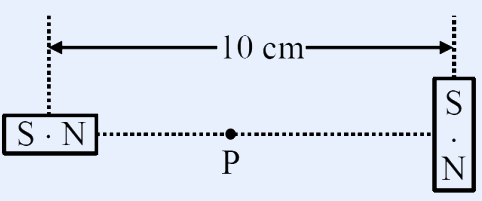
Two identical small bar magnets each of dipole moment are placed at a center to center separation of 10 cm , with their axes perpendicular to each other as shown in figure. The value of magnetic field at the point P midway between the magnets is T. The value of is ___ . ()
SolutionAnswer: 12
Approach:
Treat each bar magnet as an ideal dipole. P lies on the axial line of magnet 1 and on the equatorial line of magnet 2; compute the two field magnitudes, identify that the two contributions are mutually perpendicular, and combine vectorially.
Step 1:Given: dipole moment , centre-to-centre separation , axes mutually perpendicular as per the figure. Midpoint P is at from each magnet. Also . Target: such that the net field at P equals .
Step 2:From the figure, magnet 1 has its axis along the line joining the centres, so P lies on its axial line. Magnet 2's axis is perpendicular to that line, so P lies on its equatorial line.
Step 3:Axial-field magnitude at P from magnet 1.
Step 4:Equatorial-field magnitude at P from magnet 2.
Step 5: is directed along the line of centres (parallel to magnet 1's axis). The equatorial field of an ideal dipole points anti-parallel to its moment, so is directed along magnet 2's axis, which is perpendicular to the line of centres. Hence the two contributions are mutually perpendicular.
Step 6:Combine by Pythagoras.
Step 7:Compare with the prescribed form .
Final answer: 12
Q49NumericalMagnetic Effects of Current and Magnetism
A circular coil of radius 2 cm and 125 turns carries a current of 1 A. The coil is placed in a uniform magnetic field of magnitude 0.4 T. The axis of the coil makes an angle of with the direction of the magnetic field. The torque acting on the coil is N.m. The value of is ____ . ()
SolutionAnswer: 314
Approach:
Use , where the magnetic moment is along the coil's axis; the angle between and equals the stated .
Step 1:Given: , , , , (between coil axis and ), . Target: where .
Step 2:Compute the cross-sectional area of one turn.
Step 3:Magnetic moment magnitude is directed along the coil axis, so the angle between and is the given .
Step 4:Substitute into the torque formula with .
Step 5:Recast in the prescribed form.
Final answer: 314
Q50NumericalOptics
In a double slit experiment, when one of the slits is covered by a transparent mica sheet of refractive index 1.56, the central fringe shifts to the position of bright fringe, obtained with both slits uncovered. If the light source wavelength is 450 nm, the thickness of mica sheet is m. The value of is ______.
SolutionAnswer: 5625
Approach:
Equate the lateral fringe shift caused by introducing a thin transparent sheet over one slit to seven fringe widths; the geometric factor cancels.
Step 1:Given: refractive index of the mica sheet , wavelength , central maximum shifts to the position of the bright fringe of the unaltered pattern, so . Target: thickness t expressed as .
Step 2:Inserting a sheet of refractive index and thickness t adds an extra optical path of to the path through that slit. The fringe pattern shifts by , while one fringe spacing is .
Step 3:Setting the shift equal to fringe widths gives the working equation; has cancelled, so the result is independent of the slit-to-screen geometry.
Step 4:Solve for the thickness .
Step 5:Convert to the prescribed form.
Final answer: 5625
Chemistry25 questions
Q51Single correctSome Basic Concepts in Chemistry
The correct order of total number of atoms present in (A) 2 moles of cyclohexane (B) 684 g of sucrose (C) 90.8 L of dihydrogen at STP is :
(1)
(2)
(3)
(4)
SolutionAnswer: Option 4
Approach:
Convert each quantity to moles, multiply by atoms per molecule and Avogadro number, then order the totals.
Step 1:Given: (A) 2 mol cyclohexane (18 atoms per molecule); (B) 684 g sucrose (molar mass 342 g mo, 45 atoms per molecule); (C) 90.8 L of at STP (2 atoms per molecule). Target: order of total atoms.
Step 2:Atoms in (A).
Step 3:Moles of sucrose in (B) and corresponding atoms.
Step 4:Moles of in (C) and corresponding atoms.
Step 5:Order the three totals.
Final answer:
Q52Single correctAtomic Structure
The species having identical radii according to the Bohr's theory are: A. H (first orbit) B. He (first orbit) C. He (Second orbit) D. L (first orbit) E. B (Second orbit) Choose the correct answer from the options given below:
(1)
(2)
(3)
(4)
SolutionAnswer: Option 2A and E Only
Approach:
Apply Bohr's orbit radius formula to each hydrogen-like species and identify pairs with equal radii.
Step 1:Given species and their (n, Z) values: A: H (1, 1); B: He (1, 2); C: He (2, 2); D: L (1, 3); E: B (2, 4). Target: identify pairs with identical Bohr radii.
Step 2:Compute for A.
Step 3:Compute for B.
Step 4:Compute for C.
Step 5:Compute for D.
Step 6:Compute for E.
Step 7:Compare radii to find the matching pair.
Final answer: A and E Only
Q53Single correctChemical Bonding and Molecular Structure
Which of the following pictorial diagram most correctly represents the ( antibonding) molecular orbital between two atoms if the internuclear axis is taken to be in the z-direction () ?
(1)
(2)
(3)
(4)
SolutionAnswer: Option 3Pi-antibonding () molecular orbital: two p-orbital lobes on each atom oriented perpendicular to the z internuclear axis with opposite phases on the two atoms (nodal plane between the nuclei perpendicular to the bond axis).
Approach:
Apply symmetry rules of LCAO-MO: identify the diagram whose lobes lie perpendicular to the internuclear axis and carry opposite phases on the two atoms.
Step 1:Given: internuclear axis is the z-direction; target is the MO. Pi MOs arise from sideways overlap of or orbitals (perpendicular to z).
overlap
Step 2:Bonding : in-phase combination, lobes of the same sign on the two atoms, no nodal plane between nuclei. Antibonding : out-of-phase combination, lobes of opposite sign on the two atoms, an additional nodal plane perpendicular to z lies between the nuclei.
Step 3:Match the four diagrams to MO symmetry. Option 1 (single spherical lobe) is bonding; option 2 (same-sign side lobes, no node between atoms) is bonding; option 4 (two end-on p lobes with a node along z between nuclei) is ; option 3 (perpendicular lobes, opposite sign on either atom, node between nuclei) is .
Final answer: Pi-antibonding () molecular orbital: two p-orbital lobes on each atom oriented perpendicular to the z internuclear axis with opposite phases on the two atoms (nodal plane between the nuclei perpendicular to the bond axis).
Q54Single correctSolutions
At , aqueous solution and aqueous solution are placed in a container separated by a semi permeable membrane AB. Assume complete dissociation of both the solutes. Which of the following statement is correct?
(1)
(2)
(3)
(4)
SolutionAnswer: Option 3Solution on side '' is hypotonic.
Approach:
Compute the van't Hoff factor and effective particle concentration on each side; assign hypertonic/hypotonic on that basis and then refute the remaining statements.
Step 1:Given: side x has 0.1 M , side y has 0.1 M at the same temperature 27 C; assume complete dissociation. Target: identify the correct statement.
Step 2:Dissociation on side x produces 5 ions per formula unit.
Step 3:Dissociation on side y produces 4 ions per formula unit.
Step 4:Compare osmotic pressures via at common T. Since , . By definition, the side with lower osmotic pressure is hypotonic.
Step 5:Refute the other options. (1) Prussian-blue formation requires the and to mix; the semipermeable membrane blocks ions, so no colour forms on either side. (2) Ions are solute particles which a semipermeable membrane explicitly blocks. (4) Reverse osmosis requires an external pressure greater than the osmotic pressure difference applied on the hypertonic (concentrated) side x; an arbitrary 'any value' does not suffice, so the statement is wrong.
Final answer: Solution on side '' is hypotonic.
Q55Single correctEquilibrium
20 mL of a solution of acetic acid required 28.4 mL of 0.1 M NaOH for its neutralization. A solution (X) was prepared by mixing 20 mL of the above acetic acid and 14.2 mL of 0.1 M NaOH solution. What is the pH of the solution (X) ? value of acetic acid is 4.75).
(1)
(2)
(3)
(4)
SolutionAnswer: Option 24.75
Approach:
Determine moles of acid and added base; recognise the half-neutralisation buffer and apply Henderson-Hasselbalch.
Step 1:Given: 20 mL acetic acid is fully neutralised by 28.4 mL of 0.1 M NaOH; in solution X, 20 mL of the same acid is mixed with 14.2 mL of 0.1 M NaOH; . Target: pH of X.
Step 2:Compute moles of NaOH added in X.
Step 3:NaOH converts an equal mole of acid into the conjugate salt. Remaining acid = 2.84 - 1.42 = 1.42 mmol; salt formed = 1.42 mmol.
Step 4:Substitute the ratio into Henderson-Hasselbalch.
Final answer: 4.75
Q56Single correctSome Basic Principles of Organic Chemistry
Match the LIST-I with LIST-II
| List-I (Reaction) | List-II (Mechanism) |
|---|---|
| A. Williamson Synthesis | I. Electrophilic addition |
| B. Friedel Craft Reaction | II. Free radical substitution |
| C. Bromination of vinyl benzene | III. Nucleophilic substitution |
| D. Chlorination of toluene in light | IV. Electrophilic substitution |
(1)
(2)
(3)
(4)
SolutionAnswer: Option 3A-III, B-IV, C-I, D-II
Approach:
Classify each named reaction by its mechanistic family using the rate-determining elementary step.
Step 1:List the four reactions and four mechanism categories. Target: assign each reaction to its mechanism class.
Step 2:A. Williamson ether synthesis proceeds by an alkoxide nucleophile attacking an alkyl halide in 2 fashion. Hence A pairs with III (Nucleophilic substitution).
Step 3:B. Friedel-Crafts alkylation/acylation generates an electrophile ( or ) that substitutes an aromatic ring hydrogen via an arenium intermediate. Hence B pairs with IV (Electrophilic substitution).
Step 4:C. Bromination of vinyl benzene () targets the alkene C=C, where adds across the double bond through a bromonium intermediate. Hence C pairs with I (Electrophilic addition).
Step 5:D. Photochlorination of toluene proceeds at the benzylic C-H by a chain mechanism initiated by radicals. Hence D pairs with II (Free radical substitution).
Step 6:Combine pairings.
Final answer: A-III, B-IV, C-I, D-II
Q57Single correctClassification of Elements and Periodicity in Properties
The ionization enthalpy for Mg is . The most probable estimated value of the ionization enthalpy of Mg is ______ .
(1)
(2)
(3)
(4)
SolutionAnswer: Option 3
Approach:
Use the universal rule that successive ionization enthalpies increase () due to the rising effective nuclear charge on the residual cation; eliminate options inconsistent with this rule.
Step 1:Given: ; both first and second ionizations remove electrons from the 3s subshell since Mg has configuration . Target: estimate .
Step 2:Removing the second electron from a cation requires more energy than removing the first from a neutral atom because the residual nuclear pull is stronger. Therefore . This immediately rejects option (4) at 590 kJ/mol (smaller than ).
Step 3:Empirically, the increase from to within the same outer subshell is by a factor of 1.8-2.0 for group 2 metals. Options (1) 906 and (2) 856 kJ/mol fall only about 1.15-1.23 times , which is too small for removal of a second 3s electron from a +1 cation; option (3) 1450 kJ/mol () is consistent.
Step 4:Match to the available option.
Final answer:
Q58Single correctp-Block Elements
The electronegativity of a group 13 element ' E ' is same as that of Ge (on Pauling scale and upto one decimal point). The CORRECT statements about are A. It can act as a reducing agent. B. It can act as an oxidizing agent. C. is more stable than . D. The standard electrode potential value for is positive. Choose the correct answer from the options given below:
(1)
(2)
(3)
(4)
SolutionAnswer: Option 3B and D Only
Approach:
Match Ge's Pauling electronegativity ( to 1 d.p.) to the only group 13 element with the same value, then deduce the stability of via the inert-pair effect and evaluate the sign of .
Step 1:Given: to 1 d.p. Among group 13 elements (B 2.0, Al 1.5, Ga 1.8, In 1.8, Tl 2.0 - revised Pauling), Tl shares 2.0 with Ge. Target: assess the four statements for .
Step 2:Inert-pair effect makes the pair reluctant to ionize, so (which retains the pair) is more stable than . Therefore tends to gain two electrons to become , behaving as an oxidising agent. Statement B is TRUE; statement C ( more stable than ) is FALSE; statement A ( a reducing agent) is FALSE because a species being reduced cannot itself reduce.
Step 3:Standard reduction potential of is positive ( V tabulated), reflecting that reduction of to metallic Tl is thermodynamically favoured. Statement D is TRUE.
Step 4:Combine the truth values.
true; false
Final answer: B and D Only
Q59Single correctd- and f-Block Elements
Pairs of elements with the same number of electrons in their respective 4 f orbital are [Atomic number. Eu-63, Gd-64, Dy-66, Ho-67, Tm-69, Yb-70, Lu-71, Hf-72] A. (Eu and Gd) B. (Dy and Ho) C. (Yb and Hf) D. (Lu and Tm) Choose the correct answer from the options given below:
(1)
(2)
(3)
(4)
SolutionAnswer: Option 4A and C Only
Approach:
Write each ground-state configuration, count the 4f population (with the Gd and Lu half/full-filled exceptions), and compare within each pair.
Step 1:List the ground-state 4f populations using atomic numbers and standard exceptions. Eu(63): ; Gd(64): ; Dy(66): ; Ho(67): ; Tm(69): ; Yb(70): ; Lu(71): ; Hf(72): .
Step 2:Pair A (Eu, Gd): both have 7 4f electrons. MATCH.
Step 3:Pair B (Dy, Ho): 10 vs 11. NO MATCH.
Step 4:Pair C (Yb, Hf): both have 14 4f electrons.
Step 5:Pair D (Lu, Tm): 14 vs 13. NO MATCH.
Step 6:Combine: A and C only satisfy the condition.
Final answer: A and C Only
Q60Single correctCoordination Compounds
Consider the metal complexes and . Choose the CORRECT option by considering the number of unpaired electrons present in (A), (B) and (C) respectively and the order of frequency of absorption.
(1)
(2)
(3)
(4)
SolutionAnswer: Option 12, 2, 2 and
Approach:
Determine geometry and d-electron filling of each N () complex to count unpaired electrons; order absorption frequency using and the spectrochemical series.
Step 1:Given: three N complexes A , B , C . N has in every case. Target: unpaired-electron counts and frequency order.
Step 2:A is octahedral with en (bidentate, moderately strong field). For octahedral filling, regardless of high/low spin the two orbitals each carry one electron, giving 2 unpaired.
Step 3:B is tetrahedral (4-coordinate with C weak field). tetrahedral: , giving 2 unpaired.
Step 4:C is octahedral with N. Same analysis: 2 unpaired.
Step 5:Order frequencies. Spectrochemical strengths: , so . Tetrahedral field gives , the smallest splitting. Frequency .
Step 6:Combine results.
Final answer: 2, 2, 2 and
Q61Single correctChemical Bonding and Molecular Structure
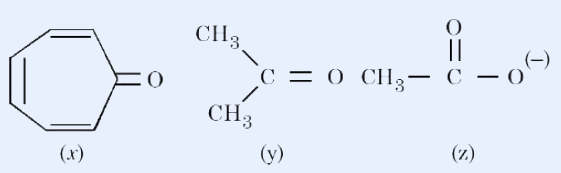
Consider the following molecules/species: (x) cycloheptatrienone (tropone), (y) acetone , (z) acetate ion . The correct order of carbon - oxygen double bond length is :
(1)
(2)
(3)
(4)
SolutionAnswer: Option 4
Approach:
Estimate effective C-O bond order in each species from resonance contributions; smaller bond order corresponds to longer bond length.
Step 1:Identify the three carbonyl systems. (x) tropone is a 7-membered cycloheptatrienone whose C=O conjugates with three ring C=C, generating an aromatic tropylium () resonance form with . (y) acetone has an isolated C=O. (z) acetate ion delocalises the negative charge symmetrically between two oxygens.
Step 2:Estimate effective C-O bond orders. For tropone, the aromatic resonance structure carries pronounced weight (it satisfies with ), so the C-O is between single and double, bond order well below 1.5. For acetate, the two equivalent resonance structures give an exact 1.5 bond order to each C-O. For acetone, no resonance lengthens the C=O, so bond order is 2.
Step 3:Convert bond orders to lengths using the inverse relationship.
Step 4:Match to the option list.
Final answer:
Q62Single correctd- and f-Block Elements
Consider is the difference in oxidation states of Mn in highest manganese fluoride and highest manganese oxide. The ions with number of unpaired electrons from the following are: A. B. C. D. E. Choose the correct answer from the options given below:
(1)
(2)
(3)
(4)
SolutionAnswer: Option 3C and E Only
Approach:
Determine from the highest Mn oxidation state in the fluoride () versus the highest in the oxide (); then pick ions with exactly that many unpaired d-electrons.
Step 1:Given facts about manganese: the highest binary manganese fluoride is (Mn in +4); the highest manganese oxide is (Mn in +7). Target: and the ions with that many unpaired electrons.
Step 2:Compute d-electron configurations of the listed ions. : (0 unpaired). : (0 unpaired).
Step 3:: - three singly occupied orbitals. (free ion, high spin): - one paired plus four unpaired = 4 unpaired. : - two paired plus three unpaired = 3 unpaired.
Step 4:Select ions matching .
Final answer: C and E Only
Q63Single correctChemical Kinetics
Consider the given graph showing variation of reactant concentration with time. Three different reactions were started with identical initial concentration of reactants. Which of the following statement is correct?
(1)
(2)
(3)
(4)
SolutionAnswer: Option 2The rate constant of reaction 3 is larger than the rate constant of reaction 2 if the order of reaction is same for both.
Approach:
Read the relative position of the three [R]-vs-t curves to identify which reaction decays fastest, then test each statement against the integrated rate laws and the units of .
Step 1:Given: three reactions with the same starting concentration ; curve 1 lies on top (slowest reactant loss), curve 2 in the middle, curve 3 at the bottom (fastest reactant loss) on the [R]-vs-t plot. Target: identify the only true statement.
Step 2:Evaluate statement (1). The three curves have visibly different shapes (line versus curved decays of different curvatures), so they cannot all have the same order. FALSE.
Step 3:Evaluate statement (3). Curve 1, being a straight line, corresponds to zero order; its rate constant has units , not . FALSE.
Step 4:Evaluate statement (4). Decomposition of HI on a hot gold surface is the textbook example of a zero-order surface reaction (saturated catalyst surface), corresponding to curve 1, not curve 2. FALSE.
Step 5:Evaluate statement (2). Suppose hypothetically reactions 2 and 3 had the same order n and the same initial concentration. From each integrated rate law, and depend monotonically on k; greater k produces a steeper drop, hence smaller [R] at every . Since curve 3 lies below curve 2, the conditional implication 'same order ' holds for every n. TRUE.
Step 6:Only statement (2) survives; it is the answer.
Final answer: The rate constant of reaction 3 is larger than the rate constant of reaction 2 if the order of reaction is same for both.
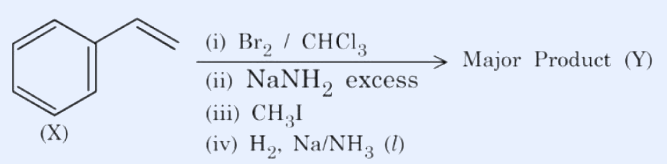
Q64Single correctHydrocarbons
Compound (X) is subjected to the sequence of reactions as shown above. Molar mass of the major product (Y) formed is ______ . (Given molar mass in ) Reagents: (i) , (ii) excess, (iii) , (iv) .
(1)
(2)
(3)
(4)
SolutionAnswer: Option 2118
Approach:
Sequentially apply each reagent to styrene, identify the final hydrocarbon Y, and compute its molar mass from atomic contributions.
Step 1:Identify the starting material X = styrene () and the reagent sequence (i) , (ii) excess , (iii) , (iv) . Target: molar mass of the major product Y.
Step 2:Electrophilic anti-addition of to the alkene gives the vicinal dibromide.
Step 3:Excess performs two successive eliminations on the dibromide, giving phenylacetylene; the excess base then deprotonates the terminal alkyne to give the sodium acetylide.
Step 4: alkylation of the acetylide with furnishes an internal alkyne.
Step 5:Dissolving-metal reduction with delivers two hydrogens trans across the internal alkyne, yielding the (E)-alkene.
Step 6:Compute the molar mass of .
Final answer: 118
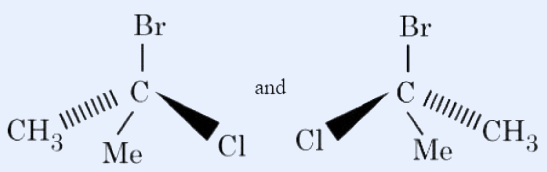
Q65Single correctSome Basic Principles of Organic Chemistry
The following structures are
(1)
(2)
(3)
(4)
SolutionAnswer: Option 2identical molecules.
Approach:
Inspect the four substituents at the central carbon for stereocenter status, then test the two drawings for superimposability.
Step 1:List the substituents on the central carbon in each drawing: Br, Cl, (written as ), and (written as Me). Both and Me denote the same methyl group.
Step 2:Since the central carbon carries two identical groups, it fails the four-distinct-groups requirement and is therefore not a stereocenter.
Step 3:From the alt-text geometry, the right drawing is obtained from the left by interchanging the positions of the two methyl groups, equivalent to a 180 degree rotation about the Br-C bond axis. Since the swapped ligands are identical, the rotated structure is indistinguishable from the original.
Step 4:Two superimposable representations correspond to one and the same molecule.
Final answer: identical molecules.
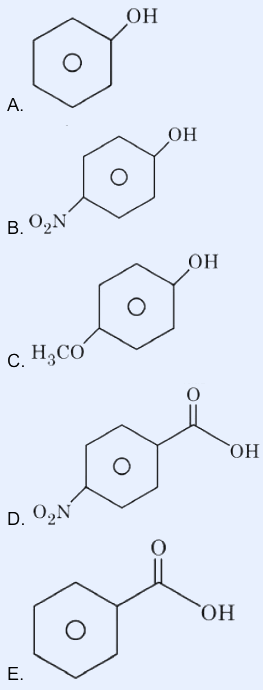
Q66Single correctOrganic Compounds Containing Oxygen
The descending order of acidity among the following compounds is: A. Phenol B. 4-nitrophenol C. 4-methoxyphenol D. 4-nitrobenzoic acid E. Benzoic acid. Choose the correct answer from the options given below:
(1)
(2)
(3)
(4)
SolutionAnswer: Option 4
Approach:
First separate the carboxylic acids from the phenols using their characteristic pKa ranges, then order within each class by para-substituent electronic effects.
Step 1:Identify the five compounds and their conjugate-base stability classes: D and E are aryl carboxylic acids; A, B, C are para-substituted phenols. Objective: arrange in descending acidity.
Step 2:Aryl carboxylic acids () are intrinsically stronger acids than phenols () because the carboxylate negative charge is delocalised over two equivalent oxygen atoms, whereas the phenoxide charge is delocalised onto less electronegative ring carbons.
Step 3:Within the carboxylic acids, the para group is strongly electron-withdrawing by both and , stabilising the carboxylate and lowering .
Step 4:Within the phenols, para stabilises the phenoxide (most acidic), while para destabilises it via donation (least acidic); parent phenol lies between.
Step 5:Concatenate the two ordered chains.
Final answer:
Q67Single correctOrganic Compounds Containing Nitrogen
The strongest conjugate acid will result from:
(1)
(2)
(3)
(4)
SolutionAnswer: Option 34-nitroaniline
Approach:
Translate the question via the conjugate-acid/base relation, rank the four anilines by basicity using electronic effects of the para substituent, then pick the weakest base.
Step 1:Identify the target: the conjugate acid is the anilinium cation ; its strength varies inversely with the basicity of the parent amine .
Step 2:Classify the four para substituents. donates electrons by (and weak ); donates by hyperconjugation/; is the reference; withdraws strongly by and .
Step 3:Translate to basicity at nitrogen: greater electron density on N gives a stronger base.
Step 4:By the inversion in step 1, the weakest base yields the strongest conjugate acid (4-nitroanilinium).
Final answer: 4-nitroaniline
Q68Single correctBiomolecules
A D-aldotetrose on oxidation with concentrated resulted in optically inactive dicarboxylic acid. The structure of the D-aldotetrose is:
(1)
(2)
(3)
(4)
SolutionAnswer: Option 3D-erythrose Fischer projection (both -OH groups on the right; CHO top, CH2OH bottom)
Approach:
Convert each candidate D-aldotetrose to its aldaric acid by oxidising the terminal -CHO and -CH2OH to -COOH, then identify which product possesses an internal mirror plane (meso, optically inactive).
Step 1:Identify the D-aldotetrose family: only two members exist, D-erythrose (both middle -OH on the right in the Fischer projection) and D-threose (middle -OH on opposite sides). The objective is to pick the one whose oxidation product is optically inactive.
Step 2:Apply oxidation to D-erythrose: and both become , giving an aldaric acid with both internal -OH groups on the right.
Step 3:Apply the same oxidation to D-threose: the two middle -OH groups remain on opposite sides, giving an aldaric acid in which the stereocentres do NOT internally compensate.
Step 4:The optically inactive product is delivered only by D-erythrose, which corresponds to the Fischer projection with both middle -OH groups on the right (option 3).
Final answer: D-erythrose Fischer projection (both -OH groups on the right; CHO top, CH2OH bottom)
Q69Single correctPrinciples Related to Practical Chemistry
Among and , identify the one that gets precipitated out while passing in presence of as group reagent. The highest possible oxidation state of the corresponding metal is
(1)
(2)
(3)
(4)
SolutionAnswer: Option 4+7
Approach:
Place each cation in its qualitative-analysis group, pick the one that precipitates as a sulphide under in alkaline () medium, and quote the maximum oxidation state of that metal.
Step 1:Identify the four candidate cations and the group reagent (H2S in NH4OH/NH4Cl), corresponding to qualitative analysis Group IV.
Step 2: and are Group II cations: they precipitate as PbS / CuS under H2S in dilute acidic (HCl) medium, NOT in NH4OH.
Step 3: is a Group III cation: it precipitates as on addition of in presence of , before any sulphide forms.
Step 4: is a Group IV cation. In the alkaline medium, the [] is high enough to exceed , giving a buff (flesh-coloured) sulphide precipitate.
Step 5:Maximum oxidation state of manganese equals its periodic-table group number (Group 7); the +7 state is realised in (e.g., ) and .
Final answer: +7
Q70Single correctPrinciples Related to Practical Chemistry
Match the LIST-I with LIST-II
| List-I Compound | List-II Test |
|---|---|
| A. | I. Hinsberg's reagent test |
| B. | II. Phthalein dye test |
| C. | III. Lucas test |
| D. | IV. Tollen's test |
(1)
(2)
(3)
(4)
SolutionAnswer: Option 1A-III, B-I, C-IV, D-II
Approach:
Map each compound's principal functional group to its characteristic confirmatory wet test (alcohol -> Lucas; primary amine -> Hinsberg; aldehyde -> Tollen's; phenol -> phthalein dye).
Step 1:Identify the functional-group identity of each List-I compound: A is a secondary alcohol; B is a primary aliphatic amine; C is an aldehyde; D is a phenol. Each List-II test is selective for one of these groups.
Step 2:Cyclohexanol (A): the Lucas reagent () reacts with alcohols and the rate (turbidity time) discriminates alcohols, giving the standard alcohol test.
Step 3:Cyclohexylamine (B): benzenesulphonyl chloride () reacts with the primary amine to give a sulphonamide whose acidic N-H is soluble in alkali, the hallmark of the Hinsberg test.
Step 4:Cyclohexanecarbaldehyde (C): aldehydes reduce Tollen's reagent (ammoniacal ) to metallic silver, producing the silver-mirror.
Step 5:Phenol (D): condensation with phthalic anhydride in conc. yields phenolphthalein (pink in base), the phthalein dye test specific to phenols.
Step 6:Assemble the four pairs.
Final answer: A-III, B-I, C-IV, D-II
Q71NumericalChemical Thermodynamics
If 3.365 g of ethanol (l) is burnt completely in a bomb calorimeter at 298.15 K, the heat produced is 99.472 kJ. The of ethanol at 298.15 K is _____ . (Nearest integer)
Given: Standard enthalpy for combustion of graphite
Standard enthalpy of formation of water (l)
Molar mass in of C, H, O are 12, 1 and 16 respectively
Given: Standard enthalpy for combustion of graphite
Standard enthalpy of formation of water (l)
Molar mass in of C, H, O are 12, 1 and 16 respectively
SolutionAnswer: 3
Approach:
Convert the calorimetric heat to per mole, add to obtain , then invert Hess's law to extract of ethanol.
Step 1:Given: g, kJ (heat released), K. Molar mass of = g/mol. Target: in units of kJ/mol.
Step 2:Moles of ethanol burnt.
Step 3:Molar of combustion from the bomb-calorimeter (constant-volume) heat (sign: exothermic ==> negative).
Step 4:Write the balanced combustion: . Gaseous moles: .
Step 5:Convert to enthalpy of combustion.
Step 6:Apply Hess's law with .
Step 7:Solve for of ethanol.
Step 8:Express the magnitude in units of kJ/mol and round to the nearest integer.
Final answer: 3
Q72NumericalEquilibrium
For the following reaction at and at 2 atm pressure,
is 50% dissociated.
The magnitude of standard free energy change at this temperature is x.
_____ [Nearest integer].
Given:
is 50% dissociated.
The magnitude of standard free energy change at this temperature is x.
_____ [Nearest integer].
Given:
SolutionAnswer: 2474
Approach:
Set up the ICE table with 50% dissociation, convert mole fractions to partial pressures at the stated total pressure, compute , then apply .
Step 1:Setup: start with mol of ; take for convenient arithmetic. Degree of dissociation means 1 mol of reacts.
Step 2:Stoichiometry of : reaction of 1 mol produces 1 mol and 0.5 mol .
Step 3:Mole fractions and partial pressures at atm.
Step 4:Evaluate (atm units).
Step 5:Compute using the supplied logarithm table.
Step 6:Apply .
Step 7:Arithmetic.
Final answer: 2474
Q73NumericalRedox Reactions and Electrochemistry
An electrochemical cell, consist of the following two redox couples, and . The cell is recorded to be 0.2057 V. If the reaction quotient of the electrochemical reaction is found to be , then the value of x is _____. (Nearest integer)
[Given: M is a p-block metal and ]
[Given: M is a p-block metal and ]
SolutionAnswer: 2
Approach:
Identify cathode and anode from standard potentials, compute , then apply the Nernst equation with the given reaction quotient to extract the number of electrons n; relate n to x from the balanced cell reaction.
Step 1:Given inputs: , , , . Higher standard reduction potential means is reduced (cathode); Fe is oxidised to (anode).
Step 2:Standard cell potential.
Step 3:Balance the overall reaction by taking LCM of and 3 electrons: multiply the cathode half by 3 and the anode half by . Total electrons transferred .
Step 4:Substitute into the Nernst equation with .
Step 5:Solve for .
Step 6:From .
Step 7:Sanity check on identity: with matches the p-block couple (), consistent with the hint that M is a p-block metal.
Final answer: 2
Q74NumericalChemical Kinetics
For a first order reaction
| | |
| 0 | 0.6500 |
| x | 0.0650 |
| 20 | 0.00065 |
_____ min. (Nearest integer)
| | |
| 0 | 0.6500 |
| x | 0.0650 |
| 20 | 0.00065 |
_____ min. (Nearest integer)
SolutionAnswer: 7
Approach:
Use the first-order integrated rate law to extract from the (t=0, t=20) data, then invert it to solve for the time at which the concentration has dropped by a factor of 10.
Step 1:Given: M, M at , M at min. Target: x.
Step 2:Apply the first-order law at min to obtain the rate constant.
Step 3:Apply the same law at .
Step 4:Solve for .
Step 5:Round to the nearest integer.
Final answer: 7
Q75NumericalPrinciples Related to Practical Chemistry
In sulphur estimation, mol of an organic compound (X) (molar mass ) gave 0.4813 g of barium sulphate (molar mass ). The percentage of sulphur in the compound (X) is _____ % (Nearest integer)
SolutionAnswer: 435
Approach:
Each mole of sulphur in X ends up as one mole of in the Carius/gravimetric estimation. Convert mass of to mass of S, divide by the mass of organic compound taken, and express the result as a multiple of %.
Step 1:Given: mol, g/mol, g, g/mol, g/mol. Target: %S in X expressed as %.
Step 2:Mass of organic compound taken.
Step 3:Moles of formed.
Step 4:Mass of S contained in that (one S per formula unit).
Step 5:Percentage of sulphur in .
Step 6:Express in units of % and round to nearest integer.
Final answer: 435
Mathematics25 questions
Q1Single correctSets, Relations and Functions
For the function defined by , among the two statements: (I) The set contains exactly two elements, and (II) The set is an empty set,
(1)
(2)
(3)
(4)
SolutionAnswer: Option 1only (I) is TRUE
Approach:
Reduce statement (I) using strict monotonicity to , and test statement (II) by applying the Intermediate Value Theorem to a continuous difference function.
Step 1:Given on . The target is to determine the cardinality of and . Since on with equality only at , f is strictly increasing.
Step 2:For (I), strict monotonicity forces the graphs of f and to meet only on . Substituting gives , that is . With this becomes , hence .
Step 3:For (II), the inverse is , so . The equation reduces to , that is .
Step 4:Evaluate endpoints. At : . At : . By the Intermediate Value Theorem applied to the continuous g on , there exists with .
Step 5:Combining the two conclusions yields the verdict.
Final answer: only (I) is TRUE
Q2Single correctComplex Numbers and Quadratic Equations
Let . Then is equal to:
(1)
(2)
(3)
(4)
SolutionAnswer: Option 438
Approach:
Solve the quadratic for both complex roots, shift each by , and add the squared moduli.
Step 1:Given with . The target is . Applying the quadratic formula: .
Step 2:Shift by and compute its squared modulus.
;
Step 3:Shift by and compute its squared modulus.
;
Step 4:Sum the two contributions.
Final answer: 38
Q3Single correctMatrices and Determinants
If the system of equations: , , has infinitely many solutions, then the value of is:
(1)
(2)
(3)
(4)
SolutionAnswer: Option 218
Approach:
Set the coefficient determinant to zero to fix , then enforce row-reduction consistency to fix .
Step 1:Given the system with coefficient matrix and constants . The target is . Expanding along the first row: .
Step 2:Substitute and apply elementary row operations. yields ; yields .
Step 3:The third reduced row is exactly twice the second reduced row in the coefficients, so consistency demands .
Step 4:Add the two parameters.
Final answer: 18
Q4Single correctComplex Numbers and Quadratic Equations
If and , where are two roots of the equation , , then is equal to:
(1)
(2)
(3)
(4)
SolutionAnswer: Option 3
Approach:
Use the real-coefficient conjugate root theorem to identify the third root, recover via Vieta's, then integrate term by term.
Step 1:Given roots and of a real cubic. The target is . By the conjugate root theorem the third root is .
Step 2:Apply Vieta's. Sum of roots: , so .
Step 3:Sum of pairwise products: , so . Product of roots: , so .
Step 4:Integrate over . Odd powers vanish by parity: and . The remaining contribution is .
Final answer:
Q5Single correctComplex Numbers and Quadratic Equations
If the quadratic equation , has two positive roots, then the number of possible integral values of is:
(1)
(2)
(3)
(4)
SolutionAnswer: Option 22
Approach:
Impose discriminant non-negativity together with positive sum and positive product of roots, intersect the constraints, and count integers in the resulting interval.
Step 1:Given with . The target is the count of integer for which both roots are real and positive. Identify , , .
Step 2:Discriminant constraint: . Dividing by flips the inequality: , i.e. .
Step 3:Sum of roots and product . Both ratios share sign, so each requires and of the same sign.
Step 4:Intersect the two regions. Within , the portion satisfying or is (the point is excluded since it makes the product zero, not positive).
Step 5:Enumerate integers in . Since , the integers are and .
Final answer: 2
Q6Single correctCo-ordinate Geometry
Let and , where is a real number. If the largest possible value of is p, then the circle , intersects the co-ordinate axes at:
(1)
(2)
(3)
(4)
SolutionAnswer: Option 33 points
Approach:
Compute the characteristic polynomial of , extract the largest real eigenvalue, then intersect the circle with both coordinate axes and count distinct points.
Step 1:Given matrix A and the family of circles with centre and radius . The target is the count of distinct axis crossings. First form by cofactor expansion along row 1 of .
Step 2:Expand each bracket. , so first bracket . Second bracket . Third bracket .
Step 3:Combine the three terms. . Adding gives the characteristic polynomial.
Step 4:Test : , so is a factor. Polynomial division gives . The quadratic factor has roots , both negative since .
Step 5:Circle is . Intersect with x-axis by setting : . Intersect with y-axis by setting : .
Step 6:The point appears in both lists. Distinct points are , and .
Final answer: 3 points
Q7Single correctSequence and Series
Let and . Then the value of is equal to:
(1)
(2)
(3)
(4)
SolutionAnswer: Option 38
Approach:
Sum each geometric series to a single value, simplify each exponent via change-of-base, then evaluate the two power terms.
Step 1:Given the two geometric series with first terms and common ratios . Both ratios have absolute value less than 1. The target is .
Step 2:Simplify the first exponent. By change of base, .
Step 3:Evaluate the first term. Since , .
Step 4:Simplify the second exponent and evaluate. and . Therefore .
Step 5:Add the two contributions.
Final answer: 8
Q8Single correctStatistics and Probability
For 10 observations , if and , then their standard deviation is:
(1)
(2)
(3)
(4)
SolutionAnswer: Option 43
Approach:
Expand both shifted sum-of-squares to linear equations in and , solve the system, then compute the variance and take the positive square root.
Step 1:Given , and . The target is the standard deviation . Let and .
Step 2:Expand the two given equations using the expansion identity.
Step 3:Subtracting (ii) from (i): , giving . Hence .
Step 4:Substitute into (ii): , giving .
Step 5:Apply the variance formula and take the square root.
Final answer: 3
Q9Single correctBinomial Theorem and its Simple Applications
In the expansion of , if the term independent of x is , then k is equal to:
(1)
(2)
(3)
(4)
SolutionAnswer: Option 184
Approach:
Form the binomial general term, find the index that nullifies the power of , evaluate the resulting numerical coefficient, and divide by .
Step 1:Given , , . The target is k such that the term independent of x equals 221k. The general term is .
Step 2:Setting the exponent of x to zero: .
Step 3:Evaluate the numerical factor at . Since , and . Also .
Step 4:Compute .
Step 5:Solve .
Final answer: 84
Q10Single correctCo-ordinate Geometry
Let , be a point on the ellipse , Q be a point on the circle and R be a point on the line such that the centroid of the triangle PQR is . Then the sum of the ordinates of all possible points R is:
(1)
(2)
(3)
(4)
SolutionAnswer: Option 48
Approach:
Use centroid coordinates to relate and , eliminate using the circle, parametrise on the line, and solve the resulting quadratic for the ordinates of .
Step 1:Given , on the circle, on , and centroid . The target is over admissible R. Multiplying the centroid coordinates by : and .
Step 2:From R on the line : . Substituting back: and .
Step 3:Convert the circle to standard form: . Centre , radius .
Step 4:Impose Q on the circle: . Expanding: .
Step 5:Solve , so . Corresponding ordinates from are . Sum of ordinates equals .
Final answer: 8
Q11Single correctCo-ordinate Geometry
Let be a hyperbola such that the distance between its foci is 6 and the distance between its directrices is . If the line intersects the hyperbola H at the points A and B such that the area of the triangle AOB is , where O is the origin, then equals
(1)
(2)
(3)
(4)
SolutionAnswer: Option 2
Approach:
Combine and to determine and , derive , then equate the chord-triangle area to recover .
Step 1:Given and , equivalently and . The target is . Multiplying the two equations: .
Step 2:Dividing the equations: .
Step 3:Apply .
Step 4:Substitute in the hyperbola: . Hence and .
Step 5:The perpendicular distance from to the vertical line is . Apply the area condition: . Squaring: , hence .
Step 6:Let . Solve : or . Since , .
Final answer:
Q12Single correctLimit, Continuity and Differentiability
is equal to:
(1)
(2)
(3)
(4)
SolutionAnswer: Option 2
Approach:
Substitute , locate the interior critical point via the derivative, evaluate the function there, and compare against the endpoint values.
Step 1:Given on . Substituting , the variable runs over and . The target is .
Step 2:Differentiate: .
Step 3:Setting : either giving (where ), or . In , this gives .
Step 4:Evaluate g at : , , .
Step 5:Compare with endpoint values and . Since , the maximum is attained at .
Final answer:
Q13Single correctThree Dimensional Geometry
The shortest distance between the lines and , is:
(1)
(2)
(3)
(4)
SolutionAnswer: Option 2
Approach:
Apply the skew-line shortest-distance formula using the difference of position vectors, the cross product of the direction vectors, and the scalar triple product.
Step 1:Given , , , . The target is the shortest distance d. Compute the difference of position vectors: .
Step 2:Compute . With and : first component ; second ; third .
Step 3:Magnitude of the cross product: . Since this is non-zero, the lines are not parallel; combined with the next step it confirms they are skew.
Step 4:Scalar triple product: . Its absolute value is .
Step 5:Apply the formula.
Final answer:
Q14Single correctThree Dimensional Geometry
If is the image of in the line , then the possible value(s) of is (are)
(1)
(2)
(3)
(4)
SolutionAnswer: Option 1Only
Approach:
Find the foot of perpendicular F from on the line, set image equal to the given image, and solve for .
Step 1:Given: , line passes through with direction . Parametrize the foot as . Target: find so that the reflection of P in the line equals .
Step 2:Impose to locate the foot.
Step 3:Compute the image component-wise. The x-component becomes , matching the given first coordinate identically.
Step 4:Equate with the given second coordinate.
Step 5:Equate with the given third coordinate.
Step 6:Intersect the two solution sets to satisfy both coordinate equations simultaneously.
Final answer: Only
Q15Single correctVector Algebra
Let and be unit vectors inclined at an acute angle such that . If , then is equal to:
(1)
(2)
(3)
(4)
SolutionAnswer: Option 1
Approach:
Use to compute and , then express as a linear combination of these two scalars.
Step 1:Given: are unit vectors with at an acute angle, so and . The vector is given. Target: express in terms of and .
Step 2:Dot with , using and .
Step 3:Dot with , using and .
Step 4:Seek constants a,b such that . Substituting the expressions yields . Matching the coefficient of : . Matching constants: .
Step 5:Solving the system: from the second equation, substitute into the first to give , hence and .
Step 6:Write in the required form.
Final answer:
Q16Single correctSets, Relations and Functions
Let for some , be a function satisfying for all . If and , then the value of is:
(1)
(2)
(3)
(4)
SolutionAnswer: Option 2
Approach:
Set in the functional equation to obtain a closed form for f, then identify by comparing with the equation at general (x,y), and finally evaluate the sum.
Step 1:Given: functional equation , with and . Target: .
Step 2:Substitute in the functional equation to express explicitly.
Step 3:Substitute this f back into the original equation: . Comparing with forces for all x,y.
Step 4:Form the summand: . Sum over using and .
Step 5:Add the three contributions.
Final answer:
Q17Single correctPermutations and Combinations
. Then n(A) is equal to:
(1)
(2)
(3)
(4)
SolutionAnswer: Option 3
Approach:
Fix , count non-negative integer solutions of for each admissible , then sum.
Step 1:Given: triples of non-negative integers with . Target: total such triples.
Step 2:Determine the admissible range of c from .
Step 3:For a fixed , has non-negative integer solutions.
Step 4:Evaluate the arithmetic sum: has 12 terms with first term 23 and last term 1.
Final answer:
Q18Single correctIntegral Calculus
The area of the region bounded by the curves and is equal to:
(1)
(2)
(3)
(4)
SolutionAnswer: Option 3
Approach:
Express both curves as , find the y-limits where they meet, and integrate the horizontal width .
Step 1:Given: curve (leftward parabola through origin) and curve (leftward parabola through ). Target: enclosed area.
Step 2:Solve to find the intersection limits in y.
Step 3:Determine which curve lies on the right between the limits by testing : and , so inside the region. Compute the horizontal width.
Step 4:Integrate using even symmetry of the integrand.
Final answer:
Q19Single correctDifferential Equations
Let be the solution of the differential equation: , satisfying . If , then is equal to:
(1)
(2)
(3)
(4)
SolutionAnswer: Option 4
Approach:
Recognize the integrating factor so that , integrate, and apply the initial condition.
Step 1:Given: , , . Target: with .
Step 2:Try and verify . Logarithmic derivative gives . Combining over the common denominator produces .
Step 3:Multiply the ODE by . The right-hand side simplifies because .
Step 4:Integrate both sides with respect to .
Step 5:Apply the initial condition at : , hence . Substituting gives .
Step 6:Evaluate at : and the RHS equals .
Step 7:Match with .
Final answer:
Q20Single correctIntegral Calculus
The integral is equal to:
(1)
(2)
(3)
(4)
SolutionAnswer: Option 4
Approach:
Rewrite using the inverse-tan subtraction identity, then evaluate each integral by parts.
Step 1:Given: . Observe , so . Therefore (since for both arctan arguments give a positive difference).
Step 2:Substitute in the first integral.
Step 3:Apply the standard antiderivative on .
Step 4:Apply the standard antiderivative on .
Step 5:Subtract: collect the terms via , and the terms via .
Final answer:
Q21NumericalStatistics and Probability
From a month of 31 days, 3 different dates are selected at random. If the probability that these dates are in an increasing A.P. is equal to , where and , then is equal to _____.
SolutionAnswer: 944
Approach:
Count favourable 3-term increasing APs from , divide by total selections , reduce the fraction, and add numerator and denominator.
Step 1:Given: dates are drawn uniformly at random from , three distinct values selected. Target: probability that the chosen triple forms an increasing 3-term AP, expressed as in lowest terms; report .
Step 2:Compute the size of the sample space.
Step 3:Count favourable triples. An increasing AP requires , , , giving admissible starts for each .
Step 4:Form the probability and reduce. Factorize and , so .
Step 5:Add numerator and denominator.
Final answer: 944
Q22NumericalLimit, Continuity and Differentiability
Let and . If the number of points where g is not continuous and is not differentiable are and respectively, then is equal to _____.
SolutionAnswer: 4
Approach:
Analyze and separately for continuity and differentiability, then combine the failure sets in .
Step 1:Given: for and for . Compute but , so f is discontinuous at . Target: count discontinuity points and non-differentiability points of .
Step 2:Since always, uses only the second branch: . This is continuous everywhere; the corner is multiplied by , so it is non-differentiable solely at .
Step 3:Analyze . For , , so is smooth. For , has simple zeros at and , so has corners there. At the same jump in f persists in since .
Step 4:Determine discontinuities of g: is continuous everywhere, so g is discontinuous exactly where is, namely at . Hence .
Step 5:Determine non-differentiability of g. The combined failure set is . At the smooth part cannot cancel the corner from (a smooth function plus a non-smooth one is non-smooth). At , g is already discontinuous, hence non-differentiable. Thus .
Step 6:Add the two counts.
Final answer: 4
Q23NumericalCo-ordinate Geometry
Let A,B be points on the two half-lines , at a distance of from their point of intersection P. The line segment AB meets the angle bisector of the given half-lines at the point Q. If and R is the radius of the circumcircle of , then is equal to _____.
SolutionAnswer: 9
Approach:
Identify the two half-lines and their apex angle, locate A,B,Q explicitly using symmetry, deduce that is equilateral, then compute the required ratio.
Step 1:Given: the equation with decomposes into () and (). Both meet at . Each half-line makes angle with the positive x-axis (direction vectors ), so the apex angle and the angle bisector is the x-axis ().
Step 2:Place A on at distance from P along the unit direction , and B symmetrically on .
Step 3:Segment is vertical, so it intersects the bisector at its midpoint . The horizontal distance from to gives .
Step 4:With and , the law of cosines gives , so . Hence is equilateral with side .
Step 5:Apply the law of sines for the circumradius.
Step 6:Compute the required ratio.
Final answer: 9
Q24NumericalCo-ordinate Geometry
Let A,B and C be the vertices of a variable right angled triangle inscribed in the parabola . Let the vertex B containing the right angle be and the locus of the centroid of be a conic . Then three times the length of latus rectum of is _____.
SolutionAnswer: 16
Approach:
Parametrize on the parabola, impose the right-angle condition at , then eliminate the parameters from the centroid coordinates to obtain the locus.
Step 1:Given: parabola gives , so and the parametric form is . The fixed vertex corresponds to . Let and with .
Step 2:Form , and similarly . The right-angle condition at B requires .
Step 3:Introduce and . The constraint expands to , i.e. . The centroid (h,k) is given by averaging the three vertices.
Step 4:From , . Substitute into the h relation: .
Step 5:Substitute .
Step 6:Solve for to obtain the standard parabola form .
Step 7:Three times the latus rectum.
Final answer: 16
Q25NumericalIntegral Calculus
Let f be a twice differentiable function such that Then is equal to _____.
SolutionAnswer: 5
Approach:
Simplify the first integral by linear substitution, differentiate the resulting integral equation, solve the first-order linear ODE, then evaluate at the required points.
Step 1:Given: the integral equation on , with f twice differentiable. Target: .
Step 2:Substitute in the first integral (, limits ). Then evaluate using .
Step 3:Rewrite the equation and differentiate both sides w.r.t. via the Leibniz rule.
Step 4:Let . Then , a separable equation. Integrating gives , hence for some constant A.
Step 5:Apply (from the integral equation at , both integrals vanish): . Therefore , with and .
Step 6:Evaluate at the prescribed points.
Step 7:Combine.
Final answer: 5
More JEE Main 2026 papers
- JEE Main 2026 — April 02, Shift 1
- JEE Main 2026 — April 02, Shift 2
- JEE Main 2026 — April 04, Shift 1
- JEE Main 2026 — April 05, Shift 1
- JEE Main 2026 — April 05, Shift 2
- JEE Main 2026 — April 06, Shift 1
- JEE Main 2026 — April 06, Shift 2
- JEE Main 2026 — April 08, Shift 2
- JEE Main 2026 — January 21, Shift 1
- JEE Main 2026 — January 21, Shift 2
- JEE Main 2026 — January 22, Shift 1
- JEE Main 2026 — January 22, Shift 2
- JEE Main 2026 — January 23, Shift 1
- JEE Main 2026 — January 23, Shift 2
- JEE Main 2026 — January 24, Shift 1
- JEE Main 2026 — January 24, Shift 2
- JEE Main 2026 — January 28, Shift 1
- JEE Main 2026 — January 28, Shift 2
Frequently Asked Questions
How many questions are in the JEE Main 2026 April 04, Shift 2 paper?
The JEE Main 2026 April 04, Shift 2 paper has 75 questions — Physics (25), Chemistry (25) and Mathematics (25). Every question is on this page with its correct answer and a step-by-step solution.
What is the marking scheme for JEE Main?
JEE Main awards +4 marks for each correct answer and −1 for a wrong answer, with 0 for questions left unattempted. The paper covers Physics, Chemistry and Mathematics.
Are the answer key and step-by-step solutions provided for the 2026 April 04, Shift 2 paper?
Yes — every question shows the correct answer (answer key) and a detailed step-by-step solution, free to read online.
Can I take the JEE Main 2026 April 04, Shift 2 paper as a timed mock test?
Yes. With a free JEEnify account you can attempt this exact paper as a timed test in the real exam interface, then see your score and weak-area analysis.
Solved this paper? Calculate your JEE Main scoremost important chaptersformula sheetsall free tools.