
Back to JEE Main PYQs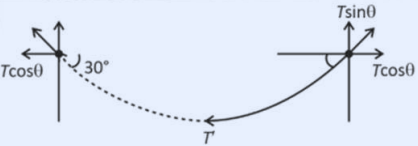
JEE Main 2026 January 24, Shift 2 Question Paper with Solutions
All 73 questions from the JEE Main 2026 (January 24, Shift 2) shift — Physics (24), Chemistry (25) and Mathematics (24) — each with the correct answer (answer key) and a step-by-step solution. Read it free online, or attempt the full paper as a timed mock test.
Physics24 questions
Q25Single correctLaws of Motion
A flexible chain of mass m hangs between two fixed points at the same level. The inclination of the chain with the horizontal at the two points of support is . Considering the equilibrium of each half of the chain, the tension of the chain at the lowest point is_____
(1)
(2)
(3)
(4)
SolutionAnswer: Option 3
Approach:
Each half of the chain is in equilibrium under three forces: its own weight, the tension at the support directed along the chain at 30 degrees to the horizontal, and the purely horizontal tension at the lowest point. Vertical balance of one half fixes the support tension; horizontal balance equates the lowest-point tension to the horizontal component of the support tension.
Step 1:By symmetry each half of the chain carries weight mg/2. The tension at its support acts along the chain at 30 degrees to the horizontal. Vertical force balance of this half determines the support tension.
Step 2:At the lowest point the chain is horizontal, so the tension there is horizontal. Horizontal balance of the half sets this tension equal to the horizontal component of the support tension.
Final answer:
Q26Single correctMagnetic Effects of Current and Magnetism
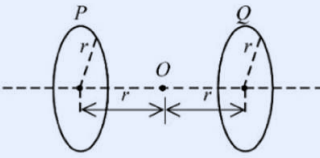
Two identical circular loops and each of radius are lying in parallel planes such that they have common axis. The current through and are and respectively in clockwise direction as seen from . The net magnetic field at is:
(1)
(2)
(3)
(4)
SolutionAnswer: Option 2 towards Q
Approach:
Point O lies on the common axis at distance r from each loop. The axial field of each loop is evaluated with the on-axis formula at x = r. Both currents are clockwise as viewed from O, so each loop sends its axial field away from O, making the two contributions oppose along the axis; the net field points toward the loop carrying the larger current.
Step 1:For loop P at axial distance , substitute into the axial formula. The denominator equals .
Step 2:Loop Q carries 4I at the same axial distance r, scaling the same expression by 4, with its field directed toward Q.
Step 3:The two axial fields point in opposite directions along the axis, so the net field is their difference and is directed toward the stronger loop Q.
Final answer: towards Q
Q27Single correctProperties of Solids and Liquids
A cubical block of density floats in a liquid of density . If the height of block is then height of the submerged part is_____ cm.
(1)
(2)
(3)
(4)
SolutionAnswer: Option 2
Approach:
In floating equilibrium the block's weight equals the buoyant force from the displaced liquid. With a uniform cross-section the common area cancels, leaving the submerged height as the full block height scaled by the ratio of block density to liquid density.
Step 1:The buoyant force equals the weight of liquid displaced by the submerged portion of height , and this balances the weight of the whole block of height H. The cross-sectional area A is common to both volumes and cancels.
Step 2:Substitute the block density 600, the liquid density 900, and the height 8 cm.
Final answer:
Q28Single correctOptics
In the Young's double slit experiment the intensity produced by each one of the individual slits is . The distance between two slits is . The distance of screen from slits is . The wavelength of light is . The intensity of light on the screen in front of one of the slits is_____.
(1)
(2)
(3)
(4)
SolutionAnswer: Option 2
Approach:
The point on the screen directly in front of one slit is offset from the central axis by half the slit separation. The path difference at that point fixes the phase difference, which is substituted into the two-source intensity relation whose maximum value is 4I0.
Step 1:Directly in front of one slit the screen coordinate is y = d/2. Substitute d = 2 mm = 2e-3 m, y = 1 mm = 1e-3 m, D = 10 m into the path-difference expression.
Step 2:Convert the path difference to a phase difference with angstrom m.
Step 3:Substitute into the intensity relation, with half the phase difference equal to and .
Final answer:
Q29Single correctOscillations and Waves
The fifth harmonic of a closed organ pipe is found to be in unison with the first harmonic of an open pipe. The ratio of lengths of closed pipe to that of the open pipe is . The value of x is_____.
(1)
(2)
(3)
(4)
SolutionAnswer: Option 4
Approach:
A closed organ pipe supports only odd harmonics, so its fifth harmonic frequency is five times the fundamental, . An open pipe's first harmonic is . Unison means equal frequencies; equating the two expressions yields the ratio of lengths, which is compared with the stated form .
Step 1:Set the closed-pipe fifth harmonic equal to the open-pipe first harmonic for unison.
Step 2:Cross-multiply and solve for the ratio of the closed-pipe length to the open-pipe length.
Step 3:Match the obtained ratio with the stated form 5/x to identify x.
Final answer:
Q30Single correctThermodynamics
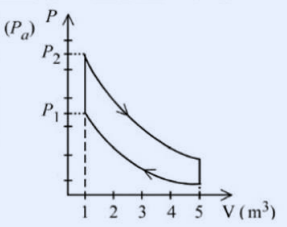
10 mole of an ideal gas is undergoing the process shown in the figure. The heat involved in the process from to is Joule ( and , , ). The value of is_____
(1)
(2)
(3)
(4)
SolutionAnswer: Option 1
Approach:
The segment from to runs along the vertical dashed line of the figure, a constant-volume path. At constant volume no work is done, so the heat exchanged equals the internal-energy change . The product n dT is replaced through the ideal-gas relation at constant volume, , turning the heat into .
Step 1:Along the constant-volume segment W = P dV = 0, so by the first law the heat equals the internal-energy change.
Step 2:From the ideal-gas law at fixed volume , . Substitute to express Q through the pressure change.
Step 3:The pressure change Pa cancels the factor 8.3 in R, leaving the value of .
Final answer:
Q31Single correctOptics
A point source is kept at the center of a spherically enclosed detector. If the volume of the detector increased by 8 times, the intensity will
(1)
(2)
(3)
(4)
SolutionAnswer: Option 4decrease by 4 times
Approach:
An eightfold increase in the spherical detector volume increases its radius by the cube root of 8, that is by a factor of 2. The intensity from a point source at the detector surface follows the inverse-square law, so doubling the radius reduces the intensity to one quarter.
Step 1:Set the new volume equal to eight times the original; the constant 4/3 pi cancels, relating the new radius to the old through a cube root.
Step 2:The total power P from the source is unchanged, so the intensity ratio at the two radii is the inverse square of the radius ratio.
Final answer: decrease by 4 times
Q32Single correctCurrent Electricity
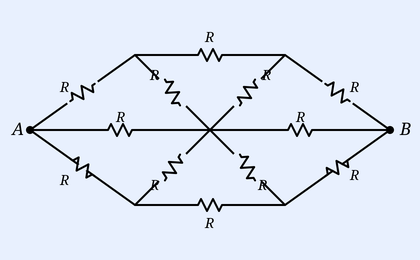
A regular hexagon is formed by six wires each of resistance r and the corners are joined to the centre by wires of same resistance. If the current enters at one corner and leaves at the opposite corner, the equivalent resistance of the hexagon between the two opposite corners will be
(1)
(2)
(3)
(4)
SolutionAnswer: Option 2
Approach:
Label the hexagon corners A, B, C, D, E, F with the centre O; current enters at A and leaves at the opposite corner D. The network is symmetric about the diagonal A-D, so mirror-image nodes are at equal potential and the centre O sits at the mean potential of A and D. Setting up node potentials with a unit current injected reduces the mesh and gives the equivalent resistance as the potential difference between A and D.
Step 1:Each corner connects to its two neighbours through edge resistors r and to the centre O through a spoke resistor r. By symmetry about the A-D axis the centre lies at the mean potential, , and the mirror pairs satisfy and . Ground D at 0 and inject current at A.
Step 2:Apply Kirchhoff's current law at nodes B and C (using r = 1). At B: connected to A, C, O. At C: connected to B, D, O. Solving these together with the injection condition at A yields the node potentials.
Step 3:The equivalent resistance is the potential difference between A and D divided by the injected current of 1, restoring the factor r.
Final answer:
Q33Single correctOptics
Distance between an object and three times magnified real image is 40 cm. The focal length of the mirror used is_____ cm.
(1)
(2)
(3)
(4)
SolutionAnswer: Option 2
Approach:
A concave mirror forms a real, three-times magnified image, so the image is inverted and the image distance has three times the magnitude of the object distance. The fixed separation of 40 cm between object and image fixes both magnitudes, which are then placed in the mirror formula with the proper signs to find the focal length.
Step 1:A real magnified image gives m = -3, so |v| = 3|u|. The real object and real image lie on the same side, and their separation is the difference of the magnitudes.
Step 2:With the standard sign convention both distances are negative for a concave mirror with real object and real image. Substitute u = -20 cm and v = -60 cm into the mirror formula.
Step 3:Invert to obtain the focal length.
Final answer:
Q34Single correctAtoms and Nuclei
The binding energy for the following nuclear reactions are expressed in MeV.
If denote the stability of , and respectively, then the correct order is:
If denote the stability of , and respectively, then the correct order is:
(1)
(2)
(3)
(4)
SolutionAnswer: Option 3
Approach:
Stability of a nucleus is measured by its binding energy per nucleon. The energy released when a neutron is captured equals the gain in total binding energy. The first reaction releases 20 MeV forming He-4, the second absorbs 0.9 MeV forming He-5; from these the total binding energies are related and the binding energy per nucleon of each nucleus is compared.
Step 1:The free neutron has zero binding energy. The first reaction releasing 20 MeV gives the binding-energy difference between He-4 and He-3, so He-4 has the higher total binding energy.
Step 2:The second reaction absorbing 0.9 MeV makes the binding energy of He-5 slightly less than that of He-4, so He-4 is more stable than He-5.
Step 3:Take B(He-4) = 28.3 MeV as a reference. Then B(He-3) = 8.3 MeV and B(He-5) = 27.4 MeV. Dividing by the mass numbers gives the binding energy per nucleon for each nucleus.
Final answer:
Q35Single correctLaws of Motion
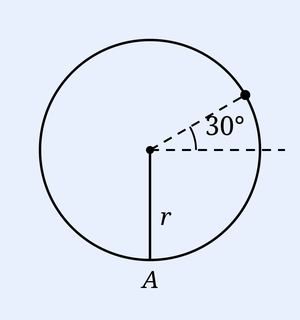
In case of vertical circular motion of a particle by a thread of length if the tension in the thread is zero at an angle shown in figure, the velocity at the bottom point () of the circular path is ( = gravitational acceleration)
(1)
(2)
(3)
(4)
SolutionAnswer: Option 1
Approach:
The figure marks the radius to the particle at 30 degrees above the horizontal, so it makes 60 degrees with the upward vertical. At that point the thread tension is zero, so the radial component of gravity alone provides the centripetal force, fixing the speed there. Energy conservation between the bottom point A and that point, separated vertically by , then gives the speed at A.
Step 1:The radius to the particle is 30 degrees above the horizontal, so the inward radial direction makes 60 degrees with the downward vertical. With the tension zero, the component of gravity along the inward radial supplies the centripetal force.
Step 2:The centre is a height r above A, and the particle sits above the centre, so its height above A is . Apply energy conservation from A to that point.
Step 3:Substitute and combine.
Final answer:
Q36Single correctKinematics
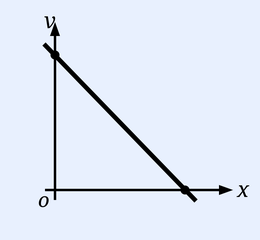
The velocity - Distance graph is shown in figure. Which graph represents acceleration versus distance variation of this system?
(1)
(2)
(3)
(4)
SolutionAnswer: Option 1Straight line of positive slope with a negative intercept on the a-axis (a increases linearly with x, starting below the x-axis)
Approach:
The velocity-distance graph is a straight line of negative slope, so v decreases linearly with x and is written v = v0 - m x with m > 0. Acceleration in terms of position is v dv/dx; substituting the linear v gives a as a linear function of x with a positive slope and a negative value at x = 0, which selects the matching a-x graph.
Step 1:The straight v-x line of negative slope is expressed in slope-intercept form, where v0 is the intercept on the v-axis and m the magnitude of the slope.
Step 2:Compute the acceleration as v times dv/dx and expand the product.
Step 3:This is a straight line in x with positive slope and a negative intercept at , rising and crossing zero at .
Final answer: Straight line of positive slope with a negative intercept on the a-axis (a increases linearly with x, starting below the x-axis)
Q37Single correctPhysics and Measurement
In a vernier callipers, 50 vernier scale divisions are equal to 48 main scale divisions. If one main scale division = mm, then the least count of the vernier callipers is_____ mm.
(1)
(2)
(3)
(4)
SolutionAnswer: Option 2
Approach:
The least count of a vernier callipers equals one main scale division minus one vernier scale division. The relation 50 VSD = 48 MSD expresses one vernier division in terms of a main division, and the main scale division value 0.05 mm converts the result to length.
Step 1:From the relation between divisions, one vernier scale division equals 48/50 of a main scale division.
Step 2:The least count is one main division minus one vernier division, expressed as a fraction of one main division.
Step 3:Substituting one main scale division equal to 0.05 mm gives the least count.
Final answer:
Q38Single correctElectrostatics
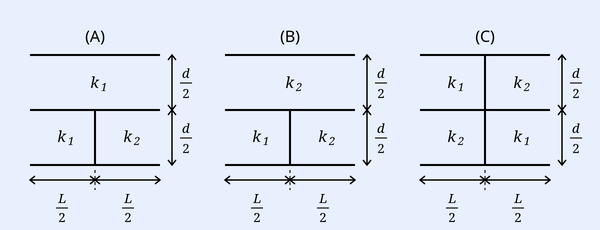
Three parallel plate capacitors each with area A and separation d are filled with two dielectric and in the following fashion. Which of the following is true?
(1)
(2)
(3)
(4)
SolutionAnswer: Option 4
Approach:
Each plate has area A and gap d, split into a top half-gap and a bottom half-gap that are in series; within a half-gap, side-by-side regions of area act in parallel. Writing each equivalent capacitance in units of and substituting orders the three configurations.
Step 1:Configuration A: top half is over full area giving (in units of ); bottom half has and side by side, each area over gap , giving in parallel. The two halves are in series.
Step 2:Configuration B: top half is giving ; bottom half again gives ; the two halves in series.
Step 3:Configuration C: each half (top side by side; bottom side by side) equals ; two equal halves in series halve the value.
Step 4:For any the three expressions order strictly, with A largest and B smallest.
Final answer:
Q39Single correctElectronic Devices
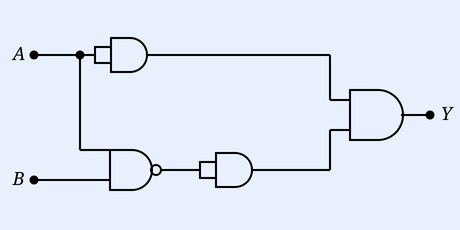
Identify the correct truth table of the given logic circuit.
(1)
(2)
(3)
(4)
SolutionAnswer: Option 3A | B | Y
0 | 0 | 0
0 | 1 | 0
1 | 0 | 1
1 | 1 | 0
0 | 0 | 0
0 | 1 | 0
1 | 0 | 1
1 | 1 | 0
Approach:
The gate network forms the NAND of A and B, then ANDs that result with A. De Morgan's law and the distributive rule reduce the output to , which is evaluated for all four input pairs.
Step 1:The output is the NAND of A and B combined with A through an AND gate.
Step 2:Applying De Morgan's law and distributing A removes the A complement term.
Step 3:Evaluating Y = A AND NOT B over all input pairs gives output 1 only when A = 1 and B = 0.
Final answer: A | B | Y
0 | 0 | 0
0 | 1 | 0
1 | 0 | 1
1 | 1 | 0
0 | 0 | 0
0 | 1 | 0
1 | 0 | 1
1 | 1 | 0
Q40Single correctCurrent Electricity
A moving coil galvanometer of resistance shows a full scale deflection for a current of . The value of resistance required to convert this galvanometer into an ammeter, showing full scale deflection for a current of , is_____
(1)
(2)
(3)
(4)
SolutionAnswer: Option 4
Approach:
A shunt resistance S is placed across the galvanometer so the excess current bypasses the coil while the coil still carries its full-scale current. The voltage across coil and shunt is equal, giving S in terms of the galvanometer resistance and the current ratio.
Step 1:The voltage across the galvanometer equals the voltage across the shunt, since they are in parallel.
Step 2:Substituting , full-scale coil current mA and required range mA.
Final answer:
Q41Single correctOptics
Five persons and recorded object distance (u) and image distance (v) using same convex lens having power as and respectively. Identify correct statement
1) Readings recorded by person are incorrect
2) Readings recorded by and persons are incorrect
3) Readings recorded by and persons are incorrect
4) Readings recorded by all persons are correct
1) Readings recorded by person are incorrect
2) Readings recorded by and persons are incorrect
3) Readings recorded by and persons are incorrect
4) Readings recorded by all persons are correct
(1)
(2)
(3)
(4)
SolutionAnswer: Option 1Readings recorded by person are incorrect
Approach:
A convex lens of power D has focal length 20 cm, so every valid (u, v) pair must satisfy , equivalent to a power of D. Each recorded pair is tested and the one whose computed power departs sharply from D is the incorrect reading.
Step 1:The required power corresponds to for distances in centimetres.
Step 2:Testing (25, 96), (30, 62), (45, 35) and (50, 32) each give close to , 0.0495, and , all within a few percent of .
Step 3:Testing (35, 37) gives a value far above , corresponding to about D and a focal length near 18 cm, marking it as the incorrect reading.
Final answer: Readings recorded by person are incorrect
Q42Single correctRotational Motion
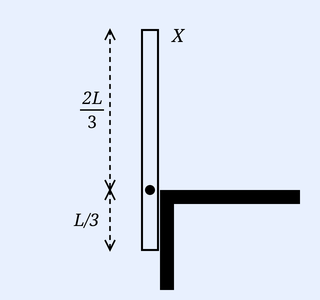
A thin uniform rod (X) of mass M and length L is picoted at a height as shown in the figure. The rod is allowed to fall from a vertical position and lie horizontally on the table. The angular velocity of this rod when it hits the table top, is_____. (g = gravitational acceleration)
(1)
(2)
(3)
(4)
SolutionAnswer: Option 3
Approach:
The rod rotates about a fixed pivot located L/3 from the lower end. Energy conservation equates the loss of gravitational potential energy of the centre of mass, which lowers by its distance from the pivot when the rod swings from vertical to horizontal, to the rotational kinetic energy with the moment of inertia about the pivot from the parallel-axis theorem.
Step 1:The centre of mass is at L/2 from the end and the pivot at L/3 from the end, so the pivot-to-centre distance is L/2 - L/3 = L/6; swinging from vertical to horizontal lowers the centre of mass by this distance.
Step 2:The moment of inertia about the pivot uses the parallel-axis theorem with offset L/6.
Step 3:Substituting into the energy balance and solving for the angular velocity.
Final answer:
Q43Single correctCurrent Electricity
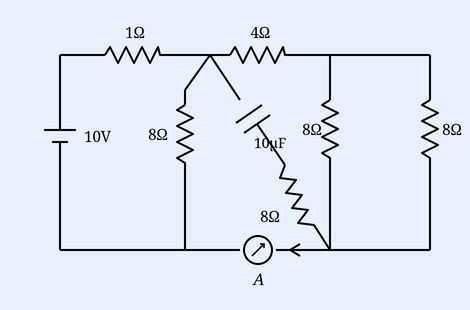
The reading of the ammeter (A) in steady state in the following circuit (assuming negligible internal resistance of the ammeter) is_____ A.
(1)
(2)
(3)
(4)
SolutionAnswer: Option 2
Approach:
In steady state the 10 microfarad capacitor branch carries no current, so its series 8 ohm path is removed. The remaining network reduces to the battery driving node B, from which one path goes directly through the left 8 ohm to the return rail and a second path goes through 4 ohm to node C and then through the two parallel 8 ohm resistors. The ammeter sits on the return of the second path and reads that branch current.
Step 1:The two 8 ohm resistors from node C to the return rail are in parallel, giving 4 ohm; this 4 ohm is in series with the 4 ohm resistor between B and C, giving an 8 ohm path from B to the return.
Step 2:This 8 ohm path is in parallel with the direct left 8 ohm from B to the return rail, giving 4 ohm; adding the series 1 ohm gives the total resistance and the source current.
Step 3:The potential at B above the return rail is 2 A times the 4 ohm parallel combination = 8 V; this 8 V drives two equal 8 ohm paths, so each carries 1 A. The ammeter lies on the return of the C-side path.
Final answer:
Q44Single correctDual Nature of Matter and Radiation
When a light of a given wavelength falls on a metallic surface the stopping potential for photoelectrons is . If a second light having wavelength twice of first light is used, the stopping potential drops to . The wavelength of first light is_____ m. ()
(1)
(2)
(3)
(4)
SolutionAnswer: Option 2
Approach:
Einstein's photoelectric equation is written for both incident lights, the second wavelength being twice the first. Subtracting the two equations cancels the work function and relates the stopping-potential difference directly to the first wavelength.
Step 1:Writing the equation for the first light (wavelength , stopping potential 3.2 V) and the second light (wavelength , stopping potential 0.7 V), then subtracting to eliminate the work function.
Step 2:Solving for the first wavelength.
Final answer:
Q45NumericalProperties of Solids and Liquids
A soap bubble of surface tension is blown to a diameter of 7 cm. If of work is done in blowing it further to make its diameter 14 cm, then the value of x is_____
SolutionAnswer: 11304
Approach:
A soap bubble has two liquid surfaces, so the work done in expanding it equals the surface tension times the change in total surface area, namely 8 pi T times the difference of squared radii. The diameters 7 cm and 14 cm give radii 3.5 cm and 7 cm; the computed work is equated to (15000 - x) microjoules to find x.
Step 1:The radii change from r1 = 3.5 cm = 0.035 m to r2 = 7 cm = 0.07 m.
Step 2:Substituting T = 0.04 N/m and pi = 22/7 into the work expression for a two-surface film.
Step 3:Equating the computed work to the given expression and solving for x.
Final answer: 11304
Q46NumericalElectrostatics
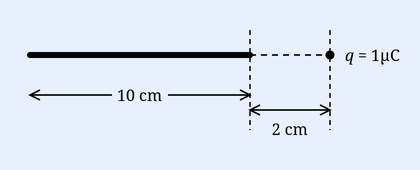
A point charge is located at a distance 2 cm from one end of a thin insulating wire of length 10 cm having a charge , distributed uniformly along its length, as shown in figure. Force between q and wire is_____ N.
SolutionAnswer: 90
Approach:
The wire carries a uniform linear charge density . Each element dq at distance r from the point charge exerts a Coulomb force along the line; integrating from the near end (2 cm) to the far end (12 cm) gives a force proportional to the difference of reciprocals of the two end distances.
Step 1:The linear charge density is the total charge divided by the wire length.
Step 2:Integrating the element force from m to m gives the reciprocal-difference form.
Step 3:Evaluating the product gives the force on the point charge.
Final answer: 90
Q47NumericalCurrent Electricity
In a meter bridge experiment to determine the value of unknown resistance, first the resistances and are connected in the left and right gaps of the bridge and the null point is obtained at a distance l\,cm from the left. Now when an unknown resistance is connected in parallel with resistance, the null point is shifted by 10 cm to the right of wire. The value of unknown resistance x is_____ .
SolutionAnswer: 6
Approach:
The meter bridge balance condition equates the ratio of the two gap resistances to the ratio of the two wire segment lengths. The first balance with 2 ohm and 3 ohm fixes the initial null length; adding x in parallel with the 3 ohm shifts the null 10 cm to the right, and the new balance equation solves for x.
Step 1:The first balance with 2 ohm (left) and 3 ohm (right) gives the initial null length.
Step 2:Connecting x in parallel with the 3 ohm shifts the null 10 cm right to 50 cm, so the two segments are equal and the resistance ratio equals 1.
Step 3:Solving the balance equation for x.
Final answer: 6
Q48NumericalRotational Motion
A uniform solid cylinder of length L and radius R has moment of inertia about its axis equal to . A small co-centric cylinder of length and radius carved from this cylinder has moment of inertia about its axis equals to . The ratio is_____.
SolutionAnswer: 162
Approach:
The moment of inertia of a solid cylinder about its axis is . The carved cylinder, of the same material, has mass set by its fractional volume; its radius is and length . Combining the mass and radius factors gives the ratio of the two axial moments of inertia.
Step 1:The full cylinder moment of inertia about its axis.
Step 2:The carved cylinder has radius and length , so its volume is of the full volume; at the same density its mass is .
Step 3:Computing the carved cylinder moment of inertia and forming the ratio.
Final answer: 162
Chemistry25 questions
Q49Single correctSolutions
At 298 K, the mole percentage of in air is 80%. Water is in equilibrium with air at a pressure of 10 atm. What is the mole fraction of in water at 298 K?
(1)
(2)
(3)
(4)
SolutionAnswer: Option 2
Approach:
Henry's law states the partial pressure of a gas above a liquid equals the Henry constant times the mole fraction of the dissolved gas. The partial pressure of nitrogen is its gas-phase mole fraction times the total pressure (expressed in the same pressure unit as the Henry constant); dividing this partial pressure by the Henry constant gives the mole fraction of dissolved nitrogen.
Step 1:The gas-phase mole fraction of nitrogen is 0.80 and the total pressure is 10 atm. The partial pressure of nitrogen in atm is the product of these two quantities.
Step 2:The Henry constant is given in mm Hg, so the partial pressure is converted to mm Hg using 1 atm = 760 mm Hg.
Step 3:Dividing the partial pressure by the Henry constant gives the mole fraction of dissolved nitrogen.
Final answer:
Q50Single correctSome Basic Concepts in Chemistry
A student has planned to prepare acetanilide from aniline using acetic anhydride. The student has started from 9.3 g of aniline. However, the student has managed to obtain 11 g of dry acetanilide.The % yield of this reaction is :-
(1)
(2)
(3)
(4)
SolutionAnswer: Option 3
Approach:
Aniline reacts with acetic anhydride to give acetanilide in a 1:1 mole ratio. The moles of aniline taken give the theoretical moles, and hence the theoretical mass, of acetanilide. The percentage yield is the actual mass obtained divided by this theoretical mass, times one hundred.
Step 1:The molar mass of aniline (C6H5NH2) is 93 g/mol, so 9.3 g corresponds to 0.1 mol. Acetylation gives an equal number of moles of acetanilide.
Step 2:The molar mass of acetanilide (C6H5NHCOCH3) is 135 g/mol, giving the theoretical mass.
Step 3:The actual mass obtained is 11 g, so the percentage yield follows from the ratio of actual to theoretical mass.
Final answer:
Q51Single correctAtomic Structure
The wavelength of spectral line obtained in the spectrum of ion, when the transition takes place between two levels whose sum is 4 and difference is 2, is
(1)
(2)
(3)
(4)
SolutionAnswer: Option 3
Approach:
The two levels involved in the transition are found from their stated sum and difference. The Rydberg formula for a hydrogen-like ion with nuclear charge Z = 3 gives the reciprocal wavelength, which is inverted and converted to centimetres.
Step 1:The sum of the two levels is 4 and their difference is 2; solving the two linear relations gives the lower and upper levels.
Step 2:For the lithium ion , and . Substituting these into the Rydberg formula gives the reciprocal wavelength.
Step 3:Inverting gives the wavelength in metres, which is converted to centimetres by multiplying by 100.
Final answer:
Q52Single correctOrganic Compounds Containing Nitrogen
Given below are two statements:
Statement I: The dipole moment of R-CN is greater than R-NC and R-NC can undergo hydrolysis under acidic medium to produce
Statement II: R-CN hydrolyses under acidic medium to produce a compound which on treatment with followed by the addition of gives another compound(x). This compound (x) on treatment with NaOCl / NaOH gives a product, that on treatment with produces R-NC In the light of the above statements, choose the correct answer from the options given below
Statement I: The dipole moment of R-CN is greater than R-NC and R-NC can undergo hydrolysis under acidic medium to produce
Statement II: R-CN hydrolyses under acidic medium to produce a compound which on treatment with followed by the addition of gives another compound(x). This compound (x) on treatment with NaOCl / NaOH gives a product, that on treatment with produces R-NC In the light of the above statements, choose the correct answer from the options given below
(1)
(2)
(3)
(4)
SolutionAnswer: Option 4Statement I is false but Statement II is true
Approach:
Statement I is judged on two claims: the relative dipole moments of nitrile and isocyanide, and the acid-hydrolysis product of an isocyanide. Statement II is judged by tracing its full reaction chain from nitrile through carboxylic acid, acid chloride, amide, primary amine, and finally isocyanide.
Step 1:An isocyanide R-NC carries a larger separation of charge across the N-to-C linkage than the nitrile R-CN, so the dipole moment of R-NC exceeds that of R-CN; the claim in Statement I that R-CN has the greater dipole moment is therefore false.
Step 2:Acid hydrolysis of an isocyanide gives a primary amine and formic acid, not a carboxylic acid of the form R-COOH; the hydrolysis claim in Statement I is therefore also false, so Statement I is false.
Step 3:In Statement II, a nitrile hydrolyses to a carboxylic acid; thionyl chloride converts it to the acid chloride; ammonia converts that to the amide (x); the amide with NaOCl/NaOH undergoes Hofmann degradation to the primary amine; the amine with chloroform and KOH on heating gives the isocyanide R-NC by the carbylamine reaction. The chain is internally consistent, so Statement II is true.
Final answer: Statement I is false but Statement II is true
Q53Single correctChemical Bonding and Molecular Structure
Pair of species among the following having same bond order as well as paramagnetic character will be
(1)
(2)
(3)
(4)
SolutionAnswer: Option 4
Approach:
The total electron count of each species fixes its molecular-orbital filling, from which the bond order and the number of unpaired electrons are obtained. The pair that shares the same bond order while both being paramagnetic is selected.
Step 1: has 15 electrons: 10 bonding and 5 antibonding, giving bond order 2.5 with one unpaired electron in the pi-star set, hence paramagnetic.
Step 2: has 15 electrons: 10 bonding and 5 antibonding, giving bond order 2.5 with one unpaired electron in the pi-star set, hence paramagnetic.
Step 3:The other listed species do not match this combination: has bond order 1.5, has bond order 2.0, and has bond order 2.5 but is paired only with (1.5) in option 3. Only and share bond order 2.5 and both are paramagnetic.
Final answer:
Q54Single correctCoordination Compounds
The wavelength of light absorbed for the following complexes are in the order
(I) ; (II) ; (III) ; (IV) ; (V)
(I) ; (II) ; (III) ; (IV) ; (V)
(1)
(2)
(3)
(4)
SolutionAnswer: Option 1III IIVIIV
Approach:
The wavelength of light absorbed is inversely proportional to the crystal-field splitting energy, which increases with the field strength of the surrounding ligands as set by the spectrochemical series. A stronger field gives a larger splitting and a shorter absorbed wavelength, so the order of increasing wavelength is the reverse of the order of decreasing field strength.
Step 1:The field strength of the ligands follows the spectrochemical series, with cyanide the strongest and fluoride the weakest. The mixed pentaammine-aqua environment lies just below the pure hexaammine and above the pure hexaaqua.
Step 2:Since absorbed wavelength varies inversely with field strength, the wavelength order is the reverse of the field-strength order.
Final answer: III IIVIIV
Q55Single correctAldehydes, Ketones and Carboxylic Acids
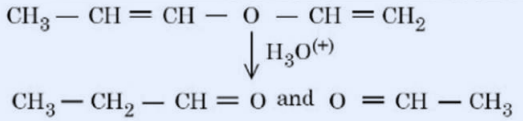
The unsaturated ether on acidic hydrolysis produces carbonyl compounds as shown below:-
Based on this, predict the solution/reagent that will help to distinguish "P" and "Q" obtained in the following reaction:-
Based on this, predict the solution/reagent that will help to distinguish "P" and "Q" obtained in the following reaction:-
(1)
(2)
(3)
(4)
SolutionAnswer: Option 3Fehling solution
Approach:
Acid hydrolysis of an unsaturated (vinyl/enol) ether cleaves each enol-ether linkage, and the released enol tautomerises to a carbonyl compound. The two carbonyl products P and Q are identified by carbon count, and a reagent that reacts with one carbonyl class but not the other is chosen to distinguish them.
Step 1:The left fragment CH3-CH=CH-O- is the enol ether of propanal; on hydrolysis it gives propanal, an aldehyde. This is product P.
Step 2:The right fragment -O-C(CH3)=CH2 is the enol ether of acetone; on hydrolysis it gives acetone, a ketone. This is product Q.
Step 3:Fehling solution oxidises the aldehyde P to a carboxylate with formation of a brick-red precipitate of cuprous oxide, whereas the ketone Q does not react. This difference distinguishes the two products.
Final answer: Fehling solution
Q56Single correctAtomic Structure
The heat of atomisation of methane and ethane are 'x' and 'y' respectively. The longest wavelength () of light capable of breaking the C-C bond can be expressed in SI unit as:
(1)
(2)
(3)
(4)
SolutionAnswer: Option 3
Approach:
The heat of atomisation of methane breaks four C-H bonds, fixing the C-H bond energy per mole. The heat of atomisation of ethane breaks one C-C bond and six C-H bonds, so subtracting the six C-H contributions isolates the C-C bond energy per mole. Converting to joules and dividing by Avogadro's number gives the energy per C-C bond, which equals the energy of the longest-wavelength photon able to break it.
Step 1:The methane atomisation breaks four C-H bonds, so the C-H bond energy per mole is one quarter of x.
Step 2:Subtracting the six C-H bond contributions from the ethane atomisation isolates the C-C bond energy per mole.
Step 3:Converting from kJ/mol to J/mol multiplies by 1000; dividing by Avogadro's number gives the energy per single C-C bond, which equals the longest-wavelength photon energy .
Step 4:Solving for the wavelength gives the SI expression for the longest wavelength capable of breaking the C-C bond.
Final answer:
Q57Single correctAlcohols, Phenols and Ethers
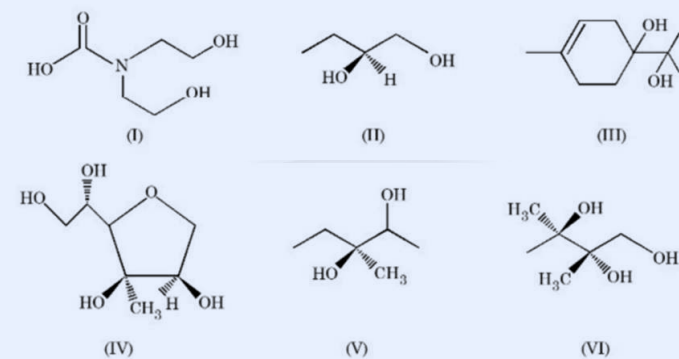
From the following, how many compounds contain at least one secondary alcohol?
Choose the correct answer from the options given below:
Choose the correct answer from the options given below:
(1)
(2)
(3)
(4)
SolutionAnswer: Option 1Three
Approach:
A secondary alcohol carries its hydroxyl group on a carbon bonded to exactly two other carbon atoms and one hydrogen. Each of the six drawn structures is examined at every carbinol carbon, and those bearing at least one such secondary hydroxyl are counted.
Step 1:Structure (I) is a carbamic-acid derivative bearing two -CH2CH2OH arms; each hydroxyl sits on a terminal CH2 carbon bonded to only one carbon, so both are primary, and the HO-C(=O) is a carboxylic acid, not an alcohol. No secondary alcohol is present.
Step 2:Structure (II), CH3CH2-CH(OH)-CH2OH, has its central hydroxyl on a carbon bonded to an ethyl group and a CH2OH group (two carbons) plus one hydrogen, which is a secondary alcohol.
Step 3:Structure (III) is a 4-methylcyclohexene ring carbon bearing -OH and a -C(CH3)2OH substituent; the ring carbinol carbon is bonded to three carbons (tertiary) and the side-chain carbinol carbon to three carbons (tertiary). No secondary alcohol is present.
Step 4:Structure (IV) is an oxolane bearing a HOCH2-CH(OH)- side chain and a ring CH(OH); the side-chain CH(OH) carbon is bonded to two carbons plus a hydrogen (secondary) and the ring CH(OH) is likewise secondary, so the molecule contains secondary alcohols.
Step 5:Structure (V), CH3CH2-C(OH)(CH3)-CH(OH)-CH3, has its central carbinol carbon bonded to three carbons (tertiary), while the adjacent carbon bearing -OH is bonded to two carbons plus a hydrogen, which is a secondary alcohol.
Step 6:Structure (VI), (CH3)2... drawn as H3C-C(CH3)(OH)-C(CH3)(OH)-CH2OH, has both internal carbinol carbons bonded to three carbons (tertiary) and a terminal -CH2OH (primary). No secondary alcohol is present. Counting (II), (IV) and (V) gives three structures.
Final answer: Three
Q58Single correctBiomolecules
The number of possible tripeptides formed involving alanine (ala), glycine (gly) and valine (val), where no amino acid has been used more than once is:
(1)
(2)
(3)
(4)
SolutionAnswer: Option 16
Approach:
A tripeptide built from three different amino acids, each used exactly once, is a directional chain with a distinct N-terminus, middle, and C-terminus. Reversing or reordering the residues gives a different peptide, so the count equals the number of ordered arrangements of three distinct units.
Step 1:Three distinct amino acids arranged in an ordered sequence give 3 factorial distinct tripeptides.
Step 2:The six distinct directional sequences are listed explicitly.
Final answer: 6
Q59Single correctRedox Reactions and Electrochemistry
One mole of (g) was passed into 2 L of cold 2M KOH solution. After the reaction, the concentrations of , and are respectively (assume volume remains constant)
(1)
(2)
(3)
(4)
SolutionAnswer: Option 2
Approach:
In cold dilute alkali, chlorine disproportionates to chloride and hypochlorite. The initial moles of chlorine and hydroxide are computed, the stoichiometry fixes the moles of each product and of hydroxide consumed, and dividing the remaining amounts by the fixed volume gives the concentrations.
Step 1:The initial amounts are 1 mol of chlorine and 2 L x 2 M = 4 mol of hydroxide. Hydroxide is in excess, so all 1 mol of chlorine reacts.
Step 2:By the stoichiometry, 1 mol of chlorine produces 1 mol of chloride and 1 mol of hypochlorite while consuming 2 mol of hydroxide; the hydroxide remaining is 4 - 2 = 2 mol.
Step 3:Dividing each amount by the constant 2 L volume gives the final concentrations.
Final answer:
Q60Single correctSolutions
Two liquids A and B form an ideal solution at temperature T K. At T K, the vapour pressures of pure A and B are 55 and 15 kN respectively. What is the mole fraction of A in solution of A and B in equilibrium with a vapour in which the mole fraction of A is 0.8?
(1)
(2)
(3)
(4)
SolutionAnswer: Option 2
Approach:
For an ideal solution, Raoult's law gives each component's partial pressure as its pure vapour pressure times its liquid-phase mole fraction. The ratio of vapour-phase mole fractions equals the ratio of partial pressures, producing a single equation that is solved for the liquid-phase mole fraction of A.
Step 1:With pure vapour pressures 55 and 15 and a vapour mole fraction of A equal to 0.8 (so ), the ratio of vapour mole fractions equals the ratio of partial pressures.
Step 2:Cross-multiplying gives a linear equation in .
Step 3:Solving for the liquid-phase mole fraction of A and evaluating the fraction gives the result.
Final answer:
Q61Single correctChemical Equilibrium
Consider the following gaseous equilibrium in a closed container of volume 'V' at T(K).
2 moles each of , and are present at equilibrium. Now one mole each of '' and '' are added to the equilibrium keeping the temperature at T(K). The number of moles of and and PQ at the new equilibrium, respectively, are
2 moles each of , and are present at equilibrium. Now one mole each of '' and '' are added to the equilibrium keeping the temperature at T(K). The number of moles of and and PQ at the new equilibrium, respectively, are
(1)
(2)
(3)
(4)
SolutionAnswer: Option 3
Approach:
The reaction conserves the total number of gas moles, so the volume terms cancel and the equilibrium constant reduces to a ratio of mole numbers. K is fixed from the first equilibrium, then re-applied to the disturbed system to find the forward extent of reaction and the new mole numbers.
Step 1:At the first equilibrium each species has 2 mol. Since the total moles of gas are equal on both sides, the volume factors cancel and K is the ratio of mole numbers.
Step 2:Adding 1 mol of and 1 mol of raises above K, so the reaction proceeds forward by an extent x. The new mole numbers are , , .
Step 3:Taking the positive square root of both sides gives a linear equation in x.
Step 4:Substituting x = 1/3 into the new mole expressions.
Final answer:
Q62Single correctp-Block Elements
Choose the INCORRECT statement.
1. Carbon cannot exceed its covalency more than four.
2. Among the isotopes of carbon, is a radioactive isotope.
3. is the most acidic oxide among the dioxides of group of 14 elements.
4. Carbon exhibits negative oxidation states along with +4 and +2.
1. Carbon cannot exceed its covalency more than four.
2. Among the isotopes of carbon, is a radioactive isotope.
3. is the most acidic oxide among the dioxides of group of 14 elements.
4. Carbon exhibits negative oxidation states along with +4 and +2.
(1)
(2)
(3)
(4)
SolutionAnswer: Option 2Among the isotopes of carbon, is a radioactive isotope.
Approach:
Each statement on group-14 chemistry of carbon is tested against established facts, and the single false statement is identified.
Step 1:Carbon has only s and p orbitals available in its valence shell (no d orbitals in n = 2), so its covalency is capped at four. Statement 1 is true.
Step 2:Carbon-12 and carbon-13 are stable isotopes; carbon-14 is the radioactive one used in radiocarbon dating. Labelling as radioactive is false.
Step 3:Acidic character of the group-14 dioxides decreases down the group, so is the most acidic, making statement 3 true; carbon shows negative oxidation states (e.g. -4 in ) besides +4 and +2, making statement 4 true.
Final answer: Among the isotopes of carbon, is a radioactive isotope.
Q63Single correctPrinciples Related to Practical Chemistry
In the Group analysis of cations, & are precipitated respectively as
(1)
(2)
(3)
(4)
SolutionAnswer: Option 3carbonate & carbonate
Approach:
The group of qualitative analysis to which and belong is identified, and the precipitate each forms with the corresponding group reagent is determined.
Step 1: and belong to Group V (alkaline-earth group) of cation analysis. The group reagent is ammonium carbonate added with and . Barium precipitates as its carbonate.
Step 2:Calcium reacts identically with the same group reagent, precipitating as calcium carbonate.
Final answer: carbonate & carbonate
Q64Single correctSome Basic Principles of Organic Chemistry
Find out the statements which are not true.
A. Resonating structures with more number of covalent bonds and lesser charge separation are more stable.
B. In electromeric effect, an unsaturated system shows +E effect with nucleophile and -E effect with electrophile.
C. Inductive effect is responsible for high melting point, boiling point and dipole moment of polar compounds.
D. The greater the number of alkyl groups attached to the doubly bonded carbon atoms, higher is the heat of hydrogenation.
E. Stability of carbanion increases with the increase in s - character of the carbon carrying the negative charge.
Choose the correct answer from the options given below:
A. Resonating structures with more number of covalent bonds and lesser charge separation are more stable.
B. In electromeric effect, an unsaturated system shows +E effect with nucleophile and -E effect with electrophile.
C. Inductive effect is responsible for high melting point, boiling point and dipole moment of polar compounds.
D. The greater the number of alkyl groups attached to the doubly bonded carbon atoms, higher is the heat of hydrogenation.
E. Stability of carbanion increases with the increase in s - character of the carbon carrying the negative charge.
Choose the correct answer from the options given below:
(1)
(2)
(3)
(4)
SolutionAnswer: Option 3B & D only
Approach:
Each of the five statements on electronic effects and molecular stability is judged against standard organic-chemistry principles, and the untrue statements are collected.
Step 1:Statement A is true: resonance structures with more covalent bonds and less charge separation carry lower energy and contribute more. Statement C is true: inductive (and other electronic) effects make polar compounds more associated, raising melting point, boiling point and dipole moment. Statement E is true: carbanion stability increases with s-character of the carbon bearing the lone pair, since higher s-character holds the electron pair closer to the nucleus.
Step 2:Statement B reverses the electromeric effect: an unsaturated system shows the +E effect toward an electrophile and the -E effect toward a nucleophile, so the statement as written is false.
Step 3:Statement D reverses the hydrogenation trend: more alkyl groups on the doubly bonded carbons stabilise the alkene (hyperconjugation), so its heat of hydrogenation is lower, not higher.
Final answer: B & D only
Q65Single correctClassification of Elements and Periodicity in Properties
The correct order of C, N, O and F in terms of second ionisation potential is
(1)
(2)
(3)
(4)
SolutionAnswer: Option 4
Approach:
The second ionisation enthalpy removes an electron from the singly charged cation, so the configurations of , , and govern the trend. Extra-stable half-filled or otherwise stable cations resist losing a further electron, raising the second ionisation potential.
Step 1:The relevant electron is removed from the +1 cation. The valence configurations of the monocations are: , , (half-filled, extra stable), .
Step 2:Removing an electron from destroys the stable half-filled configuration, requiring the most energy, so oxygen has the highest second ionisation potential. The half-filled stabilisation of is absent, and across the remaining cations the energy rises with nuclear charge for similar sub-shell occupancy, giving the increasing order .
Final answer:
Q66Single correctd- and f-Block Elements
"X" is an oxoanion of the lightest element of group 7 (in the periodic table). The metal is in +6 oxidation state in "X". The color of the potassium salt of X is.
(1)
(2)
(3)
(4)
SolutionAnswer: Option 1green
Approach:
The lightest element of group 7 is identified, its +6 oxoanion is written, and the colour of the corresponding potassium salt is recalled.
Step 1:The lightest element of group 7 (the manganese triad) is manganese. Its oxoanion with manganese in the +6 oxidation state is the manganate ion.
Step 2:The potassium salt of the manganate ion is potassium manganate, which is green; this contrasts with potassium permanganate (Mn in +7), which is purple.
Final answer: green
Q67Single correctSome Basic Principles of Organic Chemistry
Given below are two statements:
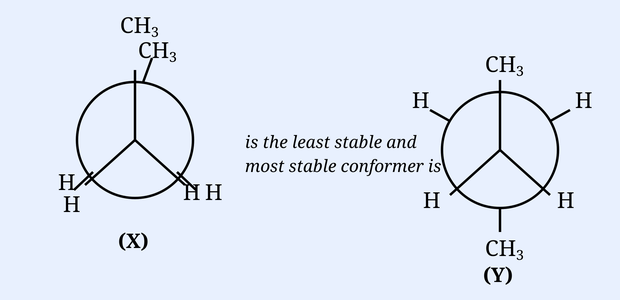
Statement I: There are several conformers for n-butane. Out of those conformers, (X) is the least stable and most stable conformer is (Y).
Statement II: As the dihedral angle increases, torsional strain decreases from (X) to (Y).
Statement I: There are several conformers for n-butane. Out of those conformers, (X) is the least stable and most stable conformer is (Y).
Statement II: As the dihedral angle increases, torsional strain decreases from (X) to (Y).
(1)
(2)
(3)
(4)
SolutionAnswer: Option 3Both Statement I and Statement II are true
Approach:
The two Newman projections are the fully eclipsed (syn) conformer (X) and the anti (staggered) conformer (Y) of n-butane. Their relative stabilities and the variation of torsional strain with dihedral angle from (X) to (Y) are assessed to judge both statements.
Step 1:Conformer (X), the fully eclipsed (syn) form, has the two methyl groups overlapping at a dihedral angle of 0 degrees, giving maximum eclipsing and steric (van der Waals) strain and therefore the highest energy and least stability. Conformer (Y), the anti form, has the methyl groups 180 degrees apart with staggered bonds, giving the lowest strain and the highest stability. Statement I is correct.
Step 2:Moving from (X) at 0 degrees toward (Y) at 180 degrees, the eclipsing of bonds is progressively relieved, so the torsional strain falls and the potential energy decreases from (X) to (Y). Statement II is correct.
Final answer: Both Statement I and Statement II are true
Q68Single correctAldehydes, Ketones and Carboxylic Acids
Given below are two statements:
Statement I: Cross aldol condensation between two different aldehydes will always produce four different products.
Statement II: When semicarbazide reacts with a mixture of benzaldehyde and acetophenone under optimum pH, it forms a condensation product with acetophenone only.
In the light of the above statements, choose the correct answer from the options given below
Statement I: Cross aldol condensation between two different aldehydes will always produce four different products.
Statement II: When semicarbazide reacts with a mixture of benzaldehyde and acetophenone under optimum pH, it forms a condensation product with acetophenone only.
In the light of the above statements, choose the correct answer from the options given below
(1)
(2)
(3)
(4)
SolutionAnswer: Option 4Both Statement I and Statement II are false
Approach:
The generality claimed for cross aldol condensation and the selectivity claimed for semicarbazide are each tested against the reactivity requirements of the carbonyl partners.
Step 1:Cross aldol condensation yields four different products only when both aldehydes carry -hydrogens, so that either can act as the enolate (nucleophile). If one aldehyde has no -hydrogen, it can serve only as the electrophilic carbonyl and fewer than four products form. The word always makes Statement I false.
Step 2:At the optimum (weakly acidic) pH, semicarbazide condenses with the more reactive carbonyl. Benzaldehyde (an aldehyde) is more electrophilic and less hindered than the ketone acetophenone, so the semicarbazone forms preferentially with benzaldehyde, not with acetophenone. Statement II is false.
Final answer: Both Statement I and Statement II are false
Q69NumericalRedox Reactions and Electrochemistry
Molar conductivity of a weak acid HQ of concentration 0.18 M was found to be 1/30 of the molar conductivity of another weak acid HZ with concentration of 0.02 M. If - happened be equal with - then the difference of the , values of the two weak acids is____ (Nearest integer). [Given: degree of dissociation for both weak acids : limiting molar conductivity of ions]
SolutionAnswer: 2
Approach:
For a weak acid the degree of dissociation equals the molar conductivity divided by the limiting molar conductivity. With equal limiting conductivities, the ratio of dissociation degrees equals the given conductivity ratio. Ostwald's dilution law then links each dissociation constant to its concentration and degree of dissociation, yielding the difference of values.
Step 1:The limiting molar conductivities are equal, so the degree of dissociation is proportional to the measured molar conductivity. The stated conductivity ratio gives the ratio of dissociation degrees.
Step 2:Applying Ostwald's law to each acid, with M and M, and forming the ratio of dissociation constants.
Step 3:The difference of values is the negative logarithm of this ratio.
Final answer: 2
Q70NumericalChemical Kinetics
The half–life of is 245 days After x days, 75% of original activity remained. The value of x in days is. (Nearest integer) (Given: and )
SolutionAnswer: 102
Approach:
Radioactive decay is first order. The rate constant follows from the half-life, and the integrated first-order law is solved for the time at which the activity falls to 75% of its initial value, evaluated with the supplied logarithms.
Step 1:The decay constant is fixed by the half-life of 245 days.
Step 2:The remaining activity is 75% of the original, so . Combining the integrated law with k and writing in base-10 logarithms gives t in terms of the half-life.
Step 3:Evaluating the logarithm and dividing by .
Final answer: 102
Q71NumericalPurification and Characterisation of Organic Compounds
0.25 g of an organic compound "A" containing carbon, hydrogen and oxygen was analysed using the combustion method. There was an increase in mass of tube and potash tube at the end of the experiment. The amount was found to be 0.15 g and 0.1837 g, respectively. The percentage of oxygen in compound A is _ %. (Nearest integer)
(Given: molar mass in g mo H: 1, C: 12, O:16)
(Given: molar mass in g mo H: 1, C: 12, O:16)
SolutionAnswer: 73
Approach:
In combustion analysis the calcium chloride tube absorbs the water formed (giving hydrogen) and the potash tube absorbs the carbon dioxide formed (giving carbon). The mass percentages of carbon and hydrogen are computed from the carbon fraction of and the hydrogen fraction of , and oxygen is found by difference from 100%.
Step 1:The potash tube gains 0.1837 g of . The carbon content is the 12/44 mass fraction of this, expressed as a percentage of the 0.25 g sample.
Step 2:The calcium chloride tube gains 0.15 g of . The hydrogen content is the 2/18 mass fraction of this, as a percentage of the sample.
Step 3:Oxygen is obtained by subtracting the carbon and hydrogen percentages from 100.
Final answer: 73
Q72NumericalSome Basic Principles of Organic Chemistry
Grignard reagent RMgBr (P) reacts with water and forms a gas (Q). One gram of Q occupies 1.4 at STP. (P) on reaction with dry ice in dry ether followed by forms a compound (Z). 0.1 mole of (Z) will weigh ____ g. (Nearest integer)
SolutionAnswer: 6
Approach:
Hydrolysis of the Grignard reagent RMgBr gives the hydrocarbon RH as gas Q; the molar volume at STP fixes its molar mass and hence the group R. Treating the same Grignard reagent with dry ice (carbon dioxide) and then acid gives the carboxylic acid Z, whose mass for 0.1 mol is found.
Step 1:One gram of Q occupies at STP, so its molar mass is the molar volume divided by the volume of one gram.
Step 2:Since hydrolysis gives methane, the alkyl group is methyl and the Grignard reagent is . Reaction with dry ice followed by converts it to the carboxylic acid with one extra carbon, namely acetic acid.
Step 3:The mass of 0.1 mol of acetic acid is the moles times the molar mass.
Final answer: 6
Q73NumericalCoordination Compounds
A chromium complex with a formula has has a spin only magnetic moment value of 3.87 BM and its solution conductivity corresponds to 1: 2 electrolyte. 2.75 g of the complex solution was initially passed through a cation exchanger. The solution obtained after the process was reacted with excess of . The amount of AgCl formed in the above process is g. (Nearest integer)
[Given: Molar mass in g mo Cr: 52; Cl: 35.5, Ag:108, O:16, H:1]
[Given: Molar mass in g mo Cr: 52; Cl: 35.5, Ag:108, O:16, H:1]
SolutionAnswer: 3
Approach:
The spin-only moment fixes the oxidation state and d-configuration of chromium, and the 1:2 electrolyte behaviour fixes how many chlorides lie outside the coordination sphere. Passing the solution through a cation exchanger removes the complex cation while leaving the ionisable chloride ions in solution; these precipitate quantitatively as silver chloride with excess silver nitrate. The moles of complex give the mass of AgCl.
Step 1:A spin-only moment of 3.87 BM corresponds to three unpaired electrons, , which is (). The 1:2 electrolyte gives three ions per formula unit, so two chlorides are ionisable (outside the sphere) and one is coordinated, giving .
Step 2:The molar mass of is computed, then the moles in 2.75 g.
Step 3:The cation exchanger retains and releases the two free chloride ions, which precipitate with excess as AgCl ().
Final answer: 3
Mathematics24 questions
Q1Single correctCoordinate Geometry
Let the length of the latus rectum of an ellipse , be 30. If its eccentricity is the maximum value of the function , then is equal to
(1)
(2)
(3)
(4)
SolutionAnswer: Option 4
Approach:
The eccentricity equals the maximum value of the downward parabola . The latus-rectum length gives one relation between a and b, and closes the system to determine .
Step 1:The parabola opens downward, so its maximum is at .
Step 2:Set the latus-rectum length equal to 30.
Step 3:Substitute with into .
Step 4:Compute and , then their sum.
Final answer:
Q2Single correctSequences and Series
Let be an A.P. of four terms such that each term of the A.P. and its common difference are integers. If and , then the largest term of the A.P. is equal to
(1)
(2)
(3)
(4)
SolutionAnswer: Option 2
Approach:
Represent the four-term A.P. symmetrically about its mean using the common difference d. The sum fixes the mean, and the condition becomes a perfect square in , which the integer constraint resolves.
Step 1:The sum of the four symmetric terms is .
Step 2:Form the product as a product of two differences of squares.
Step 3:Add ; the result is a perfect square.
Step 4:Take square roots and solve for .
Step 5:Integer common difference is ; the largest term is .
Final answer:
Q3Single correctMatrices and Determinants
Let . If and B = adj(adj A) be such that , then is equal to
(1)
(2)
(3)
(4)
SolutionAnswer: Option 3
Approach:
Recognise the integrand as the derivative of a rational function to obtain f, fix the constant from , evaluate , expand , then apply the adjoint-of-adjoint determinant identity with .
Step 1:The integrand is the derivative of , so . Since and , the constant vanishes.
Step 2:Differentiate and evaluate at via the quotient rule.
Step 3:Expand along the first row of .
Step 4:For , ; set equal to 81.
Step 5:Since , retain the non-negative value.
Final answer:
Q4Single correctComplex Numbers and Quadratic Equations
The smallest positive integral value of a, for which all the roots of are real and distinct, is equal to
(1)
(2)
(3)
(4)
SolutionAnswer: Option 4
Approach:
Substitute to reduce the biquadratic to a quadratic in t. Four real distinct values of x require two distinct positive roots in t, which translates into a discriminant, sum, and product condition on a.
Step 1:Put ; the equation becomes .
Step 2:Each positive root of g yields two real distinct ; distinct positive roots require positive product and positive sum.
Step 3:Distinct roots require a positive discriminant.
Step 4:The smallest positive integer satisfying .
Final answer:
Q5Single correctSequences and Series
upto infinite terms, is equal to
(1)
(2)
(3)
(4)
SolutionAnswer: Option 1
Approach:
With and , the n-th bracket is the geometric-type sum . Summing over reduces to two convergent geometric series.
Step 1:Identify ; the n-th bracket equals , so the total sum is .
Step 2:Evaluate the two geometric tails.
Step 3:Divide by .
Final answer:
Q6Single correctCoordinate Geometry
Let the angles made with the positive x-axis by two straight lines drawn from the point P(2, 3) and meeting the line at distance from the point P be and . Then the value of is:
(1)
(2)
(3)
(4)
SolutionAnswer: Option 3
Approach:
Parametrise each line through by its inclination with distance r to the meeting point on . Imposing produces a trigonometric equation whose two solutions are and , whose sum follows directly.
Step 1:A point at distance r from along inclination lies on when .
Step 2:Set , so .
Step 3:Solve for the two admissible angles in .
Step 4:Add the two inclinations.
Final answer:
Q7Single correctSets, Relations and Functions
Let f be a function suck that , , where . Then is equal to
(1)
(2)
(3)
(4)
SolutionAnswer: Option 2
Approach:
Evaluate m from the sum of squares to simplify the argument to . Substituting produces a second equation; eliminating the auxiliary term yields f(x) explicitly, then follows.
Step 1:Compute and simplify the argument.
Step 2:Replace x by to obtain a second relation.
Step 3:Multiply the first relation by 3 and the second by 2, then subtract to eliminate .
Step 4:Evaluate the required difference.
Final answer:
Q8Single correctPermutations and Combinations
The letters of the word "UDAYPUR" are written in all possible ways with or without meaning and these words are arranged as in a dictionary. The rank of the word "UDAYPUR" is
(1)
(2)
(3)
(4)
SolutionAnswer: Option 2
Approach:
Sort the letters of UDAYPUR alphabetically as A, D, P, R, U, U, Y (with U repeated). Count, position by position, the words that precede UDAYPUR, dividing by the factorial of the repeat count whenever both U's remain unfixed.
Step 1:Letters A, D, P, R each precede U as the first letter; each leaves 6 letters with one pair of U's.
Step 2:Fix first letter U. Second letter A precedes D, leaving 5 distinct letters (D, P, R, U, Y).
Step 3:Fix U, D, A. Fourth-letter choices P, R, U each precede Y, leaving 3 distinct letters.
Step 4:Fix U, D, A, Y. Fifth letter P matches; sixth-letter R precedes U, leaving 1 arrangement, then UDAYPUR itself adds 1.
Step 5:Add all contributions to obtain the rank.
Final answer:
Q9Single correctPermutations and Combinations
The largest value of n, for which divides 60!, is
(1)
(2)
(3)
(4)
SolutionAnswer: Option 1
Approach:
Factor and compute the exponents of the primes 2 and 5 in by Legendre's formula. The largest n is bounded by whichever prime is exhausted first.
Step 1:Exponent of 2 in .
Step 2:Exponent of 5 in .
Step 3:Require and simultaneously.
Final answer:
Q10Single correctVector Algebra
Let and . If C is a vector such that , , then is equal to
(1)
(2)
(3)
(4)
SolutionAnswer: Option 2
Approach:
Combine the two cross-product terms into a single cross product, which vanishes only if c is parallel to . The scalar-product condition fixes the proportionality constant, after which is evaluated directly.
Step 1:Combine the cross products by linearity.
Step 2:Compute from .
Step 3:Apply with .
Step 4:Compute and its squared magnitude.
Final answer:
Q11Single correctSets, Relations and Functions
If the domain of the function , is , then is equal to
(1)
(2)
(3)
(4)
SolutionAnswer: Option 1
Approach:
The arcsine argument must lie in , giving two rational inequalities in x. Solving each by sign analysis and intersecting the two solution sets yields the three domain pieces, whose endpoints are .
Step 1:Impose , i.e. , with critical points (numerator) and (denominator).
Step 2:Impose , i.e. , with critical points (numerator) and (denominator).
Step 3:Intersect the two solution sets (note and ).
Step 4:Sum the four endpoints.
Final answer:
Q12Single correctMatrices and Determinants
Let and be two square matrices of order 3 such that and . Then the value of is:
(1)
(2)
(3)
(4)
SolutionAnswer: Option 4
Approach:
Split the scaling factor into a row factor and a column factor . Pulling these out of the determinant relates to , fixing , after which the adjoint-of-adjoint identity gives the answer.
Step 1:Write , then factor out of row i and out of column j.
Step 2:Use the given .
Step 3:Apply the order-3 adjoint-of-adjoint identity with .
Final answer:
Q13Single correctCoordinate Geometry
Let the image of parabola , in the line be , . Then is equal to
(1)
(2)
(3)
(4)
SolutionAnswer: Option 2
Approach:
A point on is parametrised, its reflection in the line is computed from the standard reflection formula, and the parameter is eliminated to recover the image curve in the form .
Step 1:Take a general point of the parabola .
Step 2:Reflect in the line using .
Step 3:Express from the -relation.
Step 4:Substitute t into to eliminate the parameter.
Step 5:Match the image with and add the constants.
Final answer:
Q14Single correctStatistics and Probability
Let and for some , . If the mean and variance of the elements of Y are 30 and 750, respectively, then the sum of all possible values of b is
(1)
(2)
(3)
(4)
SolutionAnswer: Option 2
Approach:
has a fixed mean and variance. Under the mean transforms as and the variance as . The variance condition fixes a up to sign and the mean condition then fixes b for each sign.
Step 1:Compute the mean and variance of for .
Step 2:Apply the variance condition .
Step 3:Apply the mean condition for each value of a.
Step 4:Add the two admissible values of .
Final answer:
Q15Single correctIntegral Calculus
Let denote the area of the region in the first quadrant bounded by and . Then is equal to
(1)
(2)
(3)
(4)
SolutionAnswer: Option 3
Approach:
On the strip the curve is the lower boundary. The upper boundary is evaluated for and , where the moduli resolve to constants; each area is the integral of the gap over .
Step 1:Resolve the upper boundary at : the term vanishes and the moduli become constants.
Step 2:Integrate the gap for .
Step 3:Resolve the upper boundary at on , where and .
Step 4:Integrate the gap for .
Step 5:Add the two areas.
Final answer:
Q16Single correctDifferential Equations
Let be a differentiable function in the interval such that , and for each . Then is equal to
(1)
(2)
(3)
(4)
SolutionAnswer: Option 1
Approach:
The given limit is the negative derivative of at , which produces a first-order linear ODE. Solving it with an integrating factor and applying determines y(x), hence .
Step 1:Let , so and the quotient equals .
Step 2:Divide by to standard linear form.
Step 3:Compute the integrating factor.
Step 4:Integrate .
Step 5:Apply to find .
Step 6:Evaluate .
Final answer:
Q17Single correctLimit, Continuity and Differentiability
Consider the following three statements for the function defined by .
(I) f is differentiable at all (II) f is increasing in .
(III) f is decreasing in .
Then.
(I) f is differentiable at all (II) f is increasing in .
(III) f is decreasing in .
Then.
(1)
(2)
(3)
(4)
SolutionAnswer: Option 1Only (I) and (III) are TRUE.
Approach:
The function is split piecewise about , since both and change sign there. Differentiating each branch and comparing the one-sided derivatives at settles differentiability, and the sign of f' settles monotonicity on each interval.
Step 1:Write piecewise.
Step 2:Differentiate each branch.
Step 3:Compare one-sided derivatives at .
Step 4:Determine the sign of f' on , where .
Step 5:Determine the sign of f' on , where .
Step 6:Combine the conclusions.
()\ ,\ ()\ ,\ ()\
Final answer: Only (I) and (III) are TRUE.
Q18Single correctCoordinate Geometry
The sum of all values of , for which the shortest distance between the lines and is , is
(1)
(2)
(3)
(4)
SolutionAnswer: Option 3
Approach:
The shortest distance between two lines uses the connecting vector dotted with the cross product of the two direction vectors, divided by that cross product's magnitude. Setting the distance to gives a quadratic in , and Vieta's formula gives the root sum.
Step 1:Read off points and directions: , , , , and form .
Step 2:Compute the cross product .
Step 3:Compute its magnitude.
Step 4:Compute the scalar triple product (numerator).
Step 5:Set and cancel the common .
Step 6:Square and simplify to a quadratic.
Step 7:Factor and add the roots.
Final answer:
Q19Single correctLimit, Continuity and Differentiability
Let [t] denote the greatest integer less than or equal to t. If the function is continuous at , then is equal to
(1)
(2)
(3)
(4)
SolutionAnswer: Option 1
Approach:
Continuity at requires the right-hand limit, the left-hand limit and to be equal. The right-hand limit is found with standard trigonometric limits, and the left-hand limit collapses the greatest-integer term to a constant.
Step 1:Simplify the numerator of the branch.
Step 2:Evaluate the right-hand limit.
Step 3:Evaluate the bracket inside the greatest-integer function as .
Step 4:Evaluate the left-hand limit.
Step 5:Impose continuity by equating the three values.
Step 6:Compute .
Final answer:
Q20NumericalIntegral Calculus
If f(x) satisfies the relation , then is equal to
SolutionAnswer: 2
Approach:
The integral terms are constants, so with and . Computing B from this form yields a relation that fixes A, which is all that is needed for .
Step 1:Separate the kernel into the constant integrals A and B.
Step 2:Compute using , , and .
Step 3:Cancel from both sides to fix .
Step 4:Evaluate .
Step 5:Add to .
Final answer:
Q21NumericalTrigonometry
The number of elements in the set is ___
SolutionAnswer: 4
Approach:
Grouping the equation as , converting to sines and cosines and applying componendo-dividendo reduces it to . The admissible roots in are then counted.
Step 1:Group and convert to sine-cosine form, then apply componendo-dividendo to collapse the product.
Step 2:Expand the product to sums to reach a single sine.
Step 3:Apply the general solution and solve for x.
Step 4:Retain only roots in .
Step 5:Count the solutions.
#{x}=4
Final answer:
Q22NumericalStatistics and Probability
Let S be a set of 5 elements and P(S) denote the power set of S. Let E be an event of choosing an ordered pair (A, B) from the set such that . If the probability of the event E is , where , then is equal to ___
SolutionAnswer: 15
Approach:
The sample space is all ordered pairs (A,B) from . For , each of the elements is independently assigned to A only, B only, or neither, giving favourable pairs against total.
Step 1:Count the total ordered pairs for .
Step 2:Count favourable pairs: each element independently goes to only, only, or neither.
Step 3:Form the probability and match .
Step 4:Add the exponents.
Final answer:
Q23NumericalComplex Numbers and Quadratic Equations
Let , where . If , then n is equal to ___
SolutionAnswer: 5
Approach:
For the product , the squared modulus is the product of the squared moduli, so . Factorising into consecutive terms identifies the top index n.
Step 1:Express the squared modulus factor by factor.
Step 2:Build the cumulative product of and match .
Step 3:The last factor is .
Final answer:
Q24NumericalCoordinate Geometry
Let (h, k) lie on the circle and the point lie on an ellipse with eccentricity e. Then the value of is equal to ___
SolutionAnswer: 9
Approach:
Parametrising (h,k) on the circle and substituting into yields the locus of the image point as an ellipse. Identifying its semi-axes gives the eccentricity and hence .
Step 1:Parametrise on the circle and form the image coordinates.
Step 2:Solve for the trigonometric terms.
Step 3:Apply to obtain the locus.
Step 4:Since the major axis is along y; compute .
Step 5:Evaluate the requested quantity.
Final answer:
More JEE Main 2026 papers
- JEE Main 2026 — April 02, Shift 1
- JEE Main 2026 — April 02, Shift 2
- JEE Main 2026 — April 04, Shift 1
- JEE Main 2026 — April 04, Shift 2
- JEE Main 2026 — April 05, Shift 1
- JEE Main 2026 — April 05, Shift 2
- JEE Main 2026 — April 06, Shift 1
- JEE Main 2026 — April 06, Shift 2
- JEE Main 2026 — April 08, Shift 2
- JEE Main 2026 — January 21, Shift 1
- JEE Main 2026 — January 21, Shift 2
- JEE Main 2026 — January 22, Shift 1
- JEE Main 2026 — January 22, Shift 2
- JEE Main 2026 — January 23, Shift 1
- JEE Main 2026 — January 23, Shift 2
- JEE Main 2026 — January 24, Shift 1
- JEE Main 2026 — January 28, Shift 1
- JEE Main 2026 — January 28, Shift 2
Frequently Asked Questions
How many questions are in the JEE Main 2026 January 24, Shift 2 paper?
The JEE Main 2026 January 24, Shift 2 paper has 73 questions — Physics (24), Chemistry (25) and Mathematics (24). Every question is on this page with its correct answer and a step-by-step solution.
What is the marking scheme for JEE Main?
JEE Main awards +4 marks for each correct answer and −1 for a wrong answer, with 0 for questions left unattempted. The paper covers Physics, Chemistry and Mathematics.
Are the answer key and step-by-step solutions provided for the 2026 January 24, Shift 2 paper?
Yes — every question shows the correct answer (answer key) and a detailed step-by-step solution, free to read online.
Can I take the JEE Main 2026 January 24, Shift 2 paper as a timed mock test?
Yes. With a free JEEnify account you can attempt this exact paper as a timed test in the real exam interface, then see your score and weak-area analysis.
Solved this paper? Calculate your JEE Main scoremost important chaptersformula sheetsall free tools.