
Back to JEE Main PYQs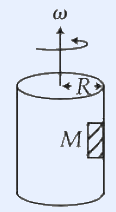
JEE Main 2026 January 21, Shift 2 Question Paper with Solutions
All 75 questions from the JEE Main 2026 (January 21, Shift 2) shift — Physics (25), Chemistry (25) and Mathematics (25) — each with the correct answer (answer key) and a step-by-step solution. Read it free online, or attempt the full paper as a timed mock test.
Physics25 questions
Q26Single correctLaws of Motion
A large drum having radius R is spinning around its axis with angular velocity as shown in the figure. The minimum value of so that body of mass M remains stuck to the inner wall of the drum taking the coefficient of friction between drum surface and mass M as is
(1)
(2)
(3)
(4)
SolutionAnswer: Option 3
Approach:
The inner wall supplies a horizontal normal force that provides the centripetal force, while vertical friction balances gravity; setting friction at its limiting value yields the minimum angular velocity.
Step 1:The wall pushes the block radially inward; this normal force provides the centripetal force for the circular motion of the block.
Step 2:For the block not to slide down, upward static friction must support the weight. At the minimum angular velocity, friction reaches its limiting value μN.
Step 3:Substitute N = Mω²R into the friction condition.
Step 4:Cancel M and solve for ω.
Final answer:
Q27Single correctOptics
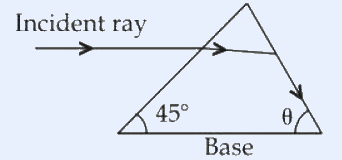
As shown in the diagram, when the incident ray is parallel to base of the prism the emergent ray grazes along the second surface. If refractive index of the material of prism is , the angle of prism is
(1)
(2)
(3)
(4)
SolutionAnswer: Option 3
Approach:
Grazing emergence means the ray meets the second surface at the critical angle; find the critical angle from μ, obtain the first-face refraction angle from the 45° geometry, apply r₁ + r₂ = A, then use the triangle angle sum to get the base angle θ.
Step 1:Grazing emergence at the second surface means the internal angle there equals the critical angle. Compute it for μ = √2.
Step 2:The incident ray is parallel to the base and the first refracting face makes 45° with the base, so the angle of incidence on the first face is 45°. Apply Snell's law there.
Step 3:Apply the prism relation to find the apex angle A.
Step 4:Use the triangle angle sum with the apex 75° and the first base angle 45° to obtain θ.
Final answer:
Q28Single correctUnits and Measurements
Keeping significant figures in view physical quantities 52.01 m, 153.2 m and 0.123 m is
(1)
(2)
(3)
(4)
SolutionAnswer: Option 3
Approach:
Add the three lengths, then round the sum to the least number of decimal places present among the addends, following the addition rule for significant figures.
Step 1:Compute the exact arithmetic sum of the three lengths.
Step 2:Identify the fewest decimal places among the addends: 52.01 has 2, 153.2 has 1, 0.123 has 3. The least is 1.
Step 3:Round the sum to one decimal place.
Final answer:
Q29Single correctKinetic Theory of Gases
The r.m.s. speed of oxygen molecules at is equal to that of hydrogen molecules kept at ______ . (mass of oxygen molecule/mass of hydrogen molecule = 32/2)
(1)
(2)
(3)
(4)
SolutionAnswer: Option 4
Approach:
Equal r.m.s. speeds require equal T/M ratios. Convert the oxygen temperature to kelvin, use the mass ratio to find the hydrogen temperature in kelvin, then convert back to degrees Celsius.
Step 1:Convert the oxygen temperature to kelvin.
Step 2:Equating r.m.s. speeds gives T/M equal for both gases. With M(O₂)/M(H₂) = 32/2 = 16, set up the proportion.
Step 3:Solve for the hydrogen temperature in kelvin.
Step 4:Convert the hydrogen temperature back to degrees Celsius.
Final answer:
Q30Single correctElectromagnetic Oscillations
A capacitor C is first charged fully with potential difference of and disconnected from battery. The charged capacitor is connected across an inductor having inductance L. In t sec 25% of initial energy in the capacitor is transferred to inductor. The value of t is _______ sec.
(1)
(2)
(3)
(4)
SolutionAnswer: Option 3
Approach:
In an LC circuit the charge oscillates as q = Q₀cos(ωt). If 25% of the energy moves to the inductor, 75% stays in the capacitor, so its charge falls to √0.75 of the initial value; solve the cosine equation for the time.
Step 1:With 25% of the energy transferred to the inductor, the capacitor retains 75% of the initial energy. Since energy is proportional to q², write the charge ratio.
Step 2:Equate to the oscillation expression and solve for the phase ωt.
Step 3:Substitute ω = 1/√(LC) and solve for t.
Final answer:
Q31Single correctElectrostatics
Consider two identical metallic spheres of radius R each having charge Q and mass m. Their centres have an initial separation of 4 R. Both spheres are given and initial speed u towards each other. The minimum value of u, so that they can just touch each other is (Take and assume where G is the gravitational constant)
(1)
(2)
(3)
(4)
SolutionAnswer: Option 3
Approach:
Apply conservation of mechanical energy from the initial centre separation 4R to the just-touching configuration (centre separation 2R). Account for both kinetic energy and the net potential energy (electrostatic repulsion plus gravitational attraction); at minimum speed the spheres just touch with zero kinetic energy.
Step 1:Write the total mechanical energy at the initial separation 4R. Both spheres move with speed u, so the total kinetic energy is 2·(½mu²) = mu².
Step 2:At the just-touching point the centre separation is 2R and the kinetic energy is zero for the minimum-speed case.
Step 3:Equate the two energies and isolate mu².
Step 4:Combine the terms over 4R.
Step 5:Solve for u and factor out kQ².
Final answer:
Q32Single correctRotational Motion
Two cars A and B each of mass are moving on parallel tracks separate by distance of 10 m, in same direction with speeds 72 km/h and 36 km/h. The magnitude of angular momentum of car A with respect to car B is _______ Js.
(1)
(2)
(3)
(4)
SolutionAnswer: Option 3
Approach:
The angular momentum of A about B equals (mass of A) × (velocity of A relative to B) × (perpendicular distance between the parallel tracks). Convert speeds to m/s and use the relative velocity.
Step 1:Convert both speeds to m/s.
Step 2:The cars move in the same direction, so the relative speed of A with respect to B is the difference.
Step 3:Apply L = m·el·erp with erp = 10 m (track separation) and m = 10³ kg.
Final answer:
Q33Single correctMagnetic Effects of Current and Magnetism
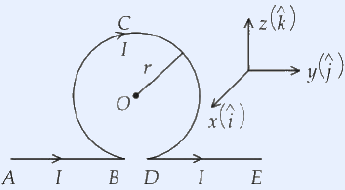
An infinitely long straight wire carrying current is bent in a planer shape as shown in the diagram. The radius of the circular part is . The magnetic field at the centre of the circular loop is
(1)
(2)
(3)
(4)
SolutionAnswer: Option 2
Approach:
Superpose the field at the centre O from the full circular loop and from the infinite straight wire that passes at perpendicular distance r below O. The two contributions are antiparallel along the x-axis; subtract their magnitudes and assign the net direction.
Step 1:Field at the centre due to the full circular loop, directed along −x for the given current sense.
Step 2:Field at O due to the infinitely long straight wire at perpendicular distance r, directed along +x (opposite to the loop field).
Step 3:Add the two antiparallel contributions, writing the loop term over the common factor μ₀I/(2π r) using 1/(2r) = π/(2π r).
Step 4:Factor out the sign to present the net field.
Final answer:
Q34Single correctCurrent Electricity
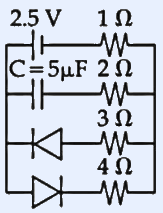
The charge stored by the capacitor C in the given circuit in the steady state is ______ .
(1)
(2)
(3)
(4)
SolutionAnswer: Option 2
Approach:
In steady state no current flows through the capacitor branch. The diodes fix a single conduction loop through the 1 Ω and 4 Ω resistors; find the loop current, the voltage across the 4 Ω resistor (which equals the capacitor voltage), and then Q = .
Step 1:At steady state the capacitor draws no current. The conducting loop is the 2.5 V source in series with the 1 Ω and 4 Ω resistors, total 5 Ω.
Step 2:The capacitor voltage equals the voltage across the 4 Ω resistor in the conduction loop.
Step 3:Compute the stored charge with C = 5 μF.
Final answer:
Q35Single correctOscillations and Waves
The kinetic energy of simple harmonic oscillator is oscillating with angular frequency of 176 rad/sec. The frequency of the simple harmonic oscillator is ______Hz.
(1)
(2)
(3)
(4)
SolutionAnswer: Option 4
Approach:
The kinetic energy of an SHM oscillator varies at twice the displacement frequency, so the displacement angular frequency is half the given KE angular frequency. Convert that to ordinary frequency.
Step 1:Kinetic energy ∝ cos²(ωt), which oscillates at twice the displacement frequency. The given 176 rad/s is therefore 2ω.
Step 2:Convert the displacement angular frequency to ordinary frequency using π = 22/7.
Final answer:
Q36Single correctKinematics
A river of width 200m flowing from west to east with a speed 18 km/h. A boat moving with speed of 36 km/h in still water, is made to travel 1 round trip (bank to bank of the river). Minimum time taken by the boat for this journey and also displacement along the river bank are ____ and _____ respectively.
(1)
(2)
(3)
(4)
SolutionAnswer: Option 1
Approach:
Minimum crossing time is achieved when the boat heads straight across, directing its full speed perpendicular to the banks. Double the one-way time for the round trip. The current drifts the boat downstream throughout both legs, accumulating a net bank displacement.
Step 1:Convert speeds: 36 km/h = 10 m/s (boat) and 18 km/h = 5 m/s (river). For minimum time, the full boat speed crosses the 200 m width.
Step 2:A round trip is two crossings (bank to bank and back), so the total time is twice the one-way time.
Step 3:The current carries the boat downstream the entire time, and the drift accumulates in the same direction over both legs.
Final answer: and displacement along the river bank
Q37Single correctProperties of Solids and Liquids
A spherical body of radius r and density falls freely through a viscous liquid having density and viscosity and attains a terminal velocity . Estimated maximum error in the quantity is (ignore errors associated with and g, gravitational acceleration)
(1)
(2)
(3)
(4)
SolutionAnswer: Option 4
Approach:
Express the viscosity from the terminal-velocity formula, then propagate the maximum relative error. With σ, ρ and g treated as exact, η depends on r² and on 1/v₀, so the fractional errors add with their respective magnitudes.
Step 1:Solve the terminal velocity relation for η.
Step 2:Ignoring errors in σ, ρ, g, take the maximum relative error. The exponent of r is +2 and of v₀ is −1, and for maximum error the magnitudes of the contributions add.
Final answer:
Q38Single correctCurrent Electricity
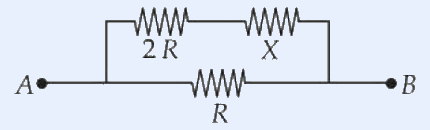
Two known resistance of and and one unknown resistance are connected in a circuit as shown in the figure. If the equivalent resistance between points A and B in the circuit is , then value of X is ______ .
(1)
(2)
(3)
(4)
SolutionAnswer: Option 4
Approach:
The top branch (2R in series with X) is in parallel with the bottom branch (R). Set this parallel combination equal to X, the stated equivalent resistance, and solve the resulting quadratic.
Step 1:Form the parallel equivalent of (2R + X) with R and set it equal to X.
Step 2:Cross-multiply and expand.
Step 3:Collect terms into a quadratic in X.
Step 4:Solve the quadratic and keep the positive root.
Final answer:
Q39Single correctRotational Motion
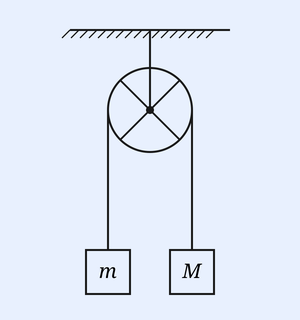
The pulley shown in the figure is made using a thin rim and two rods of equal length to the diameter of rim. The rim and each rod have a mass of M. Two blocks of mass M and m are attached to two ends of a light string passing over the pulley, which is hinged to rotate freely in vertical plane about its center. The magnitudes of the acceleration experienced by the block is _____ (Assume no slipping of string on pulley)
(1)
(2)
(3)
(4)
SolutionAnswer: Option 4
Approach:
Write Newton's equations for the two hanging blocks and the torque equation for the pulley. Compute the pulley's moment of inertia (rim plus two diametric rods), then combine using the no-slip constraint a = αr to solve for a.
Step 1:Write the force equations for the two blocks (M heavier, descending; m lighter, ascending).
Step 2:Write the torque equation for the pulley with the no-slip constraint α = a/r.
Step 3:Add the three equations so the tensions cancel.
Step 4:Compute the moment of inertia: the rim of mass M and radius r contributes Mr², and each rod has length equal to the diameter 2r, mass M, pivoted at its centre, contributing M(2r)²/12 = Mr²/3 each (two rods).
Step 5:Substitute I/r² = 5M/3 into the combined equation; the effective inertial mass is M + m + 5M/3 = (8/3)M + m.
Final answer:
Q40Single correctOptics
Given below are two statements:
Statement 1: In Young's double slit experiment, the angular separation of fringes will increase as the screen is moved away from the plane of the slits.
Statement II: In a Young's double slit experiment, the angular separation of fringes will increase when monochromatic source is replaced by another monochromatic source of higher wavelength.
In the light of the above statements, choose the correct answer from the options given below:
Statement 1: In Young's double slit experiment, the angular separation of fringes will increase as the screen is moved away from the plane of the slits.
Statement II: In a Young's double slit experiment, the angular separation of fringes will increase when monochromatic source is replaced by another monochromatic source of higher wavelength.
In the light of the above statements, choose the correct answer from the options given below:
(1)
(2)
(3)
(4)
SolutionAnswer: Option 2Statement I false but Statement II is true
Approach:
The angular fringe separation in a YDSE is θ = λ/d, depending only on wavelength and slit separation, not on screen distance. Evaluate each statement against this relation.
Step 1:Angular separation θ = λ/d is independent of the screen distance D. Moving the screen away increases the linear fringe width (β = λD/d) but not the angular separation, so Statement I is false.
Step 2:Since θ is directly proportional to λ, increasing the wavelength increases the angular separation, so Statement II is true.
Final answer: Statement I false but Statement II is true
Q41Single correctCurrent Electricity
A battery with EMF and internal resistance is connected across a resistance . The power consumption in will be maximum when:
(1)
(2)
(3)
(4)
SolutionAnswer: Option 2
Approach:
Write the power dissipated in R as a function of R, then maximise it by setting its derivative with respect to R to zero.
Step 1:The series current is I = E/(R+r); the power dissipated in R is I²R.
Step 2:Differentiate P with respect to R and set it to zero.
Step 3:Solve for R.
Final answer:
Q42Single correctWork, Energy and Power
A body of mass 2 kg is moving along x direction such that its displacement as function of time is given by where , and . The work done on the body during the time interval to , is _______ J.
(1)
(2)
(3)
(4)
SolutionAnswer: Option 3
Approach:
Differentiate the position to obtain the (constant) acceleration, compute the constant net force F = ma, find the displacement from t = 2 s to t = 3 s, and take work done = F × displacement.
Step 1:With α = 1, β = 1, γ = 1, the position is x(t) = t² + t + 1. Differentiate to get velocity and then acceleration.
Step 2:Compute the constant net force.
Step 3:Evaluate positions at t = 2 s and t = 3 s and take the displacement.
Step 4:Work done equals force times displacement (force is constant).
Final answer:
Q43Single correctCurrent Electricity
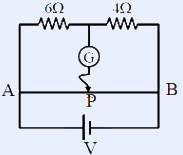
The total length of potentiometer wire AB is in the arrangement as shown in the figure. If P is the point where the galvanometer shows Zero reading then length of AP is ______ cm.
(1)
(2)
(3)
(4)
SolutionAnswer: Option 3
Approach:
At the null point the galvanometer reads zero, so the ratio of potential drops across the 6 Ω and 4 Ω resistors equals the ratio of potential drops along the wire segments AP and PB. Set up the proportion using total length 50 cm and solve for AP.
Step 1:Let AP = x cm so that PB = (50 − x) cm. Balancing the 6 Ω and 4 Ω drops against the wire segments gives the proportion.
Step 2:Simplify the ratio and cross-multiply.
Step 3:Solve for x.
Final answer:
Q44Single correctProperties of Solids and Liquids
Surface tension of two liquids (having same densities). and are measured using capillary rise method utilising two tubes of inner radius and where . The measure liquid heights in these tubes are and respectively. (ignore weight of liquid about the lowest point of meniscus). The heights and and surface tension and satisfy the relation.
(1)
(2)
(3)
(4)
SolutionAnswer: Option 1
Approach:
Capillary rise h is inversely proportional to the tube radius for a given liquid. With the same liquid (same surface tension and density) in both tubes, the larger radius tube gives the smaller rise.
Step 1:Surface tension is a property of the liquid; for the same liquid it is identical in both tubes.
Step 2:For fixed T, ρ and contact angle, the rise is inversely proportional to radius. Since r₁ > r₂, the rise in tube 1 is smaller.
Final answer: and
Q45Single correctAtoms and Nuclei
The energy of an electron in an orbit of Bohr's atom is where is the ground state energy. If L is the angular momentum of electron in this orbit and h is planks constant then is ______.
(1)
(2)
(3)
(4)
SolutionAnswer: Option 3
Approach:
In the Bohr model L = nh/(2π), so 2πL/h = n. Use the energy relation = E₀/n² (E₀ the ground-state magnitude) with the given E = −0.04 E₀ to find n.
Step 1:From the quantisation of angular momentum, 2πL/h equals the principal quantum number n.
Step 2:The orbit energy scales as 1/n² of the ground-state energy. Equate magnitudes to 0.04 E₀.
Step 3:Take the positive root for the orbit number.
Final answer:
Q46NumericalThermodynamics
A diatomic gas does of work when it is expanded isobarically. Then the heat given to the gas is ________ J.
SolutionAnswer: 350
Approach:
In an isobaric process the work is W = nRΔT and the heat is Q = nCpΔT. Use γ = 1.4 (degrees of freedom f = 5 for a diatomic gas) so that Cp = (7/2)R, giving Q as a fixed multiple of W.
Step 1:At constant pressure the work done by the gas is W = nRΔT = 100 J.
Step 2:For a diatomic gas f = 5, so Cp = (f/2 + 1)R = (7/2)R. The isobaric heat is then Q = (7/2)nRΔT.
Step 3:Substitute nRΔT = 100 J.
Final answer:
Q47NumericalDual Nature of Matter and Radiation
A particle having electric charge C and mass kg is accelerated by applying an electric potential of . Wave length of the matter wave associated with the particle is . The value of is ______. (Take Planck's constant )
SolutionAnswer: 10
Approach:
A charge accelerated through potential V gains kinetic energy qV, giving momentum p = √(2mqV). The de Broglie wavelength is λ = h/p; substitute the values and express λ in units of 10⁻¹² m.
Step 1:Compute the product 2mqV.
Step 2:Take the square root to obtain the momentum (√43.56 = 6.6).
Step 3:Compute the wavelength.
Step 4:Compare with λ = α×10⁻¹² m to read off α.
Final answer:
Q48NumericalProperties of Solids and Liquids
The terminal velocity of a metallic ball of radius 6 mm in a viscous fluid 20 cm/s. The terminal velocity of another ball of same material and having radius 3mm in same fluid will be ______ cm/sec.
SolutionAnswer: 5
Approach:
For balls of the same material in the same fluid, terminal velocity is proportional to the square of the radius. Use the ratio of radii to scale the given terminal velocity.
Step 1:Since the material density and fluid are the same, terminal velocity scales as the square of radius. Form the ratio for r₁ = 6 mm and r₂ = 3 mm.
Step 2:The smaller ball therefore has one quarter the terminal velocity of the larger ball.
Final answer:
Q49NumericalOptics
In a Young's double slit experiment setup, the two slits are kept 0.4 mm apart and screen is placed at 1m from slits. If a thin transparent sheet of thickness is introduced in front of one of the slits then center bright fringe shifts by 20 mm on the screen. The refractive index of transparent sheet is given by , where is ______.
SolutionAnswer: 14
Approach:
A thin sheet of thickness t and refractive index μ introduces an extra optical path (μ−1)t, shifting the central fringe by Δy = (D/d)(μ−1)t. Solve for μ and express it as α/10.
Step 1:Rearrange the shift equation for (μ−1).
Step 2:Substitute Δy = 20×10⁻³ m, d = 0.4 mm = 4×10⁻⁴ m, D = 1 m, t = 20×10⁻⁶ m.
Step 3:Add 1 and write the result as α/10.
Final answer: (so μ = 1.4)
Q50NumericalElectromagnetic Waves
An electromagnetic wave of frequency 100 MHz propagates through a medium of conductivity, . The ratio of maximum conduction current density to maximum displacement current density is _______.
SolutionAnswer: 1800
Approach:
Conduction current density is Jc = σE and displacement current density is Jd = ε₀ ∂E/∂t. For a harmonic field E = E₀ sin(ωt − kx), the maxima give Jc,max = σE₀ and Jd,max = ε₀ωE₀ (relative permittivity taken as 1), so the ratio is σ/(ε₀ω) with ω = 2πf.
Step 1:Take the ratio of the maximum conduction current density to the maximum displacement current density; the field amplitude E₀ cancels.
Step 2:Compute the angular frequency from f = 100 MHz = 10⁸ Hz.
Step 3:Substitute σ = 10, ε₀ = 8.85×10⁻¹² F/m and ω = 2π×10⁸ rad/s.
Step 4:Evaluate the denominator and the ratio.
Final answer: Ratio of maximum conduction current density to maximum displacement current density .
Chemistry25 questions
Q51Single correctSome Basic Concepts in Chemistry
Aqueous reacts with to form and . What is the weight (in g) of liberated when 8.7 g of reacted with excess aqueous solution? (Given Molar mass in )
(1)
(2)
(3)
(4)
SolutionAnswer: Option 17.1
Approach:
Balance the redox reaction, convert the given mass of the limiting reactant to moles, then find the mass of chlorine liberated.
Step 1:Write the balanced reaction; one mole of liberates one mole of .
Step 2:Compute molar mass of and moles present in 8.7 g.
Step 3: is in excess, so is limiting; moles of equal moles of .
Step 4:Convert moles of to mass using .
Final answer: g
Q52Single correctChemical Thermodynamics
Consider the following data: (methane, g) . Enthalpy of sublimation of graphite . Dissociation enthalpy of . The bond enthalpy of bond is given by
(1)
(2)
(3)
(4)
SolutionAnswer: Option 1
Approach:
Apply a Hess-cycle energy balance for the formation of methane from graphite and hydrogen in terms of atomization and bond-formation energies.
Step 1:Write the formation reaction of methane from its elements.
Step 2:Express the formation enthalpy as energy to atomize reactants minus energy released forming four bonds.
Step 3:Rearrange to isolate the bond enthalpy of .
Step 4:Divide by 4 to obtain the bond enthalpy.
Final answer:
Q53Single correctAtomic Structure
Consider the following spectral lines for atomic hydrogen: A) First line of Paschen series B) Second line of Balmer series C) Third line of Paschen series D) Fourth line of Bracket series. The correct arrangement of the above lines in ascending order of energy is:
(1)
(2)
(3)
(4)
SolutionAnswer: Option 1
Approach:
Identify the initial and final levels for each line, then compare transition energies using the Rydberg energy expression.
Step 1:Assign quantum numbers for each line (series lower level fixed, line number sets the upper level).
Step 2:Compute the factor for D and A.
Step 3:Compute the factor for C and B.
Step 4:Order all factors in ascending value (energy is proportional to this factor).
Final answer:
Q54Single correctRedox Reactions and Electrochemistry
For a closed circuit Daniell cell, which of the following plots is the accurate one at a given temperature ?
(1)
(2)
(3)
(4)
SolutionAnswer: Option 2
Approach:
Recognise that the standard cell potential is a fixed thermodynamic quantity independent of reaction progress at constant temperature, then match it to the correct plot.
Step 1:Identify that is defined for standard-state activities and depends only on temperature.
Step 2:Note that during discharge the actual changes with concentration, but does not change.
Step 3:A constant value versus time is a horizontal straight line.
Final answer: stays constant with time (horizontal line).
Q55Single correctChemical Kinetics
Decomposition of A is a first order reaction at T(K) and is given by . In a closed 1 L vessel, 1 bar A(g) is allowed to decompose at T(K). After 100 minutes, the total pressure was 1.5 bar. What is the rate constant of the reaction ?
(1)
(2)
(3)
(4)
SolutionAnswer: Option 2
Approach:
Relate the rise in total pressure to the partial pressure of A consumed, then apply the first-order integrated rate law.
Step 1:Set up pressures: let be the pressure of A decomposed.
Step 2:Write total pressure and solve for using the measured total.
Step 3:Find remaining pressure of A.
Step 4:Apply the first-order law over min.
Final answer:
Q56Single correctClassification of Elements and Periodicity in Properties
Given below are two statements
Statement -I: The correct order in terms of atomic/ ionic radii is
Statement -II : The correct order in terms of the magnitude of electron gain enthalpy is . In the light of the above statements, choose the correct answer from the options given below:
Statement -I: The correct order in terms of atomic/ ionic radii is
Statement -II : The correct order in terms of the magnitude of electron gain enthalpy is . In the light of the above statements, choose the correct answer from the options given below:
(1)
(2)
(3)
(4)
SolutionAnswer: Option 4Statement I is false and II is correct .
Approach:
Test each statement against periodic trends for atomic/ionic radii and for the magnitude of electron gain enthalpy.
Step 1:Across period 3, atomic radius decreases left to right, so Mg is larger than Al; cations are smaller than their parent atoms.
Step 2:Statement I claims , which contradicts the trend, so Statement I is false.
Step 3:Compare electron gain enthalpy magnitudes; third-period Cl and S have larger magnitudes than their lighter/heavier congeners due to size and electron-density effects.
Final answer: Statement I is false and Statement II is correct.
Q57Single correctChemical Bonding and Molecular Structure
Given below are two statements
Statement I : The correct order in terms of bond dissociation energy order is :
Statement II: The correct trend in the covalent character of the metal halides is , and . In the light of the above statements , choose the correct answer from the options given below :
Statement I : The correct order in terms of bond dissociation energy order is :
Statement II: The correct trend in the covalent character of the metal halides is , and . In the light of the above statements , choose the correct answer from the options given below :
(1)
(2)
(3)
(4)
SolutionAnswer: Option 3Statement I is true but Statement II is false.
Approach:
Verify the anomalous halogen bond-dissociation-energy order and check each covalent-character pair using Fajans' rules.
Step 1:Halogen bond dissociation energy is anomalous: is low because of lone-pair repulsion at the small F atoms.
Step 2:By Fajans' rules, higher cation charge gives greater covalent character, so the chlorides are more covalent than the chlorides.
Step 3:For uranium fluorides the higher oxidation state in is more covalent than in , so the claimed is wrong.
Final answer: Statement I is true but Statement II is false.
Q58Single correctPrinciples Related to Practical Chemistry
On heating a mixture of common salt and in equal amount along with concentrated in a test tube, a gas is evolved . Formula of the gas evolved and oxidation state of the central metal atom in the gas respectively are :
(1)
(2)
(3)
(4)
SolutionAnswer: Option 1 and
Approach:
Identify the chromyl chloride test product and assign the oxidation state of chromium from charge balance.
Step 1:Heating a chloride with and concentrated gives the deep red vapours of chromyl chloride.
Step 2:Assign oxidation states in : O is , Cl is .
Step 3:Solve for the chromium oxidation state.
Final answer: with chromium in the oxidation state.
Q59Single correctChemical Bonding and Molecular Structure
The correct increasing order of bonds in terms of covalent bond length is :
(1)
(2)
(3)
(4)
SolutionAnswer: Option 3
Approach:
Use standard NCERT bond-length values for each bond and arrange them in increasing order.
Step 1:List the standard bond lengths.
Step 2:Order the values in increasing length.
Final answer:
Q60Single correctd- and f-Block Elements
Given below are some of the statements about Mn and . Identify the correct statements.
A) Mn forms the oxide , in which Mn is in its highest oxidation state.
B) Oxygen stabilizes the Mn in higher oxidation states by forming multiple bonds with Mn.
C) is an ionic oxide.
D) The structure of consists of one bridged oxygen.
Choose the correct answer from the options given below :
A) Mn forms the oxide , in which Mn is in its highest oxidation state.
B) Oxygen stabilizes the Mn in higher oxidation states by forming multiple bonds with Mn.
C) is an ionic oxide.
D) The structure of consists of one bridged oxygen.
Choose the correct answer from the options given below :
(1)
(2)
(3)
(4)
SolutionAnswer: Option 4A, B and D only
Approach:
Evaluate each statement about the structure and bonding of and select the correct set.
Step 1:Statement A: in each Mn is , its highest possible oxidation state.
Step 2:Statement B: high oxidation states of Mn are stabilised by multiple (pπ-dπ) bonding from oxygen.
Step 3:Statement C: is a covalent, molecular, oily-green liquid oxide, not ionic.
Step 4:Statement D: its structure is with one bridging oxygen joining two units.
Final answer: A, B and D only.
Q61Single correctCoordination Compounds
Given below are two statements:
Statement I : Crystal field stabilization Energy (CFSE) of is greater than that of
Statement II : Potassium ferricyanide has a greater spin – only magnetic moment than sodium ferrocyanide.
In the light of the above statements, choose the correct answer from the options given below:
Statement I : Crystal field stabilization Energy (CFSE) of is greater than that of
Statement II : Potassium ferricyanide has a greater spin – only magnetic moment than sodium ferrocyanide.
In the light of the above statements, choose the correct answer from the options given below:
(1)
(2)
(3)
(4)
SolutionAnswer: Option 1Both Statement I and Statement II both are true
Approach:
Compare the d-electron CFSE of the two aqua complexes and the spin-only magnetic moments of the two cyanide complexes.
Step 1:Assign configurations: is , is ; the high-spin aqua complex has zero CFSE.
Step 2:High-spin has nonzero CFSE, so the Cr complex has greater CFSE; Statement I is true.
Step 3:Ferricyanide has (, low spin, ).
Step 4:Ferrocyanide has (, low spin, ); ferricyanide therefore has the larger moment, so Statement II is true.
Final answer: Both Statement I and Statement II are true.
Q62Single correctOrganic Compounds Containing Halogens
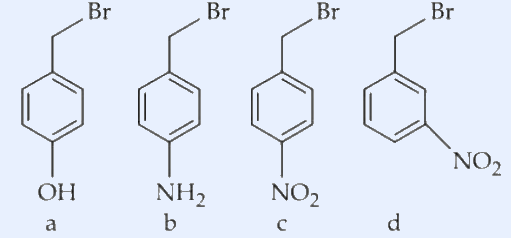
The correct order of reactivity of the following benzyl halides towards reaction with is:
(1)
(2)
(3)
(4)
SolutionAnswer: Option 4
Approach:
Recognise that benzyl halide reactivity follows the SN1 pathway and rank the compounds by the stability of the benzylic carbocation formed.
Step 1:Reaction proceeds via , so reactivity tracks benzylic carbocation stability.
Step 2:Electron-donating groups stabilise the cation; donates more strongly than .
Step 3:Electron-withdrawing destabilises the cation; para-nitro (direct resonance withdrawal) destabilises more than meta-nitro.
Step 4:Combine the two sub-orders (donors above withdrawers).
Final answer:
Q63Single correctOrganic Compounds Containing Oxygen
Match List – I with List – II.
| List-I (Reagent) | List-II Reaction name (Involving aldehydes) |
|---|---|
| A. | I. Etard reaction |
| B. | II. Rosenmund reduction |
| C. | III. Gattermann Koch reaction |
| D. | IV. Stephen reaction |
(1)
(2)
(3)
(4)
SolutionAnswer: Option 4
Approach:
Identify the named aldehyde-forming reaction associated with each reagent set and assemble the match.
Step 1: reduces an acyl chloride to an aldehyde (poisoned-catalyst reduction).
Step 2: reduces a nitrile to an imine, hydrolysed to an aldehyde.
Step 3: oxidises a methyl side chain of toluene to a benzaldehyde via a chromium complex.
Step 4: formylates benzene to benzaldehyde.
Final answer:
Q64Single correctSome Basic Principles of Organic Chemistry
Match the List-I with List-II
| List-I (Pair of Compounds) | List-II (Type of Isomers) |
|---|---|
| A.. 2-Methylpropene and but-1-ene | I. Stereoisomers |
| B.. Cis-but-2-ene and trans – but-2-ene | II. Position isomers |
| C.. 2-Butanol and diethyl ether | III. Chain isomers |
| D.. But-1-ene and but-2-ene | IV. Functional isomers |
(1)
(2)
(3)
(4)
SolutionAnswer: Option 1
Approach:
Classify the isomerism type for each pair of compounds and assemble the match.
Step 1:2-Methylpropene and but-1-ene (both ) differ in carbon skeleton.
Step 2:Cis- and trans-but-2-ene differ only in spatial arrangement about the double bond.
Step 3:2-Butanol and diethyl ether (both ) have different functional groups.
Step 4:But-1-ene and but-2-ene differ only in the position of the double bond.
Final answer:
Q65Single correctBiomolecules
The correct statements are:
A) Activation energy for enzyme catalysed hydrolysis of sucrose is lower than that of acid catalysed hydrolysis
B) During denaturation, secondary and tertiary structures of a protein are destroyed but primary structure remains intact.
C) Nucleotides are joined together by glycosidic linkage between and carbons of the pentose sugar
D) Quaternary structure of proteins represents overall folding of the polypeptide chain
Choose the correct answer from the options given below :
A) Activation energy for enzyme catalysed hydrolysis of sucrose is lower than that of acid catalysed hydrolysis
B) During denaturation, secondary and tertiary structures of a protein are destroyed but primary structure remains intact.
C) Nucleotides are joined together by glycosidic linkage between and carbons of the pentose sugar
D) Quaternary structure of proteins represents overall folding of the polypeptide chain
Choose the correct answer from the options given below :
(1)
(2)
(3)
(4)
SolutionAnswer: Option 2A and B only
Approach:
Assess each biomolecule statement against established facts and select the correct subset.
Step 1:Statement A: enzyme catalysis lowers activation energy far more than acid catalysis for sucrose hydrolysis.
Step 2:Statement B: denaturation destroys secondary and tertiary structure while the primary peptide sequence stays intact.
Step 3:Statement C: nucleotides are linked by phosphodiester bonds, not glycosidic – linkages.
Step 4:Statement D: overall folding of a single chain is the tertiary structure; quaternary describes assembly of multiple subunits.
Final answer: A and B only.
Q66Single correctOrganic Compounds Containing Halogens
The correct order of the rate of the reaction for the following reaction with respect to nuclophiles is:
(1)
(2)
(3)
(4)
SolutionAnswer: Option 1
Approach:
Rank the anions by nucleophilicity, which decreases as the negative charge becomes more delocalised (more stable anion is a weaker nucleophile).
Step 1: has a localised charge on one oxygen and is the strongest nucleophile.
Step 2: delocalises charge into the benzene ring, making it weaker than .
Step 3: delocalises charge over two oxygens, weaker than .
Step 4: is stabilised over four oxygens and is the weakest nucleophile.
Final answer:
Q67Single correctSome Basic Principles of Organic Chemistry
Given below are two statements:
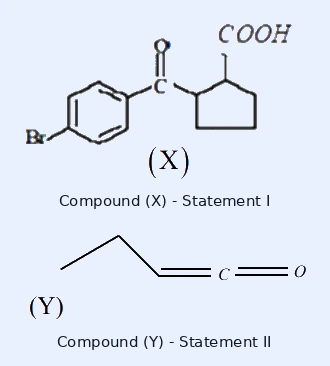
Statement – I : Compound (X), shown below, dissolves in solution and has two chiral carbon atoms
Statement –II : Compound (Y), shown below, has two carbons with hybridization, one carbon with and one carbon with sp hybridization
In the light of the above statements, choose the correct answer from the options given below:
Statement – I : Compound (X), shown below, dissolves in solution and has two chiral carbon atoms
Statement –II : Compound (Y), shown below, has two carbons with hybridization, one carbon with and one carbon with sp hybridization
In the light of the above statements, choose the correct answer from the options given below:
(1)
(2)
(3)
(4)
SolutionAnswer: Option 4Both Statement I and Statement II are true
Approach:
Test Statement I for acidity in and number of chiral centres in X, and Statement II for the hybridization of each carbon in Y.
Step 1:Compound X carries a group, which is acidic enough to react with and dissolve with effervescence.
Step 2:The two adjacent cyclopentane ring carbons each bear four different groups (the acyl substituent, the carboxyl substituent, a ring path, and H), so each is a stereocentre.
Step 3:Compound Y is the ketene ; assign hybridization carbon by carbon.
Step 4:The carbon counts match Statement II exactly (two , one , one sp), so Statement II is true.
Final answer: Both Statement I and Statement II are true.
Q68Single correctPurification and Characterisation of Organic Compounds
By usual analysis 1.00 g of compound (X) gave 1.79 g of magnesium pyrophosphate. The percentage of phosphorus in compound (X) is: (nearest integer) (Give molar mass in )
(1)
(2)
(3)
(4)
SolutionAnswer: Option 150
Approach:
Estimate phosphorus from the precipitated magnesium pyrophosphate, accounting for two phosphorus atoms per formula unit.
Step 1:Compute the molar mass of .
Step 2:Find the mass of phosphorus in 1.79 g of precipitate (two P per formula unit).
Step 3:Express as percentage of the 1.00 g sample.
Final answer:
Q69Single correctOrganic Compounds Containing Nitrogen
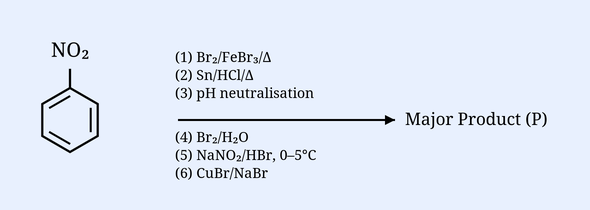
Consider the above sequence of reactions. The number of bromine atom(s) in final product (P) will be?
(1)
(2)
(3)
(4)
SolutionAnswer: Option 15
Approach:
Track each transformation from nitrobenzene, counting the bromine atoms introduced at every step that survives into the final product.
Step 1: on the deactivated nitrobenzene gives meta-bromonitrobenzene (1 Br).
Step 2: then pH neutralisation reduces to , giving m-bromoaniline.
Step 3: brominates the highly activated aniline at the positions ortho/para to , adding 3 more Br atoms.
Step 4: at – converts to a diazonium salt; (Sandmeyer) replaces it with Br, adding the fifth Br.
Final answer: bromine atoms
Q70Single correctSome Basic Principles of Organic Chemistry
Given below are four compounds:
a) n-propyl chloride b) iso-propyl chloride
c) sec-butyl chloride d) neo – pentyl chloride
Percentage of carbon in the one which exhibits optical isomerism is :
a) n-propyl chloride b) iso-propyl chloride
c) sec-butyl chloride d) neo – pentyl chloride
Percentage of carbon in the one which exhibits optical isomerism is :
(1)
(2)
(3)
(4)
SolutionAnswer: Option 352
Approach:
Identify the only chiral compound among the four, then compute its percentage of carbon by mass.
Step 1:Only sec-butyl chloride has a carbon bonded to four different groups (, , , ), so it is optically active.
Step 2:Compute its molar mass.
Step 3:Compute the carbon percentage.
Final answer:
Q71NumericalSolutions
The osmotic pressure of a living cell is 12 atm at 300 K. The strength of sodium chloride solution that is isotonic with the living cell at this temperature is . (Nearest integer)
Given:
Assume complete dissociation of
(Given: Molar mass of are respectively.)
Given:
Assume complete dissociation of
(Given: Molar mass of are respectively.)
SolutionAnswer: 15
Approach:
Use the osmotic-pressure equation with the van't Hoff factor for fully dissociated NaCl to get the molar concentration, then convert to grams per litre.
Step 1:For complete dissociation of NaCl into two ions, the van't Hoff factor is 2.
Step 2:Solve the osmotic-pressure equation for molar concentration.
Step 3:Convert to strength using molar mass of NaCl = 58.5.
Final answer:
Q72NumericalEquilibrium
The first and second ionization constants of are and respectively. The concentration of in solution is . (nearest integer)
SolutionAnswer: 100
Approach:
Use the standard diprotic-acid result that, with widely separated ionization constants, the doubly-deprotonated species concentration equals the second ionization constant.
Step 1:First dissociation dominates and gives nearly equal and .
Step 2:Apply the second ionization equilibrium expression.
Step 3:Since , those terms cancel leaving .
Final answer:
Q73NumericalSolutions
A substance “X” (1.5g) dissolved in 150 g of a solvent “Y” (molar mass = ) led to an elevation of the boiling point by 0.5 K. The relative lowering in the vapour pressure of the solvent “Y” is . (nearest integer) [Given: of the solvent ] Assume the solution to be dilute and no association or dissociation of X takes place in solution.
SolutionAnswer: 3
Approach:
Obtain the molality from the boiling-point elevation, then use it with the solvent molar mass to get the relative lowering of vapour pressure for a dilute solution.
Step 1:Solve for molality from the elevation (no dissociation, ).
Step 2:Apply the dilute-solution relation for relative lowering of vapour pressure.
Step 3:Express in the requested form.
Final answer:
Q74Numericald- and f-Block Elements
Identify the metal ions among and having a spin – only magnetic moment value more than 3.0 BM. The sum of unpaired electrons present in the high spin octahedral complexes formed by those metal ions is :
SolutionAnswer: 7
Approach:
Determine the d-electron count and high-spin unpaired electrons for each ion, keep only those with spin-only moment above 3.0 BM, then sum their unpaired electrons.
Step 1:Find the threshold: a moment above 3.0 BM requires more than 2 unpaired electrons.
Step 2:Assign d-configurations and high-spin unpaired counts.
Step 3:Select ions exceeding 3.0 BM: only (n=4) and (n=3) qualify.
Step 4:Sum the unpaired electrons of the qualifying ions.
Final answer:
Q75NumericalRedox Reactions and Electrochemistry
MX is a sparingly soluble salt that follows the given solubility equilibrium at 298 K. . If the standard reduction potential for is , then the value of the standard reduction potential for the metal / metal insoluble salt electrode is mV. (nearest integer) (Given: )
SolutionAnswer: 200
Approach:
Relate the metal/insoluble-salt electrode potential to the metal-ion electrode potential using the solubility product through the Nernst expression.
Step 1:Write the relation linking the two electrode potentials via .
Step 2:Substitute V and .
Step 3:Evaluate the expression.
Final answer:
Mathematics25 questions
Q1Single correctThree Dimensional Geometry
Let the line be parallel to the vector and pass through the point , and the line be parallel to the vector and pass through the point . If the line is parallel to the vector and intersects the lines and at the points C and D, respectively, then is equal to:
(1)
(2)
(3)
(4)
SolutionAnswer: Option 4
Approach:
Parametrize a general point on each line, set the direction of CD parallel to the given vector to get two linear equations, solve for the parameters, then compute the squared distance.
Step 1:A general point C on L1 with parameter t.
Step 2:A general point D on L2 with parameter s.
Step 3:The direction of CD is D-C; set it proportional to (-3,5,16).
Step 4:Solve the two linear equations by elimination.
Step 5:Apply the distance formula in 3D.
Final answer:
Q2Single correctIntegral Calculus
If the area of the region is , gcd , then the value of is :
(1)
(2)
(3)
(4)
SolutionAnswer: Option 1
Approach:
The region in the first quadrant is bounded above by the parabola and below by the line where it is positive (otherwise by the x-axis); compute the area under the parabola from 0 to 2 and subtract the small triangle below the line near the origin.
Step 1:The parabola meets the x-axis at ; the line meets the axes at and .
Step 2:The area equals the area under the parabola from 0 to 2 minus the triangle with vertices (0,0),(0,1),(1/2,0) that lies below the line.
Step 3:Evaluate the definite integral.
Step 4:Subtract the triangular area 1/4.
Step 5:With , identify , and add.
Final answer:
Q3Single correctStatistics and Probability
A random variable X takes values with probabilities , b respectively, where . Let and respectively be the mean and standard deviation of X such that . Then is equal to:
(1)
(2)
(3)
(4)
SolutionAnswer: Option 4
Approach:
Use the identity together with the total-probability condition to form two linear equations in a and b, solve them, then compute .
Step 1:Compute using and set it equal to 2.
Step 2:Apply the total-probability condition.
Step 3:Solve the linear system (i) and (ii) by elimination.
Step 4:Compute the required ratio.
Final answer:
Q4Single correctSequences and Series
The positive integer n, for which the solutions of the equation are two consecutive even integers, is:
(1)
(2)
(3)
(4)
SolutionAnswer: Option 1
Approach:
Sum the products term by term using standard summation formulas to reduce the equation to a quadratic in x, then choose n so that the quadratic has two consecutive even integer roots.
Step 1:Expand each term and sum over r=1..n.
Step 2:Use the summation identities for the coefficient sums.
Step 3:Divide through by n and multiply by 3 to simplify.
Step 4:For the quadratic becomes , i.e. .
Step 5:Check that the roots are two consecutive even integers.
Final answer:
Q5Single correctDifferential Calculus
Let . Then the value of is :
(1)
(2)
(3)
(4)
SolutionAnswer: Option 2
Approach:
Set the unknown constants , , , write f as a cubic with these coefficients, differentiate, evaluate at the stated points to get equations, solve for a, b, c, then compute .
Step 1:Write with , , ; then and .
Step 2:Impose .
Step 3:Impose .
Step 4:Since , the constant .
Step 5:Solve (1) and (2) by substitution.
Step 6:Compute .
Final answer:
Q6Single correctDifferential Equations
Let be the solution of the differential equation , . Then is equal to :
(1)
(2)
(3)
(4)
SolutionAnswer: Option 2
Approach:
Multiply by to get the standard linear form, find the integrating factor, integrate the right side via the substitution , apply the initial condition to fix the constant, then evaluate at .
Step 1:Multiply through by to obtain the standard linear form.
Step 2:Compute the integrating factor.
Step 3:Multiply and integrate the right side using , .
Step 4:Carry out the integration by parts to obtain the general solution.
Step 5:Apply to determine C.
Step 6:Evaluate at where .
Final answer:
Q7Single correctCoordinate Geometry
If the line , where , touches the ellipse at the point P in the first quadrant, then one of the focal distances of P is :
(1)
(2)
(3)
(4)
SolutionAnswer: Option 2
Approach:
Use the tangency condition to find , locate the point of contact P, compute the eccentricity, then apply the focal-distance formula.
Step 1:Write the ellipse as so , ; the line has slope and intercept .
Step 2:Compare the tangent with () to get the point of contact.
Step 3:Compute the eccentricity of the ellipse.
Step 4:Apply the focal-distance formula with , , (focus on the negative side).
Final answer: One focal distance
Q8Single correctMatrices and Determinants
For the matrices and , if , then among the following which one is true ?
(1)
(2)
(3)
(4)
SolutionAnswer: Option 2
Approach:
Apply the Cayley-Hamilton theorem to reduce to a linear expression in A and I, form , and solve the resulting homogeneous system for the relation between x and y.
Step 1:A has trace 2 and determinant 1, giving the characteristic relation.
Step 2:Inductively every power has the form , so .
Step 3:Add B to .
Step 4:The homogeneous system reduces to a single independent equation.
Step 5:Test the options against .
Final answer:
Q9Single correctMatrices and Determinants
If the system of equations has no solution, then the value of is equal to :
(1)
(2)
(3)
(4)
SolutionAnswer: Option 4
Approach:
A system has no unique solution when the coefficient determinant vanishes; set the determinant to zero and solve for (the resulting value makes the system inconsistent).
Step 1:Form the coefficient determinant.
Step 2:Expand along the first row.
Step 3:Set the determinant equal to zero.
Final answer:
Q10Single correctVector Algebra
For a triangle ABC, let and . If and , where is the angle between p and q, then is equal to :
(1)
(2)
(3)
(4)
SolutionAnswer: Option 4
Approach:
Express r in terms of p and q using the triangle relation, compute by the law of cosines, simplify the cross-product term using , then evaluate the full expression.
Step 1:From the triangle, , so .
Step 2:Compute using .
Step 3:Since , the cross product is .
Step 4:Use and evaluate the two terms.
Step 5:Add the contributions.
Final answer:
Q11Single correctSequences and Series
Let be a G.P. of common ratio . If , then is equal to:
(1)
(2)
(3)
(4)
SolutionAnswer: Option 4
Approach:
Deduce the common ratio of the sequence , , ... from the given G.P. condition, then apply the finite G.P. sum formula and solve for .
Step 1:The terms have ratio , so the ratio of successive is determined.
Step 2:Apply the sum formula with , .
Step 3:Since , solve for .
Final answer:
Q12Single correctThree Dimensional Geometry
Let the line L pass through the point and make equal angles with the positive coordinate axes. If the distance of L from the point is , then the sum of all possible values of r is :
(1)
(2)
(3)
(4)
SolutionAnswer: Option 2
Approach:
A line making equal angles with the positive axes has direction (1,1,1); write its equation, find the foot of perpendicular from the external point, set the squared distance equal to 14/3 to obtain a quadratic in r, then sum the roots.
Step 1:Write the line with direction (1,1,1) through (-3,5,2).
Step 2:Require PR perpendicular to (1,1,1) with P=(-2,r,1).
Step 3:Substitute and set .
Step 4:Reduce the quadratic.
Step 5:Add the possible values of r.
Final answer: Sum of possible values of r
Q13Single correctQuadratic Equations
Let and be the roots of the equation such that . Then the set of all possible values of a is :
(1)
(2)
(3)
(4)
SolutionAnswer: Option 3
Approach:
For a quadratic with positive leading coefficient, the number 1 lies strictly between the roots exactly when is negative; solve .
Step 1:The leading coefficient is positive, so the condition requires .
Step 2:Simplify the inequality.
Step 3:Write the solution set.
Final answer:
Q14Single correctPermutations and Combinations
The largest , for which divides 101!, is:
(1)
(2)
(3)
(4)
SolutionAnswer: Option 3
Approach:
Apply Legendre's formula to count the exponent of the prime 7 in 101! by summing the floor of 101 divided by successive powers of 7.
Step 1:Count multiples of 7.
Step 2:Count multiples of 49.
Step 3:Since 343>101 the next term is 0; sum the contributions.
Final answer:
Q15Single correctCoordinate Geometry
Let be the parabola with its vertex at O. Let P be point on the parabola and A be a point on the x-axis such that . Then the locus of the centroid of such triangles OPA is :
(1)
(2)
(3)
(4)
SolutionAnswer: Option 4
Approach:
Parametrize P on the parabola, use the right angle at P (slopes of OP and PA multiply to -1) to find the x-coordinate of A, write the centroid coordinates, and eliminate the parameter.
Step 1:Since gives , take on the parabola.
Step 2:The right angle at P gives with .
Step 3:Compute the centroid of , , .
Step 4:Eliminate t using .
Step 5:Replace h by x and k by y to write the locus.
Final answer:
Q16Single correctSets, Relations and Functions
Let . Let R be the relation on A defined by xRy if and only if . Let l be the number of elements in R, and m be the minimum number of elements required to be added in R to make it a symmetric relation. Then is equal to:
(1)
(2)
(3)
(4)
SolutionAnswer: Option 3
Approach:
List the ordered pairs (x,y) with to count l, then count the pairs whose mirror image is missing to find m (the additions needed for symmetry), and add the two counts.
Step 1:For each x, count the y with .
Step 2:Total number of pairs l.
Step 3:Identify pairs (x,y) in R whose reverse (y,x) is absent; these must be added.
Step 4:Add l and m.
Final answer:
Q17Single correctCoordinate Geometry
Let one end of a focal chord of the parabola be . If divides this focal chord internally in the ratio 5:2, then the minimum value of is equal to:
(1)
(2)
(3)
(4)
SolutionAnswer: Option 1
Approach:
Find the parameter of the given endpoint, use the focal-chord property to find the other endpoint, apply the section formula in ratio 5:2 in both orderings, and take the minimum of .
Step 1:For , ; the point gives , so .
Step 2:Compute the other endpoint B.
Step 3:Apply the section formula in 5:2 for both possible orderings of and .
Step 4:Compute for each and take the minimum.
Final answer: Minimum value of
Q18Single correctDifferential Calculus
Let be a twice differentiable function such that for all and , where a is a real number. Let . Consider the following two statements :
(1)
(2)
(3)
(4)
SolutionAnswer: Option 2Neither (I) nor (II) is True
Approach:
Rewrite the inner argument as a perfect square plus , differentiate g by the chain rule, and use that makes increasing (with ) to determine the sign of on each interval.
Step 1:Complete the square in the argument.
Step 2:Differentiate using the chain rule.
Step 3:On the argument exceeds , so (positive), while and .
Step 4:On the argument again exceeds , so , while and .
Step 5:Both statements are false.
(I) false, (II) false
Final answer: Neither (I) nor (II) is True
Q19Single correctComplex Numbers
Let Z be the complex number satisfying and having maximum positive principal argument . Then is equal to;
(1)
(2)
(3)
(4)
SolutionAnswer: Option 3
Approach:
The condition describes a disk centered at 5 with radius 3; the point of maximum positive argument is where the line from the origin is tangent to the boundary circle. Find that z and evaluate the modulus expression.
Step 1:Center 5, radius 3, distance from origin 5; the tangent gives , .
Step 2:Tangent length , so .
Step 3:Substitute into the expression and simplify.
Step 4:Take the modulus squared.
Step 5:Multiply by 34.
Final answer:
Q20Single correctSets, Relations and Functions
Let and . Then
(1)
(2)
(3)
(4)
SolutionAnswer: Option 3
Approach:
Solve each absolute-value inequality to write A and B explicitly, then evaluate the set operations and compare each with its option.
Step 1:Solve , i.e. .
Step 2:Solve , i.e. or .
Step 3:Remove the parts of A from B to obtain B-A.
Step 4:The other options fail: , , and , none of which match their stated forms.
Final answer:
Q21NumericalCoordinate Geometry
If P is a point on the circle , Q is a point on the straight line and is the perpendicular bisector of PQ, then 13 times the sum of abscissa of all such points P is ..........
SolutionAnswer: 2
Approach:
Use that is the perpendicular bisector of PQ: the midpoint of PQ lies on it and PQ has slope -1. Combine with Q on the given line and P on the circle to express P's abscissa in terms of its ordinate, solve, and sum.
Step 1:The midpoint of and lies on the bisector.
Step 2:PQ is perpendicular to the bisector, so its slope is -1.
Step 3:Q lies on ; combining with (i) and (ii) eliminates Q and gives in terms of .
Step 4:Impose P on the circle with .
Step 5:Compute the abscissae and their sum.
Step 6:Multiply the sum by 13.
Final answer:
Q22NumericalPermutations and Combinations
If , then is equal to ........
SolutionAnswer: 32
Approach:
Simplify a single bracket using the reciprocal-sum identity for binomial coefficients, multiply all 13 brackets to obtain a clean product, then compare with the right side to read off .
Step 1:Apply the identity with to a single bracket.
Step 2:Multiply all 13 brackets for r=0 to 12.
Step 3:Compare with the right-hand side to identify .
Step 4:Compute .
Final answer:
Q23NumericalDifferential Calculus
Let denote the greatest integer function and . Then is equal to
SolutionAnswer: 2
Approach:
Bound the greatest-integer term so its fractional part vanishes after dividing by , reduce f(x) to a cubic-sum limit, then sum the resulting geometric series and multiply by 12.
Step 1:Each floor term differs from its argument by a value in ; the total deviation is at most n and vanishes after dividing by .
Step 2:Apply the sum of squares and take the limit.
Step 3:Sum over j=1 to infinity (first term 1/9, ratio 1/3).
Step 4:Multiply by 12.
Final answer:
Q24NumericalIntegral Calculus
If , where , then is equal to...
SolutionAnswer: 9
Approach:
Convert cot inverse to tan inverse, split the argument as a difference of two arctangents, apply the king property to symmetrize the integral, then evaluate the remaining arctan integral by parts.
Step 1:Write cot inverse as tan inverse of the reciprocal and split using the subtraction identity.
Step 2:Replace x by 1-x in the second part using the king property; .
Step 3:Add (i) and (ii); the terms cancel.
Step 4:Evaluate by parts: integral of arctan(2x) from 0 to 1 equals .
Step 5:Compute .
Final answer:
Q25NumericalTrigonometry
Let the maximum value of for be , where . Then is equal to ..........
SolutionAnswer: 65
Approach:
Let t=sin inverse x and use sin inverse + cos inverse = to write the sum of squares as a quadratic in t; complete the square, find the range of t over the given x-interval, and maximize.
Step 1:As x ranges over , t=sin inverse x ranges over .
Step 2:Shift to center the square term at .
Step 3:Square the bound; the maximum square comes from the endpoint .
Step 4:Insert into the quadratic; the maximum occurs at the largest square.
Step 5:Read m/n and compute m+n.
Final answer:
More JEE Main 2026 papers
- JEE Main 2026 — April 02, Shift 1
- JEE Main 2026 — April 02, Shift 2
- JEE Main 2026 — April 04, Shift 1
- JEE Main 2026 — April 04, Shift 2
- JEE Main 2026 — April 05, Shift 1
- JEE Main 2026 — April 05, Shift 2
- JEE Main 2026 — April 06, Shift 1
- JEE Main 2026 — April 06, Shift 2
- JEE Main 2026 — April 08, Shift 2
- JEE Main 2026 — January 21, Shift 1
- JEE Main 2026 — January 22, Shift 1
- JEE Main 2026 — January 22, Shift 2
- JEE Main 2026 — January 23, Shift 1
- JEE Main 2026 — January 23, Shift 2
- JEE Main 2026 — January 24, Shift 1
- JEE Main 2026 — January 24, Shift 2
- JEE Main 2026 — January 28, Shift 1
- JEE Main 2026 — January 28, Shift 2
Frequently Asked Questions
How many questions are in the JEE Main 2026 January 21, Shift 2 paper?
The JEE Main 2026 January 21, Shift 2 paper has 75 questions — Physics (25), Chemistry (25) and Mathematics (25). Every question is on this page with its correct answer and a step-by-step solution.
What is the marking scheme for JEE Main?
JEE Main awards +4 marks for each correct answer and −1 for a wrong answer, with 0 for questions left unattempted. The paper covers Physics, Chemistry and Mathematics.
Are the answer key and step-by-step solutions provided for the 2026 January 21, Shift 2 paper?
Yes — every question shows the correct answer (answer key) and a detailed step-by-step solution, free to read online.
Can I take the JEE Main 2026 January 21, Shift 2 paper as a timed mock test?
Yes. With a free JEEnify account you can attempt this exact paper as a timed test in the real exam interface, then see your score and weak-area analysis.
Solved this paper? Calculate your JEE Main scoremost important chaptersformula sheetsall free tools.