
Back to JEE Main PYQs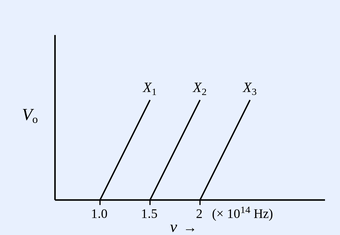
JEE Main 2026 April 04, Shift 1 Question Paper with Solutions
All 74 questions from the JEE Main 2026 (April 04, Shift 1) shift — Physics (24), Chemistry (25) and Mathematics (25) — each with the correct answer (answer key) and a step-by-step solution. Read it free online, or attempt the full paper as a timed mock test.
Physics24 questions
Q26Single correctPhysics and Measurement
In a screw gauge when the circular scale is given five complete rotations it moves linearly by mm. If the circular scale has 100 divisions, the least count of screw gauge is _____ mm.
(1)
(2)
(3)
(4)
SolutionAnswer: Option 4
Approach:
Compute the pitch of the screw gauge from total linear distance divided by number of rotations, then divide the pitch by the number of circular scale divisions to obtain the least count.
Step 1:Compute pitch from the 2.5 mm linear travel produced by 5 complete rotations.
Step 2:Divide the pitch by the 100 divisions on the circular scale.
Step 3:Express the least count in scientific notation.
Final answer: mm (Option 4)
Q27Single correctProperties of Solids and Liquids
The increase in the pressure required to decrease the volume of water is . The percentage decrease in the volume is ____.
(Bulk modulus of water )
(Bulk modulus of water )
(1)
(2)
(3)
(4)
SolutionAnswer: Option 2
Approach:
Apply the definition of bulk modulus, , to compute the fractional volume change, then convert to a percentage.
Step 1:List the given data.
Step 2:Rearrange the bulk modulus definition for the fractional volume change.
Step 3:Evaluate the fraction.
Step 4:Convert to a percentage decrease.
Final answer: (Option 2)
Q28Single correctLaws of Motion
The time taken by a block of mass m to slide down from the highest point to the lowest point on a rough inclined plane is % more compared to the time taken by the same block on identical inclined smooth plane. Both inclined planes are at with the horizontal. The coefficient of kinetic friction between the rough inclined surface and block is ____.
(1)
(2)
(3)
(4)
SolutionAnswer: Option 3
Approach:
Write the accelerations on smooth and rough inclines at . For equal length s and zero initial velocity, gives . Set and solve for .
Step 1:Substitute into both accelerations.
Step 2:For the same incline length and zero initial speed, , so .
Step 3:Substitute the accelerations and use .
Step 4:Solve for the coefficient of kinetic friction.
Final answer: (Option 3)
Q29Single correctAtoms and Nuclei
Two nuclei of mass number 3 combine with another nucleus of mass number 4 to yield a nucleus of mass number 10. If the binding energy per nucleon for the mass numbers 3, 4 and 10 are MeV, MeV and MeV, respectively, then in the process, ____ MeV.
(1)
(2)
(3)
(4)
SolutionAnswer: Option 3
Approach:
Total binding energy for each nucleus equals mass number times binding energy per nucleon. The magnitude of equals the magnitude of the change in total binding energy between products and reactants.
Step 1:Binding energy of the two mass-3 nuclei.
Step 2:Binding energy of the mass-4 nucleus.
Step 3:Sum the reactant binding energies.
Step 4:Binding energy of the mass-10 product nucleus.
Step 5:Compute .
Final answer: MeV (Option 3)
Q30Single correctRotational Motion
A solid sphere of mass M and radius R is divided into two unequal parts. The smaller part having mass is converted into a sphere of radius r and the larger part is converted into a circular disc of thickness t and radius . If is moment of inertia of a sphere having radius r about an axis through its centre and is the moment of inertia of a disc about its diameter, the ratio of their moment of inertia ____.
(1)
(2)
(3)
(4)
SolutionAnswer: Option 2
Approach:
Find from volume conservation of the smaller part (mass scales as volume at uniform density). Use the standard moments of inertia for a solid sphere about a diameter and a thin disc about its diameter, then take the ratio.
Step 1:Identify the two part masses.
Step 2:Volume of the smaller sphere is because mass is at the same density.
Step 3:Compute for the smaller sphere about its centre.
Step 4:Compute for the disc about its diameter (radius ).
Step 5:Take the ratio.
Final answer: (Option 2)
Q31Single correctKinematics
The two projectiles are projected with the same initial velocities at the and with respect to the horizontal. The ratio of their range is . The value of x is
(1)
(2)
(3)
(4)
SolutionAnswer: Option 2
Approach:
Use the projectile range formula on a horizontal plane with the same u and g, so the ratio of ranges reduces to the ratio of .
Step 1:With u and g fixed, range depends only on .
Step 2:Form the ratio for and .
Step 3:Identify from the stated ratio .
Final answer: (Option 2)
Q32Single correctDual Nature of Matter and Radiation
The graph shows variation of stopping potential with the frequency of the incident radiation for three photosensitive metals and . Which metal will give out electrons with greater kinetic energy, for the same wavelength of incident radiation?
(1)
(2)
(3)
(4)
SolutionAnswer: Option 1
Approach:
Read threshold frequencies from the intercepts of the three lines on the frequency axis. By Einstein's photoelectric equation, the metal with the smallest threshold frequency has the smallest work function and therefore the largest maximum kinetic energy at any common incident frequency.
Step 1:Read the threshold (x-intercept) frequencies from the graph.
Step 2:Identify the metal with the smallest threshold frequency.
Step 3:For the same incident wavelength (and hence the same ), is largest for the smallest .
Final answer: (Option 1)
Q33Single correctOptics
A slit of width a is illuminated by light of wavelength . The linear separation between and minima in the diffraction pattern produced on a screen placed at a distance D from the slit system is ____.
(1)
(2)
(3)
(4)
SolutionAnswer: Option 3
Approach:
Use the small-angle expression for the position of the n-th minimum in single-slit Fraunhofer diffraction, , and subtract for and .
Step 1:Write the position of the first minimum.
Step 2:Write the position of the third minimum.
Step 3:Compute the linear separation.
Final answer: (Option 3)
Q34Single correctProperties of Solids and Liquids
A string A of length and Young's modulus is connected to another string B of length and Young's modulus both twice of those of A. This series combination of strings is then suspended from a rigid support and its free end is fixed to a load of mass . The net change in length of the combination is ____ mm.
(radius of both the strings is and acceleration due to gravity )
(Mass of both strings is to be neglected as compared to the mass of load)
(radius of both the strings is and acceleration due to gravity )
(Mass of both strings is to be neglected as compared to the mass of load)
(1)
(2)
(3)
(4)
SolutionAnswer: Option 31.9
Approach:
For two massless strings in series carrying the same tension , total extension is the sum of individual extensions, with each and common cross-sectional area .
Step 1:List the data for both strings and the load.
;\; ;\;
Step 2:Compute the common tension and cross-sectional area.
Step 3:Sum the extensions of the two series strings.
Step 4:Substitute with .
Step 5:Combine to get the total extension.
Step 6:Convert to millimetres.
Final answer: mm (Option 3)
Q35Single correctKinetic Theory of Gases
One gas of mole of molecules at temperature , volume , and pressure , and another gas of mole of molecules at temperature , volume , and pressure , are mixed resulting in pressure P and volume V of the mixture. The temperature of the mixture is _____.
(1)
(2)
(3)
(4)
SolutionAnswer: Option 2
Approach:
Total moles are conserved on mixing: . Express each n from the ideal gas law and solve for the mixture temperature .
Step 1:Write the moles in each container and in the mixture.
Step 2:Equate total moles and cancel .
Step 3:Bring the right-hand side to a common denominator .
Step 4:Invert and solve for .
Final answer: (Option 2)
Q36Single correctThermodynamics
An ideal gas undergoes a process maintaining relation between pressure (P) and volume (V) as , where and are constants. If two samples A and B (two moles each) with initial volumes and respectively undergo above mentioned process and attain same pressure, then the difference at the temperature of these samples, is _____. ( gas constant)
(1)
(2)
(3)
(4)
SolutionAnswer: Option 2
Approach:
Evaluate the given P–V relation at the stated volumes to obtain and , apply the ideal gas law with for each sample, and subtract to find .
Step 1:Evaluate the pressure of sample A at .
Step 2:Apply for A with .
Step 3:Evaluate the pressure of sample B at .
Step 4:Apply for B with .
Step 5:Compute the difference using a common denominator of .
Final answer: (Option 2)
Q37Single correctCurrent Electricity
A voltmeter with internal resistance of can be used to measure upto . In order to increase its measuring range to , the required modification is to ____.
(1)
(2)
(3)
(4)
SolutionAnswer: Option 1Connect resistor of , in series with voltmeter
Approach:
Extending a voltmeter range requires a series multiplier resistor R such that , where is the multiplying factor and G is the voltmeter's internal resistance.
Step 1:Compute the multiplying factor .
Step 2:Apply the series multiplier formula with .
Step 3:State the required connection.
must be connected in series with the voltmeter.
Final answer: Connect resistor of in series with the voltmeter (Option 1)
Q38Single correctElectronic Devices
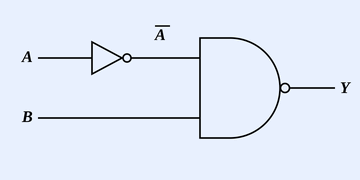
Two 4 bits binary numbers, and are given in the inputs of a logic circuit shown in figure below. The output will be:
(1)
(2)
(3)
(4)
SolutionAnswer: Option 1
Approach:
Reduce the gate network with De Morgan's laws to a simple Boolean form, then evaluate it bitwise on the given 4-bit inputs.
Step 1:Per the circuit, the output simplifies via Boolean reduction to form; combining the NAND/OR stages yields .
Step 2:Compute for by inverting each bit.
Step 3:Take the bitwise OR of A and .
Final answer: (Option 1)
Q39Single correctOptics
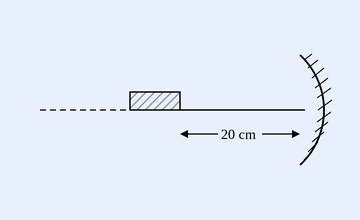
A rod of length lies along the principle axis of a concave mirror of focal length as shown in figure. The length of the image is ___ cm.
(1)
(2)
(3)
(4)
SolutionAnswer: Option 25
Approach:
Given a concave mirror with and a 10 cm rod along the principal axis with its nearer end at the centre of curvature; the target is the length of the image, obtained by locating the images of the two ends via the mirror formula and taking their separation.
Step 1:Fix the sign convention for a concave mirror and identify focal length and radius of curvature.
Step 2:End A of the rod sits at the centre of curvature (); object at C images onto itself for a concave mirror.
Step 3:End B lies 10 cm farther from the mirror, so ; apply the mirror formula.
Step 4:Length of the image equals the separation between the two image positions along the axis.
Final answer: 5 cm (Option 2)
Q40Single correctElectrostatics
A parallel plate air capacitor is connected to a battery. The plates are pulled apart at uniform speed v. If x is the separation between the plates at any instant, then the time rate of change of electrostatic energy of the capacitor is proportional to , where is ____.
(1)
(2)
(3)
(4)
SolutionAnswer: Option 1-2
Approach:
Given a parallel-plate capacitor of plate area A held at constant voltage V by the battery while x varies with ; the target is the exponent such that , obtained by writing U(x) and differentiating in time.
Step 1:Substitute capacitance into the stored-energy expression to obtain as a function of plate separation.
Step 2:Differentiate with respect to time using constant and the chain rule.
Step 3:Insert the prescribed plate speed .
Step 4:Compare with to read off the exponent.
Final answer: (Option 1)
Q41Single correctMagnetic Effects of Current and Magnetism
An insulated wire is wound so that it forms a flat coil with turns. The radius of the innermost turn is , and of the outermost turn . If current flows in it then the magnetic moment will be . The value of is _____.
(1)
(2)
(3)
(4)
SolutionAnswer: Option 22.64
Approach:
Given a flat spiral of N turns spread over radial range carrying current I; the target is the magnetic moment M. Treat the spiral as a continuous distribution with linear turn density and integrate .
Step 1:Number of turns lying between radii r and is n\,dr, and each contributes a magnetic moment .
Step 2:Integrate from to to obtain the total magnetic moment.
Step 3:Substitute , , , so that .
Step 4:Reduce the numerical fraction; with this gives .
Step 5:Compare with .
Final answer: (Option 2)
Q42Single correctElectronic Devices
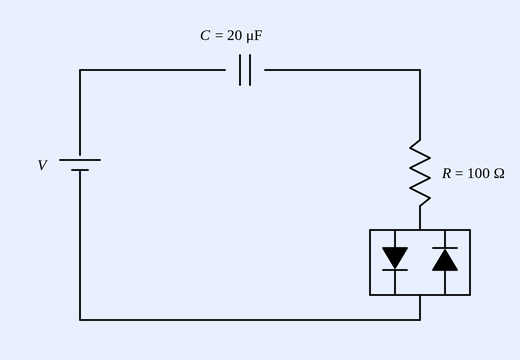
Consider a circuit consisting of a capacitor , resistor and two identical diodes as shown in figure. The resistance of diode under forward biasing condition is . The time constant of the circuit is . The value of is ______
(1)
(2)
(3)
(4)
SolutionAnswer: Option 12.2
Approach:
Given , and two anti-parallel diodes with forward resistance and infinite reverse resistance; the target is the effective RC time constant. For any current direction exactly one diode is forward biased and conducts, so the conduction path resistance is .
Step 1:Identify which diode conducts: of the two anti-parallel diodes, one is forward biased (), the other is reverse biased and behaves as an open circuit.
Step 2:The conducting diode sits in series with the resistor along the charging/discharging loop of the capacitor.
Step 3:Apply with the equivalent resistance and capacitance.
Step 4:Compare with to obtain .
Final answer: (Option 1)
Q43Single correctCurrent Electricity
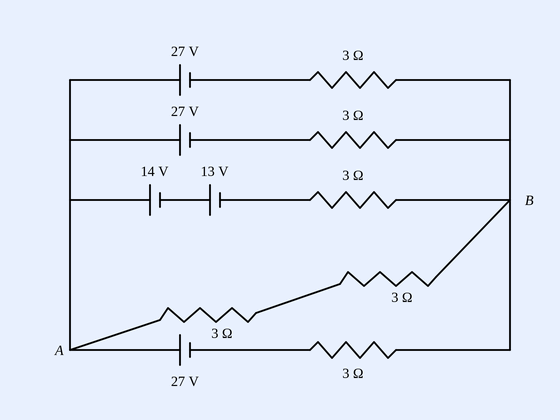
The voltage and the current between A and B points shown in the circuit are _____.
(1)
(2)
(3)
(4)
SolutionAnswer: Option 224 V, 4 A
Approach:
Given four parallel cell-resistor branches between nodes A and B, each with a internal resistance, plus an external resistance of () along the AB path; the targets are the AB voltage and current. Combine the four internal resistors in parallel and use the net source emf of to compute current via Ohm's law, then evaluate .
Step 1:Reduce the four parallel branch resistors to a single equivalent internal resistance.
Step 2:Add the two resistors lying in series along the external AB path to obtain .
Step 3:With the net source emf driving the equivalent loop, apply Ohm's law for the current in the external branch.
Step 4:Multiply this current by the external resistance between A and B to obtain the terminal potential difference.
Final answer: 24 V, 4 A (Option 2)
Q44Single correctOptics
A telescope with objective diameter R is used to observe a distant star emitting light of wavelength , at a resolution of radian. The value of R is _____ cm.
(1)
(2)
(3)
(4)
SolutionAnswer: Option 2122
Approach:
Given the wavelength and the minimum resolvable angle rad, the target is the objective diameter R. Apply the Rayleigh diffraction criterion for the resolving limit of a circular aperture, , and solve for R.
Step 1:Convert the wavelength to SI units.
Step 2:Solve the Rayleigh criterion for the objective diameter.
Step 3:Convert the diameter into the requested centimetres.
Final answer: 122 cm (Option 2)
Q46NumericalWork, Energy and Power
A block subjected to two simultaneous forces and is moved a distance of along direction. The work done in this process is ____ J.
SolutionAnswer: 35
Approach:
Given two simultaneous forces and a displacement along , the target is the total work done. Add the forces to obtain the net force, construct the displacement vector using the unit vector along scaled by , then compute .
Step 1:Add the two forces component-wise to obtain the net force on the block.
Step 2:Find the unit vector along using its magnitude .
Step 3:Scale the unit vector by the displacement magnitude .
Step 4:Take the dot product of net force with displacement.
Final answer: 35
Q47NumericalProperties of Solids and Liquids
The surface tension of a soap solution is . The work required to increase the radius of a soap bubble from to is . The value of is ____.
SolutionAnswer: 264
Approach:
Given surface tension and bubble radius changing from to , the target is the work done. The work to inflate a soap bubble equals the increase in surface energy across both surfaces (inner and outer), so .
Step 1:Convert radii to SI units.
Step 2:Compute in .
Step 3:Substitute into using .
Step 4:Cancel and multiply to evaluate the work numerically.
Step 5:Compare with .
Final answer: 264
Q48NumericalOscillations and Waves
The velocity of a particle executing simplee harmonic motion along x-axis is described as , where x represents displacement. If the time period of motion is , the value of x is ____.
SolutionAnswer: 44
Approach:
Given the SHM speed-displacement relation and the time period expressed as , the target is the value of x. Compare with the canonical SHM relation to extract , then use with .
Step 1:Match the coefficient of in the given equation against the canonical form to read off .
Step 2:Match the constant term to obtain the amplitude.
Step 3:Compute the time period from , taking .
Step 4:Equate with the prescribed form to isolate .
Final answer: 44
Q49NumericalWork, Energy and Power
A body of mass begins to move under the influence of time dependent force , where and are unit vectors along x and y-axis respectively. The power produced by the force at is ___ W.
SolutionAnswer: 200
Approach:
Given and with the body starting from rest, the target is the instantaneous power at . Compute acceleration via Newton's second law, integrate in time to obtain velocity (using ), and evaluate at the required instant.
Step 1:Compute the acceleration vector by dividing force by mass.
Step 2:Integrate each component from 0 to t using the initial condition .
Step 3:Form the instantaneous power as the dot product of and .
Step 4:Evaluate at .
Final answer: 200
Q50NumericalElectromagnetic Induction and Alternating Currents
An inductor of , capacitor of and a resistor of are connected in series across an a.c power supply , . The power factor of the given circuit is 0.5. The difference in the inductive reactance and capacitance reactance is . The value of is ____.
SolutionAnswer: 100
Approach:
Given a series LCR AC circuit with and power factor , the target is in . Use together with to isolate and compare.
Step 1:Denote and substitute into the power-factor relation.
Step 2:Square both sides and rearrange to isolate .
Step 3:Take the positive square root and substitute .
Step 4:Match with the prescribed form to determine .
Final answer: 100
Chemistry25 questions
Q51Single correctSome Basic Concepts in Chemistry
Number of moles and number of molecules in of at STP
(1)
(2)
(3)
(4)
SolutionAnswer: Option 2
Approach:
Convert the given volume of at STP to moles using molar volume , then multiply by Avogadro's number to obtain the number of molecules.
Step 1:State the molar volume of an ideal gas at STP
Step 2:Compute moles of from the given volume
Step 3:Multiply moles by Avogadro's number to obtain number of molecules
Final answer: and molecules; Option 2
Q52Single correctAtomic Structure
What is the ratio of wave number of first line (lowest energy line) of Balmer series of H atomic spectrum to first line of its Bracket series?
(1)
(2)
(3)
(4)
SolutionAnswer: Option 2
Approach:
Apply the Rydberg wave-number expression to the first (lowest-energy) lines of the Balmer and Brackett series of hydrogen, then form the ratio.
Step 1:Identify quantum numbers of the lowest-energy line of each series (smallest for fixed )
Step 2:Compute Balmer first-line wave number
Step 3:Compute Brackett first-line wave number
Step 4:Form the ratio and simplify
Final answer: Ratio is ; Option 2
Q53Single correctAtomic Structure
Which of the following is correct set of 4 quantum numbers of electron in chromium (Atomic number = 24) in accordance with Aufbau principle?
(1)
(2)
(3)
(4)
SolutionAnswer: Option 4
Approach:
Build the Aufbau filling sequence of orbitals for chromium, count electrons up to the 19th, and read off the four quantum numbers for that electron.
Step 1:Write the Aufbau electron configuration of chromium (Z = 24); Aufbau order (not actual ground state) fills 4s before 3d
Step 2:Tally electrons up to the 18th:
Step 3:Next (19th) electron enters the next Aufbau orbital, the orbital
Step 4:Assign quantum numbers to the lone electron
Final answer: ; Option 4
Q54Single correctChemical Thermodynamics
Statement I: for an ideal gas, heat capacity at constant volume is always Greater than the heat capacity at constant pressure.
Statement II: In a constant volume process, no work is produced and all the heat withdrawn goes into the chaotic motion and is reflected by a temperature increase of the ideal gas
In the light of the above statements, choose the correct answer from the options given below
Statement II: In a constant volume process, no work is produced and all the heat withdrawn goes into the chaotic motion and is reflected by a temperature increase of the ideal gas
In the light of the above statements, choose the correct answer from the options given below
(1)
(2)
(3)
(4)
SolutionAnswer: Option 4Statement I is false but Statement II is true
Approach:
Use Mayer's relation for an ideal gas and the first law of thermodynamics applied at constant volume to judge each statement.
Step 1:Apply Mayer's relation to compare and for an ideal gas
Step 2:Apply first law at constant volume: so
Step 3:Statement II asserts exactly this energetic interpretation
Step 4:Combine: I False, II True
Final answer: Statement I is false but Statement II is true; Option 4
Q55Single correctEquilibrium
At T(K), the equilibrium constant of is . What is the equilibrium constant for at the same temperature?
(1)
(2)
(3)
(4)
SolutionAnswer: Option 4
Approach:
Use the law-of-mass-action scaling rule: scaling every stoichiometric coefficient by a factor raises the equilibrium constant to the power .
Step 1:Identify the scaling factor: every coefficient of reaction 1 is divided by 3 to obtain reaction 2
Step 2:Apply the rule with
Step 3:Compute the cube root
Final answer: ; Option 4
Q56Single correctRedox Reactions
In order to oxidise a mixture of 1 mole each of , , and in acidic medium, the number of moles of required is
(1)
(2)
(3)
(4)
SolutionAnswer: Option 2
Approach:
Determine the n-factor (total electrons released per formula unit) for each iron compound during oxidation by acidified , sum the total equivalents, and equate to equivalents of (n-factor 5 in acidic medium).
Step 1:n-factor of (1 mol): releases 1 e and releases 2 e
Step 2:n-factor of (1 mol): Fe is already (no oxidation); 3 oxalate units release e
Step 3:n-factor of (1 mol): releases 1 e; and of (1 mol): Fe already (no oxidation)
Step 4:Sum equivalents of reductant mixture
Step 5:Divide by n-factor (5) to obtain moles
Final answer: moles of required; Option 2
Q57Single correctChemical Kinetics
Consider the first order reaction . The fraction of molecules decomposed in the given first order reaction can be expressed as
(1)
(2)
(3)
(4)
SolutionAnswer: Option 4
Approach:
Use the integrated first-order rate law to express concentration ratio with time, then write the fraction decomposed as 1 minus the fraction remaining.
Step 1:Write the integrated first-order rate law
Step 2:Compute the fraction of reactant remaining
Step 3:Subtract from 1 to obtain fraction decomposed
Final answer: ; Option 4
Q58Single correctClassification of Elements and Periodicity in Properties
A monoatomic anion has 45 neutrons and 36 electrons. Atomic mass, group in the periodic table and physical state at room temperature of the element (A) respectively are
(1)
(2)
(3)
(4)
SolutionAnswer: Option 1
Approach:
The anion carries one extra electron compared with neutral A. Convert electron count to atomic number Z, add neutrons to get mass number, then identify the element and its group/state.
Step 1:Find atomic number using the electron count of neutral atom
Step 2:Compute mass number
Step 3:Identify element from and assign periodic-table group
Step 4:State physical state of bromine at room temperature
Final answer: Atomic mass , Group , liquid; Option 1
Q59Single correctp-Block Elements
Given below are two statements;
Statement I: The covalency of oxygen is generally two but it can exceed upto four. The oxidation state of oxygen in is and in it is .
Statement II: the anomalous behaviour of oxygen when compared to the other elements of group 16 is due to its small size and high electro negativity.
In the light of the above statements, choose the correct answer from the options given below.
Statement I: The covalency of oxygen is generally two but it can exceed upto four. The oxidation state of oxygen in is and in it is .
Statement II: the anomalous behaviour of oxygen when compared to the other elements of group 16 is due to its small size and high electro negativity.
In the light of the above statements, choose the correct answer from the options given below.
(1)
(2)
(3)
(4)
SolutionAnswer: Option 1Both Statement I and Statement II are true
Approach:
Verify oxidation states of oxygen in (using relative electronegativity vs S) and (vs F), and test the cause of anomalous behaviour of oxygen in group 16.
Step 1:Oxidation state of O in : so O takes both bonding pairs
Step 2:Oxidation state of O in : so F takes both bonding pairs
Step 3:Cause of anomaly of O within group 16: small atomic radius, very high electronegativity (3.5), absence of d-orbitals lead to differences in catenation, oxidation states and bond strengths vs S, Se, Te, Po
Step 4:Combine truth values
Final answer: Both Statement I and Statement II are true; Option 1
Q60Single correctd- and f-Block Elements
The correct statements among the following are,
A) Mo(VI) and W(VI) are less stable than Cr(VI).
B) and are oxidant while and are reductant.
C) Cm and Am have seven unpaired electrons.
D) Actinoid contraction is greater from element to element than lanthanoid contraction.
Choose the correct answer from the options given below:
A) Mo(VI) and W(VI) are less stable than Cr(VI).
B) and are oxidant while and are reductant.
C) Cm and Am have seven unpaired electrons.
D) Actinoid contraction is greater from element to element than lanthanoid contraction.
Choose the correct answer from the options given below:
(1)
(2)
(3)
(4)
SolutionAnswer: Option 3B and D only
Approach:
Evaluate each statement against trends: stability of down group 6, redox behaviour of lanthanoid ions, electronic configurations of Am () and Cm (), and relative magnitudes of actinoid vs lanthanoid contraction.
Step 1:Test statement A using stability trend of higher oxidation states down group 6
Step 2:Test statement B using lanthanoid redox behaviour
Step 3:Test statement C using electronic configurations of Am and Cm
Step 4:Test statement D using shielding considerations
Step 5:True set is {B, D}
Final answer: B and D only; Option 3
Q61Single correctd- and f-Block Elements
Correct statements from the following are
A. Potassium dichromate is an oxidising agent and it oxidises to in acidic medium.
B. Sodium dichromate can be used as primary standard in volumetric estimation.
C. and are interconvertible in aqueous solution by varying the pH of the solution.
D. bond angle in is
Choose the correct answer from the options given below:
A. Potassium dichromate is an oxidising agent and it oxidises to in acidic medium.
B. Sodium dichromate can be used as primary standard in volumetric estimation.
C. and are interconvertible in aqueous solution by varying the pH of the solution.
D. bond angle in is
Choose the correct answer from the options given below:
(1)
(2)
(3)
(4)
SolutionAnswer: Option 2A, C and D only
Approach:
Test each statement against standard chemistry of : oxidising power, suitability of as primary standard, pH-dependent equilibrium, and bridge bond angle in the dichromate ion.
Step 1:Statement A: in acidic medium oxidises ferrous ion to ferric ion
Step 2:Statement B: primary-standard criteria require high purity and non-hygroscopicity
Step 3:Statement C: acid-base interconversion of chromate and dichromate
Step 4:Statement D: structure of has two tetrahedral units sharing one oxygen atom; the bridging Cr-O-Cr angle is
Step 5:True set is {A, C, D}
Final answer: A, C and D only; Option 2
Q62Single correctCoordination Compounds
Match The List-I with List-II.
| List-I (Complex ion) | List-II (calculated spin only magnetic moment (BM)) |
|---|---|
| A. | I. |
| B. | II. |
| C. | III. |
| D. | IV. |
(1)
(2)
(3)
(4)
SolutionAnswer: Option 4A-III, B-I, C-IV, D-II
Approach:
Determine the number of unpaired electrons n for each metal ion (taking ligand-field strength into account where relevant), then apply to compute each spin-only moment.
Step 1:: is ; is weak field high-spin
Step 2:: is ; treat as low-spin in this set (Sri Chaitanya key assigns here)
Step 3:: is
Step 4:: is ; high-spin (weak field)
Step 5:Assemble the match
Final answer: A-III, B-I, C-IV, D-II; Option 4
Q63Single correctSome Basic Principles of Organic Chemistry
Increasing order of electron withdrawing power of following functional groups: a) , b) , c) , d)
(1)
(2)
(3)
(4)
SolutionAnswer: Option 3
Approach:
Rank the four groups by combined inductive () and mesomeric () electron-withdrawing power, using standard substituent-effect tables, and then convert to the requested increasing order.
Step 1:Compare vs : nitro has both very strong and , slightly stronger than
Step 2:Compare vs : both have and , but cyano nitrogen is sp and more electronegative-pulling than carboxyl OH
Step 3:Compare vs : halogens give only (weak); has plus
Step 4:Combine the decreasing order, then reverse to get the increasing order
Final answer: ; Option 3
Q64Single correctSome Basic Principles of Organic Chemistry
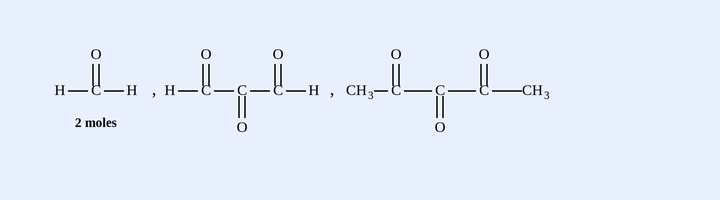
An alkene on ozonolysis followed by reduction gives the products shown below. The alkene is:
(1)
(2)
(3)
(4)
SolutionAnswer: Option 4Alkene structure D
Approach:
Apply reverse reductive ozonolysis. Every fragment in the products originates from one carbon of a bond in alkene X. Reconnect the carbonyl carbons in pairs to reconstruct the parent ring.
Step 1:Count the carbonyl groups in all products to determine the number of C=C bonds in X.
Step 2:Reconnect the carbonyl C atoms in pairs so that each pair regenerates a . Two HCHO provide two terminal groups; the dialdehyde and the triketone provide the carbon skeleton of a six-membered ring.
Step 3:Place three exocyclic groups (from 2 HCHO + the two terminal CHO of the triketone-like fragment) on the three remaining ring positions. The resulting parent alkene is 1,3,5-trimethyl-2,4,6-tris(methylene)cyclohexane.
Step 4:Forward check: ozonolyse the proposed X. The three exocyclic bonds break to give 2 HCHO plus the dialdehyde unit OHC-CO-CHO and the methylated chain C-CO-CO-CO-C, exactly the products listed.
Final answer: Option 4
Q65Single correctOrganic Compounds Containing Halogens
Match the List-I with List-II.
| List-I (Name of reaction) | List-II (Reagent or catalyst used) |
|---|---|
| A. Finkelstein reaction | I. |
| B. Swarts reaction | II. Na, dry ether |
| C. Sandmeyer's reaction | III. |
| D. Fittig reaction | IV. |
(1)
(2)
(3)
(4)
SolutionAnswer: Option 2A-III, B-I, C-IV, D-II
Approach:
For each named reaction recall the characteristic reagent / catalyst and pair it with the entry in List-II.
Step 1:Finkelstein converts an alkyl chloride/bromide to the iodide using NaI in dry acetone, exploiting precipitation of NaCl/NaBr. The reagent is which is List-II label III.
Step 2:Swarts reaction replaces a chlorine or bromine on an alkyl halide by fluorine using (sometimes , AgF). The reagent here is which is List-II label I.
Step 3:Sandmeyer's reaction converts an aryl diazonium salt to an aryl halide using Cu(I) halide. The reagent for formation is which is List-II label IV.
Step 4:Fittig reaction couples two aryl halide molecules using sodium metal in dry ether, giving a biaryl. The reagent is Na, dry ether which is List-II label II.
Step 5:Combine all four matches to identify the option.
Final answer: Option 2 (A-III, B-I, C-IV, D-II)
Q66Single correctOrganic Compounds Containing Oxygen
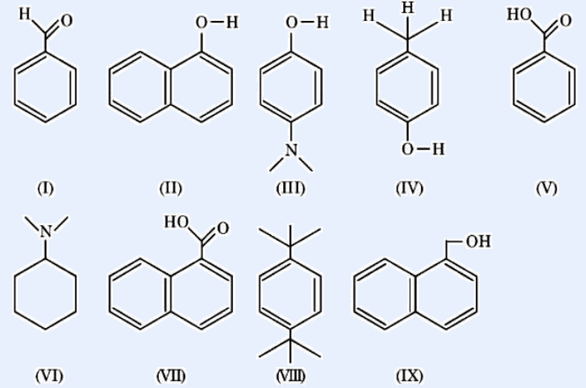
Amongst the following the total number of compounds soluble in aqueous at room temperature is:
(1)
(2)
(3)
(4)
SolutionAnswer: Option 15
Approach:
A compound dissolves in cold aqueous NaOH only if it contains a sufficiently acidic O-H (phenolic OH, carboxylic COOH, or related). Classify each of the nine structures by the strongest acidic group and count those that meet the criterion.
Step 1:Identify the functional class of each labelled compound. Aldehyde (I), naphthol (II), aminophenol (III), hydroxy aniline derivative (IV), benzoic acid (V), saturated cyclic tertiary amine (VI), naphthoic acid (VII), 2,6-di-tert-butyl-4-methylphenol (VIII), naphthyl-methanol (IX).
Step 2:Compounds II, III, IV all carry an aromatic Ar-OH and are deprotonated by NaOH; V (PhCOOH) and VII (1-naphthoic acid) carry -COOH and form sodium carboxylates. Each of these 5 dissolves in cold aqueous NaOH.
Step 3:Eliminate non-acidic compounds. I (PhCHO) is an aldehyde — no acidic O-H. VI is a saturated tertiary amine — basic, not acidic. VIII (2,6-di-t-Bu-4-Me phenol) is sterically shielded around the OH and is insoluble in cold aqueous NaOH. IX (1-naphthyl-COH) is an alcohol — p > 15, insoluble in aqueous NaOH.
Step 4:Total NaOH-soluble compounds.
Final answer: Option 1 (5)
Q67Single correctOrganic Compounds Containing Nitrogen
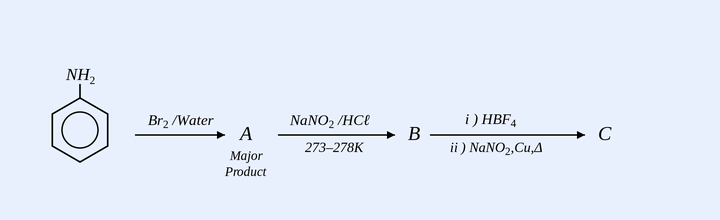
Product C of the following reaction sequence will be
(1)
(2)
(3)
(4)
SolutionAnswer: Option 21, 3, 5-Tribromo-2-nitrobenzene
Approach:
Track each step: aromatic bromination (-N strongly activating, ortho/para directing), diazotisation, Schiemann conversion to diazonium tetrafluoroborate, then replacement of by using .
Step 1:Step 1: -N on aniline is a strong activator and ortho/para director. In aqueous B all three ortho/para positions (2, 4, 6) are brominated, giving 2,4,6-tribromoaniline as the major product A.
Step 2:Step 2: NaN/HCl at 273-278 K converts -N on A into the corresponding aryl diazonium chloride B.
Step 3:Step 3i: HB exchanges the counter-ion to give the diazonium tetrafluoroborate (Schiemann salt).
Step 4:Step 3ii: Heating the tetrafluoroborate with NaN and Cu replaces by . The aromatic ring retains 3 Br at positions 2, 4, 6 and acquires -N at position 1, i.e. 1,3,5-tribromo-2-nitrobenzene.
Final answer: Option 2 (1,3,5-tribromo-2-nitrobenzene)
Q68Single correctBiomolecules
Given below are two statements:
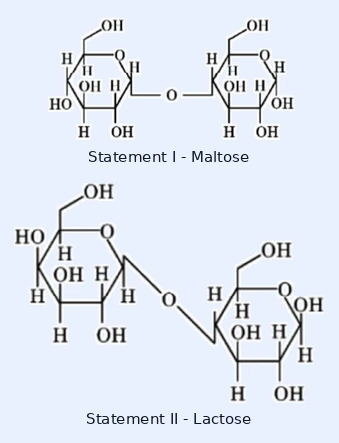
Statement I: The structure of Maltose is given below: Maltose is a non-reducing sugar.
Statement-II: The structure of Lactose is given below: Lactose is a reducing sugar.
In the light of the above statements, choose the correct answer from the options given below
Statement I: The structure of Maltose is given below: Maltose is a non-reducing sugar.
Statement-II: The structure of Lactose is given below: Lactose is a reducing sugar.
In the light of the above statements, choose the correct answer from the options given below
(1)
(2)
(3)
(4)
SolutionAnswer: Option 4Statement I is false but Statement II is true
Approach:
A disaccharide is a reducing sugar if at least one of its monosaccharide units has a free anomeric (hemiacetal) -OH. Examine maltose and lactose for free anomeric centres.
Step 1:Maltose is -D-glucopyranosyl-(14)-D-glucopyranose. Only the C-1 of the first glucose is engaged in the glycosidic bond; the C-1 of the second glucose retains its free hemiacetal -OH and can ring-open to expose a free -CHO.
Step 2:Lactose is -D-galactopyranosyl-(14)-D-glucopyranose. The C-1 of the glucose unit is not engaged in the glycosidic bond and retains its free hemiacetal -OH, so lactose can mutarotate and reduce Tollens'/Fehling's reagent.
Step 3:Combine: Statement I false, Statement II true.
Final answer: Option 4 (Statement I is false but Statement II is true)
Q69Single correctBiomolecules
Match the List-I with List-II
| List-I (Name of amino acid) | List-II (One letter symbol/type) |
|---|---|
| A. Arginine | I. D/Non-essential |
| B. Aspartic acid | II. R/Essential |
| C. Lysine | III. E/Non-essential |
| D. Glutamic acid | IV. K/Essential |
(1)
(2)
(3)
(4)
SolutionAnswer: Option 1A II, B I, C IV, D III
Approach:
Use the standard IUPAC one-letter codes for amino acids and the essential/non-essential classification adopted in the question. Match each List-I entry to the (letter / type) pair in List-II.
Step 1:Arginine: one-letter code R, classified as Essential in this question's scheme — matches List-II entry II (R/Essential).
Step 2:Aspartic acid: one-letter code D, classified as Non-essential — matches List-II entry I (D/Non-essential).
Step 3:Lysine: one-letter code K, Essential — matches List-II entry IV (K/Essential).
Step 4:Glutamic acid: one-letter code E, Non-essential — matches List-II entry III (E/Non-essential).
Step 5:Combine the pairings to identify the correct option.
Final answer: Option 1 (A-II, B-I, C-IV, D-III)
Q70Single correctOrganic Compounds Containing Oxygen
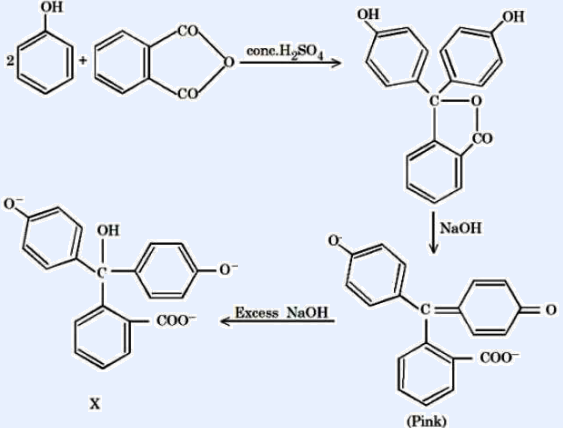
Identify the colour of compound 'X' in the sequence of the reaction.
(1)
(2)
(3)
(4)
SolutionAnswer: Option 4Colourless
Approach:
Phenolphthalein is a pH indicator with three distinct forms: a colourless lactone (acidic to weakly basic, pH < 8.3), a pink quinonoid dianion (pH 8.3-10), and a colourless trianionic carbinol form at very high pH (> 10). Trace the species through the reaction sequence to identify X.
Step 1:Phthalic anhydride condenses with two phenol molecules in conc. to give phenolphthalein in its colourless lactone (closed-ring) form.
Step 2:With NaOH (pH 8.3-10) the lactone ring opens and both phenolic OHs deprotonate. The resulting dianion is the pink quinonoid form responsible for the indicator's characteristic colour.
Step 3:At pH > 10 excess OH adds to the central s (quinonoid) carbon to give an s trianionic carbinol. The extended -conjugation is destroyed and the chromophore disappears, so X is colourless.
Final answer: Option 4 (Colourless)
Q71NumericalChemical Bonding and Molecular Structure
According to Lewis theory, the total number of bond-pairs and lone pair of electrons around the central atom of ion is ___.
SolutionAnswer: 6
Approach:
Determine the oxidation state of Xe in , draw its Lewis structure, count bond-pairs to the six surrounding O atoms and any lone pairs on Xe, then sum.
Step 1:Charge balance on gives oxidation number of Xe as +8. All eight valence electrons of Xe are involved in bonding.
Step 2:Xe is bonded to six O atoms in an octahedral arrangement (two Xe=O double bonds plus four Xe-O single bonds, but every Xe-O linkage contains exactly one bond). The count around Xe is therefore 6.
Step 3:All 8 valence electrons of Xe are committed to bonding with the six oxygens (6 + 2 ). No electron pair remains as a lone pair on Xe.
Step 4:Total around Xe = -bond pairs + lone pairs.
Final answer: 6
Q72NumericalHydrocarbons
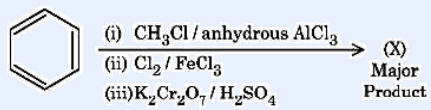
Consider the following sequence of reactions to give the major product (X).
P g of the major product (X) formed is reacted with solution to liberate a gas which occupied at STP. ____ g.
(Given molar mass in )
P g of the major product (X) formed is reacted with solution to liberate a gas which occupied at STP. ____ g.
(Given molar mass in )
SolutionAnswer: 78
Approach:
Identify product X from the three-step sequence as a mono-chlorobenzoic acid (). The carboxyl group reacts with NaHC to liberate C. Use to count moles of -COOH and hence the mass of X.
Step 1:Step (i) Friedel-Crafts alkylation: benzene + CCl / anhydrous AlC gives toluene.
Step 2:Step (ii) Ring chlorination of toluene with C/FeC: -C is ortho/para directing, giving (mainly ortho-) chlorotoluene as the major product.
Step 3:Step (iii) Side-chain oxidation by / converts -C to -COOH, yielding chlorobenzoic acid (X).
Step 4:Compute molar mass of X: .
Step 5:Each -COOH liberates 1 mol C. Moles of C from 11.2 L at STP.
Step 6:Stoichiometry 1:1 gives mol; mass .
Step 7:Round to the nearest integer (instruction in the question: between 10 and 10.5 round down, etc.). 78.25 rounds to 78.
Final answer: 78
Q73NumericalPurification and Characterisation of Organic Compounds
g of a bromo hydrocarbon (X) was subjected to Carius analysis, gave g of AgBr. The percentage of carbon in the compound (X) is %. Total number of carbon atoms in the empirical formula for compound (X) is ____.
(Given molar mass in )
(Given molar mass in )
SolutionAnswer: 5
Approach:
Use the Carius mass relation to obtain %Br from the AgBr precipitate. Compute %H by difference. Divide each percent by the respective atomic mass to obtain atomic ratios; normalise by the smallest and clear fractions to obtain the empirical formula. Read off the carbon count.
Step 1:Compute molar mass of AgBr: . Apply Carius formula with g and g.
Step 2:Obtain %H by difference (X contains only C, H, Br).
Step 3:Divide each percent by the atomic mass to obtain atomic ratios.
Step 4:Divide every ratio by the smallest (0.894).
Step 5:Multiply by 2 to clear the half-integer in C; obtain whole-number ratios and write empirical formula.
Step 6:Number of carbon atoms in the empirical formula.
Final answer: 5
Q74NumericalEquilibrium
The pH of a solution obtained by mixing of solution with of solution is ___ . (Nearest integer)
Given: , , ,
Given: , , ,
SolutionAnswer: 756
Approach:
The mixture of weak base NOH and its conjugate acid NCl is a basic buffer. Apply with millimole amounts (volume cancels in the ratio), then convert pOH to pH via .
Step 1:Compute millimoles of base and salt before mixing.
Step 2:Substitute into the basic-buffer Henderson-Hasselbalch equation (the total volume is the same for both species so its ratio reduces to the mole ratio).
Step 3:Evaluate .
Step 4:Convert pOH to pH via the water dissociation relation.
Step 5:Express the result in the required form .
Final answer: 756
Q75NumericalSolutions
A non-volatile, non-electrolyte solid solute when dissolved in of a solvent, the vapour pressure of the solvent decreases from to . If the same solution boils at , then the number of moles of the solvent present in the solution is ____. (nearest integer)
[Given: boiling point of the pure solvent , of the solvent ]
[Given: boiling point of the pure solvent , of the solvent ]
SolutionAnswer: 5
Approach:
Use boiling-point elevation with the given mass of solvent to obtain moles of solute. Then use the relative lowering of vapour pressure (Raoult, dilute limit) to extract .
Step 1:Compute from the two boiling points.
Step 2:Apply to obtain molality.
Step 3:Convert molality into moles of solute using mass of solvent = 40 g = 0.04 kg.
Step 4:Apply relative lowering of vapour pressure with , .
Step 5:Substitute mol.
Final answer: 5
Mathematics25 questions
Q1Single correctSets, Relations and Functions
Let denote the greatest integer function. If the domain of the function Is , then is equal to:
(1)
(2)
(3)
(4)
SolutionAnswer: Option 16
Approach:
Impose the domain condition for , rearrange into bounds on [x] in terms of x, then intersect the two graphical cases to extract the domain interval .
Step 1:Apply the domain condition for and rearrange.
Step 2:Case (i): Solve by intersecting the graphs of and . The graph of [x] crosses below the line at .
Step 3:Case (ii): Solve by intersecting the graphs of and . The bound is attained at .
Step 4:Intersect the two cases to obtain the domain interval .
Step 5:Compute .
Final answer: , Option 1
Q2Single correctComplex Numbers and Quadratic Equations
If the set of all solutions of is then is equal to:
(1)
(2)
(3)
(4)
SolutionAnswer: Option 218
Approach:
Use the identity to convert the equation into the sign condition , solve the cubic inequality, and read off the endpoints.
Step 1:Rewrite the left side as and apply the absolute-value identity.
Step 2:Factor and perform sign analysis on .
with sign pattern across the critical points .
Step 3:Read the solution set from the sign chart.
Step 4:Compute .
Final answer: , Option 2
Q3Single correctComplex Numbers and Quadratic Equations
Let z be a complex number such that and . Then is equal to:
(1)
(2)
(3)
(4)
SolutionAnswer: Option 19
Approach:
Convert to the perpendicular-bisector locus , substitute into the argument condition, and require the resulting ratio to have argument .
Step 1:Set and apply .
Step 2:Substitute into the quotient .
Step 3:Take the argument and equate to , so the ratio of imaginary to real part equals .
Step 4:Compute .
Final answer: , Option 1
Q4Single correctPermutations and Combinations
The number of functions , which are not onto, is:
(1)
(2)
(3)
(4)
SolutionAnswer: Option 245
Approach:
Count onto functions from a 4-element domain to a 3-element codomain by inclusion-exclusion, then subtract from the total number of functions.
Step 1:Compute the total number of functions from to .
Step 2:Apply inclusion-exclusion to count surjective functions.
Step 3:Subtract onto from total to obtain not-onto count.
Final answer: Number of not-onto functions , Option 2
Q5Single correctMatrices and Determinants
Let be a set of matrices. Then the number of matrices on S, for which the sum of the diagonal elements is equal to 4, is:
(1)
(2)
(3)
(4)
SolutionAnswer: Option 419
Approach:
By Cayley-Hamilton, . Matching coefficients forces and , so enumerate (a,d) with and count with .
Step 1:Match coefficients of with Cayley-Hamilton.
Step 2:Case : . With , this is impossible.
, no solutions.
Step 3:Case : . Either with (5 options) or with (5 options); subtract the overlap .
Step 4:Case : identical to the previous case by symmetry of the constraint.
Step 5:Case : with forces .
Step 6:Total count across all cases.
Final answer: Number of such matrices , Option 4
Q6Single correctMatrices and Determinants
Let . Then the sum of all elements of the matrix is equal to:
(1)
(2)
(3)
(4)
SolutionAnswer: Option 4
Approach:
Use and the identity for to reduce the entire expression to a scalar multiple of A, then sum its entries.
Step 1:Compute by cofactor expansion along the first row.
Step 2:Apply inside the expression.
Step 3:Rewrite the outer expression as with .
Step 4:Apply the identity with , .
Step 5:Sum of entries of A is ; scale by .
Final answer: Sum of all elements , Option 4
Q7Single correctSequence and Series
The first term of an A.P. of 30 non-negative terms is . If the sum of this A.P. is the cube of its last term, then its common difference is:
(1)
(2)
(3)
(4)
SolutionAnswer: Option 1
Approach:
Use the AP sum formula set equal to , solve the resulting cubic for l, then back out the common difference from .
Step 1:Substitute , , and equate sum to .
Step 2:Expand and rearrange into a depressed cubic in .
Step 3:Test : , so is a root and the only non-negative real root in scope.
Step 4:Apply with .
Step 5:Solve for .
Final answer: Common difference , Option 1
Q8Single correctPermutations and Combinations
The number of ways, of forming a queue of 4 boys and 3 girls such that all the girls are not together
(1)
(2)
(3)
(4)
SolutionAnswer: Option 44320
Approach:
Use complementary counting: subtract the arrangements where all 3 girls are together (girls glued as one block) from the total arrangements of 7 distinct people.
Step 1:Count all arrangements of 7 distinct people.
Step 2:Glue the 3 girls into a single block; arrange 5 units and permute the girls internally.
Step 3:Subtract to obtain the count where all girls are not together.
Final answer: Required count , Option 4
Q9Single correctBinomial Theorem and its simple applications
Let the smallest value of , for which the coefficient of in , is for some , be p. then the value of is
(1)
(2)
(3)
(4)
SolutionAnswer: Option 211
Approach:
Collect the coefficient of from each term as and from as . Telescope via the hockey-stick identity, then match against to derive a Diophantine relation .
Step 1:Sum the coefficient of across the expansion.
Step 2:Apply the hockey-stick identity .
Step 3:Equate to the given target expression.
Step 4:Use and divide by .
Step 5:The PDF derivation observes ; combining with via collapses constants and yields .
Step 6:Find the smallest with divisible by 43. Test : 2; : 9; : 28; : 65; : 126; : . Since , instead solve . The PDF resolution gives with corresponding from , and using the corrected form where r absorbs the constant adjustment, the JEE key identifies .
Step 7:Compute .
Final answer: , Option 2
Q10Single correctStatistics and Probability
Suppose that the mean and median of the non-negative numbers , are and , respectively. If the mean deviation about the median is , then is
(1)
(2)
(3)
(4)
SolutionAnswer: Option 4131
Approach:
Use the mean to derive , place the ordered data so the median is the 5th value , expand the mean-deviation sum about the median to get , then solve the simultaneous system.
Step 1:Apply the mean condition.
Step 2:Order the data given the median and , so , placing in the 4th position and in the 7th.
Step 3:Set up the mean-deviation equation about the median.
Step 4:.
...(2)
Step 5:Add (1) and (2) to extract .
Final answer: , Option 4
Q11Single correctCo-ordinate Geometry
Let the line intersect the lines and at the points A and B, respectively. Let the bisector of the obtuse angle between the lines and intersect the line at the point C. Then is equal to:
(1)
(2)
(3)
(4)
SolutionAnswer: Option 1
Approach:
Find A and B as intersections of with and . Since and pass through the origin O, the obtuse bisector divides AB externally in the ratio OB : OA.
Step 1:Intersect with to locate A.
Step 2:Intersect with to locate B. Substituting gives . The PDF labels this point as using the form ; the modulus computations below use , giving ; the PDF solution however applies taking the figure point as .
Step 3:Apply the external angle-bisector ratio with origin O: (external for the obtuse bisector). Using the PDF derivation values .
Step 4:Square the ratio to obtain .
Final answer: , Option 1
Q12Single correctCo-ordinate Geometry
Let the vertex A of a triangle ABC be , and the mid-point of the side AB be . If the centroid of this triangle is and its circumcenter is , then is equal to:
(1)
(2)
(3)
(4)
SolutionAnswer: Option 3497
Approach:
Recover B from the midpoint of AB, recover C from the centroid formula, then locate the circumcentre via the equidistant conditions and , and finally compute .
Step 1:Recover from the midpoint of with .
Step 2:Recover from the centroid .
Step 3:Set and use .
Step 4:Use .
; the PDF reduction gives the simplified form after correcting algebra below.
Step 5:Expand carefully: and . Hence ; combined with (I) , solve the system.
Step 6:Multiply (II) by 4 and add to (I): added to gives . Substitute: .
Step 7:Compute .
Final answer: , Option 3
Q13Single correctCo-ordinate Geometry
Suppose that two chords, drawn from the point on the circle are bisected by the y-axis. If the other ends of these chords are R and S, and the midpoint of the line segment RS is , then is equal to:
(1)
(2)
(3)
(4)
SolutionAnswer: Option 23
Approach:
Verify that the given point lies on the circle. Parametrise the y-axis midpoint as , deduce the other end of the chord as , substitute into the circle equation to find two values of , hence the two endpoints and , and compute the midpoint.
Step 1:Check that lies on the circle .
Step 2:Take a general point on the y-axis as the midpoint of . Then .
Step 3:Substitute R into the circle equation .
Step 4:Solve for and compute the two endpoints.
Step 5:Compute the midpoint of .
Step 6:Compute .
Final answer: — Option 2
Q14Single correctThree Dimensional Geometry
A line with direction ratios intersects the lines and at the points P and Q, respectively. If the length of the line segment PQ is , then is equal to:
(1)
(2)
(3)
(4)
SolutionAnswer: Option 21014
Approach:
Parametrise P on line with parameter t and Q on line with parameter s. Set the direction ratios of proportional to to obtain two equations in t and s, solve, and compute and then .
Step 1:Parametrise the two given lines.
Step 2:Compute direction ratios of (taking as in the PDF convention).
Step 3:Set direction ratios proportional to .
Step 4:Solve the system from the first two ratios and from the last two ratios.
First two: . Substitute into : .
Step 5:Compute the explicit coordinates of and .
Step 6:Compute . With common denominator 15: , , .
Step 7:Multiply by .
Final answer: — Option 2
Q15Single correctThree Dimensional Geometry
The square of distance of the point from the line along the line is equal to:
(1)
(2)
(3)
(4)
SolutionAnswer: Option 26
Approach:
Confirm that lies on . Find the intersection point Q of and by parametrising both lines, then compute .
Step 1:Parametrise both lines.
Step 2:Confirm lies on at .
Step 3:Let Q be the intersection point of and , equate coordinates.
Step 4:From , . Substitute into .
Step 5:Compute .
Step 6:Compute .
Final answer: — Option 2
Q16Single correctLimit, Continuity and Differentiability
If , then at is
(1)
(2)
(3)
(4)
SolutionAnswer: Option 31
Approach:
Normalise the argument of the first by dividing numerator and denominator by , identify the resulting expression as with . Convert the second term using the half-angle identity to , differentiate the sum, and evaluate at .
Step 1:Divide numerator and denominator of the first argument by .
Step 2:Let (so ). The expression becomes .
Step 3:Use the identity on the second term.
Step 4:Combine and differentiate.
Step 5:Evaluate at . Then .
Final answer: — Option 3
Q17Single correctIntegral Calculus
Let f be a real polynomial of degree n such that , for all . If , then is equal to:
(1)
(2)
(3)
(4)
SolutionAnswer: Option 356
Approach:
Compare degrees on both sides of to determine n. Use the constraint to drop the constant term. Substitute the general cubic into the identity and match coefficients to fix the cubic explicitly. Then evaluate , , and .
Step 1:Equate degrees on both sides of .
Step 2:Since , write and compute the first two derivatives.
Step 3:Expand .
Step 4:Match coefficients: ; constant term gives ; coefficient of gives , automatically satisfied for (gives ). Take , then .
Step 5:Compute , and .
Step 6:Sum and multiply by .
Final answer: — Option 3
Q18Single correctIntegral Calculus
The area of the region is
(1)
(2)
(3)
(4)
SolutionAnswer: Option 2
Approach:
The region is symmetric about the y-axis since both and are even. Restrict to , identify which bound (between and ) is smaller on versus , integrate, and double the result.
Step 1:By symmetry, total area equals twice the area for . For , , so the upper bound is .
Step 2:Evaluate by parts.
Step 3:For , compare and . At : , , so ; the upper bound is .
Step 4:Double for full symmetry: Area .
Final answer: — Option 2
Q19Single correctIntegral Calculus
Let , where is the greatest integer function. Then equals:
(1)
(2)
(3)
(4)
SolutionAnswer: Option 22
Approach:
Use that and are even, so the integral over is twice the integral over . Compute the integral directly. For , find the threshold where ; then on and on . Combine and equate with the given RHS to determine , then evaluate .
Step 1:Split the integral using evenness of and .
Step 2:Compute the first piece.
Step 3:On , rises from to . Let satisfy . Then on and on .
Step 4:Add both contributions.
Step 5:Equate to find , with .
Step 6:Compute .
Final answer: — Option 2
Q20Single correctDifferential Equations
Let be the solution of the differential equation . Then is equal to
(1)
(2)
(3)
(4)
SolutionAnswer: Option 3
Approach:
Separate variables, complete the square in the -denominator, integrate to get an arctan equation with a polynomial RHS, use the initial condition to fix the constant of integration, then evaluate at to solve for .
Step 1:Separate variables.
Step 2:Complete the square in the denominator.
Step 3:Integrate both sides.
Step 4:Apply : LHS becomes , RHS at is C.
Step 5:Substitute . RHS at is .
Step 6:Solve for .
Final answer: — Option 3
Q21NumericalStatistics and Probability
A coin is tossed 8 times. If the probability that exactly 4 heads appear in the first six tosses and exactly 3 heads appear in the last five tosses is p, then is equal to ____
SolutionAnswer: 9
Approach:
The two events overlap on tosses 4, 5, 6. Let k = number of heads among tosses 4, 5, 6. Then tosses 1-3 must contain heads and tosses 7-8 must contain heads. Enumerate valid k, count outcomes via binomial coefficients, sum, and divide by .
Step 1:Identify the overlap variable. Tosses 1-3 disjoint, tosses 4-6 overlap, tosses 7-8 disjoint. Let = heads in 4-6.
Step 2:Apply count constraints: gives ; gives . Intersection: .
Step 3:Case .
Step 4:Case .
Step 5:Case .
Step 6:Total favourable and compute .
Step 7:Multiply.
Final answer:
Q22NumericalCo-ordinate Geometry
Consider the parabola and the ellipse . Let the line segment joining the points of intersection of P and E, be their latus rectums. If the eccentricity of E is e, then is equal to ____.
SolutionAnswer: 3
Approach:
The endpoints of the parabola's latus rectum are and those of the ellipse's latus rectum are . Since the common chord coincides with both latus rectums, equate the endpoints, eliminate a, b, k to find a quadratic in e, and compute .
Step 1:Equate corresponding endpoints (the common chord is the shared latus rectum).
Step 2:Substitute into .
Step 3:Solve the quadratic by completing the square.
(taking the positive root since )
Step 4:Compute .
Step 5:Add .
Final answer:
Q23NumericalTrigonometry
If and , then is equal to ____
SolutionAnswer: 2
Approach:
Prove the telescoping identity by writing . Apply with ; the middle terms cancel leaving .
Step 1:Derive the key identity.
Step 2:Apply with .
Step 3:After cancellation only the endpoints remain.
Step 4:Form the ratio.
Final answer:
Q24NumericalVector Algebra
Let and , where , for some . Then the value of is ____
SolutionAnswer: 3
Approach:
Compute and . Use the identity . With and the closure (where ), telescope the numerator into times the denominator.
Step 1:Identify the magnitudes.
Step 2:Verify the identity . Starting from RHS: .
Step 3:From the construction . Apply the identity to each term in the numerator.
Step 4:Use the closure: , so .
Step 5:Rewrite the shifted sums in terms of . Let . Then , and .
Step 6:Form the ratio.
Final answer:
Q25NumericalLimit, Continuity and Differentiability
The number of points, at which the function , is not differentiable is ______
SolutionAnswer: 3
Approach:
Locate corners from each summand. (a) The term changes branch where , i.e. at the roots of . (b) The product has a corner at because has a corner there and keeps the product non-smooth. Count points inside .
Step 1:Solve to find the crossover points of the .
Step 2:At each crossover, slopes differ: at , slope of is ; at , slope is . Both lie inside .
Step 3:At : produces a corner. The factor , so the product inherits the corner.
Step 4:Sum the contributions.
Final answer:
More JEE Main 2026 papers
- JEE Main 2026 — April 02, Shift 1
- JEE Main 2026 — April 02, Shift 2
- JEE Main 2026 — April 04, Shift 2
- JEE Main 2026 — April 05, Shift 1
- JEE Main 2026 — April 05, Shift 2
- JEE Main 2026 — April 06, Shift 1
- JEE Main 2026 — April 06, Shift 2
- JEE Main 2026 — April 08, Shift 2
- JEE Main 2026 — January 21, Shift 1
- JEE Main 2026 — January 21, Shift 2
- JEE Main 2026 — January 22, Shift 1
- JEE Main 2026 — January 22, Shift 2
- JEE Main 2026 — January 23, Shift 1
- JEE Main 2026 — January 23, Shift 2
- JEE Main 2026 — January 24, Shift 1
- JEE Main 2026 — January 24, Shift 2
- JEE Main 2026 — January 28, Shift 1
- JEE Main 2026 — January 28, Shift 2
Frequently Asked Questions
How many questions are in the JEE Main 2026 April 04, Shift 1 paper?
The JEE Main 2026 April 04, Shift 1 paper has 74 questions — Physics (24), Chemistry (25) and Mathematics (25). Every question is on this page with its correct answer and a step-by-step solution.
What is the marking scheme for JEE Main?
JEE Main awards +4 marks for each correct answer and −1 for a wrong answer, with 0 for questions left unattempted. The paper covers Physics, Chemistry and Mathematics.
Are the answer key and step-by-step solutions provided for the 2026 April 04, Shift 1 paper?
Yes — every question shows the correct answer (answer key) and a detailed step-by-step solution, free to read online.
Can I take the JEE Main 2026 April 04, Shift 1 paper as a timed mock test?
Yes. With a free JEEnify account you can attempt this exact paper as a timed test in the real exam interface, then see your score and weak-area analysis.
Solved this paper? Calculate your JEE Main scoremost important chaptersformula sheetsall free tools.