
Back to JEE Main PYQs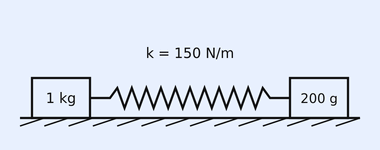
JEE Main 2026 January 28, Shift 2 Question Paper with Solutions
All 75 questions from the JEE Main 2026 (January 28, Shift 2) shift — Physics (25), Chemistry (25) and Mathematics (25) — each with the correct answer (answer key) and a step-by-step solution. Read it free online, or attempt the full paper as a timed mock test.
Physics25 questions
Q26Single correctKinetic Theory of Gases
The mean free path of a molecule of diameter at the temperature and pressure Pa, is given as___ m .(Given ).
(1)
(2)
(3)
(4)
SolutionAnswer: Option 3
Approach:
Given molecular diameter , temperature , pressure and ; target is the mean free path . Apply kinetic theory, replacing the number density by the ideal-gas relation .
Step 1:Convert the temperature to kelvin.
Step 2:Substitute the number density into the mean-free-path expression to obtain it in terms of pressure.
Step 3:Insert the numerical data.
Step 4:Cancel the common factor and collect the powers of ten in the denominator.
Step 5:Evaluate the numerical coefficient using , so .
Final answer:
Q27Single correctOscillations and Waves
As shown in figure, a spring is kept in a stretched position with some extension by holding the masses 1 kg and 0.2 kg with a separation more than spring natural length and are released. Assuming the horizontal surface to be frictionless, the angular frequency (in SI unit) of the system:
(1)
(2)
(3)
(4)
SolutionAnswer: Option 2
Approach:
Two free masses and joined by a spring of constant on a frictionless surface; target is the angular frequency . A spring connecting two free masses oscillates with their reduced mass.
Step 1:Compute the reduced mass of the two-block system.
Step 2:Substitute the reduced mass and spring constant into the angular-frequency relation.
Step 3:Evaluate the root.
Final answer:
Q28Single correctElectrostatics
Identify the correct statements:
A. Effective capacitance of a series combination of capacitors is always smaller than the smallest capacitance of the capacitor in the combination.
B. When a dielectric medium is placed between the charged plates of a capacitor, displacement of charges cannot occur due to insulation property of dielectric.
C. Increasing of area of capacitor plate or decreasing of thickness of dielectric is an alternate method to increase the capacitance.
D. For a point charge, concentric spherical shells centred at the location of the charge are equipotential surfaces.
Choose the correct answer from the options given below:
A. Effective capacitance of a series combination of capacitors is always smaller than the smallest capacitance of the capacitor in the combination.
B. When a dielectric medium is placed between the charged plates of a capacitor, displacement of charges cannot occur due to insulation property of dielectric.
C. Increasing of area of capacitor plate or decreasing of thickness of dielectric is an alternate method to increase the capacitance.
D. For a point charge, concentric spherical shells centred at the location of the charge are equipotential surfaces.
Choose the correct answer from the options given below:
(1)
(2)
(3)
(4)
SolutionAnswer: Option 4A,C and D Only
Approach:
Four statements about capacitance and electrostatic potential; target is the set of correct ones. Evaluate each against the series-capacitance rule, dielectric polarisation, the parallel-plate formula, and the equipotential property of a point charge.
Step 1:In a series combination every reciprocal adds, so the total reciprocal exceeds the largest single reciprocal, forcing the effective capacitance below the smallest member; statement A is correct.
Step 2:A dielectric responds to the applied field by polarisation, in which bound charges undergo a small displacement; this is the basis of the dielectric increasing capacitance, so statement B is incorrect.
Step 3:Since , increasing the plate area or reducing the dielectric thickness raises the capacitance; statement C is correct.
Step 4:The potential of a point charge depends only on the radial distance r, so any sphere is an equipotential surface; statement D is correct.
Final answer: A,C and D Only
Q29Single correctDual Nature of Matter and Radiation
Number of photons of equal energy emitted per second by a 6 mW laser source operating at 663 nm is_______(Given: and )
(1)
(2)
(3)
(4)
SolutionAnswer: Option 2
Approach:
Power , wavelength , with h and c given; target is the photon emission rate . Equate the source power to the rate times the single-photon energy .
Step 1:Compute the energy of a single photon.
Step 2:Divide the total power by the per-photon energy to obtain the emission rate.
Final answer:
Q30Single correctElectrostatics
Which one of the following is not a measurable quantity?
(1)
(2)
(3)
(4)
SolutionAnswer: Option 1Voltage
Approach:
Identify which listed quantity cannot be directly measured. Examine the operational definition of each quantity; an absolute potential requires an arbitrary zero reference, whereas the others are defined by measurable physical effects.
Step 1:The potential at a single point is defined only up to an additive constant fixed by an arbitrary reference, so an absolute voltage is not directly observable.
leaves all physical effects unchanged
Step 2:Potential difference, resistance and displacement current each correspond to a measurable physical effect (force/work, current-voltage ratio, and an associated magnetic field respectively).
measurable
Final answer: Voltage
Q31Single correctUnits and Measurements
Match List - I with List - II.
Choose the correct answer from the given options given below:
Choose the correct answer from the given options given below:
| List – I | List – II |
|---|---|
| A. Coefficient of viscosity | I. |
| B. Surface tension | II. |
| C. Pressure | III. |
| D. Surface energy | IV. |
(1)
(2)
(3)
(4)
SolutionAnswer: Option 4A-IV, B-III, C-I, D-II
Approach:
Match four physical quantities to their dimensional formulae. Derive each formula from its defining relation and pair it with the matching entry of List-II.
Step 1:From the viscous-force law, isolate the coefficient of viscosity dimensionally.
Step 2:Surface tension is force per unit length.
Step 3:Pressure is force per unit area.
Step 4:Surface energy is energy per unit area, equal dimensionally to work (energy).
Final answer: A-IV, B-III, C-I, D-II
Q32Single correctLaws of Motion
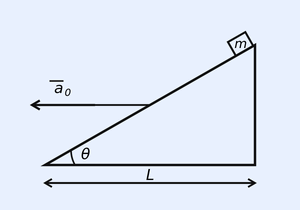
A small block of mass m slides down from the top of a frictionless inclined surface, while the inclined plane is moving towards left with constant acceleration . The angle between the inclined plane and ground is and its base length is L. Assuming that initially the small block is at the top of the inclined plane, the time it takes to reach the lowest point of the inclined plane is _____
(1)
(2)
(3)
(4)
SolutionAnswer: Option 1
Approach:
Block of mass m on a frictionless incline of angle and base L; the wedge accelerates left at ; target is the descent time. Work in the wedge frame, add the pseudo-force (directed right) to gravity, resolve along the incline, and apply rest-start kinematics over the slant length .
Step 1:Resolve gravity (component down the slope) and the pseudo-force (component up the slope) along the incline.
Step 2:The slant distance from top to bottom is the base divided by the cosine of the base angle.
Step 3:Apply the rest-start kinematic relation along the incline.
Step 4:Expand the denominator and rewrite using and .
Final answer:
Q33Single correctMagnetic Effects of Current and Magnetism
A long cylindrical conductor with large cross section carries an electric current distributed uniformly over its cross-section. Magnetic field due to this current is:
A. maximum at either ends of the conductor and minimum at the midpoint
B. maximum at the axis of the conductor
C. minimum at the surface of the conductor
D. minimum at the axis of the conductor
E. same at all points in the cross-section of the conductor
Choose the correct answer from the options given below:
A. maximum at either ends of the conductor and minimum at the midpoint
B. maximum at the axis of the conductor
C. minimum at the surface of the conductor
D. minimum at the axis of the conductor
E. same at all points in the cross-section of the conductor
Choose the correct answer from the options given below:
(1)
(2)
(3)
(4)
SolutionAnswer: Option 3D Only
Approach:
A long cylinder of radius carrying uniformly distributed current ; target is the correct statement about the radial variation of . Apply Ampere's law on circular loops inside and outside the conductor.
Step 1:Inside, the current enclosed by radius scales as the area, so Ampere's law gives a field proportional to , vanishing on the axis.
Step 2:The field rises to its maximum at the surface and decreases outside as .
Step 3:Statement B (max at axis) and E (same everywhere) contradict the linear rise; A is geometrically irrelevant; only D holds.
Final answer: D Only
Q34Single correctKinematics
A particle starts moving from time t=0 and its coordinate is given as
A. The particle returns to its original position (origin) 0.866 units later
B. The particle is 1 unit away from origin at its turning point
C. Acceleration of the particle is non-negative
D. The particle is 0.5 units away from origin at its turning point
E. Particle never turns back as acceleration is non-negative
Choose the correct answer from the options given below:
A. The particle returns to its original position (origin) 0.866 units later
B. The particle is 1 unit away from origin at its turning point
C. Acceleration of the particle is non-negative
D. The particle is 0.5 units away from origin at its turning point
E. Particle never turns back as acceleration is non-negative
Choose the correct answer from the options given below:
(1)
(2)
(3)
(4)
SolutionAnswer: Option 1A, B, C Only
Approach:
Position with motion starting at ; target is the set of true statements about turning point, acceleration sign, and return to origin. Differentiate to get velocity and acceleration, then test each statement.
Step 1:Differentiate the position and set velocity to zero to find the turning point (taking the positive root since motion starts at ).
Step 2:Evaluate the position at the turning point.
Step 3:Differentiate the velocity; for the acceleration is non-negative.
Step 4:Set the position to zero (other than ) to find the return time; since the velocity does change sign at , the particle does turn back, making E false.
Final answer: A, B, C Only
Q35Single correctElectromagnetic Waves
A plane electromagnetic wave is moving in free space with velocity and its electric field is given as , where j is the unit vector along y-axis. The magnetic field vector B of the wave is :
(1)
(2)
(3)
(4)
SolutionAnswer: Option 1
Approach:
propagating along at speed c; target is . The amplitude follows from and the direction from the requirement .
Step 1:Compute the magnetic-field amplitude.
Step 2:The phase marks propagation along and the field is along ; solve the cross-product condition for .
Step 3:Combine amplitude and direction with the same phase as the electric field.
Final answer:
Q36Single correctRotational Motion
When the position changes sign as , which one of the following vector will not flip under sign change?
(1)
(2)
(3)
(4)
SolutionAnswer: Option 4Angular momentum
Approach:
Under the parity inversion , determine which listed vector keeps its sign. Classify each as a polar vector (reverses) or an axial vector (a cross product of two polar vectors, which is invariant).
Step 1:Velocity, acceleration and linear momentum are derivatives of position or proportional to velocity, so each reverses sign under the inversion.
Step 2:Angular momentum is the cross product of two sign-reversed polar vectors, so the two sign reversals cancel.
Final answer: Angular momentum
Q37Single correctUnits and Measurements
In an experiment, a set of reading are obtained as follows -1.24 mm, 1.25 mm, 1.23 mm, 1.21 mm. The expected least count of the instrument used in recording these readings is _____mm
(1)
(2)
(3)
(4)
SolutionAnswer: Option 2
Approach:
Readings 1.24, 1.25, 1.23, 1.21 mm; target is the least count of the instrument. The least count equals the smallest division consistently resolved, read from the finest decimal place reported.
Step 1:Each reading is recorded to two decimal places of a millimetre.
Step 2:Reporting the hundredth place implies the smallest measurable division is 0.01 mm.
Final answer:
Q38Single correctAtoms and Nuclei
A nucleus has mass number and radius . Another nucleus has mass number and radius . If then .
(1)
(2)
(3)
(4)
SolutionAnswer: Option 3
Approach:
Nuclei with mass numbers and and radii , ; target is . Apply the empirical nuclear-radius relation .
Step 1:Form the ratio of radii; the constant cancels.
Step 2:Substitute and evaluate the cube root.
Final answer:
Q39Single correctCurrent Electricity
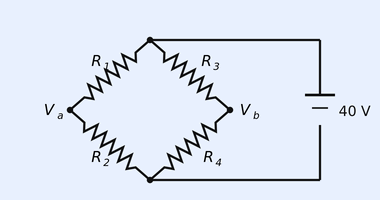
A Wheatstone bridge is initially at room temperature and all arms of the bridge have same value of resistances . When resistance is heated to some temperature, its resistance value has gone up by 10%. The potential difference (after is heated) is_____ V
(1)
(2)
(3)
(4)
SolutionAnswer: Option 4
Approach:
A 40 V source feeds two parallel divider branches; left branch ( over , equal) sets node , right branch ( over ) sets node ; after heating ; target is . Apply the voltage-divider rule on each branch.
Step 1:With , the left node sits at half the supply.
Step 2:Heating raises the upper-right arm by 10% while the lower-right arm is unchanged.
Step 3:Apply the divider rule to the right branch with the heated arm.
Step 4:Take the difference of the node potentials.
Final answer:
Q40Single correctElectronic Devices
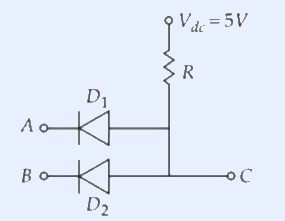
Two p-n junction diodes and are connected as shown in figure. A and B are input signal and C is the output. The given circuit will function as a____
(1)
(2)
(3)
(4)
SolutionAnswer: Option 3AND Gate
Approach:
Two diodes with anodes at inputs A, B and cathodes joined at output node C, which is pulled up to through resistor R; target is the logic function. Build the truth table by deciding, for each input combination, whether a diode conducts and clamps the output.
Step 1:If an input is low (0 V), that diode is forward biased (anode low, cathode pulled toward 5 V), so it conducts and clamps the output node near the low input.
Step 2:Only when both inputs are high (5 V) is neither diode forward biased, so the node stays high at the pull-up voltage; tabulating gives : / / / .
Final answer: AND Gate
Q41Single correctOptics
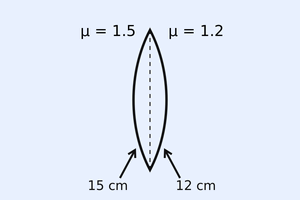
A biconvexlens is formed by using two thin planoconvex lenses, as shown in the figure. The refractive index and radius of curved surfaces are also mentioned in figure. When an object is placed on the left side of lens at a distance of 30 cm from the biconvex lens, the magnification of the image will be :
(1)
(2)
(3)
(4)
SolutionAnswer: Option 3
Approach:
A biconvex lens from two plano-convex components, with and with ; object at to the left; target is the magnification. Find each plano-convex focal length from the lens-maker formula, combine powers in contact, then apply the lens equation and .
Step 1:Focal length of each plano-convex component (flat side has infinite radius).
Step 2:Add the powers of the two lenses in contact.
Step 3:Apply the lens equation with .
Step 4:Compute the magnification.
Final answer:
Q42Single correctUnits and Measurements
The time period of simple harmonic oscillator .Measured value of mass (m) of the object is 10 g with an accuracy of 10 mg and time for 50 oscillations of the spring is found to be 60 s using a watch of 2 s resolution. Percentage error in determination of spring constant (k) is_____ %
(1)
(2)
(3)
(4)
SolutionAnswer: Option 1
Approach:
with , total time for 50 oscillations with watch resolution ; target is the percentage error in k. Rearrange the period relation to and propagate errors.
Step 1:From , the fractional error is twice the fractional period error plus the fractional mass error.
Step 2:The fractional period error equals the watch resolution over the total measured time; the fractional mass error is .
Step 3:Substitute and convert to a percentage.
Final answer:
Q43Single correctElectrostatics
Identify the correct statements:
A. Electrostatic field lines form closed loops.
B. The electric field lines point radially outward when charge is greater than zero.
C. The Gauss - Law is valid only for inverse - square force.
D. The workdone in moving a charged particle in a static electric field around a closed path is zero.
E. The motion of a particle under Coulomb's force must take place in a plane.
Choose the correct answer from the options given below:
A. Electrostatic field lines form closed loops.
B. The electric field lines point radially outward when charge is greater than zero.
C. The Gauss - Law is valid only for inverse - square force.
D. The workdone in moving a charged particle in a static electric field around a closed path is zero.
E. The motion of a particle under Coulomb's force must take place in a plane.
Choose the correct answer from the options given below:
(1)
(2)
(3)
(4)
SolutionAnswer: Option 2B, C, D, E Only
Approach:
Five statements about electrostatic field lines, Gauss's law, conservativeness, and Coulomb-force motion; target is the correct set. Test each against the governing electrostatic principles.
Step 1:Electrostatic field lines begin on positive charge and end on negative charge, so they do not close on themselves; statement A is incorrect.
Step 2:For a positive point charge the field points radially outward; statement B is correct.
Step 3:Gauss's law in its standard solid-angle form relies on the inverse-square dependence of the Coulomb field; statement C is correct.
Step 4:The electrostatic field is conservative, so work around any closed path is zero; statement D is correct. The Coulomb force is central, so torque about the centre is zero and angular momentum is conserved, confining the motion to a plane; statement E is correct.
Final answer: B, C, D, E Only
Q44Single correctOptics
For a transparent prism, if the angle of minimum deviation is equal to its refracting angle, the refractive index n of the prism satisfies.
(1)
(2)
(3)
(4)
SolutionAnswer: Option 1
Approach:
A transparent prism of refracting angle A with minimum deviation ; target is the range of the refractive index n. Relate n to A via the minimum-deviation condition, then bound A between physical limits to bound n.
Step 1:Impose the condition that the minimum deviation equals the refracting angle.
Step 2:At minimum deviation ; substitute into Snell's law and use .
Step 3:Since for any non-zero prism angle, the index has an upper bound.
Step 4:The largest physical incidence is grazing, ; with this gives so , and the lower bound follows.
Final answer:
Q45Single correctOscillations and Waves
The speed of a longitudinal wave in a metallic bar is 400 m/s. If the density and Young's modulus of the bar material are increased by 0.5% and 1%, respectively then the speed of the wave is changed approximately to m/s.
(1)
(2)
(3)
(4)
SolutionAnswer: Option 3
Approach:
Initial speed , density up 0.5%, Young's modulus up 1%; target is the new speed. Differentiate logarithmically to relate fractional changes.
Step 1:Substitute the given fractional changes (1% modulus, 0.5% density).
Step 2:Scale the initial speed by the fractional change.
Final answer:
Q46NumericalElectromagnetic Induction and Alternating Currents
An inductor stores 16 J of magnetic field energy and dissipates 32 W of thermal energy due to its resistance when an a.c. current of 2 A (rms) and frequency 50 Hz flows through it. The ratio of inductive reactance to its resistance is. (=3.14)
SolutionAnswer: 314
Approach:
Stored energy , dissipated power , , ; target is . Extract L from the energy and R from the power, then form the reactance-to-resistance ratio.
Step 1:Solve the energy and power relations for and .
Step 2:Form the ratio of inductive reactance to resistance.
Step 3:Substitute the frequency and the given value of .
Final answer: 314
Q47NumericalThermodynamics
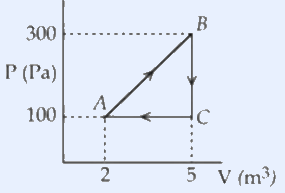
A thermodynamic system is taken through the cyclic process ABC as shown in the figure. The total work done by the system during the cycle ABC is _____J.
SolutionAnswer: 300
Approach:
Closed cycle ABC on a P-V diagram with vertices A(2,100), B(5,300), C(5,100); target is the net work over the cycle. The net cyclic work equals the enclosed area, here a triangle.
Step 1:Identify the base (volume span C to B) and height (pressure span C to B) of the triangle.
Step 2:Compute the enclosed triangular area, which is the net work.
Final answer: 300
Q48NumericalRotational Motion
A fly wheel having mass 3 kg and radius 5 m is free to rotate about a horizontal axis. A string having negligible mass is wound around the wheel and the loose end of the string is connected to 3 kg mass. The mass is kept at rest initially and released. Kinetic energy of the wheel when the mass descends by 3 m is J. (g=10 m/)
SolutionAnswer: 30
Approach:
Flywheel of mass , radius (disc, ), hanging mass descending ; target is the wheel's rotational kinetic energy. Apply energy conservation with the string constraint .
Step 1:Express the wheel's rotational kinetic energy using and .
Step 2:Apply energy conservation: the lost potential energy splits into the mass's translational KE and the wheel's rotational KE.
Step 3:Solve for and substitute into the wheel's kinetic energy.
Final answer: 30
Q49NumericalOptics
A beam of light consisting of wavelengths 650 nm and 550 nm illuminates the Young's double slits with separation of 2 mm such that the interference fringes are formed on a screen, placed at a distance of 1.2 m from the slits. The least distance of a point from the central maximum, where the bright fringes due to both the wavelengths coincide, is .
SolutionAnswer: 429
Approach:
Wavelengths , , slit separation , screen distance ; target is the least distance from the central maximum where bright fringes coincide. Bright fringes coincide when for the smallest integer orders.
Step 1:Equate the bright-fringe positions of the two wavelengths and reduce the order ratio to lowest terms.
Step 2:Substitute the smallest order of the 650 nm light into the fringe-position formula.
Step 3:Evaluate the numerical value by collecting the constants and powers of ten.
Final answer: 429
Q50NumericalOscillations and Waves
Two tuning forks A and B are sounded together giving rise to 8 beats in 2 s. When fork A is loaded with wax, the beat frequency is reduced to 4 beats in 2 s. If the original frequency of tuning fork B is 380 Hz then the original frequency of tuning fork A is ______Hz
SolutionAnswer: 384
Approach:
Initial 8 beats in 2 s, after waxing fork A 4 beats in 2 s, ; target is the original . The beat frequency is , giving two candidates; the change after waxing (which lowers ) selects the correct one.
Step 1:Convert the initial beat count to a frequency and list the two candidates around 380 Hz.
Step 2:Loading A with wax lowers ; the beat frequency drops to , so must have started above 380 Hz to move closer to it.
Final answer: 384
Chemistry25 questions
Q51Single correctp-Block Elements
Consider the following reactions
The oxidation states of Cu in Z and Q, respectively are:
The oxidation states of Cu in Z and Q, respectively are:
(1)
(2)
(3)
(4)
SolutionAnswer: Option 4 and
Approach:
The sequence is the borax bead test, with borax () decomposing on heating into species X and Y, Y reacting with in the oxidising (non-luminous) flame to form the coloured bead Z, and Z being reduced by carbon in the luminous flame to Q. The target is the oxidation state of copper in Z and in Q.
Step 1:Borax decomposes on heating into two moles of sodium metaborate and one mole of boric anhydride, fixing and .
Step 2:In the non-luminous (oxidising) flame boric anhydride converts copper(II) sulphate into copper metaborate; balancing charge with two ligands keeps copper at .
Step 3:In the luminous (reducing) flame carbon reduces copper metaborate to copper(I) metaborate; charge balance with one gives copper at .
Step 4:Collect the copper oxidation states from and in order.
Final answer: and
Q52Single correctp-Block Elements
Given below are two statements:
Statement I: The increasing order of boiling point of hydrogen halides is
Statement II: The increasing order of melting point of hydrogen halides is
In the light of the above statements, choose the correct answer from the options given below:
Statement I: The increasing order of boiling point of hydrogen halides is
Statement II: The increasing order of melting point of hydrogen halides is
In the light of the above statements, choose the correct answer from the options given below:
(1)
(2)
(3)
(4)
SolutionAnswer: Option 2Both Statement I and Statement II are true
Approach:
Two statements are given, one ordering boiling points and one ordering melting points of the hydrogen halides. The target is to establish the true boiling-point and melting-point orders and test each statement against them. Hydrogen bonding in HF raises both its transition temperatures above the other halides, while among the rest van der Waals forces increase with molar mass.
Step 1:HF possesses strong intermolecular hydrogen bonding giving it the highest boiling point; among HCl, HBr, HI dispersion forces grow with molar mass, yielding the full boiling-point order.
Step 2:Statement I orders only HCl, HBr and HF as ; extracting these three from the full sequence preserves their relative order, so Statement I holds.
Step 3:For melting points the larger, more polarisable HI lies above HF, giving the full melting-point sequence.
Step 4:Statement II states , identical to the established melting-point order, so Statement II holds.
Final answer: Both Statement I and Statement II are true
Q53Single correctCoordination Compounds
The correct increasing order of spin-only magnetic moment values of the complex ions and is:
(1)
(2)
(3)
(4)
SolutionAnswer: Option 3
Approach:
Four complex ions are given. The target is the increasing order of spin-only magnetic moment, which rises monotonically with the number of unpaired electrons n. For each complex the metal-ion d-configuration, ligand field strength and geometry fix n, then orders them.
Step 1:In manganese is , a ion; bromide is a weak-field tetrahedral ligand that cannot pair the electrons, leaving all five unpaired.
Step 2:In copper is , a ion, which has exactly one unpaired electron regardless of field strength.
Step 3:In nickel is (); cyanide is a strong-field ligand forcing a square-planar arrangement that pairs all electrons.
Step 4:In nickel is () in a weak octahedral field, giving a configuration with two unpaired electrons.
Step 5:Order by increasing unpaired-electron count , which is the order of increasing magnetic moment.
Final answer:
Q54Single correctClassification of Elements and Periodicity in Properties
Consider the elements N, P, O, S, Cl and F. The number of valence electrons present in the elements with most and least metallic character from the above list is respectively.
(1)
(2)
(3)
(4)
SolutionAnswer: Option 2 and
Approach:
The list is N, P, O, S, Cl, F. The target is the valence-electron count of the most metallic and the least metallic element. Metallic character increases down a group and decreases across a period, so the element farthest down/left is most metallic and the most electronegative is least metallic.
Step 1:Place the elements: N and O are in period 2; P, S, Cl in period 3; F in period 2. Phosphorus sits lowest and farthest left, giving it the greatest metallic character of the set.
Step 2:Fluorine is the smallest and most electronegative element, hence the least metallic; its valence shell holds seven electrons.
Step 3:Report the valence-electron counts in the order most-metallic then least-metallic.
Final answer: and
Q55Single correctAtomic Structure
The wavelength of photon 'A' is nm. The frequency of photon 'B' is . The wave number of photon 'C' is . The correct order of energy of these photons is:
(1)
(2)
(3)
(4)
SolutionAnswer: Option 4
Approach:
Photon A is specified by wavelength, B by frequency, C by wave number. The target is the energy order. Reducing each photon to a common wavelength scale lets the inverse relation rank the energies.
Step 1:Photon A is given directly by its wavelength.
Step 2:Convert B's frequency to a wavelength with using .
Step 3:Convert C's wave number to a wavelength with .
Step 4:Rank the wavelengths ; since , the energy order is the reverse.
Final answer:
Q56Single correctSolutions
Consider the following aqueous solutions.
I.2.2 g Glucose in 125 mL of solution.
II.1.9 g Calcium chloride in 250 mL of solution.
III.9.0 g Urea in 500 mL of solution.
IV.20.5 g Aluminium sulphate in 750 mL of solution.
The correct increasing order of boiling point of these solutions will be:
[Given: Molar mass in g : and ]
I.2.2 g Glucose in 125 mL of solution.
II.1.9 g Calcium chloride in 250 mL of solution.
III.9.0 g Urea in 500 mL of solution.
IV.20.5 g Aluminium sulphate in 750 mL of solution.
The correct increasing order of boiling point of these solutions will be:
[Given: Molar mass in g : and ]
(1)
(2)
(3)
(4)
SolutionAnswer: Option 1
Approach:
Four aqueous solutions with given solute masses and volumes. The target is the increasing boiling-point order. Boiling-point elevation ; for dilute aqueous solutions molality molarity, so the ranking follows the product of van't Hoff factor and molarity.
Step 1:Glucose, molar mass , non-electrolyte : compute molarity and the product .
Step 2:Calcium chloride, molar mass , dissociates into 3 ions .
Step 3:Urea, molar mass , non-electrolyte .
Step 4:Aluminium sulphate, molar mass , dissociates into 5 ions .
Step 5:Order by increasing : , which is the boiling-point order since .
Final answer:
Q57Single correctOrganic Compounds Containing Nitrogen
A student performed analysis of aliphatic organic compound 'X' which on analysis gave %
This compound, on treatment with produced another compound 'Y' which did not contain any nitrogen atom. However, the compound 'Y' upon controlled oxidation produced another compound 'Z' that responded to Iodoform test. The structure of 'X' is:
This compound, on treatment with produced another compound 'Y' which did not contain any nitrogen atom. However, the compound 'Y' upon controlled oxidation produced another compound 'Z' that responded to Iodoform test. The structure of 'X' is:
(1)
(2)
(3)
(4)
SolutionAnswer: Option 3isopropylamine
Approach:
An aliphatic compound X has , , ; with it loses nitrogen to give Y, and controlled oxidation of Y gives Z that answers the iodoform test. The target is the structure of X, found from the empirical formula plus the deamination and iodoform clues.
Step 1:Divide each mass percentage by the atomic mass to obtain relative moles.
Step 2:Divide by the smallest value to get whole-number ratios.
Step 3: contains one nitrogen; reaction with nitrous acid to give a nitrogen-free product is characteristic of a primary amine, which is converted to the corresponding alcohol. Two primary amines exist: n-propylamine and isopropylamine.
Step 4:The iodoform-positive Z requires Y to be a secondary alcohol (oxidising to a methyl ketone); n-propylamine would give propan-1-ol oxidising to propanal/propanoic acid (iodoform-negative). Only isopropylamine gives propan-2-ol, oxidising to acetone, which is iodoform-positive.
Final answer: isopropylamine
Q58Single correctEquilibrium
Observe the following equilibrium in a 1 L flask.
At T (K), the equilibrium concentrations of A and B are 0.5 M and 0.375 M respectively. 0.1 moles of A is added into the flask and heated to T (K) to establish the equilibrium again. The new equilibrium concentrations (in M) of A and B are respectively
At T (K), the equilibrium concentrations of A and B are 0.5 M and 0.375 M respectively. 0.1 moles of A is added into the flask and heated to T (K) to establish the equilibrium again. The new equilibrium concentrations (in M) of A and B are respectively
(1)
(2)
(3)
(4)
SolutionAnswer: Option 3
Approach:
For in a 1 L flask the first equilibrium has , . Adding 0.1 mol of A (concentration rise 0.1 M) re-establishes equilibrium. The target is the new [A] and [B], found from the constant and a forward shift x.
Step 1:Evaluate the equilibrium constant from the first equilibrium concentrations.
Step 2:Adding 0.1 mol A in the 1 L flask raises to M; let the reaction move forward by , so the new concentrations are and .
Step 3:Impose the equilibrium constant and expand.
Step 4:Solve for and substitute back.
Final answer:
Q59Single correctPurification and Characterisation of Organic Compounds
A student has been given 0.314 g of an organic compound and asked to estimate Sulphur. During the experiment, the student has obtained 0.4813 g of barium sulphate. The percentage of sulphur present in the compound is_________. (Given Molar mass in g )
(1)
(2)
(3)
(4)
SolutionAnswer: Option 1
Approach:
g of compound yields g of in the gravimetric sulphur estimation. The target is the percentage of sulphur. All sulphur in the sample is precipitated as , so the molar-mass ratio converts the precipitate mass to sulphur mass.
Step 1:One mole of (233 g) contains one mole of sulphur (32 g), so the mass fraction of S in the precipitate is .
Step 2:Apply the fraction to the precipitate mass to get the mass of sulphur.
Step 3:Divide the sulphur mass by the compound mass and convert to a percentage.
Final answer:
Q60Single correctSome Basic Concepts in Chemistry
For the given reaction;
If 90 g is added to 300 mL of HCl which contains 38.55% HCl by mass and has density 1.13 g, then which of the following option is correct?
Given molar mass of H, Cl, Ca and O are 1, 35.5, 40 and 16g respectively.
If 90 g is added to 300 mL of HCl which contains 38.55% HCl by mass and has density 1.13 g, then which of the following option is correct?
Given molar mass of H, Cl, Ca and O are 1, 35.5, 40 and 16g respectively.
(1)
(2)
(3)
(4)
SolutionAnswer: Option 4g of remains unreacted
Approach:
90 g reacts with 300 mL of 38.55% (by mass) HCl of density via . The target is the unreacted HCl mass, found by computing moles of each reactant, identifying the limiting reagent, and converting the excess HCl back to mass.
Step 1:Compute the molarity of HCl from its mass percent and density, then its moles in 300 mL. Molar mass of HCl .
Step 2:Compute moles of calcium carbonate. Molar mass .
Step 3:Each mole of consumes 2 mol HCl, so 0.9 mol needs mol HCl. Since , HCl is in excess and is limiting.
Step 4:Convert the unreacted HCl moles to mass.
Final answer: g of remains unreacted
Q61Single correctHydrocarbons
Identify the correct statements:
The presence of group in benzene ring
A. Activates the ring towards electrophilic substitutions.
B. deactivates the ring towards electrophilic substitutions.
C. activates the ring towards nucleophilic substitutions.
D. deactivates the ring towards nucleophilic substitutions.
Choose the correct answer from the options given below:
The presence of group in benzene ring
A. Activates the ring towards electrophilic substitutions.
B. deactivates the ring towards electrophilic substitutions.
C. activates the ring towards nucleophilic substitutions.
D. deactivates the ring towards nucleophilic substitutions.
Choose the correct answer from the options given below:
(1)
(2)
(3)
(4)
SolutionAnswer: Option 4B and C only
Approach:
The substituent on benzene is a strong electron-withdrawing group ( and ). The target is to mark which of statements A-D correctly describe its effect on electrophilic and on nucleophilic aromatic substitution, by tracking how it changes ring electron density and intermediate stability.
Step 1:The nitro group withdraws electron density by both induction and resonance, lowering ring electron density, so the ring is deactivated towards electrophiles. Statement A (activates electrophilic) is false; statement B (deactivates electrophilic) is true.
Step 2:In nucleophilic aromatic substitution the rate-limiting step forms a carbanionic Meisenheimer intermediate; the electron-poor ring accepts the nucleophile and the group stabilises the negative charge, so the ring is activated towards nucleophiles. Statement C (activates nucleophilic) is true; statement D (deactivates nucleophilic) is false.
Step 3:Collect the true statements.
Final answer: B and C only
Q62Single correctChemical Thermodynamics
The plot of vs gives a straight line. The intercept and slope respectively are (Where K is equilibrium constant).
(1)
(2)
(3)
(4)
SolutionAnswer: Option 3
Approach:
A plot of against is linear. The target is its intercept and slope. Combining with and rearranging to form (with ) reads off the intercept and slope.
Step 1:Equate the two expressions for .
Step 2:Divide both sides by to isolate .
Step 3:Match to with and : the constant term is the intercept and the coefficient of is the slope.
Final answer:
Q63Single correctHydrocarbons
The reactions which produce alcohol as the product are:
A.
B.
C.
D.
E.
Choose the correct answer from the options given below:
A.
B.
C.
D.
E.
Choose the correct answer from the options given below:
(1)
(2)
(3)
(4)
SolutionAnswer: Option 1C and D only
Approach:
Five oxidations A-E are given. The target is to select only those whose major product is an alcohol, by identifying the product of each: catalytic oxidation of methane over , ethane oxidation with manganese acetate, oxidation of the tertiary C-H of isobutane, copper-catalysed high-pressure oxidation of methane, and acidic permanganate cleavage of an internal alkene.
Step 1:Reaction A: methane over on heating is oxidised to formaldehyde, an aldehyde, not an alcohol.
Step 2:Reaction B: ethane with manganese acetate is oxidised to acetic acid, a carboxylic acid.
Step 3:Reaction C: the lone tertiary C-H of isobutane is oxidised by to tert-butyl alcohol.
Step 4:Reaction D: methane under copper catalysis at 523 K and 100 atm gives methanol. Reaction E: acidic permanganate cleaves the symmetric internal alkene to two acetic acid molecules.
Step 5:Only reactions C and D give an alcohol as product.
Final answer: C and D only
Q64Single correctBiomolecules
Structures of four disaccharides are given below. Among the given disaccharides, the non-reducing sugar is:
(1)
(2)
(3)
(4)
SolutionAnswer: Option 4the pyranose-furanose disaccharide (sucrose-type) in which both anomeric carbons are linked, an acetal (non-reducing)
Approach:
Four disaccharide Haworth structures are given. The target is the non-reducing one. A disaccharide is non-reducing only when the glycosidic bond joins the anomeric (hemiacetal) carbons of both rings, converting both into a single acetal so no free hemiacetal remains to open into an aldehyde. Each structure is examined for a free hemiacetal carbon.
Step 1:Options 1, 2 and 3 each show two pyranose rings joined so that at least one ring still carries a free anomeric -OH (hemiacetal), which can ring-open to a free aldehyde; these are reducing sugars.
Step 2:Option 4 links a pyranose ring through an oxygen bridge to a furanose ring bearing the group, joining both anomeric carbons; this is the sucrose-type arrangement with no free hemiacetal centre.
Step 3:With both anomeric carbons locked in the acetal linkage the rings cannot open to an aldehyde, so option 4 cannot reduce Tollens' or Fehling's reagent and is the non-reducing sugar.
Final answer: the pyranose-furanose disaccharide (sucrose-type) in which both anomeric carbons are linked, an acetal (non-reducing)
Q65Single correctd- and f-Block Elements
Consider the following statements about manganite and permanganate ions. Identify the correct statements.
A. The geometry of both manganate and permanganate ions is tetrahedral.
B. The oxidation states of Mn in manganate and permanganate are +7 and +6, respectively.
C. Oxidation of Mn(II) salt by peroxodisulphate gives manganate ion as the final product.
D. Manganate ion is paramagnetic and permanganate ion is diamagnetic.
E. Acidified permanganate ion reduces oxalate, nitrite and iodide ions.
Choose the correct answer from the options given below:
A. The geometry of both manganate and permanganate ions is tetrahedral.
B. The oxidation states of Mn in manganate and permanganate are +7 and +6, respectively.
C. Oxidation of Mn(II) salt by peroxodisulphate gives manganate ion as the final product.
D. Manganate ion is paramagnetic and permanganate ion is diamagnetic.
E. Acidified permanganate ion reduces oxalate, nitrite and iodide ions.
Choose the correct answer from the options given below:
(1)
(2)
(3)
(4)
SolutionAnswer: Option 2A, D and E only
Approach:
Five statements concern manganate () and permanganate (). The target is the set of correct statements, evaluated by assigning the geometry, oxidation states, the product of Mn(II) oxidation by peroxodisulphate, the magnetic behaviour from d-electron count, and the oxidising action of acidified permanganate.
Step 1:Both and have four oxygen atoms around manganese with no lone pair on Mn, giving tetrahedral geometry. Statement A is correct.
Step 2:Charge balance gives Mn in manganate and in permanganate. Statement B reverses these and is incorrect.
Step 3:Oxidation of by peroxodisulphate (, with catalyst) proceeds all the way to permanganate, not manganate. Statement C is incorrect.
Step 4:In manganese is (), one unpaired electron, hence paramagnetic; in manganese is (), no unpaired electron, hence diamagnetic. Statement D is correct.
Step 5:Acidified permanganate is a strong oxidant: it oxidises oxalate to , nitrite to nitrate and iodide to iodine, being itself reduced to . Statement E is correct. Collecting the true statements gives A, D and E.
Final answer: A, D and E only
Q66Single correctOrganic Compounds Containing Oxygen
The correct order of acidic strength of the major products formed in the given reaction, is:
A.
B.
C.
D.
Choose the correct answer from the options given below:
A.
B.
C.
D.
Choose the correct answer from the options given below:
(1)
(2)
(3)
(4)
SolutionAnswer: Option 3
Approach:
Four routes each yield a carboxylic acid A-D. The target is the decreasing order of acid strength. Each major product is identified, then ranked by conjugate-base stability: formic acid (no electron-donating alkyl) is strongest, benzoic acid (aryl, ) next, phenylacetic acid follows, and propionic acid (electron-donating ethyl) is weakest.
Step 1:A: aniline is diazotised at low temperature, the diazonium is treated with CuCN (Sandmeyer) to give benzonitrile, then hydrolysed to benzoic acid.
Step 2:B: Tollens' reagent oxidises propanal to its carboxylate, giving propionic (propanoic) acid on workup.
Step 3:C: methane is oxidised over to formaldehyde, which is further oxidised by acidic dichromate to formic acid.
Step 4:D: the benzyl Grignard reagent adds to and the adduct is hydrolysed to phenylacetic acid.
Step 5:Rank by acid strength: formic (C) is strongest; benzoic (A) follows; phenylacetic (D) next; propionic (B) weakest.
Final answer:
Q67Single correctSome Basic Principles of Organic Chemistry
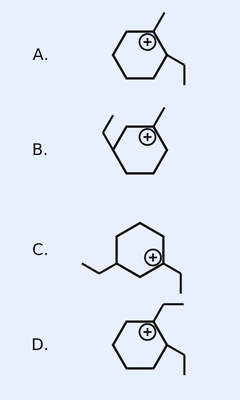
The cyclic cations having the same number of hyperconjugation are:
(1)
(2)
(3)
(4)
SolutionAnswer: Option 2A and C only
Approach:
Four substituted cyclohexyl carbocations A-D are shown. The target is the pair with an equal number of hyperconjugative structures. The number of hyperconjugations equals the number of C-H bonds (C-H bonds on carbons directly attached to the positively charged carbon). Each cation's C-H count is found and the matching ones are selected.
Step 1:Cation A: the cationic ring carbon is flanked by ring carbons and an adjacent ethyl-bearing carbon; counting the C-H bonds on all carbons attached to C+ gives six hydrogens.
Step 2:Cation B: the substitution pattern around the cationic carbon presents seven C-H bonds.
Step 3:Cation C: the cationic carbon is flanked symmetrically so that six C-H bonds are available, equal to A.
Step 4:Cation D: the cationic carbon bears a more branched neighbour leaving five C-H bonds.
Step 5:Compare counts ; only A and C share the same number of hyperconjugations.
Final answer: A and C only
Q68Single correctChemical Bonding and Molecular Structure
Match the LIST-I with LIST-II according to shape.
| List - I | List - II |
|---|---|
| A. | I. |
| B. | II. |
| C. | III. |
| D. | IV. |
(1)
(2)
(3)
(4)
SolutionAnswer: Option 1
Approach:
List-I has four xenon species and List-II has four reference species. The target is to pair each List-I shape with the List-II species of identical shape. Each shape is fixed by VSEPR from the steric number (bonding pairs plus lone pairs on the central atom).
Step 1:: Xe has 3 bond pairs and 1 lone pair (), giving a trigonal pyramidal shape, the same as (3 bond pairs, 1 lone pair).
Step 2:: Xe has 2 bond pairs and 3 lone pairs (, trigonal bipyramidal with axial F), giving a linear shape, the same as .
Step 3:: Xe has 4 bonding regions and 1 lone pair (), giving a seesaw shape, the same as .
Step 4:: Xe has 5 bonding regions and 1 lone pair (), giving a square pyramidal shape, the same as .
Final answer:
Q69Single correctOrganic Compounds Containing Nitrogen
Total number of alkali insoluble solid sulphonamides obtained by reaction of given amines with Hinsberg's reagent is _________.
Aniline, N-Methylaniline, Methanamine, N, N – Dimethulmethanamine, N-Methyl Methanamine, Phenylmethanamine, N-propylaniline, N-phenylaniline, N, N-Dimethylaniline, Allyl amine, Isopropyl amine
Aniline, N-Methylaniline, Methanamine, N, N – Dimethulmethanamine, N-Methyl Methanamine, Phenylmethanamine, N-propylaniline, N-phenylaniline, N, N-Dimethylaniline, Allyl amine, Isopropyl amine
(1)
(2)
(3)
(4)
SolutionAnswer: Option 1
Approach:
Eleven amines are listed. The target is the count of alkali-insoluble solid sulphonamides formed with Hinsberg's reagent (benzenesulphonyl chloride). Primary amines give sulphonamides with an acidic N-H, which dissolve in alkali; secondary amines give sulphonamides with no N-H, which are alkali-insoluble solids; tertiary amines do not react. Only secondary amines are counted.
Step 1:Classify the primary amines: Aniline, Methanamine, Phenylmethanamine (benzylamine), Allyl amine and Isopropyl amine. Their sulphonamides carry an acidic N-H and dissolve in alkali, so they are excluded.
Step 2:Classify the tertiary amines: N,N-Dimethylmethanamine and N,N-Dimethylaniline have no N-H and do not react with Hinsberg's reagent, so they are excluded.
Step 3:The remaining four are secondary amines: N-Methylaniline, N-Methyl Methanamine, N-propylaniline and N-phenylaniline (diphenylamine).
Step 4:Each secondary amine gives one alkali-insoluble solid sulphonamide, so the total is four.
Final answer:
Q70Single correctOrganic Compounds Containing Halogens
Which of the following reaction is NOT correctly represented?
(1)
(2)
(3)
(4)
SolutionAnswer: Option 3the methylcyclohexene + reaction, which is drawn without the expected allylic substitution and double-bond shift, so it is NOT correctly represented
Approach:
Four halogenation schemes are shown. The target is the scheme whose drawn product is incorrect. Each reaction's correct regiochemistry and mechanism is identified — aryldiazonium substitution, benzylic free-radical bromination, allylic free-radical bromination of a methylcyclohexene, and Lewis-acid ring bromination — and the mismatch is found.
Step 1:Option 1: benzenediazonium chloride with (Sandmeyer) correctly gives bromobenzene. Option 2: toluene with correctly gives benzyl bromide by benzylic free-radical substitution.
Step 2:Option 4: toluene with in the dark is electrophilic ring bromination giving ortho- and para-bromotoluene, correctly drawn.
Step 3:Option 3: the methyl-substituted cyclohexene under undergoes allylic free-radical bromination; the allylic radical is delocalised, so substitution proceeds at the allylic position accompanied by a shift of the double bond. The scheme instead shows simple methyl-to- conversion with the ring double bond unchanged, which does not represent the true allylic substitution.
Final answer: the methylcyclohexene + reaction, which is drawn without the expected allylic substitution and double-bond shift, so it is NOT correctly represented
Q71NumericalChemical Kinetics
(first reaction)
(second reaction)
Consider the above two first-order reactions. The rate constant for first reaction at 500 K is double of the same at 300K. At 500 K, 50% of the reaction becomes complete in 2 hour. The activation energy of the second reaction is half of that of first reaction. If the rate constant at 500 K of the second reaction becomes double of the rate constant of first reaction at the same temperature; then rate constant for the second reaction at 300 K is ______ (nearest integer).
(second reaction)
Consider the above two first-order reactions. The rate constant for first reaction at 500 K is double of the same at 300K. At 500 K, 50% of the reaction becomes complete in 2 hour. The activation energy of the second reaction is half of that of first reaction. If the rate constant at 500 K of the second reaction becomes double of the rate constant of first reaction at the same temperature; then rate constant for the second reaction at 300 K is ______ (nearest integer).
SolutionAnswer: 5
Approach:
For the first-order reaction , hr at 500 K and . The second reaction has and . The target is in units of . The half-life fixes , the doubling fixes via the two-temperature Arrhenius form, and the same form then gives .
Step 1:From the first-order half-life at 500 K for .
Step 2:Apply in the Arrhenius form to fix the first reaction's activation energy. With .
Step 3:Since , the temperature factor for between 300 K and 500 K is half, giving the ratio of its rate constants.
Step 4:The rate constant of at 500 K is double that of at 500 K.
Step 5:Divide by the ratio to obtain .
Final answer:
Q72NumericalCoordination Compounds
The number of isoelectronic species among and is 'n'. If 'n' moles of AgCl is formed during the reaction of complex with formula With excess of solution, then the number of electrons present in the orbital of the complex is_________.
SolutionAnswer: 6
Approach:
Among , n is the count of isoelectronic species; n moles of AgCl form from with excess , which fixes the number of ionisable chlorides and hence the complex formula. The target is the number of electrons of cobalt. Electron counts give n, the precipitation gives the coordination sphere, and the field strength gives the configuration.
Step 1:Count electrons: , , , , . The pair with equal counts is and (22 each, both ).
Step 2: moles of AgCl form, so two chlorides are ionisable counter-ions and one chloride is coordinated; the complex is .
Step 3:Charge balance: the complex ion is and the coordinated contributes , so cobalt is , a ion. The ligands en and are strong-field, giving a low-spin configuration.
Step 4:Count the electrons in the set.
Final answer:
Q73NumericalAtomic Structure
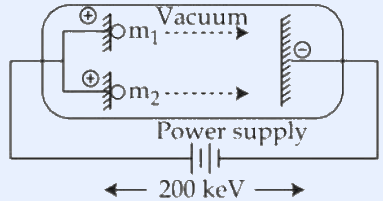
Two positively charged particles and have been accelerated across the same potential difference of 200 keV as shown below.
[Given mass of amu and amu]
The debroglie wavelength of will be x times of . The value of x is ______ (nearest integer)
[Given mass of amu and amu]
The debroglie wavelength of will be x times of . The value of x is ______ (nearest integer)
SolutionAnswer: 2
Approach:
Two singly charged particles of masses amu and amu are accelerated through the same potential difference (200 keV stated). The target is . Equal charge and equal accelerating potential give equal kinetic energy, and the de Broglie wavelength at fixed kinetic energy scales as .
Step 1:Each particle gains kinetic energy ; with the same charge and the same potential difference, both kinetic energies are equal.
Step 2:Form the ratio of the two wavelengths; the common factors h and cancel.
Step 3:Evaluate the ratio.
Final answer:
Q74NumericalRedox Reactions and Electrochemistry
For strong electrolyte increases slowly with dilution and can be represented by the equation
Molar conductivity values of the solutions of strong electrolyte AB at are given below:
| 0.04 | 0.09 | 0.16 | 0.25
| 96.1 | 95.7 | 95.3 | 94.9
The value of constant A based on the above data unit is ______.
Molar conductivity values of the solutions of strong electrolyte AB at are given below:
| 0.04 | 0.09 | 0.16 | 0.25
| 96.1 | 95.7 | 95.3 | 94.9
The value of constant A based on the above data unit is ______.
SolutionAnswer: 4
Approach:
The data follow the Debye-Huckel-Onsager relation , linear in with slope . The target is A. Subtracting the equation for two concentrations eliminates and isolates A.
Step 1:Write the equation at the first two concentrations.
Step 2:Substitute and and subtract the second from the first.
Step 3:Solve for .
Final answer:
Q75NumericalEquilibrium
A volume of x mL of 5 M solution was mixed with 10 mL of 2 M solution to make an electrolytic buffer. If the same buffer was used in the following electrochemical cell to record a cell potential of 235.3 mV, then the value of x = ______ mL (nearest integer).
Consider upto one place of decimal for intermediate calculations
Given:
Antilog
Consider upto one place of decimal for intermediate calculations
Given:
Antilog
SolutionAnswer: 78
Approach:
A bicarbonate/carbonic-acid buffer made from x mL of 5 M and 10 mL of 2 M supplies the / activity to the cell, which records mV. Given V, V, , V and . The target is x. The standard cell potential and Nernst equation fix the buffer pH, then Henderson-Hasselbalch gives the buffer composition ratio and hence x.
Step 1:Compute the standard cell potential. The couple is the cathode and the couple is the anode.
Step 2:Insert the measured potential into the Nernst equation. The fixed-concentration terms of and together with leave the activity as the only variable, which fixes the buffer's pH.
Step 3:The supplied logarithm value fixes the buffer ratio: solving gives , so and the ratio is the antilog.
Step 4:Express the ratio in moles: comes from x mL of 5 M ( millimoles) and from 10 mL of 2 M ( millimoles); since both occupy the same total volume, the concentration ratio equals the millimole ratio.
Step 5:Solve for .
Final answer:
Mathematics25 questions
Q1Single correctStatistics and Probability
The probability distribution of a random variable X is given below:
X | | | | | | | |
P(x) | | | | | | | |
If , then is equal to:
X | | | | | | | |
P(x) | | | | | | | |
If , then is equal to:
(1)
(2)
(3)
(4)
SolutionAnswer: Option 1
Approach:
The X-values are multiples of k with the given probabilities summing to , and the mean satisfies . The objective is . Apply to determine k, convert each X-value to a number, then add the probabilities of the values below .
Step 1:Multiply each X-value by its probability and sum, grouping the integer X-values and separately from the sevenths.
Step 2:Combine the bracket over a common denominator of .
Step 3:Set the mean equal to and solve for k.
Step 4:Substitute to convert each X-value to a number.
Step 5:Add the probabilities attached to the six X-values below .
Final answer:
Q2Single correctComplex Numbers and Quadratic Equations
Let and . Then the max is.
(1)
(2)
(3)
(4)
SolutionAnswer: Option 4
Approach:
A is a closed disc from and B is an ellipse from the focal-distance sum . The objective is the largest separation between a disc point and an ellipse point. Identify the disc and ellipse, then maximise the separation as (disc radius) + (distance from disc centre to the farthest ellipse point).
Step 1:Interpret A: the condition is the closed disc centred at with radius .
Step 2:Interpret B: foci and give , and gives ; the ellipse is centred at the origin with .
Step 3:The ellipse point farthest from the disc centre is the left vertex ; compute its distance from .
Step 4:Add the disc radius to this distance, since the farthest disc point lies a further units along the same line.
Final answer:
Q3Single correctSequence and Series
is equal to:
(1)
(2)
(3)
(4)
SolutionAnswer: Option 1
Approach:
The sum S has a lone first term followed by terms of the form for . Write the terms as a geometric series of ratio , sum it in closed form, and simplify using .
Step 1:Rewrite the general term of the trailing series, where runs from to .
Step 2:Sum the trailing terms with the geometric series formula.
Step 3:Add the first term so the residual fractions cancel.
Final answer:
Q4Single correctCo-ordinate Geometry
An ellipse has its center at one focus at and one vertex at . Then the length of its latus rectum is:
(1)
(2)
(3)
(4)
SolutionAnswer: Option 2
Approach:
Centre , focus and vertex all share the same ordinate, so the major axis is horizontal. The objective is the latus-rectum length. Read c and a from the given distances, find , then apply .
Step 1:The distance from the centre to the focus gives , and to the vertex gives .
Step 2:Compute from .
Step 3:Apply the latus-rectum formula.
Final answer:
Q5Single correctBinomial Theorem and its Simple Applications
The sum of the coefficients of and in is:
(1)
(2)
(3)
(4)
SolutionAnswer: Option 4
Approach:
is a geometric progression in x with ratio . The objective is the sum of the coefficients of and . Collapse the GP to a closed form, extract the two coefficients, and combine them with Pascal's identity.
Step 1:Sum the geometric series with first term , ratio and terms.
Step 2:The term contributes nothing to powers below , so read the required coefficients from .
Step 3:Add the two coefficients using Pascal's identity with .
Final answer:
Q6Single correctSets, Relations and Functions
Given below are two statements:
Statement I: The function defined by is one one.
Statement II: The function defined by is many one.
In the light of above statement, chose the correct answer from the options given below:
Statement I: The function defined by is one one.
Statement II: The function defined by is many one.
In the light of above statement, chose the correct answer from the options given below:
(1)
(2)
(3)
(4)
SolutionAnswer: Option 3Both Statement I and Statement II are true
Approach:
Statement I asserts is one-one; Statement II asserts the rational function is many-one. Test Statement I by establishing strict monotonicity, and test Statement II by exhibiting two distinct inputs with equal output.
Step 1:Write piecewise to analyse Statement I.
Step 2:On , has derivative ; on , has derivative . Both branches increase and join continuously at the origin.
Step 3:For Statement II evaluate the rational function at .
Step 4:Solve to find a second preimage of .
Step 5:Both statements hold.
Final answer: Both Statement I and Statement II are true
Q7Single correctComplex Numbers and Quadratic Equations
Let the arithmetic mean of and be , . if is such that ,b are in A.P., then the equation has :
(1)
(2)
(3)
(4)
SolutionAnswer: Option 1One root in and another in
Approach:
are four consecutive A.P. terms with common difference d, and the arithmetic mean of and is . Write in terms of d, fix d from the mean condition, form the quadratic, factor it, and locate its roots.
Step 1:With the four-term A.P. , take as the second term and write the terms in d.
Step 2:Apply the mean condition and clear denominators.
Step 3:Expand and solve the resulting quadratic in .
Step 4:Substitute into .
Step 5:Factor the quadratic and locate the roots.
Final answer: One root in and another in
Q8Single correctVector Algebra
Let P be a point in the plane vectors and such that P is equidistant from the lines AB and AC . If , then the area of the triangle ABP is :
(1)
(2)
(3)
(4)
SolutionAnswer: Option 3
Approach:
, , P equidistant from lines AB and AC, and . Equidistance forces AP to bisect the angle at A, so the area of with obtained from the half-angle of .
Step 1:Compute the magnitudes and the dot product to find the cosine of the full angle between AB and AC.
Step 2:AP bisects the angle, making angle with AB; obtain via the half-angle identity.
Step 3:Substitute , and into the area formula.
Final answer:
Q9Single correctBinomial Theorem and its Simple Applications
Given below are two Statements:
Statement I: is divisible by 7.
Statement II: The integral part of is an odd number.
In the light of the above statement, choose the correct answer from the options given below:
Statement I: is divisible by 7.
Statement II: The integral part of is an odd number.
In the light of the above statement, choose the correct answer from the options given below:
(1)
(2)
(3)
(4)
SolutionAnswer: Option 4Both statement I and statement II are true
Approach:
Statement I concerns divisibility of by ; Statement II concerns the parity of the integer part of . Pair the powers so each pair is divisible by via the odd-power factor rule, and use the conjugate-pair identity to fix the parity.
Step 1:Pair the terms so each pair has the form with odd, divisible by .
Step 2:Since , the whole sum is divisible by .
Step 3:Write with , and its conjugate with because .
Step 4:Since is an even integer and , the fractional parts add to , forcing odd.
Final answer: Both statement I and statement II are true
Q10Single correctTrigonometry
Considering the principal values of inverse trigonometric functions, the value of the expression is equal to:
(1)
(2)
(3)
(4)
SolutionAnswer: Option 3
Approach:
Set and so the target is . Find and , apply the double-angle formula to get and , then use the tangent difference formula.
Step 1:From obtain and , then double.
Step 2:From obtain and , then double.
Step 3:Apply the difference formula to .
Final answer:
Q11Single correctCo-ordinate Geometry
Let A be the focus of the parabola . Let the line intersect the parabola at two distinct points B and C .If the centroid of the triangle ABC is , then is equal to :
(1)
(2)
(3)
(4)
SolutionAnswer: Option 4
Approach:
has and focus ; parametrise and . Use the centroid coordinates to form symmetric equations in , solve for the parameters, find B and C, and compute .
Step 1:Write the focus and the two intersection points, then apply the -coordinate of the centroid.
Step 2:Apply the -coordinate of the centroid.
Step 3:Use to find , then form and solve the quadratic with these symmetric functions.
Step 4:Obtain the endpoints and compute the squared length of BC.
Final answer:
Q12Single correctThree Dimensional Geometry
Let Q (a, b, c,) be the image of the point in the line . Then the distance of Q from the line is
(1)
(2)
(3)
(4)
SolutionAnswer: Option 4
Approach:
Reflect in the first line to get its image Q, then find the perpendicular distance of Q from the second line . Locate the foot N via the perpendicularity condition, set , and use the Pythagorean split with the projection AM along the second line.
Step 1:Take a general point on the first line with direction and impose with .
Step 2:Reflect through to obtain .
Step 3:Choose on the second line with direction ; compute and the projection AM of along the line.
Step 4:Apply the Pythagorean relation in right triangle to find the perpendicular distance .
Final answer:
Q13Single correctIntegral Calculus
Let and be two parabolas. If the area of the bounded region enclosed between and is six times the area of the bounded region enclosed between the line and , then is equal to:
(1)
(2)
(3)
(4)
SolutionAnswer: Option 4
Approach:
, , and the line with . The objective is , given . Integrate the difference between the two parabolas, then integrate the region between and the line, set up the ratio, and solve for .
Step 1:Find where and meet, then integrate the vertical gap using even symmetry.
Step 2:Use the given six-fold relation to find the area between and the line.
Step 3:Find where meets and integrate the region between them.
Step 4:Set the line-region area equal to and solve for .
Final answer:
Q14Single correctLimit, Continuity and Differentiability
Let , . Consider the following two statements:
(I) f(x) is discontinuous at
(II) f(x) is continuous at
Then
(I) f(x) is discontinuous at
(II) f(x) is continuous at
Then
(1)
(2)
(3)
(4)
SolutionAnswer: Option 1Neither (I) nor (II) is true
Approach:
With , the factor for and for , giving f a piecewise form. Build the branches of f near and , compute one-sided limits and the value, and compare to decide continuity at each point.
Step 1:Form f near : for the power vanishes leaving ; for the power dominates leaving .
Step 2:Compute the one-sided limits and the value at (where exactly).
Step 3:Form f near : for the power vanishes leaving ; for the power dominates leaving .
Step 4:Since the one-sided limits at differ, is discontinuous at ; statement (II) is false.
Step 5:Combine the two findings.
Final answer: Neither (I) nor (II) is true
Q15Single correctCo-ordinate Geometry
Let the circle intersect x-axis at the point and .Let and be two points such that . Then the point of intersection of AQ and BP lies on :
(1)
(2)
(3)
(4)
SolutionAnswer: Option 4
Approach:
and are the x-intercepts of ; and with . The objective is the locus of the intersection of lines AQ and BP. Reparametrise Q through , find the slopes of BP and AQ in terms of , and eliminate t.
Step 1:Find the x-intercepts and reparametrise Q using .
Step 2:Slope of BP through and P, simplified by the half-angle identity with .
Step 3:Slope of AQ through and , simplified in .
Step 4:Equate the two expressions for and clear denominators to eliminate the parameter.
Step 5:Cancel and collect terms into standard circle form.
Final answer:
Q16Single correctDifferential Equations
Let be the solution of the differential equation If , then is equal to :
(1)
(2)
(3)
(4)
SolutionAnswer: Option 4
Approach:
The ODE is on with . Recognise the left side as , integrate , fix the constant from the initial condition, then evaluate the required combination.
Step 1:Divide the equation by to expose the quotient derivative and integrate.
Step 2:Apply to fix C.
Step 3:Evaluate y at and using and .
Step 4:Form the required combination so the terms cancel.
Final answer:
Q17Single correctIntegral Calculus
Let be such that . If then is equal to
(1)
(2)
(3)
(4)
SolutionAnswer: Option 2
Approach:
with , and with integers a,b. Substitute to rationalise both fractional powers, perform polynomial division and a logarithmic integral, fix the constant from , then evaluate .
Step 1:Substitute so , , and reduce the integrand.
Step 2:Integrate term by term and return to x with .
Step 3:Apply : at , , giving .
Step 4:Evaluate at () and identify .
Final answer:
Q18Single correctIntegral Calculus
Let denote the greatest integer function. Then is equal to
(1)
(2)
(3)
(4)
SolutionAnswer: Option 4
Approach:
The integrand is piecewise-constant because [x], and are step functions. Split at the breakpoints , evaluate the constant integrand on each subinterval, multiply by its length, and add.
Step 1:On : , , , so integrand .
Step 2:On : , , , so integrand .
Step 3:On : , , , so integrand .
Step 4:On : , , , so integrand .
Step 5:Add all contributions, collecting the terms and constants.
Final answer:
Q19Single correctCo-ordinate Geometry
Let the ellipse and the hyperbola have the same foci. If e and L respectively denote the eccentricity and the length of the latus rectum of H, then the value of is:
(1)
(2)
(3)
(4)
SolutionAnswer: Option 1
Approach:
The ellipse has (vertical major axis) and the hyperbola rewrites as (vertical transverse axis). Find the ellipse foci, equate to the hyperbola foci to fix , compute the hyperbola eccentricity e and latus rectum L, then evaluate .
Step 1:For the ellipse with along y and , find c and the foci.
Step 2:Set the hyperbola foci equal to to find .
Step 3:Compute the hyperbola eccentricity and latus rectum with , .
Step 4:Combine into the required value.
Final answer:
Q20Single correctTrigonometry
The sum of all the elements in the range of is:
(1)
(2)
(3)
(4)
SolutionAnswer: Option 3
Approach:
The four signum terms are constant within each open quadrant, where the signs of are fixed. Evaluate f in each of the four quadrants to obtain the range, then sum its distinct elements.
Step 1:Quadrant I, : all positive.
Step 2:Quadrant II, : , the rest negative.
Step 3:Quadrant III, : .
Step 4:Quadrant IV, : .
Step 5:Collect the distinct outputs and sum them.
Final answer:
Q21NumericalThree Dimensional Geometry
If the distance of the point from the line along a line with direction rations is then is equal to ____
SolutionAnswer: 170
Approach:
with ; the given line has points , and the distance from P to it measured along direction is . Take Q as the foot on the line of the ray from P with direction ; require , then match the prescribed length to solve for .
Step 1:Write and require it parallel to ; the zero z-component of the direction forces to equal the z-coordinate of Q.
Step 2:Parallelism to relates the surviving components.
Step 3:Impose the distance condition .
Step 4:Use to select the consistent root: gives (rejected); gives .
Final answer:
Q22NumericalIntegral Calculus
Let f be a differentiable function satisfying and Let if p and q are respectively the points of local minima and local maxima of g, then the value of is equal to ____
SolutionAnswer: 9
Approach:
f satisfies an integral equation with kernel , and g'(x) comes from the Fundamental Theorem applied to the integrand of g. Convert the integral equation to a first-order linear ODE, solve for f, write g'(x) explicitly, and analyse the sign changes of g' to locate the local minimum p and maximum q.
Step 1:Multiply by , differentiate, and simplify to a linear ODE; the original equation at gives .
Step 2:Solve: try a linear particular solution (since ), and the homogeneous part is ; gives .
Step 3:Substitute into via .
Step 4:Track the sign of g', noting : across it goes (local minimum) and across it goes (local maximum); no change at .
Final answer:
Q23NumericalMatrices and Determinants
Let and B be two matrices such that . Then the sum of all the elements of is ____
SolutionAnswer: 0
Approach:
and B comes from . The objective is the sum of all entries of . Establish the closed form of by computing low powers, evaluate , solve for B, then show B is nilpotent so is the zero matrix.
Step 1:Compute the first powers to detect the pattern.
Step 2:Set and isolate B from .
Step 3:Compute to test nilpotency.
Step 4:Add all entries of the zero matrix.
Final answer:
Q24NumericalSequence and Series
If , where p and q are positive integers such that gcd , then p+q is equal to ____
SolutionAnswer: 976
Approach:
The summand is with factoring as . Split the term into telescoping partial fractions using , sum from to , and reduce the fraction to lowest terms.
Step 1:Factor the denominator and write to split the term.
Step 2:Observe , so consecutive terms cancel; sum from to .
Step 3:Simplify the remaining expression.
Step 4:Confirm lowest terms (, , so ) and add.
Final answer:
Q25NumericalPermutations and Combinations
Three persons enter in a lift at the ground floor. The lift will go upto floor. the number of ways, in which the three persons can exit the lift at three different floors, if the lift does not stop at first, second and third floor, is equal to ____
SolutionAnswer: 210
Approach:
Three distinguishable persons exit at three different floors among those allowed; floors are excluded and the lift reaches the floor. Count the floors available for exit, then count ordered selections of three distinct floors for the three distinguishable persons.
Step 1:List the floors where exit is permitted (4 through 10) and count them.
Step 2:Choose three distinct floors and assign them to the three distinguishable persons.
Final answer:
More JEE Main 2026 papers
- JEE Main 2026 — April 02, Shift 1
- JEE Main 2026 — April 02, Shift 2
- JEE Main 2026 — April 04, Shift 1
- JEE Main 2026 — April 04, Shift 2
- JEE Main 2026 — April 05, Shift 1
- JEE Main 2026 — April 05, Shift 2
- JEE Main 2026 — April 06, Shift 1
- JEE Main 2026 — April 06, Shift 2
- JEE Main 2026 — April 08, Shift 2
- JEE Main 2026 — January 21, Shift 1
- JEE Main 2026 — January 21, Shift 2
- JEE Main 2026 — January 22, Shift 1
- JEE Main 2026 — January 22, Shift 2
- JEE Main 2026 — January 23, Shift 1
- JEE Main 2026 — January 23, Shift 2
- JEE Main 2026 — January 24, Shift 1
- JEE Main 2026 — January 24, Shift 2
- JEE Main 2026 — January 28, Shift 1
Frequently Asked Questions
How many questions are in the JEE Main 2026 January 28, Shift 2 paper?
The JEE Main 2026 January 28, Shift 2 paper has 75 questions — Physics (25), Chemistry (25) and Mathematics (25). Every question is on this page with its correct answer and a step-by-step solution.
What is the marking scheme for JEE Main?
JEE Main awards +4 marks for each correct answer and −1 for a wrong answer, with 0 for questions left unattempted. The paper covers Physics, Chemistry and Mathematics.
Are the answer key and step-by-step solutions provided for the 2026 January 28, Shift 2 paper?
Yes — every question shows the correct answer (answer key) and a detailed step-by-step solution, free to read online.
Can I take the JEE Main 2026 January 28, Shift 2 paper as a timed mock test?
Yes. With a free JEEnify account you can attempt this exact paper as a timed test in the real exam interface, then see your score and weak-area analysis.
Solved this paper? Calculate your JEE Main scoremost important chaptersformula sheetsall free tools.