
Back to JEE Main PYQs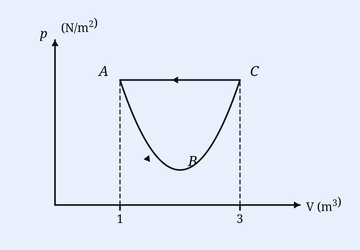
![Reaction sequence. Compound (x) [given molecular data: 76.6% C, 6.38% H, vapour density 47] is treated with (i) CO2, NaOH, 120 C, high pressure and then (ii) H3O+ to give compound (y) (Major Product). Below, the mechanism is drawn: X is phenol (benzene ring with -OH), which on (i) CO2, NaOH, high pressure and (ii) H3O+ gives Y, salicylic acid (benzene ring bearing an -OH group and an ortho -COOH group).](/api/qna-image?path=QnA%2Fb65cda62-f924-480b-b4db-1d3aaa6069d4%2F5ef15551-aed6-4f93-a8d5-a219b7a5d19b%2F18eb3d8c-1c96-5cd2-8bba-a6aa9a2c55f0%2F18eb3d8c-1c96-5cd2-8bba-a6aa9a2c55f0%2Fimages%2FQ59_reaction_sequence.webp)
Consider the above reaction
A. The reaction proceeds through a more stable radical intermediate.
B. The role of peroxide is to generate (hydrogen radical).
C. During this reaction, benzene is formed as a byproduct.
D. 1-Bromo-2-phenylethane is formed as the minor product.
E. The same reaction in absence of peroxide proceeds via carbocation intermediate.
Identify the correct statements. Choose the correct answer from the options given below.
JEE Main 2026 January 28, Shift 1 Question Paper with Solutions
All 74 questions from the JEE Main 2026 (January 28, Shift 1) shift — Physics (25), Chemistry (25) and Mathematics (24) — each with the correct answer (answer key) and a step-by-step solution. Read it free online, or attempt the full paper as a timed mock test.
Physics25 questions
Q26Single correctLaws of Motion
A block of mass 5 kg is moving on an inclined plane which makes an angle of with the horizontal. Friction coefficient between the block and the inclined plane surface is . The force to be applied on the block so that the block will move down without acceleration is ______ N.
(1)
(2)
(3)
(4)
SolutionAnswer: Option 3
Approach:
Givens: , , , . Target: the applied force along the incline that produces zero acceleration while the block slides down. Principle: resolve forces along and perpendicular to the incline; since the block moves down, kinetic friction acts up the incline.
Step 1:Compute the gravity component along the incline acting down the plane.
Step 2:Compute the maximum kinetic friction, which acts up the incline opposing downward sliding.
Step 3:Friction up the incline () exceeds gravity down the incline (); for sliding down at constant velocity an extra force down the incline is required to balance the net up-slope force.
Final answer:
Q27Single correctOptics
Given below are two statements:
Statement I: A plane wave after passing through prism remains as plane wave but passing through small pin hole may become spherical wave.
Statement II: The curvature of a spherical wave emerging from a slit will increase for increasing slit width.
In the light of the above statements, choose the answer from the options given below:
Statement I: A plane wave after passing through prism remains as plane wave but passing through small pin hole may become spherical wave.
Statement II: The curvature of a spherical wave emerging from a slit will increase for increasing slit width.
In the light of the above statements, choose the answer from the options given below:
(1)
(2)
(3)
(4)
SolutionAnswer: Option 2Statement I is true but Statement II is false
Approach:
Two statements concern how a wavefront is reshaped by optical elements. Huygens' principle, in which each point of a wavefront launches secondary spherical wavelets whose envelope forms the next wavefront, fixes the outcome for a prism, a pinhole and a slit.
Step 1:A prism refracts a plane wavefront uniformly, tilting and slowing it while keeping it planar, so a plane wave stays plane after a prism.
Step 2:A pinhole is an aperture far smaller than the wavefront, so it acts as a single secondary source and emits an essentially spherical wave; combining both facts, Statement I is correct.
Step 3:For a slit, diffraction and hence wavefront curvature grow as the slit narrows and diminish as the slit widens. Statement II asserts curvature increases with increasing slit width, the reverse of the true dependence, so it is false.
Final answer: Statement I is true but Statement II is false
Q28Single correctOptics
The magnitudes of power of a biconvex lens (refractive index 1.5) and that of a plano-concave lens (refractive index = 1.7) are same. If the curvature of plano-concave lens exactly matches with the curvature of back surface of the biconvex lens, then ratio of radius of curvature of front and back surface of the biconvex lens is ______.
(1)
(2)
(3)
(4)
SolutionAnswer: Option 2
Approach:
Givens: biconvex lens of with surface radii of magnitude (front) and (back); plano-concave lens of whose curved face matches the back surface, so its curved radius is ; the two powers are equal in magnitude. Target: . Principle: lens maker's formula with magnitudes of surface contributions.
Step 1:For the biconvex lens both surfaces converge light, so the magnitudes of the two surface contributions add.
Step 2:For the plano-concave lens one face is flat () and the curved face has radius .
Step 3:Equate the magnitudes of the two powers and isolate the term.
Step 4:Rearrange to the ratio of radii.
Final answer:
Q29Single correctCurrent Electricity
In the potentiometer, when the cell in the secondary circuit is shunted with resistance, the balance is obtained at the length 120 cm of wire. Now when the same cell is shunted with resistance, the balance is shifted to a length of 180 cm. The internal resistance of cell is ______ .
(1)
(2)
(3)
(4)
SolutionAnswer: Option 2
Approach:
Givens: a cell shunted by balances at and by balances at . Target: internal resistance r. Principle: the balance length is proportional to the terminal voltage across the shunt.
Step 1:Form the ratio of the two balance conditions, the emf cancelling.
Step 2:Simplify both sides.
Step 3:Cross-multiply and expand.
Step 4:Solve for the internal resistance.
Final answer:
Q30Single correctKinematics
Water drops fall from a tap on the floor, 5 m below at regular intervals of time. The first drop strikes the floor when the sixth drop begins to fall. The height at which the fourth drop will be from ground at the instant when the first drop strikes the ground is ______ m.
(1)
(2)
(3)
(4)
SolutionAnswer: Option 2
Approach:
Givens: drops fall from a tap above the floor at equal time intervals ; the first drop strikes the floor as the sixth begins to fall; . Target: the height of the fourth drop above the ground at the instant the first drop lands. Principle: distance in free fall is proportional to the square of the elapsed time.
Step 1:Five equal intervals separate drop 1 and drop 6, so when drop 1 lands it has fallen for and the fourth drop (released two intervals after the first) has fallen for .
Step 2:Drop 1 covers the full in time , fixing the relation .
Step 3:Distance fallen by the fourth drop in time .
Step 4:Height above the ground equals total height minus distance fallen.
Final answer:
Q31Single correctElectromagnetic Waves
The electric field of an electromagnetic wave travelling through a medium is given by . Then the refractive index of the medium is ______. (All given measurements are in SI units)
(1)
(2)
(3)
(4)
SolutionAnswer: Option 2
Approach:
Givens: electric field in SI units. Target: refractive index of the medium. Principle: the phase velocity follows from and k, and the refractive index is the ratio of the vacuum light speed to this velocity.
Step 1:Compare with to read the angular frequency and wave number.
Step 2:Compute the wave speed in the medium.
Step 3:Divide the vacuum speed of light by the medium speed.
Final answer:
Q32Single correctThermodynamics
In the following p-V diagram the equation of state along the curved path is given by , where a is a constant. The total work done in the closed path is ______.
(1)
(2)
(3)
(4)
SolutionAnswer: Option 1
Approach:
Givens: closed cycle on a p-V diagram with the curved part obeying ; the parabola has its vertex (point B) at and rises to and , which are joined by a horizontal segment CA at the top. Target: net work over the closed path. Principle: work in a cycle equals the signed area enclosed, .
Step 1:Evaluate the pressure at the end volumes and ; both give the top level of the loop.
Step 2:Area under the parabolic path from to (the lower boundary ).
Step 3:Area under the horizontal top segment CA from to at .
Step 4:Traversal increases V along the lower parabola, and decreases V along the upper line; this counterclockwise sense makes the net work the lower-area contribution minus the upper-area contribution.
Final answer:
Q33Single correctProperties of Solids and Liquids
Which of the following best represents the temperature versus heat supplied graph for water, in the range of -2C to 12C?
(1)
(2)
(3)
(4)
SolutionAnswer: Option 4Heating curve starting at -20°C with horizontal plateaus at 0°C and 100°C, ending at 120°C (option 4)
Approach:
Givens: water heated from to ; option graphs of temperature versus heat supplied. Target: the correct heating curve. Principle: temperature rises during single-phase heating () and stays constant during a phase change ().
Step 1:From to the ice warms, so temperature rises with heat.
Step 2:At the ice melts at constant temperature while heat is absorbed.
Step 3:From to the liquid warms, temperature rising with heat.
Step 4:At the water boils at constant temperature while heat is absorbed.
Step 5:From to the steam warms, temperature rising again.
Final answer: Heating curve starting at with horizontal plateaus at (melting) and (boiling), then rising to .
Q34Single correctMagnetic Effects of Current and Magnetism
The magnetic field at the centre of a current carrying circular loop of radius R is 16 T. The magnetic field at a distance on its axis from the centre is ______ T.
(1)
(2)
(3)
(4)
SolutionAnswer: Option 1
Approach:
Givens: field at the centre of a circular current loop ; axial point at . Target: axial field B. Principle: the axial field of a loop scales as relative to the centre value.
Step 1:Form the ratio of the axial field to the central field.
Step 2:Substitute , giving .
Step 3:Evaluate the product.
Final answer:
Q35Single correctMagnetic Effects of Current and Magnetism
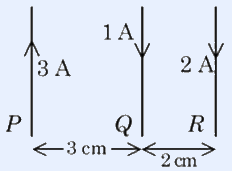
Three long straight wires carrying current are arranged mutually parallel as shown in the figure. The force experienced by 15 cm length of wire Q is ______.
(1)
(2)
(3)
(4)
SolutionAnswer: Option 2
Approach:
Wire Q (current A directed downward) lies between wire P ( A directed upward, cm to its left) and wire R ( A directed downward, cm to its right). Antiparallel currents repel and parallel currents attract; applying the standard force per unit length to each neighbour and combining the two contributions gives the net force on a cm length of Q.
Step 1:List the data in SI units.
Step 2:P and Q are antiparallel, so they repel; the force on Q from P pushes Q away from P, i.e. toward R. Evaluate its magnitude on the cm length.
Step 3:Q and R are parallel (both downward), so they attract; the force on Q from R pulls Q toward R. Compute its magnitude.
Step 4:Both contributions point toward R, so they add directly to give the net force on Q.
Final answer: towards R
Q36Single correctAtoms and Nuclei
An atom is bombarded by shower of fundamental particles and in 10 s this atom absorbed 10 electrons, 10 protons and 9 neutrons. The percentage growth in the surface area of the nucleons is recorded by: ______
(1)
(2)
(3)
(4)
SolutionAnswer: Option 2
Approach:
Givens: nucleus () absorbs 10 electrons, 10 protons and 9 neutrons. Target: the percentage change in nuclear surface area as reported. Principle: nuclear radius scales as , so surface area scales as ; only nucleons (protons, neutrons) change the mass number.
Step 1:Electrons do not contribute to the mass number; added protons and neutrons raise it.
Step 2:Form the surface-area ratio.
Step 3:Express the surface-area ratio as a percentage, as reported in the paper.
Final answer:
Q37Single correctElectromagnetic Induction and Alternating Currents
The electric current in the circuit is given as . The r.m.s current for the period to is ______.
(1)
(2)
(3)
(4)
SolutionAnswer: Option 1
Approach:
Givens: current over to . Target: the r.m.s. current over this interval. Principle: the r.m.s. value is the square root of the time-averaged square of the current.
Step 1:Substitute the current into the mean-square expression.
Step 2:Evaluate the integral.
Step 3:Take the square root of the mean square.
Final answer:
Q38Single correctExperimental Skills
When both jaws of vernier callipers touch each other, zero mark of the vernier scale is right to zero mark of main scale. mark on vernier scale coincides with certain mark on the main scale. While measuring the length of a cylinder, observer observes 15 divisions on main scale and division on vernier scale coincides with a main scale division. Measured length of cylinder is ______ mm. (Least count of Vernier calliper = 0.1 mm)
(1)
(2)
(3)
(4)
SolutionAnswer: Option 2
Approach:
Givens: with jaws touching, the vernier zero lies to the right of the main-scale zero and the 4th vernier division coincides (positive zero error); least count ; while measuring, 15 main-scale divisions are read and the 5th vernier division coincides. Target: corrected measured length. Principle: corrected reading equals observed reading minus the positive zero error.
Step 1:The vernier zero is to the right of the main-scale zero with the 4th division coinciding, giving a positive zero error.
Step 2:Compute the observed reading from 15 main-scale divisions (each ) and the coinciding 5th vernier division.
Step 3:Subtract the positive zero error from the observed reading.
Final answer:
Q39Single correctProperties of Solids and Liquids
Two wires A and B made of different materials of lengths 6.0 cm and 5.4 cm, respectively and area of cross sections and , respectively are stretched by the same magnitude under a given load. The ratio of the Young's modulus of A to that of B is x : 3. The value of x is ______.
(1)
(2)
(3)
(4)
SolutionAnswer: Option 3
Approach:
Given wire A of length cm and area , wire B of length cm and area , both stretched by the same elongation under the same load. Target: the value of x where . Principle: Young's modulus relates load, length, area and elongation.
Step 1:With identical load F and identical elongation for both wires, the ratio of moduli depends only on length and area.
Step 2:Substituting the lengths in cm and the areas in (the common factors cancel).
Step 3:Matching the reduced ratio with the stated form .
Final answer:
Q40Single correctProperties of Solids and Liquids
10 kg of ice at C is added to 100 kg of water to lower its temperature from 25 C. Consider no heat exchange to surroundings. The decrement to the temperature of water is ______ C.
(Specific heat of ice = 2100 J/Kg.C, specific heat of water = 4200 J/Kg.C, latent heat of fusion of ice = J/Kg)
(Specific heat of ice = 2100 J/Kg.C, specific heat of water = 4200 J/Kg.C, latent heat of fusion of ice = J/Kg)
(1)
(2)
(3)
(4)
SolutionAnswer: Option 2
Approach:
Given 10 kg ice at C added to 100 kg water at C with no heat loss; J/kgC, J/kgC, J/kg. Target: the decrement of the water temperature. Principle: conservation of heat (heat lost equals heat gained).
Step 1:Heat absorbed by the ice equals warming it from C to C, melting it, and warming the melt water from C to the final temperature T.
Step 2:Heat released by the 100 kg of water cooling from C to T.
Step 3:Equating heat lost to heat gained and solving for the final temperature .
Step 4:The decrement is the drop in the water temperature from its initial value to .
Final answer:
Q41Single correctRotational Motion
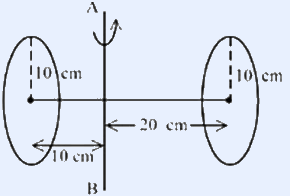
Two circular discs of radius each 10 cm are joined at their centres by a rod of length 30 cm and mass 600 gm as shown in figure. If the mass of each disc is 600 gm and applied torque between two discs is dyne.cm, the angular acceleration of the discs about the given axis AB is ______ rad/.
(1)
(2)
(3)
(4)
SolutionAnswer: Option 1
Approach:
Two identical discs (each mass kg, radius m) sit at the ends of a rod (mass kg, length m) and the assembly turns about the axis through the rod's centre, perpendicular to the rod. The total moment of inertia about is built from the two discs (parallel-axis theorem) and the rod, then the applied torque is divided by it.
Step 1:Convert the applied torque to SI units.
Step 2:Each disc centre lies at half the rod length from the axis, m. Combine the disc's central inertia with the parallel-axis term.
Step 3:Compute the rod's moment of inertia about the perpendicular axis through its centre.
Step 4:Sum the contributions of both discs and the rod.
Step 5:Divide the torque by the total moment of inertia.
Final answer:
Q42Single correctCurrent Electricity
For the two cells having same EMF E and internal resistance r, the current passing through the external resistor 6 is same when both the cells are connected either in parallel or in series. The value of internal resistance r is ______ .
(1)
(2)
(3)
(4)
SolutionAnswer: Option 2
Approach:
Given two cells each of EMF E and internal resistance r feeding an external resistor , with the external current equal in the series and parallel configurations. Target: the value of r. Principle: the loop current equals equivalent EMF divided by total resistance.
Step 1:In parallel the equivalent EMF is and the equivalent internal resistance is , giving the external current.
Step 2:In series the equivalent EMF is and the equivalent internal resistance is .
Step 3:Setting the two external currents equal and cancelling .
Final answer:
Q43Single correctElectrostatics
Two point charges of 1 nC and 2 nC are placed at the two corners of equilateral triangle of side 3 cm. The work done in bringing a charge of 3 nC from infinity to the third corner of the triangle is ______ J.
(1)
(2)
(3)
(4)
SolutionAnswer: Option 2
Approach:
Given charges nC and nC fixed at two corners of an equilateral triangle of side cm m, and a charge nC brought from infinity to the third corner, with . Target: the work done. Principle: work equals the change in electrostatic potential energy.
Step 1:The third corner is at distance a from each fixed charge, so the work equals the sum of the two interaction energies of q with and .
Step 2:Substituting C, C, m and the Coulomb constant.
Step 3:Evaluating the arithmetic.
Final answer:
Q44Single correctProperties of Solids and Liquids
Particle of mass m falls from rest through a resistive medium having resistive force , where v is the velocity of the particle and k is a constant. Which of the following graphs represents velocity (v) versus time (t)?
(1)
(2)
(3)
(4)
SolutionAnswer: Option 2
Approach:
Given a particle of mass released from rest in a medium with resistive force ( constant). Target: identify the versus graph. Principle: Newton's second law produces a first-order linear differential equation whose solution saturates to a terminal velocity.
Step 1:The net downward force is gravity reduced by the resistive force, giving the equation of motion.
Step 2:Separating variables and integrating from at .
Step 3:At the velocity is zero, and as it approaches the terminal velocity, so the curve rises from the origin and flattens to a horizontal asymptote.
Final answer:
Q45Single correctElectronic Devices
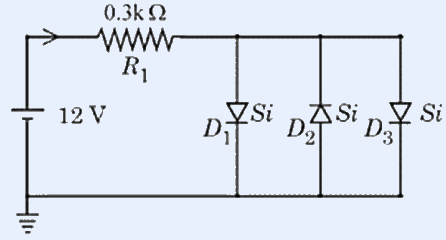
Assuming in forward bias condition there is a voltage drop of 0.7 V across a silicon diode, the current through diode in the circuit is ______ mA. (Assume all diodes in the given circuit are identical)
(1)
(2)
(3)
(4)
SolutionAnswer: Option 4
Approach:
A 12 V source feeds three identical silicon diodes ( V) through a series resistor . The diode orientations in the figure decide which branches conduct, after which the series current and its division give the current through .
Step 1:From the circuit, and are forward biased while is reverse biased, so blocks and only the two forward branches carry current.
Step 2:The total current from the source flows through after a single forward diode drop of V.
Step 3:The two identical conducting diodes are in parallel across the same node pair, so they share the total current equally; the current through is half.
Final answer:
Q46NumericalOscillations and Waves
The displacement of a particle, executing simple harmonic motion with time period T, is expressed as , where A is the amplitude. The maximum value of potential energy of this oscillator is found at . The value of is ______.
SolutionAnswer: 2
Approach:
For an oscillator the potential energy is proportional to , so it peaks where the displacement is largest. Equating the first such instant to the given form fixes .
Step 1:Potential energy is maximum when the displacement reaches the amplitude, .
Step 2:Substitute to obtain the first instant of maximum potential energy.
Step 3:Match this instant to the given expression and solve.
Final answer:
Q47NumericalCurrent Electricity
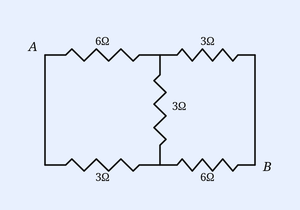
The equivalent resistance between the points A and B in the following circuit is . The value of x is ______.
SolutionAnswer: 21
Approach:
From the figure: terminal A at top-left, terminal B at bottom-right. Top path AB; bottom path AB; a resistor bridges C to D. Target: the value of x where . Principle: this is an unbalanced Wheatstone bridge, solved by nodal analysis (or delta-star reduction).
Step 1:Check balance: the arm ratios and are unequal, so the bridge is unbalanced and the bridge arm carries current.
Step 2:Inject A at A, take it out at B, and set . Writing KCL at A, C and D gives three equations in .
Step 3:With A injected and , the equivalent resistance equals .
Step 4:Matching with the stated form .
Final answer:
Q48NumericalDual Nature of Matter and Radiation
The ratio of de Broglie wavelength of a deuteron with kinetic energy E to that of an alpha particle with kinetic energy 2E, is n : 1. The value of n is ______. (Assume mass of proton = mass of neutron).
SolutionAnswer: 2
Approach:
Given a deuteron (mass ) with kinetic energy E and an alpha particle (mass 4u) with kinetic energy 2E, with proton and neutron masses taken equal. Target: the value of n where . Principle: the de Broglie wavelength relates to mass and kinetic energy through momentum .
Step 1:Forming the ratio of the deuteron wavelength to the alpha particle wavelength with their respective masses and kinetic energies.
Step 2:Substituting and .
Step 3:Expressing the ratio in the form .
Final answer:
Q49NumericalRotational Motion
A solid sphere of radius 10 cm is rotating about an axis which is at a distance 15 cm from its centre. The radius of gyration of this axis is cm. The value of n is ______.
SolutionAnswer: 265
Approach:
Given a solid sphere of radius cm rotating about an axis at distance cm from its centre, with radius of gyration cm. Target: the value of n. Principle: the moment of inertia about the external axis follows from the parallel-axis theorem and equals .
Step 1:Applying the parallel-axis theorem and equating to , then cancelling the mass.
Step 2:Substituting cm and cm (lengths in cm so is in c).
Step 3:Matching with cm.
Final answer:
Q50NumericalOptics
A convex lens of refractive index 1.5 and focal length f = 18 cm is immersed in water. The difference in focal lengths of the given lens when it is in water and in air is . The value of n is ______. (refractive index of water = 4/3)
SolutionAnswer: 3
Approach:
Given a convex lens of refractive index with focal length cm in air, immersed in water (); the focal-length difference is . Target: the value of n. Principle: the lens maker formula links focal length to the relative refractive index of the lens material with respect to its surroundings.
Step 1:In air the surrounding index is 1, giving the air focal length in terms of the surface term.
Step 2:In water the surrounding index is , giving the water focal length with the same surface term .
Step 3:Dividing the two relations eliminates and gives the water focal length.
Step 4:Expressing the difference of focal lengths as a multiple of the air focal length.
Final answer:
Chemistry25 questions
Q51Single correctChemical Thermodynamics
of an ideal gas 'X' at 600 K and 0.5 MPa undergoes isothermal reversible expansion until pressure of the gas is 0.2 MPa. Which of the following option is correct?
(Given: and )
(Given: and )
(1)
(2)
(3)
(4)
SolutionAnswer: Option 4
Approach:
An ideal gas at 600 K expands isothermally and reversibly from 0.5 MPa to 0.2 MPa, starting at 20.0 . For an isothermal change of an ideal gas the internal energy and enthalpy depend only on temperature, so both are zero. The reversible work is evaluated from the isothermal work expression and the heat follows from the first law.
Step 1:For an ideal gas at constant temperature, internal energy and enthalpy are functions of temperature alone and therefore do not change.
Step 2:The product nRT equals the initial pressure times volume. With and , this gives the energy scale of the process and corresponds to about two moles of gas.
Step 3:The pressure ratio for the reversible isothermal work is , and .
Step 4:Insert the values into the reversible isothermal work expression. The gas expands, so it performs work on the surroundings and the work done on the gas is negative.
Step 5:Since the internal energy is unchanged, the first law gives heat equal in magnitude and opposite in sign to the work; heat is absorbed during the expansion.
Final answer:
Q52Single correctEquilibrium
Consider a weak base 'B' of . 'x' mL of 0.02 M HCl and 'y' mL of 0.02 M weak base 'B' are mixed to make 100 mL of a buffer of pH 9 at 25 . The values of 'x' and 'y' respectively are:
(Given: , , )
(Given: , , )
(1)
(2)
(3)
(4)
SolutionAnswer: Option 2
Approach:
A weak base B (pKb = 5.699) is partly neutralised by strong acid HCl to form a basic buffer of the conjugate acid BH+ and the leftover base B in a total volume of 100 mL. The target pH 9 fixes pOH = 5, the Henderson equation for the base relates the salt-to-base ratio, and the volume balance x + y = 100 closes the system.
Step 1:Convert the target pH to pOH for the basic buffer.
Step 2:HCl (0.02x mmol) neutralises an equal amount of base to form the conjugate acid salt BH+; the unreacted base is the original base minus the neutralised portion. Both salt and base share the same 100 mL volume, so the concentration ratio reduces to the mole ratio.
Step 3:Apply the Henderson equation and isolate the logarithm.
Step 4:Since log 5 = 0.699, the antilog of -0.699 is 1/5; solve the ratio for the relation between y and x.
Step 5:Substitute into the volume balance and solve.
Final answer:
Q53Single correctAtomic Structure
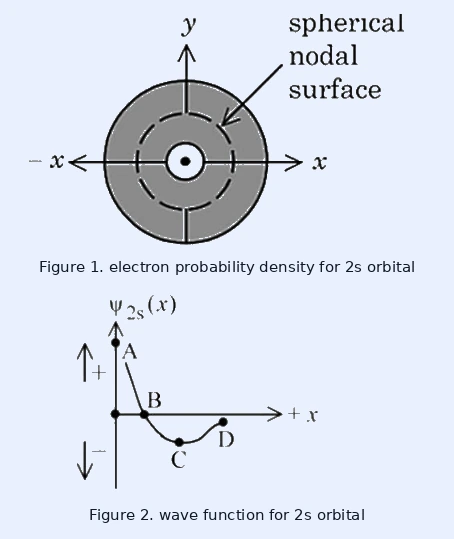
Which of the following point in Figure 2 most accurately represents the nodal surface as shown in Figure 1?
(1)
(2)
(3)
(4)
SolutionAnswer: Option 2
Approach:
The spherical nodal surface of the 2s orbital is its radial node, the radius at which the wave function passes through zero and reverses sign. Locating that zero crossing on the Figure 2 plot identifies the labelled point.
Step 1:The 2s orbital has exactly one radial node; the spherical nodal surface in Figure 1 marks the radius where the electron probability density falls to zero.
Step 2:On the Figure 2 curve, point A is the maximum near the axis and point C is the negative minimum, so the curve crosses zero somewhere between them.
Step 3:The point where and the sign changes is labelled B, so B represents the nodal surface.
Final answer:
Q54Single correctBiomolecules
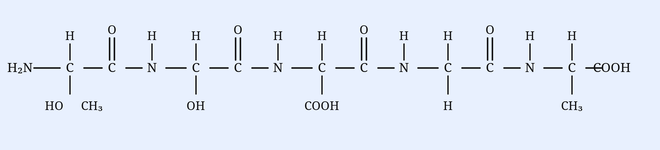
In the given pentapeptide, find out an essential amino acid (Y) and the sequence present in the pentapeptide:
Choose the correct answer from the options given below:
Choose the correct answer from the options given below:
(1)
(2)
(3)
(4)
SolutionAnswer: Option 2
Approach:
Each residue of the pentapeptide is named from its side chain read from the N-terminal H2N end to the C-terminal COOH end; the essential amino acid among them is identified, and the residues are listed in order to obtain the sequence.
Step 1:From the N-terminal H2N end, the first alpha-carbon carries a side chain bearing both an OH and a CH3 on the beta carbon, the threonine side chain; the second residue carries -CH2OH (serine); the third carries -CH2COOH (aspartic acid); the fourth carries -H (glycine); the fifth, ending in COOH, carries -CH3 (alanine).
Step 2:Among these five residues, threonine is the essential amino acid (it cannot be synthesised by the body), so Y is threonine.
Step 3:Reading the chain from the free amino end to the free carboxyl end gives the primary sequence.
Final answer:
Q55Single correctClassification of Elements and Periodicity in Properties
In period 4 of the periodic table, the elements with highest and lowest atomic radii are respectively.
(1)
(2)
(3)
(4)
SolutionAnswer: Option 1K\ &\ Br
Approach:
Atomic radius across a period is set by the competition between rising effective nuclear charge and electrons filling the same principal shell. Applying this trend across period 4 identifies the largest and smallest atoms.
Step 1:Across a period the effective nuclear charge rises while electrons enter the same shell, so atomic radius decreases from left to right.
Step 2:Potassium opens period 4 as the group-1 element with one loosely held 4s electron, giving the largest atomic radius of the period.
Step 3:Toward the right the radius is smallest at bromine among the representative elements, whose high effective nuclear charge contracts the 4p shell.
Final answer: K\ &\ Br
Q56Single correctCoordination Compounds
The correct statement among the following is:
(1)
(2)
(3)
(4)
SolutionAnswer: Option 4 and are diamagnetic and is paramagnetic
Approach:
The oxidation state of nickel and the field strength of the ligand together fix the d-electron count, the geometry, and the number of unpaired electrons, which determine whether each complex is diamagnetic or paramagnetic.
Step 1:In Ni(CO)4 nickel is in the zero oxidation state with a 3d10 configuration after rearrangement; CO is a strong-field ligand and the complex is sp3 tetrahedral with every electron paired, hence diamagnetic.
Step 2:In [Ni(CN)4]2- nickel is Ni2+ (d8); the strong-field cyanide ligand forces pairing, giving a dsp2 square-planar complex with no unpaired electrons, hence diamagnetic.
Step 3:In [NiCl4]2- nickel is again Ni2+ (d8); chloride is a weak-field ligand, so the complex is sp3 tetrahedral with two unpaired electrons, hence paramagnetic.
Final answer: and are diamagnetic and is paramagnetic
Q57Single correctChemical Kinetics
An organic compound undergoes first order decomposition. The time taken for decomposition to and of its initial concentration are and respectively. What is the value of ?
(log 2 = 0.3)
(log 2 = 0.3)
(1)
(2)
(3)
(4)
SolutionAnswer: Option 4
Approach:
For a first-order decomposition the time to reach a given fraction of the initial concentration is proportional to the logarithm of the ratio of initial to final concentration. Taking the ratio of the two times cancels the rate constant, leaving a ratio of logarithms.
Step 1:Decomposition to one-eighth leaves [A] = [A0]/8, so the logarithmic factor is log 8; decomposition to one-tenth leaves [A] = [A0]/10, so the factor is log 10.
Step 2:Form the ratio; the constant 2.303/k cancels, and log 8 = 3 log 2 = 3(0.3) = 0.9 while log 10 = 1.
Step 3:Multiply by ten as required by the question.
Final answer:
Q58Single correctOrganic Compounds Containing Oxygen
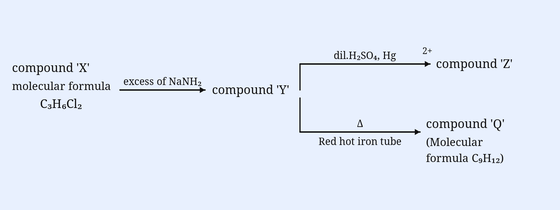
Given below are two statements for the following reaction sequence.
Statement I : Compound 'Z' will give yellow precipitate with NaOI.
Statement II: Compound 'Q' has two different types of 'H' atoms (aromatic : aliphatic) in the ratio 1 : 3
In the light of the above statements, choose the correct answer from the options
Statement I : Compound 'Z' will give yellow precipitate with NaOI.
Statement II: Compound 'Q' has two different types of 'H' atoms (aromatic : aliphatic) in the ratio 1 : 3
In the light of the above statements, choose the correct answer from the options
(1)
(2)
(3)
(4)
SolutionAnswer: Option 4Both Statement I and Statement II are true
Approach:
Compound X (C3H6Cl2) on double dehydrohalogenation with excess NaNH2 yields propyne (Y). Markovnikov hydration of propyne with dil. H2SO4 and Hg2+ gives acetone (Z), tested against the iodoform reaction. Cyclic trimerisation of propyne over a red-hot iron tube gives mesitylene (Q, C9H12), whose hydrogen environments are counted.
Step 1:X is a dichloropropane (C3H6Cl2). Excess sodamide removes two molecules of HCl to build a carbon-carbon triple bond, giving propyne as compound Y.
Step 2:Propyne undergoes Markovnikov hydration with dil. H2SO4 and Hg2+; water adds with OH on the more substituted carbon, and the resulting enol tautomerises to acetone, a methyl ketone (Z). A methyl ketone responds to the iodoform reaction with NaOI to give the yellow precipitate of iodoform.
Step 3:Three molecules of propyne trimerise over a red-hot iron tube to 1,3,5-trimethylbenzene (mesitylene), C9H12. It carries 3 aromatic H on the ring and 9 aliphatic H in the three methyl groups, an aromatic-to-aliphatic ratio of 3 : 9 = 1 : 3.
Final answer: Both Statement I and Statement II are true
Q59Single correctOrganic Compounds Containing Oxygen
Consider the following reaction sequence
Compound (y) develops characteristic colour with neutral solution.
Identify the INCORRECT statement from the following for the above sequence.
Compound (y) develops characteristic colour with neutral solution.
Identify the INCORRECT statement from the following for the above sequence.
(1)
(2)
(3)
(4)
SolutionAnswer: Option 4Compound x is more acidic than compound y.
Approach:
The elemental data and the colour with neutral FeCl3 identify compound x as phenol. The Kolbe-Schmitt reaction (CO2/NaOH at high pressure, then acidification) converts phenol to salicylic acid (y). Each statement is evaluated and the false one is selected.
Step 1:Vapour density 47 gives molar mass 94, matching C6H5OH; carbon 76.6% and hydrogen 6.38% fit C6H6O, and a characteristic colour with neutral FeCl3 is diagnostic of a phenol. Thus x is phenol.
Step 2:Phenol treated with CO2 and NaOH at about 120 C under high pressure, followed by acidification, undergoes the Kolbe-Schmitt reaction to give salicylic acid (2-hydroxybenzoic acid), bearing an OH and an ortho COOH; salicylic acid is y and also gives a colour with neutral FeCl3 owing to its phenolic OH.
Step 3:Statement 1: both phenol and salicylic acid have acidic OH/COOH groups and dissolve in NaOH (true). Statement 2: salicylic acid contains a carboxylic acid group, so it dissolves in NaHCO3 with evolution of CO2 (true). Statement 3: both are aromatic with high carbon-to-hydrogen content and burn with a sooty flame (true). Statement 4: salicylic acid (a carboxylic acid) is more acidic than phenol, so the claim that phenol is more acidic is false.
Final answer: Compound x is more acidic than compound y.
Q60Single correctSome Basic Principles of Organic Chemistry
CORRECT order of stability for the following is
(1)
(2)
(3)
(4)
SolutionAnswer: Option 4
Approach:
Carbanion stability tracks the s-character of the orbital holding the lone pair: greater s-character keeps the negative charge closer to the nucleus and lowers its energy. Assigning hybridisation to each carbanion carbon orders the stabilities.
Step 1:Assign the hybridisation of the carbon bearing the negative charge: is , is , and is sp.
Step 2:Order the s-character, since a lone pair in an orbital of higher s-character is held closer to the nucleus and is more stable.
Step 3:Greater s-character gives greater stability, so the stability order follows the s-character order.
Final answer:
Q61Single correctAtomic Structure
The wave numbers of three spectral lines of H atom are considered. Identify the set of spectral belonging to Balmer series.
(R = Rydberg constant)
(R = Rydberg constant)
(1)
(2)
(3)
(4)
SolutionAnswer: Option 4
Approach:
The Balmer series of hydrogen arises from electronic transitions terminating at n = 2. The Rydberg formula with the final level fixed at 2 and the initial level taken as 3, 4 and 5 generates the wave numbers, which are matched to the option set.
Step 1:Transition from n = 3 to n = 2.
Step 2:Transition from n = 4 to n = 2.
Step 3:Transition from n = 5 to n = 2.
Final answer:
Q62Single correctd- and f-Block Elements
Given below are two statements:
Statement I: The number of pairs, from the following, in which both the ions are coloured in aqueous solutions is 3.
and
Statement II: is the strongest reducing agent among and .
In the light of the above statements, choose the correct answer from the options given below
Statement I: The number of pairs, from the following, in which both the ions are coloured in aqueous solutions is 3.
and
Statement II: is the strongest reducing agent among and .
In the light of the above statements, choose the correct answer from the options given below
(1)
(2)
(3)
(4)
SolutionAnswer: Option 3Both Statement I and Statement II are false
Approach:
Colour of an aqueous transition-metal ion arises from d-d transitions, which require a partially filled d subshell (d1 to d9); d0 and d10 ions are colourless. Each pair is examined to count those in which both ions are coloured. For the f-block ions, reducing strength is judged from the tendency of the ion to be oxidised to a more stable configuration.
Step 1:Evaluate each pair. [Sc3+, Ti3+]: Sc3+ is d0 (colourless), Ti3+ is d1 (coloured) - not both coloured. [Mn2+, Cr2+]: Mn2+ is d5 and Cr2+ is d4, both coloured. [Cu2+, Zn2+]: Cu2+ is d9 (coloured), Zn2+ is d10 (colourless) - not both coloured. [Ni2+, Ti4+]: Ni2+ is d8 (coloured), Ti4+ is d0 (colourless) - not both coloured.
Step 2:The number of pairs with both ions coloured is one, not three, so Statement I is false.
Step 3:Among Th4+, Ce4+, Gd3+ and Eu2+, the strongest reducing agent is the one most readily oxidised. Eu2+ is readily oxidised to the stable half-filled Eu3+ (4f7) and is the strongest reducing agent; Th4+ has the inert [Rn] core and is neither a strong reductant nor oxidant. Hence Statement II, which names Th4+, is false.
Final answer: Both Statement I and Statement II are false
Q63Single correctChemical Bonding and Molecular Structure
Given below are two statements:
Statement I: The number of species among and , that have unequal E-F bond lengths is two. Here, E is the central atom.
Statement II: Among and has the highest bond order
In the light of the above statements, choose the correct answer from the options given below
Statement I: The number of species among and , that have unequal E-F bond lengths is two. Here, E is the central atom.
Statement II: Among and has the highest bond order
In the light of the above statements, choose the correct answer from the options given below
(1)
(2)
(3)
(4)
SolutionAnswer: Option 2Both Statement I and Statement II are false
Approach:
The geometry of each fluoride is obtained from VSEPR/hybridisation to decide whether all E-F bonds are equivalent. Bond orders of the dioxygen species are computed from molecular orbital theory to find the largest, and each statement is judged.
Step 1:BF4- (sp3) and SiF4 (sp3) are regular tetrahedra, so all E-F bonds are equal. XeF4 (sp3d2, two lone pairs) is square planar with four equivalent Xe-F bonds, all equal. SF4 (sp3d, one lone pair) is a see-saw shape with two axial bonds longer than two equatorial bonds, so its bonds are unequal.
Step 2:The number of species with unequal E-F bond lengths is one, not two, so Statement I is false.
Step 3:From MO theory the bond orders are O2+ = 2.5 (15 electrons), O2- = 1.5 (17 electrons), - = 1.0 (18 electrons), and F2 = 1.0 (18 electrons). The highest bond order is that of O2+, not O2-, so Statement II is false.
Final answer: Both Statement I and Statement II are false
Q64Single correctSolutions
At T(K), 2 moles of liquid A and 3 moles of liquid B are mixed. The vapour pressure of ideal solution formed is 320 mm Hg. At this stage, one mole of A and one mole of B added to the solution. The vapour pressure is now measured as 328.6 mm Hg. The vapour pressre (in mm Hg) of A and B are respectively:
(1)
(2)
(3)
(4)
SolutionAnswer: Option 3
Approach:
Given two ideal-solution vapour pressures at different compositions, the pure-component vapour pressures are required. Raoult's law writes the total pressure as the mole-fraction-weighted sum of pure vapour pressures. Applying it to the 2:3 mixture and to the 3:4 mixture obtained after adding one mole of each component gives two linear equations in and , solved simultaneously.
Step 1:For the initial mixture of 2 mol A and 3 mol B (total 5), the mole fractions are and ; applying Raoult's law to the measured 320 mm Hg gives the first equation.
Step 2:Adding one mole of A and one mole of B changes the composition to 3 mol A and 4 mol B (total 7), with and ; the measured 328.6 mm Hg gives the second equation.
Step 3:Eliminate by computing .
Step 4:Substitute into the first equation to obtain .
Final answer: mm Hg
Q65Single correctPurification and Characterisation of Organic Compounds
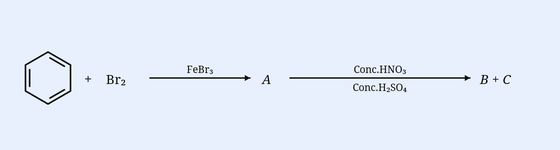
Method used for separation of mixture of products (B and C) obtained in the following reaction is
(1)
(2)
(3)
(4)
SolutionAnswer: Option 1
Approach:
Benzene is brominated to bromobenzene (A), whose halogen is ortho/para directing; nitration then gives a mixture of two positional isomers, B and C. The required separation method follows from the physical nature of the two isomeric products.
Step 1:Electrophilic bromination of benzene with Br2 and FeBr3 yields bromobenzene; the C-Br bond makes the halogen an ortho/para director.
Step 2:Nitration of bromobenzene with conc. HNO3 and conc. H2SO4 substitutes a nitro group at the ortho and para positions, producing the two products B and C.
Step 3:The two products are mutually miscible liquids that differ moderately in boiling point; such a mixture of miscible liquids with close boiling points is separated by repeated vaporisation-condensation, i.e. fractional distillation. Simple distillation fails for close boiling points, steam distillation suits immiscible volatile solids, and sublimation suits compounds that pass directly to vapour.
Final answer: Fractional distillation
Q66Single correctp-Block Elements
Regarding the hydrides of group 15 elements (E = N, P, As, Sb), select the correct statement from the following:
A) The stability of hydrides decreases down the group
B) The basicity of hydrides decreases down the group
C) The reducing character increases down the group
D) The boiling point increase down the group
Choose the correct answer from the options given below:
A) The stability of hydrides decreases down the group
B) The basicity of hydrides decreases down the group
C) The reducing character increases down the group
D) The boiling point increase down the group
Choose the correct answer from the options given below:
(1)
(2)
(3)
(4)
SolutionAnswer: Option 1
Approach:
The four statements about the group 15 hydrides are each tested against established periodic trends in thermal stability, basicity, reducing character and boiling point as the central atom increases in size down the group.
Step 1:Statement A: as the central atom grows down the group the E-H bond weakens, so thermal stability falls in the order shown. A is correct.
Step 2:Statement B: the lone pair becomes more diffuse and less available for donation as size increases, so basicity decreases down the group (). B is correct.
Step 3:Statement C: weaker E-H bonds make the hydrides more readily oxidised, so the reducing character increases down the group. C is correct.
Step 4:Statement D: boiling point does not increase monotonically because is anomalously high owing to hydrogen bonding, giving the irregular order . D is incorrect.
Final answer: A, B & C only
Q67Single correctOrganic Compounds Containing Oxygen
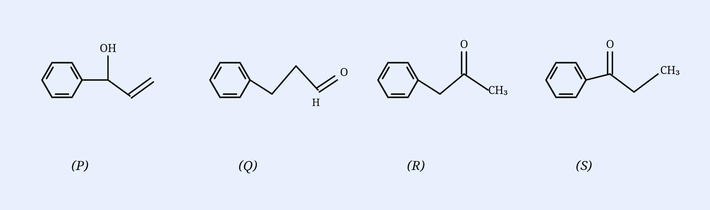
Given below are the four isomeric compounds (P, Q, R, S)
Identify correct statements from below.
A. Q, R and S will give precipitate with 2,4-DNP.
B. P and Q will give positive Baeyer's test.
C. Q and R will give sooty flame.
D. R and S will give yellow precipitate with .
E. Q alone will deposit silver with Tollen's reagent.
Choose the correct option.
Identify correct statements from below.
A. Q, R and S will give precipitate with 2,4-DNP.
B. P and Q will give positive Baeyer's test.
C. Q and R will give sooty flame.
D. R and S will give yellow precipitate with .
E. Q alone will deposit silver with Tollen's reagent.
Choose the correct option.
(1)
(2)
(3)
(4)
SolutionAnswer: Option 1
Approach:
The four isomers are P (1-phenylprop-2-en-1-ol, , allylic-benzylic alcohol with a vinyl group), Q (3-phenylpropanal, , aldehyde), R (1-phenylpropan-2-one, , methyl ketone) and S (1-phenylpropan-1-one, , ethyl ketone). Each diagnostic test is applied to every structure to judge statements A-E.
Step 1:Statement A: Q (aldehyde), R (ketone) and S (ketone) each contain a carbonyl group and give an orange precipitate with 2,4-DNP; P is an alcohol and gives none. A is correct.
Step 2:Statement B: Baeyer's reagent (cold dilute alkaline ) tests for an alkene C=C. P bears a vinyl group and decolourises it, but Q () has no carbon-carbon double bond, so the pair 'P and Q' is not jointly positive. B is incorrect.
Step 3:Statement C: Q and R are aromatic compounds with high carbon-to-hydrogen ratio and burn with a sooty (luminous) flame; the statement is a true observation. C is correct.
Step 4:Statement D: the iodoform test needs a or unit. R () has and is positive, but S () is an ethyl ketone lacking that unit and is negative, so the pair 'R and S' is not jointly positive. D is incorrect.
Step 5:Statement E: only an aldehyde reduces Tollens' reagent; Q is the sole aldehyde, so Q alone deposits silver. E is correct.
Final answer: A, C and E only
Q68Single correctOrganic Compounds Containing Nitrogen
Consider the following reactions giving major product. Identify the correct reaction
(1)
(2)
(3)
(4)
SolutionAnswer: Option 2
Approach:
Each drawn scheme is judged for whether its major product is the genuine outcome. Option 2 is the Hofmann bromamide degradation, the standard conversion of a primary amide to a primary amine with one fewer carbon; its balanced stoichiometry is checked. The remaining schemes are tested for the validity of their drawn products.
Step 1:Option 2: propanamide is degraded by and alkali, losing the carbonyl carbon to give ethylamine (a primary amine with one fewer carbon) together with , and water.
Step 2:Balance check of option 2: C , N , Br , K , O , H , all conserved, so the drawn equation is correct.
Step 3:Option 1 (benzanilide nitration) places the nitro group incorrectly on the acyl ring rather than where the strongly activating -NH-CO- amide nitrogen directs; option 3 does not regenerate benzylamine through the carbylamine intermediate as drawn; option 4 (Gabriel synthesis) cannot give aniline because aryl halides do not undergo nucleophilic substitution with potassium phthalimide. These schemes are wrong.
Final answer: Hofmann bromamide degradation:
Q69Single correctHydrocarbons
Consider the above reaction
A. The reaction proceeds through a more stable radical intermediate.
B. The role of peroxide is to generate (hydrogen radical).
C. During this reaction, benzene is formed as a byproduct.
D. 1-Bromo-2-phenylethane is formed as the minor product.
E. The same reaction in absence of peroxide proceeds via carbocation intermediate.
Identify the correct statements. Choose the correct answer from the options given below.
(1)
(2)
(3)
(4)
SolutionAnswer: Option 4
Approach:
Addition of HBr to styrene with benzoyl peroxide follows the anti-Markovnikov (peroxide/Kharasch) free-radical pathway, while without peroxide it follows the ionic Markovnikov pathway through a carbocation. Each statement is judged against the mechanism and the stability of the intermediates.
Step 1:Statement A: in the chain step a bromine radical adds to the terminal , generating the resonance-stabilised benzylic radical rather than the less stable primary radical, so the reaction proceeds through the more stable radical. A is correct.
Step 2:Statement B: the peroxide initiates the chain by decomposing into radicals that abstract H from HBr to generate bromine radicals (), which are the chain carriers; it does not generate hydrogen radicals. B is incorrect.
Step 3:Statement C: benzoyl peroxide decomposes via to phenyl radicals that abstract hydrogen from HBr, forming benzene () as a by-product of initiation. C is correct.
Step 4:Statement D: the benzylic radical abstracts H from HBr to give (1-bromo-2-phenylethane) as the major anti-Markovnikov product, so calling it the minor product is wrong. D is incorrect.
Step 5:Statement E: without peroxide, electrophilic addition of HBr proceeds by protonation to the more stable benzylic carbocation (Markovnikov), so the no-peroxide route is via a carbocation. E is correct.
Final answer: A, C & E only
Q70Single correctPrinciples Related to Practical Chemistry
Given below are two statements:
Statement I: Griss-Ilosvay test is used for the detection of nitrite ion, which involves the use of sulphanilic acid and -naphthylamine reagent.
Statement II: In the above test, sulphanilic acid is diazotized by the acidified nitrite ion, which on further coupling with -naphthylamine forms an azo-dye.
In the light of the above statements, choose the correct answer from the options given below
Statement I: Griss-Ilosvay test is used for the detection of nitrite ion, which involves the use of sulphanilic acid and -naphthylamine reagent.
Statement II: In the above test, sulphanilic acid is diazotized by the acidified nitrite ion, which on further coupling with -naphthylamine forms an azo-dye.
In the light of the above statements, choose the correct answer from the options given below
(1)
(2)
(3)
(4)
SolutionAnswer: Option 2
Approach:
The Griess-Ilosvay test for nitrite ion is examined for both its overall identity (reagents and purpose) and the detailed sequence (which species is diazotised and which couples). The standard mechanism is that acidified nitrite diazotises sulphanilic acid and the resulting diazonium salt couples with -naphthylamine to give a red azo dye; each statement is checked against this sequence.
Step 1:Statement I identifies the Griess-Ilosvay test as the detection of nitrite ion using sulphanilic acid and -naphthylamine, which is the correct description of the test. Statement I is true.
Step 2:Statement II describes the sequence: the acidified nitrite (as ) diazotises sulphanilic acid, and the diazonium salt couples with -naphthylamine to form an azo dye. This is the established mechanism of the test, so Statement II is also true.
Step 3:Both statements are correct and Statement II gives the mechanistic explanation underlying Statement I.
Final answer: Both Statement I and Statement II are true
Q71NumericalEquilibrium
Consider the dissociation equilibrium of the following weak acid:
If the pKa of the acid is 4, then the pH of 10 mM HA solution is ______.(Nearest integer)
Given: [The degree of dissociation can be neglected with respect to unity.]
If the pKa of the acid is 4, then the pH of 10 mM HA solution is ______.(Nearest integer)
Given: [The degree of dissociation can be neglected with respect to unity.]
SolutionAnswer: 3
Approach:
For a weak monoprotic acid where the degree of dissociation is negligible compared with unity, the hydrogen-ion concentration is the geometric mean of and the initial concentration C. The pH follows from the half-relation in and . Given and mM.
Step 1:Convert the data: gives , and 10 mM gives M.
Step 2:Compute the hydrogen-ion concentration with dissociation neglected against unity.
Step 3:Take the negative logarithm to obtain the pH.
Final answer:
Q72NumericalRedox Reactions and Electrochemistry
Consider the following redox reaction taking place in acidic medium:
If the Nernst equation for the above balanced reaction is
then the value of n is ____. (Nearest integer)
If the Nernst equation for the above balanced reaction is
then the value of n is ____. (Nearest integer)
SolutionAnswer: 24
Approach:
The n in the Nernst equation equals the total electrons transferred in the balanced overall reaction. Oxidation-state changes give the n-factor of the oxidant () and of the reductant (); balancing electrons gives the smallest whole-number coefficients, and the total electron transfer is the common multiple.
Step 1:Oxidation states: in the hydride H is and B is ; in B remains while the four hydrogens go from to . Each therefore loses electrons (n-factor 8).
Step 2:In chlorine is and in it is , so each gains electrons (n-factor 6).
Step 3:Equate electrons lost and gained using the least common multiple of 8 and 6, which is 24, giving 3 () and 4 (). The total electron transfer is 24.
Final answer:
Q73NumericalCoordination Compounds
X is the number of geometrical isomers exhibited by .
Y is the number of optically inactive isomer(s) exhibited by .
Z is the number of geometrical isomers exhibited by .
The value of X+Y+Z is ______.
Y is the number of optically inactive isomer(s) exhibited by .
Z is the number of geometrical isomers exhibited by .
The value of X+Y+Z is ______.
SolutionAnswer: 6
Approach:
Each coordination entity is analysed for its required isomer count from its geometry and ligand set: a square-planar [Mabcd] Pt complex (X, geometrical isomers), an octahedral chromium complex (Y, optically inactive isomers) and an octahedral cobalt complex (Z, geometrical isomers). The three counts are then summed.
Step 1: is square planar of type Mabcd (four different monodentate ligands); such a complex shows three geometrical isomers, defined by which ligand sits trans to each chosen one. Hence X = 3.
Step 2: is octahedral of type with two bidentate oxalate ligands and two chlorides; it exists as cis and trans forms. The cis form is chiral (optically active, pair) while the trans form has a plane of symmetry and is optically inactive. The number of optically inactive isomers is therefore one (the trans). Hence Y = 1.
Step 3: is octahedral of type ; the three identical ligands can occupy one face (facial, fac) or a meridian (meridional, mer), giving two geometrical isomers. Hence Z = 2.
Step 4:Add the three counts.
Final answer:
Q74NumericalPurification and Characterisation of Organic Compounds
0.53 g of an organic compound (x) when heated with excess of nitric acid (concentrated) and then with silver nitrate gave 0.75 g of silver bromide precipitate. 1.0 g of (x) gave 1.32 g of gas on combustion. The percentage of hydrogen in the compound (x) is ____%. [Nearest Integer]
[Given: Molar mass in H : 1, C : 12, Br : 80, Ag : 108, O : 16; Compound (x) ]
[Given: Molar mass in H : 1, C : 12, Br : 80, Ag : 108, O : 16; Compound (x) ]
SolutionAnswer: 4
Approach:
The compound contains only C, H and Br. The carbon percentage is found from the produced per gram of sample, the bromine percentage from the AgBr precipitate per gram of sample (Carius method), and the hydrogen percentage is obtained by difference.
Step 1:From 1.0 g of compound giving 1.32 g , the mass of carbon is g, so the carbon percentage is 36%.
Step 2:Molar mass of AgBr is . From 0.53 g of compound giving 0.75 g AgBr, the mass of bromine is g.
Step 3:The bromine percentage uses the 0.53 g sample.
Step 4:Hydrogen is the remainder after subtracting carbon and bromine.
Final answer:
Q75NumericalRedox Reactions and Electrochemistry
500 mL of 1.2 M KI solution is mixed with 500 mL of 0.2 M solution in basic medium. The liberated iodine was titrated with standard 0.1 M solution in presence of starch indicator till the blue color disappeared. The volume (in L) of consumed is ______. (Nearest integer)
SolutionAnswer: 3
Approach:
In basic medium permanganate is reduced from to (n-factor 3) while oxidising iodide to iodine. The liberated iodine is then reduced by thiosulphate (n-factor 1). By electron conservation through the iodine intermediate, the equivalents of permanganate equal the equivalents of thiosulphate, which gives the required thiosulphate volume.
Step 1:Moles of mol; in basic medium goes to (), n-factor 3, so its equivalents are . Iodide (0.6 mol available) is in excess, so permanganate is fully consumed.
Step 2:The electrons captured from iodide reappear when the liberated iodine is titrated by thiosulphate (n-factor 1), so equivalents of thiosulphate equal 0.3; set .
Step 3:Solve for the volume in litres.
Final answer:
Mathematics24 questions
Q1Single correctMatrices and Determinants
Let A,B and C be three matrices with real entries such that and . If and , then is
(1)
(2)
(3)
(4)
SolutionAnswer: Option 4
Approach:
Given , , and the product BC, the objective is where . The relations are used to express BC and CB as the same matrix, after which the linear system is solved.
Step 1:The data fix the matrices A,B,C with , , , and the target is the sum of components of the solution vector of . Expand .
Step 2:Substitute into and apply .
Step 3:Expand to obtain the companion relation for .
Step 4:Substitute into and apply , giving the same matrix as .
Step 5:Form the linear system from and eliminate by addition.
Step 6:Add the two components.
Final answer:
Q2Single correctStatistics and Probability
The mean and variance of 10 observations are 9 and 34.2, respectively. If 8 of these observations are 2,3,5,10,11,13,15,21, then the mean deviation about the median of all the10 observations is
(1)
(2)
(3)
(4)
SolutionAnswer: Option 4
Approach:
Ten observations have mean and variance with eight values listed. The two missing values are recovered from the sum and sum-of-squares conditions, all ten values are ordered, and the mean deviation about the median is computed.
Step 1:The known eight values sum to . With mean over ten observations the total is , so the two missing values satisfy the sum condition.
Step 2:Variance gives . The known eight squares sum to .
Step 3:Use the identity to find ab, then solve the pair.
Step 4:Order all ten values and take the median as the mean of the fifth and sixth terms.
Step 5:Sum the absolute deviations from the median and divide by ten.
Final answer:
Q3Single correctCo-ordinate Geometry
Let be the equation of a chord of the circle (in the closed half - plane ) of diameter 10 passing through the origin. Let be another circle described on the given chord as its diameter. If the equation of the chord of the circle , which passes through the point and is farthest from the center of , is then is equal to
(1)
(2)
(3)
(4)
SolutionAnswer: Option 1
Approach:
The chord through the origin meets circle (diameter ) at two points that form the diameter of . Its centre is found, then the chord through farthest from that centre, being perpendicular to the line joining the centre and the point, is determined and matched to .
Step 1:The circle of diameter in the half-plane through the origin is . Intersect with .
Step 2:Circle has this chord as diameter, so its centre is the midpoint of and .
Step 3:A chord through a fixed point is farthest from the centre when perpendicular to . Compute the slope of with .
Step 4:Write the chord of slope through and match with .
Final answer:
Q4Single correctVector Algebra
For three unit vectors a,b,c satisfying and , the positive value of k is
(1)
(2)
(3)
(4)
SolutionAnswer: Option 2
Approach:
For unit vectors a,b,c the first condition fixes the sum of pairwise dot products; this forces , which reduces the second magnitude condition to a one-vector equation solved for the positive k.
Step 1:Expand the first condition using .
Step 2:Substitute this into the norm of the vector sum.
Step 3:Rewrite the second condition with .
Step 4:Solve the absolute-value equation.
Step 5:Select the positive root.
Final answer:
Q5Single correctSequence and Series
The value of is
(1)
(2)
(3)
(4)
SolutionAnswer: Option 4
Approach:
The summand is split via into two factorial series; each is re-indexed to the expansion of and the contributions combined.
Step 1:Split the numerator and apply factorial reduction.
Step 2:Re-index the first series with , so .
Step 3:Re-index the second series with , so .
Step 4:Add the two contributions.
Final answer:
Q6Single correctPermutations and Combinations
Let S={1,2,3,4,5,6,7,8,9}. Let be the number of 9-digit numbers formed using the digits of the set such that only one digit is repeated and it is repeated exactly twice. Let be the number of 9-digit numbers formed using the digits of the set S such that only two digits are repeated and each of these is repeated exactly twice. Then:
(1)
(2)
(3)
(4)
SolutionAnswer: Option 2
Approach:
From , x counts nine-digit numbers with exactly one digit repeated twice and y counts those with exactly two digits each repeated twice. Both counts use selection of the repeated and single digits times the multinomial arrangement; their ratio gives the relation.
Step 1:For : a nine-digit number with one digit repeated twice uses eight distinct digits from . Choose the eight distinct digits, choose which one is doubled, then arrange nine positions with one identical pair.
Step 2:For : two digits each repeated twice use seven distinct digits. Choose the seven distinct digits, choose the two that are doubled, then arrange with two identical pairs.
Step 3:Form the ratio of the counts.
Step 4:Cross-multiply to obtain the relation.
Final answer:
Q7Single correctStatistics and Probability
A bag contains 10 balls out of which k are red and are black, where . If three balls are drawn at random without replacement and all of them are found to be black, then the probability that the bag contains 1 red and 9 black balls is:
(1)
(2)
(3)
(4)
SolutionAnswer: Option 1
Approach:
Each composition is treated as equally likely a priori. The likelihood of drawing three black balls is hypergeometric, and Bayes' theorem gives the posterior probability of the composition with one red and nine black ().
Step 1:With eleven equally likely compositions , the prior is and the likelihood of three black balls when are black is . The common factors and cancel, leaving counts proportional to .
Step 2:The composition one red, nine black corresponds to with weight .
Step 3:Sum the weights over all , equivalently over black count from to , using the hockey-stick identity.
Step 4:Apply Bayes' theorem and simplify.
Final answer:
Q8Single correctCo-ordinate Geometry
Let ABC be an equilateral triangle with orthocenter at the origin and the side BC on the line . If the co-ordinates of the vertex A are , then the greatest integer less than or equal to is:
(1)
(2)
(3)
(4)
SolutionAnswer: Option 1
Approach:
For an equilateral triangle the orthocentre, centroid and circumcentre coincide at the origin. The centroid divides the median from A to the midpoint M of BC in ratio , with A and M on opposite sides of the origin along the perpendicular to BC. The vertex is located and evaluated.
Step 1:The orthocentre O at the origin coincides with the centroid. The foot M of the perpendicular from O to is at distance OM.
Step 2:The unit normal to BC is . Since the line value at O is , M lies in the normal direction, .
Step 3:Confirm A lies on the perpendicular from O to BC (slope ): gives , which holds. Compute .
Step 4:Take the absolute value and apply the greatest-integer function.
Final answer:
Q9Single correctComplex Numbers and Quadratic Equations
If , where , are the roots of the equation such that , then the sum of all possible values of is
(1)
(2)
(3)
(4)
SolutionAnswer: Option 4
Approach:
The quadratic factors with roots and . Imposing for both orderings consistent with yields the admissible values of , whose sum is required.
Step 1:Factor the quadratic to read off the roots.
Step 2:For the ordering (requires ), impose the condition.
Step 3:For the ordering (requires ), impose the condition.
Step 4:Add the admissible values.
Final answer:
Q10Single correctIntegral Calculus
If , where C is the constant of integration, then is equal to
(1)
(2)
(3)
(4)
SolutionAnswer: Option 3
Approach:
The integrand is the exact derivative of , so ; evaluation at and gives the required difference.
Step 1:Differentiating reproduces the integrand, so the antiderivative is identified.
Step 2:Evaluate f at .
Step 3:Evaluate f at .
Step 4:Form the difference and factor by .
Final answer:
Q11Single correctComplex Numbers and Quadratic Equations
Let be a set of polynomials. Then the number of polynomials in S, which are divisible by , is
(1)
(2)
(3)
(4)
SolutionAnswer: Option 4
Approach:
Divisibility of the monic cubic by forces it to equal . Coefficient comparison fixes b and ties c to a; the natural-number triples within the bound are then counted.
Step 1:Since the cubic is monic, the quotient on division by is . Expand the product.
Step 2:Match coefficients with .
Step 3:Apply with . The value is admissible, and bounds a.
Step 4:Each admissible gives one valid triple ; count them.
Final answer:
Q12Single correctDifferential Equations
Let be the solution of the differential equation . If , then is equal to
(1)
(2)
(3)
(4)
SolutionAnswer: Option 2
Approach:
Dividing by and substituting converts the equation into a first-order linear ODE in t, solved by an integrating factor; the condition fixes the constant and is read off.
Step 1:Divide the equation by and use to obtain a relation in .
Step 2:Compute the integrating factor.
Step 3:Multiply through and integrate the exact derivative.
Step 4:Apply , so at .
Step 5:Evaluate at .
Final answer:
Q13Single correctIntegral Calculus
The area of the region is
(1)
(2)
(3)
(4)
SolutionAnswer: Option 3
Approach:
Givens: the region bounded by , , the hyperbola and . Target: its area. Method: determine the upper boundary as above the line , split the x-integration at the crossover, and integrate.
Step 1:The lower boundary is . The upper boundary is the smaller of and . Equating gives , so the curves cross at .
Step 2:Determine the x-range. The lower curve meets at , and the hyperbola meets at . For the top is ; for the top is .
Step 3:Integrate the first part from to with top and bottom .
Step 4:Integrate the second part from to with top and bottom .
Step 5:Add the two contributions and factor.
Final answer:
Q14Single correctSets, Relations and Functions
If , and , then is
(1)
(2)
(3)
(4)
SolutionAnswer: Option 3
Approach:
Givens: , , and . Target: . Method: take f linear, match coefficients to fix it, then evaluate the composition.
Step 1:Since the right side is quadratic and g is quadratic, f is linear. Apply .
Step 2:Substitute into and expand.
Step 3:Match the coefficient of and the coefficient of x.
Step 4:Write and evaluate .
Step 5:Compute .
Final answer:
Q15Single correctSequence and Series
The common difference of the A.P.: is 13 more than the common difference of the A.P.: . If , , and , then is equal to:
(1)
(2)
(3)
(4)
SolutionAnswer: Option 1
Approach:
Givens: , , , . Target: . Method: extract from two b-terms, get , then back out .
Step 1:Use to find the common difference of the b-series.
Step 2:The common difference of the a-series is more than .
Step 3:Express from .
Final answer:
Q16Single correctLimit, Continuity and Differentiability
The Value of
(1)
(2)
(3)
(4)
SolutionAnswer: Option 4
Approach:
Givens: the limit of as . Target: the limit value. Method: expand numerator and denominator to leading order in and take the ratio of coefficients.
Step 1:Convert the logarithm of the product into a sum and apply .
Step 2:Expand the denominator using .
Step 3:Form the ratio of leading terms.
Final answer:
Q17Single correctTrigonometry
If , , then
(1)
(2)
(3)
(4)
SolutionAnswer: Option 4tan A, tan C, tan B are in G.P
Approach:
Givens: with . Target: the progression relating . Method: reduce the relation to a product condition on the tangents.
Step 1:Isolate the first term.
Step 2:Multiply both sides by and use on the left and the product form on the right.
Step 3:Reducing the trigonometric identity yields a symmetric product relation among the tangents.
Step 4:Since is the geometric mean of and , the ordering is geometric.
Final answer: tan A, tan C, tan B are in G.P
Q18Single correctComplex Numbers and Quadratic Equations
Let z be a complex number such that and . Then the value of is equal to
(1)
(2)
(3)
(4)
SolutionAnswer: Option 3
Approach:
Givens: and . Target: . Method: identify the two circles, locate their unique common point, and evaluate the polynomial there.
Step 1:Read off the two circles: centre radius , and centre radius .
Step 2:Compute the distance between the centres.
Step 3:Since equals the sum of radii, the circles touch externally at the midpoint of .
Step 4:Compute and .
Step 5:Assemble the polynomial.
Final answer:
Q19Single correctThree Dimensional Geometry
If the distances of the point from the line along the lines and are equal, then is equal to
(1)
(2)
(3)
(4)
SolutionAnswer: Option 2
Approach:
Givens: point , the fixed line , and lines through P whose distances from P to the fixed line measured along and are equal. Target: . Method: find where and meet the fixed line, impose equal distances, and read off a,b,c.
Step 1:Intersect with the fixed line. A point on is ; matching x and y with gives and , so . The meeting point on the fixed line is .
Step 2:Intersect with the fixed line. A point on is ; matching gives and , so . The meeting point on the fixed line is .
Step 3:Impose equal distances from , taking the -coordinates of and on the fixed line as and .
Step 4:Use and with .
Step 5:Add the three values.
Final answer:
Q20Single correctIntegral Calculus
Let f be a polynomial function such that , for all . Then is equal to
(1)
(2)
(3)
(4)
SolutionAnswer: Option 1
Approach:
Givens: . Target: . Method: recover f via the substitution , then integrate the explicit polynomial.
Step 1:Express the right side in and substitute .
Step 2:Integrate from to .
Step 3:Simplify.
Final answer:
Q22NumericalTrigonometry
If , then the number of solutions of the equation is
SolutionAnswer: 1
Approach:
Givens: and the equation . Target: the number of solutions. Method: simplify k via complementary angles, reduce to an algebraic equation, and count roots inside the valid domain.
Step 1:Set . Since , the second angle is , so .
Step 2:Substitute and rewrite the right side using the identity.
Step 3:Take sine of both sides; .
Step 4:The roots are and ; the root lies outside the domain and is discarded.
Step 5:Confirm in the original equation.
Final answer:
Q23NumericalSequence and Series
In a G.P., if the product of the first three terms is 27 and the set of all possible values for the sum of its first three terms is , then is equal to
SolutionAnswer: 90
Approach:
Givens: a G.P. whose first three terms have product and whose set of possible first-three-term sums is . Target: . Method: use symmetric terms to fix the middle term, express the sum through , and apply its range to locate the excluded interval.
Step 1:Take the terms as . Their product is .
Step 2:Write the sum of the three terms.
Step 3:Apply or for real .
Step 4:Hence the values omits form the open interval , so and .
Step 5:Compute .
Final answer:
Q24NumericalIntegral Calculus
The value of is
SolutionAnswer: 210
Approach:
Givens: the sum . Target: its value. Method: evaluate in closed form using the symmetry of , reduce each summand, and sum the arithmetic series.
Step 1:For integer r, , so the symmetry rule applies with .
Step 2:Form each summand .
Step 3:Sum from to .
Final answer:
Q25NumericalCo-ordinate Geometry
For some , let the eccentricity and the length of the latus rectum of the hyperbola be and respectively, and let the eccentricity and the length of the latus rectum of the ellipse be and respectively. If , then is equal to
SolutionAnswer: 8
Approach:
Givens: hyperbola with eccentricity and latus rectum , ellipse with eccentricity and latus rectum , and the relation . Target: . Method: standardise both conics, apply the relation to fix , then substitute.
Step 1:Standardise the hyperbola as .
Step 2:Standardise the ellipse as with the major axis along y since .
Step 3:Apply the relation .
Step 4:At evaluate each element: , , , , .
Step 5:Simplify the quotient.
Final answer:
More JEE Main 2026 papers
- JEE Main 2026 — April 02, Shift 1
- JEE Main 2026 — April 02, Shift 2
- JEE Main 2026 — April 04, Shift 1
- JEE Main 2026 — April 04, Shift 2
- JEE Main 2026 — April 05, Shift 1
- JEE Main 2026 — April 05, Shift 2
- JEE Main 2026 — April 06, Shift 1
- JEE Main 2026 — April 06, Shift 2
- JEE Main 2026 — April 08, Shift 2
- JEE Main 2026 — January 21, Shift 1
- JEE Main 2026 — January 21, Shift 2
- JEE Main 2026 — January 22, Shift 1
- JEE Main 2026 — January 22, Shift 2
- JEE Main 2026 — January 23, Shift 1
- JEE Main 2026 — January 23, Shift 2
- JEE Main 2026 — January 24, Shift 1
- JEE Main 2026 — January 24, Shift 2
- JEE Main 2026 — January 28, Shift 2
Frequently Asked Questions
How many questions are in the JEE Main 2026 January 28, Shift 1 paper?
The JEE Main 2026 January 28, Shift 1 paper has 74 questions — Physics (25), Chemistry (25) and Mathematics (24). Every question is on this page with its correct answer and a step-by-step solution.
What is the marking scheme for JEE Main?
JEE Main awards +4 marks for each correct answer and −1 for a wrong answer, with 0 for questions left unattempted. The paper covers Physics, Chemistry and Mathematics.
Are the answer key and step-by-step solutions provided for the 2026 January 28, Shift 1 paper?
Yes — every question shows the correct answer (answer key) and a detailed step-by-step solution, free to read online.
Can I take the JEE Main 2026 January 28, Shift 1 paper as a timed mock test?
Yes. With a free JEEnify account you can attempt this exact paper as a timed test in the real exam interface, then see your score and weak-area analysis.
Solved this paper? Calculate your JEE Main scoremost important chaptersformula sheetsall free tools.