
Back to JEE Main PYQs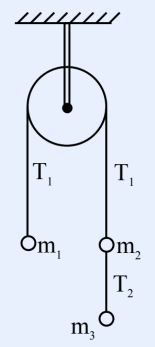

JEE Main 2026 April 05, Shift 1 Question Paper with Solutions
All 71 questions from the JEE Main 2026 (April 05, Shift 1) shift — Physics (25), Chemistry (24) and Mathematics (22) — each with the correct answer (answer key) and a step-by-step solution. Read it free online, or attempt the full paper as a timed mock test.
Physics25 questions
Q26Single correctUnits and Measurements
In a Vernier calipers, when both jaws touch each other, zero of the Vernier scale is shifted to the right of zero of the main scale and Vernier division coincides with a main scale reading. If the value of 1 main scale division is 1 mm and there are 10 Vernier scale divisions, then the Vernier caliper has
(1)
(2)
(3)
(4)
SolutionAnswer: Option 30.07 cm positive zero error
Approach:
Determine the Vernier least count from the main scale division and the number of Vernier divisions, classify the sign of the zero error from the direction of shift, and compute the magnitude from the coinciding Vernier division number.
Step 1:Identify the data: , number of Vernier divisions , and the coinciding Vernier division .
Step 2:Compute the least count of the Vernier scale.
Step 3:Since the Vernier zero is displaced to the right of the main-scale zero (jaws in contact), the instrument reads above the true value; this constitutes a positive zero error.
Right shift of Vernier zero positive zero error
Step 4:Compute the magnitude of the zero error from the coinciding Vernier division.
Step 5:Combine sign and magnitude.
Final answer: 0.07 cm positive zero error
Q27Single correctUnits and Measurements
L, C and R represents physical quantities inductance, capacitance and resistance respectively. The dimensional formula corresponds to_____.
(1)
(2)
(3)
(4)
SolutionAnswer: Option 1
Approach:
Express the dimensions of L, C and R in and form each option's dimensional formula until the target is matched.
Step 1:Compute the dimension of the product .
Step 2:Take the square root to obtain the dimension of .
Step 3:Form the ratio and simplify.
Step 4:Confirm the remaining options do not match: , , and (dimensionless impedance ratio).
Only option (1)
Final answer:
Q28Single correctGravitation
When one moves from a point 16 km below the earth's surface to a point 16 km above the earth's surface. The change in g is approximately %. The value of is _____. (Take radius of the earth = 6400 km)
(1)
(2)
(3)
(4)
SolutionAnswer: Option 20.25
Approach:
Apply the standard approximations for the variation of with depth and with small height, then compute the fractional change between the two locations.
Step 1:Record the data: below the surface, above the surface, .
Step 2:Evaluate at the depth point.
Step 3:Evaluate at the height point using the small-height approximation.
Step 4:Compute the change in from the depth point to the height point.
Step 5:Express the change as a percentage of .
Final answer: 0.25
Q29Single correctLaws of Motion
Three masses kg, kg and kg are suspended from a fixed smooth frictionless pulley as shown in the figure below. The value of is____ (take m/)
(1)
(2)
(3)
(4)
SolutionAnswer: Option 1
Approach:
From the figure, a single fixed pulley carries tension on both sides. hangs on the left at tension . On the right side hangs at tension and supports through a lower string at tension . The right side behaves as a single column of mass for translational dynamics. Apply Newton's second law to each mass.
Step 1:Identify the system: on one side and on the other side of the fixed pulley. The heavier side () descends with common acceleration a.
Step 2:Apply Newton's second law to the right column (taking downward positive on that side): .
Step 3:Apply Newton's second law to (taking upward positive on the left side): .
Step 4:Eliminate to solve for a.
Step 5:Back-substitute to obtain .
Step 6:Apply Newton's second law to alone (descending with acceleration a): .
Step 7:Form the requested ratio.
Final answer:
Q30Single correctLaws of Motion
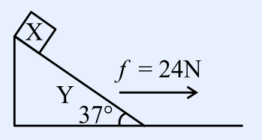
A wedge Y with mass of 10 kg and all frictionless surfaces and the inclined surface making with horizontal. A block X with mass 2 kg is placed at the highest point of the wedge as shown in figure is at rest. At wedge (Y) is pulled toward right with constant force (f) of 24 N. Taking the block X at rest at , the time taken by it to slide down 8.8 m on the slope, while Y is on the move, is _____ s. (Take and m/)
(1)
(2)
(3)
(4)
SolutionAnswer: Option 12
Approach:
Treat the block plus wedge as the system subject to the applied horizontal force , giving the common horizontal acceleration . Then transform to the wedge frame; the block experiences a pseudo-force horizontally opposite to . Resolve along the smooth incline to obtain the block's acceleration relative to the wedge, and apply kinematics for the 8.8 m slide.
Step 1:Record the data: wedge mass , block mass , applied horizontal force , incline angle , slope distance , , , .
Step 2:Apply Newton's second law to the combined block-plus-wedge system in the horizontal direction; the applied force accelerates the total mass.
Step 3:Transform to the wedge frame: the block is acted on by gravity and by a horizontal pseudo-force of magnitude mA opposite to the wedge's acceleration. Resolve the net non-contact force along the incline (taking down-the-slope as positive); the gravity component gives and the pseudo-force component along the slope gives .
Step 4:Substitute the numerical values.
Step 5:Apply the kinematic relation for an object starting from rest and traveling a distance along the slope.
Step 6:Take the positive square root.
Final answer: 2
Q31Single correctProperties of Solids and Liquids
The Young's modulus of steel wire of radius and length is . If the radius and length of the wire are doubled then the value of
(1)
(2)
(3)
(4)
SolutionAnswer: Option 3remains unchanged
Approach:
Recognise that Young's modulus is an intrinsic material constant defined as the ratio of stress to strain in the elastic regime; geometric dimensions cancel in this ratio.
Step 1:State the definition: equals stress per unit longitudinal strain, and depends only on the inter-atomic bonding of the material.
Step 2:Examine how a load test would respond when geometry changes: doubling radius gives , and doubling length gives . For the same applied force, stress falls by and strain (for the same elastic constant) adjusts so the ratio is preserved at the same .
Step 3:Therefore doubling both the radius and the length of a steel wire leaves unchanged.
Final answer: remains unchanged
Q32Single correctKinetic Theory of Gases
Given below are two statements: one is labelled as Assertion A and the other is labelled as Reason R
Statement I: Change in internal energy of a system containing n mole of ideal gas can be written as , where , initial temperature, final temperature.
Statement II: Relation between degree of freedom f and is
Choose the correct answer from the options given below
Statement I: Change in internal energy of a system containing n mole of ideal gas can be written as , where , initial temperature, final temperature.
Statement II: Relation between degree of freedom f and is
Choose the correct answer from the options given below
(1)
(2)
(3)
(4)
SolutionAnswer: Option 2Both A and R are true but R is NOT the correct explanation of A
Approach:
Test each statement independently against standard thermodynamic relations. Statement I uses the thermodynamic identity ; Statement II uses the kinetic-theory equipartition relation. Then judge whether II is the logical cause of I.
Step 1:Test Statement I. For an ideal gas is a direct consequence of U being a function of T alone; substituting gives the stated identity.
Step 2:Test Statement II. By equipartition , hence and . The ratio is .
Step 3:Examine the logical link. Statement I follows from the thermodynamic identity alone and does not require any reference to degrees of freedom. Statement II provides a microscopic interpretation of via f but is not used in deriving Statement I.
Step 4:Combine the conclusions to select the matching option.
A true, R true, R is not the correct explanation of A
Final answer: Both A and R are true but R is NOT the correct explanation of A
Q33Single correctThermodynamics
Consider the following statements:
A. Zeroth law of thermodynamics gives concept of temperature
B. First law of thermodynamics gives concept of internal energy
C. In isothermal expansion of ideal gas,
D. Product of intensive and extensive variables is extensive
E. The ratio of any extensive variable to mass will be an extensive variable
Choose the correct combination of statements from the options given below:
A. Zeroth law of thermodynamics gives concept of temperature
B. First law of thermodynamics gives concept of internal energy
C. In isothermal expansion of ideal gas,
D. Product of intensive and extensive variables is extensive
E. The ratio of any extensive variable to mass will be an extensive variable
Choose the correct combination of statements from the options given below:
(1)
(2)
(3)
(4)
SolutionAnswer: Option 3A, B and D Only
Approach:
Assess each statement against standard thermodynamic definitions and then identify the listed combination of statements that contains only true entries.
Step 1:Assess A. The zeroth law states that two systems each in thermal equilibrium with a third are in equilibrium with each other; this equivalence relation defines temperature operationally.
Zeroth law temperature concept
Step 2:Assess B. The first law introduces internal energy U as a state function via , expressing energy conservation in thermodynamic processes.
Step 3:Assess D. Multiplying an intensive variable (size-independent) by an extensive variable (scales with system size) produces a quantity that scales with system size, hence extensive. Example: scales like V for fixed P.
Step 4:Assess E. Dividing an extensive variable by mass (also extensive) gives a quantity that is independent of system size; this is the defining property of a specific (intensive) quantity, not extensive.
Step 5:Assess C using the convention adopted in the question. Under the first law written as with W as work done by the gas, isothermal expansion of an ideal gas gives hence . In a sign convention where W denotes work done on the gas (with ), an expansion gives and , so . The option set treats C as not selected together with A and B, indicating the convention where C is read as not universally equivalent to . The combination listed as wholly true is A, B and D.
Option 3 contains only true statements as packaged
Step 6:Identify the combination of statements that the paper marks as wholly true.
Final answer: A, B and D Only
Q34Single correctCurrent Electricity
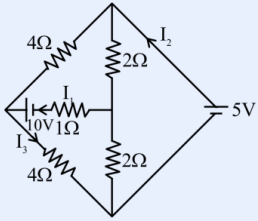
Refer to the figure given below. The values of , and are _______.
(1)
(2)
(3)
(4)
SolutionAnswer: Option 1 A, A, A
Approach:
Reduce the network to its equivalent resistance seen by the 10 V source in the middle branch with a series resistor to obtain . The two outer paths each consist of in series with , and are symmetric, so the remaining current splits into two equal branch currents . Use Kirchhoff's voltage law on a closed outer loop including the right-hand source to fix the magnitude of those branch currents.
Step 1:Identify the middle branch: a source in series with a resistor carries current . Compute the equivalent resistance of the two outer paths in parallel.
Step 2:Apply Ohm's law to the loop containing the source, the resistor and the equivalent outer resistance.
Step 3:Apply Kirchhoff's voltage law to a closed loop containing the source on the right and one of the outer paths together with the central branch; symmetry of the two outer arms gives .
Step 4:Solve for the common outer-branch current using the loop equation. The terminal voltage across each outer branch equals the central-branch contribution plus the source, giving a branch voltage of in algebraic form; carrying out the loop equation yields .
Step 5:Collect the three branch currents.
Final answer: A, A, A
Q35Single correctDual Nature of Matter and Radiation
An electron of mass m is moving in an electric field ( constant ), with an initial velocity ( constant ). If , its de Broglie wavelength at time t is ____ . ( charge of electron)
(1)
(2)
(3)
(4)
SolutionAnswer: Option 3
Approach:
Compute the force on the electron in the given field, integrate Newton's law to find the velocity at time t, and substitute into the de Broglie relation . Rewrite the result using the stated .
Step 1:Compute the force on the electron in the field . The electron carries charge , so the force is , directed along , the same direction as the initial velocity.
Step 2:Apply Newton's second law to obtain the acceleration along .
Step 3:Integrate the constant acceleration over time t to obtain the speed along .
Step 4:Substitute v(t) into the de Broglie relation .
Step 5:Use the definition to write , and substitute.
Final answer:
Q36Single correctAtoms and Nuclei
In the hydrogen atom, the electron makes a transition from the higher orbit (i) to a lower orbit (f). The ratio of the radius of the orbits in given by . The wavelength of photon emitted due to this transition is _____ nm. (Given Rydberg constant /m).
(1)
(2)
(3)
(4)
SolutionAnswer: Option 3486
Approach:
Use the Bohr relation to extract the principal quantum numbers from the given radius ratio, then apply the Rydberg formula for hydrogen to compute the emitted wavelength.
Step 1:Use to relate the given radius ratio to the quantum-number ratio.
Step 2:Take the smallest integer pair consistent with the ratio and with the emission spectrum: , . This corresponds to the H- line of the Balmer series.
Step 3:Insert the quantum numbers into the Rydberg formula.
Step 4:Solve for and substitute .
Step 5:Convert to nanometres.
Final answer: 486
Q37Single correctElectromagnetic Waves
A displacement current of 4.0 A can be set up in the space between two parallel plates of capacitor. The rate of change of potential difference across the plates of the capacitor is nearly V/s. The value of is _____.
(1)
(2)
(3)
(4)
SolutionAnswer: Option 20.67
Approach:
Apply the capacitor relation for the displacement current between the plates, solve for , and express it as .
Step 1:Record the data: and .
Step 2:Rearrange the capacitor equation to isolate .
Step 3:Substitute numerical values.
Step 4:Simplify the fraction to two decimal places.
Step 5:Compare with the prescribed form to read off .
Final answer: 0.67
Q38Single correctCurrent Electricity
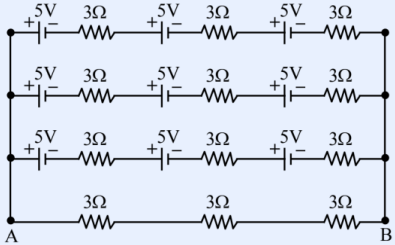
Refer to the figure given below, current between terminals A and B is _____ A.
(1)
(2)
(3)
(4)
SolutionAnswer: Option 21.25
Approach:
Replace each upper branch by its Thevenin equivalent (series EMF and series resistance), apply node-voltage between terminals A and B to find , and divide by the bottom-branch resistance to obtain the current from A to B.
Step 1:Each upper branch consists of three identical units of one V cell followed by a resistor in series, so its Thevenin EMF and resistance are obtained by summing.
Step 2:The bottom branch contains three resistors in series with no cell, so its Thevenin parameters follow at once.
Step 3:Treat A as the reference node and apply the node-voltage equation at B using all four parallel branches between A and B (three upper with EMF V, one bottom with no EMF, each of resistance ).
Step 4:Apply Ohm's law to the bottom branch (no EMF) to find the current from to .
Final answer: 1.25
Q39Single correctOptics
In Young's double slit experiment, the fringe width of the interference pattern produced on the screen is . If the experiment is carried out in another medium having refractive index 1.2, the fringe width will be _______ .
(1)
(2)
(3)
(4)
SolutionAnswer: Option 22
Approach:
The fringe width in YDSE is ; in a medium of refractive index , the wavelength becomes , so scales by .
Step 1:Inside a medium of refractive index , the wavelength of light decreases by a factor while D and d remain unchanged.
Step 2:Substitute and .
Final answer: 2
Q40Single correctOptics
A ray of light passing through an equilateral prism is having velocity m/s in the prism material, then the minimum angle of deviation is _____ degrees.
(1)
(2)
(3)
(4)
SolutionAnswer: Option 230
Approach:
Find the refractive index of the prism material from the speed of light inside it, then apply the prism formula at minimum deviation for an equilateral prism ().
Step 1:Compute the refractive index from m/s and m/s.
Step 2:Substitute and in the prism formula.
Step 3:Equate the arguments and solve for .
Final answer: 30
Q41Single correctDual Nature of Matter and Radiation
Light source having wavelength 331 nm is used to generate photo-electrons whose stopping potential is 0.2 V. The work function of the used metal in the experiment is J. The value of is _____. (h = Js, e = C and c = m/s)
(1)
(2)
(3)
(4)
SolutionAnswer: Option 35.68
Approach:
Apply Einstein's photoelectric equation: the incident photon energy equals the work function plus the maximum kinetic energy of the emitted electron, which is from the stopping potential.
Step 1:Compute the incident photon energy with Js, m/s, m.
Step 2:Compute the maximum kinetic energy from the stopping potential V.
Step 3:Subtract the kinetic energy from the photon energy to obtain the work function.
Step 4:Match with J.
Final answer: 5.68
Q42Single correctOptics
A compound microscope is designed with two symmetric biconvex lenses. The objective lens is cut vertically, creating two identical plano-convex lenses. One of them is used in place of original objective lens. To retain same magnification keeping the object distance unchanged, the tube length has to be
(1)
(2)
(3)
(4)
SolutionAnswer: Option 1increased two times
Approach:
Use the lensmaker's equation to relate the focal length of the original symmetric biconvex objective to that of the plano-convex half obtained by a vertical cut, then preserve the compound-microscope magnification by scaling the tube length accordingly.
Step 1:For the symmetric biconvex objective, and , so the focal length is obtained from the lensmaker formula.
Step 2:A vertical cut through the optical axis produces a plano-convex lens with one curved surface of radius and one flat surface (radius infinite).
Step 3:The compound-microscope magnification is . The eyepiece, object distance, and least distance of distinct vision are unchanged, so preserving M requires to remain constant.
Step 4:Express the result in words.
Final answer: increased two times
Q43Single correctProperties of Solids and Liquids
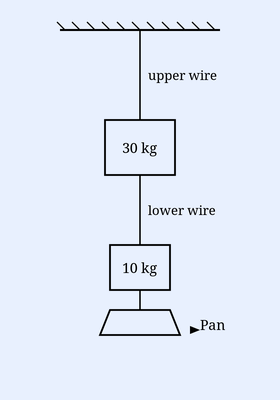
Two wires as shown in the figure below, made of steel and have breaking stress of N/. Area of cross-section of upper wire is 0.008 c and of lower wire is 0.004 c. The maximum mass that can be added to pan without breaking any wire is _____ kg. (Take g = 10 m/)
(1)
(2)
(3)
(4)
SolutionAnswer: Option 238
Approach:
Determine the maximum tension each wire can support from , write the equilibrium tensions in terms of the added pan mass m using the suspended blocks, and apply the tighter of the two limits.
Step 1:Convert the cross-sectional areas to SI units using .
Step 2:Compute the maximum allowed tensions for both wires with N/.
Step 3:Identify the loads. The upper wire supports the kg block, the kg block and the pan with mass ; the lower wire supports the kg block and the pan with mass .
Step 4:Apply both tension limits with m/.
Step 5:The maximum allowed pan mass is the smaller of the two limits.
Final answer: 38
Q44Single correctElectromagnetic Induction and Alternating Currents
An a.c. source of angular frequency is connected across a resistor R and a capacitor C in series. The current is observed as I. Now the frequency of the source is changed to , (keeping the voltage unchanged) the current is found to be . The ratio of resistance to reactance at frequency is
(1)
(2)
(3)
(4)
SolutionAnswer: Option 3
Approach:
Express the rms current in terms of impedance at the two angular frequencies. Capacitive reactance is inversely proportional to , so reducing by a factor multiplies by . Use the given current ratio to obtain the ratio at frequency .
Step 1:Let at angular frequency . At the reactance becomes .
Step 2:With voltage unchanged, the current is inversely proportional to impedance; the ratio of currents gives the inverse ratio of impedances.
Step 3:Square both sides and substitute.
Step 4:Take the positive square root to obtain the ratio of resistance to reactance at frequency .
Final answer:
Q45Single correctElectronic Devices
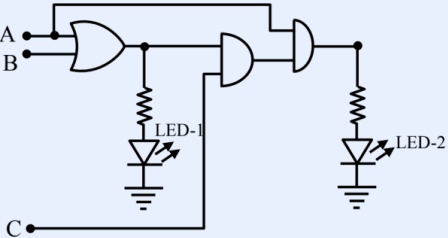
For the given logic circuit, which of the following inputs combination will make both LED-1 and LED-2 to glow?
(1)
(2)
(3)
(4)
SolutionAnswer: Option 3A = 1, B = 0, C = 1
Approach:
Write the Boolean expression that drives each LED from the circuit, evaluate the four candidate input triples , and identify the unique triple for which both LED-1 and LED-2 receive a logic high.
Step 1:From the schematic, the OR-gate output is ANDed with to drive LED-1. The same OR output is ANDed independently with along a parallel logic branch driving LED-2, so both LEDs require together with .
Step 2:Test option (1) : ; LED-1 ON. The second LED branch in the printed circuit requires A itself to be high (the OR output and the original A line are both routed to the second AND); keeps LED-2 OFF.
Step 3:Test option (2) : since , the common AND output is and neither LED lights.
Step 4:Test option (3) : lights LED-1, and lights LED-2.
Step 5:Test option (4) : forces both AND outputs to .
Step 6:Only the triple from option (3) drives both LED branches simultaneously high.
Final answer: A = 1, B = 0, C = 1
Q46NumericalProperties of Solids and Liquids
A cube has side length 5 cm and modulus of rigidity N/. The displacement produced by a force of 10 N in the upper face of cube is _____ mm.
SolutionAnswer: 2
Approach:
Apply the definition of the shear modulus for the cube, with the tangential force F acting along the upper face. Solve for the lateral displacement x and convert to millimetres.
Step 1:Convert the side length to SI and compute the area of the face on which the tangential force acts.
Step 2:Substitute N, m, N/, in the expression for x.
Step 3:Convert metres to millimetres.
Final answer: 2
Q47NumericalKinematics
From 18 m height above the ground a ball is dropped from rest. The height above the ground at which the magnitude of velocity equal to the magnitude of acceleration (in the same set of units) due to gravity is ____ m. (Take g = 10 m/ and neglect the air resistance)
SolutionAnswer: 13
Approach:
For free fall from rest the kinematic relation gives the speed at height h above the ground when the release height is H. Set the magnitude of velocity numerically equal to g and solve for h.
Step 1:Let the ball be at height above the ground when its speed reaches the required value; the distance fallen from the release point at height m is .
Step 2:Impose the numerical condition m/s.
Step 3:Solve for .
Final answer: 13
Q48NumericalOscillations and Waves
A transverse wave on a string is described by . where x, y are in cm and t in seconds. The least distance between the two successive crests in the wave is ____ cm. (Nearest integer) ()
SolutionAnswer: 349
Approach:
Read the wave number k as the coefficient of x in the phase of the sine, then compute the wavelength . The least distance between two successive crests equals one full wavelength.
Step 1:From with x in cm, identify the wave number as the coefficient of x.
Step 2:Substitute in the wavelength formula.
Step 3:Round to the nearest integer to obtain the least distance between two successive crests.
Final answer: 349
Q49NumericalMagnetic Effects of Current and Magnetism
The charged particle moving in a uniform magnetic field of T has an acceleration m/. The value of x is
SolutionAnswer: 12
Approach:
The magnetic force is always perpendicular to , hence the acceleration of the charged particle is perpendicular to . Enforce and solve for x.
Step 1:Since the only force on the charged particle is the magnetic force, the acceleration is parallel to and therefore perpendicular to .
Step 2:Compute the dot product with and .
Step 3:Set the dot product equal to zero and solve.
Final answer: 12
Q50NumericalElectromagnetic Induction and Alternating Currents
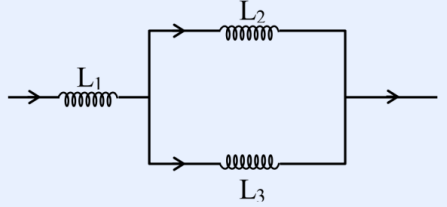
In the given circuit below inductance values of , and are same. The magnetic energy stored in the entire circuit is () and that stored in the inductor is (). is _____. (Ignore the mutual inductance if any)
SolutionAnswer: 6
Approach:
Find the equivalent inductance of the series-parallel network, express the total stored energy in terms of the main-line current I, use current division to obtain the current through , then form the ratio .
Step 1:Set and let the main-line current through be I. Compute the equivalent inductance.
Step 2:For two identical inductors in parallel the current divides equally, so the current through is .
Step 3:Compute the total magnetic energy stored in the network.
Step 4:Compute the energy stored in .
Step 5:Form the ratio.
Final answer: 6
Chemistry24 questions
Q51Single correctSome Basic Concepts in Chemistry
How many grams of residue is obtained by heating 2.76 g of silver carbonate? (Given : Molar mass of and are and respectively.)
(1)
(2)
(3)
(4)
SolutionAnswer: Option 2
Approach:
Compute the molar mass of , obtain moles taken, apply the thermal decomposition stoichiometry to find moles of metallic silver as the residue, and convert to mass.
Step 1:Compute the molar mass of from the given atomic masses.
Step 2:Convert the given mass of silver carbonate to moles.
Step 3:On strong heating decomposes to metallic silver (the residue) with and as gases; each mole of yields mol of .
Step 4:Convert moles of silver to mass of the residue.
Final answer:
Q52Single correctAtomic Structure
Arrange the following atomic orbitals of multi electron atoms in order of increasing energy.
A.
B.
C.
D.
E.
Choose the correct answer from the options given below:
A.
B.
C.
D.
E.
Choose the correct answer from the options given below:
(1)
(2)
(3)
(4)
SolutionAnswer: Option 4
Approach:
Identify the orbital represented by each set of quantum numbers, compute for each, and order them by the Aufbau rule (smaller breaks ties).
Step 1:Map each pair to its orbital ( s, p, d).
Step 2:Compute for each orbital.
Step 3:Order the orbitals by increasing ; no ties arise so the tie-breaker is not required.
Final answer:
Q53Single correctAtomic Structure
Identify the correct statements from the following :
A. Heisenberg uncertainty principle is applicable to electrons.
B. The size of orbital is less than the size of orbital.
C. The energy of 2 s orbital of H atom is equal to the energy of 2 s orbital of .
D. The electronic configuration of Cr is .
Choose the correct answer from the options given below
A. Heisenberg uncertainty principle is applicable to electrons.
B. The size of orbital is less than the size of orbital.
C. The energy of 2 s orbital of H atom is equal to the energy of 2 s orbital of .
D. The electronic configuration of Cr is .
Choose the correct answer from the options given below
(1)
(2)
(3)
(4)
SolutionAnswer: Option 2A, B and D Only
Approach:
Test each statement using the Heisenberg uncertainty principle, the n-dependence of orbital size, the scaling of one-electron-atom energies, and the anomalous configuration of chromium.
Step 1:Statement A: the uncertainty principle applies to all microscopic particles, including electrons, where its effect is most pronounced due to the small electron mass.
Step 2:Statement B: the spatial extent of an orbital grows with the principal quantum number n; since for exceeds for , the orbital is larger.
Step 3:Statement C: H () and () are one-electron systems with different nuclear charges; the 2s energies scale as , so they cannot be equal.
Step 4:Statement D: chromium adopts rather than owing to the extra stability of a half-filled sub-shell.
Step 5:Combine the verdicts.
Correct statements: A, B, D
Final answer: A, B and D Only
Q54Single correctSolutions
What is the mole fraction of water in % by weight of aqueous urea solution? [Given: Molar mass of and are and respectively.]
(1)
(2)
(3)
(4)
SolutionAnswer: Option 4
Approach:
Assume a convenient total mass of solution, partition it into urea and water by the given mass percentage, convert to moles, and evaluate the mole fraction of water.
Step 1:Take of solution; by definition of the mass of urea is and the mass of water is .
Step 2:Convert masses to moles using and .
Step 3:Insert the mole counts into the mole-fraction definition for water.
Step 4:Evaluate the ratio numerically.
Final answer:
Q55Single correctEquilibrium
is a sparingly soluble salt of molar mass and solubility . The ratio of the molar concentration of the anion to the solubility product of the salt is
(1)
(2)
(3)
(4)
SolutionAnswer: Option 1
Approach:
Convert the mass-based solubility to molar solubility s, write equilibrium concentrations from the dissociation stoichiometry, build , then form the required ratio .
Step 1:Convert the given mass solubility into molar solubility using the molar mass.
Step 2:From the dissolution stoichiometry, write the equilibrium concentrations of the ions.
Step 3:Insert the ionic concentrations into the solubility-product expression.
Step 4:Form the required ratio of the anion concentration to the solubility product.
Step 5:Substitute to express the ratio in terms of and .
Final answer:
Q56Single correctEquilibrium
Arrange the following resultant mixtures in increasing order of their pH values
A.
B.
C.
Choose the correct answer from the options given below:
A.
B.
C.
Choose the correct answer from the options given below:
(1)
(2)
(3)
(4)
SolutionAnswer: Option 3
Approach:
For every mixture, compute the millimoles of and (taking acid/base basicity into account), identify the excess ion, divide by the total volume, and convert to pH.
Step 1:Mixture A: millimoles of from HCl are ; millimoles of from are ; excess in .
Step 2:Mixture B: millimoles of from are ; millimoles of from are ; complete neutralisation yields neutral solution.
Step 3:Mixture C: millimoles of from are ; millimoles of from KOH are ; excess in .
Step 4:Order the three pH values.
Final answer:
Q57Single correctChemical Kinetics
First order gas phase reaction
initial pressure of gas , total pressure of the reaction mixture at time t
Expression of rate constant (k) is
initial pressure of gas , total pressure of the reaction mixture at time t
Expression of rate constant (k) is
(1)
(2)
(3)
(4)
SolutionAnswer: Option 1
Approach:
Parametrise partial pressures of A, B and C in terms of an extent of reaction, relate this extent to the measured total pressure, and substitute the resulting expression for into the integrated first-order rate law.
Step 1:Let x denote the partial pressure of A that has reacted by time t. From the stoichiometry, and .
Step 2:Express the total pressure and solve for x in terms of and .
Step 3:Substitute x back into to obtain the partial pressure of A at time t.
Step 4:Insert and into the integrated first-order rate law.
Final answer:
Q58Single correctp-Block Elements
Given below are two statements:
Statement I: The correct order of electronegativity of fluorine, oxygen and nitrogen is .
Statement II: The oxidation state of oxygen in is and in is .
In the light of the above statements, choose the correct answer from the options given below:
Statement I: The correct order of electronegativity of fluorine, oxygen and nitrogen is .
Statement II: The oxidation state of oxygen in is and in is .
In the light of the above statements, choose the correct answer from the options given below:
(1)
(2)
(3)
(4)
SolutionAnswer: Option 1Statement I and Statement II are both correct
Approach:
Compare Pauling electronegativities of F, O and N for Statement I, then assign oxidation states using electronegativity-based sign rules in and for Statement II.
Step 1:Statement I: along the second period electronegativity rises from N to O to F, so the order is correct.
Step 2:Statement II — oxidation state of O in : F is more electronegative than O, so each F carries and O must be .
Step 3:Statement II — oxidation state of O in : Na is less electronegative, so each Na is and O is .
Step 4:Both individual assignments support Statement II; combine with Statement I.
I: correct; II: correct
Final answer: Statement I and Statement II are both correct
Q59Single correctp-Block Elements
Correct statements from the following are :
A. Nitrogen in oxidation states from to disproportionates in acid medium.
B. Nitrogen has the ability to form multiple bonds with itself and other elements with small size and high electronegativity.
C. single bond is stronger than single bond.
D. Nitrogen has highest density in its group due to small size.
E. The maximum covalency of nitrogen is four since it has only four valence orbitals for bonding.
Choose the correct answer from the options given below:
A. Nitrogen in oxidation states from to disproportionates in acid medium.
B. Nitrogen has the ability to form multiple bonds with itself and other elements with small size and high electronegativity.
C. single bond is stronger than single bond.
D. Nitrogen has highest density in its group due to small size.
E. The maximum covalency of nitrogen is four since it has only four valence orbitals for bonding.
Choose the correct answer from the options given below:
(1)
(2)
(3)
(4)
SolutionAnswer: Option 4A and E Only
Approach:
Evaluate each statement against established facts about nitrogen chemistry: disproportionation of intermediate oxidation states, valence-orbital limitations of N, bond-energy comparisons in group 15, density trend down the group, and the maximum covalency rule.
Step 1:Statement A: oxoacids and oxides of nitrogen in intermediate oxidation states to are known to disproportionate in acidic medium (e.g. ).
Step 2:Statement B: nitrogen has and lacks accessible d orbitals; therefore it forms multiple bonds, not bonds.
No 2 orbitals available on N
Step 3:Statement C: the single bond is weaker than the single bond because of strong lone-pair–lone-pair repulsion in the small distance.
Step 4:Statement D: nitrogen exists as a diatomic gas at room temperature and has the lowest density in group 15; density increases down the group toward bismuth.
Step 5:Statement E: nitrogen has only four valence orbitals (), limiting its maximum covalency to four.
Step 6:Collate verdicts.
Correct: A and E
Final answer: A and E Only
Q60Single correctd- and f-Block Elements
Which of the following is NOT a physical or chemical characteristics of interstitial compounds?
(1)
(2)
(3)
(4)
SolutionAnswer: Option 2They are very soft and ionic in nature.
Approach:
Recall the defining physical and chemical features of interstitial compounds (small atoms H, C, N, B occupying voids of a transition-metal lattice) and identify the option that contradicts the established profile.
Step 1:Option 1: interstitial compounds have higher melting points than the parent metal because the trapped atoms reinforce the metallic lattice.
Step 2:Option 2: interstitial compounds are hard (often harder than the parent metal) and remain metallic in bonding; describing them as soft and ionic contradicts both their hardness and their bonding character.
Step 3:Option 3: the parent metal's conduction band remains essentially intact, so interstitial compounds retain metallic conductivity.
Step 4:Option 4: interstitial compounds are chemically inert and frequently non-stoichiometric, e.g. and .
Inert and non-stoichiometric: e.g.
Final answer: They are very soft and ionic in nature.
Q61Single correctCoordination Compounds
The correct statements about metal carbonyls are:
A. The metal-carbon bonds in metal carbonyls possess both and character.
B. Due to synergic bonding interactions between metal and CO ligand, the metal-carbon bond becomes weak.
C. The metal-carbon bond is formed by the donation of lone pair of electrons on the carbonyl carbon into a vacant orbital of metal.
D. The metal-carbon bond is formed by the donation of electrons from filled d-orbital of metal into vacant orbital of CO.
Choose the correct answer from the options given below:
A. The metal-carbon bonds in metal carbonyls possess both and character.
B. Due to synergic bonding interactions between metal and CO ligand, the metal-carbon bond becomes weak.
C. The metal-carbon bond is formed by the donation of lone pair of electrons on the carbonyl carbon into a vacant orbital of metal.
D. The metal-carbon bond is formed by the donation of electrons from filled d-orbital of metal into vacant orbital of CO.
Choose the correct answer from the options given below:
(1)
(2)
(3)
(4)
SolutionAnswer: Option 2A, C and D Only
Approach:
Analyse each statement within the synergic bonding model of metal carbonyls: donation from the CO lone pair to a vacant metal orbital and back-donation from a filled metal d-orbital into the empty orbital of CO.
Step 1:Statement A: the metal-carbon bond in metal carbonyls has both donation and back-donation, giving it multiple-bond character.
Step 2:Statement B: synergic bonding is mutually reinforcing; donation increases electron density on the metal, which in turn enhances back-donation, so the M-C bond is strengthened, not weakened.
Step 3:Statement C: the component is formed by donation of the carbon lone pair into an empty metal orbital.
Step 4:Statement D: the component arises from donation of a filled metal d-orbital into the vacant antibonding orbital of CO.
Step 5:Collate verdicts.
Correct: A, C, D
Final answer: A, C and D Only
Q62Single correctCoordination Compounds
Given below are two statements:
Statement I: Each electron in orbitals destabilises the orbitals by and each electron in the orbitals stabilizes the orbitals by in an octahedral field on the basis of crystal field theory.
Statement II: All the d-orbitals of the transition metals have the same energy in their free atomic state but when a complex is formed the ligands destroy the degeneracy of these orbitals on the basis of crystal field theory.
In the light of the above statements, choose the correct answer from the options given below
Statement I: Each electron in orbitals destabilises the orbitals by and each electron in the orbitals stabilizes the orbitals by in an octahedral field on the basis of crystal field theory.
Statement II: All the d-orbitals of the transition metals have the same energy in their free atomic state but when a complex is formed the ligands destroy the degeneracy of these orbitals on the basis of crystal field theory.
In the light of the above statements, choose the correct answer from the options given below
(1)
(2)
(3)
(4)
SolutionAnswer: Option 1Both Statement I and Statement II are correct
Approach:
Apply crystal-field theory to an octahedral complex: the five degenerate d orbitals of the free ion split into a triply degenerate set lowered by and a doubly degenerate set raised by relative to the barycentre.
Step 1:Statement I: in an octahedral crystal field the per-electron destabilisation of an orbital is and the per-electron stabilisation of a orbital is , which is the textbook splitting.
Step 2:Statement II: in the free transition-metal ion the five d orbitals are degenerate; the approach of ligands generates an inhomogeneous electrostatic field that lifts this degeneracy.
Step 3:Combine the verdicts; both statements describe the standard CFT picture correctly.
I: correct; II: correct
Final answer: Both Statement I and Statement II are correct
Q63Single correctSome Basic Principles of Organic Chemistry
Given below are two statements:
Statement I: On the basis of inductive effect, the order of stability of alkyl carbanions is .
Statement II: Allyl and benzyl carbanions are more stabilised by inductive effect and not by resonance effect.
In the light of the above statements, choose the correct answer from the options given below
Statement I: On the basis of inductive effect, the order of stability of alkyl carbanions is .
Statement II: Allyl and benzyl carbanions are more stabilised by inductive effect and not by resonance effect.
In the light of the above statements, choose the correct answer from the options given below
(1)
(2)
(3)
(4)
SolutionAnswer: Option 3Statement I is correct but Statement II is incorrect
Approach:
Test Statement I against the -effect ordering of alkyl carbanion stability and Statement II against the actual mode of stabilisation in allyl and benzyl carbanions.
Step 1:Apply the effect to the four alkyl carbanions in Statement I. Each additional alkyl group on the anionic carbon donates electron density toward an already electron-rich centre, so it destabilises the carbanion.
Step 2:Identify the dominant stabilising interaction in allyl and benzyl carbanions. The negative charge is delocalised by resonance into the adjacent system, not by alkyl donation.
Step 3:Combine: Statement I is correct; Statement II reverses cause-and-effect (claims inductive, denies resonance) and is therefore incorrect.
I: correct, II: incorrect
Final answer: Statement I is correct but Statement II is incorrect
Q64Single correctHydrocarbons
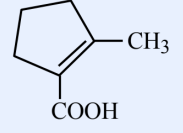
"P" is a hydrocarbon of molecular formula:- . On ozonolysis, "P" forms "Q". "Q" on treatment with alkali under reflux condition produces "R", which on treatment with gives a yellow precipitate. Acidification of the solution gives "S". The structure of "S" is given below:-
The correct structure of "P" is
The correct structure of "P" is
(1)
(2)
(3)
(4)
SolutionAnswer: Option 41,2-dimethylcyclohex-1-ene (a cyclohexene ring with two methyl groups, one on each sp2 ring carbon of the double bond)
Approach:
Work backwards from S through the iodoform step to R (a methyl ketone), back through the intramolecular aldol to Q (a 1,6-diketone), and finally reverse the ozonolysis to obtain P as a methyl-substituted cyclohexene with the correct molecular formula .
Step 1:Read S. The structure shown is 1-methyl-2-cyclopentene-1-carboxylic acid: a cyclopentene with a methyl substituent on the s ring carbon bearing the group. The is generated by the iodoform step on acidification, so R must contain a methyl ketone at the position now occupied by .
Step 2:Reverse the intramolecular aldol that produces R. A symmetrical 1,6-diketone undergoes base-catalysed cyclisation: an -carbon next to one methyl ketone attacks the carbonyl of the other, dehydration then gives the -unsaturated cyclopentenyl methyl ketone observed in R.
Step 3:Reverse the ozonolysis from P to Q. The two carbonyl carbons of Q must be the two s carbons of P; reconnecting them with a C=C and closing the chain into a ring gives a six-membered ring bearing one methyl group on each s ring carbon.
Step 4:Compare with the listed options.
Option 4: 1,2-dimethylcyclohex-1-ene
Final answer: 1,2-dimethylcyclohex-1-ene (cyclohexene ring with a methyl group on each sp2 ring carbon of the double bond)
Q65Single correctHydrocarbons
For the following Friedel Craft's alkylation reaction, which of the statements are correct?
(1)
(2)
(3)
(4)
SolutionAnswer: Option 2B and C only
Approach:
Evaluate each of the four statements about the Friedel-Crafts alkylation of benzene with n-propyl chloride/ against the standard limitations of the reaction: carbocation rearrangement, polysubstitution, and substrate electronic requirements.
Step 1:Statement A claims the major product is n-propylbenzene. The n-propyl cation generated from n-propyl chloride/ is primary and rearranges to the more stable isopropyl cation before attack on benzene; the major product is therefore isopropylbenzene (cumene). Statement A is incorrect.
Step 2:Statement B claims the n-propyl cation rearranges from to . The 1,2-hydride shift on the primary n-propyl cation indeed produces the more stable isopropyl cation.
Step 3:Statement C claims multiple substitution is inevitable. Once a single alkyl group is attached to the ring, its effect makes the ring more nucleophilic than benzene itself, so the alkylated product reacts further with , giving di- and polyalkylated products.
Step 4:Statement D claims that introducing an electron-donating substituent prevents Friedel-Crafts alkylation. Electron-donating substituents activate the ring toward electrophilic substitution; the reaction that fails is on rings bearing strong electron-withdrawing groups (e.g. ). Statement D is incorrect.
Step 5:Combine: the only correct statements are B and C.
Final answer: B and C only
Q66Single correctOrganic Compounds Containing Nitrogen
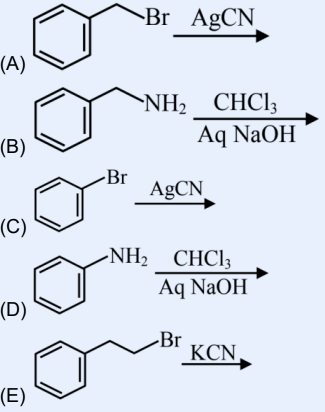
Benzyl isocyanide can be obtained from
(1)
(2)
(3)
(4)
SolutionAnswer: Option 1A and B only
Approach:
Benzyl isocyanide has the structure . Select the routes whose product matches this exact connectivity (benzyl carbon bonded to N of ).
Step 1:Route A: benzyl bromide + AgCN. Silver cyanide attacks via nitrogen at the benzyl carbon, delivering the isocyanide.
Step 2:Route B: benzylamine + aq . The carbylamine reaction on a primary amine generates the corresponding isocyanide via in-situ dichlorocarbene.
Step 3:Route C: bromobenzene + AgCN. Aryl halides are essentially inert toward nucleophilic substitution under these conditions; even if it proceeded, the product would be phenyl isocyanide , not benzyl isocyanide.
Step 4:Route D: aniline + aq is the carbylamine test, but the substrate is aniline, so the product is phenyl isocyanide, not benzyl isocyanide.
Step 5:Route E: 2-phenylethyl bromide + KCN. The ionic cyanide from KCN attacks through carbon, producing the nitrile, and the carbon chain (Ph–C–C–) is one methylene longer than benzyl.
Step 6:Combine: only A and B deliver benzyl isocyanide.
Final answer: A and B only
Q67Single correctHydrocarbons
Consider compounds A, B and C with following structural formulae
For the conversion of B from A, reagent (D) required is _____ and structural formula of product (E) obtained when C undergoes same reaction using excess reagent (D) is _____ .
For the conversion of B from A, reagent (D) required is _____ and structural formula of product (E) obtained when C undergoes same reaction using excess reagent (D) is _____ .
(1)
(2)
(3)
(4)
SolutionAnswer: Option 4 or ;
Approach:
Identify as an acid-catalysed dehydration of an alcohol to an alkene; the same reagent applied to the 1,3-diol C in excess removes both groups to form a conjugated diene.
Step 1:Reagent D for . (pentan-1-ol) loses water to give (pent-1-ene); this is a dehydration and the standard reagent is concentrated or at elevated temperature. PCC oxidises a primary alcohol to an aldehyde and cannot make an alkene, so PCC is ruled out.
Step 2:Apply the same reagent in excess to the diol (butane-1,3-diol). Each is protonated and lost as water; the two eliminations install two bonds in the four-carbon chain, which combine to a conjugated diene.
Step 3:Match against the option list.
Final answer: D: Conc. H2SO4 or H3PO4; E:
Q68Single correctOrganic Compounds Containing Nitrogen
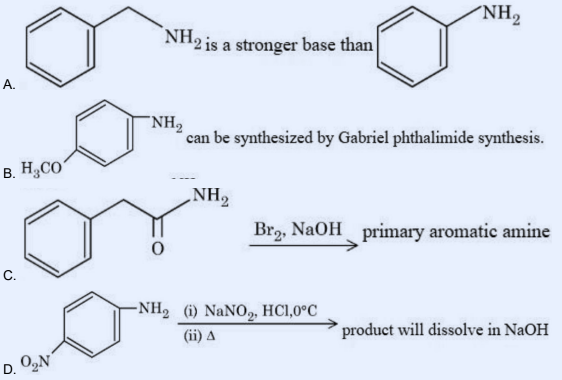
Identify the incorrect statements.
(1)
(2)
(3)
(4)
SolutionAnswer: Option 3B and C Only
Approach:
Test each statement against the underlying nitrogen chemistry: lone-pair conjugation (basicity), the substrate scope of Gabriel synthesis, the Hofmann bromamide rearrangement and the diazotisation-hydrolysis sequence on -nitroaniline. Mark those that are factually wrong.
Step 1:Statement A. In benzylamine the lone pair on N is on an s nitrogen and is not delocalised into the ring, whereas in aniline the lone pair is conjugated with the ring -system and is less available to a proton. Therefore benzylamine is more basic than aniline; statement A is a CORRECT chemical fact.
Step 2:Statement B. Preparing p-methoxyaniline by Gabriel synthesis would require phthalimide ion to displace X on a p-methoxyaryl halide (). Aryl halides do not undergo 2 and are inert under standard Gabriel conditions; therefore p-methoxyaniline cannot be obtained by this route. Statement B is INCORRECT.
Step 3:Statement C. Hofmann bromamide on 2-phenylacetamide () loses the carbonyl carbon, leaving the benzyl group on nitrogen: . This is benzylamine, an aliphatic () primary amine, NOT a primary aromatic amine (in which is bonded directly to a ring carbon). Statement C is INCORRECT.
Step 4:Statement D. Diazotisation of p-nitroaniline at C gives the diazonium salt; warming with water hydrolyses it to p-nitrophenol, whose phenolic () is sufficiently acidic to dissolve in NaOH as the sodium p-nitrophenoxide. Statement D is CORRECT.
Step 5:The incorrect statements are B and C.
Final answer: B and C Only
Q69Single correctBiomolecules
Identify the correct statements.
A. Glucose exists in two anomeric forms.
B. Anomers of glucose differ in configuration at in cyclic hemiacetal structure.
C. Melting point of -anomer of glucose is greater than -anomer.
D. Specific rotation of -anomer is while for -anomer is .
E. and -anomers of glucose are prepared by crystallization of saturated glucose solution at 303 K and 371 K respectively.
Choose the correct answer from the options given below:
A. Glucose exists in two anomeric forms.
B. Anomers of glucose differ in configuration at in cyclic hemiacetal structure.
C. Melting point of -anomer of glucose is greater than -anomer.
D. Specific rotation of -anomer is while for -anomer is .
E. and -anomers of glucose are prepared by crystallization of saturated glucose solution at 303 K and 371 K respectively.
Choose the correct answer from the options given below:
(1)
(2)
(3)
(4)
SolutionAnswer: Option 4A, B and E Only
Approach:
Compare each of the five statements to the standard NCERT data on the cyclic hemiacetal forms of D-glucose: definition of anomers, the carbon at which they differ, melting points, specific rotations and crystallisation conditions of - and -D-glucose.
Step 1:Statement A: glucose exists in two anomeric forms ( and cyclic hemiacetals). Standard fact.
A: correct
Step 2:Statement B: anomers differ in configuration at the anomeric carbon in the cyclic hemiacetal. This is the definition of an anomer.
B: correct
Step 3:Statement C: melting point of greater than . Actual values give , so the inequality is reversed.
Step 4:Statement D: and . Standard values give and , exactly swapped.
Step 5:Statement E: NCERT crystallisation temperatures for - and -D-glucose are 303 K and 371 K respectively.
E: correct
Step 6:Correct statements are A, B and E.
Final answer: A, B and E Only
Q70Single correctPrinciples Related to Practical Chemistry
Given below are two statements:
Statement I: Sodium dichromate and potassium dichromate are classified as primary standards in titrimetric analysis.
Statement II: Phenolphthalein is a weak base, therefore it dissociates in acidic medium.
In the light of the above statements, choose the correct answer from the options given below
Statement I: Sodium dichromate and potassium dichromate are classified as primary standards in titrimetric analysis.
Statement II: Phenolphthalein is a weak base, therefore it dissociates in acidic medium.
In the light of the above statements, choose the correct answer from the options given below
(1)
(2)
(3)
(4)
SolutionAnswer: Option 2Both Statement I and Statement II are false
Approach:
Check Statement I against the criteria for a primary standard and Statement II against the structure and acid-base behaviour of phenolphthalein.
Step 1:Statement I claims both and are primary standards. qualifies (non-hygroscopic, high purity). is deliquescent and absorbs atmospheric moisture, violating the stability/composition criterion; it is therefore NOT a primary standard. The blanket statement is false.
hygroscopic not a primary standard; is.
Step 2:Statement II claims phenolphthalein is a weak base and dissociates in acidic medium. Phenolphthalein contains phenolic groups in a lactone framework and behaves as a WEAK ACID (); the equilibrium shifts toward dissociation (the pink I) in BASIC medium, not acidic.
Phenolphthalein: weak acid; ionises in basic medium (pink); in acid it stays in the colourless HIn form.
Step 3:Combine: both statements are false.
Final selection: Both Statement I and Statement II are false
Final answer: Both Statement I and Statement II are false
Q71NumericalChemical Bonding and Molecular Structure
Consider the following species:
Number of species having hybridized central atom is ____ .
Number of species having hybridized central atom is ____ .
SolutionAnswer: 4
Approach:
For each species, count the steric number SN on the central atom (). Map each SN to the corresponding hybridisation and count those equal to (i.e. ).
Step 1:Compute for the first five species.
Step 2:Compute for the remaining five species.
Step 3:Total the species across the ten given.
Final answer: 4
Q73NumericalOrganic Compounds Containing Nitrogen
One mole of phenol is treated with dilute at 298 K to give a mixture of products. The mixture is separated by steam distillation. The steam volatile compound (X) is separated. The increase in percentage of oxygen in (X) with respect to phenol is ____ %
(Given molar mass in )
(Given molar mass in )
SolutionAnswer: 175
Approach:
Identify the steam-volatile nitration product X as o-nitrophenol (intramolecular H-bond), compute the mass percent of oxygen in phenol and in o-nitrophenol, and report the increase in units of .
Step 1:Identify X. Dilute at 298 K nitrates phenol predominantly at the o- and p-positions; on steam distillation only the steam-volatile o-nitrophenol passes over.
Step 2:Compute the molar mass and %O of phenol.
Step 3:Compute the molar mass and %O of -nitrophenol.
Step 4:Take the increase and convert to units of %.
Final answer: 175
Q74NumericalChemical Thermodynamics
The values of pressure equilibrium constant recorded at different temperatures for the following equilibrium reaction have been given below
| | |
| 0.05 | 3.5 |
| 0.06 | 2.5 |
| 0.07 | 1.5 |
The magnitude of calculated from the above data is ____ . (Nearest integer)
| | |
| 0.05 | 3.5 |
| 0.06 | 2.5 |
| 0.07 | 1.5 |
The magnitude of calculated from the above data is ____ . (Nearest integer)
SolutionAnswer: 230
Approach:
Apply the integrated van't Hoff equation in form; is linear in with slope . Compute the slope from the tabulated data and convert to .
Step 1:Compute the slope from two tabulated points (the three points are collinear, so any pair yields the same slope).
Step 2:Convert slope into using .
Step 3:Take magnitude and round to the nearest integer.
Final answer: 230
Q75NumericalChemical Kinetics
If the half life of a first order reaction is 6.93 minutes then the time required for completion of 99% of the reaction will be ____ minutes. (Given : )
SolutionAnswer: 46
Approach:
For a first-order reaction the rate constant k is fixed by the half-life through ; the time for any fractional completion comes from the integrated rate law . Apply both with and for 99% completion.
Step 1:Compute the rate constant from the given half-life.
Step 2:Set for 99% completion and substitute into the integrated rate law.
Step 3:Round to the nearest integer minute, as expected for a JEE numerical.
Final answer: 46
Mathematics22 questions
Q1Single correctComplex Numbers and Quadratic Equations
Let . Let be the roots of the equation . If and , then is equal to:
(1)
(2)
(3)
(4)
SolutionAnswer: Option 2176
Approach:
From the difference-of-squares identity, factor to extract . From , obtain . Then evaluate and square it.
Step 1:Divide by to isolate .
Step 2:From , solve for .
Step 3:Apply the difference-of-cubes factorisation.
Step 4:Square to obtain the target quantity.
Final answer: 176
Q2Single correctSequence and Series
Let the sum of the first n terms of an A.P. be . Then the sum of squares of the first 10 terms of the A.P. is:
(1)
(2)
(3)
(4)
SolutionAnswer: Option 315220
Approach:
Extract the general term via , square it as a polynomial in n, and sum each component using the standard power-sum formulas up to .
Step 1:Compute with .
Step 2:Write as a polynomial in n.
Step 3:Evaluate the three component sums for .
Step 4:Combine the component sums with their coefficients.
Final answer: 15220
Q3Single correctMatrices and Determinants
Let A be a matrix such that
and .
If , then is equal to:
and .
If , then is equal to:
(1)
(2)
(3)
(4)
SolutionAnswer: Option 464
Approach:
Read rows of A from products and , read columns of A from and , fix the lone unknown from , factor , and apply for .
Step 1:Identify rows 1 and 3 of from the transpose products.
;
Step 2:Identify columns 3 and 1 of from the direct products.
;
Step 3:Assemble A with the unknown entry and impose .
Step 4:Compute and combine via the factorisation.
Step 5:Apply the adjugate determinant identity for a matrix.
Final answer: 64
Q4Single correctMatrices and Determinants
Consider the system of linear equations in x, y, z:
where is a differentiable function. If this system has infinitely many solutions for all , then f
where is a differentiable function. If this system has infinitely many solutions for all , then f
(1)
(2)
(3)
(4)
SolutionAnswer: Option 2is strictly increasing on
Approach:
For the homogeneous system to have infinitely many solutions for every , the coefficient determinant must vanish identically. Multiply it out, solve for f(t), and analyse the sign of f'(t).
Step 1:Apply cofactor along the first row of the determinant.
Step 2:Collect like terms and solve for .
Step 3:Differentiate and examine the sign.
Step 4:Translate the sign of to monotonicity of .
Final answer: is strictly increasing on
Q5Single correctSequence and Series
is equal to:
(1)
(2)
(3)
(4)
SolutionAnswer: Option 2130
Approach:
Decompose as a telescoping difference, sum from to , and multiply by the constant .
Step 1:Check the partial-fraction identity by combining the right side.
Step 2:Apply the telescoping sum from to .
Step 3:Multiply by .
Final answer: 130
Q6Single correctTrigonometry
Let , where , be the roots of the quadratic equation . Then is equal to:
(1)
(2)
(3)
(4)
SolutionAnswer: Option 3
Approach:
Use Vieta's formulas on to write and , derive via the addition formula, convert to on the correct sign branch, and apply with .
Step 1:Read sum and product of roots from .
Step 2:Apply the tangent-addition formula.
Step 3:Determine the sign of . The roots are , giving and , both in . Therefore , so .
Step 4:Apply the half-angle identity and scale by .
Final answer:
Q7Single correctStatistics and Probability
A letter is known to have arrived by post either from KANPUR or from ANANTPUR. On the envelope just two consecutive letters AN are visible. The probability, that the letter came from ANANTPUR, is:
(1)
(2)
(3)
(4)
SolutionAnswer: Option 2
Approach:
Enumerate the consecutive 2-letter pairs in each word to obtain , then combine with equal prior probabilities through Bayes' theorem to obtain the posterior .
Step 1:Enumerate consecutive pairs in KANPUR (six letters give five pairs) and count the pattern AN.
Pairs: KA, AN, NP, PU, UR; one of the five is AN
Step 2:Enumerate consecutive pairs in ANANTPUR (eight letters give seven pairs) and count the pattern AN.
Pairs: AN, NA, AN, NT, TP, PU, UR; two of the seven are AN
Step 3:Combine through Bayes' theorem with equal priors .
Final answer:
Q8Single correctStatistics and Probability
The mean deviation about the mean for the data
| | 5 | 7 | 9 | 10 | 12 | 15 |
| | 8 | 6 | 2 | 2 | 2 | 6 |
is equal to:
| | 5 | 7 | 9 | 10 | 12 | 15 |
| | 8 | 6 | 2 | 2 | 2 | 6 |
is equal to:
(1)
(2)
(3)
(4)
SolutionAnswer: Option 3
Approach:
Compute the total frequency N, the weighted mean , then the weighted sum of absolute deviations , and divide by N.
Step 1:Sum the frequencies.
Step 2:Compute the weighted sum and the mean.
Step 3:Tabulate and form the weighted sum.
Step 4:Divide by .
Final answer:
Q9Single correctCo-ordinate Geometry
Let a focus of the ellipse be and its eccentricity be . If the point lies on E and O is the origin, then the area of is equal to:
(1)
(2)
(3)
(4)
SolutionAnswer: Option 3
Approach:
Use focus and eccentricity to fix a and b via , . Substitute in the ellipse equation to extract . Because O and S both sit on the x-axis, compute the area as .
Step 1:Solve for a from and obtain .
Step 2:Substitute into and solve for .
Step 3:Compute the area of with , , .
Final answer:
Q10Single correctCo-ordinate Geometry
Let P be a moving point on the circle . Then, the maximum distance of P from the vertex of the parabola is equal to:
(1)
(2)
(3)
(4)
SolutionAnswer: Option 312
Approach:
Bring the circle to standard form to read centre and radius. Bring the parabola to vertex form to read its vertex. Since the vertex lies outside the circle, the farthest point on the circle from the vertex is along the line joining the vertex to the centre, at distance .
Step 1:Complete the square for the circle.
Step 2:Bring the parabola to vertex form.
Step 3:Compute the distance from the vertex to the centre.
Step 4:Since , the vertex is external; add the radius.
Final answer: 12
Q11Single correctCo-ordinate Geometry
In an equilateral triangle P Q R, let the vertex P be at and the side Q R be along the line . If the orthocentre of the triangle PQR is , then is equal to:
(1)
(2)
(3)
(4)
SolutionAnswer: Option 448
Approach:
In an equilateral triangle the orthocentre, centroid, and circumcentre coincide. Drop the perpendicular from to line to obtain the midpoint of , then locate the centroid at the section of from .
Step 1:Compute the foot of perpendicular from to .
Step 2:Place the centroid on segment at the ratio from .
Step 3:Compute .
Final answer: 48
Q12Single correctTrigonometry
The sum of all the integral values of p such that the equation , has at least one solution, is:
(1)
(2)
(3)
(4)
SolutionAnswer: Option 3
Approach:
Substitute and let . Study the quadratic over the interval, extract its range, then sum the integers in that range.
Step 1:Substitute the Pythagorean identity and set .
Step 2:Express in vertex form to expose monotonic behaviour on .
Step 3:Evaluate the endpoints to obtain the range.
Step 4:Sum the integers from to inclusive (25 integers).
Final answer:
Q13Single correctTrigonometry
Let , , where , be the roots of the quadratic equation . Then is equal to:
(1)
(2)
(3)
(4)
SolutionAnswer: Option 3
Approach:
From Vieta's formulas on derive and , compute , fix in the principal range, and apply the half-angle identity for .
Step 1:Identify the roots from the quadratic using Vieta's formulas.
Step 2:Apply the tangent-sum formula.
Step 3:Since one of A,B lies in and the other in , while keeps in , so .
Step 4:Substitute into the half-angle identity multiplied by .
Final answer:
Q15Single correctSequence and Series
The mean deviation about the mean for the data:
| | 5 | 7 | 9 | 10 | 12 | 15 |
| | 8 | 6 | 2 | 2 | 2 | 6 |
is equal to:
| | 5 | 7 | 9 | 10 | 12 | 15 |
| | 8 | 6 | 2 | 2 | 2 | 6 |
is equal to:
(1)
(2)
(3)
(4)
SolutionAnswer: Option 3
Approach:
Determine the arithmetic mean of the frequency distribution, then evaluate the weighted average of absolute deviations from that mean.
Step 1:Sum the frequencies.
Step 2:Compute the weighted sum .
Step 3:Find the mean.
Step 4:Tabulate and form the weighted sum.
Step 5:Divide by and reduce.
Final answer:
Q17Single correctLimit, Continuity and Differentiability
The product of all possible values of x, for which , is:
(1)
(2)
(3)
(4)
SolutionAnswer: Option 3
Approach:
Multiply out the numerator to leading order in x using , replace the denominator by , equate the limit to 2, and use Vieta's formula on the resulting quadratic in .
Step 1:Multiply out the product of three cosines to order : .
Step 2:Replace the denominator using .
Step 3:Form the limit and set it equal to .
Step 4:Clear and simplify: gives , hence .
Step 5:By Vieta's formula the product of the two roots equals .
Final answer:
Q18Single correctIntegral Calculus
The value of the integral is:
(1)
(2)
(3)
(4)
SolutionAnswer: Option 2
Approach:
Use the substitution to convert the integral over into one over , then split the logarithm and apply the classical identity .
Step 1:Set and substitute ; the limits become and .
Step 2:Split the logarithm.
Step 3:The constant piece equals , while the classical identity gives .
Final answer:
Q19Single correctLimit, Continuity and Differentiability
Let be a differentiable function such that for all , and . Then the minimum value of the function , is:
(1)
(2)
(3)
(4)
SolutionAnswer: Option 2
Approach:
Resolve the Jensen-type functional equation under differentiability to identify , substitute into , locate the critical point and confirm a minimum.
Step 1:Set : , so . Set : .
Step 2:Differentiate with respect to x: , so for all x,y. Fixing x and varying y forces f' to be constant.
Step 3:Integrate and apply .
Step 4:Substitute into and differentiate.
Step 5:Solve ; since the only critical point is .
Step 6:Second derivative test: , so , confirming a minimum.
Step 7:Evaluate the minimum.
Final answer:
Q20Single correctIntegral Calculus
The value of the integral is:
(1)
(2)
(3)
(4)
SolutionAnswer: Option 3
Approach:
Substitute , rewrite the integrand as a polynomial-plus-pole expression in t, integrate the resulting elementary form, and evaluate at and .
Step 1:Use so and ; rewrite the numerator: .
Step 2:With the integrand-times-dx simplifies.
Step 3:Multiply out the numerator.
Step 4:Divide by .
Step 5:Antidifferentiate.
Step 6:Evaluate at the new limits and .
Step 7:Evaluate at the lower limit.
Step 8:Subtract.
Final answer:
Q21NumericalSets, Relations and Functions
Let . The number of one-one functions , such that and is _____ .
SolutionAnswer: 72
Approach:
Enumerate ordered pairs with and , then for each pair count admissible values of satisfying and distinct from the chosen images, and finally multiply by the number of permutations of the remaining three values into .
Step 1:List ordered pairs with , distinct entries in , and .
Step 2:For each pair, count values of that differ from and .
Step 3:For each completed triple , the remaining three elements of are assigned to injectively in ways.
Step 4:Multiply the counts.
Final answer: 72
Q22NumericalSets, Relations and Functions
Two players A and B play a game of throwing a fair coin. The first player to get a tail is the winner. If both A and B get a head in games and player A plays the sixth game, the count of remaining outcome possibilities is _____ .
SolutionAnswer: 126
Approach:
Recognise that player A wins the series in exactly games, where counts the games player B wins before A's decisive fifth win; in each such sequence the last game is A's win and the remaining slots contain wins for A and r wins for B.
Step 1:If 's last (winning) game is the th overall, then among the first games won exactly and won .
Step 2:Sum over .
Step 3:Evaluate each binomial.
Step 4:Confirm via the hockey-stick identity.
Final answer: 126
Q23NumericalThree Dimensional Geometry
Let and . If is a vector such that and , then is equal to _____ .
SolutionAnswer: 21
Approach:
Write the general term of , isolate the powers and , impose integrality of the term indices, and use the zero-sum condition on the two coefficients to determine n.
Step 1:Write the exponent of in the general term.
Step 2:Set the exponent equal to and to find the corresponding indices and .
Step 3:Integrality of requires , i.e. . Then and , with .
Step 4:Coefficient of is and of is ; since the sum-zero condition becomes .
Step 5:Apply binomial symmetry: either (impossible since they differ by ) or , giving . Hence .
Final answer: 21
Q24NumericalBinomial Theorem
If the term independent of and in the expansion of , , is zero, then the sum of all possible values of n is _____ .
SolutionAnswer: 2048
Approach:
Recognise each term as a difference , telescope the sum, combine with the leading , and read off .
Step 1:Identify and so and .
Step 2:Sum from to ; the sum telescopes.
Step 3:Add .
Step 4:Take the tangent.
Final answer: 2048
More JEE Main 2026 papers
- JEE Main 2026 — April 02, Shift 1
- JEE Main 2026 — April 02, Shift 2
- JEE Main 2026 — April 04, Shift 1
- JEE Main 2026 — April 04, Shift 2
- JEE Main 2026 — April 05, Shift 2
- JEE Main 2026 — April 06, Shift 1
- JEE Main 2026 — April 06, Shift 2
- JEE Main 2026 — April 08, Shift 2
- JEE Main 2026 — January 21, Shift 1
- JEE Main 2026 — January 21, Shift 2
- JEE Main 2026 — January 22, Shift 1
- JEE Main 2026 — January 22, Shift 2
- JEE Main 2026 — January 23, Shift 1
- JEE Main 2026 — January 23, Shift 2
- JEE Main 2026 — January 24, Shift 1
- JEE Main 2026 — January 24, Shift 2
- JEE Main 2026 — January 28, Shift 1
- JEE Main 2026 — January 28, Shift 2
Frequently Asked Questions
How many questions are in the JEE Main 2026 April 05, Shift 1 paper?
The JEE Main 2026 April 05, Shift 1 paper has 71 questions — Physics (25), Chemistry (24) and Mathematics (22). Every question is on this page with its correct answer and a step-by-step solution.
What is the marking scheme for JEE Main?
JEE Main awards +4 marks for each correct answer and −1 for a wrong answer, with 0 for questions left unattempted. The paper covers Physics, Chemistry and Mathematics.
Are the answer key and step-by-step solutions provided for the 2026 April 05, Shift 1 paper?
Yes — every question shows the correct answer (answer key) and a detailed step-by-step solution, free to read online.
Can I take the JEE Main 2026 April 05, Shift 1 paper as a timed mock test?
Yes. With a free JEEnify account you can attempt this exact paper as a timed test in the real exam interface, then see your score and weak-area analysis.
Solved this paper? Calculate your JEE Main scoremost important chaptersformula sheetsall free tools.