
Back to JEE Main PYQs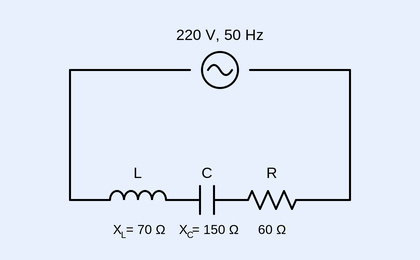
JEE Main 2026 January 24, Shift 1 Question Paper with Solutions
All 74 questions from the JEE Main 2026 (January 24, Shift 1) shift — Physics (24), Chemistry (25) and Mathematics (25) — each with the correct answer (answer key) and a step-by-step solution. Read it free online, or attempt the full paper as a timed mock test.
Physics24 questions
Q26Single correctProperties of Solids and Liquids
Density of water and are and respectively the increase in internal energy of of water when it is heated from to is ____ J. (specific heat capacity of water and atmospheric pressure )
(1)
(2)
(3)
(4)
SolutionAnswer: Option 1
Approach:
Heat absorbed at constant atmospheric pressure is reduced by the work done against the atmosphere during expansion, and the difference is the change in internal energy through the first law of thermodynamics.
Step 1:Given quantities: mass , specific heat , temperature rise , densities at and at , and . The target is the increase in internal energy .
Step 2:The heat supplied to raise the temperature follows from calorimetry.
Step 3:The volume increases because the density drops; the change in volume comes from the two densities.
Step 4:The water expands against the constant atmospheric pressure, doing work on the surroundings.
Step 5:Substituting into the first law gives the increase in internal energy.
Final answer:
Q27Single correctOptics
In a microscope of tube length , two convex len's are arranged with focal length of and Total magnification obtained with this system for normal advistament is the value of K is
(1)
(2)
(3)
(4)
SolutionAnswer: Option 3
Approach:
The total magnification of a compound microscope in normal adjustment is the product of the objective and eyepiece magnifications, which is then expressed as a power of five.
Step 1:Given tube length , objective focal length , eyepiece focal length , and least distance of distinct vision . The target is k in .
Step 2:Substituting the data into the magnification expression.
Step 3:Evaluating the product as a power of five.
Step 4:Comparing with the given form fixes the exponent.
Final answer:
Q28Single correctAtoms and Nuclei
Two electrons are moving in orbits of two hydrogen like atoms with speed and respectively. If the radii of these orbits are nearly same then, the possible order of energy states are ____ respectively
(1)
(2)
(3)
(4)
SolutionAnswer: Option 4 and
Approach:
The Bohr-model proportionalities for orbital speed and orbital radius are combined so that, for nearly equal radii, the principal quantum numbers follow the inverse ratio of the orbital speeds.
Step 1:Given orbital speeds and in two hydrogen-like atoms whose orbital radii are nearly equal. The target is the pair of principal quantum numbers (energy-state orders).
Step 2:Since energy varies as the square of the orbital speed, the energy ratio follows from the speed ratio.
Step 3:For nearly equal radii the energy ratio also equals the square of the inverse quantum-number ratio, since and together give at fixed radius.
Step 4:The smallest integer pair satisfying this ratio assigns the lower quantum number to the faster electron.
Final answer: and
Q29Single correctOptics
An unpolarised light is incident at an interface of two dielectric media having refractive indices of and respectively to satisfy the condition that reflected and refracted rays are perpendicular to each other, the angle of incidence is ___
(1)
(2)
(3)
(4)
SolutionAnswer: Option 2
Approach:
The requirement that the reflected and refracted rays are mutually perpendicular is the polarizing condition, so the angle of incidence equals the Brewster angle determined by the two refractive indices.
Step 1:Given the incidence medium index and the refraction medium index , with the reflected and refracted rays required to be perpendicular. The target is the angle of incidence.
Step 2:The perpendicularity of reflected and refracted rays is the Brewster (polarizing) condition, so the tangent of the angle is the index ratio.
Step 3:Inverting the tangent yields the polarizing angle.
Final answer:
Q30Single correctMagnetic Effects of Current and Magnetism
Match the list -1 with list-II
| List-I | List-II |
|---|---|
| A. Magnetic induction | I. |
| B. Magnetic flues | II. |
| C. Magnetic permeability | III. |
| D. Self induction | IV. |
(1)
(2)
(3)
(4)
SolutionAnswer: Option 4
Approach:
The dimensional formula of each magnetic quantity is derived from its defining relation and matched against the List-II entries.
Step 1:Magnetic induction is force per unit charge per unit velocity, giving its dimensions from , , .
Step 2:Magnetic flux is induction times area, multiplying the previous result by .
Step 3:From , permeability has dimensions .
Step 4:From the stored magnetic energy, self inductance has dimensions of energy per current squared.
Final answer:
Q31Single correctElectromagnetic Induction and Alternating Currents
For a series LCR circuit connected with a.c source as shown in the figure The power factory is the valve of is ___
(1)
(2)
(3)
(4)
SolutionAnswer: Option 3
Approach:
The impedance of the series LCR circuit is built from the net reactance and the resistance, and the power factor is the ratio of resistance to impedance, which is matched to the given form.
Step 1:From the figure the circuit has , and , driven at , . The target is in .
Step 2:The net reactance is the difference of the capacitive and inductive reactances.
Step 3:The impedance combines the net reactance and the resistance in quadrature.
Step 4:The power factor is the ratio of resistance to impedance.
Step 5:Equating to the given form fixes the constant.
Final answer:
Q32Single correctElectromagnetic Waves
Match the list -1 with list-II
| List-I | List-II |
|---|---|
| A. Ratio wave | I. Is produced by magnetron value |
| B. Micro wave | II. Due to change in vibrational modes of atoms |
| C. Infrared - wave | III. Due to inner shell electron moving from higher energy level to lower energy level |
| D. X-ray | IV. Due to rapid acceleration of chares |
(1)
(2)
(3)
(4)
SolutionAnswer: Option 1
Approach:
Each band of the electromagnetic spectrum is paired with the physical mechanism that generates it.
Step 1:Radio waves are emitted by oscillating currents in antennas, that is, by rapidly accelerating charges, pairing A with IV.
Step 2:Microwaves are generated in specialized vacuum tubes such as the magnetron, pairing B with I.
Step 3:Infrared radiation is emitted through changes in the vibrational modes of molecules, pairing C with II.
Step 4:X-rays are produced when inner-shell electrons drop from higher to lower energy levels, pairing D with III.
Final answer:
Q33Single correctOscillations and Waves
A cylindrical block of mass M and area of cross section A is floating in a liquid of density and with x-axis vertical when depressed a little an released the block starts oscillating the period of oscillation is ___
(1)
(2)
(3)
(4)
SolutionAnswer: Option 2
Approach:
A small vertical depression produces an extra buoyant force proportional to the displacement, which acts as a linear restoring force and yields the time period of simple harmonic motion.
Step 1:Given a floating cylinder of mass M and cross-sectional area A in liquid of density , displaced vertically by y from equilibrium. The target is the period of oscillation.
Step 2:Depressing the block by submerges an extra volume , and the additional upthrust opposes the displacement.
Step 3:Applying Newton's second law gives an acceleration proportional to and opposite the displacement, identifying simple harmonic motion.
Step 4:The period follows from the angular frequency.
Final answer:
Q34Single correctAtoms and Nuclei
Given below are two statements:
Statement -I :- For all elements, grater then mass of the nucleus, greater is the binding energy per nucleon
Statement -II :-For all elements, nuclei with less binding energy per nucleon transforms to nuclei with grater bonding energy per nucleon
In the light of the above statements, choose the correct answer from the option given below
Statement -I :- For all elements, grater then mass of the nucleus, greater is the binding energy per nucleon
Statement -II :-For all elements, nuclei with less binding energy per nucleon transforms to nuclei with grater bonding energy per nucleon
In the light of the above statements, choose the correct answer from the option given below
(1)
(2)
(3)
(4)
SolutionAnswer: Option 4Statement -I is false but Statement -II is true
Approach:
Each statement is judged against the known shape of the binding-energy-per-nucleon curve and the direction in which energy-releasing nuclear transformations proceed.
Step 1:The objective is to assign truth values to Statement-I (binding energy per nucleon rises with nuclear mass for all elements) and Statement-II (nuclei of lower binding energy per nucleon convert to nuclei of higher binding energy per nucleon).
Step 2:The binding-energy-per-nucleon curve increases up to mass number near 56 (iron region) and then decreases for heavier nuclei, so it is not monotonically increasing with mass; Statement-I is therefore false.
Step 3:Spontaneous and induced nuclear transformations (fusion of light nuclei, fission of heavy nuclei) move toward higher binding energy per nucleon, releasing energy; Statement-II is therefore true.
Step 4:Combining the two truth values selects the matching option.
Final answer: Statement -I is false but Statement -II is true
Q35Single correctElectrostatics
The electro static potential in a charged spherical region of radius r varies as . where a and b are constants. The total charge in the sphere of unit radius is . The value of is ______. (permittivity of vacuum is )
(1)
(2)
(3)
(4)
SolutionAnswer: Option 3
Approach:
The radial electric field is the negative gradient of the potential, and Gauss's law over the unit sphere relates the flux to the enclosed charge, which is compared with the given form.
Step 1:Given the radially symmetric potential with constants a,b inside the charged region. The target is in the enclosed charge at radius .
Step 2:Differentiating the potential gives the radial field.
Step 3:Applying Gauss's law over a sphere of radius relates the flux to the enclosed charge.
Step 4:Setting the radius to unity and comparing with the given form fixes the constant.
Final answer:
Q36Single correctElectrostatics
Three charges and are satiated at and respectively in the x y plane. The resultant dipole moment about origin is______.
(1)
(2)
(3)
(4)
SolutionAnswer: Option 3
Approach:
The resultant dipole moment about the origin is the vector sum of each charge multiplied by its position vector.
Step 1:Given charges at , at , and at in the xy-plane. The target is the resultant dipole moment about the origin.
Step 2:Each charge is multiplied by its position vector.
Step 3:Like components are combined.
Step 4:Factoring the common factor gives the compact form.
Final answer:
Q37Single correctCurrent Electricity
Two resistor's of each are connected in series with a battery a voltmeter of resistance is connected two measure the voltage drop a cross one of the resistance the voltmeter reading is______V
(1)
(2)
(3)
(4)
SolutionAnswer: Option 2
Approach:
The measured resistor is replaced by its parallel combination with the voltmeter, the resulting circuit current is found, and the voltmeter reading equals the voltage across that combination.
Step 1:Given two series resistors of across a battery, with a voltmeter of across one resistor. The target is the voltmeter reading.
Step 2:The voltmeter is in parallel with one resistor, lowering its effective resistance.
Step 3:The total circuit resistance is this parallel block in series with the other resistor, giving the current.
Step 4:The voltmeter reads the voltage across the parallel combination it spans.
Final answer:
Q38Single correctRotational Motion
Two masses 400g and 350g are suspended from the ends of a light string passing over a heavy pulley of radius 2 cm when released from rest the heavier mass is observed to fall 81 cm is 9s. The rotational inertia of the pulley is ___kg.. (g=9.8 m/)
(1)
(2)
(3)
(4)
SolutionAnswer: Option 3
Approach:
Newton's second law is applied to each suspended mass together with the rotational equation of the pulley, and the kinematics of the falling mass fixes the acceleration that determines the moment of inertia.
Step 1:State the given data: heavier mass kg, lighter mass kg, pulley radius m, fall distance m in time s starting from rest, with m/. The objective is the rotational inertia I of the pulley.
Step 2:Since the motion starts from rest, the linear acceleration of the falling mass follows from the displacement relation.
Step 3:Rearrange the system-acceleration relation to isolate the total effective inertia term.
Step 4:Subtract the mass term kg to leave the inertia contribution.
Step 5:Multiply by to obtain the moment of inertia.
Final answer:
Q39Single correctKinematics
A boy throw's a ball in to air at 4 from the horizontal to land on a roof of a building of height H. If the ball attains maximum height in 2s and land on the building in 3s after launch then the value of H is ___m (g=10 m/)
(1)
(2)
(3)
(4)
SolutionAnswer: Option 115
Approach:
The time to reach maximum height fixes the vertical launch speed, which is then used in the vertical displacement equation at the landing instant to give the roof height.
Step 1:State the given data: launch angle , time to apex s, landing time s, m/. The objective is the roof height H.
Step 2:At the apex the vertical velocity component is zero, so the initial vertical speed equals .
Step 3:Substitute the vertical launch speed into the displacement equation evaluated at the landing time s.
Step 4:Evaluate the difference to obtain the roof height.
Final answer: 15
Q40Single correctProperties of Solids and Liquids
A brass wire of length 2m and radius 1mm at 2c is held taut between two rigid supports initially it was cooled to temperature of -4c creating a tension T in the wire. The temperature to which the wire has to be cooled in order to increase the tension in it to 1.4T is ___c
(1)
(2)
(3)
(4)
SolutionAnswer: Option 3-71
Approach:
The thermal tension in a wire clamped between rigid supports is proportional to the temperature drop, so the ratio of two tensions equals the ratio of their temperature drops from the reference temperature.
Step 1:State the given data: reference temperature c, tension T at c, and the target temperature t at which the tension becomes . The objective is t.
Step 2:Since Y, A and are common to both states, form the ratio of the two thermal tensions using their drops from c.
Step 3:Cross-multiply to solve for the difference .
Step 4:Solve for the final temperature.
Final answer: -71
Q41Single correctGravitation
Three masses 200 kg, 300 kg and 400 kg are placed at the vertices of an equilateral triangle with sides 20 m. They are rearranged on the vertices of a bigger triangle of side 25 m and with same centre. The work done in this process is ___J. (Gravitational constant )
(1)
(2)
(3)
(4)
SolutionAnswer: Option 4
Approach:
The work done against gravity equals the change in the total gravitational potential energy of the three pairwise interactions as the common side length of the equilateral triangle increases.
Step 1:State the given data: masses kg, initial side m, final side m, N/k. In an equilateral arrangement all three pair separations equal the side length. The objective is the work done W.
Step 2:Sum the three pairwise mass products, common to both configurations.
Step 3:Compute the initial total potential energy at side 20 m.
Step 4:Compute the final total potential energy at side 25 m.
Step 5:Subtract the initial from the final energy to obtain the work done.
Final answer:
Q42Single correctCurrent Electricity
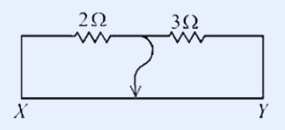
Two resistors and are connected in the gap of bridge as shown in fig the null point is obtained with the contact of jockey at some point on wire XY. When an unknown resistor is connected in parallel with resistor, the null point is shifted by 22.5cm towards Y. The resistance of unknown resistor is ___
(1)
(2)
(3)
(4)
SolutionAnswer: Option 42
Approach:
The metre-bridge balance condition is written for the original gap resistors and again after the unknown resistor is placed in parallel with the 3 ohm arm, and the shifted balance length determines the unknown resistance.
Step 1:State the given data: left-gap resistance , right-gap resistance , and a balance-point shift of cm towards Y after an unknown R is connected in parallel with the arm. The objective is R.
Step 2:Apply the balance condition to find the original balance length measured from X.
Step 3:A shift of cm towards Y increases the balance length.
Step 4:With the 3 ohm arm replaced by its parallel combination , apply the balance condition at the new length.
Step 5:Cross-multiply and solve for the unknown resistance.
Final answer: 2
Q43Single correctOscillations and Waves
A spring of force constant 15N/m is cut into two pieces If the ratio of their lengths is 1:3, then force constant of smaller pieces is ___N/m
(1)
(2)
(3)
(4)
SolutionAnswer: Option 360
Approach:
A spring's force constant is inversely proportional to its length, so the product of force constant and length is invariant when the spring is divided.
Step 1:State the given data: original force constant N/m and a length ratio for the two cut pieces. The objective is the force constant of the smaller piece.
Step 2:Express the length of the smaller piece in terms of the total length using the ratio.
Step 3:Conserve the product between the original spring and the smaller piece.
Final answer: 60
Q44Single correctOptics
The exit surface of prism with Refractive index n is coated with material having Refractive index n/2 when this prism is set for minimum angle of deviation It Exactly meet's the condition of critical angle, the prism angle is ___
(1)
(2)
(3)
(4)
SolutionAnswer: Option 2
Approach:
The critical angle at the coated exit surface is computed, equated to the internal refraction angle at minimum deviation, and combined with the prism relation to obtain the prism angle.
Step 1:State the given data: prism medium refractive index , coating refractive index , prism set at minimum deviation, and the exit ray meeting the critical-angle condition. The objective is the prism angle .
Step 2:Compute the critical angle at the boundary between the prism and the coating.
Step 3:At minimum deviation the two internal refraction angles are equal, and the ray meets the exit face exactly at the critical angle.
Step 4:Add the two internal refraction angles to obtain the prism angle.
Final answer:
Q45NumericalLaws of Motion
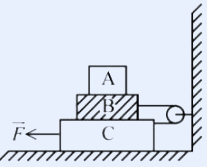
In the given figure the blocks A, B and C weigh 4 kg , 6 kg and 8 kg respectively. The co-efficient of sliding friction between any two surfaces is 0.5. The force F required to slide the block C with constant speed is ___N. (Use g=10 m/)
SolutionAnswer: 210
Approach:
Block C moves at constant speed so its net force is zero; the applied force balances the bottom-surface friction, the string tension transmitted through the wall-mounted pulley, and the top-surface friction from block A.
Step 1:State the given data: masses A kg, B kg (hanging), C kg, coefficient between every pair of surfaces, m/. The objective is the force F that slides C at constant speed.
Step 2:Friction between A and the top of C uses the normal force equal to the weight of A.
Step 3:Friction at the floor under C uses the normal force equal to the combined weight of A, B and C resting on the ground through C.
Step 4:Block A is held by the string over the pulley; its equilibrium relative to C requires the tension to overcome the friction on both of A's surfaces, namely N on top of C and the N friction associated with the load transmitted through it.
Step 5:Apply zero net force to block C: the applied balances the floor friction, the pulley tension reacting on C, and the N friction transmitted through C.
Final answer: 210
Q46NumericalElectronic Devices
A voltage regulating circuit consisting of Zener diode, having break-down voltage of 10 V and maximum power dissipation of 0.4 W, is operated at 15 V. The approximate value of protective resistance in this circuit is ___
SolutionAnswer: 125
Approach:
The maximum Zener current follows from the power rating at the breakdown voltage, and Ohm's law applied to the voltage dropped across the series protective resistor gives its resistance.
Step 1:State the given data: breakdown voltage V, maximum power dissipation W, supply voltage V. The objective is the series protective resistance R.
Step 2:Determine the Zener current corresponding to maximum power dissipation at the breakdown voltage.
Step 3:The same current flows through the series resistor, which carries the difference between the supply and breakdown voltages.
Final answer: 125
Q47NumericalKinetic Theory of Gases
A gas of certain mass filled in a closed cylinder at a pressure of 3.23 kPa has temperature 50 C. The gas is now heated to double its temperature. The modified pressure is ___Pa.
SolutionAnswer: 3730
Approach:
At constant volume the gas pressure is proportional to absolute temperature; doubling the Celsius reading gives the final state, and Gay-Lussac's law in kelvin yields the modified pressure.
Step 1:State the given data: initial pressure kPa Pa, initial temperature C, and a final temperature equal to double the initial Celsius value, namely C. The objective is the modified pressure .
Step 2:Convert both temperatures to the absolute scale.
Step 3:Apply the constant-volume pressure-temperature relation to obtain the final pressure.
Final answer: 3730
Q48NumericalMagnetic Effects of Current and Magnetism
A short bar magnet placed with its axis at 3 with an external field of 800 Gauss, experiences a torque of 0.016 N.m. The work done in moving it from most stable to most unstable position is . The value of is ___
SolutionAnswer: 64
Approach:
The torque relation fixes the product of dipole moment and field, and the work equals the difference in orientation energy between the most stable and most unstable positions.
Step 1:State the given data: axis angle with the external field, torque , and the work form J between the most stable and most unstable orientations. The objective is .
Step 2:Determine the product from the torque at 30 degrees.
Step 3:The most stable position is alignment and the most unstable is anti-alignment ; substitute into the work expression.
Step 4:Evaluate the work and write it in the required form.
Final answer: 64
Q49NumericalProperties of Solids and Liquids
Sixty four rain drops of radius 1 mm each falling down with a terminal velocity of 10 cm/s coalesce to form a bigger drop. The terminal velocity of bigger drop is ___ cm/s.
SolutionAnswer: 160
Approach:
Volume conservation during coalescence fixes the radius of the combined drop, and the terminal velocity, proportional to the square of the radius, gives the result.
Step 1:State the given data: identical drops of radius mm each with terminal velocity cm/s coalescing into one drop of radius R. The objective is the terminal velocity of the combined drop.
Step 2:Equate the total volume of the 64 small drops to the volume of the big drop.
Step 3:Apply the proportionality of terminal velocity to the square of the radius.
Step 4:Substitute the given small-drop terminal velocity.
Final answer: 160
Chemistry25 questions
Q50Single correctCoordination Compounds
Given below are two statements:
Statement-I: Hybridisation, shape and spin only magnetic moment of is , octahedral and 4.9 BM respectively.
Statement-II: Geometry, hybridisation and spin only magnetic moment values (BM) of the ions , and respectively are square planar, tetrahedral, octahedral; , , and 0, 5.9, 4.9.
In light of the above statements, choose the correct answer from the options given below
Statement-I: Hybridisation, shape and spin only magnetic moment of is , octahedral and 4.9 BM respectively.
Statement-II: Geometry, hybridisation and spin only magnetic moment values (BM) of the ions , and respectively are square planar, tetrahedral, octahedral; , , and 0, 5.9, 4.9.
In light of the above statements, choose the correct answer from the options given below
(1)
(2)
(3)
(4)
SolutionAnswer: Option 2Both S-I and S-II are true
Approach:
Assign the oxidation state and d-electron configuration of each metal centre, apply the ligand field strength to fix the spin state, then deduce hybridisation, geometry and spin-only magnetic moment for every complex named in the two statements.
Step 1:Statement-I requires the configuration of cobalt in and the configurations of the three ions of Statement-II. The target is to test the truth of each statement against valence bond theory.
Step 2:In cobalt carries a charge giving a configuration. Carbonate is a weak field ligand, so the set stays as with four unpaired electrons, forcing outer-orbital hybridisation and an octahedral shape.
Step 3:Substituting into the spin-only expression gives the moment quoted in Statement-I.
Step 4:For , nickel is (); the strong field pairs the electrons, leaving one vacant orbital and producing hybridisation, square planar geometry and zero unpaired electrons.
Step 5:For , manganese is (); the weak field leaves all five electrons unpaired, giving hybridisation and a tetrahedral shape.
Step 6:For the cobalt fluoro ion (, ) the weak field leaves four unpaired electrons, giving hybridisation, octahedral geometry and BM. Each geometry, hybridisation and moment in Statement-II is reproduced, so Statement-II is true.
Final answer: Both S-I and S-II are true
Q51Single correctChemical Bonding and Molecular Structure
Given below are statements about some molecules/ions.
Identify the CORRECT statements.
A. The dipole moment value of is higher than that of .
B. The dipole moment value of is zero.
C. The bond order of and is same.
D. The formal charge on the central oxygen atom of ozone is -1.
E. In , all the three atoms satisfy the octet rule, hence it is very stable.
Choose the correct answer from the options given below:
Identify the CORRECT statements.
A. The dipole moment value of is higher than that of .
B. The dipole moment value of is zero.
C. The bond order of and is same.
D. The formal charge on the central oxygen atom of ozone is -1.
E. In , all the three atoms satisfy the octet rule, hence it is very stable.
Choose the correct answer from the options given below:
(1)
(2)
(3)
(4)
SolutionAnswer: Option 1B & C only
Approach:
Test each lettered statement separately using dipole-moment vector addition, molecular-orbital bond-order counting, formal-charge calculation and octet analysis, then collect the correct statements.
Step 1:Five statements A to E are to be assessed and the subset that is correct selected. Both and are pyramidal with a lone pair on nitrogen.
Step 2:In the lone-pair dipole points the same way as the resultant of the three NH bond dipoles, so they add. In the bond dipoles point from N toward the more electronegative F, opposing the lone-pair dipole, so they subtract. Therefore has the larger dipole moment and statement A is false.
Step 3: is linear (, no lone pair on Be), so its two equal and opposite bond dipoles cancel exactly, giving a net dipole moment of zero. Statement B is true.
Step 4: and each carry 18 electrons. Filling the molecular orbitals gives bonding and antibonding electrons in both, so each has bond order and statement C is true.
Step 5:In ozone the central oxygen has one lone pair (2 electrons), one O=O double bond and one O-O single bond (6 bonding electrons total). Its valence electron count is 6, so the formal charge is , not . Statement D is false.
Step 6: has an odd total of 17 valence electrons, leaving an unpaired electron on nitrogen, which therefore carries seven electrons and does not complete its octet. Statement E is false.
Step 7:The true statements are B and C only.
Final answer: B & C only
Q52Single correctSome Basic Principles of Organic Chemistry
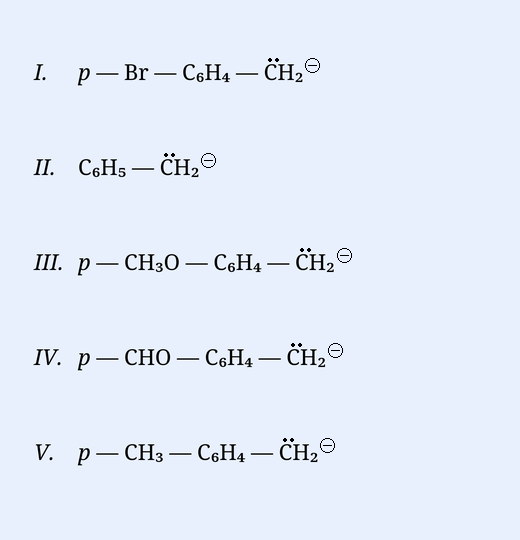
Arrange the following combinations in the decreasing order of stability
(1)
(2)
(3)
(4)
SolutionAnswer: Option 4IV > I > II > V > III
Approach:
Rank the five para-substituted benzylic carbanions by the electron-withdrawing or electron-donating power of the para substituent acting on the negatively charged benzylic carbon.
Step 1:The five species are para-substituted benzyl carbanions: I = p-Br, II = p-H (unsubstituted), III = p-OC, IV = p-CHO, V = p-C. The objective is the decreasing stability order of the carbanion.
Step 2:A carbanion bears a localised negative charge, so an electron-withdrawing group (, ) at the para position disperses that charge and stabilises the anion, while an electron-donating group intensifies the charge and destabilises it.
Step 3:The para-formyl group (IV) withdraws strongly by resonance (), delocalising the negative charge onto its oxygen, so it gives the most stable carbanion.
Step 4:Para-bromine (I) withdraws by the inductive effect, stabilising more than the unsubstituted carbanion (II), placing I above II.
Step 5:Para-methyl (V) donates by hyperconjugation and weak , destabilising the anion below the unsubstituted case, while para-methoxy (III) donates most strongly by resonance (), making III the least stable.
Step 6:Combining the partial orders gives the full decreasing stability sequence.
Final answer: IV > I > II > V > III
Q53Single correctOrganic Compounds Containing Nitrogen
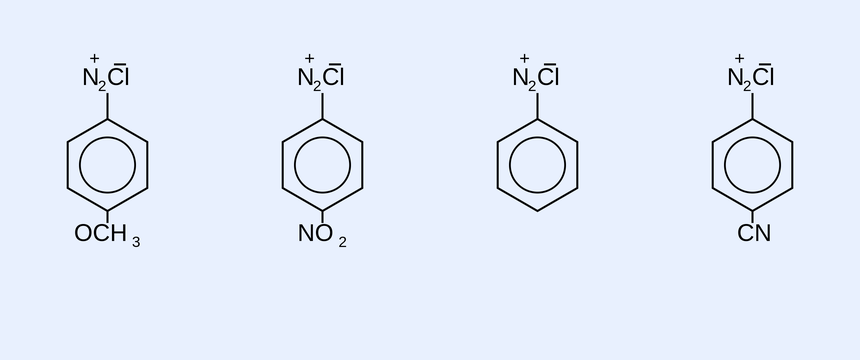
The correct stability order of the following diazonium salts is
(1)
(2)
(3)
(4)
SolutionAnswer: Option 3A > C > D > B
Approach:
Rank the four aryldiazonium cations by how the para substituent donates electron density toward the electron-deficient diazonium group, which governs salt stability.
Step 1:The four salts carry para substituents: A = p-OC, B = p-N, C = unsubstituted, D = p-CN. The objective is the decreasing stability order.
Step 2:The diazonium nitrogen bears a positive charge and is electron deficient, so an electron-donating group raises the electron density of the ring and stabilises the cation, whereas an electron-withdrawing group lowers it and destabilises the cation.
Step 3:Para-methoxy (A) donates strongly by resonance (), so it is the most stable; the unsubstituted salt (C) follows since it has neither donor nor acceptor.
Step 4:Both cyano and nitro withdraw electrons. Cyano (D) is the weaker acceptor while nitro (B) is the strongest electron acceptor, so D destabilises less than B.
Step 5:Combining the partial orders gives the decreasing stability sequence.
Final answer: A > C > D > B
Q54Single correctChemical Bonding and Molecular Structure
Among the following, the correct combinations are
A.
B.
C.
D.
Choose the correct answer from the options given below:
A.
B.
C.
D.
Choose the correct answer from the options given below:
(1)
(2)
(3)
(4)
SolutionAnswer: Option 1A, B and C only
Approach:
Apply VSEPR theory to each species by computing the steric number (bond pairs plus lone pairs) on the central atom, then assign hybridisation and shape and test each lettered combination.
Step 1:Four combinations of species, shape and hybridisation are to be tested. The central atom for A, B, C is iodine and for D is chlorine.
Step 2:Iodine in has 7 valence electrons; three form bonds with F and the remaining four form two lone pairs, giving . This is , hybridised, T-shaped. Statement A is correct.
Step 3:Iodine in uses five electrons in bonds with F, leaving one lone pair, giving . This is , hybridised, square pyramidal. Statement B is correct.
Step 4:Iodine in uses all seven valence electrons in bonds with F, leaving no lone pair, giving . This is , hybridised, pentagonal bipyramidal. Statement C is correct.
Step 5:In chlorine has four bonding regions to oxygen and no lone pair, giving , hybridisation and a tetrahedral shape, not square planar with . Statement D is false.
Step 6:The correct combinations are A, B and C only.
Final answer: A, B and C only
Q55Single correctChemical Thermodynamics
A D is an endothermic reaction occurring in three steps (elementary).
(i)
(ii)
(iii)
Which of the following graphs between potential energy (y-axis) vs reaction coordinate (x-axis) correctly represents the reaction profile of A D?
(i)
(ii)
(iii)
Which of the following graphs between potential energy (y-axis) vs reaction coordinate (x-axis) correctly represents the reaction profile of A D?
(1)
(2)
(3)
(4)
SolutionAnswer: Option 4Three-peak reaction profile in which intermediate B lies above reactant A (step i endothermic), C lies below B and D lies below C (steps ii and iii exothermic), with the final product D ending above the starting reactant A so that the overall A to D process is endothermic.
Approach:
Convert the sign of each step enthalpy into the relative energy levels of A, B, C and D, then select the three-peak profile whose level pattern matches every constraint.
Step 1:The given data are three elementary steps with , , , and an overall endothermic reaction . The objective is the energy-level ordering of A, B, C, D.
Step 2:Three elementary steps each pass through one transition state, so the profile must contain three activation peaks.
Step 3:Since step (i) has positive , the product of that step lies higher in energy than its reactant, so intermediate B is above A.
Step 4:Steps (ii) and (iii) have negative , so each product falls below its reactant, placing C below B and D below C.
Step 5:The overall reaction is endothermic, so the final product D sits above the starting reactant A. The matching profile rises to B, descends stepwise to C and D, yet ends above A.
Final answer: Three-peak reaction profile in which intermediate B lies above reactant A (step i endothermic), C lies below B and D lies below C (steps ii and iii exothermic), with the final product D ending above the starting reactant A so that the overall A to D process is endothermic.
Q56Single correctOrganic Compounds Containing Halogens
Given below are two statements
Statement-I: 'C - Cl' bond is strong in than
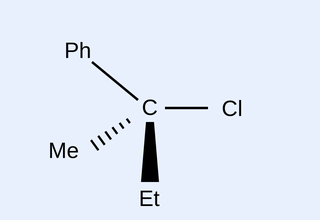
Statement-II: The given optically active molecule, on hydrolysis gives a solution that can rotate the plane polarized light.
In the light of the above statements, choose the correct answer from the options given below.
Statement-I: 'C - Cl' bond is strong in than
Statement-II: The given optically active molecule, on hydrolysis gives a solution that can rotate the plane polarized light.
In the light of the above statements, choose the correct answer from the options given below.
(1)
(2)
(3)
(4)
SolutionAnswer: Option 3Both S-I and S-II are true
Approach:
Compare the C-Cl bond character in vinyl chloride against ethyl chloride for Statement-I, and analyse the chirality of the hydrolysis product of the depicted stereocentre for Statement-II.
Step 1:Two statements are to be judged. The depicted substrate is a carbon bonded to four different groups: phenyl, methyl, ethyl and chlorine.
Step 2:In the chlorine lone pair conjugates with the adjacent , giving the C-Cl bond partial double-bond character on an carbon. This shortens and strengthens the bond relative to the C-Cl bond on the carbon of . Statement-I is true.
Step 3:The substrate carbon carries four different groups (Ph, Me, Et, Cl), so it is a stereocentre and the molecule is optically active.
Step 4:Hydrolysis replaces Cl by OH, producing a carbinol carbon still bonded to four different groups (Ph, Me, Et, OH). This product is itself chiral, so its solution rotates plane-polarised light. Statement-II is true.
Step 5:Both statements are true, selecting the corresponding option.
Final answer: Both S-I and S-II are true
Q57Single correctOrganic Compounds Containing Halogens
Match List-I with List-II
| List-I (Chloro derivative) | List-II (Example) |
|---|---|
| A. Vinyl Chloride | I. |
| B. Benzyl Chloride | II. |
| C. Alkyl Chloride | III. |
| D. Allyl Chloride | IV. |
(1)
(2)
(3)
(4)
SolutionAnswer: Option 4A-III, B-IV, C-II, D-I
Approach:
Match each named chloro derivative in List-I to its structural example in List-II by recognising the position of the chlorine relative to the double bond or the aromatic ring.
Step 1:List-I names four classes (vinyl, benzyl, alkyl, allyl chloride) and List-II gives four structures (I: ; II: ; III: ; IV: benzene ring with a CHCl carbon bearing a ). The objective is the correct pairing.
Step 2:Vinyl chloride carries chlorine directly on a doubly bonded () carbon, which is the structure , item III.
Step 3:Benzyl chloride has chlorine on a benzylic carbon attached to the aromatic ring, which is the ring-bearing structure of item IV.
Step 4:An alkyl chloride bears chlorine on a saturated carbon with no neighbouring unsaturation, which is , item II.
Step 5:Allyl chloride bears chlorine on the carbon adjacent to a double bond, which is , item I.
Step 6:Collecting the pairs gives the complete match.
Final answer: A-III, B-IV, C-II, D-I
Q58Single correctCoordination Compounds
Consider a mixture 'X' which is made by dissolving 0.4 mol of and 0.4 mol of in water to make 4 L of solution. When 2 L of mixture 'X' is allowed to react with excess of , it forms precipitate 'Y'. The rest 2 L of mixture 'X' reacts with excel to form precipitate 'Z'. which of the following statements is CORRECT?
(1)
(2)
(3)
(4)
SolutionAnswer: Option 20.2 mol of 'Z' is formed
Approach:
Identify the free counter-ion released by each ionisation isomer, find the moles available in each 2 L portion, then apply precipitation stoichiometry to evaluate each statement.
Step 1:The 4 L mixture contains 0.4 mol and 0.4 mol . The objective is to determine the moles and identity of precipitates Y (with ) and Z (with ) from each 2 L half.
Step 2:In the sulphate is inside the coordination sphere, so bromide is the free counter-ion. This releases 0.4 mol into 4 L.
Step 3:In the bromide is coordinated, so sulphate is the free counter-ion. This releases 0.4 mol into 4 L.
Step 4:Each 2 L portion is half of the 4 L mixture, so it contains 0.2 mol free and 0.2 mol free .
Step 5:Excess precipitates the free bromide as Y = AgBr (0.2 mol). Excess precipitates the free sulphate as Z = (0.2 mol). The coordinated and Br stay in their spheres and do not precipitate.
Step 6:Testing the options: 0.1 mol Y is wrong (it is 0.2), 0.4 mol Z is wrong (it is 0.2), and the identities in option 4 are swapped. Only 0.2 mol of Z is correct.
Final answer: 0.2 mol of 'Z' is formed
Q59Single correctPrinciples Related to Practical Chemistry
Consider three metal chlorides x, y and z, where x is water soluble at room temperature, y is sparingly soluble in water at room temperature and z is soluble in hot water. x, y and z re respectively
(1)
(2)
(3)
(4)
SolutionAnswer: Option 2 and
Approach:
Match each of the three solubility descriptions (freely soluble at room temperature, sparingly soluble at room temperature, soluble only in hot water) to a metal chloride, then test which option satisfies all three simultaneously.
Step 1:Three roles are defined: x is freely soluble in cold water, y is sparingly soluble in cold water, and z dissolves only on heating. The objective is to assign each role to a chloride that uniquely fits.
Step 2:Copper(II) chloride is a typical freely soluble chloride in cold water, fitting role x.
Step 3:Silver chloride has a very low solubility product () and is sparingly soluble in cold water, fitting role y.
Step 4:Lead(II) chloride is only sparingly soluble in cold water but its solubility rises strongly with temperature, so it dissolves appreciably in hot water and is recovered on cooling, fitting role z.
Step 5:Option 2 assigns , , , satisfying all three descriptions cleanly. Options 1 and 4 require or (both freely soluble in cold water) to fill the hot-water-only role, and option 3 makes AgCl the freely soluble salt, both of which conflict with standard solubility behaviour.
Final answer: and
Q60Single correctOrganic Compounds Containing Oxygen
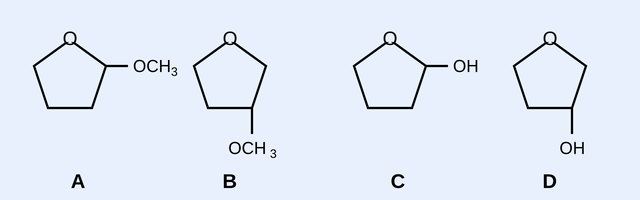
A student is given one compound among the following compounds that gives positive test with Tollen's reagent.
The compound is
The compound is
(1)
(2)
(3)
(4)
SolutionAnswer: Option 3C
Approach:
Recognise that a positive Tollen's silver-mirror test requires an aldehyde, then identify which ring structure is a cyclic hemiacetal that ring-opens to an aldehyde.
Step 1:Four tetrahydrofuran-type rings are given: A has OC on the carbon next to ring oxygen (2-position), B has OC at the 3-position, C has OH on the carbon next to ring oxygen (2-position), D has OH at the 3-position. The objective is the one giving a positive Tollen's test.
Step 2:Tollen's reagent oxidises aldehydes to give a silver mirror. A carbon bearing both an (ring oxygen) and an on the same atom is a hemiacetal, and it equilibrates with the open-chain hydroxy-aldehyde, exposing a free that reacts.
Step 3:In structure C the hydroxyl sits on the carbon directly bonded to the ring oxygen, so that carbon carries (ring) and together. This is a cyclic hemiacetal.
Step 4:Structure A has on the carbon next to ring oxygen, making it an acetal (two groups, no ), which does not open to an aldehyde. Structures B (a 3-methoxy ether) and D (a 3-hydroxy alcohol) have no carbon bearing both and , so none reacts.
Step 5:Only structure C gives the silver mirror.
Final answer: C
Q61Single correctOrganic Compounds Containing Oxygen
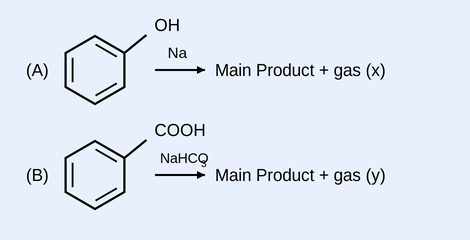
Consider the following two reactions A and B
Numerical value of [molar mass of x + molar mass of y] is ...
Numerical value of [molar mass of x + molar mass of y] is ...
(1)
(2)
(3)
(4)
SolutionAnswer: Option 246
Approach:
Determine the gas liberated in each reaction from the acid-base chemistry of the substrate, then add the molar masses of the two gases.
Step 1:Reaction A is phenol with sodium metal giving gas x; reaction B is benzoic acid with sodium bicarbonate giving gas y. The objective is the sum of the molar masses of x and y.
Step 2:Sodium metal reacts with the acidic O-H of phenol to give sodium phenoxide and liberate hydrogen gas, so gas x is .
Step 3:Benzoic acid is acidic enough to react with sodium bicarbonate, giving sodium benzoate, water and carbon dioxide, so gas y is .
Step 4:The molar mass of is g/mol and of is g/mol. Adding them gives the required value.
Final answer: 46
Q62Single correctCoordination Compounds
Given below are two statements;
Statement-I: The number of paramagnetic species among , , and is 3.
Statement-II: is the correct order in terms of number of unpaired element(s) present in the complexes.
In the light of the above statements, choose the correct answer from the options given below
Statement-I: The number of paramagnetic species among , , and is 3.
Statement-II: is the correct order in terms of number of unpaired element(s) present in the complexes.
In the light of the above statements, choose the correct answer from the options given below
(1)
(2)
(3)
(4)
SolutionAnswer: Option 1Both S-I and S-II are true
Approach:
Determine the number of unpaired electrons in each species from the metal oxidation state, d-electron count and ligand field strength, then test the count in Statement-I and the ordering in Statement-II.
Step 1:Statement-I lists four species whose unpaired-electron counts must be found; Statement-II gives an increasing-unpaired-electron ordering of four iron complexes. The objective is to test both.
Step 2: has () with the weak field , so it stays high spin with 4 unpaired electrons (paramagnetic). has () with 1 unpaired electron (paramagnetic).
Step 3: has vanadium as () with zero unpaired electrons (diamagnetic). has () with the strong field , giving the low-spin set with 1 unpaired electron (paramagnetic).
Step 4:For Statement-II: has () low spin with 0 unpaired; has () low spin with 1 unpaired; has () high spin with 4 unpaired; has () high spin with 5 unpaired.
Step 5:The unpaired counts are monotonically increasing in the order listed in Statement-II, so Statement-II is true. Both statements being true selects the corresponding option.
Final answer: Both S-I and S-II are true
Q63Single correctClassification of Elements and Periodicity in Properties
Given below are two statements:
Statement-I: is the correct order in terms of metallic character.
Statement-II: Atomic radius is always greater than the ionic radius for any element.
In the light of the above statements, the correct answer from the options given below
Statement-I: is the correct order in terms of metallic character.
Statement-II: Atomic radius is always greater than the ionic radius for any element.
In the light of the above statements, the correct answer from the options given below
(1)
(2)
(3)
(4)
SolutionAnswer: Option 4S-I is true but S-II is false
Approach:
Evaluate each statement against the periodic trend in metallic character and the relation between atomic and ionic radii for cations and anions.
Step 1:Given quantities: Statement-I ordering of metallic character , and Statement-II claiming atomic radius always exceeds ionic radius. The objective is the joint truth value of the two statements.
Step 2:Metallic character increases on descending a group and decreases along a period; potassium being a period-4 alkali metal is most metallic, magnesium and aluminium follow within period 3, and boron of period 2 is least metallic.
Step 3:A cation, formed by loss of electrons, has ionic radius smaller than its atom, whereas an anion, formed by gain of electrons, has ionic radius larger than its atom; the relation therefore depends on the ion sign and is not universal.
Step 4:Combine the individual truth values into the matching option.
Final answer: S-I is true but S-II is false
Q64Single correctSolutions
A solution is prepared by dissolving 0.3 g of non-volatile non-electrolyte solute 'A' of molar mass 60 g mo and 0.9 g of non-volatile non-electrolyte solute 'B' of molar mass 180 g mo in 100 mL O at . Osmatic pressure of the solution will be [Given: R = 0.082 L atm mo]
(1)
(2)
(3)
(4)
SolutionAnswer: Option 32.46 atm
Approach:
Add the molar concentrations of the two non-electrolyte solutes and apply the van't Hoff osmotic-pressure relation.
Step 1:Given data: mass of A is 0.3 g with molar mass 60 g mo, mass of B is 0.9 g with molar mass 180 g mo, solvent volume 100 mL, temperature 300 K, R = 0.082 L atm mo. The target is the osmotic pressure.
Step 2:Molar concentration of A using moles divided by volume in litres.
Step 3:Molar concentration of B by the same procedure.
Step 4:Substitute the total concentration into the osmotic-pressure relation at 300 K.
Final answer: 2.46 atm
Q65Single correctOrganic Compounds Containing Oxygen
The hydroxy compound (X) with molar mass 122 g mo is acetylated with acetic anhydride, using a large excess of the reagent ensuring complete acetylation of all hydroxyl groups. The product obtained has a molar mass of 290 g mo. The number of hydroxyl groups present in compound (X) is:
(1)
(2)
(3)
(4)
SolutionAnswer: Option 14
Approach:
Each acetylation replaces a hydroxyl hydrogen by an acetyl group, raising the molar mass by a fixed increment; divide the total mass gain by that increment.
Step 1:Given data: molar mass of X is 122 g mo, molar mass of the fully acetylated product is 290 g mo. The target is the number of hydroxyl groups in X.
Step 2:On acetylation each becomes , replacing one H of mass 1 by an acetyl group of mass 43, a net gain of 42 g mo per hydroxyl.
Step 3:Total molar-mass increase on complete acetylation.
Step 4:Divide the total gain by the gain per hydroxyl group to get the count.
Final answer: 4
Q66Single correctChemical Kinetics
At in presence of a catalyst, activation energy of a reaction is lowered by 10 kJ mo. The logarithm of ratio of is …. (Consider that the frequency factor for both reactions is same)
(1)
(2)
(3)
(4)
SolutionAnswer: Option 21.741
Approach:
With identical frequency factors, the ratio of rate constants depends only on the difference in activation energies through the Arrhenius equation, and a base-10 logarithm is taken.
Step 1:Given data: activation-energy lowering kJ mo, temperature 300 K, common frequency factor, R = 8.314 J mo. The target is .
Step 2:Since the frequency factors cancel, the ratio of rate constants reduces to the exponential of the activation-energy difference over RT.
Step 3:Take the base-10 logarithm and substitute the numerical values.
Final answer: 1.741
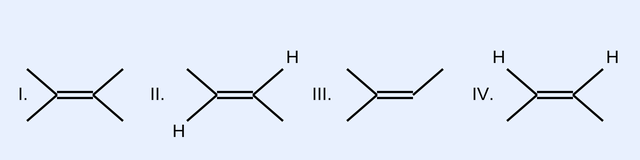
Q67Single correctHydrocarbons
Arrange the following alkenes in decreasing order of stability
(1)
(2)
(3)
(4)
SolutionAnswer: Option 1I > III > II > IV
Approach:
Rank the alkenes by the number of alkyl substituents on the double bond, which stabilise it through hyperconjugation, and break the tie between equally substituted isomers by geometry.
Step 1:Classify each structure by substitution: I is tetrasubstituted, III is trisubstituted, II is the trans (E) disubstituted isomer, and IV is the cis (Z) disubstituted isomer.
Step 2:A larger count of alkyl groups on the double bond provides more hyperconjugative and inductive electron release, so the tetrasubstituted I is the most stable and the trisubstituted III ranks next.
Step 3:Between the two disubstituted alkenes, the trans isomer II places its alkyl groups on opposite sides, reducing steric strain relative to the cis isomer IV, so II is more stable than IV.
Step 4:Merge the partial rankings into one decreasing sequence.
Final answer: I > III > II > IV
Q68Single correctSolutions
'W' g of non-volatile electrolyte solid solute of molar mass 'M' g mo when dissolved in 100 mL water, decreases vapour pressure of water from 640mm Hg to 600 mm Hg. If aqueous solution of the electrolyte boils at 375 K and for water is 0.52 K kg mo, then the mole fraction of the electrolyte solution () in the solution can be expressed as ( Given: Density of water = 1 g/mL and boiling point of water = 373 K)
(1)
(2)
(3)
(4)
SolutionAnswer: Option 4
Approach:
Determine the van't Hoff factor from the boiling-point elevation, then substitute it into the relative-lowering-of-vapour-pressure expression to isolate the solute mole fraction.
Step 1:Given data: solute mass W g, molar mass M g mo, solvent 100 mL water (0.1 kg, density 1 g/mL), vapour pressure drops from 640 to 600 mm Hg, boiling point rises from 373 K to 375 K, K kg mo. The target is the solute mole fraction .
Step 2:Write the boiling-point elevation with molality expressed for 0.1 kg of water.
Step 3:Solve the elevation relation for the van't Hoff factor.
Step 4:Apply the relative-lowering-of-vapour-pressure expression with the given pressures.
Step 5:Substitute the van't Hoff factor and solve for the solute mole fraction.
Final answer:
Q69Single correctChemical Thermodynamics
Match List-I with List-II
| List-I (Isothermal process for ideal gas system) | List-II (Work done ) |
|---|---|
| A. Reversible expansion | I. |
| B. Free expansion | II. |
| C. Irreversible expansion | III. |
| D. Irreversible compression | IV. |
(1)
(2)
(3)
(4)
SolutionAnswer: Option 2A-II, B-I, C-III, D-IV
Approach:
Match each isothermal process with its work expression derived from the integral of under the appropriate path conditions.
Step 1:Reversible isothermal expansion proceeds against an external pressure equal to the gas pressure at every instant, so the work integrates to the logarithmic reversible expression, matching II.
Step 2:Free expansion occurs into vacuum where the external pressure is zero, so no work is done, matching I.
Step 3:Irreversible expansion against a constant external pressure with gives work proportional to , matching III.
Step 4:Irreversible compression against a constant external pressure brings the system from larger to smaller volume, written as , matching IV.
Final answer: A-II, B-I, C-III, D-IV
Q70NumericalRedox Reactions and Electrochemistry
X and Y are the number of electrons involved, respectively during the oxidation of I to and to S by acidified . The value of X + Y is ____.
SolutionAnswer: 12
Approach:
Balance each oxidation against the dichromate reduction half-reaction and count the electrons transferred per dichromate ion in each case.
Step 1:Given: acidified oxidises to (electron count X) and to S (electron count Y). Each dichromate ion accepts 6 electrons during reduction. The target is X + Y.
Step 2:Each loses one electron forming ; balancing against one dichromate requires 6 iodide ions losing 6 electrons.
Step 3:Each loses two electrons forming S; balancing against one dichromate requires 3 sulphide ions losing 6 electrons.
Step 4:Add the two electron counts.
Final answer: 12
Q71NumericalRedox Reactions and Electrochemistry
Electricity is passed through an acidic solution of till all the was exhausted, leading to the deposition of 300 mg of Cu metal. However, a current of 600 mA was continued to pass through the same solution for another 28 minutes by keeping the total volume of the solution fixed at 200 mL. The total volume of oxygen evolved at STP during the entire process is __mL. (nearest integer)
Molar mass of Cu = 63.54 g mo
Molar mass of = 32 g mo
Faraday Constant = 96500 C mo
Molar volume at STP = 22.4 L
Molar mass of Cu = 63.54 g mo
Molar mass of = 32 g mo
Faraday Constant = 96500 C mo
Molar volume at STP = 22.4 L
SolutionAnswer: 111
Approach:
Oxygen evolves at the anode throughout; equate the anode electrons producing oxygen to the cathode electrons (first depositing copper, then continuing as constant current) using Faraday equivalence, then convert moles of oxygen to volume at STP.
Step 1:Given: 300 mg Cu deposited in stage 1; stage 2 passes 600 mA for 28 minutes; molar mass Cu = 63.54 g mo, F = 96500 C mo, molar volume at STP = 22.4 L. Each needs 2 electrons and each needs 4 electrons. The target is the total oxygen volume at STP.
Step 2:Stage 1: electrons supplied to deposit copper equal the electrons removed at the anode in producing oxygen.
Step 3:Stage 2: charge passed equals current times time, and oxygen forms from this charge after copper exhaustion.
Step 4:Add the oxygen from both stages and convert to volume at STP.
Step 5:Round to the nearest integer.
Final answer: 111
Q72NumericalEquilibrium
Consider two group IV metal ions and
A solution containing 0.01 M and 0.01 M is saturated with S. The pH at which the metal sulphide YS will form as a precipitate is … (nearest integer)
(Given: (XS) = 1 1 at , (YS) = 4 1 at , [S] = 0.1M in solution, (S) = 1.0 1, log 2 = 0.30, log 3 = 0.48, log 5 = 0.70)
A solution containing 0.01 M and 0.01 M is saturated with S. The pH at which the metal sulphide YS will form as a precipitate is … (nearest integer)
(Given: (XS) = 1 1 at , (YS) = 4 1 at , [S] = 0.1M in solution, (S) = 1.0 1, log 2 = 0.30, log 3 = 0.48, log 5 = 0.70)
SolutionAnswer: 4
Approach:
Find the minimum sulphide-ion concentration needed to start precipitating YS, then use the overall dissociation constant of H2S to obtain the corresponding hydrogen-ion concentration and the pH.
Step 1:Given: M, , M, , with . The target is the pH at which YS begins to precipitate.
Step 2:Precipitation of YS begins when the ionic product equals its solubility product; the required sulphide concentration follows.
Step 3:Rearrange the overall dissociation expression for and substitute the sulphide and H2S concentrations.
Step 4:Take the square root and convert to pH using the given logarithm.
Step 5:Round to the nearest integer.
Final answer: 4
Q73NumericalAtomic Structure
The hydrogen spectrum consists of several spectral lines in Lyman series (, , …..; has lowest energy among Lyman series). Similarly it consists of several spectral lines in Balmer series (, , …; has lowest energy among Balmer lines). The energy of is x times the energy of . The value of x is … x 1 (Nearest integer)
SolutionAnswer: 54
Approach:
Identify the lowest-energy line of each series as the transition between the two adjacent levels, apply the hydrogen transition-energy formula, and take the ratio.
Step 1:The Lyman series terminates at ; its lowest-energy line is the transition. The Balmer series terminates at ; its lowest-energy line is the transition. The target is the ratio , expressed as .
Step 2:Energy of the lowest Lyman line.
Step 3:Energy of the lowest Balmer line.
Step 4:Form the ratio; the constant and cancel.
Step 5:Express in the requested form .
Final answer: 54
Q74NumericalPurification and Characterisation of Organic Compounds
In Dumas method for estimation of nitrogen, 0.50 g of an organic compound gave 70 mL of nitrogen collected at 300 K and 715 mm pressure. The percentage of nitrogen in the organic compound is ….% (Aqueous tension at 300 K is 15 mm).
SolutionAnswer: 15
Approach:
Correct the collected nitrogen volume to STP using the dry-gas pressure obtained after subtracting aqueous tension, then apply the Dumas percentage-nitrogen formula.
Step 1:Given: sample mass 0.50 g, collected nitrogen volume 70 mL at 300 K and 715 mm total pressure, aqueous tension 15 mm at 300 K. The target is the percentage of nitrogen. The dry nitrogen pressure is the total minus aqueous tension.
Step 2:Convert the dry nitrogen volume to STP (760 mm, 273 K) using the combined gas law.
Step 3:Evaluate the STP volume.
Step 4:Apply the Dumas percentage-nitrogen formula with this STP volume.
Step 5:Round to the nearest integer.
Final answer: 15
Mathematics25 questions
Q1Single correctComplex Numbers and Quadratic Equations
Let then is equal to
(1)
(2)
(3)
(4)
SolutionAnswer: Option 1
Approach:
Convert each modulus equation into a Cartesian locus, solve the resulting system for the members of S, and add their squared moduli.
Step 1:Given , the target is the set S of points satisfying both modulus conditions, after which is required. The first condition is equivalent to .
Step 2:Expanding removes and , leaving , so .
Step 3:The second condition gives . Since and , this becomes . Expanding and dividing by yields the circle.
Step 4:Substituting into the circle equation produces a quadratic in x: , i.e. , whose roots are .
Step 5:The members of S are and . Summing the squared moduli gives .
Final answer:
Q2Single correctLimit, Continuity and Differentiability
If the function is continues at then the value of is equal to
(1)
(2)
(3)
(4)
SolutionAnswer: Option 1
Approach:
Split the limit into two parts and evaluate each by a standard exponential limit and by L'Hospital's rule.
Step 1:Continuity at requires . The numerator splits, so the limit separates into and , with .
Step 2:For A, set . Then , while , giving .
Step 3:For B, both numerator and denominator tend to , so applying L'Hospital's rule with and gives .
Step 4:Adding the two parts gives .
Final answer:
Q3Single correctCo-ordinate Geometry
Let a circle of radius pass through the origin O. The Points and where a and b are real parameters . Then the locus of the centroid is circle of radius
(1)
(2)
(3)
(4)
SolutionAnswer: Option 3
Approach:
Apply the right-angle-at-origin condition so that AB is a diameter, relate the parameters, then express the centroid coordinates and eliminate the parameters.
Step 1:The objective is the radius of the locus traced by the centroid of triangle OAB as a,b vary. Since A lies on the x-axis and B on the y-axis through O, the angle ; a right angle at O means AB subtends a diameter of the radius- circle, so .
Step 2:The centroid of , and is . Solving for the parameter combinations gives and .
Step 3:Writing the constraint as and substituting gives .
Step 4:The locus is a circle centred at the origin, so its radius is the square root of .
Final answer:
Q4Single correctSequence and Series
Consider an A.P : If and then is equal to
(1)
(2)
(3)
(4)
SolutionAnswer: Option 4
Approach:
Use the three given conditions to find the common difference, first term and number of terms, then compute the sum of the first seventeen terms.
Step 1:The common difference is . The target is , which needs . Substituting into gives a relation between and n.
Step 2:Applying with gives , hence .
Step 3:Substituting into gives , that is . Factoring as yields and therefore .
Step 4:Computing the sum of the first seventeen terms via with , gives .
Final answer:
Q5Single correctLimit, Continuity and Differentiability
Let such that the function be differentiable at all then
(1)
(2)
(3)
(4)
SolutionAnswer: Option 3
Approach:
Impose continuity and equality of the one-sided derivatives at the junction x=1 to obtain two linear equations, solve them, and evaluate the required expression.
Step 1:The function is a polynomial on each side of , so differentiability everywhere reduces to matching value and derivative at . Matching values: the left limit equals the right value .
Step 2:Differentiating each branch gives for and for . Matching at gives .
Step 3:From equation (1), . Substituting into equation (2): , so , giving .
Step 4:Computing the required expression: , so .
Final answer:
Q6Single correctIntegral Calculus
Let . if and then equals
(1)
(2)
(3)
(4)
SolutionAnswer: Option 3
Approach:
Substitute the logarithm to a new variable, simplify the integrand with half-angle identities into the form, integrate, fix the constant from the first condition, then evaluate at the second point.
Step 1:The objective is defined by . Setting gives and , so . Using and rewrites the rational factor.
Step 2:Taking gives , so the integrand is exactly . Hence the antiderivative is plus a constant.
Step 3:Applying : at , and , so .
Step 4:Evaluating at : , and . Thus , which matches .
Final answer:
Q7Single correctBinomial Theorem and its Simple Applications
Let Up to 13 terms. If then is equal to
(1)
(2)
(3)
(4)
SolutionAnswer: Option 1
Approach:
Recognise the series as a sum of reciprocals 1/(r!(26-r)!) over odd r, factor out 1/26! to obtain a sum of odd-index binomial coefficients of order 26, then simplify 13S.
Step 1:Each general term has the form for odd , which gives terms. Factoring from every term turns each into a binomial coefficient of order .
Step 2:The sum of the odd-index binomial coefficients of order equals .
Step 3:Forming and using , the factor cancels: .
Step 4:Comparing identifies and , so .
Final answer:
Q8Single correctComplex Numbers and Quadratic Equations
The number of real solutions of a the equation is
(1)
(2)
(3)
(4)
SolutionAnswer: Option 1
Approach:
Split the modulus signs at the critical points x=-3 and x=1, solve the resulting quadratic on each interval, and count the roots that fall inside their interval.
Step 1:The objective is the count of real roots of . The modulus arguments change sign at and , defining three intervals. For : and , so , i.e. , with roots .
Step 2:For : and , so , i.e. , with roots .
Step 3:For : and , so , i.e. , with roots .
Step 4:Collecting the valid roots from all intervals gives the set .
Final answer:
Q9Single correctThree Dimensional Geometry
Let the lines and intersect at the point R. Let P and Q be the points lying on the lines and respectively such that and and if the Point P lies in the 1st octant then is equal to
(1)
(2)
(3)
(4)
SolutionAnswer: Option 3
Approach:
Find the intersection point R, fix P from the first-octant and |PR| conditions, solve the |PQ| condition for Q, then compute .
Step 1:The objective is . First locate R by equating and : , , . From the third, ; substituting into the second gives , so , and , which also satisfy the first equation.
Step 2:Writing on , the vector . Then . Setting this to gives , so or .
Step 3:For , lies in the first octant; for , does not. Hence . Writing on , . Setting this equal to gives , i.e. .
Step 4:The vector , so . Multiplying by gives the answer.
Final answer:
Q10Single correctStatistics and Probability
From a lot containing 10 defective and 90 and defective bulbs, 8 bulbs are selected one by one with replacement then the probability of getting at least 7 defective bulbs is
(1)
(2)
(3)
(4)
SolutionAnswer: Option 3
Approach:
Model the number of defective bulbs as a binomial variable and add the probabilities of exactly seven and exactly eight defectives.
Step 1:Selection is with replacement, so each draw is independent with defective probability and non-defective probability , over draws. The objective is .
Step 2:Computing .
Step 3:Computing .
Step 4:Adding the two probabilities gives the total.
Final answer:
Q11Single correctCo-ordinate Geometry
Let and be three points. If the equation of bisector of the angle ABC is then the value of is
(1)
(2)
(3)
(4)
SolutionAnswer: Option 3
Approach:
Use the internal-bisector ratio from vertex B to locate the point D on AC, form the line BD, and read off the coefficients.
Step 1:The objective is where is the bisector of angle B. Computing the two sides at B: and .
Step 2:The bisector from B meets AC at D dividing AC in ratio , so with , . Then and , giving the sum .
Step 3:The bisector is line BD through and . Its slope is , so , i.e. .
Step 4:Computing the required quantity gives .
Final answer:
Q12Single correctTrigonometry
The value of is equal to
(1)
(2)
(3)
(4)
SolutionAnswer: Option 3
Approach:
Reduce the numerator to a single sine using a compound-angle combination, evaluate the cosine product in the denominator by a standard identity, and divide.
Step 1:The objective is to evaluate the given fraction. The numerator combines over a common denominator to . Writing is not used; instead .
Step 2:Since , the numerator simplifies to .
Step 3:For the denominator, . Including the extra factor gives .
Step 4:Dividing the numerator by the denominator gives .
Final answer:
Q13Single correctLimit, Continuity and Differentiability
If the Domain of the function is then equals
(1)
(2)
(3)
(4)
SolutionAnswer: Option 3
Approach:
Require the logarithm argument positive and the base positive and unequal to one, intersect the regions, and read off the five endpoints.
Step 1:The objective is from the domain. The argument must be positive: . Its roots are , i.e. and . Since the leading coefficient is positive, the argument is positive for or .
Step 2:The base must be positive: . Its roots are , i.e. and . So the base is positive for or .
Step 3:The base must not equal one: , i.e. , with roots , namely and . Intersecting the argument and base regions gives . Within this set, is already an excluded endpoint, while lies in and must be removed.
Step 4:Matching the form identifies , , , , . Their sum over the common denominator is .
Final answer:
Q14Single correctStatistics and Probability
The mean and variance of data of 10 observations are 10 and 2 respectively. If an observation in this data is replaced by , then the mean and variance become 10.1 and 1.99 respectively then equals
(1)
(2)
(3)
(4)
SolutionAnswer: Option 3
Approach:
Translate the changes in mean and variance into equations for the sum of the values and the sum of their squares, then combine the difference and product of the replaced observations.
Step 1:The data has observations with mean and variance ; the objective is after is replaced by . From the original mean and variance the total and the sum of squares are fixed.
Step 2:Replacing by changes the total, and the new mean is , so the new total is .
Step 3:The new variance is with new mean , which fixes the new sum of squares.
Step 4:Factor the difference of squares and substitute the known difference .
Final answer:
Q15Single correctTrigonometry
If for some then is equal to
(1)
(2)
(3)
(4)
SolutionAnswer: Option 1
Approach:
Regroup the products into sine and cosine of the compound angle to collapse the expression to , then evaluate using half-angle values whose signs are fixed by the quadrant.
Step 1:Given with , the target is the value of the trigonometric expression. Expanding the brackets and collecting the four products separates a sine combination and a cosine combination of and .
Step 2:Apply the compound-angle identities with , where .
Step 3:Since lies in the third quadrant where , and gives , the cosine is determined.
Step 4:For the half-angle lies in the second quadrant, so and . Substituting into the half-angle formulas gives the magnitudes.
Step 5:Add the two half-angle values.
Final answer:
Q16Single correctCo-ordinate Geometry
Let each of the two ellipses and have eccentricity . Let the Length of the latusrecta of and be respectively such that . If the distance between foci of is 8. Then the difference between foci of is
(1)
(2)
(3)
(4)
SolutionAnswer: Option 3
Approach:
Use the focal distance of with its eccentricity to fix its semi-axes and latus rectum, then apply the given latus-rectum relation to find B for and compute its focal separation.
Step 1:Both ellipses have . For () the major axis is along x, the foci distance is , and the target is the focal separation of . Solving for a:
Step 2:Compute from the eccentricity relation and then the latus rectum of .
Step 3:For with , the major axis is along y, so and the latus rectum is .
Step 4:Apply the given relation and solve for B.
Step 5:The distance between the foci of is .
Final answer:
Q17Single correctSets, Relations and Functions
Let R be relation defined on the set by then the number of elements in R is
(1)
(2)
(3)
(4)
SolutionAnswer: Option 3
Approach:
Match the value to over by listing the attainable values of each side and counting the consistent quadruples.
Step 1:With , the target is the count of quadruples satisfying . The left side ranges from to , and the right side ranges from to , so only common values are usable.
Step 2:Tabulate the right side: with the pairs (c,d) producing each value. The relevant attainable values and their pairs are , , , , , , , .
Step 3:For each value , the number of solutions is the count of with times the count of with . Each tabulated right-side value above is produced by a single , so the contribution equals the number of giving that : from gives ; from gives ; from and gives ; from gives ; from and gives ; from gives ; from gives ; from gives .
Step 4:Summing the contributions counts all consistent quadruples, listed explicitly as together with the two double-counted values, totaling twelve.
Final answer:
Q18Single correctSequence and Series
Let be a sequence and denote the product of the first n terms of the sequence. If and gcd of then is equal to
(1)
(2)
(3)
(4)
SolutionAnswer: Option 2
Approach:
Express each term as a power of , form the product of the first terms, take its -th root, sum the resulting geometric series, and match to the given form.
Step 1:The sequence is , so the k-th term is ; the target is . This is the given data.
Step 2:The product of the first terms adds the exponents.
Step 3:Take the n-th root of .
Step 4:Sum the geometric series of terms with first term and ratio .
Step 5:Multiply by and write over a single power of , then read off .
Final answer:
Q19Single correctIntegral Calculus
Let the bounded area enclosed by the curves and y-axis that lies in the first quadrant. Let be bonded area enclosed by the curves and y-axis that lies in the first quadrant then is equal to
(1)
(2)
(3)
(4)
SolutionAnswer: Option 1
Approach:
Determine the relevant intersection limits, set up each bounded region as a definite integral of the upper curve minus the lower curve, evaluate both, and subtract.
Step 1:The objective is , both first-quadrant regions bounded on the left by the y-axis (). The parabola meets the line where their values coincide.
Step 2:On the line lies above the parabola , giving .
Step 3:For on , the parabola is the upper curve and (that is ) is the lower curve.
Step 4:Subtract the two areas.
Final answer:
Q20Single correctVector Algebra
Let , and . Let be a vector such that , and angle between and is . Then is equal to
(1)
(2)
(3)
(4)
SolutionAnswer: Option 2
Approach:
Compute and its magnitude, use the cross-product magnitude with the given angle to find , then expand to isolate .
Step 1:Given , , the target is . Compute and its magnitude, and record .
Step 2:Use to find .
Step 3:Expand the given norm condition .
Step 4:Solve for the dot product.
Final answer:
Q21NumericalPermutations and Combinations
The number of numbers greater than 5000, less than 9000 and divisible by 3, that can be formed using the digits 0, 1, 2, 5, 9, if the repetition of the digits is allowed is___
SolutionAnswer: 42
Approach:
Fix the leading digit from the range constraint, then count the choices of the remaining three digits so that the total digit sum is divisible by , using residues modulo .
Step 1:A number greater than and less than is a four-digit number whose thousands digit lies in . From the allowed digits , only qualifies, so the thousands digit is fixed.
Step 2:The remaining three digits b,c,d each come from with repetition, and divisibility by requires the total to be a multiple of .
Step 3:Classify the allowed digits by residue modulo : residue from (count ), residue from (count ), residue from (count ). Let r be the residue of each chosen digit; the count of triples with residues summing to is the product of the corresponding residue counts summed over all ordered residue patterns.
Step 4:Summing the products of residue-class sizes over all ordered residue triples with gives the count.
Final answer: 42
Q22NumericalIntegral Calculus
Let a differentiable function f satisfy the equation . If is a standard parabola passing through the points and then is equal to______
SolutionAnswer: 64
Approach:
Substitute the standard parabola into the integral equation to fix , use the point to fix c, then evaluate at and form .
Step 1:The objective is for the standard parabola f satisfying the integral equation and passing through and . A standard parabola through the origin-symmetric form is ; substitute it into the left side with .
Step 2:Since , the left side equals . Equate to the right side .
Step 3:Use the point on to determine c.
Step 4:Evaluate at to find .
Step 5:Form .
Final answer: 64
Q23NumericalMatrices and Determinants
The number of matrices A. which can be formed using the elements of the set such that the sum of all the diagonal elements of is 5, is _________
SolutionAnswer: 312
Approach:
Identify the diagonal sum of as the sum of squares of all entries of A, list the square partitions of over the allowed entry-squares, and count position and sign choices.
Step 1:A matrix has six entries from ; the objective is the count of such matrices with diagonal sum of equal to . That diagonal sum equals the sum of squares of all six entries.
Step 2:Each entry-square lies in . The only ways six such values sum to are one with one (rest ), or five 1's (rest ).
Step 3:Type : select the position of the entry with square (value ) in ways with signs, then a position for the entry with square (value ) among the remaining with signs.
Step 4:Type five 's: select which of the entries is ( ways) and assign a sign to each of the five entries ( ways).
Step 5:Add the two disjoint counts.
Final answer: 312
Q24NumericalLimit, Continuity and Differentiability
Let be the largest interval in which the function is strictly decreasing. Then the local maximum value of the function , is________
SolutionAnswer: 4
Approach:
Find the largest decreasing interval of f to fix (and the coefficient ), then differentiate g, locate the interior critical point that is a maximum, and evaluate g there.
Step 1:The interval is the largest on which is strictly decreasing for ; this fixes , which then sets the coefficient in g. For , so with , which is positive there.
Step 2:For , so with , which is negative on and positive on . Therefore the largest strictly decreasing interval is .
Step 3:Match to read off ; consistently and , so . Substitute into g.
Step 4:Differentiate and factor to locate critical points on .
Step 5:On , is positive for and negative for , so is a local maximum; evaluate .
Final answer: 4
Q25NumericalThree Dimensional Geometry
Let a line L passing through the point be perpendicular to the lines and . Let the line L intersect the yz-plane at the point Q. Another line parallel to L and passing through the point intersects the yz-plane at point R. Then the square of the area of the parallelogram PQRS is equal to_________
SolutionAnswer: 6
Approach:
Find the direction of as the cross product of the two given line directions, locate and on the -plane , then compute the parallelogram area from the edge vectors at and square it.
Step 1:The objective is the square of the area of parallelogram PQRS with and . The line L is perpendicular to directions and , so its direction is their cross product.
Step 2:Parametrize from and intersect the -plane .
Step 3:The line through parallel to meets at parameter similarly.
Step 4:Form the edge vectors at and take their cross product.
Step 5:The area is the magnitude of this cross product; square it.
Final answer: 6
More JEE Main 2026 papers
- JEE Main 2026 — April 02, Shift 1
- JEE Main 2026 — April 02, Shift 2
- JEE Main 2026 — April 04, Shift 1
- JEE Main 2026 — April 04, Shift 2
- JEE Main 2026 — April 05, Shift 1
- JEE Main 2026 — April 05, Shift 2
- JEE Main 2026 — April 06, Shift 1
- JEE Main 2026 — April 06, Shift 2
- JEE Main 2026 — April 08, Shift 2
- JEE Main 2026 — January 21, Shift 1
- JEE Main 2026 — January 21, Shift 2
- JEE Main 2026 — January 22, Shift 1
- JEE Main 2026 — January 22, Shift 2
- JEE Main 2026 — January 23, Shift 1
- JEE Main 2026 — January 23, Shift 2
- JEE Main 2026 — January 24, Shift 2
- JEE Main 2026 — January 28, Shift 1
- JEE Main 2026 — January 28, Shift 2
Frequently Asked Questions
How many questions are in the JEE Main 2026 January 24, Shift 1 paper?
The JEE Main 2026 January 24, Shift 1 paper has 74 questions — Physics (24), Chemistry (25) and Mathematics (25). Every question is on this page with its correct answer and a step-by-step solution.
What is the marking scheme for JEE Main?
JEE Main awards +4 marks for each correct answer and −1 for a wrong answer, with 0 for questions left unattempted. The paper covers Physics, Chemistry and Mathematics.
Are the answer key and step-by-step solutions provided for the 2026 January 24, Shift 1 paper?
Yes — every question shows the correct answer (answer key) and a detailed step-by-step solution, free to read online.
Can I take the JEE Main 2026 January 24, Shift 1 paper as a timed mock test?
Yes. With a free JEEnify account you can attempt this exact paper as a timed test in the real exam interface, then see your score and weak-area analysis.
Solved this paper? Calculate your JEE Main scoremost important chaptersformula sheetsall free tools.