
Back to JEE Main PYQs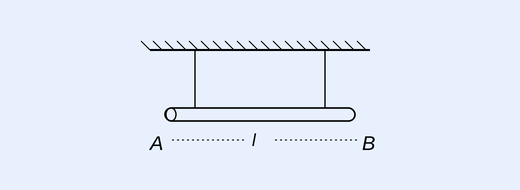
JEE Main 2026 January 21, Shift 1 Question Paper with Solutions
All 75 questions from the JEE Main 2026 (January 21, Shift 1) shift — Physics (25), Chemistry (25) and Mathematics (25) — each with the correct answer (answer key) and a step-by-step solution. Read it free online, or attempt the full paper as a timed mock test.
Physics25 questions
Q26Single correctThermal Properties of Matter
A gas based geyser heated water flowing at the rate of 5.0 litres per minute from to . The rate of consumption of the gas is_____g/s. (Take heat of combustion of gas , specific heat capacity of water J/kg. )
(1)
(2)
(3)
(4)
SolutionAnswer: Option 4
Approach:
Equate the heat absorbed by water per unit time to the heat liberated by the burning gas per unit time, then solve for the gas mass-consumption rate.
Step 1:List the data in SI units; water density gives mass rate from volume rate.
Step 2:Compute the rate of heat supplied to the water.
Step 3:All this heat comes from the combusting gas, so equate and solve for the gas rate.
Step 4:Evaluate the gas consumption rate.
Final answer: g/s
Q27Single correctElectrostatics
The point of charge of is placed at origin. The work done is moving a point at from point A(4,4,2) m to B(2,2,1) m is ______ J. ( in SI unit)
(1)
(2)
(3)
(4)
SolutionAnswer: Option 2
Approach:
Work done by the external agent equals the change in electrostatic potential energy of the two-charge system; compute the radial distances of A and B from the origin and take the difference.
Step 1:Identify the charges and constants.
Step 2:Find each point's distance from the origin charge.
Step 3:Substitute into the work formula.
Step 4:Evaluate the bracket and the product.
Final answer: J
Q28Single correctDual Nature of Radiation and Matter
A light wave described by (in SI units) fall on a metal surface of work function 2.8 eV. The maximum kinetic energy of ejected photoelectron is (approximately)____eV. ( and )
(1)
(2)
(3)
(4)
SolutionAnswer: Option 4
Approach:
The incident light contains two angular frequencies; the maximum photoelectron energy is governed by the higher frequency. Convert that photon energy to eV and apply Einstein's photoelectric equation.
Step 1:Select the higher angular frequency in the superposition.
Step 2:Compute the corresponding photon energy in joules.
Step 3:Convert to electron-volts.
Step 4:Apply the photoelectric equation with eV.
Final answer: eV
Q29Single correctRotational Motion
A uniform rod of mass m and length l suspend by means of two identical inextensible light strings as shown in figure. Tension in one string immediately after the other string is cut is ______. (g – acceleration due to gravity)
(1)
(2)
(3)
(4)
SolutionAnswer: Option 4
Approach:
Immediately after one string is cut, apply Newton's second law for translation of the centre of mass, the torque equation about the COM, and the constraint that the still-attached end has zero vertical acceleration.
Step 1:Identify the forces just after the cut: weight at COM downward and tension upward at the remaining end.
Step 2:Translational equation for the centre of mass.
Step 3:Torque about the COM gives the angular acceleration.
Step 4:The attached end stays on the string, so its vertical acceleration is zero, linking and .
Step 5:Combine (1), (2), (3) to find the angular acceleration.
Step 6:Back-substitute into Equation (2) for the tension.
Final answer:
Q30Single correctLaws of Motion
A 4Kg mass moves under the influence of a force where t is time in sec. If mass starts from origin , the velocity and position after t=2s will be
(1)
(2)
(3)
(4)
SolutionAnswer: Option 2
Approach:
Divide the force by the mass to obtain the acceleration components, integrate each component from (zero initial velocity, origin) to get velocity, then integrate velocity to get position, evaluating at s.
Step 1:Compute acceleration components from N with kg.
Step 2:Integrate accelerations to velocity at .
Step 3:Integrate for the x-position.
Step 4:Integrate for the y-position.
Step 5:Assemble velocity and position vectors.
Final answer:
Q31Single correctSemiconductor Electronics
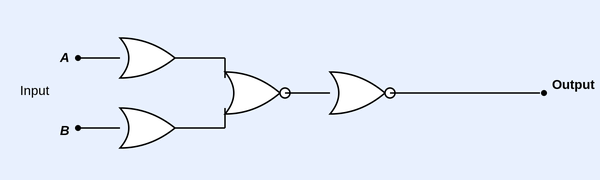
The given circuit works as:
(1)
(2)
(3)
(4)
SolutionAnswer: Option 3NAND gate
Approach:
Trace the Boolean expression through the gate network from inputs A and B to the output and identify the equivalent single gate.
Step 1:Take the two inputs A and B feeding the gate combination.
Step 2:Reduce the cascaded gate network using Boolean algebra to a single expression.
Step 3:Recognise the standard gate corresponding to the complemented product.
Final answer: NAND gate
Q32Single correctElectromagnetic Induction
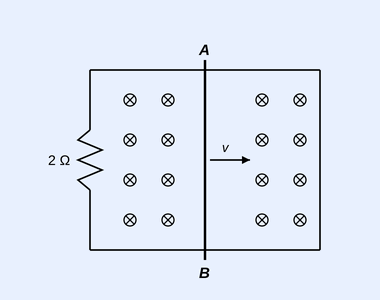
A 1 m long metal rod AB completes the circuit as shown in figure. The area of circuit is perpendicular to the magnetic field of 0.10 T. If the resistance of the total circuit is 2 then the force needed to move the rod towards right with constant speed (v) of is ______N.
(1)
(2)
(3)
(4)
SolutionAnswer: Option 2
Approach:
At constant speed the applied force balances the magnetic retarding force on the induced current; the motional EMF drives a current giving a force .
Step 1:List the given quantities.
Step 2:For constant speed the net force is zero, so the applied force equals the magnetic retarding force.
Step 3:Substitute the numerical values.
Step 4:Evaluate.
Final answer: N
Q33Single correctElectromagnetic Induction
A conducting circular loop of area is placed perpendicular to a magnetic field which varies as Tesla. If the resistance of the loop is . Then the average thermal energy dissipated in the loop in one period is_____J.
(1)
(2)
(3)
(4)
SolutionAnswer: Option 2
Approach:
Use Faraday's law to get the induced EMF from the time-varying field, write the instantaneous dissipated power , and integrate over one full period to get the heat.
Step 1:List the loop data; the period of is .
Step 2:Differentiate the flux to get the induced EMF.
Step 3:Form the heat integral over one period.
Step 4:The average of over a full period is .
Final answer: J
Q34Single correctMoving Charges and Magnetism
A current carrying solenoid is placed vertically and a particle of mass m which charge Q is released from rest. The particle move along the axis of solenoid. If g is acceleration due to gravity, then the acceleration (a) of the charged particle will satisfy
(1)
(2)
(3)
(4)
SolutionAnswer: Option 1
Approach:
On the axis of a solenoid the magnetic field points along the axis; the released particle moves along that same axis, so velocity and field are parallel and the magnetic force vanishes, leaving only gravity.
Step 1:Set the geometry: vertical solenoid axis, particle released from rest moving along the axis.
Step 2:Evaluate the magnetic force when velocity is parallel to the axial field.
Step 3:Apply Newton's second law with only gravity acting.
Final answer:
Q35Single correctWave Optics
In a double slit experiment, the distance between the slits is 0.1cm and the screen is placed at 50cm from the slit plan. When one slit is covered with a transparent sheet having thickness t and refractive index n(=1.5), the central fringe shifts by 0.2cm. The value of t is
(1)
(2)
(3)
(4)
SolutionAnswer: Option 3
Approach:
A thin transparent sheet over one slit shifts the central fringe by ; solve this for the thickness t.
Step 1:List the given quantities in consistent (cm) units.
Step 2:Substitute into the fringe-shift relation.
Step 3:Solve for the sheet thickness.
Final answer: cm
Q36Single correctAtoms and Nuclei
If an alpha particle with energy 7.7 MeV is bombarded on a thin gold foil, the closest distance from nucleus it can reach is ________m. (Atomic number of gold = 79 and in SI units)
(1)
(2)
(3)
(4)
SolutionAnswer: Option 1
Approach:
At the distance of closest approach the alpha particle is momentarily at rest, so its initial kinetic energy is entirely converted into Coulomb potential energy between the alpha () and the gold nucleus ().
Step 1:Convert the kinetic energy to joules and note the constant.
Step 2:Set Coulomb PE equal to KE and solve for .
Step 3:Substitute numerical values.
Step 4:Simplify and evaluate.
Final answer: m
Q37Single correctWork, Energy and Power
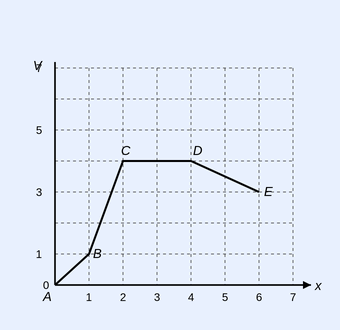
Potential energy (V) versus distance (x) is given by the graph. Rank various regions as per the magnitudes of the force.(F) acting on a particle from high to low.
(1)
(2)
(3)
(4)
SolutionAnswer: Option 4
Approach:
The force on the particle is , so its magnitude equals the magnitude of the slope of the versus graph; compute each segment's slope and rank by magnitude.
Step 1:Read the segment endpoints from the V-x graph.
Step 2:Compute the slope of each segment.
Step 3:Take magnitudes, since force magnitude is proportional to the slope magnitude.
Step 4:Write the force ranking from high to low.
Final answer:
Q38Single correctWaves
Two strings (A,B) having linear densities and and lengths and respectively are joined. Free ends of A and B are tied to two rigid supports C and D, respectively creating a tension of 500 N in the wire. Two identical pulses, sent from C and D ends, take time and respectively, to reach the joint. The ratio is :
(1)
(2)
(3)
(4)
SolutionAnswer: Option 3
Approach:
A transverse pulse travels at on each string; the time to reach the joint is length over speed. The common tension cancels in the ratio .
Step 1:List the data for the two strings, joined under common tension N.
Step 2:Form the time ratio; the tension cancels.
Step 3:Substitute the values.
Step 4:Evaluate the numerical ratio.
Final answer:
Q39Single correctUnits and Measurements
Consider a modified Bernoulli equation. Constant If f has the dimension of time then the dimension A and B are _____, _____ respectively.
(1)
(2)
(3)
(4)
SolutionAnswer: Option 2 and
Approach:
Apply the principle of dimensional homogeneity: every additive term must carry the dimension of pressure. Use length to obtain [B], then equate to pressure to obtain [A].
Step 1:State targets: t has dimension of time; find [A] and [B] from homogeneity of the term and the pressure term .
Step 2:In , must have the dimension of (length).
Step 3:The term is added to pressure P, so it equals pressure dimensionally.
Step 4:Substitute the dimensions and simplify.
Final answer: and (option 2)
Q40Single correctGravitation
Initially a satellite of 100 kg is in a circular orbit of radius . This satellite can be moved to a circular orbit of radius by supplying of energy The value of is __________ (Take Radius of Earth m and g )
(1)
(2)
(3)
(4)
SolutionAnswer: Option 3
Approach:
The total mechanical energy of a circular orbit is . Energy supplied equals the difference between final and initial orbital energies. Replace GM by .
Step 1:Define radii and data.
Step 2:Energy difference between final and initial orbits.
Step 3:Replace .
Step 4:Substitute numbers.
Step 5:Express as .
Final answer: (option 3)
Q41Single correctMechanical Properties of Fluids
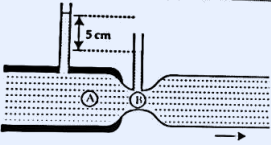
Water flows through a horizontal tube as shown in the figure. The difference in height between the water Columns in vertical tubes is 5 cm and the area of cross-sections at A and B are and respectively. The rate of flown will be ________ . (take )
(1)
(2)
(3)
(4)
SolutionAnswer: Option 1
Approach:
Apply continuity and Bernoulli to the wide (A) and narrow (B) sections of a horizontal venturi tube. The column height difference gives the pressure difference , leading to the venturi flow-rate formula. Work in CGS.
Step 1:Define given quantities in CGS.
Step 2:Geometric factor from continuity + Bernoulli.
Step 3:Compute .
Step 4:Apply the venturi formula.
Step 5:Rationalise.
Final answer: (option 1)
Q42Single correctElectromagnetic Waves
The electric field in a plane electromagnetic wave is given by: The expansion for magnetic field associated with this electromagnetic wave is _____T.
(1)
(2)
(3)
(4)
SolutionAnswer: Option 2
Approach:
For a plane EM wave, B has the same phase as E, amplitude , and orientation set by (propagation direction).
Step 1:Read propagation direction and E orientation from the given wave.
phase propagation along ; E along y
Step 2:Compute the magnetic amplitude.
Step 3:Find the field direction from .
along
Step 4:Write with identical phase to .
Final answer: (option 2)
Q43Single correctElectrostatic Potential and Capacitance
A parallel plate capacitor has capacitance C, when there is vacuum within the parallel plates. A sheet having thickness of the separation between the plates and relative permittivity K is introduced between the plates. The new capacitance of the system is :
(1)
(2)
(3)
(4)
SolutionAnswer: Option 1
Approach:
Treat the plate gap as the vacuum region with a dielectric slab of thickness inserted. Use the standard slab-capacitance formula and express in terms of .
Step 1:Define slab thickness and permittivity.
, relative permittivity K
Step 2:Insert into the slab formula and factor out .
Step 3:Simplify the denominator.
Step 4:Invert to obtain .
Final answer: (option 1)
Q44Single correctUnits and Measurements
In an experiment the values of two spring constants were measured as and . If these spring are connected in parallel, then the percentage error in equivalent spring constant is :
(1)
(2)
(3)
(4)
SolutionAnswer: Option 1
Approach:
Springs in parallel add: . For a sum, absolute uncertainties add. Convert the absolute error to a percentage of K.
Step 1:Define measured values.
N/m
Step 2:Equivalent constant.
Step 3:Add absolute uncertainties.
Step 4:Percentage error.
Final answer: (option 1)
Q45Single correctThermal Properties of Matter
An aluminium and steel rods having same lengths and cross-sections are joined to make total length of 120 cm at . The coefficient of linear expansion of aluminium and steel are and , respectively. The length of this composite rod when its temperature is raised to , is ________cm
(1)
(2)
(3)
(4)
SolutionAnswer: Option 4
Approach:
The composite rod is two equal halves (60 cm each) of aluminium and steel in series. Each expands by ; add both expansions to the original 120 cm.
Step 1:Define data; each rod length 60 cm, temperature rise C.
Step 2:Aluminium rod expansion.
Step 3:Steel rod expansion.
Step 4:Add expansions to original length.
Final answer: cm (option 4)
Q46NumericalRay Optics and Optical Instruments
In a microscope, the objective is having focal length and eye-piece is having focal length . The tube length is 32cm. The magnification produced by this microscope for normal adjustment is ______.
SolutionAnswer: 100
Approach:
For a compound microscope in normal adjustment (image at near point cm), the magnification is the product of objective linear magnification (tube length over ) and eyepiece angular magnification ().
Step 1:Define data with near point cm.
(cm)
Step 2:Substitute into the magnification formula.
Step 3:Evaluate.
Final answer:
Q47NumericalRay Optics and Optical Instruments
A collimated beam of light diameter 2mm is propagating along x-axis. The beam is required to be expanded in a collimated beam of diameter 14 mm using a system of two convex lenses. If first lens has focal length 40 mm, then the focal length of second lens is _____mm.
SolutionAnswer: 280
Approach:
A two-convex-lens beam expander (Keplerian) magnifies a collimated beam by the ratio of focal lengths, which equals the output-to-input diameter ratio. Solve for .
Step 1:Define data.
Step 2:Apply the diameter-to-focal-length ratio.
Step 3:Evaluate.
Final answer: mm
Q48NumericalThermodynamics
A 10 mole of oxygen is heated at constant volume from to . The change in the internal energy of gas is _____Cal. (The molar specific heat of oxygen at constant pressure. and )
SolutionAnswer: 500
Approach:
At constant volume, . Obtain from Mayer's relation .
Step 1:Define data; temperature change C.
cal/(molC),
Step 2:Find .
Step 3:Apply the internal-energy formula.
Step 4:Evaluate.
Final answer: Cal
Q49NumericalRotational Motion
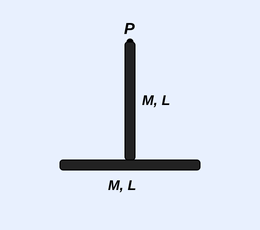
Two identical thin rods of mass M kg and length L m are connected as shown in figure. Moment of inertia of the combined rod system about an axis passing through point P and perpendicular to the plane of the rods is . The value of x is __________
SolutionAnswer: 17
Approach:
The system is a T-shape: a vertical rod with point at its top end, joined at its lower end to the centre of a horizontal rod, distance from . Add the moment of inertia of the vertical rod about its end and the horizontal rod about via the parallel-axis theorem.
Step 1:Geometry: at top of vertical rod; horizontal rod centre is at the vertical rod's lower end, a distance from .
for the horizontal rod's centre from
Step 2:Vertical rod about its end .
Step 3:Horizontal rod about : centre value plus parallel-axis shift .
Step 4:Sum the contributions.
Step 5:Compare with .
Final answer:
Q50NumericalCurrent Electricity
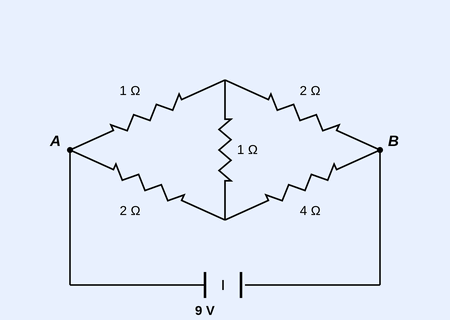
The heat generated in 1 minute between points A and B in the given circuit, when a battery of 9 V with internal resistance of 1 is connected across these points is _________ J.
SolutionAnswer: 1080
Approach:
The four resistors (1,2 top; 2,4 bottom) with the central 1 form a balanced Wheatstone bridge, so the bridge arm carries no current. Reduce the two series branches in parallel, add internal resistance, find current, then apply Joule heating for 60 s.
Step 1:Check balance condition for the bridge.
, balanced; central carries no current
Step 2:Reduce: top branch , bottom branch , in parallel.
Step 3:Total current including internal resistance .
Step 4:Heat generated between A and B (across ) in s.
Final answer: J
Chemistry25 questions
Q51Single correctd- and f-Block Elements
in acidic medium; disproportionates to
(1)
(2)
(3)
(4)
SolutionAnswer: Option 4 and
Approach:
Manganate(VI) ion is stable only in strongly alkaline medium; in acid it undergoes disproportionation. Assign the Mn oxidation state and split it into a simultaneous oxidation and reduction, then balance the redox equation.
Step 1:Determine the oxidation state of Mn in manganate.
Step 2:Identify the two half changes of disproportionation about +6.
Step 3:Balance electrons (2 oxidised per 1 reduced) and complete with H+ and water.
Final answer: and
Q52Single correctPurification and Characterisation of Organic Compounds
In Carius method; 0.75g of an organic compound give 1.2 gm of barium sulphate. Find percentage of sulphur (molar mass 32 gmo). Molar mass of barium sulphate is 233 gmo.
(1)
(2)
(3)
(4)
SolutionAnswer: Option 2
Approach:
In the Carius method sulphur is converted quantitatively to . The mass fraction of S in times the precipitate-to-sample mass ratio gives the percentage of sulphur in the compound.
Step 1:List the given data.
Step 2:Substitute into the formula.
Step 3:Evaluate the arithmetic.
Final answer:
Q53Single correctChemical Bonding and Molecular Structure
Given below are two statement:
Statement – I: The number of species among , , , , , and that have tetrahedral geometry is 3.
Statement – II: In the set ; all the molecules have incomplete octet around central atom.
Statement – I: The number of species among , , , , , and that have tetrahedral geometry is 3.
Statement – II: In the set ; all the molecules have incomplete octet around central atom.
(1)
(2)
(3)
(4)
SolutionAnswer: Option 3Statement-I is false but Statement-II is true
Approach:
Statement-I: assign VSEPR/hybridisation geometry to each listed species and count the tetrahedral ones, comparing with the claimed value 3. Statement-II: test whether every molecule in the set has an incomplete octet at the central atom.
Step 1:Assign geometry of each Statement-I species.
seesaw (), tetrahedral (), square planar (), square planar (), seesaw (), square planar (); tetrahedral
Step 2:Count tetrahedral species and compare to 3.
tetrahedral count
Step 3:Examine octet status of Statement-II set.
(odd-electron, 17 on N region), (4 ), (6 ), (6 )
Step 4:Combine the two verdicts to pick the option.
I false, II true
Final answer: Statement-I is false but Statement-II is true
Q54Single correctBiomolecules
Identify correct statements:
A: Arginine and Tryptonphan, are essential Amino acid.
B: Histidine does not contain heterocyclic ring in its structure.
C: Proline is a six membered ring cyclic amino acid.
D: Glyncine does not have chiral center.
E: Cysteine has characteristic feature of side chain as .
Choose the correct answer from the options given below:
A: Arginine and Tryptonphan, are essential Amino acid.
B: Histidine does not contain heterocyclic ring in its structure.
C: Proline is a six membered ring cyclic amino acid.
D: Glyncine does not have chiral center.
E: Cysteine has characteristic feature of side chain as .
Choose the correct answer from the options given below:
(1)
(2)
(3)
(4)
SolutionAnswer: Option 1A and D only
Approach:
Evaluate each lettered statement against standard amino-acid facts (essential amino acids, ring structures, chirality, side-chain identities) and select the set of true statements.
Step 1:Test A: essential amino acids.
Arginine and tryptophan are essential
Step 2:Test D: chirality of glycine.
: -C bears two H, so no chiral centre
Step 3:Test B, C, E for errors.
B: histidine HAS an imidazole (heterocyclic) ring -> false; C: proline is a 5-membered ring -> false; E: is the methionine side chain, not cysteine () -> false
Step 4:Select the correct set.
true statements A and D
Final answer: A and D only
Q55Single correctChemical Thermodynamics
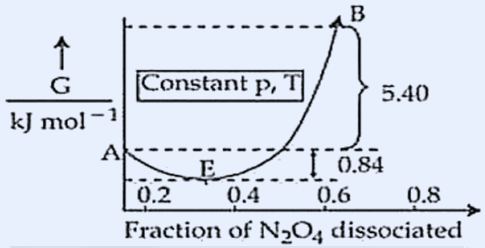
For the reaction , graph is plotted as shown below. Identify correct statements. A. Standard free energy change for the reaction is . B. As in graph is positive. Will not dissociate into at all. C. Reverse reaction will go to completion. D. When 1 mole of changes into equilibrium mixture, value of . E. When 2 mole of changes into equilibrium mixture, for equilibrium mixture is . Choose the correct answer from the options given below:
(1)
(2)
(3)
(4)
SolutionAnswer: Option 3D and E only
Approach:
Read the Gibbs-energy versus extent-of-dissociation curve. The minimum E lies below the pure- level A by 0.84 kJ/mol, and the pure- level B lies above A by 5.40 kJ/mol. Use that any approach toward the equilibrium minimum has , and evaluate each statement.
Step 1:Read graph values.
drop ; rise ; so
Step 2:Statement D: 1 mol pure (level A) approaching equilibrium (E).
Step 3:Statement E: 2 mol pure (level B) approaching equilibrium (E).
Step 4:Reject A, B, C.
A misstates ; B is false ( DOES partly dissociate to the minimum); C is false (reverse reaction stops at equilibrium, not completion)
Step 5:Select the correct set.
D and E
Final answer: D and E only
Q56Single correctOrganic Compounds Containing Nitrogen
A hydrocarbon 'P' () on reaction with HCl gives an optically active Compound Q () which on reaction with one mole of ammonia gives compound 'R' (). 'R' on diazotization followed by hydrolysis gives 'S'. Identify P, Q, R and S.
(1)
(2)
(3)
(4)
SolutionAnswer: Option 3
Approach:
Take P as but-2-ene (gives a chiral chloride). Add HCl by Markovnikov/electrophilic addition to obtain the optically active 2-chlorobutane Q, substitute with ammonia to the amine R, then diazotise and hydrolyse to the alcohol S.
Step 1:Identify P and add HCl to a chiral product.
(2-chlorobutane, , chiral C-2)
Step 2:React Q with one mole of ammonia.
(butan-2-amine, )
Step 3:Diazotise R and hydrolyse.
(butan-2-ol)
Step 4:Match the assembled set to the options.
Final answer:
Q57Single correctOrganic Compounds Containing Nitrogen
An organic compound (P) on treatment with aqueous ammonia under hot condition forms (Q) which on heating with and KOH forms compound (R) having molecular formula . Names of P, Q and R respectively are
(1)
(2)
(3)
(4)
SolutionAnswer: Option 1Benzoic acid, benzamide, aniline
Approach:
Aqueous ammonia with a carboxylic acid under heat gives the amide Q; the amide then undergoes Hofmann bromamide degradation with /KOH to give a primary amine R with one fewer carbon. Match R to .
Step 1:P to Q with aqueous ammonia and heat.
(benzamide)
Step 2:Q to R via Hofmann degradation.
Step 3:Check R against the given molecular formula.
aniline
Step 4:Name P, Q, R.
benzoic acid, benzamide, aniline
Final answer: Benzoic acid, benzamide, aniline
Q58Single correctSome Basic Principles of Organic Chemistry
From the following the least stable structure is
(1)
(2)
(3)
(4)
SolutionAnswer: Option 3Structure with a carbanion adjacent to the positively charged nitrogen (least stable)
Approach:
These are resonance (canonical) forms of a conjugated nitro-butadienyl system. Rank stability by the standard rules: full conjugation/charge delocalisation and placement of negative charge on electronegative atoms stabilise; an isolated carbocation adjacent to a carbanion that is not conjugated through the -system is the most destabilised.
Step 1:State the stability criteria for canonical forms.
more covalent bonds + charge on electronegative atoms = more stable; localised + adjacent unlike charges not in conjugation = less stable
Step 2:Apply to the four structures.
option 3 places a terminal C=C still present (un-conjugated) with an isolated carbocation and a separate carbanion () that is not delocalised into the nitro group, i.e. broken conjugation
Step 3:Compare and select the least stable form.
the non-conjugated carbocation/carbanion structure is the least stable contributor
Final answer: The canonical form with an isolated carbocation and a non-conjugated carbanion (charges not delocalised into the nitro group), i.e. option 3, is the least stable.
Q59Single correctAldehydes, Ketones and Carboxylic Acids
An organic compound 'P' of molecular formula gives positive iodoform test but negative Tollen's test. When 'P' is treated with dilute acid, it produces 'Q'. 'Q' gives positive Tollen's test and also iodoform test. The structure of 'P' is
(1)
(2)
(3)
(4)
SolutionAnswer: Option 1 (a methyl ketone with an acetal)
Approach:
Positive iodoform requires a methyl ketone (CH3-CO-) group; negative Tollens that turns positive only after dilute-acid treatment indicates a masked aldehyde, i.e. an acetal -CH(OR)2 that hydrolyses to -CHO. Build P with C6H12O3 containing a methyl ketone plus a dimethyl acetal.
Step 1:Interpret the test results on P.
iodoform + => methyl ketone present; Tollens - (no free CHO) but + after acid => an acetal that unmasks an aldehyde
Step 2:Write a C6H12O3 structure fitting both tests.
Step 3:Hydrolyse P with dilute acid to give Q.
Step 4:Confirm Q gives both tests.
Q has both (iodoform +) and a free (Tollens +)
Final answer: (option 1): a methyl ketone bearing a dimethyl acetal.
Q60Single correctCoordination Compounds
Given below are two statements:
Statement–I: Among , , and , has the maximum number of unpaired electrons.
Statement–II: The number of pairs among , and that contain only diamagnetic species is two.
In the light of the above statements, those the correct answer from the given below:
Statement–I: Among , , and , has the maximum number of unpaired electrons.
Statement–II: The number of pairs among , and that contain only diamagnetic species is two.
In the light of the above statements, those the correct answer from the given below:
(1)
(2)
(3)
(4)
SolutionAnswer: Option 3Statement-I is true but Statement-II is false
Approach:
Statement-I: determine the d-electron count and unpaired electrons of each metal centre; the complex with the most unpaired electrons is identified. Statement-II: classify each Ni species as diamagnetic or paramagnetic and count how many of the three given pairs contain only diamagnetic species.
Step 1:Count unpaired electrons for Statement-I.
(5 unpaired); (1); (2 in and )
Step 2:Classify the four nickel species in Statement-II.
tetrahedral (weak field) paramagnetic; tetrahedral diamagnetic; square planar diamagnetic
Step 3:Count pairs containing only diamagnetic species.
pairs: mixed; mixed; both diamagnetic only 1 pair
Step 4:Combine verdicts.
I true, II false
Final answer: Statement-I is true but Statement-II is false
Q61Single correctClassification of Elements and Periodicity in Properties
Which of the following represents the correct trend for the mentioned property?
A: – First Ionisation Energy.
B: – Electron Affinity.
C: – Metallic Character.
D: - Basic character.
Choose the correct answer from the options given below:
A: – First Ionisation Energy.
B: – Electron Affinity.
C: – Metallic Character.
D: - Basic character.
Choose the correct answer from the options given below:
(1)
(2)
(3)
(4)
SolutionAnswer: Option 1A, B and D only
Approach:
Check each stated periodic order against the accepted trend for first ionisation energy, electron affinity, metallic character, and oxide basicity, then select the set of correct trends.
Step 1:Trend A: first ionisation energy.
: F highest; P > S (half-filled stability) > B; order correct
Step 2:Trend B: electron affinity.
: Cl > F (small F atom electron repulsion); S > P; order correct
Step 3:Trend C: metallic character.
stated is wrong; correct order is
Step 4:Trend D: basic character of oxides.
: basicity falls left-to-right / up a group; order correct
Step 5:Select correct set.
A, B and D
Final answer: A, B and D only
Q62Single correctSome Basic Concepts in Chemistry
80mL of a hydrocarbon on mixing with 264ml of oxygen in a closed U-tube undergoes complete combustion. The residual gases after cooling to 273K occupy 224mL. When the system is treated with KOH solution, the volume decreases to 64mL. The formula of the hydrocarbon is
(1)
(2)
(3)
(4)
SolutionAnswer: Option 3
Approach:
Eudiometry at constant T,P: equal gas volumes are proportional to moles (Avogadro). is the volume absorbed by KOH; the leftover after KOH is excess . Use the volume for the carbon count and the consumed for the hydrogen count.
Step 1:List measured volumes.
Step 2:Find (absorbed by KOH) and hence x.
Step 3:Excess is the 64 mL left after KOH; find consumed.
Step 4:Solve for y.
Step 5:State the formula.
Final answer:
Q63Single correctp-Block Elements
Given below are two statements:
Statement – I: The number of pairs among , , and which contains oxides that are both amphoteric is 2.
Statement – II: is an electron deficient molecule, act as a Lewis acid forms adduct with and has a trigonal planar geometry.
In the light of the above statements, Choose the correct answer from the options given below:
Statement – I: The number of pairs among , , and which contains oxides that are both amphoteric is 2.
Statement – II: is an electron deficient molecule, act as a Lewis acid forms adduct with and has a trigonal planar geometry.
In the light of the above statements, Choose the correct answer from the options given below:
(1)
(2)
(3)
(4)
SolutionAnswer: Option 1Both Statement-I and Statement-II are true
Approach:
Statement-I: examine each oxide pair and count how many pairs have BOTH oxides amphoteric. Statement-II: verify the bonding facts about BF3 (electron deficiency, Lewis acidity, adduct with NH3, geometry).
Step 1:Classify each oxide pair for amphoterism.
: weakly acidic, acidic not both amphoteric; : both amphoteric; : both amphoteric; : amphoteric but GeO not no
Step 2:Count and conclude Statement-I.
number of fully amphoteric pairs
Step 3:Verify Statement-II facts about BF3.
B has 6 electrons (incomplete octet) -> electron deficient; acts as Lewis acid; forms adduct ; , trigonal planar geometry
Step 4:Combine the verdicts.
I true, II true
Final answer: Both Statement-I and Statement-II are true
Q64Single correctSolutions
Elements 'P' and 'Q' from two types of non-volatile; non-ionizable compounds PQ and . When 1g of PQ is dissolved in 50g of solvent 'A'; was 1.176 K while when 1g of is dissolved in 50g of of solvent 'A'; was 0.689K. (Kb of A is 5 K kg mo). The molar masses of element P and Q (in g mo) respectively are
(1)
(2)
(3)
(4)
SolutionAnswer: Option 2
Approach:
From each boiling-point elevation, compute the solute molar mass via the colligative relation, obtaining M(PQ) and M(PQ2); then write two linear equations in the atomic masses P and Q and solve the system.
Step 1:List the given data for both solutions in solvent A.
Step 2:Compute molar mass of PQ from its boiling-point elevation.
Step 3:Compute molar mass of PQ2 from its boiling-point elevation.
Step 4:Write the two atomic-mass equations and subtract to isolate Q, then back-substitute for P.
Final answer: (P = 25 g/mol, Q = 60 g/mol) — Option 2
Q65Single correctSome Basic Principles of Organic Chemistry
Identify correct statements from the following :
A) Propanal and propanone are functional isomers
B) Ethoxyethane and methoxy propane are metamers
C) But-2-ene shows optical isomerism
D) But-1-ene and But-2-ene are functional isomers
E) Pentane and 2,2-dimethyl propane are chain isomers
Choose the correct answer from the options given below:
A) Propanal and propanone are functional isomers
B) Ethoxyethane and methoxy propane are metamers
C) But-2-ene shows optical isomerism
D) But-1-ene and But-2-ene are functional isomers
E) Pentane and 2,2-dimethyl propane are chain isomers
Choose the correct answer from the options given below:
(1)
(2)
(3)
(4)
SolutionAnswer: Option 1A, B and E only
Approach:
Apply the precise definition of each isomerism class to every statement A-E, classifying the relationship of each named pair, and select the set whose classifications are all correct.
Step 1:Statement A: propanal vs propanone, both .
Step 2:Statement B: ethoxyethane vs methoxypropane, both .
Step 3:Statement E: pentane vs 2,2-dimethylpropane, both .
Step 4:Statement C: but-2-ene has a C=C with two different groups on each carbon and no stereocentre, so it shows geometrical (cis-trans), not optical, isomerism; Statement D: but-1-ene and but-2-ene differ only in the position of the double bond, making them position isomers, not functional isomers.
Final answer: A, B and E only — Option 1
Q66Single correctHydrocarbons
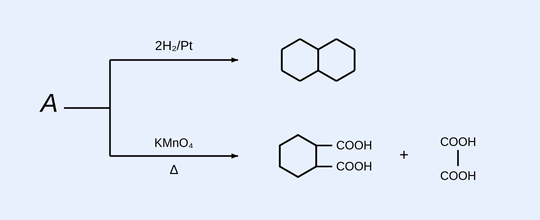
Identify 'A' in the following reaction: (decalin) ; (cyclohexane-1,2-dicarboxylic acid, COOH, COOH) (oxalic acid COOH, COOH)
(1)
(2)
(3)
(4)
SolutionAnswer: Option 3Octahydronaphthalene with the double bond at the ring-fusion region (the isomer giving the stated products)
Approach:
Use the catalytic-hydrogenation stoichiometry to count the degrees of unsaturation in A, then use the specific oxidative-cleavage products to fix the positions of the two C=C bonds within the fused bicyclic framework.
Step 1:Interpret the hydrogenation: addition of 2 over Pt converts A to decalin (decahydronaphthalene), so A is a fully fused bicyclic ring system carrying exactly two C=C bonds (an octahydronaphthalene).
Step 2:Apply oxidative cleavage: the products are cyclohexane-1,2-dicarboxylic acid (an intact six-membered carbocycle bearing two adjacent -COOH) plus oxalic acid (HOOC-COOH, a two-carbon diacid). This requires the two C=C bonds to lie wholly within one ring, cleaving a two-carbon fragment to oxalic acid while leaving the other ring intact as the 1,2-dicarboxylic acid.
Step 3:Select the structure: the isomer of octahydronaphthalene with both C=C bonds in the same (right-hand) ring, positioned so cleavage excises a -CH=CH- pair as oxalic acid and yields the adjacent ring as the 1,2-diacid, matches both observations.
Final answer: Octahydronaphthalene with the two C=C bonds in the right-hand ring (the isomer giving cyclohexane-1,2-dicarboxylic acid and oxalic acid) — Option 3
Q67Single correctChemical Thermodynamics
Which of the following graphs pressure 'P' versus volume 'V' represents the maximum workdone?
(1)
(2)
(3)
(4)
SolutionAnswer: Option 1Curve expanding from to — largest area under the curve (option 1)
Approach:
Work done by an expanding gas equals the area enclosed under its P-V expansion path; evaluate each graph for direction (expansion vs compression vs isochoric) and enclosed area, selecting the expansion process with the largest area.
Step 1:State the criterion: positive work requires increasing volume (); the magnitude equals the area under the path. A constant-volume step contributes zero work and a compression contributes negative work.
Step 2:Examine the four graphs. Graph 2 is an isobaric step then an isochoric vertical drop (small area). Graph 3 carries arrows of compression/return (work not maximal positive). Graph 4 is a closed lens-shaped loop (net area, not a single maximal expansion). Graph 1 is a single reversible expansion curve from (22.4 L, 2.0 bar) to (44.8 L, 1.0 bar) sweeping the largest area under the path.
Step 3:Select the graph giving maximum work done by the gas.
Final answer: The reversible expansion curve from to — Option 1
Q68Single correctAtomic Structure
Statement – I: When an electric discharge is passed through gaseous hydrogen, the hydrogen molecules dissociate and the energetically excited hydrogen atoms produce electromagnetic radiation of discrete frequencies.
Statement – II: The frequency of second line Balmer series obtained from equal to that of first line of Lyman series obtained from hydrogen atom.
In the light of the above statements, Choose the correct answer from the options given below:
Statement – II: The frequency of second line Balmer series obtained from equal to that of first line of Lyman series obtained from hydrogen atom.
In the light of the above statements, Choose the correct answer from the options given below:
(1)
(2)
(3)
(4)
SolutionAnswer: Option 2Both Statement-I and Statement-II are true
Approach:
Assess Statement-I against the known origin of the hydrogen line spectrum, then test Statement-II quantitatively using the Bohr/Rydberg frequency relation with explicit scaling for the H first Lyman line and the second Balmer line.
Step 1:Statement-I: an electric discharge dissociates into atoms; excited H atoms relax between quantized levels, emitting radiation only at discrete (quantized) frequencies — the line spectrum. This is correct.
Step 2:Compute the H first Lyman line factor (, , ).
Step 3:Compute the He+ second Balmer line factor (, , transition to for the second member).
Step 4:Compare: the two proportionality factors are identical, so the two frequencies are equal. Statement-II is correct.
Final answer: Both Statement-I and Statement-II are true — Option 2
Q69Single correctp-Block Elements
Consider the following reactions.
(Hot solution)
In the above reactions, A, B and X are respectively.
(Hot solution)
In the above reactions, A, B and X are respectively.
(1)
(2)
(3)
(4)
SolutionAnswer: Option 3
Approach:
Trace the three lead reactions sequentially: precipitation of lead chromate, its amphoteric dissolution in excess base to a plumbite, and the acetate displacement forming an acetato-plumbate complex, identifying A, B and X.
Step 1:Reaction 1: hot PbCl2 with K2CrO4 precipitates yellow lead chromate, giving A.
Step 2:Reaction 2: PbCrO4 (amphoteric lead centre) dissolves in NaOH releasing chromate and forming the tetrahydroxoplumbate(II), giving B.
Step 3:Reaction 3: PbSO4 with ammonium acetate liberates ammonium sulfate and forms the ammonium tetraacetatoplumbate(II) complex, giving X.
Final answer: — Option 3
Q70Single correctSome Basic Concepts in Chemistry
14.0gm of calcium metal is allowed to react with excess HCl at 1.0 atm pressure and 273K which of the following statements is incorrect? [Given molar mass in gmo of Ca – 40; Cl – 35.5; H – 1.]
(1)
(2)
(3)
(4)
SolutionAnswer: Option 4 g of is produced
Approach:
Compute moles of calcium, apply the stoichiometry to evaluate moles and volume at STP, the limiting reagent and the mass, then identify the single statement that is false.
Step 1:Moles of Ca; HCl is in excess so 1:1 stoichiometry gives equal moles of and .
Step 2:Volume of at 1 atm, 273 K (STP, 22.4 L/mol).
Step 3:Limiting reagent: HCl is supplied in excess, so calcium limits the reaction.
Step 4:Mass of (): the produced mass is 38.85 g, not 33.3 g, so statement 4 is false.
Final answer: The incorrect statement is "33.3 g of is produced" (true value 38.85 g) — Option 4
Q71NumericalChemical Kinetics
Pre-exponential factors of two different reactions of same order are identical. Let activation energy of first reaction exceeds the activation energy of second reaction by 20 kJ mo. If and are the rate constants of first and second reaction respectively at 300 K, then will be ____. (nearest integer) [R=8.3]
SolutionAnswer: 8
Approach:
With identical pre-exponential factors, take the ratio of the two Arrhenius rate constants so A cancels; the logarithm of the ratio depends only on the activation-energy difference, which is then evaluated at 300 K.
Step 1:List data: the first reaction's activation energy exceeds the second's by 20 kJ/mol; identical A; T = 300 K, R = 8.3.
Step 2:Form the ratio of rate constants; equal A cancels, and dividing exponentials gives the difference of activation energies in the exponent.
Step 3:Substitute and evaluate.
Final answer: (nearest integer)
Q72Numericald- and f-Block Elements
Consider the following reactions: In the product 'C', 'X' is the number of units, 'Y' is the total number oxygen atoms present and 'Z' is the oxidation state of Cr. The value of X + Y + Z is____.
SolutionAnswer: 13
Approach:
Identify each species in the chromyl-chloride sequence (A = chromyl chloride, B = sodium chromate, C = chromium pentoxide), then count peroxo units, total oxygen atoms and the oxidation state of Cr in C and sum them.
Step 1:Reaction 1 forms chromyl chloride A; reaction 2 hydrolyses it in NaOH to sodium chromate B; reaction 3 acidified chromate with gives blue chromium pentoxide C.
Step 2:In the structure is : two side-on peroxo () units and one doubly-bonded oxo. Count peroxo units X.
Step 3:Count total oxygen atoms Y in .
Step 4:Oxidation state Z of Cr: two peroxo groups contribute 2x(-2) = -4 and the oxo contributes -2; for a neutral molecule Cr balances +6.
Step 5:Sum the three quantities.
Final answer:
Q73NumericalOrganic Compounds Containing Nitrogen
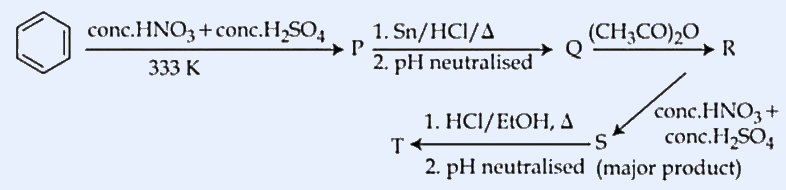
Consider the following reaction sequence (benzene) P Q R ; R S (major product) ; S T. The percentage of nitrogen in product 'T' formed is ______%. (Nearest integer) (Given molar mass in H: 1, C : 12, N : 14, O : 16)
SolutionAnswer: 20
Approach:
Follow the aromatic substitution sequence step by step to the final product T (4-nitroaniline), establish its molecular formula and molar mass, then compute the nitrogen mass percentage.
Step 1:Trace the sequence: benzene nitrates to nitrobenzene (P); Sn/HCl reduction then neutralisation gives aniline (Q); acetic anhydride acetylates to acetanilide (R); nitration of acetanilide (o/p-director) gives mainly p-nitroacetanilide (S); acidic HCl/EtOH hydrolysis then neutralisation removes the acetyl group to give 4-nitroaniline (T).
Step 2:Write the molecular formula and molar mass of T.
Step 3:Mass of nitrogen per mole and percentage.
Step 4:Evaluate.
Final answer: (nearest integer)
Q74NumericalRedox Reactions and Electrochemistry
The pH and conductance of a weak acid (HX) was found to be 5 and , respectively. The conductance was measured under standard condition using a cell where the electrode plates having a surface area of were at a distance of 15 cm apart. The value of the limiting molar conductivity is __________ (nearest integer) (Given: degree of dissociation of the weak acid )
SolutionAnswer: 6
Approach:
Obtain the ion (and acid) concentration from pH given , compute the cell constant from the plate geometry, convert conductance to conductivity, then divide by concentration to get the molar conductivity, which equals the limiting molar conductivity because the acid is essentially undissociated.
Step 1:From pH = 5 the hydrogen-ion concentration is M; because the analytical acid concentration is taken equal to this ion concentration.
Step 2:Cell constant from l = 15 cm and a = 1 c; convert to SI ().
Step 3:Conductivity from measured conductance times cell constant.
Step 4:Molar conductivity; with the value computed from the dilute ion concentration is the limiting molar conductivity.
Final answer: (nearest integer)
Q75NumericalChemical Thermodynamics
Use the following date:
Substance | |
AB(g) | 32 | 222
| 6 | 146
| x | 280
One mole each of and are taken in a 1 L closed flask and allowed to establish the equilibrium at 500K. The value of x (in ) is __________(Nearest integer) (Given: )
Substance | |
AB(g) | 32 | 222
| 6 | 146
| x | 280
One mole each of and are taken in a 1 L closed flask and allowed to establish the equilibrium at 500K. The value of x (in ) is __________(Nearest integer) (Given: )
SolutionAnswer: 70
Approach:
Compute the standard Gibbs energy of reaction from the equilibrium constant, the standard entropy change from the tabulated entropies, then use Gibbs-Helmholtz to find the reaction enthalpy and equate it to the formation-enthalpy expression to solve for .
Step 1:Reaction and data: at 500 K; , R = 8.3.
Step 2:Standard Gibbs energy of reaction from K.
Step 3:Standard entropy change from tabulated S values (products minus reactants).
Step 4:Reaction enthalpy via Gibbs-Helmholtz.
Step 5:Express the same enthalpy from formation enthalpies and solve for x.
Final answer: (nearest integer)
Mathematics25 questions
Q1Single correctIntegral Calculus
The value of is equal to
(1)
(2)
(3)
(4)
SolutionAnswer: Option 4
Approach:
Split the integrand into its odd and even parts; the odd part vanishes over the symmetric interval, then reduce and integrate the even part by a shift substitution.
Step 1:Separate the integrand: the constant- piece with an even denominator, and the piece.
Step 2:The denominator is even in x (depends on ); is odd, so the second integrand is odd and integrates to zero.
Step 3:The first integrand is even, so fold the interval and replace with x on .
Step 4:Substitute , , limits , and use the reciprocal identity.
Step 5:Integrate to and apply the limits.
Step 6:Simplify: , so the bracket equals .
Final answer:
Q2Single correctQuadratic Equations
The sum of all roots of equation is
(1)
(2)
(3)
(4)
SolutionAnswer: Option 1
Approach:
Substitute to obtain a quadratic in , take the non-negative roots, recover all , and sum them.
Step 1:Let , turning the equation into a quadratic in t.
Step 2:Factor and solve for .
Step 3:Both roots are non-negative, so each yields two valid -values.
Step 4:Sum all four roots.
Final answer:
Q3Single correctTrigonometry
The value of is equal to
(1)
(2)
(3)
(4)
SolutionAnswer: Option 3
Approach:
Combine the two reciprocal terms over a common denominator, write the numerator as a single sine, and reduce the denominator with the double-angle identity.
Step 1:Write the expression with explicit reciprocals.
Step 2:Combine over the common denominator .
Step 3:Factor from the numerator to expose a sine difference with .
Step 4:Reduce the denominator with the double-angle identity.
Step 5:Divide; the factors cancel.
Final answer:
Q4Single correctComplex Numbers
If , then the value of is
(1)
(2)
(3)
(4)
SolutionAnswer: Option 1
Approach:
Identify the root as a primitive cube root of unity, evaluate by , raise to the fourth power, and count the contributions for to .
Step 1:From , with and ; the general term is .
Step 2:Evaluate by residue of n mod .
Step 3:Raise each to the fourth power.
Step 4:For to , multiples of are (eight values giving ); the remaining values give .
Step 5:Sum the contributions.
Final answer:
Q5Single correctSequence and Series
Let be a G.P of increasing positive terms such that & then is equal to
(1)
(2)
(3)
(4)
SolutionAnswer: Option 2
Approach:
Use the product condition to fix , divide the given sum to form a symmetric equation in , solve for , then write the target as times the given sum.
Step 1:First term , common ratio (increasing positive terms); target is .
Step 2:Apply the product condition.
Step 3:Write the sum and divide by .
Step 4:This gives ; solve for .
Step 5:Note , so multiply the given sum by .
Final answer:
Q6Single correctSets, Relations and Functions
The number of relations, defined on the set which are both reflexive & symmetric is equal to
(1)
(2)
(3)
(4)
SolutionAnswer: Option 3
Approach:
Reflexivity forces all diagonal pairs into the relation; symmetry ties each off-diagonal pair together, leaving independent binary choices over the unordered pairs.
Step 1:The set has elements, so the full relation lives in ordered pairs.
Step 2:Reflexivity forces the diagonal pairs to be present, with no freedom.
Step 3:The remaining off-diagonal ordered pairs form unordered pairs; symmetry makes each unordered pair one independent choice.
Step 4:Each of the pairs is independently included or excluded.
Final answer:
Q7Single correctDifferential Equations
Let be the solution curve of the differential equation then value of is
(1)
(2)
(3)
(4)
SolutionAnswer: Option 2
Approach:
Rewrite as a linear first-order ODE in y, use the integrating factor , integrate by parts, apply , and evaluate at .
Step 1:Divide by to get standard linear form.
Step 2:Compute the integrating factor.
Step 3:Multiply through; the left side is . With the right integral is by parts.
Step 4:Solve for y by dividing by .
Step 5:Apply with .
Step 6:Evaluate at with .
Final answer:
Q8Single correctCoordinate Geometry
Let a point A lie between the parallel lines and such that its distances from and are 6 and 3 units respectively then the area (in sq units) of equilateral triangle ABC where the Points B and C lie on lines and respectively is
(1)
(2)
(3)
(4)
SolutionAnswer: Option 1
Approach:
Place the parallel lines as and with and on ; rotate by to reach the third vertex C, force C onto to fix a, then compute the side and area.
Step 1:Set , (distance ), at distance from and from , and on .
Step 2:Rotate about B by to get C.
Step 3:Force C onto : its y-coordinate equals .
Step 4:Compute side length from .
Step 5:Apply the equilateral-area formula.
Final answer:
Q9Single correctCoordinate Geometry
Let foci of a hyperbola coincide with the foci of the ellipse if eccentricity of the hyperbola is 5 then length of its latus rectum is
(1)
(2)
(3)
(4)
SolutionAnswer: Option 3
Approach:
Find the ellipse foci, equate them to the hyperbola foci to determine a, use the hyperbola eccentricity to get , then apply the latus-rectum formula.
Step 1:For the ellipse , , so foci are .
Step 2:Hyperbola shares these foci, so with .
Step 3:Compute from the hyperbola relation.
Step 4:Apply the latus-rectum formula.
Final answer:
Q10Single correctLimits, Continuity and Differentiability
Let be a twice differentiable function such that and then is equal to
(1)
(2)
(3)
(4)
SolutionAnswer: Option 3
Approach:
Bring the exponent inside the logarithm, set , expand f to second order about (using ), and apply .
Step 1:Pull the exponent out; let so .
Step 2:Expand with .
Step 3:Form the ratio.
Step 4:Apply the small-argument logarithm.
Step 5:Substitute and cancel .
Final answer:
Q11Single correctPermutations and Combinations
The number of strictly increasing functions f from set to the set such that for is equal to
(1)
(2)
(3)
(4)
SolutionAnswer: Option 4
Approach:
A strictly increasing integer map forces ; the constraint becomes . Shift the values to absorb this and count by a single binomial.
Step 1:Map , strictly increasing, with . Strict increase forces .
Step 2:Since , the condition is equivalent to .
Step 3:Define , strictly increasing; then becomes .
Step 4:Any strictly increasing -tuple from automatically satisfies , so the constraint imposes nothing extra.
Step 5:Count strictly increasing -subsets of an -element set.
Final answer:
Q12Single correctVector Algebra
Let and c be a vector such that if then is equal to
(1)
(2)
(3)
(4)
SolutionAnswer: Option 2
Approach:
Write , expand into three scalar equations, add the dot-product constraint, solve the linear system, then compute .
Step 1:With and , expand the cross product.
Step 2:Set equal to .
Step 3:Add the dot-product condition .
Step 4:From eq3, ; from eq2, . Substitute into .
Step 5:Back-substitute to get and .
Step 6:Compute the magnitude squared.
Final answer:
Q13Single correctInverse Trigonometric Functions
If the domain of the function is the interval , then is equal to
(1)
(2)
(3)
(4)
SolutionAnswer: Option 3
Approach:
Impose the domain conditions for and for , solve each, intersect, and read off .
Step 1:Require both arguments in .
Step 2:Solve the quadratic condition. Lower bound: (discriminant , always true). Upper bound: .
Step 3:On , . Upper bound: (holds). Lower bound: (holds).
Step 4:Intersect: the rational condition is met throughout , so the domain is .
Step 5:Read and compute .
Final answer:
Q14Single correctIntegral Calculus
The area of the region inside the ellipse and outside the region bounded by the curve and is
(1)
(2)
(3)
(4)
SolutionAnswer: Option 1
Approach:
Recognize the ellipse has semi-axes ; the curves and bound a square. Compute the ellipse area, the square area, and subtract since the square lies inside the ellipse.
Step 1:Rewrite the ellipse in standard form and read off the semi-axes.
Step 2:Compute the area enclosed by the ellipse.
Step 3:Find where the two curves meet: , giving the closed figure with vertices , a square with both diagonals equal to .
Step 4:Compute the area of this square.
Step 5:The square's vertices satisfy , so it lies inside the ellipse; subtract the inner area from the ellipse area.
Final answer:
Q15Single correctBinomial Theorem
If the coefficient of x in the expansion of is -56 and the coefficient of and are both zero then a+b+c is equal to
(1)
(2)
(3)
(4)
SolutionAnswer: Option 4
Approach:
Expand to the powers , write the product's coefficients of using , set up three equations, and solve for a,b,c.
Step 1:Compute the needed coefficients of .
Step 2:Set the coefficient of to .
Step 3:Set the coefficient of to .
Step 4:Set the coefficient of to .
Step 5:Solve the linear system.
Step 6:Add the constants.
Final answer:
Q16Single correctCoordinate Geometry
Let PQ and MN be two straight lines touching the circle at the point A and B respectively. Let O be centre of the circle and then the locus of the point of intersection of the lines PQ and MN is
(1)
(2)
(3)
(4)
SolutionAnswer: Option 3
Approach:
Find the circle's centre O and radius r. From the external point R, two tangents touch at A,B with . Use the right triangle OAR to relate OR to r, compute the power , and write the locus.
Step 1:Read off centre and radius.
Step 2:Since , triangle OAR is right-angled at A with , so and .
Step 3:Compute the power of with respect to the circle.
Step 4:Set equal to and clear the denominator.
Step 5:Simplify.
Final answer:
Q17Single correctStatistics and Probability
Let the mean and variance of 7 observations 2,4,10,x,12,14,y,x>y, be 8 and 16 respectively two numbers are chosen form one after another without replacement then the probability that the smaller number among the two chosen numbers is less than 4 is
(1)
(2)
(3)
(4)
SolutionAnswer: Option 1
Approach:
Use the mean and variance of the seven observations to find x,y with , construct the selection set , then compute via complement the probability that the smaller of two chosen numbers is less than .
Step 1:Apply the mean to the seven values .
Step 2:Apply the variance: known squares sum to .
Step 3:Combine to get , then solve the quadratic with .
Step 4:Form the selection set.
Step 5:Complement event: both chosen numbers are , i.e. both from .
Step 6:Required probability is the complement.
Final answer:
Q18Single correctCoordinate Geometry
Let c and d be vectors such that and .if are the possible values of then the equation represents of a circle for K equal to
(1)
(2)
(3)
(4)
SolutionAnswer: Option 4
Approach:
Show is parallel to from the cross-product relation, use to fix the scalar, compute the dot product to obtain , substitute into the conic, and impose the conditions for a circle.
Step 1:From , with .
Step 2:Write and apply the magnitude with .
Step 3:Compute the projection-type dot product.
Step 4:Substitute into the conic.
Step 5:Require zero -coefficient.
Step 6:Require equal and coefficients.
Step 7:Take the common value satisfying both.
Final answer:
Q19Single correctCoordinate Geometry
Let O be the vertex of the parabola and Q be any point on it let the locus of the point P which divides The line segment OQ internally in the ratio 2:3 be the conic C then the equation of the chord of C which is bisected at point (1,2) is
(1)
(2)
(3)
(4)
SolutionAnswer: Option 1
Approach:
Parametrise Q on , apply the internal section formula to find P dividing OQ in ratio , eliminate the parameter to get the conic C, then use to write the chord of C bisected at .
Step 1:Take on and ; P divides OQ as .
Step 2:Set and eliminate t via .
Step 3:Write for at midpoint .
Step 4:Substitute .
Step 5:Rearrange to standard form.
Final answer:
Q20Single correctCoordinate Geometry
Let be the co-ordinates of the foot of the perpendicular drawn from the point on the line then the length of the projection of vector on the vector is
(1)
(2)
(3)
(4)
SolutionAnswer: Option 1
Approach:
Express a general point B on the line, impose that is perpendicular to the direction to solve for and find the foot, then compute the scalar projection of the foot's position vector onto .
Step 1:Point on line and vector from with .
Step 2:Impose .
Step 3:Substitute to get the foot .
Step 4:Project the position vector onto , with .
Final answer:
Q21NumericalSequence and Series
Let and for then is equal to
SolutionAnswer: 2
Approach:
Define and show the recurrence forces , making geometric; then sum the infinite series and take the modulus.
Step 1:Define the auxiliary sequence.
Step 2:Form using .
Step 3:Combine over ; the numerator vanishes identically.
Step 4:Identify the geometric sequence.
Step 5:Sum and take modulus.
Final answer:
Q22NumericalIntegral Calculus
is equal to
SolutionAnswer: 17
Approach:
Factor the integrand as , substitute , reduce to , split at the sign changes, and integrate.
Step 1:Factor the integrand.
Step 2:Substitute (as , ); .
Step 3:The sign of changes at and ; split accordingly.
Step 4:Use antiderivative and sum the pieces.
Step 5:Multiply by .
Final answer:
Q23NumericalMatrices and Determinants
For some let and be such that then is equal to
SolutionAnswer: 225
Approach:
By the Cayley-Hamilton form , match the given relations to fix ; compute , take the difference, and apply before squaring.
Step 1:Match : trace 4, determinant .
Step 2:Match : trace 3, determinant .
Step 3:Compute the matrix cubes.
Step 4:Form the difference and its determinant.
Step 5:For , .
Step 6:Square the result.
Final answer:
Q24NumericalPermutations and Combinations
Let if number of elements (m,n) In S such that is a multiple of 5 is P and the number of elements (m,n) in S such that m+n is a square of a prime number is Q then P+Q is equal to
SolutionAnswer: 1333
Approach:
Reduce and modulo to count P (pairs with ), then enumerate equal to a prime-square value with to count Q, and add.
Step 1:Reduce the expression modulo .
Step 2:Divisibility by requires , i.e. n odd.
Step 3:Count : any of values, any of the odd values in .
Step 4:Prime squares with are ; count pairs with .
Step 5:Add the two counts.
Final answer:
Q25NumericalLimits, Continuity and Differentiability
Let be a twice differentiable function such that the quadratic equation In m, has two equal roots for every .If , and is the largest interval in which the functions is increasing, then is equal to
SolutionAnswer: 1
Approach:
The equal-roots condition gives zero discriminant, leading to the ODE , equivalently ; solve with to get f, then determine where is increasing.
Step 1:Set the discriminant of to zero.
Step 2:Rearrange and integrate.
Step 3:Apply initial data .
Step 4:Differentiate for .
Step 5:Solve ; the exponential is positive, so the sign comes from .
Step 6:Read and add.
Final answer:
More JEE Main 2026 papers
- JEE Main 2026 — April 02, Shift 1
- JEE Main 2026 — April 02, Shift 2
- JEE Main 2026 — April 04, Shift 1
- JEE Main 2026 — April 04, Shift 2
- JEE Main 2026 — April 05, Shift 1
- JEE Main 2026 — April 05, Shift 2
- JEE Main 2026 — April 06, Shift 1
- JEE Main 2026 — April 06, Shift 2
- JEE Main 2026 — April 08, Shift 2
- JEE Main 2026 — January 21, Shift 2
- JEE Main 2026 — January 22, Shift 1
- JEE Main 2026 — January 22, Shift 2
- JEE Main 2026 — January 23, Shift 1
- JEE Main 2026 — January 23, Shift 2
- JEE Main 2026 — January 24, Shift 1
- JEE Main 2026 — January 24, Shift 2
- JEE Main 2026 — January 28, Shift 1
- JEE Main 2026 — January 28, Shift 2
Frequently Asked Questions
How many questions are in the JEE Main 2026 January 21, Shift 1 paper?
The JEE Main 2026 January 21, Shift 1 paper has 75 questions — Physics (25), Chemistry (25) and Mathematics (25). Every question is on this page with its correct answer and a step-by-step solution.
What is the marking scheme for JEE Main?
JEE Main awards +4 marks for each correct answer and −1 for a wrong answer, with 0 for questions left unattempted. The paper covers Physics, Chemistry and Mathematics.
Are the answer key and step-by-step solutions provided for the 2026 January 21, Shift 1 paper?
Yes — every question shows the correct answer (answer key) and a detailed step-by-step solution, free to read online.
Can I take the JEE Main 2026 January 21, Shift 1 paper as a timed mock test?
Yes. With a free JEEnify account you can attempt this exact paper as a timed test in the real exam interface, then see your score and weak-area analysis.
Solved this paper? Calculate your JEE Main scoremost important chaptersformula sheetsall free tools.