
Back to JEE Main PYQs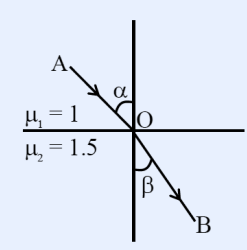
![Graph with y-axis t(1/2)/s and x-axis [A]0/mol L^-1, showing a straight line of positive slope passing through the origin (as drawn in Statement II).](/api/qna-image?path=QnA%2Fb65cda62-f924-480b-b4db-1d3aaa6069d4%2F5ef15551-aed6-4f93-a8d5-a219b7a5d19b%2Ffa5c5f69-d647-49ae-9322-5f2b2479d618%2Ffa5c5f69-d647-49ae-9322-5f2b2479d618%2Fimages%2FQ57_graph_based.webp)
JEE Main 2026 April 08, Shift 2 Question Paper with Solutions
All 72 questions from the JEE Main 2026 (April 08, Shift 2) shift — Physics (24), Chemistry (24) and Mathematics (24) — each with the correct answer (answer key) and a step-by-step solution. Read it free online, or attempt the full paper as a timed mock test.
Physics24 questions
Q26Single correctUnits and Measurements
A new unit () of length is chosen such that it is equal to the speed of light in vacuum. What is the distance between Venus and Earth in terms of units if light takes 6 min. 40s to cover this distance?
(1)
(2)
(3)
(4)
SolutionAnswer: Option 2
Approach:
The chosen unit of length satisfies in magnitude (the numerical value of the speed of light in vacuum). Since distance equals speed multiplied by time, the light-path distance in units of reduces to the elapsed time in seconds.
Step 1:Given: speed of light c (m/s), travel time , and the new unit . Target: distance d expressed in units of .
Step 2:Convert the time into seconds.
Step 3:Compute the path distance and convert to the new unit by dividing by .
Step 4:Dimensional check: carries the dimension of c (length/time), and leaves a pure number equal to the seconds elapsed, giving . Result: the distance is .
Final answer:
Q27Single correctUnits and Measurements
Consider the equation Where H = magnetic field; E = electric field, = permittivity, x = distance, t = time. The values of p, q, r and s respectively are:
(1)
(2)
(3)
(4)
SolutionAnswer: Option 1
Approach:
Apply the principle of dimensional homogeneity. Express each quantity in base dimensions (M, L, T, A), substitute into , and equate the exponent of each base dimension on both sides to obtain a solvable linear system. Here H is the magnetic field strength (units A/m), consistent with the option set.
Step 1:Base dimensions of each quantity. Target: exponents .
Step 2:Substitute into and equate exponents of M, L, T, A.
Step 3:Solve the system. From M, . Substituting into A: , so and . From T: . From L: , giving .
Step 4:Back-substitution of the full product . Result: the exponents are .
Final answer:
Q28Single correctLaws of Motion
A car moving with a speed of 54 km/h takes a turn of radius 20 m. A simple pendulum is suspended from the ceiling of the car. Determine the angle made by the string of the pendulum with the vertical during the turning. (Take g = 10 m/)
(1)
(2)
(3)
(4)
SolutionAnswer: Option 3
Approach:
In the non-inertial frame of the turning car, the bob experiences gravity mg downward and a horizontal centrifugal pseudo-force outward. The string aligns with the resultant, so the angle with the vertical satisfies .
Step 1:Given: speed , turn radius , . Target: angle of the string with the vertical.
Step 2:Convert the speed to SI units.
Step 3:Force balance. Horizontal: ; vertical: . Dividing gives .
Step 4:Dimensional check: has dimensions , which is dimensionless, suitable for a tangent. Result: the angle follows.
Final answer:
Q29Single correctKinematics
A gas balloon is going up with a constant velocity of 10 m/s. When this balloon reached a height of 75 m, a stone is dropped from it and balloon keeps moving up with the same velocity. The height of the balloon when the stone hits the ground is ...... m. (Take g = 10 m/)
(1)
(2)
(3)
(4)
SolutionAnswer: Option 4
Approach:
At release the stone shares the balloon's upward velocity of 10 m/s and then moves under gravity from a height of 75 m. Solve for the time to reach the ground, then add the distance the balloon rises in that time (at 10 m/s) to its release height of 75 m.
Step 1:Quantities (upward positive): stone's initial velocity , ground displacement , acceleration ; balloon rises at . Target: balloon height when the stone lands.
Step 2:Apply the stone's displacement equation.
Step 3:Solve the quadratic and keep the positive root for time of flight.
Step 4:Add the balloon's rise during this time to its release height. Check: substituting into the stone equation gives , matching the ground level.
Final answer: m
Q30Single correctOptics
A thin biconvex lens is prepared from the glass () both curved surfaces of which have equal radii of 20 cm each. Left side surface of the lens is silvered from outside to make it reflecting. To have the position of image and object at the same place, the object should be placed, from the lens at a distance of ......... cm.
(1)
(2)
(3)
(4)
SolutionAnswer: Option 1
Approach:
A lens with one face silvered acts as an equivalent mirror whose power is (light crosses the lens twice and reflects once). The object coincides with its own image when placed at the centre of curvature of the equivalent mirror, i.e. at .
Step 1:Given: , biconvex radii , , silvered surface radius . Target: object distance for image–object coincidence.
Step 2:Compute the lens power and the silvered-surface mirror power.
Step 3:Combine into the equivalent mirror power and its focal length.
Step 4:For a self-coincident image the object sits at the centre of curvature of the equivalent concave mirror, a distance . At , mirror rays retrace and form the image on the object.
Final answer: cm
Q31Single correctKinematics
Two identical bodies, projected with the same speed at two different angles cover the same horizontal range R. If the time of flight of these bodies are 5 s and 10 s, respectively, then the value of R is ________ m. (Take g = 10 m/)
(1)
(2)
(3)
(4)
SolutionAnswer: Option 1
Approach:
Equal range from the same speed at two different angles requires complementary projection angles and . The product of their times of flight relates to the common range through .
Step 1:Given: complementary angles and , common speed u, flight times , , . Target: range R.
Step 2:Form the product of the two flight times.
Step 3:Rearrange and substitute the numerical values.
Step 4:Dimensional check: has dimensions , correct for a range.
Final answer: m
Q32Single correctRotational Motion
A solid cylinder having radius R and length L is slipping on a rough horizontal plane. At time t = 0 the cylinder has a translational velocity m/s, perpendicular to its axis and a rotational velocity about the centre. The time taken by the cylinder to start rolling is ____ seconds. (coefficient of kinetic friction and g = 9.8 m/)
(1)
(2)
(3)
(4)
SolutionAnswer: Option 2
Approach:
The translational velocity exceeds the surface speed of rotation (), so the contact point slips forward and kinetic friction acts backward. Friction decelerates the centre of mass while its torque about the centre increases the angular velocity. Pure rolling begins when .
Step 1:Given: , so , , . Target: time t to begin rolling.
Step 2:Write the translational velocity, decelerating under friction.
Step 3:Surface rotational speed. Torque with gives , so .
Step 4:Apply the rolling condition and solve. Check: at , and , equal.
Final answer: s
Q33Single correctProperties of Solids and Liquids
A liquid of density 600 kg/ flowing steadily in a tube of varying cross-section. The cross-section at a point A is 1.0 c and that at B is 20 m. Both the points A and B are in same horizontal plane, the speed of the liquid at A is 10 cm/s. The difference in pressures at A and B points is ______ Pa.
(1)
(2)
(3)
(4)
SolutionAnswer: Option 4
Approach:
Find the speed at B from the equation of continuity, then apply Bernoulli's equation at the same horizontal level (no height term) to obtain the pressure difference .
Step 1:Given, converted to SI: , , , . Target: .
Step 2:Apply continuity to find the speed at B.
Step 3:Apply Bernoulli's equation at equal height to express the pressure difference and substitute.
Step 4:Dimensional check: gives . The smaller area at B yields higher speed and lower pressure, consistent with a positive .
Final answer: Pa
Q34Single correctProperties of Solids and Liquids
A spherical liquid drop of radius R acquires the terminal velocity when falls through a gas of viscosity . Now the drop is broken into 64 identical droplets and each droplet acquires terminal velocity falling through the same gas. The ratio of terminal velocities is ____ .
(1)
(2)
(3)
(4)
SolutionAnswer: Option 4
Approach:
By Stokes' law the terminal velocity of a sphere is proportional to the square of its radius. Conserving total volume when the drop splits into 64 identical droplets fixes the small-droplet radius, after which the velocity ratio follows from the radius ratio squared.
Step 1:Given: original radius R with terminal velocity ; 64 identical droplets of radius r with terminal velocity , same , , , g. Target: .
Step 2:Apply volume conservation to find the droplet radius.
Step 3:Form the velocity ratio using .
Step 4:Consistency check: the larger drop falls faster, so , and a fourfold larger radius scales velocity by .
Final answer:
Q36Single correctThermodynamics
Initial pressure and volume of a monoatomic ideal gas are P and V. The change in internal energy of this gas in adiabatic expansion to volume is ____ J.
(1)
(2)
(3)
(4)
SolutionAnswer: Option 3
Approach:
Applying the adiabatic relation for a monoatomic gas gives the final pressure, and then gives the change in internal energy, since the internal energy of an ideal gas depends only on the state quantity PV.
Step 1:Given the initial state , final volume , and a monoatomic gas with and . The target is in joules.
Step 2:The final pressure follows from the adiabatic condition.
Step 3:The product goes into the internal-energy expression.
Step 4:An adiabatic expansion does positive work with , so and the negative sign is consistent. The change in internal energy is .
Final answer: J
Q37Single correctOscillations and Waves
The frequency of oscillation of a mass m suspended by a spring is . If the length of the spring is cut to half, the same mass oscillates with frequency . The value of is ______ .
(1)
(2)
(3)
(4)
SolutionAnswer: Option 3
Approach:
The force constant of a uniform spring is inversely proportional to its natural length, so halving the length doubles the constant. The relation with the same mass gives the ratio.
Step 1:The original spring of length L has constant k, and the same mass m hangs from it. The target is the ratio after the spring length is reduced to .
Step 2:Since , cutting the length in half doubles the force constant.
Step 3:The new frequency forms a ratio with the original, and cancels.
Step 4:A stiffer spring with larger k raises the frequency; doubling k scales the frequency by , consistent with the result.
Final answer:
Q38Single correctDual Nature of Matter and Radiation
A monochromatic source of light operating at kW emits photons/s. The region of an electromagnetic spectrum to which the emitted electromagnetic radiation belongs to ____. (Take J.s and m/s).
(1)
(2)
(3)
(4)
SolutionAnswer: Option 4Ultraviolet
Approach:
The energy per photon equals the emitted power divided by the photon emission rate. This converts to a wavelength via , which is classified against the visible band (400-700 nm).
Step 1:Power , photon rate , , and . The target is the spectral region.
Step 2:Energy of a single photon.
Step 3:The photon energy converts to a wavelength.
Step 4:Since , the violet edge of the visible band, the radiation lies in the ultraviolet region.
Final answer: Ultraviolet
Q39Single correctMagnetic Effects of Current and Magnetism
A current carrying circular loop of radius cm with unit normal is placed in a magnetic field, . If T and current A, the torque experienced by the loop is ____ Wb.A. ().
(1)
(2)
(3)
(4)
SolutionAnswer: Option 4
Approach:
The magnetic dipole moment is with , and the torque is the cross product .
Step 1:Here , , , and . The area follows.
Step 2:Magnetic moment vector; the in I cancels the in .
Step 3:With , the cross product uses and .
Step 4:Both and lie in the x-z plane, so their cross product must be along ; the net coefficient is positive, giving .
Final answer: WbA
Q40Single correctElectromagnetic Induction and Alternating Currents
A cm long solenoid has turns per cm and area of c. The current through the solenoid coil varies from A to A in s. The e.m.f. induced in the coil is V. The value of is ____ .
(1)
(2)
(3)
(4)
SolutionAnswer: Option 2
Approach:
The self-inductance is with n the turns per unit length, and the induced emf follows from .
Step 1:Here , , , , , and .
Step 2:Self-inductance of the solenoid.
Step 3:Induced emf from the rate of current change.
Step 4:From , . The factor in and the nearly cancel, leaving a clean numeric value.
Final answer:
Q41Single correctElectrostatics
Two point charges and are placed at points and respectively. Force on charge is ____ N. (Take SI Units).
(1)
(2)
(3)
(4)
SolutionAnswer: Option 2
Approach:
The displacement vector from to and its magnitude feed Coulomb's law in vector form for the force on .
Step 1:Here at , at , and . The target is the force on .
Step 2:Magnitude of the separation and its cube.
Step 3:Scalar prefactor of the force on .
Step 4:Multiplying the prefactor by gives the force. Opposite charges attract, so the force on points toward , i.e. along , consistent with the positive components.
Final answer: N
Q42Single correctOptics
Light ray incident along a vector emerges out along vector as shown in the figure below. The value of C is ____ . (Medium 1 above the interface has , medium 2 below has .)
(1)
(2)
(3)
(4)
SolutionAnswer: Option 1
Approach:
The interface is horizontal, so the normal is the y-direction. The angle each ray makes with the normal has a sine equal to (horizontal component)/(vector magnitude). Snell's law then gives C.
Step 1:The incident ray is in medium 1 () and the refracted ray is in medium 2 (), with the normal along . The sine of incidence:
Step 2:Sine of the angle of refraction from the components of .
Step 3:Applying Snell's law and solving for .
Step 4:Substituting gives , so and . Both sides agree, and (bending toward the normal in the denser medium) as shown.
Final answer:
Q43Single correctDual Nature of Matter and Radiation
and be the maximum kinetic energies of photoelectrons emitted from a surface of a given material for the light of wavelength and , respectively. If then the work function of material is given by :
(1)
(2)
(3)
(4)
SolutionAnswer: Option 4
Approach:
Einstein's photoelectric equation holds for both wavelengths. Since , the photon energy at is twice that at . Eliminating the photon energies expresses the work function in .
Step 1:With and as the photon energies, the photoelectric equation for each wavelength is:
Step 2:Photon energy is inversely proportional to wavelength, and gives .
Step 3:Substituting and into and solving for .
Step 4:The shorter wavelength delivers higher photon energy, giving the larger kinetic energy ; back-substitution reproduces , consistent with the result.
Final answer:
Q44Single correctAtoms and Nuclei
Two radioactive substances A and B of mass numbers and respectively, shows spontaneous -decay with same Q value of MeV. The ratio of energies of -rays produced by A and B is ____ .
(1)
(2)
(3)
(4)
SolutionAnswer: Option 3
Approach:
In two-body alpha decay, momentum conservation gives the alpha kinetic energy as , with A the parent mass number. The ratio for the two parents removes the common Q.
Step 1:Parent A has and parent B has , both with , and the daughter mass number is in each case. The target is .
Step 2:Alpha energy for parent B.
Step 3:The ratio removes .
Step 4:Dividing numerator and denominator by their common factor 16.
Final answer:
Q45Single correctElectronic Devices
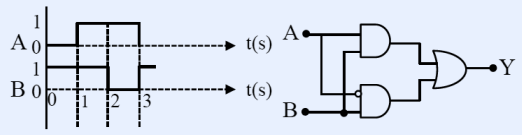
The output for the given inputs and to the circuit is :
(1)
(2)
(3)
(4)
SolutionAnswer: Option 2Waveform 2
Approach:
The network has two AND gates feeding a final OR gate. The gate outputs are evaluated interval by interval from the input waveforms for A and B, and the output waveform Y is then assembled.
Step 1:From the input waveforms, B = 1 during 0-1 s (A = 0); A = 1 during 1-2 s (B = 0); both A and B = 0 during 2-3 s. The two AND gates feed an OR gate, so the effective output is high when either A or B is high.
Step 2:Interval 0-1 s: A = 0, B = 1. With one input high, the OR combination of the gate outputs drives Y high.
Step 3:Interval 1-2 s: A = 1, B = 0. One input high again keeps Y high.
Step 4:Interval 2-3 s: A = 0, B = 0, so Y = 0. Thus Y is a single continuous high pulse from 0 to 2 s and low afterward, which is Waveform 2.
Final answer: Y is high over 0-2 s and low afterward, corresponding to Waveform 2.
Q46NumericalElectrostatics
A parallel plate capacitor is having separation between plates . It has a capacitance of when the space between the plates is filled with an insulating material of resistivity and resistance . Relative permittivity of the insulating material is . The value of is ________. (Take permittivity of free space )
SolutionAnswer: 2
Approach:
The same slab of dielectric fixes both the resistance and the capacitance . The geometric ratio is extracted from the resistance relation and substituted into the capacitance relation to solve for the relative permittivity .
Step 1:The givens with units are: resistivity , resistance , capacitance , ; the target is , with to be found.
Step 2:From the resistance relation the geometric factor is extracted.
Step 3:Rearranging the capacitance relation gives in terms of C, and .
Step 4:Evaluating the product yields .
Step 5:Dimensional consistency: is dimensionless, consistent with a relative permittivity.
Step 6:Comparing with the computed value gives .
Final answer:
Q47NumericalOptics
Some distant star is to be observed by some telescope of diameter of objective lens a, at an angular resolution of radian. If the wavelength of light from the star reaching the telescope is , the minimum diameter of the objective lens of the telescope is ______ cm. (nearest integer)
SolutionAnswer: 203
Approach:
The angular resolution of a telescope objective is set by the Rayleigh criterion for a circular aperture, . Rearranging for the aperture diameter a and substituting the given wavelength and angular resolution yields the minimum lens diameter.
Step 1:The givens with units are: angular resolution , wavelength ; the target is the aperture diameter a in cm.
Step 2:The Rayleigh resolution criterion for the circular objective is written.
Step 3:Rearranging for the aperture diameter .
Step 4:Evaluating the quotient gives in metres.
Step 5:Converting to centimetres and rounding to the nearest integer.
Step 6:The minimum objective diameter follows.
Final answer:
Q48NumericalMagnetic Effects of Current and Magnetism
A particle carrying a charge of is moving with velocity of in a region having magnetic field . It moves a distance of meter along when it completes 5 revolutions. The value of is ______.
SolutionAnswer: 2
Approach:
The velocity component perpendicular to (the part) drives uniform circular motion, while the component along (the part) is unaffected and produces a steady drift, making the path a helix. The displacement along over 5 revolutions equals the parallel velocity times the time for 5 cyclotron periods.
Step 1:The givens with units are: mass , charge , field along ; the target is the axial distance over revolutions.
Step 2:The velocity is resolved relative to (along ): the perpendicular component along and the parallel component along .
Step 3:The cyclotron period is computed from mass, charge and field.
Step 4:Time for 5 revolutions.
Step 5:Axial displacement equals the parallel velocity times the elapsed time.
Step 6:By units, , and the period is independent of speed (cyclotron property), confirming consistency. The axial distance follows.
Final answer:
Q49NumericalCurrent Electricity
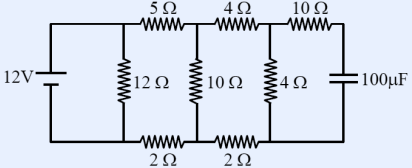
The stored charge in the capacitor in steady state of the following circuit is ______ .
SolutionAnswer: 200
Approach:
In steady state no current flows through the capacitor branch, so that branch is treated as open and current flows only through the resistive ladder. Node potentials are obtained by Kirchhoff's current law applied to the reduced network; the potential difference appearing across the open capacitor branch is then used in .
Step 1:Source , capacitance . In steady state the capacitor current is zero, so its branch is an open circuit and carries no current.
Step 2:With the capacitor branch open, no current passes through the top resistor leading to the capacitor node, so that node sits at the potential of the junction before it. The four active interior nodes (top-mid B, top-right C, bottom-mid E, bottom-right F) are referenced to the source negative at and the positive at .
Step 3:Applying KCL at the interior nodes for the current-carrying ladder ( and top, and vertical, and bottom). Solving the linear node equations gives the node potentials.
Step 4:The capacitor sits between the top-right node (at , carried unchanged across the current-free ) and the bottom-right node F at . The steady-state voltage across the capacitor is the difference.
Step 5:Applying with and .
Step 6:The assumption is self-consistent because the computed node potentials satisfy KCL with no current in the capacitor branch. The stored charge follows.
Final answer:
Q50NumericalKinematics
Two masses of and are accelerated from an initial speed of and , respectively. The distances traversed by the masses in the second are and , respectively. The ratio of their momenta after is . The value of x is ______.
SolutionAnswer: 9
Approach:
The distance covered in the n-th second, , fixes each acceleration. The velocity after follows from , the momentum from , and the ratio is matched to .
Step 1:The givens with units are: mass 1 , , ; mass 2 , , ; . The target is x where .
Step 2:The n-th-second relation for mass 1 (, so ) is solved for .
Step 3:The same relation for mass 2 is solved for .
Step 4:The velocities after follow from .
Step 5:The momenta are computed and the ratio is formed.
Step 6:Since , a pure dimensionless ratio, matching to gives .
Final answer:
Chemistry24 questions
Q51Single correctSome Basic Concepts in Chemistry
Match List - I with List - II.
| List - I Mass of substance | List - II Number of atoms |
|---|---|
| A. 1.8 mg water | I. |
| B. 9.8 mg sulphuric acid | II. |
| C. 1.8 mg carbon | III. |
| D. 5.85 mg salt (NaCl) | IV. |
(1)
(2)
(3)
(4)
SolutionAnswer: Option 3A-III, B-IV, C-II, D-I
Approach:
For each mass, the moles follow from the molar mass, multiplied by the number of atoms in one formula unit, giving the total number of atoms as a multiple of Avogadro's number , which fixes the matching List-II value.
Step 1:Each List-I mass converts to moles and then to total atoms. Water has and 3 atoms per molecule; has and 7 atoms; carbon has and 1 atom; has and 2 atoms per formula unit.
Step 2:For 1.8 mg water, mol, atoms . For 9.8 mg , mol, atoms .
Step 3:For 1.8 mg carbon, mol, atoms . For 5.85 mg , mol, atoms .
Step 4:Each mass gives an integral or half-integral multiple of mol, and every List-II value is used exactly once, giving a one-to-one assignment.
Final answer: A-III, B-IV, C-II, D-I
Q52Single correctSolutions
Given below are two statements:
Given: Molar mass of C, H, O, Cl are 12, 1, 16 and 35.5 , respectively.
Statement I: In 30%(w/w) solution of methanol in (at T K), the mole fraction of is equal to 0.33.
Statement II: Mixture of methanol and shows positive deviation from Raoult's law.
In the light of the above statements, choose the correct answer from the options given below:
Given: Molar mass of C, H, O, Cl are 12, 1, 16 and 35.5 , respectively.
Statement I: In 30%(w/w) solution of methanol in (at T K), the mole fraction of is equal to 0.33.
Statement II: Mixture of methanol and shows positive deviation from Raoult's law.
In the light of the above statements, choose the correct answer from the options given below:
(1)
(2)
(3)
(4)
SolutionAnswer: Option 1Both Statement I and Statement II are true
Approach:
A 100 g basis of the 30% (w/w) solution gives the masses of methanol and ; converting to moles yields the mole fraction of for Statement I, while the intermolecular interactions fix the deviation type in Statement II.
Step 1:In 100 g of a 30% (w/w) methanol solution there are 30 g methanol (, ) and 70 g ().
Step 2:The masses convert to moles.
Step 3:The mole fraction of follows from the moles.
Step 4:Pure methanol is strongly hydrogen bonded; adding inert disrupts this H-bonding, raising the escaping tendency so the observed vapour pressure exceeds the Raoult prediction, that is, positive deviation. Statement II is true, so both statements are true.
Final answer: Both Statement I and Statement II are true
Q53Single correctChemical Bonding and Molecular Structure
Bromine trifluoride autoionizes to form and . The shapes of the cation and anion are respectively ______, and ______.
(1)
(2)
(3)
(4)
SolutionAnswer: Option 1bent, square planar
Approach:
For each ion, the valence electrons on the central Br atom (adjusted for charge) give the bond pairs and lone pairs, the steric number follows, and VSEPR gives the actual shape.
Step 1:Br has 7 valence electrons. In one electron is removed for the positive charge; in one electron is added for the negative charge. Each Br–F bond uses one electron from Br.
Step 2: has electrons on Br; two are used in the two Br–F bonds, leaving 4 electrons = 2 lone pairs. So 2 bond pairs and 2 lone pairs give steric number 4 ().
Step 3: has electrons on Br; four are used in the four Br–F bonds, leaving 4 electrons = 2 lone pairs. So 4 bond pairs and 2 lone pairs give steric number 6 (); the two lone pairs occupy axial positions.
Step 4: with 2 lone pairs gives bent geometry, and with 2 axial lone pairs gives square planar, matching the known interhalogen ion shapes.
Final answer: bent, square planar
Q54Single correctSolutions
Which of the following statements are not correct?
A. For water, magnitude of is more than the magnitude of .
B. The elevation in boiling point of water when a non-volatile solute is added to it is larger in magnitude than its depression in freezing point.
C. Osmotic pressure measurement is preferred over any other colligative property to determine molar mass of proteins and polymers.
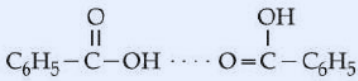
D. The dimerised form of benzoic acid in benzene is
Choose the correct answer from the options given below:
A. For water, magnitude of is more than the magnitude of .
B. The elevation in boiling point of water when a non-volatile solute is added to it is larger in magnitude than its depression in freezing point.
C. Osmotic pressure measurement is preferred over any other colligative property to determine molar mass of proteins and polymers.
D. The dimerised form of benzoic acid in benzene is
Choose the correct answer from the options given below:
(1)
(2)
(3)
(4)
SolutionAnswer: Option 3A, B and D only
Approach:
The question asks which statements are NOT correct. Each statement is tested against the known values of the ebullioscopic and cryoscopic constants of water, the relative magnitudes of the colligative effects, the suitability of osmotic pressure for macromolecules, and the actual cyclic structure of the benzoic acid dimer.
Step 1:For water and , hence . Statement A claims , which is false.
Step 2:For the same molality, and ; since , the freezing point depression exceeds the boiling point elevation. Statement B claims the elevation is larger, which is false.
Step 3:Osmotic pressure is large and measurable at room temperature even for very dilute macromolecular solutions, so it is the preferred colligative property for proteins and polymers. Statement C is correct, so it is not among the wrong statements.
Step 4:Benzoic acid in benzene forms a cyclic dimer held by TWO O–HO hydrogen bonds (each carbonyl O of one molecule binds the O–H of the other). The depicted linkage with a single hydrogen bond is not this cyclic dimer, so Statement D is incorrect. Therefore the incorrect statements are A, B and D.
Final answer: A, B and D only
Q55Single correctEquilibrium
Consider the following reactions in which all the reactants and products are present in gaseous state:
;
;
The value of for the equilibrium is:
;
;
The value of for the equilibrium is:
(1)
(2)
(3)
(4)
SolutionAnswer: Option 3
Approach:
The two given equilibria are manipulated (reversed, halved, then added) so their sum reproduces the target equilibrium, and the equilibrium constants combine accordingly: reciprocal on reversal, power on halving, and product on addition.
Step 1:The target is . Reaction 1 makes from ; it must be reversed and halved to produce xy from . Reaction 2 already converts to xyz.
Step 2:Reversing and halving reaction 1 gives the constant .
Step 3:Reaction 2 is used as given.
Step 4:Adding the two manipulated reactions reproduces the target stoichiometry exactly, so the constants multiply.
Final answer:
Q56Single correctRedox Reactions and Electrochemistry
Given at 298 K:
Volt
Volt
The in Volt at 298 K is given by:
Volt
Volt
The in Volt at 298 K is given by:
(1)
(2)
(3)
(4)
SolutionAnswer: Option 2
Approach:
Standard electrode potentials are not directly additive when the electron counts differ; instead the standard Gibbs energies of the half reactions combine and convert back to a potential for the target single-electron couple.
Step 1:The two given half reactions carry their Gibbs energies. has and . has and .
Step 2:The target half reaction is obtained as (reaction 1) minus (reaction 2), so the Gibbs energies subtract.
Step 3:For the target couple , so . Equating the two expressions for gives the potential.
Step 4:The electron balance holds () and is additive, giving the target potential as .
Final answer:
Q57Single correctChemical Kinetics
Given below are two statements:
and
Statement I: When , the room temperature rate constant is doubled by a increase in temperature (298 K to 308 K).
Statement II: For a first order reaction , the plot of /s versus /mol is a straight line passing through the origin with positive slope. Here is the initial concentration of A and is the half life of reaction.
In the light of the above statements, choose the correct answer from the options given below:
and
Statement I: When , the room temperature rate constant is doubled by a increase in temperature (298 K to 308 K).
Statement II: For a first order reaction , the plot of /s versus /mol is a straight line passing through the origin with positive slope. Here is the initial concentration of A and is the half life of reaction.
In the light of the above statements, choose the correct answer from the options given below:
(1)
(2)
(3)
(4)
SolutionAnswer: Option 3Statement I is true but Statement II is false
Approach:
The two-temperature Arrhenius equation tests whether the rate constant doubles for kcal/mol over 298 K to 308 K, and the first-order half-life expression settles the dependence of on initial concentration in Statement II.
Step 1:The activation energy in joules is , with and .
Step 2:Substituting into the Arrhenius equation, and .
Step 3:Exponentiating gives the ratio. Since , the rate constant doubles. Statement I is true.
Step 4:For a first-order reaction is independent of , so the plot of versus is a horizontal line, not a line through the origin with positive slope. Statement II is false; hence Statement I true and Statement II false.
Final answer: Statement I is true but Statement II is false
Q58Single correctClassification of Elements and Periodicity in Properties
Match List - I with List - II.
| List - I Electronic configuration of neutral atom (where n = 2) | List - II 1st Ionization Energy () |
|---|---|
| A. | I. 2080 |
| B. | II. 899 |
| C. | III. 800 |
| D. | IV. 1402 |
(1)
(2)
(3)
(4)
SolutionAnswer: Option 1A-II, B-III, C-IV, D-I
Approach:
Each electronic configuration identifies the second-period () element, whose first ionization energy follows from periodic trends, including the dip at boron (easier removal of a electron versus the filled of beryllium) and the elevated value for nitrogen (half-filled stability) and neon (noble gas).
Step 1: with is = beryllium (Be). The first ionization energy of Be is about 899 .
Step 2: is = boron (B). Removing the higher-energy, less-penetrating electron is easier than removing from Be's filled , so is lower, about 800 .
Step 3: is = nitrogen (N). The half-filled subshell is extra stable, raising to about 1402 .
Step 4: is = neon (Ne), a noble gas with the highest of the period, about 2080 . The ordering matches B < Be < N < Ne, confirming the assignment.
Final answer: A-II, B-III, C-IV, D-I
Q59Single correctp-Block Elements
Find the correct statements related to group 15 hydrides.
A. Reducing nature increases from to .
B. Tendency to donate lone pair of electrons decreases from to .
C. The stability of hydrides decreases from to .
D. HEH bond angle decreases from to (E = Elements of group 15).
Choose the correct answer from the options given below:
A. Reducing nature increases from to .
B. Tendency to donate lone pair of electrons decreases from to .
C. The stability of hydrides decreases from to .
D. HEH bond angle decreases from to (E = Elements of group 15).
Choose the correct answer from the options given below:
(1)
(2)
(3)
(4)
SolutionAnswer: Option 3A, B, C and D
Approach:
The established down-the-group trends for group 15 hydrides (from to ) apply: E–H bond strength falls, which sets the reducing power, basicity, thermal stability and bond angle; each statement is tested against these trends.
Step 1:Down the group the E–H bond weakens, so the hydride releases hydrogen more readily and acts as a stronger reducing agent. Hence reducing nature increases from to . Statement A is correct.
Step 2:The lone pair occupies an increasingly large and diffuse orbital down the group, lowering its donating tendency, so basicity decreases from to . Statement B is correct.
Step 3:Weaker E–H bonds down the group make the hydrides thermally less stable, so stability decreases from to . Statement C is correct.
Step 4:As the electronegativity of the central atom falls, the bonding pairs lie farther out and the bond angle contracts: . Statement D is correct, so all four statements are correct.
Final answer: A, B, C and D
Q60Single correctd- and f-Block Elements
Given below are two statements:
Statement I: The number of pairs among , , and in which both ions are coloured is 3.
Statement II: The number of pairs among , and ions in which both are diamagnetic is 3.
In the light of the above statements, choose the correct from the options given below:
Statement I: The number of pairs among , , and in which both ions are coloured is 3.
Statement II: The number of pairs among , and ions in which both are diamagnetic is 3.
In the light of the above statements, choose the correct from the options given below:
(1)
(2)
(3)
(4)
SolutionAnswer: Option 1Both Statement I and Statement II are correct
Approach:
For Statement I, an ion is coloured when it has partially filled d-orbitals allowing d–d transitions; the count is the pairs in which BOTH ions are coloured. For Statement II, an f-block ion is diamagnetic when its f-subshell is empty () or completely filled (); the count is the pairs in which BOTH ions are diamagnetic.
Step 1:The d-configurations are (colourless), (coloured), (coloured), (coloured), (coloured).
Step 2:For Statement I: has colourless (fails); both coloured (counts); both coloured (counts); both coloured (counts). Total = 3, so Statement I is correct.
Step 3:For Statement II, the f-configurations are , , , , (5), . Every ion is either or , hence all are diamagnetic.
Step 4:Each of the three pairs in Statement II has both ions diamagnetic, so the count is 3 and Statement II is correct. Therefore both statements are correct.
Final answer: Both Statement I and Statement II are correct
Q61Single correctd- and f-Block Elements
Given below are two statements for catalytic properties of transition metals.
Statement I: First row transition metals which act as catalyst utilise their 3d electrons only for formation of bonds between reactant molecules and atoms on the surface of catalyst.
Statement II: There is increase in the concentration of reactants on the surface of catalyst which strengthens the bonds in reacting molecules.
In the light of the above statements, choose the correct answer from the options given below :
Statement I: First row transition metals which act as catalyst utilise their 3d electrons only for formation of bonds between reactant molecules and atoms on the surface of catalyst.
Statement II: There is increase in the concentration of reactants on the surface of catalyst which strengthens the bonds in reacting molecules.
In the light of the above statements, choose the correct answer from the options given below :
(1)
(2)
(3)
(4)
SolutionAnswer: Option 2Both Statement I and Statement II are incorrect
Approach:
Evaluate the validity of each statement against the accepted mechanism of heterogeneous catalysis by first-row transition metals.
Step 1:Given: two statements about how first-row transition metals function as heterogeneous catalysts. Principle: catalytic activity arises from the availability of unpaired d electrons and partially filled d orbitals together with variable oxidation states; both 3d and 4s electrons participate in surface bonding.
and electrons participate
Step 2:Statement I claims the metals use their 3d electrons ONLY. Bond formation with adsorbed reactants involves both 3d and 4s electrons (and the variable valencies they provide), so restricting it to 3d electrons alone is wrong.
Step 3:Statement II claims that increased reactant concentration on the surface strengthens the bonds in the reacting molecules. Adsorption indeed raises local reactant concentration, but the surface interaction WEAKENS the bonds within reactant molecules, lowering the activation energy; it does not strengthen them.
Step 4:Both statements are wrong, so the correct choice is the option stating both are incorrect.
Final answer: Both Statement I and Statement II are incorrect
Q62Single correctPurification and Characterisation of Organic Compounds
Given below are two statements :
Statement I: Vapours of the liquid with higher boiling point condense before vapours of the liquid with lower boiling points in fractional distillation.
Statement II: The vapours rising up in the fractionating column become richer in high boiling component of the mixture.
In the light of the above statements, choose the correct answer from the options given below :
Statement I: Vapours of the liquid with higher boiling point condense before vapours of the liquid with lower boiling points in fractional distillation.
Statement II: The vapours rising up in the fractionating column become richer in high boiling component of the mixture.
In the light of the above statements, choose the correct answer from the options given below :
(1)
(2)
(3)
(4)
SolutionAnswer: Option 3Statement I is true but Statement II is false
Approach:
Analyse the behaviour of the two components inside a fractionating column with respect to condensation order and vapour composition as height increases.
Step 1:Given: a mixture undergoing fractional distillation. Principle: the component with the higher boiling point is less volatile, while the lower boiling component is more volatile and remains in the vapour phase longer.
Step 2:Statement I: as the mixed vapours ascend and cool, the higher boiling (less volatile) component reaches its condensation point first and condenses earlier, falling back down the column. This is correct.
Step 3:Statement II: because the high boiling component repeatedly condenses and drains back, the vapours that continue rising become progressively enriched in the LOW boiling (more volatile) component, not the high boiling one.
Step 4:Statement I true and Statement II false gives the option stating I is true but II is false.
Final answer: Statement I is true but Statement II is false
Q63Single correctSome Basic Principles of Organic Chemistry
The major product of which of the following reaction is not obtained by rearrangement reaction?
(1)
(2)
(3)
(4)
SolutionAnswer: Option 2tert-butyl alcohol dehydration to 2-methylpropene (no rearrangement)
Approach:
For each option determine whether the carbocation (or skeletal) intermediate must rearrange to reach the stated major product; the required reaction is the one whose product forms without any rearrangement.
Step 1:Option 1: Friedel-Crafts alkylation of benzene with 1-chloropropane generates a primary n-propyl cation, which undergoes a 1,2-hydride shift to the more stable secondary isopropyl cation, giving cumene. The product arises through rearrangement.
Step 2:Option 3: n-hexane treated with anhydrous AlCl3/HCl undergoes acid-catalysed isomerisation to the branched 2-methylpentane, a skeletal rearrangement. Option 4: the branched primary/secondary alcohol forms a less stable cation that undergoes a hydride/methyl shift before eliminating to the more substituted alkene; rearrangement is involved.
Step 3:Option 2: protonation and loss of water from tert-butyl alcohol gives the tertiary tert-butyl cation, which is already the most stable possible cation. It directly loses a beta proton to form 2-methylprop-1-ene, with no shift.
Step 4:Only option 2 yields its major product without any rearrangement; the other three proceed via hydride/methyl/skeletal shifts.
Final answer: Dehydration of tert-butyl alcohol to 2-methylprop-1-ene proceeds without rearrangement
Q65Single correctHydrocarbons
n-Butane on monochlorination under photochemical condition gives an optically active compound "P". "P" on further chlorination gives dichloro compounds.
The number of dichloro compounds obtained (ignore stereoisomers) is :
The number of dichloro compounds obtained (ignore stereoisomers) is :
(1)
(2)
(3)
(4)
SolutionAnswer: Option 24
Approach:
Identify the optically active monochloro product P, then enumerate every distinct constitutional dichloro product obtained by replacing a second hydrogen of P, ignoring stereoisomers.
Step 1:Monochlorination of n-butane () gives 1-chlorobutane and 2-chlorobutane. 1-Chlorobutane has no stereocentre, whereas 2-chlorobutane, , has C2 bonded to four different groups and is optically active. Hence P = 2-chlorobutane.
Step 2:Label the carbons of P: C1 (), C2 (), C3 (), C4 (). Replacing one further hydrogen at each position gives the dichloro products. Substitution at C1 gives 1,2-dichlorobutane; at C2 gives 2,2-dichlorobutane; at C3 gives 2,3-dichlorobutane.
Step 3:Substitution at C4 places the two chlorines on carbons 2 and 4 of the original chain; renumbering from the C4 end gives the lowest locants 1,3, i.e. 1,3-dichlorobutane, which is constitutionally distinct from the previous three.
Step 4:The distinct constitutional dichloro compounds are 1,2-dichlorobutane, 2,2-dichlorobutane, 2,3-dichlorobutane and 1,3-dichlorobutane, giving a total of 4 (stereoisomers ignored).
Final answer: 4 dichloro compounds (1,2-, 1,3-, 2,2- and 2,3-dichlorobutane)
Q66Single correctOrganic Compounds Containing Halogens
Given below are two statements :
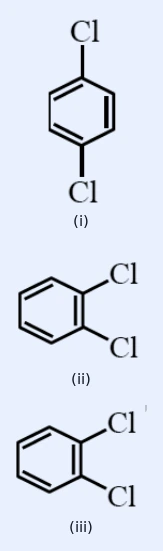
Statement I: Due to increase in van der Waals forces, the order of boiling points is .
Statement II: As (i) shown below is more symmetric, its melting point is higher than (ii) shown below; however its boiling point is lower than (iii) shown below.
In the light of the above statements, choose the correct answer from the options given below :
Statement I: Due to increase in van der Waals forces, the order of boiling points is .
Statement II: As (i) shown below is more symmetric, its melting point is higher than (ii) shown below; however its boiling point is lower than (iii) shown below.
In the light of the above statements, choose the correct answer from the options given below :
(1)
(2)
(3)
(4)
SolutionAnswer: Option 1Both Statement I and Statement II are true
Approach:
Test the boiling-point trend of the homologous alkyl iodides (Statement I) and the melting/boiling-point comparison of the dichlorobenzene isomers based on symmetry and dipole moment (Statement II).
Step 1:Given: comparison of boiling points of CH3I, CH3CH2I and CH3CH2CH2I, and of melting/boiling points of para- and ortho-dichlorobenzene. Principle: boiling point rises with molecular size (stronger van der Waals forces), while melting point depends strongly on crystal packing/symmetry and boiling point on net dipole moment.
Step 2:Statement I: along the series methyl, ethyl, n-propyl iodide the molecular size and surface area increase, strengthening van der Waals forces, so the boiling point order CH3CH2CH2I > CH3CH2I > CH3I is correct.
Step 3:Statement II, melting point: the para isomer is highly symmetric and packs efficiently into the crystal lattice, so its melting point is higher than that of the ortho isomer. This part is correct.
Step 4:Statement II, boiling point: para-dichlorobenzene is symmetric with the two C-Cl dipoles cancelling (net dipole = 0), whereas ortho-dichlorobenzene has a finite net dipole moment and thus extra dipole-dipole attraction, giving it a higher boiling point. Therefore the para boiling point is lower than the ortho, so Statement II is fully true and both statements are true.
Final answer: Both Statement I and Statement II are true
Q67Single correctOrganic Compounds Containing Nitrogen
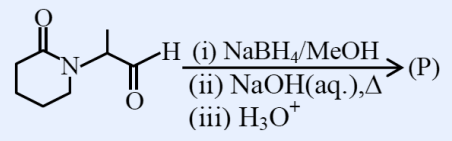
Consider the following reaction.
The major product (P) formed is :
The major product (P) formed is :
(1)
(2)
(3)
(4)
SolutionAnswer: Option 3HOOC-(CH2)4-NH-CH(CH3)CH2OH (ring-opened amino acid with amino alcohol)
Approach:
Apply each reagent in sequence to the substrate, distinguishing the chemoselective behaviour of NaBH4 (reduces aldehyde, not amide) from base-promoted hydrolysis of the lactam ring, then the acidic work-up.
Step 1:Identify the substrate: a six-membered lactam (a ring amide, the carbonyl on a ring carbon adjacent to nitrogen) whose nitrogen bears a -CH(CH3)-CHO side chain. The two reactive carbonyls are the side-chain aldehyde and the ring amide.
Step 2:Step (i) NaBH4/MeOH reduces the aldehyde selectively to a primary alcohol; NaBH4 is too weak to reduce the amide (lactam) carbonyl, which is therefore untouched.
Step 3:Step (ii) NaOH(aq.) with heat hydrolyses the cyclic amide, cleaving the C-N bond and opening the ring to give a pentanoate carboxylate at one end and a secondary amine (still carrying the -CH(CH3)CH2OH group) at the other.
Step 4:Step (iii) H3O+ protonates the carboxylate to the free carboxylic acid, giving P = HOOC-(CH2)4-NH-CH(CH3)CH2OH, an open-chain amino acid bearing the amino-alcohol substituent.
Final answer: P = HOOC-(CH2)4-NH-CH(CH3)CH2OH, the ring-opened amino acid bearing an amino-alcohol substituent
Q68Single correctOrganic Compounds Containing Nitrogen
Which statements are True?
A. In Hoffmann bromamide degradation, 4 moles of NaOH and 2 moles of are consumed per mole of an amide
B. Hoffmann bromamide reaction is not given by alkyl amides
C. Primary amines can be synthesized by Hoffmann bromamide degradation.
D. Secondary amide on reaction with and NaOH will give secondary amine.
E. The by-products of Hoffmann degradation are and .
Choose the correct answer from the options given below :
A. In Hoffmann bromamide degradation, 4 moles of NaOH and 2 moles of are consumed per mole of an amide
B. Hoffmann bromamide reaction is not given by alkyl amides
C. Primary amines can be synthesized by Hoffmann bromamide degradation.
D. Secondary amide on reaction with and NaOH will give secondary amine.
E. The by-products of Hoffmann degradation are and .
Choose the correct answer from the options given below :
(1)
(2)
(3)
(4)
SolutionAnswer: Option 3C and E only
Approach:
Write the balanced equation for the Hoffmann bromamide degradation and use it, together with the requirement of a primary amide, to test each statement A-E.
Step 1:Write and balance the reaction: one mole of primary amide consumes one mole of and four moles of , producing the primary amine (with one fewer carbon), sodium carbonate, sodium bromide and water.
Step 2:Statement A: the balanced equation uses 4 moles but only 1 mole per mole amide, so claiming 2 moles is wrong; A is false. Statement B: the reaction is given by both alkyl and aryl primary amides, so saying alkyl amides do not react is wrong; B is false.
Step 3:Statement C: the reaction converts a primary amide into a primary amine (with loss of one carbon), so primary amines can indeed be made this way; C is true. Statement D: the reaction requires a primary amide ( with an ); secondary amides lack the necessary N-H pattern and do not undergo the degradation to give secondary amines; D is false.
Step 4:Statement E: from the balanced equation the by-products include Na2CO3 and H2O (along with NaBr), so E is true. The true statements are C and E only.
Final answer: C and E only
Q69Single correctBiomolecules
The incorrect statement from the following with respect to carbohydrates is :
(1)
(2)
(3)
(4)
SolutionAnswer: Option 2The monosaccharide units obtained from hydrolysis of oligosaccharides are always the same.
Approach:
Assess the truth of each statement about carbohydrate classification and behaviour and isolate the one that is false.
Step 1:Statement (1): every monosaccharide, whether aldose or ketose, carries a free aldehyde or alpha-hydroxy ketone group capable of reduction, so all monosaccharides are reducing sugars; this is true.
Step 2:Statements (3) and (4): starch and cellulose are high molecular weight polysaccharides made of more than ten monosaccharide units (true), and D-(+)-glucose exists as an equilibrium of open-chain and cyclic forms responsible for mutarotation (true).
Step 3:Statement (2): hydrolysis of oligosaccharides need not give identical monosaccharides. Sucrose yields glucose + fructose and lactose yields glucose + galactose, both giving two different monosaccharides, so the claim that they are always the same is false.
Step 4:The only false (incorrect) statement is statement (2).
Final answer: The statement that the monosaccharide units from hydrolysis of oligosaccharides are always the same is incorrect
Q70Single correctBiomolecules
Which of the following amino acid will give violet coloured complex with neutral ferric chloride solution?
(1)
(2)
(3)
(4)
SolutionAnswer: Option 3Tyrosine
Approach:
Recognise that the violet colour with neutral ferric chloride is the characteristic phenol test, then identify which amino acid side chain contains a phenolic hydroxyl group.
Step 1:Neutral ferric chloride produces a violet/purple coloured complex specifically with phenols (compounds bearing an -OH directly on an aromatic ring), through formation of a coloured iron-phenoxide complex.
Step 2:Examine the side chains: threonine and serine carry aliphatic (non-aromatic) -OH groups, and cysteine carries a thiol (-SH); none of these is phenolic, so none gives the violet colour.
Step 3:Tyrosine has a para-hydroxyphenyl side chain, i.e. a true phenolic -OH on the aromatic ring, which is the group required for the test.
Step 4:Only tyrosine satisfies the requirement, so tyrosine gives the violet coloured complex with neutral ferric chloride.
Final answer: Tyrosine
Q71NumericalCoordination Compounds
Number of paramagnetic complexes among the following is ______.
SolutionAnswer: 6
Approach:
For each complex the central metal oxidation state, the d-electron count, the coordination geometry, and the ligand field strength (strong/weak) are determined. By crystal field theory and valence bond theory, the unpaired electrons are counted; a complex is paramagnetic when it has at least one unpaired electron.
Step 1:The task is to count complexes with one or more unpaired electrons among the ten listed. The oxidation states and d-electron counts are: M ; N ; N ; N ; C ; F ; M ; T ; C ; C .
Step 2:Consider the tetrahedral halide complexes (weak-field, high spin). tetrahedral fills giving 5 unpaired electrons. tetrahedral fills giving 2 unpaired electrons. Both are paramagnetic.
Step 3:Consider the strong-field and Ni species. with strong-field CN is square planar, all electrons paired, n=0. is N , completely filled, n=0. Both are diamagnetic.
Step 4:Consider the octahedral complexes. with weak-field F is high spin t, n=4 (paramagnetic). with strong CN is low spin t, n=0 (diamagnetic). low spin t, n=2 (paramagnetic). , n=1 (paramagnetic). , n=1 (paramagnetic). with chelating oxalate (strong field) is low spin t, n=0 (diamagnetic).
Step 5:The paramagnetic complexes (n>=1) are , , , , , . The diamagnetic complexes (n=0) are , , , . Total paramagnetic = 6.
Final answer: 6
Q72NumericalOrganic Compounds Containing Oxygen
'x' is the product which is obtained from benzene by reacting it with carbon monoxide and hydrogen chloride in the presence of cuprous chloride. 'y' is the major product obtained from the benzene by reacting it with ethanoyl chloride in the presence of anhydrous . Product (major) obtained by heating x and y in the presence of alkali is z. Total number of electrons in z is ______
SolutionAnswer: 16
Approach:
x is the Gattermann-Koch product of benzene and y is the Friedel-Crafts acylation product. The base-mediated crossed (Claisen-Schmidt) aldol condensation of x and y gives z, and every pi electron in z is counted.
Step 1:Benzene with CO and HCl over cuprous chloride (Gattermann-Koch reaction) introduces a formyl group, giving benzaldehyde as x.
Step 2:Benzene with ethanoyl chloride (CH3COCl) and anhydrous AlCl3 undergoes Friedel-Crafts acylation to give acetophenone as y.
Step 3:Heating benzaldehyde and acetophenone in alkali drives a crossed Claisen-Schmidt aldol condensation: the -hydrogen of acetophenone forms a carbanion that adds to the aldehyde carbonyl, and dehydration gives the -unsaturated ketone (E)-chalcone.
Step 4:Each benzene ring contributes 3 C=C, i.e. 6 pi electrons; with two rings that is 12. The conjugated alkene C=C contributes 2, and the carbonyl C=O contributes 2.
Step 5:Summing all pi electrons of chalcone gives the total.
Final answer: 16
Q73NumericalAtomic Structure
Consider two radiations of wavelengths
1.
2.
The ratio of the energies of these two radiations is ______ (Nearest integer).
1.
2.
The ratio of the energies of these two radiations is ______ (Nearest integer).
SolutionAnswer: 3
Approach:
Photon energy is inversely proportional to wavelength via , so the energy ratio equals the inverse ratio of wavelengths.
Step 1:Two radiations have wavelengths and ; the target is the energy ratio .
Step 2:By the Planck-Einstein relation, photon energy varies inversely with wavelength.
Step 3:Forming the ratio cancels the constant hc.
Step 4:Substituting the wavelengths and evaluating.
Step 5:The shorter wavelength () carries the higher energy; the ratio is the integer 3.
Final answer: 3
Q74NumericalChemical Thermodynamics
Consider the reaction:
The magnitude of enthalpy change for the reaction in is ______. (Nearest integer)
Given: , ,
The magnitude of enthalpy change for the reaction in is ______. (Nearest integer)
Given: , ,
SolutionAnswer: 1126
Approach:
Hess's law in the form of standard formation enthalpies applies: the reaction enthalpy equals the sum over products minus the sum over reactants, with stoichiometric coefficients. Elemental in its standard state has zero formation enthalpy. The magnitude is reported.
Step 1:Coefficients: . Formation enthalpies (kJ/mol): , , , . The target is the magnitude of .
Step 2:The Hess's law expression with stoichiometric coefficients is written out.
Step 3:Evaluating the product sum.
Step 4:Evaluating the reactant sum ( contributes zero).
Step 5:Subtracting and taking the magnitude, rounded to the nearest integer.
Final answer: 1126
Q75NumericalEquilibrium
Solid carbon, CaO and are mixed and allowed to attain equilibrium at T K.
The partial pressure of CO is ____ atm
The partial pressure of CO is ____ atm
SolutionAnswer: 4
Approach:
Solids have unit activity, so the first equilibrium fixes the partial pressure at . Substituting this into the expression of the second equilibrium gives the partial pressure.
Step 1: atm for ; atm for . The target is expressed in units of atm.
Step 2:In the first equilibrium, and are solids (activity 1), so equals the partial pressure.
Step 3:In the second equilibrium, carbon is solid, so only and appear in .
Step 4:Solving for by substituting atm.
Step 5:Taking the square root gives , expressed in units of atm.
Final answer: 4
Mathematics24 questions
Q1Single correctSets, Relations and Functions
Consider the relation R on the set defined by if and only if . Then, among the statements :
I. The number of elements in R is 17
II. R is an equivalence relation
I. The number of elements in R is 17
II. R is an equivalence relation
(1)
(2)
(3)
(4)
SolutionAnswer: Option 1Only I is true
Approach:
Translate the defining condition into , count the ordered pairs over the grid by excluding those with , then test the equivalence-relation properties.
Step 1:Given set with possible ordered pairs. Target: count pairs with and decide whether R is reflexive, symmetric and transitive.
Step 2:Identify the pairs that violate the condition, i.e. . Products equal to : give pairs. Products equal to : give pairs. Products equal to : give pairs.
Step 3:All remaining pairs satisfy (pairs containing give ; equal-sign nonzero pairs give ). Hence , so statement I is true.
Step 4:Check equivalence: reflexive since ; symmetric since . Transitivity fails: and , but , so .
Step 5:Since transitivity fails, R is not an equivalence relation, so statement II is false. Only statement I holds.
Final answer: Statement I (|R| = 17) is true and statement II (R equivalence) is false, so only I is true.
Q2Single correctComplex Numbers and Quadratic Equations
The number of values of , satisfying the equations and , is :
(1)
(2)
(3)
(4)
SolutionAnswer: Option 22
Approach:
Read each equation as a locus in the plane: the first is a circle, the second is an ellipse with the given foci; then compare their axes to count common points.
Step 1:Target: count points lying on both loci. Foci of the second equation are and ; the constant sum of distances is .
Step 2:Compute the focal distance: , so . The constant sum gives , hence and .
Step 3:Since , the second locus is a genuine ellipse with semi-minor axis , so . Its centre is the midpoint of A,B, namely .
Step 4:The first equation is a circle centred at with radius , concentric with the ellipse. Its radius equals the semi-minor axis and is less than , so the circle meets the ellipse exactly at the two endpoints of the minor axis.
Step 5:Consistency check: on the minor axis the ellipse reaches distance from the centre, exactly the circle radius, while on the major axis it reaches ; thus contact occurs only at the two minor-axis endpoints.
Final answer: There are exactly values of .
Q3Single correctMatrices and Determinants
If the system of linear equations:
has infinitely many solutions, then the value of equals:
has infinitely many solutions, then the value of equals:
(1)
(2)
(3)
(4)
SolutionAnswer: Option 322
Approach:
For infinitely many solutions the augmented rank must equal the coefficient rank and be less than 3, so the third equation is a linear combination of the first two; match coefficients to find and .
Step 1:Given , , . Target: find making dependent, then compute . Write and match x and y coefficients.
Step 2:Subtract the first matching equation from the second: , giving , and then .
Step 3:Match the z coefficient: .
Step 4:Match the constant term: . Hence .
Step 5:Dependence check: with , the third equation is exactly ( plus ), so the coefficient and augmented matrices share rank , confirming infinitely many solutions.
Final answer: .
Q4Single correctMatrices and Determinants
Let and . If , then equals :
(1)
(2)
(3)
(4)
SolutionAnswer: Option 3441
Approach:
Build from cofactors, add the given matrix, impose to solve for , then apply .
Step 1:Given the matrix A with parameter and the matrix B formed by adding a known matrix to , with . Target: . Evaluating along row 1: .
Step 2:Form from the cofactor transpose and add the given matrix to obtain B. Evaluating the determinant of the sum yields .
Step 3:Impose : . Then .
Step 4:For a matrix, .
Step 5:Consistency check: , so A is invertible and the adjoint identity applies; substituting back gives , matching the data.
Final answer: .
Q5Single correctTrigonometry
Let upto 40 terms. If is a root of the equation , , then is equal to :
(1)
(2)
(3)
(4)
SolutionAnswer: Option 12
Approach:
Group the series into 20 pairs forming an AP to evaluate , reduce the exponent, select the admissible root of the quadratic to find , then evaluate the trigonometric expression.
Step 1:The 40-term series groups into consecutive pairs , giving 20 pair-sums , an AP with first term and common difference . Target: evaluate , the exponent, , and the expression.
Step 2:Sum the AP: . Then the exponent is .
Step 3:Factor the quadratic: , with roots and . Since , the root must be 1, so . With , and .
Step 4:At , , so .
Step 5:Consistency check: directly , agreeing with the identity-based value.
Final answer: .
Q6Single correctStatistics and Probability
A candidate has to go to the examination centre to appear in an examination. The candidate uses only one means of transportation for the entire distance out of bus, scooter and car. The probabilities of the candidate going by bus, scooter and car, respectively, are and . The probabilities that the candidate reaches late at the examination centre are and if the candidate uses bus, scooter and car, respectively. Given that the candidate reached late at the examination centre, the probability that the candidate travelled by bus is :
(1)
(2)
(3)
(4)
SolutionAnswer: Option 2
Approach:
Treat the three transport modes as mutually exclusive causes and 'reaching late' as the observed event, then apply Bayes' theorem.
Step 1:Given prior probabilities and late probabilities . Target: . Compute the bus joint probability .
Step 2:Compute the other joint probabilities: scooter and car .
Step 3:Total probability of being late, over LCD : .
Step 4:Apply Bayes: .
Step 5:Consistency check: the three posterior numerators over sum to , confirming a valid probability distribution.
Final answer: .
Q7Single correctStatistics and Probability
A set of four observations has mean 1 and variance 13. Another set of six observations has mean 2 and variance 1. Then, the variance of all these 10 observations is equal to :
(1)
(2)
(3)
(4)
SolutionAnswer: Option 36.04
Approach:
Recover each group's sum of squares from , find the combined mean, then apply the variance formula to the pooled data.
Step 1:Group 1: . Group 2: . Target: pooled variance over all 10 observations. Recover group 1 sum of squares: .
Step 2:Recover group 2 sum of squares: .
Step 3:Combined mean: .
Step 4:Pooled sum of squares . Pooled variance .
Step 5:Consistency check: the pooled variance lies between the group variances and and exceeds the weighted average of variances by the between-group spread.
Final answer: The combined variance is .
Q8Single correctBinomial Theorem and its Simple Applications
If , then is equal to :
(1)
(2)
(3)
(4)
SolutionAnswer: Option 351
Approach:
Recognize each term as the result of integrating over ; isolate the even-index terms by averaging and .
Step 1:Each summand has the form for even k from to . Target: . Evaluate the two enabling integrals: and .
Step 2:Averaging the integrands isolates even powers, since . Integrating term by term over gives .
Step 3:The given bracket starts at , so it omits the term . Hence the bracket equals .
Step 4:Multiply by : . Comparing with gives .
Step 5:Numerical check using : the even-index bracket times evaluates to , confirming .
Final answer: .
Q9Single correctPermutations and Combinations
A person has three different bags and four different books. The number of ways, in which he can put these books in the bags so that no bag is empty, is :
(1)
(2)
(3)
(4)
SolutionAnswer: Option 236
Approach:
Count onto (surjective) assignments of 4 distinct books to 3 distinct bags using the inclusion-exclusion principle.
Step 1:Each of the distinct books is placed into one of distinct bags, with the constraint that no bag is empty (surjection). Target: count such assignments. Total unrestricted assignments: .
Step 2:Subtract assignments leaving at least one chosen bag empty: .
Step 3:Add back assignments where two chosen bags are empty (subtracted twice): .
Step 4:Inclusion-exclusion gives the number of surjections: .
Step 5:Cross-check via Stirling numbers: the number of onto maps equals , where partitions 4 books into 3 nonempty unlabelled groups.
Final answer: There are such ways.
Q10Single correctCo-ordinate Geometry
If a straight line drawn through the point of intersection of the lines and , meets the co-ordinate axes at the points P and Q, then the locus of the mid point of PQ is :
(1)
(2)
(3)
(4)
SolutionAnswer: Option 2x+y-14xy=0
Approach:
Locate the fixed point of intersection, parametrize the variable line by its intercepts using the midpoint , then impose that the line passes through the fixed point to obtain the locus.
Step 1:Find the fixed point common to all such lines by solving and . Subtracting: . Substituting into : , so . Fixed point .
Step 2:Let the variable line meet the axes at and with midpoint , so and . The line in intercept form is .
Step 3:Impose passage through : .
Step 4:Multiply through by : . Replacing (h,k) by (x,y) gives the locus .
Step 5:Consistency check: the fixed point corresponds to the midpoint case , giving , satisfying the locus.
Final answer: The locus of the midpoint of PQ is .
Q11Single correctCo-ordinate Geometry
Let O be the vertex of the parabola and its chords OP and OQ are perpendicular to each other. If the locus of the mid-point of the line segment PQ is a conic C, then the length of its latus rectum is :
(1)
(2)
(3)
(4)
SolutionAnswer: Option 2
Approach:
Parametrize and on the parabola, impose perpendicularity of the chords from the vertex, then eliminate the parameters from the midpoint coordinates to obtain the locus and read off its latus rectum.
Step 1:Take and on , with vertex . Target: the locus of the midpoint M(h,k) of PQ. Slopes from O are and .
Step 2:Perpendicular chords give , so .
Step 3:Midpoint coordinates: and . Using gives .
Step 4:Substitution check: replacing (h,k) by (x,y) yields , of the standard form with , so the latus rectum length is .
Final answer: The length of the latus rectum of the locus is .
Q12Single correctTrigonometry
Let and , where inverse trigonometric functions take only the principal values. Given below are two statements :
Statement I: .
Statement II: .
In the light of the above statements, choose the correct answer from the options given below :
Statement I: .
Statement II: .
In the light of the above statements, choose the correct answer from the options given below :
(1)
(2)
(3)
(4)
SolutionAnswer: Option 1Both Statement I and Statement II are true
Approach:
Bound each inverse-trigonometric value to locate , and in their quadrants, then determine the signs of the required cosines.
Step 1:Given and . Target: signs of and . With , rad, so rad.
Step 2:Since , the angle lies in the second quadrant, where cosine is negative.
Step 3:With , rad, so rad. Then rad.
Step 4:Quadrant check on the sum: , so lies in the fourth quadrant, where cosine is positive.
Final answer: Both Statement I and Statement II are true.
Q13Single correctLimit, Continuity and Differentiability
For the function , consider the following statements:
Statement I : f is differentiable for all .
Statement II: f is increasing in .
In the light of the above statements, choose the correct answer from the options given below :
Statement I : f is differentiable for all .
Statement II: f is increasing in .
In the light of the above statements, choose the correct answer from the options given below :
(1)
(2)
(3)
(4)
SolutionAnswer: Option 1Both Statement I and Statement II are true
Approach:
Write f piecewise about (the only point where is non-smooth), match one-sided derivatives there, then analyze the sign of f' on .
Step 1:Branches of f: for , ; for , and , so . The only candidate non-differentiable point is .
Step 2:Right derivative: , so . Left derivative: , so . The one-sided derivatives agree.
Step 3:On the values satisfy , so . On this interval , hence , giving .
Step 4:Since throughout , f is strictly increasing there.
Final answer: Both Statement I and Statement II are true.
Q14Single correctVector Algebra
Let , and a vector be such that . If , then is equal to :
(1)
(2)
(3)
(4)
SolutionAnswer: Option 2
Approach:
Combine the cross products into to write , fix using , then evaluate the required dot product.
Step 1:Given , and with . Target: where . Using , the relation becomes .
Step 2:Hence . Then and .
Step 3:Apply , so .
Step 4:Substituting: and . Then .
Final answer: .
Q15Single correctThree Dimensional Geometry
Let the foot of perpendicular from the point on the line be the point . Then the distance between the lines and is equal to:
(1)
(2)
(3)
(4)
SolutionAnswer: Option 3
Approach:
Use that the foot lies on the given line to find , then use perpendicularity of the foot-to-point vector with the line direction to find ; the two target lines share a direction, so apply the parallel-lines distance formula.
Step 1:Foot lies on with parameter t. From x: . Then and , consistent.
Step 2:The vector from foot to is and must be perpendicular to the line direction : .
Step 3:Target lines: through and through , both with direction , hence parallel. With , .
Step 4:Magnitude of the direction: , so .
Final answer: The distance between the lines is .
Q17Single correctDifferential Equations
Let be the solution of the differential equation . Then equals:
(1)
(2)
(3)
(4)
SolutionAnswer: Option 1
Approach:
Cast the equation as a first-order linear ODE in y, use the integrating factor, integrate the right side by parts, fix the constant from the limit condition, and evaluate at .
Step 1:Divide the equation by to get . Here , ; target is .
Step 2:Integrating factor , so . Integrating by parts with , , giving : .
Step 3:Apply : as , , so , while . Hence , .
Step 4:Evaluating at : , . Then , so . Numerically .
Final answer: .
Q18Single correctIntegral Calculus
Let be a function defined as . Let , where . If , then the area of the region bounded by the curves and is:
(1)
(2)
(3)
(4)
SolutionAnswer: Option 1
Approach:
Find the iteration period of f to evaluate , hence g, locate the boundary intersections, and split the bounded region into a triangular part under the line and a part under the curve.
Step 1:With , target is . Then ; ; . The iterates have period .
Step 2:Since , , so .
Step 3:Boundaries: curve , line (from ), , and . The line meets at ; the line meets the curve at (with ). The curve meets at .
Step 4:Split the bounded region: the triangle under the line from to has area ; the part under the curve from to has area . Total .
Final answer: The area of the bounded region is .
Q19Single correctLimit, Continuity and Differentiability
Let . If f is continuous at , then the value of is :
(1)
(2)
(3)
(4)
SolutionAnswer: Option 4
Approach:
Apply continuity at via the right-hand limit to determine b, fix the integration limit , then integrate by splitting at its sign change.
Step 1:Given and right branch . Substitute , : and , so .
Step 2:Right-hand limit . Continuity requires , so , giving .
Step 3:Evaluate . Factoring, , negative on and positive on , so split at .
Step 4:, and . Total .
Final answer: The value of the integral is .
Q20Single correctCo-ordinate Geometry
Let represent an ellipse with major axis along y-axis, where f is a strictly decreasing positive function on . If the set of all possible values of a is , then is equal to :
(1)
(2)
(3)
(4)
SolutionAnswer: Option 2
Approach:
Major axis along the y-axis means the denominator exceeds the denominator; use that f is strictly decreasing to convert this into an inequality between the arguments, then solve the resulting quadratic inequality for a.
Step 1:The ellipse has major axis along y iff ; since f is positive, both denominators are valid. Target: from the excluded interval .
Step 2:As f is strictly decreasing, the inequality on f-values reverses to its arguments: .
Step 3:Solve : factoring, , so or , i.e. .
Step 4:The excluded interval is , so , , giving .
Final answer: .
Q21NumericalComplex Numbers and Quadratic Equations
The sum of squares of all the real solutions of the equation is equal to
SolutionAnswer: 2
Approach:
Factor both arguments so they share the bases, reduce the equation to a single variable using change of base, solve the resulting quadratic in that variable, then apply the logarithm domain conditions and sum the squares of admissible real solutions.
Step 1:Givens: equation in with variable bases and . Target: sum of squares of all real solutions. Factorise the arguments to reveal the bases.
Step 2:Splitting the left logarithm and setting gives , so the right side equals .
Step 3:Clear the denominator to obtain a quadratic in and solve it.
Step 4:Case : . Case : .
Step 5:Apply the domain conditions . For the base (rejected); for the base (rejected); for all conditions hold.
Step 6:Sum the squares of all admissible real solutions.
Final answer: 2
Q22NumericalIntegral Calculus
If , then is equal to
SolutionAnswer: 12
Approach:
Combine the product of cotangents with 1 into a single trigonometric fraction, reduce it to a rational function of , integrate using the standard logarithmic form, evaluate the definite integral, and match the result to .
Step 1:Givens: definite integral over with , . Target: . Combine using the cotangent identity, where so .
Step 2:Rewrite and simplify the integrand.
Step 3:Substitute , using and , to reduce the integral to a rational form.
Step 4:Integrate with and evaluate the limits to . At : ; at : .
Step 5:Since , . Therefore the integral equals , so .
Step 6:Compute the requested quantity.
Final answer: 12
Q23NumericalThree Dimensional Geometry
Let a line pass through the origin and be perpendicular to the lines and . If , is the point on at a distance of from the point of intersection of and , then is equal to .................
SolutionAnswer: 4
Approach:
Take the direction of as the cross product of the direction vectors of and , solve for the intersection of and , then locate the point on at distance from that intersection using the integer constraint on the first coordinate.
Step 1:Givens: , , through origin perpendicular to both. Target: . Compute 's direction.
Step 2:Write as and equate with a point on to find the intersection.
Step 3:Equating the first and third equations gives , then ; the second equation is satisfied.
Step 4:A general point on is . Impose .
Step 5:Multiply out and solve the quadratic in .
Step 6:For to be an integer, take , giving , then compute .
Final answer: 4
Q24NumericalCo-ordinate Geometry
Consider the circle . Let a variable chord AB of the circle C subtend a right angle at the origin. If the locus of the foot of the perpendicular drawn from the origin on the chord AB is the circle , then is equal to......
SolutionAnswer: 18
Approach:
Homogenise the circle equation with the chord line to obtain the pair of lines joining the origin to A and B, impose perpendicularity by setting the sum of the coefficients of the squared terms to zero, then substitute the foot-of-perpendicular relations to obtain the locus.
Step 1:Givens: circle and a chord AB subtending a right angle at the origin. Target: . With the chord written as , homogenise the circle with it.
Step 2:For the pair to be perpendicular, set the sum of the coefficients of and to zero.
Step 3:With as the foot of the perpendicular from the origin on , invert to express l,m and in terms of x,y.
Step 4:Substitute into the right-angle condition and multiply through by .
Step 5:Compare with to read off the coefficients.
Step 6:Compute the requested combination.
Final answer: 18
Q25NumericalSequence and Series
Let f be a polynomial function such that and . Then is equal to ______.
SolutionAnswer: 395
Approach:
Sum the infinite geometric series to evaluate the first logarithm, collapse the product of logarithms with the change-of-base identity, solve the resulting functional equation to identify the polynomial form, fix the exponent from , then evaluate the finite sum.
Step 1:Givens: log relation for the polynomial f with and . Target: . Sum the geometric series with .
Step 2:Substitute and collapse the product of logarithms using .
Step 3:Trying the polynomial gives and , satisfying the functional equation.
Step 4:Apply to fix the exponent.
Step 5:Evaluate the finite sum using the sum-of-squares formula with .
Step 6:Add the terms.
Final answer: 395
More JEE Main 2026 papers
- JEE Main 2026 — April 02, Shift 1
- JEE Main 2026 — April 02, Shift 2
- JEE Main 2026 — April 04, Shift 1
- JEE Main 2026 — April 04, Shift 2
- JEE Main 2026 — April 05, Shift 1
- JEE Main 2026 — April 05, Shift 2
- JEE Main 2026 — April 06, Shift 1
- JEE Main 2026 — April 06, Shift 2
- JEE Main 2026 — January 21, Shift 1
- JEE Main 2026 — January 21, Shift 2
- JEE Main 2026 — January 22, Shift 1
- JEE Main 2026 — January 22, Shift 2
- JEE Main 2026 — January 23, Shift 1
- JEE Main 2026 — January 23, Shift 2
- JEE Main 2026 — January 24, Shift 1
- JEE Main 2026 — January 24, Shift 2
- JEE Main 2026 — January 28, Shift 1
- JEE Main 2026 — January 28, Shift 2
Frequently Asked Questions
How many questions are in the JEE Main 2026 April 08, Shift 2 paper?
The JEE Main 2026 April 08, Shift 2 paper has 72 questions — Physics (24), Chemistry (24) and Mathematics (24). Every question is on this page with its correct answer and a step-by-step solution.
What is the marking scheme for JEE Main?
JEE Main awards +4 marks for each correct answer and −1 for a wrong answer, with 0 for questions left unattempted. The paper covers Physics, Chemistry and Mathematics.
Are the answer key and step-by-step solutions provided for the 2026 April 08, Shift 2 paper?
Yes — every question shows the correct answer (answer key) and a detailed step-by-step solution, free to read online.
Can I take the JEE Main 2026 April 08, Shift 2 paper as a timed mock test?
Yes. With a free JEEnify account you can attempt this exact paper as a timed test in the real exam interface, then see your score and weak-area analysis.
Solved this paper? Calculate your JEE Main scoremost important chaptersformula sheetsall free tools.