
Back to JEE Main PYQs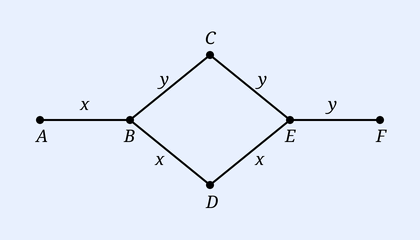
![Four bromide structures labelled (I), (II), (III), (IV). (I) is a bicyclo[2.2.2]octane bridgehead bromide with Br at a bridgehead carbon. (II) is a bicyclo[2.2.1]heptane (norbornyl) bridgehead bromide with Br at a bridgehead carbon. (III) is tert-butyl bromide: a central carbon bearing Br and three CH3 groups (drawn as lines). (IV) is a central carbon bearing Br, two phenyl (Ph) groups and one more alkyl group (diphenyl-substituted bromide).](/api/qna-image?path=QnA%2Fb65cda62-f924-480b-b4db-1d3aaa6069d4%2F5ef15551-aed6-4f93-a8d5-a219b7a5d19b%2F7947835e-f76c-44ed-80a1-930f42fcb030%2F7947835e-f76c-44ed-80a1-930f42fcb030%2Fimages%2FQ59_alkyl_bromides.webp)
JEE Main 2026 January 22, Shift 1 Question Paper with Solutions
All 75 questions from the JEE Main 2026 (January 22, Shift 1) shift — Physics (25), Chemistry (25) and Mathematics (25) — each with the correct answer (answer key) and a step-by-step solution. Read it free online, or attempt the full paper as a timed mock test.
Physics25 questions
Q26Single correctKinetic Theory of Gases
The volume of an ideal gas increases 8 times and temperature becomes of initial temperature during a reversible adiabatic change. If there is no exchange of heat in this process then identify the gas from the following options (Assuming the gases given in the options are ideal gases):
(1)
(2)
(3)
(4)
SolutionAnswer: Option 2
Approach:
Given a reversible adiabatic change with and and , the target is the ratio of specific heats , from which the degrees of freedom f and hence the gas are fixed. Apply the adiabatic relation .
Step 1:Equate the adiabatic invariant between the two states.
Step 2:Insert the given ratios and .
Step 3:Express both sides as powers of 2 and solve for .
Step 4:Relate to the degrees of freedom.
Step 5:Identify the monatomic gas among the options.
Final answer:
Q27Single correctRotational Motion
A solid sphere of mass 5 kg and radius 10 cm is kept in contact with another solid sphere of mass 10 kg and radius 20 cm. The moment of inertia of this pair of spheres about the tangent passing through the point of contact is ____ .
(1)
(2)
(3)
(4)
SolutionAnswer: Option 3
Approach:
Given two solid spheres (, ) and (, ) in contact, the target is the moment of inertia of the pair about the common tangent through the point of contact. This tangent line is tangent to each sphere, so the parallel-axis theorem applies to each.
Step 1:Each sphere's centre is a distance equal to its radius from the tangent line, so its tangent inertia is ; sum for both spheres.
Step 2:Substitute SI values.
Step 3:Evaluate the bracket and multiply.
Final answer:
Q28Single correctKinematics
A Projectile is thrown upward at an angle with the horizontal. The speed of the projectile is 20 m/s when its direction of motion is with the horizontal. The initial speed of the projectile is ------ m/s
(1)
(2)
(3)
(4)
SolutionAnswer: Option 4
Approach:
Given launch angle and a later instant where the speed is at to the horizontal, the target is the initial speed u. Gravity acts vertically, so the horizontal velocity component is conserved throughout the flight.
Step 1:Equate the horizontal velocity at launch and at the instant.
Step 2:Solve for .
Final answer:
Q29Single correctProperties of Solids and Liquids
Given below are two statements:
Statement I: Pressure of fluid is exerted only on a solid surface in contact as the fluid- Pressure does not exist everywhere in a still fluid .
Statement II: Excess potential energy of the molecules on the surface of a liquid. When compared to interior, results in surface tension.
In the light of the above statements, choose the correct answer from the options given below
Statement I: Pressure of fluid is exerted only on a solid surface in contact as the fluid- Pressure does not exist everywhere in a still fluid .
Statement II: Excess potential energy of the molecules on the surface of a liquid. When compared to interior, results in surface tension.
In the light of the above statements, choose the correct answer from the options given below
(1)
(2)
(3)
(4)
SolutionAnswer: Option 3Statement I is false but Statement II is true
Approach:
Each statement is evaluated against the physics of fluid pressure and the molecular origin of surface tension. The target is the truth value of each statement.
Step 1:Assess Statement I on fluid pressure.
Step 2:Assess Statement II on surface tension.
Step 3:Combine the two assessments.
Final answer: Statement I is false but Statement II is true
Q30Single correctUnits and Measurements
Match the LIST-I with LIST-II
| List -I | List-II |
|---|---|
| A. Spring constant | I. |
| B. Thermal conductivity | II. |
| C. Boltzmann constant | III. |
| D. Inductive reactance | IV. |
(1)
(2)
(3)
(4)
SolutionAnswer: Option 1A-II,B-IV,C-I,D-III
Approach:
Dimensions of each List-I quantity are obtained from its defining relation and matched to the List-II entries using base symbols .
Step 1:Spring constant from force per unit extension.
Step 2:Thermal conductivity from Fourier's law, with .
Step 3:Boltzmann constant from energy per unit temperature.
Step 4:Inductive reactance has the dimensions of resistance (voltage per current).
Final answer: A-II,B-IV,C-I,D-III
Q31Single correctProperties of Solids and Liquids
Rods x and y of equal dimensions but of different materials are joined as shown in figure, Temperatures of end points A and F are maintained at and respectively . Given the thermal conductivity of rod x is three times that of rod y, the temperature at junction points B and E (close to):
(1)
(2)
(3)
(4)
SolutionAnswer: Option 3 and respectively
Approach:
Given a network of equal-dimension rods with , end A at and end F at , the target is the steady-state temperatures at junctions B and E. Each rod is a thermal resistance ; for equal l and A, take rod x resistance and rod y resistance . From the figure, AB is x; the rhombus has upper path of two y rods and lower path of two x rods; EF is y.
Step 1:Assign resistances using so that rod x has the smaller resistance.
Step 2:Reduce the rhombus between B and E: upper branch C-path is , lower branch D-path is , in parallel.
Step 3:Combine the series chain with , , .
Step 4:Compute the heat current from the to ends.
Step 5:Find from the drop across AB.
Step 6:Find from the drop across the rhombus.
Final answer: and respectively
Q32Single correctAtoms and Nuclei
7.9 MeV -particle scatters from a target material of atomic number 79. From the given data the estimated diameter of nuclei of the target material is (approximately) ____m. [ and electron charge ]
(1)
(2)
(3)
(4)
SolutionAnswer: Option 2
Approach:
Given a -particle (charge 2e) approaching a nucleus of atomic number (charge Ze) head-on, the target is the distance of closest approach, taken as the estimated nuclear size. At closest approach the entire kinetic energy is stored as electrostatic potential energy.
Step 1:Solve the balance for the closest-approach distance.
Step 2:Convert the kinetic energy from MeV to joules.
Step 3:Evaluate the numerator .
Step 4:Divide by the kinetic energy.
Final answer:
Q33Single correctCurrent Electricity
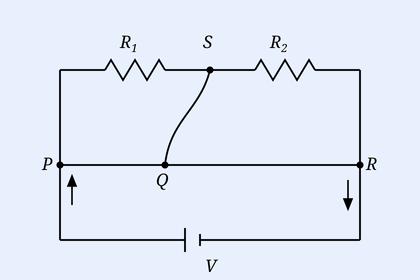
A meter bridge with two resistance and as shown in figure was balanced (null point) At from the point P. The null point changed to from the point P, when resistance is connected in parallel to . The values of resistances and are____
(1)
(2)
(3)
(4)
SolutionAnswer: Option 2
Approach:
Given a metre bridge balanced at from P, and rebalanced at after a resistor is placed in parallel with , the target is the pair . The balance condition equates the resistance ratio to the length ratio of the bridge wire.
Step 1:Apply the balance condition at .
Step 2:Apply the balance at with replaced by its parallel combination .
Step 3:Substitute and cancel .
Step 4:Solve for and then .
Final answer:
Q34Single correctGravitation
The escape velocity from a spherical planet A is 10 . The escape velocity from another planet B whose density and radius are 10% of those of planet A. is ____ m/s.
(1)
(2)
(3)
(4)
SolutionAnswer: Option 2
Approach:
Given and planet B with and , the target is . Express escape velocity through density and radius using .
Step 1:Form the ratio of escape velocities; the constant cancels.
Step 2:Insert and .
Step 3:Compute with .
Final answer:
Q35Single correctElectrostatics
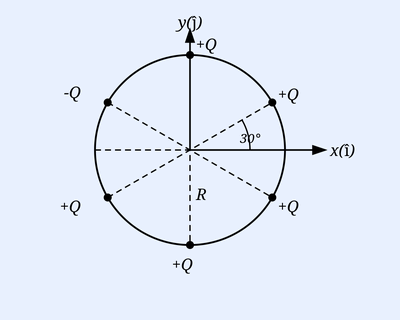
Six point charges are kept apart from each other on the circumference of a circle of radius R as shown in figure. The net electric field at the center of the circle is ____ . ( is permitivity of free space)
(1)
(2)
(3)
(4)
SolutionAnswer: Option 2
Approach:
Six charges sit apart on a circle of radius R. From the figure the angular positions (measured from , with the marked placing one at ) carry charges: at , at , at , at , at and at , i.e. five and a single . The target is the net field at the centre, found by superposition with the single-charge field .
Step 1:Six equal charges symmetrically placed apart give zero net field at the centre.
Step 2:Replace the at by . This equals removing one (adding its field) plus adding a (another its field): total times the field of a located at .
Step 3:Field at the centre from a at angle points from charge to centre, direction ; take .
Step 4:Multiply by to obtain the net field.
Final answer:
Q36Single correctElectromagnetic Induction and Alternating Currents
Three identical coils and are closely placed such that they share a common axis, is exactly midway. carries current I in anti-clockwise direction while carries current I in clockwise direction . An induced current flows though will be in clockwise direction when
(1)
(2)
(3)
(4)
SolutionAnswer: Option 2 moves towards and moves away from
Approach:
Three coaxial coils with midway; carries I anti-clockwise and carries I clockwise (viewed from the same side). The target is the relative motion that drives a clockwise induced current in . By Lenz's law the induced current opposes the change of net flux linking .
Step 1:Determine the flux sense each neighbour sends through . Viewed from toward , the anti-clockwise current of produces flux out of toward ; viewed from toward , the clockwise current of produces flux of the opposite sense.
Step 2:A clockwise induced current in (by the same viewing convention) must oppose an increase of the flux contributed in the sense, requiring that the flux due to rises while the opposing flux due to falls.
Step 3:Flux linkage strengthens as a coil approaches and weakens as it recedes.
Final answer: moves towards and moves away from
Q37Single correctAtoms and Nuclei
The minimum frequency of photon required to break a particle of mass 15.348 amu into particles is ____ kHz. [mass of He nucleus amu, 1amu kg, J.s and m/s]
(1)
(2)
(3)
(4)
SolutionAnswer: Option 3
Approach:
A particle of mass is split into four particles ( each). The minimum photon energy equals the mass-defect energy , and the minimum frequency follows from . The requested unit is kHz.
Step 1:Compute the mass defect and convert to kilograms.
Step 2:Find the threshold energy.
Step 3:Obtain the frequency in hertz.
Step 4:Convert to the requested kHz ().
Final answer:
Q38Single correctElectromagnetic Induction and Alternating Currents
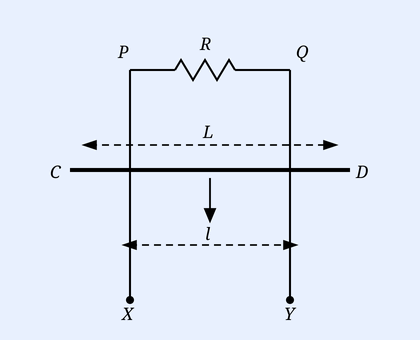
XPQY is a vertical smooth long loop having a total resistance of R where PX is parallel to QY and separation between them is l. A constant magnetic field B perpendicular to the plane of the loop exists in the entire space. A rod CD of length and mass m is made to slide down from rest under the gravity as shown in figure. The terminal speed acquired by the rod is ____
(1)
(2)
(3)
(4)
SolutionAnswer: Option 2
Approach:
A rod CD of length L slides down vertical rails of separation l () inside a uniform field B normal to the loop of total resistance R. The target is the terminal speed . Only the length l between the rails forms part of the closed circuit, so the active length for emf and force is l. At terminal speed gravity balances the magnetic retarding force.
Step 1:Write the induced current from the motional emf across the rail separation .
Step 2:Set the upward magnetic force equal to the weight at terminal speed (zero acceleration).
Step 3:Solve for the terminal speed.
Final answer:
Q39Single correctOptics
A thin convex lens of focal length 5 cm and a thin concave lens of focal length 4 cm are combined together (without any gap) and this combination has magnification when an object is placed 10 cm before the convex lens. Keeping the positions of convex lens and object undisturbed a gap of 1 cm is introduced between the lenses by moving the concave lens away. Which lead to a change in magnification of total lens system to . The value of is ____
(1)
(2)
(3)
(4)
SolutionAnswer: Option 3
Approach:
Given a convex lens cm and a concave lens cm, object distance cm from the convex lens. Target: , where is the magnification with the lenses in contact and is the magnification with a 1 cm gap. The in-contact case uses a combined focal length; the separated case is traced lens-by-lens with the convex image acting as object for the concave lens.
Step 1:Combine the focal lengths for the in-contact pair.
Step 2:Apply the lens equation to the combination with cm.
Step 3:Compute the in-contact magnification.
Step 4:Separated case: convex lens first, with cm and cm.
cm
Step 5:The image lies 10 cm right of the convex lens, hence 9 cm right of the concave lens placed 1 cm away, forming a virtual object at cm. Apply the lens equation to the concave lens.
Step 6:Compute the concave magnification and the overall separated magnification.
Step 7:Form the required ratio.
Final answer:
Q40Single correctGravitation
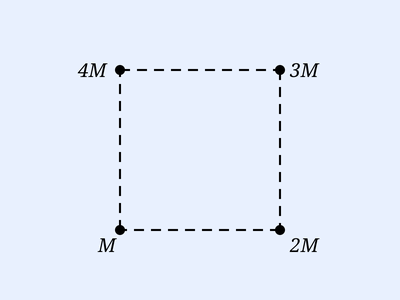
Net gravitational force at the center of a square is found to be when four particles having mass M,2M,3M and 4M are placed at the four corners of the square as shown in figure and it is when the positions of 3M and 4M are interchanged. The ratio is . The value of a is ____
(1)
(2)
(3)
(4)
SolutionAnswer: Option 2
Approach:
Given four masses at the corners of a square at equal distance from the centre. Each produces a force at the centre directed toward it; diagonally opposite masses act along the same line and partially cancel, and the two diagonal resultants are mutually perpendicular. Target: a where , comparing the original layout (4M, 3M, M, 2M) with the layout after 3M and 4M are swapped.
Step 1:Each mass contributes a force its mass since all corner distances are equal. Along one diagonal the net is the difference of the opposite masses; along the perpendicular diagonal likewise. Original: 4M opposite 2M, and 3M opposite M.
Step 2:After swapping 3M and 4M, the diagonal pairs become 3M opposite 2M and 4M opposite M.
Step 3:Form the ratio of the two resultants.
Step 4:Compare with the given form .
Final answer:
Q41Single correctOptics
Consider an equilateral prism A ray of light is incident on its one surface at a certain angle i. If the emergent ray is found to graze along the other surface then the angle of refraction at the incident surface is close to
(1)
(2)
(3)
(4)
SolutionAnswer: Option 3
Approach:
Given an equilateral prism with apex angle and refractive index . The emergent ray grazes the second face, so the ray meets that face exactly at the critical angle. Target: the refraction angle at the incident face, obtained from the prism relation .
Step 1:Grazing emergence corresponds to the ray hitting the second face at the critical angle. Compute it for .
Step 2:Apply the prism relation with .
Final answer:
Q42Single correctOscillations and Waves
A simple pendulum has a bob with mass m and charge q. The pendulum string has negligible mass. When a uniform and horizontal electric field E is applied. The tension in the string changes. The final tension in the string when pendulum attains an equilibrium position is ____ (g acceleration due to gravity)
(1)
(2)
(3)
(4)
SolutionAnswer: Option 1
Approach:
Given a charged bob (mass , charge ) in a horizontal uniform field , the bob experiences weight vertically down and electric force horizontally. At equilibrium the string lines up with the resultant of these two perpendicular forces, so the tension equals the magnitude of that resultant. Target: the equilibrium tension .
Step 1:Resolve the forces on the bob: weight acts vertically downward, the electric force acts horizontally, and these are mutually perpendicular.
Step 2:At equilibrium the string tension balances their resultant, so equals the resultant magnitude.
Final answer:
Q43Single correctElectrostatics
Electric field in a region is given by , where and . If the electric potential at a point (10,20) is , then the electric potential at origin is ____ V.
(1)
(2)
(3)
(4)
SolutionAnswer: Option 4
Approach:
Given with , , and V at . The potential difference equals minus the line integral of . Target: the potential at the origin, found by integrating each component along its axis.
Step 1:Evaluate the line integral from the origin to , taking the -leg then the -leg.
Step 2:Substitute and and integrate.
Step 3:Apply the potential relation with V.
Final answer:
Q44Single correctElectronic Devices
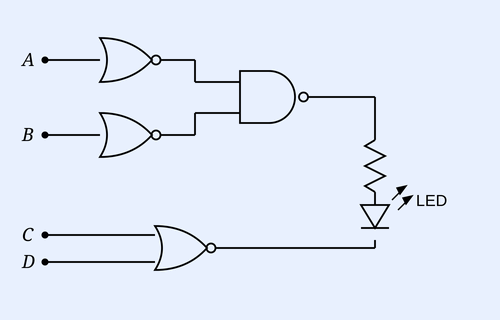
Find the correct combination of A,B,C and D inputs which can cause the LED to glow.
(1)
(2)
(3)
(4)
SolutionAnswer: Option 3
Approach:
Given a combinational network whose AND stages feed a final OR gate driving the LED, the LED glows when the OR output is logic 1, i.e. when at least one AND stage outputs 1. Target: the input pattern among the options that produces output 1. Each option is tested against the gate structure (an AND on , a stage on the middle inputs, an AND on , all into an OR).
Step 1:The final OR gate gives 1 if any feeding AND stage gives 1. The upper AND stage on inputs A,B outputs ; the lower AND stage on inputs C,D outputs .
Step 2:Test option 1, .
Step 3:Test the designated pattern ().
Step 4:The pattern drives the OR output high, so the LED conducts and glows.
Final answer:
Q45Single correctKinetic Theory of Gases
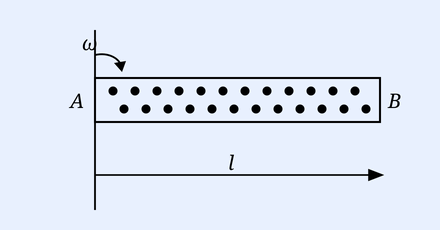
A cylindrical tube AB of length l, closed at both ends contains an ideal gas of 1 mol having molecular weight M. The tube is rotated in a horizontal plane with constant angular velocity about an axis perpendicular to AB and passing through the edge at end A as shown in the figure. If and are the pressures at A and B respectively. Then (Consider the temperature is same at all points in the tube)
(1)
(2)
(3)
(4)
SolutionAnswer: Option 1
Approach:
Given a closed tube of length l holding 1 mol of ideal gas (molar mass M) at uniform temperature T, rotated about a vertical axis through end A at angular velocity . In the rotating frame each gas element feels an outward centrifugal force; balancing the radial pressure gradient against this force and using the ideal-gas density gives a separable equation. Target: the relation between and .
Step 1:Substitute the ideal-gas density into the radial balance to obtain a separable equation in and .
Step 2:Integrate from A (, pressure ) to B (, pressure ).
Step 3:Exponentiate both sides.
Final answer:
Q46NumericalOscillations and Waves
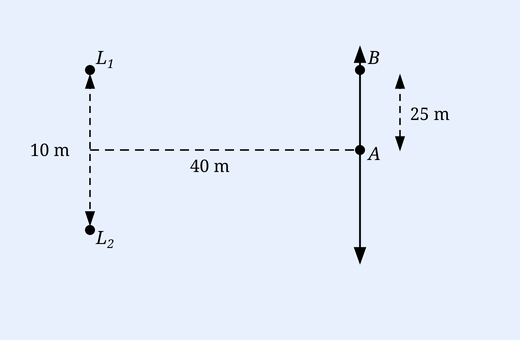
Two loudspeakers ( and ) are placed with a separation of 10 m. as shown in figure. Both speakers are fed with an audio input signal of same frequency with constant volume A voice recorder, initially at point A at equidistance to both loud speakers is moved by 25m along the line AB while monitoring the audio signal The measured signal was found to undergo 10 cycles of minima and maxima during the movement. The frequency of the input signal is ____ Hz (Speed of sound in air is 324 m/s and )
SolutionAnswer: 600
Approach:
Given two speakers separated by 10 m, the recorder starts at A equidistant from both (zero path difference) and moves 25 m along AB, recording 10 full maxima-minima cycles. Ten cycles correspond to the path difference increasing by . Using the geometry the path difference at B fixes and hence the frequency. Target: f in Hz, with m/s and .
Step 1:Set coordinates: , , , . Compute the two source-to-B distances.
Step 2:Compute the distance from to B.
m
Step 3:The path difference is zero at A and at B equals ; evaluate with .
m
Step 4:Equate the path difference to and solve for the wavelength.
m
Step 5:Compute the frequency from the wave relation.
Final answer:
Q47NumericalRotational Motion
A circular disc has radius and thickness . Another circular disc made of the same material has radius and thickness . If the moment of inertia of both discs are same and then . The value of is ____
SolutionAnswer: 16
Approach:
Given two discs of the same material with and equal moments of inertia about their central axes. Mass equals density times volume (), so for fixed . Equating the inertias relates the thicknesses. Target: where .
Step 1:Express the moment of inertia in terms of geometry and density.
Step 2:Equate the two inertias (same cancels).
Step 3:Substitute , i.e. .
Step 4:Match with .
Final answer:
Q48NumericalElectromagnetic Induction and Alternating Currents
Inductance of a coil with turns is 10 mH and it is connected to a dc source of 10 V with internal resistance of . The energy density in the inductor when the current reaches of its maximum value is . The value of is ____
SolutionAnswer: 20
Approach:
Given a coil ( turns, mH) on a 10 V dc source with internal resistance . The steady (maximum) current is ; treating the coil as a long solenoid, the interior field is with (length m so ), and the energy density is . Target: where the energy density at equals , with .
Step 1:Compute the maximum current and the turns per unit length.
Step 2:The current at the stated instant is A. Insert into the energy-density expression.
Step 3:Simplify the numerical factor: and .
Step 4:Match with .
Final answer:
Q49NumericalElectromagnetic Waves
The electric field of a plane electromagnetic wave, travelling in an unknown non-magnetic medium is given by . (where x,t and other values have S.I. units).The dielectric constant of the medium is ____ (Speed of light in free space is )
SolutionAnswer: 4
Approach:
Given a plane EM wave in a non-magnetic medium, the wave number is and angular frequency . The phase speed is , and for the dielectric constant is . Target: , with m/s.
Step 1:Read and k from the wave argument and compute the phase speed.
Step 2:For a non-magnetic medium , so .
Step 3:Square to obtain the dielectric constant.
Final answer:
Q50NumericalOptics
A parallel beam of light travelling in air (refractive index 1.0) is incident on a convex spherical glass surface of radius of curvature 50 cm. Refractive index of glass is 1.5. The rays converge to a point at a distance x cm from the centre of the curvature of the spherical surface . The value of x is ____ cm.
SolutionAnswer: 100
Approach:
Given a parallel beam in air () striking a convex spherical glass surface (, cm), refraction at a single spherical surface fixes the image (convergence) distance v from the surface for an object at infinity. The convergence point is then expressed relative to the centre of curvature. Target: x, the distance of the convergence point from the centre of curvature.
Step 1:Apply the surface relation with a parallel beam (, so ), , , cm.
Step 2:Solve for the image distance from the surface.
Step 3:The centre of curvature lies cm from the surface on the same side; subtract to locate the convergence point from it.
Final answer:
Chemistry25 questions
Q51Single correctSome Basic Principles of Organic Chemistry
As compared with chlorocyclohexane, which of the following statements correctly apply to chlorobenzene ?
A. The magnitude of negative charge is more on chlorine atom
B. The C-Cl bond has partial double bond character
C. bond is less polar
D. C-Cl bond is longer due to repulsion between delocalised electrons of the aromatic ring and lone pairs of electrons of chlorine.
E. The C-Cl bond is formed using hybridized orbital of carbon
Choose the correct answer from the options given below :
A. The magnitude of negative charge is more on chlorine atom
B. The C-Cl bond has partial double bond character
C. bond is less polar
D. C-Cl bond is longer due to repulsion between delocalised electrons of the aromatic ring and lone pairs of electrons of chlorine.
E. The C-Cl bond is formed using hybridized orbital of carbon
Choose the correct answer from the options given below :
(1)
(2)
(3)
(4)
SolutionAnswer: Option 3B, C and E Only
Approach:
Given two C–Cl bonds, one in chlorobenzene and one in chlorocyclohexane, the objective is to identify which statements (A–E) correctly describe chlorobenzene relative to chlorocyclohexane. The method is to apply resonance delocalisation of a chlorine lone pair into the aromatic ring and the sp2 geometry of the aromatic carbon.
Step 1:In chlorobenzene a lone pair on chlorine is conjugated with the ring, producing resonance structures in which the C–Cl bond carries partial double bond character. In chlorocyclohexane (sp3 carbon) no such conjugation exists, so the C–Cl bond is a pure single bond. Hence statement B applies to chlorobenzene.
Step 2:Delocalisation transfers electron density from chlorine into the ring, leaving a partial positive charge on chlorine. The chlorine therefore bears a smaller magnitude of negative charge than in chlorocyclohexane, so statement A (more negative charge on Cl) is false.
Step 3:Because chlorine's lone-pair density is partly drawn into the ring and the bonding carbon is sp2 (higher electronegativity, shorter bond), the dipole arising from the C–Cl bond is reduced. The C–Cl bond in chlorobenzene is therefore less polar than in chlorocyclohexane, so statement C applies.
Step 4:Partial double bond character shortens the C–Cl bond in chlorobenzene rather than lengthening it; statement D asserts a longer bond and a repulsion mechanism, both contrary to the shortening produced by resonance, so statement D is false.
Step 5:The ring carbon bonded to chlorine in chlorobenzene is part of the aromatic system and is sp2 hybridised, whereas in chlorocyclohexane it is sp3. Statement E (C–Cl formed using sp2 carbon orbital) therefore applies.
Final answer: B, C and E Only
Q52Single correctHydrocarbons
Given below are two statements :
**Statement I :** Benzene is nitrated to give nitrobenzene, which on further treatment with / will give
**Statement II :** group in a m-directing, and deactivating group
In the light of the above statements, choose the most appropriate answer from the options given below.
**Statement I :** Benzene is nitrated to give nitrobenzene, which on further treatment with / will give
**Statement II :** group in a m-directing, and deactivating group
In the light of the above statements, choose the most appropriate answer from the options given below.
(1)
(2)
(3)
(4)
SolutionAnswer: Option 2Statement I is incorrect but Statement II is correct
Approach:
Statement I claims that nitrobenzene reacts with / to give an acetyl-substituted nitrobenzene; Statement II classifies the nitro group as meta-directing and deactivating. The objective is to judge each statement using the rules of Friedel–Crafts acylation and the electronic nature of .
Step 1:The nitro group is a strong electron-withdrawing substituent that powerfully deactivates the aromatic ring. Friedel–Crafts acylation requires an activated (electron-rich) ring; it fails on rings bearing strongly deactivating groups such as , so nitrobenzene does not undergo acylation with /.
Step 2:Since the acyl-substituted product cannot form, the transformation depicted in Statement I is invalid; Statement I is incorrect.
Step 3:The nitro group withdraws electron density (–I and –R), deactivating the ring, and directs incoming electrophiles to the meta position because the ortho/para positions bear the greatest positive charge in the intermediate. Thus is meta-directing and deactivating; Statement II is correct.
Final answer: Statement I is incorrect but Statement II is correct
Q53Single correctEquilibrium
Given below are two statements:
Statement I : The Henry's law constant is constant with respect to variations in solution's concentration over the range for which the solution is ideally dilute.
Statement II : does not differ for the same solute in different solvents.
In the light of the above statements, choose the correct answer from the options given below
Statement I : The Henry's law constant is constant with respect to variations in solution's concentration over the range for which the solution is ideally dilute.
Statement II : does not differ for the same solute in different solvents.
In the light of the above statements, choose the correct answer from the options given below
(1)
(2)
(3)
(4)
SolutionAnswer: Option 1Statement I is true and Statement II are false
Approach:
Statement I asserts that the Henry's law constant is constant with concentration in the ideally dilute range; Statement II asserts that is the same for a given solute in different solvents. The objective is to test each against the definition and behaviour of .
Step 1:Henry's law states that the partial pressure of a volatile solute is proportional to its mole fraction in an ideally dilute solution, with proportionality constant . Within the dilute range where the law applies, does not vary with solute concentration; it is a fixed parameter for the given solute–solvent pair at a fixed temperature.
Step 2: measures the solute–solvent interaction, so it depends on the identity of the solvent. The same gas dissolved in different solvents has different values; for example, the of a gas in water differs from its in an organic solvent. Statement II (same in different solvents) is false.
Final answer: Statement I is true and Statement II are false
Q54Single correctSome Basic Concepts in Chemistry
In the reaction
(1)
(2)
(3)
(4)
SolutionAnswer: Option 411.2 L at STP is produced for every mole of HCl consumed
Approach:
Given the balanced equation , the objective is to find the statement consistent with the stoichiometric coefficients and the molar volume of a gas at STP. The method applies mole ratios and .
Step 1:From the coefficients, 2 mol Al give 3 mol , so 1 mol Al gives 1.5 mol . At STP this is 1.5 x 22.4 = 33.6 L, but only at STP. Option 1 (67.2 L) and option 3 (33.6 L regardless of T and P) are therefore wrong; gas volume depends on temperature and pressure.
Step 2:From the coefficients, 6 mol HCl give 3 mol , a 2:1 ratio in moles. At equal temperature and pressure, volume is proportional to moles, so the : volume ratio is also 2:1. For 6 L of produced, 12 L of HCl(g) would be consumed, but HCl here is aqueous, so a gas-volume ratio cannot be applied to it; option 2 is wrong.
Step 3:From 6 mol HCl giving 3 mol , 1 mol HCl gives 0.5 mol . At STP this corresponds to 0.5 x 22.4 = 11.2 L of for every mole of HCl consumed, matching option 4.
Final answer: 11.2 L at STP is produced for every mole of HCl consumed
Q55Single correctp-Block Elements
Given below are two statements
Statement-I : The halogen that makes longest bond with hydrogen in HX, has the smallest covalent radius in its group.
Statement-II : A group 15 elements hybride has the lowest boiling point among corresponding hybrids of other group 15 elements. The maximum covalency of that element E is 4
In the light of the above statements, choose the correct answer from the options given below
Statement-I : The halogen that makes longest bond with hydrogen in HX, has the smallest covalent radius in its group.
Statement-II : A group 15 elements hybride has the lowest boiling point among corresponding hybrids of other group 15 elements. The maximum covalency of that element E is 4
In the light of the above statements, choose the correct answer from the options given below
(1)
(2)
(3)
(4)
SolutionAnswer: Option 2Both Statement I and Statement II are false
Approach:
Statement I links the longest H–X bond to the smallest covalent radius in group 17; Statement II identifies the group-15 hydride with the lowest boiling point and gives the maximum covalency of E as 4. The objective is to test both against periodic trends.
Step 1:Bond length in HX increases as the halogen size increases: HF < HCl < HBr < HI. The longest H–X bond is in HI. Iodine, being the heaviest halogen, has the largest covalent radius in group 17, not the smallest. Statement I (longest bond pairing with smallest covalent radius) is therefore false.
Step 2:Among group-15 hydrides the boiling point order is PH3 < AsH3 < < SbH3: is raised by hydrogen bonding, SbH3 by its large molar mass, and PH3 is lowest. So the lowest-boiling hydride is PH3, identifying E as phosphorus.
Step 3:Phosphorus has accessible 3d orbitals and expands its octet, reaching a maximum covalency of 6, as in PF6- and /PCl6-. The claimed maximum covalency of 4 is too low, so the second part of Statement II is false, making Statement II false.
Final answer: Both Statement I and Statement II are false
Q56Single correctOrganic Compounds Containing Nitrogen
'A' is a neutral organic compound (M. F: ). On treatment with aqueous / , 'A' forms a compound 'B' which is soluble in dilute acid. 'B' on treatment with aqueous / produces a compound 'C' which on treatment with CuCN/ NaCN produces 'D' . Hydrolysis of 'D' produces 'E' which is also obtainable from the hydrolysis of 'A'. 'E' on treatment with acidified produces 'F'. 'F' contains two different types of hydrogen. The structure of 'A' is
(1)
(2)
(3)
(4)
SolutionAnswer: Option 12-methylbenzamide (o-toluamide): benzene ring with adjacent CH3 and CONH2 groups
Approach:
Given a neutral compound A () and the sequence A->B (aq. /), B->C (/HCl, 0–5 C), C->D (CuCN/NaCN), D->E (hydrolysis, also from A), E->F (acidified ), with the constraint that F has two different types of hydrogen, the objective is to identify the structure of A among the four toluamide isomers.
Step 1:A () is neutral with degree of unsaturation 5, consistent with a benzene ring plus a carbonyl: it is a methyl-substituted benzamide (). Treatment with aqueous and is the Hofmann bromamide degradation, which removes the carbonyl carbon and converts the amide to an amine with one fewer carbon, giving toluidine B (), which dissolves in dilute acid because the arylamine forms a soluble salt.
Step 2:B with /HCl at 0–5 C is diazotised to the diazonium salt C (). Treatment of C with CuCN/NaCN (Sandmeyer reaction) replaces the diazonium group by a nitrile to give D ().
Step 3:Hydrolysis of the nitrile D gives the carboxylic acid E (CH3-C6H4-COOH, a toluic acid). Hydrolysis of the amide A also gives the same acid CH3-C6H4-COOH, confirming the carboxyl and methyl substituents in A and E occupy the same two ring positions.
Step 4:Acidified oxidises the ring methyl group of E to a carboxyl group, converting toluic acid to a benzenedicarboxylic acid F (HOOC-C6H4-COOH). The number of distinct hydrogen environments in F fixes the isomer: only the ortho (phthalic) acid gives a ring whose aromatic hydrogens fall into two equivalent pairs, i.e. two different types of hydrogen, while the meta and para isomers give three and one type respectively.
Step 5:Since F must be the ortho diacid, the CH3 and the carboxyl-derived group in E (and hence the CH3 and CONH2 in A) are ortho to each other. Therefore A is 2-methylbenzamide (o-toluamide), the structure with adjacent CH3 and CONH2 groups, which is option 1.
Final answer: 2-methylbenzamide (o-toluamide): benzene ring with adjacent CH3 and CONH2 groups
Q57Single correctChemical Bonding and Molecular Structure
TWO p – block elements X and Y form fluorides of the type . The fluoride compound is a Lewis acid and is a Lewis base. The hybridizations of the central atoms of and respectively are
(1)
(2)
(3)
(4)
SolutionAnswer: Option 1 and
Approach:
Given two p-block elements forming fluorides EF3, with XF3 a Lewis acid and YF3 a Lewis base, the objective is to find the hybridisation of each central atom. The method links Lewis acid/base behaviour to the presence or absence of a lone pair and applies VSEPR to assign hybridisation.
Step 1:A Lewis acid accepts an electron pair, which requires an electron-deficient central atom with a vacant orbital and no lone pair. An EF3 of this type is a group-13 fluoride such as : boron has three bonding pairs and no lone pair, giving three electron domains, trigonal planar geometry, and sp2 hybridisation.
Step 2:A Lewis base donates an electron pair, which requires a lone pair on the central atom. An EF3 of this type is a group-15 fluoride such as NF3: nitrogen has three bonding pairs and one lone pair, giving four electron domains, pyramidal shape, and sp3 hybridisation.
Step 3:Combining the two, the hybridisations of the central atoms in the Lewis-acidic XF3 and the Lewis-basic YF3 are sp2 and sp3 respectively, which is option 1.
Final answer: and
Q58Single correctOrganic Compounds Containing Oxygen
Match the List-I with List – II
| List-I | List-II |
|---|---|
| A.. , KOH | I.. Tollen's Test |
| B.. | II.. Clemmensen Reduction |
| C.. Aq. , Sodium Potassium tartarate, KOH | III.. Wolff – Kishner Reduction |
| D.. ,HCl | IV.. Fehling's Test |
(1)
(2)
(3)
(4)
SolutionAnswer: Option 3A-III, B-I, C-IV, D-II
Approach:
List-I gives four reagent systems and List-II gives four named reactions of carbonyl compounds. The objective is to pair each reagent with the reaction it characterises, by recalling the defining reagents of each named test or reduction.
Step 1:Hydrazine with a strong base (NH2-NH2, KOH) reduces a carbonyl group to a methylene group through a hydrazone intermediate; this is the Wolff–Kishner reduction. Hence A pairs with III.
Step 2:The diamminesilver(I) hydroxide complex is Tollen's reagent; an aldehyde reduces it to a silver mirror. Hence B pairs with I.
Step 3:Aqueous CuSO4 complexed with sodium potassium tartrate in KOH is Fehling's reagent; an aliphatic aldehyde reduces the Cu(II) to a red Cu2O precipitate. Hence C pairs with IV.
Step 4:Zinc amalgam with concentrated HCl (Zn-Hg, HCl) reduces a carbonyl group to a methylene group under acidic conditions; this is the Clemmensen reduction. Hence D pairs with II.
Final answer: A-III, B-I, C-IV, D-II
Q59Single correctOrganic Compounds Containing Halogens
The correct order of the rate of reaction of the following reactants with nucleophile by mechanism is (Given : Structures I and II are rigid)
(1)
(2)
(3)
(4)
SolutionAnswer: Option 3II < I < III < IV
Approach:
Given four bromides reacting by an SN1 mechanism, the objective is to order their rates. Since the rate-determining step of SN1 is ionisation to a carbocation, the rate follows the stability of the carbocation each substrate forms. Structures I and II are rigid bicyclic bridgehead bromides.
Step 1:A carbocation prefers planar sp2 geometry. In a rigid bicyclic cage the bridgehead carbon is held in a pyramidal arrangement and cannot flatten (Bredt's rule), so bridgehead cations are highly destabilised and these substrates ionise extremely slowly. Both I and II are therefore the slowest.
Step 2:Between the two cages, the smaller, more strained bicyclo[2.2.1] (norbornyl, II) bridgehead resists planarisation even more than the larger, more flexible bicyclo[2.2.2]octyl (I) bridgehead. The larger cage relieves strain slightly better, so I ionises faster than II.
Step 3:tert-Butyl bromide (III) ionises to the tertiary carbocation (CH3)3C+, which is planar and hyperconjugatively stabilised, far more stable than either constrained bridgehead cation. So III reacts faster than I.
Step 4:The triphenyl-substituted bromide (IV, Ph3C-Br) ionises to the trityl cation Ph3C+, stabilised by resonance over three benzene rings, the most stable cation in the set. So IV reacts fastest.
Step 5:Chaining the comparisons II < I, I < III, III < IV gives the full order II < I < III < IV, which is option 3.
Final answer: II < I < III < IV
Q60Single correctOrganic Compounds Containing Oxygen
Given below are two statements :
Statement I : Phenol on treatment with / aq.KOH under refluxing condition, followed by acidification produces p- hydroxy benzaldehyde as the major product and o-ohydroxy benzaldehyde as the minor product.
Statement II : The mixture of p-hydroxybenzaldehyde and o- hydroxybenzaldehyde can be easily separated through steam distillation.
In the light of the above statements, choose the correct answer from the options given below.
Statement I : Phenol on treatment with / aq.KOH under refluxing condition, followed by acidification produces p- hydroxy benzaldehyde as the major product and o-ohydroxy benzaldehyde as the minor product.
Statement II : The mixture of p-hydroxybenzaldehyde and o- hydroxybenzaldehyde can be easily separated through steam distillation.
In the light of the above statements, choose the correct answer from the options given below.
(1)
(2)
(3)
(4)
SolutionAnswer: Option 4Both Statement I and Statement II are true
Approach:
Statement I describes the Reimer–Tiemann product distribution (para major, ortho minor) and Statement II claims the ortho/para mixture is separable by steam distillation. The objective is to judge both using the mechanism of the Reimer–Tiemann reaction and the hydrogen-bonding behaviour of the products.
Step 1:Phenol with CHCl3 and aqueous KOH generates dichlorocarbene, which attacks the phenoxide ring to introduce a -CHO group; acidification gives hydroxybenzaldehydes (the Reimer–Tiemann reaction). With the bulky K+ counterion solvating the ortho phenoxide oxygen, the steric environment directs the carbene preferentially to the para position, so p-hydroxybenzaldehyde is the major and o-hydroxybenzaldehyde the minor product. Statement I is correct.
Step 2:In o-hydroxybenzaldehyde the -OH and -CHO are adjacent and form an intramolecular hydrogen bond (chelation), lowering its association and making it volatile in steam. In p-hydroxybenzaldehyde the groups are too far apart for intramolecular bonding, so it engages in intermolecular hydrogen bonding and is non-volatile. The ortho isomer therefore steam-distills over while the para isomer remains, so the mixture is separable by steam distillation. Statement II is correct.
Final answer: Both Statement I and Statement II are true
Q61Single correctChemical Bonding and Molecular Structure
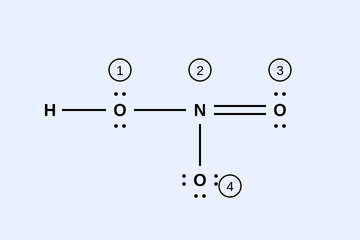
The formal charges on the atoms marked as (1) to (4) in the Lewis representation of molecule respectively are
(1)
(2)
(3)
(4)
SolutionAnswer: Option 30, + 1, 0, -1
Approach:
Given the Lewis structure H-O(1)-N(2)=O(3) with the nitrogen also single-bonded down to O(4) bearing three lone pairs, the objective is the formal charge on atoms 1–4. The method applies , where V is valence electrons, N is non-bonding electrons, and B is bonding electrons.
Step 1:Atom 1 is the oxygen bonded to H and N by two single bonds and carrying two lone pairs. V = 6, N = 4, B = 4 (two single bonds). FC = 6 - 4 - 1/2(4) = 0.
Step 2:Atom 2 is nitrogen with no lone pair: one single bond to O(1), one single bond to O(4), and one double bond to O(3), i.e. four bonds (8 bonding electrons). V = 5, N = 0, B = 8. FC = 5 - 0 - 1/2(8) = +1.
Step 3:Atom 3 is the doubly bonded oxygen with two lone pairs. V = 6, N = 4, B = 4 (one double bond). FC = 6 - 4 - 1/2(4) = 0.
Step 4:Atom 4 is the singly bonded oxygen carrying three lone pairs. V = 6, N = 6, B = 2 (one single bond). FC = 6 - 6 - 1/2(2) = -1.
Final answer: 0, + 1, 0, -1
Q62Single correctAtomic Structure
The energy required by electrons, present in the first Bohr orbit of hydrogen atom to be excited to second Bohr orbit is _______ J mo Given : ergs
(1)
(2)
(3)
(4)
SolutionAnswer: Option 1
Approach:
Given erg, the objective is the energy per mole to excite an electron from the n=1 to the n=2 Bohr orbit of hydrogen. The method computes the per-atom transition energy from the Rydberg expression, converts the unit from erg to joule, and scales by Avogadro's number.
Step 1:Convert the Rydberg energy from erg to joule using 1 erg = J: = 2.18 x erg = 2.18 x J.
Step 2:Apply the transition energy for = 1 to = 2: the bracket is 1/1 - 1/4 = 3/4. Hence per atom dE = 2.18e-18 x (3/4) = 1.635 x J.
Step 3:The question asks for energy per mole, so multiply the per-atom energy by Avogadro's number = 6.022 x .
Final answer:
Q63Single correctChemical Kinetics
product (First order reaction)
Three sets of experiment were performed for a reaction under similar experimental conditions :
Run 1 100 mL of 10 M solution of reactant A
Run 2 200 mL of 10 M solution of reactant A
Run 3 100 mL of 10 M solution of reactant A + 100 mL of added.
The correct variation of rate of reaction is
Three sets of experiment were performed for a reaction under similar experimental conditions :
Run 1 100 mL of 10 M solution of reactant A
Run 2 200 mL of 10 M solution of reactant A
Run 3 100 mL of 10 M solution of reactant A + 100 mL of added.
The correct variation of rate of reaction is
(1)
(2)
(3)
(4)
SolutionAnswer: Option 2Run 3 < Run 1 = Run 2
Approach:
For the first-order reaction A -> product, the rate is r = k[A]. Three runs differ in volume and dilution: Run 1 is 100 mL of 10 M A, Run 2 is 200 mL of 10 M A, Run 3 is 100 mL of 10 M A diluted with 100 mL water. The objective is to rank the rate of reaction, an intensive quantity that depends only on concentration.
Step 1:Determine the concentration of A in each run. Run 1: 10 M. Run 2: still 10 M (taking more of the same solution does not change concentration). Run 3: 100 mL of 10 M diluted to a total of 200 mL gives [A] = 10 x 100 / 200 = 5 M.
Step 2:The rate of a reaction r = k[A] is an intensive property; under identical conditions k is the same, so r depends only on [A] and not on the volume or total amount taken. Run 1 and Run 2 share the same 10 M concentration, so their rates are equal.
Step 3:Run 3 has half the concentration (5 M), so its rate is half that of Run 1 and Run 2 and is the smallest. Combining, Run 3 < Run 1 = Run 2.
Final answer: Run 3 < Run 1 = Run 2
Q64Single correctCoordination Compounds
A first row transition metal (M) does not liberate gas from dilute HCl. 1 mol of aqueous solution of is treated with excess of aqueous KCN and then is passed through the solution. The amount of MS (metal sulphide) formed from the above reaction is _______ mol
(1)
(2)
(3)
(4)
SolutionAnswer: Option 20
Approach:
Given: a first-row transition metal M whose 1 mol is treated with excess KCN, then saturated with (g). Target: moles of MS precipitate. Identify M from the clue that it does not liberate from dilute HCl, form its cyanide complex, and test whether free metal ion remains for sulphide precipitation.
Step 1:A first-row transition metal that does not displace hydrogen from dilute HCl lies below hydrogen in the activity series, i.e. it has a positive standard reduction potential. Copper ( = +0.34 V) satisfies this, so M is copper and is .
Step 2: with excess is first reduced to ( oxidised to cyanogen) and the is captured as the very stable tetracyanocuprate(I) complex.
Step 3:The dissociation constant of [Cu(CN)4]3- is extremely small, so the free Cu+ concentration is too low for the ionic product to exceed the solubility product of Cu2S. Hence H2S produces no metal sulphide precipitate.
Step 4:Therefore the amount of metal sulphide formed is zero.
Final answer: 0
Q65Single correctCoordination Compounds
Consider the transition metal ions and and all form low spin octahedral complexes. The correct decreasing order of unpaired electrons in their respective d-orbitals of the complexes is
(1)
(2)
(3)
(4)
SolutionAnswer: Option 4
Approach:
Given: , , , , all forming low-spin octahedral complexes. Target: decreasing order of unpaired electrons. Determine each d-electron count, fill the t2g/eg sets under strong-field (low-spin) splitting, and count unpaired electrons.
Step 1: has the configuration d3. The first three electrons occupy the three t2g orbitals singly, giving 3 unpaired electrons.
Step 2: has the configuration d4. In the low-spin case the fourth electron pairs within t2g rather than entering eg, leaving 2 unpaired electrons.
Step 3: has the configuration d5. Low-spin filling pairs electrons in t2g until five occupy it, leaving 1 unpaired electron.
Step 4: has the configuration d6. Low-spin filling completely fills t2g, leaving 0 unpaired electrons. The unpaired counts are (3) > (2) > (1) > (0).
Final answer:
Q66Single correctOrganic Compounds Containing Halogens
The correct order of reactivity of in methanol with the following nucleophiles is and
(1)
(2)
(3)
(4)
SolutionAnswer: Option 2
Approach:
Given: CH3Br reacting in methanol (a protic solvent) with the nucleophiles F-, I-, C2H5O- and C6H5O-. Target: order of reactivity. Rank the species by nucleophilicity in a protic solvent, where polarisability and degree of solvation control the halides, and basicity differentiates the two oxygen anions.
Step 1:In a protic solvent, small anions form strong hydrogen bonds and are heavily solvated, lowering their nucleophilicity, while large, polarisable anions are weakly solvated. Among the halides, iodide is the most polarisable and least solvated (strongest), and fluoride is the smallest and most solvated (weakest).
Step 2:Comparing the two oxygen nucleophiles, ethoxide is the conjugate base of a weak alcohol and is strongly basic, whereas phenoxide is resonance-stabilised over the ring and is far less basic. Greater basicity and charge localisation make ethoxide the better nucleophile.
Step 3:Both alkoxide and phenoxide, being charge-localised oxygen bases, are stronger nucleophiles than the heavily solvated fluoride but weaker than the large polarisable iodide. Combining the rankings gives the full order.
Final answer:
Q67Single correctClassification of Elements and Periodicity in Properties
A 'p' block element (E) and hydrogen form a binary cation , while on treatment with in alkaline medium gives a precipitate of basic mercury (II) amido – iodine. Given below are first ionisation enthalpy values (kJ mo) for first element each from group 13, 14, 15 and 16. Identify the correct first ionisation enthalpy value for element E.
(1)
(2)
(3)
(4)
SolutionAnswer: Option 31402
Approach:
Given: p-block element E forms the cation (EH4)+, and EH3 with K2HgI4 in alkaline medium gives the basic mercury(II) amido-iodide; first ionisation enthalpies for the first members of groups 13, 14, 15, 16. Target: IE1 of E. Identify EH3 from the qualitative test, fix E, then choose its ionisation enthalpy.
Step 1:K2HgI4 in alkaline medium is Nessler's reagent, whose characteristic positive test (a brown precipitate of the basic mercury(II) amido-iodide) is given by ammonia. Thus EH3 is and the cation (EH4)+ is , identifying E as nitrogen of group 15.
Step 2:The first members of groups 13, 14, 15 and 16 are B, C, N and O. Their first ionisation enthalpies are 801, 1086, 1402 and 1314 kJ mol-1 respectively; nitrogen's is the largest because its half-filled 2p3 configuration is extra stable, exceeding even oxygen.
Step 3:Therefore the first ionisation enthalpy of E (nitrogen) is 1402 kJ mol-1.
Final answer: 1402
Q68Single correctBiomolecules
Given below are two statements :
Statement I : Sucrose is dextrorotatory. However, sucrose upon hydrolysis gives a solution having mixture of products. This solution shows laevorotation.
Statement II : Hydrolysis of sucrose gives glucose and fructose. Since the laevorotation of glucose is more than the dextrorotation of fructose, the resulting solution becomes laevorotatory.
In the light of the above statements, choose the correct answer from the options given below.
Statement I : Sucrose is dextrorotatory. However, sucrose upon hydrolysis gives a solution having mixture of products. This solution shows laevorotation.
Statement II : Hydrolysis of sucrose gives glucose and fructose. Since the laevorotation of glucose is more than the dextrorotation of fructose, the resulting solution becomes laevorotatory.
In the light of the above statements, choose the correct answer from the options given below.
(1)
(2)
(3)
(4)
SolutionAnswer: Option 2Statement I true but Statement II is false
Approach:
Given: Statement I (sucrose is dextrorotatory; its hydrolysis mixture is laevorotatory) and Statement II (the laevorotation of glucose exceeds the dextrorotation of fructose). Target: judge each statement's truth. Use the specific rotations of sucrose, glucose and fructose and identify which product controls the sign of the net rotation.
Step 1:Sucrose has a positive specific rotation, so it is dextrorotatory. Acidic or enzymatic hydrolysis (inversion) cleaves it into equimolar glucose and fructose, and the product solution is laevorotatory. Statement I is therefore true.
Step 2:Glucose is dextrorotatory with specific rotation +52.5 degrees, and fructose is laevorotatory with specific rotation -92 degrees. The magnitude for fructose exceeds that for glucose, so the net rotation is negative because of fructose, not glucose.
Step 3:Statement II asserts that glucose is laevorotatory and outweighs fructose; in reality glucose is dextrorotatory and fructose provides the dominant laevorotation. Statement II is therefore false.
Final answer: Statement I true but Statement II is false
Q69Single correctChemical Thermodynamics
Match the List-I with List – II
| List-I (Thermodynamic Process) | List-II (Magnitude in kJ) |
|---|---|
| A.. Work done in reversible, isothermal expansion of 2 mol of ideal gas from 2 d to 20 d at 300 K | I.. 4 |
| B.. Work done in irreversible isothermal expansion of 1 mol ideal gas from 1 to 3 at 300 K against a constant pressure of 3kPa | II.. 11.5 |
| C.. Change in internal energy for adiabatic expansion of 1 mol ideal gas with change of temperature = 320 K and | III.. 6 |
| D.. Change in enthalpy at constant pressure of 1 mol ideal gas with change of temperature = 337 K and | IV.. 7 |
(1)
(2)
(3)
(4)
SolutionAnswer: Option 1A-II, B-III, C-I, D-IV
Approach:
Given four thermodynamic quantities A-D with their data, and List-II magnitudes 4, 11.5, 6, 7 kJ. Target: match each. Compute each quantity with its proper expression and pair it with the corresponding magnitude.
Step 1:A: reversible isothermal expansion of 2 mol from 2 to 20 dm3 at 300 K. The volume ratio is 10, so = 1, and the magnitude is 2.303 x 2 x 8.314 x 300 x 1 = 11486 J, i.e. about 11.5 kJ.
Step 2:B: irreversible expansion of 1 mol from 1 m3 to 3 m3 against a constant 3 kPa. The work magnitude is 3000 Pa x (3 - 1) m3 = 6000 J = 6 kJ.
Step 3:C: adiabatic expansion, dU = n Cv dT with n = 1, Cv = (3/2)R, dT = 320 K. dU = 1 x 1.5 x 8.314 x 320 = 3991 J, about 4 kJ.
Step 4:D: constant-pressure heating, dH = n Cp dT with n = 1, Cp = (5/2)R, dT = 337 K. dH = 1 x 2.5 x 8.314 x 337 = 7005 J, about 7 kJ. The matches are A-II, B-III, C-I, D-IV.
Final answer: A-II, B-III, C-I, D-IV
Q70Single correctEquilibrium
Consider a solution dissolved in water in a closed container. Which one of the following plots correctly represents variation of log (partial pressure of in vapour phase above water) [y-axis] with log (mole fraction of in water) [x-axis] at C ?
(1)
(2)
(3)
(4)
SolutionAnswer: Option 2Straight line of positive slope (1) with positive y-intercept (log )
Approach:
Given: (g) dissolved in water in equilibrium with vapour at 25 C. Target: the plot of log(partial pressure of ) versus log(mole fraction of in water). Apply Henry's law and linearise it logarithmically to find the slope and intercept.
Step 1:For a sparingly soluble gas at equilibrium, Henry's law states that the partial pressure of above the solution is directly proportional to its mole fraction in water, with proportionality constant KH (a large positive number for in water).
Step 2:Taking base-10 logarithms of both sides gives a linear relation between the logarithms, with slope +1 and intercept log KH.
Step 3:A slope of +1 (positive, rising line) and a positive intercept log KH (the line meets the y-axis above the origin) describe a straight line of positive slope cutting the positive y-axis.
Final answer: Straight line of positive slope (1) with a positive y-intercept equal to
Q71NumericalRedox Reactions and Electrochemistry
Consider the following electrochemical cell at 298 K If the reaction quotient at a given time is , then the cell EMF is _______ V (Nearest integer). Given the standard half – cell reduction potential as and
SolutionAnswer: 4
Approach:
Given: the alkaline cell at 298 K with reaction quotient Q = , and standard reduction potentials = -0.44 V (right electrode) and = -0.90 V (left electrode). Target: Ecell as integer x in x x V. Determine E0cell, balance the cell to fix n, then apply the Nernst equation.
Step 1:The right electrode (, higher potential -0.44 V) is the cathode and the left electrode (, -0.90 V) is the anode. The standard cell potential is the cathode minus the anode value.
Step 2:At the anode tin is oxidised from +2 to +4, releasing 2 electrons: . At the cathode each bismuth is reduced from +3 to 0, and takes up 6 electrons: . Balancing electrons multiplies the anode by 3, so the overall cell transfers n = 6 electrons.
Step 3:Apply the Nernst equation with Q = and n = 6. The logarithmic term is (0.06/6) x = 0.01 x 6 = 0.06 V.
Step 4:Expressing 0.40 V in the requested form gives 4 x V, so the integer is 4.
Final answer: 4
Q72NumericalChemical Thermodynamics
Dissociation of a gas takes place according to the following chemical reaction. At equilibrium, the total pressure is 1 bar at 300 K. The standard Gibbs energy of formation of the involved substances has been provided below :
Substance | |
| -100.00 |
A | -50.832 |
The degree of dissociation of (g) given by where x = _______ (Nearest integer ) [Given : R = 8 J mo, log 2 = 0.3010, log 3 = 0.48] Assume degree of dissociation is not negligible
Substance | |
| -100.00 |
A | -50.832 |
The degree of dissociation of (g) given by where x = _______ (Nearest integer ) [Given : R = 8 J mo, log 2 = 0.3010, log 3 = 0.48] Assume degree of dissociation is not negligible
SolutionAnswer: 33
Approach:
Given: (g) <=> 2A(g) at 300 K with total pressure 1 bar, dGf() = -100.00 and dGf(A) = -50.832 kJ/mol, R = 8 J/mol/K, log2 = 0.3010, log3 = 0.48. Target: x in = . Find the reaction Gibbs energy, convert to Kp, relate Kp to at P = 1 bar, and solve.
Step 1:The standard reaction Gibbs energy is twice the formation value of A minus that of .
Step 2:Substitute into dG = -2.303 R T log Kp with R = 8, T = 300. The factor 2.303 x 8 x 300 = 5527.2, so log Kp = 1664/5527.2 = 0.3010 = log 2.
Step 3:For <=> 2A starting from 1 mol with degree of dissociation , the total moles are (1 + ) and the mole fractions give Kp = 4 P / (1 - ). With P = 1 bar and Kp = 2, set 4 /(1 - ) = 2.
Step 4:Cross-multiplying: 4 = 2(1 - ) = 2 - 2 , hence 6 = 2, so = 1/3 = 0.3333 = 33.33 x . Comparing with = gives x = 33.33, nearest integer 33.
Final answer: 33
Q73NumericalPurification and Characterisation of Organic Compounds
The cycloalkene (X) on bromination consumes one mole of bromine per mole of (X) and gives the product (Y) in which C:Br ratio is 3 : 1. The percentage of bromine in the product (Y) is _______ % (Nearest integer) (Given : molar mass in g mo H:1, C : 12, O : 16, Br : 80)
SolutionAnswer: 66
Approach:
Given: cycloalkene X adds one mole of per mole to give product Y with C:Br = 3:1. Target: mass percentage of Br in Y. Use the atom ratio with the two Br atoms added to fix the molecular formula of Y, then compute the bromine mass fraction.
Step 1:Addition of one mole of across the C=C double bond introduces 2 bromine atoms per molecule. Since the C:Br ratio in Y is 3:1, the number of carbons is 3 x 2 = 6. A cycloalkene of 6 carbons (cyclohexene) thus gives a dibromide with 6 C and 2 Br.
Step 2:Saturating cyclohexene () with gives 1,2-dibromocyclohexane, . Its molar mass is the sum of carbon, hydrogen and bromine masses.
Step 3:The bromine mass in one mole is 160 g out of 242 g, so the percentage is 160/242 x 100 = 66.11 %, nearest integer 66.
Final answer: 66
Q74NumericalChemical Kinetics
The temperature at which rate constants of the given below two gaseous reactions become equal is _______ K (Nearest integer) Given : ln 10 = 2.303
SolutionAnswer: 1303
Approach:
Given: = and = , with ln 10 = 2.303. Target: temperature T at which = . Equate the two expressions, take natural logarithms, and solve for T.
Step 1:Set the two rate constants equal.
Step 2:Take natural logarithms of both sides, using = 6 ln10 and = 4 ln10.
Step 3:Group like terms: 2 ln10 = (30000 - 24000)/T = 6000/T.
Step 4:Substitute ln 10 = 2.303 and solve: T = 6000/(2 x 2.303) = 6000/4.606 = 1302.6, nearest integer 1303 K.
Final answer: 1303
Q75NumericalPrinciples Related to Practical Chemistry
Sodium fusion extract of an organic compound (Y) with CHC and chlorine water gives violet colour to the CHC layer. 0.15 g of (Y) gave 0.12 g of the silver halie precipitate in Carius method. Percentage of halogen in the compound (Y) is _______ (Nearest integer) (Given : molar mass g mo C: 12, H : 1, Cl : 35.5, Br : 80, I : 127)
SolutionAnswer: 43
Approach:
Given: sodium fusion extract of Y with CHCl3 and chlorine water turns the CHCl3 layer violet; 0.15 g of Y gives 0.12 g of silver halide in the Carius method. Target: mass percentage of halogen in Y. Identify the halogen from the colour test, then use the Carius mass relation between the silver halide and the halogen.
Step 1:Chlorine water oxidises iodide in the extract to iodine, which dissolves in chloroform to give a violet colour. The violet CHCl3 layer therefore identifies the halogen as iodine, and the Carius precipitate is silver iodide.
Step 2:The molar mass of AgI is the silver mass plus the iodine mass; the iodine mass fraction in AgI is 127/235.
Step 3:The 0.12 g of AgI contains (127/235) x 0.12 g of iodine; dividing by the 0.15 g sample and multiplying by 100 gives the percentage.
Step 4:The percentage of iodine is 43.23 %, nearest integer 43.
Final answer: 43
Mathematics25 questions
Q1Single correctStatistics and Probability
Two distinct numbers and are selected at random from . The probability, that their product is divisible by , is
(1)
(2)
(3)
(4)
SolutionAnswer: Option 1
Approach:
Given the set , two distinct numbers a,b are drawn; the target is . Count the total unordered pairs, then use complementary counting on the pairs whose product carries no factor of 3.
Step 1:Count all ways of choosing two distinct numbers from the 50 available.
Step 2:Among to the multiples of are , totalling 16; the remaining numbers are not divisible by .
Step 3:The product fails to be divisible by exactly when neither factor is a multiple of ; count such pairs.
Step 4:Subtract from the total to obtain the favourable pairs.
Step 5:Form the required probability.
Final answer:
Q2Single correctDifferential Equations
Let the solution curve of the differential equation , , ; be . Then is equal to
(1)
(2)
(3)
(4)
SolutionAnswer: Option 3
Approach:
Given with and , the target is . The equation is homogeneous of degree one, so the substitution separates the variables.
Step 1:Solve the original relation for the derivative.
Step 2:Substitute and cancel the common term.
Step 3:Separate and integrate both sides.
Step 4:Replace and clear denominators to obtain the general solution.
Step 5:Apply to determine the constant.
Step 6:Isolate the radical and square to remove it.
Step 7:Divide by (valid since ) and evaluate at .
Final answer:
Q3Single correctIntegral Calculus
The value of , where denotes the greatest integer function, is
(1)
(2)
(3)
(4)
SolutionAnswer: Option 2
Approach:
The integrand is piecewise constant because [x] is constant on each unit interval. Partition at the integers it contains and sum the constant pieces.
Step 1:Since and , the sub-intervals and values of are: with ; with ; with ; with .
respectively
Step 2:Write the integral as the sum of constant integrand times sub-interval length.
Step 3:Collect the -dependent and the constant contributions.
Step 4:Combine over the common denominator .
Step 5:Factor out of the numerator.
Final answer:
Q4Single correctThree Dimensional Geometry
Let be the point on the line at distance from the point and nearer to the origin. Then the shortest distance, between the line and , is equal to
(1)
(2)
(3)
(4)
SolutionAnswer: Option 4
Approach:
Parametrize the first line, impose the distance from to fix the parameter, select the point nearer the origin as , then apply the skew-line shortest-distance formula to the two lines as written.
Step 1:Write the point on the first line as and impose the distance from .
Step 2:The two candidate points are with norm and with norm; the nearer to the origin is the latter.
Step 3:Identify the two lines: line passes through with direction ; line 2, written as , passes through with direction .
Step 4:Compute the cross product of the direction vectors.
Step 5:Form the joining vector and the scalar triple product.
Step 6:Divide the magnitude of the triple product by the magnitude of the cross product.
Final answer:
Q5Single correctLimit, Continuity and Differentiability
Let , and the minimum value of the function f(x) in the interval be . Then n is equal to
(1)
(2)
(3)
(4)
SolutionAnswer: Option 3
Approach:
Given on , the target is n where the minimum value equals . Locate the interior stationary point via , evaluate f there using the substitution , and match the prescribed form.
Step 1:Differentiate and factor the derivative.
Step 2:Set the non-trivial factor to zero for the interior critical point in .
Step 3:Express f through since and .
Step 4:Factor the common power.
Step 5:Rewrite as times a single base power and compare with .
Final answer:
Q6Single correctComplex Numbers and Quadratic Equations
The number of distinct real solutions of the equation is
(1)
(2)
(3)
(4)
SolutionAnswer: Option 1
Approach:
Given , the target is the count of distinct real roots. The moduli change sign at and ; split the real line into three intervals, solve each resulting quadratic, and retain only roots lying inside their defining interval.
Step 1:For both and , so and .
Step 2:Test the two roots against : qualifies while does not.
Step 3:For , and .
Step 4:For , and .
Step 5:Total the admissible roots across the three intervals.
Final answer:
Q7Single correctBinomial Theorem and its Simple Applications
The coefficient of in is equal to
(1)
(2)
(3)
(4)
SolutionAnswer: Option 3
Approach:
Let ; the target is the coefficient of . Apply the multiply-by- and subtract technique to collapse the arithmetic-geometric series into a closed form, then read off the coefficient.
Step 1:Write and , then subtract to form as a geometric series minus the last term.
Step 2:Solve for in closed form.
Step 3:The first fraction's coefficient equals the coefficient of ; the linear term contributes nothing to .
Step 4:The second fraction's coefficient equals times the coefficient of .
Step 5:Add the two contributions.
Final answer:
Q8Single correctThree Dimensional Geometry
If the image of the points in the line is , then is equal to
(1)
(2)
(3)
(4)
SolutionAnswer: Option 2
Approach:
Given with image in the line , the target is . Use that the midpoint of P and Q lies on the line and that is perpendicular to the line direction.
Step 1:Rewrite the line with a consistent direction; gives direction through , and the parametric point is .
Step 2:The midpoint lies on the line; matching the x-coordinate fixes the parameter.
Step 3:Match the and coordinates of with the parametric point at .
Step 4:Impose perpendicularity of to .
Step 5:Solve with .
Step 6:Compute the sum of squares.
Final answer:
Q9Single correctSets, Relations and Functions
Let relation R on the set be given by . Then the minimum number of elements required to be added in R, in order to make the relation symmetric, is equal to
(1)
(2)
(3)
(4)
SolutionAnswer: Option 3
Approach:
Given and , the target is the minimum number of ordered pairs to adjoin so that R becomes symmetric. List the members of R, then count non-diagonal pairs whose reverse is absent.
Step 1:From , is an integer only when , i.e. , giving .
Step 2:Retain only pairs with both entries in M; gives and is discarded.
Step 3:Check each pair for its reverse: is its own reverse; needs ; needs .
Step 4:The minimum additions equal the number of missing reverses.
Final answer:
Q10Single correctCo-ordinate Geometry
If the line , where , does not meet the hyperbola , then a possible value of is
(1)
(2)
(3)
(4)
SolutionAnswer: Option 4
Approach:
Given the line and the hyperbola , the line misses the hyperbola when their simultaneous equations have no real solution. Substitute, form a quadratic in x, and require a negative discriminant.
Step 1:Solve the line for and substitute into .
Step 2:Expand to a quadratic in .
Step 3:Compute the discriminant.
Step 4:Require for no real intersection.
Step 5:Compare the choices with the threshold.
, while
Final answer:
Q11Single correctLimit, Continuity and Differentiability
If the domain of the function is , then is equal to
(1)
(2)
(3)
(4)
SolutionAnswer: Option 4
Approach:
Given , the target is for the domain . Find the inverse-sine domain by a rational inequality, the logarithm domain by positivity and the exclusion , then intersect.
Step 1:Impose the upper bound , which rearranges to , satisfied for or .
Step 2:Impose the lower bound , which rearranges to , satisfied for or .
Step 3:Intersect the two inverse-sine conditions.
Step 4:Apply the logarithm constraints: and .
Step 5:Intersect both domains.
Step 6:Evaluate the required expression.
Final answer:
Q12Single correctIntegral Calculus
Let the line divided the area of the region in the ratio m:n, . Then is equal to
(1)
(2)
(3)
(4)
SolutionAnswer: Option 4
Approach:
Given the region bounded by the parabola below and the line above, the line splits it in ratio m:n with ; the target is . Find the intersection abscissae, integrate the vertical gap on the left piece and on the whole region, then reduce the ratio.
Step 1:Find where the bounding curves meet.
Step 2:The vertical gap of the region is .
Step 3:Integrate from to for the piece left of the dividing line.
Step 4:Integrate over the whole region from to .
Step 5:The right piece is the remainder; form and reduce the ratio.
Step 6:Add the reduced parts.
Final answer:
Q13Single correctVector Algebra
Let and . Let the projection of the vector on the diagonal of the parallelogram ABCD be of length one unit. If , where , be the roots of equation then is equal to
(1)
(2)
(3)
(4)
SolutionAnswer: Option 2
Approach:
Given , and with the projection of on the diagonal of length one, the target is for the roots of . Form , impose the unit projection to solve for , then solve the quadratic.
Step 1:Add the adjacent sides to obtain the diagonal.
Step 2:Compute the dot product and magnitude needed for the projection.
Step 3:Set the projection length to one and square.
Step 4:The terms cancel, leaving a linear equation.
Step 5:Substitute into the quadratic and solve.
Step 6:With , assign , and evaluate.
Final answer:
Q14Single correctSequence and Series
If the sum of the first term of an A.P. is and the sum of its first six terms is , then the sum of its first twelve terms is
(1)
(2)
(3)
(4)
SolutionAnswer: Option 4
Approach:
Given an A.P. with first term a and common difference d, the data fixes the sum of the first four terms as and the sum of the first six terms as . The target is . Translate both conditions into linear equations in a and d, solve, then evaluate .
Step 1:Write and using the sum formula.
Step 2:Multiply by and subtract from to eliminate .
Step 3:Substitute into to find a.
Step 4:Evaluate with the found a and d.
Final answer:
Q15Single correctStatistics and Probability
If random variable x has the probability distribution
x | | | | | | | |
P(x) | | | k | | | | |
Then is equal to
x | | | | | | | |
P(x) | | | k | | | | |
Then is equal to
(1)
(2)
(3)
(4)
SolutionAnswer: Option 2
Approach:
Given the probability distribution of x in terms of a parameter k, the total-probability condition fixes k. The target collects the probabilities of .
Step 1:Add all listed probabilities and set the sum equal to .
Step 2:Factor the quadratic and keep the root giving valid probabilities.
Step 3:Sum the probabilities for the outcomes lying in .
Step 4:Substitute .
Final answer:
Q16Single correctCo-ordinate Geometry
If the set of all values of r, for which the circle and intersect at two distinct points be the interval . Then is equal to
(1)
(2)
(3)
(4)
SolutionAnswer: Option 2
Approach:
Two circles intersect at two distinct points when the distance d between their centres satisfies . Identify the centres and radii, compute d, form the interval for r, then evaluate .
Step 1:The first circle has centre and radius r.
Step 2:For , read , giving centre and radius .
Step 3:Compute the distance between the two centres.
Step 4:Apply the two-distinct-intersection condition , which yields .
Step 5:Multiply the endpoints using the difference of squares.
Final answer:
Q17Single correctCo-ordinate Geometry
If the chord joining the points and on the parabola subtends a right angle at the vertex of the parabola, then is equal to
(1)
(2)
(3)
(4)
SolutionAnswer: Option 4
Approach:
Represent the two points on in parametric form. The chord subtending a right angle at the vertex (origin) forces a relation between the parameters . Express through and evaluate.
Step 1:Comparing with gives , so and a point is .
Step 2:The slope of the line from the vertex to is ; perpendicularity at the vertex gives the product .
Step 3:Form the required combination using .
Step 4:Substitute .
Final answer:
Q18Single correctTrigonometry
The number of solutions of , where , equal to
(1)
(2)
(3)
(4)
SolutionAnswer: Option 1
Approach:
On the interval the product , so the inverse-tangent sum formula applies directly. Combine the terms, take the tangent of both sides to obtain a quadratic in x, then count the roots lying in the interval and respecting the positive right-hand side.
Step 1:Combine the two inverse tangents with .
Step 2:Take the tangent of both sides, using .
Step 3:Cross-multiply and rearrange into a quadratic.
Step 4:Solve with the discriminant .
Step 5:Compare with the interval ; only lies inside, while is outside and would also make the left side negative, contradicting .
Final answer:
Q19Single correctMatrices and Determinants
If then the determinant of the matrix is
(1)
(2)
(3)
(4)
SolutionAnswer: Option 3
Approach:
Factor the common power out of , leaving . Using multiplicativity of the determinant and , the answer reduces to .
Step 1:Factor the expression and record .
Step 2:Compute .
Step 3:Form .
Step 4:Take the determinant; the factor contributes .
Final answer:
Q20Single correctIntegral Calculus
Let be a differentiable function if . For all , then the value of is
(1)
(2)
(3)
(4)
SolutionAnswer: Option 3
Approach:
Differentiate the relation with the Leibniz rule to obtain a first-order linear differential equation in f. Solve it, fix the constant from the relation evaluated at , then compute .
Step 1:Differentiate both sides with respect to .
Step 2:Divide by and rewrite as the derivative of .
Step 3:Integrate to obtain the general solution.
Step 4:Evaluate the original relation at , where the integral vanishes, to fix .
Step 5:Compute the required difference.
Final answer:
Q21NumericalComplex Numbers and Quadratic Equations
Let and , . If , Then m is
SolutionAnswer: 49
Approach:
The numbers and are the non-real cube roots of unity and , satisfying , and . Reduce each bracket and combine, exploiting .
Step 1:Identify with and .
Step 2:The fourth bracket collapses using .
Step 3:Let be the third bracket. Then the first and second brackets are and respectively (using ).
Step 4:Combine the first three twentieth powers; and , so .
Step 5:Only the fourth power survives; equate to .
Final answer:
Q22NumericalMatrices and Determinants
Let A be a matrix such that . If , and , where are nonnegative integers, then is equal to
SolutionAnswer: 18
Approach:
The condition makes A a skew-symmetric matrix, so its non-zero entries are determined by the two given matrix-vector products. Build A, compute , then apply the identities and to evaluate , and factor into prime powers.
Step 1:Skew-symmetry forces . The conditions and fix the entries.
Step 2:Form and compute its determinant.
Step 3:Let . Then , and scaling by gives .
Step 4:Take the adjugate determinant of this matrix: square its determinant.
Step 5:Factor and collect prime powers.
Step 6:Add the exponents.
Final answer:
Q23NumericalPermutations and Combinations
Let ABC be a triangle. Consider four points on the side AB, five points on the side BC and four points on the side AC, None of these points is a vertex of the triangle ABC. Then the total number of pentagons, that can be formed by taking all the vertices from the points , is
SolutionAnswer: 660
Approach:
A pentagon needs of the points placed so that no chosen points are collinear (three or more points from the same side are collinear and cannot all be polygon vertices). Sides AB, BC, AC carry , 5, points, so at most may be taken from any side; the only split of with each part is across the three sides. Sum the three placements of the lone single.
Step 1:Choose from , from , from .
Step 2:Choose from , from , from .
Step 3:Choose from , from , from .
Step 4:Add the three mutually exclusive cases.
Final answer:
Q24NumericalTrigonometry
If , where , then is equal to
SolutionAnswer: 4
Approach:
Apply to the numerator and to the denominator, evaluate the standard angles, and substitute the exact values of and to write the ratio in the form .
Step 1:Transform the numerator with and the denominator with .
Step 2:Use , so they cancel, leaving the ratio .
Step 3:Substitute and .
Step 4:Rationalize by multiplying numerator and denominator by , then reduce.
Step 5:Match with ; since and are linearly independent over the rationals, .
Final answer:
Q25NumericalIntegral Calculus
If , where and are positive integers with for and C is the constant of integration, then is equal to
SolutionAnswer: 16
Approach:
Rewrite the integrand using and , substitute so , reduce to , integrate term by term, convert back through , and read off each reduced coefficient .
Step 1:Write the integrand as and substitute , using and .
Step 2:Expand and divide by .
Step 3:Integrate each power.
Step 4:Convert via , so , etc., yielding the four coefficients in lowest terms.
Step 5:Form the required quantity.
Final answer:
More JEE Main 2026 papers
- JEE Main 2026 — April 02, Shift 1
- JEE Main 2026 — April 02, Shift 2
- JEE Main 2026 — April 04, Shift 1
- JEE Main 2026 — April 04, Shift 2
- JEE Main 2026 — April 05, Shift 1
- JEE Main 2026 — April 05, Shift 2
- JEE Main 2026 — April 06, Shift 1
- JEE Main 2026 — April 06, Shift 2
- JEE Main 2026 — April 08, Shift 2
- JEE Main 2026 — January 21, Shift 1
- JEE Main 2026 — January 21, Shift 2
- JEE Main 2026 — January 22, Shift 2
- JEE Main 2026 — January 23, Shift 1
- JEE Main 2026 — January 23, Shift 2
- JEE Main 2026 — January 24, Shift 1
- JEE Main 2026 — January 24, Shift 2
- JEE Main 2026 — January 28, Shift 1
- JEE Main 2026 — January 28, Shift 2
Frequently Asked Questions
How many questions are in the JEE Main 2026 January 22, Shift 1 paper?
The JEE Main 2026 January 22, Shift 1 paper has 75 questions — Physics (25), Chemistry (25) and Mathematics (25). Every question is on this page with its correct answer and a step-by-step solution.
What is the marking scheme for JEE Main?
JEE Main awards +4 marks for each correct answer and −1 for a wrong answer, with 0 for questions left unattempted. The paper covers Physics, Chemistry and Mathematics.
Are the answer key and step-by-step solutions provided for the 2026 January 22, Shift 1 paper?
Yes — every question shows the correct answer (answer key) and a detailed step-by-step solution, free to read online.
Can I take the JEE Main 2026 January 22, Shift 1 paper as a timed mock test?
Yes. With a free JEEnify account you can attempt this exact paper as a timed test in the real exam interface, then see your score and weak-area analysis.
Solved this paper? Calculate your JEE Main scoremost important chaptersformula sheetsall free tools.